To Stay In The Land: Investing In The Ten Commandments

When Moses addressed the Israelites in Parashat Vaetchanan, standing on the threshold of the Promised Land, his message was clear and urgent: Keep the commandments and you will live; abandon them and you will be driven from the land.

“You must observe His rules and His commandments that I am commanding you today, so that it may go well with you and your children after you, and so that you may endure in the land that God, your God, is giving to you forever.”

Deuteronomy 4:40

It wasn’t a political warning. It wasn’t about borders, treaties, or weapons. It was spiritual. Covenantal. National.

He reminded them: God didn’t choose you because you were many or mighty. He chose you because He loved you. And what does God ask in return? Not sacrifices, not empty rituals, but love expressed through loyalty. Loyalty shown in deeds—by keeping His commandments and walking in His ways.

That covenant stands today.

Amid a global spike in antisemitism, war in Israel, and growing divides between Jews in Israel and the Diaspora as well as secular and religious Jews in Israel, it’s time to return to the constitutional core of Jewish life: the Ten Commandments.

There are 613 commandments in the Torah, but these ten were spoken directly by God to the entire nation at Sinai. They were repeated again by Moses in Deuteronomy for a reason. They are not just laws—they are foundations.

If we want to stay in the Land we must invest in them.

Here are ten national action items for Israeli and Diaspora Jews alike to bring the Aseret HaDibrot back to life:

1. “I am the Lord your God” — Reclaim Faith

In Israel: Integrate emunah (faith) into national identity, not just religion. Teach the purpose of Jewish existence in the IDF, sherut leumi, and public schools.

In the Diaspora: Strengthen Jewish schools and programs that teach belief as something deeper than ethnicity or culture. Anchor identity in divine purpose.

The Shema prayer is in this parsha, a prayer to be read aloud with concentration. Let each session of the Knesset and Jewish  day schools begin with that first sentence.

2. No Other Gods — Confront Idolatry

In Israel: Take on modern idols—power, tech, money. Demand spiritual accountability from the startup- scaleup nation.

In the Diaspora: Counter the worship of celebrity and culture with Jewish meaning and humility. Lead with Jewish ethics, not trendiness.

Focus on Humble Faith to moderate the human tendency to exaggerate our worth and blind us to God’s gifts.

3. Do Not Take God’s Name in Vain — Elevate Speech

In Israel: Clean up public discourse. Hold politicians, rabbis, and influencers accountable for words that desecrate God’s name.

In the Diaspora: Promote reverence and honesty in all Jewish communication—online, in media, and in leadership.

We all carry a global megaphone with us at all times of the day. Beware of proclamations and defamations made in the name of Judaism.

4. Keep the Sabbath — Build National Unity

In Israel: The Haredi community must not sit out the war. They must serve through sherut leumi by helping others keep Shabbat—cooking meals, opening homes, dancing in the streets. Make Shabbat the shared joy of the nation.

In the Diaspora: Host Shabbat for unaffiliated Jews. Create communal spaces that let people taste sacred time—no judgment, just joy.

Jews have the special opportunity to show each other and the world the special nature of Shabbat. Make it holy for you and your family. From there, let it spread outward to the community, country and civilization.

5. Honor Your Father and Mother — Care for the Elderly

In Israel: Train Israeli youth in elder care. It’s a disgrace that our Holocaust survivors and parents are mostly cared for by foreign workers.

In the Diaspora: Create teen-elder programs that pass down memory and dignity. Jewish continuity depends on honoring the past.

Modern psychology has taught many of us to center our being on ourselves and blame parents for our situations. Even – or especially – if that’s true, spend time showing honor to parents and in-laws. It is a pathway for a healthy society.

6. Do Not Murder — Value All Life

In Israel: Try to end domestic violence and youth crime. Reclaim the sanctity of life as a national value, not just a slogan.

In the Diaspora: Jews must lead on mental health and abortion, the leading causes of preventable death.

Every life is a world. Whether one is in favor or opposed to abortion, treat life with the utmost respect and engage in debates that are centered on life.

7. Do Not Commit Adultery — Strengthen Families

In Israel: Fund pre-marriage education and family counseling. Healthy families are the front line of Jewish survival.

In the Diaspora: Promote Jewish relationships and marriage through values-based education—not just dating apps.

Reorient Friday night dinners away from invited company for two Sabbaths every month to focus on personal relationships.

8. Do Not Steal — Demand Integrity

In Israel: Tackle corruption. Ethical leadership is not optional in a holy land.

In the Diaspora: Teach financial and business ethics as part of Torah. Kiddush Hashem starts in the workplace.

At an early age, allow children to reserve certain toys for personal use as opposed to sharing with friends; it allows them to incorporate the idea of ownership and space both for themselves and others.

9. Do Not Bear False Witness — Seek Truth

In Israel: End the plague of slander and fake news in politics and media. Truth is a national security issue.

In the Diaspora: Speak with compassion and accuracy. Lashon hara is poison. Truth builds communities.

10. Do Not Covet — Practice Gratitude

In Israel: Reduce economic resentment by promoting gratitude and generosity. Envy destroys unity.

In the Diaspora: Celebrate others’ success. Give, volunteer, and stop keeping score.

Being truly grateful involves the public declaration of appreciation: to God in prayer, and fellow person in thanks. It centers the interplay between ourselves and the world in a healthy dynamic.

Conclusion: Choose Life

Moses didn’t say this for nothing. The land doesn’t tolerate injustice, idolatry, or apathy. If we want to remain in Eretz Yisrael, we must remember what kept us from here: the first tablets were shattered on diaspora rocks and we wandered in the desert for failing to believe in God’s gift.

We must also remember what brought us to the land: God’s love—and a call to respond in kind.

The Ten Commandments are not old laws. They are today’s mission.

The Old City of Jerusalem including the Jewish Temple Mount/ Al Aqsa Compound

Lanternflies and the Spread of Antisemitism

From nowhere they came — and now they’re everywhere. The spotted lanternfly, with its colorful delicate wings and destructive path, has infested the American landscape. It’s believed to have originated from China and, in just a few years, has spread across states, devastating crops and trees like the “tree of heaven,” its favorite host. The government seems incapable of containing it. Few natural predators exist. The infestation has become a symbol of bureaucratic failure and public resignation.

Spotted lanternfly

But some wonder: does this pestilence reflect something deeper, more corrosive — a cultural infestation?

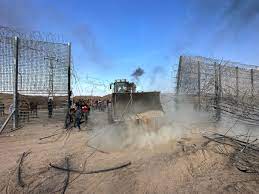
In the wake of October 7, when thousands of Gazans crossed into Israel in a massacre they proudly broadcast around the world, antisemitism in America, Canada and Australia exploded. Synagogues were vandalized. Jewish cars were firebombed. Campus protests called for a “global intifada.” And the institutions tasked with standing guard — universities, governments, media — offered excuses, silence, or, worse, justifications.

Many point again to China, not just for the lanternfly, but for feeding antisemitism into western culture, especially through TikTok — a powerful delivery system for ideological poison. Others blame Qatar, which has poured billions into American universities that now shelter hatred under the guise of “free speech.” The Gaza war may have triggered the firestorm, but the kindling was laid long ago — through foreign influence, academic corruption, legal systems reluctant to confront hate when it wears the right colors and intersectional culture intent on vanishing Jews.

The response has been toothless. Protesters shut down airports and bridges with impunity. Cities release vandals hours after they’re arrested. Politicians decry antisemitism in speeches while voting to defund the very police tasked with protecting vulnerable communities. Universities who once claimed to be safe spaces now protect the mob instead of the beleaguered minority.

Like the lanternfly, antisemitism has become endemic. And just as officials tell us to stomp on the bugs as a civic duty, people now post videos taking down “protest” signs and washing off graffiti — not to eradicate the hate, but to vent helplessness.

We’ve reached a tipping point. Many have chosen to watch the wave rather than swim against it.

But Jews are not trees. Unlike the “tree of heaven,” the Jews have a history of moving, surviving, rebuilding. As America shrugs at the firebombs and broken windows, and as elected leaders dismiss Jewish fear as overreaction, a quiet migration begins. New York, Toronto, and Melbourne may look the same in ten years — but they will feel different. Not because the skyline will change, but because of the absence. The absence of a people whose presence once animated these places with faith, culture, and conscience.

Vienna was no longer Vienna after the Jews were rounded up and slaughtered, and French leaders know that France will no longer really be French if Jewish frustration and fear makes them move. But America has no such institutional memory. And as Americans elect younger and more inexperienced radical politicians, the destruction will accelerate.

Jews were forced to wear distinctive clothing in the Middle Ages and in Nazi Germany, and were tattooed in concentration camps before the annihilation was manifest. But it’s the moral corruption of the cities themselves that marks Jews for extinction; black sooty mold as the lanternflies feast and kill.

The last Jews will be those who see fellow Jews’ fears as fantasies, constellations drawn from a few distinct points like ancient mariners and pagans lost in heavenly thoughts. Perhaps those survivors will be the only Jews the West wants anyway: hearty crops which withstood the plague may have more in common with the new natural order.

Progressive Jews as the New Apostles

A friend recently attended a Shabbat dinner in New York City and came away shaken by the politics. Somewhere between the challah and the halva, she realized that nearly everyone at the table planned to vote for Zohran Mamdani for mayor. The same Democratic Socialist Mamdani who whitewashes slogans like “Globalize the Intifada,” who supports defunding the police, who has floated ideas about taxing “white neighborhoods” and redistributing wealth based on racial and ideological lines.

She was dumbfounded. How could fellow Jews support someone so openly hostile to the Jewish state, so enamored with radical ideologies, and so completely without experience?

Poll showing a majority of non-Orthodox and younger Jews supporting Zohran Mamdani

I pointed her to the recent conversation between Peter Beinart and Jon Stewart on The Daily Show. Two progressive Jews—one secular (Stewart), the other traditional (Beinart)—discussed Beinart’s new book Being Jewish After the Destruction of Gaza: A Reckoning. The 18-minute segment is deeply revealing. The entire interview should be watched here, but allow me to share some essential lessons—before and after viewing—that help explain why so many Jews, especially young urban progressives, are drawn to voices like Mamdani and Beinart.


Lesson 1: Empathy Above All

To understand the progressive worldview, you must begin with its North Star: empathy.

Numerous studies (one in Israel, from Pew Research and the Cato Institute) have shown that liberal parents prioritize teaching their children empathy far more than rules or tradition. In contrast, conservative parents emphasize justice, law, and the preservation of custom (hence more prevalent among Orthodox and older Jews.)

This foundational difference creates radically divergent outlooks on society. A progressive might prefer to risk letting many guilty people roam free than to wrongly incarcerate one innocent person. A conservative accepts that, tragically, some mistakes happen but that a functioning justice system must deliver accountability and deterrence.

That lens helps understand how different people see the Hamas War from Gaza. The progressive Jewish instinct is not to ask how such barbarism could happen on October 7, but to imagine what life must feel like under Israeli rule, or how starvation affects a child in Khan Younis.

So when Hamas raped and tortured Israelis, when they slaughtered entire families and burned babies alive, Stewart and Beinart give it a passing nod… then quickly pivot to the suffering of Palestinians in Gaza, who—in their view—are the true victims, regardless of what many of them supported or elected.

Lesson 2: Virtue Signaling as Moral Currency

Empathy doesn’t just sit as a value; it becomes a performance.

Among progressive Jews, virtue signaling is a sort of social currency. The more you publicly condemn your “privilege,” the more you highlight your efforts to engage the suffering, and the more elevated you become to your audience.

Beinart models this in the interview. He talks about how well his family is doing, how comfortable his life is in New York, and then contrasts that by expressing concern for Gazans. The clear message: Look how aware I am of my privilege, and how much I care about the “Other.” He is not just the model of progressive Jewry, but a self-anointed saint of Tikkun Olam, “repairing the world.”

But this empathy becomes hollow when it’s divorced from context. Where is his concern for the Israeli mothers whose sons are still buried beneath Gaza? Where is the recognition that Gazans elected Hamas and would do so again today? Where is the acknowledgment that Israel lives under constant threat from genocidal neighbors, that Israeli civilians are routinely targeted, and that Hamas has vowed to repeat October 7 “again and again”?

This isn’t empathy—it’s performative pity, practiced in the safety of a Manhattan studio. And it is toxic.

Peter Beinart and Jon Stewart on The Daily Show

The Problem of Projection

Beinart and Stewart approach Israel through the lens of American liberalism. They treat it as if it should behave like the U.S.—a country of immigrants with separation of church and state, with no ethnic identity at its core. A massive country with only two neighbors, each of which is no threat.

But Israel was not created to be an echo of America. It is the reestablished homeland of the Jewish people, in a region dominated by theocratic regimes. It’s not just a democracy—it’s an ethnic democracy, forged out of centuries of persecution and built in response to repeated extermination campaigns. It is a small country surrounded by hostile neighbors with ever-present security threats.

Israel cannot survive if it mimics U.S. norms. It has different rules because IT IS DIFFERENT and faces existential threats the U.S. does not. Yet Beinart and Stewart project their own experiences as comfortable, wealthy New York Jews onto a situation they cannot fully grasp—and then fault Israelis for not aligning with their fantasy of liberalism. It is an impossible liberal standard in the Middle East, and they fault the Jewish State for coming up short.


Progressive Jews Are Winning the Narrative—But At What Cost?

Beinart wants to be the prophet of the next generation of Jews—disillusioned, skeptical of Israel, obsessed with universal empathy. He’s the aspiring Grand Rebbe of Tikkun Olam. Stewart plays the court jester to the progressive tribe on his popular show, delivering cathartic lines that avoid hard truths.

Together, they are shaping a Jewish worldview in which Israel is an embarrassment to be shunned, and October 7 is a short footnote to be ignored. The primary directive is to lead with empathy, which is always directed away from oneself, and towards those perceived as underdogs. Whether those weaker individuals intend to do harm can ideally be rationalized. Better still, the AsAJew credentials provide a get-out-of-jail free card, absolving the sin and sinner by the highest authorities. If Hamas cannot or will not change, then Jewish victims must forgive the wicked party, grant their wishes, and risk their lives again as the pathway towards peace and coexistence. They are modern-day Jesuses delivering the sermon on the Mount – via cable TV.

That’s why voting for someone like Mamdani doesn’t feel like a betrayal—it feels like moral progress ensconced in a Jewish-like religion. Accept abuse as the toxic cleanse of particularism and embrace the abuser in the spiritual bath of universalism.

In the name of empathy, they abandon solidarity. In the name of justice, they ignore murder. In the name of virtue, they vote for those who vilify their own.

That’s not progressive. That’s perverse.


Final Thoughts

People should have empathy for children suffering. Every child is inherently innocent, born and raised as a product of their environment. But understand that for twenty-five years – a generation – two-thirds of Gazans have wanted to see Jewish civilians in Israel murdered. Gaza’s children have been victims for a long time, of a perverse society.

“Being Jewish after Gaza,” for progressives is a swamp of guilt, seeing Gaza as a killing field by right-wing Israeli Islamophobes. For conservatives, “after Gaza” means freedom, recognizing Gaza as a terrorist enclave steeped in a profound moral “deformity.” Both may have elements of truth, but neither side can imagine the validity of the other.

In the Middle East, progressive like Peter Beinart see Jews as supremacists. In New York, progressives like teacher union boss Randi Weingarten see city Jews as the “ownership class,” and WESPAC’s Howard Horowitz visualizes Jewish Zionists as racists. These progressives portray Jews around the world as rich, capitalist victimizers who cannot claim the mantle of victimhood, even after the October 7 massacre.

They are teaching young, progressive and non-Orthodox Jews to lead with select and projected empathy. In New York City, they can create a manifest destiny with votes for the alt-left, far more tangible than prancing with placards about something thousands of miles away.

Young New York Jews are picking up the “intifada” chant – Arabic for “shaking off” – of the Jewish State and pro-Israel Jews. At this moment, they may not recognize the jihad they have joined. Time will tell whether they will care when it inevitably turns violent on the most persecuted minority-minority.

And that’s how the show is supposed to end anyway, right? Jesus on the cross. But the epilogue has a pivot, seeking empathy-squared: Jesus was a Jew. Now the Jews are Jesus.

The grand rebbes of Tikkun Olam are the new apostles for Zohran Mamdani.

Related:

The Empathy Swamp (January 2024)

Anti-Semites Don’t Ride In Cattle Cars (September 2022)

When Only Republicans Trust the Police (July 2018)

The United Nations’ Adoption of Palestinians, Enables It to Only Find Fault With Israel (March 2016)

Why WESPAC?

When IsraelAnalysis.com first reported an act of anti-Israel vandalism on the streets of White Plains, it pointed to the possibility of WESPAC—a long-standing left-wing activist group with a record of anti-Israel rhetoric—as being behind the hate-fueled attack. While no individual has been arrested or charged, the suspicion is not without reason. The question arises: why WESPAC?

Let’s start with timing. The graffiti appeared around 5:00 p.m. on the Ninth of Av, the somber Jewish fast day that mourns the destruction of the First and Second Temples in Jerusalem. WESPAC planned a “urgent vigil for the children of Gaza” at the same time the next day in Peekskill. That city lies further north in Westchester, while many of WESPAC’s most vocal “activists” live in southern Westchester, including White Plains. “Solidarity” for these comrades in southern Westchester may have brought them out on a sunny Sunday.

WESPAC ad for a vigil for Gaza in northern Westchester

Moreover, the vandalized site itself—a street decorated with American and Israeli flags—was an obvious magnet for anti-Israel agitators. What better canvas for those hoping to make a statement on a Jewish day of mourning than one visually celebrating the very state they protest?

But the context runs deeper.

WESPAC has long used the veneer of social justice to cloak its deeply anti-Israel agenda. In neighboring Hartsdale, the group confronted Jews filled with virulent anti-Israel rhetoric. And the current chair of WESPAC, Howard Horowitz, isn’t just a local—he’s a paradoxical figure leading the Israel Action Committee at Temple Israel of New Rochelle, even while aligning publicly with radical anti-Zionist groups like Jewish Voice for Peace (JVP) and IfNotNow.

Horowitz’s own writings are telling. He lashed out at Jewish residents of New Rochelle who had the temerity to run for school board seats, accusing them—and by extension the broader Jewish community—of racism against people of color. He has taken aim at “the vast majority [who] repeat the “I stand with Israel” declarations, disregarding the horrific facts on the ground” in Gaza, making the banner-lined street in White Plains a perfect target for his vitriol. He further believes that such pro-Israel proclamation “denigrates the Jewish tragedies” like the Ninth of Av, making the fast day an appropriate moment to attack Israel supporters.

Horowitz makes no bones about mocking Jewish “nationalism” as evil and “antithetical to Yiddishkeit,” even while he advocates for Arab nationalism. That’s his right, but it doesn’t put him or his group beyond the sphere of suspicion.

As reported by Lohud, the media site covering the lower Hudson Valley, ADL reported that in 2024, Westchester was unique among the suburbs of New York City, to have an increase in antisemitic incidents, a rise of 22% from 2023. Rockland, Nassau and Suffolk counties had declines of 11%, 36% and 26%, respectively. The disparity had much to do with anti-Israel groups including JVP, Palestinian Youth Movement and Democratic Socialist of America – all groups aligned and supported by WESPAC.

Lohud article on rise of antisemitism in New York and Westchester County

To be clear: no direct evidence has emerged tying WESPAC—or Horowitz—to this act of vandalism in White Plains. But in a county like Westchester, where anti-Israel rhetoric has become increasingly normalized in certain activist circles, and where groups like WESPAC operate openly with impunity, the suspicion is understandable.

This wasn’t random graffiti. It was a calculated message, timed for maximum symbolic effect. It struck at a street display of solidarity, and a people commemorating thousands of years of trauma.

And when neighbors ask: Who would do something like this?—it’s not hard to see why eyes turn toward the radical group operating, quite literally, just down the street.

The UK’s Troubling Misunderstanding of the Balfour Declaration, the Palestine Mandate, and the Middle East Today

In a recent speech at the United Nations, UK Foreign Secretary David Lammy declared his country was “determined to protect the viability of the two-state solution.” At first glance, this appears to be a standard diplomatic statement. But in elaborating on Britain’s historical role in the region, Lammy offered a revisionist take on the Balfour Declaration that reveals a deep and dangerous misunderstanding of Middle Eastern history—and raises questions about the UK’s current policy stance toward Israel and the Jewish people.

Lammy said the Balfour Declaration came with the “solemn promise that nothing shall be done which may prejudice the civil and religious rights of the Palestinian people.” This phrasing might sound accurate to the uninformed, but in fact, it fundamentally distorts the language and intent of the original 1917 Declaration. The actual text stated that “nothing shall be done which may prejudice the civil and religious rights of existing non-Jewish communities in Palestine.” That is a significant difference—not a matter of semantics, but of historical and political accuracy.

UK Foreign Minister David Lammy brings up the Balfour Declaration which he doesn’t comprehend

1. The Myth of a “Palestinian People” in 1917

In 1917, there was no recognized Palestinian national identity. The population of the region known as “Palestine” was a mix of Jews, Arabs, Druze, Bedouins, and others. They lived across a geographic region that included modern-day Israel, Jordan, Gaza, and what is now termed the West Bank. The idea of a distinct Palestinian Arab national identity only began to emerge decades later, especially in reaction to the creation of the State of Israel.

By 1948, the demographics had shifted dramatically, in part due to waves of Arab migration into the British Mandate territories from Syria, Lebanon, Iraq, and Egypt. Lammy’s reference to “the Palestinian people” as the subject of the Balfour Declaration imposes a modern nationalist narrative on a time when none existed. Balfour’s “existing non-Jewish communities in Palestine” would exclude millions of Arabs who moved into Palestine after the 1917 declaration, whom Lammy probably considers “Palestinian people” today.

Balfour Declaration

2. A Jewish State That Did Not Prejudice Others

When Israel declared independence in 1948, it offered full citizenship to the roughly 160,000 non-Jews residing in its territory. Today, over 20% of Israel’s citizens are Arab, enjoying rights and protections that are absent in many neighboring states. Far from violating the civil and religious rights of non-Jewish communities, Israel has ensured freedom of worship, speech, and assembly for all its citizens.

So when Lammy said, “this has not been upheld and it is a historical injustice which continues to unfold,” he is lying. Completely. Israeli Arabs today enjoy far greater civil liberties than Arabs in Syria, Egypt, Jordan, or in Palestinian Authority- and Hamas-ruled territories. The “historical injustice” is not Israel’s creation, it exists beyond Israel’s internationally recognized borders.

3. Britain’s Role in Enabling Discrimination—Against Jews

Ironically, it was the UK itself—through the Mandate for Palestine—that laid the legal foundation for a Jewish homeland. And for ongoing antisemitism.

Britain unilaterally partitioned off nearly 80% of that territory in 1921 to create Transjordan (now Jordan), and stood by as the Hashemite Kingdom banned Jews from citizenship and ownership of land. When Jordan illegally seized the area later known as the “West Bank” in 1948, Britain was the only three countries (Pakistan and Iraq, which was also a British mandate) to formally recognize that annexation—a striking contradiction to the Balfour Declaration’s supposed promise of equal rights.

The Hashemite Kingdom, with Britain’s backing, quickly turned its part of Palestine into a Jewish-free zone, passing a citizenship law in 1954 that specifically excluded Jews. This glaring double standard—permitting discrimination against Jews while demanding protections for Arabs—is a historical stain that remains unacknowledged in Lammy’s telling.

Worse, it continues.

4. Britain’s Ongoing Endorsement of a Jew-Free Palestine

In 2016, the UK voted in favor of United Nations Security Council Resolution 2334, which declared Israeli presence in the West Bank—including Jewish neighborhoods in the Old City of Jerusalem—to be illegal under international law. Then, in a joint statement with France and Canada last week, the UK reiterated this view, calling for Israel to “halt [Jewish] settlements,” and warning of potential sanctions.

In effect, the UK is advocating for a future Palestinian state that is entirely Jew-free—while curiously condemning Israel for allowing non-Jews to live freely within its own borders. How is this consistent with the principle of equal civil and religious rights? How can Lammy demand protections for non-Jews – who have rights – while simultaneously supporting policies that trample the rights of Jews to live in their ancestral homeland?

5. A “Two-State” Solution That Isn’t Two Equal States

This leads to the inescapable conclusion that what the UK envisions is not a genuine two-state solution. It is one and a half states for Arabs, and half a state for Jews—because one of those two states is expected to be Judenrein.

The fact that millions of non-Jews can live in Israel while Jews are prohibited from living in the proposed Palestinian state is not a path to peace. It is the codification of apartheid, not its cure. Can any reasonable person believe that a state founded on the exclusion of Jews will live peacefully beside the world’s only Jewish state?

6. A Dangerous Historical Amnesia

Lammy’s casual misquote of the Balfour Declaration isn’t just historically inaccurate—it betrays a worldview that has forgotten the lessons of Britain’s own policy failures. Britain once promised the Jews a national home, but reneged repeatedly, prioritizing Arab appeasement and imperial interests. It didn’t vote for a Jewish State in the November 1947 UN resolution and walked away from Palestine in May 1948, leaving the warring parties to fight it out. At war’s end, it blessed Jordan’s illegal seizure and ethnic cleansing of Jews.

Today, that legacy lives on in the UK’s refusal to recognize Israel’s legitimate rights while whitewashing Palestinian maximalist demands—whether from the Palestinian Authority (Jew-free Gaza and West Bank) or Hamas (Jew-free “from the river to the sea.”)

The Foreign Secretary’s focus on providing the Stateless Arabs from Palestine (SAPs) self-determination, has blinded him to history and the basic human rights of Jews. A vision of peace that requires the ethnic cleansing of Jews from Judea and Samaria and demanding that Israeli Arabs with full citizenship rights get somehow even more rights, is not a peace worth supporting.

Inching Antisemitism: Hate Hits Close to Home in White Plains

White Plains, the county seat of Westchester just north of New York City, is no stranger to civic pride and Jewish community life. But as the election of anti-Israel Democratic Socialist Zohran Mamdani looms in NYC, many moderate Jews are finding that antisemitism isn’t just brewing in politics — it’s staining the streets right outside their homes.

On the quiet and sunny Sunday afternoon of August 3, 2025, residents of Coolidge Avenue — a peaceful, flag-lined street known for its American and Israeli banners — were shocked to discover the words “F*ck Israel” scrawled in red spray paint across the pavement.

Vandalism on the quiet streets of White Plains, NY on August 3, 2025

“It’s a slap in the face,” said Joseph Block, a senior at Columbia University who was home for the weekend, observing the Ninth of Av, the somber fast day mourning the destruction of the ancient Temples in Jerusalem. He had just returned from paying a condolence visit to a Holocaust survivor whose wife had passed away when he saw the fresh vandalism.

Police were quickly called. Officers initially attempted to power wash the graffiti, but the paint had seeped deep into the concrete. Rather than risk further damage, they placed heavy steel plates over the words — a temporary fix for an all-too-permanent feeling.

It wasn’t the first such incident in the area. In January 2024, nearby Scarsdale saw Jewish-owned stores defaced with the phrase “Genocide supporters.” But this time, it struck at the heart of a tight-knit neighborhood known for its pride, unity and neighborliness.

“I thought we were done with this kind of disgusting anti-Israel venom,” Block said. “Unfortunately, the attacks just keep coming.”

His brother Isaac who attends Yeshiva University echoed the sentiment: “This neighborhood — the Highlands — is one of the most pro-Israel places in the county. We’ve got Jews and non-Jews, all patriotic, all proud of our connection to Israel.”

The Highlands is home to five synagogues representing the full spectrum of Jewish observance — Reform, Reconstructionist, Conservative, and two Modern Orthodox – all within walking distance of each other. While their approaches to religion and politics may differ, the congregations often collaborate on shared causes, including pro-Israel activities.

Dean Ungar, one of the volunteers with the Five Synagogues of White Plains Israel Action Committee expressed deep concern over the attack. “We’re literally about to launch a program called Healing Arts to help Israeli children cope with trauma from the last two years,” he said. “And here we are, facing hate on our own streets.”

Just days before the vandalism, two of the Blocks’ front-yard pro-Israel lawn signs were stolen. “It’s escalating,” said Joseph. “From theft to vandalism in just one week. I’m scared to think about what might come next.”

In January 2023, Westchester County adopted the IHRA (International Holocaust Remembrance Alliance) working definition of antisemitism for “identifying acts of antisemitism,” which include some types of attacks on Israel. It was signed by then-County Executive George Latimer, who now is the area’s congressman, having defeated anti-Israel Rep. Jamaal Bowman in the Democratic primary last summer.

Less than three miles from the graffiti is the headquarters of WESPAC, a virulently anti-Israel organization that has protested in front of Jewish elementary schools about Israel. The group has also tried to recruit Jewish students for a new anti-Israel school. Several White Plains residents wonder whether members of the organization were behind the defacement.

Neighbors think that the latest targeted hate crime will unlikely yield any arrests. It will, they believe, produce many more American and Israeli flags.

The solid US-Israel alliance that existed in 2012 is floundering

UNRWA, Hamas, and Genocide: A Lesson in Propaganda Over Truth

As accusations of genocide in Gaza dominate global headlines, it’s important to revisit a revealing episode that exposes the deeper priorities of Palestinian political culture—from Hamas to institutions like UNRWA and even the Palestinian Authority.

Starting in 2009, the United Nations Relief and Works Agency (UNRWA) made multiple attempts to introduce Holocaust education into its school curriculum. Hamas, which governs Gaza, unequivocally rejected the idea. Its officials declared that teaching about the Holocaust would “poison the minds of Palestinian children.”

  • Yunes al-Astal, member of the Hamas faction in the Palestinian Legislative Council said teaching the Holocaust in UNRWA schools would lead to “marketing and spreading a lie.” He said that adding the subject to the curriculum was “a war crime” and “support and service of the Zionists” (Filastin al-Yawm, August 30, 2009).
  • Sami Abu Zuhri, Hamas spokesman in the Gaza Strip, said that Hamas opposed adding Holocaust to the curriculum because its objective was to justify the “Israeli the occupation” of the land of the Palestinian territories (Reuters, August 30, 2009).
  • Abd al-Rahman al-Jamal, head of the Palestinian Legislative Council’s education committee for Hamas, told a BBC correspondent that the Holocaust was “a big lie.”
  •  Mustafa Sawaf, editor of Hamas’ Felesteen, wrote an editorial (September 1) entitled slamming UNRWA’s intention to teach the Holocaust an attempt to brainwash the younger generation in the Gaza Strip and to “prettify the image of the murderous, criminal Jews.”
  • Jamila Al-Shanti, Hamas Minister of Education, said that “Talk about the Holocaust and the execution of the Jews contradicts and is against our culture, our principles, our traditions, values, heritage and religion.” (Washington Post, September 2, 2009).
  • The Hamas-affiliated Popular Committees for Refugee Affairs denounced UNRWA, claiming that the Holocaust had not yet been scientifically proven and that teaching it was liable to cause students to identify with the Jews. Members of the committee absolute refused to have their children “learn the lie invented by the Zionists” (Filastin al-‘An website, August 30, 2009). According to the Committees, “the Holocaust was not real and outstanding Western scholars have proved that.” (PalToday website, August 30, 2009). It added “Holocaust studies in refugee camps is a contemptible plot and serves the Zionist entity with a goal of creating a reality and telling stories in order to justify acts of slaughter against the Palestinian people.”

UNRWA teachers in Jordan also refused to teach about the Holocaust, saying “teaching UNRWA students about the so-called ‘Holocaust’ as part of human rights harms the Palestinian cause… and changes the students’ views regarding their main enemy, namely the Israeli occupation.”

The Palestinian Authority remained silent or dismissive about Holocaust education in the West Bank.

Consequently, UNRWA held back from pushing the issue, as its mantra is to work within the framework of the “host countries” in which it operates.

This episode illustrates three key realities:

  1. UNRWA and Hamas are not the same—but not separate either. UNRWA claims neutrality, but its own documents state that it must work with the local authorities—in Gaza, that’s Hamas. This means Hamas effectively vetoes what UNRWA can teach and what it can do, no matter what UN policy says.

2. Antisemitic attitudes aren’t limited to Hamas. The resistance to teaching the Holocaust spans Palestinian political and educational institutions well beyond Gaza.

3. Propaganda overrides fact. From Holocaust denial to blood libel-style rhetoric, the dominant trend has been the elevation of anti-Israel and antisemitic narratives over historical truth. Even Columbia professor Edward Said – who vilified the State of Israel – acknowledged the antisemitic and conspiratorial discourse in Palestinian circles regarding Holocaust denial. James Zogby went so far as to call the violent antisemitic obsession, a “tragic deformity in Palestinian political culture,” when speaking at the United Nations in June 2023.

Whether or not what is happening in Gaza today constitutes a genocide is a matter of intense debate. But what is beyond dispute is the long-standing, systemic preference in Palestinian political culture to weaponized falsehoods to spread propaganda to destroy the Jewish State.

From Devarim to Today: Firsthand Testimony as a Covenant Across Generations

In Parshat Devarim, Moses begins his final speech to the Israelites. He does not begin with the Creation of the world or the stories of the Jewish patriarchs and matriarchs. The Book of Genesis — with its grand universal themes and personal family journeys — is set aside. Instead, Moses focuses on the collective journey he himself witnessed: the liberation from Egypt, the giving of the Ten Commandments, the rebellions and reckonings in the wilderness. It is as though this is where the Jewish people’s national story truly begins.

Rabbi Jonathan Sacks observed that Deuteronomy is not just a repetition of laws — it is Moses’ personal testimony, his urgent effort to pass on memory, meaning, and mission. As the Israelites stand poised to enter the Land, Moses knows he will not go with them. What he offers instead is the one thing only he can give: the lived truth of experience.

This resonates today more than ever. We are witnessing the passing of another generation of eyewitnesses: the survivors of the Holocaust and the founders of the modern State of Israel. Like Moses, they saw the journey with their own eyes — from slavery and destruction to sovereignty and rebuilding. They walked from Auschwitz to Jerusalem. They built a state out of the ashes, defended it in war, and gave it the infrastructure of a living, breathing nation.

Their stories — of suffering and survival, of faith and fortitude — are not just history lessons. They are testaments. And they come with a charge: to remember, to be vigilant, to defend our people and our land, and to carry forward the values of Torah and the reality of Jewish nationhood.

Just as Moses recounted the past to prepare the people for the future, so too must we internalize the legacy of those who came before us. Their firsthand accounts are not simply about what was, but about what must be. A people grounded in memory is a people prepared for destiny.

If we listen to their voices — and not merely archive them — we gain strength to resist the deniers, the revisionists, and the haters. We reaffirm that we are not just a people with a past, but a people with a purpose — a covenantal mission that stretches from Sinai to today.

Kotel Plaza

Guterres’ Dangerous Delusions

United Nations Secretary-General António Guterres has once again proven himself to be a reckless ideologue, dangerously detached from reality. In his latest remarks on July 28, 2025 regarding the Israeli-Palestinian conflict, Guterres declared that Palestinians have a “right” to a state. This is not only false, but dangerously misleading at a time when thousands of lives hang in the balance.

No group of people has an entitlement to a state. International law does not guarantee statehood to any specific ethnic or religious population. What people have is the right to self-determination, which can be fulfilled through various frameworks — including autonomy, federation, or integration with existing states. The assumption that this must culminate in Palestinian sovereignty from the river to the sea is not a legal imperative; it is a political preference, and a deadly one at that.

Guterres framed the issue as a false binary: either Palestinians get a state, or they will be condemned to expulsion or second-class status. This is a silly strawman, ignoring the obvious alternatives. Palestinians could become citizens of Jordan or Egypt — both of which administered the West Bank and Gaza, respectively, before 1967. Or they could establish a state in Gaza and in Area A of the West Bank, which is already under Palestinian control under the Oslo Accords. But they have no right to demand Israeli land, nor a capital in Jerusalem.

His reference to “East Jerusalem” as if it were a legitimate, independent entity is equally misleading. “East Jerusalem” was never a recognized capital or separate city — it was a temporary result of Transjordan’s illegal occupation between 1949 and 1967. The 1947 UN Partition Plan, which Arabs rejected with violence, never designated it for an Arab state. There is no legal basis to call Israel’s presence there “occupation.”

The most disturbing part of Guterres’ statement is his call for Hamas to be included in a unity government with fantasy notions of “we must support Palestinian unity around a peaceful, democratic and inclusive vision for statehood.” Let’s be clear: these are the same Hamas terrorists who committed mass rape, torture, and murder on October 7. This is a group with the most antisemitic and genocidal foundational charter ever written. To reward their atrocities with political power is not peacebuilding — it is moral depravity. It is the very definition of appeasement, sanitizing evil and encouraging further violence.

What kind of values is Guterres promoting when he elevates genocidal psychopaths into prospective leaders of a future state? It is not peace. It is not justice. It is not coexistence.

UNSG Antonio Guterres

Time and again, Palestinian leadership — whether Fatah or Hamas — has made its goals clear: no Israel, and no Jews. From school curricula to charters to chants in the streets, the obsession is not with borders, but with obliteration. The Secretary-General’s repeated attempts to whitewash this reality reveal either staggering ignorance or something much more nefarious.

Guterres is not a neutral peacemaker. He is actively endangering Israeli lives by proposing that Israel close its eyes to reality and pretend Hamas is a peace partner. He is fueling conflict under the guise of diplomacy and exposing the rot at the heart of the UN system.

When Dignity Becomes a Death Sentence

In many societies around the world, the concepts of honor and dignity are considered sacred. They are meant to reflect integrity, courage, and the moral fabric of individuals and communities. But in some cultures, the language of honor has been twisted into a tool of control, oppression, and even justification for murder—particularly against women.

“Honor killings” represent one of the most brutal manifestations of this warped morality. These acts of violence—often carried out by family members—are meant to “restore” honor allegedly tarnished by a relative’s behavior. In this framework, dignity is no longer something inherent in the individual, but something projected onto them by a society steeped in twisted religious patriarchy and fear of shame.

Honor killing by West Bank Muslim man

Across the world, honor killings persist, especially in parts of Southeast Asia, the Middle East, and North Africa. Pakistan, Afghanistan, and Gaza regularly report killings tied to perceived slights like refusing an arranged marriage, or even being a victim of rape. In such societies, a woman’s body and choices are not her own. They are just tools in a selfish calculus.

It is especially revolting to note that some societies legally protect these “honor killings.” The Palestinian Authority still has the Jordanian Penal Code No. (16) of 1960, and the Palestinian Penal Code No. (74) of 1936 in the Gaza Strip which provide reduced sentences for such family murders of girls.

Unsurprisingly, societies that bless the murder of women and girls for “honor,” have no compunction about sacrificing them for the dignity of everyone. Gaza’s leaders send women and children into harm’s way while they hide underground. They have even less regard for female enemies: Gazan soldiers and civilians marched into Israel on October 7, 2023 and raped women in front of their families and burned girls alive.

The radical jihadists in Gaza have a vastly different definition about honor than people in the Global North. Insisting that a solution to the Arab-Israeli conflict meet Gazan’s measure of dignity is a death sentence for women, girls and Jews in the Middle East.