The US State Department’s Selective Preference of “Status Quos”

On September 14, 2015, State Department Spokesperson John Kirby gave a daily press briefing in which he said: “The United States is deeply concerned by the recent violence and escalating tensions surrounding the Haram Al-Sharif/Temple Mount. We strongly condemn all acts of violence. It is absolutely critical that all sides exercise restraint, refrain from provocative actions and rhetoric, and preserve unchanged the historic status quo on the Haram Al-Sharif/Temple Mount in word and in practice.”

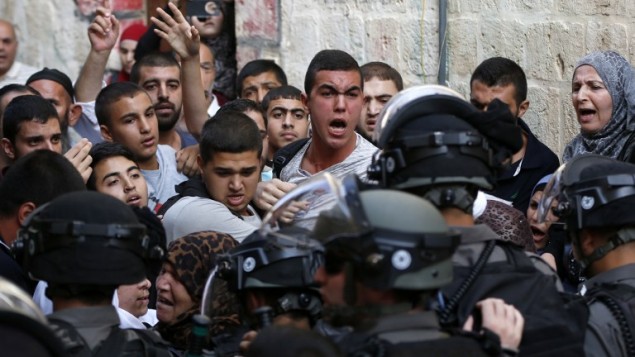
The comment came after a clash between Arab rock throwers and Israeli police on Rosh Hashanah, the Jewish New Year, as Arabs sought to prevent Jews from visiting the site.

Kirby
State Department Spokesperson John Kirby

State Department Status Quo it Favors

The “status quo” that the State Department presumably sought to maintain was the ban on Jewish prayer on the entire 35 acre Temple Mount platform, the Jews’ holiest place on earth.  That ban was put in place by Muslims in the middle of the 16th century, and Israel has allowed the Islamic Waqf to maintain the ban, even after it captured the Old City from Jordan and reunified the city in 1967.

State Department Status Quo it Seeks to Change

Later in this same briefing, Kirby responded to a question as to whether the Oslo Agreement between the Israelis and Palestinians should be scrapped since no Palestinian state was on the horizon: “Secretary Kerry is committed to pursuing a two-state solution, and I think you’re going to see him continue to do that throughout his tenure here at the department. I don’t think anybody’s – certainly not here – willing to give up on that ultimate goal.”

Kerry is “committed” to changing current reality and creating an Arab-led sovereign state in the holy land for the first time in history.

What makes one status quo worth keeping while the other is not? Does the State Department only endorse a status quo which Muslims desire (banning Jews from the Temple Mount) even though it is clearly anti-Semitic? Is it less a matter of favoring Muslim demands over American integrity and principle, but rather a function of seeking the support of 57 Arab countries versus a single Jewish State?

A more proper – and consistent – response would have been that Israel and the Jordanians and Palestinian Arabs will determine any changes to the status of Jerusalem and the holy sites as part of a final peace agreement. Those changes to the status quo will include matters of sovereignty and rights of access and prayer.


Related First One Through articles:

Joint Prayer: The Cave of the Patriarchs and the Temple Mount

The United Nations and Holy Sites in the Holy Land

The Battle for Jerusalem

A “Viable” Palestinian State

Subscribe YouTube channel: FirstOneThrough

Join Facebook group: FirstOne Through  Israel Analysis


Names and Narrative: CNN’s Temple Mount/ Al Aqsa Complex Inversion

temple mount protest
(Muslim and Israeli police confront each other at The Temple Mount,
September 13, 2015. Source: AFP Photo/Ahmad Gharabli)

On September 13, 2015, CNN reported on a confrontation between “Arab youths and Israeli police” in the Old City of Jerusalem using language that inverted the facts. The news discussed:

  • Palestinian protestors,” but of what? Jews visiting the Temple Mount which they had every legal and moral right to do? Perhaps they were protesting new Israeli laws meant to keep Muslim groups from attacking Jewish visitors to the Temple Mount. The report made it appear that the “protestors” were just seeking a right to pray.
  • The “Al Aqsa Complex” that CNN mentioned gives an Islamic name to the entire 35 acre compound, even though the Al Aqsa Mosque is located on just the southern tip of the platform. This entire platform was built for the Second Jewish Temple and is therefore historically known as the Temple Mount. Using an Islamic name as the official name and only stating that “Jews… call it the Temple Mount” divorces history, reality and Jews from the site. It is more accurate to use the default name “The Temple Mount” to the entire location and state that ‘Muslims call it the Al Aqsa Complex”.
  • “…Is one of the holiest sites in the world for Muslims” The mosque itself is the third holiest site, not the entire Temple Mount platform. The story does not clarify that Jews had no interest in visiting the mosque itself, but the other parts of the platform.
  • Stating that “the clashes ended when Muslim worshippers were allowed in the complex for prayers” makes the entire event seem like all the Arab protestors sought was a right to pray (which they had already completed doing), as oppose to stopping Jews from visiting the Temple Mount on their Jewish New Year. This was another inversion of the narrative.
  • CNN’s report that “Jordan, which is in charge of the complex” is incomplete. Jordan’s Islamic Waqf has religious oversight of the Temple Mount, but it is Israel that is in charge of security on the Mount. Article 9 of the 1994 Jordan-Israel Peace Treaty clearly states that “Each party will provide freedom of access to places of religious and historical significance.” That is why the Israeli police legally deployed personnel to prevent Arab rock-throwers from attacking visiting Jews on the Mount.

Overall, CNN failed to report that Israel was legally trying to protect Jews visiting the Temple Mount, their holiest spot on one of their holiest days of the year. Instead they painted a picture of Israeli police blocking Arab youths from praying at the Al Aqsa Complex, one of their holiest places.

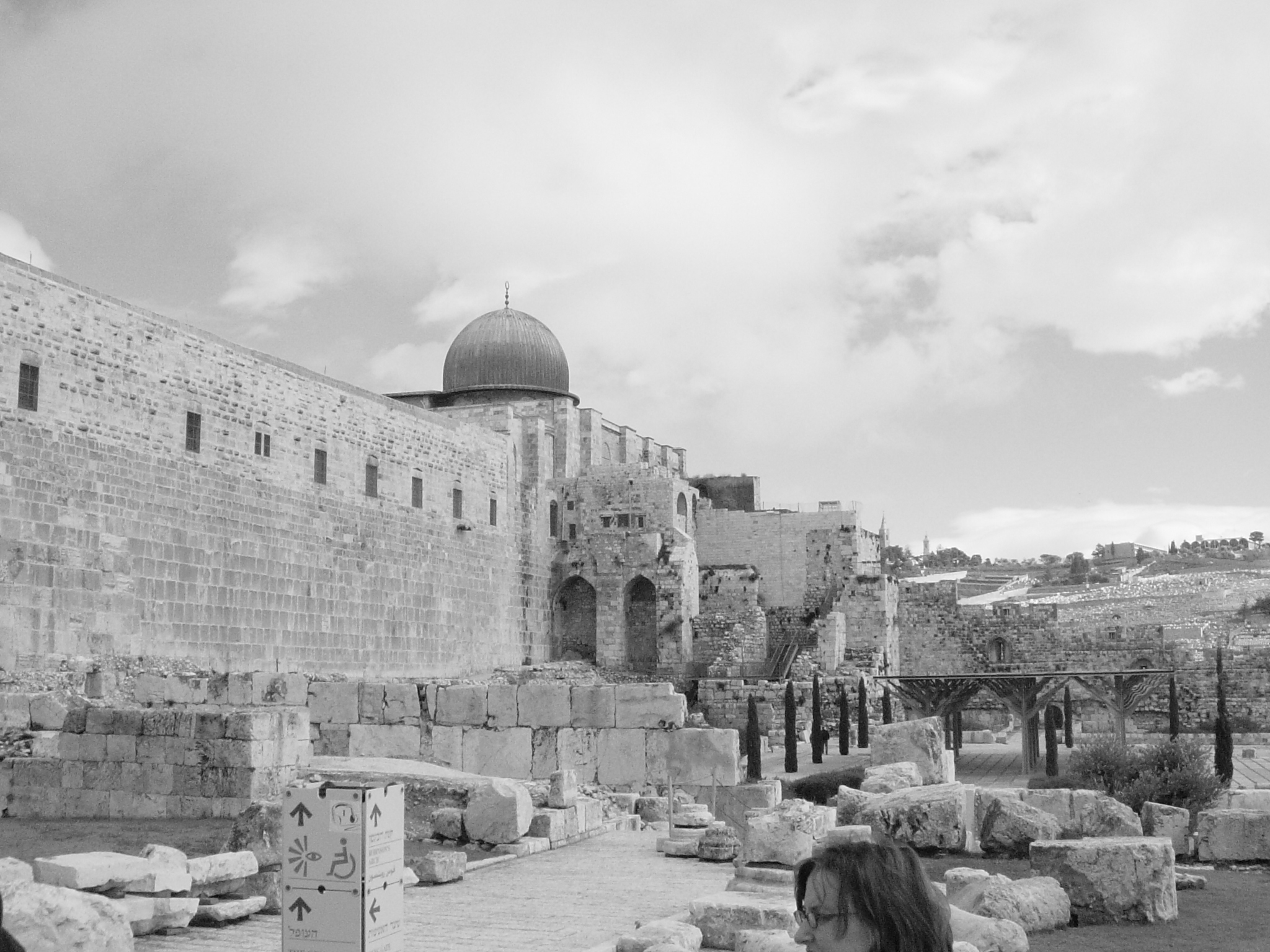
DSC00357
Al Aqsa Mosque at the very southern tip of the Temple Mount Platform
(Source: First One Through)


Related First One Through articles:

The Waqf and the Temple Mount

The Cave of the Patriarchs and the Temple Mount

The Arguments over Jerusalem

Tolerance at the Temple Mount

“Extremist” or “Courageous”

Names and Narrative: The West Bank / Judea and Samaria

Nicholas Kristof’s “Arab Land”

Subscribe YouTube channel: FirstOneThrough

Join Facebook group: FirstOne Through  Israel Analysis

UN Comments on the Murder of Innocents: Itamar and Duma

The Middle East is unfortunately no stranger to attacks on innocent people. In July 2015, an arson attack on the home of Palestinian Arabs in the town of Duma killed an 18-month old baby. Just 15 miles away, in the town of Itamar, two Palestinian Arabs stabbed to death five members of a Jewish family in their beds in March 2011.

The taking of innocent lives is a terrible thing. It is also sad to watch completely different reactions from world bodies to the two events. Here is the UN news release of the 2011 deliberate murders of five Israeli Jews and the news release of July 2015 on the arson attack that claimed one Palestinian Arab. A short comparison:

Deliberate Murder of 5 Israeli Jews Arson Attack which Claimed Life of 1 Palestinian Arab
Words in article 220 422
Attack called “terrorism” None Three times
Blame placed Not placed on Arabs or Muslims Placed on “Jewish extremists
Other Attacks Mentioned No mention of repeated attacks by Palestinians on Israelis Discussed “repeated acts of settler violence
Comment on leadership Welcomes the strong condemnation… by President Abbas No welcome of condemnation by Netanyahu. Blamed Netanyahu for variety of items including demolishing Palestinian homes and settlement policy.
Cause for Attack Not discussed Blamed on “Israel’s illegal settlement policy

#JewishLivesMatter

The continued disproportionate attacks by the United Nations on only one party in the Israeli-Palestinian conflict will marginalize the UN as a factor in arriving at a long-term solution in the region.

Ban Ki Moon
UN Secretary-General Ban Ki-Moon
(photo: AP/Gary Cameron)


Sources:

Text of UN March 2011: “12 March 2011 – Secretary-General Ban Ki-moon and the United Nations diplomatic partners in the search for peace in the Middle East today condemned the shocking murder of an Israeli family of five, including three children, in a West Bank settlement overnight and called for the prosecution of the perpetrators of the crime.

Mr. Ban also urged all concerned to act with restraint.

The diplomatic Quartet of the UN, European Union, Russia and United States, which seeks a two-State solution to the Israeli-Palestinian conflict, condemned the killings “in the strongest possible terms.”

“The Quartet offers their condolences to the loved ones of the victims and to the Israeli people. Attacks on any civilians are completely unacceptable in any circumstance,” the Quartet said in a statement.

“The Quartet calls on those responsible to be brought to justice and welcomes the strong condemnation of this attack by [Palestinian] President [Mahmoud] Abbas and the Palestinian leadership.”

It stressed the need to expedite efforts to achieve Israeli-Palestinian and comprehensive Arab-Israeli peace.

Media reports said the killings occurred in the settlement of Itamar, near the city of near Nablus. The victims were reportedly stabbed to death by an intruder who broke into their home.

The Israeli army radio said the killer had spared two other children, and that the murder was discovered by another one when she came home.”

Text of UN July 2015: “31 July 2015 – United Nations Secretary-General Ban Ki-moon and the UN special envoy on the Middle East have strongly condemned today’s arson attack in the West Bank that killed a Palestinian child and left the child’s parents severely injured.

The Secretary-General strongly condemns today’s murder of a Palestinian child in the West Bank and calls for the perpetrators of this terrorist act to be promptly brought to justice,” reads a statement issued by his spokesperson in New York.

Continued failures to effectively address impunity for repeated acts of settler violence have led to another horrific incident involving the death of an innocent life, adds the statement. “This must end.”

The absence of a political process and Israel’s illegal settlement policy, as well as the harsh and unnecessary practice of demolishing Palestinian houses, have given rise to violent extremism on both sides, the statement continues.

“This [situation] presents a further threat to the legitimate aspirations of the Palestinian people for statehood, as well as to the security of the people of Israel. The Secretary-General urges both sides to take bold steps to return to the path of peace.”

Mr. Ban reiterates his call on all parties to ensure that tensions do not escalate further, leading to more loss of life, the statement concludes.

Earlier today, the United Nations special envoy on the Middle East today expressed his outrage over what he called a “heinous murder” and a “terrorist crime.”

“I am outraged by today’s vicious arson attack by suspected Jewish extremists in the Occupied West Bank village of Duma, near Nablus, which killed Palestinian toddler Ali, critically injured his mother and father, and injured his four-year old sibling,” the Special Coordinator for the Middle East Peace Process, Nickolay Mladenov, said.

Joining in the “strong condemnations” issued by Israeli and Palestinian Governments and political leaders, the Special Coordinator also called for a “full and prompt investigation” to bring the perpetrators to justice.

“This heinous murder was carried out for a political objective. We must not permit such acts to allow hate and violence to bring more personal tragedies and to bury any prospect of peace. This reinforces the need for an immediate resolution of the conflict and an end to the occupation.”

Later today, the Security Council issued a statement to the press, condemning “in the strongest terms” the “vicious terrorist attack,” and underlining the need to bring the perpetrators of this “deplorable act” to justice.

Council members encouraged all sides to work to lower tension, reject violence, avoid all provocations, and seek a path toward peace.”


Related FirstOneThrough articles:

The United Nations Audit of Israel

Double Standards: Assassinations

Every Picture Tells a Story: The Invisible Murdered Israelis

The Legal Israeli Settlements

The Death of Civilians; the Three Shades of Sorrow

Eyal Gilad Naftali Klinghoffer. The new Blood Libel.

Cause and Effect: Making Gaza

Subscribe YouTube channel: FirstOneThrough

Join Facebook group: FirstOne Through  Israel Analysis

John Kerry’s Hypocrisy: “Can You Deliver?”

Listening to US Secretary of State John Kerry try to explain and defend the P5+1 Iranian nuclear deal to various audiences is a spectacle to behold, regardless of one’s position on the best course of action.  One of the people who might want to watch the sessions and learn something from John Kerry is John Kerry.

Kerry CFR
John Kerry speaking at the Council of Foreign Relations
July 2015

Secretary Kerry argued at the Council for Foreign Relations (CFR) that Congress must support the deal or it would undermine his ability to negotiate any treaty with any government in the future. At 29:55 of the CFR talk, Kerry said: “Other people in the world are going to sit there and say ‘hey, let’s negotiate with the United States, they have 535 Secretaries of State. I mean, please! I would be embarrassed to try to go out… I mean, what am I going to say to people after this as Secretary of State? ‘Come negotiate with us?’ ‘Can you deliver?’ Please!

Kerry made the point that when two parties sit down to negotiate, it is critical for the sides to know that the negotiating parties are both authorized to negotiate and have the ability to fulfill their sides of the deal. If no such authority or ability exists, the discussions are an irrelevant waste of time.

Despite Kerry being quite clear about his logic, he has nevertheless insisted that Israeli Prime Minister Benjamin Netanyahu sit down and negotiate with Acting-President of the Palestinian Authority Mahmoud Abbas, even though it is clearly understood that Abbas can deliver nothing.

  • No Mandate: Abbas’s four-year term as president ran out in 2009. No presidential elections have been held since then.
  • No Authority: Abbas’s Fatah party lost legislative elections in 2006, winning only 33% of the parliament. No legislative elections have been held since then.
  • No Support: Abbas lags in every Palestinian poll held since 2006.
  • No Control: Abbas has no control of Gaza since his Fatah party was kicked out in 2007.
  • No Track Record: Abbas has shown zero credibility in being able to strike compromises to govern his own people, let alone deliver compromises with Israel.

Despite the glaringly obvious impotence of Abbas, the Obama administration continued to pressure Israel to negotiate with this straw man.

The Obama administration publicly acknowledged that the Palestinian Authority has absolutely no ability to deliver peace a few years ago. During the Gaza war on Israel in 2012, then US Secretary of State Hillary Clinton tried to broker a cease-fire. She made a dozen calls to various world leaders to halt the war- but not ONCE called the Abbas and the Palestinian Authority.

Compounding the inherent flaws in Abbas and the Palestinian Authority is Abbas’s insistence on bringing terms of any deal with Israel to a referendum. Abbas stated that he cannot decide on the “Right of Return” for all Palestinians, but that each of the 5 million Palestinian Arab “refugees” must make a decision for themselves. Hey Kerry- 535 “second-guessers” looks pretty good compared to 5 million! In terms of the rest of the components of a final agreement, Abbas stated that he “would go to a referendum everywhere because the agreement represents Palestinians everywhere.”  That’s impressive – he seeks the approval of 11 million “Palestinian” Arabs from all around the world!


Kerry’s comments regarding Iran are both on- and off-the-mark.  Iran and all of the parties in the negotiations know that the United States is a democracy and the political process must run its course.  Once the American people’s representatives in Congress make a decision, the government will deliver on its commitments.

However, Abbas – a complete straw man if ever there was one – with no authority or control whatsoever, openly states that millions of individuals will ultimately not only decide the fate of an Israeli-PA deal overall, but even on certain components on an individual basis.


Kerry fully appreciates that before negotiators start a process that they want to know the answer to the fundamental question: “Can you deliver“? However, he doesn’t care when he forces Israel to do exactly that with Abbas and the Palestinian Authority.


Related FirstOneThrough video and articles:

Abbas demands R-E-S-P-E-C-T

The Disappointing 4+6 Abbas Anniversary

Palestinian “Refugees” or “SAPs”?

Subscribe YouTube channel: FirstOneThrough

Join Facebook group: FirstOne Through  Israel Analysis

Has the “Left-Wing” Joined the UN in Protecting Iran and the Palestinians from a “Right-Wing” Israel?

The left-wing Israeli newspaper Haaretz published an article in May 2015 questioning Israel’s nervousness over a possible deal regarding Iranian nuclear weapons. It pointed out that another Muslim country, Pakistan, already possessed nuclear weapons and Israel did not object.  However, the paper noted that “though Pakistan is the first Muslim state with a nuclear weapons program, it does not call for Israel’s destruction or sponsor terror attacks against Israel. A nuclear Iran, by contrast, would receive cover to step up its hegemonic ambitions in the region and intensify its support for terrorism against the Jewish state.”  A significant difference.

The parameters of the final Iran deal made many people question whether Iran would be able to advance a nuclear weapons program immediately, as the verification program ultimately was very far from the “anywhere, anytime” stated goal that would have better ensured Iranian compliance.  The plan left wide open the possibility that Iran could “break-out” with nuclear weapons in a decade.

Putting aside the question of if-and-when Iran obtains nuclear weapons for a moment, the following deal points are clear:

Unlike the core issue of Iran potentially having nuclear weapons, these dangerous deal points are not in question.

Ramifications – More Money and Weapons

The US State Department considers Iran a state-sponsor of terrorism.  Specifically, it stated: “Iran has historically provided weapons, training, and funding to Hamas and other Palestinian terrorist groups, including the Palestine Islamic Jihad (PIJ) and the Popular Front for the Liberation of Palestine-General Command (PFLP-GC), although Hamas’s ties to Tehran have been strained due to the Syrian civil war.  Since the end of the 2006 Israeli-Hizballah conflict, Iran has also assisted in rearming Hizballah, in direct violation of UNSCR 1701.  Iran has provided hundreds of millions of dollars in support of Hizballah in Lebanon and has trained thousands of its fighters at camps in Iran.  These trained fighters often use these skills in support of the Assad regime in Syria.”

With the execution of this Iranian deal, $150 billion will flow to Iran, some of which, the Obama administration noted, will most likely go towards terrorism.  The deal will also provide a fresh flow of missiles to Iran and likely to Iranian friends on the borders of Israel.

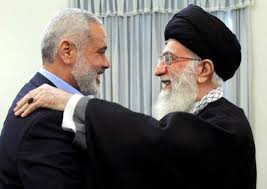
Iran Hamas
Hamas leader Haniyeh and Iranian spiritual head Khamenei

Ramifications – Tighter Border Controls

While Israel’s main fear is a nuclear-armed Iran, the flow of money and missiles to Hamas and other terrorists on Israeli borders are also significant concerns.  The likely Israeli actions to counter these threats will be:

  • Tighter Gaza blockade
  • Permanent security positions along the Jordan Valley
  • Fewer permits with longer delays in allowing Palestinian Arabs to travel to Israel and between territories

The significantly enhanced threats on Israel’s borders – even before factoring in a nuclear Iran – will force Israel to take additional security measures which will harm daily life for ordinary Israelis and Palestinian Arabs.

World Preemptive Action – Stop Israeli Defenses

The global powers voted to approve the Iranian deal and lift the sanctions against Iran, knowing of Israel’s security concerns.  The world has now begun to take additional steps to prevent Israel from protecting itself:

As Israel prepares to protect its citizens from the immediate threats from the Iranian nuclear deal that the United Nations approved, the world prepares to challenge those very defenses that Israel needs to implement, such as the land and sea border controls..

 What is the Goal of all the Negotiations?

These actions beg questions that contradicts the narrative used in the west:

      • was the real goal of the Iranian nuclear deal to protect Iran from a nuclear Israel? The deal includes language that the P5+1 group will “protect against, and respond to nuclear security threats, including sabotage [against the Iranian nuclear program].” Seriously?
      • Has Obama deliberately handed over authority and control of the region to Iran, as he has no desire to put US troops back into the Middle East?

Is the world now taking steps to protect Palestinian Arabs from their perception of a Mr. Right Wing Benjamin Netanyahu of Israel?

The Obama narrative is that the world is safer with the Iranian deal.  In actuality, is the world safer, or is Iran safer? 

President Obama faces an American public that is more wary of Iran and sympathetic to Israel than much of the world, so he is spinning the deal in verbiage that is more accepting to Americans.  Thus far, Americans are buying the pitch, even while they strongly question whether it will work.

Who’s goals are these anyway?

  • The Arab and Muslim world celebrated the advancement of its goals to destroy the west and Israel.  They did not attempt to hide their mission.
  • The left-wing American parties, papers and groups like J-Street have endorsed the Iranian deal, and are pushing Israel to further dismantle its defenses. They are either lying to themselves or the American people about their goals. Perhaps both.

As Jeffrey Goldberg wrote in the Atlantic, “The Iran deal represents one of those rare issues that has unified Israelis of most political parties[including] the left, center, and right.”  In the United States, it has only unified the left-wing with the Iranian dream.


Related First One Through articles:

The New Endorsed Parameters of Peaceful Nuclear Power

The Gap between Fairness and Safety: WMDs in Iraq and Iran

Hidden Reactor, Silent Reaction

Netanyahu’s View of Obama: Trust and Consequences

UN’s Confusion on the Legality of Israel’s Blockade of Gaza

A “Viable” Palestinian State

UN’s Confusion on the Legality of Israel’s Blockade of Gaza

In June 2015, the United Nations issued a report highly critical of Israel’s handling of its war against Palestinian attacks. Throughout the report, the committee suggested that the Israeli blockade of Gaza was a major cause for suffering of Palestinians, rather than a result of Palestinian actions, and helped precipitate the war.

Member of the Commission of Inquiry on the 2014 Gaza conflict Doudou Diene (L) gestures next to Chairperson of the Commission Mary McGowan Davis during a press conference to present their report on June 22, 2015 at the United Nations Office in Geneva. Both Israel and Palestinian militants may have committed war crimes during last year's Gaza war, a widely anticipated United Nations report said on June 22, decrying "unprecedented" devastation and human suffering.   AFP PHOTO / FABRICE COFFRINI

Member of the Commission of Inquiry on the 2014 Gaza conflict Doudou Diene (L) gestures next to Chairperson of the Commission Mary McGowan Davis during a press conference to present their report on June 22, 2015 at the United Nations Office in Geneva.  AFP PHOTO / FABRICE COFFRINI

2015 UN Assertion that
Blockade was Cause for Conflict

In the section of the report that reviewed the background to the 2014 conflict, the report stated that “In the preceding months, there were few, if any, political prospects for reaching a solution to the conflict that would achieve peace and security for Palestinians and Israelis and realize the right to self-determination of the Palestinian people. The blockade of Gaza by Israel, fully implemented since 2007 and described by the Secretary-General as “a continuing collective penalty against the population in Gaza” (A/HRC/28/45, para. 70), was strangling the economy in Gaza and imposed severe restrictions on the rights of the Palestinians.” By way of correction and education to the reader, the naval blockade of Gaza only began in January 2009 (not 2007). The land blockade of Gaza began in 2007 after Hamas routed Fatah from Gaza and took complete control of the region.

It is important and significant to point out that this 2015 report suggested that there were “few POLITICAL PROSPECTS for reaching a solution” and that the “blockade of Gaza.. was strangling the economy” and “imposed severe restrictions” on Palestinians. This directly implied that the Palestinians were seeking a political solution and rightfully frustrated with a blockade that was imposed on them (presumably for no reason).  Therefore, since a political solution was not available, they were forced to pursue a military response.

That is outrageous on many levels.

  1. Hamas has stated clearly in its charter and in addresses by its leaders that it seeks the complete destruction of Israel and that it will never enter peace negotiations. (A fact that was never mentioned in the UN report)
  2. Hamas clearly stated that it would not pursue any “peaceful solutions and international conferences” as seen in its charter, below.
  3. Hamas’s takeover of Gaza in 2007 is never mentioned in the UN report.

Hamas Charter Article 13: “Initiatives, and so-called peaceful solutions and international conferences, are in contradiction to the principles of the Islamic Resistance Movement…. These conferences are only ways of setting the infidels in the land of the Moslems as arbitraters… There is no solution for the Palestinian question except through Jihad. Initiatives, proposals and international conferences are all a waste of time and vain endeavors.

The UN report inverted reality and ignored that the blockade of Gaza was in response to Hamas’s taking over of Gaza and firing thousands of missiles at Israeli civilians.

 2015 UN Report
Call to Remove the Blockade

The UN report concluded with several suggestions which clearly placed the blame for the conflict on Israel’s actions: “The commission calls upon the Government of Israel… to address structural issues that fuel the conflict and have a negative impact on a wide range of human rights, including the right to self-determination; in particular, to lift, immediately and unconditionally, the blockade on Gaza.

This conclusion and suggestion are in stark contrast to the September 2011 UN “Palmer Commission Report” which clearly spoke of the legal nature of Israel’s blockade of Gaza and spoke to the harm and evil intent of Hamas which necessitated the blockade.


2011 UN Report
on LEGAL NATURE of Blockade of Gaza

To start, the Palmer Report correctly identified the different blockades of Gaza and the reason for them: “the tightening of border controls between Gaza and Israel came about after the take-over of Hamas in Gaza in June 2007.  On the other hand, the naval blockade was imposed more than a year later, in January 2009.”

The report continued that “the naval blockade as a distinct legal measure was imposed primarily to enable a legally sound basis for Israel to exert control over ships attempting to reach Gaza with weapons and related goods.  This was in reaction to certain incidents when vessels had reached Gaza via sea.”

The report then continued in greater detail on the “structural issues that fuel the conflict” with specific history (as opposed to simply echoing the Palestinian narrative as it did in the 2015 report): “Israel has faced and continues to face a real threat to its security from militant groups in Gaza.  Rockets, missiles and mortar bombs have been launched from Gaza towards Israel since 2001.  More than 5,000 were fired between 2005 and January 2009, when the naval blockade was imposed.  Hundreds of thousands of Israeli civilians live in the range of these attacks.  As their effectiveness has increased some rockets are now capable of reaching Tel Aviv. Since 2001 such attacks have caused more than 25 deaths and hundreds of injuries.  The enormity of the psychological toll on the affected population cannot be underestimated.  In addition, there have been substantial material losses.  The purpose of these acts of violence, which have been repeatedly condemned by the international community, has been to do damage to the population of Israel.  It seems obvious enough that stopping these violent acts was a necessary step for Israel to take in order to protect its people and to defend itself.

In regard for using a naval blockade to prevent the assault from Gaza on Israel, the report stated “The Israeli report to the Panel makes it clear that the naval blockade as a measure of the use of force was adopted for the purpose of defending its territory and population, and the Panel accepts that was the case.  It was designed as one way to prevent weapons reaching Gaza by sea and to prevent such attacks to be launched from the sea.  Indeed there have been various incidents in which ships carrying weapons were intercepted by the Israeli authorities on their way to Gaza.”

In sharp contrast to the 2015 report which cited the UN Secretary General’s comment that the blockade was a “collective penalty against the population in Gaza“, the 2011 Palmer Report concluded that “Although a blockade by definition imposes a restriction on all maritime traffic, given the relatively small size of the blockade zone and the practical difficulties associated with other methods of monitoring vessels (such as by search and visit), the Panel is not persuaded that the naval blockade was a disproportionate measure for Israel to have taken in response to the threat it faced.

The report concluded with clarity: “Israel was entitled to take reasonable steps to prevent the influx of weapons into Gaza.  With that objective, Israel established a series of restrictions on vessels entering the waters of Gaza.  These measures culminated in the declaration of the naval blockade on 3 January 2009… There is nothing before the Panel that would suggest that Israel did not maintain an effective and impartial blockade….  it is evident that Israel had a military objective.  The stated primary objective of the naval blockade was for security.  It was to prevent weapons, ammunition, military supplies and people from entering Gaza and to stop Hamas operatives sailing away from Gaza with vessels filled with explosives… It is also noteworthy that the earliest maritime interception operations to prevent weapons smuggling to Gaza predated the 2007 take-over of Hamas in Gaza.  The actual naval blockade was imposed more than one year after that event. These factors alone indicate it was not imposed to punish its citizens for the election of Hamas….  As this report has already indicated, we are satisfied that the naval blockade was based on the need to preserve Israel’s security.  Stopping the importation of rockets and other weapons to Gaza by sea helps alleviate Israel’s situation as it finds itself the target of countless attacks, which at the time of writing have once again become more extensive and intensive…  We have reached the view that the naval blockade was proportionate in the circumstances… The Panel therefore concludes that Israel’s naval blockade was legal… Israel faces a real threat to its security from militant groups in Gaza.  The naval blockade was imposed as a legitimate security measure in order to prevent weapons from entering Gaza by sea and its implementation complied with the requirements of international law.

Quite a different narrative and conclusion than the UN wrote up in 2015.


Related FirstOneThrough article:

Cause and Effect: Making Gaza

Gaza Blockade versus Cuban Blockade

Considering a Failed Palestinian State

Failed Countries
On July 9, 2011, the world welcomed a new country, South Sudan, which separated from Sudan. South Sudan rapidly became a failed state, one in which the central government lost the ability to control the security and economy of the country.
Failed states suffer from many terrible and unstable features: lack of governmental control; factional militias and armies; lack of border integrity and gross poverty. These societies often see rampant human rights abuses as various parties assert control over parts of the country and seek vengeance and control over minorities and local populations.
Consider some reports from South Sudan over the past year:
Ten thousand people have been killed and more than 1.6 million have been internally displaced since civil war broke out in South Sudan in December 2013.
June 2015: South Sudanese army may have caused widespread human rights abuses according to the UN
May 2015: At least 129 children killed, boys castrated and girls raped
July 2014: Food crisis declared worst in the world by UN Security Council
According to Business Insider, the worst failed states include: South Sudan; Sudan; Somalia; Congo; Chad and Yemen. The populations of these countries are forced to flee, suffer or die.

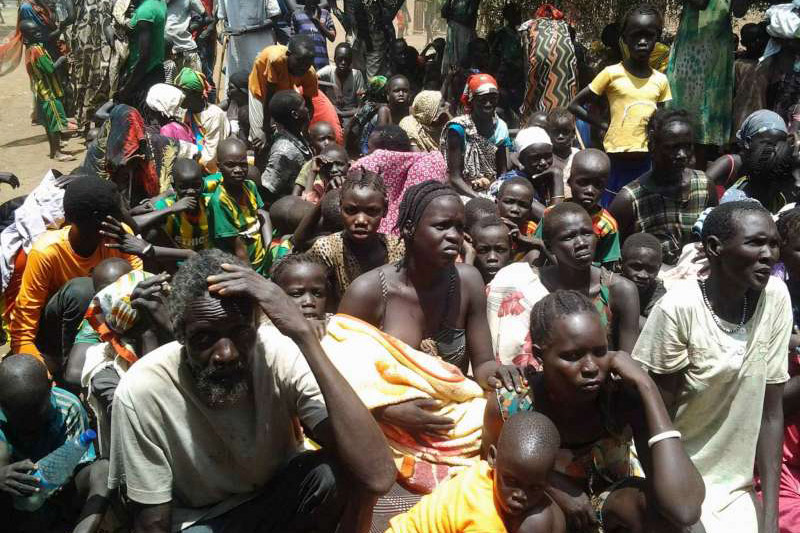
South Sudanese refugees wait to be registered at a crossing into Ethiopia earlier in 2015. (Photo: UNHCR/R. Riek)
Considering a Palestinian State
Many countries in the United Nations would like to see the Palestinian Arabs gain self-determination and have their own country. However, many of the ingredients for a failed state currently reside in the political structure of the Palestinian Authority:
The Palestinian territories have various stand-alone armies and militias including Hamas and Islamic Jihad
No central government, as the west bank of the Jordan River and Gaza strip are administered independently
Internal fighting as witnessed in the 2007 rout of Fatah by Hamas forces in Gaza, and various extrajudicial killings between those parties that continued since then
No border integrity as bedlam prevails in Gaza, Sinai and Israeli towns near the border of Gaza
Lack of functioning economy and widespread unemployment due: to the extremely high percentage of people under 25 years old; and constant war to destroy Israel
No presidential or legislative elections, as they were suspended due to the splits mentioned above. The presidential election was last held in 2005 and the president’s term expired a long time ago.
A country built on this framework would likely deteriorate. Factional fighting to dictate the future of the country would exacerbate. Unemployment would further skyrocket. Cross-border battles with Israel would escalate and also include the area east of the Green Line, EGL/ west bank of the Jordan River. This region, which already leads the world in the “honor killings” of women, would likely continue to see such murders increase.
It would be a country built in chaos, with people’s dreams dying alongside their lives.
Concrete Steps to Avoid a Failed Palestinian State
Should the Palestinian Arabs hope to achieve a functioning state after self-determination, important steps need to be instituted before the state is formed:
Remove all weaponry from Hamas and other groups. A functioning government must only have a single army. There cannot be a society in which various entities wage internal and external wars.
Ban Hamas. No entity which advocates for murder of minorities should be allowed to sit in any elected office, and no country should have any dealings with any country that seeks destruction of another country. As Hamas advocates for the killing of Jews and calls for the complete destruction of Israel, the party should be banned in its entirety until it renounces both positions completely.
Form new Political Parties and Hold Elections. The Palestinian Arabs have not held presidential elections since 2005 and legislative elections since 2006. As Hamas won legislative elections in 2006 and have polled to win future elections, new parties should be organized that can compete in new elections.
These are the basic steps that must occur for the Palestinian Authority to have a functioning government. Once the central authority rests in a representative body, that entity can negotiate a final status agreement with Israel to create a new state. To minimize the chances that it slip into a failed state, the Palestinian government should further consider the following:
Peace Agreement with Israel. A viable government should have a strong economy, including a flow of people and goods. Due to the separation of the Palestinian territories, it would be most efficient for the government to have a good working relationship with Israel to facilitate commerce.
Minimize Incoming Youth. A Palestinian state would likely want to welcome Arabs whose families once lived in the region. As a large population below age 25 often leads to rampant unemployment and instability, the emphasis on incoming people should be on professionally-trained adults.
Transitional control from UNRWA. UNRWA has kept infant mortality, immunizations, life expectancy and literacy of Palestinian Arabs at among the best rates in the world. Over a period of years, the UN should cede control of the schools and hospitals to Palestinian control.
While the world celebrated the founding of a new country four years ago in South Sudan, the declaration proved a hollow victory for the people. It would be a mistake to push forward another declaration for Palestinian Arabs at this time which would ultimately lead to further suffering. Mayhem with a flag benefits no one.

Related First.One.Through article:
A “Viable” Palestinian State

The Disproportionate Defenses of Israel and the Palestinian Authority

The United Nations Human Rights Council (UNHRC) produced a report in the spring of 2015 about the war between Israel and the Palestinians in the summer of 2014. The UNHRC continued with a debate in June 2015 in which several “delegations strongly condemned Israel’s excessive and disproportionate military aggression against the Palestinians” including from: Egypt; Tunisia; Maldives; Iraq; South Africa; Indonesia; Ireland and Cuba.

This analysis does not directly review “disproportionate force” but disproportionate defense employed by the two sides.

Obligation to Defend

The foremost responsibility of any governmental leadership is to protect its population. Such defense can be implemented in a variety of ways: a police force or army to maintain order; infrastructure to ensure safety; and intelligence which can guide the appropriate use of manpower and equipment. The United Nations has been developing a framework for “The Responsibility to Protect” over the past several years.

In the conflict between Israel and the Palestinian Authority, only one side proactively protects its citizens, while the other side uses reactive defenses. One side assumes responsibility via using its own resources and capabilities, while the other side relies completely on outside agents.

ISRAEL – ACTIVE DEFENSE

Protecting Against Incoming Missiles and Armaments

Bunkers and Bomb Shelters: Israel is unique in the Middle East in establishing a policy of bomb shelters throughout the country. In response to being surrounded to hostile neighbors that have attacked and shelled its people and lands since its inception, houses, schools, hotels, hospitals and even playgrounds are built with bomb shelters.

The Palestinians have not built shelters. Instead, they used their cement to build tunnels with which to attack Israel.

Israel_-_shelter_by_kate_simmons

Playground shelter in Israel
(photo: Kate Simmons)
Iron Dome. Israel developed a new missile defense system called the Iron Dome, and continues to build new air defense systems to protect the country from incoming missiles.

The Palestinians have neither developed nor imported defensive systems. They have only imported offensive weaponry.

irondome

Israeli developed “Iron Dome” Defense System
Blockade of Gaza. Israel imposed a naval blockade around Gaza after the terrorist group Hamas, which is sworn to the destruction of Israel, seized the land. The blockade has successfully kept out many missiles and other arms from reaching Hamas and ultimately causing death and destruction in Israel.

Protection Against Killers

Security Barrier. In September 2000, the Palestinians began multi-year riots which killed over a thousand Israelis through hundreds of attacks. In response, the Israeli government began to construct a security barrier in 2002 to keep out terrorists who mostly emanated from cities in Judea and Samaria/ east of the Green Line (EGL).

The Palestinians have not built any security barriers from the Israelis. There have been no suicide bombers going from Israel into Gaza or EGL blowing up civilians.

IMG_1805

Stretch of Security Barrier along highway
(photo: FirstOneThrough)

Airport Security. Well before the world became attuned to airport security after the attacks on the United States on 9/11/01, Israel established an extensive airport security system. The screening of passengers, x-rays of baggage and other methods were in response to a series of airplane hijackings in the 1970s (a method of terrorism created by the Palestinian Arabs).

The Palestinians do not have an airport and therefore no such security concerns.
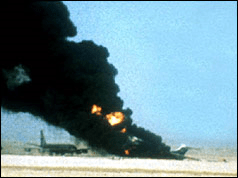
plane blowup 1970

Palestinians blow up plane, 1970

Protection Against Lethal Plans

Intelligence. Israelis utilize a wide variety of information sources to uncover plans to attack its country. Whether through a network of Israeli spies, Palestinian informants, money tracking, wiretapping and other means, the Israelis gather information and make assessments on potential Palestinian Arab attacks. It is then able to take preventative action before such attacks occur.

PALESTINIAN AUTHORITY AND HAMAS – REACTIVE DEFENSE

Relying on Israeli Sensitivities and Sensibilities

Civilians. As detailed above, the Palestinian Authority and Hamas have not instituted proactive tangible means of defending its people. One of the ways it attempts to defend the population is by making it nearly impossible to distinguish between fighters and civilians.

  • The fighters do not typically wear uniforms and can therefore not be distinguished from civilians
  • Men, women and children are all enlisted in the war against Israel
  • Militants fire at Israel from mosques, schools and civilian neighborhoods

Palestinian Arabs hope that Israel will not indiscriminately fire upon everyone. By forcing Israel to take time and extra precautions to target the right attackers, it slows down Israeli defenses during battles.
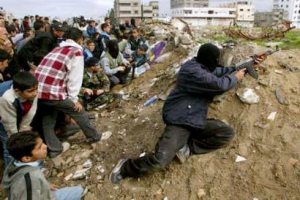
humanshieldsgaza

Destroying its Own Infrastructure. Hamas built an extensive offensive network of tunnels into Israel which originated in many private homes. By relying on Israelis sensitivities to minimize destruction in civilian neighborhoods, Hamas was able to protect many tunnel openings.

Further, Hamas and other Palestinian Arab groups often booby-trapped homes from which they attacked Israel. While the Palestinian Arabs destroyed their own infrastructure, they slowed down and killed many Israelis who looked to root out the attackers.

Relying on Global Bodies like the United Nations

United Nations. One of the principal methods that the Palestinian Authority uses to defend its population is through global bodies AFTER a war. The United Nations includes 57 Islamic countries (in the OIC) and 22 Arab countries (in the Arab League) which align themselves with the Palestinian Arab cause. Many of those countries do not even recognize the State of Israel. They were instrumental in passing the “Zionism is Racism” resolution in 1975 and creating several committees devoted only to Palestinian causes.

The Palestinians turn to the UN to highlight the damage that Israel inflicts on its intentionally defenseless population. It uses deliberate attacks on Israel to provoke premeditated casualties to show the world.

This same UN has not condemned the Palestinian Authority for not properly defending its population. Instead, it recommended the incredulous idea that Israel must give the Arabs the defensive systems like Iron Dome that it developed.

The latest forum that the Palestinian Authority has pursued is the International Criminal Court, the ICC. While it is evident that the Palestinians Arabs definitely committed war crimes in the 2014 War against Israel, it would still sue Israel in the hopes that such action will hurt Israel, further its cause and protect the Palestinian Arabs.


As detailed above the two sides in the Israel-Palestinian Authority conflict have disproportionate defenses.

  • The Israelis use several proactive approaches; the Palestinians use reactive methods
  • The Israelis rely upon ingenuity and preparedness; the Palestinians rely on Israeli sensitivities and global sympathy
  • The Israelis principally depend on themselves; the Palestinians depend on the world

A discussion of “disproportionate force” cannot be made in a vacuum without discussing “disproportionate defenses”. The global community cannot continue to reward the acts of a leadership that deliberately deals in its own premeditated casualties.


Related FirstOneThrough articles:

Israel: Security in a Small Country

The United Nations and Holy Sites in the Holy Land

The International Criminal Court for Palestinians and Israelis

The United Nations Audit of Israel

Every Picture Tells a Story: The Invisible Murdered Israelis

In an Instagram and Twitter world, people expect their news in small tidbits. The major media sources have understood this and not only have taken to social media, but have their news stories include more pictures than they had previously. A review of their selection of pictures and captions provides an interesting snapshot of their views of the news.


Over a two week period in June/July 2015, seven major unprovoked attacks on Israeli Jews were committed by Palestinian Arabs. The Washington Post captured the anguish of the attacks with a picture of a grieving family which included a caption “Relatives of Malachi Moshe Rosenfeld, an Israeli settler who died in a car shooting attack on Tuesday near a Jewish settlement in the Israeli-occupied West Bank, cry during his funeral.”

The New York Times had no such pictures or description of Israelis suffering. Even while reporting on the region from many different journalists on June 24, 25, 26, 27, 28, 29, 30 and July 1 and 4

On June 27, the NYTimes made a small post without a picture in the World Briefing section in a blurb called “Man is Shot in West Bank After Opening Fire on Soldiers”. (journalist: Diaa Hadid)

On July 1, the NYTimes posted in the World Briefing section a blurb called “Man Died After West Bank Attack”. (Isabel Kershner)

These two attacks on Israeli Jews were completely invisible to a casual reader.

Another World Briefing report on June 24 without picture had a headline “Gazans Denied Access to Mosque.” (Diaa Hadid)

On June 30 Diaa Hadid had another World Briefing “Ship Halted in Blockade Protest

DSC_0101DSC_0105

On June 30, the NYTimes ran a larger article, also without a picture entitled “Worried that a Fasting Palestinian Prisoner Could Die, Israel Releases Him.” While there was no picture, the bold headline might have caught someone’s attention. The details in the article that the Palestinian prisoner was the spokesman for the terrorist group Islamic Jihad certainly would not have been recorded. (by Diaa Hadid)

Here are stories that the Times emphasized with pictures with their own terse storyline captions.

On June 29 the paper had an article which included a small map. The heading was “Israel plans Fence for part of Jordan Border.” (Diaa Hadid and Rick Gladstone)

On June 26, the Times included a small color photograph under an article called “Palestinians Deliver Accusations of Israeli War Crimes to International Criminal Court.” The picture of a group of people had a caption “Riad al-Malki, the Palestinian foreign minister, center, and delegation members on Thursday after submitting what they called evidence of Israeli war crimes to the court in The Hague.” (by Marlise Simmons)

On June 25, the Times posted two large black and white photographs as part of an article “Years after Massacre, a West Bank ‘Ghost Town’ Stirs.” The large picture was of Israeli soldiers walking past a store, while the smaller picture was of a man opening his store before four children. The single caption read “Israeli soldiers patrolling al-Sahla Street passed a reopened granary. Below, children watched as Mohammed Abu Halaweh briefly unlocked his butcher shop.” (by Jodi Roduren)

DSC_0099

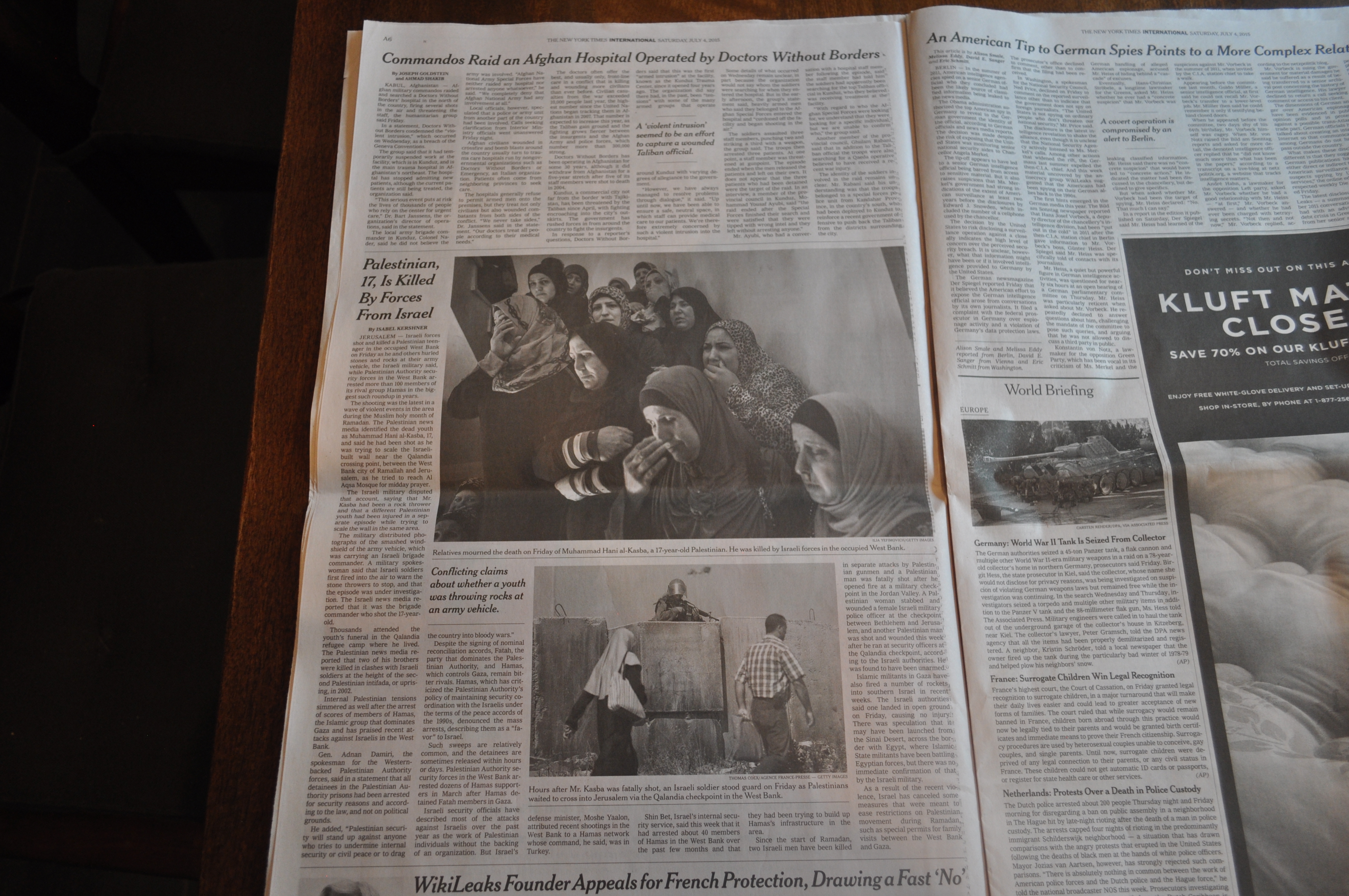
On July 4, The Times again posted two large black and white pictures alongside an article called “Palestinian, 17, is Killed by Forces from Israel.” The large photograph was of Palestinian women mourning with a caption “Relatives mourned the death on Friday of Muhammad Hani al-Kasba, a 17-year-old Palestinian. He was killed by Israeli forces in the occupied West Bank.” The smaller picture was of an Israeli soldier behind a barricade with two people walking before him. The caption read “Hours after Mr. Kasba was fatally shot, an Israeli soldier stood guard on Friday as Palestinians waited to cross to Jerusalem via the Qalandia checkpoint in the West Bank.” (Isabel Kershner)

DSC_0110

There was one news story which had two color pictures, albeit smaller than the two stories above. On June 28, the paper ran an article “Youth Chorus Unites Israelis and Palestinians, at Least for a Few Hours.” The two pictures were of a group of young men and women clapping and laughing. The caption read “Members of the Jerusalem Youth Chorus, above, took a break from rehearsing this month for their first United States tour. Micah Hendler, right, a Maryland native, founded the group.” (by Isabel Kershner)

DSC_0102

Contrast in Israeli Jews and Palestinian Arabs

The balance in the stories overall and in individual news reports was completely lacking in the New York Times.

First, consider the pictures and the stories they told: the Palestinians were dignitaries and everyday people going about life or mourning a death. They had names and professions. However, every Israeli that was pictured was a soldier and nameless. Even more, they were accused of war crimes.

Second, think of the seven attacks on Israelis Jews. They were treated as non-events and received no pictures or mention in the captions. The casual reader would not even know that such attacks occurred.

Third, review a specific story: The July 4 headline, pictures and caption would lead a reader to think that Israeli soldiers simply opened fire on a youth and that soldiers continue to patrol the intimidate the Arab population. The complete news report was that the Arab that was killed initiated an attack by hurling stones at Israeli vehicles, smashed the windows. It was in response to the Arab attack that soldiers got out of their vehicles and shot him. There were many pictures of the smashed car available that the Times could have posted as the second picture to show the complete story of the incident. Instead, it opted to convey a one-sided narrative of Palestinian Arabs as passive victims and Israelis as military oppressors.


The pictures and captions in the New York Times tell a specific narrative time after time after time: the Palestinian Arabs are passive victims under the oppression of the Israeli military. It is only these poor Arabs that suffer – unprovoked. Ordinary Israelis are not stoned, stabbed and murdered and are not subject to attacks by Palestinian Arabs. More, if there is any chance for peace in the region, it will come from Americans who will bring peace to the region.


Related First.One.Through articles

Every Picture Tells a Story, Don’t It?

Every Picture Tells a Story, the Bibi Monster

Every Picture Tells a Story- Whitewashing the World (except Israel)

The New York Times’ Buried Pictures

Flip-Flopping on the Felling of Terrorist Groups’ Founders

The New York Times reported on July 3, 2015 that “Tunisia’s most wanted jihadist” was killed in an American airstrike. The New York Times coverage stood in sharp contrast to the coverage that the paper used in covering Israel’s killing of a top jihadist in 2004.

DSC_0015
New York Times July 3, 2015 page A6

Headline: The headline from the story in 2015 was “Jihadist From Tunisia Died in Strike in Libya, U.S. Official Says” which clearly labeled the target as a “jihadist”. The way he died was framed in the passive “died” and was attributed to a “U.S. Official” speaking about the incident. This was in sharp contrast to the NYT article “Leader of Hamas killed in Airstrike by Israeli Missile” which did not suggest that the target was a militant but a “leader.” The man was “killed” in an active way, rather than simply stating that he “died”, and the method of the assassination was clearly attributed to Israeli action, rather than news reported by “US Officials.”

Opening paragraphs: A comparison of the opening paragraphs of each article shows the pattern of the Times coaxing its readers to celebrate the assassination of bad jihadists, but questioning the tactics of Israelis.

TUNIS — Tunisia’s most wanted jihadist, who masterminded a campaign of assassinations and terrorist attacks, including one against the United States Embassy in Tunis, was killed in an American airstrike in Libya in mid-June that had targeted another Al Qaeda leader, a senior United States official said on Thursday.

The jihadist, Seifallah Ben Hassine, also known as Abu Ayadh, was one of Osama bin Laden’s top lieutenants and the leader of the outlawed group Ansar al-Shariah in Tunisia. He had been based in Libya since 2013, according to reports, and ran training camps and a network of militant cells across the region.”

The article clearly spelled out that Ben Hassine was a very bad man from the very start of the article. He was the “most wanted jihadists” who led “assassination and terrorist attacks” including against American interests. If the US took out a man who launched many attacks including against Americans, it would make sense that such person got what he deserved. Heck, the article threw in two references to “Al Qaeda” and “Osama bin Laden” to convince the reader that this was a really, really bad guy.

Let’s compare the article about the targeted killing of the founder of Hamas by Israel in 2004:

JERUSALEM, Monday, March 22 Sheik Ahmed Yassin, the spiritual leader and founder of the militant Palestinian group Hamas, was killed early Monday by an Israeli missile that struck him as he left a mosque in Gaza City, his family and Hamas officials said. They said at least two bodyguards had been killed with him.

Sheik Yassin, a symbol to Palestinians of resistance to Israel and to Israelis of Palestinian terrorism, was by far the most significant Palestinian militant killed by Israel in more than three years of conflict.

The article led with the Sheik’s name. He was referred to as the “spiritual leader” who was killed while he “left a mosque.” His demise was reported by “his family.” Overall, he was regarded as much more of a religious human being than the “most wanted terrorist” in the article the attacker against the U.S.

The Times continued that the Sheik was “a symbol to Palestinians of resistance.” This phrase did many things: 1) using the term “symbol” made him appear as an uninvolved player; 2) “resistance” gave credence to a Palestinian narrative. No such equivalence was given to Tunisia’s most wanted terrorist.

While the Times stated that Yassin was the “founder of the militant Palestinian group Hamas”, it did not go on to state that the organization was considered a terrorist group by the US, EU, Israel and many other countries. Yet it did state that the Tunisian terrorist was “the leader of the outlawed group Ansar al-Shariah.”

Don’t worry. The contrasts get worse.

The NY Times then went on to praise the murder of the Tunisian terrorist:

“His death, if confirmed, would be an important victory for Tunisia in its struggle to contain a persistent insurgency in its western border region and a growing threat to its urban centers. Just last Friday, 38 people, most of them British, were massacred at a beach resort in the town of Sousse. In March, 21 people were killed when militants attacked the national museum.

The government has attributed many of the attacks to sleeper cells established by Mr. Ben Hassine when he founded Ansar al-Shariah after Tunisia’s revolution in 2011.”

The Times gave its readers the conclusion of the operation: it was “an important victory”. The people of Tunisia were struggling against a “persistent… and growing threat.” What about Israel?

“Black smoke curled over Gaza City as Palestinians began burning tires in the streets and demonstrators chanted for revenge. Mosque loudspeakers blared a message across Gaza of mourning for Sheik Yassin in the name of Hamas and another militant group, Al Aksa Martyrs Brigades.”

The Times reported that the assassination was not a step forward but a step backward. The killing of the founder of a terrorist movement in Tunisia was a step towards stability while the killing of founder of the Palestinian terrorist group was just a move to escalate a cycle of violence.

The Times emphasized the point by reporting on the recent attacks in Tunisia on tourists at a beach resort and a national museum (anyone in the world could have been one of those tourists, which elicits global sympathy). The Times failed to report on the multi-year Second Intifada which started in September 2000 in which Palestinians killed thousands of Israeli civilians. Just before the Israeli strike, Hamas took credit for two bombings at the Port of Ashdod which killed 10 people. No mention of the incident until much later in the article.


I leave the rest of the two articles for you to read. You will note that one article describes a military attack against a man with a long history of terrorist activities. The other article describes a Palestinian community in grief over the death of a “quadriplegic” without any mention of the hundreds of attacks and thousands of civilians murdered by Hamas.

It is not a coincidence that the article about Tunisia on July 3rd was next to another with a headline “Egypt fights back in Northern Sinai after Deadly Assault by Militants.”  The Times has taken to reporting that much of the world responds to militants while Israel attacks civilians and “spiritual leaders”.  The world’s responses will lead to victory and peace, while Israeli actions escalate violence.

Pretty amazing conclusions

  • from a country that has been waging wars for fourteen years, killing hundreds of thousands of people,
  • about a country that sits in the middle of region that is embroiled in civil wars and terrorist attacks that have also killed hundreds of thousands of people,
  • that is fighting against a group that has declared loudly and proudly its intentions of destroying its state

Related FirstOneThrough articles:

Double Standards: Assassinations

CNN’s Embrace of Hamas

The New York Times wants the military to defeat terrorists (but not Hamas)

Strange difference of opinion on Boko Haram and Hamas in New York Times

Differentiating Hamas

Why the Media Ignores Jihadists in Israel