The Debate About Two States is Between Arabs Themselves and Jews Themselves

The common refrain surrounding the Arab-Israeli Conflict is that the Israelis and Arabs need to find a compromise solution that will work for both parties. People on the left believe that Israel, as the entity which is much stronger than the Palestinian Authority, must make the majority of that compromise. For those on the right, Israel is the smaller party that has always been under attack by the surrounding Arab and Muslim world, and therefore will demand that Arabs must make significant concessions.

This viewpoint is valid in concept, but lacks any nuance to capture the situation as it exists today. In reality, it is the Palestinian Arabs themselves and the Israelis themselves who are torn on the path towards an enduring peace. Until each party can arrive at a consensus internally, the only bridge with consensus regarding a two state solution is found between the Palestinian Authority leadership and far left progressive Jews; a failed partnership, as the PA is despised by the Arab masses and fellow Jews in Israel and the diaspora consider the progressives a dangerous fringe group, as discussed below.

The Arabs

The Palestinian Arabs have three distinct viewpoints regarding the conflict, and a fourth approach among Israelis Arabs who share some commonality with Jews.

  1. Hamas. Hamas has no interest in a two-state solution as they believe that Israel has no right to exist. While it may make some short-term accommodations related to a cease-fire or an interim acceptance for a two-state solution, the concept of an enduring peace between two countries is abhorrent to Hamas and all of its supporters.
  2. The Palestinian Authority. The PA is a corrupt and inept kleptocracy which seeks a two-state solution to empower and enrich themselves. It has stated it will make the great “compromise” of not demanding the entirety of Israel as part of its state and “very reasonably” demand that its country be stripped of any Jews while refusing to accept Israel as a Jewish State. From such perch, the PA flies around the world with honor, pomp and circumstance while fattening their bellies as foreign nations pour money into the wallets of its leadership.
  3. The Palestinians. The Palestinian Arabs have no interest in a two-state solution according to their own polls, even if they get everything which the PA demands. They are fed up with everybody – the PA, Hamas, the Israelis and the Arab world which has forgotten about them. They view any and every deal with deep distrust.

This is not very promising. The only Palestinians who want the two-state solution today is a leadership which has no legitimacy as it is ten years past its stated term limit, and the majority of Palestinians want the acting leadership to resign.

A softer position in the Arab world which is closer to the Jewish positions on two states is held by Israeli Arabs.

Israeli Arabs. The Israeli Arabs are eager for a two state solution which looks very different than what the PA has proposed. They want NO RETURN of any Palestinian refugees into Israel. They want Israel to be recognized as the nation state of the Jewish people. They demand institutions that are transparent and devoid of any fraud – all desires which the PA will not accept.
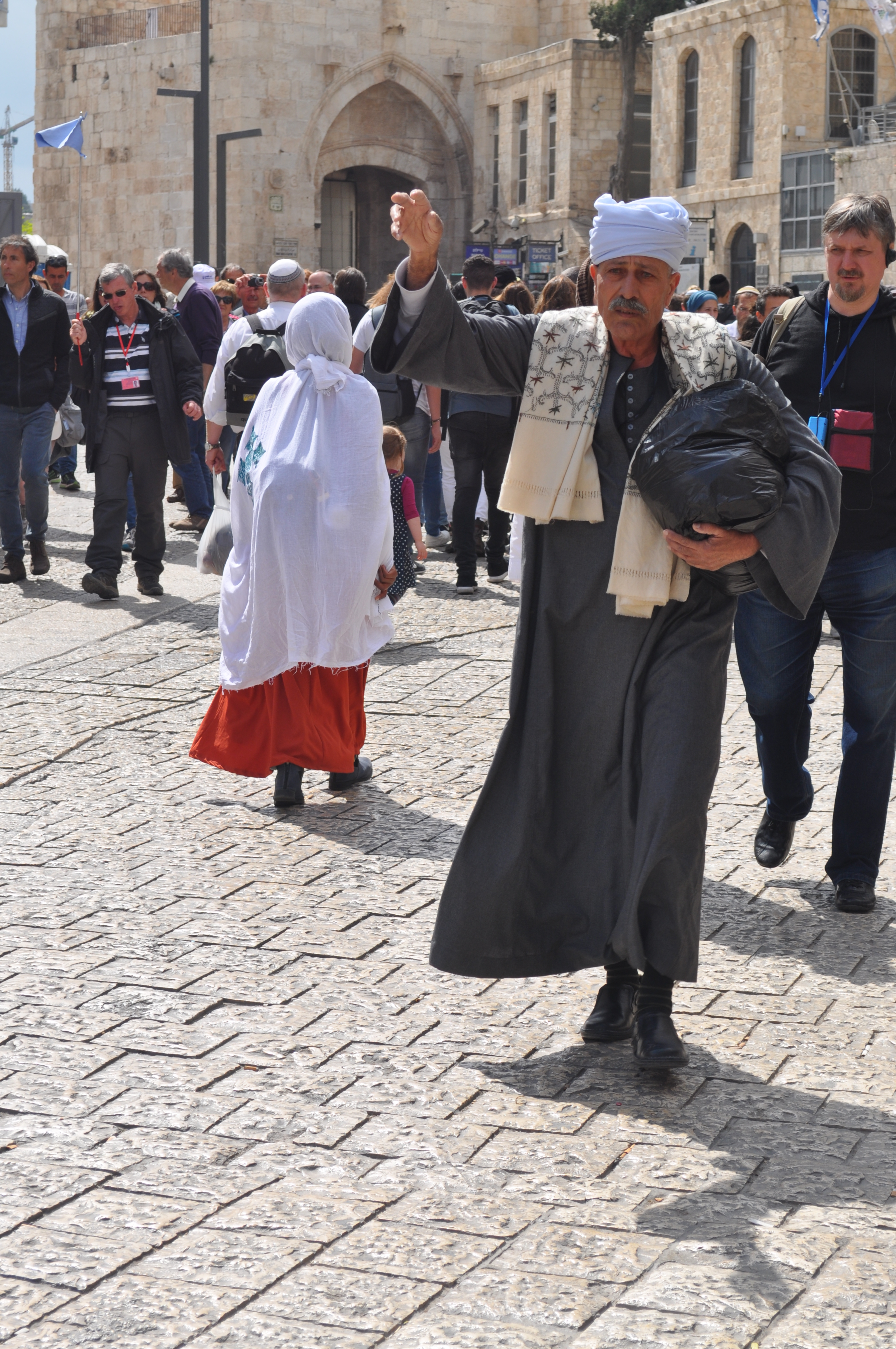

Arabs in the Old City of Jerusalem
(photo: First.One.Through)

The wide range of opinions regarding a two state-solution is not limited to Arabs, as Jews also have their own spectrum of ideas.

The Jews

  1. The Far Right. Israel has a number of political parties including Yisrael Beiteinu, United Right (each with 5 seats in the new Knesset), Zehut and the New Right (which got zero seats in the 2019 election) who support annexing Judea and Samaria/ the area east of the Green Line (EGL) commonly called the “West Bank.” The extent of Palestinian “sovereignty” would be limited to Gaza which will be denied any standing army, and essential be an entity with autonomy but will likely need to be a territory of either Egypt, Jordan or Qatar. Israel would likely never permit it to be aligned with Turkey.
  2. The Right. Is represented by the majority Likud party and Prime Minister Benjamin Netanyahu. It is in favor of annexing blocs of the West Bank such as the Gush Etzion area and Maale Adumim, but would give the Palestinian Authority large sections of the West Bank where the majority of Palestinian Arabs live including Areas A and B and parts of Area C. There would be no admittance of any Stateless Arabs from Palestine (SAPs). Good news is that the Israelis just held elections so there is clarity that this is the majority consensus view.
  3. The Left.The left is represented by the Blue and White party which came in second in the Israel elections. They would allow as many as 100,000 SAPs into Israel as part of a peace deal and give virtually the entirety of the West Bank and eastern Jerusalem to the PA. A bit further to the left in Israel are the Labor and Meretz parties in Israel (6 and 4 seats, respectively) and in the diaspora in groups like J Street and the Israel Policy Forum who oppose the notion of Israel as the Nation State of the Jewish people.
  4. The Far Left. Believes that Israel should cease to exist as a Jewish State. They advocate for folding all of Israel, the West Bank and Gaza into a bi-national state with no special rights or privileges for Jews. Essentially the Hamas platform, without the murder of Jews, but with all of the demonization. There is virtually no one in Israel with such views, but is in vocal extremist diaspora organizations like Jewish Voice for Peace, the New Israel Fund and Code Pink.

Lining up the groups against each other reveals interesting bedfellows between Arabs and Jews:

  • Hamas <> JVP/ Code Pink
  • the PA <> Labor/ J Street
  • Israeli Arabs <> Likud/ Republican Jewish Coalition
  • some Israeli Arabs <> Yisrael Beiteinu/ the New Right
  • The Palestinians <> everyone who has given up hope for any solution

Hamas, JVP, Code Pink, Students for Justice in Palestine and similar groups have tried to gain legitimacy in the public sphere. Former US President Jimmy Carter blessed Hamas despite its vile antisemitic charter and the United Nations has sought to fold it into the Palestinian Authority. Groups like SJP are getting awards on college campuses like New York University. These are hate groups and should be condemned and boycotted by everyone who wants to see an enduring peace in the Middle East. They will never be accepted by any Israeli administration forging a peace settlement, and will only make Israelis move further rightward.

J Street and progressives around the world have been reaching out to the PA as the best chance for peace. However, the PA is despised and disrespected by Palestinians. Until there are legitimate Palestinian elections, reaching out to the PA is a fool’s errand. Most Jews and conservatives see through the chimera and think J Street’s moves to weaken Israel and go against the Israeli government by advancing condemnations at the United Nations and promoting a deeply flawed Iranian nuclear deal are dangerous and divisive. The liberal media mostly follows this narrative and will promote the PA as “moderate” which is counter-factual and J Street as “mainstream” which is liberal wishful thinking. However, if they can tack towards the center instead of continuing to lurch leftward, perhaps they can be part of forging an enduring solution instead of today’s alt-left miasma.

For their part, Israeli Arabs and Likud consider the past decade a tremendous success. While the neighboring region had wars killing nearly a million people in Iraq, Syria, Yemen and other countries; with millions of war refugees scattered around the world; military coups taking over Egypt and almost Turkey; and heads of state chopped off in Libya, Israel was relatively calm. When the financial markets took the western world into an abyss, Israel emerged unscathed and its economy boomed. Riding the status quo has worked, and selectively extending that secret sauce with more global partnerships and annexing blocs of the West Bank are logical next steps.

However, the masses are unhappy. The lack of self-determination for the SAPs is not in anyone’s interest and everyone should want to see a resolution to their status. But with no consensus between the Arabs themselves and Israelis themselves, there is little hope for an enduring peace anytime soon.

It may therefore be time for some Israeli Arabs to assume a leadership role in the negotiations to help both the Arabs and Jews each reach a centrist consensus among themselves, and then ultimately with each other.


Israeli Arab women entering the Western Wall Plaza
(Photo: FirstOneThrough)


Related First.One.Through articles:

The Israeli Peace Process versus the Palestinian Divorce Proceedings

“Peace” According to Palestinian “Moderates”

The Only Precondition for MidEast Peace Talks

The Time Factor in the Israeli-Arab Conflict

The Hebron Narratives: Is it the Presence of Jews or the Israeli Military

Subscribe YouTube channel: FirstOneThrough

Join Facebook group: FirstOne Through Israel Analysis and FirstOneThrough


Israeli Arabs SUPPORT Israel as the Nation State of the Jewish People

On a good day, the mainstream media will spin narratives of alternative facts. On bad days, they will completely lie to their readership, either deliberately or through indifference to doing research which might reveal facts counter to their preferred narratives.

A favorite repeated lie for the New York Times is that Israel’s Nation State Law was anti-Arab, racist and loudly condemned by Israel Arabs (or as the Times prefers to call them, “Palestinian citizens of Israel.”). It simply is not true.

At the same time that Israel was debating and passing the new Basic Law on July 18, 2018, detailed polling was going on among Palestinians, Israeli Jews and Israeli Arabs on a wide range of issues. The splits between the various groups on different topics were interesting, but perhaps nothing was more revealing than the questions which garnered almost unanimous approvals.

The Palestinians and the Israeli Jews were divided among themselves on every issue. However, the Israeli Arabs showed overwhelming consensus on four questions:

  1. Support for the recognition that Israel is the home for Jewish people and Palestine is the home for Arab people received 84.8% approval (compared to Palestinian Arabs and Israeli Jews who only favored it by 42.9% and 61.9%, respectively).
  2. Palestinian refugees will return to Palestine and a cap of 100,000 refugees will move to Israel as part of family reunification. The balance of refugees will receive compensation, got 84.1% approval (compared to Palestinian Arabs and Israeli Jews who only favored it by 47.5% and 21.3%, respectively).
  3. The future Palestinian state and the state of Israel will both have a democratic
    political system based on rule of law, periodic elections, free press, strong parliament, independent judiciary and equal rights for religious and ethnic minorities as well as strong anti-corruption measures received 91.2% approval (compared to Palestinian Arabs and Israeli Jews who only favored it by 48.2% and 61.7%, respectively).
  4. The Israeli-Palestinian agreement will be part of a larger peace agreement
    with all Arab states according to the Arab Peace Initiative received 84.5% approval (compared to Palestinian Arabs and Israeli Jews who only favored it by 45.8% and 50.8%, respectively).

Israeli Arabs – more than Israeli Jews and Palestinian Arabs – want distinct Jewish and Arab states and want to be a protected minority in the Jewish State. They DO NOT want to see millions of refugees descend and transform Israel into a bi-national state. They want those refugees to go to a new Palestinian Arab state while they remain citizens of the nation state of the Jewish people.

That is what the Israeli Arabs say. Would you rather believe them or a media industry intent on telling you that Israel is a racist apartheid state?


Related First.One.Through articles:

What the Palestinians Were Thinking While Israelis Were Voting

An Inconvenient Truth: Palestinian Polls

The Real “Symbol of the Conflict” is Neta Sorek

Names and Narrative: “Palestinians” versus Palestinian Arabs / Israeli Arabs

The Basic Law’s “Unique” Problem

Deciphering the 2018 Basic Law in Israel – The Nation State of the Jewish People

Subscribe YouTube channel: FirstOneThrough

Join Facebook group: FirstOne Through Israel Analysis and FirstOneThrough


Israeli Arabs in the Galilee
(photo: FirstOneThrough)

What the Palestinians Were Thinking While Israelis Were Voting

While the Israelis went to the polls again to elect their government in a democratic process, the Palestinian Arabs could only watch with envy. They have not held an election since 2006, when they elected the terrorist group Hamas to 58% of Parliament. They last got to vote for a president in 2005 for what was supposed to be a four-year term. Mahmoud Abbas has opted to not hold elections for 10-plus years passed his expiry date and counting.

Political pundits will comment about what the new Israeli government will mean for the peace process, as if the tango just involved a single party. In fairness, the ineptitude and corruption of Palestinian Authority which cannot even broker a peace between the rival Fatah and Hamas parties make them easy to ignore as a counter-party for Israel. But if one wants to actually be able to achieve an enduring peace, it is important to understand what Palestinian Arabs think about their situation and the Jewish State next door.

The latest Palestinian poll results were released on April 9, 2019, on the same day as the Israeli elections, and reflect polling done March 13-16. Here is snapshot of some of the findings:

  • 60% of Palestinians want acting-President Mahmoud Abbas to resign, with 62% being dissatisfied with his job performance
  • Only 54% of Palestinians believe that the PLO is the sole legitimate representative of the Palestinian people, a low-water mark
  • More Palestinians blame their own leaders for the conditions in Gaza than Israel
  • 50% of Palestinians oppose the two-state solution; more people in Gaza support two states than people in the West Bank
  • Even if the Peace Plan contained everything that Abbas currently claims to desire (East Jerusalem capital, 1967 borders, return of refugees) only 43% of Palestinians would vote in favor of it and 52% would reject it
  • 47% support a return to armed intifada
  • 71% want an armed battalion to exist outside of the control of the Palestinian Authority
  • 64% oppose the Palestinian Authority engaging with the Trump Administration
  • 60% fear for their safety if their criticize the Palestinian leadership
  • 95% of Palestinians consider themselves religious

Based on these results, there is no pathway towards an enduring peace anytime in the near-future regardless of who leads the State of Israel. The Palestinian Arabs have no faith in their own leadership and no interest in accepting the most generous two-state solution (which Israel wouldn’t offer anyway).

It is therefore ridiculous to look at the Israeli elections through the prism of a peace process. Instead, the orientation should be about shrinking the conflict with the Stateless Arabs (SAPs); dealing with Iran and Hezbollah; establishing more diplomatic and trading partners around the world; continuing to build the economy; developing a comprehensive housing strategy; and bringing the devout communities (Haredi and Arabs) into the workforce and out of poverty.

We wish the new Israeli government best of luck in tackling these issues.


The Menorah outside of the Knesset
(photo: FirstOneThrough)


Related First.One.Through article:

In Israel, the Winner is… Democracy

Welcoming the Unpopular Non-President (Abbas) of a Non-Country (Palestine)

Related video:

The Changed Israel Knesset (music by David Bowie)

Subscribe YouTube channel: FirstOneThrough

Join Facebook group: FirstOne Through Israel Analysis and FirstOneThrough

The United Nations Bias Between Jews and Palestinians Regarding Property Rights

On December 10, 1948, the United Nations passed the Universal Declaration of Human Rights. In it, the global body sought to ensure that all people had basic human rights as laid out in the preamble:

“Whereas recognition of the inherent dignity and of the equal and inalienable rights of all members of the human family is the foundation of freedom, justice and peace in the world,”

Such rights afforded to all people included the right to own property as enumerated in Article 17:

“(1) Everyone has the right to own property alone as well as in association with others.
(2) No one shall be arbitrarily deprived of his property.”

With such understanding, it is worth delving into the rights of Jews and Arabs to own property in the holy land.

Jews Owning Property in the Holy Land

Even before the UDHR was codified, international law encouraged Jews to live and settle throughout Palestine, which at the time included areas which today are commonly called, Israel, the West Bank, Gaza and Jordan. The Mandate of Palestine of 1922 stated clearly the mission to “secure the establishment of the Jewish national home,” and encourage “close settlement by Jews on the land, including State lands and waste lands not required for public purposes.” Further, the law laid out that “[n]o discrimination of any kind shall be made between the inhabitants of Palestine on the ground of race, religion or language. No person shall be excluded from Palestine on the sole ground of his religious belief.”

International law stated that everyone – Jew, Arab and all others – could live throughout the land, but it was specifically Jews who were encouraged to settle the land and establish a national home throughout the entirety of the Palestine Mandate. Article 25 of the Mandate did allow the British to separate off the area east of the Jordan River (now known as Jordan), but it still forbade such entity from banning people from living and owning property because of their religion.

But that’s precisely what happened.

On September 23, 1922, the British separated that area into “Transjordan” and soon recognized a new government there. That government believed that Jews had no rights to own land. When Jordan invaded Israel in 1948 and took over the area now known as the “West Bank” and eastern Jerusalem, it evicted every Jew. When Jordan passed a nationality law in 1954, it specifically forbade the Jews from eastern Jerusalem and the West Bank from getting citizenship. The Jordanians also passed a law that made it a capital offense for any Arab to sell land to a Jew. The Palestinian Authority has proudly inherited and maintained that policy today.

And the world seemed to endorse this Jew-free formula.

Even beyond the dozens of Muslim states which refused to recognize the basic existence of Israel, in 2014, former US President Barack Obama chastised Jews for legally buying homes in the predominantly Arab section of eastern Jerusalem stating that the “US condemns the recent occupation of residential buildings in the neighborhood of Silwan by people whose agenda provokes tensions.” The inherent dignity of Jews to own property was viewed as secondary to the demands of the antisemitic Arab neighbors.

For Muslims nations, progressives and much of the world, the inalienable human right to own property did not cover Jews, and in their homeland, no less.

Arabs With Rights to Ancestors’ Homes

In stark contrast to Jews who uniquely have been determined as not worthy of basic human rights and dignity, the United Nations extended the property rights for Palestinian Arabs that do not exist for any other group of people.

On November 22, 1974 the UN General Assembly passed A/RES/3236 (XXIX) which granted Palestinian Arabs the rights to not just own property but the “inalienable right” to go actually “return” to homes and property where ancestors lived generations ago.

“2. Reaffirms also the inalienable right of the Palestinians to return to their homes and property from which they have been displaced and uprooted, and calls for their return;”

The concept was and remains without precedent. Do Americans have the right to return to homes in other continents where great grandparents lived 100 years ago? Even more outrageous, most of the local Arabs in Palestine did not own the house or land; it was mostly owned by wealthy people from other areas including Turkey and Syria. That is why the UNRWA definition of a “refugee” simply states that it is for “persons whose normal place of residence was Palestine,” not that they OWNED any property. Even more, the Palestinian “refugees” which concern the UN simply lived in Palestine between 1946 and 1948, with most having moved to the area from neighboring Arab lands in the preceding years.

Not surprisingly, the UN branded “Zionism is a form of racism,” and “a threat to world peace” just a year later as it pushed resolutions to eliminate Jewish rights and dignity while advancing those of the Arabs in their midst.


Jews have been uniquely stripped of their “inalienable rights” to purchase and own homes in the Jewish homeland, while Palestinian Arabs have been uniquely granted “inalienable rights” to move to houses and villages which no longer exist in a foreign country because ancestors once lived and worked there, even if they were just renting for a couple of years.

With the absurdity of such biased declarations, why should Israel pay any heed to the rantings of the rabidly antisemitic and biased body?


Related First.One.Through articles:

The Original Nakba: The Division of “TransJordan”

The Long History of Dictating Where Jews Can Live Continues

Time to Dissolve Key Principles of the “Inalienable Rights of Palestinians”

No Jews Allowed in Palestine

The Parameters of Palestinian Dignity

Compensation Fund for Palestinian Arabs’ and MENA Jews’ Lost Property

The United Nations Oxymoronic Care for Israel

The United Nations’ Adoption of Palestinians, Enables It to Only Find Fault With Israel

Subscribe YouTube channel: FirstOneThrough

Join Facebook group: FirstOne Through Israel Analysis and FirstOneThrough


Homes in the Jewish Quarter of the Old City of Jerusalem,
a city which has been majority Jewish since the 1860’s


Correcting Menendez: Israel MUST Fight the Palestinians

Senator Bob Menendez (D-NJ) took the floor at the closing of AIPAC’s 2019 conference on March 26, 2019. While he spoke forcefully for the US-Israel alliance and the need to fight antisemitism in all of its manifestations from the right and the left, he softened his tone when it came to Palestinian Arabs. At 4:20 of his remarks, he said the following about Israel responding to rocket attacks from Gaza:

“Israel has every right to defend herself, to hold her perpetrators accountable, and to defend the safety and security of her people.”

Israel does not defend itself as a right, but an OBLIGATION. A government is meaningless if its primary purpose is not to actively and forcefully defend its citizens and borders from attacks. Menendez calling the response of Israel a “right” softens the role of the Israeli government. The government has a “right” to engage in trade policy with another country. It has a “right” to decide who to let into the country. But defense is not a “right” which may or may not be acted upon; defense is an obligation – and the primary one – for every government in the world.

Menendez similarly made another comment softening the lines in the Arab-Israeli Conflict. At 5:20, Menendez said the following:

“Hamas has hoodwinked the people of Gaza who remain oppressed by terrible economic hardship and increasing political crackdowns.”

Why did Menendez strip the Gazans of responsibility for their situation and paint them as suffering victims? Hamas isn’t simply a terrorist group like ISIS – it’s an official political party of the Palestinians, no different than the Republican and Democratic parties. The Palestinian Arabs elected Hamas to 58% of the parliament, a whopping majority, even though the Hamas Charter is the most vile antisemitic charter on the planet, calling for the death of Jews and destruction of Israel. Further, if presidential elections were held, Hamas would have beaten Fatah in every single poll, except for the most recent one in March 2019, and the only reasons for Hamas’s drop in the polls was Palestinians loving Fatah’s Mahmoud Abbas’s refusal to soften his stance on paying the families of terrorists who murder Israelis, and Arab anger over Hamas’s crackdown on protests. But make no mistake: between one-third and one-half of all Palestinians still want an “armed struggle” against Israel.

Israel is not in an optional battle against a rogue terrorist entity; it is in an ongoing war against a people at its borders who want to destroy it. If a proud defender of Israel like Bob Menendez cannot articulate that clearly, how can we expect more from the ill-informed members of Congress?


Related First.One.Through articles:

What do you Recognize in the Palestinians?

It’s the Democracy, Stupid

Cause and Effect: Making Gaza

Extreme and Mainstream. Germany 1933; West Bank & Gaza Today

The Highbrow Anti-Semite

The Palestinians aren’t “Resorting to Violence”; They are Murdering and Waging War

Subscribe YouTube channel: FirstOneThrough

Join Facebook group: FirstOne Through Israel Analysis and FirstOneThrough


The United Nations Oxymoronic Care for Israel

The United Nations Special Coordinator for the Middle East Peace Process, Nickolay Mladenov, gave the UN Security Council a briefing on February 20, 2019. It included the following two sentences to conclude his introductory remarks:

“An international community that understands that the weaker party – the Palestinian people who have lived under occupation for more than fifty years – need our support more than ever.

“It should never be about Israel or Palestine, it should be about Israel and Palestine.“

The concluding comment is one that seemingly people on all sides of the conflict could support – establishing a framework that is both pro-Israel and pro-Palestinian; a scenario in which all of the parties are supported.


Nickolay Mladenov

But the immediately preceding comment makes clear that the aim of the UN is NOT to support both parties, but only “the weaker party – the Palestinian people.”

This sentiment rallies the alt-left, that the weaker party is always the one to be embraced, regardless of whether it is moral or ethical. Progressives therefore embrace such toxic notions that the Palestinian Authority is right to pay the families of Arab murderers of Israeli Jews, because the families of those murderers are poor and stateless. The evil is rationalized, normalized.

For the alt-left, it is an appalling blessing of murder. For the United Nations, it continues a long history of virulent anti-Zionist behavior.


Related First.One.Through articles:

Eyal Gilad Naftali Klinghoffer. The new Blood Libel.

The Liberals in Canada are Following Obama in Turning on Israel

The UN Never Demands Justice for Palestinian Killers

The United Nations Once Again “Encourages” Hamas

The Hollowness of the United Nations’ “All”

The United Nations’ Select Concern for Arson in the Middle East

Subscribe YouTube channel: FirstOneThrough

Join Facebook group: FirstOne Through Israel Analysis and FirstOneThrough

The UN Never Demands Justice for Palestinian Killers

The United Nations Special Coordinator for Middle East Peace, Nickolay Mladenov, is forever busily tweeting and making statements about the violence in the Arab-Israel Conflict. Curiously, while he often condemns all acts of violence, he uses very different language when the attackers are either Israelis or Palestinians. When an Israeli commits the attack, Mladenov demands that the perpetrator be brought to justice, however, when a Palestinian commits the attack, all Mladenov can muster is a generic condemnation of terror.

Consider Mladenov’s Tweet on February 10, 2019 about the horrific intentional butchering of a teenage Israeli woman:

I’m appalled by the horrific murder of 19-year old , by a Palestinian perpetrator in . My deepest condolences to Ori’s family. There is no justification for violence and terror. Such brutal acts must be condemned by all.

While Mladenov condemned the violence and noted that a Palestinian was the perpetrator, he did not call for the Arab killer to be brought to justice. That is in sharp contrast to how Mladenov reacted towards violence from Israelis.

Here is Mladenov’s Tweet from January 26:

Today’s violence in is shocking & unacceptable! must put an end to settler violence & bring those responsible to justice. My thoughts & prayers go out to the family of the man killed & those injured. All must condemn violence, stand up to terror.

Not only did Mladenov not demand that the Palestinian killer be brought to justice, he didn’t demand that the Palestinian Authority stop the violence.

When it came to Arab-on-Arab violence, as on January 3, 2019 when Palestinian PM Rami Hamdallah’s motorcade came under attack, Mladenov again called for justice:

The attack on PM convoy on Christmas is a very worrying incident. It is absolutely unacceptable & the perpetrators must be brought to justice. Stones can kill— it was at the same spot where  lost her life in October. Such violence must stop

Whether the violence is initiated by Israelis or Palestinians, the only party for whom the UN seeks justice are Palestinian Arabs.

Some other examples:

I acknowledge efforts by to prevent settler-related violence. Further measures are needed to ensure that it fulfills its obligation to protect civilians and hold accountable those responsible for attacks.

The best Mladenov can muster when Jews are attacked is saying that there is no justification for the attack, a generic comment which is far from demanding that the Arab killers be punished.

I condemn the recent drive-by shooting near Ofra where 7 were injured and a pregnant woman whose baby was delivered prematurely and has tragically passed away. There is no justification for terror and I call on all to condemn it.

I condemn this Friday’s attack in the in which a woman was killed and her husband injured by stones allegedly thrown by assailants. Those responsible must be swiftly brought to justice. I urge all to stand up to violence and terror.

I extend my condolences to the family of , an Israeli-American civilian, who was stabbed in the yesterday. Everyone must stand up violence and condemn .

Shocked by the murder of an man yesterday by a teen in the . My thoughts and prayers go out to the bereved family. Such horrible acts serve only those who stand in the way of . Terror must be condemned by all.

There was only one time when Mladenov demanded that a Palestinian murderer be brought to justice, but even then he didn’t mention the killer’s background or ethnicity:

There is no justification for and those who condone it, praise it or glorify it. This is not the path to ! The perpetrators of yesterday’s attack must be brought to justice.

When the United Nations continually demands that Jewish terrorists be “brought to justice,” but does not similarly call upon Palestinian Arab terrorists to be punished for butchering Israelis, it reiterates its unceasing bias against Israel. Without a basic notion of justice for Israelis, the resolutions the UN passes against Israel are meaningless Palestinian propaganda posters without a shred of moral significance.

For many years, the UN has stood as a crude tool of despots and dictators, pretending to have an iota of credibility. But time and again the shroud of respectability falls revealing the UN’s pathetic utility as a blunt instrument in the Muslim and Arab war against the Jewish State.


Related First.One.Through articles:

The United Nations’ Adoption of Palestinians, Enables It to Only Find Fault With Israel

The United Nations Can Hear the Songs of Gazans, but Cannot See Their Rockets

The UN Does Not Want Palestinian Terrorists to be Held Accountable

The UN Can’t Support Israel’s Fight on Terrorism since it Considers Israel the Terrorists

The Only Religious Extremists for the United Nations are “Jewish Extremists”

What’s “Outrageous” for the United Nations

The United Nations Once Again “Encourages” Hamas

The Hollowness of the United Nations’ “All”

UN Comments on the Murder of Innocents: Itamar and Duma

Subscribe YouTube channel: FirstOneThrough

Join Facebook group: FirstOne Through Israel Analysis and FirstOneThrough


The Shrapnel of Intent

“The diameter of the bomb was thirty centimeters
and the diameter of its effective range about seven meters,
with four dead and eleven wounded.
And around these, in a larger circle
of pain and time, two hospitals are scattered
and one graveyard. But the young woman
who was buried in the city she came from,
at a distance of more than a hundred kilometers,
enlarges the circle considerably,
and the solitary man mourning her death
at the distant shores of a country far across the sea
includes the entire world in the circle.
And I won’t even mention the howl of orphans
that reaches up to the throne of God and
beyond, making
a circle with no end and no God.”

“The Diameter of a Bomb”
Yehuda Amichai (1924 – 2000)


Yehuda Amichai moved to Palestine from Germany in 1936, as the Nazi war against the Jews was emerging in Europe, and the Arab war against the Zionists was gathering steam in Palestine. He would fight together with the British army in World War II and with the Jewish Defense Forces in Israel’s War of Independence in 1948-9. He would later become one of Israel’s most treasured poets, winning the Israel Prize for poetry in 1982 for his collection of works he penned in Hebrew. He died at the age of 76, at the start of the Second Intifada in September 2000.

Like all living things, Amichai’s life had a beginning and end. However, his works touched upon deeper truths which surpassed both time and geography. In a life framed by antisemitism and rejection, his words brought the Jewish people a mixture of bitterness, longing, anger and comfort about the hatred and violence they all endured.

The poem above is such an example regarding how the diameter of a bomb doesn’t begin to explain the sphere of its impact. While the scars are physical, the trauma is mental; the explosion may be ephemeral, but the shock is eternal.

Amichai’s words resonated deeply for the small global Jewish community which suffered from constant attacks both in Israel and in the diaspora. In Europe and Russia during the 20th century, millions of Jews were slaughtered while the Jews in Arab countries were expelled. The physical pain experienced by one Jew touched their cousins around the world. The grief was shared.

But the pain experienced by the Jews in Israel from multiple Arab wars and countless terrorist attacks carried an extra burden for world Jewry. While the emotional trauma of fellow Jews slaughtered and maimed reinforced the constant haunting echo of antisemitism, the attacks on the Jews in Zion also compromised the Promised Land. A place of holiness became a house of mourning. The collective Jewish inheritance bestowed by God was being ravaged in an unholy assault.

Since the beginning of the rebirth of the Jewish State in the early 1900’s, Jews and pro-Israel people around the world have been emotionally connected to the terrorism and wars inflicted upon Israeli Jews. Amichai’s poem noted that local Israeli tragedies encircled the world in grief. The bombs severed limbs and cut lives short, yet they connected everyone.

But something changed drastically over the past dozen years. The tragedies befalling Israeli Jews are now perceived through different lenses for both Israeli Jews and the Zionist community around the world.

The Changed Israeli Perspective: The Bombers

The beginning of the altered Israeli perspective began as the Second Intifada was born at the failure of the Oslo Accords.

The September 1995 Oslo II Accords were scheduled to reach a conclusive peace agreement in five years, in September 2000. However, when the Palestinian Arab leadership under Yasser Arafat was not able to secure 100% of his desired goals, he launched waves of attacks against Jewish civilians, killing hundreds of people over several years.

The ramification of the Second Intifada was not only the hundreds of murdered Israelis, but the penetrating shock waves that rippled through Israeli society which left permanent scars. Israelis internalized that the conflict was not about land as they had hoped, or about Palestinian “refugees” as they had been told. Israelis concluded that people who would intentionally slaughter children because they did not get a 100% of their demands, would never allow the Jewish State to exist on even 1% of the land. The Second Intifada scorched the psyche of Israelis that the Palestinians rejected the basic presence of Jews and the existence of the Jewish State. No enduring peace could ever be achieved with such Arab sentiment.

The shrapnel of intent of the bombers of the Second Intifada entered the minds of Israelis altering their views of the Palestinian Arabs, while the heat of the blasts incinerated the Israeli doves. The dream of peace with such murderers was reckoned a fantasy too dangerous to pursue and impossible to achieve.

In light of their new perspectives, the Israelis altered direction in dealing with the Palestinian Arabs. They erected a security barrier between the Arabs in the West Bank and Israel, and have elected a series of right-of-center governments. All to the chagrin of the liberals in the diaspora.

The Changed Diaspora Perspective: Untouched

Yossi Klein Halevi, an American-Israeli author who works at the left-of-center Shalom Hartman Institute recently wrote a book called  “Letters to My Palestinian Neighbor,” which captures some of the divide between the American left-wing and Israelis. In describing the book, he talked about the anguish of his dream of peace with Palestinian Arabs being destroyed by the Second Intifada.

“The Second Intifada brought the right back to power and nearly destroyed the Israeli left, something the international community still hasn’t internalized.”

For Israelis, the Second Intifada was different than the wars and terrorism before 2000. The Israelis felt that they had stretched far to achieve peace and were rewarded with the massacre of innocents. Even after the Second Intifada, when the Palestinians got to hold open elections for their parliament for the first time in 2006, they elected the terrorist group Hamas to a 58% majority. When Israel left Gaza in 2005, it was rewarded with wars in 2008, 2012 and 2014. And regarding people living and working side-by-side, the coexistence was paid for with stabbings and car rammings – literally funded by the Palestinian Authority.

Unlike Yehuda Amichai’s poem, liberals outside of Israel were not deeply touched by the Second Intifada. The Jewish diaspora didn’t see the pizza store and bus bombings of the 2000’s as markedly different than Palestinians shooting up schools or hijacking planes in the 1970’s: the Palestinian Arabs were still seeking 100% of their demands and the Israelis were not compromising nearly enough. The Israelis concluded that the counter-party was forever false, while the international community was occupied counting refugees and square kilometers of land.

While Israelis became convinced that the Palestinians rejected any enduring peace with the Jewish State, the left-wing diaspora was certain that the Israelis were never going to give the Arabs everything they demanded without external pressure. The viewpoints were different; the near term objectives were different; and one party was going to force the other to adhere to its terms.


Amichai’s poem concluded with a bond of empathy that surpassed boundaries: deeper truths surpass raw figures. While Israelis gained clarity of their relationship with the Palestinians in witnessing their pathological reaction to minuscule gaps in an agreement, the international community and liberal diaspora Jews were tracing the invisible 1949 Armistice Lines.

The difference in reactions opened a wide divide in the relationship.

Since the Second Intifada, the diameter of Palestinian bombs no longer encircles and binds Israeli Jews and liberal diaspora Jews. Until the shrapnel of intent penetrates the minds of the international community, the chasm in the relationship is only likely to widen.


Related First.One.Through articles:

Pray for a Lack of “Proportionately” in Numbers. There will never be an Equivalence of Intent.

The Cancer in the Arab-Israeli Conflict

The Non-Orthodox Jewish Denominations Fight Israel

Israel’s Peers and Neighbors

The Proud Fathers of Palestinian Terrorists

For Liberals, It’s Israelis, Palestinians, and Indifference

The Impossible Liberal Standard

Related First.One.Through videos:

The 2011 Massacre of the Fogels in Itamar (Music by Gorecki)

Subscribe YouTube channel: FirstOneThrough

Join Facebook group: FirstOne Through Israel Analysis and FirstOneThrough

The Real “Symbol of the Conflict” is Neta Sorek

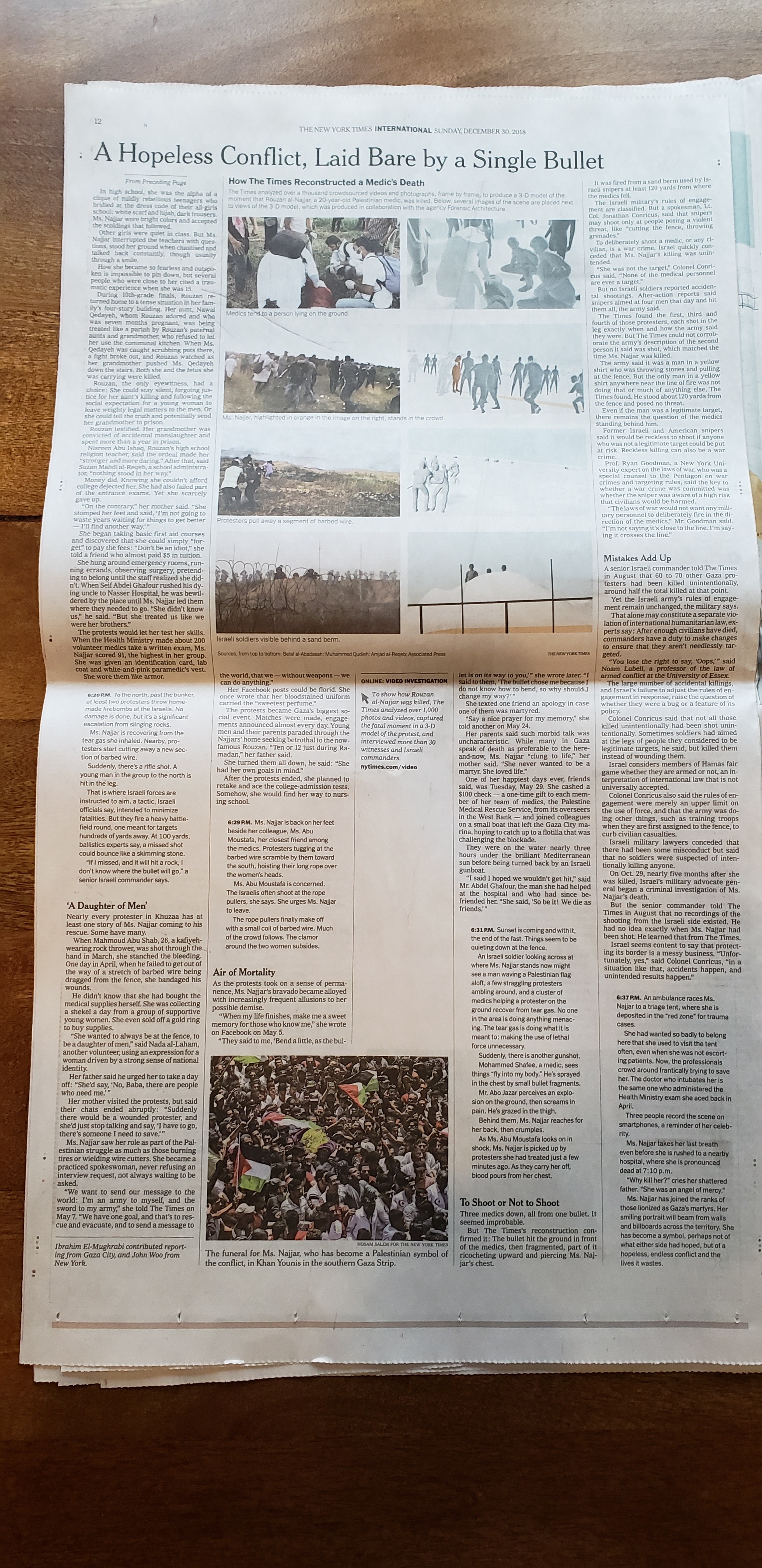
The New York Times spared no ink to report on an incident in the Israeli-Arab Conflict on December 30, 2018. In a large front page picture and story which covered a full three additional pages, the Times wrote a detailed story which it called “a symbol of the conflict.”


Spread of NY Times on Israeli soldier shooting Palestinian medic
December 30, 2018

The tragic story of a female Palestinian medic being killed is an unfortunate incident but does not scratch the surface about the essence of the conflict itself. That the Times would repeat over-and-again that the incident is a “symbol” says more about the Times perception of the conflict than the actual situation itself.

The Times elaborate “symbolic” story was of

  • a killing of a Palestinian, not an Israeli,
  • in Gaza, not in Israel,
  • by a soldier, not a civilian,
  • where the separation fence held, and was not cut through

But the entire nature of the conflict stems from Palestinian Arabs rejection of the Jewish State and Jews living in Israel. It is not about the recent “Gaza Blockade” or a Palestinian protest to those actions taken by Israel, Egypt and the Palestinian Authority, as the Times attests.

A true symbol of the conflict can be seen in the murder of another woman, by the name of Neta Sorek.


Neta Sorek, Israeli woman killed while walking near Beit Shemesh, Israel
by Palestinian Arabs on February 24, 2010

Neta Sorek was an English teacher in the Israeli city of Zichron Yaakov. A proud feminist, she was also a strong advocate for peace with Palestinian Arabs, and held many events together with Arabs as a member of the group Women for Peace.

But this Israeli’s quest for peace was rewarded with murder.

On February 24, 2010, a few Palestinian Arabs found a gap in the security barrier Israeli had constructed to stem the wave of Arab killers coming from the West Bank. The Arabs robbed a car in the Israeli city of Beit Shemesh and drove to a nearby Christian monastery waiting for nightfall to assault unarmed Jews. Neta happened to be there at the monastery, enjoying the surrounding gardens by herself. The Arabs saw her and stabbed her to death. The Arabs then escaped back through the barrier into the West Bank.

A few months later, on December 18, the same Palestinian Arabs came through the barrier again. This time, they found two women going for a walk in the Mata forest near Beit Shemesh. Kristine Luken, an American Christian who was visiting Israel to gain a deeper connection to God was there with her friend, Kay Wilson, an Israeli tour guide who was escorting her on her journey. The Arabs attacked both women, killing Luken while Wilson managed to survive despite over a dozen stab wounds.


The real “symbol of the conflict” is a slaughtered Jewish feminist peace activist by Palestinian Arabs who infiltrated Israel. That horrific story – and of subsequent attacks by Palestinian Arabs – highlights the rabid Arab antisemitism at the core of the standoff and underscores the reason Israel was compelled to build – and continue to maintain – the security barriers in Gaza and the West Bank.

But the New York Times tells its readers otherwise. It declared that the conflict is about Israeli soldiers (“the far stronger party“), sitting comfortably behind a fence shooting at unarmed women in Gaza, amounting to war crimes. The Times deployed five journalists (David Halbfinger, Yousur Al-Hlou, Malachy Brown, Iyad Abuhewila and Neil Collier) and wrote 2000+ words with multiple pictures and graphics about the “symbol of the conflict,” to which Israel “refuses to find a solution.” The authors never mentioned Hamas’s stated mission for destroying Israel, the Palestinians electing Hamas to 58% of Parliament, or their preference to elect a Hamas leader as the next president in every poll. The core of the conflict was concealed; the perpetrators were cast as victims.

And what about Neta Sorek? Like the murdered woman in the Times article, she was a feminist. She was unarmed. She was killed by the opposing side.

Good luck finding a single word or picture of her in The New York Times.

Even the murdered American woman, Kristine Luken would get no ink, until a year later when four Palestinians were sentenced for her murder and that of Neta Sorek.

A microcosm of the conflict played out in the gardens of a Christian monastery in Israel, where a country that welcomes people of all religions became a crime scene. A woman who strove for peace was slaughtered for the simple reason that she was Jewish by Arab assailants who wanted to rid the region of Jews. The Muslim terrorists found a hole in the Jewish State’s defenses and seized the opportunity to commit murder, repeatedly until caught.

Not for The New York Times. It believes that Israel is a racist right-wing colonial occupier of Arab land, indifferent to non-Jewish lives.

The symbol of #AlternativeFacts is the New York Times.


Related First.One.Through articles:

A Review of the The New York Times Anti-Israel Bias

Paying to Murder Jews: From Iraq, Saudi Arabia and Iran to the Palestinian Authority

Reviewing the Rhetoric of Palestinian Arabs and Israelis

The Proud Fathers of Palestinian Terrorists

Subscribe YouTube channel: FirstOneThrough

Join Facebook group: FirstOne Through Israel Analysis

Not Remembering, Forgetting and Never Knowing

While the Bible is one of the oldest texts in history, it contains important lessons about memory and history within its own stories.

One of the great episodes in the book of Genesis was about Joseph interpreting dreams for a baker and cup-bearer while they all sat in prison. Joseph correctly interpreted the dreams of both people, with the baker ultimately being killed while the cup-bearer was returned to his position in court. In exchange for his services, Joseph only asked that the cup-bearer remember him so that he could also gain his freedom: “Only remember me, when it is well with you, and please do me the kindness to mention me to Pharaoh, and so get me out of this house.” (Genesis 40:14)

But the cup-bearer did not do as Joseph asked: “Yet the chief cupbearer did not remember Joseph, but forgot him.” (Genesis 40:23)

The text above is seemingly redundant. Why state that the cupbearer both “did not remember” Joseph and then again “forgot him”?

Was this dynamic a precursor for the story of Joseph played out years later, when Joseph was forgotten again after he died? “Now there arose a new king over Egypt, who did not know Joseph.” (Exodus 1:8)

Not Remembering versus Forgetting

Not remembering someone is seemingly not a malicious act. A person could not be remembered because of other activities which gathered more attention or because the person was simply not present.

As opposed to not remembering which is a passive act, forgetting is an active verb. It suggests a willful desire to not recall a person or action.

In the world of social media, not remembering could be akin to not thinking of someone because they didn’t post anything for some time. Forgetting someone would be closer to unfriending the person. The former is a momentary occasion that comes from a lack of stimuli, whereas the latter comes from deliberate dismissal.

In the Bible story, the cupbearer may have not remembered Joseph because he was busy attending to Pharaoh. However, the forgetting of Joseph may have been a deliberate disregard for Joseph because he had nothing to offer anymore. Only when the cupbearer heard of Pharaoh’s dreams and had a chance to gain his master’s good graces, was Joseph actively recalled. Forgetting was tied to self-absorption and selfishness.

Not Knowing

One could perhaps forgive the new king of Egypt for not knowing Joseph as relayed in the beginning of Exodus. If two people never met – perhaps because they lived in different generations – there was obviously no ill will, just circumstances.

But the introduction of Exodus tells us not to be so casual in the reading of the new king not knowing Joseph.

Exodus 1:1 “These are the names of the sons of Israel who went to Egypt with Jacob, each with his family.” The bible had just ended Genesis with a full accounting of the children of Jacob; why list them here?

Rashi states that it was because the children of Jacob were dear to God and therefore worth remembering, even when deceased. Other commentators say that the extra word “names” in the sentence conveys that their reputations continued to live on.

If that is so, how could it be that Joseph – more famous than any of Jacob’s sons – who had saved Egypt and the entire Middle East from famine a generation earlier, could not have been remembered by the new Egyptian king? Did the prior generation passively not remember and actively forget the efforts of Joseph just like the cupbearer? It seems unfathomable that such events and good deeds could have been easily forgotten. The “not knowing” seemingly was connected to active disinformation to disassociate Joseph from Egypt’s success through the famine. Perhaps the new Egyptian king sought to elevate the reputation of himself and his family by rewriting history.

The Bible tells us right after the new king’s unfamiliarity with Joseph, that the Israelites were viewed with suspicion and then enslaved. Historic allies became enemies. People who had lived together side-by-side were suddenly in a hierarchical ecosystem.

When the cupbearer forgot Joseph, a single person forgot a single person’s actions, and the repercussion was that Joseph remained in prison. However, when the actions of Joseph saving all of Egypt were wiped from memory, the entirety of the Jewish people became enslaved.

The situation of denying history with horrible consequences continues today.

Jews in Israel Today

The history of Jews in Israel is not only being forgotten, it is being rewritten.

Over the past few decades, the Arab and Muslim world have been very active in denying and recasting Jewish history.

  • Holocaust denial. The leaders of Iran and the Palestinian Authority have taken a variety of approaches in denying the deliberate slaughter of 6 million Jews in Europe, ranging from denying that the event happened to arguing that Zionists plotted with the Nazis to enable the creation of a Jewish State in Palestine (yes, that was the essence of Mahmoud Abbas’ doctoral thesis).
  • The Jewish State was founded in reaction to the Holocaust. In a curious bit of mind-bending, the same people that deny the Holocaust existed, argue that the world gave Palestine to the Jews out of guilt. The 3,500 years of Jewish history is ignored as are the modern international laws of 1920 and 1922 (which predate the Holocaust), explicitly laying out the history of Jews in Palestine and reestablishing their homeland.
  • No Jews lived in Israel. The Arab and Muslim world deny that Jews have any history in Israel. They have gone to such lengths as to hold up the United Nations from putting on a display showcasing Jews’ 3,500 year history in Israel.
  • There was Never a Temple in Jerusalem. Yasser Arafat and various members of the Arab and Muslim world have denied the existence of the two Jewish Temples on the Temple Mount in Jerusalem.
  • Jerusalem is a Muslim city. The city of Jerusalem (both eastern and western) has had a Jewish majority since the 1860s. You’d have a hard time knowing that from the consistent lies that Jerusalem is losing its “Arab character.”
  • Palestinians are Canaanites. Beyond denying Jewish history, Palestinian leaders have tried to rewrite their own history, stating that Palestinians are descendants of Canaanites who predate Abraham’s arrival in Israel, even though Arabs only arrived en masse to Israel in the 7th century (the descendants of ancient Canaanites are actually Lebanese). More “Palestinian” Arabs arrived during the British Mandate 1922-1948, than Jews, from countries including Iraq and Egypt.

These are not examples of “not remembering” or forgetting, but much more aggressive deliberate denials of history. And the aim of the Jew-haters is clear: cement the position that Jews are interlopers and foreign colonialists in Arab land. That is the revised history which they want people to know.

The Arab and Muslim countries use their vast numbers – over 1.6 billion people and over 50 countries – to change Jewish history at the United Nations and in school textbooks where they are in power.

  • UN resolutions refer to the Jewish Temple Mount by an Arabic name
  • UN agency resolutions claim that Israel is changing the Arab character of Jerusalem
  • UN resolutions condemn Israel for changing the Muslim character of Jewish sites such as the Cave of the Jewish Patriarchs in Hebron and the Tomb of Rachel in Bethlehem

As the eradication of Jewish heritage and history takes root, the next generation of millennials have begun to look at Jews in Israel with disgust. Why are all of these Jews in Arab land? Like Pharaoh in ancient times, they do not know the long and deep history of Jews in the holy land. For the millennials and progressives, those “facts” are stories of fantasy only believed by Evangelical Christians and far-right Orthodox Jews. The only history they know and accept is presented by AJ+ and those backed by Arab and Muslim money funneled into their universities.

Corrective Course

For those who care about history – and remembering actual history – there are a number of actions to take:

  • Insert the word “Jewish” into the Sites. Whether it’s on road signs or maps, whether it’s the Cave of the JEWISH Patriarchs or the JEWISH Temple Mount, reinforce history, be clear that these have always been Jewish sites.
  • Mark HISTORIC dates of Israel’s cities, not just modern ones. It is wonderful to celebrate Jerusalem Day in June on the anniversary of Jerusalem being reunited. But why not celebrate the day that King David took the city 3,000 years ago; mark Hebron Day when Abraham bought the Cave of Machpelah to bury his wife Sarah.; Jericho Day, for when Joshua conquered the first city when the Jews came back to their Promised Land; etc.
  • Teach Tanakh in schools. Jewish Day Schools barely teach the stories of the prophets. Only 18 of the 54 parshas in the Torah have a haftorah which includes a section from the historical accounts described in Joshua, Judges, Samuel I & II and Kings I & II. And these short sections are often ignored by people when read on Sabbath. Young and old Jews need to better understand their own history and should read the stories together with maps laying out where the events took place.
  • Endow Israel Studies programs at universities. Iran and Saudi Arabia are funding universities throughout the United States. It is no surprise that the schools getting multi-million dollar gifts for Persian studies like UC Berkeley and Princeton, also have many anti-Israel professors. It is time to have more than three American universities with strong Israel studies programs.
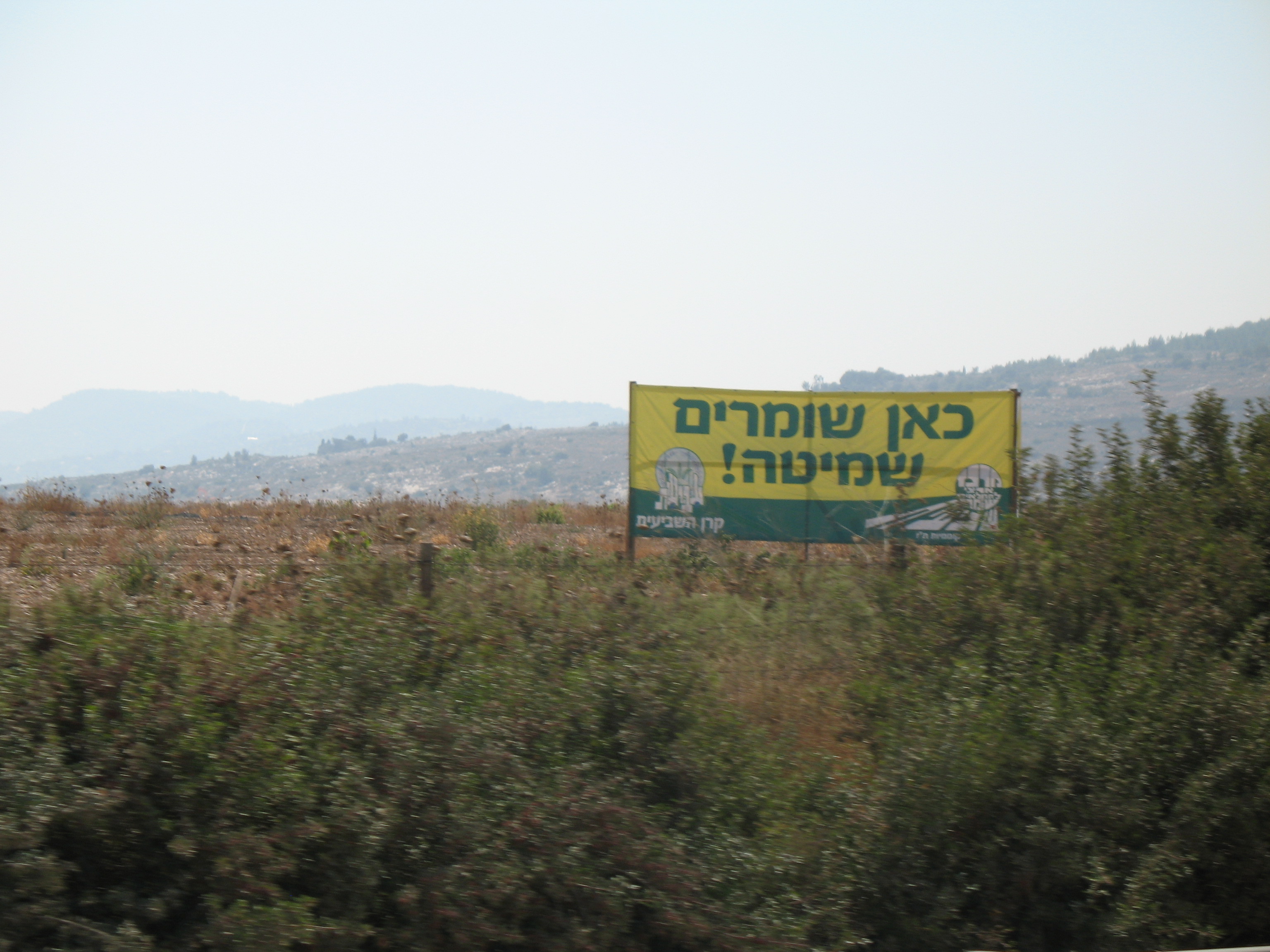
  • Observe Judaism in Israel. The Bible commands Jews – at a minimum a Jewish king – to write a sefer Torah, so have a permanent sofer, a Torah scribe, at the Kotel or at the City of David just south of the Jewish Temple Mount where Kings David and Solomon had their palaces. Replace the siren that marks the entry of Sabbath and Jewish holidays with the sound of a shofar from the same loudspeakers. Mark every field that observes shmita with a large sign, including the verses from the bible declaring such law. etc.

The United States and other countries can also take actions:

Reject any UN Resolution out of hand that does not:

  • mention the “Jewish Temple Mount” when referencing the “Al Aqsa Compound”
  • note that Jerusalem has had a Jewish majority since the 1860s whenever it discusses the “Arab character of Jerusalem”
  • Refer to the region as “Judea and Samaria” whenever it refers to the “West Bank”
  • Comment that the Jordanians and Palestinians ethnically cleansed Judea and Samaria and the eastern part of Jerusalem in 1949, in any resolution which accuses Israel of committing “ethnic cleansing”

Arab and Muslim nations have waged an assault on Jewish history, and the alt-left have become willing disciples. People who care about truth, Jews and Zionism must counter this affront with a comparable campaign to remember and not forget the long and remarkable history of Jews in the Jewish holy land.


Related First.One.Through articles:

The Cave of the Jewish Matriarch and Arab Cultural Appropriation

The Countries that Acknowledge the Jewish Temple May Surprise You

Squeezing Zionism

Iran’s New Favorite Jewish Scholars

The UN’s Disinterest in Jewish Rights at Jewish Holy Places

The New York Times Inverts the History of Jerusalem

The New York Times will Keep on Telling You: Jews are not Native to Israel

Losing the Temples, Knowledge and Caring

In Defense of Foundation Principles

Related First.One.Through video:

Judea and Samaria (Music by the Foo Fighters)

10 Ignored Facts about Jews and Muslim Populations in Israel (Music by Seal)

Who are the Palestinians (Music by The Who)

Subscribe YouTube channel: FirstOneThrough

Join Facebook group: FirstOne Through Israel Analysis