New York City Mayor Zohran Mamdani just appointed Ana Maria Archila of the Working Families Party to lead the Mayor’s Office of International Affairs. She will serve as the city’s chief liaison to the United Nations and the State Department.
She doesn’t care much for Israeli Jews.
In 2018, Archila became a national symbol of “believe survivors” during the confirmation fight over Brett Kavanaugh. She demanded that allegations of sexual violence be treated with complete moral seriousness.
Yet in June 2024, she had no issue championing Rep. Jamaal Bowman who had taken to the streets of his district after the heinous October 7, 2023 Arab massacre of Israelis to yell to a crowd that the story of Hamas raping Jewish women was a lie.
To add toxic fuel to the fire, while dozens of Jewish Israeli women remained captive in the terror tunnels of Gaza by the Palestinian leadership, Archila yelled at the Bowman rally (4:47) that “we end foreign policy that keeps Palestinian people in shambles and Palestine in shackles.” That is not an exaggeration: she came out to a rally to support a rape denier and yelled that the victims of kidnapping were actually the perpetrators.
Now Mayor Zohran Mamdani is elevating Archila into an international-facing role for New York City, the city with the largest Jewish population outside Israel.
In the alt-left political establishment in New York City today, raped Jewish women are not to be believed, their kidnapping is to be mocked, and their tormentors are to be canonized before cheering crowds.
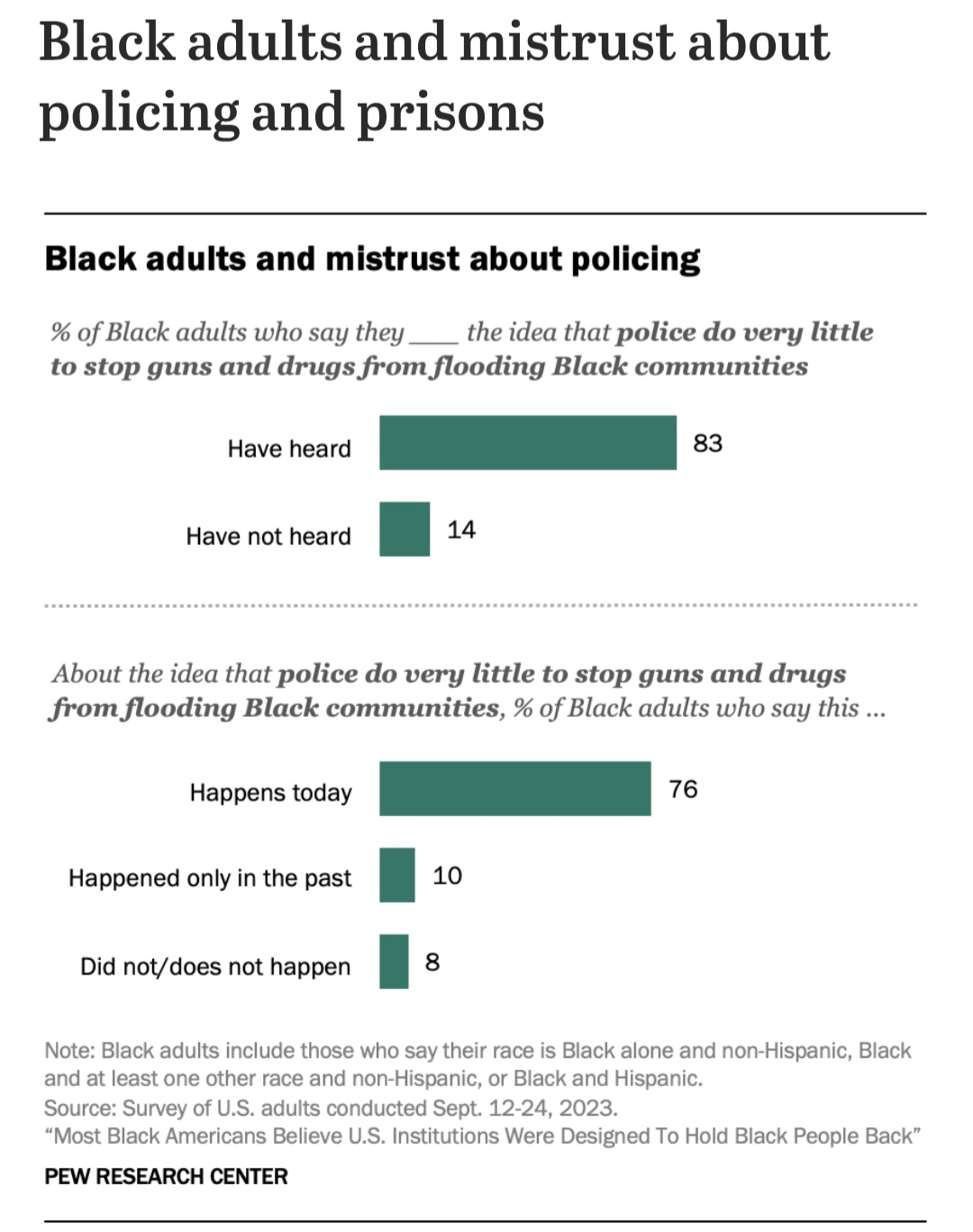
Black Americans have long used a phrase that captures a structural grievance: over-policed and under-protected.
The complaint is that disproportionate scrutiny produces disproportionate outcomes. If people in one neighborhood are stopped more often, searched more often, cited more often, it will generate more arrests. Those arrests are then cited as proof that the scrutiny was justified. The cycle validates itself.
Israel occupies a similar structural position in international institutions.
At the United Nations Human Rights Council, Israel is the only country assigned a permanent, standalone agenda item — Item 7: “Human rights situation in Palestine and other occupied Arab territories.” Every regular session includes debate under this item. No other state – not China, not Iran, not North Korea – is subject to a standing country-specific agenda item.
The numbers reinforce the asymmetry. Since its creation in 2006, the Council has adopted more condemnatory resolutions against Israel than against any other country. In multiple sessions, Israel alone has faced more resolutions than the rest of the world combined.
Volume creates narrative.
Layer onto that the density of global media in Jerusalem – more permanent foreign correspondents than in most active war zones – and the scrutiny becomes constant. Every military action is instantly internationalized. Allegations become juridical language before investigations conclude. Terms like “war crimes” and “genocide” enter discourse early and stick.
The latest war began with an attack Israel did not initiate and repeatedly stated it did not seek. It conditioned an end to fighting simply on the return of hostages and disarmament, to which Gazans repeatedly refused. While urban combat against embedded fighters produces tragic civilian loss, the reported civilian-to-combatant ratios in this conflict fell well below ranges seen in other recent urban wars. That context rarely leads headlines.
Black Americans understand how presumption operates. When systems assume danger, data accumulates accordingly. When institutions assume guilt, findings follow.
“It’s the broader narrative of who belongs and who doesn’t, which allows certain groups to tap in the police department, to use the police department or weaponized the police department in ways that are conducive to violence against Black people” – Lallen T. Johnson, Department of Justice, Law and Criminology at American University
Similarly, the United Nations decided that Jews do not belong in Jerusalem – the holiest city in Judaism – or east of the 1949 Armistice Lines / the “West Bank”, so have developed a criminal system that specifically and persistently targets Jews. The mere presence of Jews is labelled “illegal” and an affront to international law.
“Condemning all measures aimed at altering the demographic composition, [presence of Jews] character and status of the Palestinian Territory occupied since 1967, including East Jerusalem,” – UN Security Council Resolution 2334
The United Nations made a law declaring Jewish presence at their holiest location to be illegal
When one minority community, whether it be racial or national, lives under permanent investigation, outcomes will look like confirmation of wrongdoing, even when standards are warped and unevenly applied.
Over-policing corrodes trust at home. Over-condemnation corrodes credibility abroad.
Justice requires symmetry. Blacks and Jews know it all too well.
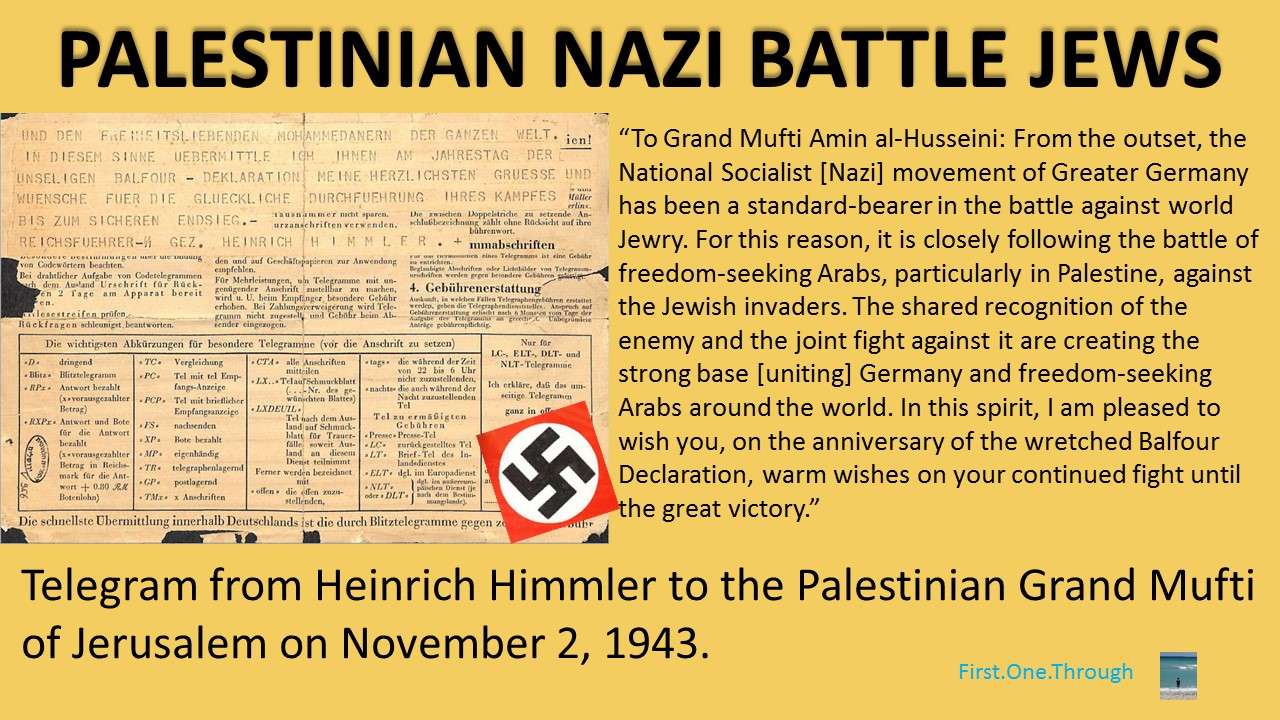
In November 1943, Heinrich Himmler sent a telegram to Haj Amin al-Husseini on the anniversary of the Balfour Declaration.
He wrote of a “shared recognition of the enemy” and “the joint fight against it.”
“The enemy” meant world Jewry.
That phrasing did real work. It turned a people into a threat. Once Jews were cast as a civilizational danger – “Jewish invaders” – their removal became a duty. Vocabulary cleared the ground and policy followed. Then came the machinery.
This is how collective persecution begins: define a group as the problem.
Eighty years later, the same grammar keeps resurfacing.
In Doha, Francesca Albanese, the United Nations Special Rapporteur on the occupied Palestinian territories, used the phrase “common enemy” to describe Israel. The target was the world’s only Jewish state. The effect was to cast Jewish sovereignty itself as something humanity must oppose.
That language strips legitimacy and treats existence as offense. It moves from argument to exclusion with the implied goal of eradication.
The pattern appears in American activism as well. Speaking at a conference hosted by American Muslims for Palestine, Zahra Billoo of the Council on American-Islamic Relations urged audiences to “oppose the polite Zionists too,” grouping mainstream Jewish institutions — synagogues, federations, Hillel chapters, civil-rights groups — into the camp of adversaries, “they are your enemies.”
The construction never changes.
Nazi Himmler: Jews are the common enemy. CAIR Billoo: Zionists are the enemy. UN Albanese: Israel is the common enemy.
Different decades. Different accents. Identical structure.
Demonization targets identity. Once identity becomes the indictment, anything feels justified and the line between debate and dehumanization disappears.
After World War II, the human-rights system was built to prevent precisely this logic — the idea that an entire people could be pushed outside the moral community. Yet the vocabulary has returned, polished and respectable, spoken from podiums that claim the language of justice.
When the Nazis called Jews “the enemy,” the world should have drawn the line right there. No conferences. No nuance. No excuses. Anyone who speaks that way disqualifies themselves.
That same rule applies now.
Human-rights officials who talk like antisemitic propagandists should lose their mandates. Activists who label Jews the enemy lose the claim to civil-rights leadership positions. Institutions that tolerate this language lose credibility.
The mob put a yellow Jewish Star on Jews 80 years ago and told everyone that they are the enemy. The mob is labelling Jews as Zionists today and doing the same. We shouldn’t pause to take action, if “never again” means anything.
Years ago in Australia, I rented a car and learned what every American driver eventually does overseas: instinct is not universal.
About 45 minutes into my first drive, I took a left turn too wide and drifted into the wrong lane. No crash. No damage. Just a slow, awkward mistake at a four-way stop.
An older driver exploded at me. Shouting. Cursing. A full theatrical performance of outrage.
I apologized immediately. I explained I was American and adjusting to the other side of the road. That only intensified things. Now the insults expanded — not just me, but my country and people like me. He wasn’t correcting a traffic error. He was indicting a type.
I didn’t engage. I blew him a kiss and wished him a good day. His fury was his burden, not my identity.
Then I drove away and forgot him.
I could afford to. He had no power. No platform. No mechanism to convert temper into consequence. He was just a man yelling at an intersection.
But imagine if he did.
Imagine if he persuaded Australian officials that Americans are inherently unsafe drivers. Rental cars should require warning stickers: CAUTION — AMERICAN DRIVER and charge them higher insurance premiums. Restricted roads. Special licensing. Even banning them from the road. Imagine it caught on and other countries adopted the same “precautions.”
Now the incident isn’t about a bad turn. It’s an inditement of an entire people, with irritation morphing to governance.
Apply this to western antisemitism.
The Mechanism
Western antisemitism rarely begins as doctrine. It begins as emotion: resentment, humiliation, envy. A story forms around the feeling. Jews are clannish, privileged, manipulative, alien.
From there, the sequence is almost mechanical:
Anecdote becomes stereotype. Stereotype becomes narrative. Narrative becomes moral permission. Permission becomes policy.
By the time formal discrimination appears, the ethical resistance has already been dissolved. People do not feel they are doing wrong. They feel they are being sensible.
The danger is not the man screaming at the intersection; every society has loud fools.
The danger is when the fool’s story becomes civic common sense.
Why Pride Isn’t Enough
One response to the current wave of western antisemitism is to ignore the screamers and turn inward: strengthen Jewish identity, deepen learning, fortify community. There is wisdom there. Cultural confidence is stabilizing.
But pride is psychological armor. It is not structural protection.
You can build a stronger community life. That does not prevent surrounding institutions from teaching your neighbors to see you as a problem to be managed. Parallel vitality does not neutralize hostile narratives embedded in the systems that shape public belief.
Resilience helps you endure hostility. It does not stop hostility from becoming rule.
Where the Real Battle Is: Public Schools
Street hate is episodic. Institutional formation is durable.
Public schools are the key civic storytelling monopolies. For more than a decade, nearly every American child passes through them, and is taught and tested by them. That is where moral categories are formed, historical legitimacy is assigned, and group identities are framed as native or suspect.
If students absorb a picture of Jews as recent interlopers, racial outsiders, uniquely powerful, or structurally oppressive by nature, then the Melbourne intersection has already found its legislature.
Western antisemitism does not need crude slurs. It adapts. It speaks the language of equity, power, decolonization, and social justice — while recycling ancient claims of Jewish illegitimacy and hidden control.
A new syllabus needs to be established.
Students should be taught that Judaism is the ancient Israelite civilization of the Hebrew Bible; that Jewish peoplehood originates in the land of Israel long before Christianity and Islam; that both later faiths arise in dialogue with — and departure from — that earlier tradition. That millions of Hispanics today are descendants of conversos – Jews who were forced to convert by the Inquisition hundreds of years ago, and that the majority of Jews in Israel today are descended from Muslim-majority countries that forced them to flee.
Today, the opposite is taught at the most antisemitic public schools – like those in California and Massachusetts – where Jews are cast as “oppressors,” “racists” and only care about themselves.
The public schools are setting the environment, and while I respect Bret Stephens, Jewish pride is ill equipped to address the current curriculum.
Yes, Jews should spend more time focused on their Judaism, but that will not insulate them from a hostile society. Jews and all decent Americans should take back K-12 education from the socialist-jihadi alliance that has assumed control of many school boards and unions.
An immediate effort should be to advance more charter schools and enable funding of non-public schools. Breaking the monopoly of school unions is a must to save the future.
Another remedy would be to pass a law that any school union that does not take immediate action to report, investigate and discipline (as appropriate) incidents of racism and antisemitism, will lose its right to collect dues out of paychecks and to negotiate contracts with the relevant municipality.
Public schools should also be prohibited from using materials provided by another government, such as Qatar which has been funding K-12 textbooks and trips to Qatar. This initiative is being advance under the “Transparency in Reporting of Adversarial Contributions to Education Act,” the TRACE Act.
As opposed to the COVID-19 pandemic which mostly impacted older people, the western antisemitism pandemic has consumed the youth, courtesy of a deeply broken and plagued public school system.
We cannot pretend it doesn’t matter and there’s nothing to be done. Not just for ourselves, but to save the West from the furious fools in the intersections who have gained real power.
On the day after Holocaust Remembrance Day—after solemn vows of “Never Again”—the Secretary-General of the United Nations chose to praise a cleric who has spent years demonizing Jews and denying their right to exist in their holiest city under the framework of an “International Day of Human Fraternity.“
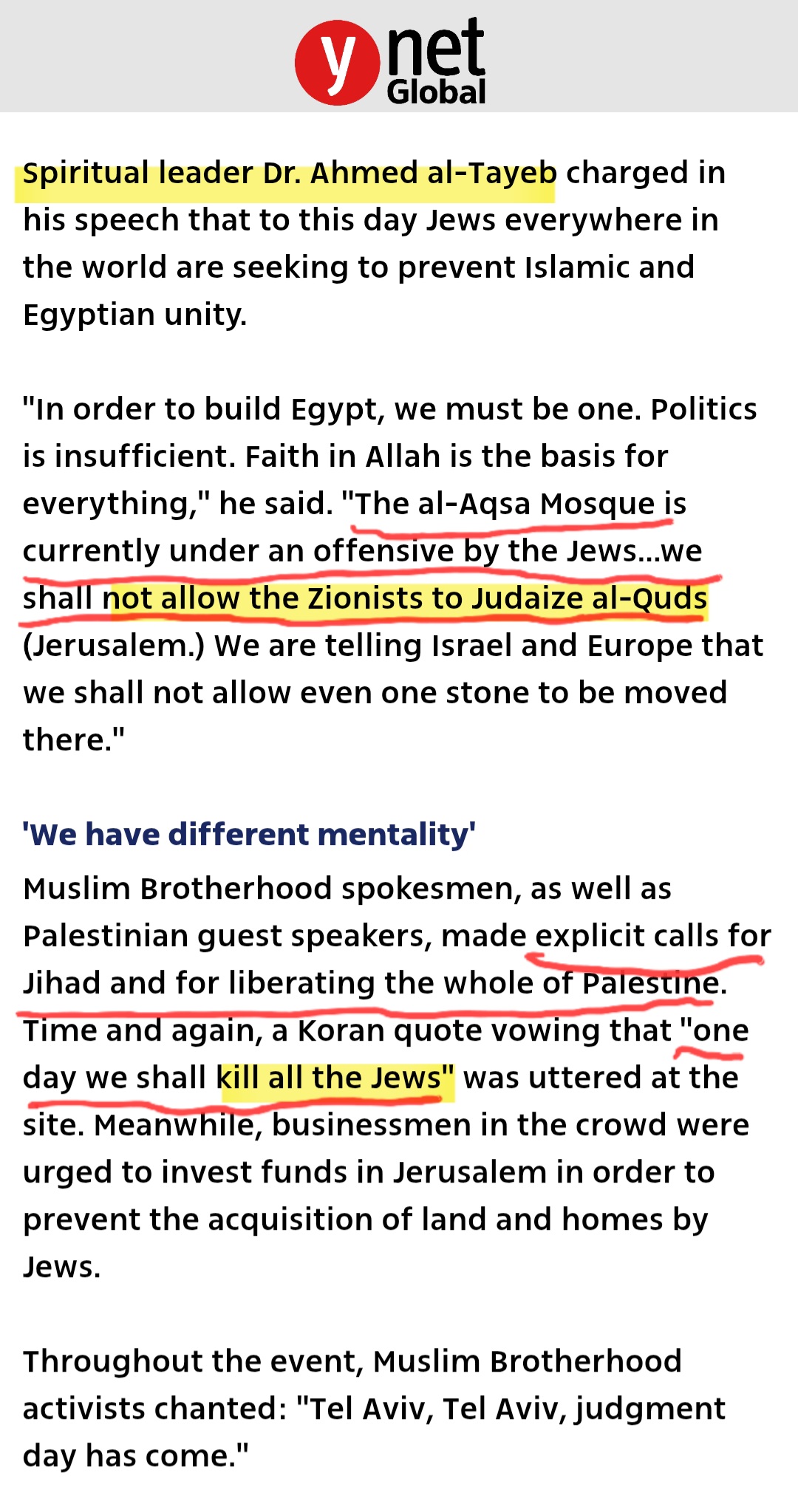
António Guterres elevated “His Eminence the Grand Imam of Al-Azhar Sheikh Ahmed El-Tayeb” as a global partner for peace, despite a record steeped in antisemitic incitement. Under el-Tayeb’s authority, Jews are framed as conspirators, Jewish prayer is cast as desecration, and Jewish presence in Jerusalem is portrayed as a civilizational crime. At events tied to his influence, chants calling for the killing of Jews and the eradication of Jewish sovereignty are tolerated and normalized.
“both Judaism and the Hebrew language have nothing to do with Jerusalem and Palestine.” – official statement of Al-Azhar
The ideology behind it is familiar. It rests on an Islamic superiority complex that treats Jewish sovereignty as illegitimate, Jewish history as fraudulent, and Jewish worship as contamination. In this worldview, Islam may rule Jerusalem absolutely; Jews may exist only conditionally and quietly—preferably elsewhere. Jewish presence in their ancestral capital becomes an offense demanding correction.
“”Do not think that we will ever give up on Jerusalem. We cannot abandon our rights there as a Muslim people. Allah will not enable you to erect a single stone on this land as long as Jihad persists.”” – official statement of Al-Azhar
El-Tayeb has given voice to this logic. Crowds gathered under his prestige repeat it. The demand is explicit: Jerusalem must be purged of Jewish claims, Jewish history, and Jewish life.
“In their attempt to judaize Jerusalem, the Zionists, in reliance on brutal Western imperialist powers, are risking the future of the Jews themselves by overstepping the limits of the Muslim Nation whose population is about a quarter of humanity, and who are able, one day soon, to restore their usurped rights by force.”
When the UN Secretary-General praises this man as a moral authority, he aligns with that demand. The language used by the UN confirms it. The profound antisemitism is ignored. Calls to violence dissolve into “grievance.” Incitement becomes “cultural difference.” Jewish presence is reframed as provocation.
This is how the United Nations defines peace: Jewish invalidation, submission, removal.
Guterres speaks of “a world based on equal rights for all and compassion” while elevating a cleric who denies Jews equality in the one place central to their faith and history. That contradiction is structural and vicious.
A jihadi antisemite is rebranded as a peacemaker, with ethnic cleansing repackaged as protection of holy sites.
And so, holocaust remembrance evaporates overnight.
History will read this moment clearly. When antisemitism returned cloaked in religious authority and liberation rhetoric, the United Nations offered applause, legitimacy, and a podium.
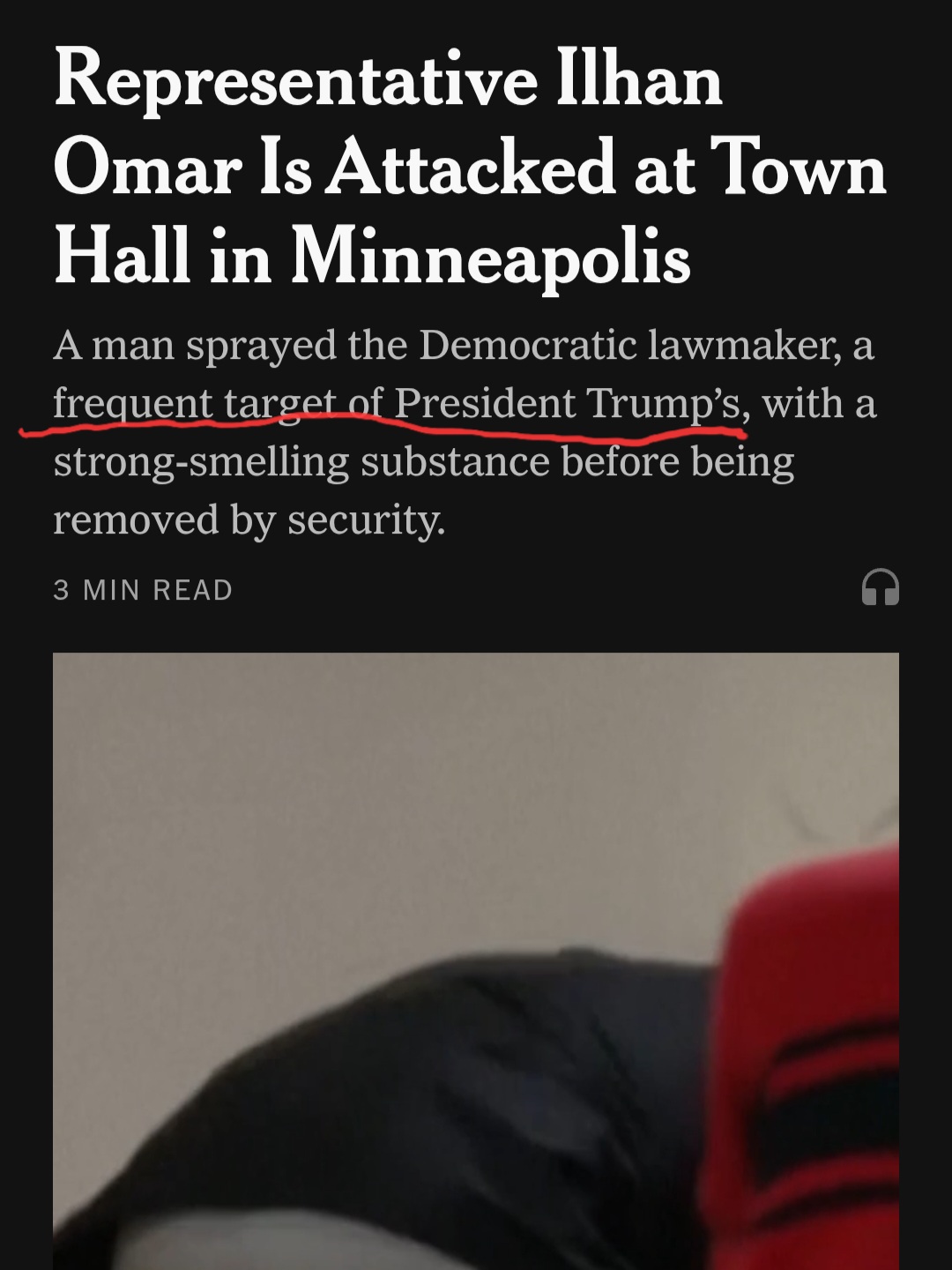
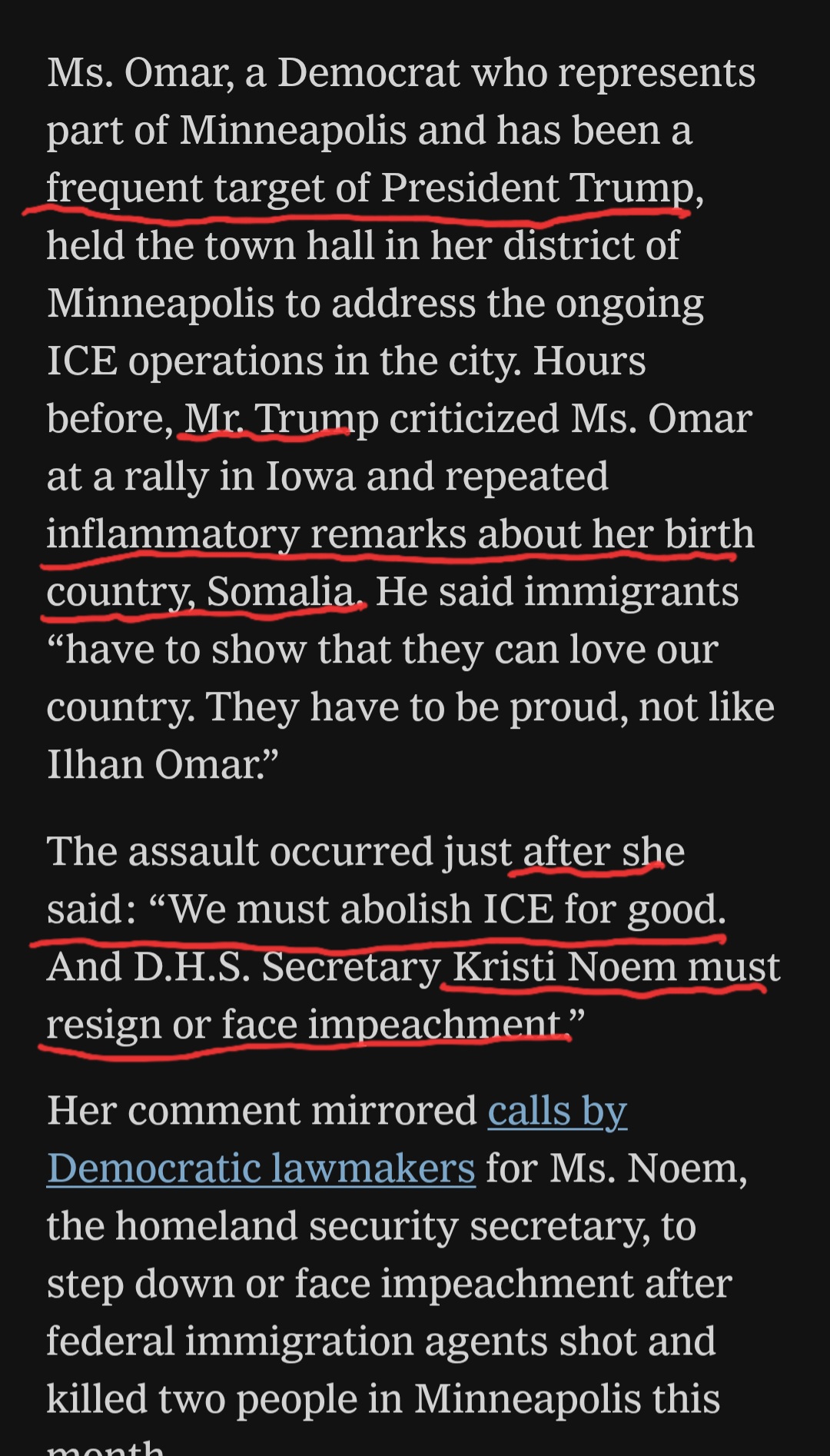
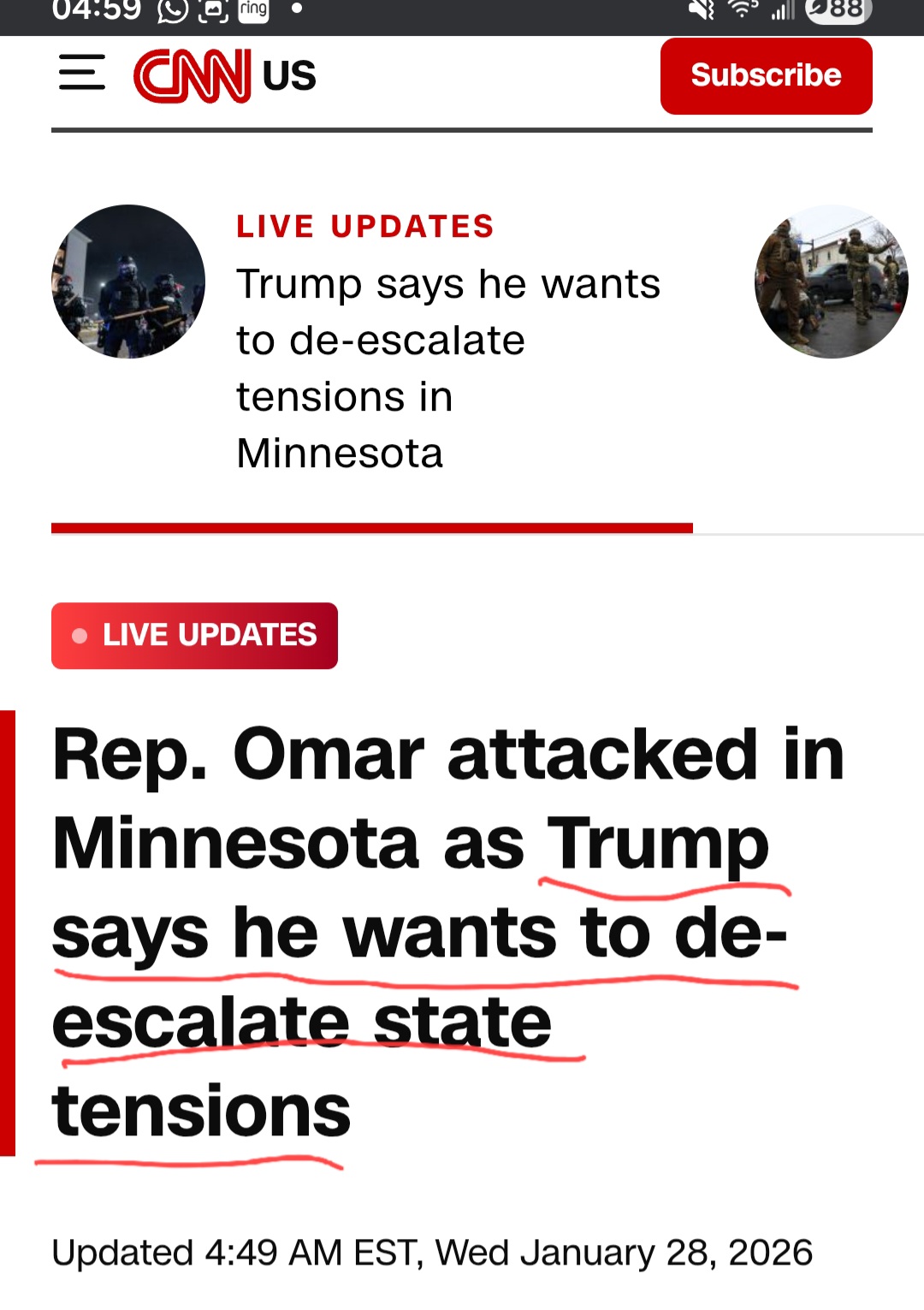
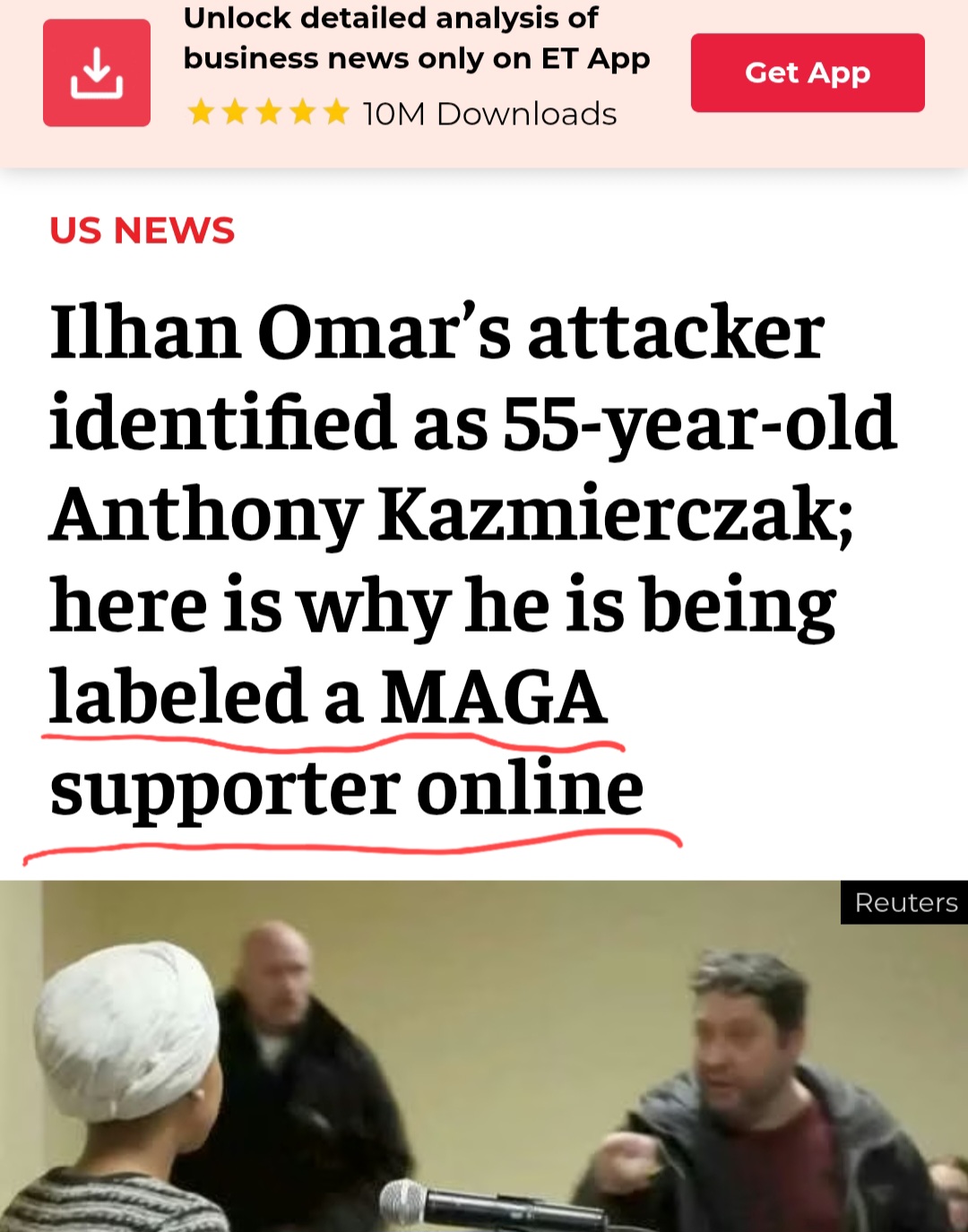
When Rep. Ilhan Omar was squirted with a liquid by an assailant, the story was not the act itself. The story was the atmosphere. Readers were immediately given Minnesota ICE protests, Trump’s rhetoric, the temperature of MAGA politics, and speculative motive pathways pointing firmly rightward. Political attribution preceded investigative certainty. Context did the work and assigned blame.
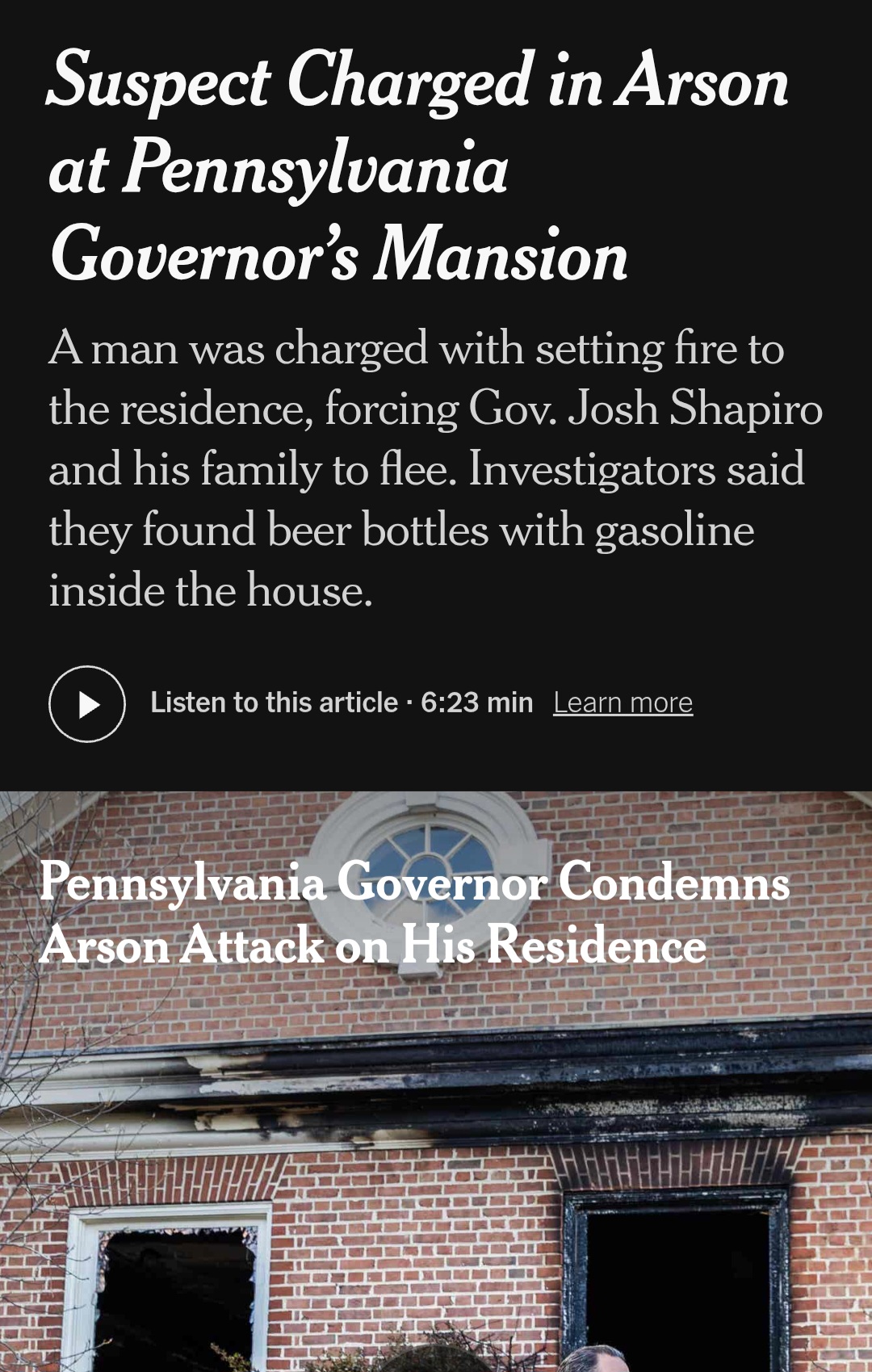
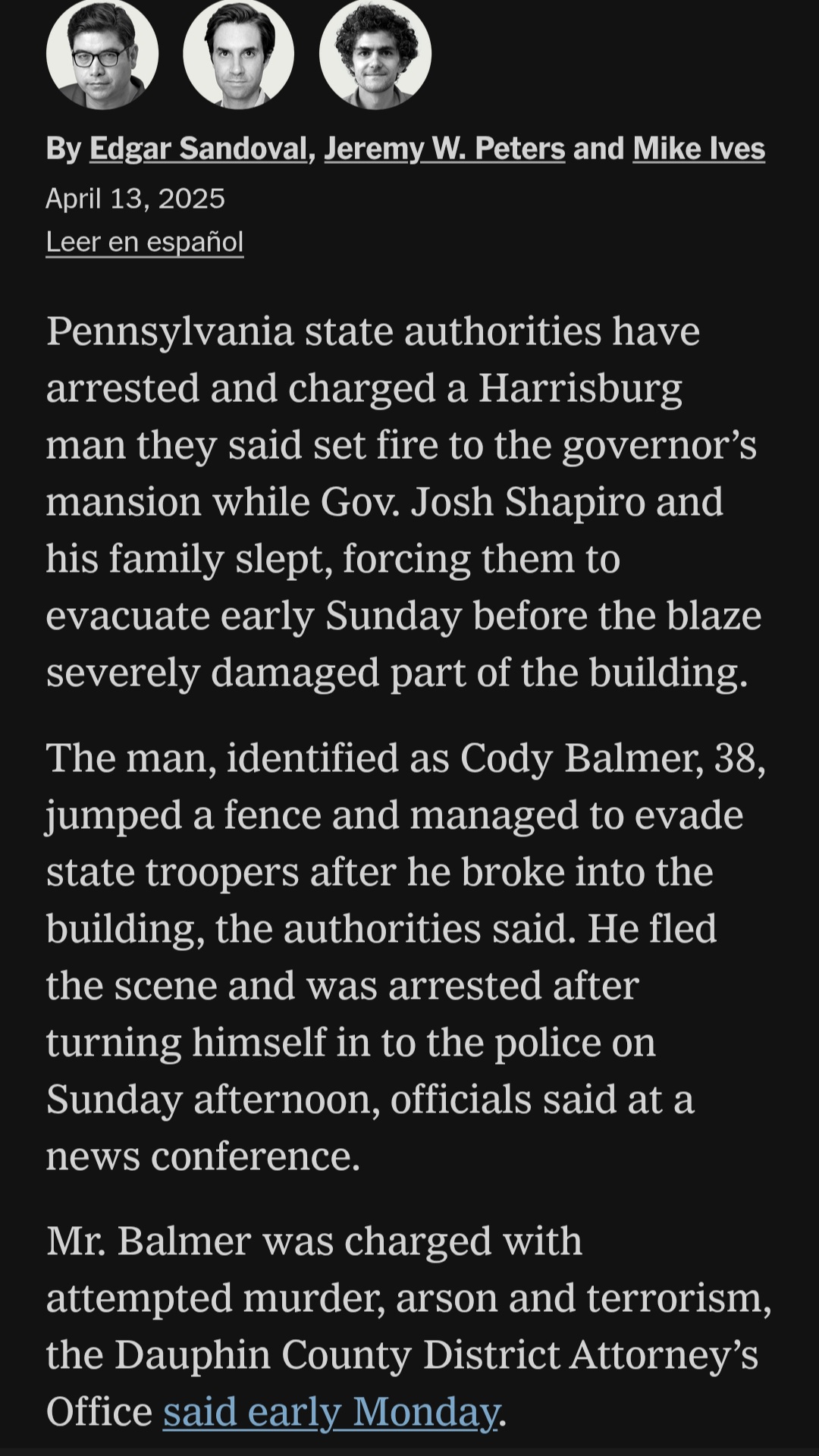
Yet when Pennsylvania Governor Josh Shapiro’s home was attacked by arson in April, context vanished.
There was no mention of the documented surge in antisemitic incidents. No reference to months of anti-Israel rhetoric saturating elite politics. No discussion of the “No Genocide Josh” campaign. No acknowledgment that the attack occurred during Passover—a fact ordinarily noted when violence intersects with religious or communal significance, but here omitted entirely. No exploration of whether sustained accusations of genocide, ethnic-cleansing chants, or the casual demonization of Jews in power might have contributed to a permissive climate. Investigative caution preceded any discussion of political backdrop.
This was not restraint. It was a choice.
The same media institutions that insist “words have consequences” suddenly treat words as irrelevant when the victim is Jewish and the potential inciters sit on the progressive side of the aisle. Context, once treated as morally essential, becomes editorially radioactive.
The pattern is no longer subtle. When violence – staining a shirt – touches a left-wing Muslim lawmaker, identity and ideology are framed as explanatory forces. When violence – arson and attempted murder of an entire family – touches a Jewish, pro-Israel official, identity is scrubbed clean and politics are declared off-limits. One story expands outward into meaning. The other … nothing.
The issue is not what motivated the attacker. The issue is why certain motivations are never even permitted to be discussed.
To contextualize the attack on Shapiro would require acknowledging uncomfortable truths: that anti-Israel rhetoric frequently curdles into antisemitism; that political incitement is not confined to one end of the spectrum; that portraying Jews as uniquely malevolent actors has consequences beyond protest slogans and campus chants. Easier, then, to say nothing.
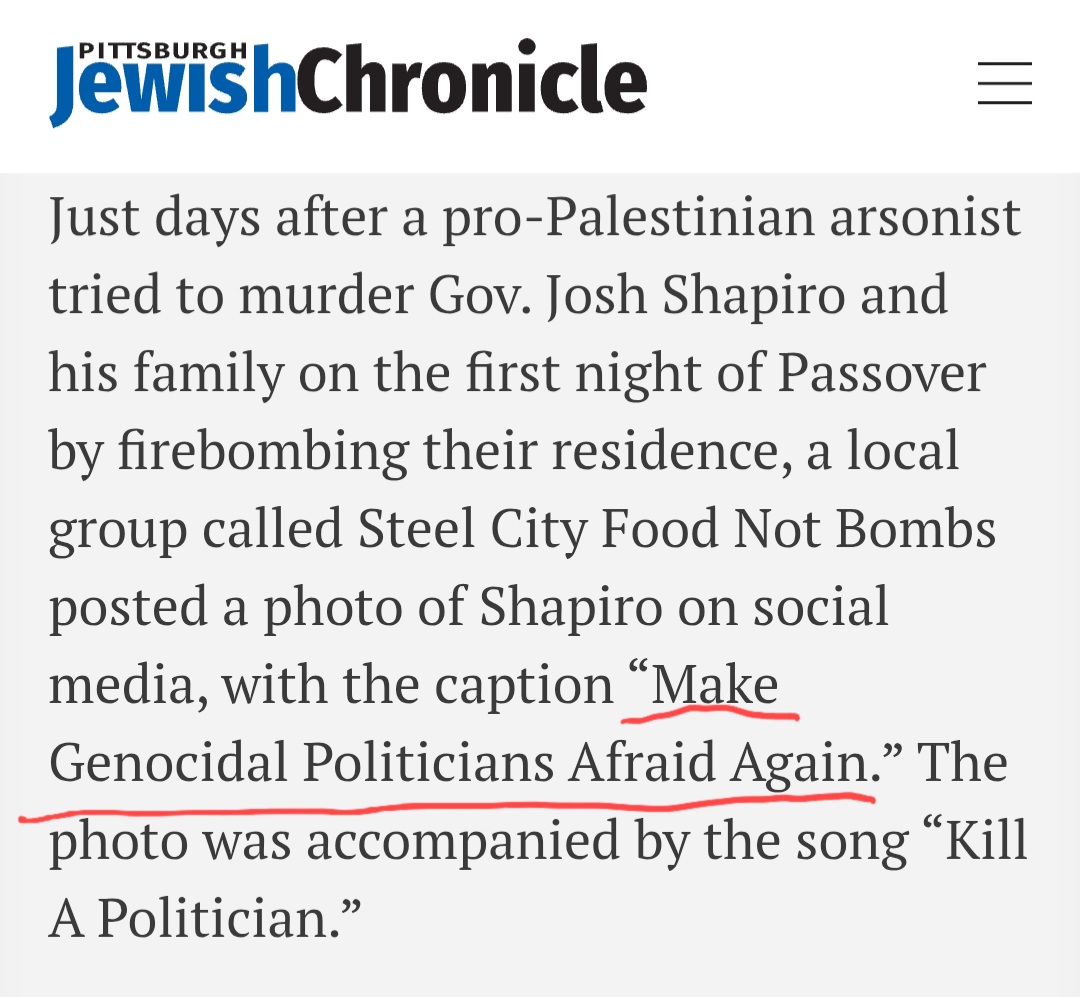
The Pittsburgh Jewish Chronicle had no issue clearly identifying the “Pro-Palestinian arsonist” and the support for targeting the Jewish governor, something liberal media scrubbed clean. The Steel City Food Not Bombs group is associated with the Socialist Rifle Associationwhich seeks “to combat the toxic, right-wing, and exclusionary firearm culture in place today.”
But silence is not passive. It is editorial.
For Ilhan Omar, context was everything. For Josh Shapiro, context was invisible.
If context is essential when violence can be plausibly traced to the right, it must be highlighted when violence engulfs Jews as well. Anything else is antisemitic choreography.
On Holocaust Remembrance Day, António Guterres reached for the safest symbol available: Nuremberg. He spoke of universal lessons, multilateralism, and the dangers of unchecked hatred. It sounded solemn, but it was evasive. By invoking Nuremberg instead of Eichmann, the UN spun a story in which institutions matter more than victims, and legality matters more than justice.
That choice is not accidental. It is institutional self-protection.
Why the UN Prefers Nuremberg
The International Military Tribunal flatters multilateral ideals. It universalizes guilt, diffuses responsibility, and allows the UN to present itself as the heir to postwar justice. It avoids a harder truth: the world did not finish the job. Genocide went unnamed. Jewish extermination was evidence, not the charge. Many perpetrators melted back into ordinary life.
The Nuremberg trials were necessary but insufficient. And on Holocaust Remembrance Day, sufficiency is the point.
“I have always understood the clear link between the horrors of the Holocaust and the spirit of multilateralism, justice and rights that founded our organization. Just over 80 years ago, the Nuremberg trials began. These trials represented the beginning of a new era in international criminal law; an era 78 which individuals, including the most powerful, are held accountable. Today, more than ever, we need to reclaim that spirit.” – UN Secretary General Antonio Guterres on Holocaust Remembrance Day
Eichmann Is the Missing Sentence—And the Turning Hinge
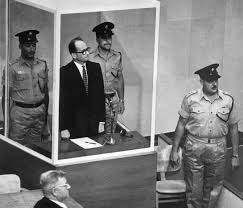
The trial of Adolf Eichmann in Jerusalem did what Nuremberg did not. It named genocide as genocide. It put survivor testimony at the center. It replaced bureaucratic fog with individual culpability. Eichmann was not tried as a generic war criminal; he was judged as an architect of the annihilation of Jews.
Adolf Eichmann on trial in Jerusalem, many years after the Nuremberg trials
As Hannah Arendt observed, the case exposed how extermination was operationalized by ordinary men. And it exposed a global failure: Eichmann lived freely for years after the war. Many like him were never tried at all.
That is why Eichmann is not an “example” to be mentioned in passing. He is the pivot of postwar justice—the moment when the Holocaust was finally understood, named, and judged as what it was.
Universalism That Erases the Crime
Guterres’s language collapses the Holocaust into a general warning about hatred. of course hatred matters. But flattening the crime turns extermination into general prejudice and genocide into an abstraction. The Holocaust was not simply bigotry run amok; it was a state-organized project to destroy a people everywhere it could reach them.
Universalism should follow truth—not replace it. When remembrance avoids naming genocide plainly, “Never Again” becomes a slogan that comforts institutions rather than indicts them.
The Uncomfortable Lesson the UN Avoids
The defining act of Holocaust justice did not come from the UN system. It came from a Jewish state acting unilaterally. Without Israel, Eichmann would have died untried, his crimes dissolved into postwar amnesia. That is not a political claim; it is a historical conclusion.
The UN prefers Nuremberg because Eichmann exposes its limits. Nuremberg affirms process; Eichmann exposes failure. One reviews general war crimes while the other points the finger squarely at demonic antisemitism. One is safe to cite as the other forces accountability.
Holocaust Remembrance Day is not a seminar on international law. It is a reckoning with a singular crime and a singular abandonment. The Jewish state does not exist to teach the world lessons, but we see plainly that the world failed to protect Jews—and then failed to prosecute their murderers. And it fails to recognize the clear difference to this day – on the very day designated to remember.
The Line That Cannot Be Dodged
Remembrance without judgment is theater. On Holocaust Remembrance Day, the honest citation is not Nuremberg’s promise but Eichmann’s dock. One symbolizes aspiration. The other delivered judgment.
If the UN wants this day to mean more than ritual, it must say the truth it avoids: the Holocaust was finally understood, named, and judged because Jews had a state willing to act when the world would not. That is not a complication of remembrance. It is its core.
Antisemitism came bursting onto the American scene these last years. Jews were murdered. Synagogues were attacked. Jewish students were stalked, doxxed, and targeted by name. Schools and workplaces became hostile terrain.
And at that moment—when antisemitism crossed unmistakably from speech into violence—Jewish New York Congressman Jerry Nadler responded with the Antisemitism Response and Prevention Act.
ARPA was framed as action. In reality, it was an exercise in evasion. While Jews were being assaulted and killed, Nadler urged Congress to study, track, and administratively manage antisemitism—while carefully avoiding the standards already designed to confront it.
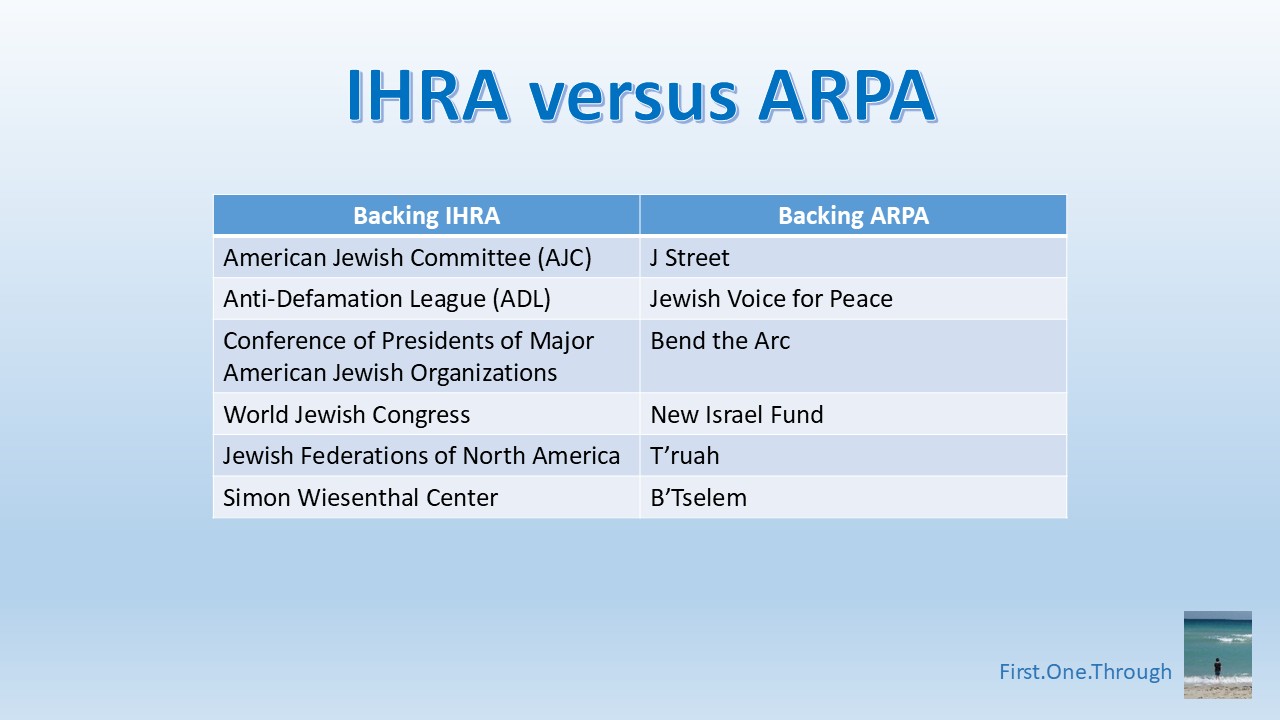
The United States already had a playbook, the International Holocaust Remembrance Alliance (IHRA) working definition, adopted precisely because it reflects how antisemitism functions in the modern world. IHRA recognizes what recent victims already knew: antisemitism today often arrives wrapped in ideological language—through demonization of Israel, denial of Jewish self-determination, and collective punishment of Jews for the actions of the Jewish state.
That clarity made IHRA inconvenient to some. It required institutions to draw lines. ARPA was drafted to move in the opposite direction.
“this bill [H.Res 1449 to use IHRA definition of antisemitism] threatens to chill constitutionally protected speech.” – Rep. Jerry Nadler (D-NY)
Instead of reinforcing enforcement under existing civil-rights law and a recognized definition, ARPA handed discretion to federal agencies. Antisemitism would be assessed holistically. Guidance would follow. Coordination would improve. Standards would remain flexible.
But flexibility is a luxury for bystanders, not for targets.
“the IHRA definition is plainly unconstitutionally vague.” – Rep. Jamie Raskin (D-MD)
Mainstream Jewish organizations understood the consequence immediately. Ambiguity does not restrain institutions that already fail to act. Universities that tolerated harassment would gain new procedural defenses. Administrators could claim compliance while Jewish students were chased from quads and classrooms. The more antisemitism intensified, the slower the response would become.
That is why opposition to ARPA came from the center of Jewish communal life, groups like Jewish Federations and the AJC. Their message was blunt and grounded in reality: Jews were being attacked under existing law. The failure was enforcement, not definition. Weakening standards while violence increased was not caution—it was retreat.
Support for ARPA came largely from groups more concerned with preserving far-left wing ideological space around anti-Israel activism than with confronting antisemitism as it actually manifested. In their calculus, the risk of over-enforcement mattered more than the fact that Jews were being targeted, assaulted, and killed. The alt-left preferred to cast their lot with CAIR in falsely labeling the IHRA definition as a gag order.
Congress eventually pivoted—toward strengthening Title VI enforcement and reaffirming IHRA—quietly conceding the obvious. When antisemitism turns violent, clarity protects lives. Process protects institutions.
“I share the concerns of groups like Jewish Voice for Peace, Bend the Arc, B’Tselem, Amnesty International, and the ACLU that the IHRA definition of antisemitism will be used to stifle dissent and chill free speech, especially Palestinian human rights advocacy. The resolution also does not recognize that the fight against antisemitism is connected to our fight against Islamophobia, racism, white nationalism, and all other forms of hate.” – Rep. Rashida Tlaib (D-MI)
ARPA will stand as a reminder of a grim truth: at a moment when antisemitism demanded resolve, left-wing Jews chose ambiguity and cozying to antisemites, rather than defense.
History has a grim rhythm. The most destructive ideas rarely hatch overnight but stew in society. They are excused as rhetoric, theater, or “just politics.” Then—roughly five and a half years later—they explode.
This is not numerology. It is pattern recognition.
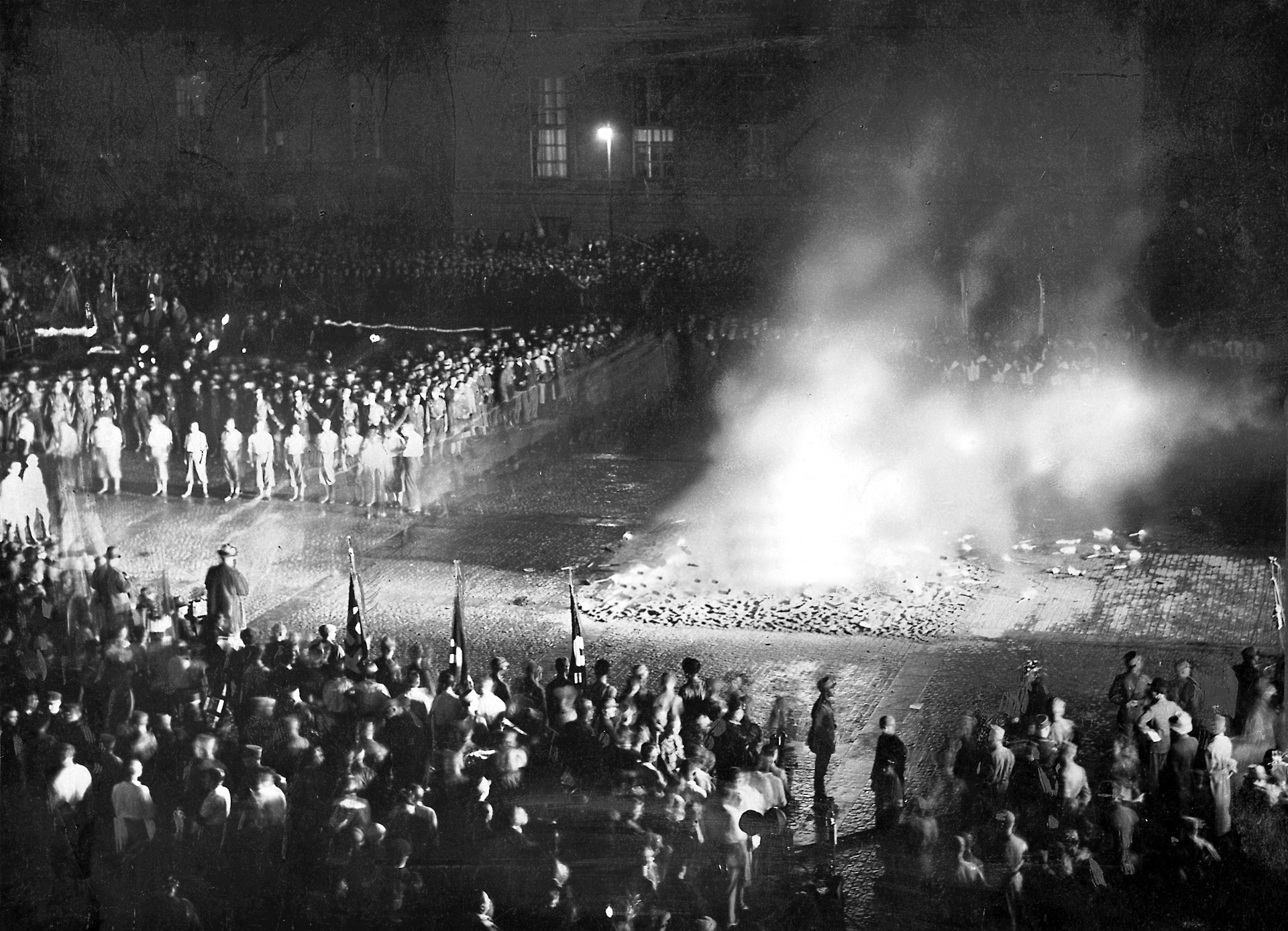
In 1933, Germans burned Jewish books in public squares. It initiated the cultural permission for the destruction of Jews. Five and a half years later, that permission hardened into the machinery of the Final Solution.
Als Höhepunkt einer von Joseph Goebbels initiierten ‘Aktion wider den undeutschen Geist’ werden auf dem Opernplatz in Berlin von Studenten und SA-Einheiten Bücher von Autoren verbrannt, die den Nationalsozialisten mißliebig waren.
In 2018, Gaza launched the so-called “Great March of Return.” It acted as a trial run to invade Israel and slaughter Jews. Five and a half years later, October 7 arrived—mass murder, rape, kidnapping—exactly as promised and practiced.
Ideas announce themselves early. The damage arrives later.
Today, in America, a new idea is being spoken aloud with disturbing ease: personal property is conditional.
Property Is the Load-Bearing Wall
Private property is not a side feature of capitalism; it is the load-bearing wall. Remove it and the structure collapses—investment freezes, contracts become jokes, and capital flees to wherever the rules still mean something.
Yet in recent years, voices across the ideological spectrum have started to say the quiet part out loud.
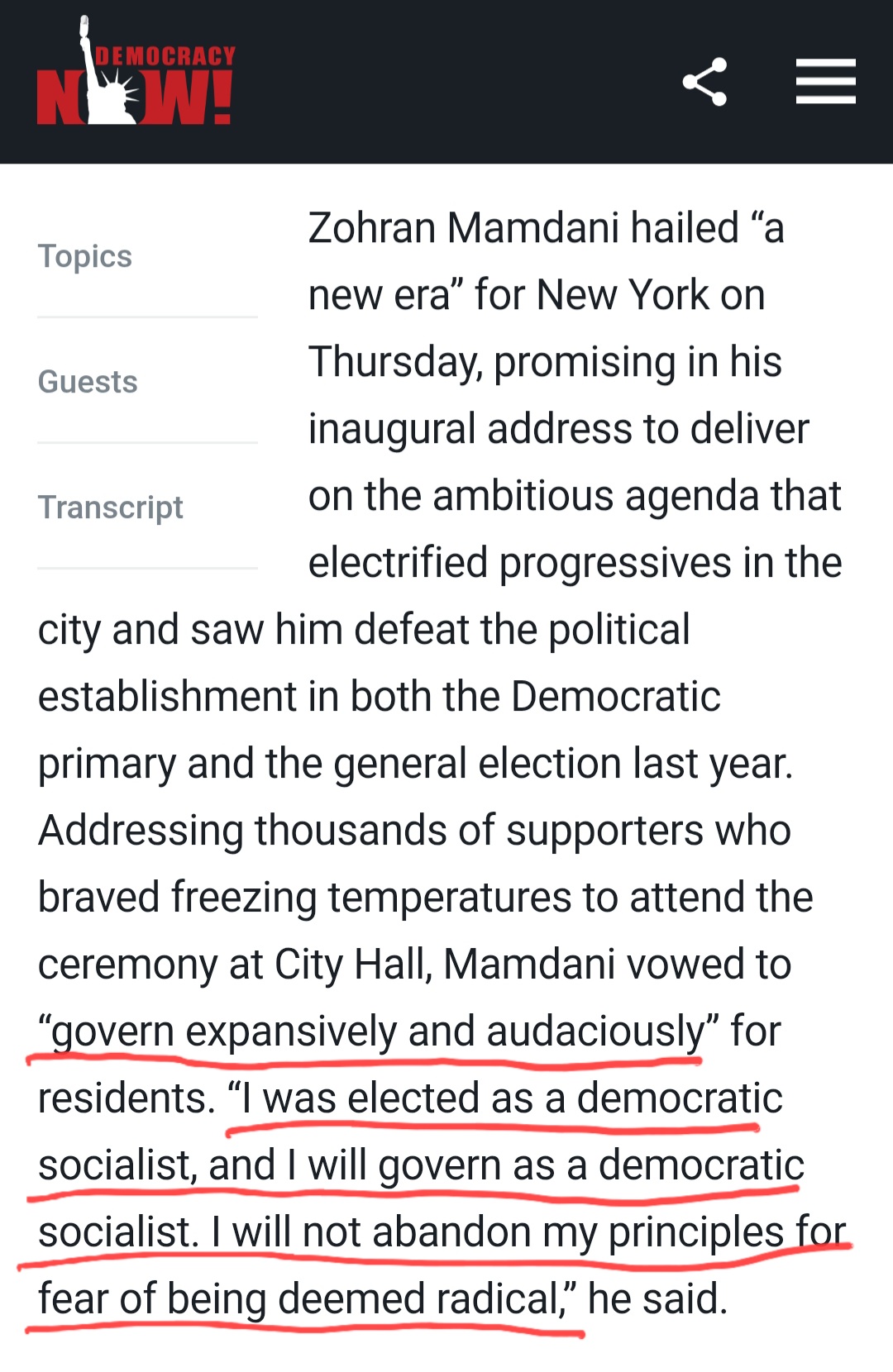
On the progressive left, figures like Zohran Mamdani and his partners in crime like Cea Weaver have openly argued that housing and land can be seized or overridden by the state in the name of moral urgency. Ownership becomes a social inconvenience. “Use” replaces title. Force replaces consent.
On the populist right, Donald Trump has flirted with the same heresy from a different direction—embracing sweeping government power over land, contracts, and assets when it suits political goals. The rhetoric differs. The result converges.
When the left and right agree that property rights are optional, the center cannot hold.
From Rhetoric to Ruin
Every historical catastrophe begins with intellectual laundering.
Book burning was framed as cleansing culture. The Gaza marches were framed as civil resistance. Property seizure is framed as compassion or patriotism.
Once a society accepts that ownership is contingent on political favor, every asset becomes provisional. Homes, farms, factories, patents—nothing is safe from the next emergency, the next slogan, the next election.
Capital responds rationally. It leaves. Innovation slows. Black markets thrive. Strongmen fill the vacuum. What follows is not equality but scarcity enforced by power. And there will be a scapegoat, and Jews have proven the most convenient.
July 2031 Is Not Far Away
Count forward five and a half years.
Ideas being normalized today will be policy tomorrow. Policies will become enforcement. Enforcement will become precedent. By the summer of 2031, the damage will no longer be theoretical.
This is how capitalism dies—not with tanks in the streets, but with applause for confiscation. This is how world order fractures—not through invasion, but through the voluntary abandonment of the rules that made prosperity possible.
This is how the Global North will collapse-not through open country borders, but the eradication of personal property lines.
The lesson of history is brutally clear: destruction is foretold in dangerous gestures towards property that eventually comes for the persons who own them.
The blood libel begins with how the Book of Exodus is misremembered. Exodus is a story of Jewish liberation, yet antisemites preserve it as a story of punishment. That inversion is not confusion but tradition. Every generation dresses the libel in new language, while the structure never changes.
The plagues were directed at dismantling Egyptian authority with precision. The opening strike hit the Nile—Egypt’s god, economy, and source of life—and exposed a crime already committed there. Egypt had drowned Israelite infants in that river to erase a future it feared. The first plague named that bloodshed and stripped Egypt of moral order.
What followed was escalation with restraint. Egypt lost land, productivity, and cosmic claims. Darkness collapsed Pharaoh’s divine authority. What remained was the empire’s final refuge: the belief that continuity would return, that tomorrow would repair what today exposed.
The final plague took it. The death of the firstborn judged a state that had already made children expendable. It revoked Egypt’s claim on the future. Regimes that destroy children forfeit moral legitimacy. Measure followed measure.
The Israelites did not celebrate death. They marked their doors, stayed inside, and departed at dawn. Their defining act was escape from bloodlust, not indulgence in it. Freedom—not punishment—was the center of the story.
Antisemitism begins by erasing that fact.
Across centuries, Jews were remembered not as a people who fled violence but as a people who embodied it. Divine judgment on a tyrannical state was detached from context and reassigned as a permanent Jewish trait. Victims became perpetrators. Liberation became threat. From this inversion, the blood libel followed naturally, and not surprisingly, during Jewish celebrations of Passover when they left Egypt.
The charge did more than justify violence; it recoded Jews as a permanent danger. If society believes Jews possess bloodlust, then Jews must be watched, monitored, restricted, and scrutinized. They become an unwanted risk. Suspicion overwhelms citizenship. Surveillance replaces equality. In this logic, it is only a matter of time before Jews are assumed to act—and preemptive punishment becomes rationalized as self-defense.
This is how the libel works. It marks Jews forever as dangerous rather than as people who long for freedom. It recasts victims as villains and turns survival itself into evidence of guilt. The blood libel means that Jews are never trusted as equals, and never accepted as free.
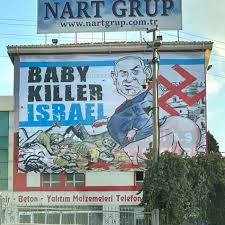
That inheritance governs today’s rhetoric. Calling Jews “baby killers” is not a factual claim; it is the inherited reflex of a culture that never accepted Jewish freedom. The accusation is identity-based, not evidence-based. It exists to keep Jews outside the circle of legitimate humanity and to deny the moral standing of Jewish self-defense before it is even asserted.
Turkey fans the blood libel in Hamas’s latest war to destroy Israel
This mindset survives because it is passed down, laundered through new vocabulary, and presented as moral concern. But it is the same lie. It refuses to see Jews as a people who escaped societies that murdered their children and insists instead on seeing Jews as the source of murder itself.
The story that antisemitism started when Pharoah forgot Joseph and became worried about the growing number and power of Jews was the fear of a monarch. Antisemitism was instilled in the masses when the Exodus story was flipped that Jews had a bloodlust and didn’t deserve equality. Every society that accepted the libel eventually convinced itself that Jewish freedom was intolerable—and acted accordingly.















 First One Through