Is there a more gay-friendly capital than Reykjavík?
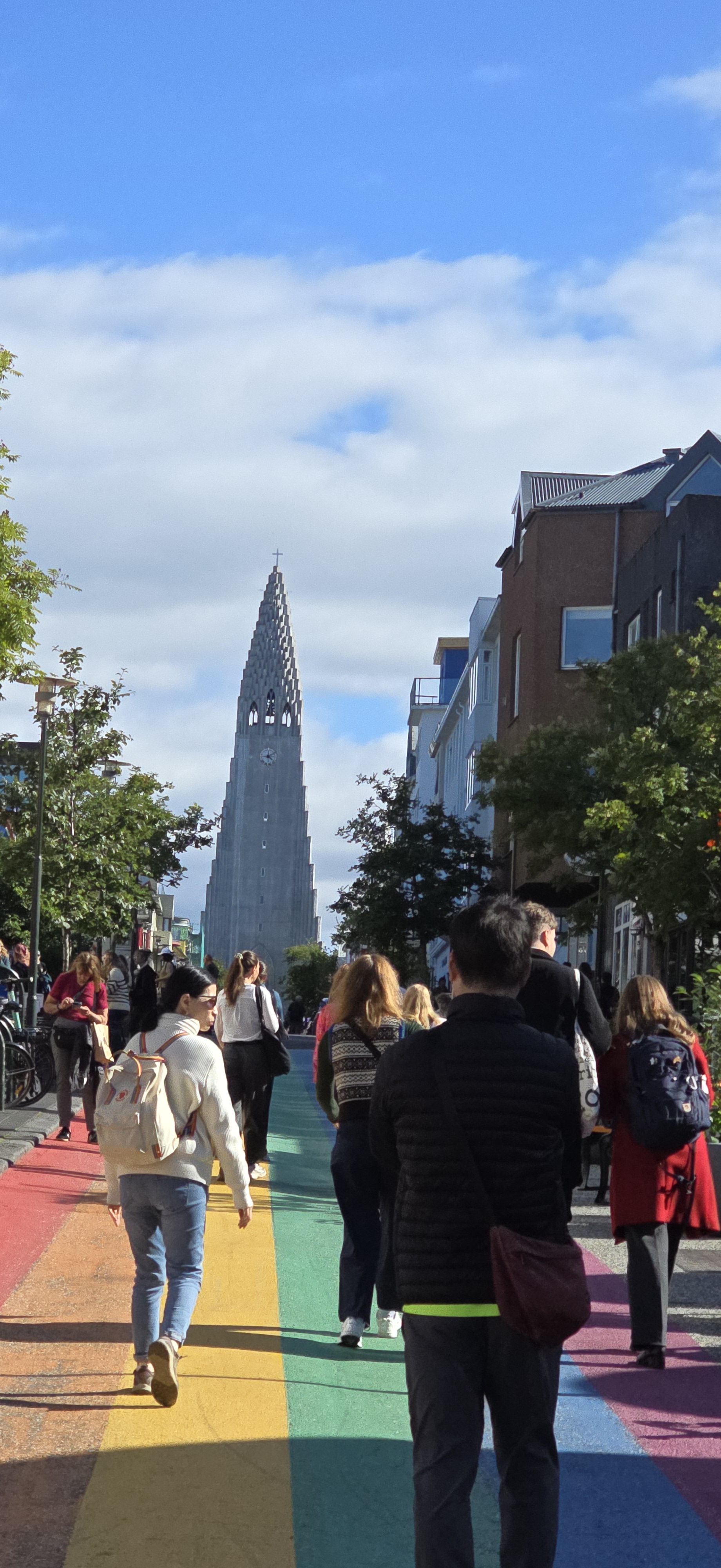
Walk through Iceland’s capital and Pride is everywhere. Rainbow flags fly from storefronts. Streets are painted in LGBTQ colors. Businesses and government buildings proudly proclaim their support for gay rights, queer rights and equality.
Then look a little closer.
On those same Reykjavík streets are Zionists Not Welcome stickers and other expressions of hostility toward the one country in the Middle East where LGBTQ people openly flourish: Israel.
Anti-Israel sticker on parking pay station in Reykjavik, Iceland (photo: First One Through)
The contradiction is hard to miss.
In Israel, gay people serve openly in government and the military. Tel Aviv Pride is one of the world’s best-known LGBTQ celebrations. Gay couples live openly. LGBTQ organizations operate publicly.
Across the Palestinian Arab territories and much of the surrounding Muslim Middle East, the reality is radically different. Hamas governs Gaza according to an Islamist ideology hostile to homosexuality. Iran criminalizes same-sex relations and has imposed the death penalty for homosexual conduct.
Yet in Reykjavík, the political sympathy often seems to run precisely backward.
The rainbow flag is supposed to say that gay rights are human rights. That should apply in Iceland, Israel, Gaza, Iran and everywhere else.
Reykjavík proudly covers itself in rainbows but should follow those colors all the way to the Middle East and ask where gay people can actually live beneath them.
For most of human history, people did not belong to countries. They belonged to tribes.
Family came first. Then clan. Then religion. Then ethnicity. Your protection did not come from an impartial government but from the people who shared your blood and your history.
The modern nation-state asked humanity to do something profoundly unnatural. It asked millions of strangers to trust one another more than they trusted their tribe.
That may be civilization’s greatest political achievement.
Political scientist Francis Fukuyama has argued that human beings are naturally wired for tribalism. The genius of the modern state was not that it erased those instincts, but that it redirected them. Loyalty shifted from clan to constitution, from ancestry to citizenship, from family name to the rule of law.
No nation embodied that experiment more successfully than the United States.
America was never united by blood. It became a nation because generation after generation chose to believe that citizenship mattered more than ancestry. Irish immigrants, Jewish refugees, engineers from India, scientists from Taiwan, and millions of others came from different histories but increasingly shared one future.
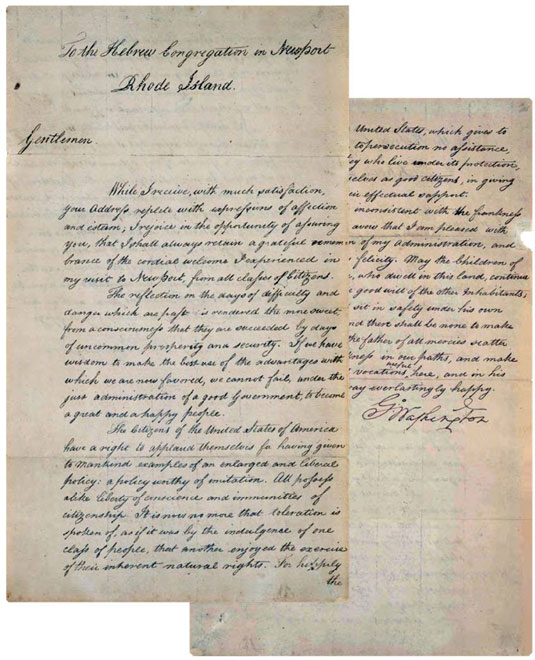
“The Citizens of the United States of America have a right to applaud themselves for having given to mankind examples of an enlarged and liberal policy: a policy worthy of imitation. All possess alike liberty of conscience and immunities of citizenship. It is now no more that toleration is spoken of, as if it was by the indulgence of one class of people, that another enjoyed the exercise of their inherent natural rights. For happily the Government of the United States, which gives to bigotry no sanction, to persecution no assistance requires only that they who live under its protection should demean themselves as good citizens, in giving it on all occasions their effectual support.” – George Washington’s letter to the synagogue in Newport, RI in 1790
George Washington’s letter to the synagogue in Newport, RI in 1790
America never eliminated tribes. It simply made being American more important than belonging to one.
But that civic bargain rested on something deeper than patriotism. It rested on hope.
America has never been a perfect nation. It never claimed to be.
Slavery contradicted its founding ideals. Women were denied the vote. Segregation mocked the promise of equal protection. Entire groups were excluded from opportunities others took for granted.
Yet what distinguished America was not the absence of injustice. It was the belief that injustice could be corrected.
The nation repeatedly expanded the circle of citizenship. Slavery was abolished. Constitutional amendments extended the franchise. The civil rights movement dismantled legalized segregation. Immigration laws evolved. Opportunity broadened. Each generation inherited an imperfect republic and, however incompletely, tried to leave it more just than it found it.
People can tolerate inequality longer than they can tolerate hopelessness. They can accept that today’s America is imperfect if they believe tomorrow’s America will offer greater opportunity for themselves and for their children.
For much of our history, that belief proved remarkably resilient. Yet today it is under strain.
The reason is not simply that inequality has grown. It is that many Americans increasingly question whether the civic bargain still works.
Over the past two decades, extraordinary wealth has accumulated among roughly the wealthiest one-tenth of one percent of American households—families whose wealth is roughly $50 million and more. Together they now control a remarkable share of the nation’s wealth, much of it held not in homes or factories but in ownership stakes in software companies, semiconductor firms, and cloud infrastructure.
The question for ordinary Americans is whether they believe they have a realistic chance of becoming tomorrow’s winners.
Yet much of the political debate on the left uses the moral vocabulary of the twentieth century to explain the economics of the twenty-first. Progressives point to slavery, segregation, redlining, and inherited privilege. They therefore demand reparations. But that’s the lexicon and proposals of a period past.
Today’s economy is not dominated by inherited railroad empires or industrial monopolies. It is dominated by technological innovation.
According to Forbes, roughly two-thirds of America’s 400 richest people built their fortunes themselves rather than inheriting them. Many of the largest fortunes were created within a single generation through software, semiconductors, venture capital, and artificial intelligence. America continues to produce extraordinary upward mobility. Immigrants account for roughly one in seven American billionaires, and more than nine in ten of those immigrant billionaires are self-made, many arriving from India, Israel, Taiwan, and China before building companies at the forefront of the technology revolution.
America is still the land of remarkable opportunity for all but it is predominantly happening inside an innovation economy that relatively few people understand—and even fewer know how to enter.
That distinction changes the political conversation. And it is magnified by the fear of artificial intelligence.
As the AI economy concentrates wealth, the identities of many of its most visible participants also become politically salient. Many of America’s leading technology founders, investors, and executives are white, Asian, or Jewish—groups often associated with educational and entrepreneurial success. That should be irrelevant in a civic republic. But in a society increasingly tempted by tribal politics, economic frustration is often translated into identity politics. The result is a dangerous feedback loop: the far left explains disparities through privilege and oppression, while the far right responds with conspiracy theories about ethnic or religious elites. Both abandon the American principle that citizens should be judged primarily as individuals rather than as members of competing tribes.
Alexandr Wang, 29, Chief AI Officer at Meta, worth an estimated $3.3 billion
And the concern is no longer merely that the rich will become richer. It is that AI will automate millions of middle-class jobs. Lawyers, accountants, software developers, analysts, designers, customer service representatives, and countless others increasingly wonder whether they are watching the economic ladder disappear beneath them. That is not just the rich getting richer and the poor getting poorer. It is everyone below the 0.1% – the entire lower, middle and upper middle class – becoming significantly poorer.
That anxiety helps explain proposals such as far-left Senator Bernie Sanders’ American AI Sovereign Wealth Fund Act. Sanders argues that because artificial intelligence is trained on humanity’s collective knowledge, the extraordinary wealth it creates should not belong solely to a handful of technology companies and investors. Whether one agrees with that proposal or not, it marks a profound shift. The political debate is moving beyond redistributing wealth after it is created, toward seizing and controlling the technologies that create the wealth in the first place.
Never has the U.S. government considered inserting itself so forcefully into the leading drivers of innovation, jobs and wealth, and pitted itself against those “elites” spearheading the effort.
On one side, the far-left is organizing around tribalism focused on race, gender, and “privilege,” which produces a counter-movement on the far-right around White nationalism. Both movements are inherently anti-American and undermine the founders’ ideals of a grand civic bargain. Each tells its followers that the other tribe is responsible for the country’s decline. Both play a part.
America fractures as both right and left move towards tribalism, and no longer trust the “establishment” political class, mainstream media and failing schools. Meanwhile, the real enormous promise and fear of the future for both groups is playing out in real-time before everyone: that AI will exacerbate the inability to trust people, information and institutions, while simultaneously creating a cohort of individuals – seemingly of only a few tribes – with remarkable wealth as the middle class loses its wealth.
If AI becomes a dominant technology that only a tiny club understands, owns, and profits from, the civic bargain weakens. Citizens begin searching for smaller communities that promise protection and belonging. Race becomes more important than citizenship. Class becomes more important than opportunity. Tribe becomes more important than country.
That is a future we can, should and must avoid.
America has solved this problem before. Every great technological revolution—from the steam engine to electricity to the internet—created extraordinary fortunes for its pioneers. Yet each ultimately generated industries, professions, suppliers, entrepreneurs, investors, educators, and workers whose prosperity far exceeded that of the original inventors. The wealth did not remain confined to those who built the breakthrough. It spread through the countless derivative businesses, careers, and opportunities that followed.
Artificial intelligence should be no different. America should not punish the innovators building the future or discourage the investment and risk-taking that made these breakthroughs possible. The challenge is to ensure that the AI economy develops the same broad ecosystem that previous technological revolutions produced—new companies, new professions, new skills, new services, new capital formation, and new pathways into prosperity for millions of Americans.
Just as importantly, we must prevent the far left and the far right from hijacking this technological revolution for their own political ends. The left should resist reducing innovation to a story of privilege and oppression, while the right should resist turning successful innovators into symbols of ethnic or cultural conspiracy. Both narratives encourage Americans to see AI through the lens of tribe rather than citizenship, resentment rather than opportunity.
For 250 years, Americans repeatedly chose the civic bargain over tribalism because they believed each generation would inherit greater opportunity than the last. Artificial intelligence now puts that bargain to the test. The defining question of the AI age is not whether America can continue producing extraordinary innovators. It is whether the prosperity they create becomes the foundation for millions of new success stories.
The American experiment has never depended on preventing greatness. It has depended on ensuring that greatness inspires opportunity rather than resentment, and that every generation believes it still has a place in the nation’s future. If AI expands opportunity as dramatically as previous technological revolutions ultimately did, it will strengthen the civic bargain that has made America history’s most successful multiethnic republic.
America’s next century can be truly remarkable, if we avoid the partisan pitfalls that plague us.
Until this week, Europe’s migration crisis was largely a story about the Mediterranean Sea.
For more than a decade, desperate migrants boarded overcrowded boats in North Africa, hoping to survive the crossing into Europe. Thousands never made it. The sea itself was the barrier.
Then came Ceuta.
Ceuta and Melilla are tiny Spanish outposts in Africa
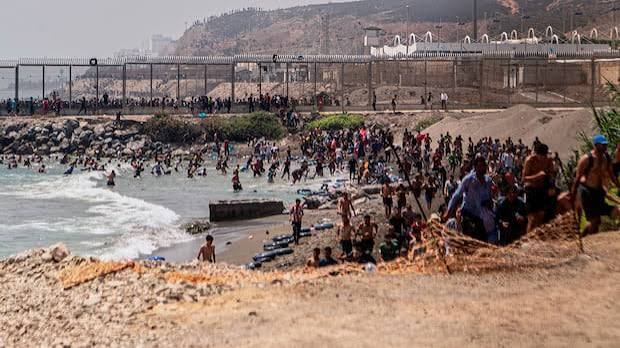
In one of the largest mass border breaches Europe has seen in modern times, Spain’s tiny enclave on the North African coast was overwhelmed as an estimated 49,000 migrants crossed from Morocco by land and sea in just 24 hours. Spain deployed its military, Morocco reinforced the frontier, at least 18 people died during the rush, and the crossing was largely halted the following day.
The numbers are staggering. Ceuta is home to only about 85,000 residents. In a single day, arrivals equaled well over half the city’s population. This was a demonstration that, if the border gives way, hundreds of thousands of people can enter European territory almost immediately.
For governments, the calculation is entirely different. No country can meaningfully screen tens of thousands of arrivals in real time. Authorities cannot determine identities, criminal histories, security concerns, or asylum claims after a border has already been overwhelmed.
And this is not merely Spain’s problem.
Spain guards one of the European Union’s external frontiers. The Schengen system depends on every member securing that frontier because what enters one country can ultimately affect them all. Spain’s border policy is therefore not just Spain’s policy—it affects Paris, Rome, Berlin, Amsterdam, and every other country that has entrusted its own internal borders to the Schengen system.
That is why Italy’s Giorgia Meloni and other European leaders reacted so sharply. Their concern is larger than Ceuta itself. It is whether Europe can preserve free movement inside the Union if member states adopt fundamentally different approaches to controlling who enters from outside.
“We are in the process of bringing together the competent bodies and, once these meetings are over, we are ready to act, including through exceptional measures… such as suspending the Schengen agreement with Spain.” – Italian Prime Minister Giorgia Meloni
Since the Arab Spring, Europe has absorbed millions of refugees and migrants fleeing civil wars in Syria, Libya, Afghanistan, and elsewhere. Those movements reshaped European politics, accelerated the rise of nationalist parties, and transformed debates over sovereignty, identity, and integration.
Ceuta is different. It revealed a land route from Africa into the European Union capable of moving extraordinary numbers of people in an astonishingly short period. If this becomes an established migration corridor, Europe could face pressures unlike any it has experienced since the Arab Spring, and it will likely far surpass it in terms of numbers.
From here, several futures are possible.
Spain could conclude that maintaining Ceuta and Melilla is no longer worth the political and financial cost and eventually negotiate their return to Morocco.
Spain could dramatically strengthen its external border, making clear that humanitarian obligations do not require surrendering control over who enters the country.
Or Spain could continue on its current course, betting that Europe will absorb the consequences. If so, pressure from its European partners will intensify. Calls to suspend Spain from Schengen or restore permanent internal border controls will become louder. While a “Spexit” (Spain’s exit from the European Union) remains a remote possibility, the political strains that produce such conversations would only deepen.
Nearly 50,000 migrants from Africa are estimated to have crossed into Ceuta, Spain on July 30, 2026
There is another outcome that deserves more attention beyond the immediate decisions of the government of Spain.
If governments are seen as unable or unwilling to control migration, voters rarely abandon the issue. They abandon the governments. Nationalist and right-wing parties would likely continue to gain strength across Spain and Europe. The political backlash would not stop at the wave of immigration. It would spill over into wider suspicion of immigrant communities and minorities who had no role in creating the crisis, further polarizing European society.
History offers reminders.
More than thirteen centuries ago, Muslim armies crossed from North Africa into Iberia and established Al-Andalus, reshaping the peninsula for centuries. Eventually, Spain pushed out all of its Muslims in a forced expulsion which also included the Jews. The roughly 200,000 Jews of Spain were expelled on July 31, 1492, and Spain has been basically Jew-free since then.
More recently, in the 1930s and 1940s, the National Socialists of Germany marked for extermination millions of unwanted people, including Jews, Roma and those with disabilities. Fierce tribalism marked foreigners as enemies, regardless of the actions of the residents.
Today, the choice is not between compassion and security. A democratic society requires both.
The Strait of Gibraltar remains one of the shortest distances between Africa and Europe. Ceuta has reminded Europe that borders are not abstract lines on a map: they are political decisions. If Europe chooses not to control its external frontier, events like this will not remain exceptional. They will become the new normal. As will the ramifications.
Will Europe decide who enters its borders, or will it let events on the ground make that decision for it. Each is a deliberate political decision.
Listen to many of today’s most prominent progressive Jewish organizations—T’ruah, Bend the Arc, Jewish Voice for Peace, and many rabbis who speak in similar terms—and a pattern quickly emerges. Their Judaism is explained through a familiar vocabulary.
Justice.
Human dignity.
Welcoming the stranger.
Repairing the world (Tikkun Olam).
Compassion.
These are presented not simply as Jewish values, but as the defining Jewish values.
It is an appealing message. It is also one the modern Western world already overwhelmingly believes.
Nearly every university, corporation, NGO, church, and democratic government affirms human dignity, equality, compassion, caring for refugees, and social justice. Whether one agrees with every application of those ideals is beside the point. They are no longer uniquely Jewish insights. They have become the common moral language of much of the modern world.
The progressive Jewish rabbis and organizations often remind audiences that many of those ideals trace their roots to the Hebrew Bible. That observation is true. Judaism profoundly shaped Western moral thought. Therefore the comment of them being Jewish values is seemingly to educate the western world that they only have their own universal values because of Jews. Also perhaps true, but to what end is the observation? Is it to inform those listening that Jews alone carry the essence of justice, with a transmission extending back thousands of years? That they alone are the actual guardians of values?
Or that they are all on the same page – that the values the West holds dear and the progressive rabbis are one and the same? That one or the other may take the lead on a subject – say condemning genocide, for example – and the other will echo the sentiment?
That approach deliberately strips anything uniquely Jewish from values. It makes the adjective superfluous. Redundant.
Many non-progressive rabbis and the mainstream Jewish organizations have a different view, one that affirms the Jewish component of values. Those are values that are woven into the covenant between God and the Jewish people, as laid out in the Bible and holy books, and debated for thousands of years.
In such telling, justice is not equity as progressive rabbis champion, but based on fairness and balance.
Charity is not generosity. It is tzedakah – an obligation, and one in which helping someone get a paying job and being able to care for themselves is viewed as much greater than making them addicted to welfare.
Rest is not work-life balance. It is Shabbat, a holy day that interrupts commerce, technology, and ordinary life every seventh day because God commanded it. The notion of people adding holiness to something inanimate – like an idol – is actually prohibited in Judaism, while it is encouraged for something specified and incorporeal like the seventh day.
Environmental stewardship is not merely “sustainability.” It includes shmita, allowing the Land of Israel itself to rest every seventh year, because it is a special gift to the Jewish people, much like Shabbat.
Family is not simply important. Marriage, children, circumcision, honoring parents, and transmitting Torah from one generation to the next are sacred obligations.
The list goes on. Some Jewish values are absent from the umbrella of tikkun olam, while others stand in direct contrast to the T’ruah placards.
Recovering the definition matters. Otherwise, “Jewish values” risks becoming little more than progressive ethics wrapped in Hebrew vocabulary—a faith whose unique contribution is remembered mainly as history, while its living covenant is quietly left behind.
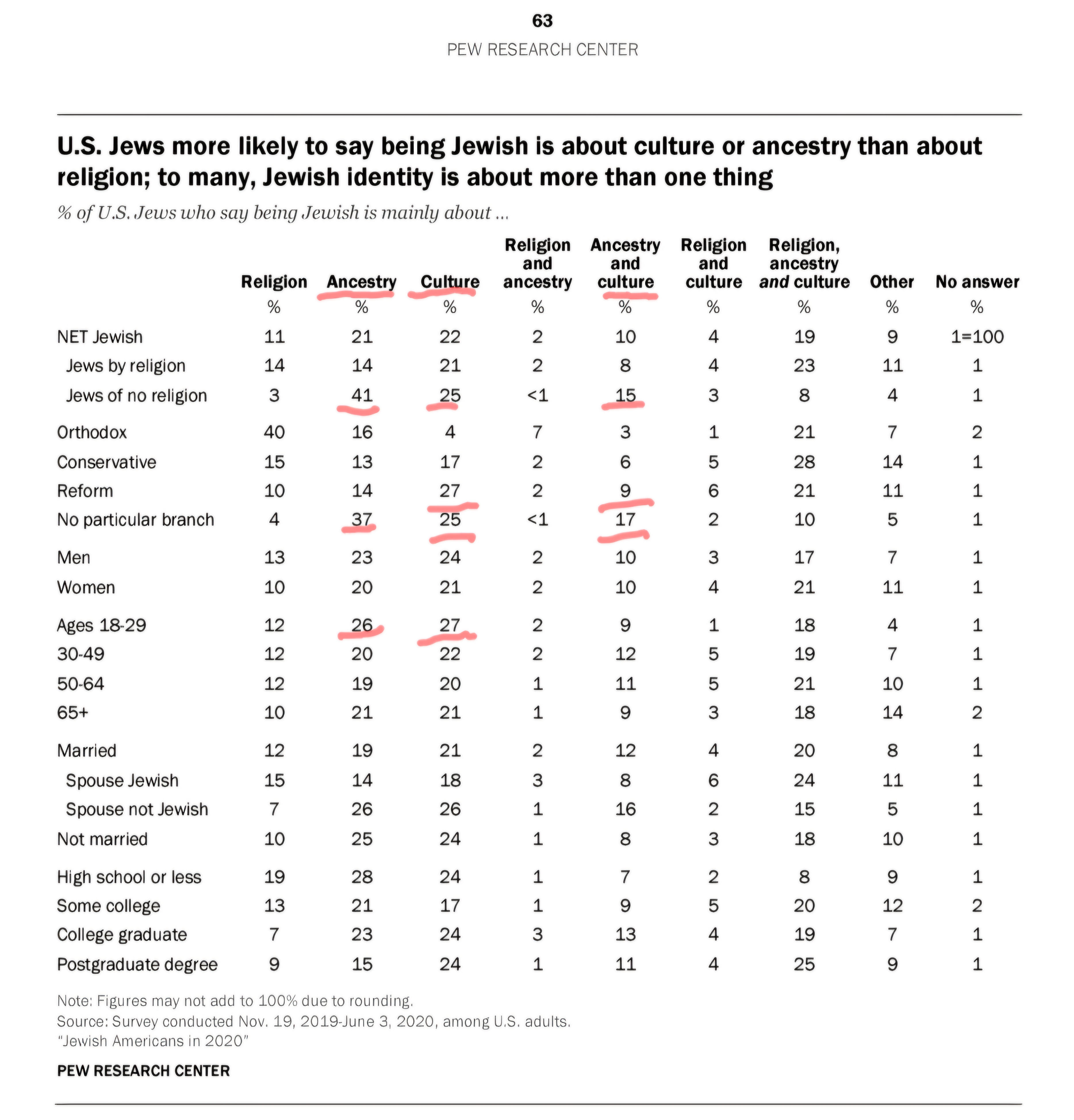
“U.S. Jews do not have a single, uniform answer to what being Jewish means…. Many American Jews prioritize cultural components of Judaism over religious ones…. Orthodox Jews are a striking exception…. A plurality of Orthodox Jews say that being Jewish is mainly about religion alone (40%), and they are the only subgroup in the survey who overwhelmingly feel that observing halakha is essential to their Jewishness (83%)… The vast majority of Jews of no religion say that for them, being Jewish is mainly a matter of ancestry (41%), culture (25%) or both (15%).” – Pew Research May 2021
At this moment in time, the distinction is not theoretical or esoteric. Many progressive left Jewish organizations have adopted stridently anti-Israel positions, some arguing that the Jewish State should be destroyed. They knowingly lock arms with antisemites to advance such future vision.
And should it be a surprise? If the essence of Jewish values for the non-Orthodox far-left is that there is nothing particular about Jews, and that both the noun and adjective “Jew” and “Jewish” are simply historic words without meaning, why should Jews have self-determination any more than left-handed people?
“Supporting Israel is not a battle of political orientation between liberal and conservative Jews. It is a philosophical break in the Jewish community with a fault line regarding the uniqueness of Jews and the Jewish State. The non-Orthodox denominations’ religious philosophy will only let it embrace an Israel that is: about people, not God; about rights not rituals; more secular than religious; more democratic than Jewish; and more universal than particular.” – The Non-Orthodox Jewish Denominations Fight Israel, January 2018
The broader Jewish community should be clear and confident to say that this simply untrue. Judaism and Jewish values are not ancient rock carvings on a cave from which sprang forth the Judeo-Christian values of today. Jews are a living people with a belief in an ongoing covenant which have particular Jewish values that extend beyond universal morality. We should not accept self-erasure in the current environment of cancelling Jews.
More, everyone should fight this approach. Not only Jews but every people who care about their own unique culture and perspective. The lure of the “melting pot” is great but needn’t be absolute. Appreciate the universal AND the particular for Jews and every neighbor.
Judaism helped shape the modern vocabulary of universal values. But Judaism’s enduring contribution is not simply to teach those ideals but show how they are woven into a sacred way of living. One that sanctifies time through Shabbat, family through covenant, body through mitzvot, land through shmita and pilgimmage, and elevates communal responsibilities to a daily obligation.
Jewish values are not simply universal values. And we should not be ashamed to state it clearly.
Worried about New York City Mayor Mamdani’s politics going statewide and national? You need to do a lot more than show up to a protest with placards.
New York is not simply a Democratic state. It is a Democratic supermajority state.
The governor, Governor Kathy Hochul is a Democrat. Democrats hold 41 of the State Senate’s 63 seats and 103 of the Assembly’s 150 seats—more than enough for a veto-proof supermajority in the Assembly and just one seat shy of one in the Senate. The practical result is that currently, Republicans have little ability to force negotiation or compromise. The state’s most important political debates now occur almost entirely within the Democratic Party.
That is critical at a moment like this.
When organizations such as the Democratic Socialists of America (DSA) succeed in electing candidates or moving Democratic primaries to the far-left, the effects are no longer confined to activist circles. Ideas that gain traction within the Democratic caucus can become state policy without needing bipartisan support. Whether the issue is criminal justice, taxation, housing, energy, education, labor regulation, or Israel policy, the decisive battle is often the Democratic primary, not the general election.
This does not mean every progressive proposal becomes law. Democratic legislators disagree on many issues. But a supermajority means there are fewer institutional checks when one faction gains influence.
For New Yorkers who want a different direction than being advanced by the DSA and NYC Mayor Mamdani, the answer is not simply to oppose legislation after it is introduced. It is to change the composition of the Legislature itself.
That is why a relatively small number of competitive districts carry outsized importance this year.
Competitive legislative races do more than elect a senator or assemblymember. They build volunteer networks, raise money, increase turnout, and strengthen candidates throughout the ticket.
Congressman Mike Lawler’s race in the Hudson Valley is a prime example. His campaign in New York’s 17th Congressional District is again expected to be one of the nation’s most competitive House races. A strong Republican legislative effort in the region can reinforce his campaign, just as a strong Lawler campaign can help Republican candidates for the State Senate and Assembly. The same dynamic applies across Long Island, Staten Island, and other competitive suburban districts.
Congressman Mike Lawler (R-NY17)
Among the key legislative opportunities Republicans will target are suburban Senate districts on Long Island and in the Hudson Valley, along with competitive Assembly districts in Nassau and Suffolk Counties, Staten Island, Monroe County, Onondaga County, and the Capital Region.
Every election cycle, voters are told that one legislative seat cannot make much difference. In New York, the opposite is true.
A handful of seats in New York’s election can determine whether the Legislature remains a near-unchecked trifecta supermajority allowing radical far-left motions to become law or becomes a body where broader consensus is once again required. Those races will shape not only who governs in Albany, but how New York is governed.
One of the more curious developments in American politics is watching mainstream Democrats increasingly tailor their positions to satisfy activists who still refuse to support them.
The answer lies in understanding the difference between a coalition and an ideology.
A coalition exists to win elections. It is broad by design. People disagree on taxes, immigration, foreign policy, and the Middle East, yet work together because they share enough common ground to govern. Coalitions ask one question: Can we work together despite our differences?
An ideological movement asks a different question: Do you believe what we believe?
That distinction changes everything.
Purity tests are not an accident of ideological movements; they are their natural consequence. If your goal is to advance a comprehensive worldview, disagreement is no longer just a different opinion but evidence that someone has failed the test.
This helps explain the relationship between the Democratic Party and organizations such as the Democratic Socialists of America. The Democratic Party is trying to hold together one of the broadest electoral coalitions in America. The DSA is advancing an ideology. It has shown little hesitation about opposing Democratic incumbents who fail its litmus tests, whether on capitalism, Israel, policing, or other defining issues.
Israel illustrates the divide clearly. Within a coalition, someone can support Israel’s defensive war while criticizing particular government officials or military actions. Within an ideological movement, those distinctions may not be enough.
That is why the political response of some mainstream Democrats is so puzzling. They often behave as though they are negotiating with another coalition partner. They are not. They are seeking approval from a movement whose purpose is to distinguish believers from non-believers. Incremental concessions rarely earn lasting acceptance. They simply establish a new baseline for the next demand.
The DSA’s own long-term political vision underscores the point. It has argued that America’s two-party system should ultimately be replaced by a multi-party parliamentary democracy. That is an entirely coherent position for an ideological movement. But it also reveals why the tension is so persistent. A movement that seeks its own distinct ideological party will naturally find itself in conflict with a broad coalition whose purpose is to assemble majorities among people who disagree on fundamental questions. The friction is inevitable.
Perhaps the better response for mainstream Democrats is not to seek the DSA endorsement at all.
Every endorsement tells voters something about shared values. If an organization rejects your belief in a market economy, your support for the Jewish State’s continued existence, or your willingness to govern through compromise rather than ideological purity, why should the DSA’s endorsement be considered a prize? A politician should not be embarrassed to say, “We simply have different visions for the country.”
In fact, the willingness to disappoint ideological movements may be one of the clearest signs that a politician still understands the difference between governing and evangelizing.
There is a lesson here for the pro-Israel community as well.
Politics rewards participation, not nostalgia. Elected officials respond to the people who organize, communicate with their offices, volunteer, build local networks, and vote. If supporters of the U.S.-Israel relationship want their voices heard, they must become a consistently visible part of the political coalition—not merely assume their support will be taken for granted.
Building coalitions by attempting to contort to the demands of extremist ideologues will be a painful exercise to watch. And to live with. It has made many Democrats feel abandoned by their party as it chases the far-left which despises most of the coalition.
Coalitions are built by persuading people who disagree to work together. Ideologies are built by deciding who belongs. The Democratic Party will remain a relevant governing party only if it remembers which one it is.
When I wrote I’m Offended, You’re Dead in 2015, I argued that the West fundamentally misunderstood violent jihadism. It was routinely described as the work of a tiny fringe because Western observers were looking almost exclusively at Europe and North America. But that was never where most Muslims lived or where most of the violence occured.
The view that a few “extremists” have hijacked Islam and are attacking the freedom of press is both myopic in terms of history and geography, and hazy in terms of numbers and scope.
In the Global North, Muslims make up only about 2.6% of the population. Across the Global South, they account for roughly 28%. Excluding Latin America and China, that figure rises to about 42%. The attitudes that gave rise to violent jihadism were therefore never confined to a handful of isolated extremists. Across large parts of the Muslim world, Islamist movements and deeply illiberal religious doctrines already exercised enormous influence and persecute people attempting to live with basic human rights. The West mistook a geographic illusion for an ideological one.
Terrorist movements do not emerge in an ideological vacuum. An ideology does not need majority support to convince a determined minority that violence is both righteous and necessary.
And you no longer have to listen carefully to hear that message.
Over the past decade, migration, social media, and global communications have brought that ideological current into the daily background of Western life. Many will be alarmed and others will feel called. Either way, it has become ever-present and one no longer needs to search to find it.
The attacks increasingly follow a familiar pattern because they spring from the same worldview.
The gay patrons of the Pulse nightclub in Orlando were condemned as morally corrupt and massacred by a man with ties to al Qaeda and Hezbollah. This week, a Berlin Pride parade became the target of a man who had reportedly sought to join ISIS. Christmas markets in Germany have repeatedly been attacked by men invoking Islamist causes. Trucks and cars have been used as weapons against civilians in France, Germany, and Israel. In Manhattan, a deranged man allegedly shouted “Allahu Akbar” while carrying out a stabbing spree.
Moses Grunhaus after he was stabbed by a man yelling “Allahu Akbar.” He was in New York City to clear out his apartment to move to Florida because of the election of Mayor Zohran Mamdani
Different countries. Different perpetrators. Different personal histories.
Official Palestinian media produced cartoons calling for Arabs to run over Jews
Yet the underlying message is strikingly similar: for the jihadists, those who offend do not merely deserve criticism – they deserve elimination.
That is the lesson many in the West still refuse to absorb. We continue to interpret these attacks through the lens of isolated extremism, mental illness, or individual grievance. Those factors may help explain why one person acts and another does not. They do not explain why the same religious slogans, the same enemies – the West, and the same methods appear again and again across continents.
The lesson of I’m Offended, You’re Dead is even more relevant today than it was a decade ago. The argument was never that every Muslim is a jihadist. It was that an ideology can become pervasive enough to inspire violence far beyond the ranks of organized terrorist groups. Even beyond “lone wolves.” It becomes the default language of the street.
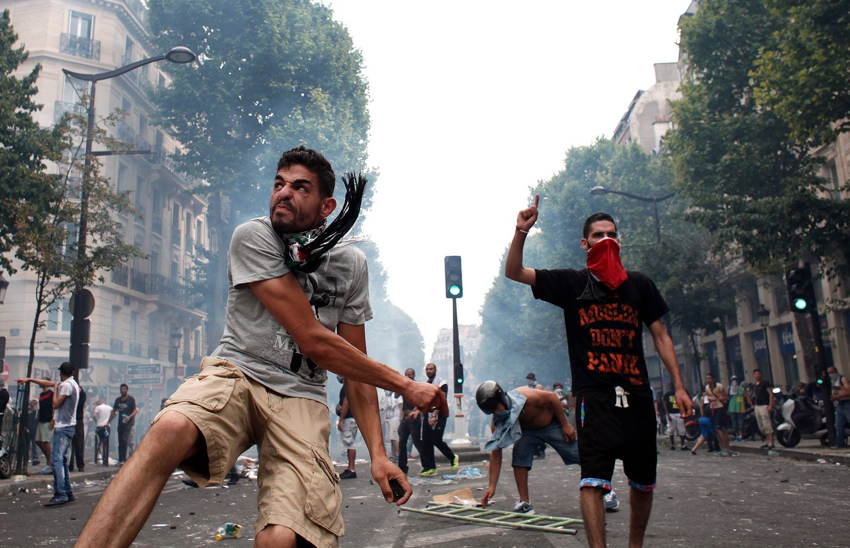
Islamic radicals riot in Paris, France
The West believes it is engaged in an argument over speech and tolerance. About the quantitative size of immigration and the culture of new arrivals. Because that is the culture of the West – to debate, to find compromise, to coexist.
But violent jihadism is engaged in something else entirely. It is not trying to persuade those it finds offensive. It seeks to destroy them.
A decade ago, you had to look for that message, to parse that difference. Today, you don’t.
The call of “Allahu Akbar” is no longer confined to jihadi groups or even “lone wolf” radicals as they commit attacks. Because the anti-West lexicon has become normalized on the angry streets, hunting people perceived of as “monsters.”
Thousands of Jews visited the Temple Mount in Jerusalem this week during normal visiting hours on Tisha B’Av, the day commemorating the destruction of the First and Second Jewish Temples that once stood on that very site.
That is the basic fact. Everything that follows depends on how news organizations chose to describe it.
Outlet
Who?
Place
Action
The Guardian
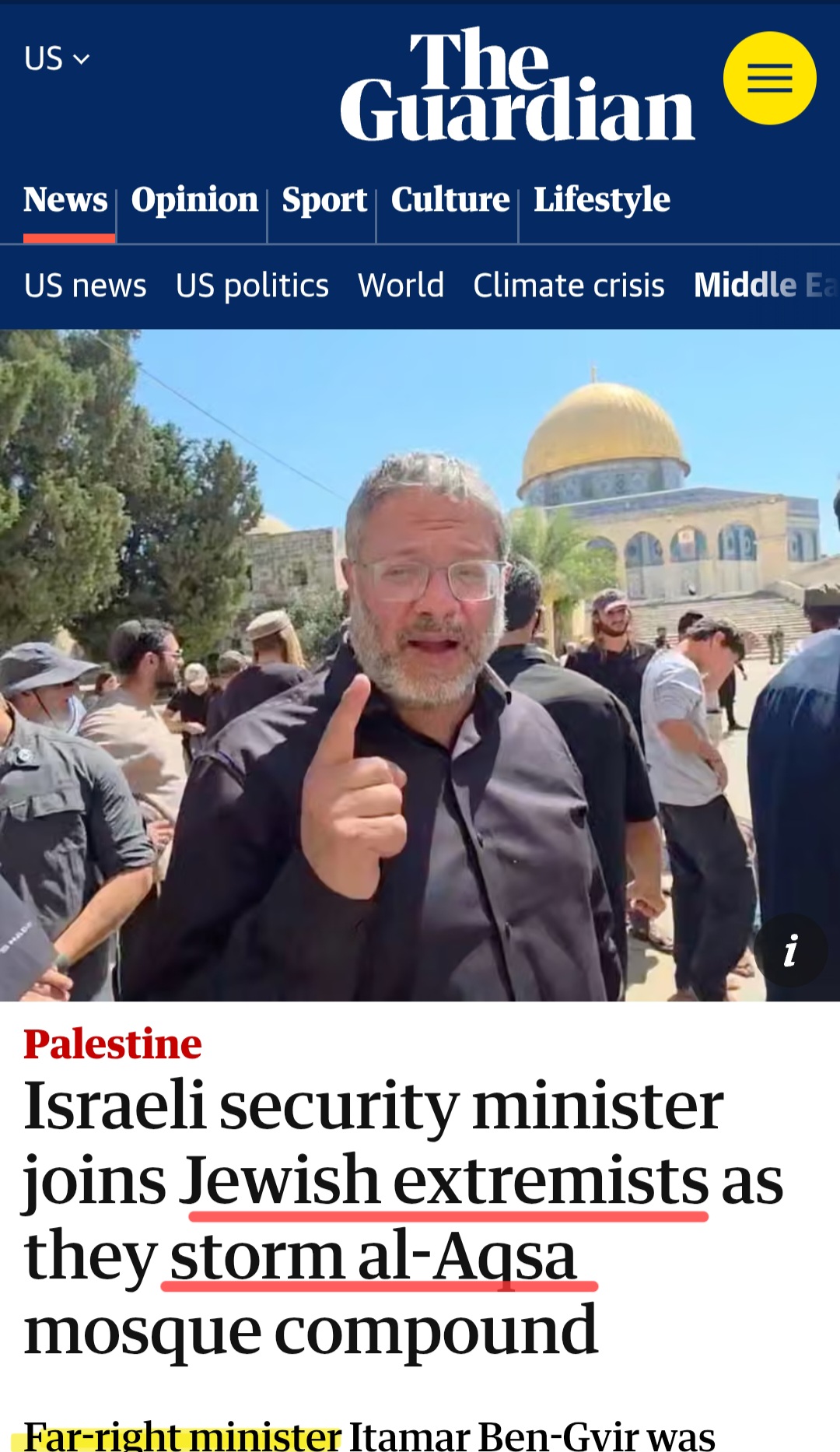
“Jewish extremists“; “far-right” ministers
“Al-Aqsa mosque compound”
“Storm”
Reuters
“Israel’s Ben Gvir”; “National Security Minister”
“Al-Aqsa Mosque compound” (also notes Jews call it the Temple Mount in article)
“Visits”
Haaretz
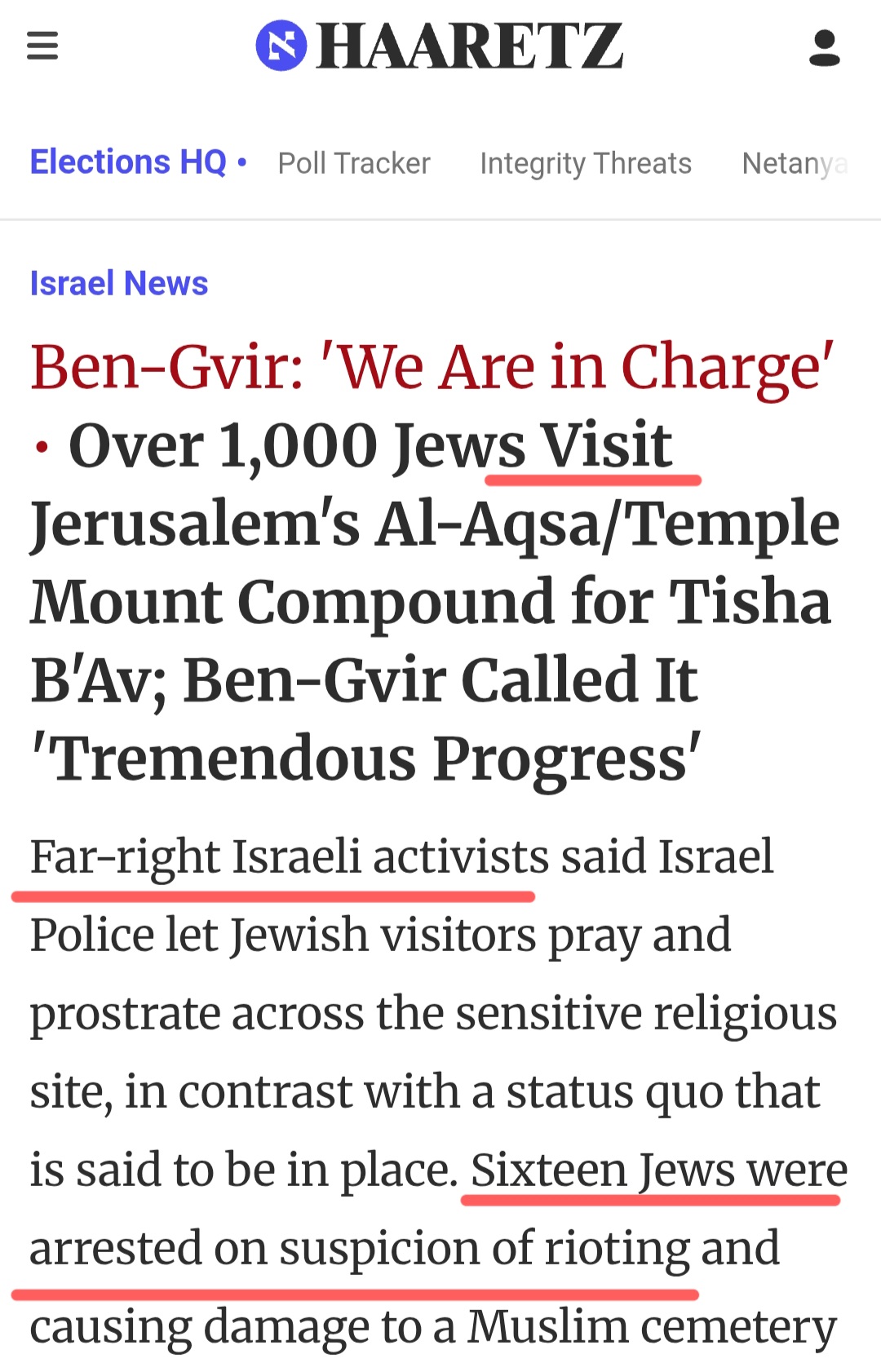
“Far right Israeli acitivists“
“Al-Aqsa/Temple Mount Compound”
“Visit”
Arab & Palestinian media
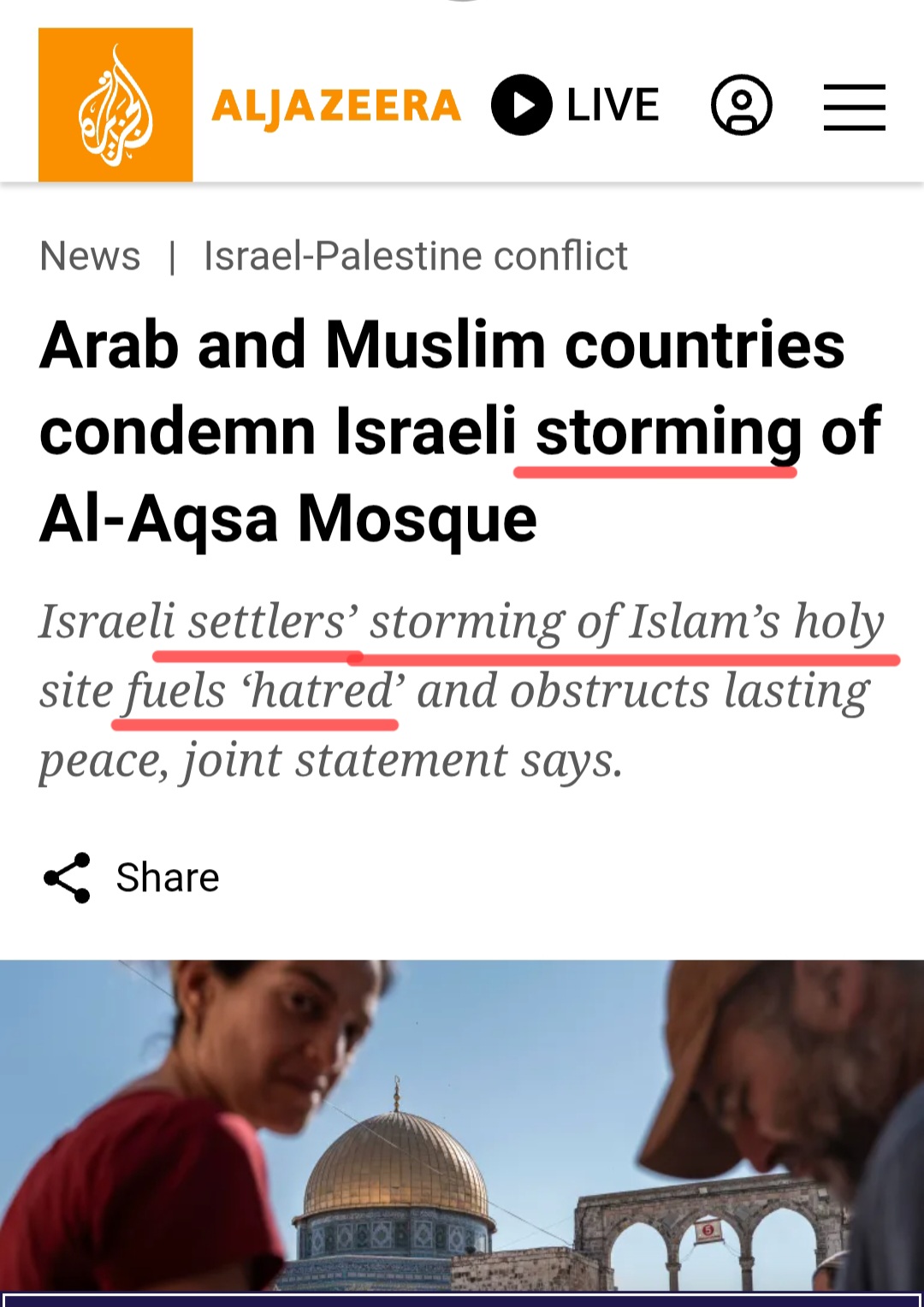
“Settlers,” “far-right” or “extremists“
“Al-Aqsa Mosque“
“Raid” / “Storm“
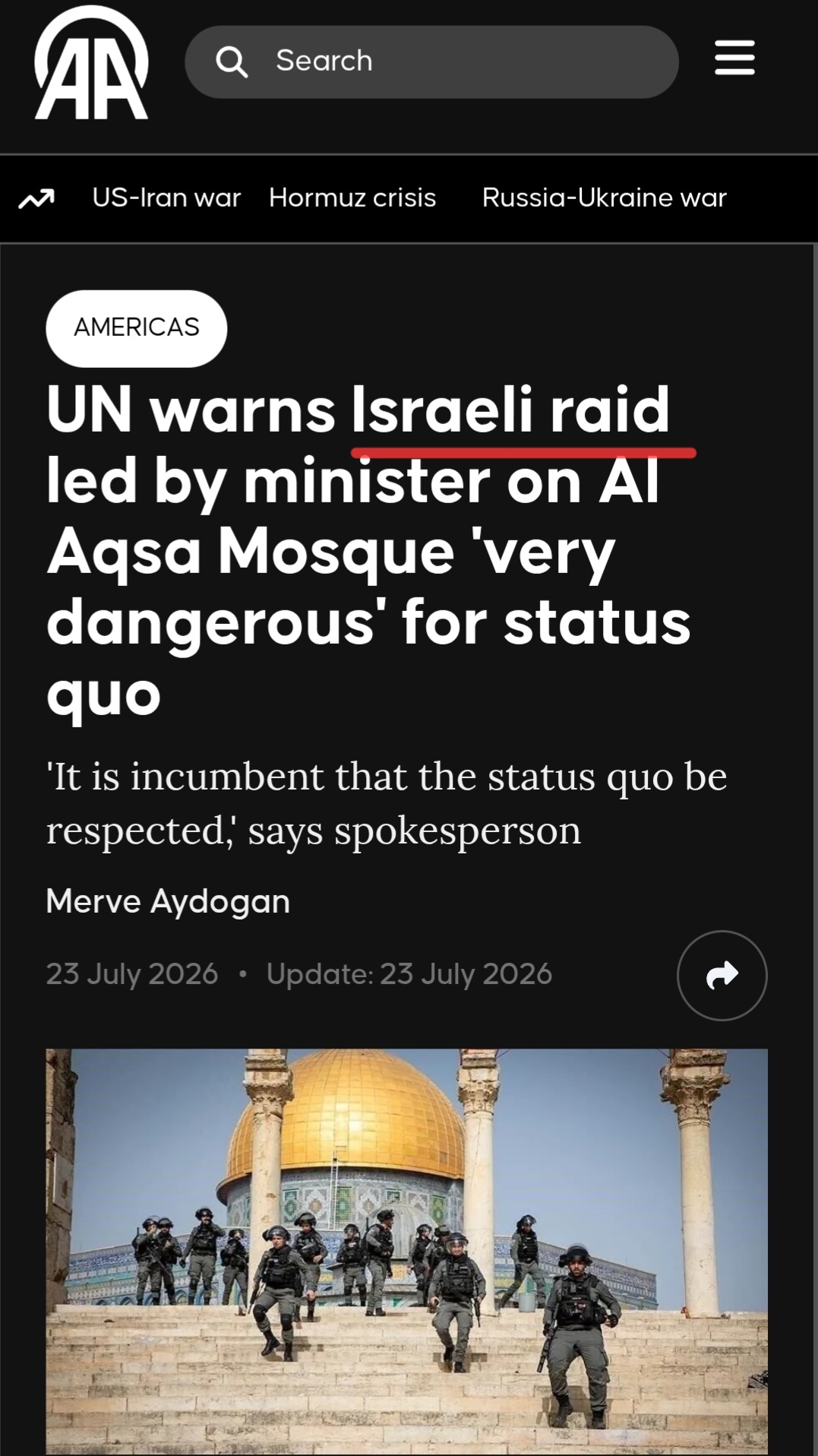
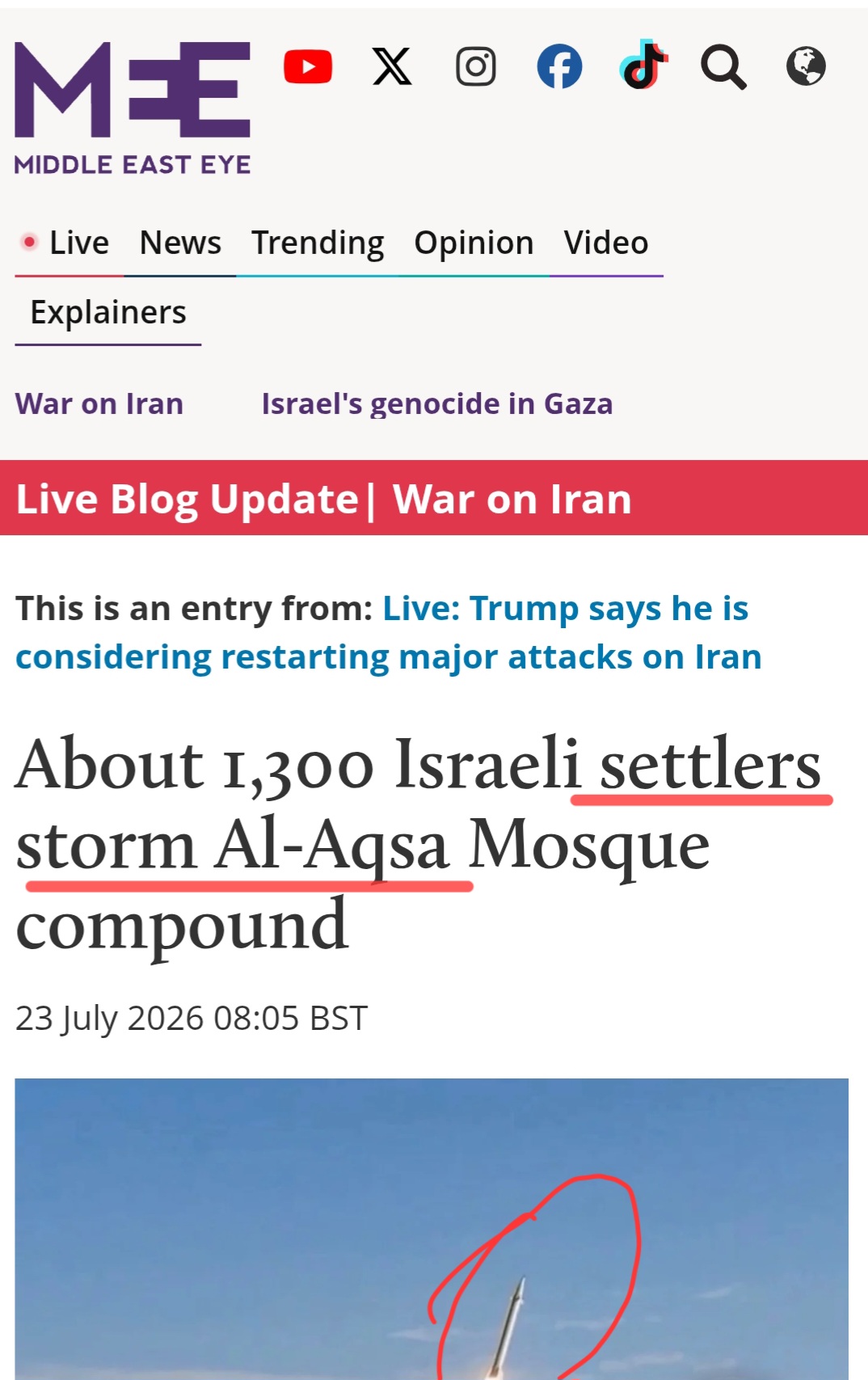
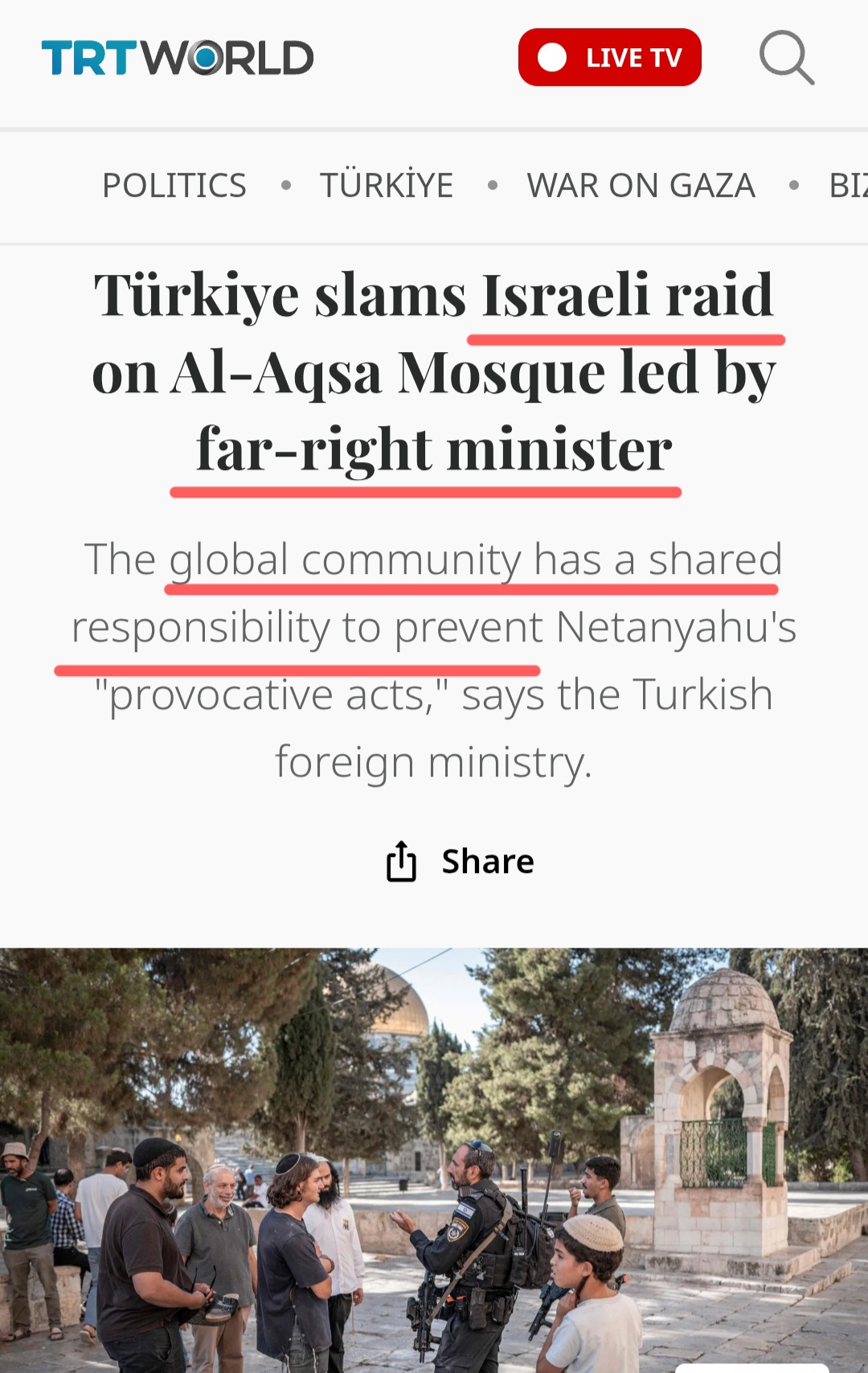
The pattern is clear. The same event is transformed through language in the Muslim and Arab world: Temple Mount becomes Al-Aqsa; Jewish worshippers become “settlers” or “extremists”; a regulated religious visit during visiting hours becomes a “raid” or “storming.” And the results are laid out as “very dangerous” and “the global community has a shared responsibility to prevent Netanyahu’s ‘provocative acts.'”
This has a long ugly history and is expected in the radical Muslim press.
What is becoming more commonplace is for Europe to join this antisemitic framing. The United Kingdom’s The Guardian reported on the visit with the shrill tone and narrative of the Islamic world in a news article, not an opinion piece.
The visitors did not storm the site. They entered through Israeli security during established visiting hours. The Jews never entered the Al-Aqsa Mosque itself. They visited the Temple Mount – the holiest place in Judaism and site of the First and Second Jewish Temples – on a Jewish holiday about that specific location.
Calling thousands of Jewish worshippers “extremists” because they ascended Judaism’s holiest site on Tisha B’Av is itself an extraordinary editorial choice. The remarkable inversion is that the descendants of the people whose temples stood there are portrayed as intruders, while their religious observance is framed as an act of aggression.
Newspapers do not report that Muslims “stormed Mecca” during the Hajj or that Christians “stormed” the Vatican during Easter. Yet when Jews gather at Judaism’s holiest site, peaceful pilgrimage suddenly becomes an extremist assault.
This is especially troubling in Britain, where antisemitism has surged since October 7. British officials have repeatedly warned that the demonization of Israel spills into the demonization of British Jews, while chants of “jihad” and “intifada” have echoed through the country’s streets. The concern is no longer theoretical. Britain’s deadliest recent synagogue attack was carried out by an Islamic State adherent whose communications revealed deeply antisemitic views. More than half of Britain’s recorded antisemitic incidents in 2025 referenced Israel, “Palestine,” Hamas or the Gaza war.
The Guardian is not simply another British newspaper. It is one of the world’s most influential English-language news organizations, with most of its readership now outside Britain, including Ireland and Australia. Its reporting helps shape how millions understand events in Israel. Media watchdogs including CAMERA and HonestReporting have repeatedly criticized its language and framing on Israel and Jerusalem. Yet despite years of such criticism—and against the backdrop of rising antisemitism and repeated attacks on Jews in Britain—the newspaper chose to describe Jews observing one of Judaism’s most solemn days at their holiest site as fanatical Jews coming for Islamic holy sites. That framing does not remain confined to Britain. It travels with The Guardian‘s global audience.
Journalism’s first obligation is to help readers understand reality before interpreting it. When The Guardian abandons that duty in favor of inflammatory framing, it bears responsibility for contributing to the climate of hostility that encourages anti-Jewish hatred and violence.
For nearly 2,000 years, Jews have fasted on Tisha B’Av to mourn the destruction of the First and Second Temples, the loss of Jewish sovereignty, exile from Jerusalem, and a long chain of national tragedies.
Jewish tradition also teaches that the fast will not last forever. The prophet Zechariah envisioned a day when the fasts commemorating Jerusalem’s destruction would become days of “joy and gladness and cheerful festivals.” Many rabbis have understood that era to arrive with the rebuilding of the Temple.
No one knows when that day will come.
Yet the last century has witnessed changes that generations of Jews scarcely dared imagine.
The Jewish people returned to their ancestral homeland. The State of Israel was reborn (1948). Jerusalem was reunited under Jewish sovereignty (1967). For the first time in nearly two thousand years, Israel is home to the world’s largest Jewish population (2012).
Israel has also become increasingly accepted by its Arab and Muslim neighbors, establishing diplomatic relations with Egypt (1979), Jordan (1994), the United Arab Emirates (2020), Bahrain (2020), Morocco (2020), Sudan (2020, pending implementation), and Kosovo (2021). Meanwhile, the United States (2018), Guatemala (2018), Honduras (2021), Kosovo (2021), Papua New Guinea (2023), Paraguay (2024), and Fiji (2024) have moved their embassies to Jerusalem, while other countries (Slovenia and Nauru) are considering doing the same.
Last year (2025), more than 75,000 Jews ascended the Temple Mount – a modern record that would have been unimaginable only a generation ago.
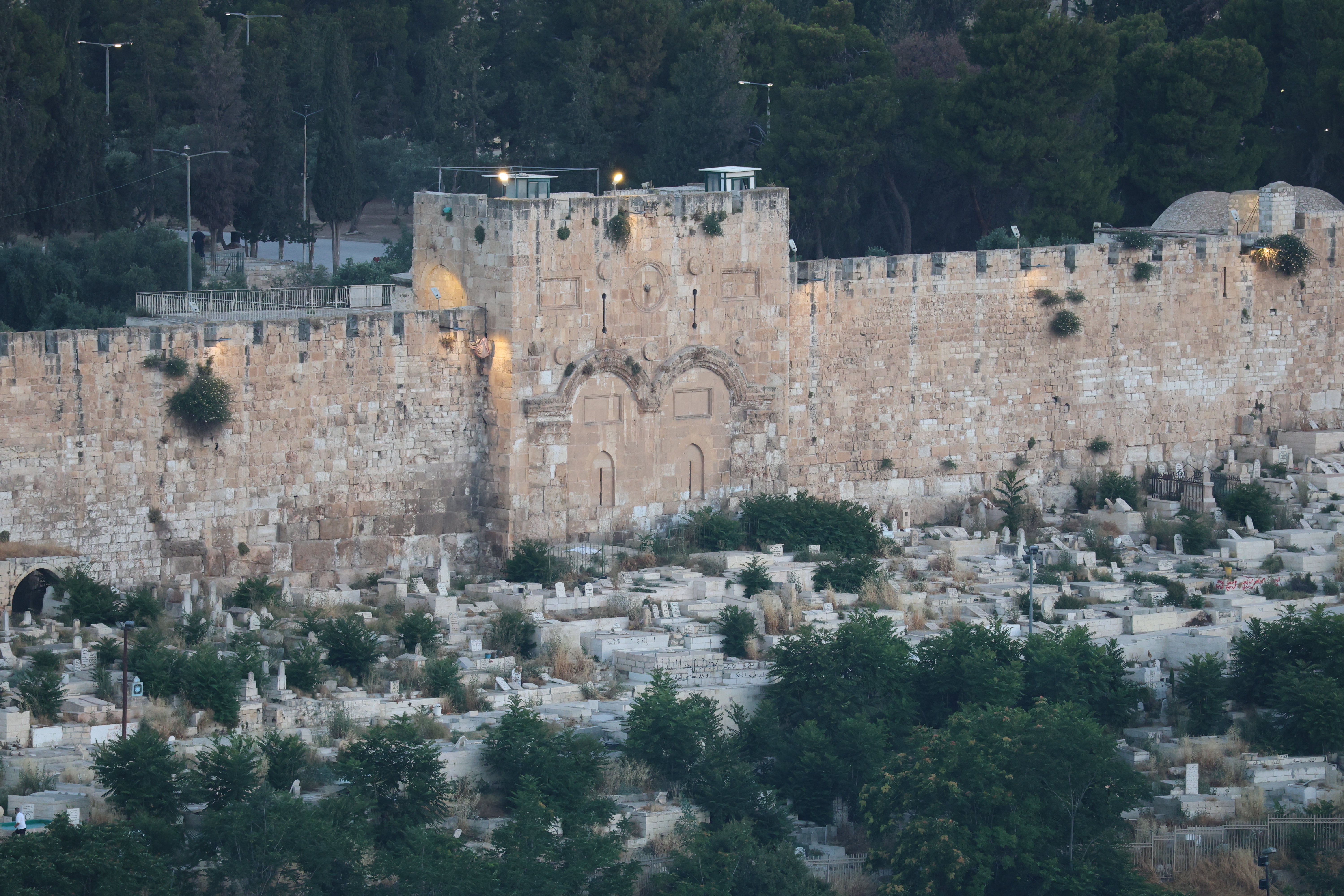
The Golden Gate in Jerusalem’s Old City exterior wall (photo: First One through)
The Temple remains unbuilt and Tisha B’Av remains a day of mourning.
But it does raise a question that previous generations could scarcely have imagined asking: Will this be the last Tisha B’Av fast?
Perhaps Jews a century from now will still be asking the same question. Or perhaps they will look back and realize that ours was among the last generations to mourn the destruction rather than celebrate the restoration.
For almost two thousand years, that possibility seemed unimaginable. Today, it no longer does.
There is something profoundly human about gathering related things into a single vessel.
We do it with photo albums, where a lifetime of moments is gathered into one book. We do it with museums, where centuries of artifacts are brought together under one roof.
The Jewish calendar does the same with time.
Tisha B’Av is not merely the anniversary of the destruction of the First and Second Temples. Over centuries it became the vessel into which Jewish history poured its sorrows – from the destruction of the Temples to the expulsions from England and Spain, to catastrophes that culminated in the Holocaust. Generations found in Tisha B’Av a place large enough to hold them all.
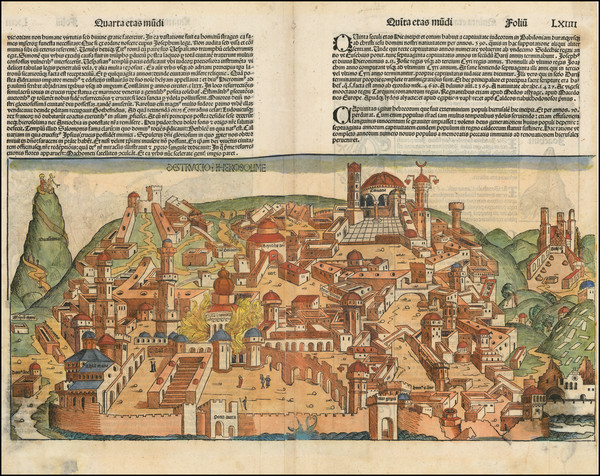
The Nuremberg Chronicle showing the destruction of Jerusalem
The Temple Mount in Jerusalem became another vessel. Of place.
For much of history, Jerusalem was known as the city of the Jewish Temple. But over time it gathered far more meaning. It became the location of the near sacrifice of Isaac, the destination of pilgrimage, the focus of exile, and the direction toward which Jews have prayed for thousands of years.
Other faiths also poured meaning into Jerusalem. Christians revere it as the place of Jesus’ crucifixion and resurrection. Muslims honor it as the destination of Muhammad’s Night Journey. Layer upon layer, century upon century, Jerusalem became more than a city. It became a vessel carrying humanity’s deepest convictions, hopes, and conflicts.
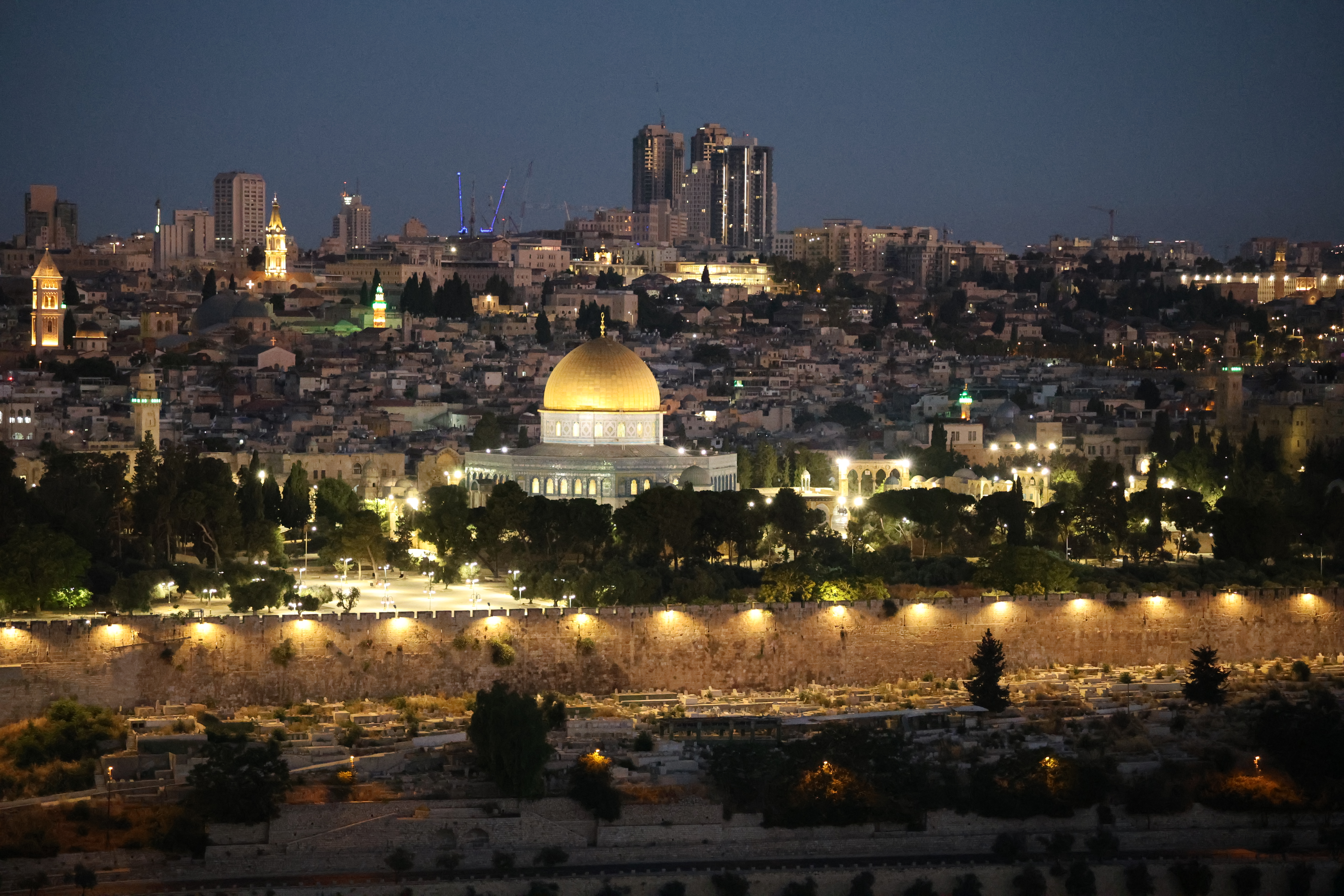
Temple Mount at dawn (photo: First One Through)
And then there is a unique people.
The Jewish people became a vessel unlike any other. Across thousands of years they carried covenant, exile, learning, persecution, survival, and hope. They preserved ancient language, sacred texts, melodies, customs, and memory across continents and generations. They became the vessel through which memory survived when kingdoms fell, empires vanished, and even the Temple itself lay in ruins.
Every vessel carries something. Some carry water. Some carry treasure. Some carry ashes. The greatest vessels carry what cannot be touched: memory, identity, covenant, and hope.
And that is what the Jewish people, Jerusalem, and Tisha B’Av have become. Three vessels in one elaborate story.
Every generation poured something more into those vessels: not only grief, but hope.
Within them rests the hope captured in the Israeli national anthem, Hatikvah: that the Jewish people will live as a free people in their own land, with Jerusalem at its heart.
And on Tisha B’Av in particular, the vessel holds one additional hope above all others: the rebuilding of the Beit HaMikdash. Not because Jews long merely for stones and walls, but because it represents the restoration of wholeness – between God and humanity, a people and their land, memory and redemption.
Every Tisha B’Av, Jews gather into one day the grief of centuries, turn toward one city, and renew one hope. As they do, they recognize that this is more than a story of three fused vessels. It is that together they carry one enduring promise.