Actions and Adjectives: Cluster Bombs

Summary: When it comes to reporting on the death of civilians, it is interesting to review how and when some media outlets choose to simply report facts, rather than delve into critical reporting. Here is a comparison of the New York Times discussion of cluster bombs being used by Syria and the Kingdom of Saudi Arabia (KSA). Remarkably, the party that is lambasted the most in the articles is Israel.

 Actions and Adjectives

The “Actions and Adjectives” series discusses the media’s use of language. Oftentimes, the press chooses to be fairly clinical in describing a situation, while at other times, it chooses to direct (or redirect) the conversation in a particular fashion.

For an example, an article can have different ways of describing a car crash:

  1. “Three people died in a car crash,” is purely factual.
  2. “Three people were killed in a car crash when a teenager crashed his car into oncoming traffic,” provides more color about the incident, giving an account of how the crash happened.
  3. “Three innocent people were killed when an irate teenager plowed his car into oncoming traffic after the teen had a big fight with his girlfriend,” takes the article to an entirely different place.

While all of the sentences are factual, the third description does two significant things:

  • It gets the reader to be more engaged- “innocent people were killed” by an “irate teenager,” phraseology gets the reader more excited and angry.
  • Further, the conversation moves the reader away from the victims, towards the driver. The reader is intentionally led towards possible motivation and background which caused the incident. Most likely, a more detailed description of the driver and his relationship would follow in the article. Should the balance of the article focus on teenage relationships, the headline would unlikely be about the car crash; the accident was there solely as a tool to delve into the main focus, which in this example, is the potential danger and ramifications of teenage love.

With that general overview about word choice and focus, consider the New York Times description of the use cluster bombs by Syria and Saudi Arabia.

Cluster Bombs Used by Saudi Arabia

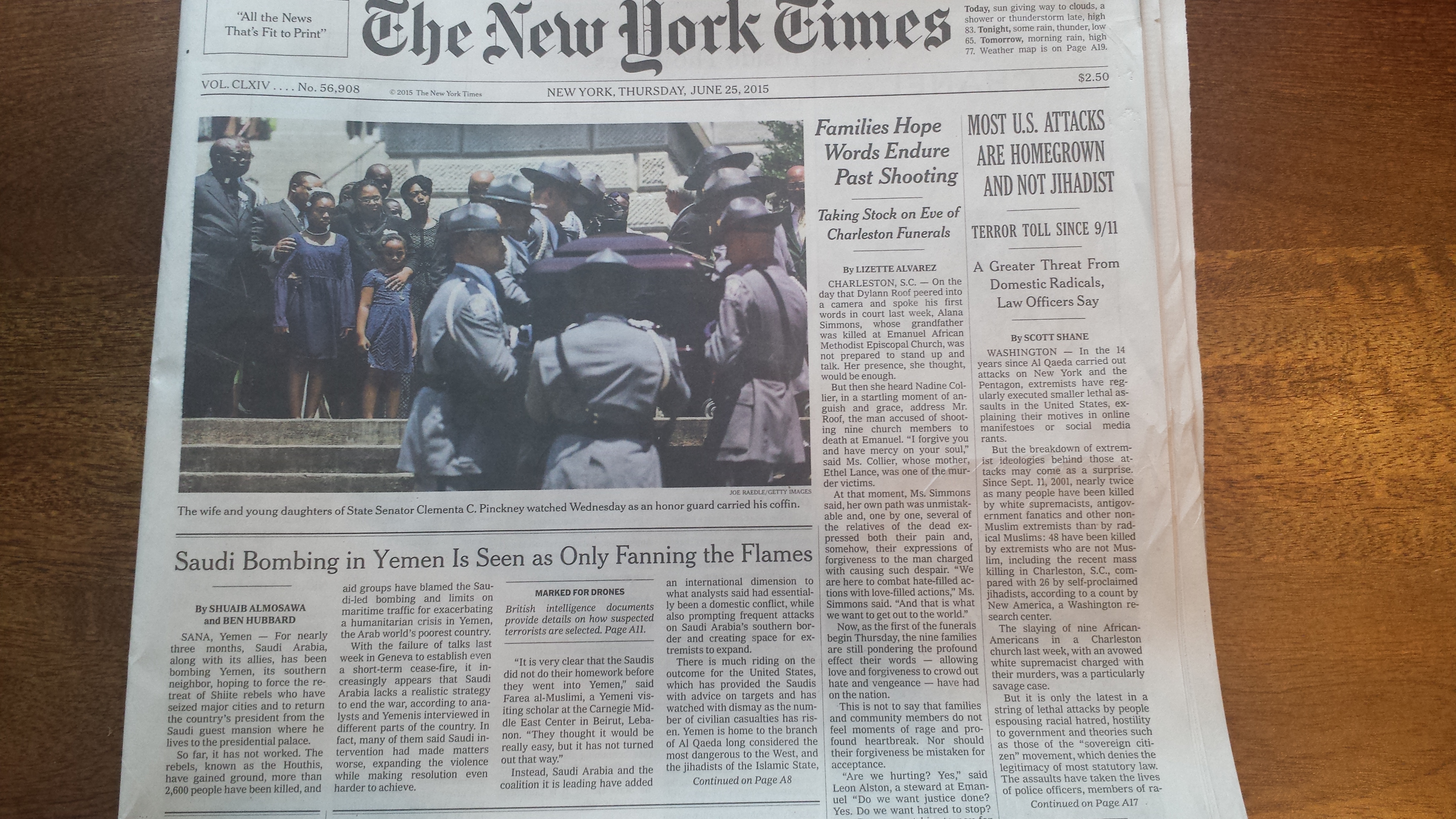
On May 3, 2015, the New York Times published a piece entitled “Saudi-led Group Said to Use Cluster Bombs in Yemen“. The 14 -paragraph article showed up at the bottom of page 10 and discussed a report by the Human Rights Watch (HRW) which concluded that Saudi Arabia used cluster bombs on at least two occasions. No casualty figures were supplied.

Saudi Arabia cluster bombs

The article made clear that “cluster munitions, which are banned by much of the world, though not by the United States, Saudi Arabia or Yemen,… pose a long-term danger to civilians because of the unexploded bomblets they leave behind.” The article included a single condemnation of KSA for its use of the weapons: “Saudi Arabia has come under growing international criticism for the high civilian death toll during its aerial campaign, which has been carried out over more than five weeks alongside a coalition of Arab states and with intelligence and logistical support from the United States. More than 1,000 people have been killed in fighting since late March, when Saudis said their military was intervening to roll back gains by the Houthis, a Shiite rebel group that had captured large parts of Yemen and forced the president, supported by Saudi Arabia, into exile.

These sentences may look unremarkable on their own, but consider what was actually written and the direction of the article as a whole:

  • It was clear that the parties that engaged in the use of the cluster bombs had not signed onto the treaty barring their usage
  • The “unexploded bomblets” were left behind by the cluster bombs, not by the Saudis which were a step removed
  • KSA was portrayed in a negative manner only a single time in the article: “growing international criticism
  • The aerial campaign was described as having wide support from a “coalition” which included “support from the United States”
  • A rationale was given for the KSA military attack- to “roll back” a “rebel group

The article stayed roughly true to the HRW report. This was in very stark comparison to an article in the New York Times published on August 28, 2014 called “Heavy Use of Banned Cluster Bombs Reported in Syria”

Cluster Bombs Used by Syria

In September, FirstOneThrough wrote a detailed analysis of the August 2014 article which outlined how the story about Syria’s use of cluster bombs ended up becoming harsh a critique of Israel. Below is some added comparisons to this week’s NYT article.

The 2014 article had a single negative comment for Syria’s use of cluster bombs, attributed to a HRW lawyer: “This year’s use of cluster munitions shows that while these weapons have been banned by most countries of the world, some actors still flout international opinion and standards,” Mary Wareham, the advocacy director of Human Rights Watch’s arms division,” in a statement that did not specifically mention Syria.

However, the Times did heap condemnation many times upon Israel, even though it was presumably not the focus of the article.  The author, Rick Gladstone, redirected the timely article about Syria towards Israel’s use of the cluster bombs eight years earlier.

 “Israel-Lebanon conflict that triggered global outrage and contributed to the establishment of the ban convention. Israel’s military was widely criticized at home and abroad for its heavy cluster-bomb use in Lebanon,”

Gladstone’s 16-paragraph article mentioned Israel in six of the paragraphs. In almost each case, Israel was lambasted.

  • In the 2015 article, KSA had “growing international criticism” while in 2014, Israel had “global outrage” and was “widely criticized” and many other uses of such critical language for Israel, including “insane and monstrous”  and “completely immoral.” Syria was not condemned by name.
  • In 2015, KSA fought against “the Houthis, a Shiite rebel group,”  However, in the 2014 article, Hezbollah, a Shiite army that is considered a terrorist group by the United States, was mentioned only once while “Israel-Lebanon” was used repeatedly.
  • The 2015 article articulated the reason KSA waged its aerial campaign; the 2014 article did not describe Hezbollah’s firing rockets into Israel and blowing up military vehicles which initiated the war.


As evidenced in this week’s KSA article on cluster bombs, the Times can write an article about the current news when it desires. It has also shown that it is deft at inflaming passion and redirecting an article towards Israel, as it did in August 27, 2014.  Why did the New York Times report on cluster bombs in such a different manner?

In August 2014, Israel and Hamas had just ended a bloody war in which the New York Times covered Israel as an evil, murderous aggressor against civilians.  The story of cluster bombs in Syria served as an excuse to continue to portray Israel as indifferent to the lives of civilians in a war.  The choice of critical adjectives and adverbs such as “insane,”  “monstrous” and “immoral” for Israel were meant as permanent monikers.

Other questions arise when reviewing the two cluster bomb -articles:

  • Why does the New York Times goes out of its way to portray Saudi Arabia as an ally of the United States that receives “support” but does not do the same for Israel?
  • Why was the United States’ usage of cluster bombs in 2009 buried at the bottom of the 2015 article, and the thousands that the US dropped in Vietnam mentioned in passing in the 2014 article?

Articles do not just convey facts. They tell a story that the editors want you to follow and believe. What do you believe?


Related First One Through articles:

Every Picture Tells a Story- Whitewashing the World (except Israel) 

New York Times Talking Turkey


Every Picture Tells a Story- Whitewashing the World (except Israel)

Summary: The New York Times continued to minimize pictures of attacks on civilians and assassinations around the world by burying small pictures deep inside its paper. The precious front page ink was only reserved for portrayals of Israel as the aggressor.


The Every Picture Tells a Story series reviewed media’s deliberate use of pictures to tell a story to its readers. It is a story that conveyed Israel committing gross atrocities, uniquely in the world:

  • Every Picture Tells a Story, Don’t it?” reviewed the New York Times’ use (and lack) of pictures of the three murdered Israeli teenagers in the summer of 2014 on the front page of its newspaper, while showing the Arab family whose son was killed.
  • Every Picture Tells a Story, the Bibi Monster reviewed how the NYT showed a large color picture of a Palestinian Arab teenager injured by Israeli police on its front page, while small pictures of mass murders in Kenya, Uganda and Yemen were found inside the paper. Further, pictures of Israeli PM Netanyahu repeatedly showed up next to pictures of injured Arabs, while no member of the Palestinian Authority or Hamas ever made it to the front pages during the entire Operation Protective Edge.
  • The New York Times Buried Pictures analyzed the puzzling lack of exposure of the Hamas terror tunnels from Gaza into Israel, which were the primary reasons for the Israeli ground offensive into Gaza.
  • The New York Times 2014 Picture of the Year wrapped up these observations, noting that the New York Times used large color photographs on its cover page of injured Palestinian Arabs repeatedly – on July 11, 14, 17, 21, 22, 24 and 29 – while continuing to hide pictures of Palestinian Arab aggression, and attacks in conflicts around the world.

THE WORLD

The Times continued preference for ignoring mass killings and assassinations in the world continued into 2015.

During a week of April 2015, world governments and terrorists killed hundreds of people. Not one incident merited a front page picture in the Times:

These articles were found buried in the paper. The associated pictures were relatively small and several were in black and white. No picture showed the victims injured or hurt.

This is not a new phenomenon. The Times often minimizes attacks that occur in the MENA (Middle East/ North Africa) region.  The exception to the rule, is if Israel is the attacker.

ISRAEL

Natan Sharansky, a famous Jewish refusenik who was jailed in Russia for trying to move to Israel, developed a three part “3D test” to determine anti-Semitism: Double standards; Demonization; and Delegitimization. Many liberals disagree with this approach and feel that double standards do not convey anti-Semitism. The liberal argument is that Israel should not be held to the same standards as Yemen, Iran, Iraq, Kenya, Saudi Arabia and the many countries in the Middle East, let alone terrorist groups like ISIS and al-Shabab. As Israel is a modern progressive country, the standards should be more akin to the USA or Western Europe. But that argument falls flat in general, and in particular, regarding the New York Times coverage of Israel.

DOUBLE STANDARDS

First, the situations are not remotely comparable. The US and Western Europe do not sit in the middle of the Middle East, surrounded by a combination of: war; terrorist groups operating freely; countries and entities that threaten to destroy their countries; and constant attacks on its citizens. It is easy to be judgmental while lunching in Luxembourg. However, Israel is forced to fight and defend itself repeatedly because of the volatile neighborhood and hostile attitude of its neighbors.

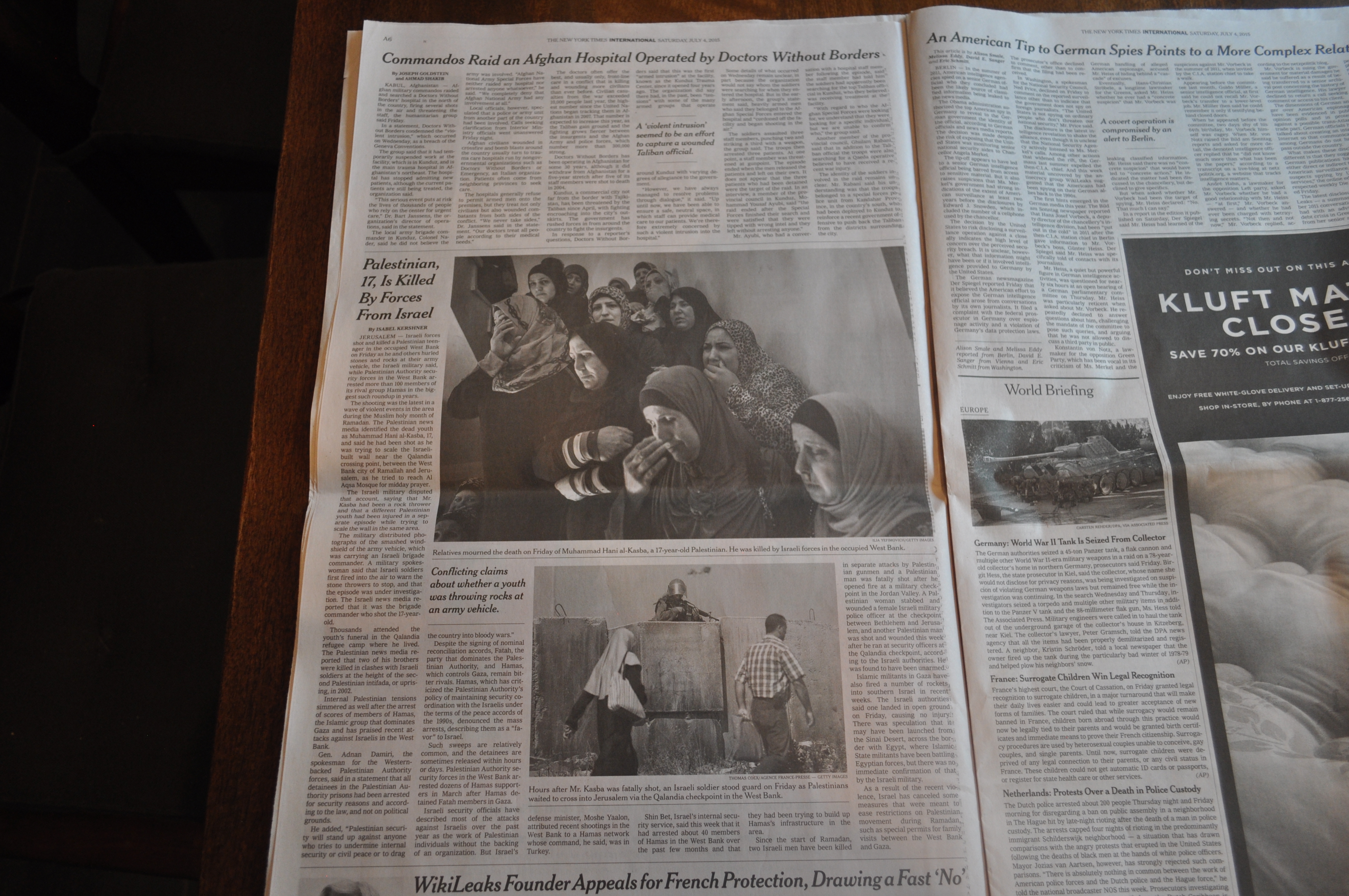
Second, the New York Times uses a double standard for the US and its allies. The paper does not treat the war effort of the US and Europe which have opted to fight battles thousands of miles from their borders, in the same manner as Israel fighting to defend itself. The NYT never posted a picture of President Obama next to the victims of a drone strike (which the president actually authorized) as it does with PM Netanyahu (for general military actions). It does not show pictures of civilians killed by US troops. It minimizes the pictures of terrorists killed by the US and its allies, using small black and white photos in the middle of the newspaper, rather than large color photographs on the front page as it does for Israel.

DEMONIZATION

Third, the NYT and many liberals do not only use double standards, but demonize and delegitimize Israel as well. The unique focus on how Israel defends itself is one thing (double standards). Uniquely showing pictures of injured Palestinian Arab victims alongside pictures of Israeli leaders and weaponry is demonization.

Simply compare the natural human reaction of looking at a small headshot picture of an al Qaeda leader (accompanied by an article that the United States killed the person), to a collage of pictures of injured and killed Palestinian civilians alongside pictures of Israeli military personnel and another of the Israeli Prime Minister. A person would likely skip the article buried in the paper that only has a head shot. But the large color collage of pictures on the front page delivers a biased story that is impossible to ignore: that the Israeli government is responsible for sending its army to kill civilians.

Further, consider opening the pages of paper and seeing a smoke trail coming from Gaza (the closest the Times came to showing Hamas militants firing weapons). The accompanying article refers to the people in Gaza providing a “counterpunch,” making the group appear as the victims instead of the party that initiated the fight.

20140718_103800

Imagine if the Times had shown pictures of the missiles Israel used to “tap” the roof of targeted homes to let the occupants know that a real explosive was coming so they could flee. Imagine the Times showed pictures of the thousands of leaflets that Israel dropped on certain neighborhoods urging residents to leave an upcoming battle zone.  Imagine pictures of Arabs holding cellphones far from the military action, because they received calls from Israel to move to safety.

You would need to imagine such images, because the Times does not print them.

DELIGITIMIZATION

The defensive nature of Israel’s war against Hamas was delegitimzed by the Times because the paper did show pictures of Hamas leaders, nor its tunnels and weaponry. Without the clear imagery of the three slain Israeli teenagers and Hamas terror tunnels which were the causes for the war, the reader was left with an impression that it was a war of choice for Israel.  Cover page pictures of injured Palestinians were coupled with articles under the headline “Confrontation in Gaza” as opposed to “War FROM Gaza,” left the reader with the incorrect conclusion that Israel as the big belligerent party.

The Times 2014 war coverage failed on all parts of the “3D Test” for anti-Semitism.


Now, in 2015, the Times photo editor has taken time off since Israel is not at war.

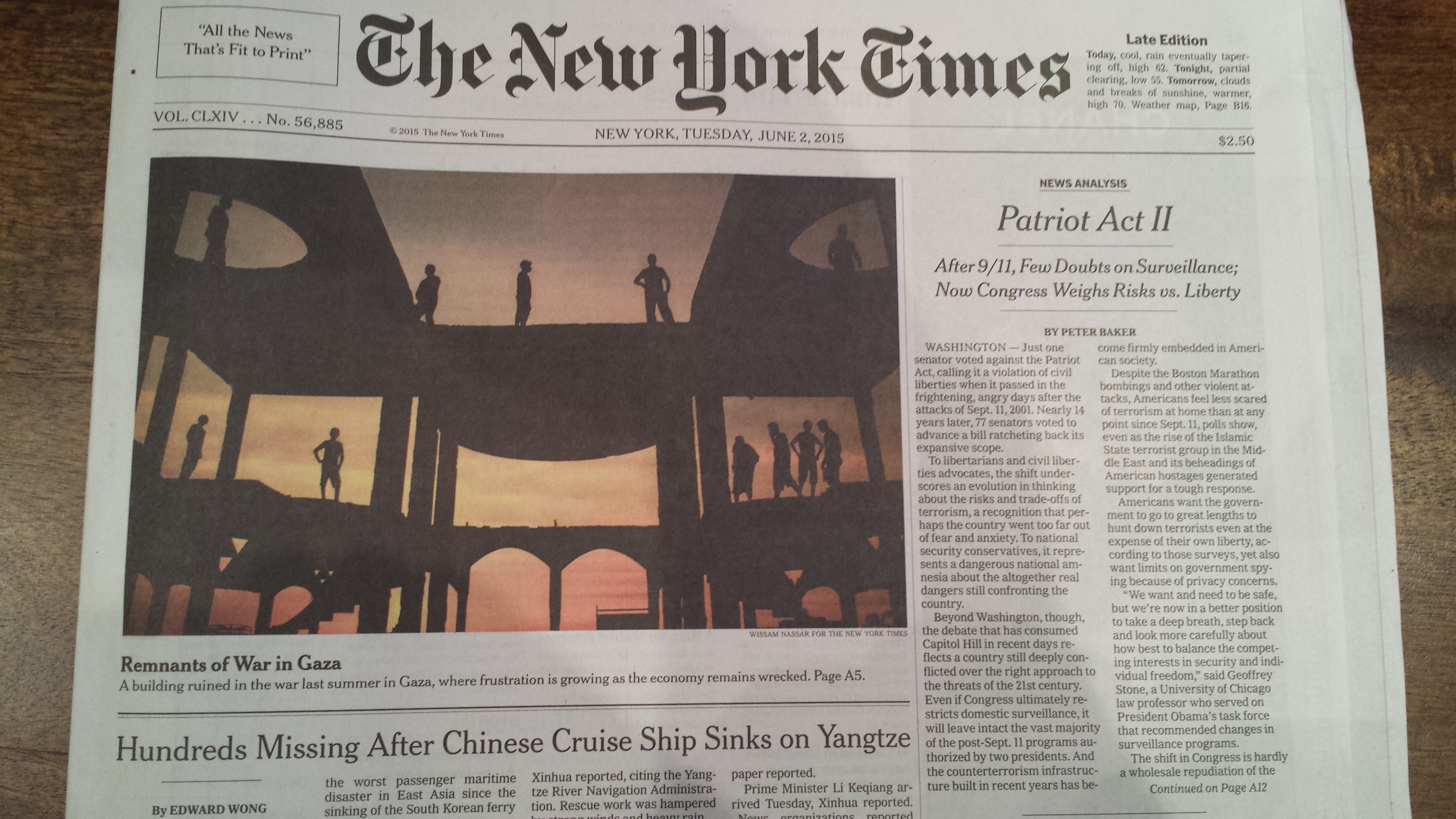
Attacks around the world continue to be buried inside the paper. Without images of Israel as the aggressor, more neutral and natural images cover the paper, such as shipwrecks in the Mediterranean, earthquakes and volcanoes.


The New York Times tried to defend its coverage of Israel as balanced. By going through the effort of explaining itself, it has at least realized that the accusation of double standards for Israel is indeed anti-Semitism, which is a better than many liberal pundits. It stil

It is time that everyone join the effort of pointing out to the Times its 3D failures, rather than just a handful of outlets like CAMERA, Honest Reporting, StandWithUs and FirstOneThrough.

Finding Mr. Right-Wing

Summary: US President Obama seemed fixed on select comments from Israeli Prime Minister Benjamin Netanyahu, in an effort to portray the Israeli leader as a right-wing extremist who is a regional threat to peace. Not the Iranians who seek nuclear weapons. Not the Palestinians who support Jihad.


Many articles have been published about US President Obama’s bizarre focus on select statements from Israeli Prime Minister Benjamin “Bibi” Netanyahu in the heat of elections. Articles point out the hypocrisy of Obama who himself made many statements during his elections from which he later back-tracked. Obama is also duplicitous in ignoring Iran’s chants of “Death to America” in the middle of nuclear negotiations.

How and why are some statements glossed over while Obama gives others great attention?

Obama is using Netanyahu as the straw man for the Iranian nuclear talks and the Israeli-Palestinian conflict. Obama has orchestrated a narrative where Netanyahu is the belligerent, right-wing, war-mongering leader, and not the Iranians or Palestinians.

IRANIAN NUCLEAR WEAPONS

  • The Concern: A right-wing, global sponsor of terrorism which has publicly and repeatedly declared its desire to destroy the United States and Israel is being allowed to develop nuclear weapons under Obama’s negotiations
  • The Israeli Position: Don’t threaten to destroy us; don’t have arms to carry out your threat; we will protect ourselves, as needed. We will make peace with you, if possible, on terms that do not undermine our security or viability.
  • The Obama position: Israel is a right-wing, war-chanting, racist country that doesn’t believe in a negotiated solution. The Iranians are-who-they-are and this is the best we can expect from them, and the best deal that can be achieved at this time.

Obama has said throughout his presidency that Iran should not get nuclear weapons and that he will make sure that they cannot get such weapons of mass destruction (WMDs). However, he has softened his tone and position significantly and acquiesced that Iran will be able to keep various plants and operations to make such weaponry. He believes that Iran has already advanced too far in its knowledge and infrastructure. Further, he thinks the rest of the P5+1 parties in the negotiations will not go along with a sanctions to enforce a better deal. Therefore, he capitulates to the Iranians as Brett Stephens of the Wall Street Journal wrote.

But why trash Netanyahu?

The Israeli Prime Minister believes the contemplated deal is a fiasco and has made his opinion known. He made clear that the deal assures the Iranians protection from attack while it continues to advance its nuclear research and development. The contemplated deal is not a nuclear deal, but simply a basis for the US to establish a new relationship with Iran and China. This same Iran, that threatens to destroy the US and Israel while it hangs gays in the streets. The same China, that executed three times the number of people as the rest of the world combined in 2014.

Netanyahu’s chant that “the emperor has no clothes” makes it hard for Obama to sell the failure. Obama has no response to tough questions about the nature of the deal, or about the nature of Iran itself. As such, he has enlisted his party hacks to skewer Netanyahu to draw attention away from the failure to keep his promises about Iran.

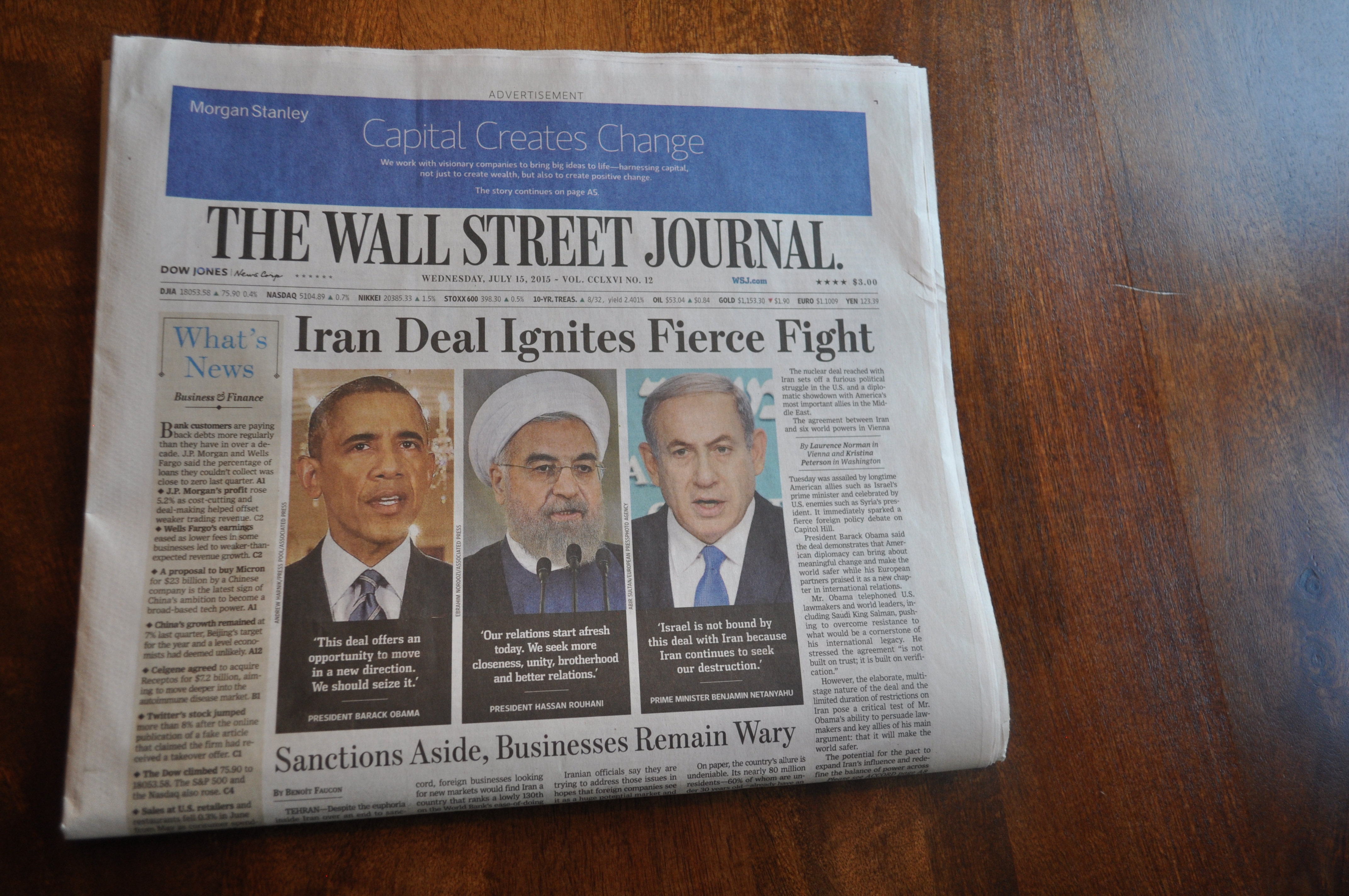
Obama and liberal loyalists have attempted to paint Israel as the right-wing fanatical country, not Iran. They portray Netanyahu as a hard-liner, not Iranian President Hassan Rouhani who is described as a moderate trying to fight his own Iranian “hard-liners. Netanyahu is described as a “racist“, while Rouhani is described as a “relative moderate“.

These characterizations are both an inversion of the truth and a red herring. But it serves to rally Obama’s liberal base in selling the Iranian non-nuclear deal: a right-wing fanatic (to them it has become Israel) is attacking a liberal country (magically, this has become Iran). Obama’s media minions mystically transformed the threat of the terrorist state of Iran being granted WMDs under Obama, to the right-wing rogue state of Israel attempting to block the moderate Iranians establishing ties with America. The deal’s numerous failures are ignored and the focus is diverted onto Netanyahu.

ISRAEL-PALESTINIAN CONFLICT

  • The Concern: The most anti-Semitic people in the world that has repeatedly gone to war to destroy Israel, continue to seek its destruction. A straw man without the people’s support nor power to enforce a peace deal, is labeled as a “moderate” for only seeking an end to the conflict on terms that undermine Israel’s peace and viability.
  • The Israeli Position: Don’t threaten to destroy us; don’t have arms to carry out your threat; we will protect ourselves, as needed. We will make peace with you, if possible, on terms that do not undermine our security or viability
  • The Obama position: Israel is a right-wing, war-chanting, racist country that doesn’t believe in negotiations. The Palestinians are-who-they-are and Israel cannot wait forever for the Palestinians to become moderate.

Obama made a specific calculation to build bridges to the Muslim world which he felt were damaged under President George W Bush. He began his presidency with an international trip to Egypt where he gave his famous “New Beginning” speech to the parliament in Cairo. (He did not use the opportunity of being in the region to visit Israel). Indeed, when he finally came to Israel in 2013, he snubbed Netanyahu’s invitation to address the Israeli parliament and instead used that time to speak to select Israeli students that support his weltanschauung.

When it came to America’s involvement in Israeli-Palestinian peace negotiations, Obama dictated various terms and conditions upon Netanyahu which had never been instituted in any of the various peace talks between the parties. It included a ten month freeze on constructing new homes east of the Green Line (EGL) and releasing dozens of convicted Palestinian terrorists. Netanyahu did both. These actions were on top of his handing control of EGL cities like Hebron to the Palestinians.

So why trash Netanyahu?

The Obama administration has not been able to extract a single concession from the Palestinians. They pushed to join the ICC against US wishes. The sought membership in UN agencies against US wishes. And they have spent the last several years continuing on a path that undermines any chance for peace with the Jewish State:

  • Inciting violence against Israel
  • Repeated wars against Israel
  • Insisting on a “right of return” for people who are not refugees, but “SAPs” (Stateless Arabs from Palestine) who are children and grandchildren of Arabs who sought the destruction of Israel
  • Never agreeing to recognize Israel as a Jewish State
  • Declaring a new Palestinian state must be free of Jews
  • Stating that no peace deal would happen without the eastern half of Jerusalem as a capital

Obama concluded that the Palestinians are forever stubborn and he has minimal influence over their actions.  He therefore feels he must exert greater pressure on Israel.

That left Obama in the uncomfortable position of pressuring its ally which has the strong support of the American people over an antisemitic people that preach Israel’s destruction. He concluded that the best way to convince the American people was to invert reality and portray the Palestinians as desperate moderates who only seek peace, and the Israelis as belligerent racist occupiers.  His left-wing megaphones were happy to pick up the line.

The New York Times has called the Palestinians “desperate” and full of “discontent” about their situation. They are constantly labeled victims (consider the coverage of “The War in Gaza” as opposed to “The War FROM Gaza“). The injured Palestinians in the 2014 conflict were covered on the front page of the Times for many days (consider that no pictures of the three murdered Israeli teenagers or victims of Saudi attacks in Yemen, US drone attacks, Boko Haram, al-Shabab and others have ever appeared on the front page).

Conversely, Netanyahu is portrayed as being racist and opposing peace.  His election night get-out-the-vote comment about Arabs was described as racist, even though he had an Arab on the Likud ticket. His comment about the unlikelihood of a two state peace deal in light of the Palestinian positions and Arab Spring were painted as anti-peace by the Obama administration, even though Netanyahu has repeatedly stated his support and has taken actions towards a two-state solution.

Obama’s team attacks Netanyahu in an effort to extract greater concessions from Israel, because of its failure to extract anything from the Palestinians. It attempts to force a peace treaty that offers no peace for Israel. It is an attempt to further US relationship with the Arab world.


Netanyahu has become the convenient scapegoat for Obama’s failure to negotiate with Islamic Iran and the Palestinian Arabs. In the case of Iran, Netanyahu is a diversion from the terrible deal. He is a straw man that the only alternative to his bad deal is a call for war rather than a better deal.  In regard to the Palestinians, Obama is attempting to portray the straw man Abbas as a real moderate negotiating partner by disparaging Netanyahu. Netanyahu’s refusal to engage in a bad/false treaty is portrayed by Obama as anti-peace.


Six years ago, US citizens hoped Obama’s outreach to the Arab and Islamic world would create an opportunity to advance global peace.  Instead, Obama continues to undermine global peace to foster a better relationship with the Arab and Islamic world.


Sources:

Obama on Abbas March 2014: https://www.whitehouse.gov/the-press-office/2014/03/17/remarks-president-obama-and-president-abbas-palestinian-authority?v=1362363401000%3F

Related First One Through articles:

Germany 1933, Gaza 2014

Recent Abbas comment on the Holocaust https://firstonethrough.wordpress.com/2014/05/19/frightening-new-york-times-42714-article-on-mahmoud-abbas-shifts-on-holocaust/


The New York Times Major anti-Netanyahu Propaganda Piece

Summary: The New York Times once again showed its bias against Jews living on the west bank of the Jordan River by painting opinion as international law. It posted a large non news-article during the week of Israeli elections in an attempt to discredit Israeli Prime Minister Netanyahu.

On March 12, 2015, the New York Times ran a cover page story called “As Israeli Settlements take Root, So do Complications” and on its online version it was titled “Netanyahu and the Settlements”. The article repeatedly referred to something called the “Geneva Initiative” as if the initiative carried any backing or legal authority. In actuality, the 2003 initiative is most akin to a present day Facebook Group.

20150313_130018
New York Times large cover story on the “Settlements”

The Times wrote “Two-thirds of new construction over the last two years, the Peace Now report shows, was on the Palestinian side of a line drawn by the Geneva Initiative, an international working group that produced a model agreement in 2003…
Efrat, with nearly 10,000 residents, is to Israelis the capital of the Etzion block. Palestinians, though, do not accept it as part of the block at all,
because it is on the eastern side of Route 60 — their side of the Geneva Initiative map. Annexing it would be far more complicated.”

By reading such statements, one would think that Israel is deliberately building homes on the “Palestinian side” of a road, contrary to existing laws and/or agreements. Palestinians are comfortable with Jews living on one side of Route 60, but not on the other.  That is specifically what the NYT intends the reader to conclude by writing such an article. It is completely untrue.

The Geneva Initiative was launched by a handful of people- both Israelis and Palestinians. The civilians met during 2003 and drafted a guideline of how a two state-solution could emerge. None of the people participating were elected or appointed by any governmental body. Their initiative was not endorsed by any government. Neither Israelis nor Palestinians consider this old private working paper at all.

“the 2003 Geneva Initiative is most akin
to a present day Facebook Group”

Meanwhile ACTUAL laws and agreements were deliberately omitted from the NYT article. They include the 1922 British Mandate of Palestine which was signed by the League of Nations, the precursor to the United Nations. The Mandate stated:

  • Article 6: The Administration of Palestine, while ensuring that the rights and position of other sections of the population are not prejudiced, shall facilitate Jewish immigration under suitable conditions and shall encourage, in co-operation with the Jewish agency referred to in Article 4, close settlement by Jews on the land, including State lands and waste lands not required for public purposes.
  • Article 15: The Mandatory shall see that complete freedom of conscience and the free exercise of all forms of worship, subject only to the maintenance of public order and morals, are ensured to all. No discrimination of any kind shall be made between the inhabitants of Palestine on the ground of race, religion or language. No person shall be excluded from Palestine on the sole ground of his religious belief.

As described above, international law enabled Jews to live everywhere in Palestine. Such freedom of movement and the ability to buy land was also the case under the Ottoman Turks. This is history and law – not the opinion of a handful of private citizens.

The west bank of the Jordan River was an integral part of the 1922 British Mandate of Palestine.  It was annexed by the Jordanians in 1950, after Jordan attacked Israel in the 1948-9 war (such Jordan annexation was with approval of the Palestinians but never considered by the United Nations). The Jordanians illegally evicted all of the Jews from the area, including the eastern part of Jerusalem, counter to the Fourth Geneva Convention.

After Jordan (and the Palestinians who were Jordanian citizens) attacked Israel again in 1967, Israel was obligated to launch a counter-attack per The Hague Regulations which state:

  • Article 40: Any serious violation of the armistice by one of the parties gives the other party the right of denouncing it, and even, in cases of urgency, of recommencing hostilities immediately.

Jordan was therefore legally attacked by Israel.  The Jordanians officially gave up all claim to the land in 1988.

None of these international laws, agreements or actions on the part of governments are mentioned in this large cover story by the New York Times. Instead, the Times chose to paint a picture that Israel is not abiding to laws to make it appear as the belligerent party. It does this with the aid of a private working paper from 12 years ago.

20150313_130046
Double page story by the NYT, continued from March 12 2015 cover 

There was nothing new in the story which begs the questions:

  • Why give the article such prominence by placing it on the cover with a large color picture, and continue with a full two-page spread in the inside pages complete with pictures, maps and drawings?
  • Why use an old private Initiative to make an argument about the location of settlements instead of history and law?
  • Why post the article now?

The New York Times posted the piece as they want to see Israeli Prime Minister Netanyahu defeated in upcoming Israeli elections.  The Israeli elections will take place later in the week, on March 17, 2015.  The New York Times, which has a long history of attacking the Israeli Prime Minister, put this non-news story on the front page the week before Israeli elections to make it appear that Israeli Prime Minister Benjamin Netanyahu was acting outside of the law.

The Times has once again shown it is not a credible source of news and chooses to air its biased opinions throughout the newspaper.  It has also shown that it seeks to influence the outcome of foreign elections with large distortions.  An interesting piece of hypocrisy, as the day before, on March 11, the NYT posted an op-ed from Thomas Freidman arguing about Sheldon Adelson’s attempts to influence elections in the United States with major contributions to Republican candidates, as well as claiming Adelson’s Israel Hayom newspaper is a biased mouthpiece for Netanyahu in Israel.

Is the Times posting the opinion of Barack Obama or George Soros?


First One Through articles:

Legal settlements: https://firstonethrough.wordpress.com/2014/12/11/the-legal-israeli-settlements/

NYT’s Nicholas Kristof’s “Arab Land”  https://firstonethrough.wordpress.com/2015/02/27/nicholas-kristofs-arab-land/

NYT ignores Jihadists in Israel: https://firstonethrough.wordpress.com/2015/01/26/radical-jihadists-in-europe-and-dislocated-and-alienated-palestinians-in-Israel/

NYT minimizing Netanyahu’s election success: https://firstonethrough.wordpress.com/2014/08/11/new-york-times-talking-turkey/

NYT only using “West Bank” instead of “Judea and Samaria” https://firstonethrough.wordpress.com/2014/12/08/names-and-narrative-the-green-line-west-bank-judea-and-samaria/

Nicholas Kristof’s “Arab Land”

On February 26, 2015, Nicholas Kristof wrote an op-ed in the New York Times called “The Human Stain” that was more than flawed- it was wrong; it was more than anti-Israel, it was anti-Semitic.

Among the many incorrect and racist statements were his claims that the “West Bank” and “East Jerusalem” were Arab. Here are some quick thoughts about his statement that “nibbling of Arab land is just plain wrong.

IMG_2118
Judean Desert down to the Jordan Valley

Geography

The west bank of the Jordan and eastern Jerusalem are not part of the Arabian Peninsula. That landmass is located east of Israel. The borders of the region are surrounded by water on three sides (the peninsula) and the northwestern edge of Saudi Arabia is the land border.

The countries that constitute the Arab land in addition to Saudi Arabia are: Oman; Kuwait; UAE; Bahrain; Qatar; and Yemen. The Arabian Plate on which the peninsula rests includes parts of southern Jordan and southern Iraq.

Neither the Arabian Peninsula nor the Arabian plate cross the Jordan River, hence there is no geographical basis for referring to any land west of the Jordan as “Arab Land.”

Population

The “Arab Nation” spread beyond the Arabian Peninsula in the 7th and 8th centuries when Muslim invasion of neighboring lands brought Islam and Arabs to those areas. Those Muslim conquests brought Arabs to southern Spain called Andalusia. No one refers to Spain as Arab land today.

Politics

The Arab countries formed a “League of Arab States” which includes 22 countries. That group is political in nature and does not speak to the actual people and culture of the countries. For example, Syria was suspended from the League in 2011 due to its civil war. Palestine was admitted as a member in 1945 (the entire British Mandate of Palestine which includes Israel today) even though it was not an independent country.

To refer to the west bank of the Jordan as “Arab” because Palestine is a member state would also mean that Israel is an Arab state. Is that part of Kristof’s real message? Does he feel that Israel is not a valid entity and is occupying “Arab land”?

Ruby all Israel  29 (1)
Binyamin Region

Government Sovereignty

A “Land” is distinguishable from lowercase “land” in that one conveys sovereignty and ownership. The land on the west bank of the Jordan River is disputed land without independent sovereignty. Israel administers the land after Jordan attacked Israel in 1967 and subsequently lost the territory. Jordan gave up all claims to the land in 1988, including “East Jerusalem”. “Arab East Jerusalem” in capital letters makes no sense in any interpretation as sovereignty and administration belongs to Israel (albeit not recognized in much of the world) but the eastern part of the city is also not recognized, nor under sovereignty of Arabs, nor part of the Arab peninsula, and is 40% Jewish.

While many Palestinian Arabs claim the west bank of the Jordan as part of a future state and “East Jerusalem” as such state’s capital, the rule of the land is still in negotiations. As of this date, the land is much more Israeli than it is Palestinian.

Exclusivity

Liberals and progressives typically argue that no land should be the exclusive right of a single racial or religious group. No one refers to “White Selma” where only whites can live or “Black Harlem” where only blacks should be permitted to live.

While people refer to the Islamic State of Iran, Iran claims that it welcomes people of all faiths. Israel, the Jewish State, is 25% non-Jewish. Turkey, which is a secular Islamic state, is mostly non-Arab but has many Arabs living in the country.

Not only is the west bank of the Jordan not “Arab”, but the suggestion that it should be limited only to Arabs is racist and anti-Semitic. That policy was put into place under the Jordanian Arabs that attacked Israel in 1948 and expelled all of the Jews from the area including the eastern part of Jerusalem, counter the Fourth Geneva Convention.

IMG_4963
South of Bethlehem

Private Property

Land ultimately falls into two categories: private land and public land. Private land changes hands with the owner and is not considered to belong forever to a particular religion or people. One day it may be owned by an Arab, the next day by a Jew and the next by a WASP.

Public lands are administered by the government. As discussed above, the west bank of the Jordan is administered by Israel. The eastern part of Jerusalem was annexed by Israel decades ago.

Therefore neither the west bank of the Jordan River nor “East Jerusalem” can be considered “Arab land.”

History

For 400 years the Ottomans ruled Palestine and allowed Jews to live everywhere without restriction. They lived in Jericho and Jerusalem and throughout the region. The Ottomans welcomed the Yemenite Jews who founded Silwan in the eastern part of Jerusalem just outside the city walls in 1881 – in what Kristof terms “Arab East Jerusalem.

The international community gave the British the Mandate to govern Palestine in 1922, in which it specifically stated that the entire mandate – including Kristof’s “Arab West Bank” – “shall facilitate Jewish immigration under suitable conditions and shall encourage, in co-operation with the Jewish agency referred to in Article 4, close settlement by Jews on the land, including State lands and waste lands not required for public purposes” (Article 6). The mandate further stated in Article 15 “No discrimination of any kind shall be made between the inhabitants of Palestine on the ground of race, religion or language. No person shall be excluded from Palestine on the sole ground of his religious belief”.

 DSC_1020
Silwan, in the eastern part of Jerusalem, founded by Yemenite Jews in 1881

Countering the Bible

As detailed above, there is no basis for naming places “Arab West Bank” or “Arab East Jerusalem”.   To claim that any land inherently belongs to a single group is a direct lift from the Old Testament in which God gives the land of Canaan to the Jews. Jews have always considered the entire land holy for that reason. Modern claims that part of that land is inherently Arab (and not Jewish) is done to specifically counter the Bible and any Jewish claim to the land.

Of course, the Jewish faith that asserts that the land is holy has nothing to do with sovereignty or private ownership. Jews have always considered the land holy, even in 1400 when they had no sovereignty, and Jews today who do not own land in Israel. The land is holy to Jews, which motivates many Jews to move there.

Kristof’s claim that this specific land (the “West Bank” which didn’t even exist as an entity or term until recently) is Arab is meant to directly confront the Jewish belief that the land was given to Jews by God. Just as the Times never uses the Jewish terminology of “Judea and Samaria” to remove Jewish connection to this land, Kristof attempts to sever the Jewish connection by stating it is inherently “Arab”. It is wrong in fact and intention.

Jews have always and will always consider Judea and Samaria/ the west Bank of the Jordan as holy regardless of its sovereignty, or the religion and ethnicity of a person living in a house on the land. Such sentiments do not preclude any type of peace deal.

Kristof wrote that The 350,000 Israeli settlers in the West Bank — not even counting those in Arab East Jerusalem — impede any Middle East peace and stain Israel’s image,” can only be viewed as an obstacle to peace for racists that want a Jew-free state.

Attacking the Jewish faith is not a path to peace. Antisemitic calls for banning Jews from anywhere – let alone places they consider holy and lived in for thousands of years – is disgraceful.  The “Human Stain” is Kristof’s and those that share such sentiments.

Why the Media Ignores Jihadists in Israel

Summary: According to the Times, terrorists in Europe and Israel are very different and have different motivations.  If they weren’t, the hope that two states (Israel and Palestine) could live side-by-side in peace would obviously disappear.

The New York Times has taken to breaking the universe of Islamic terrorists attacking civilians into two camps: those that are hardened and trained to commit attacks, and those that do so as a result of their personal situation as opposed to their beliefs.  Curiously, that line is defined by geography.

Consider the January 17, 2015 reporting about the raids that prevented a terrorist attack in Belgium. The Times discussed “the expanding threat from radical jihadists, many of them battle-hardened in Syria and Iraq.” Another article on the same day questioned why Lunel, a small town in France “has come to earn the dubious distinction as a breeding ground for jihadists.” A third article that day clearly stated that attacks in Paris against the magazine Charlie Hebdo were by “jihadist gunmen”. In Europe, the Times is clear that attacks against civilians are done by radical jihadists. While the articles discussed Muslim anger at the insult to their prophet Mohammed by the Charlie Hebdo cartoons that ultimately instigated the attacks, that anger was only the final motivating factor to unleash actions embedded in the radical jihadist philosophy.

The Times does not view attacks against Israelis the same way.

On January 23, 2015 the NY Times explored the motivation of a Palestinian who stabbed a dozen Israeli civilians on a bus in Tel Aviv. Over and again the Times referred to the man as “angered by the war in Gaza… and tensions over the revered Aqsa Mosque.” The article stated that “the family was in debt and struggling” and described this assailant as well as another who attempted to assassinate a Jewish activist as stories of “dislocation”. The New York Times deliberately kept the motivations away from any categorization of “radical jihad” by saying that the assailant “was not considered an extremist.”

This description fits consistently with the Times narrative as written in its editorial page on January 1, when it described the Palestinians as “desperate.” The opinion piece suggested that the Palestinians are “deeply frustrated” by their lack of a state. The Times does not feel that Palestinians are engaged in a radical jihad against Israel in the same way European cities are facing Islamic extremism. It is curious that they arrive at such a conclusion when there are Palestinian polls and elections that consistently show an overwhelming support for Hamas, which mentions “jihad” against Israel 36 times in its charter (see the FirstOneThrough article below).

Several articles in the Times mentioned the anti-Semitism harbored by Amedy Coulibaly, the French Muslim who shot a policeman and four Jews in a kosher supermarket in Paris. They discussed his allegiance to the Islamic State which seeks to build a new state in the Middle East ruled by Islamic sharia law. However, the New York Times never mentioned that the Palestinians are the most anti-Semitic people in the world, with 93% of the population holding anti-Jewish views. It neglected to inform its readers that the popular Hamas party seeks to completely destroy Israel and set up an Islamic state ruled by sharia law.

Why does the Times continue to relay different motivations and narratives for jihadists in Europe and Israel?

The liberal newspaper would like to see a new State of Palestine established in the Middle East, whereas it is comfortable with the borders of countries elsewhere. The conundrum is that the Times’ hope for a new moderate secular Palestinian state alongside Israel is in conflict with the reality that the Palestinians are much more radical than the paper pretends.

To conceal the radical nature of the Palestinians today, the Times editorials and articles follow specific guidelines in reporting that:

  • The Palestinians and its leadership are moderates
  • The Palestinians only take to violence because they are desperate and alienated
  • The Israelis are at fault for lack of a two-state solution

In Israel, people see the jihad in Iraq, France, Nigeria and in their own country as a single violent movement of Islamic extremism. That is why Israeli Prime Minister Benjamin Netanyahu referred to Hamas and Islamic State as “branches of the same poisonous tree”. Should the Times ever decide to detail the full nature of Hamas beyond simply being a “militant group” and also discuss the huge support it receives by Palestinians, it would undermine the vision of two states living side-by-side in peace. Therefore, the pages of the Times state that Europe faces “radical jihadists” while Israel faces desperate, isolated and alienated Palestinians (who are in that situation only because of Israel).

However, hope is hardly honest reporting.
20150125_162037


Sources:

Netanyahu comment on Hamas: http://www.pressherald.com/2014/09/30/netanyahu-islamic-state-hamas-branches-of-the-same-poisonous-tree/

Palestinians proudly elcebrating murderer of Israeli civilians: https://www.youtube.com/watch?v=RRTXmeRVPlY

Related First One Through articles:

Palestinians “Desperation Move”: https://firstonethrough.wordpress.com/2015/01/06/palestinians-are-desperate-for/

Palestinians are not “resorting” to violence: https://firstonethrough.wordpress.com/2014/11/19/the-palestinians-arent-resorting-to-violence-they-are-murdering-and-waging-war/

Hamas is mainstream: https://firstonethrough.wordpress.com/2014/09/04/its-the-democracy-stupid/

Abbas pivot to Hamas positions: https://firstonethrough.wordpress.com/2014/11/12/mainstream-and-abbas-jihad/

The extremism of the Palestinian positions: https://firstonethrough.wordpress.com/2014/10/25/extreme-and-mainstream-germany-1933-west-bank-gaza-2014/

New York Times Confusion on Free Speech

The attacks on the offices of the satirical magazine Charlie Hebdo in Paris in January 2015 sparked a plethora of articles describing the freedoms of speech and press. The New York Times, like many other media sources, fiercely defended the right of people to offer their opinions, even if such views are unpopular. Despite the clarity of its overall stance, the paper appeared confused about “double standards” in its articles which failed to clarify and distinguish between free speech and hate speech.

In the NY Times lead front page story of January 14 referring to such “double standards”, the paper contrasted the right of Charlie Hebdo to make cartoons of the Islamic prophet Mohammed, to the arrested French “comedian” M’bala M’bala who stated that a Jewish journalist should have been killed in the Nazi gas chambers and that he considers himself like the terrorist who shot and killed four Jews in the Parisian supermarket. Neither clarification nor education was given about the differences and limits of free speech.

20150115_144909

The NY Times continued to confuse the public (or itself) in a story the next day by David Carr, which included the following:

  • “Not all the French were reveling in unbridled expression of speech. Dieudonné M’bala M’bala, a comedian who has made highly provocative statements since the shooting at Charlie Hebdo’s offices, was detained as an “apologist for terrorism” for statements he made on his Facebook page that were seemingly in support of one of the attackers.
  • His arrest highlights the fact that one man’s free expression is another man’s hate speech or sedition. In Israel, the conservative Jewish newspaper HaMevaser scrubbed out the German chancellor Angela Merkel from a photograph, along with other female leaders who had participated in a solidarity march in Paris, because photos containing women are considered inappropriate in ultra-Orthodox publications.”

In an effort to educate the Times and its readership, here are three important points to distinguish between various types of speech:

  • Concept versus People
  • Active versus Reactive Incitement
  • Editing versus Censorship

 Concept versus People

A central dividing line between freedom of speech and hate speech has to do with the right to discuss concepts as opposed to the right (and limit) to discuss people. Everyone is free to say anything they want about concepts such as: capitalism, communism, Islam and Buddhism. Whether it is religion or economic theory, each topic is considered a concept worthy (perhaps?!) of discussion and debate in a positive or negative fashion. However, speech can descend into “hate speech” (or libel) which is banned by many countries, if people attack either groups or specific human beings.

For example, Louis Farrakhan, a bombastic anti-Semitic Muslim preacher referred to Judaism as a “gutter religion”. He was not brought up on any charges, despite the hateful speech. Egyptian leader Mohammed Morsi was not prosecuted for calling Jews the descendants of monkeys and pigs, which could have perhaps been classified as hate speech in some countries because he addressed people rather than a religion.

 Active versus Reactive Incitement

A key factor in the distinction of permissible versus prohibited speech revolves around “incitement”. Many countries prohibit speech that incites violence, as does the recent United Nations Resolution 16/18. The UN language:

  • “condemns any advocacy of religious hatred that constitutes incitement to discrimination, hostility or violence, whether it involves the use of print, audio-visual or electronic media or any other means”

The phrase incitement to violence is clear. For example, when an imam in Germany called for killing Jews, that fell under hate speech to incite violence, and the country is now investigating that imam.

However, it is considered completely legal to say things that may involve “reactive incitement”, that is, saying something that may annoy people to the extent that they would use violence. To ban reactive incitement would stifle free speech completely which is what the press sees as the essence of the Charlie Hebdo assassinations. Just because Muslims were insulted by the publishing of cartoons of their prophet, their reaction cannot be the basis to ban that freedom of expression.

Based on the United Nations language, the incitement to discrimination would have to be explored further. Did Charlie Hebdo promote discrimination against Muslims? Was the paper simply making pictures of Mohammed or was it attempting to foster intolerance of all Muslims? The new United Nations law makes a distinction.

The M’bala M’bala calls for a Jewish journalist to be killed in gas chambers and supporting terrorists who killed four innocent Jews are calls for direct and indirect incitement to hostility and violence.  Acting Palestinian Authority President Mamoud Abbas praise for martyrs who slaughtered innocents could also be called incitement to hostility and violence.

dalal_popular_inauguration

Fatah officials at naming of Dalal Mughrabi square,
murderer of 38 civilians including 13 children

 Editing versus Censorship

Every media outlet edits their news stories. Papers constantly select only those parts of interviews that confirm a thesis it promotes to its readers. That is (theoretically) its right. Michael Moore edited interviews about global warming and the auto industry to convey a particular narrative that he wanted to portray in his movies. The public may ultimately view the half-stories they receive as accurate, half-accurate or completely inaccurate because of the known bias of the producers of the content.

However, no one considers editing to be a form of censorship or an infringement on the freedom of speech or press. If a paper opted to not publish a sports section, that is its right. If it crops a picture to focus on a particular image to reinforce its narrative, that is also its right. It may be bad journalism, but it is not censorship (and certainly not by a governmental authority).

In its ramble on free speech above, the New York Times highlighted the Israeli “conservative” newspaper Hamevaser’s choice to edit the picture of the Paris unity march to remove the female leaders. Hamevaser is run by and serves an ultra-Orthodox Jewish community (not politically conservative) that is against showing pictures of women due to their interpretation of modesty. Such action is a form of editing that newspapers engage in to meet the tastes of its readership. To somehow suggest that it is a form of Israeli censorship is absurd. Why would the Times possibly lump this example in with examples of freedom of speech and hate speech? It is completely off topic.


People in the western world rallied behind Charlie Hebdo because they see this situation as falling completely within the framework of free speech: it poked fun at a religion (a concept), not people (Muslims); and it did not call for any violence, rather the attacks came from a reaction from incensed Muslims. The case of M’bala M’bala has to do with inciting violence against people, and the Hamevaser picture has nothing at all to do with government censorship.

So how did the Times develop this list of irrelevant examples and not try to educate its readers (and actually confuse them with calling out “double standards”)?


Sources:

NYtimes articles and picture Jan 14: http://www.nytimes.com/2015/01/14/world/europe/new-charlie-hebdo-has-muhammad-cartoon.html

NY Times article January 15: http://www.nytimes.com/2015/01/15/business/media/flocking-to-buy-charlie-hebdo-citizens-signal-their-support-of-free-speech.html?_r=0

Louis Farakhan on Judaism: https://www.youtube.com/watch?v=NbrH3eUuA3U

Egyptian leader Mohammed Morsi calling Jews names: https://www.youtube.com/watch?v=JukaOi8pKzM

UN Resolution 16/18: http://www2.ohchr.org/english/bodies/hrcouncil/docs/16session/A.HRC.RES.16.18_en.pdf

German imam calling for killing Jews: http://forward.com/articles/202751/germany-warns-against-hate-speech-after-imam-calls/

PA Abbas praise for terrorists: http://www.algemeiner.com/2013/01/10/video-of-abbas-praising-hitler-supporting-mufti-terrorists-released-video/

Naming square and centers after terrorist who killed 37 civilians: http://www.palwatch.org/pages/news_archive.aspx?doc_id=1442

Related First One Through articles:

Blasphemy or terrorism: https://firstonethrough.wordpress.com/2015/01/12/blasphemy-or-terrorism/

Klinghoffer opera: https://firstonethrough.wordpress.com/2014/06/23/eyal-gilad-naftali-klinghoffer-the-new-blood-libel/


New York Times Finds Racism When it Wants

On January 3, 2015, the New York Times posted a large color picture on its front page about people in Sweden standing against a suspected arson attack on a mosque. The article on page A4 that continued onto page A9 described how anti-Muslim sentiment has taken hold in a country that had been known for its liberal immigration policy.

Sweden-articleLarge
New York Times cover about Attack on Mosque in Sweden

Anti-Muslim vs. Anti-Semitism

It is interesting to note how the paper highlighted the “anti-Muslim sentiment” in the title of the article after three suspected arson attacks against mosques in Sweden over the previous ten days. There were no witnesses and no arrests in the attacks but the Times drew its own conclusion that the fires must have been driven by “anti-Muslim” anger.

Compare that conclusion with the one at which the Times arrived in reviewing the actions in Europe during a week in July 2014. There were a dozen incidents involving thousands of people:

  • A synagogue was firebombed in Paris
  • Jewish stores including kosher butchers were looted and 18 people were arrested
  • A mob that gathered outside a synagogue with a hundred Jews trapped inside, shouted “Death to the Jews” and “Hitler was right”
  • In Belgium signs posted in store windows read “no Jews allowed”
  • In Berlin, an imam called for the murder of Jews
  • In Paris, a riot of 4000 people with weapons called for attacks on Jews; 70 were arrested
  • A Facebook page with the names and faces of Jews was posted with a call to attack the individuals who were later beaten
  • The leaders of several countries in Europe condemned the attacks as raw “anti-Semitism”

Despite the clarity of the attacks against Jews, in two separate articles the New York Times said those incidents had an “anti-Semitic tinge”. “TINGE” – meaning that the anti-Jewish sentiment was barely noticeable.

20150104_134833

The Invisible Cause

The Times article on Sweden did not highlight any Muslim actions that may have caused the Swedish “anti-Muslim” sentiment. It mentioned European “rising fear of Islamic radicalism” in a general manner, and mentioned the poor economic situation that recent immigrants find themselves in, and the generous benefits afforded by Sweden’s welfare economy. But the article sought to distance the economic strain on Swedish society by quoting a recent immigrant who stated: “We were not looking for food or benefits. We were looking for somewhere to feel safe.” Some stories neglected by the Times article:

Muslim riots: In 2013, various riots broke out in Sweden with Muslim immigrants burning cars and neighborhoods and throwing stones. Some of those events were covered by the Times. The paper referred to the rioters as “immigrants” throughout the article, and never mentioned their Islamic faith.

Explosion of Rape cases: Over the past decade, the number of reported rapes in Sweden has exploded. The country now ranks as the third highest country in terms of the number of rapes, as the frequency has jumped 250% between 2003 and 2010. While most of the world has seen reported cases of rape dropping or leveling out, the trend in Sweden has been alarming and the focus of much discussion and debate. Many people have attributed the dramatic spike as due to the influx of immigrants from the Middle East, Africa and southeast Asia where rape is much more common than western Europe. This piece of information was also not included in the Times article about Swedes becoming “anti-Muslim”.

Interestingly, in perhaps a related trend, a huge scandal broke in the summer of 2014 about 1400 girls in northern England who had been systematically raped by a gang of Pakistani Muslim men over 13 years. During its reporting of the story, the New York Times refused to publish that any of the attackers was Muslim and just referred to them as men with “Pakistani heritage”. Other media outlets did not exclude the common faith in their reporting.

It would appear that the New York Times deliberately avoids mentioning the religious background of Muslims when reporting crimes, but is quick to blame crimes against their community as “anti-Muslim”.

Conversely, in reporting the European riots protesting Israel, the New York Times seemed perplexed as to why Americans supported Israel while Europeans did not. It put forth an absurd idea that Americans supported Israel “because of the failure of the Arab Spring to spread democracy in the Middle East.” It ignored the actual evil actions and comments of the Palestinians that have been waging war against Israeli civilians for years. Once again, the Times absolved the Muslims of culpability. Regarding the riots in Europe against innocent Jewish citizens of their respective countries who were not Israelis, the Times dismissed the anti-Semitism as not noteworthy.

Racism and anti-religious feelings are indeed real.  The Times has shown that it is adept at finding or ignoring such sentiments as it fits the narrative they are selling.

20150104_134900


Sources:

Immigrant riots in Sweden: http://www.nytimes.com/2013/05/27/world/europe/swedens-riots-put-its-identity-in-question.html?pagewanted=all&_r=0

Rapes in Sweden: http://www.frontpagemag.com/2013/dgreenfield/1-in-4-swedish-women-will-be-raped-as-sexual-assaults-increase-500/

http://www.liveleak.com/view?i=de1_1394099792

Global rape statistics: http://en.wikipedia.org/wiki/Rape_statistics

Pat Condell on Sweden: https://www.youtube.com/watch?v=RZsvdg1dkJ4

Related FirstOneThrough articles:

Anti-Semitic Tinge: https://firstonethrough.wordpress.com/2014/07/25/an-anti-semitic-tinge/

NY Times calling “an anti-Semitic tinge” for a second time: https://firstonethrough.wordpress.com/2014/07/27/tinge-two-idioms-for-idiots/

1400 girls raped in Britain, yet the NY Times refuses to point to the rapists as Muslims: https://firstonethrough.wordpress.com/2014/09/06/the-ties-that-bind-and-those-unmentioned/


Palestinians are “Desperate” for…

On January 1, 2015, the New York Times editorial page led with a piece titled “The Palestinians Desperation Move.” The opinion piece advanced the case that acting Palestinian Authority President Mahmoud Abbas must be frustrated in his mission to create a new Palestinian State.

…Creating a State?

Desperate people take what they can. They view their options as limited and prospects as weak. They seize any opportunities to advance their main goal, whatever that might be.

Witness early Zionists agreeing to any size and configuration of a Jewish state, despite their dream for a larger state based on the British Mandate of Palestine in 1922. They voted “yes” to a United Nations partition in 1947. They voted “yes” to greater Jerusalem and greater Bethlehem being international cities.

The Arabs, on the other hand, consistently voted “no” at every juncture.

These are not activities of a people that is “desperate” for a state. These are not actions of leaders who are willing to make compromises to establish a country and move their people forward.


… Maximizing a Jew-free State and/or Destroying the current Jewish State

Palestinian actions have consistently had three main areas of focus:

  1. Creating a new state free of any Jews
  2. Maximize the size of the new Palestinian state: either the entirety of Israel+West Bank+Gaza or using the 1949 Armistice Lines
  3. If there remains a state of Israel, it should be small and not Jewish


A Jew-free Palestinian state: Palestinians have sought to recreate the conditions of the Arab-controlled regions that expelled and barred the Jews from 1949 to 1967. The Palestinian leadership has continually called for preventing any “settlements”, meaning barring any Jewish people from living anywhere in Gaza, the West Bank and the eastern part of Jerusalem that was controlled by Jordan from 1949-1967. Various Palestinian efforts towards peace talks have demanded a pre-condition of Jewish settlement freezes before any peace talks could begin.  They have lobbied the United Nations to condemn any and all settlements as illegal (even though Jews always lived in the lands before the illegal Jordanian takeover in 1949).

Palestinian law has repeatedly cemented the position of a Jew-free state. In 1973, it passed legislation that made the sale of any land or home to an Israeli to be a capital offense. The Palestinian Authority announced in 1997 that it would seek the death penalty for anyone selling land to a Jew or Israeli.

Abbas has repeatedly voiced his vision of a Jew-free Palestine, stating that he would not allow the presence of a single Israeli- civilian or soldier – in a new Palestine.

Abbas and other members of the Palestinian Authority have also called on the world to engage in a BDS- Boycott, Divestment and Sanction – of any Israeli company that has a presence in the territories they hope will become a Palestinian state. Their aggressive efforts in advancing BDS further underscores their desire to not only prevent any Jews living in a future state, but even establishing businesses there as well.

Even the Universities on the West Bank have laws that prohibit Jews from stepping foot onto campuses.

In short, Palestinian law and leadership calls for banning Jews from visiting, working, buying land or living in the territories it wants for a future state.

Those are the official positions of the “moderate” acting-president of the Palestinian Authority and the existing Palestinian laws. However, the majority of the Palestinian people are in favor of Hamas and would elect someone from Hamas as president according to every poll over the past few years. The Palestinian public elected Hamas to 58% of the Palestinian parliament in their last election in January 2006. Hamas’s charter and its leaders call for the outright killing of Jews and have specifically identified the Jewish nature of Israel as the root cause of the conflict: In face of the Jews’ usurpation of Palestine, it is compulsory that the banner of Jihad be raised…”


Maximize the size of the Palestinian state. It is not surprising that the Palestinians want to maximize the size of a future state; Israel wants to maximize what it can achieve in negotiations too. However, as detailed here, the working parameters for the Palestinians are to achieve “maximums” and certainly not reflective of a group that is “desperate” and willing to compromise.

Hamas calls for a single Arab Palestine to cover Gaza, the West Bank and all of Israel. They have never backed down or waivered from their 1988 charter in any statement from any leader since that time.

Abbas’ Fatah party has stated that it will “compromise” for a Palestine that follows the “1967 borders.” It states this, despite the fact the 1967 “borders” were not borders but Armistice Lines established in 1949 with Egypt and Jordan. Both of those armistice agreements specifically stated that those lines were not intended to be borders. After repeated invasions and wars by the Palestinians and its Arab allies, Israel has made clear that it will not accept those 1949 Armistice lines as final borders.

“Moderate” Palestinians argue that United Nations Resolution 242 stated that Israel should remove its armed forces from territory acquired during the 1967 war. While the Israelis point out that the language specifically does not state that it must leave “all” of the territory, Abbas is demanding such complete withdrawal; a “maximum” position within the two-state framework.


No recognition of the Jewish State. For much of Israel’s existence, the Arab world refused to recognize Israel in any matter at all and viewed Israel’s entire existence as illegitimate. The Arab world underscored the point with the famous three “no’s” in 1967 including refusing to recognize the basic existence of Israel.

In 1975, Yasser Arafat and the PLO effectively lobbied the United Nations to label the national aspirations of Jews to be a form of racial discrimination. Specifically, Resolution 3379 adopted by the General Assembly referred to the “the racist regime in occupied Palestine” and determined “that zionism is a form of racism and racial discrimination.” Such efforts have nothing to do with establishing a new country and everything to do with delegitimizing the rights and claims of Jews to their own state.

Today, Palestinian leadership continues on the same path of delegitimizing Israel.  Palestinian leadership makes a point of denying Jewish history in the Holy land. Whether addressing the United Nations General Assembly or speaking to reporters, acting Palestinian president Mahmoud Abbas denies any connection between Jews and their history in the land. In 2014, Abbas stated that “they [Israel] imagine that by brute force they can invent a history, establish claims and erase solid religious and historical facts.

Abbas has made very clear that he will never recognize the Jewishness of the state of Israel:

  • I’ll never recognize Israel as a Jewish state.” (2014);
  • We shall never agree to recognize the Jewish state.” (2013);
  • “I will never recognize the Jewishness of the state, or a “Jewish state.” (2011)

Underscoring these points is the insistence of a “Right of return” for descendants of pseudo-refugees to the state of Israel. He believes that the 4.6 million SAPs (Stateless Arabs from Palestine) should be entitled to move into Israel as opposed to a new Palestinian state. The entire point of partitioning the land for two peoples and creating a new Palestinian state is to create a home for these Arabs. What is the point of sending the grandchildren of Arabs who left homes in 1948 to a country they despise (Israel) when they are just creating the country they dreamed of (Palestine)?


For almost a century, the Palestinians have tried various paths to achieve their goals: broad regional wars;  local wars; intifadas; riots; peace talks and lobbying the United Nations.  But what are they hoping to achieve?

If the primary goal of the Palestinian people was a state, would they care if a small number of Jews lived there? Would they so strongly object to recognizing Israel as a Jewish State? Would they insist on an all-or-nothing strategy of getting everything in negotiations?

Are Palestinians truly desperate for a state or are they desperate to deny any rights and legitimacy of Jews to live in the land?

20150102_084725


Sources:

1936 riots: http://www.jewishvirtuallibrary.org/jsource/History/riots36.html

1947 Partition plan: http://www.jewishvirtuallibrary.org/jsource/History/partition_plan.html

1948-9 Israel war of Independence: http://www.jewishvirtuallibrary.org/jsource/History/1948_War.html

1967 Six Day War: http://www.washingtonpost.com/wp-dyn/content/article/2007/05/17/AR2007051701976.html

Khartoum declaration: http://www.sixdaywar.org/content/khartoum.asp

Arafat ends 2000 Clinton-Barack initiative: http://www.theguardian.com/world/2001/jan/03/israel2

Hamas wins 2006 elections: http://www.washingtonpost.com/wp-dyn/content/article/2006/01/26/AR2006012600372.html

No response to Olmert plan: http://www.haaretz.com/news/olmert-abbas-never-responded-to-my-peace-offer-1.263328

Netanyahu 10-month settlement freeze to re-start talks: http://www.nytimes.com/2009/11/26/world/middleeast/26israel.html

No Abbas engagement for nine months: http://www.foxnews.com/opinion/2010/10/13/kenneth-bandler-israel-palestine-peace-mahmoud-abbas-united-states-plo-arab/

Maximum of Olmert is short of Minimum for Abbas: http://www.israelnationalnews.com/News/News.aspx/175910#.VKl5bJs5CUl

Various quotes of Arab intents for Israel: http://www.paulbogdanor.com/israel/quotes.html

Palestinian law banning the sale of land to Jews: http://www.jpost.com/Middle-East/PA-affirms-death-penalty-for-land-sales-to-Israelis

Left-wing article on left-wing journalist barred from Bir Zeit University: http://jfjfp.com/?p=65375

UN resolution 242: http://www.jewishvirtuallibrary.org/jsource/UN/meaning_of_242.html

UN Zionism is Racism: http://unispal.un.org/UNISPAL.NSF/0/761C1063530766A7052566A2005B74D1


Related FirstOneThrough articles:

Laws of Living in Silwan: https://firstonethrough.wordpress.com/2014/10/20/real-and-imagined-laws-of-living-in-silwan/

Abbas knows Racism: https://firstonethrough.wordpress.com/2014/10/27/abbas-knows-racism/

Palestinians are not “resorting” to violence: https://firstonethrough.wordpress.com/2014/11/19/the-palestinians-arent-resorting-to-violence-they-are-murdering-and-waging-war/

The Green Line: https://firstonethrough.wordpress.com/2014/12/09/the-green-line/

Palestinian “refugees” or “SAPs”: https://firstonethrough.wordpress.com/2014/08/08/palestinian-refugees-or-saps/

Palestinian Xenophobia music video (Mr. Rogers): https://firstonethrough.wordpress.com/2014/11/11/wont-you-be-my-neighbor/


The New York Times Picture of the Year, 2014

15yearold

The year 2014 was notable for the global escalation in terror and death compared to prior years.

  • Islamic State/ ISIS created killing fields in Iraq, executing and beheading hundreds of people which it recorded and aired on the Internet. The group massacred and destroyed entire villages that existed for centuries.
  • Boko Haram in Nigeria killed hundreds of Christians and abducted hundreds of girls.
  • The ongoing war in Syria had a death toll approaching 200,000 people including over 10,000 children.
  • Israel responded to attacks from Gaza for the third time in eight years as Hamas continued rocket fire into Israeli towns. An advanced Hamas terror tunnel network extending into Israel forced a ground invasion into Gaza which claimed over 2000 lives.
  • Russia invaded and annexed Crimea, as Ukraine turned to the world for support but received virtually nothing.
  • Wars in Sudan, Yemen, Afghanistan and other countries continued to claim thousands of lives.

The year also included near break-out race riots in the United States as several unarmed black men were killed by white police officers. In Africa, the deadly disease Ebola killed thousands.

Various news agencies highlighted the most significant news events which ranged from Ebola to Russia’s invasion of Ukraine. They selected new events that impacted thousands of people in 2014 which had potentially long-term consequences.

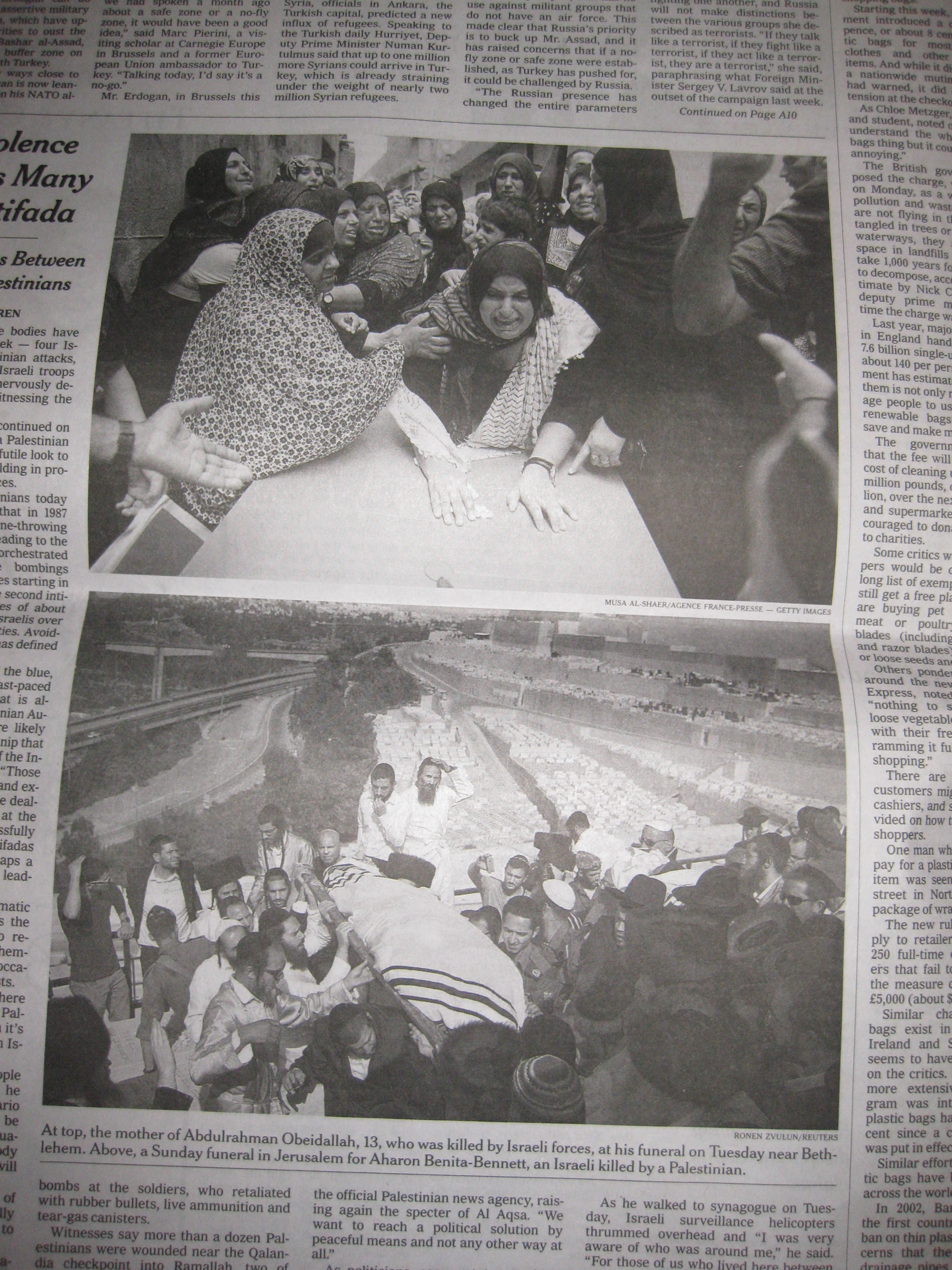
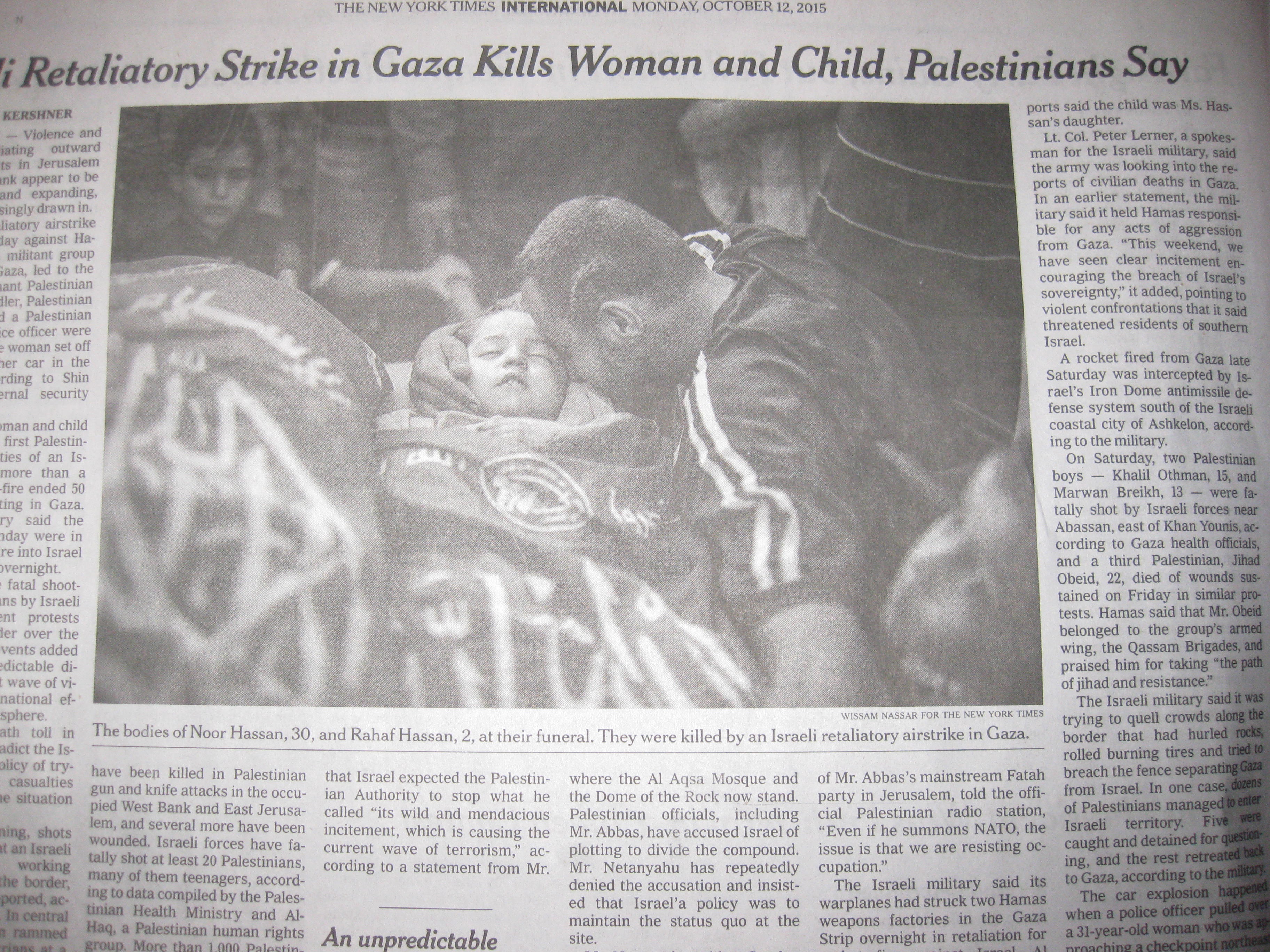
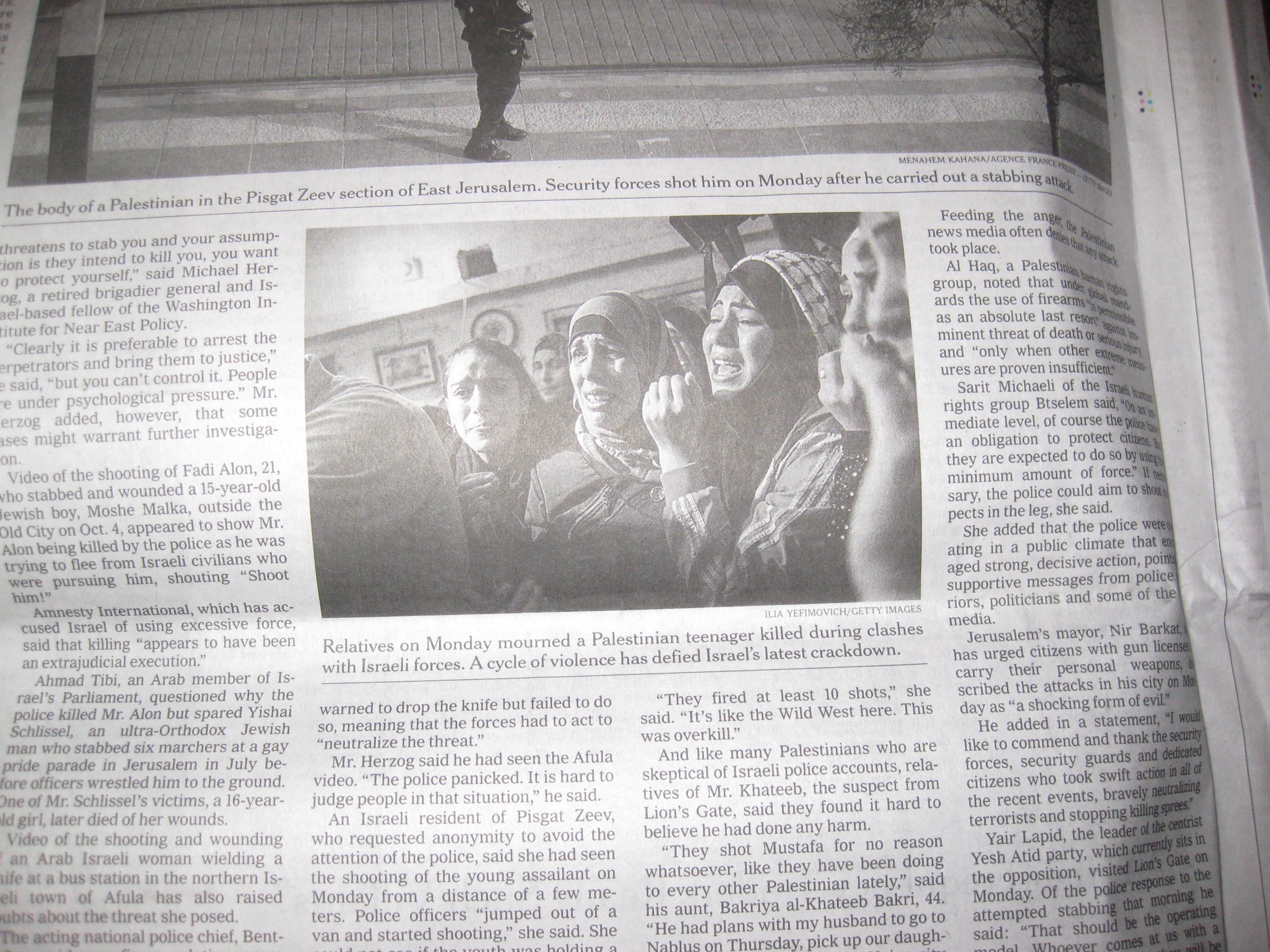
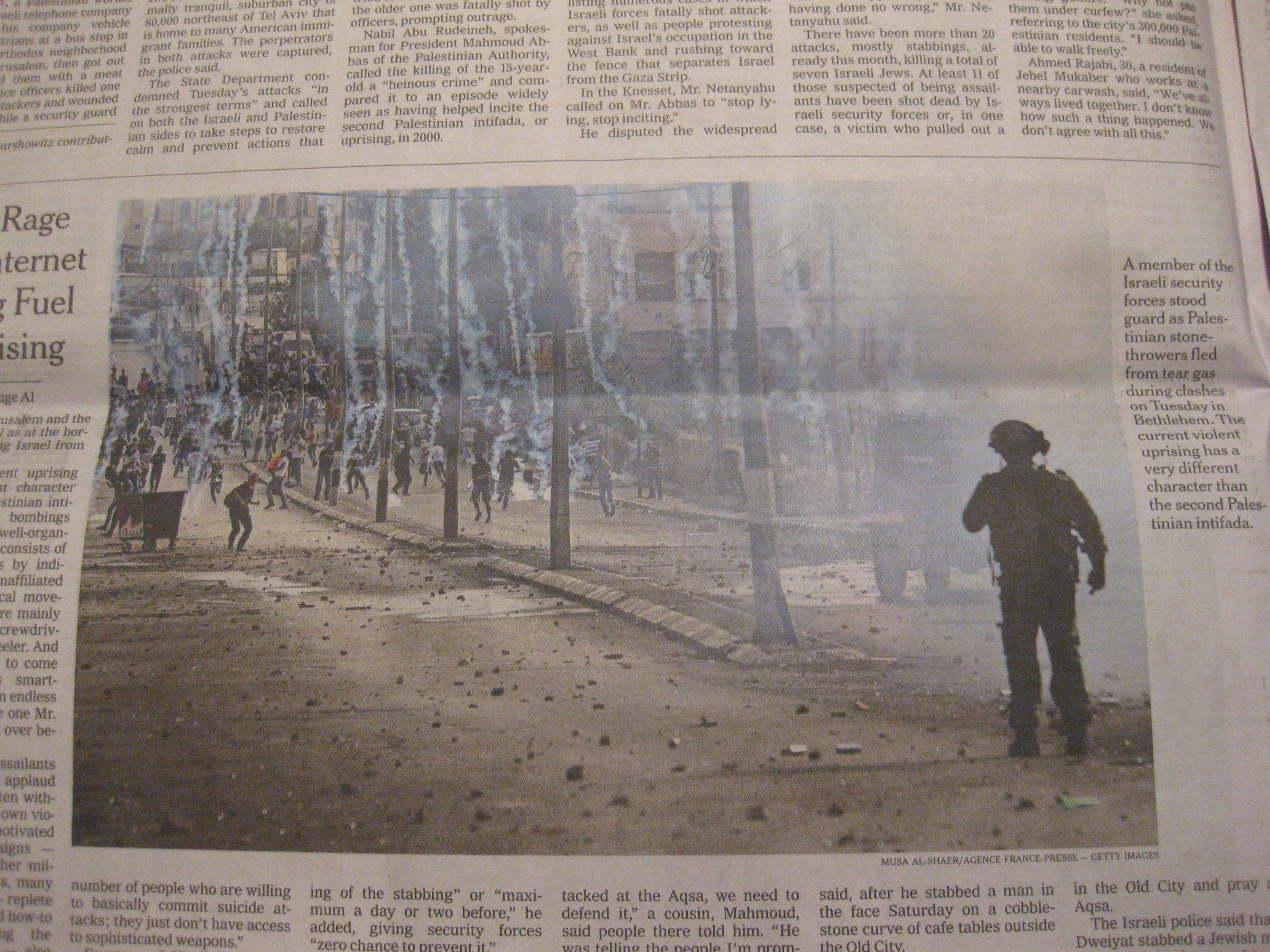
The New York Times year-end review posted dozens of pictures of conflicts around the world to encapsulate 2014.  In my opinion, the NYT picture that  summed up a dominant theme in its reporting for 2014 was the picture above, of a 15-year old Arab surrounded by Israeli policemen. For the New York Times, the stories on its cover pages in 2014 repeatedly told the story: that Israel attacks Arab youths.

The large color picture was displayed on its cover page on July 7, 2014. The bruised 15-year old Arab boy was being escorted out of a police station where he had been detained after throwing stones in a riot. There are several things that make the front-page treatment of the teenager note-worthy:

  • On that same day, over 100 people were killed in attacks in Kenya, Uganda and Yemen. Small stories appeared on the inside pages of the Times to discuss the scores murdered.
  • When Boko Haram killed hundreds, it also did not make the front page.
  • ISIS beheadings of journalists did not make the front page.

The beating of an Arab youth by Israeli forces was given more prominence and therefore deemed more important than those other world events.

This New York Times news story came shortly after three Israeli teenagers were abducted and murdered by Palestinians. The New York Times never placed even a small black-and-white photo of any of the three Jewish teenagers on the front page. Their plight was also not viewed as important by the Times.

Over the course of the next several weeks as Operation Protective Edge unfolded, the New York Times continued to put pictures of Palestinian children on the front page of the paper. Throughout July (July 11, 14, 17, 21, 22, 24 and 29th) the paper had pictures of Palestinians suffering on the front page. It took until July 29 – buried on page A6 – for the Times to write about and post a single picture of the Hamas terror tunnel network that was a main factor in launching the Israeli ground invasion of Gaza.

Further, Palestinian leadership, whether Hamas leaders such as Khaled Mashal or acting Palestinian Authority president Mahmoud Abbas, never were pictured on the pages of the Times during Operation Protective Edge (the only leader to be pictured was Ismail Haniya on September 4 page A10, well after the fighting had stopped). The paper only showed pictures of Arab civilians. However, Israeli Prime Minister Benjamin Netanyahu’s picture was shown often (July 7 twice; July 22; July 27; July 29; August 7), as were Israeli police and soldiers. The overall message of the New York Times was clear: the Israeli government was attacking Palestinian youths and civilians; it was not a war between opposing government authorities.

The Times news stories and editorials built additional narratives onto this theme, regardless of inaccuracies. In attempts to make the Israeli government seem callous to the conditions of Arab youth, an article and editorial on July 7 and July 8 stated that “days of near silence” passed before Israel Prime Minister spoke about the killing of an Arab teenager by Israeli radicals. This was completely untrue and it took days for the NYTimes to print a correction (below).

The NYT editorial board led with a piece on July 19 entitled “Israel’s War in Gaza”.  It was not called “Hamas’ War against Israel”, nor was it called the “War Between Hamas and Israel”.  The Times continued to paint the battle as an aggressive Israeli action against a populace.

In case there was any confusion in the New York Times message to its readership, it included another small picture of Netanyahu near its large picture of the year. (By way of comparison, did you ever see the NYT post a picture of US President Obama near an article about drone strikes or deaths in Afghanistan that he specifically ordered and oversaw?)


The New York Times tried to defend its coverage of the Gaza conflict by printing an editorial on November 23, 2014 entitled “The Conflict and the Coverage”.  Not surprisingly, it attempted to defend its poor media coverage and that it tried too hard to offer “symmetry” in the conflict. It claimed that the paper has “baseline beliefs that Israel has a right to exist and that the Palestinians deserve a state of their own.” The charitable Times board believing that “Israel has a right to exist,” clearly doesn’t extend to: believing that Israel has a right to defend itself; that it was reluctantly pulled into a battle in Gaza; that it sought to minimize Arab casualties; that Hamas is rabidly anti-Semitic; that Hamas leaders are intent on destroying Israel and killing Jews; and that Arab leadership was responsible for the war and deaths of both Israelis and Palestinians.


Sources:

http://www.huffingtonpost.com/2014/07/07/jodi-rudoren-new-york-times-_n_5564067.html

Times moved picture down in online of story: http://www.nytimes.com/2014/07/07/world/middleeast/israel-palestinians-muhammad-abu-khdeir.html

Every Picture Tells a story: https://firstonethrough.wordpress.com/2014/07/04/every-picture-tells-a-story-dont-it/

Bibi as a killing monster: https://firstonethrough.wordpress.com/2014/07/08/every-picture-tells-a-story-part-ii/

The NYT buried pictures: https://firstonethrough.wordpress.com/2014/07/29/the-new-york-times-buried-pictures/


NY Times Correction: July 9, 2014

An article on Monday about the arrest of six Israelis in the killing of a Palestinian teenager referred incorrectly to Prime Minister Benjamin Netanyahu’s response to the killing of Muhammad Abu Khdeir. On the day of the killing, Mr. Netanyahu’s office issued a statement saying he had told his minister for internal security to quickly investigate the crime; it is not the case that “days of near silence” passed before he spoke about it. The error was repeated in an editorial on Tuesday.”