When famine made Canaan (the land of Israel today) unlivable, Jacob’s family went down to Egypt. What began as a temporary refuge became something else entirely. Goshen (Genesis 45:9) was fertile, welcoming, and safe. The Jews prospered there. They built families, livelihoods, and a future. And for a time, it worked.
That is what makes Goshen so instructive. Unlike earlier famine detours in Genesis, this was not a brief excursion. Goshen was a one-way trip. It felt secure enough to settle into—and that comfort lasted generations. Until it didn’t.
Jews talk about it today as they ponder antisemitism’s historic trajectory. It has moved millions of Jews around the world for thousands of years, marking them as the “wandering Jew.” In 1900, most Jews spoke Russian, German, Polish and Arabic. In 2025, they almost all speak Hebrew and English, with French and Spanish covering virtually everyone else.
The land of Israel itself was not without Jewish migration. The land flourished, kingdoms rose, institutions formed. Then came division, exile, and destruction. First the northern tribes disappeared into history. Later Judah followed. The Jews did not just lose modern incarnations of Goshen; they lost their homeland for nearly two thousand years.
Parshat Vayigash is often used as the Torah’s first meditation on long-term diaspora. It offers no illusion that comfort guarantees permanence. Goshen was pleasant until a Pharaoh arose who no longer remembered Joseph. But the Jewish homeland was also strong until it fractured from within and fell to external powers. Neither place offered permanent security.
The lesson is not that exile is doomed or that the Jewish Promised Land is automatically safe. It is that where Jews live is often situational, not absolute. Prosperity can mask vulnerability. Stability can decay quietly. The obligation is vigilance—reading the environment honestly, assessing quality of life soberly, and understanding that history turns even when life feels settled.
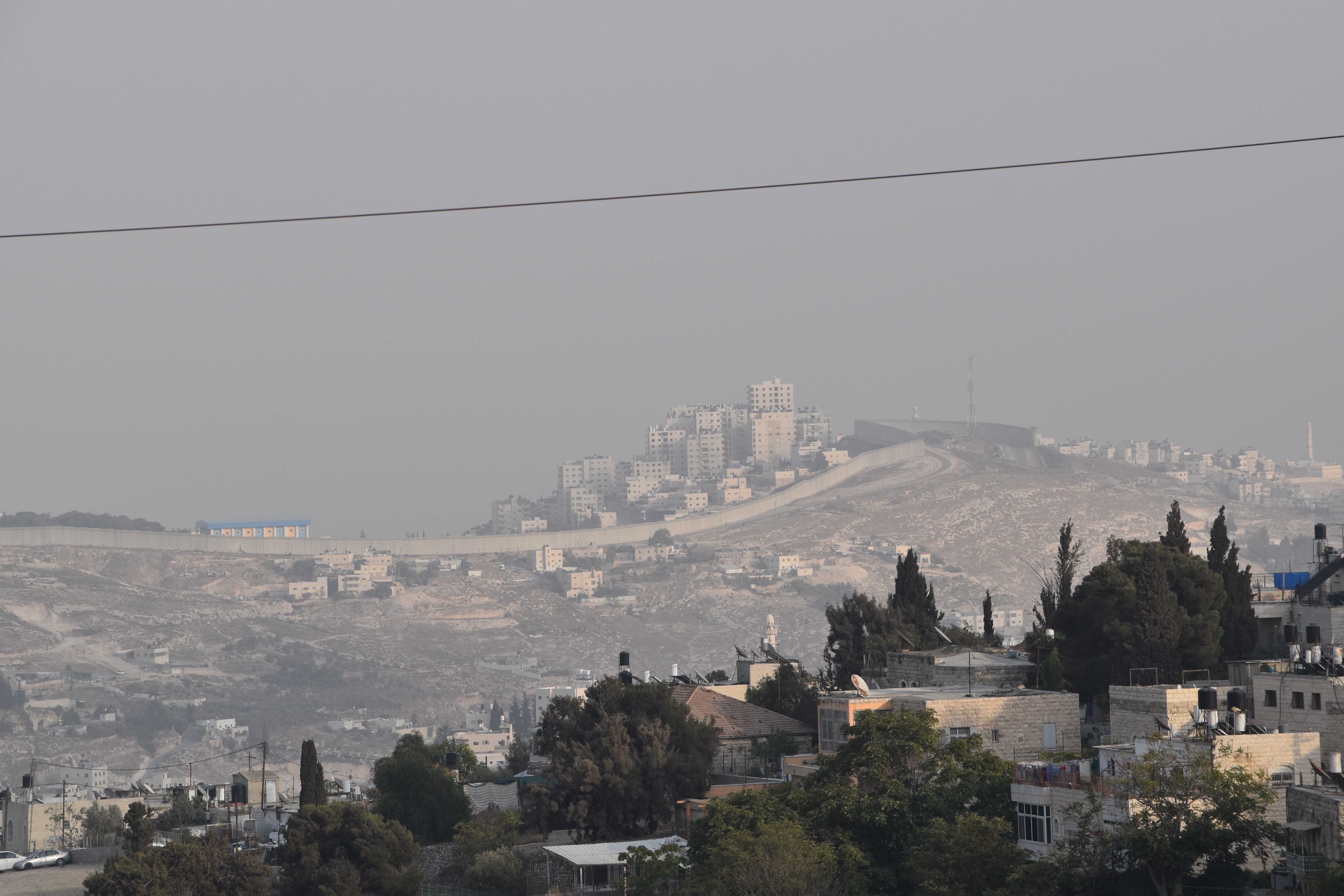
Israel’s Security Barrier as seen from Jerusalem, built to stop terrorism during the “Second Intifada”
Goshen teaches that success today is not a promise for tomorrow. But Israel teaches the same. Awareness, not geography, is what determines whether a place remains livable.
The conservative group Turning Point USA held its four day AmericaFest conference this week with a lineup of political commentators – and Nicki Minaj (1:13:00). Ben Shapiro of the Daily Wire sent the conference in a new direction, coming to speak early and attacking several of the speakers due to come on – including Tucker Carlson and Megyn Kelly – for trafficking in antisemitism and platforming wild conspiracy theories and theorists.
The media lit up that there is a rupture inside the conservative movement. Vice President JD Vance said at the conference, seemingly in response to Shapiro’s line of attacks, that “we have far more important work to do than cancelling each other.”
While the majority of people at Turning Point agree with Shapiro about Israel according to polls, the question of how to engage with people with whom you strongly disagree or want to persuade is an important question about tactics.
Consider the biblical figure Joseph.
When he first dreamed, Joseph placed himself at the center of the story and delivered the message directly to those who would one day bow before him. His brothers did not merely hear a vision of the future; they heard a declaration of hierarchy. The dream named winners and losers, elevation and humiliation.
Truthful or not, it was combustible.
Joseph learned—at extraordinary cost—that telling people they will submit to you does not hasten destiny. It creates enemies who delay it. Fate may be fixed, but its route is not.
Years later, standing before Pharaoh, Joseph applies that hard lesson with precision.
Joseph tells Pharaoh that his dream came in two forms because God has decided to do it—and to do it soon (Genesis 41:25-32). This is a striking claim, because Joseph himself had two dreams many years earlier, and nothing happened quickly.
Joseph is not contradicting himself. He is revealing what he has learned.
As a boy, Joseph assumed repetition meant imminence. Life taught him otherwise. His dreams were doubled, yet delayed for decades. They passed through betrayal, silence, and obscurity before fulfillment.
So why does Joseph now speak with certainty?
Because he ultimately understood something he did not then: the meaning of repetition depends on where the dream is aimed and who holds agency.
Joseph’s youthful dreams were aimed directly at people—at his brothers, at his parents, at their submission to him. They provoked resistance. Those who felt targeted fought the message, and history slowed.
Pharaoh’s dreams are different—not because they are truer, but because Joseph presents them differently.
Joseph does not tell Pharaoh that HIS reign will collapse or that HIS legacy will be erased. He does not aim the dream at Pharaoh’s ego. He does not place Pharaoh at the center of decline and does not elevate himself as the savior.
Instead, Joseph shifts the focus outward—to the land, to the people, to the coming conditions. Egypt will suffer. The famine will devastate the country. The threat is environmental and collective, not personal.
By doing so, Joseph removes both himself and Pharaoh from the line of fire.
Joseph learned an important lesson: when a dream threatens reality rather than pride, it accelerates history.
His own dreams were delayed because they challenged people directly. Pharaoh’s dreams moved quickly because they challenge circumstances instead.
Joseph’s greatness is not merely interpretive; it is strategic. He transforms a divine warning into a solvable problem.
He gives Pharaoh a way forward—storage, planning, delegation, foresight. Pharaoh is no longer defending his status; he is protecting his people.
Joseph learned the difference between telling people what will happen to them and showing them what will happen around them.
The first creates enemies. The second creates leaders.
Truth, But Approach
Joseph did not abandon truth. He learned how to deliver it. Ben Shapiro also spoke about serious matters honestly, but perhaps poorly. He imagined himself as the true shepherd of the conservative movement and sought to de-platform others.
When you aim at people, they shield themselves. When you aim at conditions, people mobilize.
If you want history to move, do not take aim at the audience. Give them the map—and let them walk into the future themselves.
In October 2002, in a case before the Supreme Court, Justice Antonin Scalia did something characteristically disarming. In the middle of a commercial case—a dispute about representations, intent, and liability—he reached for an example so blunt that no one in the courtroom could miss the point.
“let’s assume that there is a Federal statute that makes discrimination because of, or failure to hire someone, or let’s say, let’s say killing someone solely because of his race a crime, a separate crime. And someone, let’s assume he kills someone who is Jewish, and he said, well, I didn’t kill him solely because he was Jewish; I killed him because I disagree with the policies of Israel. Does that get him out of the statute?” – Supreme Court Judge Antonin Scalia on October 8, 2002
The question was not theatrical. It was instructional.
Scalia was making a narrow, lawyerly point about intent laundering—the habit of rebranding a harmful act with a more palatable explanation after the fact. In commercial law, courts reject that move every day. You cannot sell a defective product and escape responsibility by calling the defect innovation. You cannot mislead customers and then claim a higher purpose. Labels don’t change outcomes; explanations don’t erase harm.
He chose that example because everyone understood it immediately. Not because it was exotic, but because it was familiar. People do, in fact, come for Jews with reasons. They always have. The reasons change; the target does not. That is why the hypothetical worked even in a commercial case. It required no ideological scaffolding, no speech doctrine, no moral hedging. The room got it.
Scalia wasn’t talking about protest or expression. He was reminding the Court that post-hoc justification does not transform reality. A Jew selected as a Jew remains a Jew, regardless of the banner the attacker waves. You cannot launder murder through geopolitics any more than you can launder fraud through branding.
What makes the moment unsettling two decades later is not that Scalia saw this clearly in 2002. It’s that today, society now pretends not to.
Today, the very maneuver Scalia identified is routinely indulged. Violence against Jews is reframed as politics. Targeting Jews is explained as resistance. The word “Israel” is treated as a solvent capable of dissolving antisemitism on contact. The act is dissected until the victim disappears into the explanation.
Scalia understood that this maneuver was not new. In the Middle Ages, it was radical preachers who performed the laundering. On Easter, from pulpits across Europe, Jews were accused of killing Christ, poisoning wells, murdering Christian babies. The charge was always moral, never personal. The violence that followed—pogroms, expulsions, massacres—was framed not as hatred, but as righteous response. The excuse sanctified the act. The victim was still Jewish.
“The crimes you are committing in Palestine by desecrating the sanctity of the holy sites – foremost among them the blessed Al-Aqsa Mosque – you should expect reactions, not only from the Muslims, but rather from the entire world.” – Palestinian Authority Chairman Mahmoud Abbas’ Advisor on Religious Affairs and Islamic Relations Mahmoud Al-Habbash on December 15, 2025 about the massacre of Jews in Sydney, Australia
The vocabulary has changed. The mechanism has not.
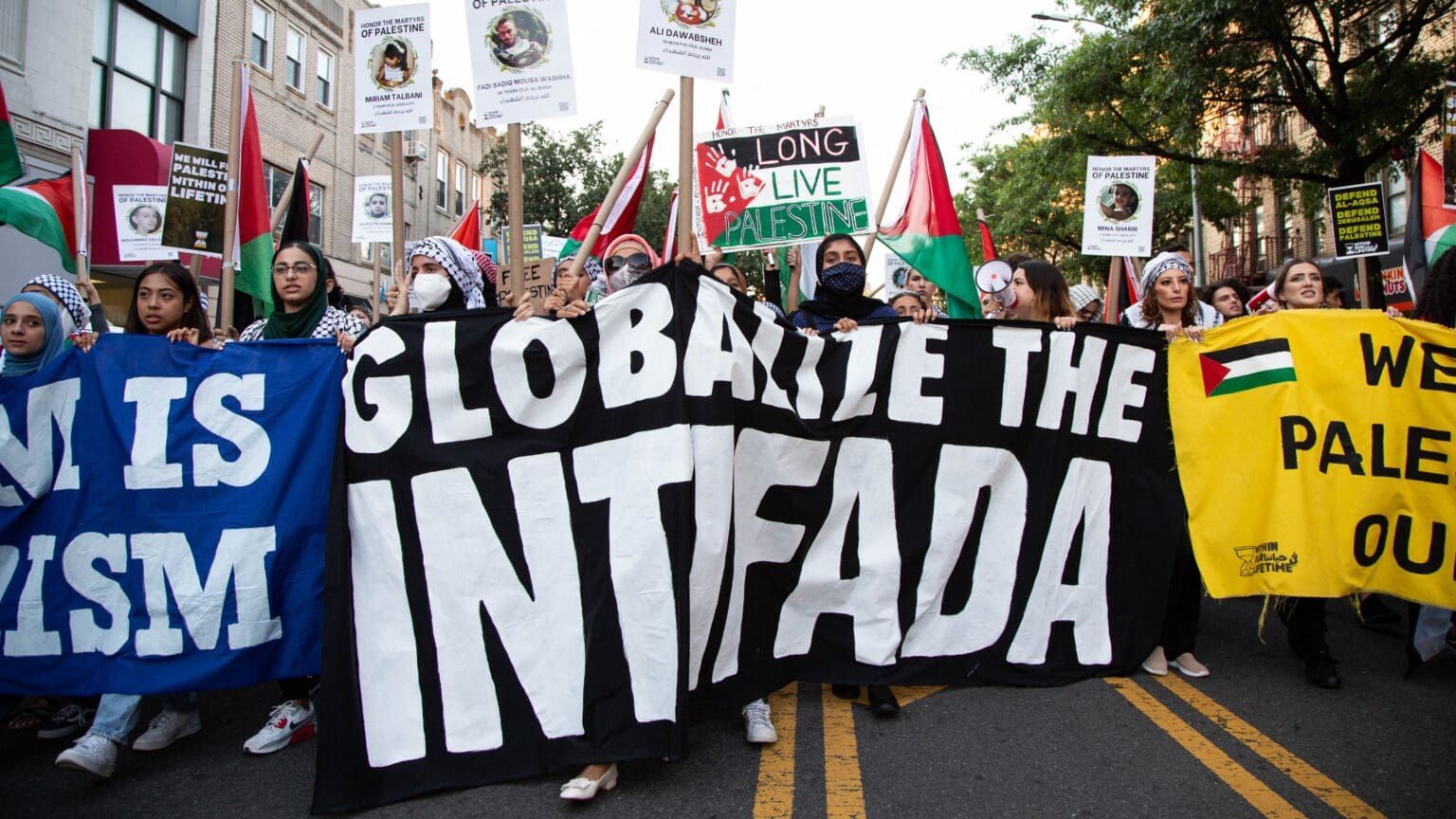
Today the laundering is done in different robes—through left-wing media narratives, academic language, teacher-union resolutions, and activist slogans. The Jewish state is branded unholy, colonial, imperial. Zionism is recast as original sin. Once that premise is accepted, Jews everywhere become legitimate stand-ins—symbols of something larger, targets by proxy. “Globalize the intifada” is not poetry. It is a call that travels, and it always knows where to land.
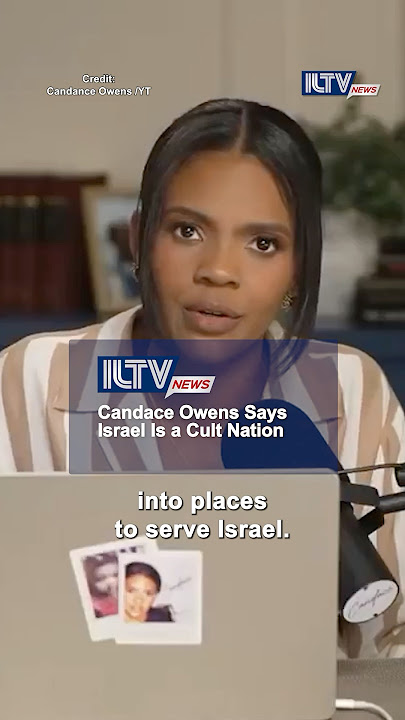
The laundering does not stop on the left. Figures like Candace Owens have vilified Jews across time itself—casting them as architects of the slave trade two centuries ago, as hidden hands behind modern social decay, as a people uniquely responsible for nearly every ill that can be stitched into a narrative. The effect is not historical inquiry; it is moral conditioning. When Jews are blamed for everything, they become appropriate targets for anything. The excuse differs. The permission is the same.
This is why Scalia’s example mattered—and why he chose it so plainly. He knew that people come for Jews with reasons. He knew those reasons are never the point. And he assumed, reasonably at the time, that everyone else could still see the difference between explanation and absolution.
Decades later, that clarity is treated as controversial. Motives are said to cleanse acts. Ideology is said to transform targets. Murder is said to become discourse if the language is fashionable enough.
You can change the sermon. You can update the slogans. You can trade Easter blood libels for postcolonial theory.
Hamas does not rule Gaza against the will of its people. It rules because large numbers of Gazans want it to. Hamas articulates aims that many in Gaza accept: “armed struggle,” permanent war, and the eradication of Israel. This is not an imposed ideology. It is a shared one.
That reality is the reason the war has not ended.
Hamas refuses to disarm. It promises to fight again. It rejects coexistence as a moral crime. And Palestinian Arabs have not rejected Hamas. There has been no uprising, no mass refusal, no turning inward to say this has destroyed us and must stop. The tunnels remain. The rockets are rebuilt. The hostages were hidden in plain sight and with complicity.
The Arab world understands this. So does the Muslim world and international community, quietly if not publicly. No money will rebuild Gaza while Hamas governs. No state will guarantee security for a territory whose leadership is openly genocidal. Even those who chant Gaza’s cause from afar refuse to absorb the cost of dismantling its rulers. Words are cheap. Responsibility is not.
And so the world fractures.
One side insists Gaza deserves unlimited sympathy—stripped of agency, frozen as a permanent victim, absolved of all consequence. The other side sees a society that has embraced a war of annihilation and asks the world whether moral condemnation is not only justified, but necessary. This divide is not about compassion versus cruelty. It is about whether moral judgment still matters.
What cannot be sustained is the fiction that Gaza is merely trapped between Hamas and Israel. Gaza is trapped— by leaders and parents who have chosen martyrdom over future, ideology over life, and war over their own children’s survival.
That is where sympathy collapses.
Because the only people in Gaza whose moral claim is uncontested are the children—and they are being sacrificed by a society willing to place guns in schools, tunnels under bedrooms, and hostages among families. A society that teaches its children that nothing is nobler than dying for the cause of destroying the Jewish State.
Sympathy cannot be demanded for that choice. It can only be extended—narrowly, painfully—to those who never had one.
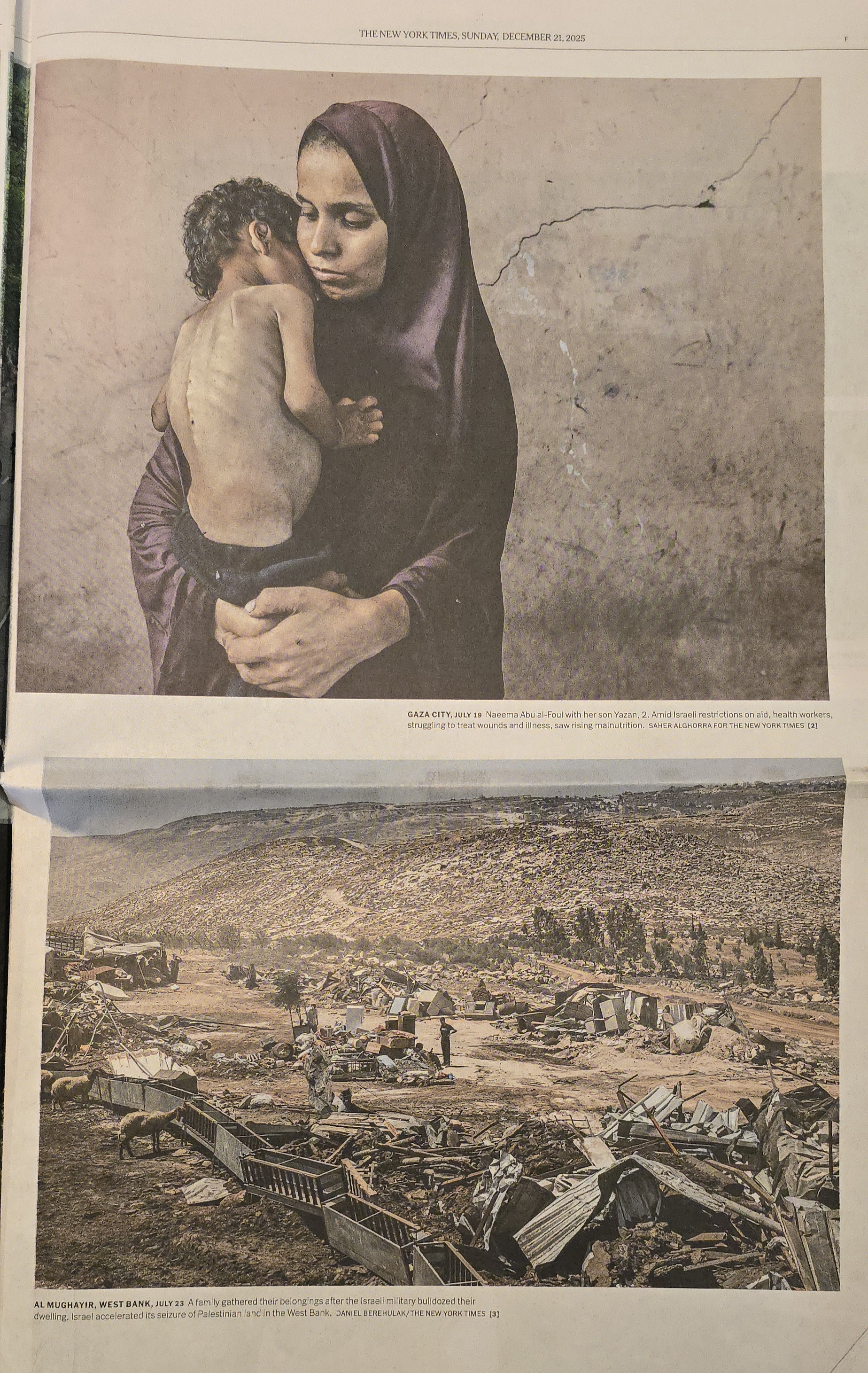
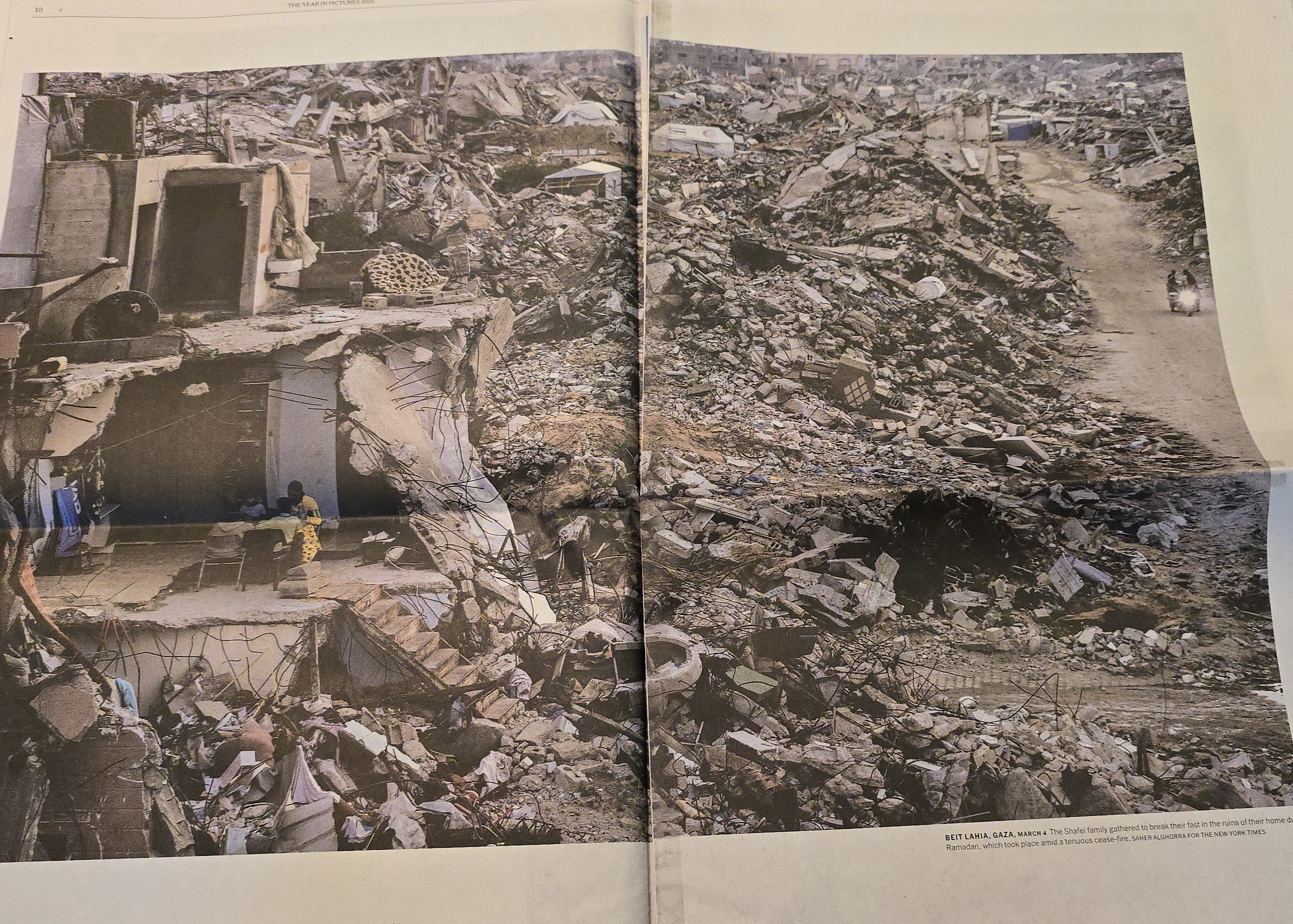
That is why the ritualized outrage of the West’s most powerful institutions now feels so hollow. Each year, The New York Times publishes its Year in Pictures, and the selection itself becomes an argument. In 2025, the year with the largest spike in antisemitism including several incidents of mass murder, there were no pictures of Jewish victims. Instead, page after page of Gaza: rubble, smoke, bloodied streets, dust-covered children. Destruction, repeated until it acquires the authority of inevitability. Israel appears only as force. Gaza appears only as suffering. Context is stripped away. Agency is erased. The camera becomes a verdict.
Two-page spread in New York Times’ 2025 year in pictures showing Gaza rubble. The only other 2-page spread was the election of Zohran Mamdani, an anti-Israel member of the DSA, as mayor of New York City
But the depravity lies not only in what is shown—it lies in what is omitted.
There are no photographs of Jewish life under siege: no police guards posted outside synagogues, no concrete barriers and metal fences erected around schools, no quiet images of fear normalized into daily routine. There are no frames of mourning for Jewish victims abroad, the couple shot in Washington, D.C., the arson at the home of the Jewish governor of Pennsylvania over Passover. No recognition of the global consequences of a war whose ideology has traveled far beyond Gaza. Violence against Jews outside Israel didn’t even make a footnote.
New security fence erected outside synagogue in 2025 (photo: First One Through)
When Israeli hostages appear in the Times, they are reduced to a single visual trope: a large military helicopter, as if their captivity were a logistical problem rather than a crime. Even Jewish victims of Gazan atrocities are set against a large Israeli military. The human cost of hostage-taking is laundered into abstraction.
New York Times only picture of a Jewish victim is a tiny speck in a large Israeli military helicopter
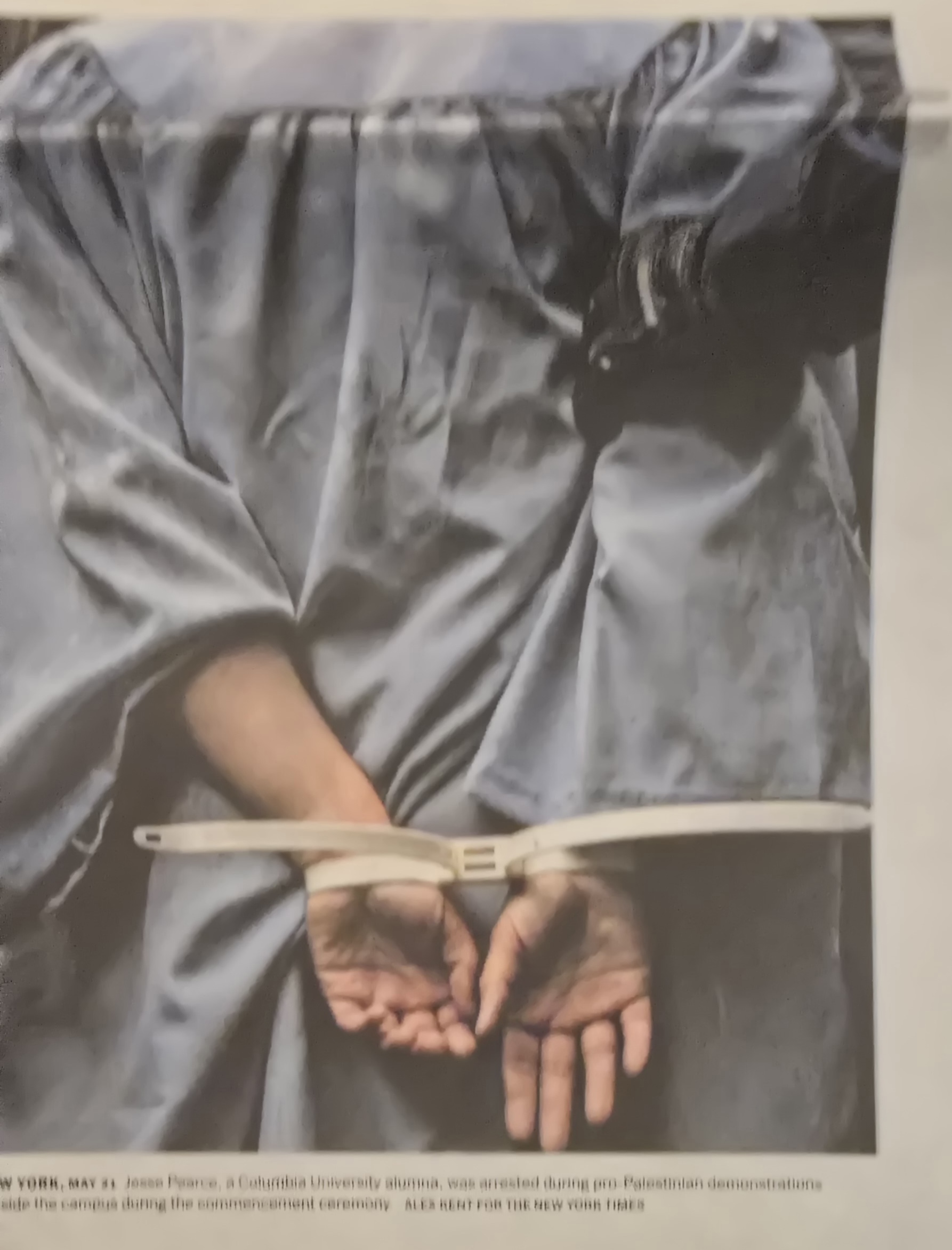
What does receive sympathetic attention are arrests—multiple images of pro-Palestinian demonstrators detained by police, framed as moral courage meeting state power. Advocacy for Israel’s destruction is softened into dissent. The pages preen about resistance while refusing to name what that “resistance” seeks to accomplish.
This is not journalism. It is moral choreography.
The pictures ask only one question—who suffered more?—while carefully avoiding the only one that matters: who chose this war? To launch it? To continue it? They do not show Hamas leaders refusing disarmament. They do not show weapons beneath nurseries. They do not show the ideological choice to sacrifice children for permanence of war.
In this telling, Israel becomes the aggressor by existing, and Gaza becomes sympathetic by persisting in annihilation. The refusal to surrender is recast as resilience. The willingness to sacrifice children is aestheticized as tragedy rather than condemned as crime. Sympathy is manufactured by amputating responsibility. The global anti-Israel advocates are embalmed in the moral light; Jewish victims disappear off the pages.
When the world’s most influential newspaper presents destruction without causation, suffering without choice, and death without ideology, it does not advance peace. It sanctifies perpetual war. It promotes a global blood libel. And it teaches readers that moral clarity is cruelty, while moral confusion is virtue.
The far-left media hopes that history will remember its curated selection of photographs and the modern moment will gather sympathy for the anti-Israel and anti-Jewish horde. Hopefully they are proved very wrong, and this time capsule will forever mark The New York Times for its profound antisemitism and moral depravity.
I was sitting in the audience at an Andrea Bocelli concert at Madison Square Garden in New York City, the lights dimmed, the hall hushed in anticipation for the encore “Con Te Partiro,” (Time to Say Goodbye), his most iconic song. He teased the audience with “New York, New York” and headed for the exit once more. The crowd cheered and he came back to sing the song they craved.
Andrea Bocelli at Madison Square Garden (photo: First One Through)
Beside me sat a close Jewish friend who grew up in Australia. We had come for the music, for the beauty of a voice that carries memory as much as sound. Yet, as the first familiar notes rose, I saw her mind was in another world.
She was thinking of her parents and brother’s family back in Melbourne.
Only days earlier, they had been at a Chabad Chanukah party—children, candles, singing, the ordinary holiness of Jewish joy. Then the news broke of the shooting in Sydney. Phones buzzed. Conversations stopped. Parents gathered children closer. And out. What had begun as celebration turned into a flight of urgency. They left with the unmistakable instinct that something precious had become fragile. Perhaps lost.
As Bocelli sang of leaving—of standing alone and dreaming of the horizon—the words landed differently. “It’s time to say goodbye,” he sings, not with bitterness, but with ache. He sings of departing lands once fully lived in, of moving forward while carrying love along. The song understands that some goodbyes are spoken precisely because the bonds mattered.
Time to say goodbye Countries I have never Seen and experienced with you
Australia has been such a land for Jews. Around 115,000 strong, the community was built in large part by Holocaust survivors and their children, who arrived determined to create lives of dignity and contribution. They succeeded. Jewish schools flourished. Synagogues filled. Jewish families felt Australian in the fullest sense—rooted, confident, woven into the national fabric. It was a beloved home.
That is why this moment feels so melancholy.
When antisemitism intrudes into Jewish life—when Chanukah gatherings require calculation, when news of violence travels faster than reassurance—something internal shifts. Families begin to think not only about safety today, but about continuity tomorrow. They listen closely for the voice of government, for the firmness of protection, for the sense that Jewish life is fully defended. When that reassurance feels thin – no, absent – dark history whispers.
Yes, I know there is no light in a room when there is no sun If you’re not there with me, with me
For two years my friend had been speaking to her parents and brother about leaving Australia as antisemitic incidents surged and the government seemed unwilling to do anything. Now, the threats had crossed to violence. Murder. On a mass scale.
At the concert, Bocelli sang on. “With you I will leave,” he promises. The line felt written for this generation of Jews. Leaving does not mean erasing. It means carrying Australia forward: the beaches, the friendships, the generosity, the years of building a good life. Love will not dissolve at the airport gate.
For children, aliyah after moments like these is not politics. It is the air they breathe. It is the desire to grow where Jewishness fills the public calendar, where holidays are shared rather than guarded, where identity settles into the background instead of standing on alert. Israel becomes the horizon the song gestures toward—not as fantasy, but as alignment.
But they know some parents – many Holocaust survivors – will not be able to make the journey. They will stay behind in a land they thought of as home while their children and grandchildren head to their homeland.
When you’re far away I dream of the horizon and words fail And I, yes, I know that you are with me, with me
As the music swelled, my friend wiped away tears. They were for her brother’s children, who should have stayed longer at a Chanukah party. They were for her parents’ generation, who believed Australia was the final chapter. They were also for something enduring: the knowledge that the Jewish story includes movement, discernment, and the courage to know when it is time.
I will leave with you On ships at sea Which, I know No, no, they don’t exist anymore
The concert ended. The applause lingered. We walked out quietly, in a world darkly distinct from the thousands of other concert-goers heading to their homes.
Somewhere between Melbourne and Jerusalem, between a beloved home and a homeland, the song kept playing, softly affirming the discussions of long goodbyes that were taking place in Jewish homes throughout Australia.
In Britain, a jury recently decided that the so‑called Khaybar chant is not antisemitic. The chant invokes Khaybar, a seventh‑century battle in which Jewish communities were slaughtered by the armies of Muhammad. The actual chant in Arabic, “Khaybar, Khaybar Ya Yahud, Jaish Mohammed Sauf Ya’ud” means “Watch Out Jews, Remember Khaybar, the Army of Mohammed is returning”. Its meaning is not subtle. It is a threat dressed up as history: remember what happened to the Jews then—remember what can happen again.
If that chant is deemed legally innocuous, what else must now be tolerated?
Would crowds chanting, “Jews, remember the ovens—the Nazis are coming,” be waved through as historical commentary about the Holocaust? What about “We love October 7—it will happen again, in your neighborhood,” explicitly celebrating the mass murder of Jews in Israel and promising its repetition elsewhere? These are not metaphors. They are incitement through remembrance, violence recalled as promise.
The problem is not that the law is incapable of recognizing hate. It plainly can. Careers are ended for misgendering. A single racial slur can bring swift institutional punishment. Speech codes are enforced with zeal—except, it seems, when the targets are Jews.
When courts insist on laundering openly antisemitic chants into something more refined and dignified—while other forms of bigotry are policed to the syllable—Jews are stripped of basic protections. Uniquely so. They are told to absorb the abuse, to endure the menace, to treat threats as culture and calls to murder as mere politics.
Law enforcement, under this logic, will intervene only—perhaps—after Jewish blood is spilled. Until then, Jews are instructed to tolerate the intolerable.
The divergence between the United States and the United Kingdom is often overstated. America claims the shield of the First Amendment; Britain claims the precision of hate‑speech law. In practice, both systems now converge on the same result: maximal latitude for antisemitic intimidation, coupled with maximal scrutiny of everyone else.
In the U.S., threats are dismissed as protected speech until they metastasize into action. In the U.K., chants that openly celebrate or foreshadow Jewish slaughter are judicially sanitized as cultural or historical expression. Different doctrines, identical outcomes.
This is not neutrality. It is a re‑creation of an old status under a modern name: Jews may live here, but only on sufferance; they may speak, but only quietly; they may appeal to the law, but not expect its protection.
If Western societies imagine that this posture will buy peace—by indulging jihadist rhetoric while disciplining polite speech—they are deluding themselves. A legal order that cannot name antisemitism, that cannot distinguish remembrance from menace, has already corroded from within.
History’s lesson is not subtle. The moment a society teaches Jews to absorb threats, it has decided that Jewish safety is optional. And when the law makes that decision, it is only a matter of time before others learn the same lesson.
A liberal democracy begins with a belief in pluralism—that a society can remain open even when its people profoundly disagree.
It assumes citizens will hold incompatible views about religion, morality, identity, and history, and that the state’s role is not to arbitrate truth but to preserve space. Speech is therefore protected broadly, even when it is crude, offensive, or deeply wrong. A liberal democracy does not require enlightenment. It requires freedom.
That freedom extends even to haters. But it is not unlimited.
Pluralism does not mean surrender. A society can protect speech while still drawing firm lines against coercion. The distinction is simple and essential: ideas are free; intimidation is not.
This is why liberal democracy depends on strong law enforcement. Courts, police, and prosecutors are the infrastructure of freedom. Without enforcement, rights exist only for those willing to defend themselves physically.
The law must intervene before intimidation hardens into violence. Waiting for broken windows or spilled blood is not neutrality—it is negligence. Fear does its work quietly. People leave long before they are injured.
This is not theoretical.
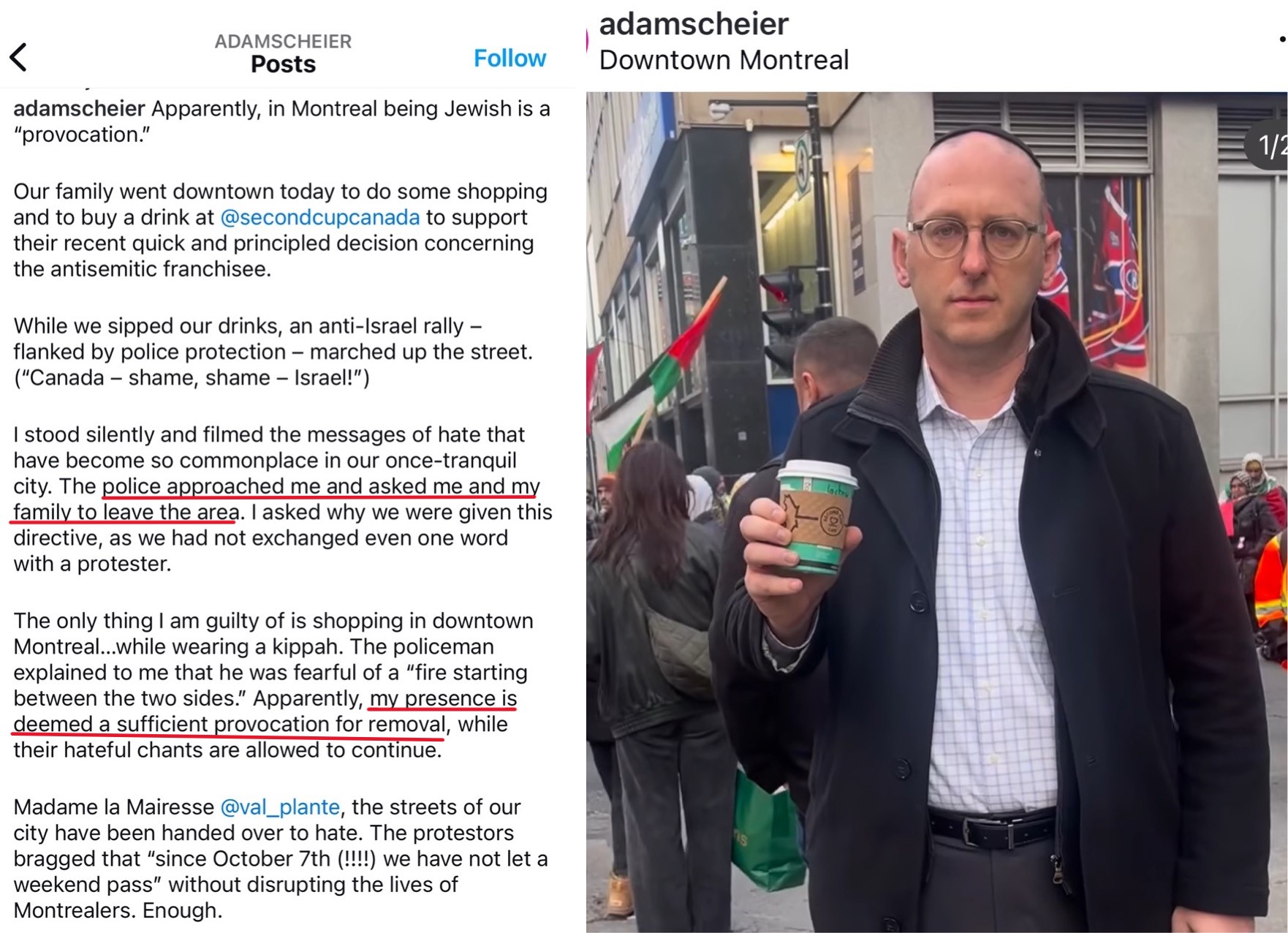
Across the West today, Jews are being harassed in public spaces, on campuses, and in neighborhoods—not for what they say or do, but for who they are. They are told their presence is a provocation. That they should leave “for their own safety.” That public space belongs to others now.
Jewish man in Montreal Canada out shopping with his family told to leave area because his physical presence was a provocation to anti-Israel protestors in November 2024
This is a flashing warning sign.
When Jews are asked to disappear so that others may feel comfortable, liberal democracy is already failing. When the burden shifts from the intimidator to the target—when minorities are told to lower their profile, avoid certain areas, or conceal their identity—the law has retreated.
President Biden’s Jewish liaison, Aaron Keyak, tells Jewish Americans to hide their religion in May 2021
The logic is dangerous: if you weren’t here, there wouldn’t be trouble.
That logic ends pluralism.
A liberal democracy does not require Jews—or any minority—to justify their presence. It does not ask them to trade visibility for safety. It does not treat their normal lives as inflammatory acts.
When intimidation succeeds, speech becomes theoretical and freedom selective. The public square shrinks until only the loudest remain, and those vicious groups with whom the government aligns. Elections may continue, courts may still issue rulings, but the civic bargain is broken.
The test of a liberal democracy is therefore how it responds when minorities are told to leave, either directly by government officials or with their tacit approval. If the state allows harassment to drive people out—quietly, gradually, without intervention—it has abandoned its most basic duty.
Zohran Mamdani, the incoming mayor of New York City who is comfortable with the phrase “globalize the Intifada,” will be in charge of law enforcement in the city with the greatest number of Jews.
How will he respond when Baruch College at the City University of New York suggests Jews cancel holiday events because antisemites have the run of the school and the institution cannot (will not) assure their safety?
What will he do when Jewish students at New York University cannot enjoy the school’s facilities because of gross failures to protect students?
Who will send in the police when Columbia University Jewish students are forced to walk a tight direct line between classrooms with an escort, because the university cannot secure the campus for everyone?
Where will the courts and law enforcement be when Jewish students and faculty at CUNY Hunter College are forced to cancel or not attend classes because of widespread harassment and intimidation?
Students at Cooper Union in downtown NYC lock themselves in a library while anti-Israel protestors threaten them outside
A successful liberal democracy welcomes immigrants and may elect a Ugandan born mayor. Yet it fails to be a liberal democracy when Jews are forced to flee the streets because governmental officials give a free pass to harassment, intimidation and discrimination.
The West is on the cusp of learning whether it remains a liberal democracy. And whether it cares.
There are Jews who keep their heads down. And then there is Chabad.
From Bondi Beach to Mumbai, from Barcelona to American college campuses, Chabad does the opposite of what fear would counsel. It does not retreat inward. It goes outward—publicly, cheerfully, stubbornly—lighting candles, setting tables, opening doors.
And for that, it bleeds.
In Australia, Chabad helped organize a large public Chanukah gathering near Bondi Beach—sun, music, children, light. A Jewish holiday celebrated exactly as it was meant to be: openly, without apology. Antisemites came – because, as they say of bank robbers robbing banks – that’s where the Jews are. Violence came to eradicate the joy.
In India, Chabad paid an even heavier price. During the 2008 Mumbai attacks, terrorists deliberately sought out the Chabad House. This was not collateral damage in a geopolitical struggle between India and Pakistan. It was targeted slaughter. The rabbi and his wife were tortured and murdered because they were Jews—and because they were visible Jews, serving other Jews. The attackers bypassed many targets to reach them. They knew exactly who they were looking for.
This pattern repeats itself with chilling consistency. Chabad emissaries—shluchim—are not anonymous. They live openly as Jews in places where Jews are few, where governments barely register their presence, let alone prioritize their safety. Some countries have only dozens of Jews. Some have none at all, except for Chabad.
And still Chabad goes.
On Friday nights in Barcelona, Jewish life gathers around Chabad tables. Tourists, locals, students—many unaffiliated, many unsure—find Judaism not as a political identity or an abstract cause, but as food, song, wine, warmth. As Shabbat.
On university campuses across North America, Chabad events now regularly outshine Hillel. This is not accidental. Where Hillel has often drifted toward “wokeness,” flattening Judaism into a vague social-justice aesthetic, Chabad offers something older and sturdier: tradition without embarrassment. Commandments without footnotes. Jewish joy without ideological permission slips.
That, too, draws attention. And danger.
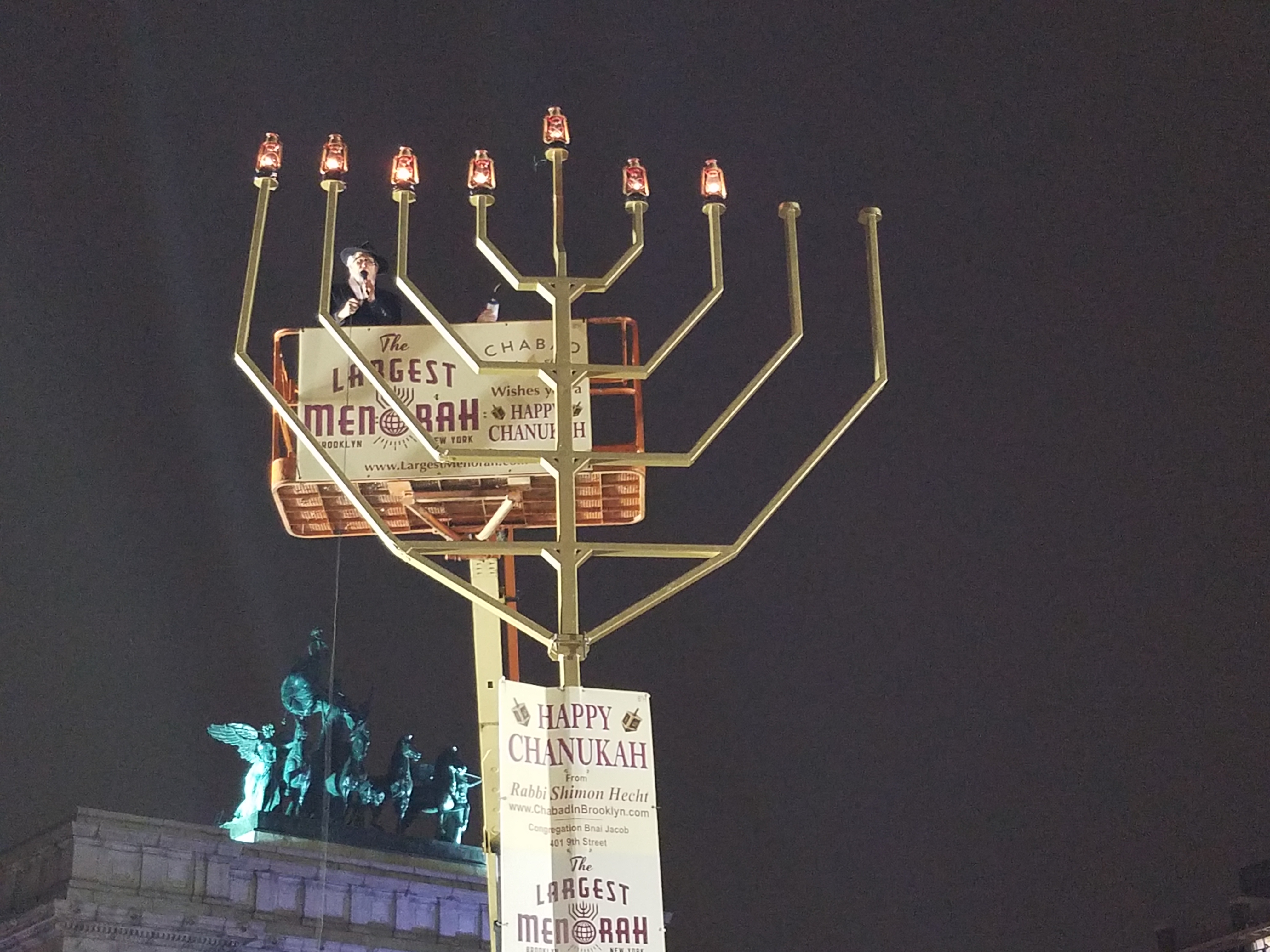
Chabad rabbis and their families know they wear a mark, and not metaphorically. They live without anonymity. They publish their addresses. They welcome strangers. They light menorahs in public squares at a moment in history when public Jewishness has been recast as a provocation.
Chabad lighting “the largest menorah” on the sixth night of Chanukah in Brooklyn’s Grand Army Plaza in 2017 (photo: First One Through)
Chanukah, of all holidays, insists on this. It is not meant to be hidden. The lights are placed in windows, at doorways, facing the street. Pirsumei nisa—publicizing the miracle—is the law. Chabad takes it seriously, even when the risk feels immediate.
In a world where Jew-hatred has resurged with startling comfort, Chabad has become something else as well: exposed in the spotlight.
There is an old biblical image for this.
When Abraham is told to sacrifice Isaac, the knife is raised but the sacrifice is halted. Instead, a ram appears, caught in a thicket by its horns. The ram is offered in Isaac’s place.
Chabad, today, feels like that ram.
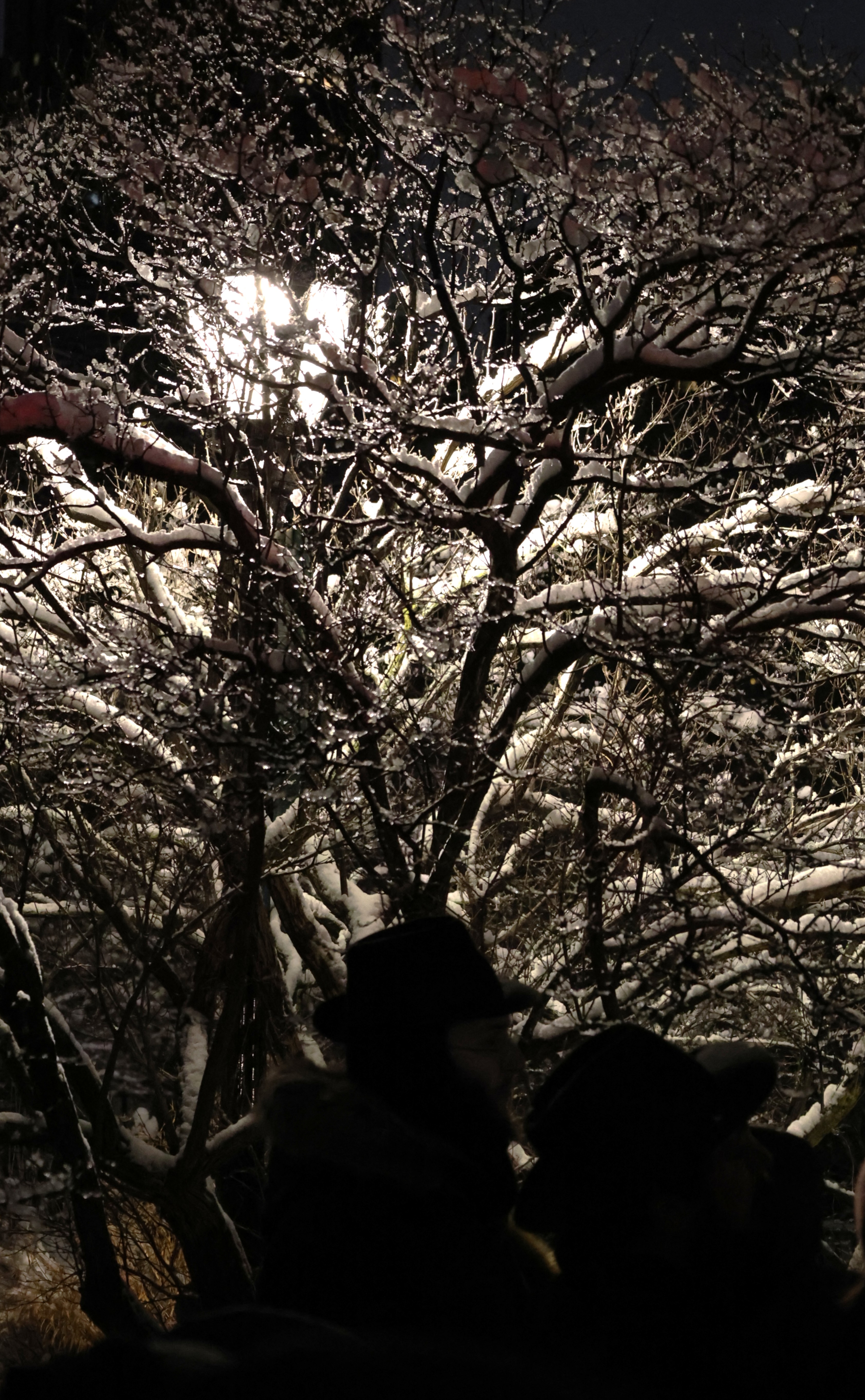
Silhouette of two Chabad men at a Chankah lighting ceremony on the Upper East Side of Manhattan, shortly after the massacre of Jews in Bondi Beach, Australia in December 2025. Just a few hundred feet away sits Gracie Mansion, soon-to-be home of New York City’s new mayor, Zohran Mamdani, who refuses to repudiate the phrase “Globalize the Intifada,” a call to kill diaspora Jews. (photo: First One Through)
Not because Chabad seeks martyrdom—it emphatically does not. It absorbs the blows meant for Jewish visibility itself. It becomes the target because it brings together Jews to celebrate Judaism with gladness – the ultimate point of inflammation for antisemites.
The world often says it wants Jews to be “normal.” Chabad refuses that bargain. It insists on being Jewish instead—fully, visibly, joyfully—even when the cost is high.
Chabad is not actually caught in a thicket; it takes its position openly. But antisemites hear a calling that is not divine but grotesque when they see joyful Jews, and are willing to sacrifice themselves and their sons – like the murderers of Bondi Beach – to feed the poisoned passion.
The Book of the Maccabees lays out that the war against the Jews did not start with violence but with policy. The Syrian-Greeks initiated the battle by denying Jews their right to religious practice. Jewish life was made illegal through decrees and prohibitions, through the quiet insistence that Jews no longer have standing in their own holiest spaces.
The Temple Mount was seized. Jewish worship was banned. Foreign rites were imposed in its place. The text is precise and unsparing:
“And forbid burnt offerings, and sacrifice, and drink offerings, in the temple; and that they should profane the sabbaths and festival days…. They set up the abomination of desolation upon the altar, and built idol altars throughout the cities of Juda on every side.” —1 Maccabees 1:45,1 Maccabees 1:54
When the Maccabees returned to Jerusalem, the devastation they witnessed was total. The enemies of the Jews intended humiliation. A holy place was turned into a ruin so complete that nature itself began to reclaim it.
“They saw the sanctuary desolate, the altar profaned, and the gates burned. In the courts shrubs had grown up as in a forest.” — 1 Maccabees 4:38
Judas and his brothers refuse to accept erasure as permanent and took action:
“Then Judas and his brothers said: ‘Behold, our enemies are crushed. Let us go up to cleanse the sanctuary and dedicate it…. They tore down the altar and stored the stones in a suitable place on the temple hill until a prophet should come to tell what to do with them.” — 1 Maccabees 4:36, 44–46 “They purified the sanctuary and made another altar of sacrifice… and offered burnt offerings according to the law….They celebrated the dedication of the altar for eight days, and offered burnt offerings with gladness.“ — 1 Maccabees 4:48–56
And then memory was mandated.
“Judas and his brethren with the whole congregation of Israel ordained, that the days of the dedication of the altar should be kept in their season from year to year by the space of eight days, from the five and twentieth day of the month Casleu, with mirth and gladness.” — 1 Maccabees 4:59
Why legislate remembrance? Why must it be done with joy?
Because danger does not end with victory nor complacency. The danger is forgetting how erasure begins—how denial of access precedes denial of life. Enemies rarely announce extermination at the start. They begin by declaring Jews illegitimate, unworthy of presence, unfit to practice their own traditions.
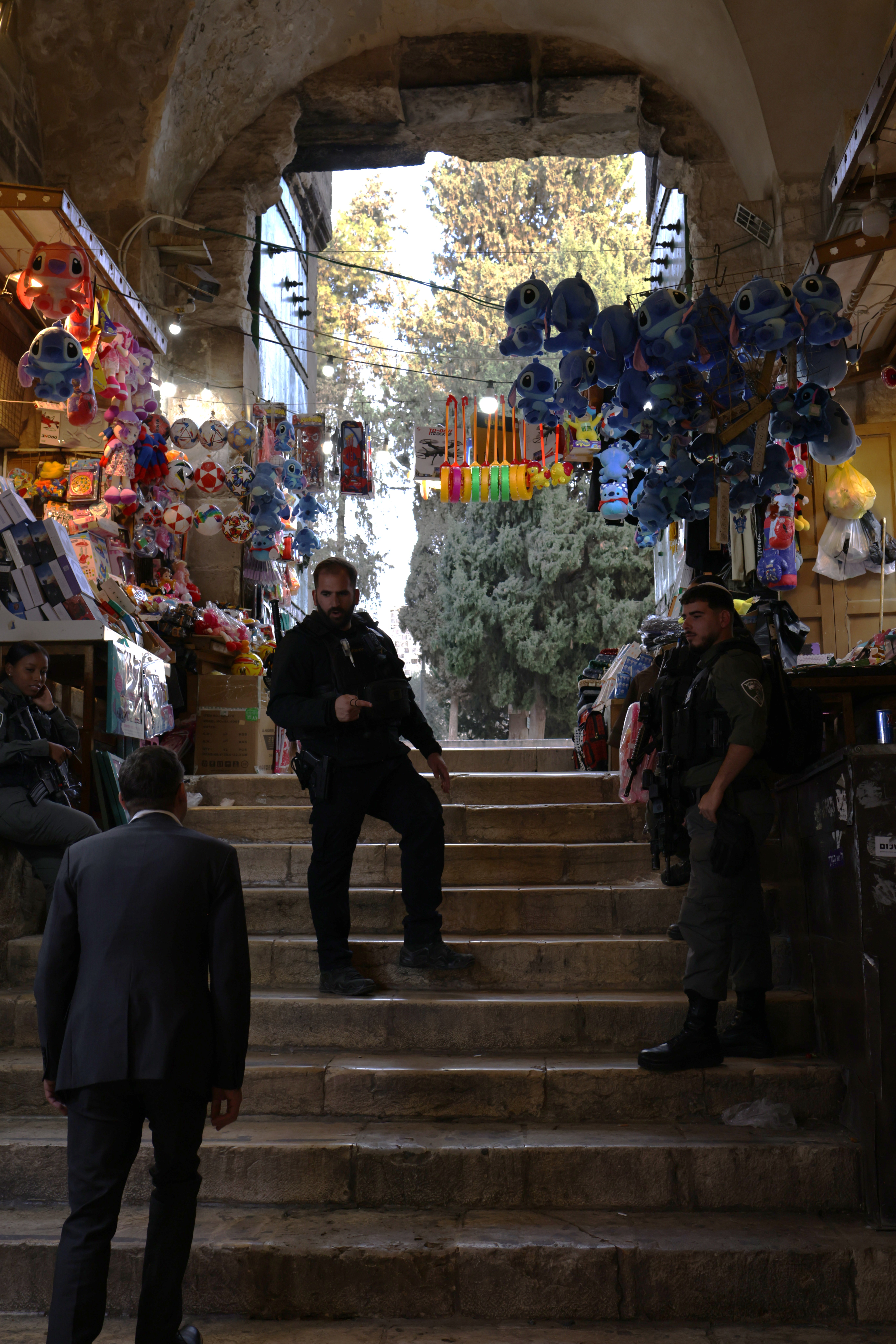
Guard blocks entry of a Jewish man onto the Jewish Temple Mount at the Cotton Merchant’s Gate, because he is a Jew, in November 2025. (Photo: First One Through)
The Maccabees understood something timeless: when Jews accept exclusion as normal, the battle has already been lost. When they are told to make do with less than basic human rights demand, they can never really have a full heart.
Hanukkah is the refusal to let others define Jewish legitimacy. It is the insistence that Jewish rights—to worship, to gather, to exist openly—are not privileges granted by empires or overseers, but as the opening lines of America’s Declaration of Independence state, “endowed by their Creator.”
There are moments when a headline tells you everything by what it refuses to say.
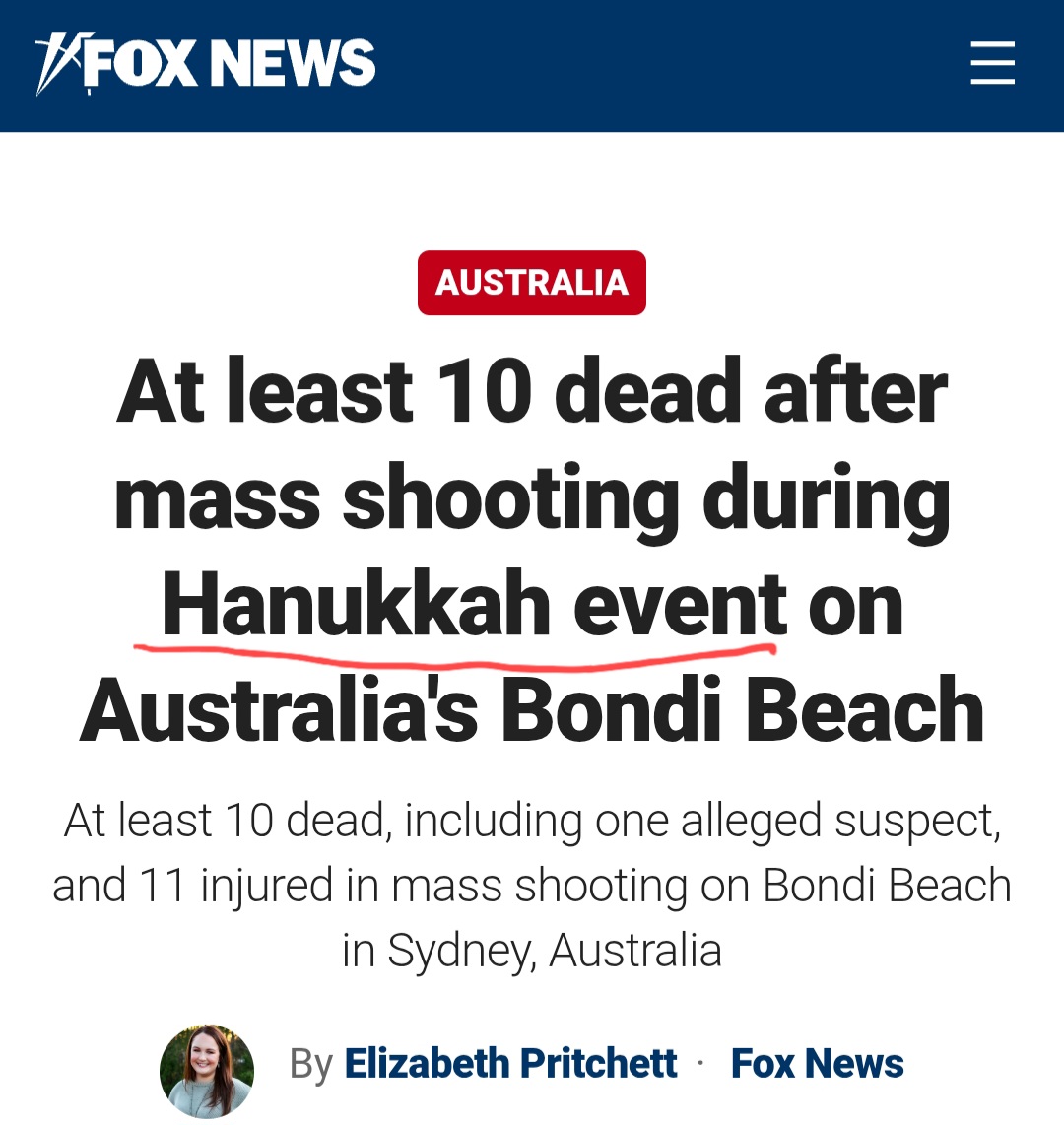
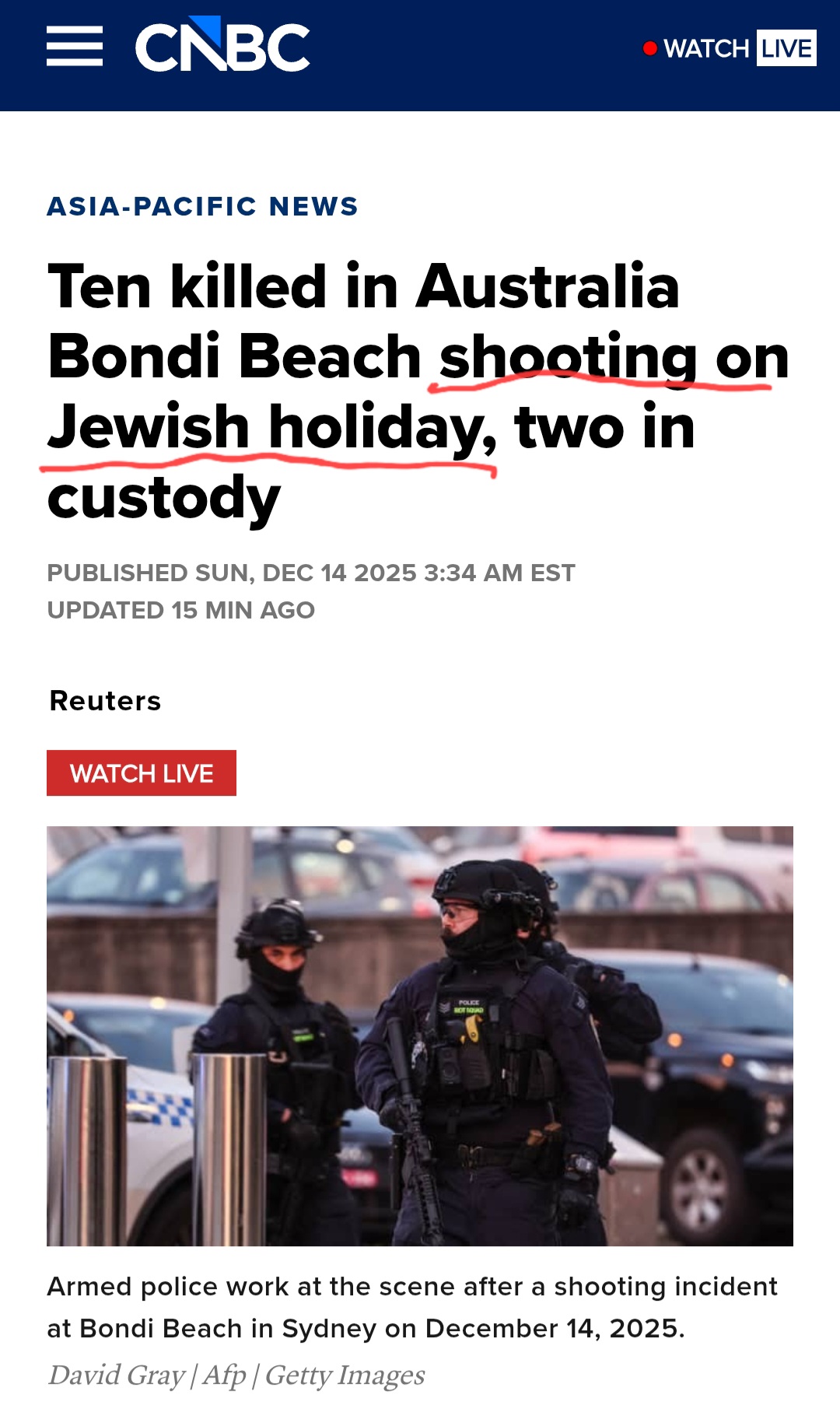
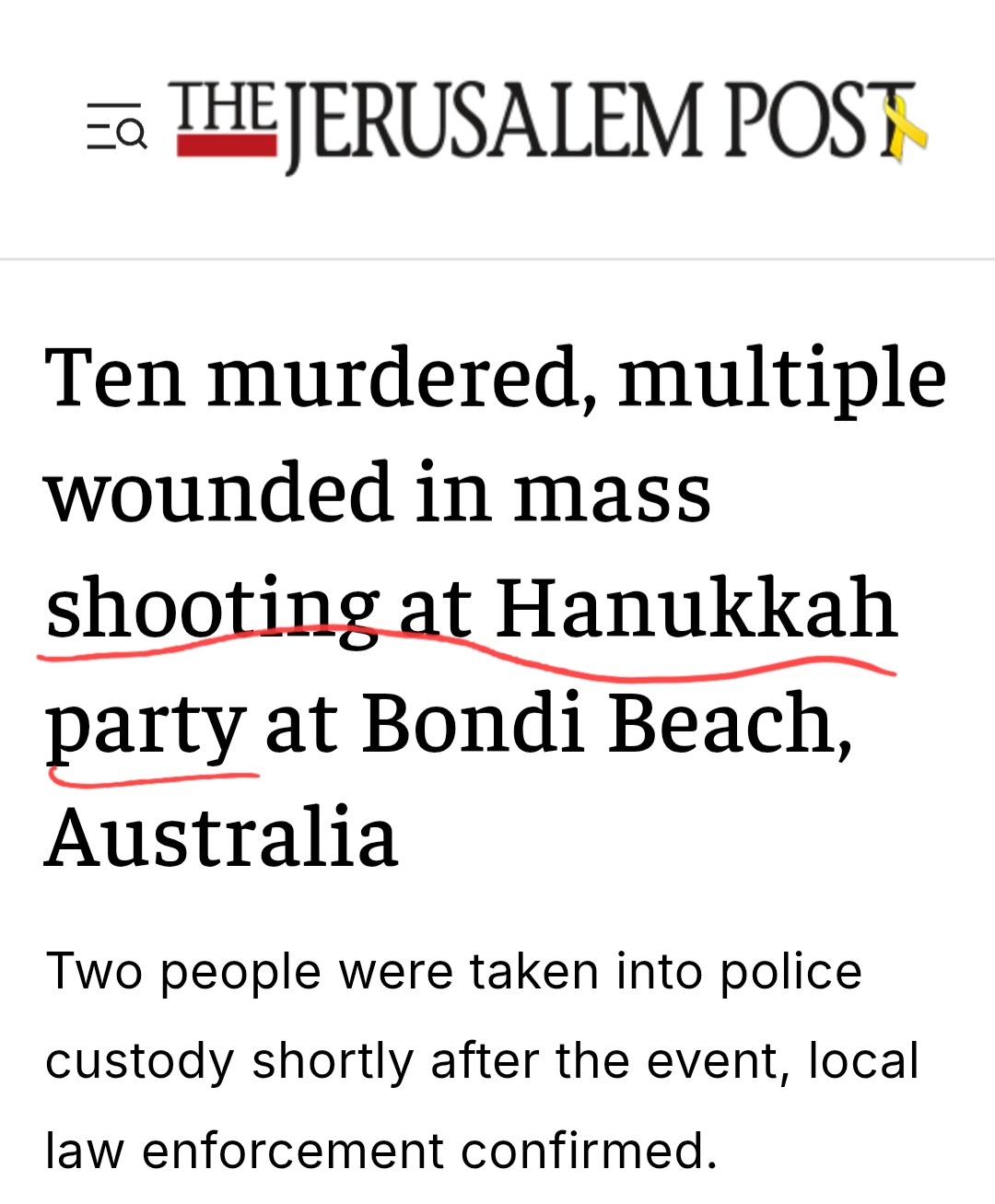
A mass shooting took place at a Hanukkah party in Sydney, Australia. A Jewish holiday. A Jewish gathering.
Yet when major global outlets reported the story, something curious happened.
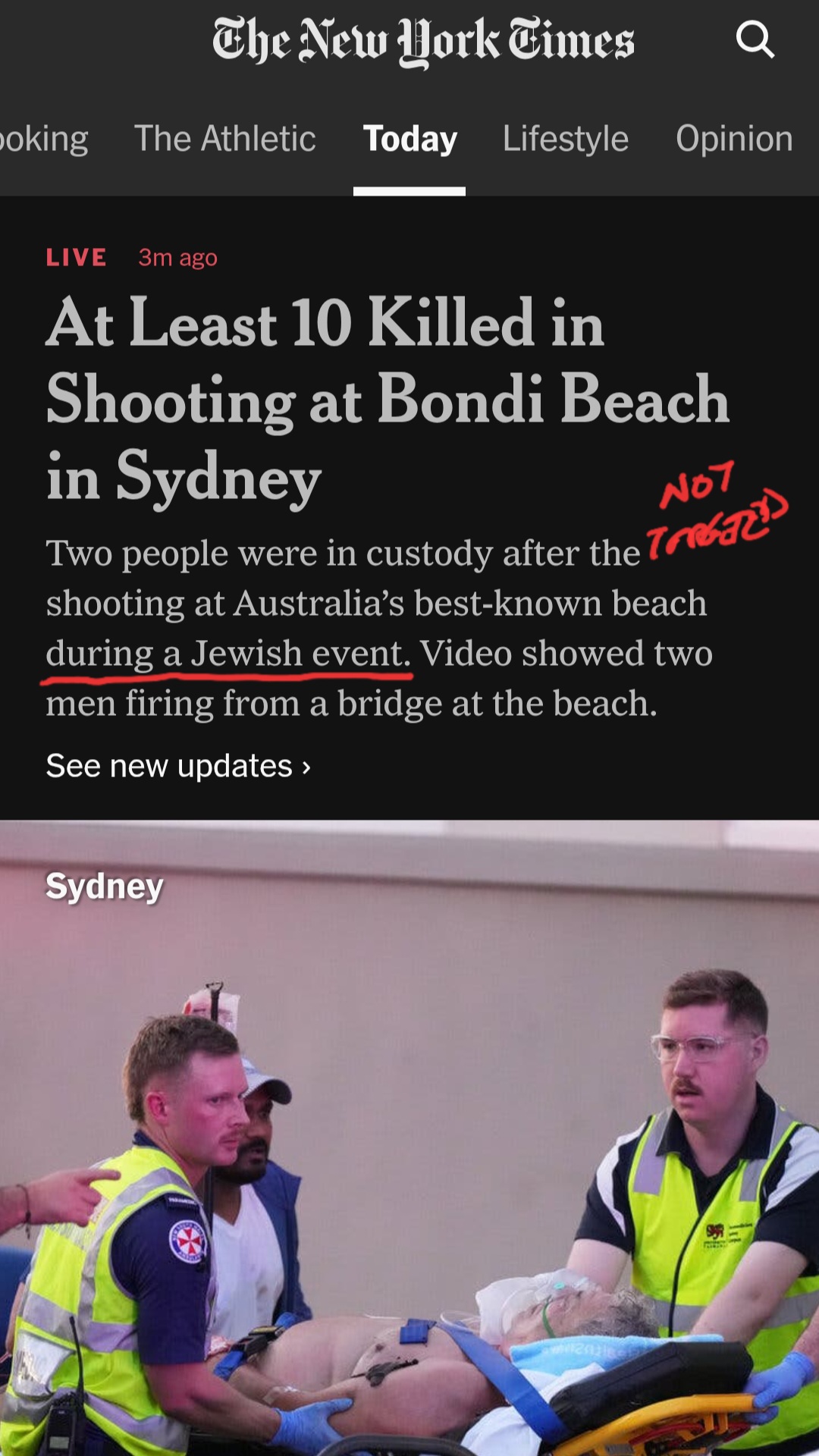
The New York Times headline did not mention Jews. Only the sub-header caught the significance of the attack, but did not say Jews were targeted.
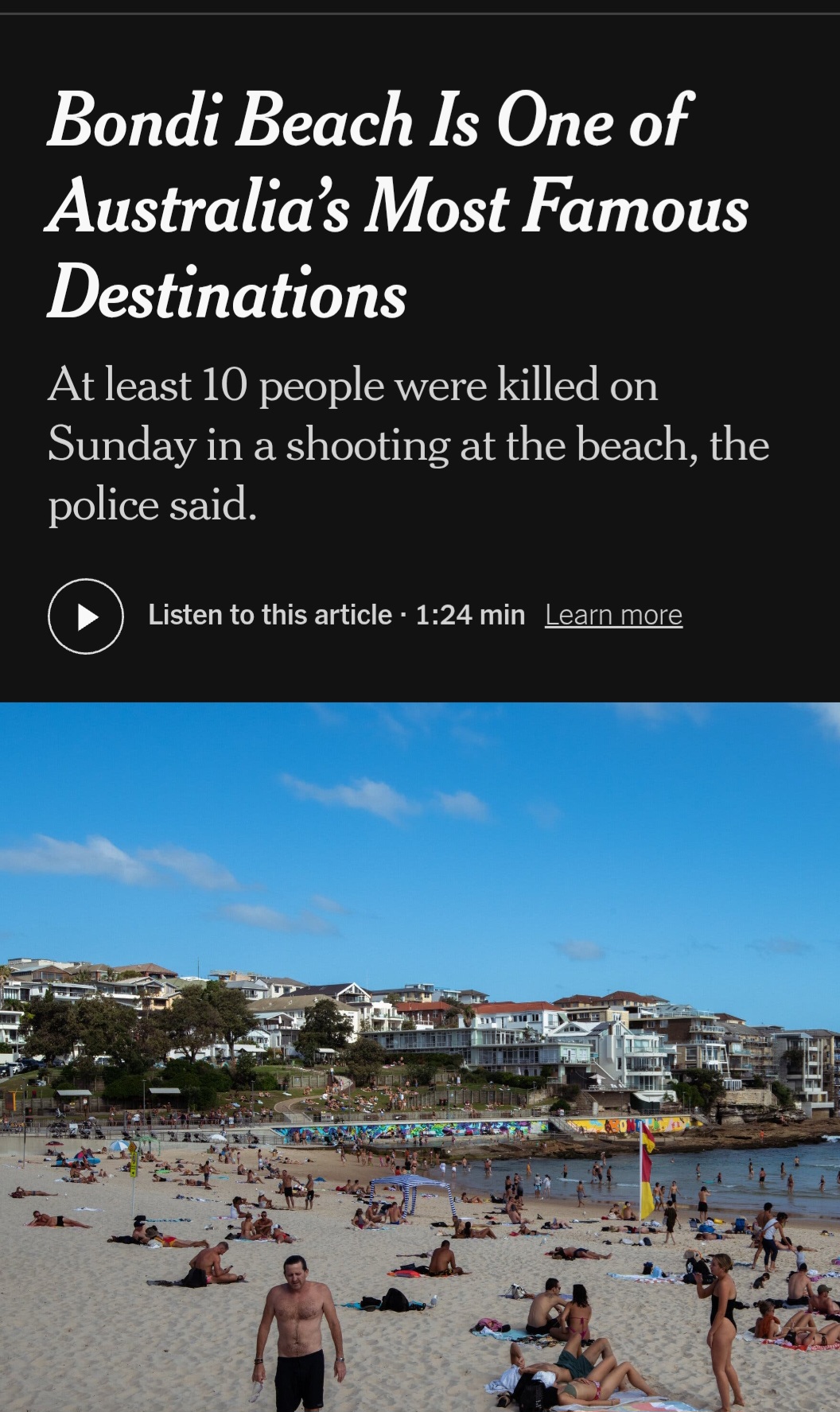
More disturbing, follow-up articles did not focus on the horrific spike in antisemitism in Australia these past two years. Instead, the Times posted an article about… Bondi Beach, and how beautiful and popular it is.
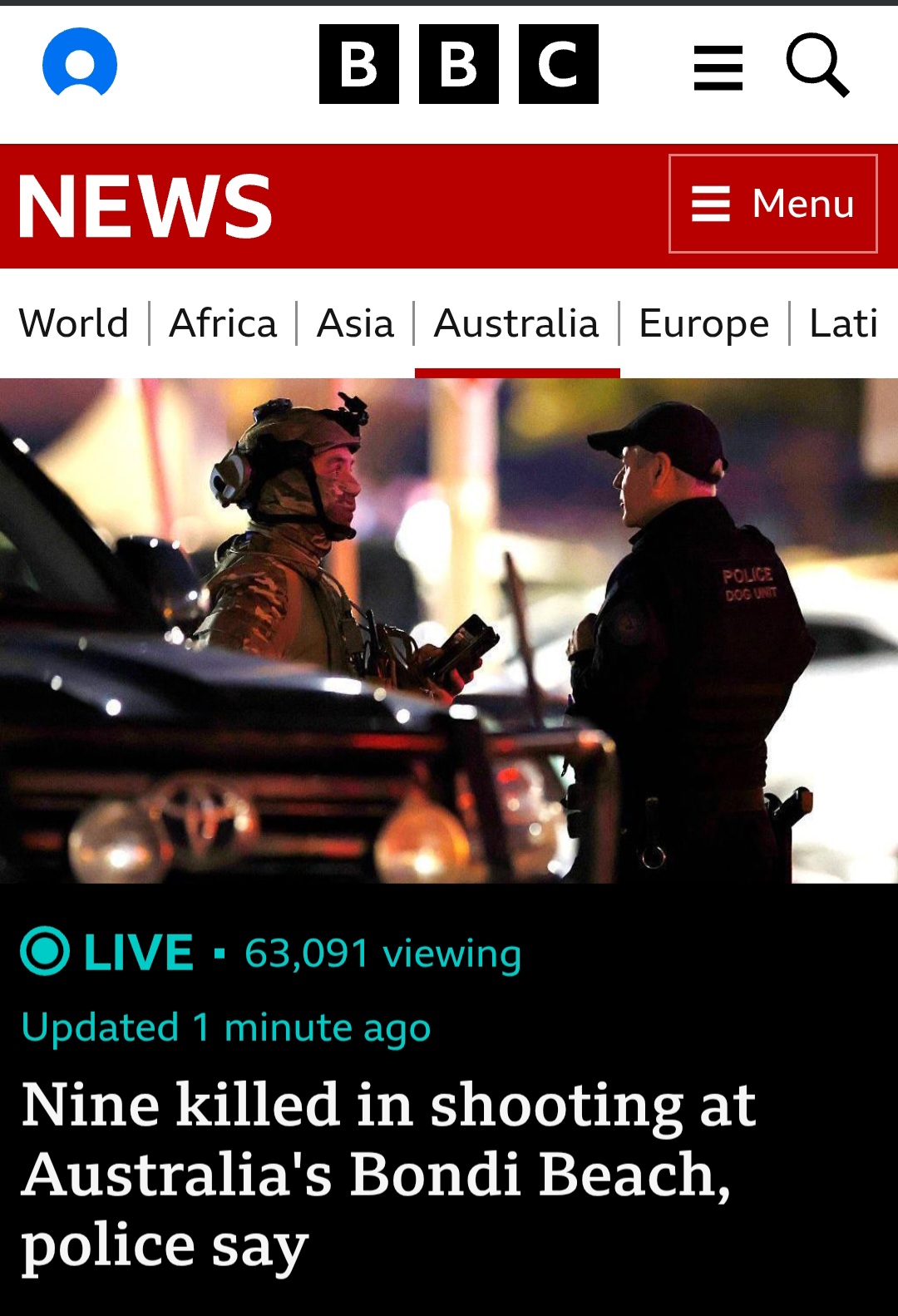
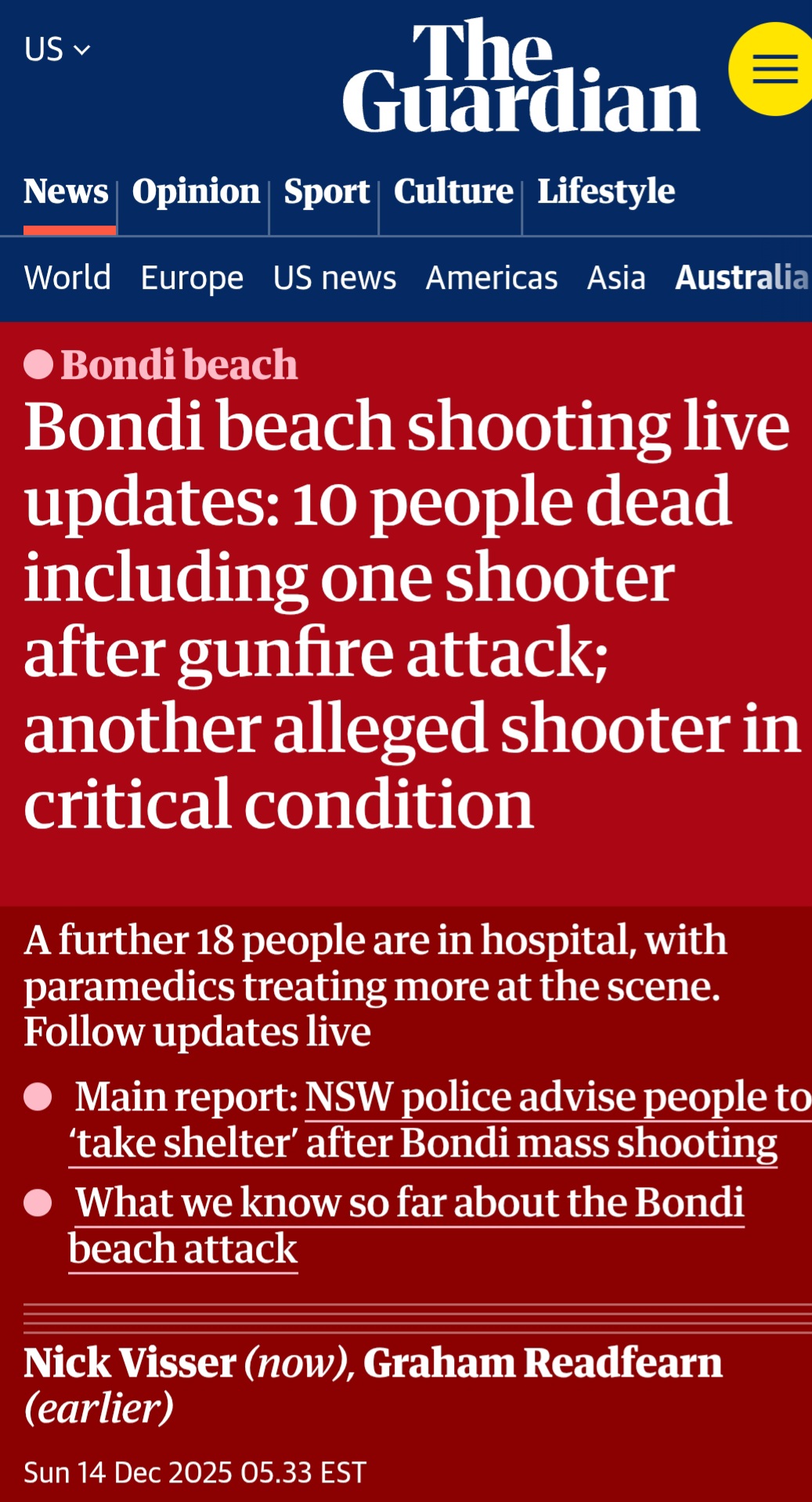
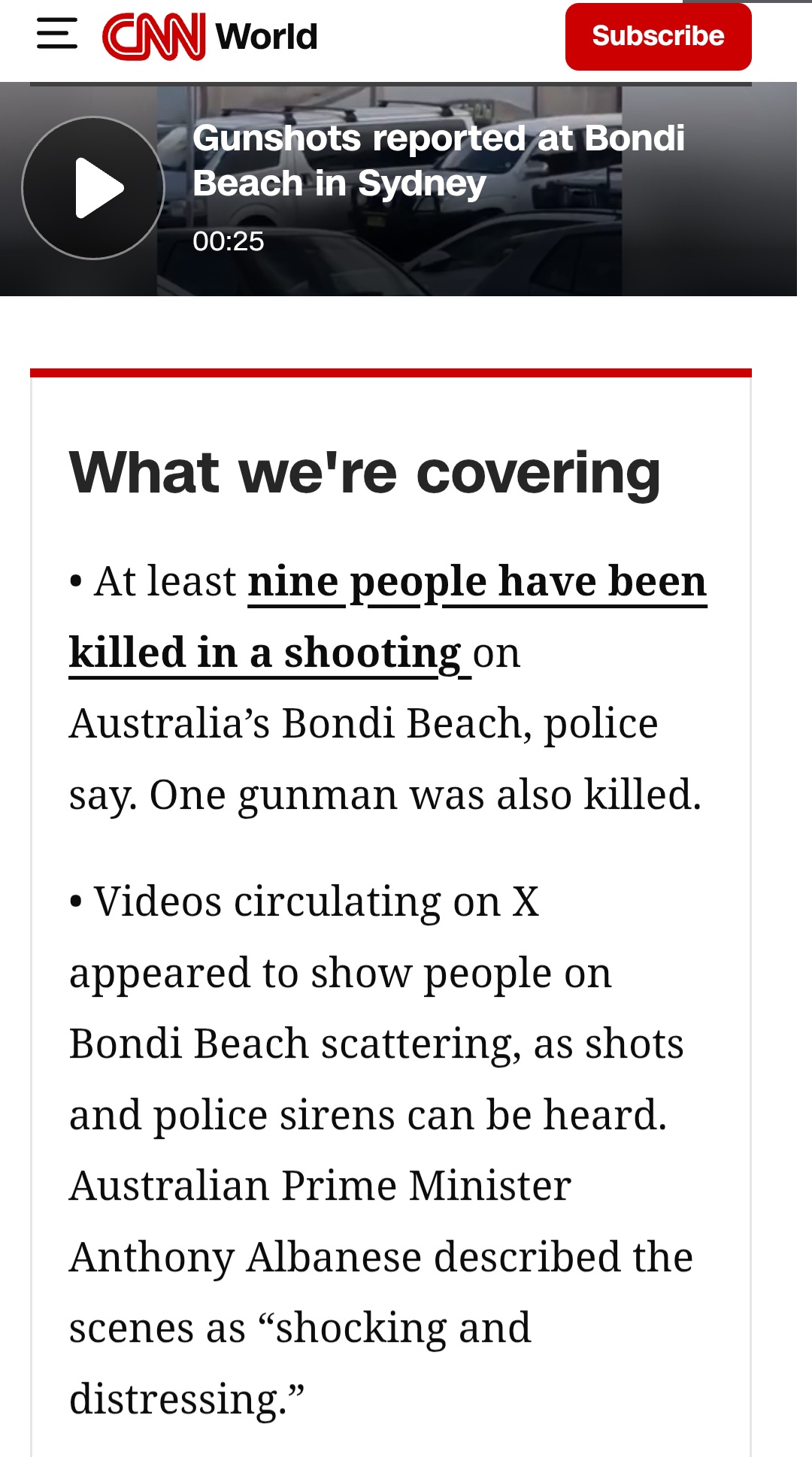
The BBC followed a similar path. So did The Guardian. So did others like CNN. The event was flattened into abstraction: a “shooting,” a “disturbance,” a “tragedy,” untethered from identity.
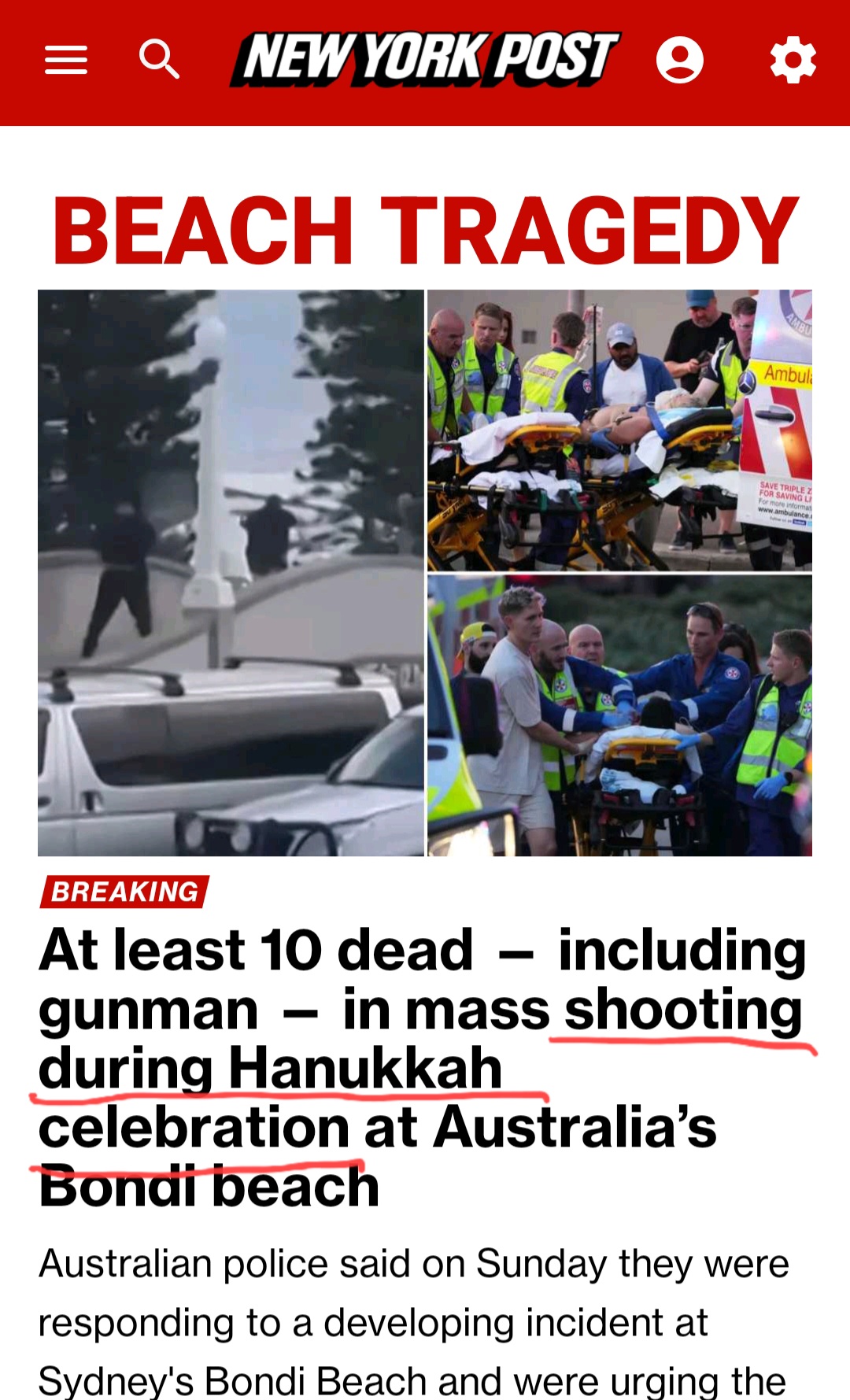
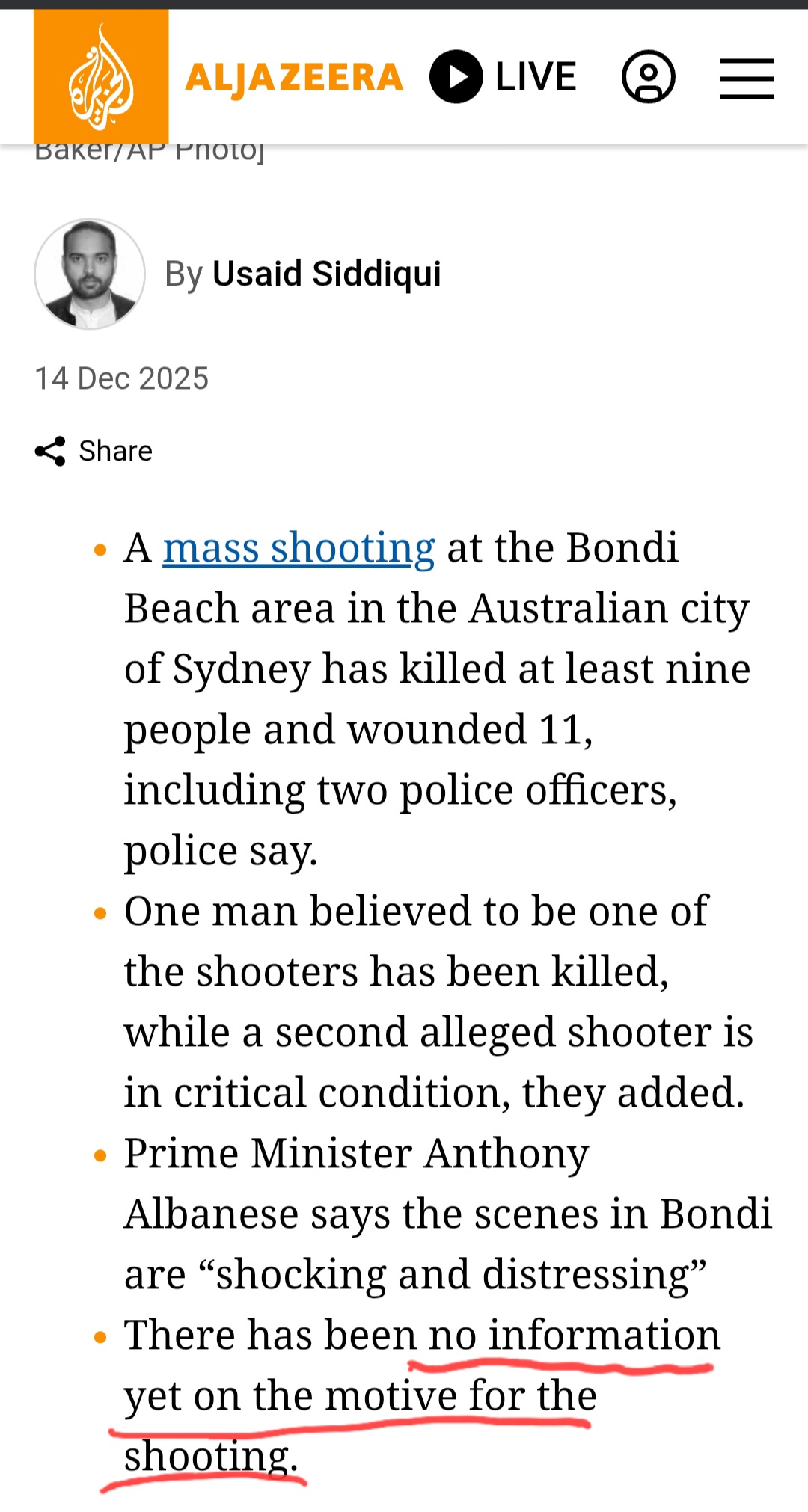
By contrast, The Telegraph named Jews. The Jerusalem Post did as well. The New York Post and CNBC, too. Al Jazeera did not. Actually, Qatari-owned Al Jazeera attempted to whitewash the entire incident that there was “no information.”
This divide is not accidental. It reflects something deeper and more uncomfortable.
Because at the same moment that major Western media hesitated to name Jewish victimhood, the global Jewish community had no such confusion. WhatsApp groups lit up within minutes. Videos circulated—not to sensationalize, but to bear witness. The injured were named, not as statistics but as people. Hebrew names were shared so strangers across continents could pray for them.
No one asked whether Jews had been targeted. They knew.
The only uncertainty discussed privately was not if the attack was antisemitic, but which strain of antisemitism it represented. Neo-Nazis? Radical Islamists? A lone actor steeped in online hate? Jews have learned, painfully, to recognize the pattern even before the authorities finish their press conference.
So why the hesitation in public framing?
Why is Jewish identity often erased precisely when Jews are attacked?
Part of the answer lies in a narrative trap the modern media has built for itself. Jews, especially Israeli Jews, are increasingly cast in a single role: power holders, enforcers, aggressors. In that framework, Jews are permitted to be actors—but not victims. Agents—but not targets. Perpetrators—but not innocents.
Victimhood, in today’s moral economy, is rationed. And Jews often find themselves disqualified from it in favor of victims of preference.
Naming Jews as victims complicates the preferred storyline. It disrupts the binary of oppressor and oppressed. It forces an uncomfortable reckoning: that a people portrayed relentlessly as powerful are still being hunted in synagogues, homes, and holiday celebrations—from Pittsburgh to Poway, from Paris to Copenhagen, from Jerusalem to Sydney.
And so the language softens. The identity disappears. The motive is delayed, blurred, or left unexplored. The story becomes about the setting, not the target. About the neighborhood, not the people. About ambience, not intent.
The question is not whether Jews are under attack. That is beyond dispute.
The question is whether the world’s most influential media institutions are willing to say so plainly—or whether Jews may only appear in headlines when they are accused, never when they are wounded.
Part of the answer to the disgraceful shrug to the barbaric October 7 massacre in Israel is the systemic brainwashing that has been going on, that Jews cannot be viewed as innocent victims. Even when they plainly are, half a world away.
















 First One Through