The Gross OVER-Staffing of UNRWA Schools

The United Nations Relief and Works Agency for Palestine Refugees in the Near East (UNRWA) has been bloating its staff and wards since 1949. Tasked with taking care of displaced Arab people from the 1948-9 Arab war against Israel’s creation, the agency has continued to provide services for children, grandchildren and great-grandchildren of the original refugees who continue to live in Lebanon, Syria, Jordan, the West Bank and Gaza.

To examine the staffing of UNRWA is to gain insight into the gross misuse of the world’s generosity.

UNRWA’s own 2017 statistics revealed the following:

 Jordan   Lebanon   Syria   West Bank   Gaza   Amman HQ   Total 
 Registered Refugees        2,175,491        463,664        543,014        809,738        1,348,536        5,340,443
 Other Registered Persons            111,152           50,131           75,114        187,435              87,080            510,912
 Total Registered Persons (RR)        2,286,643        513,795        618,128        997,173        1,435,616        5,851,355

UNRWA gives services to nearly 5.9 million people today, even though only 711,000 “refugees” existed in 1949. Of those 711,000 people, only about 25,000 real refugees are alive today.

The numbers continue to show further abuse:

 Jordan   Lebanon   Syria   West Bank   Gaza   Amman HQ   Total 
 UNRWA Staff                6,642             3,096             3,003             4,635              13,037                  386              30,799
 International Staff                      15                  15                  17                  19                      27                    85                   178
 RR / Staff                   344                166                206                215                   110                   190

As of December 31, 2017, there were close to 31,000 employees of UNRWA – more than the number of ACTUAL refugees alive today.

Further, almost all of the 31,000 employees are local Palestinian Arabs – only 178 people are “international.” UNRWA is simply a vehicle to employ local Arabs.

The most aggressive employment happens in Gaza, where there is an UNRWA Staff person for every 110 Registered Refugees (RR). That is almost twice the level in the other regions, and three times the staffing level as in Jordan.


UNRWA offices in Jerusalem
(photo: First.One.Through)

Most of the staffing is for UNRWA’s schools. As shown in the chart below, roughly 71% of the overall staffing is for the schools.

 Staff Detail   Jordan   Lebanon   Syria   West Bank   Gaza   Total 
 Educational Staff                5,090             2,082             2,193             2,671                9,910              21,946
 Pupil enrollment            121,368           36,088           46,733           48,959            262,112            515,260
 Pupil / Educational Staff                      24                  17                  21                  18                      26                      23
 Educational Staff as % Staff 77% 67% 73% 58% 76% 71%

To get an appreciation for  staffing levels of the schools, consider that UNRWA has a student-to-staff ratio of approximately 23:1. By way of comparison, the student-to-staff ratio in the schools in the United States is 32:1, according to the National Center for Education Statistics. There is a wide disparity in the ratio, ranging from 15:1 in Virginia to 136:1 in Kansas. But on average, UNRWA over-staffs its schools by roughly 40% compared to the United States.

There are various arguments against the existence of UNRWA which keeps Arabs in a perpetual state of statelessness and hopelessness (SAPs). There are additional arguments against the funding of the schools which promote antisemitism and intolerance.

It is worth taking note of the gross over-staffing of the organization as another component in assessing the funding of UNRWA.


Related First.One.Through articles:

UNRWA Is Not Just Making “Refugees,” It’s Creating Palestinians

UNRWA’s Munchausen Disease

UNRWA’s Ongoing War against Israel and Jews

Help Refugees: Shut the UNRWA, Fund the UNHCR

Delivery of the Fictional Palestinian Keys

Removing the Next Issue – The Return of 20,000 Palestinian Arabs

The UN Wants “Real Stories on REAL Refugees”

Related First.One.Through video:

Jordan’s Hypocrisy about UNRWA

The Hamas Theme Song (CSNY)

Subscribe YouTube channel: FirstOneThrough

Join Facebook group: FirstOne Through  Israel Analysis


Deciphering the 2018 Basic Law in Israel – The Nation State of the Jewish People

On July 19, 2018, Israel signed a new Basic Law called “The Nation-State of the Jewish People.” It has been called controversial by many liberal media outlets in what it purports to do with minority rights.

The notion that there is a major curtailment of Israeli Arabs’ rights is a gross exaggeration. However, what should be discussed is the novel stance whereby Israel has now assumed the responsibility for the security and the “cultural, historical and religious legacy” of Jews in the diaspora.

Below is the text of the latest Basic Law in Israel, with a review below each point.

  1. The State of Israel
    a) Israel is the historical homeland of the Jewish people in which the state of Israel was established.
    b) The state of Israel is the nation-state of the Jewish people, in which it actualizes its natural, religious, and historical right for self-determination.
    c) The actualization of the right of national self-determination in the state of Israel is unique to the Jewish people.

Review:

The comments in parts 1a and 1b are actually found in international law, in both the San Remo Conference Resolution of 1920 and the 1922 Mandate of Palestine. Specifically, international law acknowledged the historic ties of the Jewish people to the land of Israel and the goal to reconstitute such national home:

  • in favor of the establishment in Palestine of a national home for the Jewish people”
  • “recognition has thereby been given to the historical connection of the Jewish people with Palestine and to the grounds for reconstituting their national home in that country”

It’s an established fact that Jews have a long history in the land of Israel going back thousands of years. For over 100 years, Jews and the international community have been working to re-actualize the Jewish right to self-determination in that homeland. Sections 1a and 1b are seemingly innocuous and superfluous.

However, section 1c went a step further. It states that the national right of self-determination is ONLY for Jews. While the clause does not limit the INDIVIDUAL rights of non-Jews to live openly and freely in Israel, the intention of the clause is seemingly that non-Jews have no NATIONAL right of self-determination. Non-Jews in Israel have personal rights of self-determination as citizens of the state, while Jews have an added right as a people.

Why:

The State of Israel has very few Basic Laws. As such, why would the country opt to state the obvious points of 1a and 1b in a new Basic Law, and add the additional point of the uniqueness of Jewish self-determination in section 1c?

For the past several years, Palestinian Arab leaders have voiced their belief that Jews are not native to Israel and that only Palestinian Arabs are indigenous to the region. They have turned a blind eye to history and have been effective in getting various United Nations’ bodies to similarly cut off the deep historic and religious ties between Jews and their holy land. They have gotten the UN to decry that Jews are eliminating the natural and historic “Arab character” of Judaism’s holiest city and capital of Jerusalem where Jews have been a majority for over 150 years.

Further, Arabs contend that Jews are not even a people and therefore cannot have a claim of national self-determination. Jews are simply people that believe in a religion – Judaism – and are a diverse mix of cultures and nationalities from around the world, who descended on Palestine as tools of global powers to insert a foreign democracy in the heart of the Arab world. The Arabs have promoted the notion that these Israeli Jews are simply foreign interlopers, who are negating the Palestinian Arab right of self-determination. The acting-President of the Palestinian Authority Mahmoud Abbas gave a long lecture to this effect in April 2018.

If the rants of these wild fools would have been given no ear, perhaps this Basic Law would not have been drafted as is. But the mean and angry words have no longer just been echoed in the Muslim and Arab world, but are repeated in European capitals and at the United Nations. Consequently, Israel felt compelled to declare that the land of Israel has always been the homeland of the Jewish people and that the country of Israel is uniquely the nation-state of the Jewish people.

That the liberal press would be shocked at this section of the Basic Law is particularly surprising, noting how much they championed the idea of “two states for two people: one for Jews and one for Arabs,” for so many years.

  1. National symbols of the State of Israel
    a) The name of the state is Israel.
    b) The flag of the state is white, two blue stripes near the edges, and a blue Star of David in the center.
    c) The symbol of the state is the Menorah with seven branches, olive leaves on each side, and the word Israel at the bottom.
    d) The national anthem of the state is “Hatikvah”
    e) [Further] details concerning the issue of state symbols will be determined by law.

Review:

None of the items listed in section 2 is news to anyone that has ever been to Israel or knows anything about the country. These are all established facts.

Yet, it is curious that nowhere in this section is there a specific reference to Jews or Judaism. The symbols that are highlighted – Israel (Jews are known as the Children of Israel in the Bible); Star of David (King David was a leading unifying king in Jewish history); the Menorah (a symbol of religious Judaism from the Temple); the “Hatikvah” (a song of modern Jewish longing for a return to self-determination in the Jewish holy land) – are all based on Judaism and Jewish history, yet “Jews” and “Judaism” are absent in this section.

Why:

While section 1 underscored historical facts and repudiated the Arab narrative about Jews in Israel, section 2 put forward some modern manifestations of the Jewish State. As symbols, each item is simply a marker and note of Jewish pride. Each item does nothing to impact the day-to-day lives of Jew or non-Jew living in Israel.

Perhaps section 2e leaves open the idea that new state symbols might include items that are not inherently Jewish, such as a state bird.

  1. [The] unified and complete [city of] Jerusalem is the capital of Israel.

Review:

Jerusalem has always been the capital of Israel, and Israel enshrined this fact in the 1980 Basic Law about Jerusalem that was issued solely for such purpose. This section is seemingly wholly redundant.
Why:

While much of the world has not recognized Israel’s annexation of the eastern part of Jerusalem, the United Nations took additional steps against part of Israel’s capital in December 2017. UN Security Council Resolution 2334 declared that all lands that Israel won in its defensive war against Jordan in 1967 were illegally obtained, including the eastern part of Jerusalem.

It would appear that Israel opted to repeat its claim on the entirety of Jerusalem because of the recent action of the United Nations. If there were broader goals such as declaring the city as the holiest site for Jews, the statement would have been broader and discussed the holy sites in the city. Perhaps the drafters of the Law decided that they did not want to provoke the Muslim world, despite the Arabs’ constant belittling of Jewish sites and rights in Jerusalem.

  1. The Language of the State of Israel
    a) Hebrew is the language of the state.
    b) The Arabic language has a special status in the state; the regulation of the Arab language in state institutions or when facing them will be regulated by law.
    c) This clause does not change the status given to the Arabic language before the basic law was created.

Review:

Since the Mandate of Palestine of 1922, English, Arabic and Hebrew have been the official languages in Palestine (Article 22). When Israel declared itself a state in 1948, it continued to give preference to the Arabic language. This Basic law’s section 4b is seemingly a demotion of Arabic as an “official” language, but section 4c seems to ensure that there is no practical impact of such demotion, as Arabic will continue to be used in all governmental items such as monies, stamps and signage.

Why:

Section 4 can best be viewed through the same lens as section 2 – a symbolic note that has no practical impact on day-to-day life. Only the Hebrew language was called out with pride by David Ben Gurion in the country’s Declaration of Independence in May 1948. This section is seemingly another marker of the Jewishness of the State of Israel, even while it makes accommodations for people who speak Arabic.

  1. The state will be open to Jewish immigration and to the gathering of the exiled.

Review:

This statement is seemingly WEAKER than international law laid out in the Mandate of Palestine. In Article 6, that document specifically sought to “facilitate Jewish immigration under suitable conditions and shall encourage, in co-operation with the Jewish agency referred to in Article 4, close settlement by Jews on the land, including State lands and waste lands not required for public purposes.” The word “facilitate” is an active verb compared to simply being “open” to Jewish immigration.

More specifically, section 5 is completely redundant with the country’s Declaration of Independence which stated “THE STATE OF ISRAEL will be open for Jewish immigration and for the Ingathering of the Exiles.”

Why:

Once again, this Basic Law is seemingly redundant with international law and the country’s foundation document. Which might give a clue as to why the country’s lawmakers decided to issue such clauses in a rare new Basic Law.

The United Nations acted against its own international laws as it related to Jews and the Jewish homeland. The Mandate of Palestine clearly stated that no person could be excluded from living anywhere in the Mandate because of their religion (Article 15), but the British promptly separated half of the Mandate region into the Hashemite Kingdom of Jordan and allowed the country to become Jew-free. When Jordan attacked Israel in 1948 and subsequently banned all Jews from the west bank of the Jordan River, including eastern Jerusalem, and then gave citizenship only to Arabs – specifically excluding Jews – the United Nations said nothing. The UN continues to declare that the vast majority of the Mandate – Jordan, the “West Bank” and Gaza – should be Jew-free today.

Israel clearly felt the need to state in its own laws that it is going to welcome the Jewish exiles from around the world, as it has for years, and not rely on the neutered international laws from 1922, nor its own foundation document.

  1. The Diaspora
    a) The state will labor to ensure the safety of sons of the Jewish people and its citizens who are in trouble and captivity due to their Jewishness or their citizenship.
    b) The state will act to preservethe cultural, historical and religious legacy of the Jewish people among the Jewish diaspora.

Review:

Of the eleven sections in the 2018 Basic Law on The Nation State of the Jewish People, this is the only one that is truly new. It is not found in international law (1920 and 1922) nor in Israel’s Declaration of Independence (1948). It has no appearance in any of the country’s prior Basic Laws. It is extraordinary in every facet.

That a sovereign country would extend its safety net to a select group of non-citizens around the world is remarkable. It is without parallel.

The second underlying rationale of this new Basic Law becomes clear in this section. It is not only about echoing facts and laws that the world has chosen to ignore, but establishing this new one. The notion of a nation-state is a two-way street: Israel is the Jewish State, and the Jewish State is there for all Jews around the world.

This language stands against the carefully worded text of the Balfour Declaration of 1917 that specifically did not bias the Jewish communities outside of Palestine, that “nothing shall be done which may prejudice the civil and religious rights… or the rights and political status enjoyed by Jews in any other country.

While Jews are not in jeopardy of losing their “political status” as citizens of countries around the world, they now seemingly have a foreign country protecting them and their culture.

Why:

The 2014 War from Gaza unleashed waves of antisemitism around the world, particularly in Europe. Jews were attacked and killed in capital cities and small towns. It reached such a point that Israeli Prime Minister Benjamin Netanyahu went to Paris in early 2015 and asked the Jewish community whether it was time to leave France and move to Israel. It was an outrageous act, but also effective: the number of people from France making Aliya (moving to Israel) tripled after the events and Netanyahu’s visit.

Many people in France were angry at Netanyahu’s statement. The government of France appealed to its Jews that France would be considered a failure if it could not protect its Jewish population, but in fact, the Jewish community in France was broadly resentful that France was no longer a secure home for them.

Netanyahu came to Europe to state that times are different: the 1939 British White Paper which prevented Jews from fleeing the Holocaust to come to Israel was no more. Israel was a reality and ready to welcome anyone fleeing persecution as the nation-state for all Jews around the world.

It perhaps comes at a moment of security and smugness that Israel now offers its help to world Jewry, after decades of calling on world Jewry to help the nascent state. As Ben Gurion said on that fateful day in May 1948, “WE APPEAL to the Jewish people throughout the Diaspora to rally round the Jews of Eretz-Israel in the tasks of immigration and upbuilding and to stand by them in the great struggle for the realization of the age-old dream – the redemption of Israel.” Israel has now turned the table and is assuming the role of the guardian for world Jewry as opposed to the other way around.

But Jewish memory extends beyond the 1940s.

In 1917, British Jews made sure that the Balfour Declaration did not ensnare Jews outside of Palestine. However in 2018, Israel did not consult with world Jewry when it extended its sheltering tabernacle over their homes in the diaspora.

A very awkward step for a government that stated it had the interests of world Jewry in mind.


  1. The state views Jewish settlement as a national value and will labor to encourage and promote its establishment and development.

Review:

Section 7 is a repeat of international law as mentioned above in Article 6 of the Mandate of Palestine.

Why:

Settling the land has always been a priority of Zionists. It was true in the 1890s and remains true in the 21st century. The tie between the Jewish people and the Jewish holy land has been true for thousands of years, and no law that sought to connect the nation-state of Jews and Israel could possibly ignore the land of Israel. The Jewish ties to the Jewish holy land existed before the Modern State of Israel, and the government of Israel would be failing its basic mission of self-determination if it did not wholeheartedly promote the development of the land itself.

  1. The Hebrew calendar is the official calendar of the state and alongside it the secular calendar will serve as an official calendar. The usage of the Hebrew calendar and of the secular calendar will be determined by law.

Review:

Not news for anyone living in, or doing business in Israel.

Why:

As with the other items in this Basic Law, it seeks to affirm particular Jewishness of how the state operates. Like many of the sections, it does nothing to harm not-Jewish citizens, any more than some countries declaring Christmas a national holiday harms non-Christians.

  1. National Holidays
    a) Independence Day is the official holiday of the state.
    b) The Memorial Day for those who fell in the wars of Israel and the Memorial Day for the Holocaust and heroism are official memorial days of the state.

Review:

Beyond stating that the holidays and calendar of Judaism will be officially recognized in Israel’s calendar (sections 8 and 10), section 9 ascribes important moments in Israel’s history as national holidays in a typical fashion of any country, but adds a new dimension. Placing a historic event that occurred OUTSIDE of the country’s borders, which impacted a subset of its citizens is highly unusual. The Holocaust did not just have minimal impact on the non-Jews in Israel, but it had little direct impact on the majority Mizrachi Jews from countries including Iraq, Yemen, Egypt and Morocco.

But the Holocaust stands apart from the terrible persecutions suffered by Jews in Arab lands. The Holocaust was so evil and heinous, that it forced the world to create the Universal Declaration of Human Rights. Even the United Nations marks the day and encourages all member nations to remember the Nazi atrocities.

Of course the Jewish State would be one of those countries to recognize Holocaust Remembrance Day.

  1. Saturday and the Jewish Holidays are the official days of rest in the state. Those who are not Jewish have the right to honor their days of rest and their holidays. Details concerning these matters will be determined by law.

Review:

See section 8 above.

  1. This Basic Law may not be altered except by a Basic Law that gained the approval of the majority of the Knesset members.

Review:

Self explanatory.


The 2018 Basic Law is seemingly a reaction to world events since early 2014. While Israel has had to contend with an Arab world that rejects coexistence in favor of terrorism for decades, it has been the world’s more recent embrace of fake history and vile antisemitism that necessitated the Basic Law of the Nation State of the Jewish People at this time.

That the Basic Law would include language that Israel will act to protect Jews around the world, gives some insight of how Israel expects antisemitism to play out in the years ahead.


Related First.One.Through articles:

The Jewish Holy Land

The Left-Wing’s Two State Solution: 1.5 States for Arabs, 0.5 for Jews

Heritage, Property and Sovereignty in the Holy Land

A Response to Rashid Khalidi’s Distortions on the Balfour Declaration

750 Years of Continuous Jewish Jerusalem

Related First.One.Through videos:

Ethiopian Jews Come Home (Phillip Phillips)

The Anthem of Israel is JERUSALEM

Subscribe YouTube channel: FirstOneThrough

Join Facebook group: FirstOne Through Israel Analysis

The United Nations’ Select Concern for Arson in the Middle East

The fires around Israel have been burning for weeks, a direct result of the hundreds of arson attacks launched by Palestinian Arab terrorists in Gaza. And the United Nations has been silent.

Well, not exactly. The United Nations Special Coordinator for the Middle East Peace Process, Nickolay Mladenov made remarks in Gaza on July 15, 2018. In those remarks, he spoke about the situation from the Palestinian perspective. He spoke about the “humanitarian, political and security” situation of the people in Gaza, but not in Israel. The most telling indication of how Mladenov viewed the situation could perhaps be captured by this remark:

“For the last decade Palestinians in Gaza have lived through 3 conflicts. Israelis across the fence have lived with a constant threat of rocket attacks for the last decade. This cycle has to stop. It has to end.”

For the United Nations’ point person on the “Middle East Peace Process,” only the Palestinians lived through three wars, not the Israelis. The Israelis only had the “threat of rocket attacks,” not actual rocket attacks. Not abductions and infiltrations by underground tunnels. Not arson attacks through the air.

Simply threats. Not real violence.

It is not as though the UN doesn’t understand the dangers of arson. It has loudly spoken up about it – in the few cases when Israelis engaged in such attacks.

In July 2015, the UN loudly condemned Israelis. The Secretary General said at the time:

“The Secretary-General strongly condemns today’s murder of a Palestinian child in the West Bank and calls for the perpetrators of this terrorist act to be promptly brought to justice. He expresses his deepest condolences to the family of Ali Dawabsha, who were themselves severely injured in the arson attack. Continued failures to effectively address impunity for repeated acts of settler violence have led to another horrific incident involving the death of an innocent life.  This must end.”

The UN would say the same about another attack in March 2016:

“I strongly condemn today’s arson attack by suspected Jewish extremists on the home of Palestinian Ibrahim Dawabsheh in the occupied West Bank village of Duma. Mr. Dawabsheh and his wife were at home during the attack and sustained light injuries as a result of smoke inhalation. I wish them both a full and speedy recovery.”

But when it comes to Israel, the UN cannot acknowledge the HUNDREDS of arson attacks by HUNDREDS of Palestinian Arabs.

Similarly, the UN will never call out “Muslim extremists,” even while it comfortably condemns so-called “Jewish extremists,” despite passing resolutions that specifically denounce calling out extremists by their religious identity.

The UN will also not call the Palestinians’ attacks “terrorist acts” as it does for Israelis. It actually does the exact opposite. It celebrates the Palestinians. It calls the arsonists allies as it stands with the people of Gaza:

“Our allies in this are the Palestinian people in Gaza themselves. Our partners are in the Palestinian government and everybody who wants to see an end to this current escalation.”

“I assure you that the UN will not leave Gaza. We will enhance our presence here to be more effective and more efficient in providing support to the Palestinian people.”

There is ZERO concern for Israelis suffering from arson. Israel is simply a counter-party with whom the UN negotiates on behalf of the Palestinian Arabs:

“We will continue working with the Israeli authorities to improve access and movement for Gaza and to allow for more imports and exports. Without an economy, another escalation can come very quickly.”


For several decades, the United Nations has contorted itself with new and unique definitions for “refugees” just for Palestinian Arabs. It continues to turn a blind eye to the evils of Hamas which it seeks to legitimize by ushering it into a coalition government, as well as ignoring the actions of other Palestinian arsonists.

The Secretary General of the UN Antonio Guterres saidThe international community has the legal right and the moral duty to act collectively to put an end to terrorism ‘in all its forms and manifestations, committed by whomever, wherever and for whatever purposes.’” If only the UN would live up to its own values with it comes to Palestinian Arab terrorists.


Related First.One.Through articles:

The UN Must Pay to Repair the Gaza Fence

UN Comments on the Murder of Innocents: Itamar and Duma

UNRWA Is Not Just Making “Refugees,” It’s Creating Palestinians


The Time Factor in the Israeli-Arab Conflict

It is true. Time moves at a different pace for the players in the Middle East.

Looking for some proof?

  • The acting-President of the Palestinian Authority Mahmoud Abbas said in September 2016: “We ask Great Britain, as we approach 100 years since this infamous declaration, to draw the necessary lessons and to bear its historic, legal, political, material and moral responsibility for the consequences of this declaration, including an apology to the Palestinian people for the catastrophes, misery and injustice this declaration created and to act to rectify these disasters and remedy its consequences, including by the recognition of the state of Palestine.” No joke. He asked Great Britain to apologize for the Balfour Declaration from 100 years prior that sought to facilitate the emigration of Jews to their holy land.
  • A poll of Palestinians conducted in March 2018 found that only 9% of Palestinians believed that there would be peace with Israel within 100 years.

Whether 100 years into the past or 100 years into the future, the Palestinians view the situation as stagnant. They hold onto perceived injuries of 100 years ago as if they just occurred, and imagine that they will feel the same in a century as well.

Is the Arab-Israel Conflict inherently unsolvable, or is the nature of how Arabs in the Middle East consider time simply different than how Israel and western societies relate to it?

Democracy-versus-Dictatorship

Political matters typically require immediate attention, such as budgets, trade policies, military contracts and establishing treaties. Governments seek to move at the pace of life – in the present – so the protagonists act to effectuate policies under their administration and ideally witness the associated results.

That mode of thinking is actually only relevant in a democracy. A government with a finite term that must seek re-election from its citizens is vulnerable to having a short stint in office. Its “present” is fleeting. However, a dictatorship has no set term limit of being in office or caring much about the opinions of its populace. Its “present” might extend for decades.

Consider the lengths of time that Arab leaders have stayed in power in the Middle East:

  • Syria. Bashar al-Assad has been in power for 17 years and counting while he decimates his country. His father Hafez al-Assad was the leader for 29 years.
  • Jordan. King Abdullah II has been king for over 19 years. He took over from his father King Hussein who was king for 47 years.
  • Saudi Arabia. The monarchs of Saudi Arabia have all been from the same family for generations, starting with Ibn Saud in 1932.
  • Egypt. Hosni Mubarak ruled for almost 30 years until the Arab Spring swept him out. The country tried democracy electing Mohamed Morsi, but he was quickly kicked out after just a year in office.
  • Libya. Muammar Gadaffi headed the country for 42 years until he was killed.
  • Tunisia. Zine El Abidine Ben Ali ruled for 24 years until he was swept out by the Arab Spring

The list goes on, even for non-countries.

The Palestinian Authority held elections in 2005 to elect a president for a four-year term. The victor, Mahmoud Abbas, has not held elections since then and remains as the acting-President nine years after his term expired.

The leadership in the Arab world is entrenched. The only method of deposing the leaders and changing the direction of the country is often by assassination, coup or civil war, such as those raging in Syria and Yemen.

In contrast, democracies do not stay entrenched, as the citizens vote for new leaders every few years. Healthy, peaceful democracies have established term limits for the highest office. As such, the leaders in democracies are cognizant of the most precious resource – time. They know that they have a short window to take action and make their mark on society. They can stretch that time by being very mindful of their citizenry, but ultimately, the time remains short.

A dramatic contrast in the orientation of time between democracies and dictatorships.

Secular-versus-Religion

When it comes to the Middle East, religion plays a significant role in politics and government.

Many of the wars that rage in the Middle East stem from the divide within Islam between Sunni and Shiite Muslims. Iran and Iraq are predominantly Shiite, while much of the rest of the region is Sunni.

The civil war in Syria is as much about the majority Sunni Muslims fighting the Shia dictator that rules the country, as it is about a country seeking a new direction. Saudi Arabia and Iran are fighting a proxy war in Yemen about the future direction of that country, whether it will be headed by Shia or Sunni leaders.

In the Middle East, the battle between religions and sects has the added layer of the sensitivity regarding holy sites.

The region is packed with holy sites for Judaism, Christianity and Islam. The fights for control extend beyond physical land and resources, to the spiritual centers for different people.

These spiritual locations operate on a different plane. They exist beyond time.

When competing parties fight over control of holy sites, they operate in the dimension of the divine, and consequently engage in a timeless dance. The earthly connection to the Heavens is eternally rooted in a handful of discrete locations, and it is impossible to “walk away” from those anchors. To do so would be akin to being a traitor and apostate. Relinquishing a holy site to a another sect – or even worse, a different religion – would forever tarnish a person’s reputation and that of his entire family. It would be seen as the ultimate failure, an embarrassment.

Conversely, a person could achieve eternal honor by becoming a ‘shahid,’ a martyr in Arabic, by fighting to the death to protect and/or seize a religious site.

The risk-reward mathematics drives a bloody calculation. On one side, there is a consideration of compromise and relinquishing some control over holy land to enable a better day-to-day life for one’s people, but forever be viewed as a traitor to one’s religion. On the other, is the fight for a holy cause that may not yield any benefits for one’s community, but ensures a revered space within one’s society. Is a better job for a few years a worthy trade-off to an eternity with 72 virgins? (Out of curiosity, do they stay virgins for eternity, meaning there is never any sex?)

Israel and Palestinians

Within the Islamic world stretching from Morocco to Indonesia, lies the only Jewish State, Israel.

Israel is more than a little unique in the Middle East. As the sole true democracy, its leadership changes often according to the desire of the Israeli citizens. The prime minister and parliament (Knesset) may be right-of-center at one time, and left-of-center shortly thereafter.

The current Israeli Prime Minister is Benjamin Netanyahu who has won several elections, and may set a record for the longest serving leader of the country, perhaps passing David Ben Gurion if he stays in power until July 16, 2019. The democracy has not instituted term limits as it is still in a state of war with many of its neighbors.

The acting-President of the Palestinian Authority Mahmoud Abbas has been in power since 2005, not by winning several elections, but by not conducting any. If he had, he would have been thrown from office many years ago by a population that considers him to be both corrupt and ineffective at governing (he’s great at stealing).

Even without a country, Abbas is a dictator, holding onto power without the blessing of his constituents. He stands above his people and above the law as he tries to grasp at the penumbra on the holy land. He imagines himself a timeless champion fighting on behalf of nearly 2 billion Muslims worldwide against the “Zionist Invasion.”

From his vantage point, Abbas can look back in time 100 years as though he were talking to someone in the back seat of a car. The Balfour Declaration of 100 years ago is still yapping, and the Jews keep piling on and will seemingly overload the car over the next 100 years. Time only changes the number of Jews in the car, but will not change his attitude towards Jews regarding their rights to sit in the car, let alone take the wheel.

For their part, the Israelis have made many offers for peace both with Palestinian Arabs as well as Egypt and Jordan over the years. Leaders like Ehud Barak and Ehud Omert knew that they had short windows in office to make a better more peaceful future for their citizens. They attempted different approaches towards compromise with the PA, only to be shut down each time. Real compromises, even in the very small Jewish Holy Land, which received no responses.

Dictators like Abbas have a different calculus, especially since he will be second-guessed by dozens of other dictators that have an interest in Muslim holy sites in Israel. The attitude and approach cannot be moderated by time. The Palestinian Arabs feel the same way:

Time is irrelevant. Feelings trump facts and frustrate a pathway to peace. But it doesn’t matter. Peace is not the goal. Control of the land and the holy sites are paramount. Issues like the economy, security, healthcare and rights always rank at the bottom of every Palestinian poll.

The unaccomplished former US Secretary of State John Kerry understood the Arab world’s perception of time. Kerry suggested in January 2018 that the Palestinians “hold on and be strong,” and “play for time, that he [Abbas] will not break and will not yield to President [Donald] Trump’s demands.” Hey, Abbas! You are a dictator and Israel and the United States are democracies. You can wait it out. Screw today. Stick it out and wait for a better payday.

Play for time. Only democracies have a shot clock.


The Western World views time very differently than the Arab Middle East. As secular democracies, the West seeks to enjoy and improve life in the here-and-now, while the Arab Middle East is a world of religious dictatorships where time is not a critical factor. Any negotiations between parties that view time so differently must be mindful in considering short-term and long-term situations and goals, and adjust. Specifically, a democracy must adapt to either be willing to wait forever and show no rush towards concluding a deal (adopt the Arab approach), or demonstrate that time is an enemy to the dictatorship (force the Arabs to play with a shot clock too).

Israel has slowly learned the lesson. Will the rest of the West?


Related First.One.Through articles:

Failing Negotiation 101: The United States

Failing Negotiation 102: Europe

The Israeli Peace Process versus the Palestinian Divorce Proceedings

Delivery of the Fictional Palestinian Keys

Nikki Haley Channels Robert Aumann at the UN Security Council

The Parameters of Palestinian Dignity

Would You Rather Have Sovereignty or Control

The Proud Fathers of Palestinian Terrorists

Subscribe YouTube channel: FirstOneThrough

Join Facebook group: FirstOne Through Israel Analysis

Ending Apartheid in Jerusalem

Expulsion. Exclusion. Discrimination.

These are terrible actions, especially against civilians seeking to live and pray in their holiest city.

But they have been the reality in one of the great cities of the world – Jerusalem.

When the League of Nations (forerunner to the United Nations) sought to create space for Jews and Arabs in the Holy Land in 1922, it made clear that all parties should be free to live and worship according to their custom, as laid out in Article 15:

“The Mandatory shall see that complete freedom of conscience and the free exercise of all forms of worship, subject only to the maintenance of public order and morals, are ensured to all. No discrimination of any kind shall be made between the inhabitants of Palestine on the ground of race, religion or language. No person shall be excluded from Palestine on the sole ground of his religious belief.”

The United Nations tried to ensure that there would be freedom of access and worship when it took up the cause of Palestine in 1947. The UN planned on placing the cities of Jerusalem and Bethlehem into a “corpus separatum,” an international holy basin that would neither be part of a Jewish State of Israel, nor an Arab state of Palestine. While the Jewish Zionists accepted the plan, the Arabs rejected it and went to war to destroy Israel as soon as it declared itself an independent country in May 1948. By the war’s end in 1949, Jordan claimed all of Bethlehem and the eastern half of Jerusalem including Judaism’s holiest site, while Israel took the western half of Jerusalem.


The UN’s Corpus Separatum of Greater Jerusalem and Greater Bethlehem

The Israelis gave citizenship to all 160,000 non-Jews in Israel, but the Jordanians instituted an ethnic cleansing of all Jews from the west bank of the Jordan River through eastern Jerusalem.

In April 1950, the Jordanians annexed the Old City of Jerusalem, Bethlehem and the entirety in of the western bank of the Jordan River in a move that was not recognized by almost the entire world. The Arabs put up barbed wire and blockades and prevented any Jews from entering or visiting the Old City of Jerusalem including the holy sites of the Kotel, the Western Wall, and the Jewish Temple Mount.

In 1954, the Jordanians continued their discriminatory program and granted citizenship to the people of the west bank and eastern Jerusalem, specifically IF THEY WERE NOT JEWISH.

These Arab policies of expulsion, exclusion and discrimination would remain in effect until June 10, 1967.

Just as the Jordanians launched an attack on Israel in 1948, it would do so again in June 1967. And just as Israel won more land in its defensive battle of independence in 1948-9, it would take more of the land that had been allocated as a Jewish homeland in international law in 1922.

At the end of the Six Day War the Arab edicts of expulsion and exclusion were eradicated, and Jews once again moved into their holiest city, rebuilt the destroyed synagogues and resumed praying at the Kotel.

However, the stain of discrimination still exists in Jerusalem, as the government of Israel handed administrative control of the Jewish Temple Mount to the Jordanian Waqf in 1967 in an effort to forge peace. To this day, the Waqf continues to prohibit Jews from praying at Judaims’ holiest location.

While June 10, 1967 began the process of dismantling apartheid in Jerusalem, there is still some way to go.


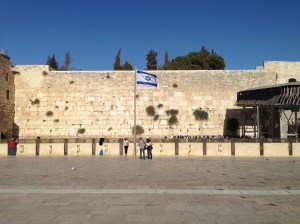
The Kotel in the Old City of Jerusalem
(photo: First.One.Through)


Related First.One.Through articles:

The Original Nakba: The Division of “TransJordan”

The Three Camps of Ethnic Cleansing in the BDS Movement

The Many Lies of Jimmy Carter

Dignity for Israel: Jewish Prayer on the Temple Mount

Visitor Rights on the Temple Mount

Joint Prayer: The Cave of the Patriarchs and the Temple Mount

The United Nations and Holy Sites in the Holy Land

750 Years of Continuous Jewish Jerusalem

Subscribe YouTube channel: FirstOneThrough

Join Facebook group: FirstOne Through Israel Analysis


The New York Times Whitewashes Motivation of Palestinian Assassin of Robert Kennedy

The New York Times published an article on June 5, 2018 about the 50th anniversary of the assassination of Robert F. Kennedy. Regarding his murderer, the Times wrote the following:

“Sirhan Bishara Sirhan, said to be motivated by Israel’s treatment of the Palestinians and his hatred of Mr. Kennedy for his support of Israel, was later convicted of the murder.”

Page A10 of the June 5, 2018 New York Times

According to the NY Times, the root cause for the killing was Israel’s treatment of the Palestinians. A country’s mistreatment of individuals. Might against right (presumably). America lost a young promising politician because Israel abuses Arabs.

This is the narrative that the Times uses today to describe the anger of Palestinian Arabs and left wing radicals against the Jewish State.

And it stands in sharp contrast to the unvarnished truth that the Palestinian Arabs have stood against the “invasion” of Jews into the region from the time of the Balfour Declaration 100 years ago until today. Sirhan Sirhan was against the presence of Jews and the existence of Israel; he was not “motivated by Israel’s treatment of the Palestinians.” It was Jew-hatred and anyone supporting the Jewish State.

To illustrate the point, here are some quotes from the Palestinian Arabs themselves in the 1960’s:

From the 1968 Palestinian National Charter:

“It is a national duty to bring up individual Palestinians in an Arab revolutionary manner. All means of information and education must be adopted in order to acquaint the Palestinian with his country in the most profound manner, both spiritual and material, that is possible. He must be prepared for the armed struggle and ready to sacrifice his wealth and his life in order to win back his homeland and bring about its liberation.”

“Armed struggle is the only way to liberate Palestine. This it is the overall strategy, not merely a tactical phase. The Palestinian Arab people assert their absolute determination and firm resolution to continue their armed struggle and to work for an armed popular revolution for the liberation of their country and their return to it .”

“Commando action constitutes the nucleus of the Palestinian popular liberation war. “

“The liberation of Palestine, from an Arab viewpoint, is a national (qawmi) duty and it attempts to repel the Zionist and imperialist aggression against the Arab homeland, and aims at the elimination of Zionism in Palestine.

The partition of Palestine in 1947 and the establishment of the state of Israel are entirely illegal, regardless of the passage of time,”

The Balfour Declaration, the Mandate for Palestine, and everything that has been based upon them, are deemed null and void. Claims of historical or religious ties of Jews with Palestine are incompatible with the facts of history and the true conception of what constitutes statehood.”

Zionism is a political movement organically associated with international imperialism and antagonistic to all action for liberation and to progressive movements in the world. It is racist and fanatic in its nature, aggressive, expansionist, and colonial in its aims, and fascist in its methods. Israel is the instrument of the Zionist movement, and geographical base for world imperialism placed strategically in the midst of the Arab homeland to combat the hopes of the Arab nation for liberation, unity, and progress.”

“The demand of security and peace, as well as the demand of right and justice, require all states to consider Zionism an illegitimate movement, to outlaw its existence, and to ban its operations,”

This updated 1968 Charter was changed from the original 1964 charter which had many of the same comments. An interesting modification between the two charters is in Article 7, trying to reconcile what to do with Jews that had lived in Palestine for generations.

  • 1964 charter: “Jews of Palestinian origin are considered Palestinians if they are willing to live peacefully and loyally in Palestine.”
  • 1968 charter: “The Jews who had normally resided in Palestine until the beginning of the Zionist invasion will be considered Palestinians.”

By 1968, the concept of “living peacefully” with Jews was abandoned.

Beyond the Palestinians, the Egyptian President Gamal Abdel Nasser sought to unite the Arab world, including the Palestinian Arabs. His May 1967 speech before the start of the 1967 War against Israel spelled out his desire to end Israel and combat its supporters including the United States and Great Britain:

“Preparations have already been made. We are now ready to confront Israel. … It is the aggression which took place in Palestine in 1948 [the establishment of the State of Israel] with the collaboration of Britain and the United States. It is the expulsion of the Arabs from Palestine, the usurpation of their rights, and the plunder of their property. It is the disavowal of all the UN resolutions in favour of the Palestinian people. … If the United States and Britain are partial to Israel, we must say that our enemy is not only Israel but also the United States and Britain and treat them as such.”

And after the June 1967 war in which the Arabs not only failed to destroy Israel but lost additional territory, the Arab states passed the Khartoum Resolution on September 1, 1967 stating:

“no peace with Israel, no recognition of Israel, no negotiations with it, and insistence on the rights of the Palestinian people in their own country.

The conference of Arab Ministers of Finance, Economy and Oil recommended that suspension of oil pumping be used as a weapon in the battle [against western countries].”

The Arab war against Israel’s supporters – including Robert Kennedy – was about the reestablishment of the Jewish people in their homeland, nothing less.

With such a boldface lie, should we wonder why the Times did not state clearly that Sirhan Sirhan was himself a Palestinian Arab? Is the Times perhaps promoting the idea that many non-Arabs are also upset with Israel’s treatment of Palestinians and might take similar actions against politicians supporting Israel?


Let’s be clear, especially since The New York Times is lying directly and explicitly to its readers: Sirhan Sirhan killed Robert Kennedy because he hated the existence of Israel and all of the country’s supporters, not because of Israel’s treatment of Palestinian Arabs. And it’s the same story about anti-Zionists today.


Related First.One.Through articles:

New York Times Lies about the Gentleness of Zionism

The Cancer in the Arab-Israeli Conflict

The “Diplomatic Settler”

The New York Times Inverts the History of Jerusalem

Subscribe YouTube channel: FirstOneThrough

Join Facebook group: FirstOne Through Israel Analysis

The UN Must Pay to Repair the Gaza Fence

The United Nations has long encouraged a deeply flawed directive which stands against global international law, that descendants of Palestinian Arabs who left homes in 1948 have a right to move back to such houses inside Israel.

In addition to that particular Palestinian-only ruling, the UN created a unique definition for a “refugee” as it relates to Palestinian Arabs, coupled with a unique refugee agency, UNRWA, distinct from the global refugee agency. These convoluted UN initiatives have encouraged the Palestinian Arabs to view the borders of Israel as permeable, as mere temporary and arbitrary lines with no meaning. The UN has educated generations of these Stateless Arabs from Palestine (SAPs) that with the help of the United Nations, they will all move into Israel.


Key on top of UNRWA camp in Bethlehem,
encouraging the “Right of Return” for Palestinian Arabs

Together with the incitement of their leaders from the terrorist group Hamas, Gazans have taken the next small step to view the border fence with Israel as not just irrelevant, but completely illegitimate.

It is therefore no surprise that Gazans attacked the border fence with Israel in their “Great March of Return” during the spring of 2018. The Palestinian Arabs have been given tacit approval of such actions for decades by the United Nations.

It is therefore highly appropriate that the United Nations take active steps to correct the violation of Israel’s sovereignty which the UN itself implicitly inspired.

The UN must contribute funds to Israel’s repair of its border fence with Gaza. It must make clear to the people of Gaza and around the world that Israel’s borders are inviolable and no threat to the country will be tolerated.

Unless it really believes otherwise.


Related First.One.Through articles:

Delivery of the Fictional Palestinian Keys

The “Great Myth of Return”

Removing the Next Issue – The Return of 20,000 Palestinian Arabs

Stabbing the Palestinian “Right of Return”

UNRWA Is Not Just Making “Refugees,” It’s Creating Palestinians

UNRWA’s Ongoing War against Israel and Jews

Help Refugees: Shut the UNRWA, Fund the UNHCR

Subscribe YouTube channel: FirstOneThrough

Join Facebook group: FirstOne Through Israel Analysis

Thomas Friedman is a Peddler of Racist Fiction and Adolescent Fantasy

Thomas Friedman, the three-time Pulitzer Prize winner for Middle East reporting seems to never be shy at demonstrating his complete ignorance, his willful naivete, and racist views on the region.
Friedman wrote an op-ed on May 22, 2018 that he “appreciate[s] the Gazans’ sense of injustice. Why should they pay with their ancestral homes for Jewish refugees who lost theirs in Germany or Iraq?” I am perhaps slightly glad he laid out that the basis for his sympathies was on a completely flawed view of reality.

Complete Ignorance

The international community made a declaration that the Jewish state should be reestablished in the Jewish holy land decades before the Holocaust. The San Remo Conference in 1920 and the Mandate of Palestine of 1922 made it clear in international law that the Jews had a long history throughout the holy land, not just in the western part of the holy land.
More specifically, to correct Freidman:
1. Jews came back to reestablish themselves in their holy land. They did not come as interlopers into someone else’s homes.
2. The movement of Jews to Palestine was established in international law. This was not a Jewish invasion or act of Britain alone.
3. The international laws were passed decades before World War II and the Holocaust. Israel was not created as a reaction to the Holocaust.
4. Jews did not seek to evict Arabs. It was the Arabs that went to war with the Jews to keep them from moving back into their Jewish holy land. The state of Israel welcomed all Arabs to become citizens of the state and help in its development. The 160,000 that stayed (18% of the population in 1948) have grown to 25% of the population in 2017. The Arabs that left in 1948 went to war to destroy Israel and continue to threaten it generations later.

5. The Jews that left homes in Germany and Iraq were hunted and persecuted by their governments. The Arabs that left homes in Israel were those that opted to launch a civil war to destroy a new country at its rebirth.

6. More Arabs than Jews moved to Palestine under the British between 1924 and 1948. Why deceptively call out Arabs’ “ancestral homes?” Because the New York Times wants to constantly pretend that Jews are not native to Israel, only Arabs are?

Friedman inverted plain facts. He proclaimed his sympathies with the Palestinians on the basis of lies.
Further, his prescription for a solution was packed with both falsehoods and racist ideas.

Willful Naivete

7. Hamas is not just “the Palestinian Islamist organization that rules the Gaza Strip.” It is recognized as a terrorist group by the US, Israel and many countries. And it was voted into a majority of parliament by Palestinians with full knowledge of these facts including having the most anti-Semitic charter in the world.

8. To state that Mahmoud Abbas and the Palestinian Authority is “secular, more moderate” than Hamas is to compare the fifth and ninth rings of Hell. Abbas is way more radical and extreme than Israeli Prime Minister Benjamin Netanyahu (who Friedman paints as being just like Hamas). Abbas is a Holocaust denier, denies the history of Jews in the holy land, calls for a country to be Jew-free, has laws that call for the death sentence for any Arab selling land to a Jew, pays for people to kill Israeli Jews, and names tournaments and squares after terrorists. How does this man and the PA remotely resemble anything moderate?

Racist Views

Friedman added to his fiction with jaundiced views about Jews and Arabs.

9. Why is Gaza Israel’s responsibility? Israel left the region in 2005 for the local Palestinian Arabs to rule themselves (for the first time in their history). Is the US responsible for Mexico’s welfare? Why isn’t Egypt called upon to handle the derelict region at its border? Does Friedman believe that Jews are uniquely responsible for neighbors?

10. “Two states for two people” as Friedman suggests means either that Jews can become a minority in Palestine the same way that Arabs are a minority in Israel, or it means that each country must be “pure.” Is Friedman suggesting that Israel expel its 2 million Arabs or is he suggesting 1.5 states for Arabs and 0.5 for Jews because Jews should be banned from the eastern part of the holy land, but not the Arabs in Israel? Either way, it sounds pretty racist to either expel non-Jews or ban Jews.

Fantasy

Friedman has not internalized that the Palestinians are no closer to welcoming their Jewish neighbors today than they were 100 years ago. He posits that the most antisemitic people should approach the border “with an olive branch in one hand and a sign in Hebrew and Arabic in the other, saying, “Two states for two peoples: We, the Palestinian people of Gaza, want to sign a peace treaty with the Jewish people — a two-state solution based on the 1967 borders, with mutually agreed adjustments.” What a moron.
Maybe the US special forces should have shown up at Osama bin Laden’s house with girl scout cookies and asked him nicely to stop killing thousands of people. Maybe he could propose that the Bashar al-Assad, the president of Syria should drop cotton candy on his people rather than chemical weapons. Friedman’s recommendations could have been written by a second grader with no comprehension of the world.

But Friedman knows the facts. He deliberately lifted from the deceased former leader of the PLO Yasser Arafat’s (fungus be upon him) 1974 speech at the United Nations: “I come to you bearing an olive branch in one hand and a freedom fighter’s gun in the other. Do not let the olive branch fall from my hand.” Friedman chose to ignore the plain and consistent fact that the Palestinians have chosen violence over coexistence with the Jewish State as he put forward a non-solution that fails to address the situation.

Perhaps Friedman’s fourth Pulitzer will be for young adult fiction.

Related First.One.Through articles:

Maybe Truman Should Not Have Recognized Israel

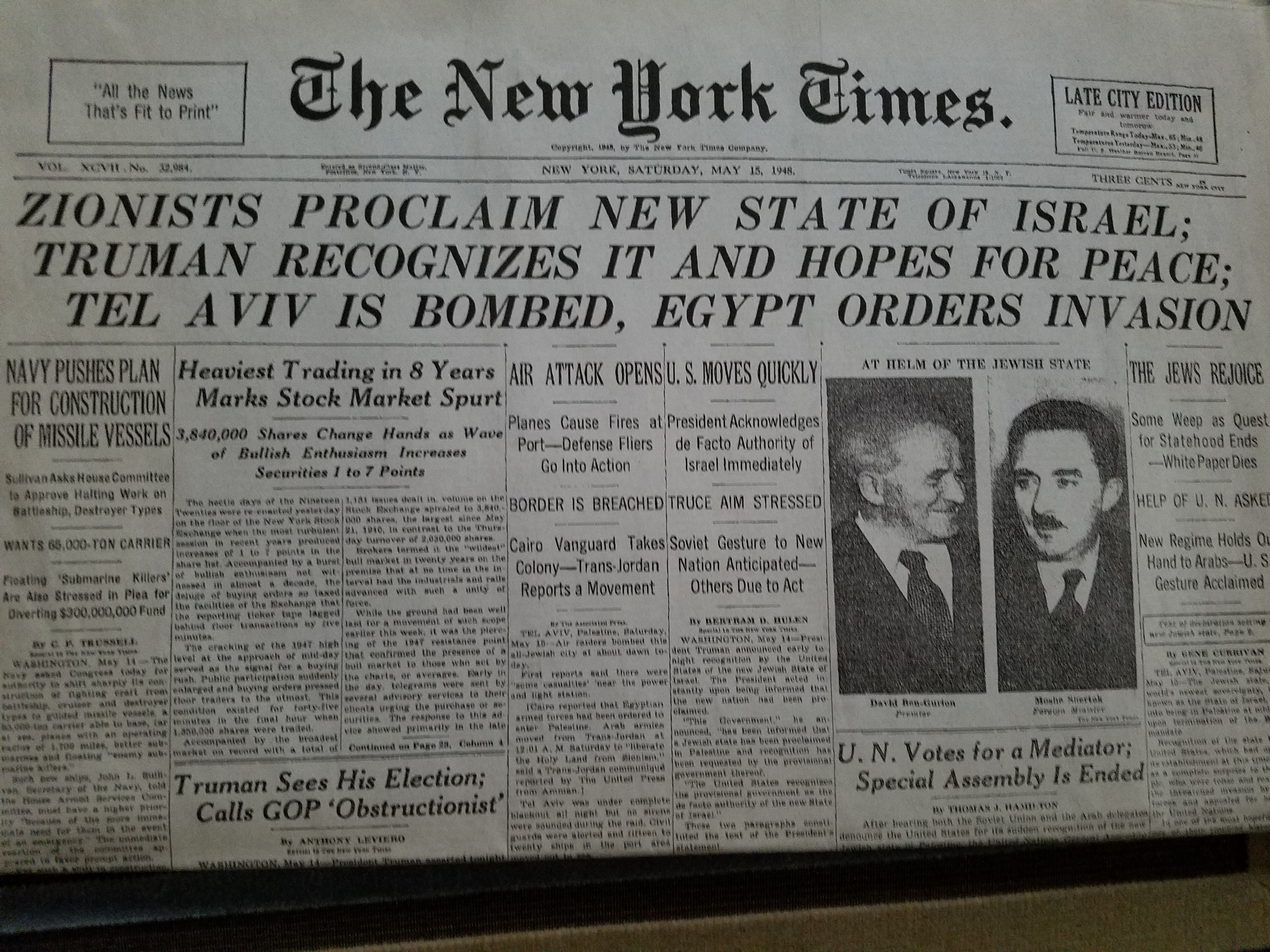
On May 14, 2018, the United States of America moved its embassy in Israel from Tel Aviv to Jerusalem. The choice of May 14 was chosen to coincide with the 70th anniversary of Israel’s declaration of independence. Just as President Harry Truman chose to have the United States of America be the first country to officially recognize the Jewish State in 1948, President Donald Trump elected to have the USA be first to formally recognize Israel’s capital in the modern day.

Some protests – particularly from the Muslim, Arab and far-left world – have been loud and furious. This group (and yes, they are coalescing into a single mass) argue that recognizing Jerusalem as the capital of Israel without having a similar declaration for Palestinians is unfair. They note that Trump’s action will make the Arab world angry and provoke violence, leading to deaths on both sides of the conflict. Further, such a move does nothing to advance the cause of peace and is therefore a terrible mistake.

I will not argue that they are not entitled to their opinion. I will instead consider their arguments as though it was 1948.


Front page of the New York Times, May 15, 1948

Consider:

  • Zionists declared an independent country in 1948, even though the local Arab population did not. Was it wrong for the US to recognize the Jewish State even though there was not a corresponding local Arab state?
  • The Arab world was furious with the declaration of the Jews and the US response. The armies of five Arab armies (Lebanon, Syria, Iraq, Jordan and Egypt) invaded Israel in a war that claimed thousands of lives.
  • No peace has come to the region. Now, over 70 years later, the Israelis have only been able to forge a peace agreement with two Arab countries, Egypt and Jordan.

The arguments of 1948 and 2018 seemingly remain the same. The US recognition was and is unbalanced, foments violence and harms peace efforts. One would therefore conclude that Truman was as wrong as Trump, and for many in the Arab/Muslim/alt-left camp (let’s call them “AMAL” for short, which means “hope” in Arabic), that is very true. (Note: Hebrew, which is read right-to-left would call these people “LAMA” which means “why?”)

But to do so is to contort cause-and-effect, actual history-with-“my truth” philosophy, and equality-with-fairness.

The AMAL legions believe that Israel is a foreign transplant in Arab land. They did not recognize the rights of Jews to live in and have sovereignty in the region in 1922 (as encouraged in international law in the Mandate of Palestine), in 1948 (at Israel’s declaration of independence) and do not recognize it now (as the US embassy moved to Jerusalem). They want Jerusalem for a capital today just as they wanted Haifa as part-and-parcel of Arab Palestine in 1948. They have fought tooth-and-nail against these events for 100 years.

For AMAL, accepting a foreigner stealing your home and land is a negation of one’s narrative and one’s dignity, and there can be no peace without dignity.

The alt-left has joined the anti-Zionist AMAL army in greater numbers as they have embraced and advanced the notion of “my truth” broadly. While the “progressives” may occasionally become offended at the vile anti-Semitism spewed by Palestinian Arabs, the Arab rejection of thousands of years of Jewish history in the holy land and the centrality of the land of Israel in Judaism, the alt-left have nevertheless adopted the underdog. They have redefined the conflict as a matter between Israel and the stateless Palestinians rather than the 100-year old Israel-Arab conflict. The alt-left sees a powerful Israel both economically and militarily on one side against a stateless impoverished people. They therefore see complete lack of equality in the actors, as they narrow the scope past the 20+ Arab and 50+ Muslim countries that dwarf the population of Jews in Israel by 100-to-1, to a scenario where Israel is the Goliath.

With such a mindset, the AMAL army contends that Trump added fuel to the fire of an unfair dynamic, just as when Truman blessed the theft of Arab land in 1948. The action continues to move the parties away from their perceived only pathway to peace which includes a bi-national Israel and a purely Arab Palestine.

The pro-Zionist camp sees the world very differently. It celebrates Truman’s recognition of Israel as part of the restoration of the Jewish people in their homeland. They know that if the Jewish State had been reestablished a decade earlier in the 1930s, tens of thousands of Jews would have been saved from the Holocaust. And they admire the thriving stable democracy which Israel has become, in the middle of a vicious and violent Arab Middle East. Recognition and partnership have been beneficial to both the USA and Israel.

But the soldiers of AMAL deny any recognition of Israel’s reality, whether Jerusalem as its capital, its flag in Judo tournaments, the research of its professors and the goods from the country. Thirty countries in AMAL still do not recognize the State of Israel. Their belief that the United States continues to be wrong from Truman to Trump runs deep.

The lines in the conflict continue to cut deeper. Do not simply consider whether the United States’ recognition of the capital of Israel was right or wrong because it is likely clouded by personal perceptions of Donald Trump. Ask yourself if you think president Truman was right in recognizing Israel 70 years ago to understand whether you are part of the AMAL horde or stand proudly with Israel.


Related First.One.Through articles:

The Cancer in the Arab-Israeli Conflict

The Palestinian State I Oppose

I call BS: You Never Recognized Jerusalem as Israel’s Capital

Israel’s Peers and Neighbors

The Impossible Liberal Standard

Subscribe YouTube channel: FirstOneThrough

Join Facebook group: FirstOne Through  Israel Analysis



May 15 is Israel’s Neighbor Day

On May 14, 1948, Israel declared itself a new independent country, as the British Mandate of Palestine expired. The declaration of independence stated that the country will be “for the benefit of all its inhabitants; it will be based on freedom, justice and peace as envisaged by the prophets of Israel; it will ensure complete equality of social and political rights to all its inhabitants irrespective of religion, race or sex; it will guarantee freedom of religion, conscience, language, education and culture; it will safeguard the Holy Places of all religions; and it will be faithful to the principles of the Charter of the United Nations.

It welcomed everyone.

Unfortunately, at that same time, the Arabs in Palestine had been rioting and killing Jews for many months in attempts to stop the Jewish State from coming into existence. Once Israel declared its independence, five armies from neighboring Arab countries came to destroy the nascent state. The war would go on for months. Israel survived.

Despite the Arab war against the Jews before Israel’s independence and after, Israel remained true to its vision of welcoming non-Jews as full citizens in the country. Approximately 156,000 non-Jews became citizens of Israel at the Jewish State’s rebirth, around 18% of the population. In 2018, 70 years later, the non-Jewish population in Israel stands at over 2 million people, representing over 25% of the Israeli population.


Israeli Arabs having a picnic in the shade under the ancient aqueduct in Caesarea
(photo: First.One.Through)

The Arab citizens of Israel have availed themselves of the open society that Israel created. 

  • There are currently 18 Arabs in the Israeli Knesset, 15% of the parliament. By way of comparison, there are only 50 blacks (9%) in the US Congress
  • Israel has non-Jewish Arabs on the Supreme Court, Salim Joubran being the first in 2004
  • Non-Jews have served as Israeli ambassadors around the world, including to Norway and the Dominican Republic
  • Non-Jews serve as generals in the Israeli army

Non-Jews are a key fabric of Israeli society, as envisioned in the Israeli declaration on May 14, 1948 that welcomed non-Jews to “participate in the upbuilding of the State on the basis of full and equal citizenship and due representation in all its provisional and permanent institutions.

It is appropriate to take the time to celebrate Israel’s non-Jewish citizens that chose to make peace with Israel, not war; that chose to help build the state, not to dismantle it; that chose to stay and be friends and neighbors with Jews, not to run and fight alongside the Jewish State’s enemies.

Regrettably, there are anti-Zionists that continue to undermine and attack Israel, who refer to the failed 1948 war to destroy the Jewish State as a “Nakba,” a “catastrophe.” As they channel their hatred on May 15th with angry calls to “Free Palestine,” let Zionists around the world commemorate “Neighbor’s Day,” a day to mark and celebrate the many non-Jews who stayed to become citizens of Israel in 1948 and continue to help the country thrive 70 years on.


Related First.One.through articles:

Arabs in Jerusalem

An Inconvenient Truth: Population Statistics in Israel/Palestine

Israel, the Liberal Country of the Middle East

Nakba 2: The Victory of a Democracy

Subscribe YouTube channel: FirstOneThrough

Join Facebook group: FirstOne Through  Israel Analysis


Arab women entering the Kotel Plaza in Jerusalem
(Photo: First.One.Through)