Well before the brutal October 7 massacre of 1,200 people in Israel, antisemitism in the United States had reached horrific levels. Jews were shot in synagogues and supermarkets. Held hostage and hacked with machetes. Vilified by famous athletes and entertainers. Accused of being too powerful in the news and told by the leading powers in the country to hide their Jewishness.
“Experts” said that the antidote was to teach people about the Holocaust. If only potential Jew-haters saw what results from “big” antisemitism they would avoid smaller antisemitic acts.
The author Dara Horn scoffed at the idea in April 2023 and now in April 2025. She argues that a narrow focus on the Holocaust limits people to thinking that Jews were wiped out as a people in the past. Israel is framed as a consolation prize awarded by Europe to appease their guilt in the genocide. Lost is the rich history of Jews.
In fact, Jewish history is not passively lost but actively obliterated and vilified. To attend universities in America about “Palestinian Studies” is not a review of any positive history of Arabs in the small slice of the Middle East that Jews view as holy, rather a demonization of Jews.
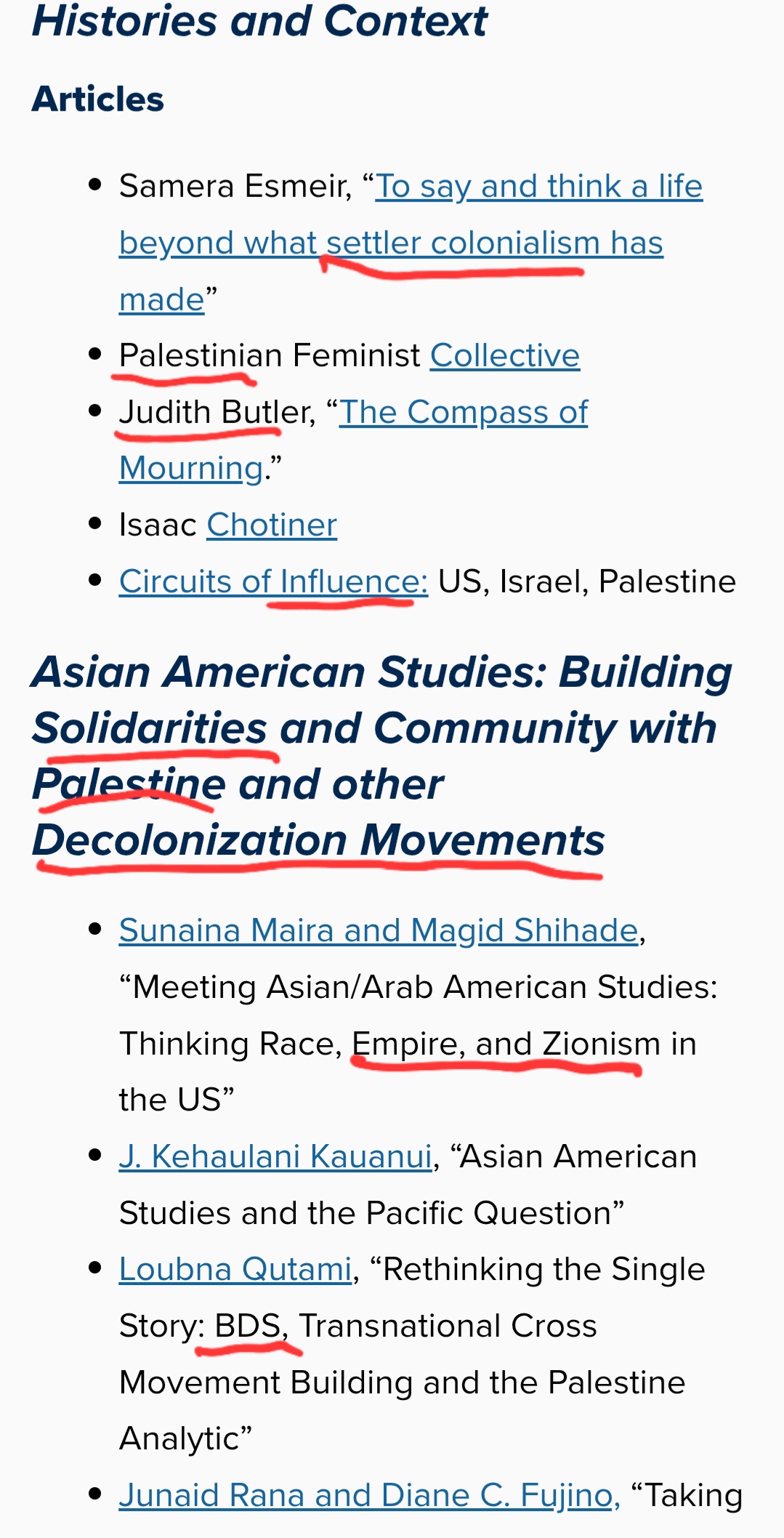
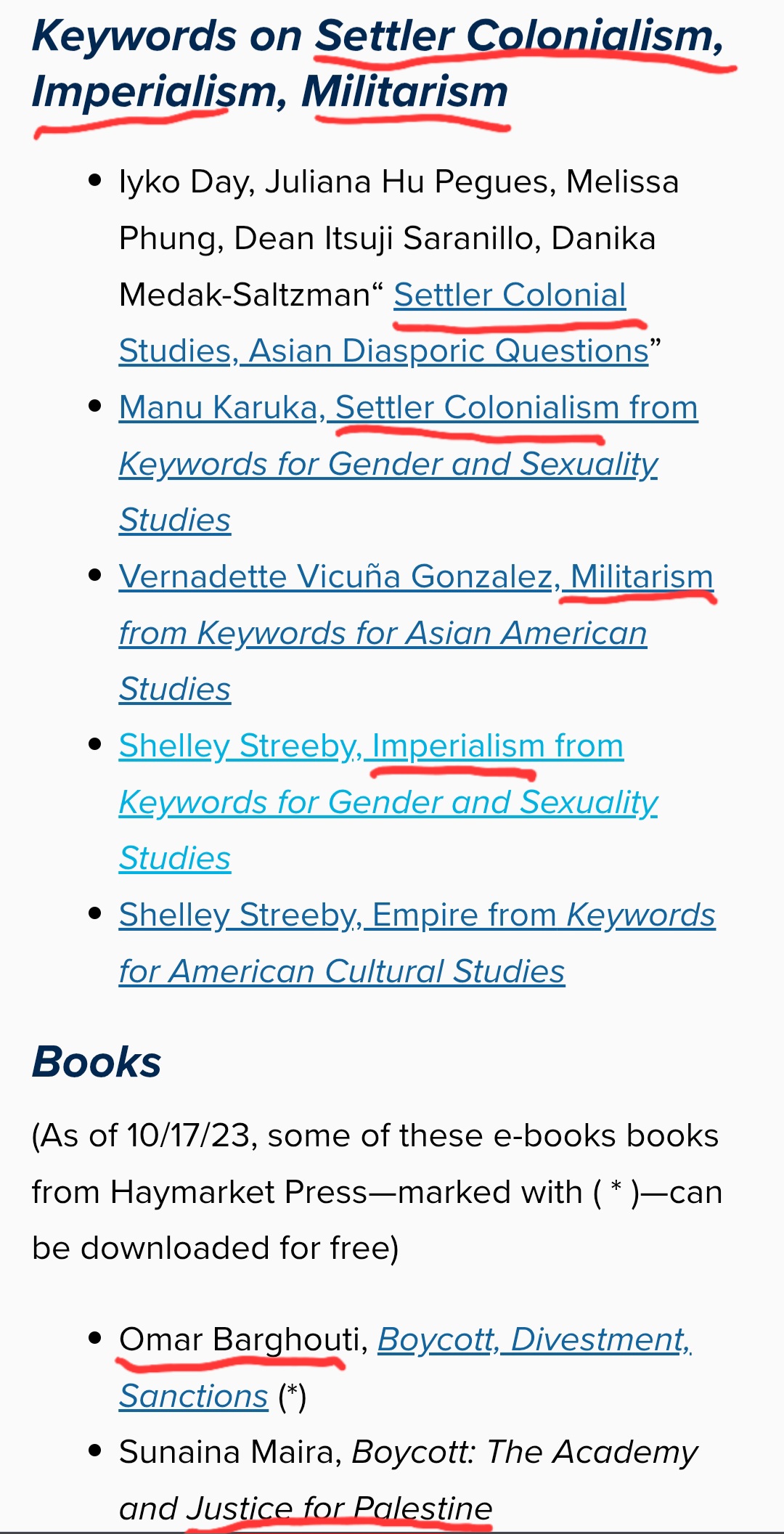
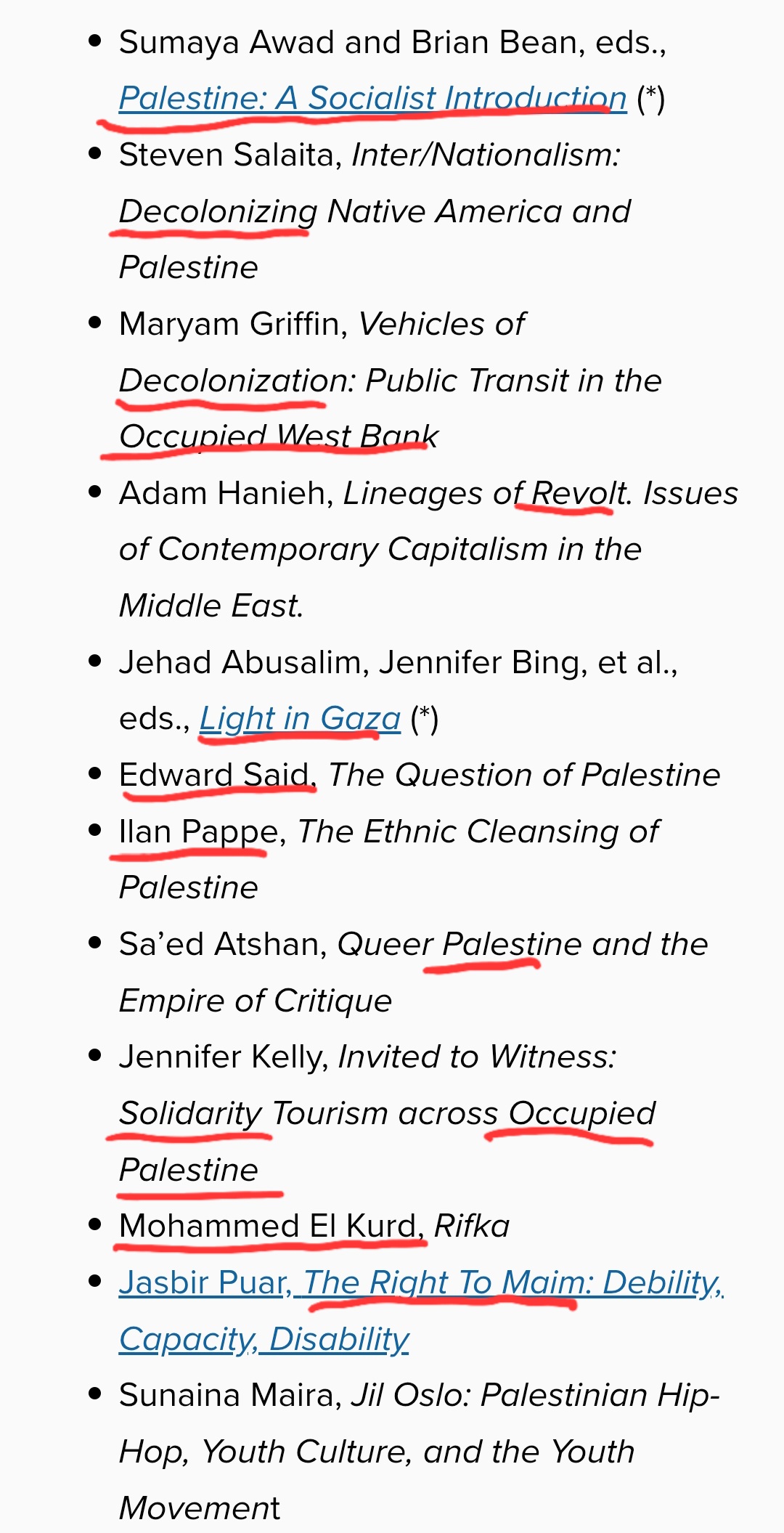
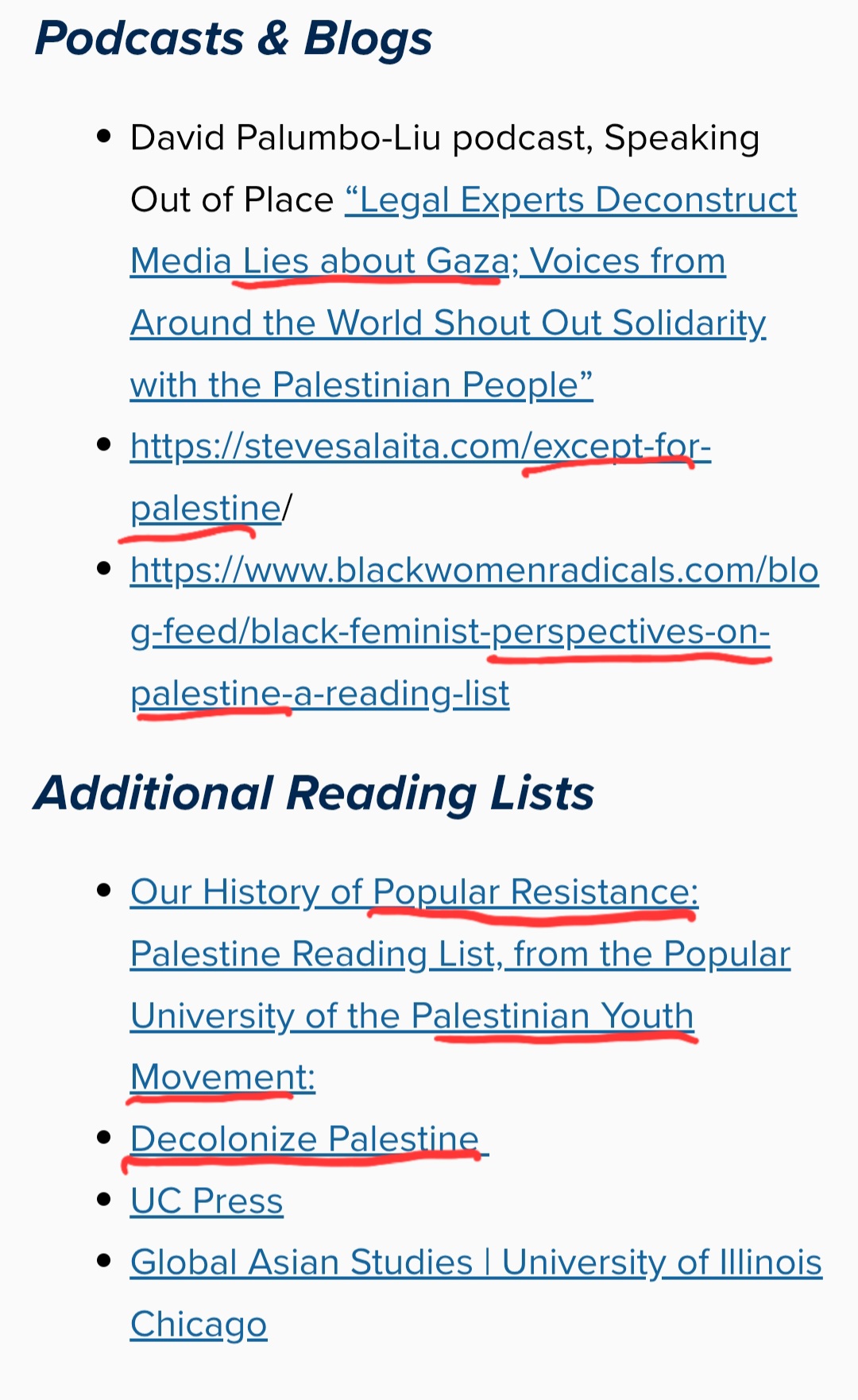
Visit the University of California, Davis website regarding reading materials on “the Situation in Palestine and Israel,” last updated on October 18, 2023, right after thousands of Gazans massacred people in Israel. The materials are completely anti-Israel, whether books, blogs or articles. Israel is condemned as a “colonial project” over again, tied to “imperialism” and “militarism.” The boycott, divest and sanctions (BDS movement) is advanced everywhere. People are urged to “revolt” against Zionism and Zionists.
Nowhere is there an iota about the thousands of years of Jewish history in the land, nor about the centrality of Jerusalem in Judaism. Rather, it includes links to articles by groups like Palestinian Youth Movement which the Israeli government has tied to U.S.-designated terrorist group, the Popular Front for the Liberation of Palestine (PFLP).
Palestineism is not a study about Arab culture or history but a rank course in antisemitism, denying thousands of years of Jewish history and the centrality of the land – and Jerusalem in particular – in Judaism.
Jewish History In Israel and Judaism
There is over 3,000 years of history of Jews in the land of Israel. Well before the modern idea of countries was formulated, Jews lived throughout their holy land. They had kings and kingdoms. They had holy temples which Jews would visit at least three times every year, ensuring they remained close to Jerusalem.
Jews have been a majority of Jerusalem since the 1860s, before the advent of modern Zionism. For hundred of years, Jews have ended their passover seder with a call “Next year in Jerusalem!” The Israeli national anthem, Hatikvah, was written in 1878, well before the First Zionist Congress, in a song about Jews being in Jerusalem and Zion. Israel is the only country in the world whose national anthem is all about its capital city.
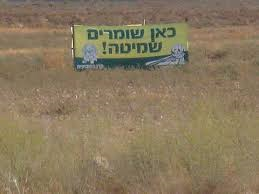
There are certain religious Jewish practices that can only be observed in the land of Israel. Jews are the only religious group with a diaspora, defined as those Jews living outside of the land of Israel, because it is the only religion tied to a specific land.
A field in Israel with a sign that it observes “shmita,” meaning the land is resting, a Jewish tradition only observed in Israel in keeping with laws in the bible (photo: First One Through)
Whether one likes the current government of Israel and its policies is irrelevant. The LAND of Israel is the Jewish homeland. That fundamental fact is not only omitted but deliberately erased in socialist-jihadi schools like UC Davis.
It is time to rethink education and focus more on the land of Israel and its centrality to Jews and Judaism, than Holocaust studies. We need to prevent anti-Jewish lessons and teach Jewish education. To prevent another genocide of Jews, start with thousands of years of Jewish history and culture in the holy land, instead of classes about the European Holocaust.
Israel is conducting a thorough review of what internal failures led to the massacre on October 7, 2023. The inquiries and analyses are designed to both assure accountability for mistakes, as well as to prevent future tragedies. The primary focus is on Israel’s military deployment and readiness, which will likely conclude with several changes inside the military.
Another analysis is needed externally – focused on Hamas and Gaza. The timeline below is meant as a framework to better consider how to address the conflict going forward.
Timeline of Key Moments in Gaza That Set October 7 Massacre
1948-9: There are two principle differences between the area east of the 1949 Armistice Lines (E49AL/ West Bank) and Gaza:
The majority of E49AL/WB Arabs are locals, whereas the majority of Gazans used to live in Israeli towns and villages;
E49AL/West Bank was annexed by Transjordan and all Arabs were given Jordanian citizenship; Gaza was only administered by Egypt
The Arabs in the much larger E49AL had citizenship and sovereignty. While most of the world considered Jordan’s annexation illegal, the local Arabs had pride in their Muslim Arab country. They also had control of Jerusalem/al Quds, the third holiest site for Muslims.
Not so for Gazans, who were in a much more confined space without citizenship, sovereignty or holy sites. Instead, they were wards of the United Nations which promised them that they would move into the Israeli towns in which they once lived.
1967: The 1967 war was a much bigger loss for West Bank Arabs than Gazans, as the Gazans already had less. Still, being under the rule of the Jewish State made the lack of sovereignty much more bitter.
2000: The Second Intifada started at the collapse of the Oslo Accords. While pundits point to a Temple Mount visit by Israeli Ariel Sharon as the trigger for the multi-year Arab riots, it was the failure of Palestinian leader Yasser Arafat to secure all of Arab demands in the negotiations, including moving millions of descendants of refugees and internally displaced people into Israel. This was especially true for Gazans.
2004: As Israel put down the Second Intifada, Israeli Prime Minister Ariel Sharon secured a letter from U.S. President George W Bush on April 14 that in exchange for pulling all Israelis out of Gaza, the United States would back Israel in assuring that all Stateless Arabs from Palestine (SAPs) would move to a new Palestinian State and not into Israel, and that new borders of Israel would account for new major Jewish population centers to be incorporated into Israel.
President George W Bush 2004 letter to Israeli Prime Minister Ariel Sharon
2005-7: Israel pulled out of Gaza in 2005 and the Palestinians elected Hamas to 58% of its parliament in 2006. In 2007, Hamas took over full control of Gaza, outsing its rival political group Fatah. In response to the antisemitic genocidal group sworn to its destruction taking over Gaza, Israel imposed a blockade of strip to halt the flow of arms. Gaza, now with self-determination, opted for radical Islam.
2008-14: Under the banner of jihad, independent Gaza did not focus on building up its economy and society but instead focused on destroying Israel. It launched wars against the Jewish State in 2008-9, 2012 and 2014, each put down by Israel. Meanwhile Hamas began to heavily invest in its underground infrastructure inside of Gaza, which in the past was principally used outside of Gaza for raids into Israel (like kidnapping Israeli soldier Gilad Shalit in 2006) and smuggling goods from Egypt.
2018-2022: Under the banner of the “Great March of Return,” Hamas led Gazan society to prepare to invade Israel. With United Nations support, thousands of students from UNRWA schools would march to the fence with Israel, familiarizing themselves with the terrain and normalizing their presence for Israelis watching their movement.
2021: When Israeli courts approved the eviction of Arab squatters from Jewish owned homes in the Sheik Jarrah section of Jerusalem, Hamas launched missiles into Israel. The action caused Israel to put the evictions on hold, educating Hamas that terror pays.
2023: By this time, Hamas’ underground infrastructure was in place and it had stockpiled thousands of missiles. It had gotten Israel accustomed to “peaceful” protests along the Gaza border fence. Better, it watched Israeli society fight amongst itself about judicial reform, and for the first time ever, a majority of Democrats favored SAPs over Israelis. With Iran on the verge of nuclear weaponry breakout and Hezbollah in Lebanon well armed with roughly 150,000 missiles, Hamas was poised for an all-out war, well beyond the limited skirmishes of prior years.
Gazans are more religious than West Bank Arabs and many more consider themselves entitled to move into Israel as UNRWA wards (81% vs. 49%). Those supporting Hamas were much more likely to understand the “Great Marches of Return” were about external political matters than those from Fatah (59% to 24%, according to a September 2023 PCPSR poll).
While the devastation to Israel on October 7 happened over a single day, it took years of planning. Just as importantly, there was societal buy in for the attack.
Key Takeaways
Israel – and the world – should consider the events that led to Hamas’ genocidal invasion of Israel and formulate strategies beyond eliminating Hamas and its military infrastructure.
The UN and Saudi Arabia must adopt the contours of the 2004 Bush letter. Over 80% of Gazans believe that the world supports their moving into Israel, validating their storming the fence. There will not be peace until the UN and Saudi Arabia make clear that a two state solution means SAPs move into a new Palestinian State, not Israel.
Dismantle UNRWA in Gaza and the West Bank. The United Nations has encouraged generations of students that Israel is not really a sovereign entity and that the UN will dictate that Israel will be forced to accept millions of Arabs. With clarity that Arabs will be settled in Gaza and the West Bank, there is no reason for UNRWA to exist in those territories.
Decimation and Vilification of Hamas. As Gazans suffered more over the course of the war, a greater percentage became interested in forging peace with Israel. Additionally, people who supported Hamas were more likely to have not seen any of the footage of the October 7 massacre and did not believe that Hamas conducted rapes. Therefore, Hamas should not only be defeated militarily, but vilified clearly so it will be abandoned by Gazans and West Bank Arabs.
Reroute funding. Gaza’s principal backers have been from Qatar, Iran and Turkey. All of these countries have hostile or tense relationships with Israel and foment anti-Israel hatred. Future funding for Gaza should principally come from countries with good relationships with the Jewish State.
No immediate plans for a Palestinian State. Gazans had internalized that terror pays, as the Second Intifada made Israel abandon Gaza, and the 2021 war stopped the evictions in Sheik Jarrah. The devastation of Gaza must terminate that notion. The only immediate plans for Gaza should be how to rebuild. Engaging in a discussion now about statehood would once again make local Arabs believe that there is nothing beyond the pale in pursuit of self-determination.
The timeline of how Gazans got to October 7 should inform the world about future actions, just as Israel’s inquiries into its military failures will change its practices.
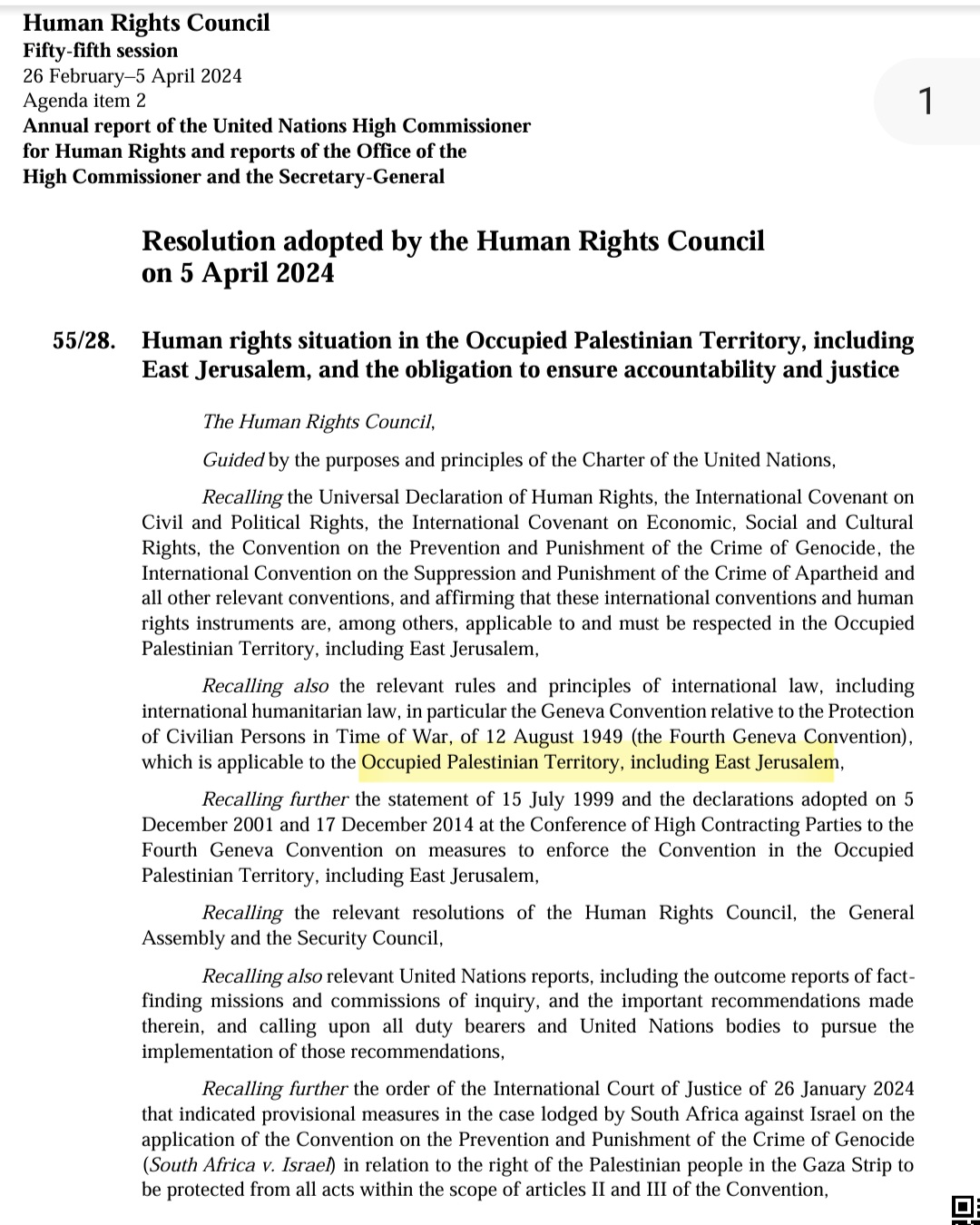
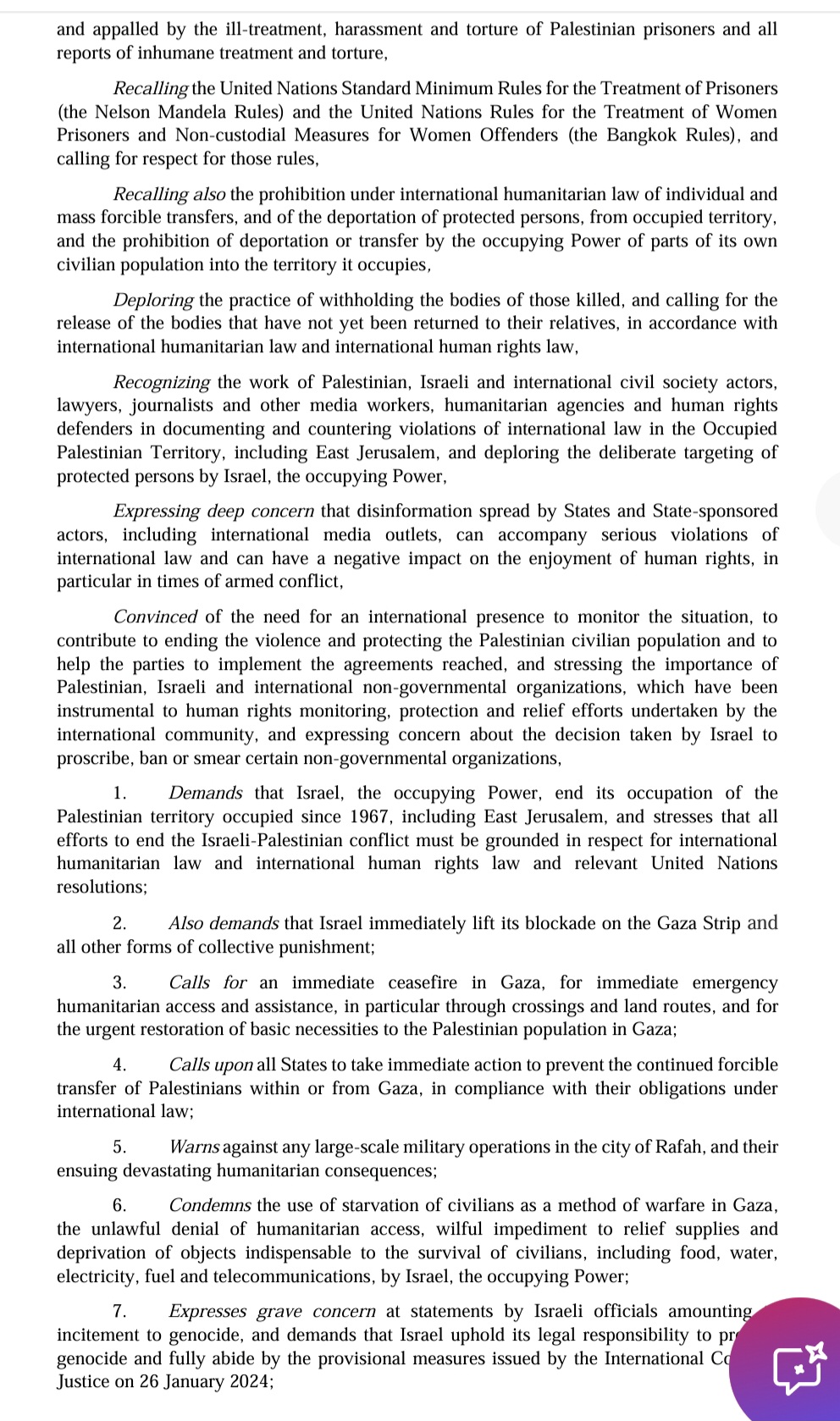
Nothing sounds so lofty as the United Nations Human Rights Council (HRC), a global organization that should theoretically be at the vanguard of protecting civilians around the world. Alas, it made itself into a highly biased joke by having ten standing items during each session to cover broad matters, with an exception for a single region – Item 7 – being dedicated to the “Human rights situation in Palestine and other occupied Arab territories.”
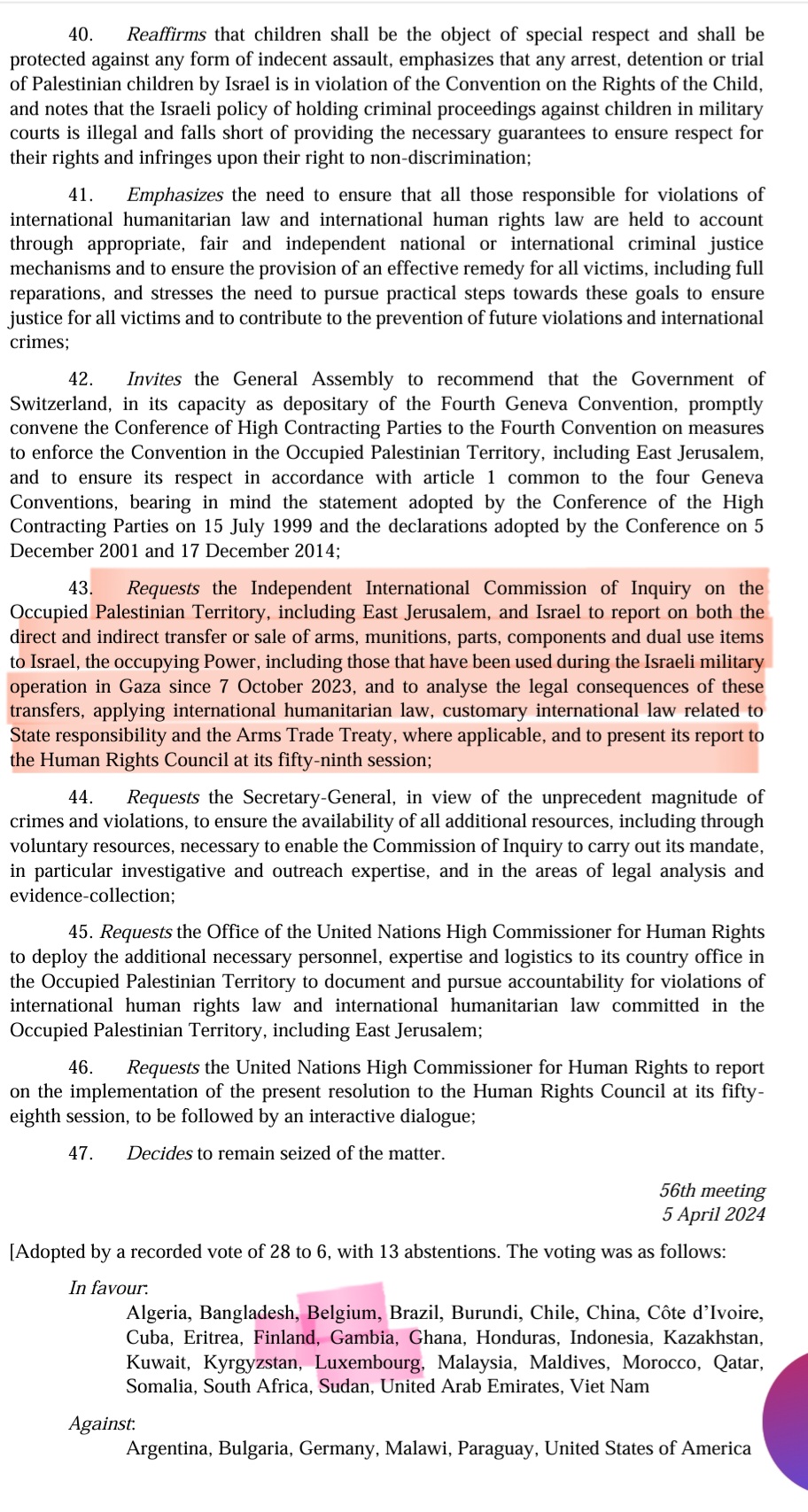
On April 5, 2024, amid the Gazan-initiated war on Israel, the UNHRC went to town on Israel, passing the outrageously biased Resolution 55/28 with a vote of 28 in favor, 6 opposed, and 13 abstentions. The Global South was joined in voting for the resolution by Belgium, Finland and Luxembourg from Europe. The chickens which abstained were: Albania, Benin, Cameron, Costa Rica, Dominican Republic, France, Georgia, India, Japan, Lithuania, Montenegro, Netherlands, and Romania.
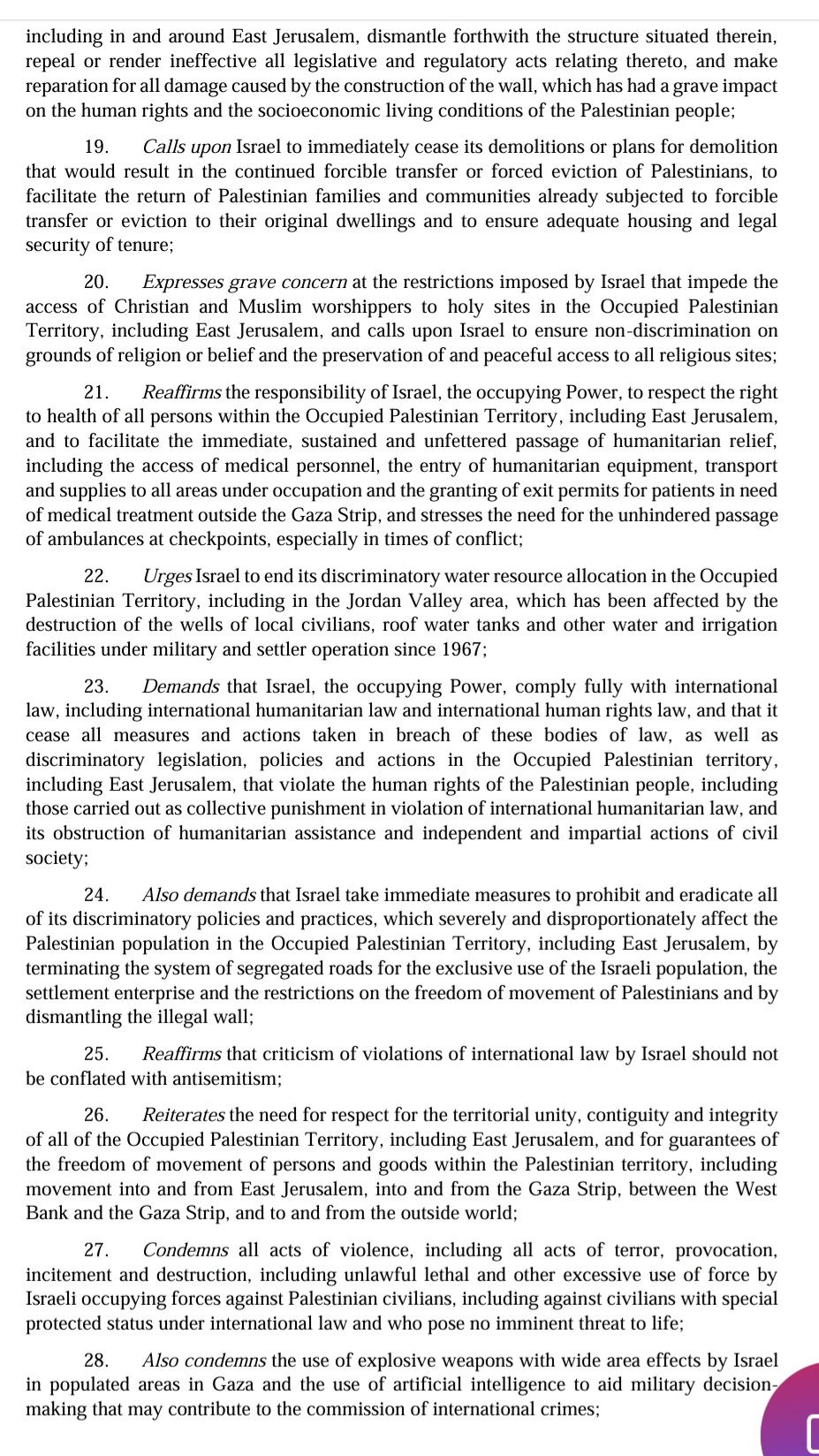
The eight pages of vitriol went well beyond actions during the war. It went beyond settlements. It went beyond withholding taxes.
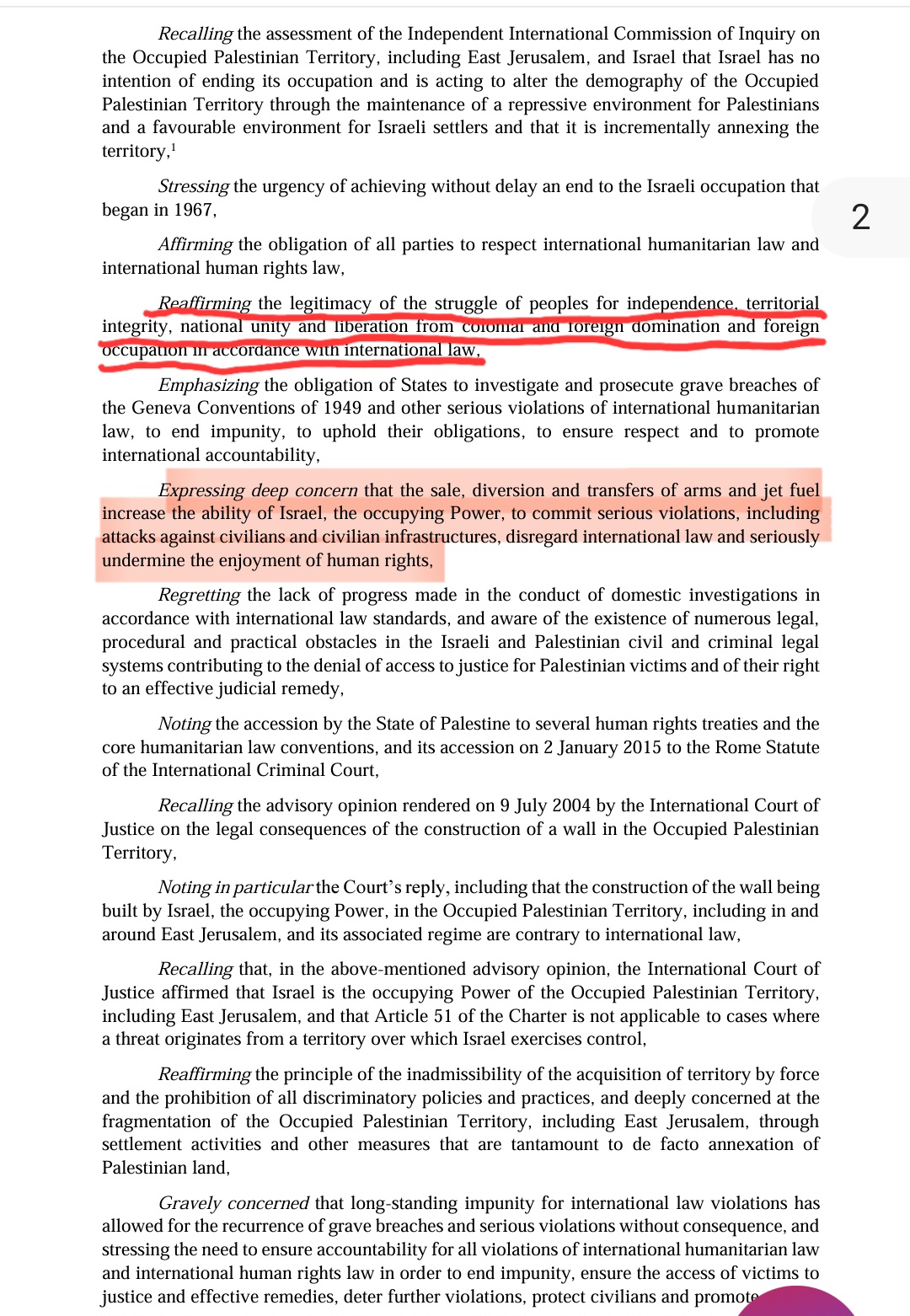
It implicitly backed Gazans’ genocidal war against Israel stating that the council “reaffirm[s] the legitimacy of the struggle of peoples for independence, territorial integrity, national unity and liberation from colonial and foreign domination and foreign occupation in accordance with international law.” This statement labeled the State of Israel as a “colonial” power, stripping it of rights of defense and designating it a rightful target for attacks.
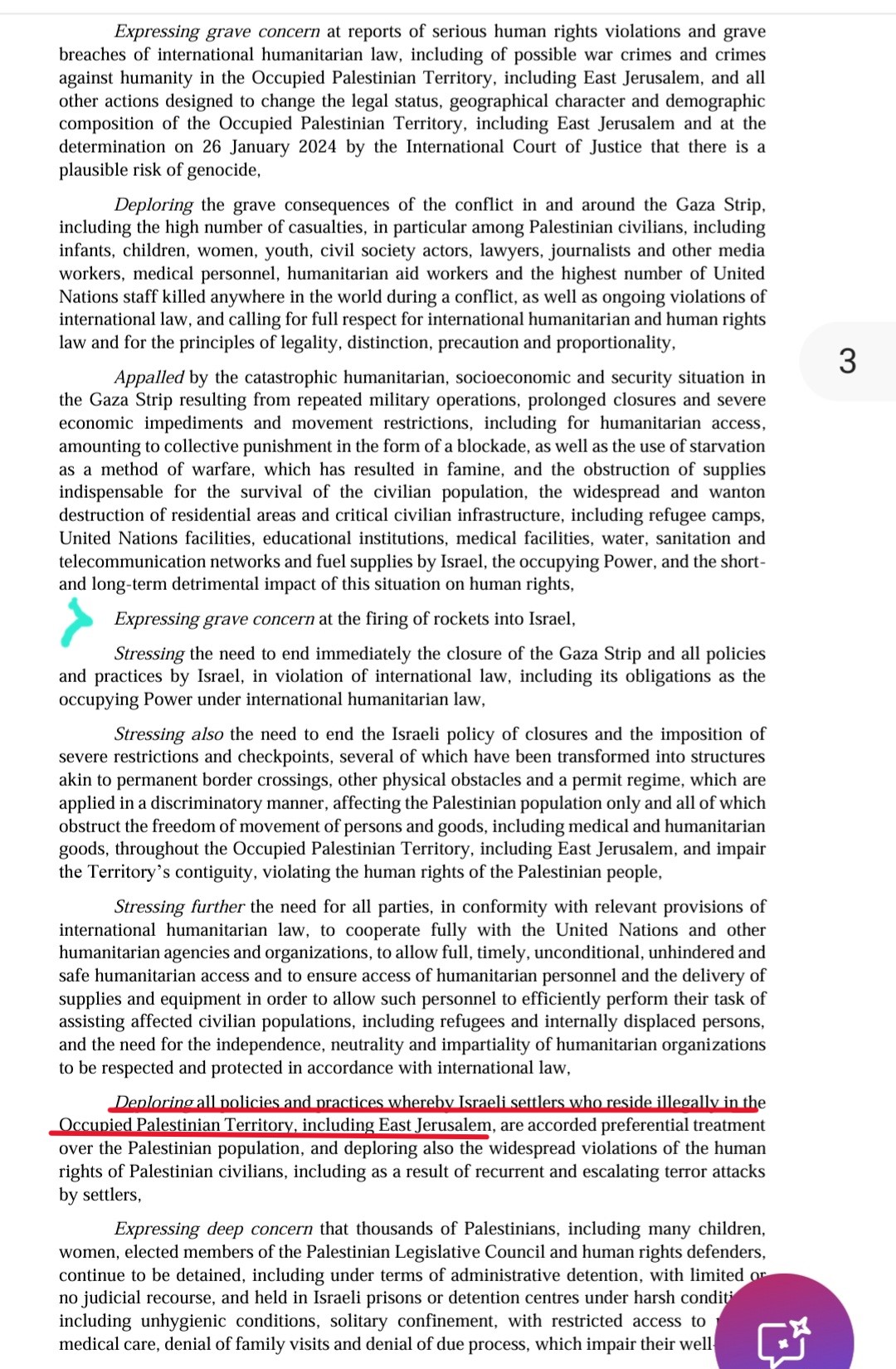
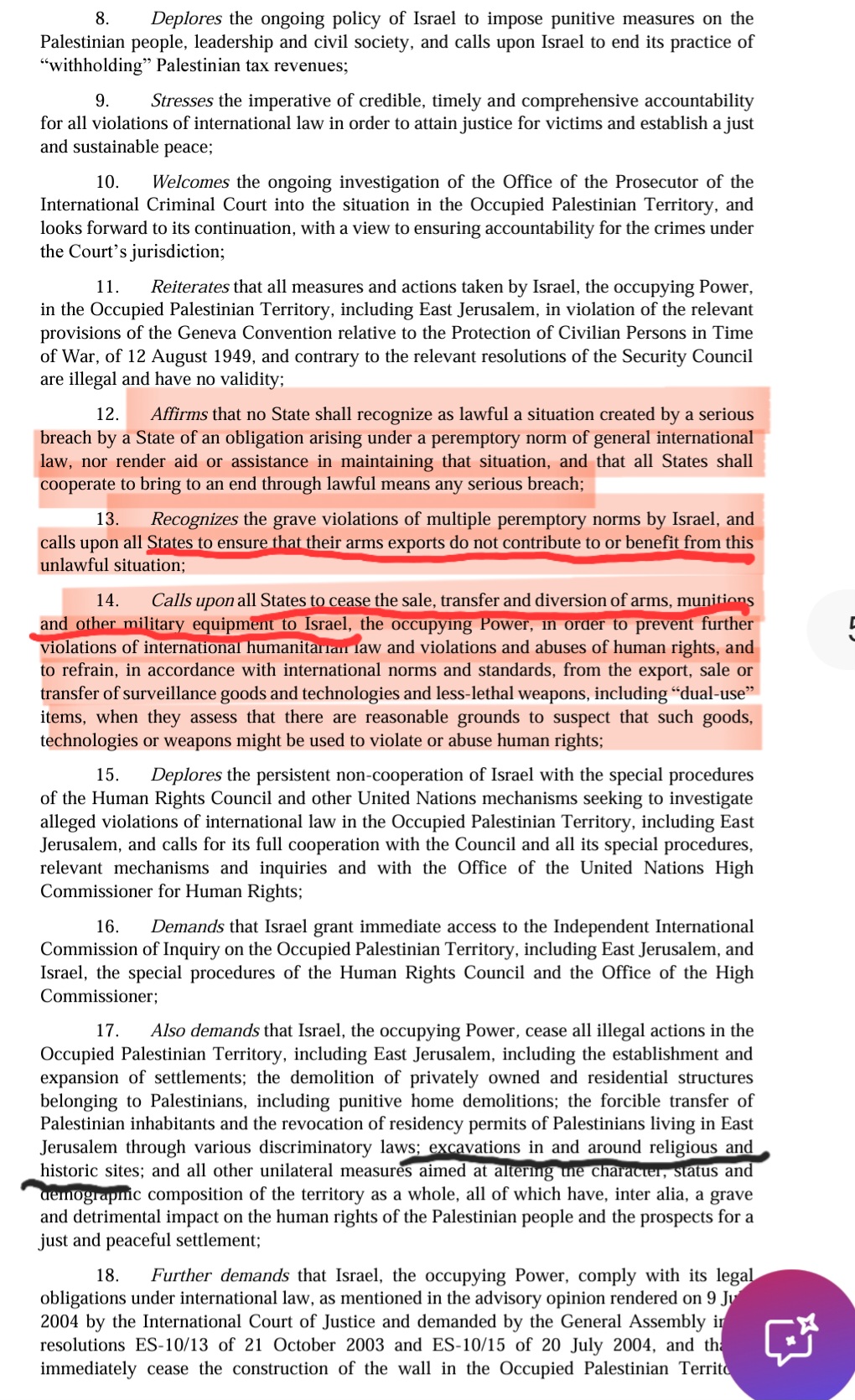
The antisemitic text even decried Jews living in their holiest and capital city of Jerusalem. It criticized Israel for archeological excavations near the Temple Mount.
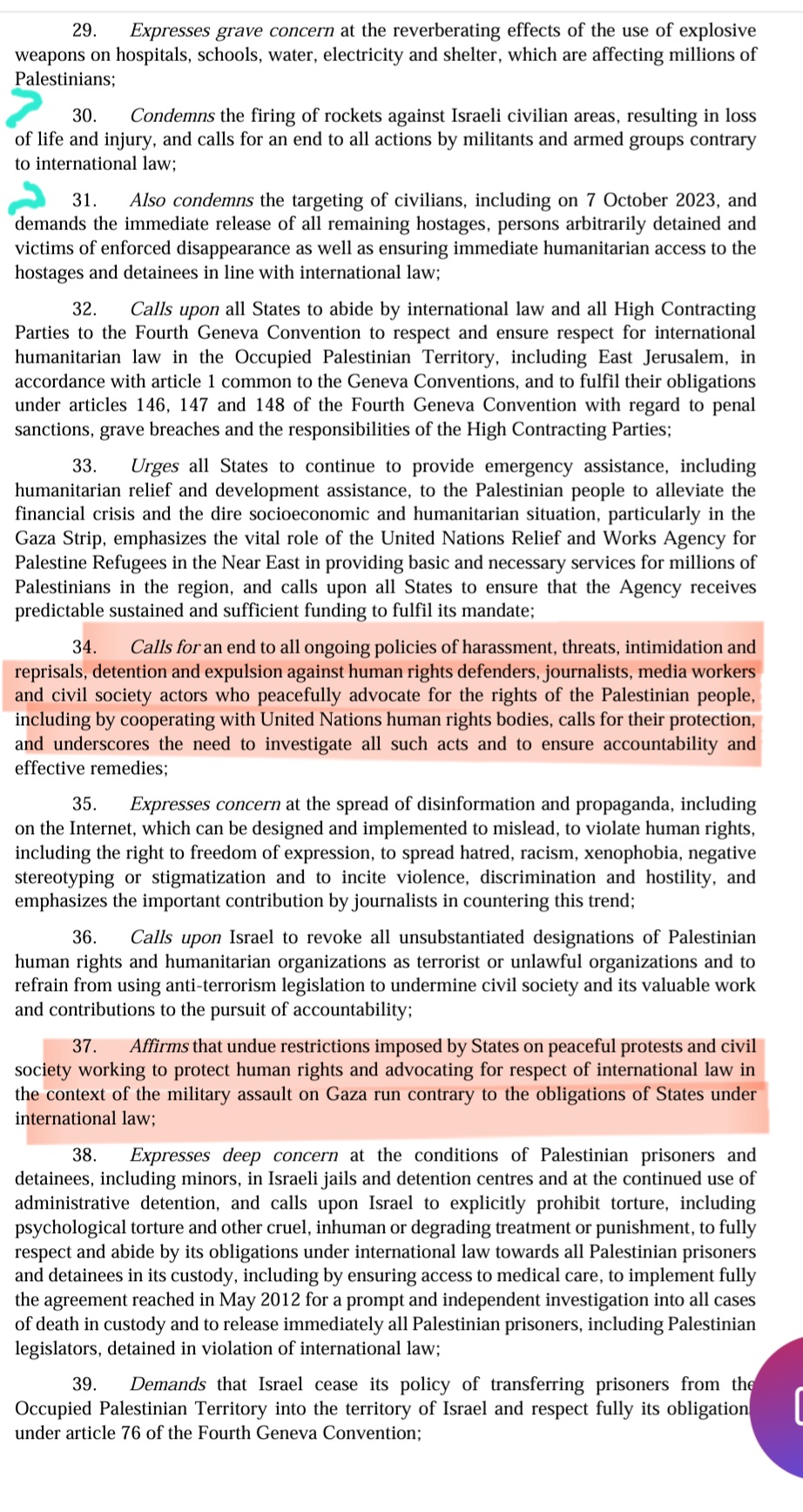
Only in three spots (marked in light blue) in the long list condemning Israel was there any expression that Gazans were doing anything wrong. Each related to the immediate situation of war and none condemned the thousands of Gazans who initiated the war killing 1,200 people, raping women and abducting 251 people, nor the Gazan leaders who threatened to commit the barbaric attacks again and again.
In multiple locations (highlighted in orange), the UNHRC demanded that countries withhold supplying arms to Israel and not take any actions against groups around the world which support the Hamas-led war against Israel. It urged countries to not supply Israel with “dual use” items like jet fuel or facial recognition software which could have both civilian and military purposes.
The text is a sickening farce, especially considering the heading of the resolution which highlighted “the obligation to ensure accountability and justice.” The text of the resolution clearly showed the HRC’s belief that only Israel should be held accountable, while Gazans should be absolved of their actions under the UN’s ode for the Stateless Arabs of Palestine (SAPs)‘ “legitimacy of the struggle of peoples for independence.”
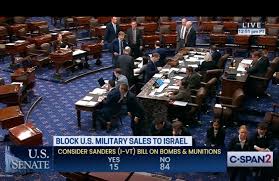
In April 2025, one year after this shameful resolution passed, Sen. Bernie Sanders (I-VT) tried to pass two resolutions in the U.S. Senate to block America’s sale of arms to Israel. His introduction to the vote lambasted AIPAC as a nefarious organization, and then called the Israeli government “racist and extremist” engaged in a “barbaric war against the Palestinian people,” even though the Israeli military constantly warns civilians to move out of battlefields and has the lowest civilian-to-combatant death toll of any modern urban war.
Fourteen senators joined Sanders in voting to block the arms sale to Israel in the middle of the multi-front war, including Sens. Richard Durbin (D-IL), Martin Heinrich (D-NM), Mazie Hirono (D-HI), Ben Ray Luján (D-NM), Tim Kaine (D-VA), Andy Kim (D-NJ), Ed Markey (D-MA), Jeff Merkley (D-OR), Chris Murphy (D-CT), Brian Schatz (D-HI), Tina Smith (D-MN), Chris Van Hollen (D-MD), Elizabeth Warren (D-MA), and Peter Welch (D-VT).
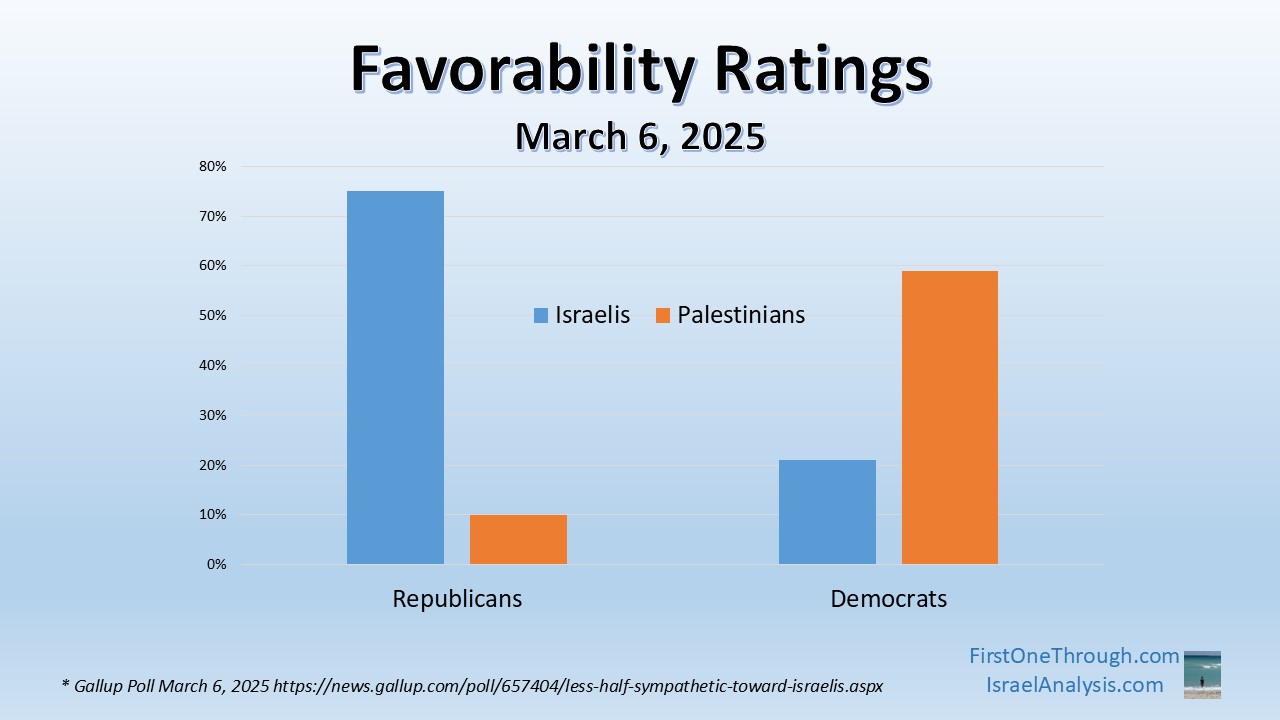
The fact that all fifteen senators voting against supplying Israel weapons during the war were Democrats should not be a surprise. According to a March 2025 Gallup poll, Republicans favor Israel over SAPs by 75% to 10%, while Democrats favor SAPs over Israelis by 59% to 21%. This is a continuation of a trend that started BEFORE Gazans’ October 7 atrocities, as highlighted in Gallups’ February 2023 poll.
It begs us to answer the framework of “the obligation to ensure accountability and justice” in general, even before applied to war. What is the baseline that the UNHRC and Democrats (HRC & D) see the Arab-Israeli conflict?
The HRC&D seemingly believe that Israel is a colonial power and SAPs have a legitimate fight for “liberation.” In such framework, even leaders of Hamas’ “political bureau” are regular “civilians entitled to protection,” (as stated by HRC). HRC&D prioritize imposing sanctions on Israeli Jewish “settlers” in the immediate aftermath of October 7 (as urged by Sen. Van Hollen in November 2023).
The HRC&D baseline for considering “accountability and justice” is that Arabs are justified in fighting Israel, while Israeli Jews are wrong for just living.
Anyone and everyone should be upset with the loss of so much civilian life in the war which started eighteen months ago. But the number of dead on each side obscures the fundamental issue in the conflict is the competing views that Israel is a legitimate sovereign state or a colonial outpost which should be combated by “any means necessary.”
Masked anti-Israel agitators at Columbia University call for the destruction of Israel
While the UN Human Rights Council and fifteen Democratic senators have not gone so far to endorse a genocide of Jews in Israel, they are actively seeking to shield Hamas and other Palestinian terrorist groups and their supporters which seek the destruction of Israel from proper measures of justice.
Many countries have pressured Israel to develop a plan for “the day after” the war for Gazans. It is a curious question, as many of those same countries have condemned Israel for operating in Gaza and demand that it leave immediately. Furthermore, they all know that any plan developed by Israel will likely be viewed with hostility and rejected outright by Gazans.
A more relevant question for Israel is what the day after will look like for Israel.
There are many aspects to that question.
What is the plan for rebuilding Israeli towns near Gaza? Will there be new codes for security, safe rooms, layouts of the streets and homes, etc.?
How will Israel manage security with Gaza? Will it construct a different type of fence and monitoring system to better protect Israelis? Arm the military bases there differently?
Will it allow work permits for Gazans, and if so, how will it manage it?
How will it monitor materials flowing into Gaza as part of a rebuilding operation?
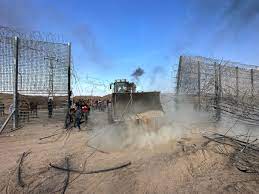
Gazans smash through security fence into Israel on October 7, 2023
As it relates to what the world most wants to hear, a restart of a political process with the Stateless Arabs from Palestine (SAPs) in Gaza and East of the 1949 Armistice Lines (E49AL), much depends on reforms made by the counterparty.
It will also depend on the United Nations.
First, the UN must clearly state that the future of their so-named “Palestinian Refugees” who never lived in Israel will not move into Israel. Their future is in a future state of Palestine, which the UN claims already exists and is “occupied.” As part of crystalizing that, it must announce plans to close all UNRWA operations in Gaza and the West Bank.
Second, to bring Israel to the table and engage with the UN as part of the process, the UN Security Council should revoke UNSC 2334, a blatantly antisemitic resolution. That resolution demands an ethnic cleansing of all Jews from E49AL, including Judaism’s holiest location, the Old City of Jerusalem.
Samantha Power, US ambassador to the UN (left) and US Secretary of State, John Kerry (right) enabled the antisemitic UNSC 2334 to pass in the waning days of the Obama administration
There is precedent for such action. In 1991, the UN rescinded UNGA 3379, which declared that Zionism was a form of racism, to get Israel to participate in the Madrid Conference, which ultimately yielded the Oslo Accords. Such action ended the First Intifada and could help end the Iranian Proxies Intifada of today.
The UN has long been the biggest instigator of the regional conflict by making promises to local Arabs on behalf of Israel, and then pressuring Israel to meet those demands. It is time for the UN to either shift course and be constructive with each party, or desist from the matter.
Israel is engaged in a war in Gaza it didn’t start or want, and will end immediately if Hamas surrenders and returns all of the hostages. Israel doesn’t need a plan for “the day after” in Gaza but should be consulted to ensure that a new regime will bring stability in the region and be a counterpart with whom to coordinate the transfer of goods and people.
Israel should be focused on its own “day after” plans. To the extent that the world wants to encourage a path to an eventual “peace process,” the UN needs to make significant reforms, including rescinding UNSC 2334.
President Donald Trump nominated former Arkansas Governor Mike Huckabee to be the next US ambassador to the State of Israel. In advance of his senate confirmation interview, the Council for American Islamic Relations (CAIR) issued a letter strongly opposing his confirmation and suggested a few questions for senators to ask Huckabee.
A few Democratic senators picked up CAIR’s line of questions including Sen. Jeanne Shaheen (D-NH), Sen. Jeff Merkley (D-OR) and Sen. Chris van Hollen (D-MD).
Huckabee’s responses were mostly diplomatic and said his role would be to carry out the president’s policies, not his own. Therefore, below are more direct responses that I imagine Huckabee and many Christian Zionists would share outside of a public hearing.
The Denial of “Palestinian identity”
CAIR asked senators to get Huckabee to state whether he believed in “Palestinian identity.” In the typical usage of English terms, adding “ian” is a recognition of a country like “Italian” means people from Italy and “Costa Rican” means citizens of Costa Rica. As the United States does not recognize a country called “Palestine,” there is nothing inconsistent with people not using “Palestinians.” Some people call the local Arabs “Stateless Arabs from Palestine” or SAPs for short, or maybe just “Gazans” and “West Bank Arabs.”
In the early 20th century, there were Palestinian Jews and Arabs in the region before nationalism brought new countries into the world. The Palestinian Liberation Organization’s charter attempted to redefine a “Palestinian” as narrowly related to Arabs. The Palestinian Authority crafted a constitution similarly said “Palestine is part of the Arab nation…. The Palestinian people are part of the Arab and Islamic nations.” By its own definitions, Palestinian Arabs refer to themselves as regional Arabs, not necessarily distinct as a “people.” It’s call to be part of “Islamic Nations,” seemingly calls for Islamic Supremacy and ignores historic reality of Palestinian Jews and Palestinian Christians before the creation of nations in the Middle East.
People do not call people today “Constantinoplians” as there is no place called Constantinople today. They certainly wouldn’t insist on using such concoction to only mean a subset of people who lived in that area, such as only Muslims. So it is with “Palestinians.”
Refusal To Use Term “West Bank”
CAIR was upset by Huckabee not using the term “West Bank” and asked senators to ask him about it at the confirmation hearing.
The commonly used term “West Bank” – as well as “East Jerusalem” – are both politicized and dated. For 4,000 years of history, neither term existed. The contours of both were manufactured because on the 1948-9 war initiated by five Arab armies to destroy the nascent State of Israel. The 1949 Armistice Agreement that Israel struck with the Hashemite Kingdom of Jordan created both entities. Jordan illegally annexed both in an action not recognized by any country other than the United Kingdom and Pakistan. Jordan then launched another attack on Israel in 1967 and lost both territories it had illegally annexed. The United Nations only started to use the term “West Bank” after that war.
The actual historic regions of Judea and Samaria existed for centuries, not 18 years of illegal Jordanian occupation from 1949 to 1967. Judea and Samaria actually have a larger footprint than Jordan’s “West Bank,” so it is also the wrong term to apply. Discussing the region today would be best using “East of the 1949 Armistice Lines” or E49AL.
CAIR’s ongoing use of the short-lived “East Jerusalem” is politicized and dated, and perhaps highlights why it gets triggered by people refusing to use the manufactured “West Bank.”
Refusal to Recognize Israeli “Occupation.”
CAIR (and the UN) believe that Israel “occupies Palestinian land.” This notion has many problems.
First, the occupation narrative is integral to the antisemitic view that Jews are “European settler colonialists.” It is nonsensical, as Jews have 3,700 years of history in the Holy Land. Judaism is a unique religion that has ties to a specific piece of land, the land of Israel. Judaism was designed in the Bible as a small regional tribe, not a global religion like other monotheistic faiths.
Second, when Israel declared itself a state in May 1948 as the British ended their mandate, the entirety of that mandate became Israel. The fact that Jordan seized the eastern part of the country and Egypt took Gaza, only made international recognition of the de facto borders of Israel more narrow. When Israel took those areas back during its 1967 defensive war, it opted to only incorporate eastern Jerusalem and left the other areas as Israeli territories to possibly swap for an enduring peace with its neighbors.
Third, most of the Global North, including Israel and the United States, do not recognize a State of Palestine. It is therefore impossible to occupy “Palestinian land.”
Gaza as “Ancestral Homeland.”
It is puzzling to see CAIR refer to Gazans as being tied to the land for centuries while simultaneously arguing that 80% of Gazans are “1948 refugees” who should move into Israel. If today’s Gazans aren’t really Gazans according to the United Nations and Arab countries, why the uproar in trying to move them out of a war zone which caused thousand of casualties? Why the uproar in trying to move them out of the rubble to rebuild the region which was decimated in a war their leaders started and they supported?
“Right of Return” and “Right To Remain”
CAIR used terms “right of return” and “right to remain” in its letter to the Senate Committee on Foreign Relations. It attempted to anchor local Arabs everywhere in the land, including in Israel. Simultaneously, CAIR advocates – as does the United Nations per UNSC 2334 – that Jews should be expelled from the “West Bank” / E49AL. This is an extremist Islamic Supremacy agenda and not one based on mutual dignity.
CAIR’s leadership made troubling statements about the Gazan war against Israel and called Jewish groups “enemies” of Muslims. It is distressing that some Democratic senators like Van Hollen and Merkley echoed the group’s questions to Mike Huckabee at his confirmation hearing. Hopefully these responses articulate what was omitted from that session.
Mike Huckabee during confirmation hearing to become US ambassador to Israel, March 2025
The World Zionist Congress is holding elections now through May 4, 2025.
To read the news, one would think that this is a matter of Jews around the world getting to vote for Jewish and Israel-related matters, with each country getting a vote based approximately on the percentage of the Jewish population in that country. For example, the United States which has roughly 40% of global Jewry gets 152 of the 525 delegates at the WZC (29%) and Israel get 38%. There are only 13 other countries which are participating in the elections which will get 33% of the delegates: Romania, Canada, Argentina, South Africa, Venezuela, Sweden, Spain, France, Peru, England, Hungary, Brazil, and Uganda. Israel gets the majority of delegates.
The allocation based on country would suggest that countries represent a unit but that is far from the case. The 22 US slates are competing aggressively AGAINST each other with religious right and left attacking the other, as well as political left and right. The handful of centrist parties tout unity to appeal to the middle swath of Jews.
The reality is that religious and political affiliations and philosophies are driving the delegates, not their countries of origin.
Consider Jamie Geller, an American influencer who moved to Israel several years ago. Despite not living in the US, she is using her platform from Israel to try to get the vote out for Aish Ha’am in America, in which she says she chairs the advisory committee.
The surprising big winner of the 2020 WZC US election was Eretz Hakodesh which had over 20,000 votes and secured 16.2% of the American delegates. The enormous slate of delegates in 2025 – multiples larger than any of the 22 slates – is packed with ultra-Orthodox rabbis and influencers who are directing their communities to vote for that slate. Much of the community is opposed to the secular nature of the State of Israel and look at local rabbinic positions that support (like Rav Avrohom Gurwicz, Rosh Yeshivas Gateshead) and oppose (like Rav Malkiel Kotler from BMG in Lakewood) participating in the election, but also look at international opinion (like Rabbi Dov Landau of Bnai Brak who opposes voting).
The center and right in Israel are not the only influencers on the American votes. The left-wing flank, consisting of A New Union, Hatikvah, Arza-Reform and Jewish Future, have gotten Israelis like Yair Golan of the Democrats Party, to lobby votes for left-wing slates.
The global nature of lobbying makes sense. After the elections, all 525 delegates will be together for votes regarding priorities and allocation of resources. The country of origin makes much less difference over the next five years.
Which leads one to conclude that the enormous effort placed on the US elections is misplaced tactically.
While Israel and US Jewry account for over 80% of world Jewry, they get only two-thirds of the delegates. Most of the rest of world Jewry doesn’t even hold elections. That leaves one-third (174) of the delegates getting an outsized impact relative to the Jewish population in the 13 countries holding elections or some sort of convention: Romania (9,000), Canada (393,000), Argentina (175,000), South Africa (75,000), Venezuela (6,000), Sweden (15,000), Spain (13,000), France (490,000), Peru (2,000), England (292,000), Hungary (47,000), Brazil (92,000), and Uganda (2,000). That’s a total Jewish population in these 13 countries of roughly 1.611 million. That equates to roughly 108 delegates per million Jews compared to only 27 per million for the United States, FOUR TIMES THE IMPACT.
Influencers should target international markets, not the United States to get real influence at the WZC. The aggressive marketing in the US may get more followers on Instagram but yield much less than focusing on Jews in Brazil and Hungary.
Many people discussing the election are not that concerned about the outcome and are using this time to engage millions of Jews with Israel. Some slates, like Israel365, are using the election to further engage Christian Zionists who cannot vote in the WZC elections but are very influential in US politics. The left-wing Israeli Policy Forum is showcasing new voices whom they hope will become emerging leaders.
The election is a tool to enlist people in preferred ideologies, even more than having influence on policy.
The World Zionist Organization amended its Jerusalem Program in February 2024, not long after the horrible massacre of around 1,200 people in Israel by thousands of Gazans. The original WZO platform was the “Basel Program” of 1897, adopted at the First Zionist Congress convened by Theodor Herzl. It has been amended through the years, including in 1951 (after Israel was established), 1968 (after Jerusalem was unified) and 2004 (amidst the “Second Intifada”).
The unity of the Jewish people, its bond to its historic homeland Eretz Yisrael, and the centrality of the State of Israel and Jerusalem, its capital, in the life of the nation;
Aliyah to Israel from all countries and the effective integration of all immigrants into Israeli society.
Strengthening Israel as a Jewish, Zionist and democratic state and shaping it as an exemplary society with a unique moral and spiritual character, marked by mutual respect for the multi-faceted Jewish people, rooted in the vision of the prophets, striving for peace and contributing to the betterment of the world.
Ensuring the future and the distinctiveness of the Jewish people by furthering Jewish, Hebrew and Zionist education, fostering spiritual and cultural values and teaching Hebrew as the national language;
Nurturing mutual Jewish responsibility, defending the rights of Jews as individuals and as a nation, representing the national Zionist interests of the Jewish people, and struggling against all manifestations of anti-Semitism;
Settling the country as an expression of practical Zionism.
Encouraging recruitment and service in the Israel Defense Forces and the security forces and strengthening them as the protective force of the Jewish people living in Zion, as well as encouraging full National Service for anyone exempted in law from service in the IDF.
The various statements above can be unpacked into three general categories: Global Jewry; the Land of Israel; and the State of Israel. It echoes Gil Troy’s definition of Zionism: Jews are a nation; Jews have ties to their particular homeland in the land of Israel; and that Jews have a right to establish a state in that homeland.
Global Jewry
“The unity of the Jewish people”: Global Jewry likely appreciates and believes in the concept of unity, whatever that term means.
“Aliyah to Israel from all countries and the effective integration of all immigrants into Israeli society.”: The statement lacks an introduction – is this encouraging and supporting aliyah or physically making aliyah? Whether they move to Israel or not, diaspora Jewry likely wants to see new immigrants absorbed into Israel effectively.
“Ensuring the future and the distinctiveness of the Jewish people by furthering Jewish, Hebrew … education,”: Most of diaspora Jewry attends public school and has assimilated into the local culture. In the United States, this is particularly true of Reform and Reconstructionist Judaism. While many diaspora Jews may appreciate Jewish and Hebrew education, they do not necessarily want to be viewed as “distinct” from their fellow countrymen. “Zionist education,” is perhaps even more foreign to Reform and Reconstructionist diaspora Jews. Using Zionist education as a tool for “distinctiveness” likely rings hollow for many, especially if “Zionism” relates more to a country or government, rather than the land.
“Nurturing mutual Jewish responsibility, defending the rights of Jews as individuals and as a nation” and “struggling against all manifestations of anti-Semitism”: Antisemitism in the diaspora is against Jews as a people, while antisemitism in Israel is against Jews as both a country and a people.
Land of Israel
“bond to its historic homeland Eretz Yisrael”: The land of Israel is the Jewish homeland. It is part of what binds Jewish people together, the common inheritance from our forefathers.
“Aliyah to Israel from all countries and the effective integration of all immigrants into Israeli society.”: As above, making “aliyah” is about the holiness of the land. Jews have made aliyah for thousands of years before there was the modern State of Israel.
“Ensuring the future and the distinctiveness of the Jewish people by furthering Jewish, Hebrew and Zionist education”: Zionism, as it relates to the land of Israel would not be controversial to even unaffiliated Jews.
“Settling the country as an expression of practical Zionism”: The phrasing here is interesting. It refers to settling the “country,” not the land. Does that mean only within the internationally recognized borders rather than the entirety of the land of Israel which would include east of the 1949 Armistice Lines (E49AL / Judea and Samaria / West Bank)? The clause describes “practical Zionism.” Does that limit where Jews move or does it encourage Jews moving to certain parts of the land? This clause is very open to interpretation.
State of Israel
The statements in the Jerusalem Program as they relate to the State of Israel are arguably difficult for a few slates in the 2025 World Zionist Congress (WZC) election in the United States run by the American Zionist Movement (AZM), based on public statements to date. This is true of the Hatikvah slate which includes Reconstructionist and Renewal branches of Judaism, and progressive groups like New Jewish Narrative (merger of Americans for Peace Now and Ameinu), T’ruah and J Street, as well as Vote REFORM.
“centrality of the State of Israel and Jerusalem, its capital, in the life of the nation”: Several members on the slates mentioned above have openly stated that they believe that Jerusalem is NOT the capital of Israel and not central to Judaism or the Jewish nation.
“Strengthening Israel as a Jewish, Zionist and democratic state”: There is arguably little for diaspora Jews to do regarding the internal workings of the state of Israel. How and why should Jews from around the world get involved with Israel’s political dynamics and rules put in place to strengthen or weaken its democratic character. People would not want Israeli Jews messing with their own government structure.
“representing the national Zionist interests of the Jewish people”: It makes sense for Israel to represent “Zionist interests” as it is the embodiment of the Zionist goal. The statement seems self-evident, unless there is a movement to create a second Jewish state somewhere else.
“Encouraging recruitment and service in the Israel Defense Forces and the security forces and strengthening them as the protective force of the Jewish people living in Zion, as well as encouraging full National Service for anyone exempted in law from service in the IDF.”: This sentence was added in the latest 2024 Jerusalem Program as a reaction to the October 7, 2023 massacre. The military conscription policies of the sovereign State of Israel are only matters for the government of Israel and its citizens, and should not be a matter of diaspora Jewry influence. Therefore, this language must be a call to encourage diaspora Jews to join the IDF. While many people do volunteer service even if not a dual-citizen, the statement is problematic. While it is not inherently illegal to serve in a foreign armed service, it could be construed as a step to relinquishing citizenship in the home country, and particularly problematic as governments and situations change.
One must be amazed that there are many current members of the Israeli Knesset who could not affirm this Jerusalem Program which is being demanded of American Jewry to participate in the WZC elections.
As detailed above, the Jerusalem Program has continued to evolve with pivotal changes to the State of Israel. It suggests that Zionism has morphed with and for the State of Israel, while it may or may not have changed for diaspora Jewry.
Consider Troy’s definition of Zionism referred to above: that Jews are a nation with ties to the land of Israel and have a right to sovereignty in that land. The current Jerusalem Program extends Zionism to encourage diaspora Jews to join the Israeli army to fight for that country. That is a long way from believing in the right of a Jewish State.
The calls for Jewish unity have been consistent and not controversial. The statements related to the Land of Israel get a tad more thorny as the text is ambiguous about the borders of the land, and whether they reflect the full holy land or just internationally recognized borders. Lastly, the State of Israel text is the most difficult for many diaspora Jews.
Many Jews participate in the WZC election who do not believe in the Jerusalem Program. Rabbi Alissa Wise, co-founder of the Rabbinical Council of the anti-Zionist Jewish Voice for Peace ran on a progressive slate some years ago as did Peter Beinart. Today, the Reform Movement is attempting to get out the vote deliberately not telling people about the Jerusalem Program. It does this to funnel monies – over $1 billion per year – to advocate for THEIR causes, not the causes outlined in the Jerusalem Program.
The Vote Reform site makes no mention of affirming the Jerusalem Program as a condition to vote
Voting for the World Zionist Congress runs from March 10 until May 4, 2025 and people are lobbying to get people to vote for their slates without knowing the incorporated affirmation. People should read the Jerusalem Program before they vote, and see whether they are comfortable with the 2024 amended language, and believe that people on the slates really endorse such program as well.
The British Foreign Minister David Lammy and the UK Ambassador to Israel Simon Walters took aim at the Jewish State for launching fresh attacks against Hamas in Gaza. Despite the political-terrorist group still controlling the region and continuing to hold dozens of Israeli hostages, Walters said “at some point the fighting has to stop and the diplomacy begin. That point is now.”
It is worth reminding the British about June 6, 1944, known as D-Day. The British declared war on Nazi Germany in September 1939 after Germany invaded Poland, even though Germany hadn’t killed a single Brit. Five years of war later, the British decided that it needed to take the war to Germany and invaded Europe. The British lost 350 soldiers on that day and about twice that number were wounded. The British would continue to battle the Nazis for almost another year, including firebombing campaigns on Dresden and Hamburg. It is estimated that 25,000 German civilians died in Dresden alone, a subset of over 2 million German civilians who were killed during the war.
Eventually, the Nazis surrendered and agreements with Great Britain were struck.
The British casualties from D-Day are in contrast to the toll of dead Israelis on October 7, who were mostly civilians. Gazans murdered 3.4 times the number of people in Israel than the Germans killed British soldiers on D-Day. The number of injured Israelis on that terrible day was over four times the number of British soldiers during their massive invasion of Europe.
When Lammy said “Diplomacy, not more bloodshed, is how we get security for Israelis and Palestinians,” he has seemingly forgotten that diplomacy will only come about once the genocidal jihadists are defeated and moderate leadership has assumed control, to ultimately forge a viable and sustainable relationship with Israel.
Lammy made that comment after he told the British House of Commons that Israel’s blockade on Gaza violates international law, even though a 2011 report stated that the Gaza blockade is “legal” and complies “with the requirements of international law.”
The current reality is that Hamas has said that they will not surrender and release the hostages. They continue to gather new recruits – all educated by UNRWA to despise Jews and that their future is in Israel – to attempt to repeat their barbarism in Israel again-and-again.
Israel has a genocidal war machine ON ITS BORDER which INITIATED A BARBARIC ATTACK and which refuses to surrender. It is quite a different dynamic than the British opting to fight the Nazis 80 years ago.
But time and place afford the British foreign minister to play armchair warrior and judge, neither one well.
As penned on these pages a decade ago after the Charlie Hebdo and kosher supermarket terrorism in Paris, “Today’s war on terrorism will continue to be waged when nations see their interests being threatened. The outpouring of emotion will also be rooted in selfish preservation.” Some of the leaders in Britain see their interests and self preservation advanced by throwing Israel under the bus, hoping to keep the jihadists in their midst at bay, sitting out the war on terror 3,600km away.
The British foreign minister would do well to remember that defeat is often a precondition for diplomacy and a path towards enduring security.
The barbaric October 7 massacre was the largest slaughter of Jews in the Jewish holy land in almost 2,000 years. Gazans perpetrated the attack on the Jewish holiday of Simchat Torah, when Jews celebrate finishing and restarting reading the Pentateuch each year. The pogrom was on Saturday, the Jewish holy day of rest. It was also on the fiftieth anniversary of the Yom Kippur War, when Islamic Arab armies invaded Israel in 1973, on the holiest day of the Jewish calendar.
In covering the war in various articles on that dark day, The New York Times did not mention that thousands of Gazans decided to invade Israel during the joyful holiday of Simchat Torah. Whether deliberate or not, the large media company headquartered in the city with the largest number of Jews in the Jewish diaspora did not add color that the Palestinian jihadists murdered Jews while the Jewish State celebrated an important religious holiday.
Not so for the woke paper’s coverage of the Gazan-initiated war regarding Islamic holidays.
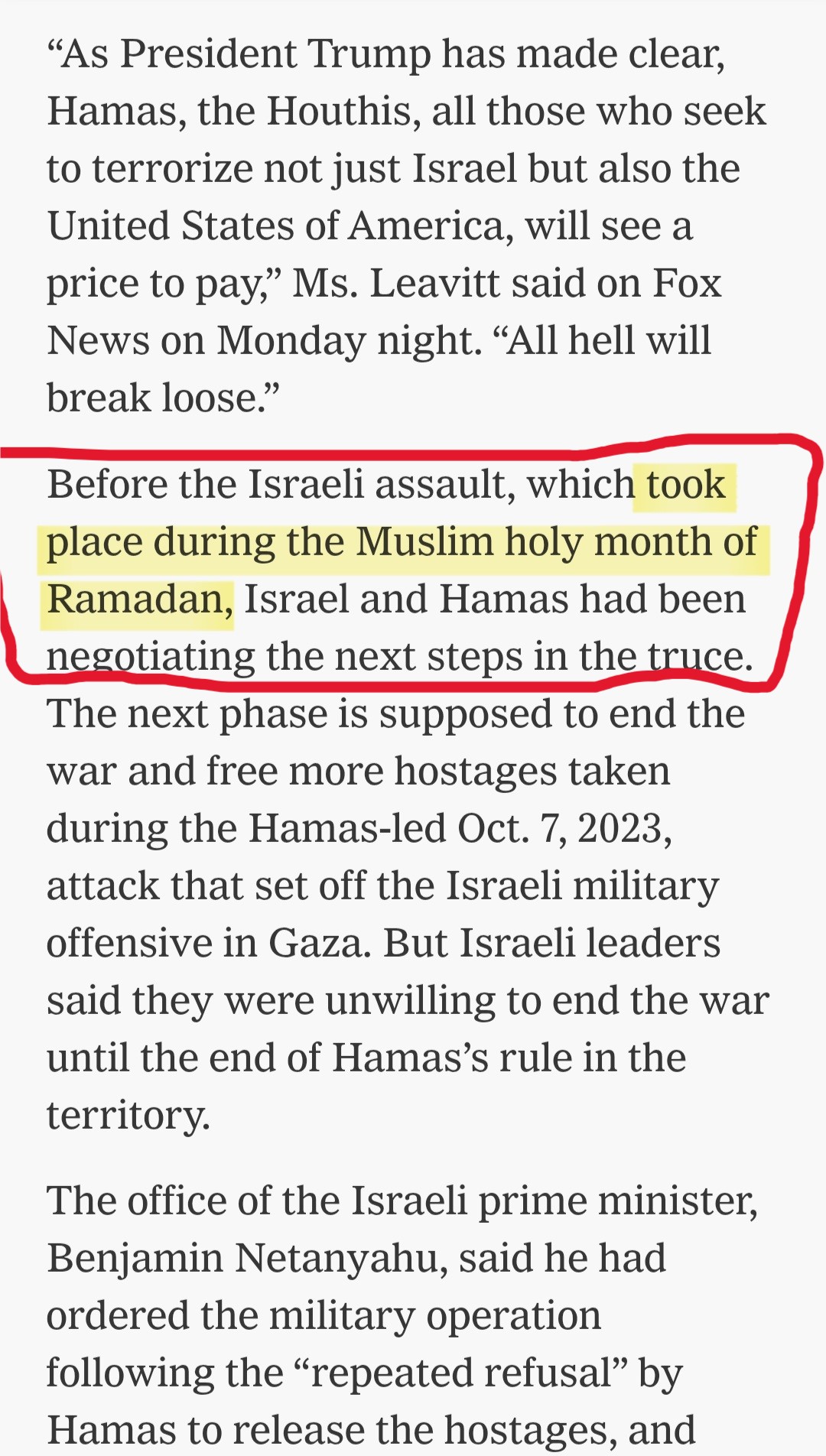
The Times made a point of telling its readers that the latest fighting in the War From Gaza happened during the month-long Islamic holiday of Ramadan. The insertion of the fact had nothing to do with recounting the military timeline in the sentence or paragraph. It had nothing to do with the entire article. Unless it was the Times’ intent to tell its readers that “the Israeli assault” happened while the parties were “negotiating the next steps in the truce” while Muslims in Gaza were celebrating a religious holiday, to make the Israelis out to be particularly heartless.
New York Times article on March 18, 2025
Perhaps it was just trying to inform its increasing Muslim readership that it the paper is halal.
The Times has long proved its anti-Israel and antisemitic bona fides. It is seemingly looking to promote its pro-Islamic credentials at this time.
Hamas, the political-terrorist group which rules Gaza, refused to release the remaining Israeli hostages and step down from power, after weeks of stalled negotiations with Israel. In the face of the impasse, Israel restarted its military campaign, killing at least five members of Hamas leadership.
In a statement about the death of the terrorists, Hamas offered a eulogy as reported in the Jerusalem Post, saying that its genocidal jihad against Israel was “fulfilling our national duty” and that it remains “committed to our religious obligation and our ethical and professional role… supporting their [Gazans] resilience.” The Hamas War, which it initiated amidst a long stretch of calm with Israel and refuse to abandon, has laid waste to Gaza. In the face of death and destruction, the last of Hamas leadership says that it is “standing firm.”
Hamas believes that it is serving a religious calling to destroy the Jewish State. It cannot compromise on its mission or face a deep reckoning with its religious beliefs. It refers to its antisemitic killing squad members as “martyrs” for a holy jihad, with many more to willingly follow. No compromise is possible with such party.
Hamas is not simply eulogizing five slain leaders of its death cult; it is eulogizing the future of Gazans.












 First One Through