An Inconvenient Truth: Palestinian Polls

There were a growing number of violent attacks by Palestinians against Israelis in October 2015.  Various politicians such as the US Secretary of State John Kerry blamed the root cause as Palestinian frustration about ongoing Jewish “settlements” east of the Green Line.  Acting President of the Palestinian Authority Mahmoud Abbas pointed the finger at defending Al Aqsa Mosque in Jerusalem from Israelis changing the status quo.  United Nations Secretary-General Ban Ki-Moon considered that it was due to Palestinians frustration about the failed peace talks and lack of progress towards creating a Palestinian state.

Why all of the guessing for identifying the root cause when the Palestinians poll themselves every three months?

The Palestinian Center for Policy and Survey Research conducts a poll every quarter on a range of issues.  It breaks the analysis between Palestinian Arabs living in the West Bank/ east of the Green Line and the Gaza Strip.  A review of the poll numbers gives a much better sense of Palestinian Arabs sentiments about their situation than biased and bogus statements from Kerry, Abbas and Ban Ki-Moon.

A Growing Majority of Palestinians Support Attacking Israeli Civilians

The poll figures do show a growing support of attacking innocent Israeli civilians.  In December 2013, the percentage of Arabs supporting unprovoked attacks was 34% and 58% in the West Bank and Gaza, respectively.  Those figures jumped to 48% and 68% for WB and Gaza in September 2014 and then to 50% and 70% in September 2015.  Overall, a clear majority of 57.2% of Palestinians were in favor of terrorism as of September 2015, up from 42.9% in December 2013.

Terrifying numbers about terrorism in both the absolute percentage and in the terrible trendline of support.

No heightened Palestinian fear regarding Annexing the West Bank and Changing the Status Quo on the Temple Mount. Palestinians are ALWAYS afraid.

Despite Kerry’s assertion that Palestinians are increasingly fearful of Israelis living east of the Green Line and Abbas’s statement about Israel changing the status quo on the Temple Mount, the statements are untrue.

kerry harvard
John Kerry at Harvard attacking Israeli settlements
(photo: Brian Snyder/Reuters)

Settlements: Palestinians have always been afraid of Israeli intentions regarding annexing land. In December 2013, 85.3% and 80.5% of Arabs in the West Bank and Gaza, respectively, believed that Israel would annex the entire region.  Those figures dropped after the 2014 Gaza War to 81.2% and 75.3% in September 2014, before rising again to 88.5% and 78% one year later.

In every quarter over the past two years, between 80% and 90% Palestinian Arabs in the West Bank thought Israel was intending to annex both the West Bank and Gaza.  The range was 70% to 82.5% for Palestinians living in Gaza.  Presumably the Arabs in Gaza did not have as great a fear as the Arabs in the West Bank since they clearly saw that Israel left Gaza in 2005.  The question remained why the fear factor numbers remain so consistently high, even in Gaza.  In any event, there was no correlation between the increased Arab desire to kill Jews and their fear of Israelis annexing territory.

Al Aqsa: The poll numbers show similar results for the Temple Mount/ Al Aqsa.  In March 2014, the PCPSR asked whether people were concerned that Israel would change the status quo on the Temple Mount.  Almost everyone – 93% – believed Israel intended to make changes to access and prayer rights.

In December 2014, 66.2% of West Bank Arabs, and 38.8% of Gazans thought that Israel intended to completely destroy the Al Aqsa mosque.  In the most recent September 2015 poll, those figures dropped to 60% and 33.4% for the West Bank and Gaza, respectively.  Again, there was no correlation between the uptick in violence due to Palestinian fears, despite the October 2015 protestations of John Kerry and Mahmoud Abbas.

The UN Fantasy of Palestinian Support for a Two State Solution
and Negotiated Process

Despite the United Nations repeated comments that the key to peace lies in a two state solution, it has never been a particularly popular dream of the Palestinians. In March 2014, a slim majority of 51.2% of Palestinians supported the idea. In the last poll of September 2015, 47.9% of Palestinians were in favor of two states.

Further, throughout 2015 a majority of Palestinians favored an armed struggle with Israel more than negotiations.  In December 2014, Arabs broke down as 41.9%, 25.6% and 28.3% in favor of using either violence, negotiations and non-violent protests, respectively. In September 2015, the polls showed little movement, with a breakdown of 41.6%, 29.2% and 24.2%.

The Palestinian polls show that the two state solution has never been a very popular idea, and those that favor it believe it can best be accomplished through violence. The recent uptick in actual violence actually accompanied a move from a preference for negotiations, counter to expectations.

Safety and Social Media

The poll numbers do show some trends that correlate to the spike in what Wall Street Journal’s Brett Stephens referred to as a Palestinian “blood lust.”

Safety: In December 2013, a majority of Arabs east of the Green Line (54.4%) and in Gaza (61.7%) felt safe.  That changed dramatically after the 2014 Gaza war.  Between June 2014 and December 2014 the sense of safety in the West Bank dropped from 51% to 38.3%, and in Gaza from 63.9% to 46.1%.  The numbers continued to stay low over 2015, with a perceived safety growing from 38.3% to 48.7% in September 2015 in the West Bank, and dropping further in Gaza from 46.1% to 39.5%.  Those are very dramatic declines from two years earlier.

Social Media: Palestinians, particularly those in the West Bank, have been getting their news from social media in much greater numbers.  In the West Bank, Arabs that use Facebook and Twitter jumped from 14.7% (June 2014) to 19% (December 2014) to 26.4% (September 2015). The numbers in Gaza over that time period went from 21.3% to 21.6% to 24.1%.  These are significant changes, particularly in the West Bank.

The survey does not cover what kind of items people are watching and sharing on social media.  According to some news reports, videos of Israeli forces shooting Palestinians and “how to” videos showing ways to stab Jews, have gone viral.

The Palestinian Authority

The Palestinian Authority has always been viewed as corrupt by Palestinians according to polls.  Anywhere from 78% to 84% of West Bank Arabs that live under the PA consider the government corrupt according to every poll.  In Gaza, the percentage is lower, from 72% to 82%, but the overall sentiment is the same.

However, what has not stayed the same is the confidence in Abbas.  While coming in dead last in a theoretical three-person presidential election each quarter, his support has plummeted in the West Bank, while it has grown in Gaza.  In the WB: 32.1% (12/13); 28.5% (6/14); 26.7% (12/14); 21.5% (9/15). In Gaza: 17.2% (12/13); 27.1% (6/14); 20.8% (12/14); and 27.4% (9/15).  By September 2015, 62.9% of West Bank Arabs and 67.4% of Gazans wanted Abbas to resign.

Conclusion

Principal players in the Israeli-Palestinian conflict are using stale and incorrect information to describe the current violence, and as such, are focused on irrelevant solutions.  The settlements and the Temple Mount are not reasons for violent attacks.  A negotiated two state solution was never popular, despite the many efforts of those who strongly advocate for it.  Like the corruption of the Palestinian Authority, these things are constant white noise that don’t suddenly motivate people to murder.

Today’s violence is erupting due to concerns over safety, and fueled by the credibility and incitement of Palestinians on new media.

Abbas announced the beginning of his retreat from the Oslo Accords and managing security in the West Bank. The West Bank Arabs now feel more threatened and communicate directly with each other over social media about attacks and injuries.  The raw videos of families and friends being injured make them feel more unsafe and angry.  They, in turn, make videos for their friends to attack Israelis and reject Palestinian leadership, which fuels the security fears on all sides.

World and regional leaders are rehashing old misconceptions about a pathway towards peace and security in the region.  They should look at what Palestinians are actually saying: they are ambivalent about of a negotiated two state solution. They do not believe or trust their own leadership any more than the intentions of the Israelis.

With such understanding, it is time to rethink always propping up Abbas, ignoring Hamas and condemning the Israelis. It is time to stop obsessing about the settlements and Temple Mount and focus on security and communications.

The inconvenient truth is that Palestinians don’t like and don’t trust any of today’s leaders, and those same leaders refuse to listen to what the Palestinians are telling them.  It is hard to imagine peace and security emerging from such a dynamic.

Subscribe YouTube channel: FirstOneThrough

Join Facebook group: FirstOne Through  Israel Analysis

Palestinians of Today and the Holocaust

The New York Times berated Israeli Prime Minister Benjamin Netanyahu for tying Palestinians to the Holocaust in its editorial pages on October 23, 2015 “Mr. Netanyahu’s Holocaust Blunder.”  It is interesting for the Times to be so angry about this remark while failing to note certain current truths about the Palestinians and the Holocaust:

  • Acting-President of the Palestinian Authority Mahmoud Abbas wrote his doctoral paper on Holocaust denial
  • Abbas’s April 2014 disturbing comments trivializing the Holocaust when he said that Palestinians understand genocide because they suffer “ethnic discrimination and racism” from Israelis was celebrated by the NY Times
  • Regular NY Times contributor Roger Cohen suggested a pathway to peace between Israelis and Palestinians was that “Jews should study the Nakba. Arabs should study the Holocaust” trivializing the torture and killing of millions of innocent people with a conflict about land.
  • Abbas repeatedly said that Israel is engaged in “a war of genocide” against Palestinians, in a deeply insulting distortion of both the conflict and the Holocaust.
  • Palestinian leaders forbid Holocaust education in UNRWA schools in Gaza, counter to the United Nations wishes and curricula.
  • The list goes on

The Palestinians are the most anti-Semitic people in the world, with almost every person (93%) holding negative feelings about Jews according to a May 2014 poll.  By almost every measure, the Palestinians today are more extreme than Germans were in 1933, whether in passing laws that forbid Jews entry onto Palestinian college campuses; laws that prevent land sales to Jews; or the stated desire to have a country free of any Jews.  Shouldn’t that be the main focus of the Times?  Why does it perpetually give a pass to the vile anti-Semitism and trivialization of the Holocaust by the Palestinians, but immediately attack of Netanyahu?

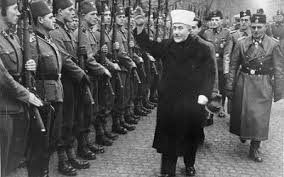
The Times stated that Netanyahu attempted “to distort history in order to draw a straight line between Mr. Husseini’s Nazi views and the current Palestinian leadership.”  Netanyahu didn’t need to do that. Palestinians do that themselves.

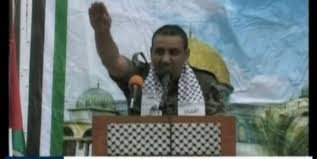
Pal nazi2Pal naziFatah nazimufi Jlem Nazi
Palestinians with Nazis yesterday. Palestinians acting like Nazis today.


Related First One Through articles:

Abbas Knows Racism

What do you Recognize in the Palestinians?

Extreme and Mainstream. Germany 1933; West Bank & Gaza Today

Subscribe YouTube channel: FirstOneThrough

Join Facebook group: FirstOne Through  Israel Analysis

UN Concern is only for Violence in “Occupied Palestinian Territory,” not Israel

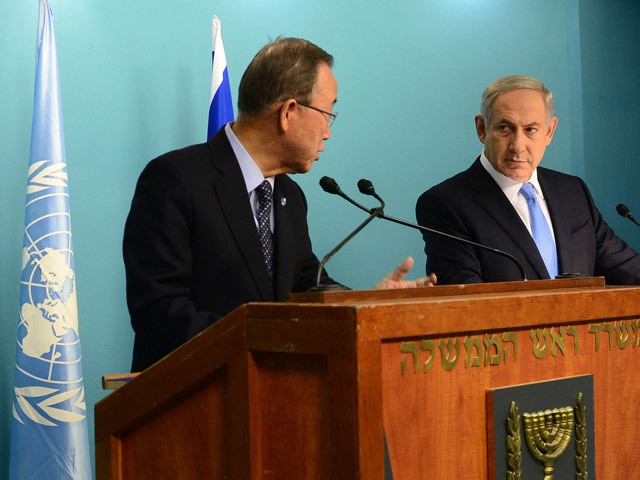
United Nations Secretary General Ban Ki-Moon arrived in Israel on October 19, 2015 with the claim that he hoped to stop “the dangerous escalation in violence across the occupied Palestinian Territory and Israel, especially in Jerusalem,” according to the UN official press release.

PM Netanyahu meets with UN Sec. Gen. Ban Ki-moon

PM Netanyahu meets with UN Sec. Gen. Ban Ki-moon (photo: GPO Kobi Gideon)

In discussing the situation, the United Nations opted to highlight certain cities where attacks took place: “in East Jerusalem, Ramallah, Hebron, Bethlehem, Jenin, Tulkarm and Nablus.” Note that every city that was mentioned was east of the Green Line. Seven cities, and not one west of the Green Line, where several attacks occurred including:

  • Petach Tikva (Stabbing October 7)
  • Kiryat Gat (stabbing October 7)
  • Tel Aviv (stabbing October 8)
  • Afula (stabbing October 8 & 9)
  • Jerusalem, west of the Green Line (stabbing and beating October 9 & 14)
  • Raanana (stabbing October 13)
  • Beer Sheva (shooting October 19)

Are these seven cities west of the Green Line not important? Is violence a concern to the United Nations only if it happens in “occupied Palestinian Territory?”

In case anyone thinks that mentioning seven random cities happened to coincidentally be east of the Green Line, the United Nations repeated those same seven cities the following day on October 20 in the press release mentioning:  “A series of deadly clashes between Palestinians and Israelis, including Israeli security forces, has marked much of October, with violent incidents reported in more than 50 different locations, including in East Jerusalem, Ramallah, Hebron, Bethlehem, Jenin, Tulkarm and Nablus.”

When Ban Ki-Moon said that “No society should have to live in fear. No society can afford to see its youth suffer in hopelessness,” did he really only mean Palestinian Arabs?


Related First One Through articles:

The Narrative that Prevents Peace in the Arab-Israeli Conflict

Eyal Gilad Naftali Klinghoffer. The new Blood Libel.

Every Picture Tells a Story: The Invisible Murdered Israelis

Subscribe YouTube channel: FirstOneThrough

Join Facebook group: FirstOne Through  Israel Analysis

The Journeys of Abraham and Ownership of the Holy Land

One of the most famous cartographers in the world was Abraham Ortelius (1527-1598). Appointed as cartographer to King Phillip II of Spain, the religious Christian Flemish cartographer is credited with creating the first world atlas called “Theatrum Orbis Terrarum” or “Theatre of the World.” The atlas was originally printed in 1570 and became one of the most popular books of its time and resulted in a few printings. In total, there were 178 plates amounting to approximately 730,000 printed copies of the various maps.

In addition to the maps printed in the atlas, Ortelius also produced “Parergon” maps of interesting places. These “classical” maps were produced by Ortelius himself, as opposed to some maps in “Theatrum” which were adopted from other cartographers. The 56 such plates produced roughly 143,000 printed maps.

One of the maps of the Parergon was called “Abrahami Patriarchae” which chronicled the life of the biblical patriarch Abraham. The first map was printed between 1590 and 1595 (975 copies made) with a second plate produced 1592-1624 (2925 copies made). The map shows the journey and life of Abraham with an inset map of his journey from Ur to Canaan, as well as 22 medallions of significant life events. The map highlights Ortelius’s gift as cartographer, artist and historian.

Ortelius
Abrahami Patriarchae Peregrinatio et vitae, 1592

Some notable medallions in the map are detailed below which underscore the belief that God gave Jews the holy land:

  • Medallion 6. Genesis 13: 14-15 “The Lord said to Abram after Lot had parted from him, “Look around from where you are, to the north and south, to the east and west. 15 All the land that you see I will give to you and your offspring forever.”
  • Medallion 10. Genesis 15: 17-21 “17 When the sun had set and darkness had fallen, a smoking firepot with a blazing torch appeared and passed between the pieces. 18 On that day the Lord made a covenant with Abram and said, “To your descendants I give this land, from the Wadi of Egypt to the great river, the Euphrates— 19 the land of the Kenites, Kenizzites, Kadmonites, 20 Hittites, Perizzites, Rephaites, 21 Amorites, Canaanites, Girgashites and Jebusites.”“
  • Medallion 12. Genesis 17:3-8 “3 Abram fell facedown, and God said to him, 4 “As for me, this is my covenant with you: You will be the father of many nations. 5 No longer will you be called Abram; your name will be Abraham, for I have made you a father of many nations. 6 I will make you very fruitful; I will make nations of you, and kings will come from you. 7 I will establish my covenant as an everlasting covenant between me and you and your descendants after you for the generations to come, to be your God and the God of your descendants after you. 8 The whole land of Canaan, where you now reside as a foreigner, I will give as an everlasting possession to you and your descendants after you; and I will be their God.”
  • Medallion 18. Genesis 21: 27-31 (ownership of Beersheba) “27 So Abraham brought sheep and cattle and gave them to Abimelek, and the two men made a treaty. 28 Abraham set apart seven ewe lambs from the flock, 29 and Abimelek asked Abraham, “What is the meaning of these seven ewe lambs you have set apart by themselves?” 30 He replied, “Accept these seven lambs from my hand as a witness that I dug this well.” 31 So that place was called Beersheba, because the two men swore an oath there.“
  • Medallion 20. Genesis 23: 19-20 (ownership of Hebron) “19 Afterward Abraham buried his wife Sarah in the cave in the field of Machpelah near Mamre (which is at Hebron) in the land of Canaan. 20 So the field and the cave in it were deeded to Abraham by the Hittites as a burial site.”

This map was made by a religious Christian, not a Jew. Many evangelical Christians and others that believe in the Old Testament firmly hold that while the holy land may be holy to all of the monotheistic faiths, the land itself is God’s gift to Jews. Indeed, God is the original Zionist.

Framing the Israeli-Palestinian Arab Conflict: WSJ and NY Times

The portrayals of the Israeli-Palestinian Arab conflict in the two main New York newspapers could not be more different.  Snapshots of the two papers on October 17, 2015 and the editorials from the prior days frame the conflicting attitudes.

In Pictures

On October 17, 2015, each paper posted a picture of an attack that occurred in Hebron. The Wall Street Journal captured the Palestinian who posed as a journalist stabbing an Israeli soldier.  The New York Times showed a picture of two Israeli soldiers standing over the dead Palestinian.

IMG_3554
Wall Street Journal front page picture of Israeli soldier attacked by Palestinian
October 17, 2015

IMG_3549
New York Times front page picture of armed Israeli soldiers standing over dead Palestinian October 17, 2015

The Wall Street Journal covered this story – and many of the stories over October 2015 when Palestinians attacked Israelis – as Palestinians as the aggressors and Israelis as defending themselves.  However, The New York Times almost uniformly showed all Palestinians as victims and Israelis as the armed aggressors.

In Editorials

New York Times: On October 15, the Times ran an editorial entitled “The Cycle of Violence in Israel.” The title and the opinion piece described a country that is in a never-ending cycle of “attacks and reprisals“, blaming neither party as being aggressor or instigating the violence.  The attacks were referred to as Palestinian “uprisings,” and the Times pointed the finger at a few parties:

  • “Yasir Arafat, could speak for all Palestinians” back in 1993 so there was a better prospect for peace according to the Times behind a unifying leader.  It neglected to state that the same Arafat walked away from a serious peace offer and then launched the Second Intifada in 2000, killing thousands.
  • The Times correctly stated that “Mahmoud Abbas is bitter and unpopular” which makes it difficult for him to lead and deliver peace negotiations. The paper failed to point out that Abbas has constantly incited violence against Israelis and never put forth any public comments on his willingness to compromise on his demands to create peace.
  • “Netanyahu has demonstrated little interest in a two-state solution” according to the Times, even though he is the only person that specifically has demonstrated a desire for peace: handing over half of the “Holy Basin”, Bethlehem, in 1996; a ten month settlement freeze in 2010; releasing dozens of terrorists; and repeatedly stating his willingness to engage in direct peace talks anytime, anywhere.

The New York Times described the only solution to ending the cycle of violence as “creating an independent Palestinian state alongside an Israel whose right to exist is fully acknowledged by all Palestinians.”  Note that the Times language specifically does not mention any Israeli demands of “security” and recognition as a “Jewish State.”  According to the Times, the only thing creating violence is the lack of a Palestinian state.

Wall Street Journal: On October 16, 2015, the WSJ had an editorial called “The Knives of Jerusalem.” The Journal’s attitude about the violence and approach could not be more different than the New York Times:

  • The WSJ called the Palestinian Arab attacks “terrorism” five times, a term never used by the Times (nor by the Obama Administration for that matter)
  • “[A] deep-seated culture of hate” among Palestinian Arab society was at the core of the attacks
  • Blame is specifically placed on Palestinian leaders including Abbas spreading “rumors” and “lies” about Israel to incite the Arabs.

The WSJ noted that Israel will need “to ride out another storm of terror.”  Peace will ultimately come when Palestinians realize that the Jews are not going to leave: “The sooner they [Israelis] impress on Palestinians that they will never bow to knives or bend to terror, the sooner the stabbings will end.”


The Times placed the principal blame for the attacks on Israeli “occupation” and therefore the solution is a peace agreement / a separation accord. Their pictures and articles repeatedly use images of Palestinians as victims and Israelis as militant occupiers.

The WSJ placed the blame on Palestinian Arabs who have denied the right of Jews to live in the holy land as self-governing people since the League of Nations gave Jews that legal right in 1922.  Peace will only come when Palestinian Arabs give up the fight and accept that the Jews are never going to leave. Their articles are more likely to show Israel as at the frontlines in the battle against Islamic radicals, similar to much of the western world.

The pictures and articles of the two papers have been consistent in their coverage of the conflict, and the weekend of October 17, 2015 brought the contrast into clear focus.


Related First One Through articles

Every Picture Tells A Story: Only Palestinians are Victims

Why the Media Ignores Jihadists in Israel

The Israeli Peace Process versus the Palestinian Divorce Proceedings

Every Picture Tells a Story: Versions of Reality

Subscribe YouTube channel: FirstOneThrough

Join Facebook group: FirstOne Through  Israel Analysis
Every Picture Tells a Story: Versions of Reality

The New York Times published an article on October 16, 2015 entitled “Conflicting Accounts of Jerusalem Strife Surround Wounded Boy“.  The article described a 13-year old Palestinian boy who stabbed a 13-year old Israeli boy who was riding a bicycle.  The acting-President of the Palestinian Authority Mahmoud Abbas claimed that the innocent Palestinian was executed by Israelis, while in fact he was recuperating at an Israeli hospital.

Normal logic would suggest that the pictures that accompany the article have something to do with the story.  Indeed, the Times did post a small black-and-white photograph of the 13-year old Palestinian recuperating in a hospital bed.  However, the Times decided to post a much larger photograph on top of that picture – of Israelis with machine guns standing over Palestinian Arab women.

IMG_3546
Times leading with a picture of armed Israelis standing over Arab women in a story about a 13-year old Palestinian terrorist being described as “executed” by Mahmoud Abbas

Why didn’t the Times also post a picture of the wounded Israeli boy? Why didn’t it have a picture of Abbas declaring the boy “executed”?  Or Israeli Prime Minister Benjamin Netanyahu pointing out the lies and incitement of Abbas? Because for this “progressive” newspaper, the real story about Arabs attacking innocent Israelis is about Israelis fighting Palestinians, not the other way around.

The Times wrote a piece about “conflicting versions of reality” between Israelis and Palestinians. The reality of the Times constant portrayal of Israelis “occupying” Palestinian victims is another disturbing story in the “conflicting” (read “false”) narratives that fan the flames in the region.


Related First One Through articles:

Every Picture Tells A Story: Only Palestinians are Victims

Every Picture Tells a Story: The Invisible Murdered Israelis

Subscribe YouTube channel: FirstOneThrough

Join Facebook group: FirstOne Through  Israel Analysis
Every Picture Tells A Story: Only Palestinians are Victims

The “Every Pictures tells a Story” series reviews newspapers through a lens focused only on their pictures and captions. The brutal attacks that occurred in Israel during the week October 7-14 provide a good snapshot for how the New York Times viewed the conflict – the only victims in the Middle East are Palestinians.

To set the background for the two weeks of violence: on October 1, 2015, Palestinians shot an Israeli couple who were driving on a road with four of their children. After shooting up the car, the Palestinians approached it once it came to a stop and executed the parents. The Times did not post any pictures of the Henkins, the murdered Israelis along the story. If one were to only focus on the pictures and captions, their murders would never have occurred.

In the following days, the number of Palestinian Arab attacks against Jews continued to grow in frequency. Yet remarkably, the Times pictures showed one story: Palestinians as victims.

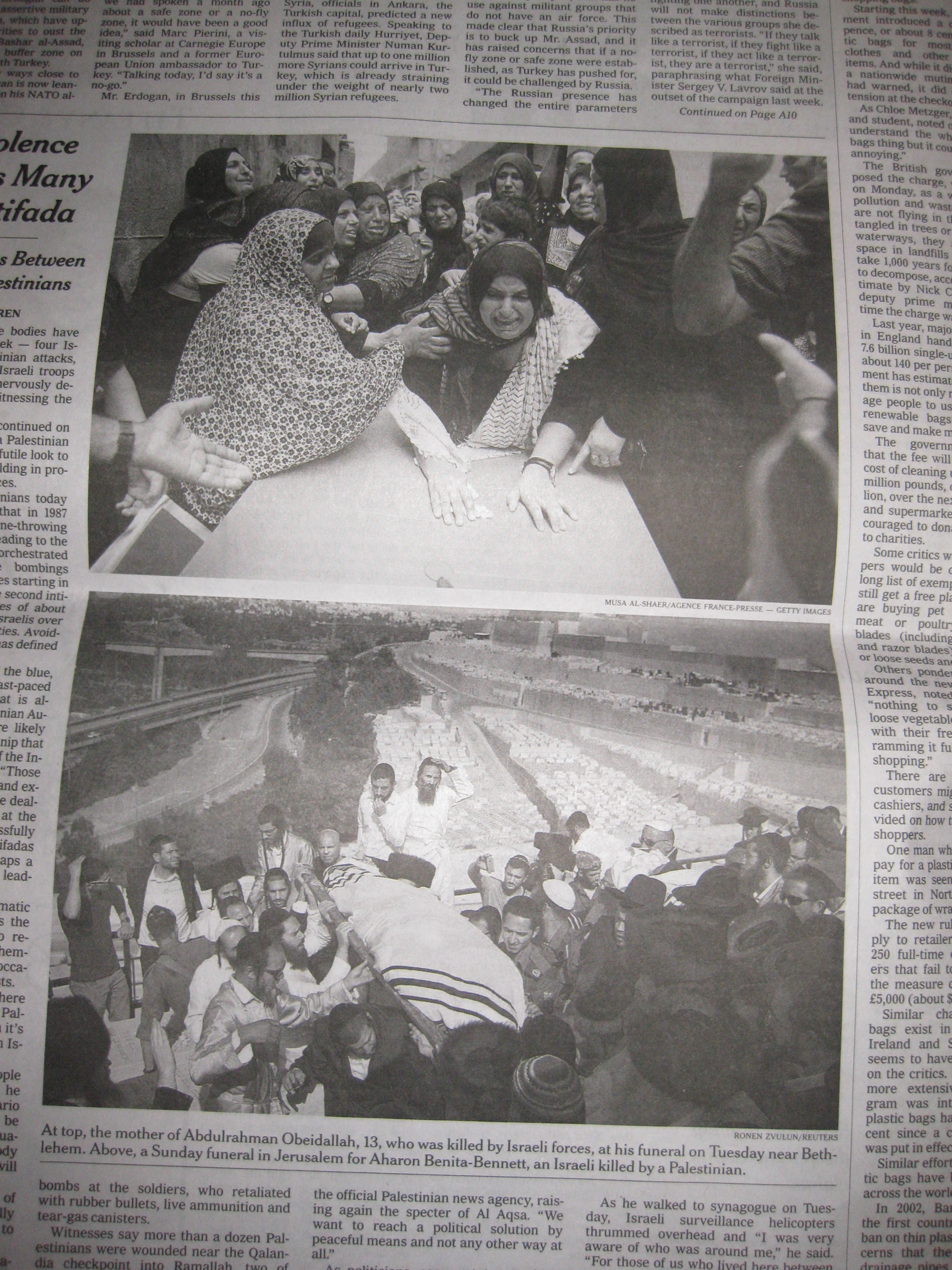
October 7 Page A4. “At top, the mother of Abdulrahaman Obeidallah, 13, who was killed by Israeli forces, at his funeral on Tuesday near Bethlehem. Above, a Sunday funeral in Jerusalem for Aharon Benita-Bennett, an Israeli killed by a Palestinian.” This was the Times only attempt at providing a “balanced” picture of deaths on both sides. However, there was no attempt to convey that the Palestinian was not shot intentionally, while the Palestinians deliberately were murdering Israelis.

IMG_3538
Only NY Times photo showing Israelis attacked during week October 7-14, 2015
included picture above of Palestinian killed

October 8 Page A6. “A Palestinian man in a flooded tunnel that was used to smuggle goods between Egypt and the Gaza Strip. Egypt has been flooding the tunnels to deter smuggling.” The large color picture and caption leads one to feel sorry for the Palestinian. Of course, what was not mentioned was that the “goods” that were being smuggled into the tunnels included weapons to target Israelis and Egyptians.  The article continued on page A14 with two black and white pictures.  The large picture’s caption “Juma Abu Shaer and his wife Masouma Abu Shaer, at home in Rafah. They fear they may have to leave because of flooding.” Names are given of people living in fear. You will not see that for Israelis over the week of terror attacks. The last small photo has a caption “The border between Rafah, in the Gaza Strip, and Egypt on the right. Egypt has flooded part of the nine-mile border area twice.” Such picture and caption confirms that the Times knows that many readers only glance over the articles and rely on the pictures and captions only.

The article about “Unrest Spreads in Israel Despite Tighter Security” which reviewed more Palestinian’s attacking Israelis had no pictures.  No Israelis were injured in unprovoked attacks for the news-in-pictures.

IMG_3536IMG_3537
Three sad Palestinian Arabs

October 9 Page A14. “An Israeli man looked over the body of a Palestinian assailant who was shot dead after carrying out a stabbing attack on an Israeli soldier and three civilians in Tel Aviv on Thursday.” Another article with larger picture “Palestinian protestors took cover during clashes with Israeli security forces on Thursday in Beit El, West Bank. Disputes over Jerusalem have added to tensions.” The pictures again show dead Palestinians and those under fire. There were no pictures of Israeli civilians who the Palestinian stabbed in unprovoked attacks. The “protestors” are not shown throwing Molotov cocktails and rocks.

IMG_3534IMG_3535
Dead Palestinian and one under attack

October 10 Page A4. Small color picture of soldiers over small boys “With security increased, Israeli border police told Palestinians on Friday they could not enter the Noble Sanctuary in Jerusalem’s Old City.” The caption fed a Palestinian narrative that the unrest is from Israeli soldiers keeping innocent Palestinians from praying at their holy site. The image of soldiers with weapons directing small boys add to the drama of the story. There were no pictures of Arabs harassing Jewish visitors on the Temple Mount nor firing firecrackers at the soldiers.

IMG_3527
Sad Palestinians Turned away by Israeli soldiers

Page A8: 2 color pictures. Very large crowd of Palestinians carrying wounded “Palestinians carried a wounded man on Friday in Gaza. It was the first time in the latest outbreak that significant unrest spread to the territory” smaller picture of man throwing stones “A Palestinian protestor hurled some stones at Israeli soldiers on Friday amid clashes on the Israeli border.” Again, Palestinians are shown injured, not Israelis.

Page A8 another article with medium color picture of Israelis taking wounded away “Israeli emergency personnel loaded a Palestinian into an ambulance on Friday after violent confrontations in the West Bank.” In the third article of the day, the Times once again chose to only show injured Palestinians in attacks that they provoked. None of the injured Israelis is pictured.

IMG_3524
Dead Palestinian

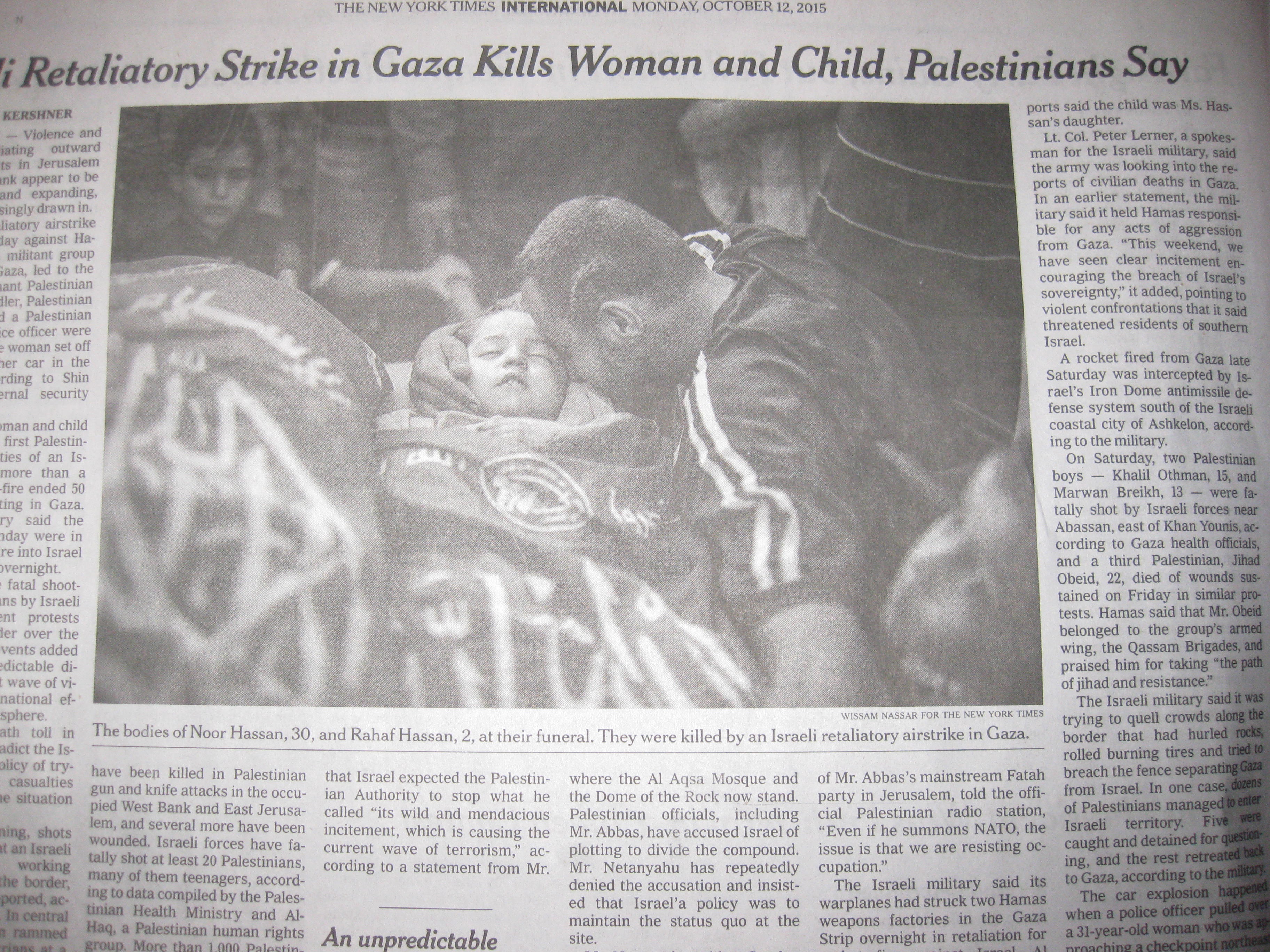
October 12 Page A6. Black and white of father over dead child “The bodies of Noor Hassan, 30m and Rahaf Hassan, 2, at their funeral. They were killed by an Israeli retaliatory strike in Gaza.” While the caption at least mentioned that the Israeli did a “retaliatory strike” conveying that Palestinians initiated the fight (compared to earlier language of a generic “confrontation”) the pictures are again only of Palestinians hurt in the conflict.

IMG_3520
Two dead Palestinian Arabs

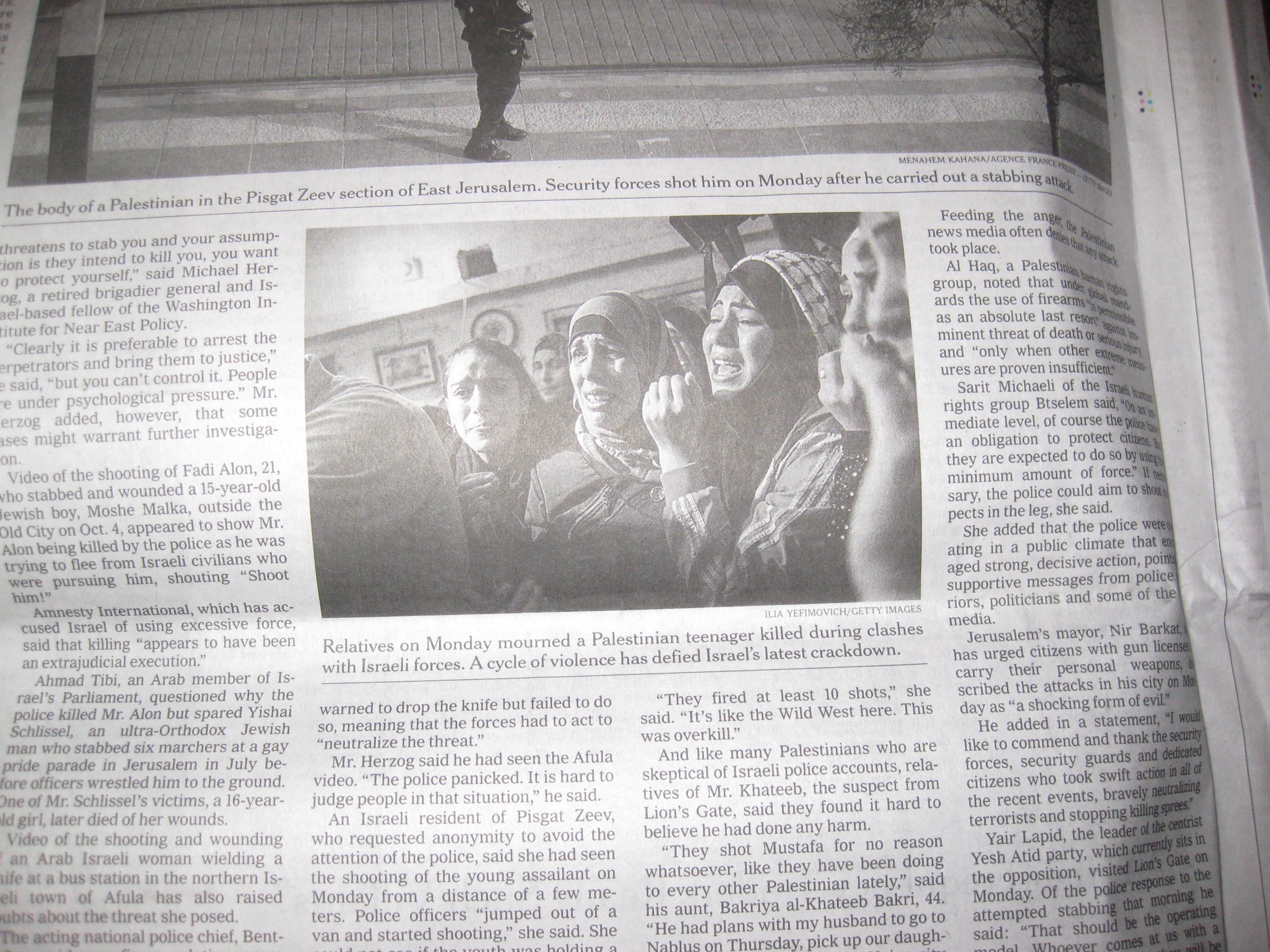
October 13 page A4. Two black and white photographs. The large photo caption reads “The body of a Palestinian in the Pisgat Zeev section of Eat Jerusalem. Security forces shot him on Monday after he carried out a stabbing attack.” The body of a partially dressed man lay on the ground surrounded by police.  The smaller photo showed women crying with a caption “Relatives on Monday mourned a Palestinian teenager killed during clashes with Israeli forces. A cycle of violence has defied Israel’s latest crackdown.”

IMG_3529IMG_3530
Dead Palestinian and Grieving Palestinians

October 14 COVER PAGE: On a particularly violent day with Palestinian Arabs hacking people with meat cleavers and killing three, the Times covered an alternative news in its pictures. The front page large color photo of Palestinians running from Israeli tear gas with a caption “Palestinian demonstrators scattered Tuesday after Israeli forces fired tear gas during clashes in the West Bank city of Bethlehem.”

IMG_3540
Cover page picture of Palestinians fleeing from Israeli forces

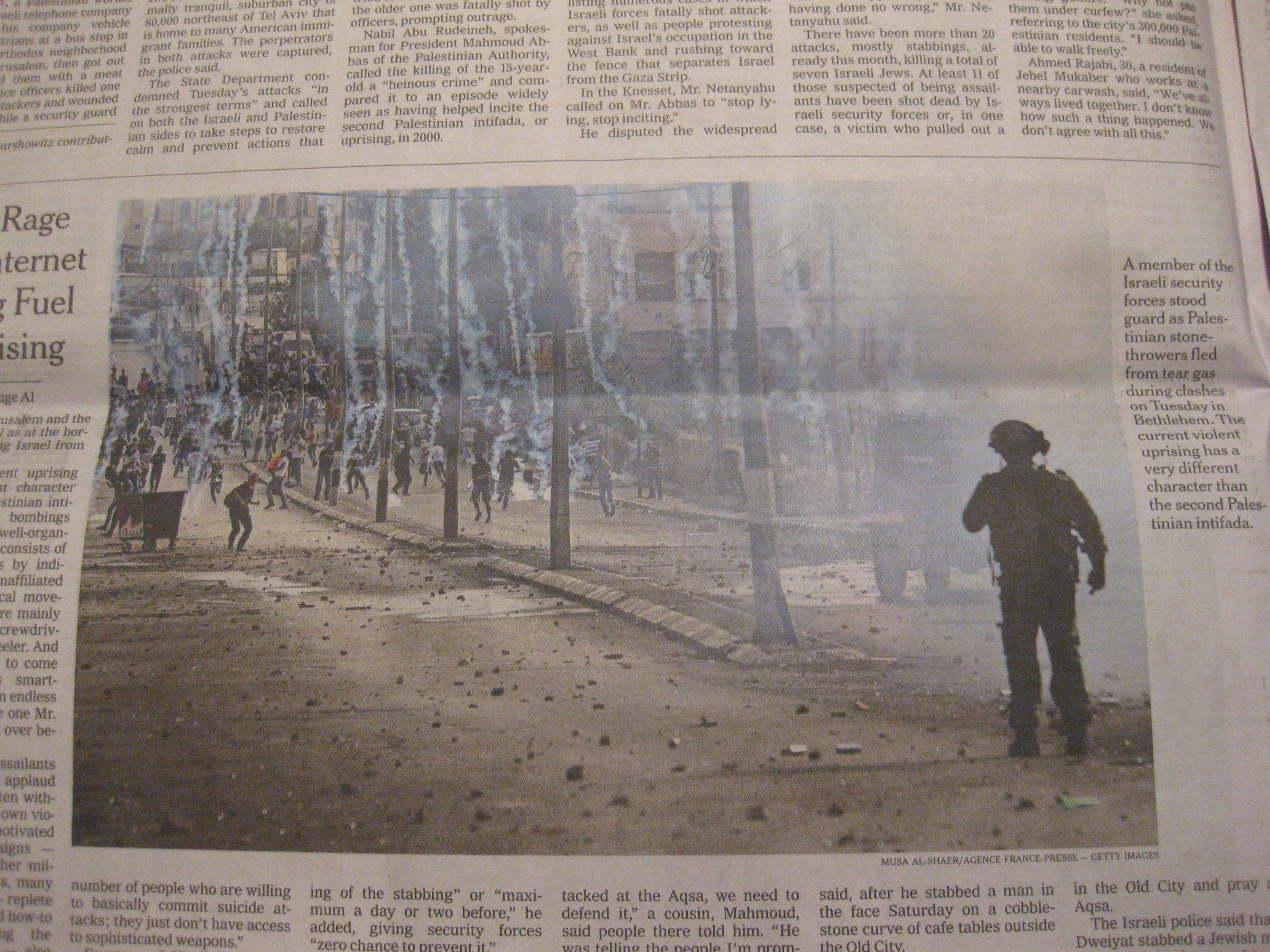
Page A8: The cover page story continued on page A8 with another large color picture of Israeli forces before Palestinians running from tear gas. The caption: “A member of the Israeli security forces stood guard as Palestinian stone throwers fled from tear gas during clashes on Tuesday in Bethlehem. The current violent uprising has a very different character than the second Palestinian intifada.”

IMG_3543
Palestinians fleeing tear gas

Page A8: Another story about the attacks medics pulling someone out of a bus. The caption: “Israeli emergency responders removing the body of a Palestinian from  bus where an attack took place in Jerusalem in Tuesday.” No Israeli victims covered from an unprovoked attack by a crazy Arab- note that no blame assigned for the “attack” in the caption.

IMG_3541
Dead Palestinian removed from a generic “attack”

In a week that saw dozens of unprovoked attacks on Israelis, it cannot be an oversight that the New York Times repeatedly chose to show only injured Palestinians. The Times deliberately decided to feed the narrative of Palestinian victimhood. The Israelis were seemingly untouched.

There are some researchers that argue that the media and social media are fanning the flames of the unrest in the Middle East by fanning “misinformation.” If so, the Times’ irresponsible journalism might be viewed as a war crime.


Related First One Through articles:

Every Picture Tells a Story: The Invisible Murdered Israelis

Every Picture Tells a Story- Whitewashing the World (except Israel)

Every Picture Tells a Story, the Bibi Monster

Every Picture Tells a Story, Don’t It?

The New York Times’ Buried Pictures

Subscribe YouTube channel: FirstOneThrough

Join Facebook group: FirstOne Through  Israel Analysis

Active and Reactive Provocations: Charlie Hebdo and the Temple Mount

Leaders of the Western World came to the defense of the French satirical magazine Charlie Hebdo in early 2015, after radical Islamists gunned down the staff in their offices. Those leaders stood in solidarity with the French in the name of freedom of speech. Yet those same leaders have not rallied to the side of Israel while Islamic radicals murder and attempt to murder Israelis for an even more basic principle.

empty-street-in-Jerusalem-during-Yom-Kippur
Empty Street in Jerusalem

Active Provocation

An act of active provocation is one in which the action itself is specifically designed to provoke and upset an individual or group. The person taking the action does not have any benefit from the activity, other than the enjoyment of upsetting someone.

For example, when Pamela Geller held a “Draw Mohammed” contest in Texas in May 2015, the event was designed to upset Muslims. The action of portraying the Islamic prophet in physical form is considered highly insulting to many Muslims, and several people came to the event with the goal of killing participants for the sacrilegious act.

While people came out in defense of Geller for exercising her right of free speech, few would argue that Geller had any personal benefit from her actions other than getting satisfaction in hurting the feelings of Muslims.

Reactive Provocation

Reactive provocation is significantly different from active provocation. Such activity has personal benefit and there is no intention of malice. For example, a person may eat a turkey sandwich which they truly enjoy, even though another person may be a vegetarian and find the action upsetting.

Everyone has sensitivities. How far could a society extend itself to ban certain “normal” activities because some people may be offended by the actions?

Would a government ban gay people from holding hands in public if it upsets the values of some religious people? Would it ban all meat because it upsets vegetarians?  It would be impossible to navigate such a world in which anyone could object and block any action.

America was founded on the principle of the “pursuit of happiness” and has defended such right in cases of active provocation such as Pamela Geller in the US and Charlie Hebdo abroad. How could it do less for situations of reactive provocations?

Western Values versus Personal Interest

Various western societies offer a wide spectrum of freedoms including, speech, assembly and religion meant to cover elements of “life, liberty and the pursuit of happiness.” Western culture is designed to offer space for different people to live and interact, even if various belief systems are in conflict. The expectation is for tolerance of different and possibly offending views.

The raison d’etre of Charlie Hebdo is to offend. It’s cartoons are examples of active provocation whereby people deliberately upset others. While the comedic value of some of the pieces could be debated, the principle of freedom of speech is core to western society and fiercely protected. While writing a magazine is not a common activity, free speech is a daily activity of everyone, so the leaders of western countries stood together to defend active provocation and all forms of free speech.

hebdo march
World Leaders come out in solidarity with France
January 2015

In Israel, people also attempt to live with ordinary freedoms.  Like other democracies, they include freedom of speech, press, religion and assembly. But such freedoms sometimes offend radical Muslims.

The Temple Mount has maintained established visiting hours for Jews and non-Jews alike for any decades.  People of all faiths visit the site.  They do so as a natural act of visiting an incredible tourist site or because of religious conviction.  They do not visit as a pretext of causing offense to anyone.  If there are some Islamic extremists who are upset that Jews visit, that is a reaction based on that person’s anti-Semitic biases, an example of reactive provocation.

Muslims have become more worried about Jewish visitation to the Temple Mount which they consider holy as well.  The number of Jews visiting the Temple Mount doubled over the past five years to about 11,000 in 2014.  It is still a paltry sum compared to the estimated 4 million Muslims who come to the site each year. However, fears of the growing Jewish presence has made Muslims begin to attack Jews throughout Israel.

So why is the western world so cavalier about the carnage in Israel from Islamic radicals, while shaken to its core for the Hebdo killings? Is freedom of religion and access a lesser democratic value than speech?  Is France considered more western than Israel? Perhaps some believe that to be true.

It is also a fact that Europe and America do not have shrines holy to Islam, so the situation of the al Aqsa mosque is really a narrow problem for Israel to handle.  Western ambivalence may not be so much a function of values as it is proximity.

How embarrassing that the narrow scope of the champions of democracy shows that they are less interested with values than personal interests.  The world should loudly condemn Islamic terrorism and support freedoms which are enshrined in Israeli law and democratic ideals.


Related First One Through articles:

My Terrorism

I’m Offended, You’re Dead

Selective Speech

Visitor Rights on the Temple Mount

Subscribe YouTube channel: FirstOneThrough

Join Facebook group: FirstOne Through  Israel Analysis
Visitor Rights on the Temple Mount

The cries coming from the acting-President of the Palestinian Authority and his rival political party, the terrorist group Hamas, to “defend al-Aqsa” stem from their claim that they are concerned that Jews are coming to destroy and/or defile the al Aqsa mosque, the third holiest site in Islam. To generate such fear, one would imagine that Jews are coming to the Temple Mount (on which al Aqsa sits on the southeastern most tip) illegally, and are bringing with them weapons and shouting threats against the mosque.

All of those assumptions would be completely false.

temple mt visit

To placate the outrageous claims from the PA, Hamas and the king of Jordan, on October 7, 2015, Israeli Prime Minister Benjamin Netanyahu announced a ban on Israeli members of Knesset from visiting the Temple Mount.

Here is a review of the completely legal, internationally approved and natural rights associated with Jews visiting the Temple Mount and today’s sad reality that none of it seems to matter.

Visiting Hours

Facts: The Temple Mount has regular visiting hours for people of all faiths. As mentioned by the popular tourist guidebook, Frommers:

“There is no charge to enter the Temple Mount compound. You must not, however, wear shorts or immodest dress in the compound. (If your outfit is too revealing, guards may be willing to provide you with long cotton wraps, or they may ask you to return another time with more modest clothing.) Visitors are allowed on the Temple Mount
by permission of the Islamic religious authorities, and are asked
to obey instructions given by the guards.

There is an admission fee of NIS 38 ($9.50/£4.75) to go inside the two mosques and the Islamic Museum. If the buildings are again open to foreign visitors, I highly recommend that you invest in the combined admission ticket, which may be purchased from a stone kiosk between Al Aqsa and the Dome of the Rock. If visiting hours
are lengthened, you may usually remain on the Temple Mount, but cannot enter
the Dome of the Rock or the Al Aqsa Mosque during the midday prayers.”

The World Travel Guide site lists the specific visiting hours and ways of accessing the Mount:

“Only one of the 10 gates to the complex, Al-Mughradi Gate, allows entry for non-worshippers. This is located to the right of the Western Wall and is accessed from
the Western Wall Plaza.

Opening Times: Closed during all prayer times (variable); otherwise Sun-Thurs 0730-1130 and 1330-1430 (summer); Sun-Thurs 0730-1030 and 1330-1430 (winter); Sun-Thurs 0730-1030 (during Ramadan); closed to non-Muslims Fri and Muslim holidays. During periods of tension, the site may be closed.

Admission Fees: No (for Temple Mount; charge for Dome of the Rock, Al Aqsa Mosque and Islamic Museum combined ticket).

Disabled Access: No

Unesco: Yes“

Reality today: Despite the publicized openness of the site, visiting this holy site and famous tourist location can be anything but pleasant. Hamas pays for Murabitun, Islamic extremists who shout and taunt Jewish visitors on the Temple Mount. Arabs have also hurled rocks at non-Muslim visitors.

Due to the various attacks, Israeli police escorts typically accompany non-Muslim visitors. The military has also occasionally restricted access to the Temple Mount for Muslims under 50 years old due to security concerns.

International Treaty

Facts: In 1994, Israel and Jordan signed a Peace Treaty. In that treaty was language that specifically gave special recognition of Jordan’s historic role at the Temple Mount site, while also cementing Israel’s responsibility for security.

The 1994 treaty discussed the Temple Mount, because Jordan had secured custodian rights to the site.  Jordan attacked Israel and illegally seized the entire Old City of Jerusalem (and Judea and Samaria) in 1948 and thereupon occupied the Old City. The Jordanians then expelled all of the Jews from the city and granted Jordanian citizenship to the Palestinians in the city. When Jordan attacked Israel again in 1967, it lost the Old City, but Israel allowed the Islamic Waqf controlled by Jordan to continue to administer the Temple Mount.

The Jordan-Israel treaty clearly gave rights to all people to visit holy sites in Jerusalem.  Article 9.1: “Each Party will provide freedom of access to places of religious and historical significance.”

And Article 9.3: “The Parties will act together to promote interfaith relations among the three monotheistic religions, with the aim of working towards religious understanding, moral commitment, freedom of religious worship, and tolerance and peace.”

Reality today: The kingdom of Jordan signed a treaty with Israel that assured the “freedom of access to places of religious and historical significance,” and to “promote interfaith relations… with the aim of working towards religious understanding.”  The words in that agreement seem empty today as the Jordanian king claims the Temple Mount only has an “Arab character,” as he threatens to destroy the relationship with Israel because Jews are visiting the Temple Mount.

Israeli Law

Facts: When Israel reunified the city of Jerusalem in 1967, the Israeli Prime Minister Levi Eshkol handed administrative control of the Temple Mount back to Jordan, the country that had just attacked his country for the second time in 20 years. He then enshrined “The Protection of Holy Places” law that all people would have access to the holy sites in Jerusalem.

” 1. The Holy Places shall be protected from desecration and any other violation and from anything likely to violate the freedom of access of the members of the different religions to the places sacred to them or their feelings with regard to those places.

  1. Whosoever desecrates or otherwise violates a Holy Place shall be liable to imprisonment for a term of seven years.

  2. Whosoever does anything likely to violate the freedom of access of the members of the different religions to the places sacred to them or their feelings with regard to those places shall be liable to imprisonment for a term of five years.”

The 1967 Israeli Law was complemented by the 1994 Jordanian-Israeli Treaty which not only promised Israeli support for universal access to the holy sites, but Jordan’s support as well.

Reality today: However, the current Prime Minister of Israel Benjamin Netanyahu is trampling on Jewish rights of access and “feelings with regard to those places” as he bans their visitation rights even though they bring no weapons and threaten no one.

United Nations on Access

Facts: The United Nations often claims that it is concerned with providing access to people of all faiths to their holy sites and that it would prefer to see a “universal” approach to sites that are holy to many religions.  For example, UNESCO on March 19, 2010 published a piece about Palestinian rights to the Cave of the Patriarchs in Hebron and the Tomb of Rachel in Bethlehem, among the holiest sites in Judaism.  UNESCO wrote:

  • that Israel was “endangering Palestinian cultural heritage and denying Palestinians their cultural patrimony, as well as denying development and access to heritage sites and historic places of worship.”
  • “Israel has publicly begun to use these sacred and universal sites to provoke unnecessary religious conflict by promoting control and access on the exclusive basis of one faith while denying the rights and views of other faiths.”

By these statement, it would appear that the UN is very concerned:

  • that people of all faiths be allowed access its holy places;
  • that such holy places not be under the exclusive control of a single faith; and
  • that people should not be cut-off from their “cultural patrimony.”

A person would naturally assume from these UN comments about Hebron and Bethlehem, that the UN must strongly endorse Jewish rights of access to their holiest site in the world, and it must strongly condemn any group or country that sought to deny Jews those rights.

Reality today: But this is the United Nations that specializes in inversion when it comes to Israel. Secretary General Ban Ki-Moon described the basic Jewish desire and action of accessing its Temple Mount as a “provocation.”


Access is Not a Provocation

As detailed above, people of all faiths visiting the Temple Mount is legal by Israeli law, enshrined in an international treaty with Jordan, and follows a blueprint for co-existence as stated by the United Nations. Indeed, visiting hours exist for everyone.

For Jews, visiting their holiest spot in the world is a natural desire. They seek to do so in peace and quiet.  They do not seek to instigate a fight with anyone on the Mount.  Even Rabbi Yehuda Glick who was shot by Palestinian Arabs for advocating for Jewish prayer rights on the Temple Mount, did not seek to harm al Aqsa Mosque in any way.

No Temple = No Rights

If Jewish access to their holy sites is guaranteed and no one urged harming the site in any way, on what basis have Palestinian Arabs and Jordanians sought to deny Jews those basic rights of access?

The Palestinian Arabs have put forth a narrative that the Jewish Temple never existed on the Temple Mount. Their rationale is that if the Temple never existed there, Jews can claim no special visitation rights.

Consider that in addition to Mahmoud Abbas never mentioning Judaism in any of his speeches at the United Nations, there have been these quotes:

  • Mahmoud Abbas: “The leaders of Israel are making a grave mistake by thinking that history can move backward and that they could impose facts on the ground by dividing the Aksa Mosque in time and space, as they did with the Ibrahimi Mosque [Cave of the Patriarchs] in Hebron.”
  • The Islamic Waqf on the discovery of ancient Jewish artifacts near the Temple Mount: “an attempt to support Israeli claims about Jewish rights in the holy city and to impose Israeli sovereignty on the occupied holy compound through the use of fake evidence….An immediate Arab and Muslim campaign is needed to stop the Israeli attempts to Judaise the holy city of Jerusalem,”
  • Israeli Arab MK Masoud Ganaim said the Temple never existed. “The site has always been holy to Islam, never to any other religion.”
  • Hamas’ Khaled Mashaal on the opening of the Hurva synagogue in the Old City: “It is part of a project to destroy the al-Aqsa Mosque” and replace it with Israel’s so-called “Solomon’s Temple.” It is a “falsification of history and Jerusalem’s religious and historic monuments.“

Never mind that even Atheists have rights of access.

Never mind that denying a core belief of Judaism spits in the face of a treaty that sought to promote interfaith relationships.

The argument itself is nonsensical by the Arabs’ own beliefs.  The Christian story of Jesus is specifically placed at Jerusalem’s Jewish Temple. How can Abbas or Jordanian king Abdullah claim special rights over the Church of the Holy Sepulchre, if they deny the story of Jesus in Jerusalem?

The Insanity of Today

Regardless, logic and rights fall flat in the face of Islamic fundamentalism: The UN condemns Israel for managing security, for which it has responsibility. It attacks Israel for the “provocation” of enabling Jews to have access to its holy sites. And the United States urges Israel to maintain the status quo, even though Netanyahu has stated over-and-again that he has and will.

So to appeal to the crazies, Netanyahu is banning members of the Knesset from access to Judaism’s holiest site.

It would appear that the left-wing radicals and racists are slowly winning the battle against human decency.


Related FirstOne Through articles:

The Waqf and the Temple Mount

Tolerance at the Temple Mount

The United Nations and Holy Sites in the Holy Land

The UN’s Disinterest in Jewish Rights at Jewish Holy Places

Jordan’s Deceit and Hunger for Control of Jerusalem

“Extremist” or “Courageous”

Subscribe YouTube channel: FirstOneThrough

Join Facebook group: FirstOne Through  Israel Analysis

US State Department Comments on Terrorism in Israel and the Territories

There were several terrorist attacks against Israeli Jews in early October 2015.  The US State Department gave very tepid comments about the murders, especially compared to how the US reacted to the arson attacks that claimed the lives of three Palestinian Arabs in July 2015.  When one considers that the attack against the Arabs was arson against a house (which could have been empty) compared to deliberate murders shooting at a moving car and stabbing individuals, the response from the US State Department was even more appalling.

 Kirby
State Department Spokesperson John Kirby


July 31 Attack on Arabs October 1 Attack on Jews October 3 Attack on Jews
Words in Statement 122 68 77
Condemnation “condemns in strongest possible terms” “strongly condemns” “strongly condemns”
Terrorist attack “vicious terrorist attack” AND “terrorism” “terrorist attack” Not called terrorism
Condolences “profound condolences” “condolences” No condolences
Prayer for Injured “prayers for a full recovery” None None
Families mentioned “Dawabsheh family” None None
Location of Incident “Palestinian village of Douma” “West Bank.” Not Israeli; not Samaria “Old City of Jerusalem today”. Not Israeli
Call for Justice “murderers” “the perpetrators” “all perpetrators of violence” A general term

As seen in the chart above, the trend line of not even expressing condolences or calling the attack terrorism is very worrying.

Supporters of Israel have long complained about the bias of the United Nations against Israel.  It would appear that those supporters must now worry about the support of its strongest ally.

#JewishLivesMatter

Attacks Against Israelis

US State Department October 3, 2015:

“The United States strongly condemns all acts of violence, including the ‎tragic stabbing in the Old City of Jerusalem today that left two victims dead and two injured. We call for all perpetrators of violence to be swiftly brought to justice. We are very concerned about mounting tensions in the West Bank and Jerusalem, including the Haram al Sharif/Temple Mount, and call on all sides to take affirmative steps to restore calm and avoid escalating the situation.”

US State Department October 1, 2015:

“The United States strongly condemns the terrorist attack that took place late Thursday evening in the West Bank. The shooting resulted in the death of an Israeli couple who were driving with their young children. We extend our condolences to the victims’ family. We urge all sides to maintain calm, avoid escalating tensions in the wake of this tragedy, and work together to bring the perpetrators to justice.”

Attacks Against Palestinian Arabs

US State Department July 31, 2015:

“The United States condemns in the strongest possible terms last night’s vicious terrorist attack in the Palestinian village of Douma. The arson attack on a family’s home in the dead of the night resulted in the death of an 18 month-old baby and the injury of three other family members. We convey our profound condolences to the Dawabsheh family and extend our prayers for a full recovery to those injured.

We welcome Prime Minister Netanyahu’s order to Israel’s security forces to use all means at their disposal to apprehend the murderers for what he called an act of terrorism and bring them to justice. We urge all sides to maintain calm and avoid escalating tensions in the wake of this tragic incident.”


Related First.One.Through articles:

UN Comments on the Murder of Innocents: Henkins

UN Comments on the Murder of Innocents: Itamar and Duma

The New Blood Libel

The US State Department’s Selective Preference of “Status Quos”

Subscribe YouTube channel: FirstOneThrough

Join Facebook group: FirstOne Through  Israel Analysis