From Dreams to Nationhood: Surrealism and the Rebirth of Israel

Surrealism did not invent the language of dreams and symbols; it applied the principles to art. For the Jewish people, that language had long been central: a civilization built on ritual, memory, and meaning encoded in objects, stories, and repeated acts of remembrance.

When Surrealism emerged from Freud’s ideas, it offered a new lens to examine what Jews had already lived: that symbols shape identity, and that dreams can carry a people across time. In the aftermath of Europe’s destruction, that lens reveals a stark contrast: while others turned to common stories to process loss, the Jewish people used their symbolic tradition to rebuild and to turn dream into reality.


Interpreting Dreams

At the turn of the twentieth century, Sigmund Freud (1856 Czechia – 1939 United Kingdom) proposed something radical: that the human mind operates on two planes at once. The conscious – ordered, rational, disciplined. And beneath it, the unconscious – restless, suppressed, filled with fears and desires that shape behavior without announcing themselves.

Dreams, Freud argued in The Interpretation of Dreams (1899), are the bridge between these worlds.

They are not noise. They are language.

A language built on symbols: recurring forms that carry meaning across individuals and cultures. A house becomes identity. Water becomes birth or transformation. Men are featured as long cylindrical objects while women are enclosed spaces. Objects are never just objects. They are carriers of something deeper, something shared.

Freud did not invent symbolic thinking. He revealed that we are already immersed in it.

And once that realization entered European culture, it transformed how artists saw their role: not as imitators of reality, but as revealers and interpreters of the unconscious.


The Dream Made Visible

Surrealism emerged from collapse.

World War I shattered Europe’s faith in reason. The same systems that promised progress delivered mechanized death. Logic, order, and scientific advancement had not restrained violence but refined it.

Into that rupture stepped André Breton (1896 France -1966 France). In 1924, his Surrealist Manifesto defined the art movement as “pure psychic automatism,” an attempt to express the true functioning of thought, unfiltered by reason or convention. It was a deliberate rejection of the structures that had failed and a search for truth in the raw, unmediated currents of the mind.

Surrealism was not escapism. It was rebellion against a reality that could no longer be trusted.

Artists like Giorgio de Chirico (1888 Greece – 1978 Italy) created haunting spaces – empty plazas, long shadows, objects placed together without explanation. These works do not resolve into meaning. They create a feeling of dislocation, of being suspended in a waking dream where logic loosens its grip.

Piazza d’Italia by Giorgi de Chirico (1913)

Jane Graverol (1905 Belgium – 1984 France) made the point plainly, saying that her canvases are “waking, conscious dreams.”

René Magritte (1898 Belgium – 1967 Belgium), strips away ambiguity and addresses the viewer directly. His 1929 painting The Treachery of Images confronted viewers with the bold statement “This is not a pipe” that what they were seeing was not an object but the symbol of an object.
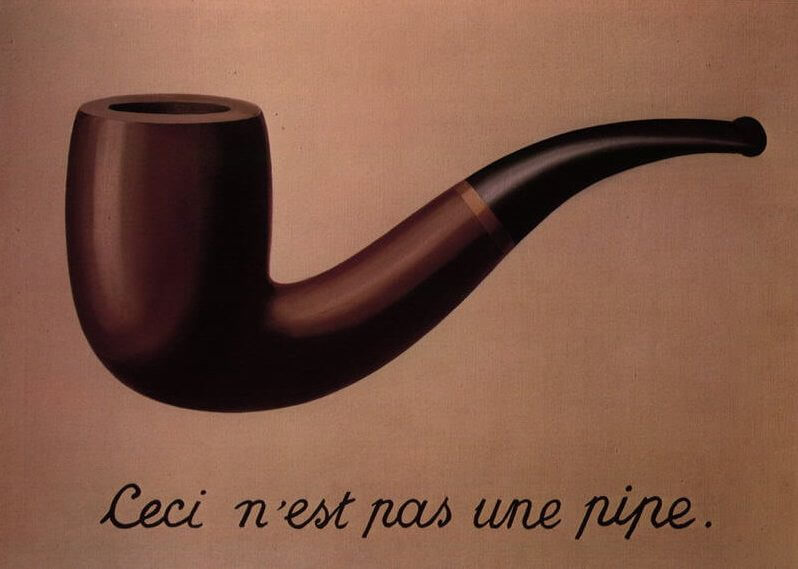
The Treachery of Images by Rene Magritte (1929)

The statement is instructional.

Magritte is not playing with illusion. He is teaching a fundamental principle: that art is inherently symbolic. The painted pipe is not a pipe but a representation of a pipe. A constructed stand-in for reality. The viewer’s instinct is to collapse that distinction, to treat the symbol as the object itself. Magritte interrupts that instinct and forces recognition.

This is not just a lesson about art. It is a lesson about perception.


Before and After the Abyss

Then came World War II. And the question of perception became far more dangerous.

Before the war, Surrealism destabilized reality with intellectual daring. It exposed how fragile meaning could be, and how easily the mind imposed order where none existed. De Chirco expressed this when he said “although the dream is a very strange phenomenon and an inexplicable mystery, far more inexplicable is the mystery and aspect our minds confer on certain objects and aspects of life.”

After the war, the issue was not mystery. It was blindness.

The European Holocaust was not carried out by a primitive society. It was executed by one of the most intellectually advanced cultures in the world – Germany and Austria – lands of philosophy, music, and scientific achievement.

Civilization did not prevent barbarism. It coexisted with it.

And in that realization, Surrealism’s inquiry deepens.

Consider Magritte before and after the war.

In The False Mirror (1928), the eye is open—wide, consuming the sky. There is a sense of total perception, of a world fully visible, even overwhelming.
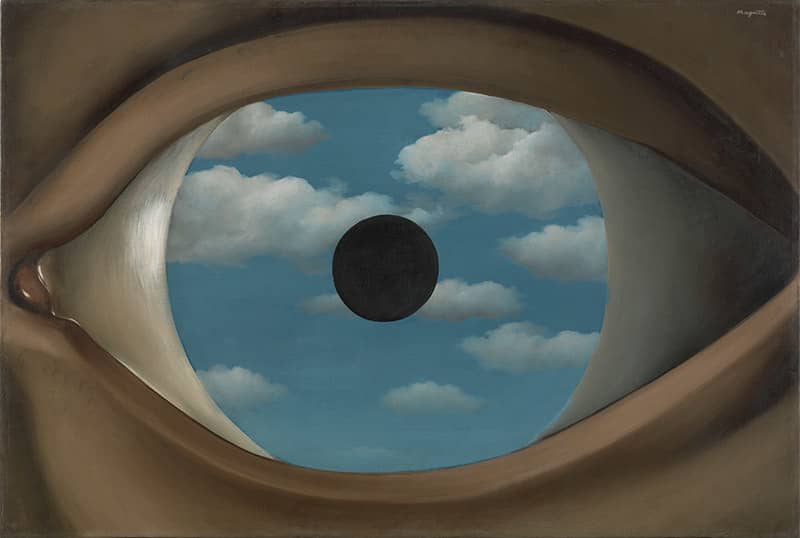
The False Mirror by Rene Magritte (1928)

By 1964, in The Son of Man, the face is obscured by a green apple.
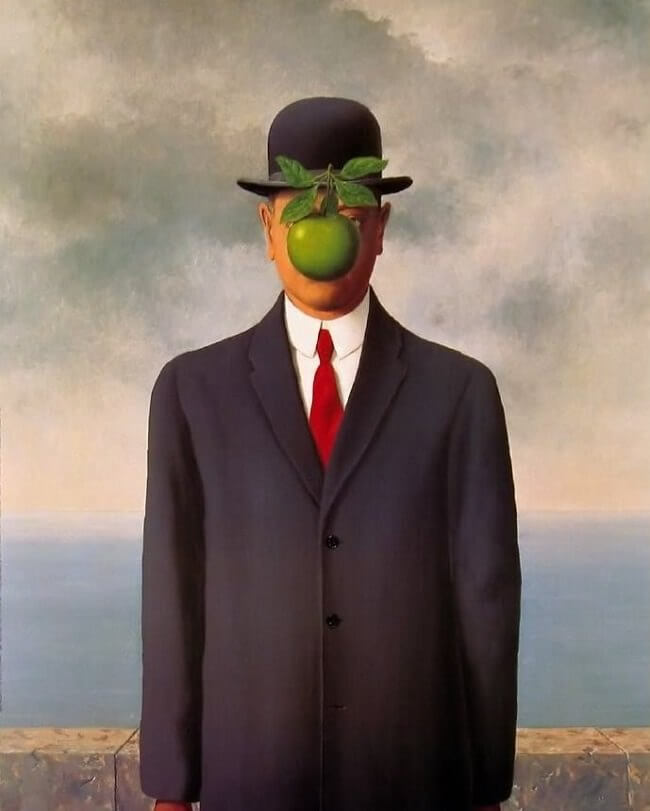
The Son of Man by Rene Magritte (1964)

The shift is profound.

The apple is not arbitrary. It carries centuries of symbolic weight: knowledge, intellect, the pursuit of understanding. It evokes Eden, the awakening of consciousness, the belief that human reason elevates and refines. And simultaneously leads to destruction, despair and the loss of paradise.

Here, that very symbol blocks the face.

What if the world’s admiration for European intellect – its reverence for German philosophy, Austrian culture, scientific brilliance – functioned as a kind of blindness? What if our advances in science and knowledge was ultimately too much responsibility for our minds to handle and yielded ultimate weapons of mass destruction to end all life?

A society’s fixation on knowledge obscured the capacity for evil.

The world saw the body and the apple. It saw a society of culture, sophistication, refinement. It did not see the face – the person, the emotion, the intent – behind it. And that face? It saw nothing at all, blinded completely by knowledge.

Magritte’s post-war image reads as indictment of willful misperception. The failure was not that reality hid the truth. It was that humanity chose not to see it.


Myth as Reconstruction

In the aftermath of this rupture, some Surrealist artists turned to mythology, a common history and culture of a now divided Europe. Myth offered what history cannot: a structure to process loss.

Consider Orpheus.

He descends into the underworld to retrieve his lost wife, Eurydice, only to lose her forever when he looks back. The story is not about failure of effort; it is about the finality of loss.

Jane Graverol paints this in 1948, as a Belgian artist from a country invaded and devastated in a war it did not seek. As Europe begins to absorb the reality of the concentration camps – the industrial killing, the desecration of bodies – the imagery becomes unbearable.
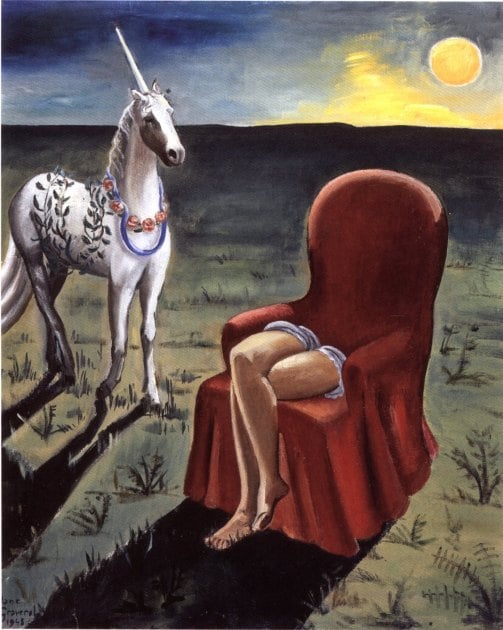
The Procession of Orpheus by Jane Graverol (1948)

A woman fused into a chair – half human, half object – evokes not abstraction, but transformation of person into material. A world in which the boundary between human and furniture was grotesquely violated.

This is not simply Orpheus losing Eurydice, disappearing as they emerged from the underworld. It is Europe recognizing that what was lost cannot be restored.


Now consider Ulysses.

After the Trojan War, Ulysses (Odysseus) spends ten years trying to return home to Ithaca. His journey is long, disorienting, and filled with trials – temptation, destruction, loss of companions, divine obstacles. When he finally arrives, he is not recognized. His home has been overtaken. He must reclaim it, rebuild it, reassert his place within it.

Return is not restoration. It is confrontation.

Giorgio de Chirico captures this in The Return of Ulysses.
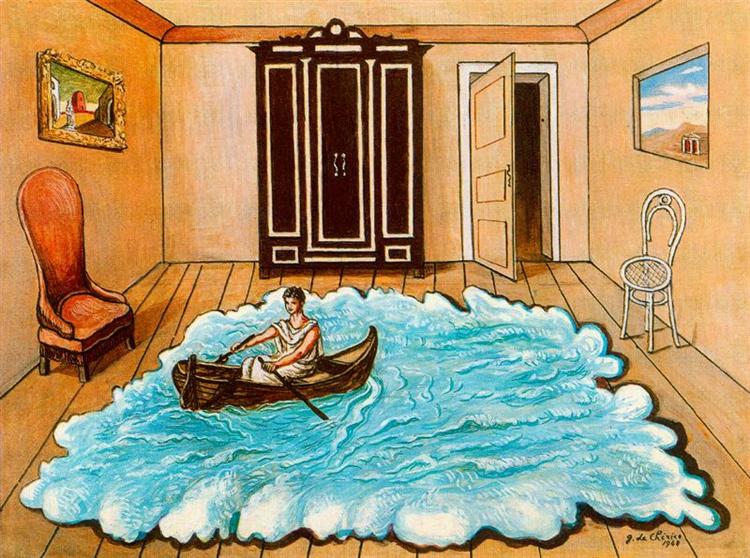
The Return of Ulysses by Giorgio de Chirico (1968)

The painting is divided.

On the left, a framed work from decades earlier sits beneath a heavy red chair. It anchors the past.

On the right, a frail white chair sits beneath an open window – exposed, stripped, uncertain. The solidity and comfort of the past gives way to fragility.

And in between, Ulysses. Small. Reduced. Rowing across water inside a room forcing the viewer to confront the symbolism.

Water, the symbol of birth, of transition, of beginning again.

He is not standing in triumph. He is navigating between worlds—between what was and what might be.

And then, something unexpected. An open door.

Not the past. Not the fractured present. But a third path.

Ulysses rows toward it. The hero moves toward something new.

The artist, from a country aligned with Germany during the war, was not focused on loss but a chance for a new future within his homeland, inside the familiar surroundings of his room.


The Jewish Path: Beyond Myth

And yet, there is a story that does not fit neatly within this framework of the Surrealist artists of the Allies and Axis. Because the Jewish people after World War II were neither and both.

They were the decimated. A people shattered, displaced, nearly erased – and forced to ask how to return, where to return.

There was no home to reclaim in the way of Ulysses.

No possibility of retrieving what was lost, like Orpheus.

There was only one path forward. Rebirth, in a new land.

And in a way unparalleled in history, they achieved it.

The reestablishment of the State of Israel was not simply political. It was civilizational. A people dispersed for nearly two thousand years, speaking different languages, living across continents, reconstituted sovereignty in its ancestral land.

Here, myth gives way to reality.

In 1968, Salvador Dalí – the master of dream imagery – was commissioned to create a series of 25 watercolor paintings for the Hartford Museum to mark Israel’s 20th anniversary. The timing was not incidental. It came just one year after the Six-Day War, when Israel not only survived existential threat but reunited Jerusalem, returning Jews to their holiest sites in the Old City.

If Theodor Herzl declared, “If you will it, it is no dream,” then Surrealism—an art form built on dreams—became the perfect language to express that transformation.
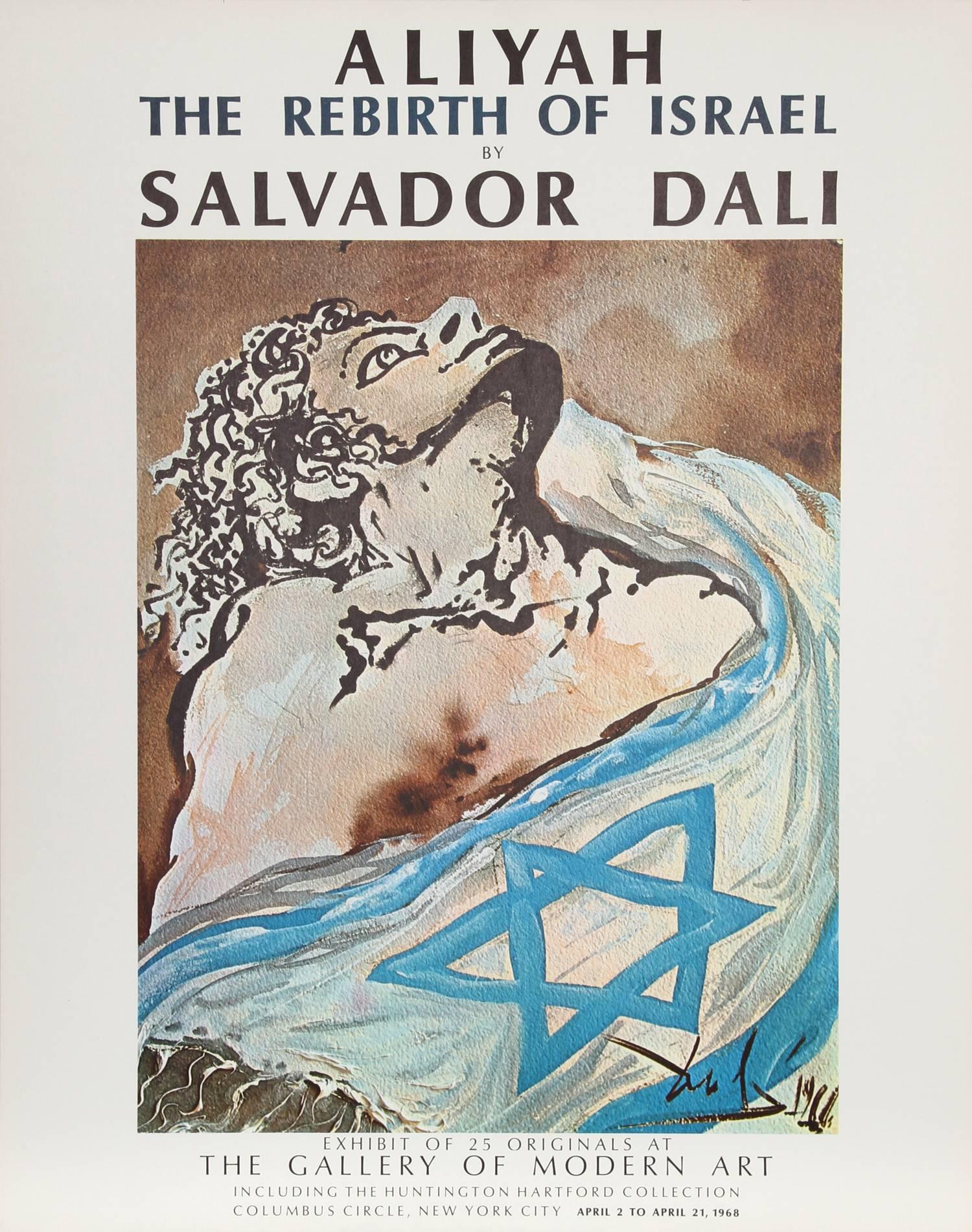
Aliyah, the rebirth of Israel by Salvador Dali (1968)

Dalí’s Aliyah: The Rebirth of Israel, the centerpiece of the series, captures this moment.

A figure rises, draped in the Israeli flag. And what is more symbolic than a national flag?

Two blue stripes evoking both the Mediterranean Sea and the Jordan River, the geographic bounds of the land, while simultaneously recalling the tallit, the Jewish prayer shawl. Nationhood and spirituality fused into a single image.

The figure is not merely standing. He is emerging naked and staring at the heavens.

This is not return. This is creation.


The Arc of Surrealism

Surrealism begins as an education, an attempt to translate Sigmund Freud’s insight into visual form, to show that human beings do not simply see the world, but interpret it through symbols, through dreams, through layers of meaning that sit beneath the surface. It teaches the viewer to slow down, to recognize that an image is not the thing itself, that representation is constructed, that what feels obvious may be anything but.

At its inception, it is a project of illumination, shaped by a Europe that still believed in its own intellectual coherence. From Paris to Brussels to Rome, it carries the confidence of a continent trying to understand itself through deeper, more elusive truths.

But that confidence does not survive World War II.

When Europe fractures, Surrealism fractures with it. The symbolic language remains intact, but it begins to tell different stories depending on where it is spoken.

In Belgium, through Jane Graverol, myth becomes a language of irreversible loss. The world she paints is one in which the human can be reduced to object, where dignity can be stripped away, where what has been taken cannot be restored. The symbols haunt.

In Italy, through Giorgio de Chirico, the question shifts. It is no longer about loss alone, but about return—about what it means to come home when home itself has changed. The past lingers, heavy and inescapable, while the future appears fragile, uncertain, barely formed. And yet, within that uncertainty, there is movement—a quiet insistence on choosing a path forward, even when the destination is unclear.

And then there are the Jews.

Not aligned with either side of Europe’s divide, but decimated, displaced, and exposed. They are not asking how to interpret what has been lost, or how to return to what was. Those paths are closed to them.

They are asking whether anything can be built again at all.

And it is here that Surrealism, for all its depth, turns to the Jews for answers.

Because the Jewish people did not need to be taught how symbols work. They had lived within that framework for centuries—through ritual, through memory, through stories that transformed objects into meaning and meaning into continuity. What Surrealism sought to uncover as theory had already been sustained as practice.

The Passover seder has been educating Jewish children for three thousand years about symbols, about the birth of a nation, and about the dream of Jerusalem.

Surrealism’s arc from the 1920s to 1960s was a story of Europeans wrestling with the mind and meaning before and after the war. It ends when those long familiar with symbolism left their nightmare and made their dream a reality.

October 7: The First Pogrom from the Global South In the Modern Era

For centuries, antisemitic violence has been a grotesque feature of Jewish history—pogroms in Tsarist Russia, inquisitions in Catholic Europe, and, ultimately, the Holocaust engineered by Nazi Germany. These atrocities were largely confined to the Global North, where much of world Jewry lived and where the modern tools of mass murder were industrialized.

Global North in blue, Global South in red

But on October 7, 2023, the locus of mass antisemitic violence shifted decisively. The massacre orchestrated by Hamas, the ruling authority of Gaza, against Israeli civilians was not merely another terror attack—it was the first state-sponsored pogrom to originate from the Global South on the Global North in centuries. It marked a turning point in the nature of antisemitic violence: no longer the work of loosely organized mobs in the South or repressive imperial regimes of the North, but the deliberate, systematic assault by a democratically-elected government in the Muslim world, targeting Jews as Jews, and Jews and “colonizers.”

A Historic Shift

Historically, Jews living under Muslim rule experienced discrimination and periodic violence, but the scale of the bloodshed never approached that of Christian Europe. Pogroms in places like Fez (1912), Constantine (1934) and Baghdad (1941), were undeniably horrific, but they typically resulted in the deaths of dozens, not thousands. In most cases, these events were local eruptions of violence, not centrally planned exterminations.

That changed dramatically in the 1950s. The rise of Arab nationalism, fused with pan-Islamic identity and antisemitic European ideologies, led to the near-total ethnic cleansing of Jews from the Muslim world. From Iraq to Egypt, from Yemen to Libya, ancient Jewish communities were uprooted. Between the late 1940s and 1970s, over 850,000 Jews were forced to flee Muslim-majority countries. They resettled primarily in Israel, France, and North America. But while the Jews left, the hatred remained. For Jews, and for Western “imperialism.”

Hamas and the Theology of Erasure

Hamas is not just a terrorist organization; it is the elected governing body of Gaza, a polity not recognized by much of the Global North but very much embraced within the Global South. Its 1988 charter is steeped in genocidal antisemitism. It doesn’t distinguish between Israeli combatants and civilians. It doesn’t merely call for “resistance” against Israeli policy—it calls for the annihilation of Jews in the land, whom it labels foreign interlopers and infidels contaminating Muslim soil.

On October 7, 2023, this ideology became mass action. Roughly 1,200 Israelis were slaughtered—women, children, the elderly—tortured, raped, and mutilated in their homes and at a music festival, and 250 people were taken captive. The violence wasn’t spontaneous. It was premeditated, coordinated, and state-executed. It echoed the darkest moments of European Jewish history, but this time the origin was a Muslim-ruled territory in the developing world.

Hamas had launched many wars against Israel since it took over Gaza in 2007, most notably in 2008, 2012, 2014 and 2021. But it never did a mass coordinated invasion of Israel. It never took hundreds of hostages. It never counted on regional allies of Houthis in Yemen, Hezbollah in Lebanon and the Islamic Republic of Iran to join the jihad.

While Muslims are a minority in the Global North, they are the plurality on the Global South

A Government Pogrom

What separates October 7 from prior attacks is its nature: it was not a riot nor mob action. It was not a fringe group operating in defiance of authorities. It was the government. Hamas planned the massacre for years. It diverted foreign aid and resources meant for schools and hospitals to build tunnels, train fighters, and manufacture weapons. And then it unleashed them— on civilians.

The western world has been slow to reckon with this fact. The idea of a pogrom—an antisemitic mass killing—carried out by a government of the Global South against the Global North challenges dominant narratives in international politics, which often frame power dynamics as North exploiting South, not the other way around. But facts do not bend to ideology.

The Silence and the Hypocrisy

Western voices that once said “Never Again” have hesitated to name October 7 for what it was. Some have even rationalized it as “resistance,” blurring the line between anti-Zionism and rank Jew hatred. But no cause justifies the butchery of innocents. No political grievance legitimizes the burning of children or the beheading of elderly Holocaust survivors.

October 7 was a pogrom. Not the first in Jewish history, but the first of its kind, launched from the Global South by a sitting government, acting with genocidal intent against a Jewish population it deems foreign and expendable.

It will not be the last. Members of the Global South have been moving to the Global North post de-colonization. The numbers have ramped considerably over the past decade, as the poorly named “Arab Spring” and civil wars launched tens of thousands of people from the Middle East and North Africa (MENA) into Europe and North America.

The First Pogrom from the Global South was greeted in western city streets with chants to “Globalize the Intifada,” because this war of annihilation is infused with radical Islamism and nationalism. The first battle is against the perceived island of the Global North inside the Muslim Global South: Israel. Europe and the United States are to follow.

Antisemitism is not bound by geography or ideology; it infects the right and left around the world. But the Muslim Crusade of colonizing the Global North is very much a function of region and philosophy. It is coming for a broad redistribution of power and wealth from North to South, and indoctrination of Islamic principles from South to North. It will achieve its aims through force of arms and diplomatic cover of an altered United Nations.

“the Jewish people suffering the worst and most murderous pogrom since the Holocaust.

UK Foreign Secretary David Cameron

Thinking of October 7 in terms of the worst slaughter of Jews since the European Holocaust blinds people to the tectonic earthquake that is taking place. History is not simply repeating itself in killing Jews. A new chapter of crusades is upon us in which Jews are the first victims but will not be the last.

Related:

Global South’s Beachhead On American Universities (March 2025)

Globalize The Intifada With Socialists (May 2024)

Most Palestinians Are For Hamas. Most Israelis Are Not European Jews. (April 2022)

The New York Times Thinks that the Jews from Arab Countries Simply “Immigrated” (October 2016)

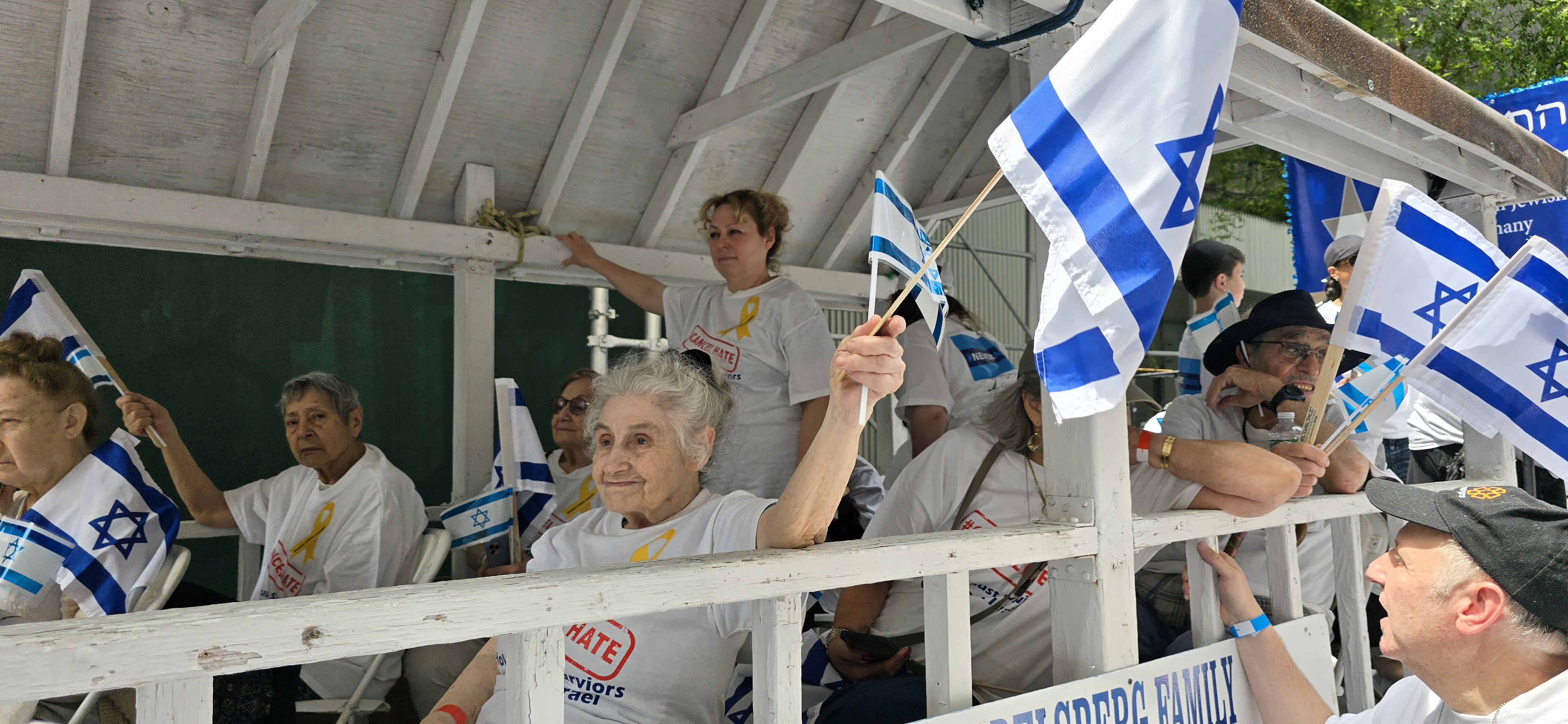
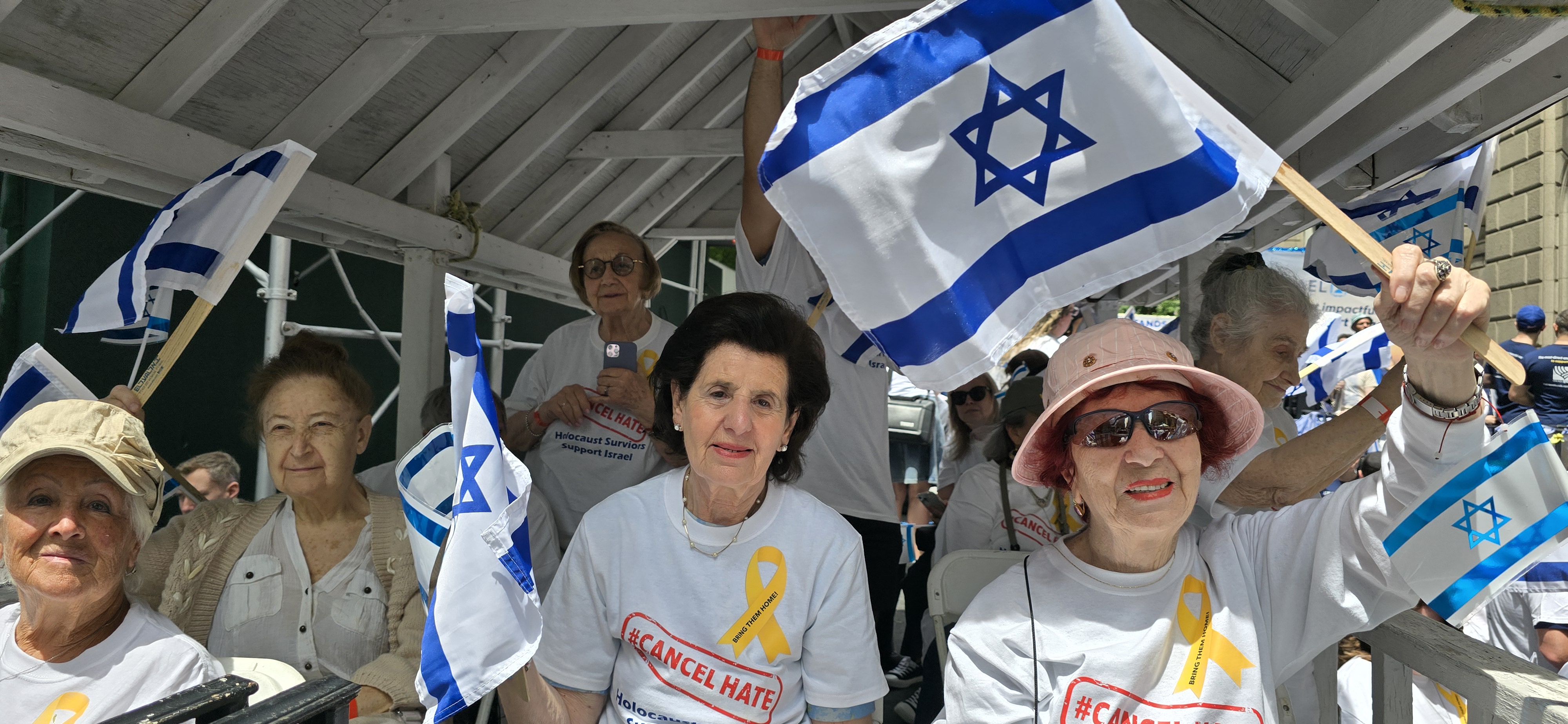
Holocaust Survivors At The 2024 Israeli Day Parade In New York City

New York City has held a Celebrate Israel Day parade for many decades. In 2024, just months after the worst attack on the Jewish people since the Holocaust, the gathering of Jews and Israel-supporters had a very different feeling.

Among the many marchers were several elderly people who survived the European Holocaust 80 years ago. Some joined a float sponsored by the Claims Conference, the organization that secures funding from European countries, principally Germany, and distributes it to help the elderly victims.

Holocaust survivors at the Israeli Day Parade, June 1, 2024 (photo: First one Through)

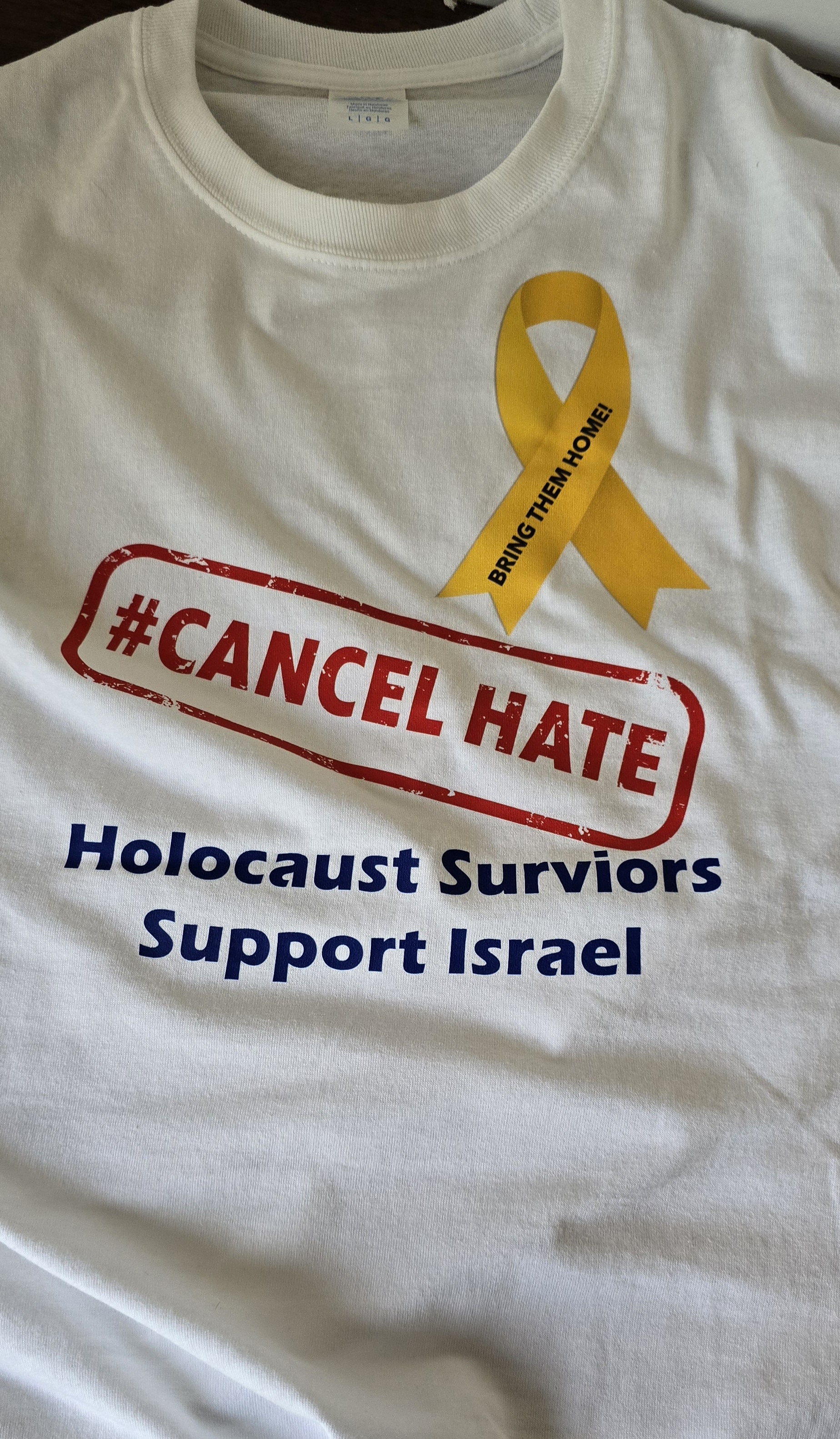
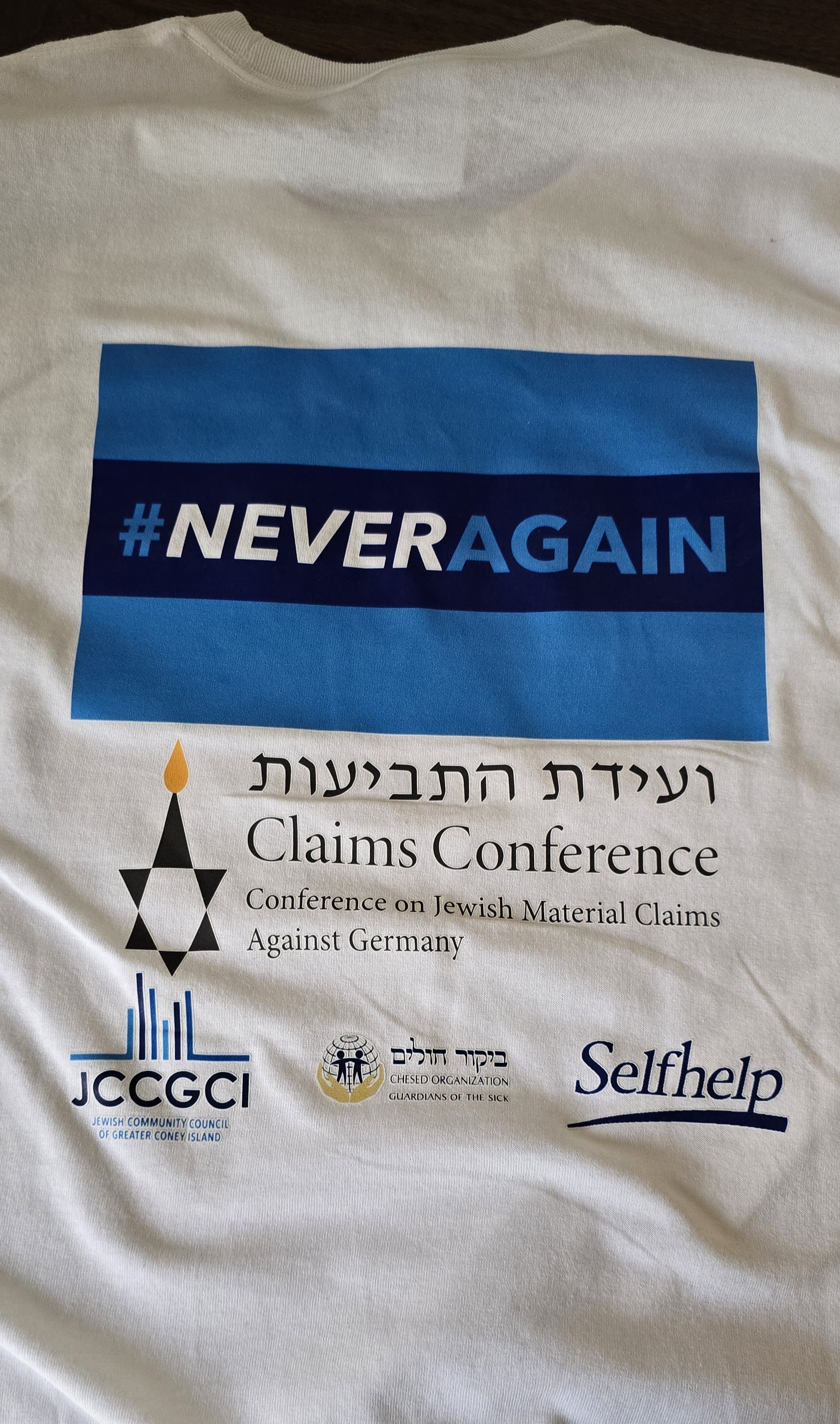
The survivors and Claims Conference supporters wore shirts that read “cancel hate” on the front, while the backs read “never again,” particularly meaningful slogans for people who had survived violent trauma as children and were living through a period of antisemitic slaughter and vulgar hatred again in their old age.

Alas, “never again” proved a hollow slogan. On October 7, vicious Palestinian Arab antisemites invaded Israel and butchered 1,200 civilians in their homes and at a peaceful dance rave. In the tragedy’s immediate aftermath, people in many cities – including New York City – chanted that they were thrilled at the burning of Jewish families. Once again.

Eight months later, Holocaust survivors rode up Fifth Avenue holding Israeli flags, as New York City Police sharpshooters watched from atop buildings, and drones and helicopters circled overhead, worried that anti-Israel protestors would attack the celebration.

Police helicopters and sharpshooters atop buildings, watched as a float carrying Holocaust survivors went up Fifth Avenue at the Israeli Parade, June 1, 2024 (photo: FirstoneThrough)

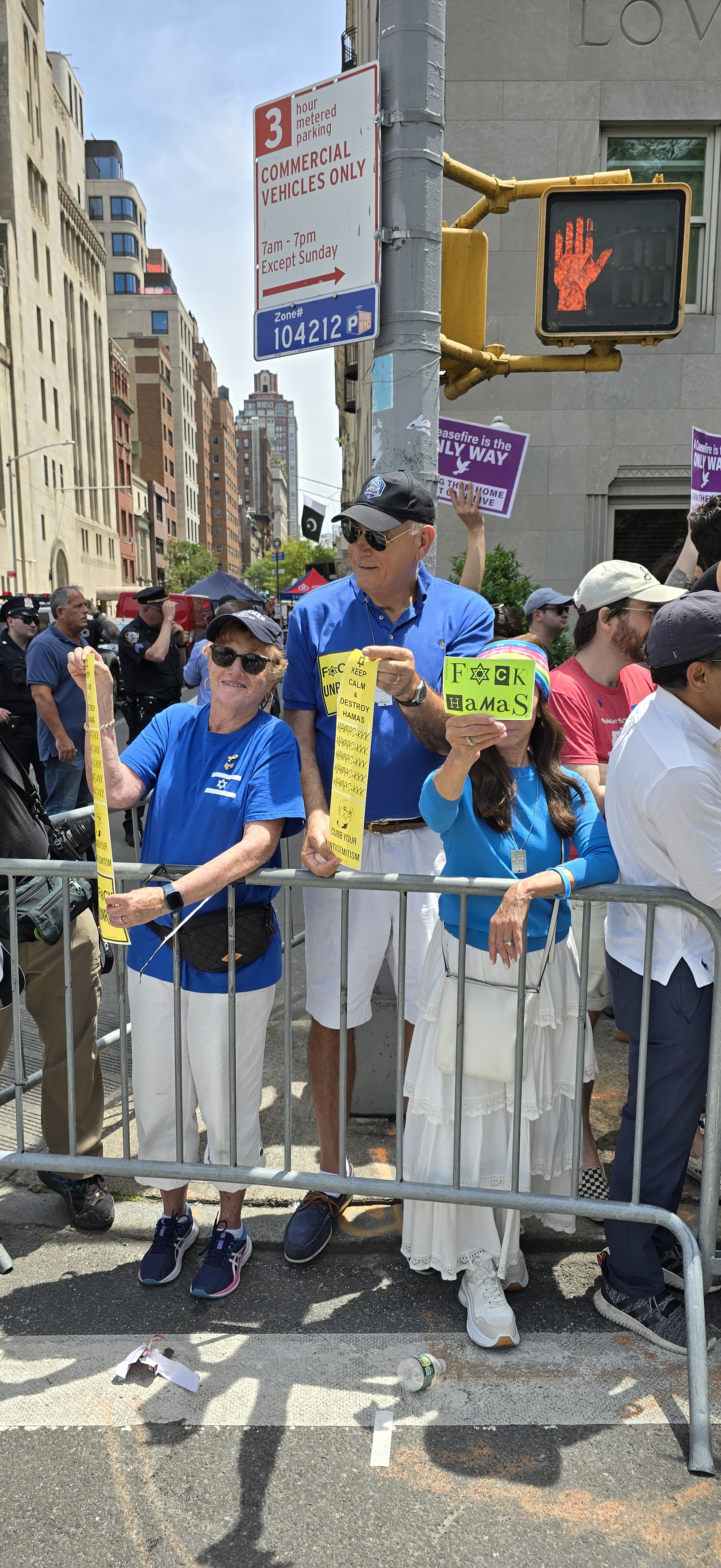
Only half of Fifth Avenue held onlookers, as the police did not want infiltrators coming in from Central Park, which packed viewers against the buildings. Many wore stickers and held placards to finish Hamas, the ruling Palestinian entity of Gaza which carried out the vicious massacre and has sworn to destroy the Jewish State.

The survivors were born in various countries including Poland and Russia. They were mostly women, as male survivors are becoming a rarity.

They waved flags. They danced with young Jews.

Holocaust survivors dance with parents and students from Hillel

They cried at the situation that they were living in a world where “never again” were empty words, even as they clasped Israeli flags and tried to remain hopeful that now Jews have autonomy in the State of Israel which was lacking during World War II.

The reality is that they had fled many years ago to America and internalized that this “goldene medina” was unique and offered Jews protection and opportunity absent in Europe.

Now, their smiles and optimism felt shallow.

The crowd very much echoed those feelings. Yellow ribbons, pins and stickers calling to bring home the 125 remaining hostages held by Palestinian Arabs, were close to everyone’s hearts and minds.

Crowd – set back by an eight-foot gap with barricades – wave to Holocaust survivors on the Claims Conference float riding on Fifth Avenue in New York City’s Israel Day Parade on June 1, 2024 (photo: First One Through)

In the end, the Holocaust survivors didn’t confront any Jew haters in the crowd as they rode the float in the Israel celebration. They and the crowd which included many with family members impacted by the October 7 Massacre as well as the War on Terror, thought about the words that accompanied them on the journey from Matisyahu’s One Day song:

All my life, I’ve been waitin’ for (waitin’ for)
I’ve been prayin’ for (prayin’ for), for the people to say
That we don’t wanna fight no more (fight no more)
There’ll be no more wars (no more wars), and our children will play

One day (one day), one day (one day)
One day (oh, oh, oh, oh-oh-oh, one day)
One day (one day), one day (one day)
One day (oh-oh-oh)

One day, this all will change, treat people the same
Stop with the violence, down with the hate
One day, we’ll all be free and proud to be
Under the same sun, singin’ songs of freedom like

Wah-yo (one day, one day), wah-yo, oh, oh (oh-oh-oh)

People cheer Holocaust survivors wearing shirts “never again” and holding Israeli flags as they ride up Fifth Avenue to Matisyahu’s song “One Day” on June 1, 2024 (First One Through)

The Zone Of Jew Hatred Interest

The Zone Of Interest‘ is an unusual Holocaust movie. It shows the daily life of the head of the Auschwitz concentration camp inside his home abutting the vast killing factory. Living a peaceful life with his wife and children, the viewer is struck by the carefree life of the Nazi officer and his family, treating the annihilation of European Jewry as simply a normal 9-to-5 job which supports the family in the way they always desired.

Part of the funding for the movie was from the government of Poland, and its influence can be seen in directing the audience to see that the true evil actors were the German Nazis and not Poles, who were portrayed as trying to help Jews in some way, dropping apples around the camp for Jews who managed to escape. Modern Poles are shown at the end of the film, keeping today’s Holocaust museum at the site tidy for tourists who can view the Jewish possessions which were not seized by the Nazis and their families. The actual rampant Polish Jew hatred is invisible in the film.

Vile Jew-hatred continues today, as do new movies, shows and museums focused on the global scourge. Many contrast past antisemitism to modern Jew-hatred such as the remarkable play ‘Prayer for the French Republic‘ as well as ‘Leopolstadt’. Others are devoted just to the Holocaust like the new museum in Amsterdam. Some try to tie antisemitism into the Arab-Israeli conflict like the opera ‘Death of Klinghoffer.

Tragically, many of the works of art about noxious Jew hatred have become awash in the Arab-Israeli conflict. It would appear that Jews being cast as victims – whether with posters of kidnapped Israeli Jewish civilians, or a Holocaust museum – is too much for Palestinian Arab supporters who want to see the Jewish State crushed.

At the March 2024 opening of the new Holocaust museum in Amsterdam, hundreds of protestors gathered outside to shout “Free, free Palestine” and “Viva, viva Intifada,” screaming for the destruction of the Jewish State and murder of Jews.

Anti-Israel demonstrators at the opening of the National Holocaust Museum in Amsterdam. Pic: AP

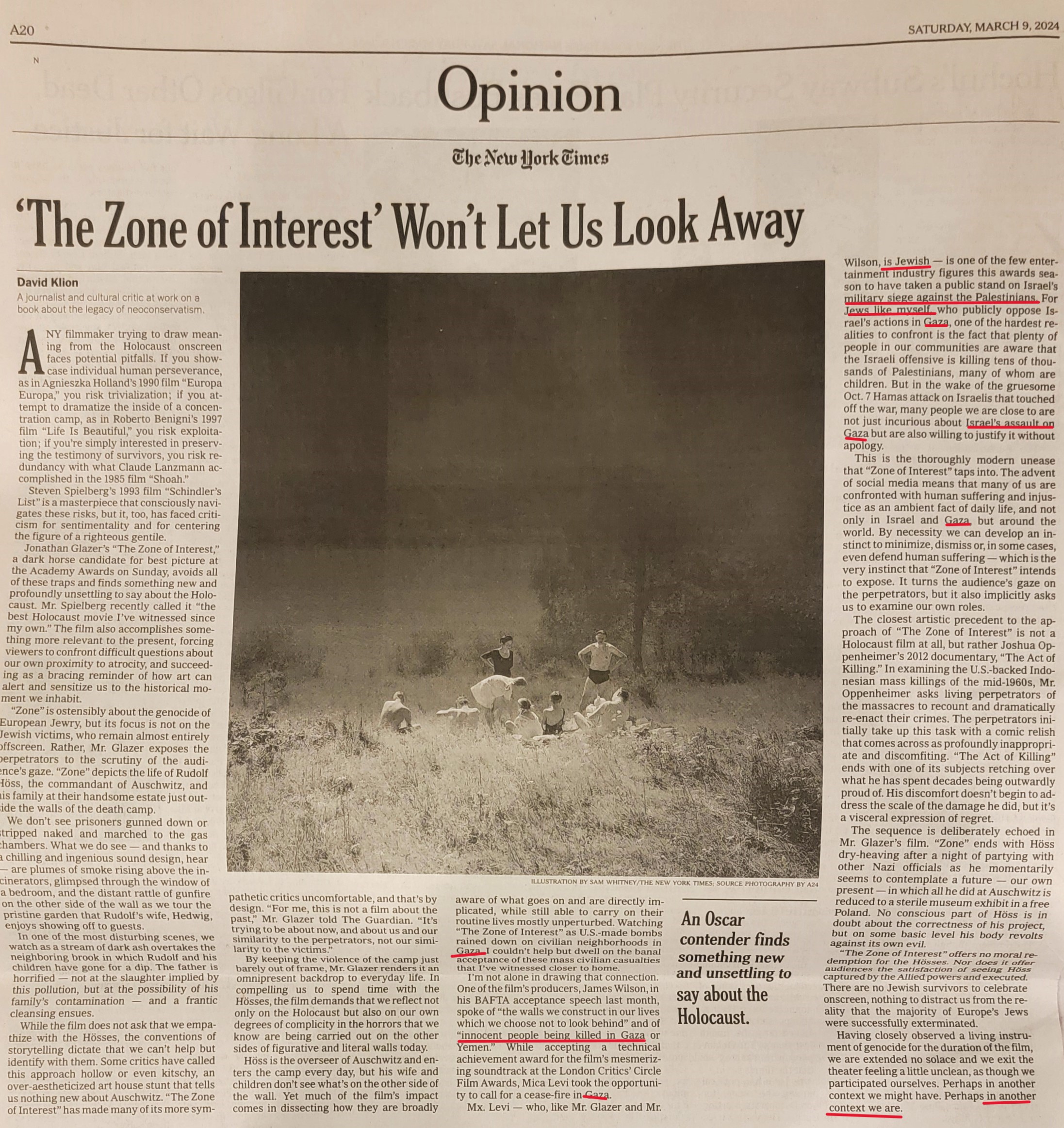
In the U.S., The New York Times published a grotesque opinion that compared Israel’s activities in trying to save its hostages and root out the perpetrators of the October 7 massacre to the Nazi family in ‘The Zone of Interest.’ Over-and-again it wrote of the “military siege of Gaza” and “Israel’s assault on Gaza” in a movie review about a Holocaust film.

NY Times lead opinion piece on March 9, 2024

The author, David Klein, could have stated his opinion about the War From Gaza without attaching his comments to a film about the systematic killing of 6 million Jews but he, and many like him, don’t want to. They want to strip Jews of any protection – offensive or defensive. The end of the article makes clear that he is against supplying Israel with weaponry to prosecute the Palestinian terrorist army of Hamas; appending his opinion to a Holocaust film is designed to also remove America’s shield for Israel at the United Nations and with resupplying the Iron Dome missile defense.

To make his refuse stink a bit less, Klein peppered the “AsAJew” line to protect himself from accusations of antisemitism.

Eli Lake penned an article in Commentary Magazine in March 2024 called “A Brief History of the ‘AsAJew’“. Lake sees this as a phenomenon of far-left diaspora Jews, as even progressives in Israel know that Hamas must be destroyed after the heinous barbarous attack which the terrorist group has threatened to repeat.

Lake described a long history of AsAJews during moments of Jewish suffering appealing to the antisemitic attackers to continue to persecute. He wrote that centuries ago, “the AsAJews of their day lobbied their hosts in the Diaspora to banish or convert the Jewish people to Christianity and to confiscate and burn the Talmud.” He details the story of a man in the 15th century named Johannes Pfefferkorn who converted from Judaism and helped fuel a mini crusade against his former co-religionists.

Times have changed some of the nouns in the anti-Semitic Mad Lib, but the story reads familiar.

Lake wrote, “In the Middle Ages, AsAJew converts were pawns the Church used to spread lies about the Talmud. In 2024, the AsAJews are not converts to Christianity. They are instead converts to the false prophecy of left-wing social-justice activism…. The anti-Semites of the Middle Ages needed AsAJews to provide credentials for the lies that justified their pogroms and expulsions. Today, Hamas and its allies in Iran need the AsAJews to persuade the Hague, European governments, and the White House to delegitimize Israel’s right to self-defense.”

I will add some observations on top of Lake’s. For centuries, antisemites including AsAJews, came for the Jews by attacking the religion itself. They concocted stories about Passover matzah in blood libels and the Talmud teaches black magic. Today’s cohort attack Jews and Jewish history, not the religion. They mock the Holocaust. They claim Jews have no history in the land of Israel and are “colonizers” who stole land from Arabs, and that Jews never had holy temples in Jerusalem so should be banned from prayer in a site that is solely holy to Muslims.

By ignoring religion, the modern day antisemites refuse to carry the antisemitic mantle because they are not attacking the religion, just bad actors who happen to be Jewish. The AsAJew allies provide a wide fig leaf for the charade, much as they’ve done for centuries.

Museums and films devoted to the heinous slaughter of Jews in the Holocaust, which would normally demonstrate the profound need for Jews to have self-determination, are being used by the alt-left and Islamic radicals to argue that Jews should be left to the wolves of Hamas. Some are not as shrill, and offer a tepid “both sides” support, blind to their echoing former President Donald Trump’s Charlottesville remarks.

‘The Zone of Interest’ Winning Best International Film on March 10, 2024, with callout to Israeli and Palestinian victims of terror

As antisemitism scales to terrifying levels around the world, the alt-left and Islamic radicals are turning works of art and remembrances of the deliberate mass butchering of Jews on October 7 and during the Holocaust into calls to attack Jews and the one Jewish State. Many progressive Jews are appalled and are abandoning their former partners-in-crime as now-revealed naked antisemites. But the AsAJews have remained steadfast and will share names and addresses of the Zionists, marking Jews as zealots who need to be punished for the good of mankind once again.

Related articles:

The Normalization Deformity: No To Zionism and Peace; Yes To Massacres and Terrorism In a Global Intifada (January 2024)

Now Is The Time For Sabra, An Israeli Superhero, To Join Captain America (October 2022)

Watching Jews (October 2022)

Anti-Semites Don’t Ride In Cattle Cars (September 2022)

The Campus Inquisition (April 2022)

11 Hours in Colleyville, 7 Days in Entebbe (January 2022)

Humble Faith (October 2021)

Peter Beinart is an Apologist for Anti-Semites (December 2020)

Socialists Employ Arabs’ Four Step Battle Plan (July 2020)

For The New York Times, “From the River to the Sea” Is The Chant of Jewish and Christian Zealots (May 2020)

The March of Silent Feet (January 2020)

Iran’s New Favorite Jewish Scholars (December 2017)

Liberals’ Biggest Enemies of 2015 (December 2015)

Eyal Gilad Naftali Klinghoffer. The new Blood Libel. (June 2014)

Eighty Years Ago In Intersectional History: Nazis And Palestinian Arabs

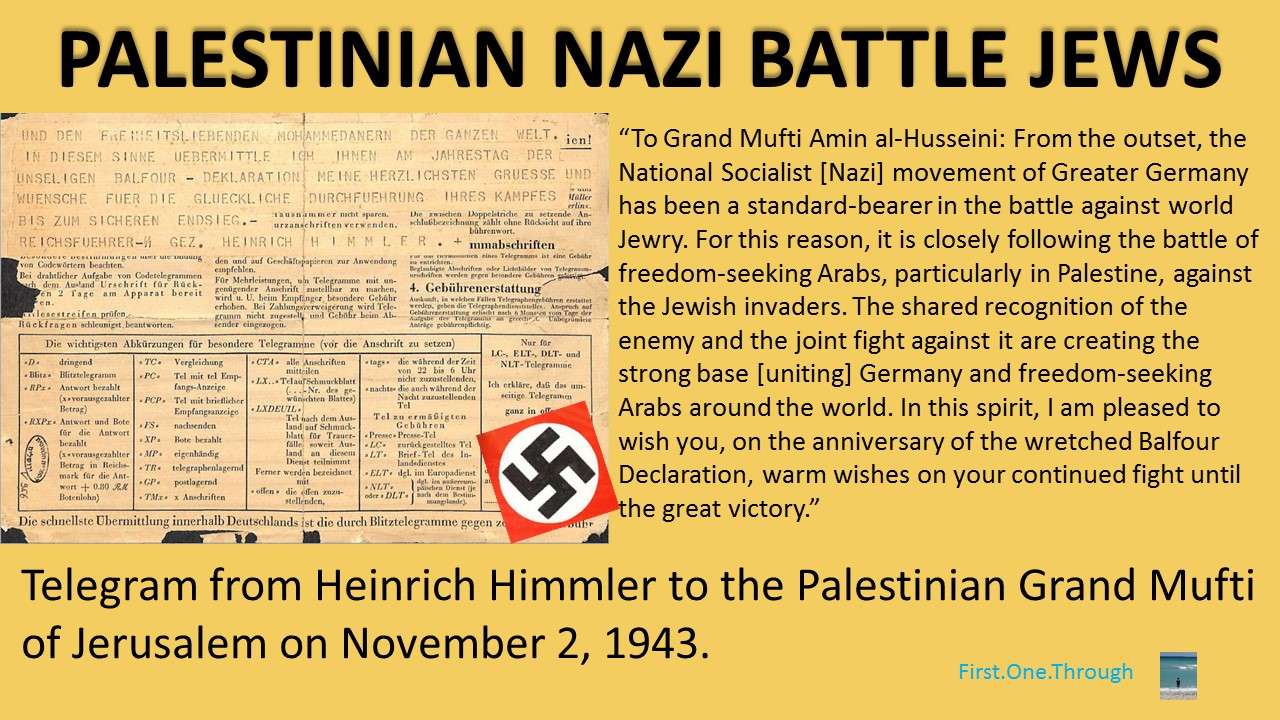
On November 2, 1943, to mark the anniversary of the Balfour Declaration, Heinrich Himmler, the Nazi leader who was the principal architect of the genocide of European Jewry, sent a Telegram to the Grand Mufti of Jerusalem, Hajj Amin al-Husseini.

The Telegram read:

“FROM ITS BEGINNING THE NATIONAL SOCIALIST MOVEMENT OF GREATER GERMANY HAS INSCRIBED THE STRUGGLE AGAINST WORLD JEWRY ON ITS BANNER. THEREFORE IT HAS ALWAYS FOLLOWED WITH SPECIAL SYMPATHY THE STRUGGLE OF THE FREEDOM – LOVING ARABS, FOREMOST IN PALESTINE, AGAINST THE JEWISH INTRUDERS. THE RECOGNITION OF THIS ENEMY AND OUR COMMON STRUGGLE AGAINST HIM FORM THE FIRM FOUNDATION OF THE NATURAL ALLIANCE BETWEEN NATIONAL-SOCIALIST GREATER GERMANY AND THE FREEDOM-LOVING MUSLIMS OF THE WHOLE WORLD. ON THE ANNIVERSARY OF THE WRETCHED BALFOUR-DECLARATION I SEND YOU IN THIS SPIRIT MY HEARTFELT GREETINGS AND WISHES FOR THE SUCCESSFUL PURSUIT OF YOUR STRUGGLE UNTIL ITS ASSURED FINAL VICTORY.”

Nazis believed that Palestinian Arabs were natural allies in the “struggle against world Jewry.” They formed an intersectional bond against this common “enemy” in which “freedom-loving Muslims” would purge the Jews from Palestine just as Nazi Germany would eradicate Jews from Europe.

History is echoing the German Socialists of the 1930s and 1940s with today’s Democratic Socialists. Eighty years after Himmler’s Telegram, socialists in the United States and Western countries are bonding with jihadists calling for destroying the Jewish State and removing Jews from perceived positions of power in the rest of the world. The genocidal goals are spread on college campuses, mainstream media and halls of Congress.

This is not simply a matter of social media offering vast echo chambers which circle the world in an instant. The purging of Jews is a core philosophy of socialists today, much as it was in Nazi Germany.

When socialists and jihadists march together around the world, Jews know enough to be terrified.

Related articles:

Heinrich Himmler’s Heirs, “Freedom Loving Arabs”

Antisemitism Is A Tool For Ethnic Cleansing

NakbaWashing Crimes Against Jews

Anti-Semitism Spikes Because Israel-Palestine is a Religious Battle

The DSA Is Systematically Coming For Zionist Jews

The Center Of Intersectionality Sounds Like Adolf Hitler

The Antisemitic Campus: Decolonize Palestine

Gaslighting Gas Chambers and Indigenousness

The Most Antisemitic Thing

Conspiracy Theories About Jewish Power and Control

We Listen To Idiots

Rashida Tlaib’s Modern ‘Mein Kampf’

The United Nations’ Sinister Attack On The Jewish State As Part Of Holocaust Event

The Lies Conflating the Holocaust and The Promised Land

Seeing the Holocaust Through Nakba Eyes

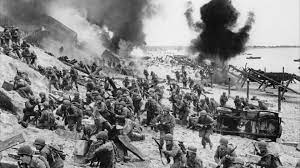
Normandy’s Shadows

There is a beach in France where the ordinary proved extraordinary,
As common men fought fire-breathing dragons
On a far away shore.

There is a beach in France below thousands of white crosses
Blanketing rolling green fields,
Manicured and resolute.

From the beach in France, American volunteers now amend a wrong
Affixing Stars of David to the headstones
Of fallen Jewish warriors.

From the beach in France, a rabbi squints at a green hill
Encasing a Jewish cemetery long overgrown
With vines on broken railings.

At the American cemetery in France, visitors stare into the distance,
Blind to the blood and bones
Soaked in the Earth.

There is a beach in France where silent sentries shine tall
Over traumatized sand,
Who cast long sunset shadows on forests covering countless forgotten lives.

The Media’s Divergent Coverage of Abbas’ “50 Holocausts”

Much of the global media covered Palestinian President Mahmoud Abbas’ disgusting comments while he was in Germany, as he tried to gain international support for his approach to dealing with Israel. Their coverage was quite different.

While standing alongside German Chancellor Olaf Schloz, a reporter asked Abbas if he would apologize to Israel for the Palestinian kidnapping and murder of Israeli athletes at the 1972 Munich Olympics, as Germany was set to commemorate the 50th anniversary of the event in a few weeks. Abbas ignored the question, and instead offered “From 1947 to the present day, Israel has committed 50 massacres in Palestinian villages and cities, in Deir Yassin, Tantura, Kafr Qasim and many others, 50 massacres, 50 Holocausts.

The condemnations for the Palestinian leader’s trivialization of the Holocaust – in Germany of all places – in response to a question about Palestinian terrorism, and inverting Jewish victim to murderer, came from around the world. Some news organization opted to focus squarely on the Holocaust denial and rebukes, while other for-profit media companies decided to provide context.

Some of the background proffered was shocking and says much about the news organization’s biases, their readers and sponsors.

Basically all news groups focused on Abbas’ “50 Holocaust” statement and the condemnations. Almost all – including AP News and The Guardian – provided background that 6 million Jews were killed in the Holocaust, except for Axios, which delivers news in an abbreviated bullet point format. None of the major news outlets informed readers that Holocaust denial is illegal in Germany, as the country feels a moral duty to not obfuscate its historic crimes against humanity. Depending on when the story broke, the media reported on the “clarification” posted on Abbas’s political party’s website.

The 1972 Palestinian massacre of Israeli athletes, the focus of the question to Abbas, was only referred to as an “attack” by Axios and Reuters. Each declined to write that eleven athletes were murdered by Palestinian terrorists.

Very few media shops gave their readership color that Abbas has a long history of Holocaust denial, including writing his doctoral thesis on the idea that Zionists conspired with the Nazis to make life unbearable for European Jews to get the Jews to move to Palestine. Abbas falsely alleges – to this day – that Jews have neither history in, nor interest to move to Palestine, so Zionists worked with the German government to prod the Jews to move. Both CNN and The New York Times gave some color on Abbas’ history of anti-Semitism.

On the fringe, CNN, Reuters and The New York Times tried to explain Abbas’s revolting comments.

CNN and Reuters essentially reprinted the Palestinian “clarification” statement which wrongfully stated that “Israeli forces” have been engaged in “massacres” of Palestinians since the “Nakba” of the founding of Israel. Reuters and The New York Times elected to write about recent battles between Palestinian Arabs and Israel that left many Arabs dead, as if somehow the slaughter of defenseless Jewish Germans by the Nazi government is akin to a war between two armed groups.

The New York Times went even further. It quoted a disgraced former Prime Minister from over a decade ago who served time in prison, who “welcomed” the Palestinian non-apology, making the matter seem like water-under-the-bridge. Such ridiculous editorializing could only happen at the anti-Zionist Times. Or maybe Qatari-owned al Jazeera.

The New York Times attempted to soften the vile Holocaust comments by Palestinian President Mahmoud Abbas on August 18, 2022.

In case readers were not satisfied that Abbas was cleared of charges of anti-Semitism by four prime ministers ago-Ehud Olmert, the Times added a bunch of information that has absolutely nothing to do with the story. It wrote that Abbas has worked closely with Israeli security to prevent violence, and that “right-wing Israeli politicians” try to isolate and demonize Abbas, even though he helps keep the peace. If that doesn’t convince the reader to absolve Abbas, the Times added that Abbas is deeply unpopular among Palestinian Arabs anyway.

The New York Times has long peddled in anti-Israel editorializing. It has now added Holocaust denial-enablement to its revolting repertoire.

Related articles:

Mahmoud Abbas’s Particular Anti-Zionist Holocaust Denial

The Ultimate Chutzpah: A New Form of Holocaust Denial

NY Times Holocaust Revisionism For Poles, Not Palestinians

Will Palestinians Ever be Taught About the Holocaust?

Seeing the Holocaust Through Nakba Eyes

Palestinians of Today and the Holocaust

Israeli-German Jews Find Empathy For Descendants of Nazis

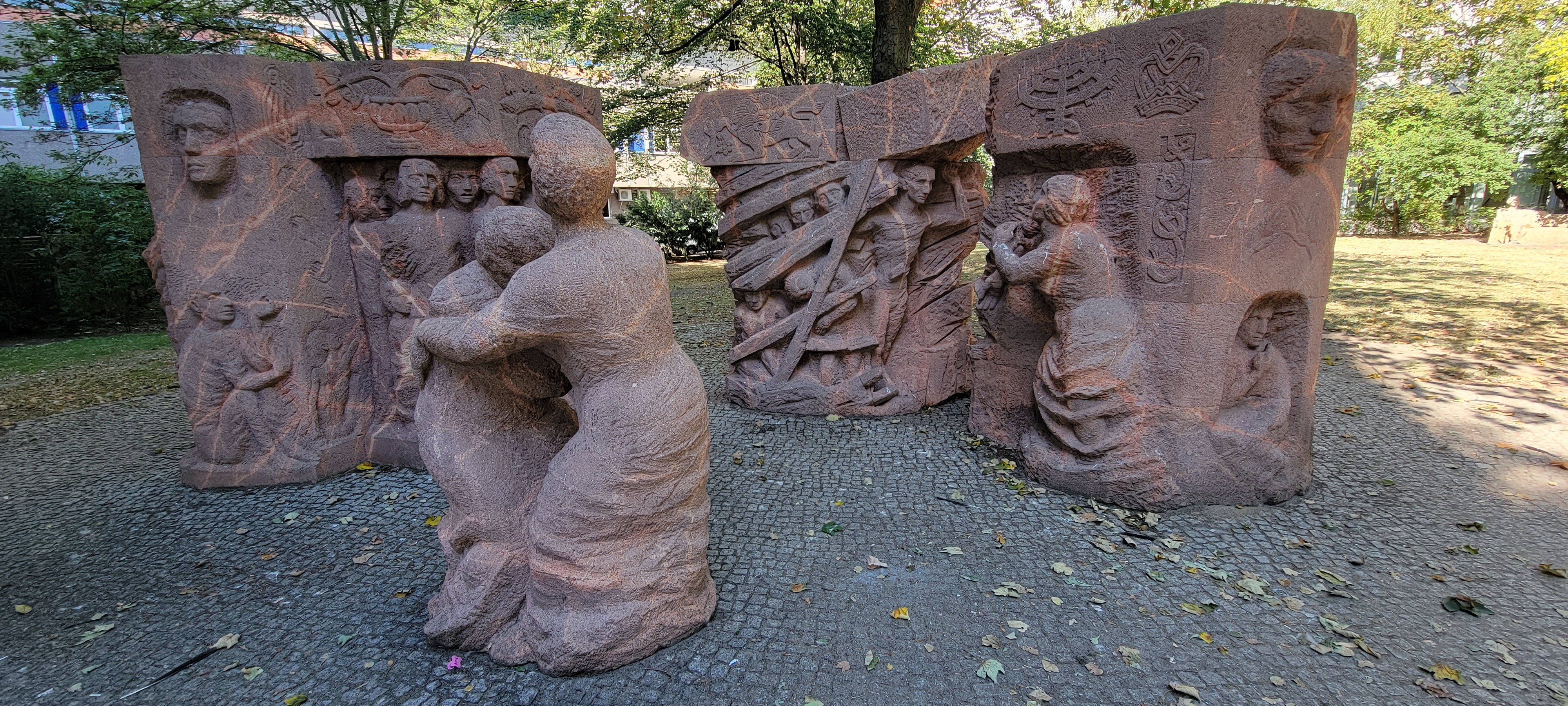
To spend time in Berlin, Germany is to be surrounded by echoes of the Holocaust. The silhouettes of Jewish victims can be seen in the memorials of concrete coffins emerging from the ground, brass plaques cemented into the sidewalks, sculptures of men, women and children atop pedestals, and the anti-Semitic edicts drawn on placards hoisted on street poles.

The small community of Israeli Jews who moved to the epicenter of the Jewish genocide since World War II have made a peculiar peace with this past. Some came when the city was divided in two and settled in West Berlin, and others are recent arrivals, former Ukrainians and Russians who prefer Eastern Europe to the Middle East.

They all know the city’s history and they know the oddity that they represent.

Speaking to these Israeli Jews about their relationships with German neighbors is a course of curiosity and incredulity. They offer that perhaps as many as 20% of Germans today are Nazi sympathizers much like their grandparents, and a similar percentage probably don’t think about the past at all. The Israeli-German residents estimate that most non-Jewish Germans are embarrassed about their legacy but don’t want to hate their own flesh-and-blood. Such Germans are left in an awkward situation when they talk with Jews: the unsympathetic descendants of murderers are engaged with the much more sympathetic descendants of their victims, creating an unbalanced state.
The Jewish Berliners dislike the dynamic, and argue that today’s generation of Germans cannot be held responsible for the sins of the past. They argue that today’s Germans have atoned as best they could through memorials and compensation to survivors. These Jews offer that they bemoan the preferred position they have in society as children of victims; they do not want such inherited status. Instead, they seek their righteous rank earned from sympathizing with the challenging constellation that places today’s Germans alongside Jews. The Jews and Germans are equally inheritors of the past, no more, no less.

Today in Berlin, I heard Jews talk about two different Children of the Holocaust. While I have long been familiar with children of Survivors like myself, it was shocking to hear some Jews relate to the grandchildren of Nazis as victims as well, albeit of familial reputational stain rather than of genocide. Perhaps that is how these new German Jews live surrounded by Jewish and Nazi ghosts: imagining that today’s Germans live with those same ghosts as well.

Berlin’s Memorial to the Murdered Jews of Europe, continues below ground with stories of Jewish families destroyed by the Nazis. It sits one block from the Brandenburg Gate, a monument used by Germans to celebrate their power and freedom.

Related articles:

Watching Jewish Ghosts

The Building’s Auschwitz Tattoo

The Beautiful and Bad Images in Barcelona

Under-educated, Liberal, Black Women Know The Least About The Holocaust

The Whoopi Goldberg incident regarding her comments about Jews in the Holocaust took another turn as she was suspended from her show ,”The View,” for two weeks. Instead of being a teaching moment for everyone, it turned into another incident of ‘cancel culture.’

Whoopi is not a boldfaced anti-Semite who wants to see Jews harmed; she is ignorant about the Holocaust – and anti-Semitism – as are many uneducated, liberal, Black women.

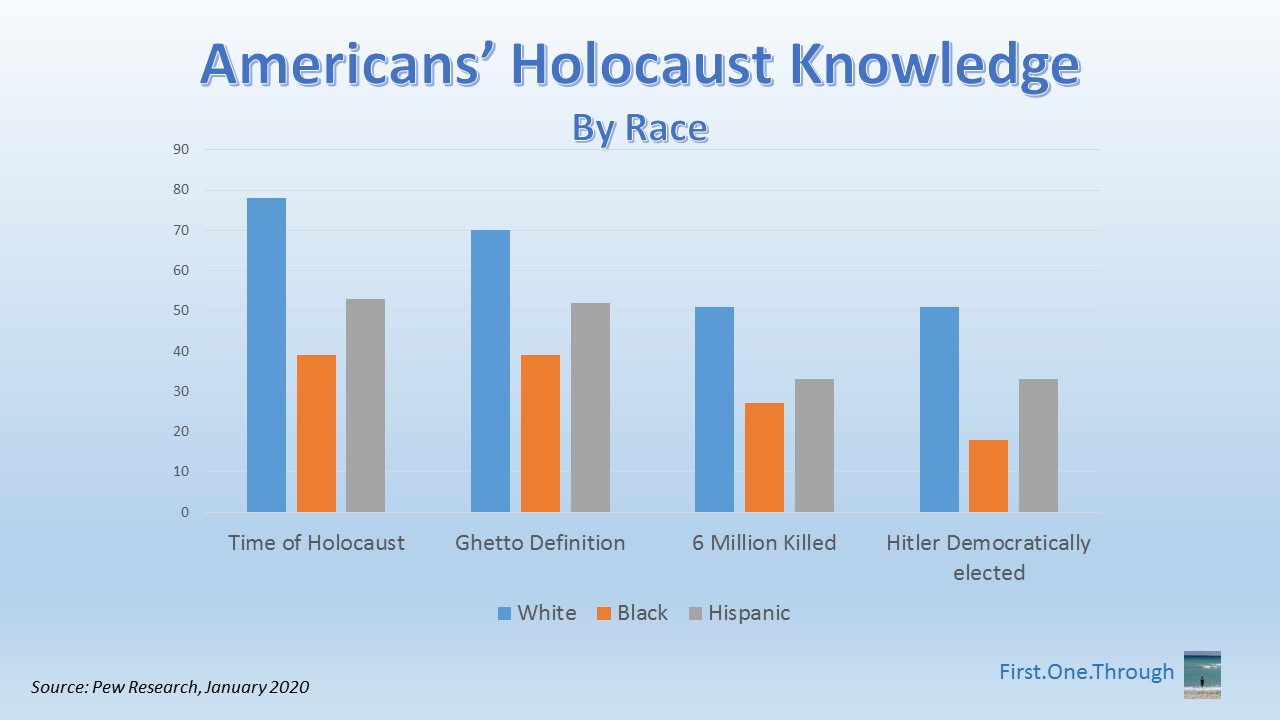
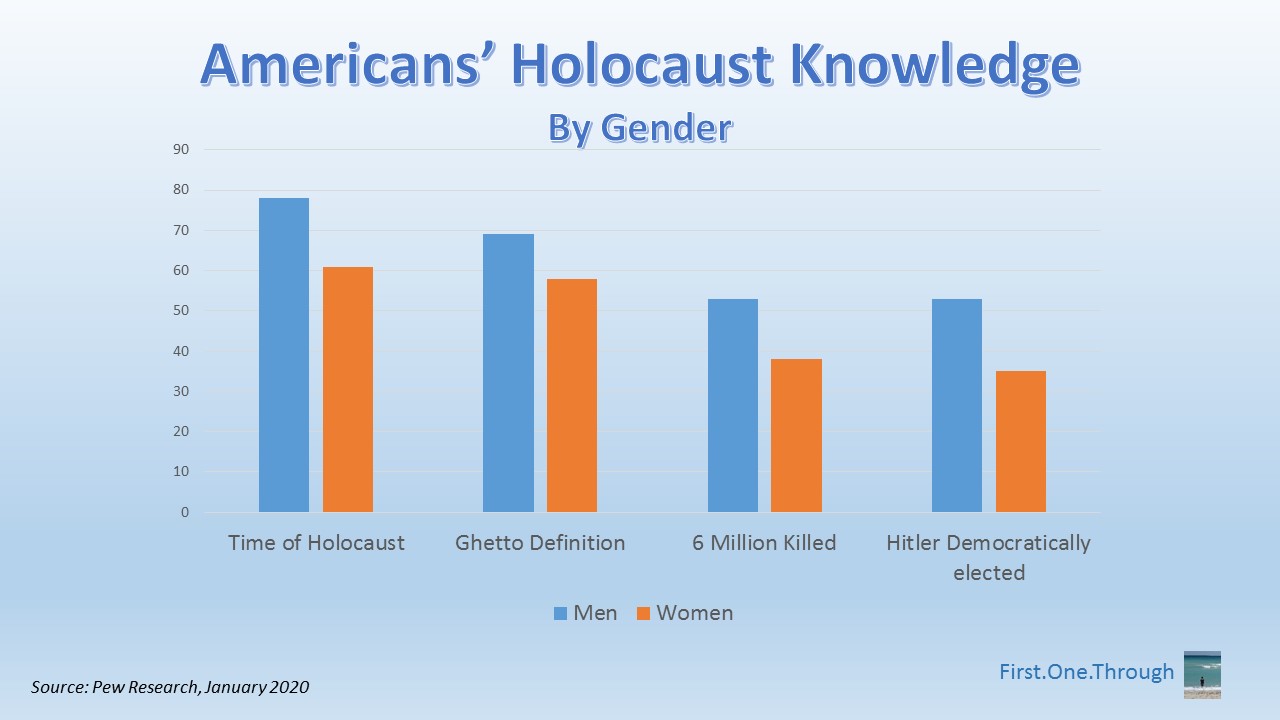
The Pew Research Center conducted a poll of Americans in January 2020, about their knowledge of the Holocaust. The results were pretty stark.

Black Americans know much less about the Holocaust than other groups.

Four questions were posed to people – when did the Holocaust happen; how were ghettos used for Jews; that 6 million Jews were killed; and that Hitler was democratically elected in Germany. On average, Blacks got 1.2 questions right out of 4, compared to 2.5 for Whites and 1.7 for Hispanics.

Women are also less informed about the Holocaust, especially, adult women who knew much less than adult men.

The general level of education also correlates to an understanding of the Holocaust. While 84 percent of college graduates knew that the Holocaust happened between 1930 and 1950, only 55 percent of those without any college knew such fact. Only 29 percent of those without any college knew that Hitler was democratically elected.

Lastly, liberals are marginally more ignorant than conservatives regarding the Holocaust, according to the Pew study.

So consider Whoopi Goldberg, a liberal Black adult female who dropped out of high school. She falls into the intersectionality of ignorance as it relates to the Holocaust. In all probability, she knows remarkably little about the genocide of European Jewry, and her “views” on the subject are probably similar to other Black women without any college education.

Society should focus on the glaring failure of our schools and which people are given coveted platforms. Today, the ignoramuses we churn out are given soap boxes on mass media, and can do severe damage in spreading disinformation with “views” which are seemingly blessed and fact-checked by the major networks.

Related articles:

The Ultimate Chutzpah: A New Form of Holocaust Denial

Bad Education @ TheFamousPeople

Bad Education: Al Jazeera

Follow the Money: Democrats and the Education Industry

NY Times Holocaust Revisionism For Poles, Not Palestinians

To mark International Holocaust Remembrance Day, The New York Times posted an editorial by Jan Grabowski about “The New Wave of Holocaust Revisionism.” The essay described how Poland was setting up monuments for Polish non-Jews who helped Jews during the Holocaust – directly in the location where hundreds of thousands of Jews were slaughtered, often with the help of other Poles.

Grabowski warns that this distortion of history is a new form of Holocaust denial – one that tries to whitewash Polish collaboration with the Nazis. It is taking flight since Poland passed a law in 2018 to penalize those people who attribute some of the blame of the Jewish Holocaust on Poland. The historian faces a number of lawsuits from the country for his detailed published research, including his book “Hunt for Jews: Betrayal and Murder in German-Occupied Poland” which won the Yad Vashem International Book Award in 2014.

Polish-Canadian historian Jan Grabowski predicts a bleak future for holocaust research.

It was appropriate for the Times to publish the lengthy essay shortly after the United Nations General Assembly passed a resolution condemning Holocaust denial. Alas, the paper did not do the same when Rep. Rashida Tlaib (D-MI) distorted the role that Palestinian Arabs played in the murder of European Jewry.

In May 2019, Tlaib said that she got a “calming feeling” thinking about ancestors who helped “create a safe haven for Jews.” Jews and many Republicans denounced the Holocaust revisionism as pure anti-Semitism, while fellow Democrats and liberal outlets rushed to her defense. The plain facts are that Palestinian Arabs pushed the British to limit Jewish immigration to Palestine during Kristallnacht, and the Grand Mufti of Jerusalem met with leading Nazi officials to support the annihilation of the Jews. When Jews arrived in Palestine after the war, Arab armies came to slaughter the Survivors.

Telegram from Nazi Heinrich Himmler to Palestinian Grand Mufti of Jerusalem about their “joint fight” against the Jews.

The Times similarly avoids writing that the President of the Palestinian Authority, Mahmoud Abbas, wrote his doctoral thesis distorting the Holocaust.

It is wrong of Poland to reorient history from the complicity of Poles in the Holocaust and to come after those who discuss the actual history, much as it is shameful for Tlaib to twist history that Palestinians were saviors of European Jews and the Democratic party loyalists to rally to her defense and demand silence on Muslim anti-Semitism.

Holocaust revisionism is finding a home in the alt-right, the alt-left and among radical Islamists. If the mainstream media selectively highlights the poison only among the racist right, it is complicit in the same Holocaust denial.

Related articles:

The Ultimate Chutzpah: A New Form of Holocaust Denial

Mahmoud Abbas’s Particular Anti-Zionist Holocaust Denial

The Left Wing’s Accelerating Assault on the Holocaust

Palestinians of Today and the Holocaust

Frightening New York Times 4/27/14 article on “Mahmoud Abbas Shifts on Holocaust”