Brooklyn Chanukah Donut Crawl 2023

The riders of the sugar storm went to Brooklyn again this year, focused on Flatbush. We started at Schreiber’s which is usually at the end of the trip, because we picked up an important taster who had just flown in from Israel into JFK Airport after ten days of volunteering after the horrible October 7 massacre. We hoped the sugar would alleviate the jet lag and stress.

All of the bakeries we tried were good, as this was our fifth year going to Brooklyn, and have eliminated those bakeries which did not score at least a “6” in the overall ranking in the past. We were sugared out after five locations, so did not make it to some favorites like Ostrovitsky’s.

Schreiber’s Homestyle Bakery, 3008 Avenue M

Per tradition, we immediately picked up Schreiber’s lace cookies which are amazing. We grabbed dairy cheese sufganiyot from the back of the store to bring to a niece who said they were amazing. We sampled the pareve selection which were just mediocre. The pistachio one only had pistachios on the outside but no pistachio flavor inside. The dough was too heavy without a lot of flavor. Overall a 6.

Pistachio donut from Schreiber’s

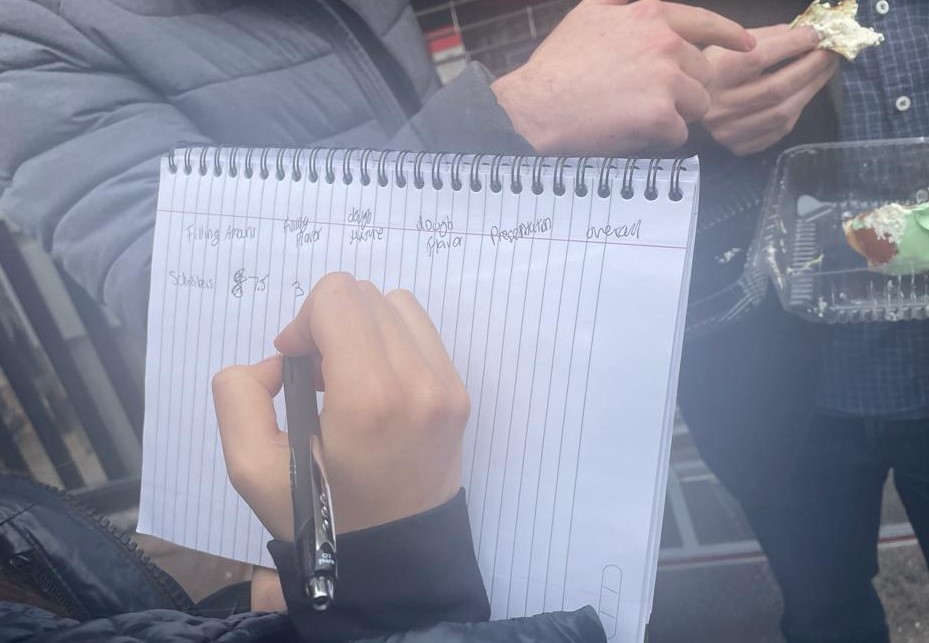
As we debated our scores outside of the bakery (note the filling flavor started as a ‘3’ and settled on a ‘5’ after everyone’s input), a local came over and asked our thoughts on the top bakeries in the neighborhood. It seems that other people are also doing the crawl.

Schreiber’s bakery kicked off the scoring for Hanukkah 2023

Kaff Bakery 1906 Avenue M

Kaff was a new addition to the crawl. We were impressed that several sefaradi people were picking up jelly donuts, as their bakeries do not have a tradition of making the holiday treats. Each one said that Kaff was a favorite but we were disappointed. While the lotus donut was packed with filling, it was not smooth and creamy, and was overly sweet (for me). Fellow travelers loved them which gave a more balanced overall score of ‘7’.

Kaff Bakery had a nice selection of donuts

Presser’s Kosher Bagels and Bakery, 1720 Ave. M

Presser’s donuts candidly did not look at all appetizing and we didn’t purchase any. Instead we tried the chocolate horn which had tasty chocolate but the dough was not as flaky as Weiss’s bakery.

Patis Bakery, 1716 Ave. M

Patis was almost completely sold out by the time we arrived around 11:00am. They had one variety – almond hazelnut – which was fantastic. Very buttery soft dough, good hazelnut filling and tasty toasted almonds on top. An ‘8.5’.

Almond hazelnut donut from Patis, Hanukkah 2023

Taste of Israel, 1322 Avenue M

Taste of Israel requires a pre-order some days in advance at (347) 554-8133. We highly recommend it. It was a new addition to the crawl and tied for top marks with Sesame. The dough is actually better than Sesame in terms of fluffiness and flavor, which is not always easy because it needs to contain the heavy filling. TOI mastered it. While the presentation is not as pretty as some of the other bakeries, the overall taste was terrific even when we ate them later at night. We went for Oreo and Halva; they also have lotus, caramel, custard, jelly and rosemary. A ‘9’.

Taste of Israel donuts ranked highest for dough, and also good flavor

Sesame – Flatbush, 1540 Coney Island Ave

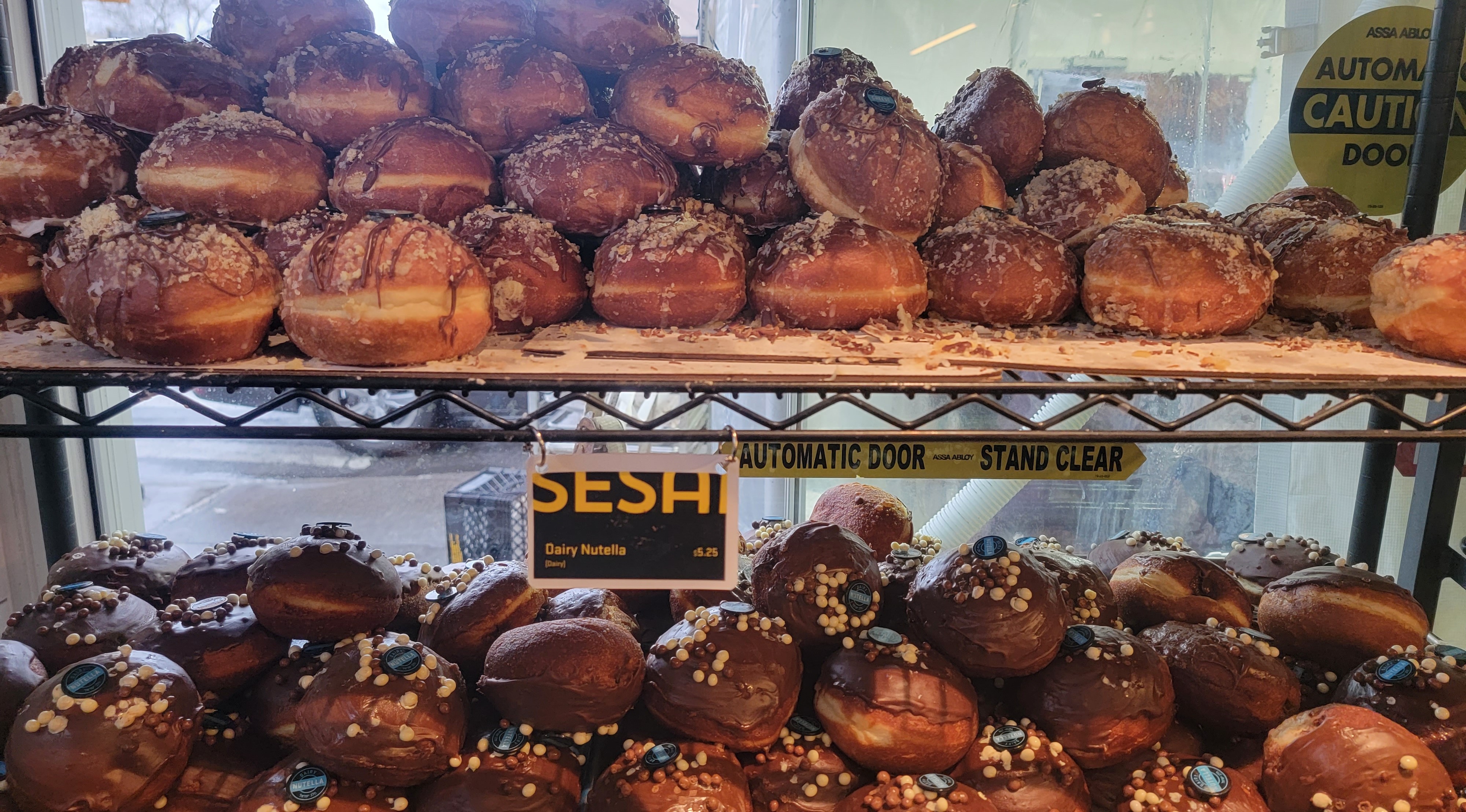
Sesame did not disappoint. Unfortunately, the store has developed a reputation for excellence so is a bit packed but perhaps that’s sharing the joy of the holiday. We heard that the dairy varieties (marked with blue labels) were out of this world but mostly purchased pareve to bring to people for dinner. The pareve (marked with green labels) peanut butter was outstanding – a 10. White chocolate, which I do not usually like was very tasty. Pistachio, as always, was terrific as was the lemon. Sesame puts flavor into the fondant on top of the donut for a doubly amazing experience. We bought dozens to bring back to share with people. A solid ‘9’.

Below is the overall scorecard for each bakery. We hope you enjoy them and Happy Chanuka!

Related articles:

Brooklyn Chanukah Donut Crawl 2022

Jerusalem Donut Crawl 2021

Brooklyn Chanukah Donut Crawl 2020

Chanukah Donuts: Brooklyn 2019

Brooklyn’s Holiday Donuts

French Riviera Crawl

The Last of the Mo’Kichels

Toss The Ivy Paper Monsters

There was a time when elite institutions successfully hawked their wares in an effort to stuff more cash into their bloated pockets. Universities like Harvard, Columbia and Cornell would shill like snake oil salesmen that thousands of dollars ponied up for pieces of paper with their embossed emblems would lead to greater riches, so a worthwhile investment.

Harvard’s online course on “leadership”

But the fragrance has left the rose and all that remains are prickly thorns from these former institutions of higher knowledge.

The weeks of October 2023 will be remembered for when the world blanched at the horrific comments stemming from the institutions’ leadership, professors and students, either endorsing or excusing the maiming and butchering of over 1,000 people in Israel.

At Cornell, professor Russell Rickford called the Hamas atrocity “exhilarating” and “energizing” before a crowd. Jewish students at the school were threatened with violence in a number of online posts.

Somehow, the school thinks that people still believe that the institution has a shred of morality to offer a course on the “psychology of leadership.”

Cornell University offering a course on “leadership” pitching that it “leads with empathy”

Columbia University professor Joseph Massad thought Hamas’s burning families alive was “awesome.” This is the same university that INVITED Malaysian Prime Minster Mahathir Mohamad to speak on campus, even though he is a known Holocaust denier and “proud antisemite.” It also INVITED Iranian President Mahmoud Ahmadinejad who threatened to wipe Israel off the map.

No worry. For several thousands of dollars you can get a paper from the school attesting to your skills at “communication,” because maybe you can find an employer stupid enough to believe that the certificate you bought from a formerly elite university is worth something.

Columbia hawking a communications degree for anyone willing to pay

Harvard is producing so many quality students that gleefully stand in support of Hamas that the school’s paper will now be known as the Bloody Crimson. Clearly everyone should purchase a “leadership” piece of paper from a school that produces such evil creatures.

America’s universities have become cesspools of radical socialism and jihadism, and the world has taken notice. People will no longer pay for worthless pieces of paper from morally bankrupt institutions which funnel proceeds to classes labeling Zionism a form of “European settler colonialism.” Employers are now shunning the schools, and people are removing any mention of them from their LinkedIn profiles.

Ivy League universities are churning out monsters. Finally, Americans are recognizing the rot and seeking to quarantine them before they destroy what was once the land of the free.

Related articles:

The Rising Generation Discusses Universities

Students for Justice in Palestine’s Dick Pics

The Antisemitic Campus: Decolonize Palestine

The Problem With Antisemitism On College Campuses Stems From Where Jews And Arabs Focused Their Donations

Biden Enables Anti-Semitism On College Campuses

Should The KKK Open Chapters In Every American University, What Say You?

Deformity Of Palestinian Culture In America’s Youth

Columbia University Completely Fails Mission. And Jews

Hamas And Harvard Proudly Declare Their Anti-Semitism And Anti-Zionism

Banksy Knows Hamas

Probably the greatest living graffiti artist alive today is known as ‘Banksy,’ who manages to stay anonymous.

That’s probably a good thing in light of his being a sponsor of Palestinian terrorism.

Banksy has several paintings on walls in the Palestinian territories which depict Israelis as merciless and Arabs as suffering souls, looking for an escape.

In one painting, Banksy shows a protestor throwing a bouquet of flowers instead of a Molotov cocktail. The implied message is that one needs to be violent to effectively protest, as throwing flowers would not yield any results.

Perhaps on the other side or along this wall, Banksy could draw images of Jewish families burned to death in their cars. Maybe a decapitated infant with an overturned crib. A woman grabbed by her hair and raped, or an elderly couple with bullets in their heads at a bus stop. Any of the gruesome images that Hamas terrorists inflicted on Israelis, with the Palestinian protestor seemingly tossing flowers onto Jewish graves.

The work could be called “Celebrating The Slaughter of Jewish Civilians” and he can sign it “Gaza and West Banksy.” The same art world which loved the Klinghoffer Opera can celebrate the “masterpiece.”

Banksy knows that he beautifies terrorists and softens their images in an appeal for sympathy. But the brutality is not beautiful and sympathy for such savages is sacrilegious.

The music at the Israeli dance festival was stopped by Palestinian bullets, and it is time for Banksy and other artists to stop adorning evil with wreaths.

Related articles:

The Holocaust Will Not Be Colorized. The Holocaust Will Be Live.

The Beautiful and Bad Images in Barcelona

Apartheid In Palestinian Authority, Not Israel

When Our History Begins

French Riviera Crawl

The French Riviera has much to offer in addition to beautiful beaches and towns, including numerous kosher restaurants and museums. Alas, the quality varies which I share honestly here. Note that this review is ground covered over nine days, so many locations are not reviewed. Below I recap the food, museums and towns.

FOOD

There are three main centers for kosher bakeries, stores and restaurants between Saint Tropez and Menton, on the border of Italy. Those are Cannes, Juan-les-Pins and Nice. Overall, Cannes has the best food of the three.

Cannes

It may only have half the size Jewish population of Nice but the food is better and the attitude of the people running the restaurants is much friendlier.

Moye. Moye is the finest of the restaurants in the region. Located on the eastern end of the main beach street of La Croisette, one can eat either outside (which can be a little noisy) or inside in a finely decorated establishment. The food is very good with a wide selection of meat main dishes, sides, wines and desserts. Try the nougat for dessert; it originated in the region and Moye makes an excellent version which doesn’t have the sticky, taffy-like consistency found in packaged varieties, but softer and more cake like. Nougat somewhat resembles macaroons in taste as it is made of egg whites, honey, sugar and almonds. The staff here is very friendly and accommodating.

Nougat dessert at Moye, Cannes, France

Le Tovel. On a quiet side street not a far walk from La Croisette is a small meat kosher restaurant. While not fancy, it had a decent menu. The steak and risotto were ready in minutes and pretty good, while the fries were oily.

Dr. Sandwich. A relatively new locale, the meat sandwich shop does not have seating. The street food is very tasty, with the sandwiches essentially made from a giant piece of challah with a slit instead of a pita pouch. Like a traditional shwarma place, you pick the salads and fillings to accompany the protein.

Bekef 26. The restaurant is attached to a makolet where one can buy a range of items including cold cuts, wine and candles. One can eat inside as we did for lunch, and the salmon dish was pretty good. Take-away cold cut sandwiches for a day trip. The staff is very friendly.

OKLM. A meat restaurant just a block from Dr. Sandwich with seating indoors and out. While not as quiet as the street with Le Tovel, it is pleasant enough outside and the food was good with large portions.

[Bakery]. There’s a small kosher bakery right next to Rouvi on Rue Louis Nouveau which has a very modest selection of items. They are fine but a far cry from the taste and appearance one finds in Paris.

Juan-les-Pins

Further east from Cannes is Juan-les-Pins, a community mostly made up of Tunisian Jews who fled in the 1960s and 1970s. There are many kosher establishments located very close to each other. Knowledge of English here is not as good as the major tourist towns of Nice and Cannes.

Kozy. A dairy café and bakery. The food is fine with a small selection of brunch food such as pancakes, eggs and sandwiches. The pastries and sweet rolls were OK.

Le Carmel. Next to Kozy is a kosher bakery that has long hours for a bakery with many locales hanging outside. Alas, the baked goods are very dry and not tasty.

Tunisian kosher bakery in Juan-les-Pins

Besbeche Azur. Just a street away from many of the kosher places is a fairly nice-looking meat restaurant called Berbeche. The meat is not very good, either lacking taste or very spicy/ salty. Foie gras was in many of the dishes, a locale favorite but not for me.

Nice

Nice is the major city in the region with a sizable Jewish community, so the kosher restaurants are a bit more spread out than in the other towns. Most are located on Rue Georges Clemenceau, and some further away. Most of the stores have the Lubavitcher Rebbe on the wall and have ties to Chabad.

Meat Bar. Near the major cluster of kosher restaurants is a small meat restaurant called Meat Bar. The menu is very limited but the dishes like lamb chops and shnitzel are very tasty. The servers are very friendly, and one is inclined to return, especially in light of the weak competition.

Falafel Sahara. Away from the cluster is a clean store selling shwarma, schnitzel and falafel. Ordering is done on a screen and eat either inside or out. Food was very fresh and tasty. Note: “green peppers” in France means jalapeno, not bell peppers.

Falafel Sahara in Nice, France

Keter. Among the cluster of restaurants is Keter, a dairy restaurant serving fish, pasta and gratin. The food is not very tasty and the staff is cold. While there is seating inside, there is no air conditioning and felt dirty.

Le Kineret. The meat restaurant has take-away options which one should consider as the store is not very clean, had no air conditioning and the staff was unfriendly. The tuna and salmon sandwiches are fine as are the baked good like meringue and biscotti. The chocolate cookies seemed weeks old. While a link to the website is included here, it is as deceiving as a dating app photo. Generally, an unremarkable B- which beats being hungry but you wouldn’t regularly visit.

Le Leviathan. While a much friendlier place than Keter and Kineret, and much cleaner, it is located on a seedy street. Don’t go there at night. The dairy food is fine (also B-) with good selection of pizza, pasta and fish.

Chabad. The shul hosts dozens of people on Friday night and has a small restaurant which we didn’t visit. While the Americans seem to reserve and pay in advance, many stragglers fill the outdoor courtyard in a classic Chabad way. Definitely enough food, with most filling up on the challah.

Try the 123cacher app to find the various restaurants.

MUSEUMS

While the region has many museums, I was advised to skip several including Renoir, Leger and the archeological museums. Outside of the first three listed below, all could be skipped. Note that the current wave of protestors throwing liquids on famous works of art sometimes produces a very long waiting line as security pours through each visitor’s bag.

Picasso. Museo Picasso in Antibes is right on the water in a bright, beautiful old building where the artist worked after World War II for about 18 months. He left most of the art he produced over this period to the location, so a great place to see unique paintings, pottery and sculpture.

Chagall. Chagall is a favorite in Nice. His museum is up the hill but very worth the visit. His enormous works about biblical scenes can be seen up close with great commentary from audio guides accessed via QR codes on your phone. There are gardens on the premises as well. Surprisingly few visitors were there when we visited.

Prince of Monaco Auto Collection. The prince of Monaco donated his car collection which includes antiques from the 1920s all the way up to cars from 2000, as well as a number of Formula 1 race cars. Located at the Monaco port on two floors, the description of the cars is a bit light but the air conditioning is very welcome after the intense Monaco sun.

Palais Lecaris. In the middle of Old Town Nice is an old mansion that now houses an amazing collection of antique musical instruments. Harps, harpsicords and lutes from hundreds of years ago are arranged in cases in the non-air conditioned building.

Matisse. Do not come here if you want to see the artist’s famous works. The best things here are a series of sketches which show how Matisse conceived of a subject before getting to the final painting, and some cut outs that were assembled to be used in future artworks. Regrettably, the museum is mostly obsessed about the building itself and how great it is (and it’s not). Further, it is far away from most other interesting destinations in Nice.

Photography. Near the flower market in Old Town Nice is a small photography museum which rotates its exhibits. Fortunately the current ones are good. Both locations (next to each other) can be viewed in 15 minutes.

MAMAC. The modern art museum of Nice is pretty large but the best art work is the white space between the installations. The museum features contemporary works of “art” which are mostly physical manifestations meant to educate the viewer about the evils of global warming and colonization.

CITIES

The French Riviera is known as Cote d’Azur because of the beautiful blue water that wraps the various coves. The beaches are mostly pebbles and rocks, collateral from the soaring cliffs above the sea. The towns on the coast are basically sized against the length of the beach, with Nice having the largest beach, promenade and city.

Going around the region by car to each town offers three main options: a single lane road along the coast, wrapping the mountains with hairpin turns, or driving inland to the highway (A8) to zoom east/west and then descending to the towns. In other words, don’t look at a map to see how close the towns are but use a driving app like Waze.

Going from most western to eastern:

Saint Tropez. The town has a big flashy name and the tourists to prove it. It features a large marina with enormous yachts, a cute old town for walking around and small boutique hotels. Parking is difficult as tourists dwarf the number of spots on the beach and things to see. Many high end clothing brands are here, and Dior has a beautiful building with courtyard for drinks and food.

Gassin. Up in the mountains above St. Tropez is a very small mountain town called Gassin. There’s not much to do but the drive through the vineyard to get there and views from the mountaintop are very nice. It claims to have the narrowest street in the world, about 15 inches across.

The vineyards near Gassin

St. Raphael. A charming beach town. While it doesn’t have the big name shopping brands like Cannes and St. Tropez, the beach and marina are inviting and very manageable as tourists seem to ignore this hidden gem.

St. Maxime. A very small town with a modest beach and a quaint old town with just a few streets with shopping for clothing, bags and home items. There is a decent sized antiques/ bric a brac market near the beach as well.

Cannes. This is the big money town. Every fancy car one could imagine dot the roads including Lambourginis, Mclarens, Aston Martins, Ferraris, Bentleys, Maserattis, antique Rolls Royces and Porsches, and many more. The botox and “enhancement” surgery is ubiquitous, with old and young women trying to compete with the curves of the cars. The old town is nice and shopping streets have a fun liveliness beyond the stores. The promenade of La Croisette is lined with palm trees and beautiful hotels like The Carlton Hotel. Hotel Martinez recaptures the Art Deco feel found in Miami hotels but with fantastic service. Stop by Palais des Festivals where people like to have their pictures taken on the red carpet where the Cannes Film Festival takes place. Bring a mat to the public beach as the rocks are hard. Renting a chair – even if you are staying at a hotel – can costs hundreds of dollars for the day. If you’re lucky, crash a wedding at the beach.

Juan-les-Pins. The town has a nice beach, cute stores and some boutique hotels and parks. Overall, it feels much poorer than Cannes, with many store fronts vacant once leaving the main beach street.

Cap d’Antibes. Between Juan-les-Pins and Antibes, a small peninsula juts out into the Mediterraean Sea. The area is mostly reserved for the wealthy homeowners behind high walls but there is a pathway towards a public beach with pretty sunsets and a place to swim.

Antibes. Not far from Juan-les-Pins is the major marina of Antibes with hundreds of boats, a charming old town which includes Museo Picasso and a beach tucked behind some breakers.

St. Paul de Vence. Driving inland is a small town on a hill. The site is basically a single street dotted with art galleries and many tourists. Chagall is buried in the cemetery.

Tourettes-sur-Loup. While St. Paul de Vence is teeming with visitors, no one comes to Touretts-sur-Loup. It is also an old city built on a hill but with many more streets but very few shops. The town offers half hour of free parking to lure visitors, seemingly unsuccessfully.

Nice. The major city which houses the airport, there is a huge old town with frequent markets which change daily – sometimes flowers, food or antiques. There are many shuls including the Grand Synagogue, mostly Sephardi, and restaurants and museums mentioned above. Also grab drinks at the Le Negresco hotel at the main promenade.

Villefranche-sur-Mer. A charming beach front town with marina, beach and places to grab a drink. It has a nice balance between the size of the town and quantity of visitors.

St. Jean Cap Ferrat. Between Villefranche and Beauleiu, Cap Ferrat juts out into the sea much like Cap d’Antibes. The water somehow seems more blue and visitors more mature than the younger Cap d’Antibes beaches. The walk around the tip from the forest to Paloma Beach is beautiful. At the beach, models of all sizes are in bikinis for professional photo shoots. Try to grab a free shuttle at the end of the day to take you to your car parked far away!

St. Jean Cap Ferrat

Beaulieu. A small marina and beach seemingly for the very wealthy and few tourists. The main draw is the beautiful La Reserve hotel. The outdoor market with high end furniture and eclectic art was empty.

Eze Village. Better than St. Paul de Vence and Tourettes-sur-Loup, Eze is an extensive town-on-a-hill with grand views of the coast. Large perfumeries like Galimard and Fragonard have tours of how perfume is made and the restaurants allow you to buy a drink and soak in the incredible views. Go to the Exquisite Jardins at the very top to see amazing succulent plants and appreciate the dramatic views of Cap Ferrat.

Views of Cap Ferrat from Eze Village

Monaco. Like Cannes, a major focus is on money, including cars, fancy hotels and shopping. The Grimaldi Forum rotates its shows (I got to see Monet) and the Prince’s Antique Car collection is worth a stop along with the grand hotels such as Hermitage. The grand Casino de Monte Carlo is beautiful and opens at 2pm for gambling but one can see the entry at any time.

Menton. Right before the Italian border is another beach town called Menton. It has a long stretch of beach and a small old town. Few tourists relative to the size of the beach.

Hopefully a useful guide for people planning a trip to the French Riviera.


Related articles:

Brooklyn Chanukah Donut Crawl 2022

Jerusalem Donut Crawl 2021

Normandy’s Shadows

There is a beach in France where the ordinary proved extraordinary,
As common men fought fire-breathing dragons
On a far away shore.

There is a beach in France below thousands of white crosses
Blanketing rolling green fields,
Manicured and resolute.

From the beach in France, American volunteers now amend a wrong
Affixing Stars of David to the headstones
Of fallen Jewish warriors.

From the beach in France, a rabbi squints at a green hill
Encasing a Jewish cemetery long overgrown
With vines on broken railings.

At the American cemetery in France, visitors stare into the distance,
Blind to the blood and bones
Soaked in the Earth.

There is a beach in France where silent sentries shine tall
Over traumatized sand,
Who cast long sunset shadows on forests covering countless forgotten lives.

Samuel L. Jackson As Princess Diana On ‘The Crown’

A bit of humour.

The entertainment industry is having both a bit of fun and mired in controversy regarding its choices of actors in movies and plays.

‘The Lehman Trilogy’ played on Broadway and featured three British non-Jewish actors – one Black – portraying three German Jews. TV’s ‘The Marvelous Mrs. Maisel’ about a female Jewish comedian is played by a non-Jewish actress. The upcoming movie about Israeli Prime Minister Golda Meir will similarly not star a Jewish – or Hebrew-speaking – actress.

The Jewish comedian Sarah Silverman called this practice “Jewface,” taking a lift from the term ‘Blackface’ in which a non-Black actor paints their face Black (something Silverman has done). While some actors object to the practice (only for Jews; it is universally condemned for Blacks), others think that the nature of acting should allow anyone to play any part.

In the show ‘Hamilton’, the founders of the American revolution were cast as Black and Hispanic, to show how the story would be told from a different perspective (considering Hamilton himself as a Black-ish figure) using rap music. The musical ‘1776‘ took this approach a step further, and recast the founding fathers as all female or non-binary, as well as non-White. The directors thought that doing so would make the discussion about slavery and “patriarchy” ring louder.

With such “progressive” approaches to reenacting historical drama, I was disappointed that the latest season of the TV show ‘The Crown’ opted to cast a milky white woman in the role of Camilla Bowles. In light of the charges of racism that former Prince Harry and his multi-racial wife Meghan Markle made against Queen Elizabeth and the royal family, it would have been an interesting twist for the redhead to hate the usurper of his father’s love, had Prince Charles run off with a Black woman.

Perhaps better still, a strong Black man, like Samuel L. Jackson, should have played Princess Diana. It would have been a meaningful commentary on proper British society for the future king of England to marry a Black man, and have the English consider racism, homophobia, the demeaning objectification of a princess, and the importance of an heir, all at one time.

Samuel L. Jackson should have played Prince Harry’s mother, Princess Diana, in ‘The Crown’

Pip-pip-tally-whacker!

Related articles:

New York To Offer Brothel Licenses To Prostitutes

“Protocols of the Elders of Zion – The Musical”

Ben & Jerry’s New Flavor: Milano Zio

Charlie Hebdo Will No Longer Sell Magazines to 20 Islamic Terrorist Groups

Liar, Liar! Hillary’s Pant Suit’s on Fire!

ObamaCar to Address Garage Inequality

Brooklyn Chanukah Donut Crawl 2022

The annual Chanukah tradition of tasting sufganiyut (filled donuts) at local bakeries returned us to Brooklyn this year. We decided to focus on Flatbush and Williamsburg, and skipped the usual run in Boro Park. Below are the bakeries we went to in order, in case anyone would like to replicate the tour.

Ostrovitsky’s, 1124 Avenue J

Our first stop was Ostrovitsky’s which scored well in prior visits. Unfortunately, the selection this year was beautiful but not good. The flavors looked great – Hazelnut, Napolean, Lotus, Oreo, Chocolate Mousse and Rosemary – but the dough tasted like it was a few days old. The filling flavor was still good but the amount of filling was very different depending on which donut we sampled (yes, we taste everything).

Pomegranate Supermarket, 1507 Coney Island Ave

We made an exception for the strictly bakery locations for Pomegranate, because of the store’s great reputation. There were basic flavors to try – jelly, chocolate, custard and caramel – and the jelly was really great. Dough was light and tasty and just the right amount of jelly and flavor. The $4.00 each for non-fancy seemed steep, but they were good.

Sesame, 1540 Coney Island Ave.

Sesame was packed as usual with a line to get in the store (and Chanukah didn’t even start until that evening!) The bakery always has a great assortment of flavors and they are usually terrific. This year, we found the dough and filling excellent once again, however a bit sweeter than past years. We are biased towards flavor over sugar, and this year, there was a complete lack of subtlety. Pistachio is always a favorite but now it comes complete with a sugar rush. We tried hazelnut and peanut this year too, and picked up a couple dozen for people in our neighborhood who crave them.

Taste of Israel, 1322 Avenue M

We heard good things about TOI but were then told that they only took pre-orders. We may stop by again next Sunday.

Schreiber’s Homestyle Bakery, 3008 Avenue M

Schreiber’s simply has the best lace cookies so we go every year. While not a complicated dessert, they have a great crispiness in a single layer and a generous dipping of excellent chocolate. Make sure to pick some up along with the sufganiyut.

The majority in the store are pareve. They have pre-boxed assortments and we picked up a few to bring to a dinner party (see below). The dairy ones which we ate on the spot had amazing dough – very light and tasty. Please go to the back to pick these up. The strawberry had the perfect amount of filling and also a really nice light flavor. The cheese was a little too light on flavor.

We took a short break to watch the World Cup finals and got to see the end of the second period of extra time and the shootout with Argentina beating France. I’m not sure how many families watched the end of the amazing 2022 game in a hair salon in the middle of a Chanukah donut crawl, but to those who did – wasn’t it great?

Oneg Bakery, 188 Lee Avenue

We drove to Williamsburg which is a hike I do not recommend. If you are going to the neighborhood anyway, that’s fine but not together with Flatbush which can be 45 minutes away.

Oneg is rightfully famous for its heavy babka, among the best in the world. They are huge at $45 for a half and $90 for a whole. We actually get the large and cut it into three, as they freeze well.

The store is very small and old school. The donuts aren’t fancy but the classic jelly was excellent, maybe only slightly behind Pomegranate’s in terms of flavor and consistency of filling.

Black and White Bakery, 520 Park Ave

B&W was a real disappointment. We had a good experience there in the past, and the chocolate horn was indeed very good. However, the donuts are too expensive ($6.50), almost all dairy, and lacking a variety of taste. Every donut seemed to have the same cheese filling, just with a different topping. While the toppings were attractive, they lacked in flavor. On the plus side, you can daven mincha at the Yeshivat Viznitz around the corner with over 100 Satmar students.

Below is the ranking for this year’s donut crawl. If you visit, please tell them about the review on the blog First One Through. As Chanukah covers two weekends this year, we are likely to make a second run next weekend, possibly visiting Boro Park and Crown Heights bakeries.

Related articles:

Jerusalem Donut Crawl 2021

Brooklyn Chanukah Donut Crawl 2020

Chanukah Donuts: Brooklyn 2019

Brooklyn’s Holiday Donuts

The Last of the Mo’Kichels

When Our History Begins

Most people likely start their history at their birthday. Others might consider the important impact of parents or grandparents, and therefore mark those births or perhaps a significant milestone in their lives like moving to a country, as the symbolic beginning of personal history.

For individuals who strongly associate with a collective, whether as citizens of a country or members of a tribe, the origin story varies.

In Art in Mexico
Diego Rivera (Dream of a Sunday Afternoon in Alameda Park)

Diego Rivera (December 8, 1886 – November 24, 1957) is one of Mexico’s most famous artists. His murals of Mexicans and Mexican history adorn the walls of government buildings, famous hotels and business headquarters. One of his wives, Frida Khalo (married to her twice, 1929-1939 and 1940-1954) was also a famous painter who shared (and surpassed) his passion for Marxism, which often infused both of their art.

Rivera was a descendant of conversos, Jews who were forced to convert to Catholicism under penalty of expulsion or death by the Inquisition. While his Mexican heritage dominates most of his work, he did share in 1935 that “Jewishness is the dominant element of my life,” and it can be seen in one of his famous murals.

Rivera had already painted many of his great works when he was commissioned to paint a mural for the Del Prado Hotel in Mexico City in 1946. At 60 years old, he spent a year painting Dream of a Sunday Afternoon in Alameda Park, a famous park in central Mexico City, frequented by high society.

Diego Rivera’s Dream of a Sunday Afternoon in Alameda Park (1946-7)

The mural was enormous, measuring 51 feet long by 15 feet wide. It told the story of the history of Mexico City chronologically, from the earliest period at the far left, to the modern city on the right.

Rivera placed himself in the painting, slightly left of center, even though he clearly did not belong there chronologically. He held an umbrella in one hand and the other grasped the hand of the “dapper skeleton.” Frida Khalo rested one hand on his shoulder while the other held an orb.

Diego Rivera, Frida Khalo and La Calavera Catrina, “the dapper skeleton”, in Dream of a Sunday Afternoon in Alameda Park

Curiously, Rivera portrayed himself as a young boy, begging us to consider the various messages he was conveying.

The dapper skeleton was originally conceived by Jose Guadalupe Posada, a lithographer who mocked upper class Latin women for dressing in French clothing and whitening their skin, seemingly ashamed of their native origins. Rivera painted himself looking up at the skeleton, acknowledging that despite his strong nativist roots, perhaps he too was pulled into that worldview, as he was celebrated by high society around the world.

But that is just part of the message.

Rivera was a foot taller, three times the weight and twenty years older than Khalo. Yet here, Khalo acts as a mother figure, protecting a young Rivera. Why does Rivera have Khalo towering over himself and from what does he need protection?

Khalo holds a yin yang, a Chinese philosophical concept that binds opposite and interconnected forces. She too had become famous in western society and dined at the finest establishments. Perhaps part of the message was that Khalo was keeping the couple grounded in their populist Mexican roots, even as they enjoyed high society.

There is more.

Rivera’s tenth birthday coincided with the 300th anniversary of the execution of the Carvajal family in Mexico City, on December 8, 1596.

The Carvajal Conversos

The Carvajal family were Hispano-Portuguese conversos. The patriarch of the family, Luis de Carvajal the Elder (1539-1591) was a sincere convert to Catholicism who won the favor of King Phillip II of Spain, while many in his family kept their Jewish faith hidden from the Spanish Inquisition.

The king granted Luis the Elder a governorship in the northern parts of New Spain (today’s Mexico to Texas), and in 1579, authorized Carvajal to bring 100 people with him to the new world. Most significantly, the king’s royal charter included the anomalous provision that such individuals need not be subject to the investigation of ancestry, with which the crown typically tried to keep New Christians out of its colonies, as the king had brought the Inquisition to Mexico in 1571. Luis the Elder, knowing of his family’s hidden crypto-Judaism, likely thought that his career could advance, and his family would be safe in the new world.

It would not protect them for long.

In 1589, the viceroy of New Spain arrested Luis the Elder for a commercial matter, and in the investigation, it came out that Luis knew of, but did not report on his family’s secret Jewish faith. He was thereby transferred from the royal prison to the prisons of the Inquisition.

The whole family became implicated, including Luis the Younger (1566-1596), his sister Isabel and mother Francesca. At the auto da fé on February 25, 1590, inquisitors sentenced the entire family to various penances and wearing of sambenito, penitential garb. Not long after, Luis the Younger, his mother and sisters resumed their forbidden practices in hiding. They were caught again after a friend gave them up in February 1595. This time, they did not get off. Francisca, Isabel, Leonor, Catalina, and Luis the Younger were all burned at the stake at the auto da fé of December 8, 1596, as relapsos, or recidivist Judaizing heretics. This history was detailed in the diary of Luis the Younger, an important document in the history of Mexico.

Rivera chose to mark this slaughter of the Carvajal family as the beginning of the history of Mexico City.

Torture and burning at the stake of the Carvajal family in Rivera’s Dream of a Sunday Afternoon in Alameda Park

Four members of the Carvajal family can be seen in the background with pointy hats tied to the stake with flames around them. The mother, Francesca, with head shaven, is before them being lashed by one Inquisitor while a member of the church sticks a cross in her face.

Rivera was deeply impacted by this story. In another section of the mural, he painted Ignacio Ramirez, a Mexican politician, holding a sign that read “God does not exist.” Catholic officials viewing the mural were offended by the line and asked Rivera to remove the text. He refused to do so and the painting was covered for nine years until he relented.

The Carvajal story elucidates the reason Rivera painted himself as a young boy.

While the history of Mexico City did not start in 1596, his personal history of the city began then due to his connection to conversos in the past. His tenth birthday was likely marked with the 300-year commemoration of the burning of the famous Jews at the stake. It impacted him deeply and he became sickened by religion. Painting about history in the shadow of the European Holocaust in 1946-7, demanded particular attention.

In the mural, Rivera is comforted by his non-Jewish wife who protected him both from the Inquisition as well as from capitalism and high society. While he was a product of many worlds, Jewish-Catholic-agnostic and socialist-capitalist, he relied on his spouse to secure him. On his own, he was left holding a folded umbrella, even while others around him held fancy canes, as he continued to fear various storms. He stood emotionally vulnerable in the nativist past, as he felt the pull of the modern bourgeois.

Rivera could have painted himself as a grown man, just as he could have started the city’s history when the Spanish came in 1521 or with the indigenous people who lived there for centuries. But that would have undermined his message that he was deeply insecure, and his personal view of the beginning of the city’s history.

In Schools in America
European (1776) and African Slavery (1619)

Proud Americans have historically viewed the beginning of their history at the Declaration of Independence in 1776. They appreciate the country’s founding fathers pulling away from England and establishing a new system of government with the Federalist Papers (1788) and the U.S. Constitution (1789). The native Americans and the first Europeans who started the colonies 150 years earlier are glossed over in favor of the first American citizens.

A new approach towards the beginning of American history is being fostered among Black Americans. The “1619 Project” has cast America as founded on slavery, a system of prejudice which Blacks continue to experience to this day. They see the start of history as African-Americans as beginning at that time, which directly feeds their orientation as Americans today.

School systems in California and elsewhere are no longer solely teaching the European view of history and are including coursework like the 1619 Project. They want all Americans to understand the various beginnings of the citizens of these United States.

In Middle East Propaganda
Palestinians (Canaanites) and Jews (Balfour 1917)

The Arab-Israeli Conflict has been ongoing for a century. Palestinian Arabs consider themselves as the indigenous people of the region and the Jews as new European interlopers. They tell themselves and the world that they are the only rightful claimants to the land based on a false spin of history.

Regarding Jews, Arabs negate the 3,300-year history of Jews in the land and the centrality of the land in Judaism. Palestinians falsely claim that today’s Jews have nothing to do with the Israelites in the Bible and are merely converts from Khazar. The Arabs absurdly assert that even the Jewish Temples in Jerusalem were located somewhere else. They lie that it was the British who launched the Jewish presence in Palestine with the Balfour Declaration in 1917.

Unsatisfied with only negating Jewish history to bolster their supposed higher claim to the land (or nervous that the anti-Semitic smears are too obviously false), the Palestinian Arabs have also changed their own history. Rather than admit that Arabs first came to the holy land en masse with the Islamic invasions of the 7th and 8th centuries, they claim that they are descendants of Canaanites and Jebusites mentioned in the Jewish Bible. Some college professors have even spun the idea of “Palestinian Hebrews”, completely stealing Jewish history and identity.

The Arab propaganda battle is very much about the beginning of their own history and of their perceived enemies, the Jews. It is an instrumental tool in their view of themselves and their position today, and an enormous obstacle to coexisting with the truly indigenous Jews.

In Meals in Religion
The Passover Seder for Jews

Jews have a unique approach towards infusing the beginning of their collective history.

While some Jews look to their forefathers of Abraham, Isaac and Jacob as the founders of monotheism and Judaism, the view of the start of Jewish history is the exodus from slavery in Egypt. It was at that time that they emerged as a nation and received the Torah, the laws to live by.

To cement the story in collective consciousness, Jews have a feast every Passover to mark that specific time in history. They have a seder, which revolves around telling the story of leaving Egypt, accompanied by a Haggadah which has been used for centuries. The meal is geared towards the children at the table, to instill a common past which ensures a uniting bond in the present.

Memory and History
Personal and Communal

Melissa Fay Greene authored a piece in April 2021 called “You Won’t Remember the Pandemic the Way You Think You Will.” She made several observations about memory including the strength of the “primacy effect”, remembering firsts, and the “narrative effect,” being able to recall dramatic events. She quoted Robyn Fivush, a psychology professor at Emory University who said “we use our memory in part to create a continuous sense of self, she [Fivush] told me, “a ‘narrative identity’ through all of life’s ups and downs: I am a person whose life has meaning and purpose. I’m more than the subject of brute forces. There’s a Story of Me.

Greene also quoted Richard McNally of Harvard in discussing memory. “Trauma gouges deeply into our minds, engraving painful and long-lasting memories. “Whether they are rape victims, combat veterans, or earthquake survivors, people exposed to terrifying trauma typically retain vivid memories of the most central aspects of such experiences, often for the rest of their lives.”

On top of firsts, stories and trauma as means to retain memories, Greene discussed the idea of “collective memory,” an idea advanced by the 20th-century French sociologist Maurice Halbwachs. “We don’t shelve a pristine first edition of an experience in a dust-free inner sanctum; we sloppily pass the memory around, inviting comment. The consolidated edition, with other people’s fingerprints all over it, is what we put on the shelf of long-term memory, unaware that we’ve done so.”

The idea that our best recalled personal memories are tainted by outside influences can be set against what that does to the view of a collective event, such as the terrorist attacks of 9/11. “To tell it [a collective event] is to become part of the community, to share the moment, to work together to understand an event that’s difficult to grasp. If we recall and talk about something often enough, it will become a ‘cultural narrative.’… Narrative-memory experts call this “the social construction of autobiographical memory.” While a personal memory has the fingerprints of others, a collective memory is an amalgamation which we accept as truth to fit into the community.

Consider extending Greene’s view of personal and collective memory towards history.

A person cannot remember the beginning of their history; it predates their ability to have memories. However, the way they conceive of themselves in the present – personally and as part of community – identifies the story in the past which made them who they are today.

Diego Rivera took a traumatic event in Mexico’s history as an important early influence on his life. Black Americans have a collective narrative of racism in America and see the slave trade as the start of their persecution. Palestinians are actively constructing an autobiographical memory to understand their lack of a state while the most persecuted people in the world which was almost wiped from the planet in recent memory, managed to create a leading first world liberal society in their backyard.

Collective history is not collective memory. The latter includes a first-person account of an event, unknowingly reformulated with the contribution of peers. It twists a reality without a person realizing that their memory includes various external inputs.

But everyone readily understands that collective history they discuss is imperfect, relying on stories told through the generations. People use their lived experiences – their successes and failures – to identify when that path was set, and simultaneously choose what history is part of their tribal worldview.

Many Americans of European descent object to the 1619 Project as undermining the remarkable accomplishments of America’s founders. While not denying the history of slavery, the slave ships do not anchor the beginning of their history. They strongly object to it being taught in public schools as destroying common heritage. Black Americans cannot fathom that objection if people acknowledge the history of slavery. Conversely, Arabs understand that if they acknowledge that Jews predate them in the holy land, the basis for demanding a country free of invaders is revealed as outrageously anti-Semitic.

Everyone tries to impart collective history to young people. The Passover seder has Jewish children engaged in questions to cement memory and history together. American and Palestinian schools teach revised histories to impart a preferred collective history. And Diego Rivera made clear that his understanding of the beginning of his city’s history was determined when he heard of a horrific story that touched him personally as a child, a trauma he considered as he learned more stories of the European Holocaust as an adult.

Communities seek to build foundations in the youth with the beginning of their histories. The narratives are crafted in schools, family dinners and what kids see in society.

Certainly our past set our current reality, but we choose our origin story based on how we define ourselves today. When our history begins is both about a point in time and our collective memory adapting the story of our collective history.

Related articles:

Watching Jewish Ghosts

In Defense of Foundation Principles

Now Is The Time For Sabra, An Israeli Superhero, To Join Captain America

Humble Faith

Prayer of The Common Man, From Ancient Egypt to Modern Israel

The Beautiful and Bad Images in Barcelona

The Last Sounds of “Son of Saul”

Now Is The Time For Sabra, An Israeli Superhero, To Join Captain America

In December 1940, a full year before the United States of America entered World War II in response to Japan’s bombing of Pearl Harbor in Hawaii, two young Jews created a superhero.

Joe Simon and Jack (Kurtzberg) Kirby were young artists who were looking to create a new superhero in the golden age of superheroes. The genre had many Jewish artists and writers, including Superman in 1938 (created by Jerry Siegel and Joe (Shusterowich) Shuster) and Batman in 1939 (by Bob Kane and Bill Finger). Those characters were created at the dawn of the European Holocaust of the Jews, and fought against fictitious bad guys generally.

Simon and Kirby opted for a more direct approach.

In an interview in 2011, a 97-year old Joe Simon relayed that they didn’t need to create a fictitious villain, “We both read the newspapers. We knew what was going on over in Europe. World events gave us the perfect comic-book villain, Adolf Hitler, with his ranting, goose-stepping and ridiculous moustache. So we decided to create the perfect hero who would be his foil.

First issue of Captain America published in December 1940, featuring Captain America punching Adolph Hitler on its cover

At that time, there were many Americans who proudly considered themselves Nazis. Groups like the German-American Bund marched proudly through public streets and even held an enormous rally at Madison Square Garden in New York City in February 1939. They chanted “Stop Jewish Domination of Christian Americans” and demanded that “our government be returned to the American People who founded it.

The American Nazis began to lose some popularity when Nazi Germany invaded Poland in September 1939 which launched World War II, with Great Britain and France declaring war on Germany. Still, Americans did not want to go to war in Europe, some being isolationists and others harboring Nazi sympathies.

American Nazis took aim at Simon and Kirby for “propaganda” advocating for America to get into the war to fight Nazi Germany. They accused Jews of wanting to sacrifice Christian blood to save Jews in Europe, a passive-aggressive blood libel. They saw the “Jewish media” controlling America’s foreign policy as puppet-masters.

Much of the same rhetoric is happening today.

The Islamic Republic of Iran is a brutal regime. It is the leading state sponsor of terrorism, backing groups like Hezbollah in Lebanon and Hamas in Gaza. It hangs gays in public squares. It kills its own Iranian women who do not cover their hair.

This extremist regime has called for the destruction of the Jewish State of Israel, as the Islamic country builds ballistic missiles and nuclear weapons. Yet the world says nothing and does nothing.

In contrast, the radical jihadists in the Palestinian Authority territories get active global assistance. Even with an anti-Semitic foundational charter lifted from Hitler’s Mein Kampf and the forgery Protocols of the Elders of Zion, the political-terrorist group Hamas won the majority of parliament. The active incitement to kill Jews with a pay-to-slay program is ignored (or possibly appreciated) as countries pour money into the terrorist enclave. The United Nations even states that it wants Hamas to join a unity government, praising the recent Algiers Declaration.

The radical jihadists have supporters across the United States. On over 200 college campuses, Students for Justice in Palestine have targeted Jews and the Jewish State. Members of Congress like Rashida Tlaib and Ilhan Omar spew anti-Semitic venom reminiscent of Nazi Germany. Entertainer Kanye West calls out Jews who control Black America and threatens them with violence.

The mainstream media echoes their sentiments, that congress is controlled by Jews. It bemoans the ‘powerful Jew‘ in sick arguments while simultaneously claiming only White supremacists make such anti-Semitic smears.

In this caldron of anti-Semitism and calls for violence against Jews and the only Jewish State, Marvel Comics announced that it will feature a superhero named Sabra, an ex-Israeli Mossad agent, to be featured in a new Captain America movie.

Marvel superhero, Sabra

The timing seems very appropriate as Israel faces genocidal fanatics in the Middle East, and anti-Semitism is spreading like wildfire in the United States and around the world.

As in Captain America’s release in 1940, many Americans are upset by a superhero with real world political roots.

Anti-Zionists fear that if an Israeli is a superhero, Palestinian Arabs will be portrayed as the genocidal villains. Isolationists and jihadists fear that the movie will advocate attacking the Islamic Republic of Iran, launching the United States into another war against a Muslim country. Run-of-the-mill anti-Semites don’t want to see a Jew infiltrate what they perceive as a cohort of Christian American superheroes.

Lost on all of them is that Captain America himself was created by Jews to attack a real genocidal anti-Semite before the magnitude of Hitler’s evil was manifest. Captain America’s relaunch in the 1960’s to a newer audience was also led by a Jew, Stan (Martin Lieber) Lee. The inclusion of an overtly Jewish superhero now, when the United Nations acts like Marvel’s evil Hydra organization seeking to destroy the Jewish State is both warranted and timely.

Alas, the Jew-bashers may yet win. Their loud shrill voices made Marvel issue a statement: “While our characters and stories are inspired by the comics. They are always freshly imagined for the screen and today’s audience, and the filmmakers are taking a new approach with the character Sabra who was first introduced in the comics over 40 years ago.

Will Marvel give Sabra a new backstory in which she may be Jewish but not Israeli? Only fight against liberals’ perception of the “right kind of anti-Semites” who are Male White Supremacists but not those Brown, Female or Muslim? It remains to be seen.

Jews and the Jewish State are under attack from all sides, and while it would be nice to see a superhero come to their aid in the world of fantasy, we need people and governments in the real world to fight back against the genocidal intentions of today’s growing anti-Jewish war machine.

Related articles:

Hamas’s Willing Executioners

‘The Maiming of the Jew’

Politicians In Their Own Words: Why We Don’t Support Defending Jews

Considering Nazis and Radical Islam on the 75th Anniversary of D-Day

Reuters Can’t Spare Ink on Iranian Anti-Semitism

Hamas And Harvard Proudly Declare Their Anti-Semitism And Anti-Zionism

11 Hours in Colleyville, 7 Days in Entebbe

Sabbath broke, so the phones turned on to check emails and the news of the prior 25 hours. The horrible reports coming out of Colleyville, Texas were not just disturbing but unsettling. Yet again, Jews were targeted by anti-Semites/ anti-Zionists to free other anti-Semites / anti-Zionists.

Between calls and community tehillim, I opted to find some strength in a historic hostage situation – when the Israeli army rescued passengers from an airplane hijacking at the Entebbe Airport in Uganda. I had seen movies relaying the exciting rescue attempts made in the 1970s, but had not seen the newer version produced in 2018 called ‘7 Days in Entebbe,’ so watched it while my thoughts were with the Jewish hostages in Texas.

It’s a very peculiar take on the story. Rather than highlight the daring rescue operation by the Israelis, the writer/ director team of Gregory Burke and Jose Padhila took a completely different approach. They told the story of two German “revolutionaries” who joined the Palestinian hijackers; explored the Israelis through the lens of a political battle between Defense Minister Shimon Peres and Prime Minister Itzhak Rabin; and littered the story with performances by the Bat Sheva Dance Company.

The Left Wing Embrace of Palestinian Terrorism
(and in a good way)

The movie opens with a distorted pro-Palestinian view of history with statements to set the background and tone of the film:

  • The United Nations created Israel in 1947
  • The Palestinians then fought to get their land back
  • They were backed up by left-wing groups around the world
  • They called themselves ‘Freedom fighters’ while the Israelis called them ‘terrorists’

The distortion needs multiple levels of unpacking.

  • The UN voted to create BOTH a Jewish State and another Arab State. The Arab world refused to accept the vote as they stood firmly against any Jewish country and wanted the entire region to rule. Israel was created through its own declaration in 1948.
  • The Palestinians did not have a country where they had self-determination so there was no fight for “the return of their land.” Five Arab nations waged a war against Jews who had just survived the Holocaust, to expunge the survivors from their historic homeland.
  • The “left-wing” groups from the 1940s, 1970s and today have morphed in mission and focus. In the telling of this story, one senses that the writers believe that “social justice” requires actions like the taking of hostages – perhaps even today if nobody listens.
  • This view was cemented by the concluding lines of how the “left-wing” viewed themselves as “freedom fighters” while the Israelis called them “terrorists.”

The “left-wing” which rallied to the Palestinians’ side, dominate the story’s focus. The movie is a platform to state how these new Germans were “not Nazis” who hated Jews like the prior generation, but fought for “social justice.” They were “humanitarians” who saw how wrong it was for the Palestinians to suffer, and therefore sought and fought for a “life of meaning,” sacrificing on behalf of others.

I think Senator Bernie Sanders may have consulted on the film.

Israeli Politicians Care About Politics, Not People
But Rabin Knew That Palestinians Deserve Negotiations

The film took a very cynical view of Israeli politicians who simply were dueling for power. While Peres may have stated that one never negotiates with terrorists, the script made clear that Peres was a political opportunist who wanted the Prime Minister to look bad so he could gain the upper hand. Even when the movie relayed how the Israeli and Jewish hostages were separated from the other passengers reminiscent of the concentration camps, there was less emotion in the scene than when a small child needed to use the restroom on the plane moments after the hijacking.

While the Israeli public was hysterical about the hostage situation, Rabin remained calm. Even after the successful rescue operation, he shared with Peres that at some point the Israelis need to talk to the Palestinians and not just fight them. The writer/director were clearly paying more attention to the future when Rabin pushed forward the Oslo Accords in the 1990s, for which he paid with his life. But it is completely ahistorical when the action happened in 1976.

The Arabs fought two wars to annihilate the Israeli Jews, in 1948-9 and in 1967. Having lost both wars of attempted genocide, they adopted the Khartoum Resolution which declared three no’s: “no peace with Israel, no recognition of Israel and no negotiations with Israel.

The refusal to talk and make peace was a uniform Arab policy from the 1920s through that hijacking in 1976. The movie completely inverted facts and made the Israelis the party that was holding back on negotiating peace, rather than acting in a defensive capacity against neighbors determined to kill them.

Secular Israelis Have Evolved, While Traditional Jews Have Become the New Nazis
as told by the Bat Sheva Dance Company

The movie opened and closed with performances by the Israeli troupe, the Bat Sheva Dance Company. Aside from being a constant break in the flow of the movie, most movie viewers likely just found the snippets annoying and bizarre. Let me offer my take on why these scenes were in the film.

The first time we see the performance, we see a semi-circle of dancers dressed seemingly like Hasidic Jews, sitting on chairs performing before an empty auditorium. They dance to a song “Who knows one?” traditionally sung at the end of the Passover seder. Each dancer jumps in his chair except one, she falls to the ground, exposing shocking red hair. We assume at first it is a mistake, that the dancer was not supposed to fall. Or perhaps we think we understand the message since we are familiar with the Entebbe story – that one Israeli soldier dies in the rescue attempt.

I think that scene is a retelling of the Holocaust. The Jews jumping on the chairs one after the other were European Jews shot before a firing line. The one who fell to the ground was the old Jew in the ghetto, a community forever vanquished. The shock of red hair is meant as an anchor for the viewer, much like the girl in the red coat in the move “Schindler’s List.” It happens before open chairs, as to one did anything to stop the genocide of the Jews.

We see the dancers in a similar scene later in the movie. However, this time the dancers – except for the one falling with red hair – remove an article of clothing after each wave of shots. At the end, they are all standing in their underwear while the one sitting is still garbed in the Hasidic attire. This is a reflection of the new Jew which has shed religion and its past, except for a lone holdout. These are the new strong Jews who come in and shoot the hijackers. The packed auditorium loves the performance. But are these killing Jews, like a Palestinian hijacker states, the “new Nazis”?

At the very end of the film, the stage is set with only two dancers remaining. In the background is the re-haired dancer running continuously and going nowhere. In the front of the stage, the stripped down modern Jew goes from a creeper-crawler to dynamic dancer. This evolved Jew commands the stage – until abruptly exiting. We are then only left with the dull and distant Hasidic Jew, forever repeating the same actions and going nowhere.

The audience in the end is only us, the viewer, left to decide what to make of Jews: the evolving, modern, beautiful and appreciated Jew who dominates the scene and then disappears, and the traditional Jew, in the background who endures.


The failure of the movie (not just from critics and Rotten Tomatoes) is the notion of choice. The allegories of the dancers interspersed throughout the film attempt to parallel the tension and options of modern and traditional Jews with the Israeli-Arab conflict, and consequently, why secular leftists attach themselves to the Arab cause for a Palestinian state.

The orientation of the film is that Israelis and Jews have a choice as to whether to be modern or traditional, and whether to make peace with Arabs or to fight them. To set such worldview (which is perhaps a worthwhile discussion today, over a coffee) in a movie about hostages in 1976 is highly offensive and illusory. The Jewish hostages had no choice. Saving them is not an option (and certainly not simply a matter of politics). It is the Arabs who have always had the option of making peace with the Jews, and opted each time to fight.


There are two sides to a conflict, and one party may view themselves as “freedom fighters” while the other views them as “terrorists.” It is clear where you and society stood on an issue by how each party was portrayed.

The end of the Texas synagogue stand-off is a cause to celebrate. Not only were the Jewish hostages saved, but all Americans came together to clearly identify with the besieged Jews. Regrettably, that is not always the case.

The western world is fracturing when it comes to other dead and persecuted Jews, such as the recent movie retelling the story of the 1976 Israeli hostages in Entebbe from the hijackers perspective, and an opera showing the 1985 Achille Lauro cruise ship hijacking in a manner which highlighted the “humanity in the terrorists,” as general manager of the Met, Peter Gelb said about the performance “The Death of Klinghoffer“.

Will society focus on providing security to Jews or evaluate the merits of the cause of the terrorists?

Related articles:

NY Times Dislikes ‘Judaizing’ Israel

Victims of Preference

The Heartwarming Story of My Guilty Demise

The Last Sounds of “Son of Saul”

“The Death of George Floyd” Opera and The Humanity of Derek Chauvin

The New Salman Abedi High School for Boys in England and the Mohamed Lahouaiej Bouhlel Soccer Tournament in France