Who Will Shoot Hamas?

The western world keeps repeating the same slogan: Gaza must be demilitarized. Every peace plan, every UN speech, every press conference insists that Hamas cannot continue to rule Gaza with guns in its hands. Billions of dollars for reconstruction are on hold until someone ensures those weapons are taken away.

There is only one problem: Hamas says it will never disarm. Not yesterday, not tomorrow, not for a state, not for the UN, not for Europe, not for the Americans, and certainly not for Israel. Hamas did not slaughter and rape Israelis on October 7 to abandon its quest to vanquish the Jewish State.

So a question hangs over every diplomat and every cabinet meeting from Cairo to Paris, a question no one wants to speak out loud: If Hamas refuses to disarm, who is going to shoot Hamas?

The West calls Hamas a terrorist organization responsible for massacres, rape, torture, kidnapping, and the deliberate targeting of civilians. But to many Palestinians, Hamas is not a rogue gang. It is the leadership they voted for, winning 58% of parliament in the last elections, and polling suggests they would win again today. To disarm Hamas is not to disarm a fringe—it is to confront their popular governmental leaders and legitimate military.

So who will go into Gaza, walk into the war tunnels, into the apartments, into the mosques used for rocket storage, and take those weapons away? Who will drag commanders from basements and seize the launchers hidden under family homes?

Hamas in Gaza war tunnels

Israel? The world says no. Israel may have destroyed Hamas battalions, but the same leaders who demand demilitarization say Israel must not stay in Gaza to enforce it.

The Palestinian Authority? Hamas threw them off rooftops in 2007. The PA’s authority barely extends through parts of the West Bank. They are not disarming anyone in Gaza without outside troops and a graveyard’s worth of casualties.

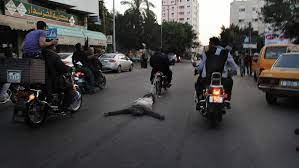
Members of Hamas drag the body of a “collaborator” through the streets of Gaza

Arab and Muslim states? This is the newest fantasy. An “International Security Force” of Egyptian, Jordanian, Saudi, Emirati, Moroccan or other troops is supposed to enter Gaza, secure the borders, keep the peace, and—if necessary—shoot Hamas fighters to take their weapons. Will Egyptian soldiers do that? Jordanians? Saudis? The UAE? And what of Qatar, which housed Hamas leaders in luxury hotels for years? Will Qatar now arrest the men it financed?

The UN? NATO? Peacekeepers do not storm bunkers or raid arms factories. It has never happened in the Middle East, and it will not start in Gaza.

Which leaves one final option, the one everyone pretends not to see: No one will disarm Hamas. The world will congratulate itself on a “post-war framework,” aid will pour in, cement will be shipped, tunnels will be rebuilt, rockets will reappear—and we will repeat this in two years, five years, ten years, with more dead children on both sides.

This is the part no diplomat wants quoted back to them: You cannot demand a demilitarized Gaza, forbid Israel from disarming Hamas, refuse to disarm Hamas yourself, and still pretend you are building peace. Those positions cannot coexist. Either someone will use force against Hamas, or Hamas remains armed, and Gaza remains a terrorist enclave.

Ask the diplomats, ask the presidents and prime ministers, ask the foreign ministers drafting communiqués they will never enforce: Who will shoot Hamas?

Peace is not built on Security Council resolutions. It is built on the willingness to confront those who would destroy it.

The Ghosts of Genocide

To visit Poland is to walk among ghosts.
The thriving Jewish civilization that once filled its towns and marketplaces was almost completely erased. Three million Jews were targeted for extermination — a number too vast to grasp by walking through silent cemeteries. The absence alone cannot speak the full horror.

To stand where synagogues were razed, where schools once taught Torah and arithmetic, where playgrounds once rang with Yiddish laughter, is to feel the emptiness press against your chest. It forces the imagination to repopulate the void — to summon the Jewish ghosts who linger, waiting for conscience to remember them.

It is easier to look at the living.
Many Poles today are the grandchildren of those who watched as their Jewish neighbors were rounded up — and sometimes finished the work themselves when survivors returned seeking their homes. They became stand-ins for the killers of yesteryear, heirs to silence, envy, and complicity.

Now another people walks amid ruins.
In Gaza, millions return to their shattered neighborhoods under a ceasefire, and we are told they have survived a “genocide” at the hands of Jews. Yet the number of Palestinian Arabs has grown, not diminished — a population larger than before the war they themselves began. They tread among the skeletons of broken buildings built atop their army’s tunnels, while ghosts — Israeli civilians burned alive in their kibbutzim and those taken hostage and murdered in Gaza — cry out from the ashes.

The Bibas family from Israel was taken hostage by Gazans on October 7, 2023. The mother and two children were murdered in captivity

I ponder the ghosts of genocide:
the murdered and the murderers;
the societies that spawned the slaughter;
the peaceful towns that became infernos.

Infrastructure shelters ghosts. Societies are haunted by the ones they create, both killer and killed. The unseen dead can no longer showcase their dancing on the one hand, or lust to murder, on the other.

There are scarcely any Jews left in Poland; their ghosts appear only to those who seek them.
In Gaza, the ghosts are not gone. They walk the streets, armed and unrepentant — not spirits of victims, but kinsmen of murderers, now turning on one another.

Poland’s haunting is one of silence — an absence so total it chills the air. The ghosts there do not cry out; they wait to be remembered. Gaza’s haunting is the opposite: a cacophony of rage that refuses reflection. Its ghosts are not silent but screaming — not victims unburied, but hatreds unrepented.

Poland’s soil holds the murdered; Gaza’s streets still host the spirit of the murderers.
One ghost asks to be mourned; the other demands to be judged.

The haunting does not end with time.
It lingers wherever truth is buried,
and it deepens each time the living deny the past that shaped them.

Only when a people can face its ghosts —
naming both the murdered and the murderers —
can it begin to live freely again.

How Many Palestinian Prisoners Returned Are Israeli Plants?

In Lebanon and Syria, senior terror leaders keep disappearing. Israel’s intelligence services have shown that even far from home, their reach is absolute. Hezbollah commanders vanish without warning. Iranian coordinators meet “accidents” in Damascus. Israel’s eyes are everywhere — east of the 1949 Armistice Lines (E49AL / “West Bank”) and far beyond.

Inside Israel and the territories under its vigilance, that network of informants has kept the Stateless Arabs from Palestine (SAPs) from unleashing the kind of barbarism seen under Hamas. The true security barrier is not made of concrete or wire — it is people: HUMINT, human intelligence, the whispers that prevent slaughter.

But Gaza became a black hole the moment Israel withdrew in 2005. Every soldier, every Jew, every Israeli presence was uprooted — and with them went the eyes and ears that had kept the region stable. Hamas seized power through blood, executing its rivals and every suspected collaborator. What followed since 2007 was not liberation but suffocation. Gaza became a fortress of fanaticism, sealed off and armed to the teeth.

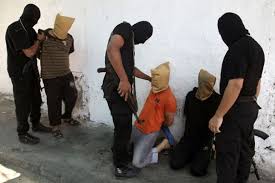
Hamas interrogates suspected informants in 2014

The legal Israeli blockade was not enough. While Israel and Egypt controlled the borders, Hamas tunneled beneath them — smuggling Iranian rockets, explosives, and even the raw materials to build new weapons. Gaza transformed from a strip of land into a terrorist enclave. By 2023, it was not just armed — it was indoctrinated, radicalized, and ready for mass murder.

Israel will not make that mistake again.

Among the newly released SAP prisoners, there are almost certainly Israeli plants — men and women turned during interrogations or cultivated long before. They will slip back into Gaza’s shattered neighborhoods, listening, watching, feeding intelligence. Every conversation, every weapons cache, every hint of reorganization could be the thread that prevents the next October 7.

Hamas knows this. Its paranoia will turn inward. Accusations will fly, confessions will be forced, and public executions will become commonplace to the shouts of “Allahu Akhbar.” The group will again devour its own, because it cannot rule without fear.

Hamas executes suspected informants in front of crowd of children

Any new ruling authority that replaces Hamas will need to coordinate with Israel. There can be no “independent Gaza” left to rot in secrecy. Deradicalization cannot be trusted to glossy NGOs or “neutral” foreign agencies alone. It must be verified — by intelligence, by informants, by those who know the difference between reform and camouflage.

[As for the Arab propaganda outlets, none of the public executions are discussed on Qatari-owned Al Jazeera. It is busy selling Gaza and Hamas as peace-loving.]

The intelligence war has already begun. The question is not whether Israel has plants among the returnees — it is how many will live long enough to stop Gaza from sinking back into the darkness it dug for itself.

Palestinian Authority Continues Blood Libel of Organ Heist

Even as the Israel-Gaza ceasefire struggles to take hold, the Palestinian Authority fuels the flames of Jew hatred with public smears that Israel is harvesting organs of Palestinian Arabs.

On October 18, 2025, Wafa, the official media of the Palestinian Authority penned an article that “Israel hands over remains of 15 slain Palestinians from Gaza.” In it, the PA claimed that the bodies of Arab prisoners handed over “appeared mutilated or missing organs.”

Article in Wafa, October 18, 2025

The only way forward for coexistence is to end the demonization and antisemitic attacks. The Palestinian Authority has repeatedly shown it is not up to the task.

The Second Israeli Victory in Gaza and the War on Diaspora Jews

For decades, Palestinians have believed there were three paths to statehood—and they pursued them simultaneously.

1. Violence.
Hamas, Islamic Jihad, Fatah’s militias and several Palestinian Arab terrorist groups waged terror wars, convinced that bloodshed brought gains: the First Intifada led to the Oslo Accords; the Second Intifada drove Israel from Gaza and parts of the West Bank; the 2021 riots were hailed for halting evictions in Sheikh Jarrah.
The October 7 massacre, backed by roughly 75% of Palestinians, was the latest in that grim pattern.

2. International Pressure.
Even as rockets fell, Palestinian allies abroad pressed boycotts, divestment, sanctions, and United Nations resolutions, seeking to isolate Israel diplomatically and economically until it yielded territory.

3. Negotiations.
The Palestinian Authority claimed to prefer talks to gain legitimacy and foreign aid—but insisted on maximalist demands: all the West Bank, all of eastern Jerusalem, a Jew-free Palestine, and a mass “right of return.”
Yasser Arafat walked away from a state in 2000 and launched the Second Intifada instead.
His successor, Mahmoud Abbas, also spoke of peace while undermining it—keeping the notorious “pay-to-slay” stipends for terrorists’ families and, in a January 2018 speech, blessing those who chose violence even as he professed support for diplomacy.

Polling has consistently shown the order of Palestinian preference: violence first, global pressure second, negotiations last.

The Cost of Failed Strategies

Both violence and sanctions have brought suffering to Palestinians themselves.
Suicide bombings and rocket wars prompted Israel to build the security fence, which restricted movement and economic activity. The October 7 attack provoked a massive war in which Gaza was devastated and Hamas decimated.
Attempts to use international pressure backfired as well, leading Israel to withhold funds from the PA and tighten restrictions.

Israel fights like a cornered raccoon—fiercely, without backing down when attacked.
Every round of violence has left Palestinians weaker and poorer.

In the recent war, Israel scored a double victory:
It destroyed Hamas’s military capability, killing an estimated 25,000 fighters, and it refused to bow to global pressure, pressing on despite UN condemnations, ICC threats, and warnings of diplomatic isolation.

This shattered the long-held belief that if terror failed, the world could still coerce Israel into retreat.

A New Reality — and a Call to the Arab World

The old strategies of terror and economic warfare have failed and only deepened Palestinian misery. The third path—real negotiations—remains the only way forward.

Israel and the United States now hope the Arab world will engage Israel constructively, encouraging Palestinian leaders to abandon impossible UN demands and accept the reality of Israel’s permanence. Clinging to maximalist positions will only bring more rounds of bloodshed and despair.

And an Alternative Reality — Coming for Diaspora Jews

While Israel feels that it may have finally fought a war that could lead to long-term peace, there are those who still cling to eradicating the Jewish State. The international “Free Palestine” fighters do not want to see Israel holding onto the Old City of Jerusalem nor limiting the entry of millions of Arabs who claim UN’s mantle of “refugees.” The light at the end of the tunnel for them is not coexistence but a continued “Nakba,” a disaster.

So they are revamping the second front of international pressure, from targeting Israel to the soft targets of diaspora Jews.

They are chanting to “globalize the Intifada” to bring the war to every Jew and pro-Israel person and organization. The incineration of the kibbutzim in Israel on the Jewish holiday of Simchat Torah was echoed in the burning of the Jewish governor of Pennsylvania’s home on the holiday of Passover. Burning Jews alive in Kibbutz Be’eri was mirrored in burning Jews in Boulder, Colorado.

While Israel sees that it is in a strongest position in the region since its reestablishment which may finally enable an enduring peace, the anti-Israel horde has opened a new front on the global diaspora.

The international pressure of the BDS camp has not been defeated but inflamed. They are ratcheting up their smears of “apartheid” to “genocide,” and marking local Jews as co-conspirators.

While Israel won the Iranian proxies war, the Free Palestine camp is taking millions of new hostages – diaspora Jewry. Who will fight for them?

The Weight of Nations

“Why do the nations rage, and the peoples plot in vain?” — Psalm 2:1

Saudi Arabia – the kingdom which Israel hoped would next join the Abraham Accords – sought to pressure Israel into ending its defensive war in Gaza by rallying nations of the Global North to recognize a State of Palestine. It found a partner in France, which successfully pulled the United Kingdom, Canada, and Australia into the orbit of recognition. In September 2025 at the United Nations, the group jointly declared their acknowledgment of a Palestinian state—with caveats—but the symbolism was unmistakable.

Israel did not budge. It viewed the coordinated announcement as an alarming reward for the genocidal Hamas regime that had unleashed war on October 7 two years earlier.

Enter the United States. President Donald Trump had tasked developer and confidant Steve Witkoff to lead a back-channel negotiation with Hamas for the release of Israeli hostages and an end to hostilities. Jared Kushner joined the effort more forcefully in September, unveiling a “20-point plan” aimed at ending the two-year war and reshaping the region’s political future.

To counter the Saudi-French gambit, Trump built his own coalition. The U.S. secured the backing of several Arab and Muslim nations from the Global South—including Qatar, Jordan, the United Arab Emirates, Indonesia, Pakistan, Türkiye, Saudi Arabia, and Egypt —for its peace framework. By October, the administration succeeded in gathering the leaders of 27 countries from across the North and South, including some that had just recognized Palestine, to fly to Egypt to sign what was billed as a ceasefire agreement.

A summit to support ending the more than two-year Israel-Hamas war in Gaza after a breakthrough ceasefire deal, Monday, Oct. 13, 2025, in Sharm El Sheikh, Egypt labeled “Peace 2025”

It was a mirage. Neither of the warring parties—Israel or Hamas—attended. The event was instead diplomatic theater, meant to transform a ceasefire proposal into a movement for regional peace. Trump designed the event to flip the script.

Where Saudi Arabia and France tried to impose the weight of the Global North on Israel, the United States sought to use the combined weight of both hemispheres on Hamas. The former demanded an immediate path to a two-state solution; the latter demanded the end of Hamas rule.

The Moral Gravity

The story of this moment is not only about geopolitics, but about moral gravity. The nations of the world have grown accustomed to weighing Israel’s every move while ignoring the crimes of its enemies. They call for “balance” in a war that began with mass murder, rape, and hostage-taking. They lecture the victim to compromise while the aggressor reloads. The UN Security Council could have easily passed resolutions to push for an end to the war if they had just condemned Hamas, but repeatedly refused to do so.

The weight of nations once meant the defense of justice and the pursuit of peace. Today, it is too often the ballast of perfidy—dragging down the innocent under the pretense of even-handedness.

Israel, standing increasingly alone, may yet prove that the true measure of a nation is not in the number of its allies, but in the steadiness of its conscience. It is fortunate to have President Trump in the White House as it shoulders this weight once again.

The tight bond between Israel and the United States has continued, despite Americans starting to sour on Israel since 2015.

The Next Part of the “20-Point Plan”: Drop Charges At The ICJ

The headline deal which everyone pretends is a simple human-rights triumph — hostages home in exchange for prisoners and a ceasefire — is, on its face, a moral imperative. Families and politicians, of course want the war to end and hostages back home. But if we treat this swap as merely a humanitarian ledger without thinking about incentives, strategy and deterrence, we invite a replay of October 7 — not because anyone wants it, but because the arithmetic of the deal makes another mass-carnage payoff seem rational to those who plan such crimes.

Palestinian Arabs wave Hamas flags atop the Red Cross truck bringing releases terrorists to the West Bank in November 2024

Here’s the cold calculus the bland statements miss.

Hostages for prisoners. Civilians for killers. A handful for hundreds. These trades have an immediate human relief value. The cost, however, is structural: they reset the reward function for terrorism. If a violent raid can reliably purchase the release of leadership, fighters, and political capital — and if the international response includes legal actions that delegitimize the responding state — then the net effect is to make mass atrocity an instrument of statecraft.

Celebrations for released Palestinian Arab terrorists in 2014

But the mathematics isn’t just – and must not be viewed as – the prisoner-to-hostage ratio. It includes the defensive response: the likely military, political, and territorial consequences of the assault. Hamas should be forced to accept that math too. If it contemplates another October 7-style operation as it has promised to do repeatedly, it must understand that the outcome will not be a tidy prisoner exchange and a televised victory lap. It will be the destruction of leadership and the decimation of military infrastructure, with broad international support for the defensive measures taken to prevent a repeat.

Which brings us to the international legal theater now playing out: the ICJ’s “genocide” accusations, the vociferous statements from states threatening arrest of Israeli officials, and the diplomatic embrace of Palestinian statehood in some quarters. These actions, however well intended by their proponents, have immediate strategic effects. They amplify Hamas’s narrative of global validation and, crucially, complicate the deterrent effect of defensive operations. If a state in self-defense risks being publicly criminalized or its leaders subject to arrest, the calculus of deterrence is altered – for the entire world.

So, what should sensible governments do if they insist on both protecting Palestinian rights and preventing another October 7? Two practical propositions:

  1. If regional governments want backing for Palestinian statehood and avoid terrorism in their own countries, they should drop the ICJ case. the Arab and Muslim countries which backed the U.S. ceasefire plan should pressure South Africa and other countries which brought the case to drop the charges and let diplomacy take center stage. Law and diplomacy should be tools of stability, not absolution for terror strategies.
  2. If the desired outcome is that populations on both sides live within range of cross-border terror and reprisals, then investing in defensive infrastructure as a bridge to a political solution is a rational step. The United Nations and donor states should be pressed to fund a replacement barrier between Gaza and Israel — walls and surveillance that reduce the risk of mass infiltrations, so that the question of where futures lie for Palestinians becomes a matter of state-building and safety inside Gaza, not a perpetual recruitment slogan for militancy.
Hamas breaks through security fence between Gaza and Israel on October 7, 2023, on way for mass murder and abductions

This is not a call to abandon human rights oversight or to whitewash abuses. Accountability and adherence to international law matter. But timing and incentives matter too. Legal actions taken in the heat of war — unmoored from a strategy to prevent recurrence — can harden positions and diminish the tools of deterrence. If the objective is to keep people alive and build a durable peace that allows Stateless Arabs from Palestine (SAPs) self-determination without repeated massacres, then international actors must think like engineers of stability, not moral prosecutors on a press release timetable.

If we are serious about both ending the war and preventing future acts of mass terrorism and barbarity, we must stop evaluating deals by immediate feel-good optics alone. The right measure of a deal includes whether it reduces the incentive to perpetrate mass atrocities, strengthens deterrence against their planners, and clears a path toward political arrangements that give civilians on all sides a future. Anything less is not a solution — it is an invitation.

The Embarrassment and Lies of the Palestinian Authority in Trump’s Peace Plan

The Palestinian Authority (PA) has perfected the art of self-deception — and the spectacle has become an embarrassment to watch. Its leaders trade in fantasies while their people – and the entire region – suffer the consequences of their delusions.

When President Donald Trump released his 20-point Comprehensive Plan to End the Gaza Conflict, it was explicit: the focus was on fixing Gaza and the PA would have no role. The document said in plain language that the PA would need to be overhauled and reformed before it could ever be trusted as a partner for peace. It deliberately withheld any credit or recognition for the current leadership, recognizing its corruption, incitement, and support for terror. “A technocratic, apolitical Palestinian committee” headed by Trump himself would be the day-after plan for Gaza. Only “qualified Palestinians” would get to sit on such committee, not the UN-lauded PA.

President Trump’s peace plan specifically did not hand control of Gaza to the PA and said the group had to “complete its reform program.”

The plan’s very structure was layered with conditionality — each potential step toward a Palestinian state contingent on verifiable reforms, renunciation of violence and demilitarization. Even then, the most it offered was that maybe one day, post-reform, there could be a pathway to a two-state solution.

The Trump plan layered conditions of “when,” “may” and “pathway” to Palestinian “statehood”

And yet, in a surreal twist, the official PA news agency WAFA ran an article in which Mahmoud Abbas claimed that Trump stood ready to endorse a Palestinian state with “East Jerusalem” as its capital. It was an astonishing fabrication — a complete lie, meant to mask Abbas’s very public humiliation and preserve his illusion of relevance.

Official PA media lied that Trump’s peace plan would establish a new Palestinian State which would follow the “June 4, 1967 borders, with East Jerusalem as its capital”

This distortion was not a misunderstanding; it was intentional misrepresentation, propaganda designed to convince Palestinian Arabs that Abbas still holds the key to their future. But everyone can see through the act. All Abbas and Hamas have delivered is destruction, division, and hatred.

The PA’s falsehoods no longer even convince its own people. Each new lie only underscores its impotence — a government in name only, ruling by inertia and deceit. The tragedy – like the lies – has layers of corruption, hatred, murder and deceit.

The Palestinian people, too, bear responsibility for their choices. They voted for Hamas, a genocidal terrorist movement to 58% of the parliamentary seats which brought death and destruction not only to Israelis but to Palestinians themselves – which the vast majority supported. They elected Mahmoud Abbas, a Holocaust denier and an ineffective president, and now watch him recycle lies and propaganda instead of leadership and reform. The Palestinians voted for failure — and the region has paid the price.

WAFA called the Israeli government an “occupation government”, clearly showing the PA was upset by being sidelined because it sorely needs reform

The Trump plan recognized that hard truth. It was not a welcome mat for Fatah or Hamas, nor a reward for decades of violence and corruption. The plan envisioned a different future entirely. The “day after” will not be another PA regime or HAMAS ruling Gaza, but the first step in a new chapter of deradicalization, where education replaces indoctrination, coexistence replaces hate, and peace is no longer a slogan but a shared reality.

Trump’s plan – as endorsed by Qatar, Jordan, the United Arab Emirates, Indonesia, Pakistan, Türkiye, Saudi Arabia, and Egypt – states clearly that a possible Palestinian State will come as a BYPRODUCT of deradicalization and peace, not in order to CREATE the forum for coexistence as offered by France and the United Kingdom. All of which may or may not happen, and most likely after Abbas is long gone.

Send in the Police and ICE on October 7

The Hamas massacre of October 7, 2023 — a day when thousands of Gazans crossed the border to slaughter Israeli civilians, rape women, burn children alive, and drag 250 people into captivity — is a date that should be remembered with grief and solemnity.

Yet in New York City, extremist groups such as Within Our Lifetime, Students for Justice in Palestine and Samidoun plan rallies on that anniversary to glorify the killers and call for an end to “Zionism” in what they call the “belly of the beast,” meaning America itself.

The “rally” was called a “Flood”, echoing Hamas’s term for the October 7 massacre, the “Al Aqsa Flood.” It includes a map of all of Israel claiming Israel’s 77 years of existence has been a “genocide” against Palestinians. It writes Israel with a lower case ‘i” meant as an insult to not recognize it, preferring to call it a “Zionist project.” The rally is a call to stand against “Zionism” and “honor the martyrs” who slaughtered people in Israel two years ago.

We make a clear and urgent appeal to governments and peoples committed to the liberation of the Palestinian people to adopt unequivocal and militant support for the cause of decolonisation. – Samidoun, October 2, 2025

This is not policy debate. It is a celebration of barbarity and a call to dismantle the Jewish homeland and undermine the United States. The chants and slogans echo the hate that fueled the October 7 pogrom.

Free Speech vs. Incitement to Violence

The United States protects free expression, even ugly and unpopular opinions. But it does not protect incitement to violence or material support for terrorist organizations.
When demonstrations cross the line into praising terrorist acts or calling for attacks on Jews or Americans, the full weight of the law — from local police to federal agencies — must be ready to respond.

It is time to escalate our actions – Samidoun, October 2, 2025

This year the anniversary falls during the Jewish festival of Sukkot, a holiday marked by public celebrations, outdoor meals, and large gatherings near synagogues and community centers. Those festivities will unfold in the shadow of these extremist rallies. That reality makes it all the more important for law-enforcement agencies to be highly visible and vigilant in keeping worshippers safe.

Standing Up for the Rule of Law

Calling to “globalize the Intifada” and praise the depraved Hamas “martyrs” feeds the chaos that violent extremists crave. What is needed is lawful, decisive enforcement:

  • Robust policing to protect Jewish neighborhoods, synagogues, sukkot gatherings, and counter-protesters.
  • Monitoring and prosecution of anyone who crosses into incitement or provides support to terrorist organizations.
  • Clear public messaging that celebrating mass murder is not political expression but moral depravity.
  • Bringing ICE (Immigration and Custom Enforcement) agents to arrest and deport non- citizens engaging in harassment and intimidation.

People can be denied a visa if they intimidate, harass or are considered security risks. These October 7 rallies will likely be causes for revoking visas.

A Moment of Moral Clarity

October 7 should be remembered as a day of horror, not a banner for hate.
Those who glorify the massacre expose themselves as the heirs of past totalitarian movements — whether Nazi or jihadist — that brought suffering not only to Jews but to all who cherish freedom.

“Terrorism” is a colonial term that we refuse to accept in reference to the heroic Resistance. – Samidoun, October 2, 2025

The response to them must be unflinching: protect the vulnerable, prosecute the lawbreakers, and reaffirm that the United States will never be a haven for the celebration of terrorism.

Video on Samidoun before rallies on October 7, 2024

Names and Narrative: “Pro-Palestinian” and “Anti-Jews”

Words aren’t decoration.  They frame a story. They tilt the field before the debate even begins.

No paper knows this better than The New York Times and no example shows it more clearly than how it writes about two of the most polarizing issues of our time—abortion and the Israeli-Palestinian conflict.

On abortion, the Times refuses the label protestors with their preferred title of “pro-life” and insists on “anti-abortion.” The paper’s label defines the movement by what it resists, not what it values. It subtly paints millions of people as opponents instead of advocates.

But when protests are aimed at Jews, the Times flips its rule. It happily uses the demonstrators’ own term: “pro-Palestinian,” even when the protestors’ behavior has nothing to do with seeking coexistence or statehood—and everything to do with targeting Jews.

The case in Teaneck, New Jersey laid the hypocrisy bare. A synagogue held a program for diaspora Jews interested in buying homes in the land of Israel—an act tied to faith and heritage, not to any government or war. Demonstrators showed up to block them.
They shrieked through vuvuzelas inches from people’s ears.
They set off stink bombs.
They mocked their religion.
They shoved and harassed them at the very doors of a house of prayer.

“Protestors” including leaders from Within Our Lifetime come to harass Jews at New Jersey synagogue, screaming “long live the intifada!”

The Justice Department sued under the Freedom of Access to Clinic Entrances (FACE) Act—a law that protects people entering both abortion clinics and houses of worship. The law exists to defend basic civil rights: to seek medical care, to pray, to gather without harassment.

Yet the Times reported the incident as a “pro-Palestinian protest,” not “anti-Jewish intimidation.”

It claimed that the law was being “repurposed” by the Trump administration which as “taking a side” in a “dispute” against “advocacy groups.”

The New York Times on September 29, 2025

For the far left media, one group—pro-life advocates—is defined by opposition; the other—those harassing Jews at worship—is defined by aspiration.

That is not journalism. That is narrative management.

Language molds the story before the facts are even heard. By choosing which side’s self-description to honor, the Times signals which side it wants readers to sympathize with. It is the Times that has taken sides, not the Trump administration. The U.S. is simply enforcing a law written to protect houses of worship which are increasingly under attack.

Police surround St. Patrick’s Cathedral in New York City, including a SWAT team with machine guns at the entrance, on September 29, 2025

A standard worth trusting would be consistent. Either call both movements by their chosen names, or describe both by their actions. But don’t dignify harassment with the protestors’ preferred brand while stripping advocacy of its own.

In the case of the NJ synagogue, the hypocrisy is worse and laid out as evil. Pro-life demonstrators don’t want ANYONE to have an abortion; the “pro-Palestinian” protestors only want JEWS to be banned from buying homes in the land of Israel. They would happily promote Arabs buying every apartment unit that was showcased at the event. They are clearly “anti-Jews” and should labeled as such.

Yet the Times rewrites the story as one about “pro-Palestinian speech” and “First amendment rights.” It pretends that the FACE law isn’t specifically about religious freedom.

The NY Times wrote that FACE was about exercising First Amendment rights at a place of worship – leading a reader to think it was about Free Speech – but FACE is about “right of religious freedom at a place of religious worship.” A sinister misdirection.

The power of the press lies not just in what it reports but in how it names things.
A double standard in language is a double standard in truth.

The left-wing media is lying to its readers that people who harass Jews are simply “pro-Palestinian” and not “Anti-Jews.” The New York Times is complicit in antisemitism.