During August and September 2023, Palestinian Arab propaganda was in full display on social media feeds. The messaging – targeted to Zionists – was clear that they believe all of Israel is “occupied Palestine” and that the physical presence of Jews in Jerusalem is a grave assault to their senses.
Israel is Occupied Palestine
Israeli cities like Acre, Jaffa, Nazareth, Jerusalem and Haifa were promoted as part-and-parcel of Palestine in ads popping up in social media feeds like Facebook.
The ads, some of which were made in 2022, were promoted from a variety of sources including Quds News Network, The Inside – Palestine, DOP (Days of Palestine), Olive Palestine, Palestine and others.
Jews in Jerusalem Going About Daily Life Is An Aggravated Assault To Arabs
The advertisements in Facebook also featured Jews in Jerusalem enjoying their holiest city. However, the narrative accompanying the text made the Jews seemingly appear as violent, even when it was clear that they were doing nothing.
All Jews are described as “settlers” whether they lived east of the 1949 Armistice Lines (E49) or not. It says that they “stormed al Aqsa Mosque” even when the pictures show that they were just walking around and not in the mosque. It even condemned some young boys dancing in the Old City of Jerusalem away from the Temple Mount as “a provocative march.”
Israel Will Be Destroyed. Soon
The messaging of the ads could not be clearer. The State of Israel is not only occupying historic Palestine; it is about to come to and end.
The majority of Palestinians believe this to be true. The June 2023 poll conducted by the Palestinian Center for Policy and Survey Research noted that “two-thirds [of Palestinian Arabs] say Israel will not celebrate the centenary of its establishment [within 25 years], and the majority believes that the Palestinian people will be able in the future to recover Palestine and return its refugees to their homes.”
Palestinian Arabs believe that the War of Liberation has begun, and were telling Zionists that this day is approaching for the past few months.
The Jewish State and Jews around the world have woken up to the fact that they are in a war, hated for who they are, where they are and what they do. It took a monstrous massacre for the reality to awaken people to the situation, and having reached this point, it’s important to know more about the haters and their intents.
The article “The Center of Intersectionality looks a lot like Adolf Hitler” listed many vile antisemites including: the Democratic Socialists of America, Rep. Rashida Tlaib, Rep. Ilhan Omar, New York City Council member Shahana Hanif, Linda Sarsour and Zahra Billoo of the Council of American-Islamic Relations. There are many others like the Mapping Project in Massachusetts which is part of the Boycott, Sanctions and Divestment (BDS) movement, which wants to make it easier to target Jewish organizations throughout the state, and so listed them and their addresses. Organizations included those that promote “normalization” and peace, as well as synagogues.
After the brutal massacre of hundreds of Israelis on October 7, 2023, one would imagine that even everyday antisemites would distance themselves from the carnage and attempt to not appear as Nazis bent on Jewish blood.
Alas, the bilestorm is upon us, and those celebrating the murder of Jews are out in the open. Jews should take note and be prepared in both the near- and intermediate-term.
Immediately after the atrocities became public, The United States Council of Muslim Organizations (USCMO) threw its full weight behind Palestinian Arabs. It published a statement about the “recent unprovoked and continuous attacks by Israel on Palestinian towns, cities, and refugee camps have resulted in tragic loss of Palestinian lives. We condemn Israel’s targeted and indiscriminate killing of civilians, including innocent children, women, and the elderly, and we denounce the inhumane siege imposed on the nearly 2 million inhabitants of Gaza, a clear violation of international law and an implied declaration of open war on the Palestinians which oblige them to be in constant self-defense.” Members of USCMO are:
American Muslims for Palestine (AMP). They have a convention in Chicago November 23-5
Council of American-Islamic Relations (CAIR) which vigorously backed Billoo’s antisemitic rant that all Jews are enemies of Muslims
Al-Awda – The Palestinian Right to Return Coalition
Within Our Lifetime
Samidoun
CUNY School of Law Students for Justice in Palestine
Decolonize This Place
Existence Is Resistance
CUNY for Palestine
Connecticut Democratic Socialists of America
Yalies for Palestine
Semilla Collective
Greater New Haven Peace Council
Wesleyan Students for Justice in Palestine
Party for Socialism and Liberation
Witness Palestine Rochester
ANSWER Coalition
Bard College SJP
Students for Justice in Palestine – Butler University
Jewish Voice for Peace – Indiana
Party for Socialism and Liberation – Indianapolis
SJP @ UC Davis
AMP Chicago
… and many more
The Democratic Socialists of America and Students for Justice In Palestine were in full force around the country backing the wanton killing of Jews. AMCHA Initiative has long tracked how the presence of SJP on college campuses results in antisemitic incidents jumping by five times.
The head of NYU Law Student Bar Association sent out a broad email about “my unwavering and absolute solidarity with Palestinian in their resistance against oppression toward liberation and self-determination.” Ryna went on to say Israel’s blockade of the terrorist enclave “made resistance necessary. I will not condemn resistance.” That such a person can be a lawyer and approve of the wanton slaughter of non-combatants en masse is terrifying. This person, Ryna Workman, should be rejected from all employment.
Ryna has company. Harvard University posted a letter signed by 30 groups supporting Hamas’s butchery. After billionaire investor Bill Ackman, an alum of the school, asked that the school release the names of the individuals behind the letter, someone posted their names.
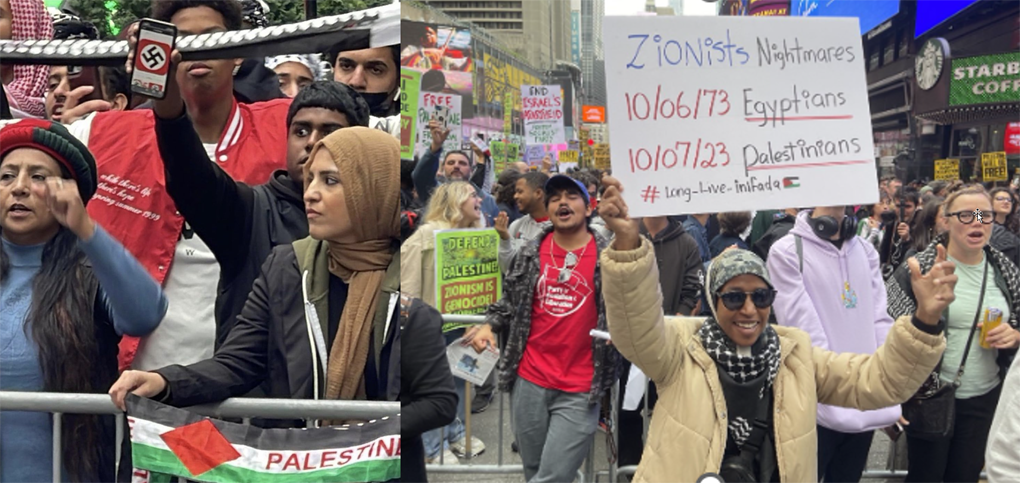
Columbia University’s Student for Justice in Palestine produced a vile antisemite named Naye Idriss who gave a speech in Times Square in New York City the day after the massacre of Jews and called for more massacres to a reception of cheers.
Idriss was likely fueled in her hatred of the Jewish State from Columbia University professor Rashid Khalidi who said that Israel’s treatment of Palestinian Arabs “will necessarily, inevitably bring a violent reaction (51:40). Another professor, Joseph Massad mocked how Jews fled on foot from their “colonies” (since he views all of Israel as an illegal colony) in the massacre. He didn’t mention a single slaughtered Jew but went on to lament Arab dead, which he hoped would be the “start of the Palestinian War of Liberation.”
Of course, this generation’s Nazis is the popular Palestinian political-terrorist group Hamas which carried out the slaughter. Its 1988 foundational charter is replete with antisemitism and the call to kill Jews and destroy the Jewish State, seemingly to the joy of Palestinian Arabs who voted the party into 58% of parliament in 2006. Its leadership calls on Muslims around the world to engage in a global intifada to support their annihilation of Israel.
Turkey, another Islamic, non-Arab country provides Hamas political support
Qatar hosts Hamas’s leadership and funnels money to it
Eugene Puryear, part of the Party for Socialism and Liberation organized rallies for Hamas and said “Palestinians are right to stand up against occupation.”
ADL has tracked many of the recent pro-Hamas protests which backed the massacre and called for the destruction of Israel. Chants included “Zionism has got to go!” and “Zionism is genocide!”, “You need to stop being apologetic about Palestinian liberation“, “Resistance is not terrorism.” Regarding the massacre of Jews, speakers said “make no mistake, we are in celebration.”
While Jews grieve and pray, they seemingly have not internalized that the pro-Palestinian community does not view this as a battle like 2008, 2012, 2014 or 2021. They don’t think it’s like the Second Intifada in which they rejected two states for two people.
Your enemies believe the war to end the Jewish State has begun. It’s 1948 Redux.
And they have called for the world to join them in their efforts to end Israel and prosecute its supporters in a “global intifada.”
Israel’s fight in Gaza is not about the terrorist group Hamas; it is about terminating Hamas’s jihadi dream of destroying the Jewish State.
Almost every Palestinian Arab is already an antisemite and this war will not make them hate Jews any less. However, it must teach them that Israel is here to stay.
The reports coming out of Israel are horrifying. The actions of Hamas in places like Kfar Aza are horrific as entire families were gunned down in their homes and babies decapitated.
The United Nations Secretary General issued a statement that “The attacks have so far claimed numerous Israeli civilian lives and injured many hundreds. The Secretary-General is appalled by reports that civilians have been attacked and abducted from their own homes.
“The Secretary-General is deeply concerned for the civilian population and urges maximum restraint. Civilians must be respected and protected in accordance with international humanitarian law at all times.”
The phrase “maximum restraint” is only used when terrorists kill Israelis and the UNSG gets worried that Israel will pursue the Palestinian Arab assailants. When terrorists kill people in other places including Pakistan, Iraq, Afghanistan or Nigeria, the UN Security Council declares “the need to hold perpetrators, organizers, financiers and sponsors of these reprehensible acts of terrorism accountable and bring them to justice.”
In light of the gross deformity of Palestinian culture and barbaric attacks by the popular political-terrorist party Hamas, it is time for Israel to pursue ‘maximum justice,’ to finish ALL “perpetrators, organizers, financiers and sponsors of these reprehensible acts of terrorism”, including the Islamic Republic of Iran if they were indeed behind the attacks.
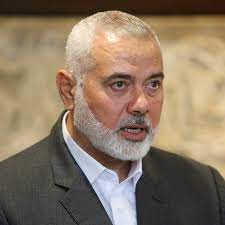
Mohammed Deif, supreme military commander of Izz ad-Din al-Qassam BrigadesYahya al-Sinwar, current leader of Hamas in GazaIsmail Haniyeh, leader of Hamas based in Qatar
There are estimated to be 30,000 people affiliated with Hamas, not including those who aid and abet the group. Israel will require significant time to bring these murderers to maximum justice and rout them from the region. We should support Israel in destroying the terrorist entity and hopefully bringing calm to the region.
The defenders of Hamas are out. In spite of the horrible massacre of innocent civilians, extremists are blind with hatred and doubling down rather than abandon their comrades. Intersectionality dogma obliges adherents to coalesce when times are dark, and the stickiness of evil can feel empowering.
Many of the backers of the Palestinian terrorists are not Islamic extremists but “progressives” who have convinced themselves that Jews have no history or rights in the holy land and are “colonial settlers” who must be fought. They blame the victim – Israel – for their own deaths. They manufacture new realities on the fly, combining jihadi antisemitic propaganda with twisted progressive values.
Consider the goal of coexistence.
If Hamas truly hated Jews, it would kill every Jew it encountered and not bring so many children, women, men and elderly back to Gaza. Jewish hostages in Gaza are proof that Jihadists favor coexistence, at least a particular kind.
“The Islamic Resistance Movement is a distinguished Palestinian movement, whose allegiance is to Allah, and whose way of life is Islam. It strives to raise the banner of Allah over every inch of Palestine, for under the wing of Islam followers of all religions can coexist in security and safety where their lives, possessions and rights are concerned. In the absence of Islam, strife will be rife, oppression spreads, evil prevails and schisms and wars will break out.”
The goal of Hamas and its supporters is not a two state solution but one state ruled under shariah law where non-Muslims can live as second class citizens as dhimmis, paying a special jizya tax for having the privilege to live “under the wing of Islam.” It’s called Jihadi Coexistence, and is actively being marketed – and showcased – by radical socialists and Islamists.
People around the globe are looking for ways to help Israel during this terrible time. Below are a few ways: Donate, Lobby, Support students, Rally, Pray. Stay informed.
Donation Dos and Don’ts
There are many organizations based in Israel which can be helpful and, unfortunately, many well-intentioned people who pour time and resources into bad ideas and scams.
DON’T give money or buy military supplies in the diaspora. It sounds illogical but there are several reasons.
The Israeli government has supplies which are consistent with how soldiers are trained and how it maintains equipment. It cannot accept and manage an odd helmet here and two night vision goggles there. It mucks up the military order.
It’s also illegal in most countries to send military supplies abroad.
DO send items. Socks, underwear, canned goods and the like are welcome and can be distributed to displaced people, soldiers, volunteers and others.
DONATIONS are welcome – to known entities. Beware of organizations which popped up overnight which might sound good but have no proven ability to direct 100% of the donations to people in need. Some good organizations in Israel include:
Friend of Israel Defense Forces (FIDF) to help soldiers
There are also organizations supporting college students who will be facing a barrage of anti-Israel attacks. Donate to organizations which help these students combat the amplified antisemitism and anti-Zionism that is growing every day:
StandWithUs helps students with training and materials
There are occasional one-offs who can help, such as The Jerusalem Great Synagogue which has set up The Emergency Fund supervised by Malcolm Hoenlein. The fund originally had roots in assisting lone soldiers in Israel and is now serving as a base to dynamically change the destination of contributions based on current need which Malcolm identifies and then gets approved by the donor before distribution.
The American Friends of The Jerusalem Great Synagogue is a United States tax exempt 501c3 charitable organization. Federal ID number: 23-7013128 Acct# – 096073694365 Acct Name: AMERICAN FRIENDS OF THE JERUSALEM GREAT SYNAGOGUE INC Acct Address: 3145 Coney island Avenue Brooklyn NY 11235 Bank Name: JPMorgan Chase Bank NA SWIFT Code: CHASUS33 Routing#: 021000021 Address: 270 Park Avenue, New York, NY 10017 Phone Number: (866) 865-1388
The Importance of Lobbying
Israel is going to need persistent support, especially as the war continues and the number of Arab casualties rises. Politicians care about and track the calls and emails that come to their offices. Contact your local representatives, even if only sharing one or two sentences. Feel free to use any article on the FirstOneThrough site with politicians to amplify your voice.
Universities have become hotbeds of radicalism among socialists and Islamic extremists. The war will likely make campuses extremely hostile for anyone clearly Jewish, such as Orthodox men wearing kippahs.
In addition to donating to organizations like StandWithUs, contact your alma mater and let them know that antisemitism and support for Hamas are completely unacceptable. Contact fellow alumni who share your passion for the subject to create bulk power initiatives to confront any biases that might arise on campus.
Rally
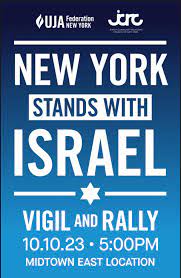
There are many rallies taking place to support Israel. Go to your local synagogue or community center website or national organizations such as UJA putting one together October 10 at 5pm at the United Nations. People need to feel the bonds of community and discuss ways of supporting each other and the Jewish State at this difficult time.
Pray
Some people like to go to synagogue and pray. Some recite chapters of Tehillim / Psalms to pray for the wounded, hostages and families directly impacted. Others join global WhatsApp groups to show a global unity reciting prayers and Psalms together.
The prayers should help all of our positive actions have the desired effect of returning the hostages safely, healing the sick and injured, and deliver appropriate punishment to the evil perpetrators who inflicted such barbarity.
Stay Informed
There are many websites like Arutz Sheva and Jerusalem Post which will have the latest news, many of which will likely get targeted by Jihadists. The Palestinian Authority posts its propaganda at Wafa. For analysis which incorporates the various news feeds, historical context, actions of the United Nations and more, subscribe to the FirstOneThrough blog below.
In response to the heinous massacre of Israelis and kidnapping of an estimated 150 Jews, Israel’s Defense Minister Yoav Gallant announced a “complete siege [of Gaza]. We are fighting barbarians and will respond accordingly.” The siege is anticipated to include halting the supply of electricity, food, water and fuel as Israeli soldiers scour the region in search of innocent hostages.
For its part, Hamas announced that it would “respond to any targeting of our people who are safe in their homes without warning, with the execution of our civilian hostages, and we will broadcast it with audio and video.”
The United Nations Secretary General immediately took sides on the competing threats – one by Israel to halt supplies while it sought to redeem its captives, and the other by Hamas which threatened to execute the Jewish civilians and broadcast it to the world.
He sided with Palestinian terrorists. His statement read:
“I am deeply distressed by today’s announcement that Israel will initiate a complete siege of the Gaza Strip, nothing allowed in — no electricity, food or fuel. The humanitarian situation in Gaza was extremely dire before these hostilities; now it will only deteriorate exponentially.
“Medical equipment, food, fuel and other humanitarian supplies are desperately needed, along with access for humanitarian personnel. Relief and entry of essential supplies into Gaza must be facilitated and the UN will continue efforts to provide aid to respond to these needs.
“I urge all sides and the relevant parties to allow United Nations access to deliver urgent humanitarian assistance to Palestinian civilians trapped and helpless in the Gaza Strip. I appeal to the international community to mobilize immediate humanitarian support for this effort.”
That is not a misprint.
United Nations Secretary General Antonio Gutteres said that the UN would rally the world to ignore Israel’s search and rescue mission for Jewish hostages marked for public execution in Palestinian territory, and instead focus on Palestinian civilians who were “trapped and helpless” ruled by Arabs which they support and elected.
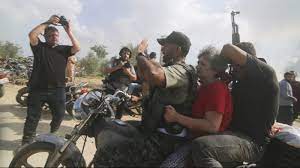
Bound Israeli female hostage pulled into Hamas jeep for Gaza
Blinded by its long-standing desire to help Palestinian Arabs, the United Nations has lost all legitimacy, and now participates in crimes against humanity and the murder of Israeli Jews.
The heinous massacre of Israeli Jews by the Palestinian political-terrorist group HAMAS meets every definition of a crime against humanity. The whitewashing of the evil source should therefore be considered a grave offense to be fought aggressively.
He flagged the “terrorist organization, Hamas” and called out terrorists a total of nine times and Hamas five times. He made it clear that the United States views the organization and its actions as evil with such declarations.
However, Biden misdirected the vitriol by constricting his language away from clearly labeling the group as the highly popular political party of Palestinian Arabs.
Worse, he made Palestinian Arabs appear as peace partners to stop the violence, saying “I’ve also directed my team to remain in constant contact with leaders throughout the region, including Egypt, Turkey, Qatar, Saudi Arabia, Jordan, Oman, the UAE, as well as with our European partners and the Palestinian Authority.“
CNN has done much the same calling out “Hamas fighters” and “Hamas militants” but disassociating the terrorist group with Palestinian Arabs. Instead, it limits the use of “Palestinians” to describe death tolls of local Arabs.
The New York Times echoes much of the narrative that Hamas is an “Iran-backed militant group that controls the Gaza Strip,” stripping the group of its Palestinian roots and nature and dressing it as a foreign implant.
This is toxic misinformation.
Hamas is the majority political party in Palestinian parliament, with 74 of the 132 seats, or 58 per cent of the total. According to a September 2023 Palestinian poll, “If new presidential elections were held today and only two candidates, Mahmoud Abbas [of Fatah] and Ismail Haniyeh [of Hamas], the voter turnout would be only 42%, and among those who would participate, Abbas would receive 37% of the vote and Haniyeh 58%,” showing the continued strength and popularity of the political-terrorist group.
The majority of Palestinians voted Hamas into power with the most antisemitic charter ever written, and a majority of Palestinian Arabs support the killing of Jews inside of Israel according to polls, just as Hamas has carried out.
Palestinian Arabs are engaged in a war to eradicate Jews from their homeland, and launched an attack on a Jewish religious holiday with a grisly crime against humanity. Efforts to recharacterize the war as stemming from a foreign-backed militant groups grossly paints Palestinian Arabs as twice-over victims – of Iranian-backed Hamas and of Israel – instead of squarely placing the root of evil on the local Arabs themselves.
The grisly crimes against humanity being waged by Palestinian Arabs against Jews must be fought militarily, financially, morally and with clarity. Hamas is the popular Palestinian political-terrorist party, not a foreign implant. Palestinian Arabs are responsible for the atrocities.
Write White House: “The grisly crimes against humanity being waged by Palestinian Arabs against Jews must be fought militarily, financially, morally and with clarity. Hamas is the popular Palestinian political-terrorist party, not a foreign implant.”
Social media sites like Facebook have enabled features for people to post whether they are safe when a particular crisis hits. It is meant as a quick tool to alert friends and families in real-time that one has escaped tragedy.
When war strikes Israel – especially on a holiday – Jews around the world await the pain of loss.
The popular Palestinian Arab political-terrorist group Hamas launched a massive attack against Israel while Jews celebrated the end of their holidays celebrating the Torah. This year, the two-day religious observance of Shemini Azeret/ Simchat Torah in the diaspora outside of Israel, coincided with the 50th anniversary of the 1973 Yom Kippur War. Hamas deployed thousands of missiles and militants into Israel to mark the day in a new war.
As horrible news leaked into synagogues about the war in Israel over the holiday, many Orthodox Jews had to wait until Sunday night to learn about the status of friends and family inside the Jewish holy land, as they do not use any electronic devices over the holiday.
A friend’s son serving in the army killed.
A friend’s cousin taken hostage.
A friend’s best friend killed.
A friend’s child’s roommate killed.
Each frantic call and review of social media was one of trauma.
There are few Jews in the world. While there are 8 billion people who are at most six degrees of separation from any other person, the 15 million Jews are at most two degrees of separation for one another. When hundreds of Jews are murdered, everyone is touched. Everyone mourns.
The Hamas website, which operated openly for years proclaiming its war against the Jewish State, was blocked as it posted videos of its grisly operation killing and kidnapping civilians. Its effort to let Jews know that they are never safe was viewed as too cruel to be given air at this time.
Palestinians pose with the Palestinian flag on an Israeli tank that was destroyed in an attack launched by Hamas on October 7. Behind the tank, the fence separating Gaza from Israel can be seen as destroyed, allowing more inflitrations. Photo: Hani Alsahaer/Anadolu Agency)
But information slowly dribbles in. And it continues to be horrific.
In addition to the over 700 dead are over 100 who have been taken captive, spread throughout the terrorist enclave of Gaza. Children as young as three. Wheelchair-bound Holocaust survivors.
The scale of the loss of life is difficult to comprehend. The number of hostages taken means that the current dangerous situation will be present for a long time.
There is no hashtag for Jews to mark themselves safe, nor an emoji to relay the deep pain at the loss of life and trauma felt for friends trapped at the center of evil.
As Jews around the world wait for bad news, they assess the actions each can take to seize the day from the implacable foe.
ACTION ITEM
Write White House “Support Israel. Cut all funding to Palestinians immediately.”
The last book of the Jewish Bible, Deuteronomy, is both a recap of the origin story of Jews and a lesson plan for the Jewish nation as they readied to return to their promised land.
Chapters 27 and 28 of Deuteronomy lay out the positive blessings that God will ensure to the Jews if they listen to His commandments, and the curses should they abandon Him. Deuteronomy 28:25 speaks of a particular curse:
יהוה will put you to rout before your enemies; you shall march out against them by a single road, but flee from them by many roads; and you shall become a horror to all the kingdoms of the earth.
This is the foundation of a cursed diaspora. While Jews had been slaves in Egypt and wandered the desert for hundreds of years, that situation was circumstantial. The Jewish forefathers of Jacob and his sons came to Egypt to avoid a famine and became trapped – together – in the land. As they were ending their time away from their promised land, God warned that they could be banished from the land of Israel, scattered and hated around the world, if they abandoned His charge.
This happened over thousands of years. While Jews had initially established their sovereignty and self-determination in the holy land, over time, invaders came and took the Jews to far away lands. As described in the Bible, they were often hated and persecuted in those lands, with many antisemites validating their persecution with verses from the Old Testament.
The middle of the 20th century brought change.
The Holocaust forced the Catholic Church to revisit their dogma. The horrors inflicted on European Jews with tacit or active support of many, caused the church to rewrite its rulings on the hated wandering Jews in the Second Vatican Council. Twenty years after the Holocaust, on October 28, 1965, the Church issued Nostra Aetate in which it reexamined its relationships with non-Christian faiths.
As it related to Jews, the declaration stated its “rejection of every persecution against any man, the Church, mindful of the patrimony she shares with the Jews and moved not by political reasons but by the Gospel’s spiritual love, decries hatred, persecutions, displays of anti-Semitism, directed against Jews at any time and by anyone…. The Church reproves, as foreign to the mind of Christ, any discrimination against men or harassment of them because of their race, color, condition of life, or religion.”
The Church abandoned the inflamed zeal which served as a driving force against non-Christians in the Crusades and Inquisition – and front row spectator in the Holocaust – and replaced it with a foundation of love for people of other faiths. The Holocaust – the “horror to all the kingdoms of the earth” as described in Deuteronomy – compelled the largest faith group in the world to reverse course and begin anew with an attitude of love towards all people.
The Church was able to do this by focusing on the texts of the Old and New Testaments and facts of history. It did not rewrite history that Jesus and the apostles weren’t Jews. It did not pretend that the Holocaust did not happen. It did not deny that the land of Israel is that exact piece of land that God promised to the Jewish people.
The Catholic Church considered facts and extracted new meaning, especially in light of Jews returning to their homeland after nearly 2,000 years, inspired and directed by love and peace.
Alas, as the years 1936 to 1967 which brought the horrors of the Holocaust, the rebirth of the Jewish State, the Second Vatican Council and the reunification of Jerusalem under Jewish control, directed the Islamic world to turn to noxious antisemitism.
While Nazi Germany gained power from 1936 to 1939, the Muslim Arabs in Palestine waged a war against Jews. They killed hundreds and successfully petitioned the British who were administering Palestine to block the entry of Jews back to their homeland, just as hundreds of thousands were fleeing the Holocaust.
During World War II, Palestinian leaders conspired with the Nazis as they had a “shared recognition of the enemy,” as Heinrich Himmler wrote to the Palestinian Grand Mufti in Jerusalem about the Jews. In the immediate aftermath of the Holocaust, Arab Muslims from Palestine and the surrounding countries invaded the new Jewish State in the hopes of a second Holocaust, to destroy the country and wipe out the Jews.
Palestinian Arabs are the most antisemitic people in the world according to polls. They are the center of Muslim antisemitism as noted in the same ADL poll that “while Muslims are more likely to hold antisemitic views than members of any other religion (49% Index Score), geography makes a big difference in their views. Muslims in the Middle East and North Africa (75% Index Score) are much more likely to harbor antisemitic attitudes than Muslims in Asia (37% Index Score), Western Europe (29% Index Score), Eastern Europe (20% Index Score), and Sub-Saharan Africa (18% Index Score).”
Ultra Orthodox Jews in the Me’a She’arim section of Jerusalem (photo: First One Through)
While Christians looked at the text of the Old Testament and saw the rebirth of the Jewish State as an affirmation of Jews being good and blessed by God’s love, Muslims were compelled to cast the Jews as evil and unworthy of the land and God’s love.
The conclusion of the Jewish Bible has stories of blessings and curses for Jews as it relates to their behavior and presence in the land of Israel. Over the last few decades, Christian Zionists have come to view the Jews as good and worthy of the promised land, while Muslims attempt to portray Jews as irredeemably evil and unworthy of of the holy land. Muslim Arabs then also fabricate stories that Jews don’t even have history in the land to further undermine any potential Jewish claim.
Muslim vilification of Jews is not simply antisemitism; it is a tool for ethnic cleansing.
Far left extremist Rep. Jamaal Bowman who represents the moderate lower Westchester County District 16 in New York State is a liar who lies a lot. More importantly, he’s very dangerous and doesn’t represent the values of his district.
Jamaal Bowman’s Fire Alarm & Nazi Lies
The current controversy of whether Bowman pulled a fire alarm in Congress is a small part of the story. He either pulled the alarm because 1) he’s an idiot who can’t read the word “FIRE” or doesn’t know what a fire alarm looks like despite years as a middle school principal, running dozens of fire drills; 2) did it on purpose and put thousands of lives at risk both in causing the evacuation of the building and pulling firefighters from actual emergencies, so he can delay a House vote to give Democrats more time to assess their strategy; or 3) was simply “confused” as he’d like you to believe.
Bowman’s staff then tried to protect their master by swearing allegiance to him and calling Republicans “Nazis” to distract attention from the episode – sort of like calling “fire over there!”. After decent people complained at using the genocide of Jews as a political fig leaf, Bowman said that he hadn’t approved of the use of the word Nazi and “I condemn the use of the term Nazi out of its precise definition. It is important to specify the term Nazi to refer to members of the Nazi party & neo-Nazis.”
That’s a lie as Bowman has called Republicans “Nazis” including conservative pundit Michael Knowles. He underscored the point saying that the Conservative Political Action Conference “support[s] a future run by Nazis.”
Jamaal Bowman’s Infrastructure Bill Lie
Bowman took to the airwaves with political theater lambasting Sen. Joe Manchin voting against the infrastructure bill, then Bowman himself voted against it. Not satisfied with hypocrisy, Bowman then lied to his constituents that he backed the bill.
Jamaal Bowman’s Small Donation Lie
Bowman likes to make himself sound like he’s in the fight for the every day worker, a populist in the model of x-President Trump. He’s claimed that the “average donation [to his campaign] is about 40 bucks,” but in fact it was $607, fifteen times as much.
But Bowman is not just a liar and hypocrite. He’s dangerous.
Jamaal Bowman Is Dangerous
The garden variety liar says that they weigh less than they actually do or maybe are a few inches taller. An average political liar would say that they were in the line of fire visiting a foreign country, when in fact they were quite safe. Bold-faced political liars make up their entire background in order to get elected.
But pulling a fire alarm to put thousands of lives at risk? Concealing the act by belittling the genocide of Jews while Jews in his district and his state are suffering from terrible antisemitism? Pushing to have the rap music of antisemites who sing about violence into school curricula?
Jamaal Bowman is only concerned with a narrow slice of his constituents: Black people, Muslims and radical leftists. He has utter contempt for moderates, a point he makes every day.
The question is whether a moderate Democrat who speaks for the entire district will oppose him in the primaries. We can only hope.