
For decades, the world has been told that Palestinians live under conditions of extraordinary deprivation. Yet before October 7, 2023, several important demographic and social indicators told a very different story.
In 2022, the West Bank and Gaza had a fertility rate of approximately 3.4 children per woman. Among countries with fertility rates above three, the Palestinian territories also reported relatively high life expectancy, low infant mortality and exceptionally high adult literacy.
Uniquely among its Arab peers. Only Kazakhstan and Uzbekistan (neither Arab) among high fertility countries, have quality of life statistics remotely close to Palestinian Arabs.
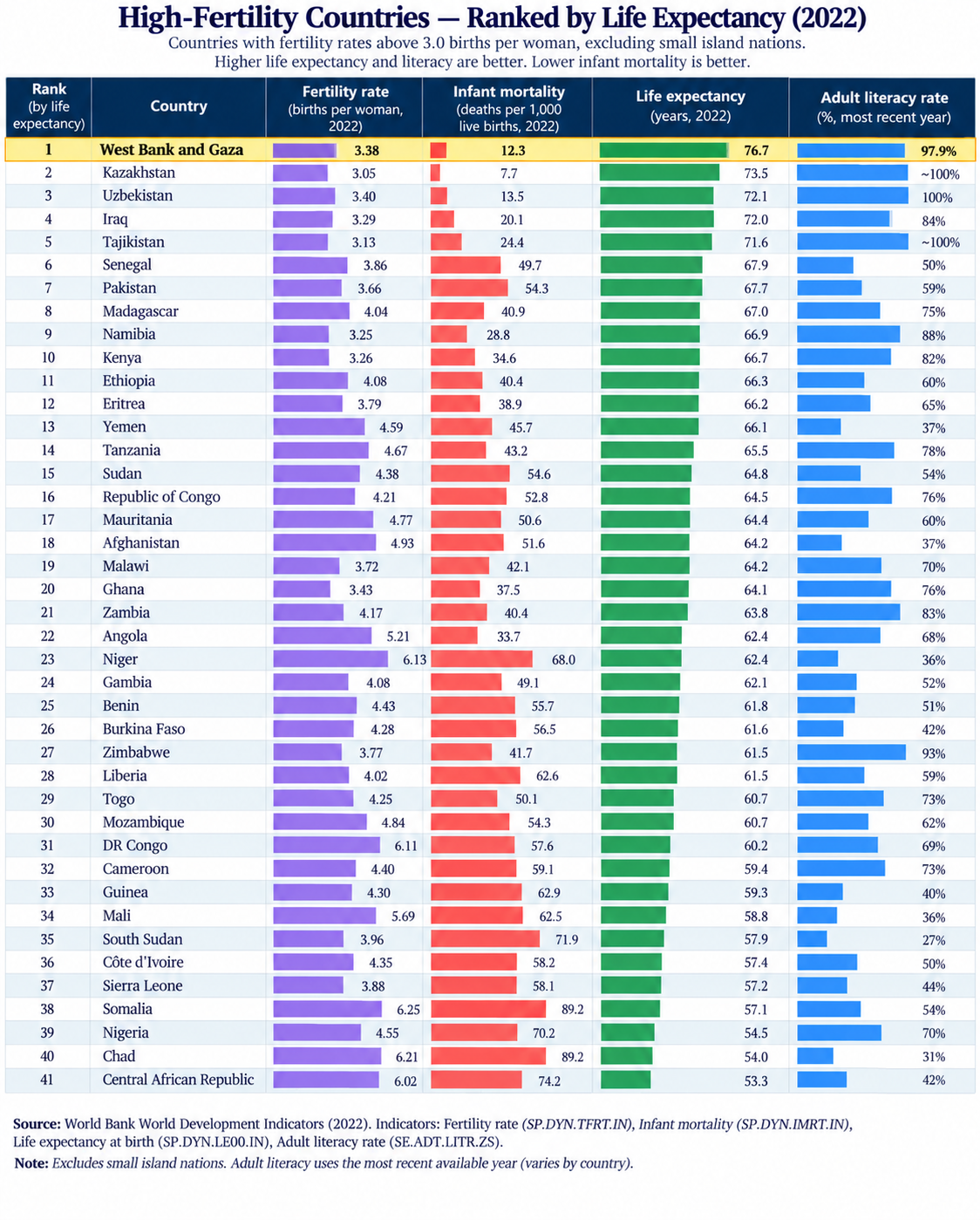
Palestinian Arab adult literacy was 98%. Infant mortality was far below that of many other high-fertility populations. Reported life expectancy was in the mid-70s, although estimates vary by source.
These were meaningful achievements, particularly in a region marked by conflict, poverty and political instability. They reflected billions of dollars of investment in education, extensive public health and educational services.
These incredible quality of life statistics came principally from the charity of western countries. The United States, Germany, the United Kingdom, France, Japan, Norway, Ireland and other countries have provided extensive financial assistance to Palestinian Arabs, both directly and through international institutions such as UNRWA.
Yet these charitable countries face an entirely different demographic reality.
In 2022, fertility in Norway was approximately 1.4 children per woman. Ireland and Germany were around 1.5. Japan approximately 1.3, and the United States around 1.7. All were below the roughly 2.1 births per woman associated with long-term population replacement in low-mortality societies.
The Palestinian territories, meanwhile, averaged approximately 3.4.
So the countries financing Palestinian schools, hospitals and social services were experiencing declining birth rates and aging populations at home. And their taxpayers were helping support a population having roughly twice as many children per woman as their own societies.
And despite the western generosity and much better quality of life than surrounding Arabs, these same Palestinians decided to launch a genocidal war against Israel and destroy the world that Europeans and Americans financed.

The uncomfortable question for international donors is whether charity to a people who prioritize destroying their neighbor over building a society is logical. Or moral.
Norway, Ireland, Germany and Japan cannot purchase peace simply by financing another generation’s schools and hospitals.
A society’s children deserve more than the opportunity to survive infancy, learn to read and live long lives. They deserve leaders who will not gamble away those achievements in war, and an ideology that values coexistence with a Jewish State.
Related:
“Deformity in Palestinian Culture” Is A Permanent Feature (August 2023)


