America’s Closed Doors

The spring of 2015 has been a tumultuous time for Americans.

Politics and debate are not new and neither are riots and war. However, it is typically the former that resides on America’s shores while the latter remains a foreign phenomenon.

Closed Doors at Home

Historically, when riots broke out in the United States, they were over isolated incidents such as after a sports game, a concert or visit of foreign diplomats. When protests had “a theme,” such as “Occupy Wall Street,” they carried on for a long time, but remained mostly non-violent. Today’s multi-city violent protests over a common cause is unusual.

The black community has had a mixed relationship with police for a long period of time. People on all sides of the political spectrum debate the reasons for the tension between law enforcement and the citizens they are there to protect. No one denies that there is a problem that is capturing more American cities, whether Ferguson, MO, Berkeley, CA or Baltimore, MD.

Liberal arguments have followed two general themes – racism and economic opportunity – which are actually one: Black unrest stems from the fact that a predominantly white populace holds positions of power. The power may be law enforcement (including the police force and lawyers), municipal government, banks or business. They argue that white people’s biases (whether overt or veiled) discriminate against black people.

The racism argument stems from the large number of arrested and incarcerated black people which is disproportionate to their population figures. The Department of Justice report on Ferguson, MO stated that “Ferguson’s police and municipal court practices both reflect and exacerbate existing racial bias, including racial stereotypes…. Evidence shows discriminatory intent.”

Counter-arguments point to the situation in Baltimore, MD where the mayor, the majority of the city council, the head of police and the majority of the police force are black. Yet, an unarmed black youth still died while in police custody and black violence took to the streets.

Regardless of the reason, doors appear closed.

Liberals argue that metaphorical doors to economic opportunity are closed to blacks which create economic hardship and frustration. Conservatives argue that doors are naturally closed to everyone; people need to open the doors on their own.  The conservatives do not agree that metaphorical doors of progress are locked because of white bigotry.

Conservatives are focused on physical doors that are closed. Stores which were looted and burned to the ground may never reopen. Both the businessmen and community suffer from the destruction.  For their part, liberals use such conservative arguments to claim that conservatives care more about business than about the lives of black people.

But more physical doors continue to close.

The city of Baltimore imposed a curfew. It barred people from attending a professional baseball game, the first time in history that a game had no fans in the stands.  What will be next?

Closed Doors Abroad

America’s doors are closing due to violence and political snafus in other parts of the world as well.

In Yemen, the United States closed its embassy doors due to unrest in the country. The Obama administration had been using drones to attack rebel forces for many years, yet the rebels overtook the capital.  It would appear that despite America’s outreach to Iran, the Iranians continue to back rebels in Yemen who fight against American allies.

America’s allies in the Middle East are not happy with Obama.  While Obama invited the leaders of several Gulf countries to visit the White House to sell them on his Iranian nuclear deal, Saudi Arabia and other countries declined the invitation.

Just months before, it was Obama who snubbed the Israeli Prime Minister on his visit to the US, who similarly disagreed with Obama’s Iranian policy.


Regarding physical doors, both in the US and abroad, people are locked out of public places and embassies because the government cannot protect them. Metaphorically, America seems to be failing its citizens and allies as well.

At least Obama is focused on opening the door with Iran…. to get nuclear weapons while it chants “Death to America.”

KerryIran
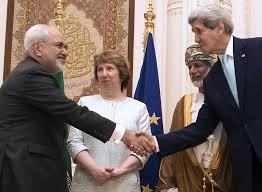
US. Secretary of State Kerry and Iranian FM Zarif shake hands as Omani FM Alawi and EU envoy Ashton watch in Muscat.. (photo credit:REUTERS)

Selective Speech

Summary: Just because we are free to do or say something, doesn’t mean we should. And the selection of what speech to admire or admonish is not hypocrisy, but a choice on philosophy.


Many people have taken very hard positions regarding the recent killings at a “Muhammad Art Exhibit and Contest,” in Texas. In an effort to portray everything in black-and-white, they miss important distinctions.

  1. Murdering someone for being insulted is ALWAYS wrong. As discussed on these pages, “I’m Insulted; You’re Dead,” everyone should whole-heartedly condemn the killing of people because sensibilities were offended. Whether the attacks were at the Parisian offices of the magazine Charlie Hebdo, or at an event in Texas where people drew the Islamic prophet, no one should condone murder.
  2. Freedom of Speech is a CAUSE worthy of Defense. Freedom of speech and press are cornerstones of western democracies. They are basic and important causes to uphold.
  3. Specific language does NOT need to be defended. Just because someone has the right to say something, doesn’t require everyone to come to the defense of the content of any particular speech. An individual or organization that opts to distance itself from an event does not mean they are against free speech.

Civil Sensitivities

Western societies are a mix of people and ideas. Such combinations create both civil and uncivil conversations. One can choose to be part of a completely civil society where nothing unpleasant is ever said, uncivil society in which people attack people all of the time, or more likely, a blend of the two, where different ideas are shared which may upset certain individuals at certain times.

Civil society’s “safe spaces” are one’s home and organizations where people share common values.  It is hard to imagine that one can walk in public and never hear or see something disagreeable.

An inherent component of being part of the mixed society is to strike a balance of the use of free speech and society’s sensitivities.  Just because someone has the right to say something, doesn’t mean that they should, and that everyone has to support the comment. The other half of that balance is that there is no requirement in society to be polite to everyone.

Not Hypocrisy, But a Preference

When a party or organization chooses to defend some speech and not others, they show their own preferences or priorities. Consider the New York Times approach to several events that upset segments of the American population:

  • Mosque at Ground Zero (2010): The United States offers freedom of religion (as well as speech and press) and as such, Muslims are free to build a mosque at any location where they legally have rights to the land. However, many people viewed the proposed building of a mosque overlooking the site where terrorists killed thousands of people in the name of Islam, as wrong and insulting. The New York Times editorial felt differently stating that it saw “the wisdom of going ahead with the project,” in an opinion that sided with Muslims but offended many people.
  • Convent at Auschwitz (1989): Similar to the mosque at the base of the destroyed World Trade Center, the location of a Roman Catholic convent on the grounds of a notorious concentration camp where over a million Jews were killed simply because of their religion, was viewed as completely insensitive by many Jews. While the Times covered the news story in several articles, it conspicuously never offered its own opinion as to whether the convent should be moved.
  • Giuliani on the Brooklyn Museum art show (1999): The Brooklyn Museum ran a controversial series of “art works” that treated Christianity harshly, including a painting of Mary covered in dung. After New York City NYOR Rudolph Giuliani threatened to withhold funding for the museum, the NYT opted to attack the Mayor stating that “Art is the name of a perpetual human struggle with the limits of perception. The Mayor… is failing dramatically in that role in a fashion that makes him and the city look ridiculous”
  • Metropolitan Opera on Klinghoffer (2014): When the streets of New York held civil protests about the Metropolitan Opera’s airing of a play that showed a sympathetic side of terrorists murdering an infirm elderly Jew, the New York Times rushed to the opera’s defense. The editorial page ran a headline that stated “The Death of Klinghoffer Must Go On”. It argued that it stood for art and free speech. Others claimed that it simply stood on the side of Palestinian terrorists.
  • Charlie Hebdo (2015): The New York Times printed a series of editorials trying to find its position on the murder of journalists by Muslim terrorists. While it clearly stood by the rights of journalists to free press, it seemed to support such right because it lampooned all religions, and not just Islam.
  • Draw Mohammed Exhibit (2015). The New York Times chose to attack the organizer of the event, Pamela Geller and stated that the event was simply “hate speech”. It condemned the contest “cannot justify blatantly Islamophobic provocations like the Garland event.”

What is the summary of the observations of the New York Times?

  • It sided with Muslims at Ground Zero and the Draw Mohammed Contest; against them at Charlie Hebdo;
  • It sided against Christians at the Brooklyn Museum and offered no opinion at the Auschwitz convent;
  • It sided against Jews for the Klinghoffer opera and no opinion at the Auschwitz convent

When it came to religion, the Times record was mixed, while showing a preference for Muslim sensitivities over Christians and Jews.

Overall, the Times will claim its record is for upholding freedoms.  It obviously failed in that principle when it came to the Mohammed Exhibit, which it claimed failed the threshold for art and was merely “hate speech”.  Perhaps the Times forgot the never-ending nature of its definition of art from 1999: “Art is the name of a perpetual human struggle with the limits of perception.”


Related First.One.Through articles:

Blasphemy OR Terrorism

My Terrorism

New York Times Confusion on Free Speech

Look for Mom on Mother’s Day

Summary: Society’s ongoing demands for special recognition is making seeing one’s mother on Mother’s Day the equivalent of “Where’s Waldo”.

Just 101 years ago, on the brink of World War I, US President Woodrow Wilson declared Mother’s Day.

In its original format, it seemed like a nice, sweet, uncontroversial idea. Each person would make time to thank and honor their own mother for the love and effort they expended in bringing them into and up in this world.

Within a few months, many of those American mothers would be mothers-no-more, as over 100,000 American men died in combat. Americans reached out to those bereaved parents, and implicitly changed the singular “Mother’s Day” to “Mothers’ Day” in plural (as preferred by President Wilson over the wishes of the holiday’s creator, Anna Jarvis).

It did not take long for other societal changes to creep into this Sunday in May.

The first foxes in the henhouses were commercial opportunists. Merchants of flowers, candy and greeting cards convinced us that buying-was-caring, and that their wares were welcome with women, while warm wishes were watered down gifts.

They exploited the public “MotherS’ Day” and advocated that every mother you ever knew was important to recognize. Gone was the one-to-one heartfelt communication from child to mother. On came mass media and mega merchandizing.

This was much better for businesses, as now husbands were expected to buy more significant gifts for their spouses. Before long, jewelry and fashion accessories became the normal gift from a spouse, while the flowers remained a welcome gift from children. Meanwhile, terms of endearment became shorter than Twitter, as the space for sentiments was just the accompanying notecard.

As society expanded the definition of MotherS’ Day, many people came forward to demand their own recognition.  The LGBT community called for more coverage of people who would not have historically been considered mothers.  Others called on society to account for recognizing women with every conceivable iteration of motherhood or non-motherhood.  It is now commonplace for a person grabbing a quick bite to be told by the cashier to call their mother.

How did all of this societal noise get introduced when the day was intended to be a direct communication between child and parent?  Can American society soon expect extreme feminists will assault Mothers’ Day and try to replace it with a single gender-neutral Parents’ Day, the way they are destroying urinals and gender distinct bathrooms?

Hillary Clinton wrote a New York Times bestseller book in 1996 called “It Takes a Village” in which she argued that all of society is needed to raise a child.  It would appear that our society is now demanding its acknowledgment in return. Perhaps you can simply use a megaphone and thank your mother in the crowd.


It is perhaps not surprising that the by-product of declaring a public day to have a private communication would eventually destroy that private moment and insist on the public’s inclusion.

However, I do hope that people can move past the cacophony of societal demands and advertising blitz to carve out time for personal expressions of thanks directly with their moms.


Source:

Wilson declares Mother’s Day

The “Unclean” Jew in the Crosshairs

Summary: Antisemites calling Jews “unclean” is their first step towards calling for purifying them from the world. How should the world respond?

There have been a number of political leaders who have called Jews “unclean”:

  • Adolf Hitler’s Mein Kampf (1925): “The moral and physical cleanliness of this race [Jews] was a point in itself. It was externally apparent that these were not water-loving people, and unfortunately one could frequently tell that even with eyes closed. Later the smell of these caftan wearers often made me ill. Added to this were their dirty clothes and their none too heroic appearance.” 
  • Hamas Charter (1988): “The basic structure of the Islamic Resistance Movement consists of Moslems who have given their allegiance to Allah whom they truly worship, – “I have created the jinn and humans only for the purpose of worshipping” – who know their duty towards themselves, their families and country. In all that, they fear Allah and raise the banner of Jihad in the face of the oppressors, so that they would rid the land and the people [Jews] of their uncleanliness, vileness and evils.”
  • Iran’s Supreme Leader Ayatollah Ali Khamenei (2013): “Israeli regime, this sinister, unclean rabid dog of the region”
  • Acting Palestinian Authority President Mahmoud Abbas (2014): “Keep the settlers and the extremists away from Al-Aqsa and our holy places. We will not allow our holy places to be contaminated.”

iran-khamenei-adl-israel-rabid-dog

It did not take long for these leaders and parties to move from their initial anti-Semitic positions, to calls to eradicate the Jews:

  • Hitler’s Nazi party gradually stripped Jews of their citizenship in the early and mid-1930’s once the gained power, pushed them into ghettoes and work camps by late 1930’s and began their annihilation by the early 1940’s.
  • Hamas called for the murder of Jews and destruction of Israel in the very same 1988 charter: “rid the land and the people [Jews]“, “there is a Jew behind me, come and kill him” and “Israel, Judaism and Jews challenge Islam and the Moslem people.”  The Palestinian people voted for Hamas into 58% of the Parliament in 2006.
  • Iran’s leader was quite clear in 2014: “This barbaric, wolflike & infanticidal regime of which spares no crime has no cure but to be annihilated“
  • The Fatah party of the Palestinians was led by Yasser Arafat who said: “We will not bend or fail until the blood of every last Jew from the youngest child to the oldest elder is spilt to redeem our land!”” His successor, Mahmoud Abbas declared “In a final resolution, we would not see the presence of a single Israeli – civilian or soldier – on our lands.“

One can call Abbas a “moderate” in comparison to those around him in that he has not openly called for killing Israelis (he prefers the indirect method of honoring and celebrating those that do kill Israelis).

President Obama commented about ISIS (2014) that “the world must never cease in seeking to defeat their evil ideology.” Such evil ideology is the open platform in the Iranian and Palestinian leadership.

As Obama is actively engaged in dialogue and negotiations with both of those parties, does he think

  • that the Iranian and Palestinian platforms are not “evil ideologies“
  • that they are exceptions that do not need to be defeated, or
  • his process of negotiation and placating them is a method of “defeating” them?

Related FirstOneThrough articles:

The Palestinians War Against the Jews

Palestinian anti-Semitism surpasses Nazi Germany

Before recognizing a Palestinian State, Recognize what the Palestinians are saying

Cause and Effect: Making Gaza

Summary: The media frequently touches on the suffering that takes place in Gaza. Yet, the depth of their coverage of Arab misery never approaches any level of analysis on the root cause for the Israeli-Arab conflict.


The Atlantic published an article on May 2, 2015 called “Gaza is Hell” (all in quotes) which described the miserable living conditions of Arabs living in Gaza. The 2000-word article covered the area and quoted the residents, but never scratched the surface of the underlying cause of the residents’ misery.

atlanticmay2
The Atlantic magazine,
May 2015

The problem in the coverage was in five key areas, long ignored by the media and politicians.

  1. Hamas isn’t “resisting” Israel. It wants to destroy Israel.
  2. Palestinian Arabs never ruled Gaza until 2005.
  3. Israel’s wars with Gaza have all been defensive.
  4. There are no “refugees” in Gaza.
  5. Much of the Gazan misery is self-inflicted.

The Atlantic article did not fall victim to a sixth category, which is actually a subset of lie #5: Hamas is the democratically-elected choice of Palestinian Arabs.

 HAMAS’S MISSION

Hamas’ mission is very clear for any literate individual: the complete destruction of Israel. It lays out its goal repeatedly in its 1988 Charter, the most antisemitic charter of any governing body in the world, including the Nazi party when it took power in 1933.

For those who cannot read (former US President Jimmy Carter?) there are dozens of recent videos from Hamas officials which call for the murder of Jews and destruction of Israel.

Yet, The Atlantic echoes soft lies in its piece stating that “Hamas’s rhetoric is all about resistance,” and “Hamas advocates militant resistance to Israel.” Nope. Resistance means opposing a force. Hamas is the force that seeks jihad and the total destruction of Israel. Any statement that says that Hamas is a resistance movement, inherently makes the argument that the basic existence of the State of Israel is an active force against Palestinians.

GAZA’S FIRST INDEPENDENCE and
ISRAEL’S DEFENSIVE WARS

The mutant siblings of lie #1 that Gazans are “resisting” Israel, are lie #2, that Palestinians have always been self-governing in a country of their own, and lie #3, that Gazans just want to live in peace alongside Israel but Israel continues to attack it.

Alice Su, the author of The Atlantic article is based in Jordan, a country that is over 50% Palestinian Arab. That country, like Gaza, was part of the 1922 British Mandate from the League of Nations. Before the British ruled Gaza, the Ottoman Turks were in charge, and after the British came the Egyptians. None of these rulers made it into Su’s description which starts a historical background of Gaza in 1967: “Gaza, which was under Israeli occupation from 1967 until 2005”. With some additional background, it would have been clear to any reader that Gaza was never ruled by local Arabs (the Ottomans were Muslims but not Arabs), and it has only been since Israel left the territory in 2005 that Gazans have ruled over themselves.

Additionally, the various wars that Israel fought against the Arabs including 1948 and 1967 were defensive wars against several Arab countries (including the Arabs in Gaza). The more recent wars from Gaza were also defensive, in response to Hamas’s rocket attacks, terror tunnels and abduction and murder of Israeli teenagers. Yet Su stated that “Israel has also launched three military operations in Gaza since the Hamas takeover,” which suggested that Israel was the aggressor, which it was not.

Arab amnesia repeats itself today, as Su writes about a Gazan: “They keep asking him why the Israelis bombed them. “I tell them, ‘Naseeb. This is our fate,’”  The Gazan assumed a completely passive stance in the conflict and Su did not educate the reader about: the abduction and murder of three Israeli teenagers; the rockets fired from Gaza into Israel; and the terror tunnels Hamas dug into Israel to kidnap Israelis.

It was only eight paragraphs later that Su brought up the tunnels: “Israel has restricted imports of key building materials like cement and steel, out of concern that they’ll be used to build tunnels and facilitate terrorist activity.”  Such concern looks out-of-place without any history regarding the Hamas tunnels which were used for terrorist activities.  The Israeli ground invasion into Gaza in 2014 was specifically to destroy those tunnels.

To underscore the point of misdirecting the reader, consider the title of the Atlantic article.  It comes from a resident of Gaza. ““Gaza is hell,” 20-year-old Ahmad told me in Shejaiya, one of the worst-hit neighborhoods in Gaza City.”

Shejaiya was the neighborhood with the greatest number of terror tunnels, many coming straight from people’s homes. That is why the Israelis concentrated its efforts on the neighborhood in a defensive action.

Why did The Atlantic run an article with a headline quote from a man who was part of the terrorist infrastructure?  Why did it deliberately mislead readers into thinking these people were merely passive homeowners who were bombed indiscriminately by Israel?

REFUGEES IN THEIR HOME

Su’s article describes refugees and refugee camps in Gaza. Now that Gaza is not occupied by Israel, Egypt, the British or anyone else, these people cannot be considered “refugees” since these “Palestinian Arabs” are living in “Palestine” run by themselves.

The refugee myth has continued to compound itself as this misnomer is incorrect on additional levels.  Refugee status cannot be handed down like inheritance through the generations.  Refugees can only be from a country, not a house or region.

At the most generous, these people can be considered descendants of “internally displaced” people from the region of Palestine which was occupied for centuries until 2005. Yet Su used the term refugee several times:

“a refugee camp initially built to shelter 9,000 out of the 750,000 Palestinians who became refugees when Israel was established in 1948. More than half a century later, the camp hosts more than 21,000 refugees,”

The description above elegantly covers many soft lies: the ones mentioned above, and that Arabs became refugees when they actively launched a war to destroy Israel; they were not passive “when Israel was established in 1948.”

SELF-INFLICTED MISERY

Su did get several things right, such as “Gaza remains in ruins.” But why?

Su pointed out that “Hamas, the Islamic militant group that governs Gaza… since the organization defeated the PLO-affiliated Fatah party in Palestinian elections in 2006.” Hamas was chosen by the Palestinians in 2006 and polls continue to show Palestinians favoring Hamas should elections ever be held again. The various quotes of Arabs on the street in Su’s article affirm that view: “Another college student said she’d lost faith in politics, but would vote for Hamas if an election were held now.”

Yet Su would have you believe that Gazans are simply passive victims in the situation. That position is encapsulated in her article: “Those who survived last summer’s war are trapped in 360 square kilometers of trauma and contradiction, choking on war and blockade, disillusioned with the Palestinian leadership and disempowered by the aid community. They sit without jobs, relief, or means of rebuilding, waiting for things to change.” Untrue.

  • The Palestinians voted for Hamas, well aware of its charter and calls to destroy Israel. The fact that Palestinians are “disillusioned” with their leadership is only because Hamas hasn’t been successful in their genocidal mission.
  • The phrase “disempowered by the aid community” is strange but Su’s meaning becomes clear when she later writes that foreign aid is slow in coming “because donors are put off by the political deadlock between Palestinian parties.”  A Lie. The aid is being held up until there are guarantees that Hamas will not have access to the funds as it is a terrorist organization.

The catalyst for war is Hamas.

  • If Gazans would turn away from Hamas, there would be no blockade.
  • If Gazans did not allow Hamas to build terror tunnels in their houses, the neighborhood would not get demolished.
  • If Hamas were disbanded and outlawed, foreign aid would flow into Gaza for rebuilding.
  • If Hamas would not attack Israel, there would be peace.

The simple cause-and-effect of the situation in Gaza is about the people’s support of a genocidal anti-Semitic regime.  But writing about such reality would make it harder to sympathize with the picture laid before readers in The Atlantic.

Scarier still, is the support for the insidious paring: Hamas with a nuclear Iran. That is what keeps the hopes of Gazans alive under the shade of complicit countries and malevolent media.


Related FirstOneThrough article:

The Death of Civilians; the Three Shades of Sorrow

Actions and Adjectives: Cluster Bombs

Summary: When it comes to reporting on the death of civilians, it is interesting to review how and when some media outlets choose to simply report facts, rather than delve into critical reporting. Here is a comparison of the New York Times discussion of cluster bombs being used by Syria and the Kingdom of Saudi Arabia (KSA). Remarkably, the party that is lambasted the most in the articles is Israel.

 Actions and Adjectives

The “Actions and Adjectives” series discusses the media’s use of language. Oftentimes, the press chooses to be fairly clinical in describing a situation, while at other times, it chooses to direct (or redirect) the conversation in a particular fashion.

For an example, an article can have different ways of describing a car crash:

  1. “Three people died in a car crash,” is purely factual.
  2. “Three people were killed in a car crash when a teenager crashed his car into oncoming traffic,” provides more color about the incident, giving an account of how the crash happened.
  3. “Three innocent people were killed when an irate teenager plowed his car into oncoming traffic after the teen had a big fight with his girlfriend,” takes the article to an entirely different place.

While all of the sentences are factual, the third description does two significant things:

  • It gets the reader to be more engaged- “innocent people were killed” by an “irate teenager,” phraseology gets the reader more excited and angry.
  • Further, the conversation moves the reader away from the victims, towards the driver. The reader is intentionally led towards possible motivation and background which caused the incident. Most likely, a more detailed description of the driver and his relationship would follow in the article. Should the balance of the article focus on teenage relationships, the headline would unlikely be about the car crash; the accident was there solely as a tool to delve into the main focus, which in this example, is the potential danger and ramifications of teenage love.

With that general overview about word choice and focus, consider the New York Times description of the use cluster bombs by Syria and Saudi Arabia.

Cluster Bombs Used by Saudi Arabia

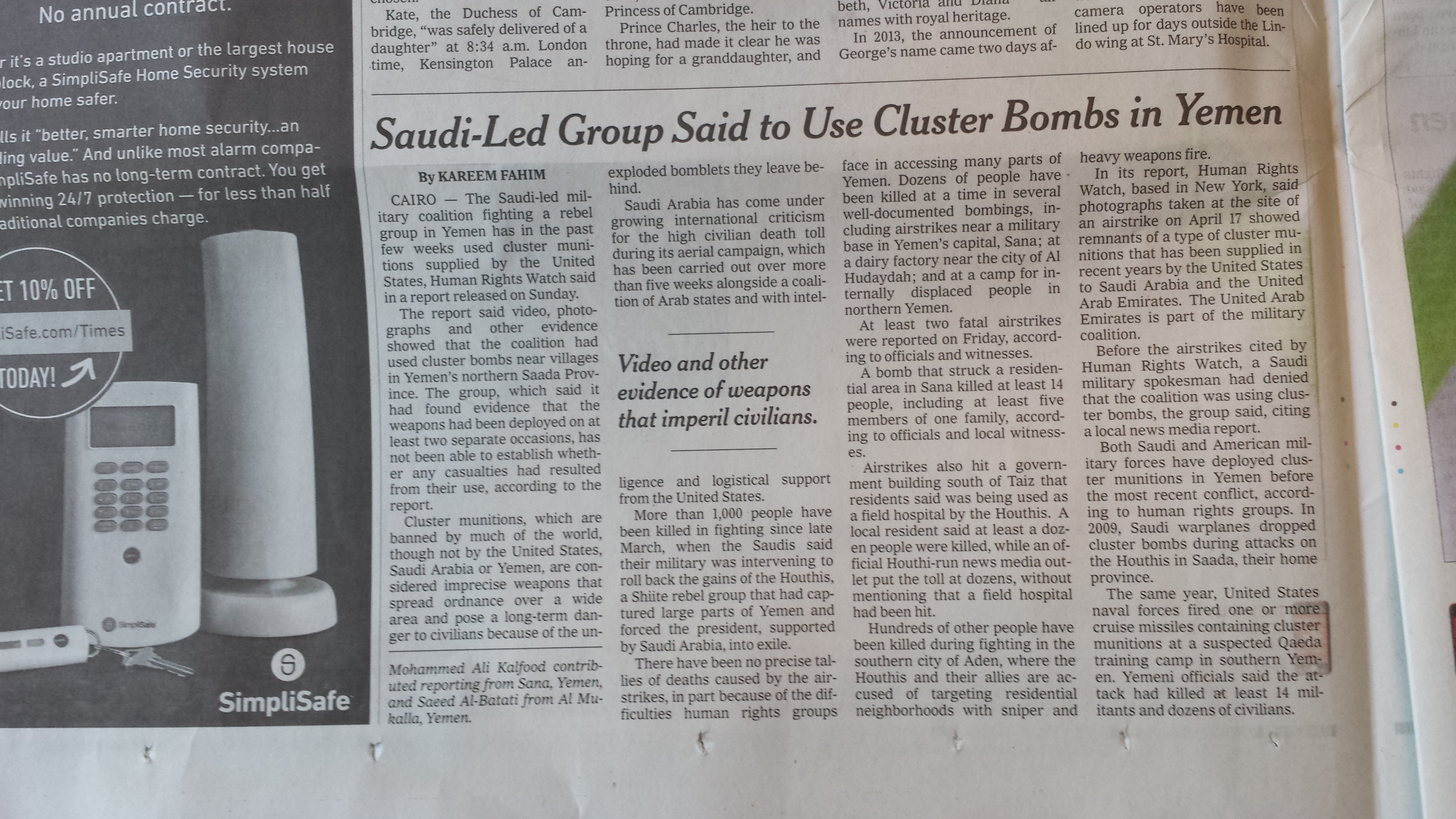
On May 3, 2015, the New York Times published a piece entitled “Saudi-led Group Said to Use Cluster Bombs in Yemen“. The 14 -paragraph article showed up at the bottom of page 10 and discussed a report by the Human Rights Watch (HRW) which concluded that Saudi Arabia used cluster bombs on at least two occasions. No casualty figures were supplied.

Saudi Arabia cluster bombs

The article made clear that “cluster munitions, which are banned by much of the world, though not by the United States, Saudi Arabia or Yemen,… pose a long-term danger to civilians because of the unexploded bomblets they leave behind.” The article included a single condemnation of KSA for its use of the weapons: “Saudi Arabia has come under growing international criticism for the high civilian death toll during its aerial campaign, which has been carried out over more than five weeks alongside a coalition of Arab states and with intelligence and logistical support from the United States. More than 1,000 people have been killed in fighting since late March, when Saudis said their military was intervening to roll back gains by the Houthis, a Shiite rebel group that had captured large parts of Yemen and forced the president, supported by Saudi Arabia, into exile.”

These sentences may look unremarkable on their own, but consider what was actually written and the direction of the article as a whole:

  • It was clear that the parties that engaged in the use of the cluster bombs had not signed onto the treaty barring their usage
  • The “unexploded bomblets” were left behind by the cluster bombs, not by the Saudis which were a step removed
  • KSA was portrayed in a negative manner only a single time in the article: “growing international criticism”
  • The aerial campaign was described as having wide support from a “coalition” which included “support from the United States”
  • A rationale was given for the KSA military attack- to “roll back” a “rebel group”

The article stayed roughly true to the HRW report. This was in very stark comparison to an article in the New York Times published on August 28, 2014 called “Heavy Use of Banned Cluster Bombs Reported in Syria”

Cluster Bombs Used by Syria

In September, FirstOneThrough wrote a detailed analysis of the August 2014 article which outlined how the story about Syria’s use of cluster bombs ended up becoming harsh a critique of Israel. Below is some added comparisons to this week’s NYT article.

The 2014 article had a single negative comment for Syria’s use of cluster bombs, attributed to a HRW lawyer: “This year’s use of cluster munitions shows that while these weapons have been banned by most countries of the world, some actors still flout international opinion and standards,” Mary Wareham, the advocacy director of Human Rights Watch’s arms division,” in a statement that did not specifically mention Syria.

However, the Times did heap condemnation many times upon Israel, even though it was presumably not the focus of the article.  The author, Rick Gladstone, redirected the timely article about Syria towards Israel’s use of the cluster bombs eight years earlier.

 “Israel-Lebanon conflict that triggered global outrage and contributed to the establishment of the ban convention. Israel’s military was widely criticized at home and abroad for its heavy cluster-bomb use in Lebanon,”

Gladstone’s 16-paragraph article mentioned Israel in six of the paragraphs. In almost each case, Israel was lambasted.

  • In the 2015 article, KSA had “growing international criticism” while in 2014, Israel had “global outrage” and was “widely criticized” and many other uses of such critical language for Israel, including “insane and monstrous”  and “completely immoral.” Syria was not condemned by name.
  • In 2015, KSA fought against “the Houthis, a Shiite rebel group,”  However, in the 2014 article, Hezbollah, a Shiite army that is considered a terrorist group by the United States, was mentioned only once while “Israel-Lebanon” was used repeatedly.
  • The 2015 article articulated the reason KSA waged its aerial campaign; the 2014 article did not describe Hezbollah’s firing rockets into Israel and blowing up military vehicles which initiated the war.


As evidenced in this week’s KSA article on cluster bombs, the Times can write an article about the current news when it desires. It has also shown that it is deft at inflaming passion and redirecting an article towards Israel, as it did in August 27, 2014.  Why did the New York Times report on cluster bombs in such a different manner?

In August 2014, Israel and Hamas had just ended a bloody war in which the New York Times covered Israel as an evil, murderous aggressor against civilians.  The story of cluster bombs in Syria served as an excuse to continue to portray Israel as indifferent to the lives of civilians in a war.  The choice of critical adjectives and adverbs such as “insane,”  “monstrous” and “immoral” for Israel were meant as permanent monikers.

Other questions arise when reviewing the two cluster bomb -articles:

  • Why does the New York Times goes out of its way to portray Saudi Arabia as an ally of the United States that receives “support” but does not do the same for Israel?
  • Why was the United States’ usage of cluster bombs in 2009 buried at the bottom of the 2015 article, and the thousands that the US dropped in Vietnam mentioned in passing in the 2014 article?

Articles do not just convey facts. They tell a story that the editors want you to follow and believe. What do you believe?


Related First One Through articles:

Every Picture Tells a Story- Whitewashing the World (except Israel) 

New York Times Talking Turkey


International-Domestic Abuse: Obama and Netanyahu

Summary: The relationship between Israel and the United States is not one between peers. While the United States is a super-power that protects Israel in many ways, Obama’s use of its dominant position has led to an abusive relationship based on control.


In an ideal relationship, parties treat each other with mutual respect and care. Close and special relationships, such as marriage, are especially intimate due to their exclusive nature. When such a relationship turns, and one party chooses to assert control over the other, that physical or psychological trauma is referred to as “domestic abuse.”

DOMESTIC ABUSE

Domestic abuse is a phenomenon that has a long sad history. It typically happens when a husband/boyfriend uses his power (money or physical size) to intimidate and harm his partner. As described in a blog:

“Domestic violence and abuse are used for one purpose and one purpose only: to gain and maintain total control over you. An abuser doesn’t “play fair.” Abusers use fear, guilt, shame, and intimidation to wear you down and keep you under his or her thumb. Your abuser may also threaten you, hurt you, or hurt those around you.”

The aspect of control through intimidation is a key component of domestic abuse. One party is effectively threatened to comply with the wishes of the dominant party. The independent will is crushed with the threats of or actual violence (active or passive) or from withholding a needed or cherished item. The abused partner has nowhere to turn, as it is reliant on the abuser.

The dynamic can be seen between countries as well. The historic special relationship between the United States and Israel, has devolved into such an abusive relationship.

Intimacy

The bond between the US and Israel is unique in many respects.

The relationship is not just one of shared values, but Israel relies on the US in several key areas:

  • Trade: The US is Israel’s largest export partner (over 2.5x number two UK)
  • Military edge: The US gives Israel $3 billion of military aid each year
  • Protection at the UN: The US protects Israel at the United Nations Security Council, often as the sole vote to protect the country from condemnation

The three aspects of Israel’s heavy reliance on the United States have come under pressure over the last few years: the BDS movement (boycott, divestment and sanctions) has attempted to hurt trade; a nuclear Iran would create an imbalance for Israel’s security; and the protective US shield at the United Nations is being threatened.

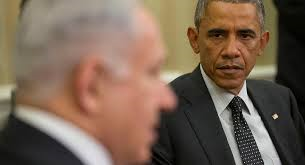
obama scorn bibi

OBAMA-NETANYAHU
INTERNATIONAL-DOMESTIC ABUSE

A natural relationship built on shared values, now more closely resembles an abuser-victim dynamic, as Obama increasingly asserted his powerful influence over Israel:

  • In 2010, Obama gave Netanyahu a series of demands to get the Israel-Palestinian talks moving including freezing settlements. Obama walked out of the meeting and left Netanyahu to stew. Israeli newspapers described the shame and weakness of Netanyahu. Netanyahu complied with Obama’s demand.
  • In 2011, French President Nicolas Sarkozy and Obama had an exchange where they called Netanyahu “a liar” and terrible person with whom to deal.
  • In 2012, the Obama administration removed all of the supporting clauses for Israeli positions from the Democratic platform that had been there for years (Hamas is a terrorist state; Palestinian “refugees” would be relocated to Palestine, not Israel; future borders would not follow the 1949 Armistice Lines; Jerusalem is the united capital of Israel).
  • In 2013, while Iran threatened to destroy Israel, Obama entered into negotiations with the Iranians, preventing Israel from taking any actions against Iran’s nuclear program.
  • In 2013, Obama declined the invitation to address the Israeli Knesset. Instead he addressed a group of students at the same time stating his desire to speak to the Israeli people, as if the democratically elected parliament was not representative of Israelis. Consider the depth of the insult to Israel, as Obama spoke to the Egyptian parliament (in 2009) as representatives of Egypt.
  • In 2013 the Obama administration demanded Israel release Palestinian terrorists convicted of murder. Nothing was asked from the Palestinians. Netanyahu complied.
  • In 2014, when Israeli three teenagers were killed, Obama asked Israel to act with “restraint.” However, when two American journalists were killed by ISIS, Obama went to war.
  • In 2014, members of the Obama administration chose to disparage Netanyahu, calling him a “chickensh*t”
  • In 2015, Obama snubbed Netanyahu at his address to a joint session of Congress, and got 58 Democratic members of Congress to walk out as well.
  • In 2015, Obama is enabling Iran to become a nuclear state. Iran has repeatedly threatened to destroy Israel, and Obama has refused to sell Israel the required defensive weaponry such as bunker busters.
  • Most recently, Obama has threatened to withhold his United Nations vote to protect Israel.

The last two actions taken by Obama are particularly frightening to Israel’s Netanyahu.

Nuclear Iran: Enabling Iran to obtain nuclear weapons is a direct existential threat to Israel. Iran has threatened to destroy Israel and has a long history of supporting terrorist groups that attack Israel (Hezbollah and Hamas) with weapons and financing. With the government of Iran obtaining nuclear weapons, the country becomes an existential threat, its proxy armies become an enormous threat, and the ability for Israel to attack Iran is significantly weakened.

Further, Iran becoming a nuclear state would create an arms race in the region, as other enemies of Israel like Saudi Arabia will also seek to obtain nuclear weapons.

Withholding UN vote: The United States has used its vote on the United Nations Security Council to protect Israel from a wide range of actions including premature Palestinian statehood and harsh economic sanctions.  If Obama follows through with this threat to move away from Israel, Israel would come under tremendous financial and security pressure.

CONGRESS TO ISRAEL’S RESCUE

Congress has taken note of the terrible trend in Obama’s actions and has taken steps to protect Israel.

netanyahu-graham
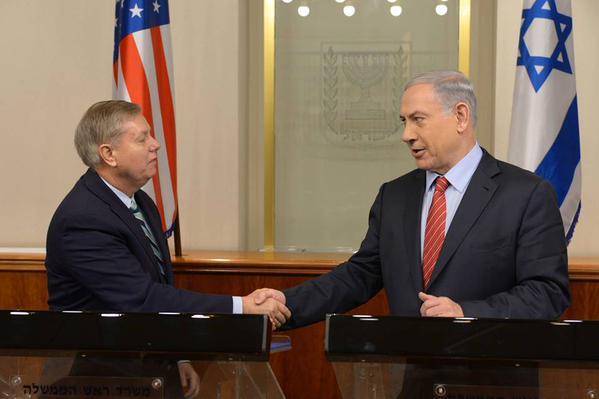
Senator Lindsay Graham with Israeli PM Netanyahu

In April 2015, the Senate passed a bill making it difficult for any company to do business with a company or country that supported BDS of Israel.

Republican Speaker of the House, John Boehner invited Netanyahu to address Congress about the Iran nuclear negotiations. That speech launched the momentum for a role for Congress in the Iranian nuclear program negotiations.

It is difficult for Congress to take direct actions against the president’s policies at the United Nations, as he controls the vote. However, Congress controls funding of the United Nations as well as the Palestinian Authority. Senator Lindsay Graham has stated his intention to use the power of the purse to prevent unilateral UN actions against Israel. “Any effort by the French, the Jordanians or anyone to avoid direct negotiations between the Israelis and the Palestinians over the peace process, anyone who tries to take this [resolution] to the U.N. Security Council, there will be a violent backlash by the Congress that could include suspending funding to the United Nations,” Graham said.

All three issues on which Israel relies on the United States are under threat by Obama, and only the US Congress is attempting to ameliorate the situation.


If Israel’s neighbors did not threaten to destroy the country both directly and indirectly, perhaps Israel would not feel alarmed.

If Israel were not surrounded by an Arab winter inferno, perhaps its fears would not be so immediate.

If Israel had many allies in the world, perhaps the abusive relationship between Obama and Netanyahu would not be as upsetting and painful.

However, the realities are different.  As such, Netanyahu has turned to Congress to become Israel’s domestic violence hotline .  What a sad state of affairs.


Related First One Through articles:

Israel is a Small Country

Israel cannot afford to be smug about its security

Obama not concerned about timeliness of Israel’s security

Israel Lends a Hand, Again

Summary: The Israeli military and civilians come to the aid of people around the world in times of need – even to countries that do not recognize its right to exist.

On April 25, 2015, an enormous earthquake shook Nepal, killing over 5,000 people. Within 48 hours, Israel sent a delegation of medical personnel to help aid in the recovery efforts and treating survivors.

By April 28, Israel had deployed 260 people to Nepal. The entire rest of the world deployed 276 people.

ShaareZedek Nepal
Israelis embark to aid victims of Nepal earthquake,
April 2015

The Shaare Zedek Medical Center in Jerusalem is playing a leading role as it has on various emergency missions such as in the Philippines (2009), Haiti (2010) and Japan (2011).  The personnel include:

  • Prof. Jonathan Halevy- Director General, Expert in Internal Medicine
  • Dr. Ofer Merin – Deputy Director General and Director of Trauma Services
  • Dr. Tamar Lachish  – Director of Infectious Diseases Unit
  • Dr. Sefi Mendelowitz – Department of Pediatrics
  • Dr. Avi Alpert – Department of Emergency Medicine
  • Prof. Amos Peyser – Director, Department of Orthopedics
  • Dr. Giora Weiser – Pediatric Emergency Department
  • Dr. Harel Arzi – Spine Unit
  • Deganit Kovliner – Nurse, Department of Emergency Medicine

These efforts are a continuation of the emergency medicine that was spear-headed by Dr. David Applebaum.  Dr. Applebaum ran the Shaare Zedek emergency room for many years introducing new methods of managing crises, an expertise developed during the Second Intifada. On the second anniversary of the 9/11/01 attacks, Dr. Applebaum came to New York City to help train American doctors in large scale emergency response. He then flew home to Jerusalem for his daughter’s wedding the next day.  That night, as the two of them had dinner together at a cafe, they were both killed in a terrorist bombing.

There is a famous saying that many Christians use from the book of Mark “Love thy neighbor as thyself.”  The original text is actually from the Old Testament (Leviticus 19:18):

“‘Do not seek revenge or bear a grudge against anyone among your people,
but love your neighbor as yourself. I am the LORD.
“

A musical tribute to the volunteers in Israel who even come to the aid of countries which do not recognize Israel’s right to exist, and the memory of Dr. David Applebaum:

“In the many decades that I have been privileged to serve as a physician as well as an IDF officer, I can honestly say that I have never felt this degree of anticipation as for what awaits us in Nepal. While I know it will be a challenging professional and personal experience, we hope it will bring significant relief to those in need and offer a sense of pride for the important role that the IDF and the State of Israel can offer others in this time of need.”

-Professor Jonathan Halevy,
as he awaited the team’s departure from Ben Gurion Airport

Every Picture Tells a Story- Whitewashing the World (except Israel)

Summary: The New York Times continued to minimize pictures of attacks on civilians and assassinations around the world by burying small pictures deep inside its paper. The precious front page ink was only reserved for portrayals of Israel as the aggressor.


The Every Picture Tells a Story series reviewed media’s deliberate use of pictures to tell a story to its readers. It is a story that conveyed Israel committing gross atrocities, uniquely in the world:

  • “Every Picture Tells a Story, Don’t it?” reviewed the New York Times’ use (and lack) of pictures of the three murdered Israeli teenagers in the summer of 2014 on the front page of its newspaper, while showing the Arab family whose son was killed.
  • “Every Picture Tells a Story, the Bibi Monster” reviewed how the NYT showed a large color picture of a Palestinian Arab teenager injured by Israeli police on its front page, while small pictures of mass murders in Kenya, Uganda and Yemen were found inside the paper. Further, pictures of Israeli PM Netanyahu repeatedly showed up next to pictures of injured Arabs, while no member of the Palestinian Authority or Hamas ever made it to the front pages during the entire Operation Protective Edge.
  • “The New York Times Buried Pictures” analyzed the puzzling lack of exposure of the Hamas terror tunnels from Gaza into Israel, which were the primary reasons for the Israeli ground offensive into Gaza.
  • “The New York Times 2014 Picture of the Year” wrapped up these observations, noting that the New York Times used large color photographs on its cover page of injured Palestinian Arabs repeatedly – on July 11, 14, 17, 21, 22, 24 and 29 – while continuing to hide pictures of Palestinian Arab aggression, and attacks in conflicts around the world.

THE WORLD

The Times continued preference for ignoring mass killings and assassinations in the world continued into 2015.

During a week of April 2015, world governments and terrorists killed hundreds of people. Not one incident merited a front page picture in the Times:

These articles were found buried in the paper. The associated pictures were relatively small and several were in black and white. No picture showed the victims injured or hurt.

This is not a new phenomenon. The Times often minimizes attacks that occur in the MENA (Middle East/ North Africa) region.  The exception to the rule, is if Israel is the attacker.

ISRAEL

Natan Sharansky, a famous Jewish refusenik who was jailed in Russia for trying to move to Israel, developed a three part “3D test” to determine anti-Semitism: Double standards; Demonization; and Delegitimization. Many liberals disagree with this approach and feel that double standards do not convey anti-Semitism. The liberal argument is that Israel should not be held to the same standards as Yemen, Iran, Iraq, Kenya, Saudi Arabia and the many countries in the Middle East, let alone terrorist groups like ISIS and al-Shabab. As Israel is a modern progressive country, the standards should be more akin to the USA or Western Europe. But that argument falls flat in general, and in particular, regarding the New York Times coverage of Israel.

DOUBLE STANDARDS

First, the situations are not remotely comparable. The US and Western Europe do not sit in the middle of the Middle East, surrounded by a combination of: war; terrorist groups operating freely; countries and entities that threaten to destroy their countries; and constant attacks on its citizens. It is easy to be judgmental while lunching in Luxembourg. However, Israel is forced to fight and defend itself repeatedly because of the volatile neighborhood and hostile attitude of its neighbors.

Second, the New York Times uses a double standard for the US and its allies. The paper does not treat the war effort of the US and Europe which have opted to fight battles thousands of miles from their borders, in the same manner as Israel fighting to defend itself. The NYT never posted a picture of President Obama next to the victims of a drone strike (which the president actually authorized) as it does with PM Netanyahu (for general military actions). It does not show pictures of civilians killed by US troops. It minimizes the pictures of terrorists killed by the US and its allies, using small black and white photos in the middle of the newspaper, rather than large color photographs on the front page as it does for Israel.

DEMONIZATION

Third, the NYT and many liberals do not only use double standards, but demonize and delegitimize Israel as well. The unique focus on how Israel defends itself is one thing (double standards). Uniquely showing pictures of injured Palestinian Arab victims alongside pictures of Israeli leaders and weaponry is demonization.

Simply compare the natural human reaction of looking at a small headshot picture of an al Qaeda leader (accompanied by an article that the United States killed the person), to a collage of pictures of injured and killed Palestinian civilians alongside pictures of Israeli military personnel and another of the Israeli Prime Minister. A person would likely skip the article buried in the paper that only has a head shot. But the large color collage of pictures on the front page delivers a biased story that is impossible to ignore: that the Israeli government is responsible for sending its army to kill civilians.

Further, consider opening the pages of paper and seeing a smoke trail coming from Gaza (the closest the Times came to showing Hamas militants firing weapons). The accompanying article refers to the people in Gaza providing a “counterpunch,” making the group appear as the victims instead of the party that initiated the fight.

20140718_103800

Imagine if the Times had shown pictures of the missiles Israel used to “tap” the roof of targeted homes to let the occupants know that a real explosive was coming so they could flee. Imagine the Times showed pictures of the thousands of leaflets that Israel dropped on certain neighborhoods urging residents to leave an upcoming battle zone.  Imagine pictures of Arabs holding cellphones far from the military action, because they received calls from Israel to move to safety.

You would need to imagine such images, because the Times does not print them.

DELIGITIMIZATION

The defensive nature of Israel’s war against Hamas was delegitimzed by the Times because the paper did show pictures of Hamas leaders, nor its tunnels and weaponry. Without the clear imagery of the three slain Israeli teenagers and Hamas terror tunnels which were the causes for the war, the reader was left with an impression that it was a war of choice for Israel.  Cover page pictures of injured Palestinians were coupled with articles under the headline “Confrontation in Gaza” as opposed to “War FROM Gaza,” left the reader with the incorrect conclusion that Israel as the big belligerent party.

The Times 2014 war coverage failed on all parts of the “3D Test” for anti-Semitism.


Now, in 2015, the Times photo editor has taken time off since Israel is not at war.

Attacks around the world continue to be buried inside the paper. Without images of Israel as the aggressor, more neutral and natural images cover the paper, such as shipwrecks in the Mediterranean, earthquakes and volcanoes.


The New York Times tried to defend its coverage of Israel as balanced. By going through the effort of explaining itself, it has at least realized that the accusation of double standards for Israel is indeed anti-Semitism, which is a better than many liberal pundits. It stil

It is time that everyone join the effort of pointing out to the Times its 3D failures, rather than just a handful of outlets like CAMERA, Honest Reporting, StandWithUs and FirstOneThrough.

A Disservice to Jewish Community

Summary: There is a Jewish community in New York with a long-standing effort to maintain a strong Community: among the various denominations of Judaism within the city, and in staying connected with the Jewish State. For the 67th birthday of Israel, it opted to destroy all of those efforts.


The Jewish community of White Plains NY is not a typical New York City suburb. The five synagogues of the city (5SWP) – Reform, Reconstructionist, Conservative and two Modern Orthodox – all sit within 1.5 miles of each other and actively seek to maintain a sense of close community. Each temple helped to establish the communal eruv around the residential neighborhood. The rabbis have study groups together. And lastly, the members of the shuls do their Israeli programming together.

In the spring of 2015, a group from the Israel Action Committee of the 5SWP decided that it was time to invite a left-wing speaker to address the group, as past speakers included right-of-center speakers including Bret Stephens and Malcolm Hoenlein. While voices of dissent came from within the committee as they learned about the proposed speaker’s line of work as a lawyer for Palestinian Arabs that sues the government of Israel, the group elected to invite Danny Seidemann to speak anyway – on Israel’s Independence Day, Yom Ha’atzmaut.

Danny Seidemann was presented to the audience as a “Leading Israeli Expert on Contemporary Jerusalem.” He spoke to the group for roughly one and one-half hours, including Q&A. If Danny is an expert, it is in deception. For 90 minutes, the group of 70 attendees heard deliberate misstatements and lies of omission. However, Danny’s views and message were very clear: that Jerusalem has never been united and can never be a united capital of Israel.

20150426_060648

Seidemann’s Lies

Here is a selection of some of Danny’s lies to support his position.

Palestinians are deliberately excluded from Jerusalem society. Danny made several remarks early in his talk that he clearly knew to be untrue. He stated that Palestinians in East Jerusalem are “deliberately and permanently disenfranchised” and “are not allowed to be leaders” in Israel. However, in Q&A at the end of the talk, he admitted that Palestinians in East Jerusalem are permitted to ask for Israeli citizenship and thousands have already become citizens. How can the Palestinian Arabs be “permanently disenfranchised” if they can become Israelis, similar to the over 1 million Arabs that are currently citizens of Israel? Those Israeli Arab citizens include members of the Israeli Knesset and the Supreme Court.

A minority of Jerusalem’s residents celebrates Israel Independence Day. Danny asserted that the capital of Israel barely celebrates Yom Ha’azmaut, undermining the claim that the city can truly be the capital of Israel. Along with Palestinian Arabs living in Jerusalem who are not Israeli citizens, are roughly one-quarter of the population that are Ultra-Orthodox Haredi who are not Zionists according to Danny, leaving only a minority of the population in Israel’s capital celebrating the holiday. However, Danny later admitted that the Haredi do actively participate in Israeli elections and actively seek roles in the Israeli Knesset. Does he not like the black hat brand of patriotism? Further, these Haredi Jews predominantly live in the western half of Jerusalem- does Danny question the legitimacy of the western part of the city too?

No Jew enters East Jerusalem. Danny claimed that “80% of East Jerusalem is off-limits to Jews.” First, that is untrue as many Jews go into East Jerusalem all of the time (and not just the Old City). For example, Pisgat Ze’ev, the largest Jewish neighborhood in Jerusalem, lies next to Shu’afat. Further, would a neighborhood being dangerous or consisting of a single ethnic group mean it ceases to be part of a city? If few Jews visit Umm al-Fahm, an Israeli city that is nearly 100% Arab (compared to the eastern part of Jerusalem which is 60% Arab), would that mean that the city is not part of Israel? When few white people entered areas of black Harlem in the 1970s, did Harlem cease to be part of New York City?

No Arab enters West Jerusalem. Danny said that Arabs no longer enter the western part of the city. That is patently false. On most days, there are more Arabs in Independence Park than there are Jews. Danny may claim that these are Israeli Arabs and not Palestinians from East Jerusalem, but how could he make such claim without speaking to the hundreds of Arabs that anyone can see in the streets of western Jerusalem every day without talking to each one?

Countries do not recognize Jerusalem as the Capital of Israel because of East Jerusalem. Danny argued that Jews pretend that Jerusalem is Israel’s capital but that such claim is untrue as no country places its embassy in the city. His point deliberately led the audience to believe that this international action is a direct result of Israel’s annexing the eastern half of the city. That is completely false. No country moved their embassy BEFORE Israel annexed the eastern half of the city because the entirety of Greater Jerusalem and Greater Bethlehem (known as the “Holy Basin” in the 1947 United Nations Partition Plan) was planned to be an international city. World governments are waiting for final status negotiations before moving any embassy, as they viewed the 1949 Jordanian annexation of East Jerusalem and the Israeli annexation of West Jerusalem as contrary to that 1947 Plan. It has NOTHING to do with Israel’s taking East Jerusalem in 1967.
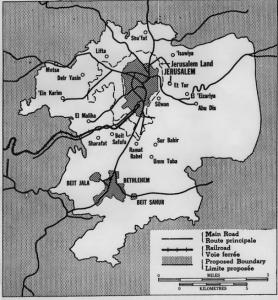
 1947plan jerusalem
United Nations 1947 proposed map for an international “Holy Basin”

Israeli Prime Minister Benjamin Netanyahu does not want Peace. Danny claimed that the four-term Israeli Prime Minister “is a terrible person who preys on Israelis’ fears of security.” Not only did Seidemann ignore Netanyahu’s numerous statements supporting a two-state solution (without any part of Jerusalem for Palestine), but Danny also failed to relay that it was Netanyahu who handed over half of the Holy Basin (Bethlehem) to the Palestinian Authority back in 1995.

The US Democratic Party Considers East Jerusalem too Controversial. Danny relayed how the 2012 Democratic National convention had removed its long-used platform language that Jerusalem would be the capital. He said that Americans were “tired of being bullied” about the contested city. What Danny failed to say was that the 2012 platform also removed the standard language that: Palestinian refugees would be settled into a new state of Palestine, not Israel; that it is unreasonable to expect that the borders of Israel would follow the 1967 “borders”/ the 1949 Armistice Lines; and that Hamas is a terrorist organization. Are Democrats tired of believing all of these platform items too? Are they now welcoming Hamas? Danny made it appear that the status of East Jerusalem was the only reason Democrats were breaking with Israel, while in fact, it was the entire pro-Israel platform that was either intentionally or unintentionally gutted.

Olmert ultimately realized the need to give up East Jerusalem. Danny said that former Israeli Prime Minister Ehud Olmert ultimately concluded late in his career that the only way to get to a final status agreement with the Palestinians was to give up East Jerusalem. What Danny failed to say was that Olmert only pitched this approach as he was about to get indicted on bribery charges, and was hoping that he could win over the liberal Israeli press to save him for going off to jail (it was too late and he was ultimately sentenced). Further, Danny failed to mention that acting President of the Palestinian Authority Mahmoud Abbas never responded to Olmert’s plan for Jerusalem.

If Jews move to East Jerusalem, then Arabs will have an added case for the Right of Return. The “expert” on Contemporary Jerusalem has no understanding of the Palestinian claim of the “Right of Return.” Danny spoke about recent “terrible” news of Jews legally (according to Israeli law) buying homes in an East Jerusalem neighborhood called Sheik Jarrah. He described that some of these homes had been owned by Jews before the 1948 Israeli War of Independence, which were then taken over by Arabs at the war’s end.

For starters, it should have been noted at some point in the speech that the Israeli War of Independence started when several Arab armies initiated an attack to destroy Israel when it declared independence at the end of the British Mandate.  The land wasn’t “Arab” and Israel’s war was of self-defense.

Secondly, Danny failed to clarify that the Jordanians (and Palestinians who accepted Jordanian citizenship), evicted all Jewish inhabitants from East Jerusalem and all of the West Bank, and then further barred their reentry after the war, counter to the Fourth Geneva Convention. Conversely, after the war, Israel granted citizenship to roughly 160,000 Arabs.

Third, Jews acquiring homes in East Jerusalem is legal according to Israeli law in the same way that Arabs may buy homes in West Jerusalem; there is no discrimination either way. These are private transaction between private people, and the government does not get involved. Danny’s commentary left the exact opposite impression that the Israeli government acted in a discriminatory manner.

Lastly, and perhaps most telling, the private purchases of homes have absolutely NOTHING to do with the Palestinian Arab claim for a Right of Return. A quick review for this “Israeli expert”:

  •  Article 13 of the Universal Declaration of Human Rights states that “[e]veryone has the right to freedom of movement and residence within the borders of each State. Everyone has the right to leave any country, including his own, and to return to his COUNTRY (emphasis added).” The law is about returning to a person’s country, not a particular house where someone’s grandparent may have lived.
  • In regard to the Israel-Palestinian conflict, UN Resolution 194 Article 11 “Resolves that the refugees wishing to return to their homes and LIVE AT PEACE WITH THEIR NEIGHBOURS (emphasis added) should be permitted to do so at the earliest practicable date, and that compensation should be paid for the property of those choosing not to return and for loss of or damage to property which, under principles of international law or in equity, should be made good by the Governments or authorities responsible.” Palestinian Arabs are not refugees, but the children and grandchildren of refugees. And as Seidemann makes abundantly clear throughout his talk, they have no intention of living at peace with Israel.

Jews acquiring properties in Silwan or Sheik Jarrah or any other parts of East Jerusalem have absolutely nothing to do with these laws and give Palestinian Arabs no additional rights or claims to any “Right of Return” to any part of Israel or western Jerusalem.

 seidemann
Daniel Seidemann at Yom Ha’atzmaut Discussion

These were just some of the false comments that the speaker made about Jerusalem. Seidemann did say that Jerusalem is holy to Jews and referred to “Jewish Jerusalem,” but he made the comment only about the western part of the city. He gave no historical context that the area called “East Jerusalem” was an artifice of war. That its creation was solely from a war started by Arabs to utterly destroy any Jewish state, and the only reason that there are fewer Jews than Arabs in that part of the city was because of the ethnic cleansing committed by the Palestinian and Jordanian Arabs.

  • There was no clarification that Jews have been a majority in ALL of Jerusalem since the 1860s.
  • No mention that the Ottomans never limited where Jews could live in Jerusalem for 400 years.
  • No mention that the British Mandate of Palestine allowed Jews to live throughout the region, including what some today refer to as the “West Bank.”

Overall, Seidemann’s speech was an attempt to portray Israel as an evil, racist occupier of eastern Jerusalem. To the more informed in the audience, all his speech actually conveyed was that the Palestinian Arabs hate the Jews, hate Israel and will never want to be part of the Jewish State.

That may be true, but it certainly does not make Israel an evil racist occupier and does not mean that Jerusalem isn’t completely part of Israel.

Seidemann’s Call to Action

An hour into the Seidemann story, he became particularly excited.

Call for BDS of the “Settlement Enterprise”. Danny gave a short preamble that what he was about to say was illegal. He then raised his hand and voice and declared that all settlers living in the West Bank should be boycotted. That all businesses in the territory should be boycotted. That he, as a “true Zionist” that paid taxes and served in the army needed to protect his country from “right-wing idealogues” who threatened his vision of Israel as a Jewish and democratic state.

At that point, people in the audience finally began to leave.

Seidemann Refusal to Engage

At the reception after the talk, Seidemann continued to lie (or being more generous, show how uninformed he was):

  • Palestinians support Abbas. Seidemann claimed that Abbas enjoyed broad support of the Palestinians. When he was confronted that it was not true as shown in every poll conducted by Palestinians themselves, including recent university elections, he refused to back off his claim.
  • Abbas is in control. When Seidemann was asked how Israel can possibly negotiate with Abbas since he lacked control of the people and territory, he reiterated that Abbas had complete control. After it was pointed out that if Abbas was in control, he was therefore responsible for the Gaza war that fired thousands of rockets into Israel, Seidemann ripped off his yamulke and stormed away.

While the speaker demanded total silence and respect from the audience, he showed the group none.


A community that sought to be educated about Israel was lied to for 90 minutes. A group that wanted to bond with fellow Jews and Israel, heard from a speaker that called for Jews to punish and economically strangle Israeli Jews.

As this self-declared UberZionist drove away, the community was left with bitter feelings. At least it was no longer on the Israeli Independence Day.


Related First One Through articles:

It isn’t “Arab Land”

Legal Israeli Settlements

A “Viable” Palestinian State

The Fault in Our Tent: The Limit of Acceptable Speech

Subscribe YouTube channel: FirstOneThrough

Join Facebook group: FirstOne Through  Israel Analysis