Stabbing the Palestinian “Right of Return”

The “Stabbing Intifada” in which Palestinian Arabs attack Israeli civilians has effectively ended the issue of the Palestinian “Right of Return.”

A Palestinian demonstrator raises a knife, during clashes with Israeli police, in Shuafat refugee camp in Jerusalem, Friday, Oct. 9, 2015. Recent days have seen a string of attacks by young Palestinians with no known links to armed groups who have targeted Israeli soldiers and civilians at random, complicating Israeli efforts to contain the violence, which has been linked to tensions over a sensitive Jerusalem holy site. (AP Photo/Mahmoud Illean)

A Palestinian raises a knife during clashes with Israeli police, in Shuafat refugee camp in Jerusalem, Friday, Oct. 9, 2015. (AP Photo/Mahmoud Illean)

Palestinian Arabs have been arguing for a return to Israel for several decades. They claim that 5 million Palestinian Arabs are have a legal right to move to Israel as declared by the United Nations. The claim has always been flawed:

Refugees: As detailed in “Palestinian Refugees or SAPs,” the definition of a refugee is someone who leaves a country, not a land. Under the most generous definition of “refugee,” there are only 30,000 Arab refugees alive who left Israel after the country was created in 1948-9. The 5 million descendants of various refugees who left Israel before the country was created are provided services by the United Nations, but are not refugees entitled to a “right of return.”

Live in Peace: The basis of the Palestinian Arab claim for the right of return under international law stems from UN General Assembly Resolution 194 which stated “refugees wishing to return to their homes and live at peace with their neighbours should be permitted to do so at the earliest practicable date, and that compensation should be paid for the property of those choosing not to return and for loss of or damage to property which, under principles of international law or equity, should be made good by the Governments or authorities responsible.”

The phrase “live at peace” is the core of being able to move to Israel. No one will be entitled to any compensation or consideration without the clear intent of living in peace with Israelis in the Jewish State.

According to an Anti Defamaition League poll in May 2014, almost every Palestinian (93%) was considered an anti-Semite. Not a good place to start for moving to the Jewish State and living in peace.

In December 2015, Palestinians conducted their own poll of Arabs in Gaza and the West Bank about the “stabbing intifada” against Jews. It concluded that “two-thirds support an armed intifada and the current wave of stabbings.”

Based on the estimate of 30,000 Arab refugees alive today, the poll would imply that only one-third, or 10,000 would potentially be interested in living in peace with Israelis (if not killing someone would be used as the barometer of “living at peace”).


The number of Arab refugees from Israel is now declining rapidly as they enter old age.  It appears that the stabbing intifada will not only delay any chance for peace between Israelis and Palestinian Arabs, it will also guarantee that one of the points for negotiation will no longer be relevant.


Related First.One.Through articles:

An Inconvenient Truth: Palestinian Polls

“Peace” According to Palestinian “Moderates”

Palestinians are “Desperate” for…

UNRWA’s Ongoing War against Israel and Jews

Help Refugees: Shut the UNRWA, Fund the UNHCR

The Israeli Peace Process versus the Palestinian Divorce Proceedings

Subscribe YouTube channel: FirstOneThrough

Join Facebook group: FirstOne Through  Israel Analysis

New York Times’ Lost Pictures and Morality for the Year 2015

On December 27, 2015, the New York Times shared its thoughts for a “Year in Pictures.” The Sunday Review was dominated by the waves of refugees and migrants from the MENA region (Middle East and North Africa) as well as pictures of terrorism that touched much of the world. For the Times, this excluded Israel.

The Times led its discussion with an opening paragraph: “This was the year of the great unravelling, with international orders and borders challenged or broken, with thousands of deaths, vast flows of migrants and terrorist attacks on some of the most cherished symbols of civilization, both Western and Muslim.”

It continued with some reviews of terrorism: “Palmyra and Paris (twice), Aleppo, Homs, Kobani and even San Bernadino, Calif…. The outrages of Boko Haram and the Shabab in Africa. The abuse of the Rohingya minority in Myanmar. The war in Ukraine and the resurgence of the Taliban in Afghanistan. New tensions in the skies over the Baltics and a Russian plane shot down by a NATO country for the first time in decades.

The ruins still in Gaza, a year after a brutal and inconclusive war, and Israel hunkering down in a region losing its compass. Even the energetic secretary of State, John Kerry, has given up on serious negotiations for Mideast peace.”

In a year where Palestinian Arabs repeatedly attacked Israel civilians killing dozens, the Times decided to highlight the Gaza war of a year ago and dismissed the shift of the Arabs’ battlefront to Judea and Samaria from Gaza. It was not an oversight, as relayed in the Times’ actual pictures.

The chronology of pictures of the year included a number of pictures related to terrorist attacks:

  • A large picture of politicians holding hands in Paris after the January attacks (no attribution given to the killers);
  • A large picture in Kenya after students slaughtered in April (attribution to “Shabab militants”)
  • A small picture in South Carolina in July where “A Confederate flag was removed from the state house after the massacre of black churchgoers in Charelston.”
  • A large picture from Gaza in August with a caption “Concrete salvagers in a building destroyed by the 2014 war between Israel and Palestinian militants in Gaza.”
  • A large picture of a victim from the Paris attacks in November (no attribution of who were the terrorists)
  • A medium sized picture of mourners in Paris honoring the victims of the November murders (no attribution)
  • A large picture of mourners in Lebanon from terrorist bombings in November (no attribution)
  • A small picture of people in California after a December attack with a caption “A candlelight vigil commemorated the victims of a mass shooting by a radicalized Muslim couple.”

DSC_0041
New York Times’ large picture of ruined building in Gaza

What message could a person extract from the New York Times review of the significant events of the year? Much of the same message that the Times imparted throughout the year:

  • Terrorist attacks in the United States were not as significant as attacks elsewhere in the world
  • The Islamic State/ISIS was not labelled as responsible for any of the terrorist attacks in the world
  • The dozens of Israelis killed in the fall of 2015 were not mentioned in text nor portrayed in pictures, as the Times did not view Israelis as terrorist victims
  • Gazans were portrayed as victims, a year after their elected terrorist leaders launched their latest battle to destroy Israel and kill Israeli civilians.

The New York Times became more deliberate in separating radical Islam from global terrorism, just as President Obama did and while Republican Presidential candidate Donald Trump drew attention to the issue. The only mention of Islam in the picture captions was in the very final picture of the year.

The Times has always been deliberate about Israel. Israelis who were shot, stabbed and run over were not victims of terrorism. Israelis did not suffer. Israelis did not mourn.

However, Palestinian Arabs who have continued to fight for the destruction of Israel were featured among pictures of the sufferers and mourners.

If the trends continue, the New York Times’ 2016 Year in Pictures” will likely feature the western world as the radical terrorists.


Related First.One.Through articles:

Every Picture Tells A Story: Only Palestinians are Victims

Every Picture Tells a Story: The Invisible Murdered Israelis

Framing the Israeli-Palestinian Arab Conflict: WSJ and NY Times

Every Picture Tells a Story: Arab Injuries over Jewish Deaths

Every Picture Tells a Story: Versions of Reality

The New York Times Picture of the Year, 2014

Subscribe YouTube channel: FirstOneThrough

Join Facebook group: FirstOne Through  Israel Analysis


The Last Sounds of “Son of Saul”

The Holocaust movie “Son of Saul” is unlike every other movie ever made in the genre. While much has and will be written about the narrow focus on the principal actor’s face throughout the movie, words cannot properly convey the impact of the sounds infused in each scene.

Sounds of a Concentration Camp

The movie opens with the camera focused on a faraway subject, completely out-of-focus. The viewer struggles to make out the distant activity, and in a short time realizes that this is intentional, when the main protagonist of the film, Saul Ausländer, slowly walks into the middle of the image in sharp focus. He remains centered there for the remainder of the movie.

The close-up of Saul leaves the movie viewer with a sliver of background imagery. The war is mostly inferred by the rapidly passing images on the screen’s edges. The viewer’s mind is left to expand upon the brutality of the concentration camp where Saul works processing the dead for the Nazis.

The picture is further clouded by Saul. His face, which fills 70% of the frame, is expressionless. He is a walking dead, somewhere between the prisoners that arrive by train at the camp, and those “pieces” that he carts to the crematoria for burning. Saul shares no emotion and offers little in the way of dialogue with the other Sonderkommandos, those Jews tasked with helping the Nazis annihilate the Jews of Europe. The little dialogue that occurs, is choppy as the Sonerkommandos come from a variety of countries – Hungary, Poland, Germany, Ukraine – and do not speak the same language.

Devoid of strong visuals and dialogue, the movie provides rich sounds. There is no background music to direct our emotions.  The sounds are of the camp itself that fill the viewers’ ears. Sounds of babies crying. Mother’s screaming. Gun shots. Metal doors crashing closed. Rocks crunching under the feet of the Sonderkommandos. Papers scraping the floor, gathered for burning.

This is the dialogue of “Son of Saul.” These sounds transport the viewer from a modern movie theater to 1944 Nazi Europe. It is not surround sound; it is transportive sound.

The Last Sounds

Saul’s journey to an awakening begins when he sees a boy survive the gas chambers. While terminal, the child won a minor victory over the Nazis’ efficient killing machine. He beat the system.

This boy gives Saul some depth of vision. He gives Saul hope – not of his own survival – but that the humanity of the natural world can break through into the unnatural brutality where he exists. Saul’s mission is set, that with the help of a rabbi, the boy will not be incinerated like everyone else in the Nazi’s ovens, but will have a proper Jewish burial.

Saul risks his own life and those around him to fulfill this mission. He understands that he and the other Sonderkommandos are the unnatural walking dead who will soon die and be incinerated. However, the boy is nature’s dead, who must have a natural burial.

As Saul manages to get the boy, his “son”, out of the concentration camp ground, he loses the body in a river. The body is taken by nature and cleansed in water. Then, without the boy’s body, Saul’s mission and hope disappear and he almost drowns before being saved by another prisoner.

Saul sits with fellow Sonderkommando in a broken shed, all catching their breaths. The dialogue between them remains almost non-existent. As they sit, a new sound slowly is introduced that seems out of place.  The noise grows louder, but unclear. The viewer considers whether this is rain falling on the leaves of the trees in the forest. But the picture tells us that it is not raining. We see the men are damp, but it is from the swim across the river, not from raindrops.

Slowly the viewer becomes aware that the sound is not raindrops, but the crackle of the fire from the crematoria ovens.

The movie viewers witness Saul showing some expression at last, as the movie’s hero understands both his completed mission and fate: he helped his son escape to nature; his fate will be to burn with the other Sonderkommandos in the Nazi’s fire.

In the unnatural world where he exists, fire extinguishes water.  However, he achieved a moment of humanity, where the water was able to extinguish the Nazi fire.

Son of Saul
Géza Röhrig who played Saul Ausländer, talking to the audience at
screening of “Son of Saul” sponsored by the Claims Conference, December 2015
(photo: First.One.Through)

In December 2015, the Claims Conference put on a special showing of “Son of Saul” in New York City. The Claims Conference obtains money from Germany and other countries that participated in the slaughter of Jews during the Holocaust, and distributes that money to the Holocaust Survivors as well as educational projects like this movie.

The Executive Chairman of the Claims Conference, Greg Schneider, interviewed the film’s star Géza Röhrig who played Saul Ausländer at the end of the screening. Via Skype, Géza relayed that the sound editing of the movie took over five months, involving hundreds of man-hours to create the environment the writers and directors sought to convey.

It was a remarkable effort that helped create one of the great movies of our time.


Related First.One.Through articles:

Eyal Gilad Naftali Klinghoffer. The new Blood Libel.

Memory and Responsibility in Germany

Wearing Our Beliefs

Subscribe YouTube channel: FirstOneThrough

Join Facebook group: FirstOne Through  Israel Analysis

Wearing Our Beliefs

There are a number of English expressions in which people describe their inner feelings by describing their external appearances.

For example, “Being comfortable in one’s skin” means exuding confidence and being content with one’s appearance.  The expression “wearing one’s heart on one’s sleeve” dates back hundreds of years. It is meant to convey the openness of one’s emotions for the world to see. The inner feelings are plain and visible for review, scrutiny, appreciation and/ or scorn.

What an individual decides to show to the outside world oftentimes says a lot about their personal beliefs and emotions.

The way a society dresses people, also says much about such society’s beliefs.

Nazi Germany Enforced Dress Code

During the Holocaust, the Germans made certain undesirable people wear badges on their outer-garments so the people could be easily identified. Jews were forced to wear yellow stars. Gays wore pink triangles. Jehovah’s Witnesses had purple ones. These symbols were not chosen by the individual as an outward expression of their faith, but by an evil society that chose to mark people for abuse, imprisonment, torture and death.

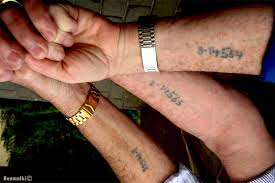
In the Auschwitz concentration camp complex, prisoners were tattooed by the Nazis beginning in autumn 1941. The numbering system etched into the arms of men, women and children, was used almost exclusively on Jews. The system allowed the Nazis to track and process hundreds of thousands of people who were not killed immediately. The ink relayed the cold reality that these prisoners were not in charge of their bodies anymore. Society no longer recognized their names nor humanity.

The evil of Nazi Germany was not simply that they viewed the “Aryan race” as superior – they viewed others as less than human.  The Nazis marked the clothing and bodies of those Untermensch to relay the Aryan perception of these sub-humans.

auschwitz tattoo

Jews Wearing Tefillin

Jewish tradition is an important component of the Jewish religion. While there are specific laws in Judaism, such as wearing phylacteries/ tefillin, the manner in which some Judaic laws are carried out changes according to custom.  Some people wrap the tefillin around the arm in an outward motion, while others wrap them going towards the body.  Some traditions have the entire name of God appearing on the hand while others only write a portion of the three letter name of God.

When a person wraps the tefillin straps around the fingers, he recites a quote from Hosea 2:19-20: “V’erastich li l’olam; v’erastich li b’tzedek u-v’mishpat u-v’chesed u-v’rachamim; v’erastich li b’emunah; v’yadat et adonai.
And I will betroth you to myself forever; and I will betroth you to myself in righteousness and in justice, in kindness and in mercy; and I will betroth you to myself in faithfulness, and you will know God.”

teffilin
Grandfather, father and two sons wearing tefillin
(photo: First.One.Through)

Just one generation ago, the dominant force in Europe labeled Jews and stole their humanity.  Today, when Jews put on tefillin, they assert themselves and declare their connection to both God and family tradition.


Related First.One.Through

The Touch of the Sound of the Shofar

The Termination Shock of Survivors

The EU’s Choice of Labels: “Made in West Bank” and “Anti-Semite”

Subscribe YouTube channel: FirstOneThrough

Join Facebook group: FirstOne Through  Israel Analysis

Memory and Responsibility in Germany

Time magazine named Angela Merkel, Chancellor of Germany as its 2015 Person of the Year. She was awarded the honor principally due to her handling of the Greek debt crisis, and the refugee wave overwhelming Europe. In each crisis, she was given credit for not only being tough and fair, but prevailing in keeping the European Union together when each situation threatened to tear the EU apart.

merkel time
Cover of Time Magazine with Angela Merkel
2015 Person of the Year

Merkel also shaped a subtle message over the year: the role of memory and responsibility for individuals and countries.

Personal Actions to Forget

A person’s “Right to be Forgotten” in online searches dates back many years. The “1995 Data Protection Directive” included a clause that an individual had the right to have certain information deleted once it was no longer relevant. That Directive underpinned a 2010 complaint by a Spanish citizen to a local newspaper and Google that personal information that showed up in searches should be removed or altered since the information was no longer correct.

In May 2014, the EU courts ruled that people have some rights to be forgotten, particularly if the information was no longer relevant (a financial hiccup that was fully resolved). The court determined that it would review personal complaints on a case-by-case basis.

In September 2015, France pushed Google to read the EU court ruling broadly, such that the search engine would need to apply individual requests coming from Europe globally, and not limit the “Right to be Forgotten” to searches within Europe.  Europeans cherished their privacy, and wanted their protections everywhere.

National Activities to Remember

In October 2015, Israeli Prime Minister Benjamin Netanyahu made a speech in which he suggested that the idea to kill the Jews in Europe in the 1930s came from the Mufti of Jerusalem, Haj Amin al-Husseini. While Adolf Hitler may have sought to rid Europe of Jews, it was al Husseini that suggested the “Final Solution.”

German Chancellor Merkel quickly squashed that interpretation of history. Her spokesperson said “All Germans know the history of the murderous race mania of the Nazis that led to the break with civilization that was the Holocaust…. This is taught in German schools for good reason, it must never be forgotten. And I see no reason to change our view of history in any way. We know that responsibility for this crime against humanity is German and very much our own.”

In an environment where courts were allowing people the “right to be forgotten,” the head of Germany stepped forward to declare that there are things that must never be forgotten. To forget history would ignore responsibility. Such action should never be permitted when the activities were so widespread and heinous, such as Germans drive to exterminate the Jews.

Memory and Responsibility.
Punishment and Forgiveness

In July 2015, history and memory overlapped in Germany.

While Google pushed back against a global order to permit the “right to be forgotten”, two events occurred: a German court found a 94-year old German sergeant from Auschwitz guilty of accessory to 300,000 murders; and over 2,000 Jews from around the world came to Berlin to compete in the Maccabi Games in the same forum as Hitler hosted the 1936 Olympics.

The intersection in time of these events underscores the role that Germany has tried to achieve regarding memory and responsibility, and its ramifications.

While modern Europe sought the right of an individual to escape from being tainted with stale information, Germany made clear that a society must always remember its own past. If some information was no longer relevant as the past situation was fleeting and rectified, perhaps that could be forgotten.  But there are actions that can never be undone, and therefore never removed from consciousness.  Memory demands taking direct responsibility, even decades later.

Germany’s active accounting for its actions paved a path for reconciliation with Jews and the Jewish State of Israel today.  That 2,000 young Jews would return to the very center of the hatred that sought to exterminate them and their families, reveals how memory coupled with responsibility can lead to forgiveness.

Times Magazine honored Merkel with the person of the year award for resolving crises.  In the Greek debt crisis she held firm that Greece could not escape its debt and irresponsible fiscal behavior.  In forcing Greece to confront its past and alter its future behavior, she paved a path for the EU to forgive some of the Greek debt and remain part of the EU.  She similarly showed that she held her own country and people responsible for its own gross failings.

It is a lesson for the world to value as it leaves the year 2015.


Related First.One.Through articles:

A country that will not assume responsibility for its role in the Holocaust: Austria’s View of Kristallnacht

Persecuting the “Other”: The End of Together

Subscribe YouTube channel: FirstOneThrough

Join Facebook group: FirstOne Through  Israel Analysis


New York Times’ Tales of Israeli Messianic War-Mongering

Summary:  One year after acknowledging that Palestinians were to blame for the failed Israeli-Palestinian Authority peace process, left-wing NY Times contributor Roger Cohen cast Israelis as fanatical nationalists and Palestinians as passive, despondent victims. The Times’ cure for Jews’ violent adherence to their religious texts is punishing settlers with BDS, while the paper distanced Muslims from their religion and called for greater compassion towards these innocents.


Just in time for Christmas, Roger Cohen decided to write about the Israeli-Palestinian Arab conflict. Again.

In an article called “The Assassination in Israel that Worked,” Cohen portrayed an Israeli society overrun with religious fanatical murderers. He described the killer of Israeli Prime Minister Yitzhak Rabin, Yigal Amir, as “a religious-nationalist follower of Baruch Goldstein, the American-born killer of 29 Palestinian worshipers in Hebron in 1994.” He wrote about Jews living east of the Green Line (EGL) as obsessed with “Messianic Zionism,” at odds with the concept of democracy. Because Palestinians are desperate for their own state, Jews living in EGL make “violence inevitable” according to Cohen. He argued that the UN’s creation of Israel “was territorial compromise, as envisaged in Resolution 181 of 1947, calling for two states, one Jewish and one Arab, in the Holy Land. This was humankind’s decision, not God’s.” In short, according to Cohen, the vast Messianic cult of violence in Israel seeks all of the Holy Land, but the rights of Jews are limited to just half of the land as dictated by man’s laws.

Lastly, Cohen argued, the only way to push back against the right-wing Israelis and their government was to employ different angles of the BDS movement (Boycott, Divestment and Sanctions) in which Obama should “close American loopholes that benefit Israeli settlers.”

Here is a bit of education for Roger Cohen (maybe the byline was wrong and this was written by Roger Waters of Pink Floyd, the loud advocate of BDS?):

A smaller percentage of Jewish “settlers” are murderers, than are terrorists which are Muslim.  The Cohen opinion piece would lead a person to believe that every Jewish “settler” takes up arms against Arabs, while the reality is that almost every Jew living in the land seeks to live in peace with their Arab neighbors. Baruch Goldstein was an anomaly, not the rule.

Why would the Times print such an inflammatory piece against Jews when it is in the midst of a blitz about the dangers of “Islamophobia”?  The Times wrote over-and-again that most Muslims are peaceful and that Muslim terrorist abuse the interpretation of Islamic holy texts.  Yet the Times was eager to describe Jewish killers as motivated by the plain reading of the Jewish holy texts, and suggested that any Jew living in Judea and Samaria is either a potential killer, or instigates Palestinian violence.

It is untrue, unfair and reeks of hypocrisy to portray Jews in such a manner.  There are almost no Jews in Judea and Samaria that committed murders, but the Times labelled all “settlers” as devout killers.  Meanwhile, the global jihadist movement enlisted thousands and slaughtered thousands, and the Times rallied to the defense of Muslims.

IMG_3677IMG_3674
“Islamophobia” Op-Eds from Paul Krugman on December 11, 2015, and
Nicholas Kristof on December 13, 2015

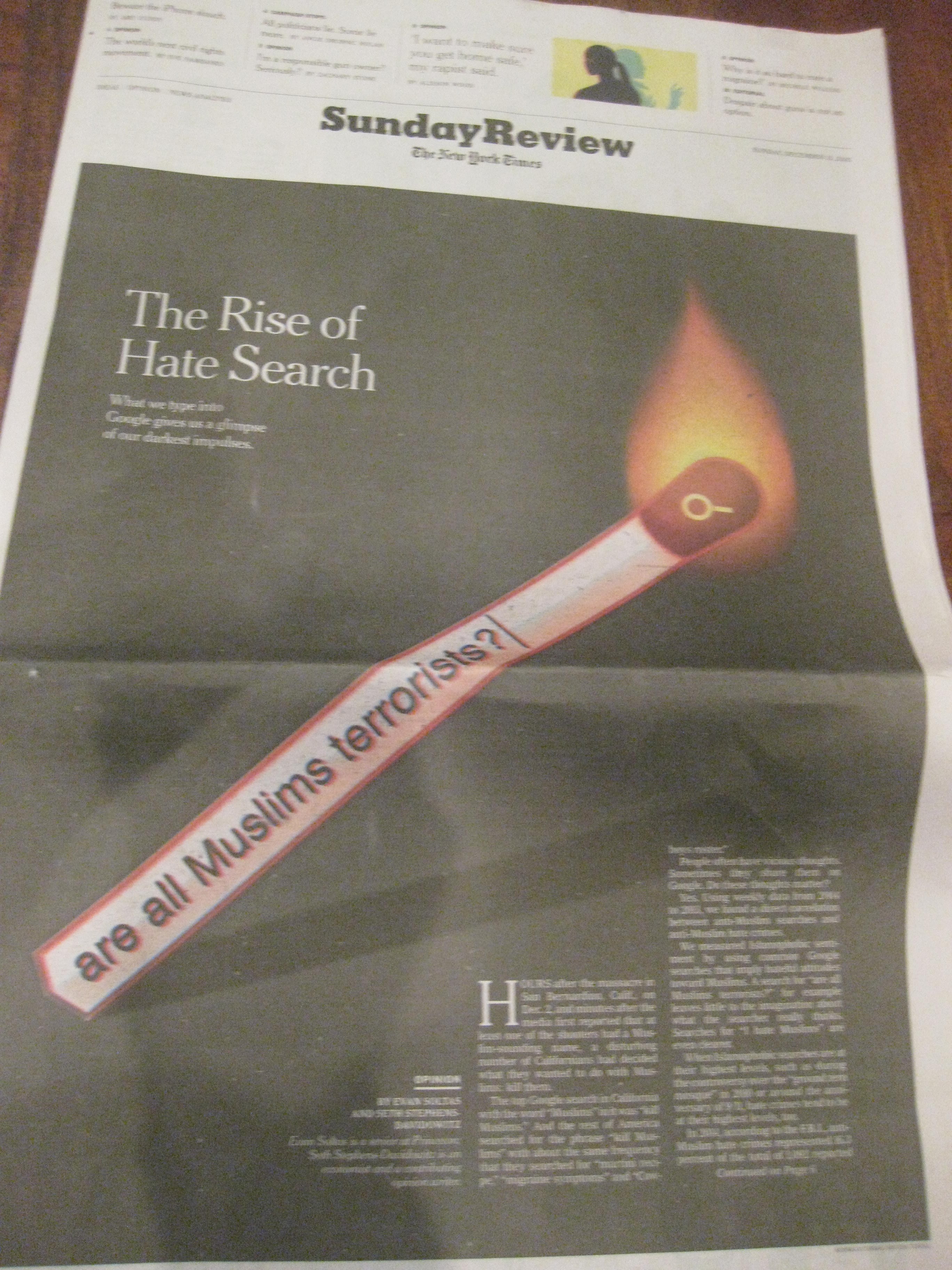
IMG_3670IMG_3671
Front Page of NY Times Sunday Review on “Islamophobia”
on December 13, 2015

IMG_3662IMG_3667
Front Page New York Times story on December 15, 2015 about
Young Muslims suffering from “Islamophobia”

Jews are entitled to live in EGL/ Judea and Samaria according to international law. The 1922 Mandate of Palestine by the League of Nations clearly and specifically encouraged Jews to live throughout the Holy Land, including areas now known as the “West Bank.” The Mandate included language that specified that no one should be prevented from living anywhere because of their religion.

“Messianic Zionism” may be a driving force motivating some Jewish families to move to the region, just as they might move to Haifa or Be’er Sheva. Some people are motivated by Zionism without a Messianic component, while others go for good jobs in the only liberal democracy in the Middle East.  The motivation for living there is irrelevant; the right of Jews to live anywhere in the Holy Land was established in international law.

“Violence is inevitable” because Arab don’t want Jews as neighbors, not because Arabs want a state.  Arabs have been killing Jews in the Holy Land for 100 years.  In several episodes in the 1920s, including the brutal Hebron massacre in 1929, Arabs called for ridding the land of Jews.  On the eve of the Holocaust, they launched multi-year riots (1936-9) slaughtering dozens of Palestinian Jews and convinced the British to limit Jewish immigration, causing the death of hundreds of thousands of European Jews.

Whites in the 1950s also did not want to live with black neighbors. Racism and anti-Semitism are to be condemned, not rationalized.  Shame on the New York Times for defending Arab attacks on Jews.

The establishment of Israel as a Jewish State has been rejected by the Arabs for 100 years, and counting.  Cohen pointed to the United Nations Partition Plan which called for creating a Jewish State in 1947.  He failed to say that the Arabs REJECTED that plan.  They opted to launch a war against Israel instead.

Israel has continued to seek peace with its neighboring Arab countries: Jews approved the partition plan in 1947; the country uprooted Jews living in Sinai in 1982; it handed various cities to the Palestinian Authority in 1995; it uprooted Jews from Gaza in 2005. Israel made various peace offers to the Palestinians, including in 2000 and 2008. The Palestinians reacted to each offer with wars, and continue to reject Israel as the Jewish State to this day.

Conclusion

One year ago, Cohen wrote “Why Israeli-Palestinian Peace Failed. “ In the article, he acknowledged various Israeli peace efforts including settlement freezes and prisoner releases.  In exchange for the Israeli gestures, the Palestinian Authority created a reconciliation government with the terrorist group Hamas, and joined international bodies counter to the agreed upon peace framework.  The peace talks collapsed.

Cohen has now concluded that while the Palestinians suffer from ineptitude and corruption, at the end of the day, their cause is just.  The Palestinians are not only despondent, but desperate for an external force to advance their vision of a state.  Cohen believes that Obama should begin to advance various iterations of BDS on Jews living east of the Green Line to assure the Palestinians goal of a Jew-free state (Obama has indicated in the past that he approves of a Judenfrei Palestine). Cohen had no suggestions – or concerns – of how to make Palestinians approve of the Jewish State living in security.

The radical left-wing call for BDS of the Israeli territories is easier to make when one ignores the 99% of peaceful families living in Judea and Samaria.  So Cohen, and other Israel-bashers paint all of these Jews as “Messianic Zionists” who are out of touch with reality.  They are either murderers of Arabs like Baruch Goldstein, or of the peace process with Arabs like Yigal Amir.

Cohen fails two of Natan Sharansky “Three Ds” test for anti-Semitism: demonization and double standards.  To rephrase the great ballad-rocker Meatloaf, Two of the Three IS Bad.

When will the Times and the left-wing fringe look at the Jewish families with an iota of the compassion they shower upon peaceful Muslims?


Related First.One.Through articles:

Palestinians are “Desperate” for…

Nicholas Kristof’s “Arab Land”

Framing the Israeli-Palestinian Arab Conflict: WSJ and NY Times

Names and Narrative: The West Bank / Judea and Samaria

Israel was never a British Colony; Judea and Samaria are not Israeli Colonies

Every Picture Tells A Story: Only Palestinians are Victims

The Narrative that Prevents Peace in the Arab-Israeli Conflict

Israel and Wars

Subscribe YouTube channel: FirstOneThrough

Join Facebook group: FirstOne Through  Israel Analysis

Grading Evil and Evil Doers

On December 14, 2015, US President Obama told Americans that “the United States and our Armed Forces continue to lead the global coalition in our mission to destroy the terrorist group ISIL (the Islamic State).”  He laid out the ongoing efforts to “destroy” the group in its various facets, including “their fighting positions, bunkers and staging areas; their heavy weapons, bomb-making factories, compounds and training camps.“

He used the word “destroy” five times in the speech.

That address stood in sharp contrast to his detailed comments on fighting “violent extremism.”

On February 18, 2015, Obama penned a piece in the Los Angeles Times called “Our Fight Against Violent Extremism.” He mentioned terrorism and terrorist threats from a range of countries, including: Yemen; Libya; Syria; Iraq; US; Canada; Australia; France; Denmark; Pakistan; Somalia and Nigeria.  His plan to deal with the global threat involved several initiatives: “We know that military force alone cannot solve this problem. Nor can we simply take out terrorists who kill innocent civilians. We also have to confront the violent extremists — the propagandists, recruiters and enablers — who may not directly engage in terrorist acts themselves, but who radicalize, recruit and incite others to do so…. Our focus will be on empowering local communities.”

Obama’s plan to fight global violent extremism was broad.  Below is a review of Obama’s approach for confronting evil and evil-doers.

Evil to Destroy

President Obama referred to an “evil ideology” when he commented on the murder of American photojournalist Luke Somers.  For Obama, the evil of AQAP (Al Qaeda in the Arabian Peninsula) was a “disregard for life” that threated to “harm our [American] citizens.”

Regarding ISIL/ the Islamic State, the evil was described in a similar manner.  In November 2015, after attacks in France and Turkey, Obama said “ISIL is the face of evil. Our goal, as I’ve said many times, is to degrade and ultimately destroy this barbaric terrorist organization.”  He echoed comments he made with French President Hollande just a few days before when he said “this barbaric terrorist group — ISIL, or Daesh — and its murderous ideology pose a serious threat to all of us.  It cannot be tolerated.  It must be destroyed.”

Evil had certain traits: barbarity and murder.  According to Obama, the root of the evil ideology was to “promote a twisted interpretation of religion that is rejected by the overwhelming majority of the world’s Muslims.”

Particular evil that needed to be destroyed, was evil that threated America, and in some cases, its allies.  Other evil could be addressed using other methods.

Consider Obama’s comments over his presidency about his desire to destroy evil.  It is limited to two terrorist groups who attacked Americans: al Qaeda and ISIL/ Islamic State.

  • December 1, 2009: “America, our allies and the world were acting as one to destroy al Qaeda’s terrorist network and to protect our common security.“
  • March 28, 2010: “Our broad mission is clear:  We are going to disrupt and dismantle, defeat and destroy al Qaeda and its extremist allies.  That is our mission [in Afghanistan].”
  • October 29, 2010: “we will continue to strengthen our cooperation with the Yemeni government to disrupt plotting by al Qaeda in the Arabian Peninsula and to destroy this al Qaeda affiliate.“
  • September 10, 2014: “Our objective is clear: We will degrade, and ultimately destroy, ISIL through a comprehensive and sustained counter-terrorism strategy.”
  • February 11, 2015: “America’s armed forces are working with some 60 nations to degrade and destroy ISIL, a terrorist group that has committed countless barbaric atrocities and poses a grave threat to the people and territorial integrity of Iraq and Syria, regional stability, and the national security interests of the United States and its allies and partners.”
  • July 6, 2015: “ISIL is a terrorist organization, pure and simple… Our main objective is to degrade and destroy this group through a comprehensive and sustained counterterrorism strategy.“

Obama with military leaders
Obama discussing anti-Islamic State plan, surrounded by military leaders including
Defense Secretary Ash Carter and Army Gen. Martin E. Dempsey, chairman of the joint Chiefs of Staff on July 6, 2015 (photo: DoD/ Glenn Fawcett)

ISIL/ Islamic State and al Qaeda remain the only groups targeted for destruction by Obama.

Condemned Evil

There are other groups – and countries –  that are barbaric murderous entities which are not in Obama’s crosshairs.  They receive Obama’s condemnation and disapproval, but not concerted military attention.

Boko Haram is a barbaric, murderous terrorist group operating in Nigeria.  Like the Islamic State, it seeks to install an Islamic country in the place of the Nigerian secular government through a murderous campaign.

Obama has condemned the group’s actions, but remained measured in his call for action:

  • May 7, 2014 (an offer to help find abducted teenaged girls): “Boko Haram, this terrorist organization that’s been operating in Nigeria, has been killing people and innocent civilians for a very long time. We’ve always identified them as one of the worst local or regional terrorist organizations there is out there…So what we’ve done is we have offered — and it’s been accepted — help from our military and law enforcement officials. We’re going to do everything we can to provide assistance to them. In the short term, our goal obviously is to help the international community and the Nigerian government as a team to do everything we can to recover these young ladies. But we’re also going to have to deal with the broader problem of organizations like this that can cause such havoc in people’s day-to-day lives.” Obama did not offer to help destroy Boko Haram.
  • March 23, 2015: “Boko Haram, a brutal terrorist group that kills innocent men, women and children must be stopped…. by casting your ballot you can help secure your nation’s progress.”  Obama gave no support to destroy the group; he just suggested that Nigerians vote peacefully in elections and the Boko Haram threat would disappear.
  • July 10, 2015: “[The president of Nigeria is] very concerned about the spread of Boko Haram and the violence that’s taken place there, and the atrocities that they’ve carried out, and has a very clear agenda in defeating Boko Haram and extremists of all sorts inside of his country.” Obama noted the President of Nigeria’s concern, but did not mention his own.

While the evil of Boko Haram and other groups operating in Africa was the same, the Obama Administration would not target the groups for destruction as Americans were not targeted.  Obama would only condemn the evil and offer American support:

  • In Chad: “support the governments and people of the Lake Chad Basin region in their ongoing struggle to defeat Boko Haram”
  • In Lebanon: ““fully support the Lebanese authorities as they conduct their investigation… reaffirms its commitment to Lebanon’s security, and will continue to stand shoulder to shoulder with the people of Lebanon in confronting terrorism”

The same evil ideology is held by other groups such as al-Shabaab in Somalia which has killed hundreds.  In Ethiopia, after a brutal attack in the country’s capital, Obama said “We don’t need to send our own marines in to do the fighting: The Ethiopians are tough fighters and the Kenyans and Ugandans have been serious about what they’re doing.”  The comment suggested that Obama’s modus operandi is that America will only engage militarily to destroy evil, if the local government is ill-equipped to do so.

Tolerated Evil

The evil ideology of barbarism and murder is not confined to a few terrorist groups that “promote a twisted interpretation of religion.”  Several countries also engage in barbarity of its own citizens.  Consider Saudi Arabia, Iran and Syria.  These countries commit barbarity including:

  • killing gays by hanging them from cranes in the streets and throwing them off buildings;
  • stoning people to death for adultery;
  • beheading people in the middle of the streets;
  • executing minors;
  • capital punishment for activities that do not hurt anyone such as apostasy (converting from Islam)

The Syrian government used chemical weapons against its own people, crossing an Obama “red line.”  However, in the end, it did not matter.  Obama would not attack the Syrian government, and opted to negotiate with them to remove chemical weapons.

Regarding Iran, Obama stated that while they may be anti-Semitic, the country’s leaders were not so consumed by evil that they would do something that would harm their own interests.  Obama would not attack the country, but chose to negotiate to slow the pace of its nuclear program, even as the Iranian leaders chanted “Death to America.”

And the Kingdom of Saudi Arabia, which publicly beheads “witches” and apostates, remains an American ally.  It receives billions of dollars of military hardware from the US.

ObamaAbdullah
Obama and the Saudi King

In short, evil perpetuated by countries is tolerated by the Obama administration.  The one country where Obama decided to launch an attack to remove its leader was Libya, a much less evil regime than in Syria, Iran or Saudi Arabia.  It just happened to be easier to remove Muammar Gaddafi, than the leaders of other countries.

Ignored Evil

The last category of Obama’s treatment of evil is “Ignored Evil”.  It is basically the same as “Tolerated Evil” except it is used for a group rather than for a country.

Palestinian Arabs have many groups that are labelled terrorist organizations by the US State Department including: Abu Nidal; Hamas; Palestine Liberation Front; Palestinian Islamic Jihad; Popular front for the Liberation of Palestine; PFLP- General Command; and al-Aqsa Martyrs Brigade, among others.  These groups have stated their intention to destroy Israel, a US ally; to target Jews for murder; and install an Islamic state in Israel. The groups also torture fellow Arabs if there is suspicion of collaboration with Israel, and drag their bodies through the streets.

Obama has not called for these groups to be destroyed.  He does not tolerate their evil, as he doesn’t negotiate with them.  He simply ignores their barbarity, as he pushes Israel to tolerate and negotiate with them.

While Obama may state that he has “no sympathy for Hamas,“ he pushed Israel to release terrorists in exchange for… nothing.  When Hamas and Fatah announced a unity government in June 2014, the Obama administration said “we intend to work with this government.”

There are Palestinian groups that are not labelled by the US as terrorists, that also incite violence against Israelis.  Acting-President of the Palestinian Authority Mahmoud Abbas called for jihad several times against Israel without rebuke from the Obama administration.

Conclusion

Obama has refused to label the evil that touches much of the world as “violent Islamic terrorism”.  By doing so, he compartmentalized the evil ideology: between those that threaten America and those that don’t; between established governments and terrorist groups seeking to replace countries.

As described above, each category received a particular treatment by the USA.  Only in Israel, did Obama opt to break his formula by ignoring the radical Palestinian jihadists, as acknowledging their evil, would likely undermine any chance for a two-state solution with Israel.

While some liberals think the nature of the evil ideology is different in particular places, most people understand the contours of jihadist terrorism and remain angered by Obama’s refusal to call out the religious barbarity in various corners of the world by its proper name.  Israel supporters are particularly enraged by Obama’s unique treatment of Palestinian Arab jihadist violence.

Liberals remain convinced that not all evil is the same, and that the barbarity has nothing to do with Islam.  Conservatives believe that all violent jihadist violence is very much the same, and should be dealt with in a singular fashion.

However, for Obama, remaining obtuse about the nature of the evil ideology enables flexibility in engaging particular evil-doers, while avoiding a broader conflict with the Muslim world.


Related First.One.Through articles:

Pick Your Jihad; Choose Your Infidel

The Banners of Jihad

I’m Offended, You’re Dead

Murderous Governments of the Middle East

My Terrorism

Subscribe YouTube channel: FirstOneThrough

Join Facebook group: FirstOne Through  Israel Analysis


The New York Times on the History of Gush Etzion

The New York Times actually tried to give its readers some history of Gush Etzion for a change. Unfortunately, it still missed the critical points.
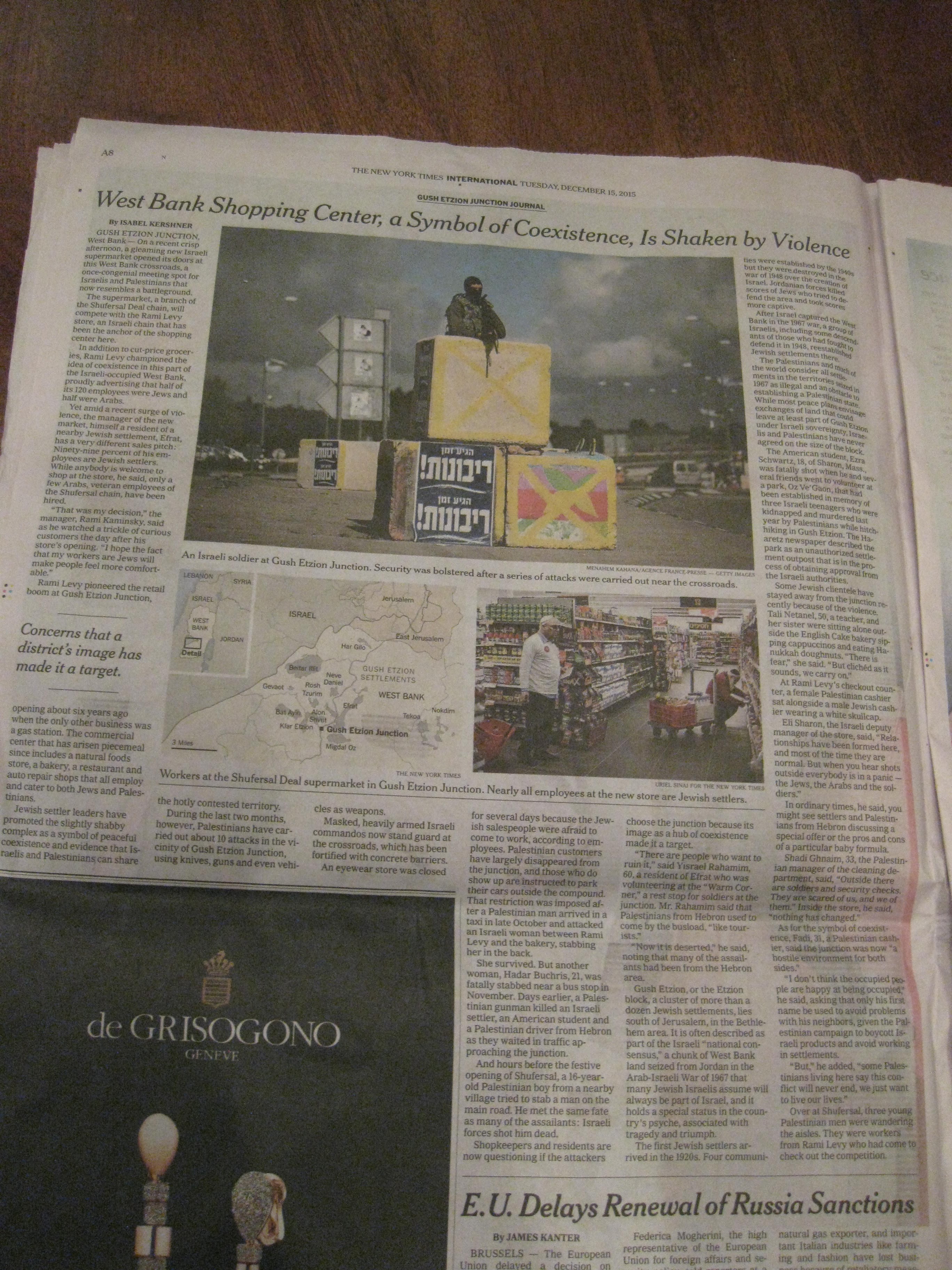
IMG_3663
New York Times article from December 15, 2015
In an article entitled “West Bank Shopping Center, a Symbol of Coexistence, is Shaken by Violence,” the Times gave more detailed history than typical when it provided background on the Gush Etzion “settlements” in Judea and Samaria/ West Bank of the Jordan River.  While the paper would typically state that “the world considers all settlements seized by Israel in 1967 as illegal,” it opted to give more historical context on December 15th.  It wrote:
“Gush Etzion, or the Etzion block, a cluster of more than a dozen Jewish settlements, lies south of Jerusalem, in the Bethlehem area. It is often described as part of the Israeli “national consensus,” a chunk of West Bank land seized from Jordan in the Arab-Israeli War of 1967 that many Jewish Israelis assume will always be part of Israel, and it holds a special status in the country’s psyche, associated with tragedy and triumph.

The first Jewish settlers arrived in the 1920s. Four communities were established by the 1940s but they were destroyed in the war of 1948 over the creation of Israel. Jordanian forces killed scores of Jews who tried to defend the area and took scores more captive.

After Israel captured the West Bank in the 1967 war, a group of Israelis, including some descendants of those who had fought to defend it in 1948, reestablished Jewish settlements there.

The Palestinians and much of the world consider all settlements in the territories seized in 1967 as illegal and an obstacle to establishing a Palestinian state. While most peace plans envisage exchanges of land that could leave at least part of Gush Etzion under Israeli sovereignty, Israelis and Palestinians have never agreed on the size of the block.”

The Times opted to repeat its often used language – twice – but it did give much more history than it normally does.  However, while it described Jews moving to area in the 1920s, and some of the new residents as descendants of those original settlers, the reader was still left with the wrong impression that Jews are living there illegally.
Key points that were omitted from the article:
  • The 1922 League of Nations Mandate specifically gave Jews the right to live and establish themselves THROUGHOUT the Holy Land. This was a matter of international law and the Jews availed themselves of this legal right.  In 1922, there was no concept of a “West Bank.”  It was all just “Palestine” and Jews legally purchased land and built homes in Gush Etzion.  As stated in Article 6, the Mandate “shall facilitate Jewish immigration under suitable conditions and shall encourage, in co-operation with the Jewish agency referred to in Article 4, close settlement by Jews on the land, including State lands and waste lands not required for public purposes.”  Further, Article 15 of the Mandate specifically stated that no part of Palestine should be off-limits to people based on their religion: “No discrimination of any kind shall be made between the inhabitants of Palestine on the ground of race, religion or language. No person shall be excluded from Palestine on the sole ground of his religious belief.”
  • When Jordan illegally attacked Israel in 1949 and killed the Jews in Gush Etzion, it did not undermine the legal rights Jews had for living in their homes.
  • Jordan’s illegal expulsion of all of the Jews from the region in 1949 counter to the fourth Geneva Convention was not mentioned by the Times.
  • The fact that Jordan illegally annexed the region in 1950 in an action that was never recognized by any country was also omitted.
  • Jordan (and Palestinians who had been granted Jordanian citizenship) attacked Israel in 1967, counter the Israel-Jordan Armistice agreement, and Israel was legally justified in responding in self-defense.
  • Jordan gave up all claim to the region in 1988.
It was nice to see the Times take steps to educate readers a bit more about Gush Etzion.  However, the details provided still left a reader with the impression that Jews live in Gush Etzion illegally, and it is only a matter of “national consensus” that leads Israelis to believe that the bloc will be formally part of Israel.  The many illegal activities of Jordan also continue to be ignored.
Perhaps the full facts disturb the Times’ narrative too profoundly to detail.

Related First.One.Through articles:

Subscribe YouTube channel: FirstOneThrough

Join Facebook group: FirstOne Through  Israel Analysis

“Peace” According to Palestinian “Moderates”

Liberals, including the left-wing paper The New York Times, often suggest that there are many leading Palestinian Arab and Israeli Arab moderates who genuinely want peace with Israel. US Secretary of State John Kerry warned Jews and Israelis about failing to fully engage “the moderate Palestinian leadership,” which could lead to “extremism.”

Over the past six weeks, one has to wonder what kind of “peace” these “moderates” have in mind.

Mahmoud Abbas

On October 28, 2015, the acting-President of the Palestinian Authority addressed the United Nations Human Rights Council in Geneva, Switzerland. In his prepared remarks he said that Israeli occupation of Palestine has been in place since Israel’s founding in 1948. He viewed all of Israel as illegitimate, and Palestinian land.

Abbas is a proud Holocaust denier as well as denier of Jewish history in the holy land. His anti-Semitic call for a Jew-free country has been endorsed by the Obama administration, and his basic refusal to recognize Israel as the Jewish State make the goal of achieving peace with this straw man a laughable fantasy.

Ayman Odeh

The NY Times was very quick to promote the prospects for Israeli-Arab peace as one of the leaders of the Joint Arab List, Ayman Odeh, was coming to New York to address groups of Jews.  On December 10, the Times ran an article “Arab-Israeli Parliament Member sees Prospect for Peace,” which described a hopeful Ayman Odeh’s thoughts about peace because “many parts of the Jewish population were able for the first time to hear us.”  Somehow, the deafness on the part of Arabs to recognize the Jewish State doesn’t seem to bother him.

IMG_3659
New York Times article on December 10, 2015

On December 10, Ayman’s vision of Israel was brought to the open (except for readers of the NY Times since it opted not to print the follow-up story).

Ayman was due to speak to the Conference of Presidents of Major American Jewish Organizations.  However, when Ayman noticed that the meeting was taking place on the same floor in the building as the Jewish Agency (a group that facilitates Jews moving to Israel) and other Zionist organizations, he refused to go up the elevator.  He insisted that the meeting location be moved so he would not have to be on the same floor as “organizations whose work displaces Arab citizens.“  The organization’s leader, Malcolm Hoenlein refused to change the meeting location and the meeting was cancelled.

Saeb Erekat

On December 13, 2015, perennial spokesperson for the Palestinians, Saeb Erekat came to speak at a conference run by the left-wing Israeli newspaper Haaretz and left-wing foundation, the New Israel Fund. Before taking the stage, he demanded that the Israeli flag be removed from the room.  The event organizers quickly complied.

“Moderates” seek a new State of Palestine,
not Peace with Israel

Many progressives have opened up various venues for engagement with Arabs to move a peace process forward.  As part of those efforts, they have chosen to label various Arab leaders as “moderates” and partners for peace.

However, these Arab “moderates” repeatedly make clear – in public, and in front of them – that they view the Jewish State of Israel as illegitimate.  The only rightful rights in the holy land belong to Arabs; if Jews are to remain in the land, it will only be subject to Arab review and approval.

Consider what these “moderates” say in private to their own constituents.

For Palestinian Arabs, there is one goal in the “peace process” and it is not peace with the Jewish State, but the establishment of a new State of Palestine.  The only difference between Arab moderates and extremists, is that extremists want to remove Israel in its entirety immediately, while moderates want to start with a Palestine in half of the holy land, before they assume complete control of the land.

John Kerry, Haaretz, the New York Times and other liberals loudly proclaim that the Palestinian Arab leadership are moderates who seek peace with Israel, but refuse to describe and detail all of the Arab comments and actions which clearly spell out their permanent hostility towards the Jewish State.

The fact that these “moderates” do not represent the general Palestinian public is yet all the more frightening, as 67% of Palestinian support the “stabbing intifada” according to the latest Palestinian poll.

The New York Times may highlight Ayman Odeh’s call that peace is possible since the “Jewish population can hear us.” But the world has news sources and blogs like First.One.Through that are read broadly around the world, that listen to more than just the sound-bites that dreamy liberals promote.

Peace partners are still not present.


Related First.One.Through articles:

The Israeli Peace Process versus the Palestinian Divorce Proceedings

The Narrative that Prevents Peace in the Arab-Israeli Conflict

Israel was never a British Colony; Judea and Samaria are not Israeli Colonies

What do you Recognize in the Palestinians?

Subscribe YouTube channel: FirstOneThrough

Join Facebook group: FirstOne Through  Israel Analysis

“Jews as a Class”

In December 2015, Republican presidential candidate Donald J. Trump announced his intention to impose a ban on all Muslims coming into the United States in response to various terrorist attacks done by militant radical jihadists. The question of whether such an action could be legally and practically enforced made historians look back to the treatment of Americans of Japanese descent during World War II. However, there is a better reference point for singling out a religious group, which happened 153 years ago this week.

General Grant Expelled the Jews

In the heat of the American Civil War, Major General Ulysses S. Grant was eager to establish military advantage. One of the ways he sought to accomplish this task was to curtail illegal smuggling of cotton and other goods out of the South which helped finance the Confederate’s war efforts. One group that Grant saw as being particularly involved in the trade was the Jews.

As such, on December 17, 1862 Union General U. S. Grant issued General Order No. 11 which stated:

“The Jews, as a class violating every regulation of trade established by the Treasury Department and also department orders, are hereby expelled from the Department [of the Tennessee] within twenty-four hours from the receipt of this order.

Post commanders will see to it that all of this class of people be furnished passes and required to leave, and any one returning after such notification will be arrested and held in confinement until an opportunity occurs of sending them out as prisoners, unless furnished with permit from headquarters.

No passes will be given these people to visit headquarters for the purpose of making personal application of trade permits.

By order of Maj. Gen. U. S. Grant”

As clearly spelled out, the order singled out one minority group – in its entirety – to be expelled from their homes within Grant’s territory (western Tennessee, Kentucky and Mississippi). This order continues to stand as the most anti-Semitic act by the US government to this day.
Grant expel jews
Jonathan D. Sarna’s book on Grant Expelling Jews in the Civil War

The Objection

As detailed in Jonathan D. Sarna’s book “When General Grant Expelled the Jews,” there were many objections to Order No. 11 at the time:

  1. Treat smugglers as individuals. While there were certainly Jewish smugglers profiting from the war, American laws require action against the people who actually commit the crime, and in some cases, people who aid and abet the illegal activity. In no situation does the law enable prosecution of an entire category of people who have no connection to the illegal activities.
  2. Prosecute all smugglers. There were many non-Jews involved in the smuggling trade. The North itself enabled the sale of cotton which it hoped would be used to finance its own war efforts while it penalized the South. Yet Grant’s orders do not punish all smugglers, but only Jewish one’s together with co-religionists, reeked of anti-Semitism and illogic.
  3. Non-violence, nor calls for violence. None of the smugglers committed any violent acts against other Americans. While Grant argued that the smuggling itself helped fund the Confederacy, neither Jews as individuals, nor any Jewish group overall called for harming the Union. All of the smugglers – Jews and non-Jews alike – were simply seeking a profit.
  4. Jews were serving in the Union Army. There were roughly eight thousand Jews serving in the Union army, including nine generals. The broad edict by Grant would have forced his own soldiers to be expelled from the region.

President Lincoln thought the order was inappropriate and countered the order. Lincoln commanded his general chief of the army, Henry Halleck, to revoke the order on January 4, 1863. Halleck wrote a letter to Grant which stated:

“It may be proper to give you some explanation of the revocation of your order expelling Jews from your department. The President has no objection to your expelling traitors and Jew peddlers, which, I suppose, was the object of your order; but, as it in terms proscribed an entire religious class, some of whom are fighting in our ranks, the President deemed it necessary to revoke it.”

Grant, who was later to become president of the United States, deeply regretted his Order No. 11 later in life, according to Sarna. He created a cabinet that included more Jews than any previous administration. When he was asked in 1875 why he issued such a bigoted order, he simply replied that in wartime “nice distinctions were disregarded. We had no time to handle things with kid gloves.”

Which has a similar ring to some calls against Muslims in America today.

Muslims in America Today

On December 8, 2015, the Wall Street Journal led with an editorial “The Obama-Trump Dialectic” which blamed the rise of Donald J. Trump’s illiberal suggestions of how to treat Muslims on the failures of Obama to confront militant radical jihadists.

The Obama failures regarding calling out and responding to radical Islam are plentiful, but beyond the scope of this article.  The question is Trump’s desire to treat “an entire religious class” (to use the Lincoln-Grant phraseology) as a single unit.

Trump had two principle ideas of handling Muslims as of December 2015:

  1. “a total and complete shutdown of Muslims entering the United States until our country’s representatives can figure out what is going on”
  2. a database for tracking all Muslims in the United States

Each of Trump’s ideas treats all Muslims as a distinct minority subject to rules that do not apply to any other people.  The distinction is based on religion, as was the case for Jews in 1862, which was objectionable to President Lincoln.

1. Immigrants: The first idea relates to incoming immigrants, not US Muslim citizens.  As such, while objectionable in principle, it is different than applying discriminatory laws against US citizens who have broad protections under the law.  Trump’s arguments for foreign Muslims today are different than for Jews in 1862, as they also are in comparing Jewish immigrants fleeing Europe in the 1930s and 1940s:

  • There were no global Jewish militants threatening to destroy America, like radical jihadist groups ISIS, Al Qaeda, and others today
  • Foreign Jewish groups did not kill thousands of Americans as was the case of Muslim foreigners over the recent past
  • There was no Jewish state for Jews 150 years ago or during World War II to act as a natural safe haven for Jews fleeing persecution, while there are 57 Muslim countries to absorb fellow Muslim immigrants
  • Jews were not engaged in any violent activities in America in the 1860s or during World War II, while Muslims today are engaged in several international wars and have attacked America
  • Jews have always been a very small minority, while there are 1.6 billion Muslims in the world leading to a potentially much more significant immigration issue
  • Jews have a long history of being expelled from countries, and hoped for a tolerant country in the United States which was founded on the principle of religious freedom; Muslims do not have a history of being expelled, but they also hope to enjoy America’s freedoms

Regarding Muslim immigration, Obama’s failures to call out Islamic terrorism is magnified by his refusal to take a strong stand on border control, according to Republicans and the WSJ.  Trump said that the ban would only be temporary until the government better understands the situation.

As detailed in “A Logical Approach to Immigration from Personal History,” there is a successful history of the US processing immigrants fleeing persecution to make sure that proper vetting takes place.  It would NOT ban all Muslims, but instead require them to first be situated out of harm’s way in a displaced person’s camp, say in Jordan, at which point vetting would occur.  Women and children would be permitted into the US first, followed by men at some point in the future.

Most significantly, not every situation is the same.  Muslims in Myanmar are different than Sunnis and Shiites from the Middle East.  Each may or may not have valid reasons to seek asylum in the USA.

Trump’s call for an edict against “Muslims as a class” regarding immigration recalls Grant’s comment during wartime that “nice distinctions were disregarded. We had no time to handle things with kid gloves.”  But today, there is time to manage a logical vetting process – which is more robust than put forward by President Obama.

2. Muslim Citizens. While non-American Muslims are not afforded protection of US laws (but only those that relate to immigration policies), American Muslims are full citizens with full rights and protections.  They account for 0.9% of the US population.  While some may have committed terrorist acts, the vast majority have not.  Further, there is no indication that there is a widespread plot to harm America or American interests.

Like the Jews in 1862, there is no basis of treating all co-religionists as a single “class,” while the treatment of the Jews was punitive, and the Trump suggestion for Muslims would just be placing the group under surveillance.

The US government just ended its vast metadata collection program.  That database was on all Americans that helped to track connections between potential terrorists.  Republican presidential candidate Chris Christie stated that ending that program was a big mistake, as using data collection and analytical tools helped locate would-be terrorists and keeps Americans safe.

Chris Christie RJC
NJ Governor Chris Christie addressing the Republican Jewish Coalition
in Washington, D.C., December 2015

(photo: First.One.Through)

A new modified approach of data collection in which people who make calls to, or visit war zones, such as Iraq and Syria, would be tracked may be an appropriate next step.  That would be more logical and fair and not treat all Muslims “as a class” simply for their religious beliefs, but based on actions.  An action-based monitoring system and database would capture information on Muslims and non-Muslims alike.

Conclusion

On December 10, 2015, the liberal newspaper The New York Times led with an editorial “The Trump Effect, and How it Spreads” which blamed the entire Republican party as being a bunch of racists.  As opposed to the Wall Street Journal editorial two days prior, it did not place any blame for the popularity of Trump’s positions on the many failures of the Obama administration.

While liberals and conservatives would both agree that a government’s primary concern is for the safety of its citizens, it does so within the framework of laws. America has laws requiring the separation of church-and-state and also does not have a class-based entrenched society.  The foundation documents of the country are that “all men are created equal“, and they should be treated equally under the law.

General Grant made an anti-Semitic order during the Civil War, but society was fortunate to have Abraham Lincoln who realized the deep inherent flaw of punishing an entire group of people.  In the middle of that episode, Lincoln made the Emancipation Proclamation on January 1, 1863, which freed the slaves.  Lincoln understood that if all men are to be equal, it must include every minority – blacks or Jews.

General Grant had Lincoln to keep his anti-Semitic edict in check, and Grant ultimately proved to be a good friend of the Jews.  His Order No. 11 was issued in the fervent hope of winning the war and protecting the Union.

Donald Trump has no power today so his words can best be kept in check by public voices, and ultimately the public vote.  Both Republicans and Democrats have spoken out against his suggestions as being un-American.  Indeed they are.

However, just as Grant was acting out of the interest of protecting America (with a very bad idea), it did not mark him as a permanent anti-Semite. It is similarly possible that a President Trump would place many Muslims on his cabinet.

Trump’s calls to treat Muslims “as a class” is wrong and racist. However, it does not mean that he will ultimately harbor anti-Muslim animus, just as Grant reformed in a time of peace.  The NY Times suggestion that all of the Republican candidates are racists is as narrow-minded and bigoted as Trump’s declaration.  However, it is more unlikely that the Times changes its biased viewpoints, than Trump modifying his.


Related First.One.Through articles:

I’m Offended, You’re Dead

Dancing with the Asteroids

The Gap between Fairness and Safety: WMDs in Iraq and Iran

Not Seeing the Eiffel Tower for the Girders

The Banners of Jihad

Finding Mr. Right-Wing

Subscribe YouTube channel: FirstOneThrough

Join Facebook group: FirstOne Through  Israel Analysis