The False Palestinian Refugee, Self-Determination Narrative

U.S. President Joe Biden decided that he would start to donate American taxpayer money to the specialized United Nations agency solely devoted to Palestinians, despite the troubled agency making few reforms. UNRWA has been constantly criticized for promoting anti-Semitism, has harbored weapons for terrorist groups and has long been a thorn in the Arab-Israeli peace process.

UNRWA actively perpetuates a false narrative that Palestinian Arabs are refugees from their homeland – even though Palestinians view all of pre-1948 Palestine as a single entity, meaning that they still live in their perceived homeland if they reside in Israel, Gaza or the West Bank.

Moreover, UNRWA encourages a storyline that all Palestinian Arabs are refugees. This is patently false. Many are stateless, but not refugees.

As seen in the charts above, according to UNRWA’s own numbers, 73% of Gazans are refugees (or more accurately, descendants of refugees) while another 8% are given services by UNRWA even though they are not refugees by any definition. Roughly one-in-five Gazans are simply residents, who have had family ties in the strip for generations who never had children with a descendant of a refugee (who would otherwise then get hereditary refugee status according to UNRWA).

The numbers east of the Green Line (EGL) / the “West Bank” are quite different, where over half of the Arabs are residents who have descendants from the region. Roughly 40% of Arab West Bankers registered with UNRWA as refugees to get free housing, education and healthcare, with another 9% “grantees” also getting services from the agency.

Another piece of commonly-stated fiction is that the Arabs have no self-determination and live under Israeli control. As Biden would say, that is “malarkey.”

Israel completely pulled out of Gaza in 2005 and gave the local Arabs there complete self-determination. With that freedom, Arabs voted the terrorist group Hamas to 58% of the Palestinian parliament in 2006 and watched Hamas take over the Gaza Strip in 2007. Hamas has thus far launched three wars from the area in 2008-9, 2012 and 2014.

Regarding EGL, Israel handed control of Areas A and B to the Palestinian Authority as part of the Oslo accords in the 1990’s. Only 14% of West Bank Arabs live in Area C under Israeli-control.

No matter. The world still berates Israel despite handing the PA land and being rewarded with wars, and condemns the Jewish State again for defending itself. No one pauses to contemplate why Israel would consider repeating the abuse at the hands of Palestinians, the UN and the media.

The Arab and Muslim-dominated United Nations manufactured a false narrative that Palestinian Arabs are refugees under Israeli-control which the anti-Israel media parrots in their quest to see the creation of a Palestinian State. In reality, it is those very lies that hinder the chance of reaching an enduring peace.


Related First One Through articles:

UNRWA Artificially Extends Its Mandate

New Head of UNRWA is Another Hamas-Sympathizer Politician

Palestinian Arabs De-Registering from UNRWA

UNRWA Anoints New Palestinian Wards

The Gross OVER-Staffing of UNRWA Schools

Enduring Peace versus Peace Now

Subscribe YouTube channel: FirstOneThrough

Join Facebook group: Israel Analysis and FirstOneThrough

NY Times Alternative Facts: Area C

The New York Times has an aggressive re-education effort about the world. It distorts history and facts in its enterprise, particularly when it comes to Israel.

A March 21, 2021 article was designed to elicit empathy for Palestinian Arabs, which is the anti-Israel’s paper common practice and right. What is unfortunate is not simply the bias but distortion of truth.

March 21, 2021 New York Times article about Palestinian sheep hearders suffering under Israeli “occupation”

The paper’s background to the area commonly known as the “West Bank” was as follows:

The Israeli government’s explanation for the demolitions dates back to the 1990s Oslo Accords with the Palestinians. The agreement gave Israel administrative control over more than 60 percent of the West Bank, including most of the Jordan Valley, pending further negotiations which were meant to be completed within five years.

But over two decades of talks, the two sides have failed to agree on a deal, so Israel retains control of the lands – known as Area C – and has the right to demolish homes built there without planning permission.”

The 1993 and 1995 Oslo Accords did not “give Israel administrative control” over area C; the Accords gave the Palestinian Authority (PA) control over Areas A and B. Israel has had administrative control of the West Bank for over fifty years. The Israelis gave the Palestinians the opportunity to control an area for the first time in history.

The Israelis were willing to give the PA more lands, including the vast majority of Area C in 2000. Not getting 100% of their stated desires, the Palestinians launched what is gently described as the “Second Intifada,” a murderous guerilla war waged for four years until Israel was able to halt the Palestinian killers by constructing a security barrier.

Israel handed additional lands to the Palestinians in 2005, as it withdrew from the Gaza Strip. That action led to wars from Gaza in 2008, 2012 and 2014 followed by West Bank car ramming and stabbing attacks in 2015 and 2016. The Palestinian actions destroyed any notion of Israel ceding control of more land to an entity hell-bent on murder. This reality is a far cry from the Times narrative that “the two sides failed to agree on a deal.”

Lastly, the Times, which forever likes to use harsh terms like “occupation” and “illegal” for Israel, is loathe to point out Palestinian terrorism and illegal activities. Like “illegal aliens” in the United States being called “undocumented immigrants,” the Times sanitized the illegally built Arab structures by claiming they were simply completed “without planning permission.”

The New York Times is deliberately posting ahistorical information to sway its readership to take a positive view of Palestinian Arabs and a negative view of Israel. It is part of the left-wing mantra to engage globally by distancing America from allies like Israel and warming relationships with state sponsors of terrorism like Iran.


Related First One Through articles:

Names and Narrative: It is Called ‘Area C’

Importing Peaceful Ideas to the West Bank

The 1967 War Created Both the “West Bank” and the Notion of a Palestinian State

American Leaders Always Planned on Israel Absorbing Much of the West Bank

The New York Times Excuses Palestinian “Localized Expressions of Impatience.” I Mean Rockets.

Names and Narrative: The West Bank / Judea and Samaria

Extreme and Mainstream. Germany 1933; West Bank & Gaza Today

NY Times Alternative Facts on Palestinian Elections

NY Times Will Not Write About Arab Pogroms

The NY Times Will Not Write About the Preferred Violence of Palestinians

NY Times Disgraceful Journeys

Subscribe YouTube channel: FirstOneThrough

Join Facebook group: Israel Analysis and FirstOneThrough

Importing Peaceful Ideas to the West Bank

While the Arab-Israeli Conflict has been going on for 100 years, there have been notable breakthroughs. Peace treaties with Egypt and Jordan in 1979 and 1994, respectively, were watershed moment which were unfortunately followed by the Two Percent War/Second Intifada (2000-2004), 2006 Lebanon War and Gaza Wars of 2008, 2012 and 2014. But in the waning years of the Trump Administration in 2020, Israel forged normalization agreements with several Arab countries including the United Arab Emirates, Bahrain, Sudan and Morocco.

Democrats offered a tepid reaction to the new Arab-Israel peace announcements because there was no similar announcement with the Palestinians. However, a review of how Palestinians viewed their Israeli neighbors over the past several years shows interesting movements precisely when such archaic negative thinking is rejected.

Gazans consistently view Israel as an enemy. Palestinian polls show Gazans in favor of armed attacks inside of Israel against Jewish civilians by a majority ranging from two-thirds to over three-quarters, a shocking figure which should alarm the world (imagine if 75% of Pakistanis were in favor of killing civilians in India).

Arabs from the West Bank have a more nuanced attitude towards Israel. Their opinions change depending on current events.

results from Palestinian polls since mid-2015

The chart above shows how West Bank Arabs changed their attitudes in regards to launching an armed “Intifada” (blue line) and supporting the killing of Jewish civilians inside of Israel (orange line).

  • The “Stabbing Intifada” which included running over soldiers and civilians in the summer/fall of 2015 was popular among West Bank Arabs and saw a peak support level for terrorism at 47%.
  • The Trump administration announcement of its intention to move the U.S. embassy to Jerusalem saw an uptick supporting terrorism that had been dropping since the 2015 peak.
  • The lowest support for terrorism occurred after Trump cut funding for UNRWA. UNRWA is much more popular in Gaza where roughly 85% of Gazans get service from the UN agency, compared to only roughly 35% in the West Bank.
  • Support for Hamas and attacks against Israel spiked shortly thereafter, when Israel botched a military operation in Gaza. Palestinian Arabs widely viewed Hamas as being the victor in the contest, and with that perceived win, support for terror rose.
  • Support for attacking Israelis among West Bank Arabs declined since then and reached a low with the signing of the Abraham Accords

Interestingly, the Trump years saw a sharp decline in attitudes among West Bank Arabs supporting “lone wolf” attacks against Israeli Jewish civilians. Those four years saw the lowest Israeli death toll from terrorism in modern Israeli history. Meanwhile, the West Bankers support for an armed “Intifada” held somewhat constant.

Ending UNRWA’s mandate and fostering peace with more Arab nations seemingly directly impacts West Bank Arabs abandoning terrorism. Conversely, perceived “wins” for HAMAS in battles with Israel breathes new life for armed conflict. The path towards peace is clear: international peace brings peace while international meddling brings terror.


Related First One Through articles:

The 1967 War Created Both the “West Bank” and the Notion of a Palestinian State

American Leaders Always Planned on Israel Absorbing Much of the West Bank

Israel Has Much Higher Claims to The West Bank Than Golan Heights

The EU’s Choice of Labels: “Made in West Bank” and “Anti-Semite”

Names and Narrative: The West Bank / Judea and Samaria

Subscribe YouTube channel: FirstOneThrough

Join Facebook group: Israel Analysis and FirstOneThrough

The West Bank / Gaza Coronavirus Gap

Palestinians polled themselves in December 2020, as they do every quarter. The differences between the West Bank and Gaza continued to be consistent in several areas such as Gazans favoring Hamas much more than West Bank Arabs.

The poll noted that more Gazans think that Hamas is not corrupt (45.3%) versus 8.3% of Arabs in the West Bank; Gazans back Hamas for president (64.4%) versus only 37.9% of West Bank Arabs; and 53.9% of Gazans believing fair elections can be held while 58.2% of West Bank Arabs think otherwise. When it comes to the Palestinian Authority (PA), almost everyone agrees that it is hopelessly corrupt (88.9% and 84.5% for Gaza and West Bank Arabs, respectively).

The latest poll also asked if people wanted to get the coronavirus vaccine. In Gaza, 50.5% and 31.6% stated they certainly did and thought they wanted to be vaccinated, respectively (82.1% in favor of vaccination), while 49.8% and 19.4% of West Bank Arabs said they certainly and probably DID NOT want to be vaccinated, respectively (69.2% against vaccination).

That is a remarkable difference in attitudes towards vaccination between the two regions which begs the question as to why Gazans want the vaccine while West Bank Arabs do not.

Two possible reasons: population density and trust in institutions.

Gaza is an extremely compact area with over 13,000 people per square mile. That compares to 759 people per square mile in the West Bank (17 times less). As the coronavirus spreads from person-to-person, it stands to reason that Gazans are more nervous about the virus rapidly spreading.

As relevant, is the fact that Gazans trust the Hamas authorities to look out for them. Both the Arabs in the West Bank and Gaza do not trust the PA in any matter. With Hamas ruling Gaza and in charge of coordinating a vaccination program with the United Nations, Gazans are much more comfortable getting the vaccine than West Bank Arabs led by the PA with zero credibility.

Meanwhile in the United States, several far-left members of Congress including Rep. Jamaal Bowman (D-NY), Rep. Joaquin Castro (D-TX), Rep. Marie Newman (D-IL), Sen. Tim Kaine (D-VA) and Rep. Rashida Tlaib (D-MI) criticized Israel for not vaccinating Arabs in Gaza and the West Bank, even though the PA took on the responsibility for healthcare in the Oslo Accords and does so together with the United Nations. To suggest that Israel should re-enter Gaza, which it left in 2005, to vaccinate people who have gone to war with Israel three times since 2008 is both illogical and dangerous. To push Israel to vaccinate West Bank Arabs who don’t want the vaccine would be an assault. If West Bankers do not trust the Palestinian Authority, why would anyone think they would trust Israel?

The PA stated publicly that it was not asking Israel to secure vaccinations for them and are coordinating efforts with the World Health Organization. Members of the PA Health Ministry were insulted by the suggestion that they work with Israel adding “We are not a department in the Israeli Defense Ministry. We have our own government and Ministry of Health, and they are making huge efforts to get the vaccine.

The concern of the American “progressives” uniquely for Palestinians is puzzling as they are faring better than most. According to the current information from Worldometers:

CountryCases per 1MDeaths per 1M
Bulgaria32,3211,346
Belize29,947761
Ukraine28,491540
Albania29,282503
Jordan32,527426
Denmark34,660382
Palestinians31,327362
Turkey29,744314
UAE32,46392
countries with roughly 31,000 cases per 1M population

The Arabs in Gaza and the West Bank rank 62nd globally in frequency of cases and have far fewer deaths than other countries with a similar positive infection rate. Yet there has been no outcry from those same Democrats about the situation in Bulgaria or Belize who are dying at rates multiples higher than Arabs. It seems to suggest that the left-wing Americans are using the coronavirus dynamic merely as a cudgel against Israel.

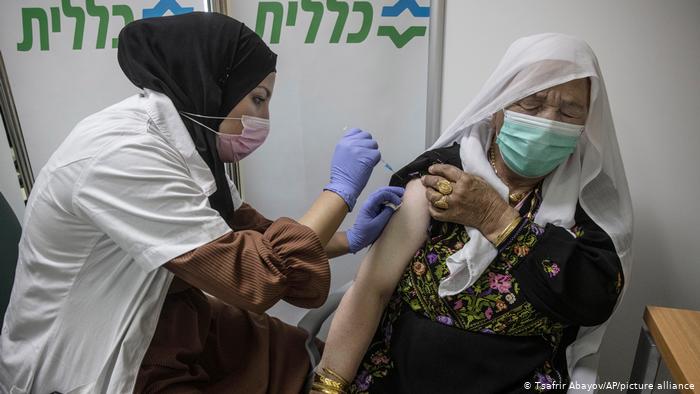
Israeli Arab receiving coronavirus vaccination

There is a significant gap in the attitude of Gazans and West Bank Arabs regarding the coronavirus vaccine as well as among far-left politicians regarding their concern for Palestinian Arabs and Albanians who are fairing much worse in the pandemic. The gap is one of trust, with Palestinians trusting Hamas but not the PA, and “Progressives” singularly not trusting Israel among all the nations.


Related First One Through article:

Liberal Senators Look to Funnel Money into Gaza

Subscribe YouTube channel: FirstOneThrough

Join Facebook group: Israel Analysis and FirstOneThrough

The Palestinian Maps of 1995, 1997 and 2005

Palestinian Arabs often share a series of maps which show that “their land and country” are in a perpetual state of shrinking when the opposite is the truth.

Local Palestinian Arabs never had self-rule until 1995. The Ottomans ruled the region from 1517 to 1917 and then the British until 1948. Israel’s War of Independence of 1948-9 saw the area west of the Jordan River split into three distinct parts: a Jewish State of Israel which gave citizenship to all the local Arabs, an Egyptian-controlled Gaza and a Jordanian region which it illegally annexed in 1950, which later became known as the “West Bank.” Jordan lost control of that land after it attacked Israel in 1967 and Egypt lost Gaza (and the Sinai peninsula which Israel returned in 1980) at the same time. Neither the Egyptians nor Jordanians made any attempt to give local Palestinians autonomy during the duration of their control of lands from 1949 to 1967.

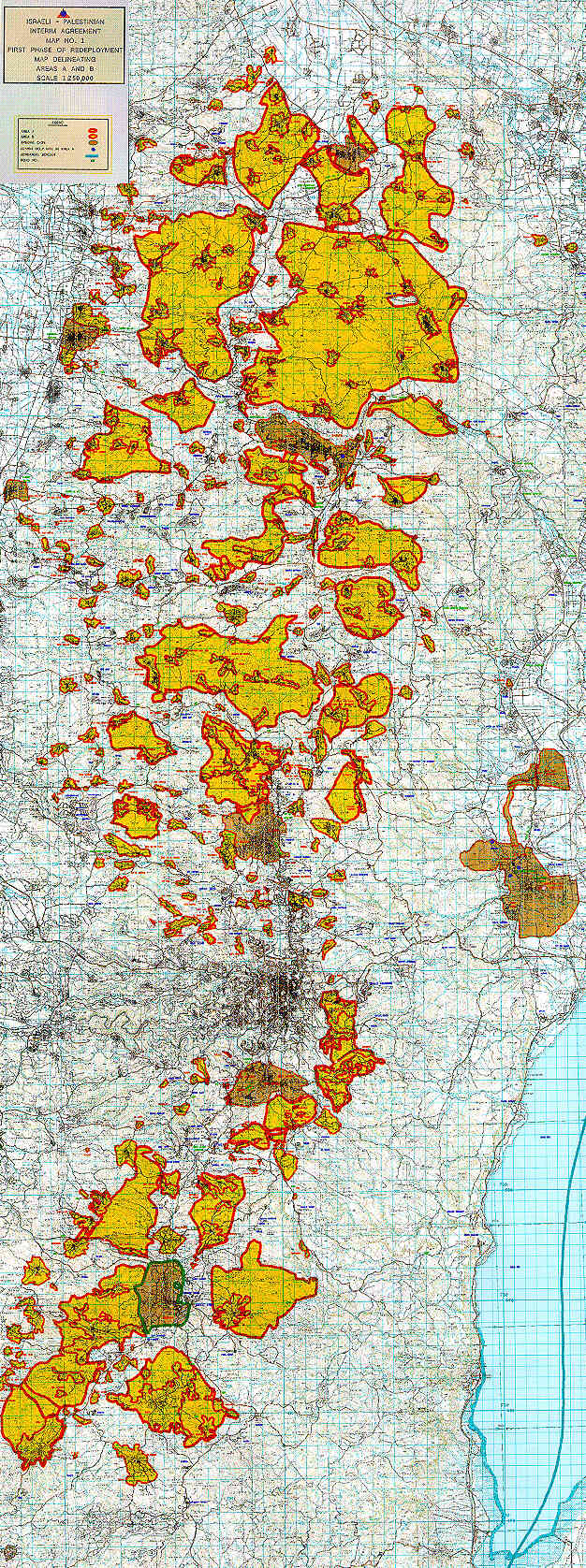
It was only with the signing of the Oslo Accords in 1995 that local Palestinian Arabs got to rule themselves, as Israel handed over six cities and 450 villages to the Palestinian Authority (PA). The six major cities were Jericho, Jenin, Tulkarem, Nablus (Shechem), Qalqilya and Bethlehem.

Areas A and B in the West Bank handed by Israel to the Palestinian Authority. Area A has full PA control

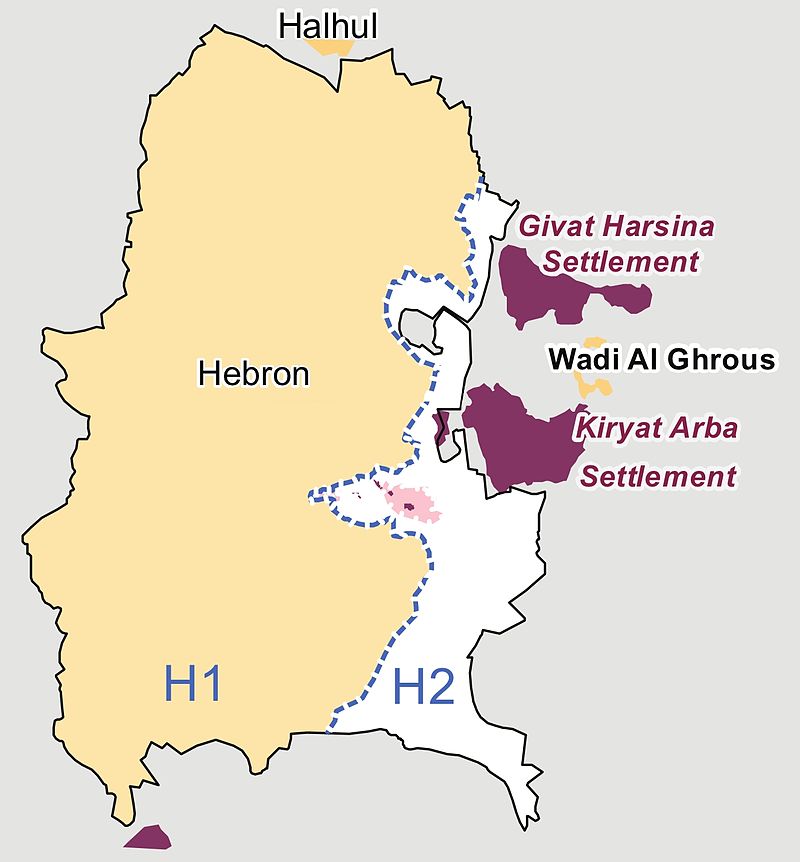
Israel continued to give the PA additional land to administer in 1997, giving almost the entirety of the city of Hebron, in an Area called H1.

Area H1 handed to the Palestinian Authority by Israel

Additional land was negotiated to be handed to the PA in September 2000 but the PA rejected the transfer of less than 100% of their demands and launched the Second Intifada, killing hundreds of Israeli civilians in numerous bombings.

In 2005, Israeli Prime Minister Ariel Sharon withdrew all Israelis from Gaza and left the region for the Palestinians to administer, subject to the understanding of the 2004 Bush letter which clearly articulated that Israel would NOT be expected to give into 100% of the PA’s land and refugee demands. This third installment was quickly met with yet additional rounds of Palestinian violence with a Hamas takeover of the area in 2007 and subsequent battles with Israel in 2008, 2012 and 2014.

No additional transfers of land from Israel to Palestinians has taken place in light of the Palestinians refusal to engage in a peace process after the 2014 process collapsed when the PA agreed to let the terrorist group Hamas into a power-sharing agreement.

Palestinians argue that their land has been shrinking for 100 years when the truth is that they continue to live throughout the land. The local Palestinian Arabs became self-governing for the first time when Israel gave them land in 1995 and subsequently handed them additional territory to administer in 1997 and 2005. If Palestinians come to the negotiating table it is possible for them to gain more land to govern, but their actions make that increasingly unlikely.


Related First One Through articles:

When You Understand Israel’s May 1948 Borders, You Understand There is No “Occupation”

Israel Has Much Higher Claims to The West Bank Than Golan Heights

Recognition of Acquiring Disputed Land in a Defensive War

The 1967 War Created Both the “West Bank” and the Notion of a Palestinian State

Abbas’s Harmful East Jerusalem Fantasy

Subscribe YouTube channel: FirstOneThrough

Join Facebook group: Israel Analysis and FirstOneThrough

The 1967 War Created Both the “West Bank” and the Notion of a Palestinian State

The area east of the Armistice Lines struck between Israel and Jordan in 1949 is commonly referred to as the “West Bank.” It only got that moniker after Israel took the area in June 1967.

Timeline to Naming the “West Bank”

After Israel’s war of Independence in 1948-9, the United Nations did not have a specific name for that region.

When Jordan annexed the area on April 24, 1950, only the United Kingdom, Iraq and Pakistan recognized Jordan’s actions while the rest of the world rejected it. After that time, during the years 1950 through 1958, the United Nations used various terms for that area which were tied to either Jordan or the Jordan River:

  • “west bank of the river in Arab Palestine” (1951)
  • “the area west of the Jordan River” (1952)
  • “West Jordan” (1950, 1951, 1952, 1954, 1955, 1956, 1957, 1958)
  • “the western bank” (1952)
  • “Western Jordan” (1951, 1952)
  • “that part of Jordan west of the Jordan River” (1956)
  • “west bank of the Jordan” (1957)

Then, in 1959, the United Nations seemed to embrace the Jordanian annexation, referring to the area simply as “Jordan,” no different than the eastern part of the kingdom. To the extent that the UN wanted to specifically call out that area it used wordy terms:

  • “Jordan side of the armistice demarcation line”
  • “frontier villagers in Jordan”

That all changed after Jordan attacked Israel in June 1967 and lost the region. By the end of that month, the United Nations quickly moved to shorthand (A/6713) by the third mention:

  • “the West Bank of the Jordan”
  • “West Bank area of the Jordan”
  • “West Bank”

This shortened version for that area east of the 1949 Armistice Line has stuck since that time.

The “West Bank”

Jordan

Israel

Seized the land in an offensive war against Israel in 1949 Took the land in a defensive war against Jordan in 1967
Annexed the land within a year Only annexed eastern Jerusalem thirteen years later
Only three countries recognized the annexation For fifty years, no country recognized the reunification of Jerusalem until the United States in December 2017
No country suggested boycotting Jordan for its illegal annexation Several countries have boycotted Israel since its re-establishment in 1948, even before taking eastern Jerusalem and the “West Bank”
Jordan expelled all Jews from the area, including the Old City of Jerusalem Israel did not expel anyone; many Palestinians who had taken Jordanian citizenship moved to Jordan
Jordan granted Arabs but not Jews citizenship within four years of annexation Israel immediately gave all people in Jerusalem – Arab and Jew alike – the option to apply for citizenship
The UN ultimately referred to the area as part of Jordan The UN to this day uses the term “East Jerusalem” even though such entity only existed between 1949 and 1967 as an artifice of war
The UN never called the region “West Bank” The UN only calls it the “West Bank” and “East Jerusalem”
The UN never called it “occupied Palestinian territory” The UN only calls it “Occupied Palestinian territory including East Jerusalem”

The United Nations applied a complete double standard to the “West Bank” and eastern Jerusalem when controlled by Jordan and then by Israel.

Timeline to Recommending Distinct Palestinian State

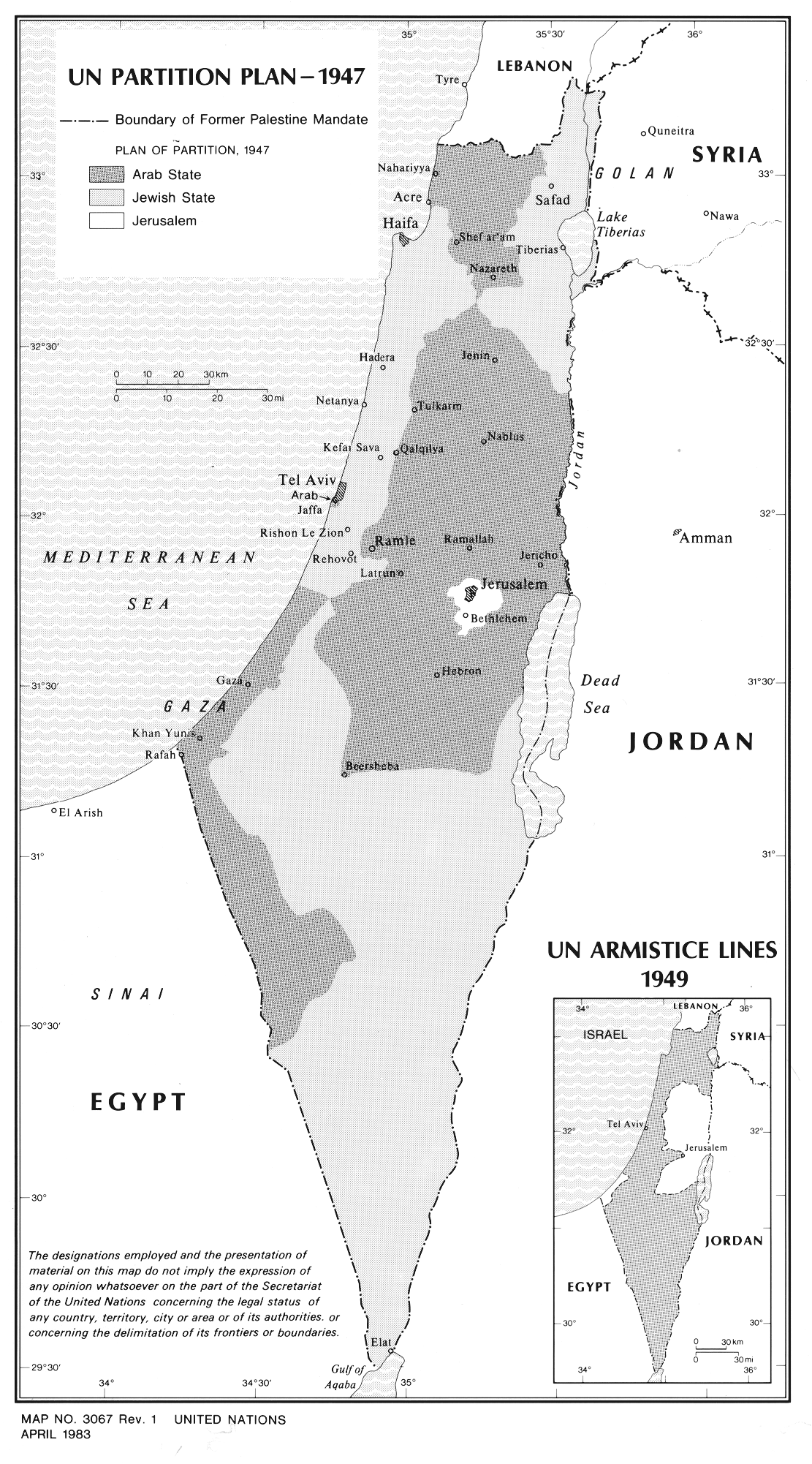
The United Nations General Assembly voted in favor of independent Jewish and Arab states in November 1947. Many countries recognized the enlarged frontiers of Israel’s border after it accumulated more land at the end of its war of independence of 1948-9.

United Nations proposed borders for the Jewish State in 1947 were much smaller than countries ultimately recognized two years later (inset map)

For eighteen years from 1949 to 1967, the United Nations considered Palestinian refugees living in the “West Bank” of Jordan as temporary residents who were waiting to move back to homes in Israel and take on Israeli citizenship. Together with their fellow Arab neighbors in the “West Bank” who were not refugees, they all took on Jordanian citizenship in 1954. For the United Nations, there was no plan for a Palestinian state until 1967; there were Palestinian Arab refugees who were to become Israelis and there were Jordanians (those who had lived in the “West Bank” before Israel’s war of independence.) The self-determination of the local Arabs was manifest in Jordan and the Egyptian-controlled Gaza Strip.

The Palestinian Liberation Organization fought that narrative. The PLO’s founding charter in 1964 sought to create a new Arab State of Palestine in the ENTIRETY of the British Mandate, and to eradicate the Zionist state. It was not a two-state solution, but the same zero Jewish state solution which remained the consistent goal in the Arab world.

Only when Egyptian President Anwar Sadat came to Israel in 1977 to forge peace was the notion of two states considered a reality anywhere in the Arab world. In his speech he called for:

  • “Ending the occupation of the Arab territories occupied in 1967. [Note: Egypt lost the Sinai Peninsula in 1967 and wanted it back]
  • Achievement of the fundamental rights of the Palestinian people and their right to self-determination, including their right to establish their own state.
  • The right of all states in the area to live in peace within their boundaries, their secure boundaries, which will be secured and guaranteed through procedures to be agreed upon, which will provide appropriate security to international boundaries in addition to appropriate international guarantees.”

The United Nations began to consider an independent Palestinian State in 1967 and the Arab world began to consider a Jewish State in 1977. The Jordanians gave up claim to the “West Bank” in 1988 and Palestinians slowly came to recognize Israel in the Oslo Accords of 1993 and 1995.

The move towards a “two-state solution” began to unravel with the Palestinian Second Intifada from September 2000 to February 2005, followed by the election of the terrorist group Hamas to the majority of the Palestinian parliament in 2006 and their subsequent takeover of Gaza in 2007. When the Palestinian Authority sought to enter a unity government with Hamas in 2014, the U.S.-brokered peace talks officially collapsed.

As we approach the 53rd anniversary of the 1967 war and consider Israel’s possible application of sovereignty to parts of Area C in the West Bank which are officially under full Israeli control according to the Oslo Accords signed by the Palestinians, it is worth noting that the world has already accepted Israel expanding its borders in a defensive war in 1949 and did not even consider the need for another Arab state in the region until 1967. There are many pathways to local Arab self-determination, and currently proposed initiatives do not terminate that aspiration.


Related First One Through articles:

When You Understand Israel’s May 1948 Borders, You Understand There is No “Occupation”

Jordan’s King Abdullah II Fights to Retain His Throne

Maybe Truman Should Not Have Recognized Israel

“Occupied Palestinian Territory, including East Jerusalem”

Recognition of Acquiring Disputed Land in a Defensive War

The Peace Proposal Monologues

A Response to Rashid Khalidi’s Distortions on the Balfour Declaration

I call BS: You Never Recognized Jerusalem as Israel’s Capital

Arabs in Jerusalem

Related First One Through video:

The anthem of Israel is JERUSALEM

The Green Line (music by The Kinks)

Judea and Samaria (music by Foo Fighters)

Subscribe YouTube channel: FirstOneThrough

Join Facebook group: Israel Analysis and FirstOneThrough

The Jewish Israeli Rosa Parks

On December 1, 1955, a black seamstress in Montgomery, Alabama refused to give up her seat at the front of the bus for a white man. In those days, segregation, the law that kept races apart, ruled the land. While black people were allowed on public transportation, they had to cede their seats in the front of the bus to white people. On that day 64 years ago, Rosa Parks was defiant and would not cater to the indecent law. Riots ensued, but ultimately, in 1964, the United States passed the Civil Rights Act which desegregated society.

Eight years earlier, on November 29, 1947, the United Nations General Assembly voted to partition the remaining portion of the British Mandate of Palestine (the land east of the Jordan River had previously been handed to the Hashemite Kingdom at the sole discretion of the British), into distinct Jewish and Arab states. While the vote was designed to create peace by separating the two peoples living in the land by establishing two clear majority-societies based on religion and culture, it still sought to allow the minority populations to live, pray and work in the majority-ruled lands. To minimize religious tension, the holy cities of Greater Jerusalem and Greater Bethlehem were voted to be placed under an international regime.

But the Arabs rejected the partition vote as they considered all of the land to be Arab and Muslim, and launched a war to destroy the Jewish State. At war’s end, they evicted all of the Jews from the lands they conquered, including all of the holy sites in Jerusalem, Bethlehem and Hebron. The Arabs forbade any Jew from living, praying or visiting their Jewish holy sites during their period of control from 1949 to 1967.

The Arabs would try to destroy Israel again, with the Jordanian Arabs (and Palestinian Arabs whom had been granted Jordanian citizenship) attacking Israel in 1967, losing their illegally seized lands. Under Jewish control, Israel opened up the holy sites in Jerusalem, Bethlehem and Hebron and enabled everyone – even Jews! – to visit, but they opted to maintain the ban on Jewish prayer at Judaism’s holiest locations, the Temple Mount, hoping to placate the broader Muslim and Arab worlds.

It did not.

The Arab and Muslim countries dug in deeper and turned the United Nations into a complete circus of antisemitic hate. While Palestinians began hijacking planes over the following decade, the other Arab nations advanced the political theory that Zionism was racism on November 10, 1975. After the United States finally led its repeal in December 1991, the Arab world advanced the same premise at the 2001 Durban Conference Against Racism, pushing the notion that not only should Jews be barred from living in parts of the holy land, but their refusal to acquiesce to antisemitic edicts was itself racist.

The September 2000 visit by Israeli Prime Minister Ariel Sharon to the Temple Mount coincided with Palestinian leader Yasser Arafat’s destruction of the Oslo Accords and launch of the Second Intifada which killed thousands. Rabbi Yehuda Glick’s advocacy for Jewish prayer on the Temple Mount in October 2014 also brought Palestinian terrorist to shoot him and launch a “stabbing intifada.” As the antisemitic Hamas Charter says, “Israel, Judaism and Jews challenge Islam and the Moslem people.” The presence of Jews in Muslim lands and holy sites is considered appalling.

The United Nations joined the chorus penned by over 50 Arab and Muslim nations that Israeli Jews should not be permitted to pray on the Temple Mount, nor live east of the 1949 Armistice Lines in the Old City of Jerusalem and in the “West Bank,” the lands which the Jordanians had seized. In December 2016, the UN Security Council, with the tacit approval of the United States’ Obama administration, passed Resolution 2334 which said that banning (not even segregating!) Israeli Jews is legal, and that such people have no rights to live and work in their holy land.


Today, there are hundreds of thousands of Israeli Jewish Rosa Parks who defy the notion that laws banning Jews from natural activities which others enjoy is in any way immoral or illegal. These Jews live in Judea and Samaria, in the Old City of Jerusalem and Hebron and fight for open access and prayer at their holy sites on the Temple Mount of Jerusalem and throughout the Cave of the Jewish Patriarchs and Matriarchs in Hebron. Perhaps it is time to erect a monument for these “settlers” at the UN Plaza, much as Rosa Parks got a statue in Montgomery, AL.


Jerusalem on Sukkot, a full Kotel Plaza,
but no Jews on the Temple Mount


Related First.One.Through articles:

Tolerance at the Temple Mount

I’m Offended, You’re Dead

Active and Reactive Provocations: Charlie Hebdo and the Temple Mount

When You Understand Israel’s May 1948 Borders, You Understand There is No “Occupation”

A Native American, An African American and a Hispanic American walk into Israel…

Joint Prayer: The Cave of the Patriarchs and the Temple Mount

It is Time to Insert “Jewish” into the Names of the Holy Sites

The United Nations and Holy Sites in the Holy Land

Visitor Rights on the Temple Mount

Taking the Active Steps Towards Salvation

Israel Has Much Higher Claims to The West Bank Than Golan Heights

The EU’s Choice of Labels: “Made in West Bank” and “Anti-Semite”

Considering Carter’s 1978 Letter Claiming Settlements Are Illegal

First.One.Through videos:

The Green Line (music by The Kinks)

Judea and Samaria (music by Foo Fighters)

10 Ignored Facts about Moslem and Jewish Population in Israel (music by Seal)

Israel Provokes the Palestinians (music by The Clash)

The Anthem of Israel is JERUSALEM

Subscribe YouTube channel: FirstOneThrough

Join Facebook group: FirstOne Through Israel Analysis

Considering Carter’s 1978 Letter Claiming Settlements Are Illegal

The November 18, 2019 announcement by US Secretary of State Mike Pompeo that Israeli “settlements” are not illegal reverses the conclusion of a lawyer advising President Jimmy Carter’s State Department in 1978. A First One Through (FOT) deconstruction of that opinion follows.

The letter was compiled by Herbet Hansell, a lawyer from Jones Day who provided occasional legal consulting services to the State Department. His letter of April 21, 1978 set the framework for Carter to label the settlements as “illegal,” an opinion not shared by any other U.S. president before or since.

“Dear Chairmen Fraser and Hamilton:

Secretary Vance has asked me to reply to your request for a statement of legal considerations underlying the United States view that the establishment of the Israeli civilian settlements in the territories occupied by Israel is inconsistent with international law. Accordingly, I am approving the following in response to that request:”

FOT COMMENT: It is important to note that the conclusion was already given to Hansell, that the “United States view that the establishment of the Israeli civilian settlements in the territories occupied by Israel is inconsistent with international law.” Any good lawyer trained at arguing either side of a case can find a rationale to give his employer the backup required. Hansell did his best in the letter.

“The Territories Involved

The Sinai Peninsula, Gaza, the West Bank and the Golan Heights were ruled by the Ottoman Empire before World War I. Following World War I, Sinai was part of Egypt; the Gaza strip and the West Bank (as well as the area east of the Jordan) were part of the British Mandate for Palestine; and the Golan Heights were part of the French Mandate for Syria. Syria and Jordan later became independent. The
West Bank and Gaza continued under British Mandate until May 1948.”

FOT: All of these statements are true to some extent. The issue is that these parcels of land like the “West Bank” were non-entities at the end of World War I. The definition of what they were to become were artifices of war and armistice lines.

Further, there is no discussion of the purpose of the British Mandate of Palestine. There was no mention that the Mandate specifically stated in Article 4 that it “shall facilitate Jewish immigration under suitable conditions and shall encourage… close settlement by Jews on the land,” nor Article 15 that “No person shall be excluded from Palestine on the sole ground of his religious belief.” The Mandate not only considered Jews living in Gaza and what would become the “West Bank” as legal, it ENCOURAGED Jews living throughout the land.

In 1947, the United Nations recommended a plan of partition, never effectuated, that allocated some territory to a Jewish state and other territory (including the West Bank and Gaza) to an Arab state. On 14 May 1948, immediately prior to British termination of the Mandate, a provisional government of Israel proclaimed the establishment of a Jewish state in the areas allocated to it under the Jewish plan. The Arab League rejected partition and commenced hostilities. When the hostilities ceased, Egypt occupied Gaza, and Jordan occupied the West Bank. These territorial lines of demarcation were incorporated, with minor changes, in the armistice agreements concluded in 1949. The armistice agreements expressly denied political significance to the new lines, but they were de facto boundaries until June 1967.”

FOT: The summary of the 1947 partition plan leaves out the principle that Greater Jerusalem and Greater Bethlehem were designed to be a “corpus separatum” and internationally-administered. Its legal position is completely unique and distinct from the “West Bank,” a horrible omission by Hansell.

Another shortcoming is that Hansell’s observation that the UN “recommended a plan of partition, never effectuated,” never enters his calculus for the remainder of his letter. If the UN simply “recommended” the partition, it had no legal validity. Therefore, when Israel declared itself an independent state at the end of the British Mandate, its borders would be set as the FULL territory, including Gaza and what would become the “West Bank” under international law known as Uti possidetis juris.

The reason that partition was never effectuated, was that the Arabs rejected it completely, as they considered the entirety of the land to be Arab with no space for a Jewish state. This makes the issue one about a civil war over a single tract of land, not one between two autonomous countries. Therefore the only international laws which would pertain would be regarding rules of war and protecting civilians, not laws dealing with incursions into foreign territory.

Even if one were to look past these failures and try to see Hansell’s point of view, the historic background still falls flat. Jordan did not simply “occupy” the West Bank; it evicted all of the Jews in 1949, annexed the territory in 1950 and then granted all non-Jews citizenship in 1954. The Arabs ethnically cleansed Judea and Samaria and then renamed the area east of the 1949 Armistice Lines the “west bank of the Jordan River,” which, over time, was shortened to the commonly used term “West Bank.” Such racist and antisemitic behavior – coming just a few years after the Holocaust no less! – should never be embraced.

Additionally, Israel secured additional land in the 1948-9 war beyond what was proposed for the Jewish State in the 1947 Partition Plan. The world accepted this additional territory both because Israel acquired the land in a defensive battle and that the Armistice Lines were expressly viewed as subject to change by both parties (the Arabs assumed Israel would shrink and the Zionists believed Israel sovereignty would expand). The principle of acquiring more land in a defensive battle in 1967 similarly applies.

Lastly, not only did the Palestinians not declare an independent Arab state, there was no more land to even consider as independent, as Egypt assumed control of Gaza and Jordan annexed the West Bank. When Hansell considers the Israeli counter-party in 1978, is he thinking about the Jordanians? Palestinians (who had accepted Jordanian citizenship)?

“During the June 1967 war, Israeli forces occupied Gaza, the Sinai Peninsula, the West Bank and the Golan Heights. Egypt regained some territory in Sinai during the October 1973 war and in subsequent disengagement agreements, but Israeli control of the other occupied territories was not affected, except for minor changes on the Golan Heights through a disengagement agreement with Syria.”

FOT: Completely absent from the narrative is the not-inconsequential point that Israel was the DEFENSIVE PARTY during the June 1967 war. While it is a matter of debate whether Israel’s preemptive attack on Syria and Egypt which had threatened to attack Israel and amassed troops on the border was defensive, there is no question that Jordan attacked Israel first. Just as Israel acquired additional land in a defensive battle in 1949 which was endorsed by the world, so too was Israel’s acquisition of the West Bank.

The Settlements
Some seventy-five Israeli settlements have been established in the above territories (excluding military camps on the West Bank into which small groups of civilians have recently moved). Israel established its first settlements in the occupied territories in 1967 as para-military ‘nahals’. A number of ‘nahals’ have
become civilian settlements as they have become economically viable.

“Israel began establishing civilian settlements in 1968. Civilian settlements are supported by the government, and also by non-governmental settlement movements affiliated in most cases with political parties. Most are reportedly built on public lands outside the boundaries of any municipality, but some are built on private or municipal lands expropriated for the purpose.”

FOT: Stating that settlements are “supported” by the Israeli government is misleading. Israel “supports” all civilians in the West Bank – including Arab towns – with various services ranging from protection to electricity and water. Hansell’s caveat that most settlements are “reportedly” built on public lands seems peculiar, as though he doubted the veracity of the report to add that “some are built on private or municipal lands.”

Legal Considerations
1. As noted above, the Israeli armed forces entered Gaza, the West Bank, Sinai and the Golan Heights in June 1967, in the course of an armed conflict. Those areas had not previously been part of Israel’s sovereign territory nor otherwise under its administration. By reason of such entry of its armed forces, Israel established control and began to exercise authority over these territories; and under international law, Israel became a belligerent occupant of these territories.”

FOT: Hansell now delves into the legal analysis of the settlements, but his omissions in the background now become toxic to the analysis.

  • There is no factual mention that Israel was without question the defensive party regarding Jordan in the West Bank, yet Hansell declares that Israel was the “belligerent” party.
  • Hansell noted that the 1949 Armistice Lines had no “political significance.” Therefore, the area one foot to the right or left of the the armistice lines was only theoretically Israel and Jordan. While the world recognized the sovereignty of Israel to the west of the line, the entirety of the UN (except Pakistan and the UK) did not acknowledge Jordan’s annexation of the West Bank. These Arabs also never declared an independent state as noted above.
  • In short, Israel entered into a disputed territory which was an integral part of the Palestine Mandate from which Jews were expelled in a defensive war 18 years earlier in a defensive maneuver.

Hansell continued:

“Territory coming under the control of a belligerent occupant does not thereby become its sovereign territory. International law confers upon the occupying State authority to undertake interim military administration over the territory and its inhabitants; that authority is not unlimited. The governing rules are designed to permit pursuit of its military needs by the occupying power, to protect the security of the occupying forces, to provide for orderly government, to protect the rights and interests of the inhabitants, and to reserve questions of territorial change and sovereignty to a later stage when the war is ended. See L. Oppenheim, 2 International Law 432-438 (7th ed., H. Lauterpacht ed., 1952); E. Feilchenfield, The International Economic Law of Belligerent Occupation 4-5, 11-12, 15-17, 87 (1942); M. McDougal & F. Feliciano, Law and Minimum World Public Order 734-46, 751-7 (1961); Regulations annexed to the 1907 Hague Convention on the Laws and Customs of War on Land, Articles 42-56, 1 Bevans 643; Department of the Army, The Law of Land Warfare, Chapter 6 (1956) (FM-27-10).

‘In positive terms, and broadly stated, the Occupant’s powers are (1) to continue orderly government, (2) to exercise control over and utilize the resources of the country so far as necessary for that purpose and to meet his own military needs. He may thus, under the latter head, apply its resources to his own military objects, claim services from the inhabitants, use, requisition, seize or destroy their property, within the limits of what is required for the army of occupation and the needs of the local population.”

FOT: Even while Hansell labels Israel as a “belligerent occupant” as if Israel aggressively attacked and entered a sovereign nation’s territory, he comments that such party has the authority to manage the security of the territory and “provide for orderly government” and oversee the inhabitants until “the war is ended.” Has the war ended? It certainly had not by 1978 when this letter was drafted. Jordan only made peace with Israel in 1994, and abandoned all claim to the West Bank in 1988, ten years after this opinion letter was drafted. As such, according to Hansell, Israel’s role in the West Bank is undisputed.

“But beyond the limits of quality, quantum and duration thus implied, the Occupant’s acts will not have legal effect, although they may in fact be unchallengeable until the territory is liberated. He is not entitled to treat the country as his own territory or its inhabitants as his own subjects…, and over a wide range of public property, he can confer rights only as against himself, and within his own limited period of de facto rule. J. Stone, Legal Controls of International Conflict, 697 (1959).”

FOT: Hansell himself comments that the “Occupant” is in charge of orderly government and security until it is “liberated.” Was the West Bank to be “liberated” to the Jordanians who illegally annexed the land? Liberated to the British who ran the Mandate until the Jordanians invaded? Liberated to the Ottoman Empire who ruled the land until the end of World War I? In 1978, the “Palestinians” of the West Bank were all Jordanians, citizens of the invading army which had ethnically cleansed the region of its Jews. It is arguable that the land was liberated from Jordan back to Israel. Yet the fact that Israel did not immediately annex the land in 1967 and put it under its full sovereignty also suggests that Israel viewed the land as disputed.

Hansell stated that the Occupant must not treat the “inhabitants as his own subjects.” A curiosity, as today people complain that Palestinian Arabs have no right to vote in Israeli elections, but that’s the desired result according to Hansell.

“On the basis of the available information, the civilian settlements in the territories occupied by Israel do not appear to be consistent with these limits on Israel’s authority as belligerent occupant in that they do not seem intended to be of limited duration or established to provide orderly government of the territories and, though some may serve incidental security purposes, they do not appear to be required to meet military needs during the occupation.”

FOT: Hansell was very unsure of himself, using couched language throughout his conclusion. He noted that the civilian settlements do not “appear” consistent with the limits as the “belligerent occupant.” Of course, that also doesn’t mean that it is illegal. It just means that his first line of consideration did not touch upon Israeli civilians. However, it did make clear that Israel has security responsibility for the entire land and that the inhabitants should not be considered citizens of the Occupant, therefore only subject to military rule with no rights to vote.

“2. Article 49 of the Fourth Geneva Convention relative to the Protection of Civilian Persons in Time of War, 12 August 1949, 6 UST 3516, provides, in paragraph 6: ‘The Occupying Power shall not deport or transfer parts of its own civilian population into the territory it occupies’.

Paragraph 6 appears to apply by its terms to any transfer by an occupying power of parts of its civilian population, whatever the objective and whether involuntary or voluntary. It seems clearly to reach such involvements of the occupying power as determining the location of the settlements, making land available and financing of settlements, as well as other kinds of assistance and participation in their creation. And the paragraph appears applicable whether or not harm is done by a particular transfer. The language and history of the provision lead to the conclusion that transfers of a belligerent occupant’s civilian population into occupied territory are broadly proscribed as beyond the scope of interim military administration.”

FOT: Hansell uses a very broad interpretation of the word “transfer,” well beyond its definition.

The law states that the government cannot “deport or transfer” its own citizens. The word “deport” means to expel, sort of the way Turkey has invaded Syria and is deporting thousands of its unwanted refugees into Syria (of course, there has been no UN Security Council resolution of Turkey’s slaughter of the Syrian Kurds and dumping unwanteds, but that’s another story). The deported people have no right to return to the original Occupant’s land. This is in contrast to “transfer” in which the civilians remain citizens of the Occupant’s country.

Because the transferred people maintain citizenship rights, Hansell seems to argue that it covers voluntary movement of civilians. However, that interpretation has nothing to do with the definition of “transfer.” Arguing that Israel is enticing its citizens to move to the West Bank because it plans the towns still does not mean the government is moving (“transferring”) anybody. It is simply providing an orderly government in the land which it is obligated to do as discussed above.

Further, Hansell’s concluding point is that the very essence of Article 49 of the Fourth Geneva Convention has to do with situations which are inherently short-term in nature. The Civil War between the Jews and Arabs for the holy land started in the 1920’s and began raging in full force in 1936 and is still going strong as evidenced by three wars, the Second Intifada and Stabbing Intifada, in just the last twenty years. The Article in question is not designed or equipped to deal with a civil war, let alone one which has been going on for decades.

“The view has been advanced that a transfer is prohibited under paragraph 6 only to the extent that it involves the displacement of the local population. Although one respected authority, Lauterpacht, evidently took this view, it is otherwise unsupported in the literature, in the rules of international law or in the language and negotiating history of the Convention, and it seems clearly not correct.
Displacement of protected persons is dealt with separately in the Convention and paragraph 6 would seem redundant if limited to cases of displacement. Another view of paragraph 6 is that it is directed against mass population transfers such as occurred in World War II for political, racial or colonization ends; but there is no apparent support or reason for limiting its application to such cases.

The Israeli civilian settlements thus appear to constitute a ‘transfer of parts of its own civilian population into the territory it occupies’ within the scope of paragraph 6.”

FOT: Having stretched the definition of “transfer” well beyond its intent, Hansell argues against a straw man whether the impact or quantity of people has any impact on his definition of “transfer.” It’s a foolish point and does not buttress his argument for reinterpreting the definition of “transfer.”

“3. Under Art. 6 of the Fourth Geneva Convention, paragraph 6 of Article 49 would cease to be applicable to Israel in the territories occupied by it if and when it discontinues the exercise of governmental functions in those territories. The laws of belligerent occupation generally would continue to apply with respect to particular occupied territory until Israel leaves it or the war ends between Israel and its neighbours concerned with the particular territory. The war can end in many ways, including by express agreement or by de facto acceptance of the status quo by the belligerent.”

FOT: Hansell’s argument is that Israel remains bound to the terms of the Fourth Geneva Convention as long as it remains in the territory or the war ends. While the parties were still fighting in 1978, Israel and Jordan subsequently signed a peace agreement in 1994 therefore implying an end to the applicability of this law. Some might note that Jordan gave up all claims to the West Bank in 1988 and effectively handed such claim to the Palestinians whom Jordan began to strip of Jordanian citizenship. But such arguments fall flat. Jordan had no rights to the West Bank in any form to relinquish them to the Palestinians; the West Bank was land being fought over in a civil war between the Zionists and the local Arabs.

4. It has been suggested that the principles of belligerent occupation, including Article 49, paragraph 6, of the Fourth Geneva Convention, may not apply in the West Bank and Gaza because Jordan and Egypt were not the respective legitimate sovereigns of these territories. However, those principles appear applicable whether or not Jordan and Egypt possessed legitimate sovereign rights in respect of those territories. Protecting the reversionary interest of an ousted sovereign is not their sole or essential purpose; the paramount purposes are protecting the civilian population of an occupied territory and reserving permanent territorial changes, if any, until settlement of the conflict. The Fourth Geneva Convention, to which Israel, Egypt and Jordan are parties, binds signatories with respect to their territories and the territories of other contracting parties, and “in all circumstances” (Article 1), and in ‘all cases’ of armed conflict among them (Article 2) and with respect to all persons who ‘in any manner whatsoever’ find themselves under the control of a party of which they are not nationals (Article 4).”

FOT: Hansell continued to point out that the relevant parties regarding the Geneva Convention are not the Palestinians (which makes sense as those living in the West Bank were all Jordanian in 1978) but Israel, Egypt and Jordan. As Israel and Jordan signed a peace agreement in 1994, the Geneva Convention no longer applies so the Trump Administration can easily state that Israeli civilians living in the West Bank are not illegal.

“Conclusion
While Israel may undertake, in the occupied territories, actions necessary to meet its military needs and to provide for orderly government during the occupation, for reasons indicated above the establishment of the civilian settlements in those territories is inconsistent with international law.”

FOT: Hansell’s arguments were extremely weak and inherently flawed in 1978 and are not relevant today as Israel has peace agreements with both Egypt and Jordan. The Trump administration’s recognition of this fact is welcome and was overdue.

Jews and Arabs are coexisting in Israel and are building a thriving country together in the midst of mayhem all around them. While it is desirable for the stateless Arabs living in Gaza and the West Bank to have citizenship in some country, such goal has no relevance on the legality of Israeli Jews living in the West Bank.
Jewish homes in Psagot, Judea and Samaria/ the West Bank
(photo: First.One.Through)


Related First One Through articles:

The Legal Israeli Settlements

The Long History of Dictating Where Jews Can Live Continues

The Many Lies of Jimmy Carter

Anti-“Settlements” is Anti-Semitism

Israel Has Much Higher Claims to The West Bank Than Golan Heights

Republicans Do Not Believe There is Any “Occupation”

Names and Narrative: The West Bank / Judea and Samaria

The EU’s Choice of Labels: “Made in West Bank” and “Anti-Semite”

When You Understand Israel’s May 1948 Borders, You Understand There is No “Occupation”

“Occupied Palestinian Territory, including East Jerusalem”

First.One.Through videos:

The Green Line (music by The Kinks)

The Anthem of Israel is JERUSALEM

Subscribe YouTube channel: FirstOneThrough

Join Facebook group: FirstOne Through Israel Analysis

When You Understand Israel’s May 1948 Borders, You Understand There is No “Occupation”

There are really only two ways to consider the borders of Israel when it declared independence in May 1948: the entirety of the Palestine Mandate OR the proposed border put forward by the United Nations General Assembly in 1947. As discussed below, only one of these is legally valid, while both options demonstrate that Israel does not occupy any “Palestinian Land.”

May 1948 Borders: the Palestine Mandate

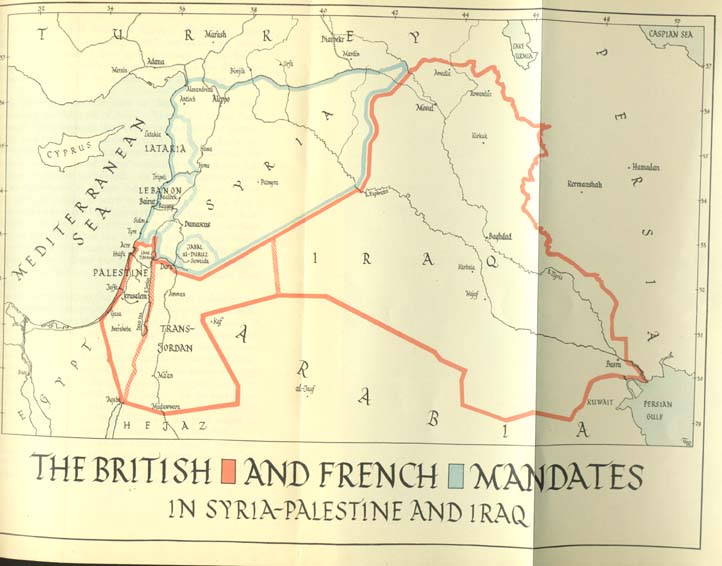
When the Ottoman Empire broke up, the French and British assumed control of various mandates until the local populations were able to establish their own functioning governments. The French took the Lebanon and Syrian mandates, and each of them became countries in 1943 and 1946, respectively, after the last of the French troops withdrew. The British took the Palestine and Iraq mandates. Iraq declared its independence in 1932. As for Palestine, the situation was more labored and complicated.

The 1922 international mandate made clear that the British were to help the Jews reestablish their homeland in the territory. However, the land east of the Jordan River was viewed as a land that the British could option to separate (Article 25), which they did. That land ultimately became the Kingdom of Jordan.

Regarding the rest of the Palestine Mandate, the British had a difficult time dealing with a local Arab population which did not want to see a flood of Jews enter the area. The multi-year Arab riots between 1936 and 1939 led the British to consider dividing the land between the Jews and Arabs (the 1937 Peel Commission which was not adopted) and placing a cap on the number of Jews allowed to enter the territory (the 1939 White Paper which was enacted).

By the end of the devastation of World War II, the British had enough rebuilding to do at home and the Jews clearly needed to have the cap on immigration terminated, so the Brits asked the United Nations to tackle the issue in 1946. The UN General Assembly voted to partition the land between the Jews and Arabs in a non-binding vote in November 1947. All of the Arab countries voted ‘no’ and the partition never took place.

When the British withdrew their last troops in May 1948, the Jews declared the new Jewish State of Israel. Like the Mandates of Lebanon, Syria and Iraq, the British troop withdrawal was accompanied by the declaration of a new state on the ENTIRETY OF THE MANDATE, including areas which have now become known as Gaza and the West Bank.

May 1948: the 1947 Partition Plan

When Israel declared its independence, the Arab community was still seeking to control the entirety of the Palestine Mandate itself. It rejected the State of Israel in 1948 the same way it rejected the 1947 proposed UN Partition Plan. It considered both illegal, null and void, invasions of their own Arab land.

When five Arab armies attacked Israel when it declared independence, the invasion did not start at Jerusalem. For the Arabs, all of the land was a single contiguous unit. The lines of the Partition Plan were as invisible and irrelevant as the proposed borders of the Peel Commission.

And so it was for the Jews.

The 1949 Armistice Lines / the Green Line

When the international community talks about “occupation” today of “Palestinian Land,” they are referring to the borders as they existed before the outbreak of the Six Day War in June 1967. These were the frontier areas that came into being at the end of the 1948-9 Israel War of Independence. These Armistice Lines established between Israel and a number of the invading countries were drawn in the maps in green, so also became known as the “Green Lines.”

The Egyptian army took over the Gaza Strip area. The Israeli-Egyptian truce specifically stated that those Armistice Lines were not to be construed as final borders. Similarly, the Jordanian army took over much of eastern Palestine, which over time became known as the “West Bank.” The Israeli-Jordanian agreement also stated that the lines were not meant as borders.

However, Jordan took a number of particularly hostile moves. Not only did it evict all Jews from the “West Bank,” it annexed the territory in 1950 in a move not recognized by almost the entire world. It took a further step of granting all of the Arabs who lived in the West Bank Jordanian citizenship in 1954 (Jews were specifically excluded from becoming Jordanians).

From 1949 until 1967, the land was divided between Israel, Egypt and Jordan. There was no Palestine.

It was in this window of time that many countries began to recognize the State of Israel. While the frontiers of the land were subject to possible modifications as outlined in the two armistice agreements, the countries recognized the Israeli sovereignty up to those lines. And so it is until this day.

The 1967 “Borders”

The fighting continued to rage between the Israelis and Egyptians and Jordanians between 1949 and 1967.

Arab fighters would cross the Green Line into Israel from Egypt and Jordan and kill Israelis in night raids and Israel would retaliate. The United Nations would debate the “Question on Palestine,” particularly as over 700,000 Arabs who fled the fighting zone were not allowed to return to towns in Israel. And the Palestinian independence movement would develop, with the establishment of the Palestinian Liberation Organization (PLO) in 1964, whose stated mission was to destroy Israel and reclaim the entirety of the Palestine Mandate for Arabs.

As fate would have it, the Jordanians attacked Israel in June 1967, after Israel launched a preemptive defensive war against Syria and Egypt which were about to attack. The Jordanians lost all of the West Bank which they had illegally annexed, the Egyptians lost Gaza and the Syrians lost the Golan Heights.

The 1949 Armistice Lines which were established and understood to be temporary, somehow morphed into the minds of many as the 1967 “borders,” implying a new sense of permanence, even though the war did the exact opposite – it reestablished Israeli control of the entire Palestine Mandate and reclaimed its boundaries of May 1948.

Israel did itself no favors. Rather than clearly state that its borders had been reestablished, it “annexed” the eastern portion of Jerusalem which had been under Jordanian control and only established military rule over the West Bank. It did this – much like it handed control of the Jewish Temple Mount to the Jordanian Waqf – in the hopes of winning over global support for peace. So much for that theory.

Even if one were to believe that Israel’s May 1948 borders were based on the UN’s 1947 Partition Plan, various countries recognized Israel’s expanded borders up to the 1949 Armistice Lines, effectively endorsing the concept of expanding one’s borders in a defensive war. That same principle would apply to Israel taking the West Bank in another defensive war in 1967.

Either way one looks at it – Israel’s May 1948 borders constituted the entirety of the Palestine Mandate or were limited to the 1947 Partition Plan – the entirety of the West Bank is Israeli territory.

No Palestinian Land / No “Occupation”

As the history above details, the Palestinians quest for self-rule has been aspirational. The global community has attempted to create a new sovereign Arab Palestinian country, or to somehow give the Arabs who reside in Gaza and the West Bank self-determination. The Arabs in Gaza got self-determination in 2005 when the Israeli troops left the area, and the majority of Arabs in the West Bank also have some self-determination in “Area A” and to a lesser extent in “Area B” when Israel handed control of select lands to the Palestinian Authority (PA) as part of the Oslo II Accords of 1995.

But there is no “Palestinian Land” beyond these lands which the PA controls. The balance is Israeli territory as it was from the time Israel declared its independence. The 1967 War did not begin “occupation” of “Palestinian Land”; it brought Israeli territory back under Israeli control from the Egyptians and Jordanians who invaded Israel back in 1948.

As the only “Palestinian Land” that exists today are those which Israel handed to the Palestinian Authority, it is impossible for there to be any “occupation.” The Palestinians will get only get more “Palestinian Land” if and when Israel gives incremental land to the PA.


The international community had defined being gay as a mental illness until 1973, and homosexuality is still considered a crime in roughly half of the member states of the United Nations. Almost all of those same UN countries also refuse to recognize the existence of the Jewish State and believe there is a “colonial occupation” of “Palestinian Land.” They may never come to accept gays or the Jewish State.

It took the western world a long time to accept the mental well-being of homosexuals, and perhaps one day soon, they will realize the rights of Jews to live throughout their homeland and that there is no illegal occupation of Palestinian land.


Related First.One.Through articles:

The Legal Israeli Settlements

Recognition of Acquiring Disputed Land in a Defensive War

“Settlements” Crossing the Line

Names and Narrative: Palestinian Territories/ Israeli Territories

Names and Narrative: Zionist Entity and Colonial Occupier

Republicans Do Not Believe There is Any “Occupation”

A Response to Rashid Khalidi’s Distortions on the Balfour Declaration

Related First.One.Through video:

The Green Line (music by The Kinks)

Judea and Samaria (music by Foo Fighters)

Subscribe YouTube channel: FirstOneThrough

Join Facebook group: FirstOne Through Israel Analysis and FirstOneThrough

Israel Has Much Higher Claims to The West Bank Than Golan Heights

On March 21, 2019, US President Donald Trump said that it was time to recognize Israel’s sovereignty over the Golan Heights. The nature of the timing was viewed by cynics as a nod to help Israeli Prime Minister Benjamin Netanyahu win the election happening in a couple of weeks. For people who understand the nature of the strategic security need for the Golan, the timing had much more to do with the ending of the eight-year civil war in Syria and the rapidly expanding deployment of Iranian forces into Syria. An Iranian-Syrian axis in the Golan Heights would certainly lead to a war with Israel which would kill tens of thousands of people, conservatively.

While there was certainly some benefit politically to Netanyahu for the gesture, the rationale for Israel’s control of the plateau is definitely about security. But the arguments applied to the Golan are relatively weak compared to all of the reasons Israel should have sovereignty over the “West Bank.”

History

Jews lived in the Golan Heights for thousands of years. The ancient Kingdom of Israel occupied most of southern Lebanon and Syria and dozens of synagogues over 1000 years old can be found in the area. But most Jews did not live in that area, certainly compared to the West Bank, over the past 100 years.

Religion

There are no particularly important religious sites for Jews in the Golan. However, almost all of the sacred sites for Jews are located in the “West Bank,” which the Jordanians seized in 1949 including Jerusalem, the Cave of the Jewish Patriarchs in Hebron, Rachel’s Tomb in Bethlehem and Joseph’s Tomb in Nablus/Shechem.

Legal

When the global powers opted to divide the Ottoman Empire after World War I, they set some arbitrary lines. The French took the mandates of Lebanon and Syria and the British took Palestine. While the Syrians wanted control of all of Palestine, the global powers allotted Syria the Golan Heights, and Syria controlled the area until Israel attacked it in a preemptive defensive war in 1967.

The situation could not be more different regarding the “West Bank.” That area has always been a core part of the Jewish holy land for thousands of years. It was set as an integral part of the Jewish Homeland in international law in 1920 and 1922, specifically stating that no person should be denied the right to live there based on their religion.

The Jordanian army seized the land of Palestine and annexed it in 1949, contrary to all international laws, and evicted all of the Jewish inhabitants. The Jordanians then attacked Israel again in 1967 and lost the land for which they never had any rights.

Security

The security situation in the Golan is extraordinary, due both to the height and reach of the area which can cover all of northern Israel, as well as the military operation of an Iranian-Syrian pact.

But the security situation from the West Bank is also severe. The spine of the western West Bank is very high and overlooks all of Israel’s major population centers and airport. The miles of borders dwarf the size of borders in the Golan and Gaza.


The contrast between the Golan Heights and the West Bank is striking:

  • Original rights: Syria was allotted the Golan Heights roughly 100 years ago, while the West Bank was allotted to the Jewish homeland at the same time.
  • Rights of holder: Israel took the Golan from Syria which had rights to the land, while Israel took the West Bank from Jordan which had NO RIGHTS to the land.
  • Method of acquisition: Israel took the Golan in a preemptive attack, and took the West Bank in a DEFENSIVE ATTACK.
  • History/connection: While Israel has a connection to the Golan Heights, it pales compared to the eternal connection to the “West Bank” and Jerusalem.

It was President Barack Obama who saw the Israeli-Arab Conflict as one based purely on security. If he were president today and saw Iran embedding itself into Syria, he might have sought to help secure Israel’s rights and defenses in the Golan, just as Trump announced.

But Trump sees the Jewish State from more than just a security or political standpoint. As he appreciates the long history, deep religious connection and legal rights of Israel to the West Bank, one must foresee Trump embracing Israel’s annexation of that region as well.


Related First.One.Through articles:

Recognition of Acquiring Disputed Land in a Defensive War

I call BS: You Never Recognized Jerusalem as Israel’s Capital

The Many Lies of Jimmy Carter

Obama’s “Palestinian Land”

Israel was never a British Colony; Judea and Samaria are not Israeli Colonies

Maybe Truman Should Not Have Recognized Israel

The US Recognizes Israel’s Reality

Subscribe YouTube channel: FirstOneThrough

Join Facebook group: FirstOne Through Israel Analysis and FirstOneThrough