The Exodus is often told as a single story of liberation, but Parshat B’shalach insists on a sharper distinction. The plagues and the splitting of the sea were aimed at different audiences, and they served different purposes. Confusing them obscures the Torah’s deepest lesson about real freedom.
The plagues were for Egypt. They dismantled Pharaoh’s authority, exposed the limits of imperial power, and forced the expulsion of a people the system refused to release voluntarily. Their purpose was external and coercive. Egypt had to be broken in order to let go.
But expulsion is not freedom. Being pushed out does not mean having moved on.
That is what the splitting of the sea achieved.
The splitting of the sea was for the Jews. At that moment, the message shifted inward. The people needed to see that the world they had left could no longer be reentered. When the waters closed, the route back to slavery closed with them. The drowning of the Egyptians was not vengeance; it was finality. History sealed behind them.
This distinction explains why the Exodus alone was incomplete. Egypt released the Jews, but the Jews had not yet released Egypt. As long as return remained imaginable, fear and discomfort could always make bondage sound reasonable again. Freedom cannot take root while the past remains accessible.
Only after that closure does the Song at the Sea emerge. The song is not merely celebration; it is internalization. A people sings when it understands that a threshold has been crossed and that what lies behind is no longer an option. Memory, at that moment, stabilizes rather than seduces. The song teaches that freedom requires acceptance of permanence.
That lesson extends beyond the biblical moment. Systems and institutions can serve as tools of liberation in one era and become obstacles to maturity in another. They remain attractive precisely because they feel moral, familiar, and legitimizing long after their original purpose has passed.
The United Nations increasingly functions as a structure that keeps the road backwards open. Born from catastrophe, it was meant to prevent a return to unconstrained power and mass violence. Over time, however, it has become a place where history is managed rather than concluded.
Consider the 1947 Partition Plan which would create a Jewish State and an Arab State in the region of Palestine. It was the logical vision of the moment and Jews accepted it and built a state. The Arabs rejected it for decades and to this date, many still believe that an Arab state will be the only reality in the region. They see a past as achievable, a Muslim-majority holy land.
Worse, the United Nations itself tells Arabs that descendants of people who lived in what is now Israel will get to move back to towns and homes. The UN continues to pass laws and resolutions to this effect, making the past the direction of time, not a future of two states living in coexistence.
The splitting of the sea teaches that freedom demands the courage to let certain paths disappear. Growth requires recognizing when a framework has completed its historical role and must be left behind. Without that willingness, societies drift endlessly between liberation and dependence, mistaking motion for progress.
The plagues ended Egypt’s control while the sea ended the possibility of return. That is the difference between being released and being free. Today, the United Nations is preventing the Israelis and the Stateless Arabs from Palestine (SAPs) from transitioning to the other side of the sea, moving on to freedom for all.
Every generation must choose which comforting and destructive structures it is finally prepared to leave in the past. Today, the United Nations may be the choice before us.
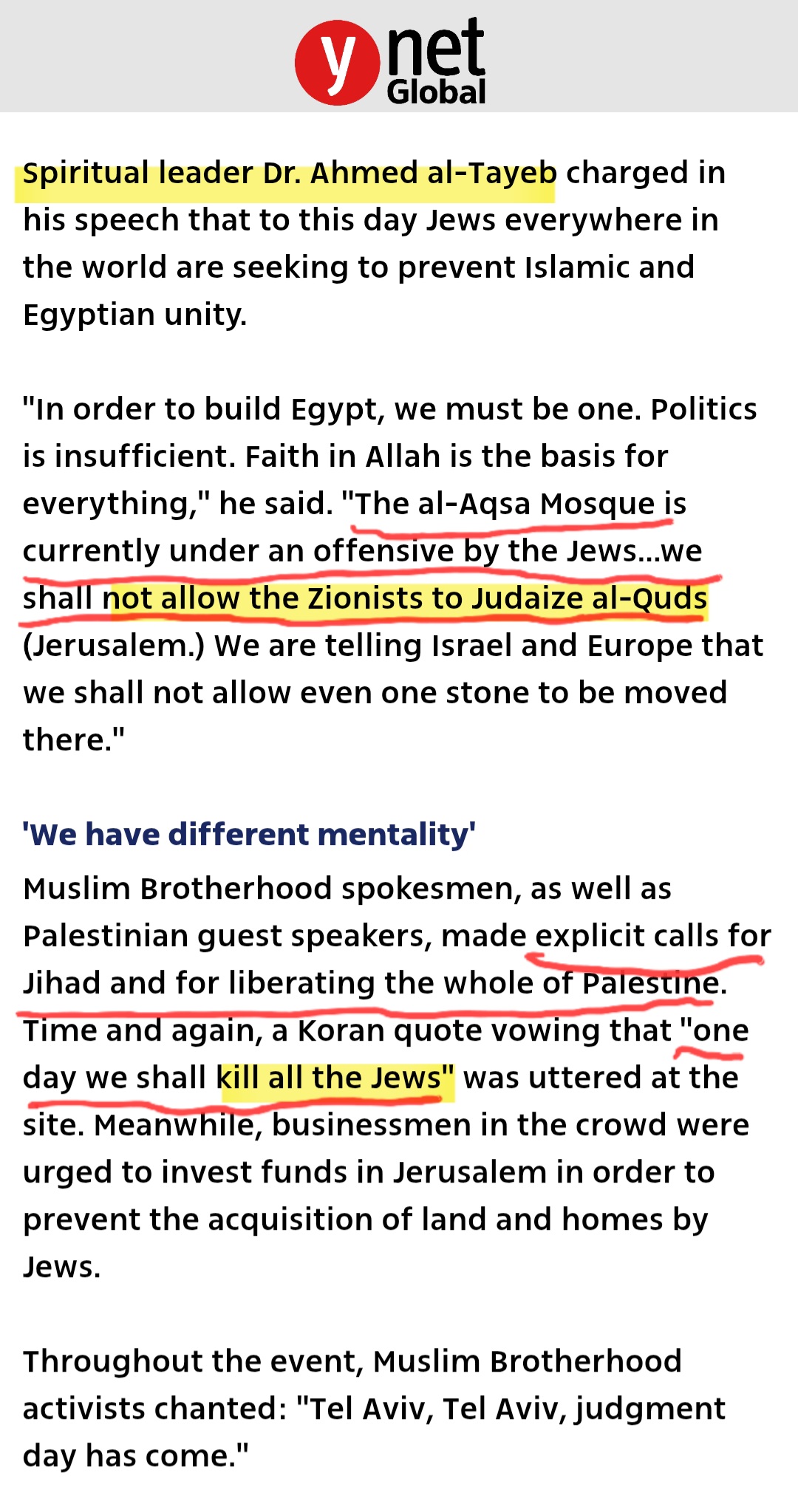
On the day after Holocaust Remembrance Day—after solemn vows of “Never Again”—the Secretary-General of the United Nations chose to praise a cleric who has spent years demonizing Jews and denying their right to exist in their holiest city under the framework of an “International Day of Human Fraternity.“
António Guterres elevated “His Eminence the Grand Imam of Al-Azhar Sheikh Ahmed El-Tayeb” as a global partner for peace, despite a record steeped in antisemitic incitement. Under el-Tayeb’s authority, Jews are framed as conspirators, Jewish prayer is cast as desecration, and Jewish presence in Jerusalem is portrayed as a civilizational crime. At events tied to his influence, chants calling for the killing of Jews and the eradication of Jewish sovereignty are tolerated and normalized.
“both Judaism and the Hebrew language have nothing to do with Jerusalem and Palestine.” – official statement of Al-Azhar
The ideology behind it is familiar. It rests on an Islamic superiority complex that treats Jewish sovereignty as illegitimate, Jewish history as fraudulent, and Jewish worship as contamination. In this worldview, Islam may rule Jerusalem absolutely; Jews may exist only conditionally and quietly—preferably elsewhere. Jewish presence in their ancestral capital becomes an offense demanding correction.
“”Do not think that we will ever give up on Jerusalem. We cannot abandon our rights there as a Muslim people. Allah will not enable you to erect a single stone on this land as long as Jihad persists.”” – official statement of Al-Azhar
El-Tayeb has given voice to this logic. Crowds gathered under his prestige repeat it. The demand is explicit: Jerusalem must be purged of Jewish claims, Jewish history, and Jewish life.
“In their attempt to judaize Jerusalem, the Zionists, in reliance on brutal Western imperialist powers, are risking the future of the Jews themselves by overstepping the limits of the Muslim Nation whose population is about a quarter of humanity, and who are able, one day soon, to restore their usurped rights by force.”
When the UN Secretary-General praises this man as a moral authority, he aligns with that demand. The language used by the UN confirms it. The profound antisemitism is ignored. Calls to violence dissolve into “grievance.” Incitement becomes “cultural difference.” Jewish presence is reframed as provocation.
This is how the United Nations defines peace: Jewish invalidation, submission, removal.
Guterres speaks of “a world based on equal rights for all and compassion” while elevating a cleric who denies Jews equality in the one place central to their faith and history. That contradiction is structural and vicious.
A jihadi antisemite is rebranded as a peacemaker, with ethnic cleansing repackaged as protection of holy sites.
And so, holocaust remembrance evaporates overnight.
History will read this moment clearly. When antisemitism returned cloaked in religious authority and liberation rhetoric, the United Nations offered applause, legitimacy, and a podium.
On Holocaust Remembrance Day, António Guterres reached for the safest symbol available: Nuremberg. He spoke of universal lessons, multilateralism, and the dangers of unchecked hatred. It sounded solemn, but it was evasive. By invoking Nuremberg instead of Eichmann, the UN spun a story in which institutions matter more than victims, and legality matters more than justice.
That choice is not accidental. It is institutional self-protection.
Why the UN Prefers Nuremberg
The International Military Tribunal flatters multilateral ideals. It universalizes guilt, diffuses responsibility, and allows the UN to present itself as the heir to postwar justice. It avoids a harder truth: the world did not finish the job. Genocide went unnamed. Jewish extermination was evidence, not the charge. Many perpetrators melted back into ordinary life.
The Nuremberg trials were necessary but insufficient. And on Holocaust Remembrance Day, sufficiency is the point.
“I have always understood the clear link between the horrors of the Holocaust and the spirit of multilateralism, justice and rights that founded our organization. Just over 80 years ago, the Nuremberg trials began. These trials represented the beginning of a new era in international criminal law; an era 78 which individuals, including the most powerful, are held accountable. Today, more than ever, we need to reclaim that spirit.” – UN Secretary General Antonio Guterres on Holocaust Remembrance Day
Eichmann Is the Missing Sentence—And the Turning Hinge
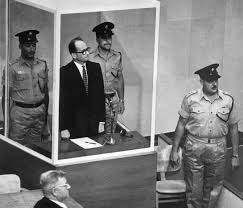
The trial of Adolf Eichmann in Jerusalem did what Nuremberg did not. It named genocide as genocide. It put survivor testimony at the center. It replaced bureaucratic fog with individual culpability. Eichmann was not tried as a generic war criminal; he was judged as an architect of the annihilation of Jews.
Adolf Eichmann on trial in Jerusalem, many years after the Nuremberg trials
As Hannah Arendt observed, the case exposed how extermination was operationalized by ordinary men. And it exposed a global failure: Eichmann lived freely for years after the war. Many like him were never tried at all.
That is why Eichmann is not an “example” to be mentioned in passing. He is the pivot of postwar justice—the moment when the Holocaust was finally understood, named, and judged as what it was.
Universalism That Erases the Crime
Guterres’s language collapses the Holocaust into a general warning about hatred. of course hatred matters. But flattening the crime turns extermination into general prejudice and genocide into an abstraction. The Holocaust was not simply bigotry run amok; it was a state-organized project to destroy a people everywhere it could reach them.
Universalism should follow truth—not replace it. When remembrance avoids naming genocide plainly, “Never Again” becomes a slogan that comforts institutions rather than indicts them.
The Uncomfortable Lesson the UN Avoids
The defining act of Holocaust justice did not come from the UN system. It came from a Jewish state acting unilaterally. Without Israel, Eichmann would have died untried, his crimes dissolved into postwar amnesia. That is not a political claim; it is a historical conclusion.
The UN prefers Nuremberg because Eichmann exposes its limits. Nuremberg affirms process; Eichmann exposes failure. One reviews general war crimes while the other points the finger squarely at demonic antisemitism. One is safe to cite as the other forces accountability.
Holocaust Remembrance Day is not a seminar on international law. It is a reckoning with a singular crime and a singular abandonment. The Jewish state does not exist to teach the world lessons, but we see plainly that the world failed to protect Jews—and then failed to prosecute their murderers. And it fails to recognize the clear difference to this day – on the very day designated to remember.
The Line That Cannot Be Dodged
Remembrance without judgment is theater. On Holocaust Remembrance Day, the honest citation is not Nuremberg’s promise but Eichmann’s dock. One symbolizes aspiration. The other delivered judgment.
If the UN wants this day to mean more than ritual, it must say the truth it avoids: the Holocaust was finally understood, named, and judged because Jews had a state willing to act when the world would not. That is not a complication of remembrance. It is its core.
António Guterres wants the world to believe that peace can be engineered with a spreadsheet — that inequality is the disease, redistribution the cure, and justice a matter of financial rearrangement. In his January 15 address, he warned that concentrated wealth corrupts institutions and that most low-development countries are in conflict. The implication is unmistakable: balance the books and peace will follow.
“The top 1 per cent holds 43 per cent of global financial assets. And last year alone, the richest 500 individuals added $2.2 trillion to their fortunes.
Increasingly, we see a world where the ultra-wealthiest and the companies they control are calling the shots like never before — wielding outsized influence over economies, information, and even the rules that govern us all.
When a handful of individuals can bend global narratives, sway elections, or dictate the terms of public debate, we are not just facing inequality — we are facing the corruption of institutions and our shared values.” – UNSG Antonio Guterres
But choosing the wrong enemy guarantees the wrong war.
Because evil is not an accounting problem.
The UN’s failure begins in its diagnosis. It treats terrorism as a social pathology when it is, in fact, an ideological one.
Terrorism is not born in empty wallets. It is born in minds captured by belief.
Two decades of research have demolished the claim that poverty causes terror. Terrorists are rarely the poorest of the poor. They are often educated, middle-class, and technically trained — the engineers of jihad, the lawyers of holy war. The suicide bomber is seldom starving. He is convinced.
If poverty produced terrorism, the poorest societies would be its factories. They are not. Many desperately poor states remain largely untouched by global jihad, while terror movements arise from politically radicalized societies with functioning middle classes and ideological incubators.
What correlates with terrorism is not poverty, but ideas combined with power: religious absolutism, revolutionary nationalism, grievance cultures, and failed identity — not failed GDP.
This is not an academic distinction. It is the fault line between clarity and catastrophe.
If money could defeat jihad, Gaza would be the proof. It is not — it is the refutation.
Gaza has received billions in international aid. What emerged was not prosperity, but the most elaborate terrorist war machine ever embedded in a civilian population: tunnels beneath hospitals, command bunkers under schools, rockets from playgrounds, children trained for martyrdom.
This was not a failure of funding. It was the success of ideology. And the UN instigates that very ideology claiming that Israel should have no sovereign control of who enters its country, and specifically that almost every Arab living in Gaza will move into Israel with UN support.
“We are totally committed in the cause of peace in Gaza, Ukraine, Sudan and far beyond.” – UNSG Antonio Guterres
Hamas did not build tunnels because Gazans were poor. Hamas built tunnels because its charter demands Israel’s destruction, because martyrdom is sacred, because jihad is identity. Money did not create this worldview — it merely financed its execution.
You can flood a society with aid, but if its governing ideology is annihilationist, all you finance is a more capable war machine.
Once the UN misdiagnoses ideology as economics, the next failure becomes inevitable.
For decades, it has constructed and sustained a grievance system around the Stateless Arabs from Palestine (SAPs) that functions symbiotically with jihadist aims. Through its agencies and resolutions, it has promised millions of SAPs who have never lived in Israel that they will one day “return” en masse into Israel — effectively proposing Israel’s demographic erasure through mass population transfer via international decree.
No state can survive if an external body claims authority over who may enter it and redefine its citizenship from the outside. Yet the UN has made this assault on sovereignty a central plank of its Palestine policy — while calling it “humanitarian.”
Through UNRWA’s unique multigenerational refugee status, displacement becomes inherited identity rather than a temporary humanitarian condition. Grievance becomes doctrine. Statelessness becomes culture. A territorial dispute becomes a perpetual weapon.
And then the UN asks for more money to sustain it.
Why does the UN persist in this inversion?
Because it refuses to judge belief systems.
It will not confront jihad as an ideology. It will not describe Islamic terrorism as such. It will not wade into cultural or civilizational dynamics because it sees itself as a neutral global body.
But neutrality toward ideology does not produce peace. It produces permission.
And because the UN will not fight belief systems, it substitutes economics.
It reframes terror as inequality. It reframes jihad as deprivation. It reframes mass murder as misallocated capital.
In doing so, it becomes part of a broader machinery seeking to shift wealth and power from the Global North to the Global South — not merely for development, but as moral rebalancing, regardless of whether this addresses the real drivers of violence.
Redistribution becomes its ritual response whenever violence erupts.
Which means: more authority, more money, more relevance for the UN.
This is not accidental. It is institutional self-preservation dressed as virtue.
So the world is invited to believe the problem is billionaires rather than beheaders. That terror is born from inequality rather than indoctrination. That peace will come from redistribution rather than defeating enemies.
Evil is not a pocketbook problem. It is an ideology.
And no amount of redistribution will make a death cult lay down its weapons.
Modern conflict is collapsing into a single, repeatable failure mode: when armed power replaces legitimacy, civilian life becomes expendable—and the international system normalizes the outcome rather than correcting it.
From Syria to Yemen, from the Gaza Strip to Somalia and Sudan, different wars follow the same script. Flags and slogans change; outcomes do not. Cities empty, economies collapse, millions flee, and societies become permanent humanitarian wards while armed elites persist.
The mechanics of collapse
Across all five regions, the structure repeats with grim consistency. Power flows from weapons rather than consent, with ideology serving as authority instead of constraining it. Civilians become leverage—through hunger, displacement, and terror—while the outside world manages suffering rather than ending the conditions that cause it.
These dynamics differ in context and scale. They converge in result.
Different conflicts, identical results
Syria survives by sacrificing its cities and people. Yemen turns famine into strategy in a proxy war. Gaza shows armed rule embedded among civilians, shifting the cost of war onto the population. Somalia normalizes permanent instability under jihadist entrenchment. Sudan mirrors the same logic through rival armed elites hollowing out cities and driving mass displacement.
The human outcome is uniform.
A shared demographic reality
Each of these societies is overwhelmingly Muslim-majority— above 90 percent. This matters for clarity. These disasters do not arise from religious diversity or minority rule. They unfold in largely homogeneous societies where armed authority crowds out the chance for peaceful legitimate governance. Shared faith does not restrain violence. Only accountable institutions do—and they are absent across all five.
Two warnings for 2026
First: recognition divorced from reality. The push to recognize Palestine as a sovereign state reflects a dangerous inversion. Recognition is meant to affirm effective governance, restraint of armed actors, and protection of civilians. Gaza demonstrates the opposite. Armed rule persists, civilians absorb the cost, and failure deepens. Recognition under these conditions elevates symbolism over survival and legitimizes collapse.
Second: repression without war. In Iran, an ideological regime in power since 1979 faces economic decline and eroding legitimacy. The response has been internal violence—security forces firing on civilians, mass arrests, repression replacing consent. Iran shows the same pattern without a battlefield: when legitimacy collapses, violence becomes governance.
The United Nations: institutionalizing failure
The United Nations was founded to prevent this exact depravity. Eighty years on, it increasingly fosters it.
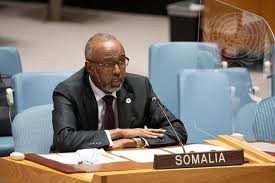
The UN grants equal procedural authority—votes, committee chairs, agenda control—to entities regardless of whether they govern responsibly or sacrifice their populations. Collapse carries no institutional penalty. In January 2026, the UN Security Council, the highest body at the UN, handed the gavel to Somalia, a state unable to protect its citizens or control its territory. Committee chairs shape agendas, manage debate, and mute scrutiny. The signal was unmistakable: mass failure has no consequence.
Somalia assumes head of UN Security Council in January 2026
This structure protects actors who weaponize civilians, including groups like Hamas, while rewarding states that export instability. Humanitarian agencies attempt to save lives on the ground, but UN governance shields the forces that endanger them. Through regional rotation, states implicated in mass civilian harm routinely gain seats, votes, and leadership roles across UN committees—including those charged with protecting human rights—without meeting any threshold of civilian protection.
Entities that systematically sacrifice civilians should lose voting rights and committee authority until they demonstrate basic standards of governance and restraint. Without consequences, international law becomes theater and failure becomes permanent.
The verdict
Syria, Yemen, Gaza, Somalia, Sudan—and the trajectory now visible in Iran—show what follows when sovereignty outweighs civilian life and armed power is indulged as politics. By preserving authority for collapsing entities, the United Nations has become part of the problem it was created to solve.
Civilian survival and protection must be the minimum requirement for legitimacy. If the UN cannot reform to enforce that standard INTERNALLY, then eighty years after its founding, it stands as a faint shadow of its founding principles at best, and an enabler of mass atrocities at worst.
Every UN humanitarian agency coordinates with the authority that governs where it operates—except in Jerusalem. That exception is not a footnote. It is the story. And it exposes a mandate failure driven by politics, not humanitarian necessity.
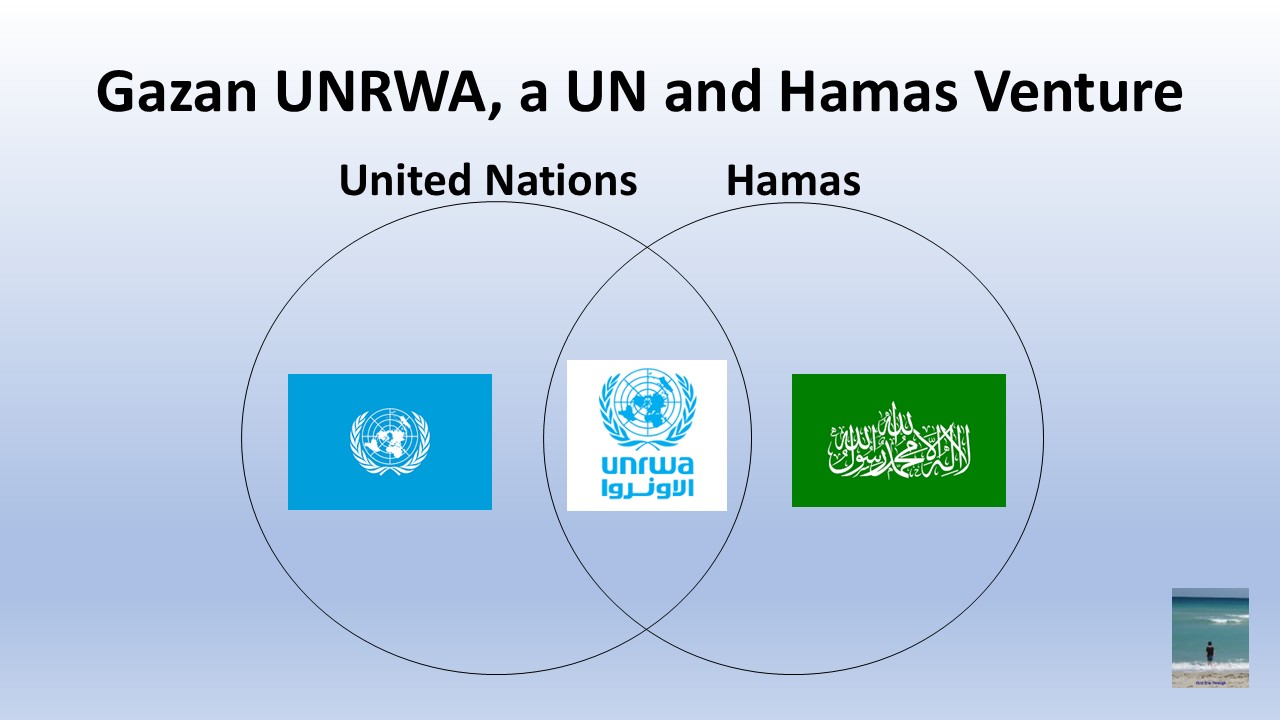
UNRWA holds that humanitarian work requires coordination with governing authorities. In practice, it does so almost everywhere: with Jordan, Lebanon, Syria, the Palestinian Authority—and even with Hamas in Gaza, despite Hamas’s terrorist designation by the United States, the EU, the UK, and others.
In Jerusalem alone, UNRWA refuses to coordinate with Israel, the authority exercising full municipal, policing, and regulatory control over the city.
Call it “coordination for access” if you like. It is still coordination. And municipal coordination is not a sovereignty concession (if one believes that Israel does not have sovereignty over eastern Jerusalem despite annexing it in 1980); it is a humanitarian necessity.
How the Facilities Came to Exist
UNRWA’s Jerusalem facilities were established between 1949 and 1967, when Jordan seized and annexed the eastern half of the city in a move not recognized by the UN or the international community. UNRWA nonetheless coordinated with the Hashemite authorities to build schools, clinics, and service centers—because humanitarian work requires coordination with whoever governs in fact.
That history matters. UNRWA’s Jerusalem footprint exists specifically because it once coordinated with an unrecognized occupier.
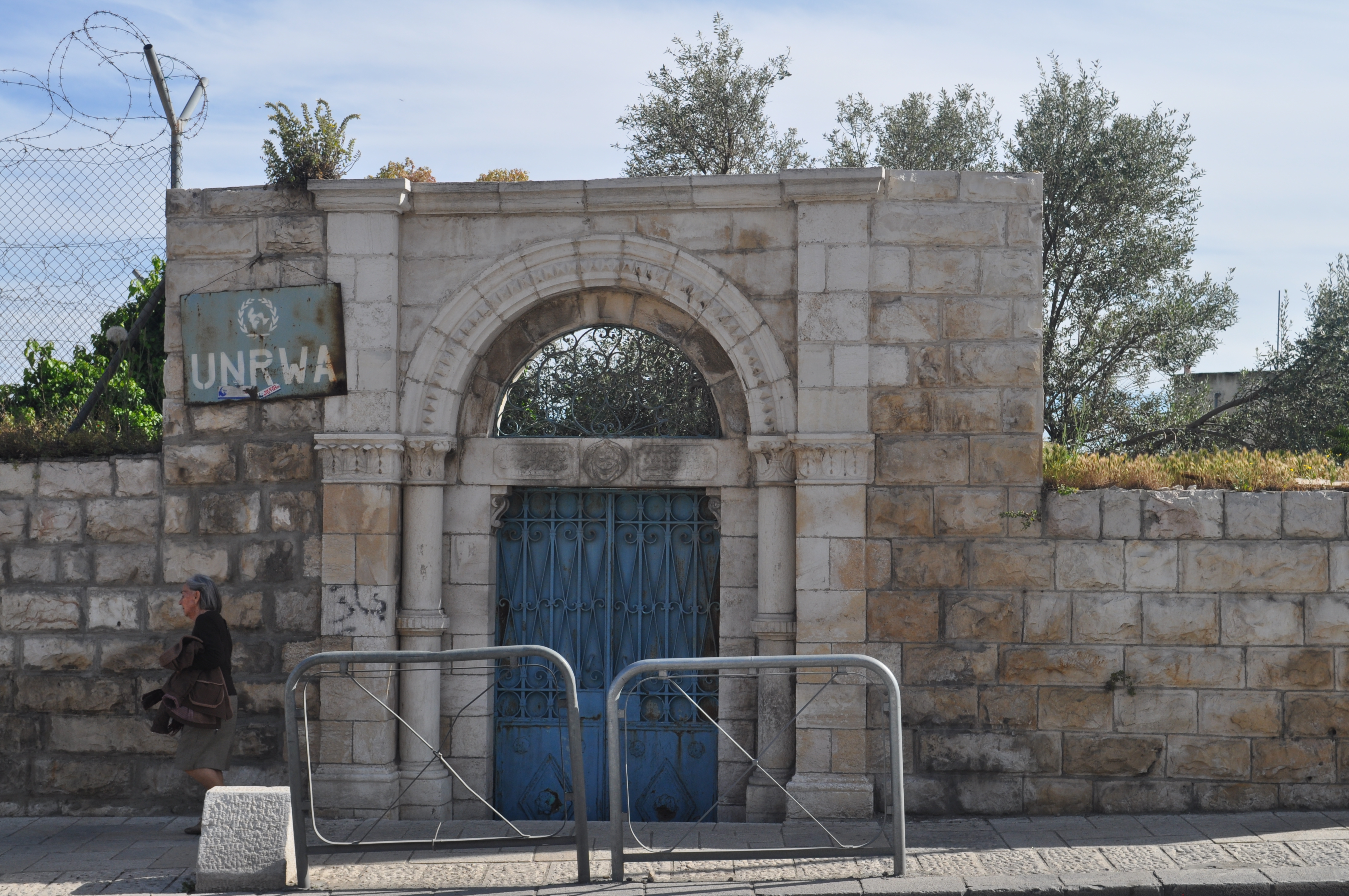
UNRWA offices in Jerusalem (photo: First One Through)
The Reversal
In 1967, Jordan entered the war, violated the armistice, and lost control of Jerusalem. Israel assumed governance and unified the city. Palestinian Arab residents became permanent residents with access to Israeli courts, healthcare, municipal services, and the right to apply for citizenship.
At that point, UNRWA reversed its logic. Where it coordinated with Jordan despite non-recognition, it now refuses to coordinate with Israel—by labeling eastern Jerusalem “occupied Palestinian territory,” theoretically negating its obligation to work with Israel.
That label sits uneasily with the UN’s own history. The 1947 Partition Plan never intended Jerusalem—east or west—to belong to an Arab state. The city was designated a corpus separatum, an internationally administered entity. Jerusalem was never meant to be Arab sovereign territory.
The contours of “Corpus Separatum” (in pink) in the United Nations 1947 Partition Plan stretched over Greater Bethlehem and Greater Jerusalem, marking the region as an international Holy Basin to be administered by the UN
An Outlier by Design
UNRWA’s mandate emphasizes cooperation with local authorities to ensure access, security, and civilian protection. That cooperation exists everywhere except Jerusalem. UNRWA coordinates with armed groups and unrecognized authorities elsewhere, yet refuses coordination with the governing authority in the city where coordination is most essential.
Refusing to coordinate with the authority responsible for public safety is not neutrality. It is an affirmative political act—one that inverts humanitarian logic by privileging narrative over civilian protection. UN immunity exists to facilitate coordination, not to replace it.
Continuity of Care—and the Standoff
Israel has enacted laws to shutter UNRWA offices in Jerusalem. UNRWA refuses to comply, invoking immunity and operating facilities largely outside municipal oversight. The confrontation exists because UNRWA chose inconsistency in the one city where consistency matters most.
“The UNRWA Jerusalem Health Centre, which serves hundreds of Palestine refugee patients every day is, for most of them, their only possibility of having access to primary healthcare…. These [Israeli] measures are a violation of the inviolability of United Nations premises and an obstacle to the implementation of the clear mandate of the General Assembly for UNRWA’s continued operations in the Occupied Palestinian Territory, including East Jerusalem.” – UN Secretary General Antonio Guterres January 15, 2026
The closure of UNRWA offices in Jerusalem would not create a humanitarian vacuum. Education, healthcare, and social services are already provided through municipal systems, national institutions, other UN bodies, and a dense NGO network operating in the city. What would end is not care delivery, but UNRWA’sparallel governance model.
Palestinian Arabs in Jerusalem rely daily on municipal emergency services, hospitals, and courts. UNRWA’s non-coordination removes the safety mechanisms coordination is meant to provide—for civilians, staff, students, and patients alike.
The Reckoning
UNRWA coordinated with Jordan when Jordan’s rule was unrecognized. It coordinates with Hamas despite terrorist designations. Yet it refuses to coordinate with Israel while Israel governs the city, extends legal status to its Arab residents, and has a network of service providers which can easily replace UNRWA in Jerusalem.
That is not humanitarian principle. It is selective politics.
Consistency is the minimum requirement of a mandate. A mandate that works everywhere but Jerusalem is not a mandate—it is a message, and it is that UNRWA is not a humanitarian organization.
UNRWA remains a rusty tool of the 1947 Partition Plan which insists that holy sites in Jerusalem never fall under Jewish rule.
The near-term ramifications of Hamas’s war against Israel are being crystalized. Hamas’s leadership is decimated and Gaza is in ruins. The political-terrorist group’s allies in Lebanon, Syria, Iran and Yemen have been dealt severe blows, perhaps fatal for some. Hamas’s cheerleaders in the Global North are the only ones to have gathered momentum, particularly in Australia and the United States where hunting season for Jews has a seemingly open permit.
To gain insight for the next tactical steps, world leaders are looking at the current situation and polls since October 7, 2023 and have drafted proposals and taken initial actions: The United Kingdom and Canada recognized a Palestinian State. The U.S.’s Trump administration put forward a plan for Gaza which would include a new governing entity. The West hopes that the targeted assaults and murder of Jews will peter out along with the end of war. And the United Nations keeps playing the same tune about supporting UNRWA.
These are bad decisions and conclusions, made on faulty assumptions.
There is an organization that has been polling Palestinian Arabs for decades, called the Palestinian Center for POLICY and SURVEY RESEARCH (PCPSR). It conducted a poll of Arabs in Gaza and the West Bank, just before the Hamas-led war, from September 28 to October 8, 2023. Because of the war, the results did not get published until June 26, 2024, and the world was too focused on the war to pay it any attention. It is deeply unfortunate, and it is required reading to help chart a better future for the region.
To start with the poll’s conclusions:
A large percentage of Palestinian Arabs have wanted to leave Gaza and the West Bank for years, not from the current destruction
Arabs are fed up with their own government – Hamas and the Palestinian Authority – much more than Israeli “occupation”
Canada is viewed much like Qatar for Gazans, a sympathetic haven
Palestinian Arabs Wanted to Emigrate Before the War
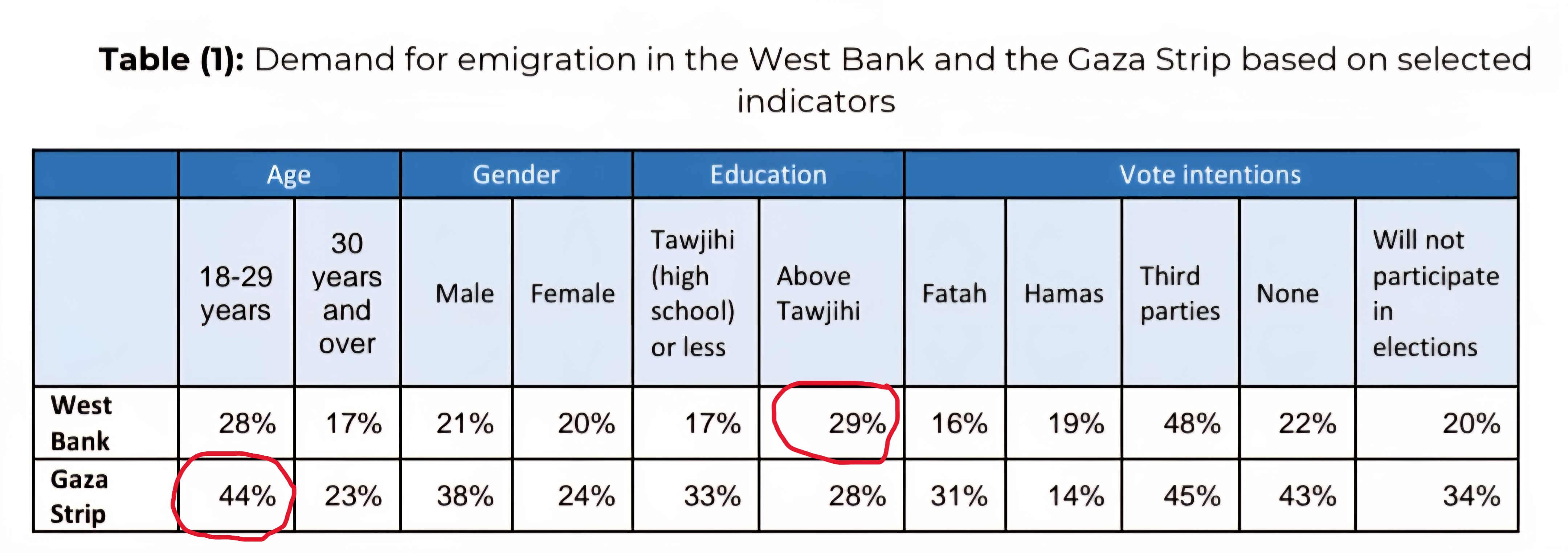
According to PCPSR, whether in October 2023 or November 2021, roughly 33% of Gazans and 20% of West Bank Arabs wanted to leave the region.
Men below age 30 make up the vast majority of those seeking to emigrate. As opposed to Gaza where both educated and uneducated people want to leave, it is the educated West Bank population that wants to move away. Among those wishing to leave, many would not vote in Palestinian elections, or if they would, they would sooner vote for third parties over Fatah or Hamas.
Palestinian Leadership is the Curse, More than Israel
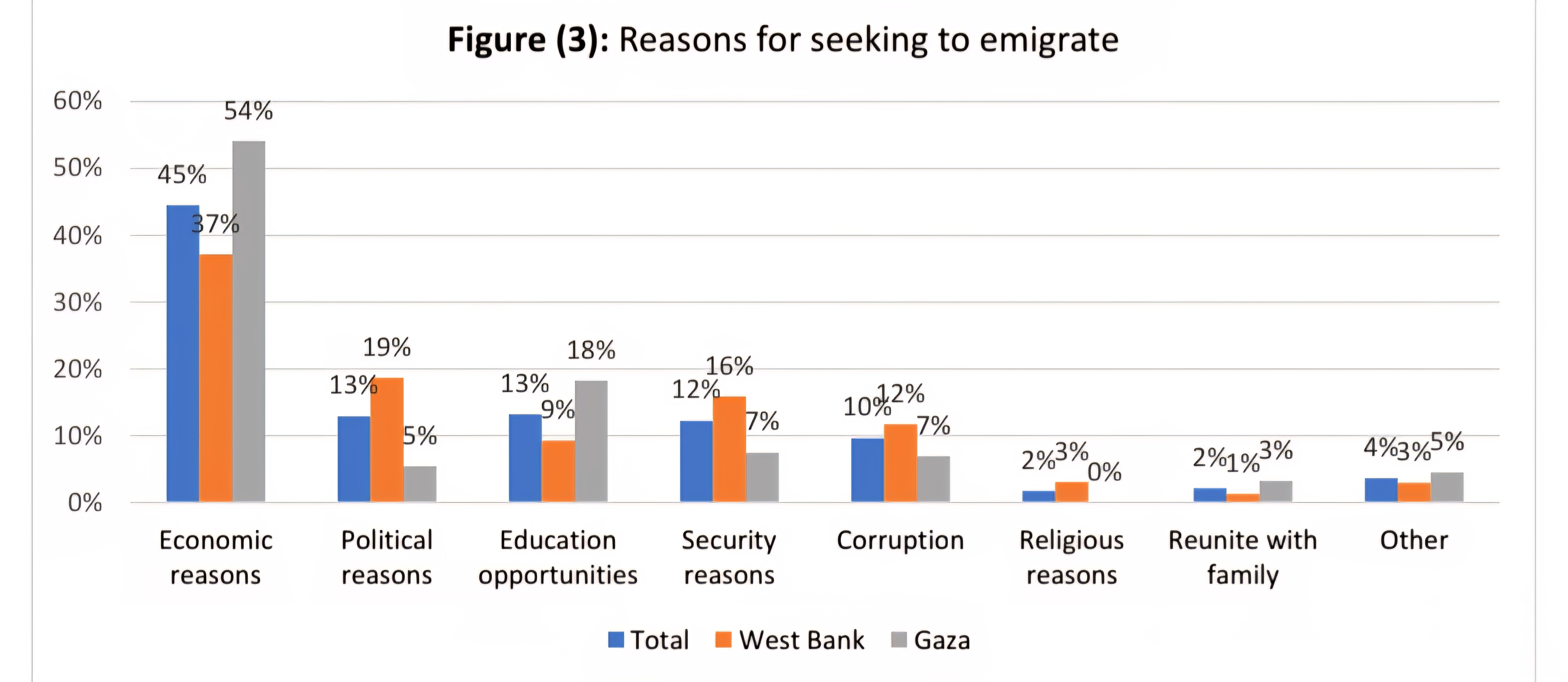
The number one reason for wanting to leave was economic conditions by a far margin. Reasons two and three were political reasons and educational opportunities. “Security reasons” came in fourth, with only 7% of Gazans focused on security; 12% overall. Corruption, religious reasons and to reunite with family rounded out the poll.
Canada as a Beacon
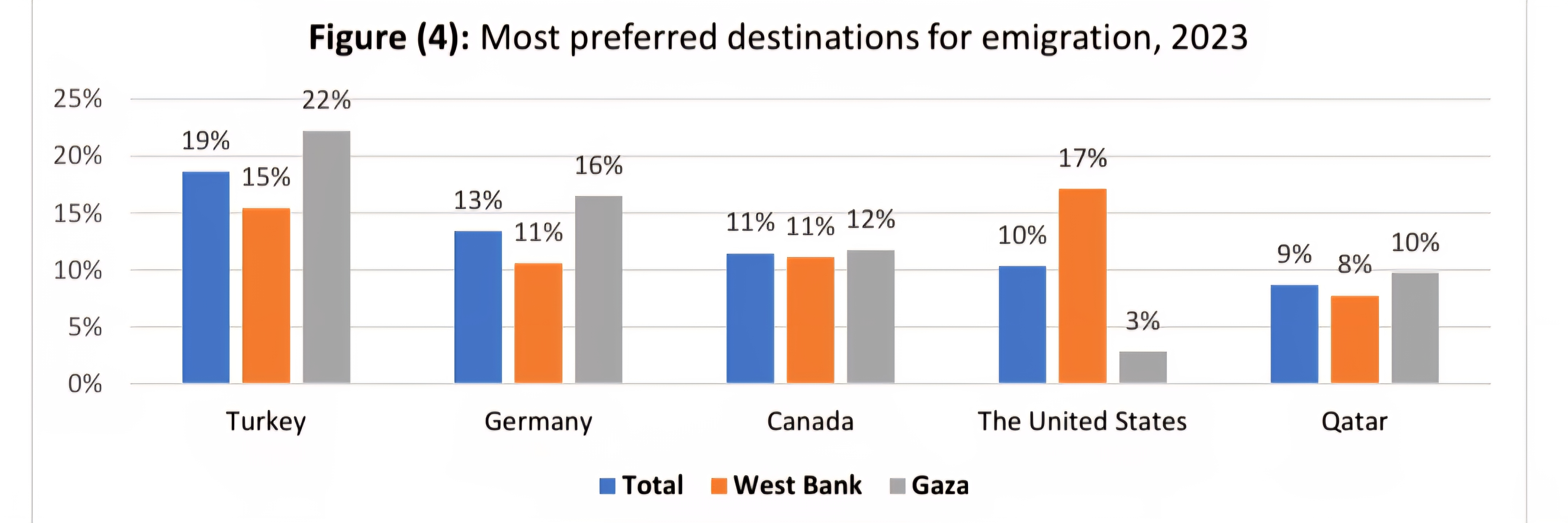
Turkey and Germany were the two most favorite destinations, especially for Gazans. Very few Gazans (3%) considered the United States, while West Bank Arabs put it as the number one choice (17%), likely seeking advanced degrees at left-wing universities. What is remarkable, is more of the Stateless Arabs (SAPs) would prefer going to Canada (11%) than Qatar (9%), the wealthy Muslim Arab nation that is a main sponsor of Hamas.
Honest Takeaways
These pre-war results leads to some basic and critical conclusions.
Complete Overhaul of Palestinian leadership, not just in Gaza
The desire of Arabs to leave was evident across both Gaza and the West Bank for many years. This was not a reaction to bombing or siege; it was a verdict on governance.
Hamas in Gaza rules through repression, diversion of aid, and religious militarism. The Palestinian Authority in the West Bank offers corruption, authoritarianism, and political stagnation. Together they have produced a society with no credible economic horizon, no accountable leadership, and no peaceful mechanism for change.
While a new entity is needed to administer Gaza, that role should be akin to a Chief Operating Officer overseeing construction. The Palestinian Authority itself needs to be gutted and rebuilt as it is a corrupt, unpopular and ineffective entity.
The United Nations Must Withdraw from Gaza and the West Bank
In its desire to create a Palestinian state, the U.N. has stripped the titular heads of Palestine of any responsibility. The UN protects Hamas despite its savagery. It props up the Palestinian Authority despite its rampant corruption. Palestinian leadership is a bed of paper scorpions.
The UN must withdraw from Gaza and the West Bank and allow local authorities to build a functioning leadership team.
The West Should Rescind Recognition of Palestine
There is no functioning Palestinian government and therefore no basic standard to recognize a Palestinian State. The United Kingdom, Australia and others should withdraw their recognition and make it conditional on building governing institutions that can lead and make peace with the Jewish State next door.
Reeducation in the West
The massacre did not arise from a sudden spike in pressure. It emerged from long-standing internal failure. Hamas chose atrocity because it couldn’t commit a complete genocide of Jews so exploited its own population to be fodder for Israel.
Western audiences were then handed a familiar script, complete with pictures. But the data taken just before the massacre tells a different story—one far more consequential. What is being taught in western public schools is divorced from reality and feeds global and local antisemitism.
Oh No, Canada
While the fears of antisemitism are focused on the United States and Australia because of recent attacks on Jews, Canada is in the hearts and minds of Palestinian Arabs seeking a warm diaspora community. Perhaps it started a decade ago under Justin Trudeau who followed U.S.’s President Barack Obama to embrace the Palestinian cause and Iranian regime over Israel. Perhaps it is because of the welcome mat for extremists groups like Samidoun. Or perhaps it is the perception that the heckler’s veto is fair game, and can run Jewish families off Canadian streets.
Whatever the inspiration, Canada is widely perceived as permissive, ideologically indulgent, and administratively porous—an attractive environment for “political activism” untethered from civic responsibility. It is a ticking time bomb.
The poll of Palestinian Arabs on the eve of the October 7 war reveals deeper truths than surface shots of leveled homes. The PCPSR findings point to a single truth: the Palestinian problem is fundamentally internal.
Ending Israeli control over territory without dismantling corrupt and extremist institutions will not deliver prosperity or peace. Statehood layered on top of dysfunction will harden it. And exporting populations shaped by jihadist rule into permissive Western societies without serious screening and integration, risks importing instability rather than relieving it.
The world likes to pretend it is debating policy. In many ways, it is actually debating whether civilization itself deserves defense—whether restraint remains a virtue or has become a liability.
That choice is one individuals are weighing, and on a macro scale, it now runs through the United Nations, through the rhetoric of reform and revolution, and through a relentless fixation on one small country—Israel—which has been made the moral test case for the survival of a rules-based order.
An Ancient Conflict, Restated
In 1944 as World War II raged, Reinhold Niebuhr described the permanent struggle of politics in The Children of Light and the Children of Darkness. The children of light believe in higher law, institutions, and restraint and try to build a just civilization. The children of darkness believe power is the only reality. They understand fear, pride, resentment—and how to use them.
Niebuhr’s delivered an unsentimental warning: civilization fails not because darkness appears, but because light refuses to learn how aggressively darkness operates.
As Portrayed Today in the Arts
That moral tension is dramatized—accidentally, but perfectly—in Game of Thrones.
Petyr Baelish (“Littlefinger”) believes nothing is sacred. Institutions are illusions; morality is theater. When order breaks, the ambitious climb. His worldview that “Chaos is a ladder” is not poetry—it is strategy. He does not want to fix the system. He wants to use its collapse to gain power.
Opposite him stands Varys, who believes in “the realm”—stability, continuity, restraint. Varys is not innocent. He lies and plots as much as Littlefinger. But he does so defensively, to preserve something larger than himself. Chaos, to him, is not liberation; it is mass suffering.
“Chaos isn’t a pit. Chaos is a ladder. Many who try to climb it fail and never get to try again. The fall breaks them. And some are given a chance to climb. They refuse, they cling to the realm or the gods or love. Illusions. Only the ladder is real. The climb is all there is.”- Littlefinger
This is the argument now playing out on the world stage.
The United Nations and the “Age of Chaos”
In September 2025, Antonio Guterres warned that the world had entered an “Age of Chaos,” where multilateralism failed repeatedly. His message was neither complacent nor revolutionary. The post-1945 order, he acknowledged, was built by Western powers and often abused. It needs reform and broader inclusion. But it must be preserved.
Guterres is a modern Varys: clear-eyed about corruption, fearful of what replaces restraint. The tragedy is that he delivers this warning while presiding over an institution that enables the very chaos he names, and where lies and bias are systemic.
Moral failure: It erases Jewish indigeneity and recasts Jewish self-determination as a moral crime.
Legal failure: It treats 1949 armistice lines as borders, declares “flagrant violation” absent negotiations, and invents a categorical illegality applied nowhere else.
Institutional failure: It weaponizes international law through selective enforcement, degrading the credibility of law itself.
UNSC 2334 is not merely flawed. It is structurally antisemitic, legally incoherent, and corrosive to the rules it claims to uphold. Any serious effort to defend and remake the UN must begin by rejecting and discarding UNSC 2334—not as a political concession, but as a moral necessity. No legitimate order can be rebuilt on a prominent pernicious lie.
The Global South’s Demand—and the Line It Cannot Cross
The Global South is right about one thing: the UN reflects a Global North power structure frozen in time. Representation must change. Influence must broaden. That reckoning is overdue.
But reform cannot be purchased by sacrificing the most vulnerable and attacked minority on earth.
Using Israel as the symbol of colonial evil is not reform; it is delegitimization by fiction. It turns history upside down, rebrands violence as virtue, and tells Jews that their survival is negotiable. Israel is targeted not because it is uniquely guilty, but because it is symbolically central.
Israel has become the ladder.
Modern Littlefingers
This logic spans ideologies.
On the left, movements such as the Democratic Socialists of America argue that markets, property, and liberal institutions are inherently illegitimate—delegitimize first, rebuild later. On the right, Donald Trump treats international norms as inconveniences, speaking casually about seizing Venezuelan oil and replacing rules with deals.
They oppose each other rhetorically, but share a premise: restraint is weakness; destruction is honesty. Chaos creates leverage.
They are modern Littlefingers.
The Failure of Passive Moderation
Between these forces stand moderates who see hypocrisy, feel exhaustion, and withdraw in disgust. That retreat feels virtuous. It is not.
As David Brooks argues by drawing on Niebuhr, moderation without courage becomes complicity. When decent people refuse to defend flawed institutions, they leave the field to those who understand power best.
Niebuhr’s answer was not extremism, but what he called “a sublime madness in the soul”—a fierce commitment to liberal institutions precisely because they restrain human savagery. The children of light must learn the wisdom of the serpent without inheriting its malice.
An Ancient Return—and a Choice
Modern politics, which prides itself on being post-religious, has returned to the oldest moral frame: absolute light versus absolute darkness. One side is pure; the other illegitimate. Violence becomes cleansing; institutions corrupt by definition. This language was written two thousand years ago in the land of Israel and discovered in caves as the Jewish State was being reestablished. And now that rebirthed country is being falsely accused of embodying the darkness.
The choice before us is not between justice and injustice. It is between reform and rupture.
Children of light today defend law and restraint aggressively while reforming them honestly.
Children of darkness weaponize grievance and moral absolutism to climb amid collapse.
Defending and remaking the UN must start with basic truths: reject antisemitic falsehoods, discard UNSC 2334, and pursue inclusion without scapegoats. Multipolarity cannot be built on moral nihilism. Reform cannot be purchased with lies.
The reckoning Niebuhr warned of is here. The ladder is already standing and it is being climbed by both right and left. Civilization survives only if those who believe in it act—clearly, courageously, and now.
Of the many classic lines from the TV sitcom Seinfeld, “it’s not you, it’s me,” is a great one, used as an excuse to get out of a relationship. It’s a phrase familiar to anyone who has ever been in a relationship which one party simply does not enjoy and wants to terminate gently.
There is no relationship so poorly constructed and toxic today as between Israel and the United Nations, harmonious at the start but broken bit by bit since that time. In an effort to complete it’s desire of completing the creation of two states, a Jewish one and Arab one as conceived in the General Assembly vote of partition in November 1947, the institution has fabricated lies and noxious resolutions against Israel and Jewish dignity everywhere.
Follow what the UN does, and what it says, and a stark pattern emerges: Palestinian Arabs are granted surplus political rights across the entire map, while Israel is denied the basic attributes of sovereignty. This is not mediation. It is architecture, scaffolding producing a permanent conflict.
1) Start with the most basic injustice: where Jews may live and pray
Begin where ideology becomes lived reality.
Across territory, the UN labels Palestinian Arab non-Jewish residence as inherently legitimate everywhere, while Jewish residence is declared subject in advance, legal where a Jewish State was once allotted but illegal everywhere else. Through instruments like United Nations Security Council Resolution 2334, Jewish civilians are criminalized simply for living beyond armistice lines—before borders are agreed, before negotiations conclude, before sovereignty is determined.
This is unprecedented. In every other territorial dispute on earth, civilian life is separated from sovereignty. Here, it is collapsed—selectively.
Then comes the religious core.
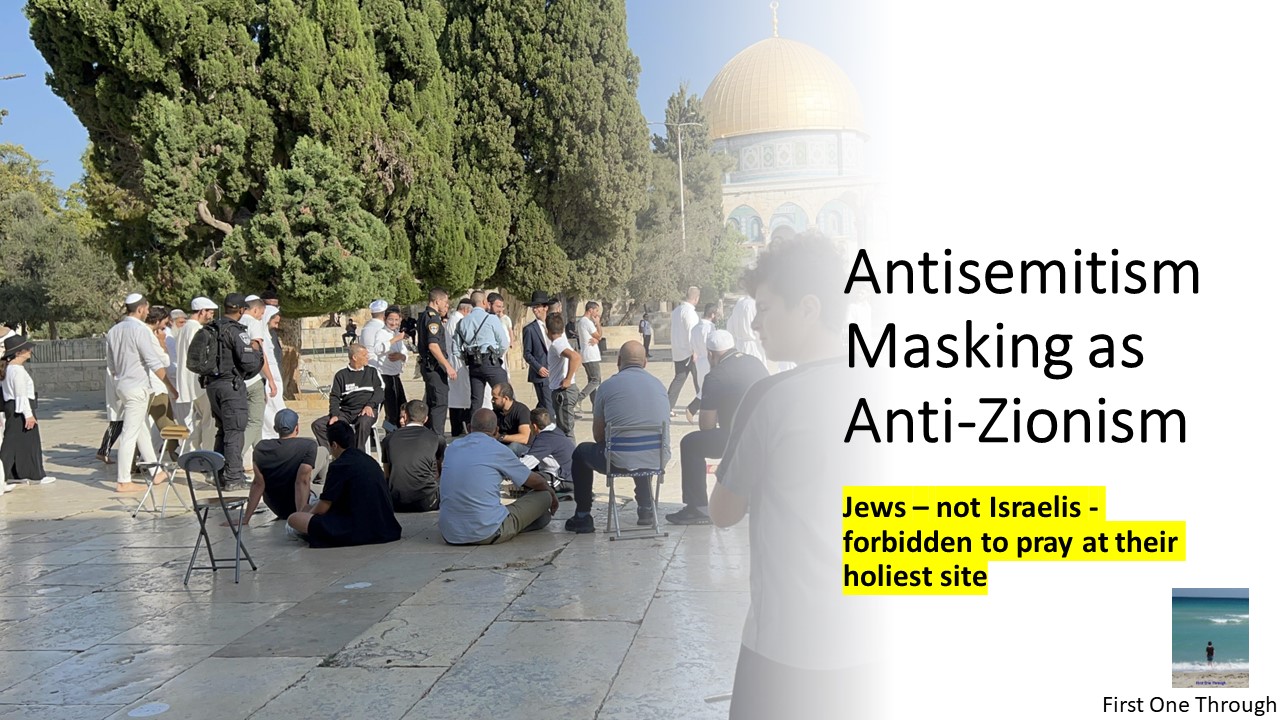
At Judaism’s holiest site—the Temple Mount / Al-Haram al-Sharif—the UN endorses a so-called “status quo” that allows Muslim prayer as a matter of course while forbidding Jewish prayer outright. Jews may visit in finite numbers. They may not worship.
No neutral body sanctifies a regime where one faith’s prayer is normal and another’s is treated as provocation. That is not stability. It is hierarchy—polished with diplomatic language.
2) Escalate to sovereignty itself: borders without control
Every sovereign state controls who enters and who becomes a citizen. Israel is uniquely told this right is negotiable.
Through endless reaffirmations of a mass “right of return,” the UN demands that Israel absorb millions of Palestinian Arabs who never lived there—descendants of a war launched to destroy the state—thereby erasing Jewish self-determination by arithmetic rather than war.
No other UN member is ordered to commit demographic self-nullification as a condition of legitimacy. Only Israel is told that survival itself is subject to international approval. International demand.
A state that cannot control entry is not sovereign. A state treated this way is not being mediated in a peace process—it is being managed.
3) Why this only happens here: permanent UN wardship
The cause is clear.
The UN did not simply sympathize with Palestinian Arabs; it adopted them as permanent wards, institutionalized most clearly through UNRWA—a bespoke agency unlike anything else in the world.
Refugee status became hereditary. Dependency became intergenerational. There is no sunset, no graduation, no expectation of resolution. Failure carries no cost because accountability is externalized.
A guardian cannot be an honest broker. An institution whose relevance depends on a client’s grievance cannot afford peace. This isn’t humanitarianism anymore. It’s custodianship—and custodianship is the enemy of compromise.
4) The doctrinal rupture: inventing a “right to a state”
Only after the machinery is in place does the UN supply its legal fiction.
The UN rewrote this rule only and specifically for Palestinian Arabs, treating sovereignty as a pre-awarded verdict because of a partition plan it voted upon in 1947 that the party refused to accept. Once the destination is guaranteed, compromise becomes optional. Negotiations become theater. Pressure flows in only one direction.
No other people receive this upgrade. Only here does the UN convert aspiration into entitlement—and then insist it is merely being neutral.
5) The smoking gun: December 1990 recasting the conflict and the legitimation of violence
Then the mask slips.
In December 1990, the UN General Assembly adopted Resolution 45/130, reaffirming “the legitimacy of the struggle of peoples … for liberation from colonial and foreign domination by all available means.” The resolution was designed to close the chapter of apartheid in South Africa, but took a heavy detour into the Israel-Palestine conflict, recasting the entire partition plan of 1947. It referenced “colonial” entities fifteen times, “Palestinians” twenty-five times, and made the establishment of an Arab state a matter of freedom from racist and external oppression, not a discussion about self-determination.
In UN practice, this language cast Israel as a colonial entity and Palestinian Arabs as a people entitled to armed struggle to dismantle it.
From that moment on, terror could be reframed as resistance, and compromise as collaboration. The UN crossed the line from mediator to moral endorser of one side’s maximalist narrative.
6) The arithmetic of the fraud
Add it up and the numbers don’t lie.
Under the UN framework, Palestinian Arabs receive:
A guaranteed future state
Political rights inside Israel
A trans-sovereign right of return into Israel
Permanent UN patronage and advocacy
International legitimation of “armed struggle” against Israel
Israel, meanwhile, is left with:
Provisional borders
Conditional legitimacy
Criminalized civilian residence in disputed territory
Restricted religious freedom
Denied control over immigration
Violence against it rhetorically excused
In this jaundiced framework, Jerusalem, which was NEVER designated to be a Palestinian city even under the 1947 partition plan, can be called “occupied Palestinian territory,” a complete fabrication even according to the UN itself.
The United Nations is not an honest broker; it is an interested architect whose rules ensure the conflict cannot end, and Jewish dignity remains conditional around the world.
By sanctifying exclusion, denying sovereignty, adopting one side as a permanent ward, inventing rights it had no authority to grant, and legitimizing violence as “anti-colonial,” the UN has guaranteed perpetual war—then blamed one of the parties for refusing peace.
In Seinfeld, one party is afforded the opportunity to end the relationship; one party has the option of providing a face-saving excuse to part ways quickly and smoothly. Not so for Israel and the United Nations, where the UN continues to manufacture obstacles and then gaslight the Jewish State that it is the root of the problem.
The UN speaks as if it is a “moral compass” in an “age of chaos.” Perhaps it once was, at least directionally. It is definitely not in the Middle East today, where its votes and actions have led to the death and misery of millions.
UN Secretary General Antonio Guterres speaks at the UN headquarters in New York in September 2025
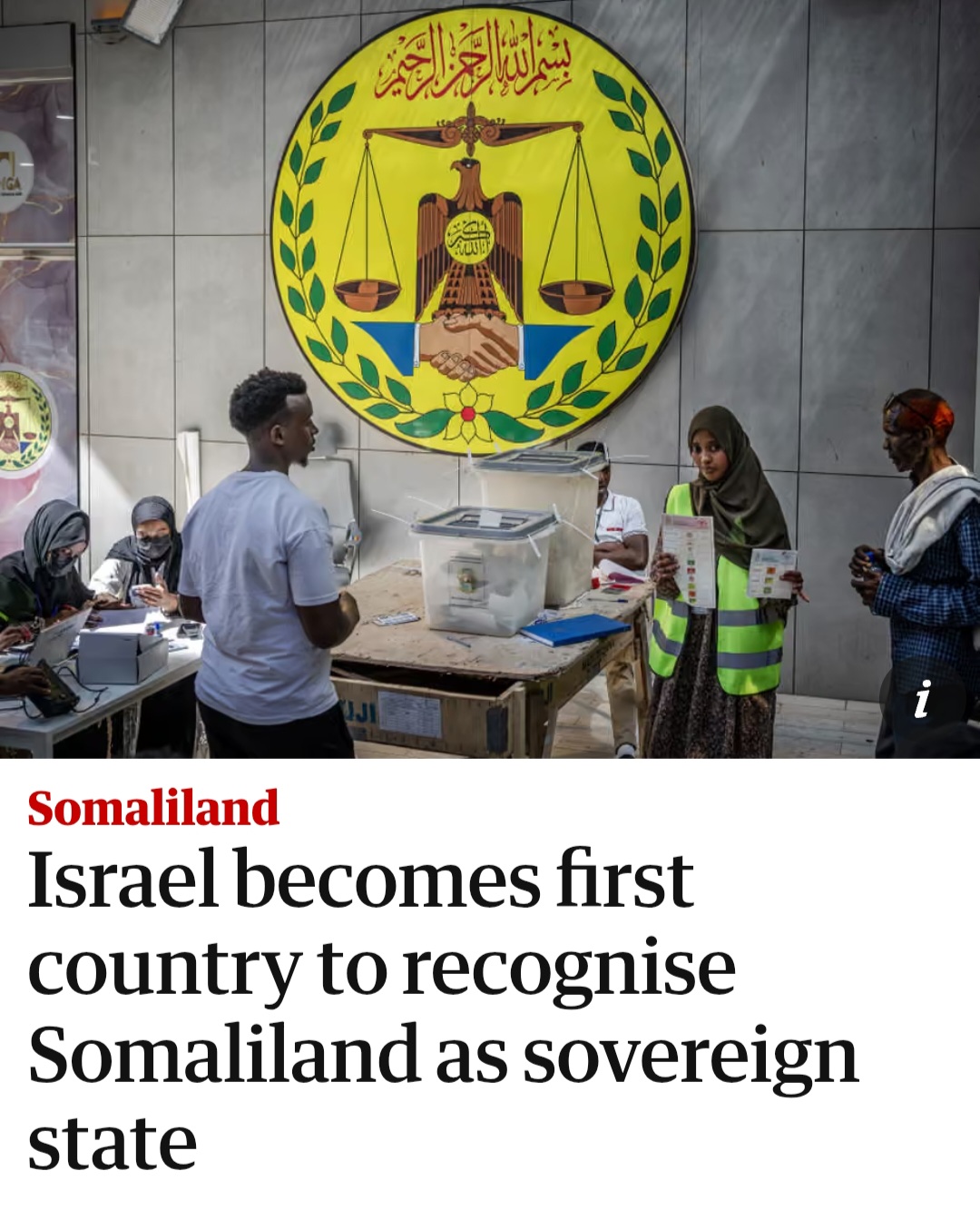
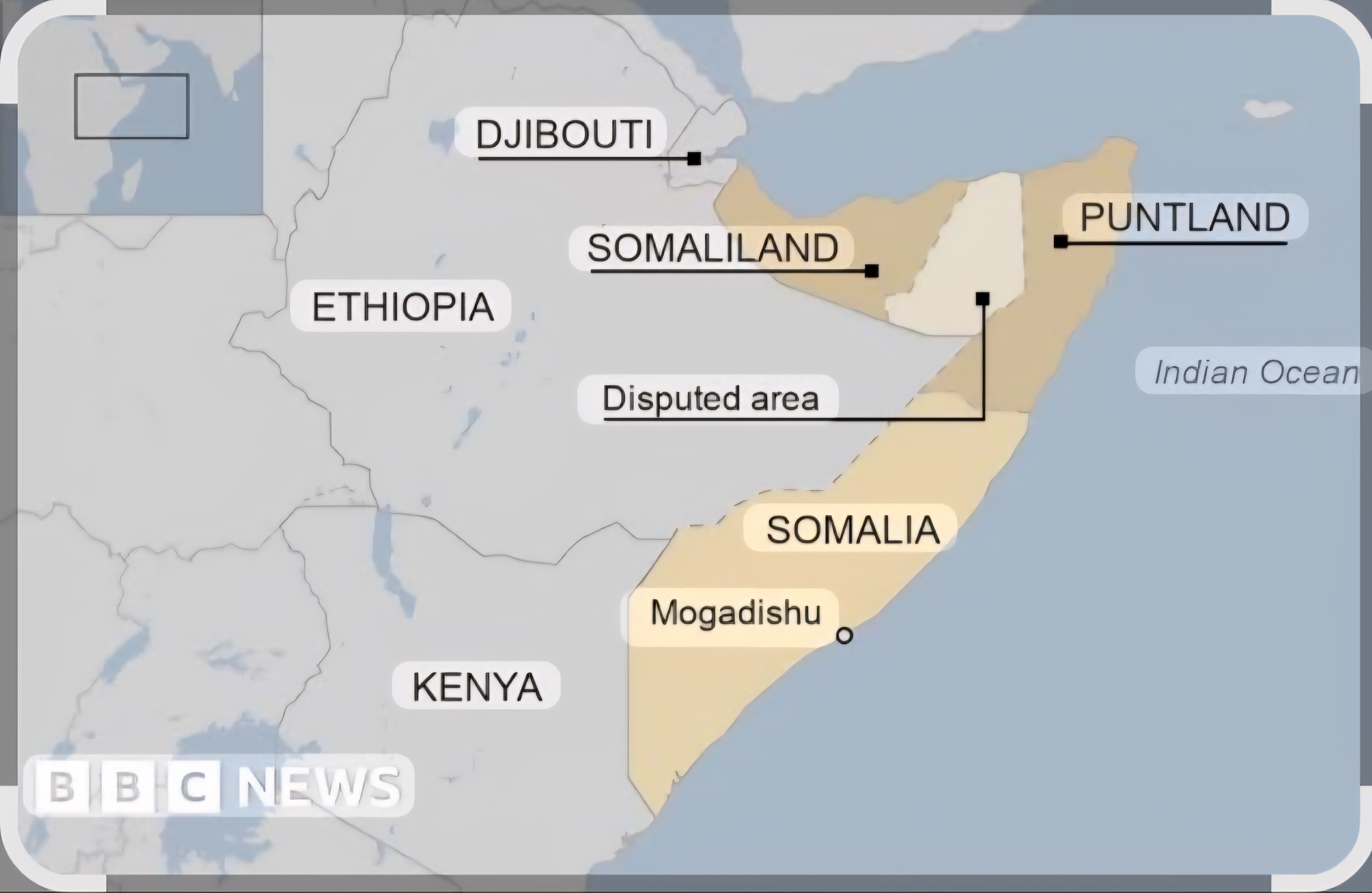
A funny thing happened as Somalia assumed the rotating presidency of the United Nations Security Council in January 2026: Israel recognized a breakaway republic, Somaliland. The timing was rich.
Somalia’s presidency of the most powerful UN body exposed rank hypocrisy: formal recognition divorced from reality. Somalia is treated as a sovereign authority – one given prestige – while it has spent nearly twenty years losing a war to Al-Shabab, an Al-Qaeda–aligned movement that taxes civilians, runs courts, controls territory, and carries out mass-casualty attacks with impunity. International troops prop the state up while Somalia’s sovereignty is tenuous.
The failure is not abstract. Somalia’s collapse has repeatedly spilled beyond its borders—most visibly through maritime piracy in the Gulf of Aden, which for years threatened global shipping lanes, energy supply chains, and food security. Still, a state unable to police its own coastline now presides over the world’s security council. That alone tells you how hollow the United Nations has become.
Somaliland, by contrast, has done the unglamorous work of statehood since 1991: defined borders, elections, peaceful transfers of power, its own currency, police, and a monopoly on force. It meets the Montevideo criteria in substance, not just in name. Yet it remains unrecognized—because recognition at the UN is political, not factual.
Now layer “Palestine” onto this picture—and the farce deepens.
Somalia is a failed state struggling against jihadists. Gaza is a jihadist state in its own right. Since 2007, Hamas has governed Gaza fully and openly. Hamas controls schools, mosques, courts, welfare, media, police, and an army fused into one ideological machine. International aid does not shore up weakness; it subsidizes jihadist rule—tunnels instead of homes, rockets instead of infrastructure, civilians embedded into military doctrine.
Here is the moral inversion the UN refuses to confront:
Somalia fails to defeat Al-Shabab and is pitied. Gaza chooses Hamas and is excused.
Somaliland governs itself responsibly and is ignored. Israel defends itself against a jihadist regime and is condemned.
The recognition asymmetry makes this starker still. In September 2025, the United Kingdom, Canada, and Australia moved decisively toward recognizing “Palestine”—despite the absence of defined borders, unified governance, or a monopoly on violence, and despite Gaza being ruled by a designated terrorist organization. Meanwhile, Somaliland—stable, democratic, and self-policing for more than three decades—remains outside the diplomatic club. The message is unmistakable: symbolism is rewarded; governance is not.
When that contradiction became too visible to ignore, the talking points shift. Accusations – by Somalia, amplified by Qatar (Hamas’s principle sponsor) – are being made that Israel intends to “relocate Gazans to Somaliland.” The claim is complete fabrication, an attempt at damage control—a smear designed to redirect attention away from the exposed hypocrisy. By turning Somaliland into a prop in an imaginary Israeli scheme, critics attempt to avoid the harder question: why a functioning African democracy is denied recognition while jihadist-run entities are indulged.
That reality was never lost on U.S. President Donald Trump. His view of Somalia is blunt: a failed state exporting instability, relevant to the United States only as a counter-terrorism battlefield. His administration treats Somalia as territory unable to govern itself or suppress Al-Shabab. In that sense, Trump is more honest than the UN: he acknowledges failure, while the UN performs credibility rituals by handing Somalia the gavel of global security.
No one claims Al-Shabab represents Somali aspirations. Yet Hamas—whose antisemitic charter sanctifies genocide and whose strategy relies on civilian death—is routinely separated from the consequences of its rule and reframed as “resistance.” Somalia’s inability to secure a monopoly on violence is acknowledged as a defect. Gaza’s total jihadist capture is rebranded as national self-determination.
This is why Israel’s recognition of Somaliland at this time matters. It is not merely diplomatic; it is diagnostic. It forces a comparison the UN would rather avoid:
What actually constitutes a state?
Who governs responsibly?
Who controls violence—and who glorifies it?
The Security Council gavel in Somalia’s hand reveals the emptiness of UN moral authority. Gaza’s treatment—shielded from accountability despite being run by a designated terrorist organization—exposes complicity. Somaliland’s exclusion, despite three decades of stability, exposes cowardice.
Israel’s move did not break international norms. It exposed the rot.
Recognition, the episode made clear, is not about peace, governance, or security. It is about politics—and the willingness to look away when jihadist rule is useful to the narrative.















 First One Through