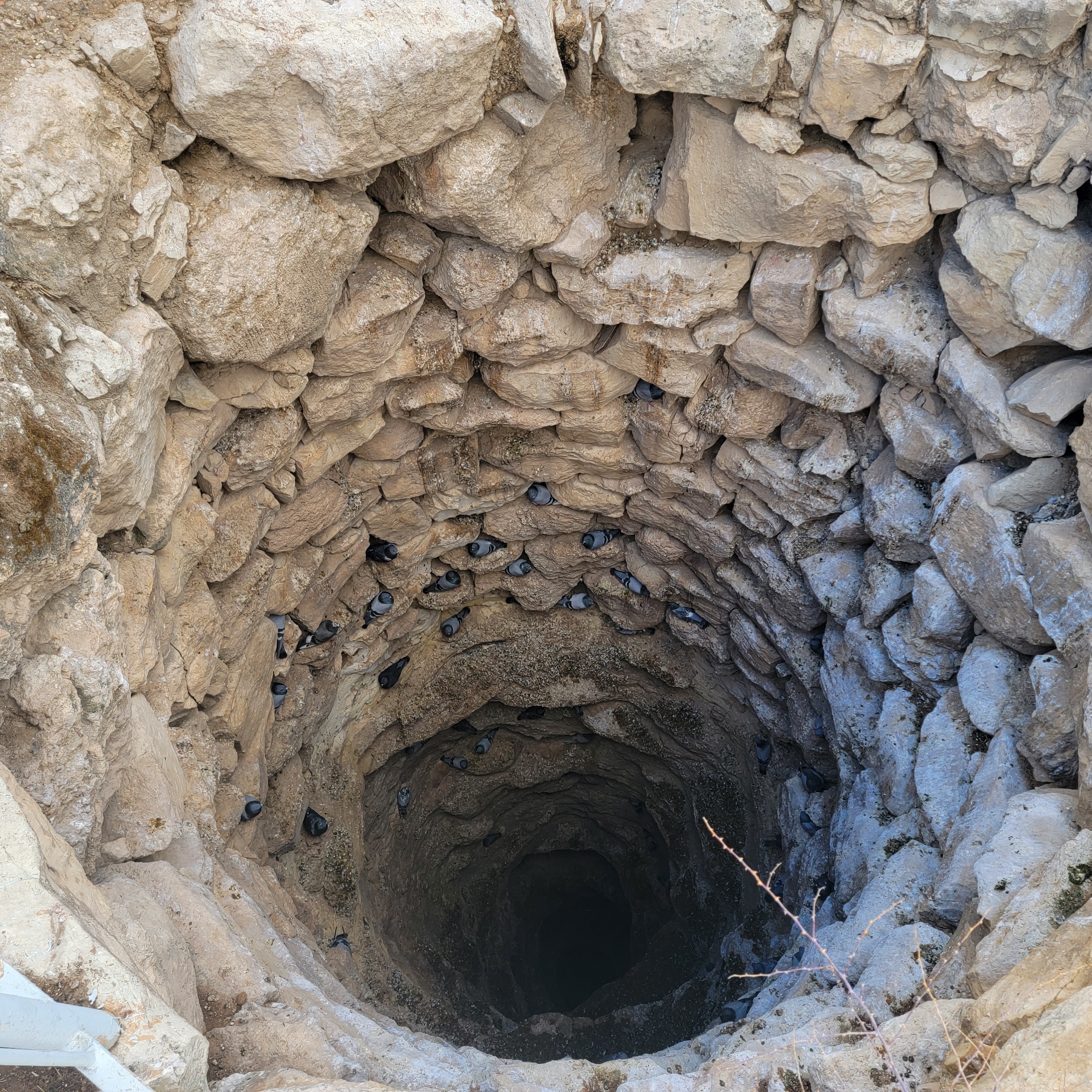
In Biblical times, wells were beacons of life. To dig and find water was to unlock the possibility of home and permanence. Water fed crops and cattle; it drew families and trade; it birthed cities. Wells were light in the desert.
But not every hole in the ground was a well. Some were empty pits, barren of water and purpose. They became places of danger—sites where wanderers fell or where enemies cast prisoners to languish. Wells meant sustenance, while pits meant despair.
Well in the Judean city of Lachish
Today, the search for peace in the Middle East feels much the same. Those who find the right spring, like the signatories of the Abraham Accords, discover flourishing opportunities for coexistence. New ties of trade, technology, and tourism have watered once-barren fields.
But failed efforts—like the Oslo Accords—are pits. They began with hope, but quickly turned treacherous. The optimism of 1993 was buried under the violence of the Second Intifada (2000–2004) and has been further extinguished by the ongoing Gazan War since 2023. What was meant to be a well has become a hazard, a pit in the sand that swallows the unsuspecting. Like any abandoned well, it should be filled in and covered, not revisited.
The digging was not in vain; the effort was noble. But it is time to recognize Oslo for what it became—a failed blueprint. A peace process crafted with antisemitic design that insisted Jews may not live in a Palestinian state or pray at their holiest site in Jerusalem, while promising a false faith that millions of Arabs would be welcomed into Israel, is not a formula for life. It is an unbalanced design destined for collapse.
And the Philistines stopped up all the wells which his father’s servants had dug in the days of his father Abraham, filling them with earth. (Genesis 26:15)
A new well must be dug with clear foundations:
A State of Palestine where millions of Arab “refugees” can live—but not in Israel.
A Palestine that allows Jews to live there, just as Arabs live in Israel.
A Jerusalem under Israeli sovereignty, open to all religions for access and worship.
Only once these parameters are accepted can the finer details of peace be discussed. Until then, the Oslo pit must be buried beneath the sand, its lessons remembered but its structure abandoned. The new effort can be called the Isaac Accords, to reflect the promise of wells of peace and abundance for everyone.
Isaac dug anew the wells which had been dug in the days of his father Abraham and which the Philistines had stopped up after Abraham’s death; and he gave them the same names that his father had given them. (Genesis 26:18)
Wells give life. Pits destroy. The task before us is to dig with the knowledge of past failures and not let ignorant hope set our shovels.
United Nations Secretary-General António Guterres has once again proven himself to be a reckless ideologue, dangerously detached from reality. In his latest remarks on July 28, 2025 regarding the Israeli-Palestinian conflict, Guterres declared that Palestinians have a “right” to a state. This is not only false, but dangerously misleading at a time when thousands of lives hang in the balance.
No group of people has an entitlement to a state. International law does not guarantee statehood to any specific ethnic or religious population. What people have is the right to self-determination, which can be fulfilled through various frameworks — including autonomy, federation, or integration with existing states. The assumption that this must culminate in Palestinian sovereignty from the river to the sea is not a legal imperative; it is a political preference, and a deadly one at that.
Guterres framed the issue as a false binary: either Palestinians get a state, or they will be condemned to expulsion or second-class status. This is a silly strawman, ignoring the obvious alternatives. Palestinians could become citizens of Jordan or Egypt — both of which administered the West Bank and Gaza, respectively, before 1967. Or they could establish a state in Gaza and in Area A of the West Bank, which is already under Palestinian control under the Oslo Accords. But they have no right to demand Israeli land, nor a capital in Jerusalem.
His reference to “East Jerusalem” as if it were a legitimate, independent entity is equally misleading. “East Jerusalem” was never a recognized capital or separate city — it was a temporary result of Transjordan’s illegal occupation between 1949 and 1967. The 1947 UN Partition Plan, which Arabs rejected with violence, never designated it for an Arab state. There is no legal basis to call Israel’s presence there “occupation.”
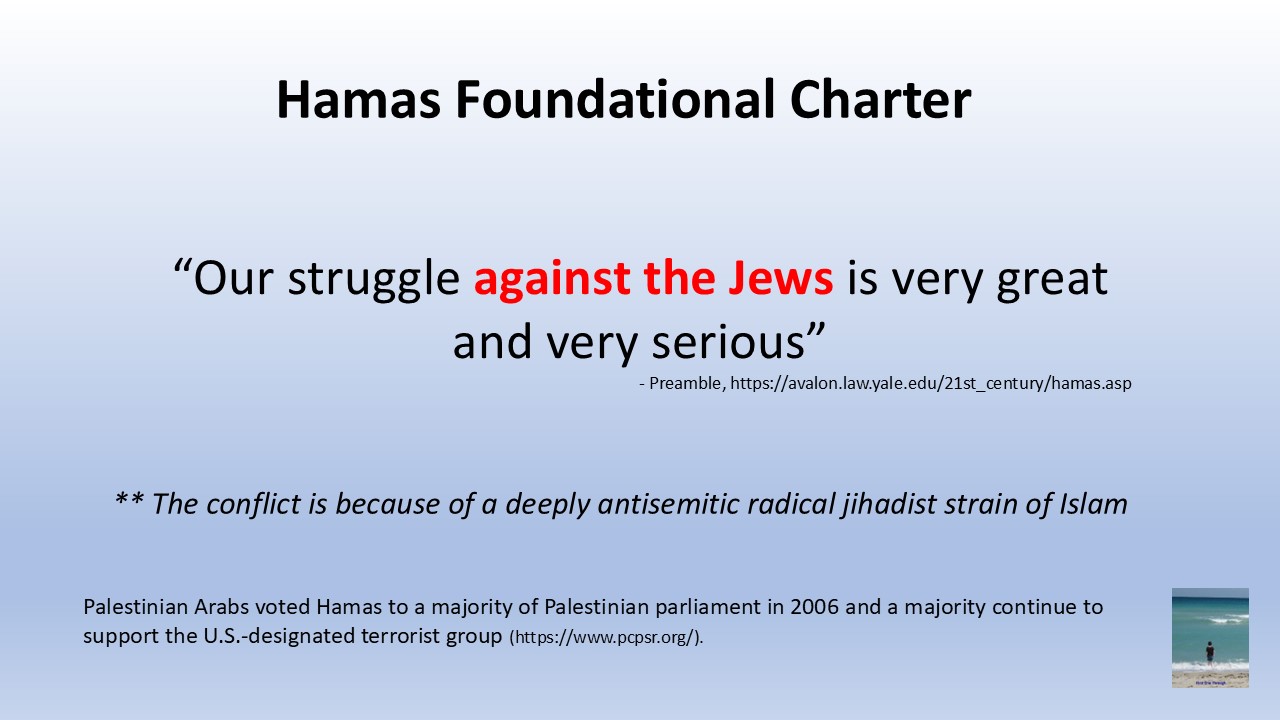
The most disturbing part of Guterres’ statement is his call for Hamas to be included in a unity government with fantasy notions of “we must support Palestinian unity around a peaceful, democratic and inclusive vision for statehood.” Let’s be clear: these are the same Hamas terrorists who committed mass rape, torture, and murder on October 7. This is a group with the most antisemitic and genocidal foundational charter ever written. To reward their atrocities with political power is not peacebuilding — it is moral depravity. It is the very definition of appeasement, sanitizing evil and encouraging further violence.
What kind of values is Guterres promoting when he elevates genocidal psychopaths into prospective leaders of a future state? It is not peace. It is not justice. It is not coexistence.
UNSG Antonio Guterres
Time and again, Palestinian leadership — whether Fatah or Hamas — has made its goals clear: no Israel, and no Jews. From school curricula to charters to chants in the streets, the obsession is not with borders, but with obliteration. The Secretary-General’s repeated attempts to whitewash this reality reveal either staggering ignorance or something much more nefarious.
Guterres is not a neutral peacemaker. He is actively endangering Israeli lives by proposing that Israel close its eyes to reality and pretend Hamas is a peace partner. He is fueling conflict under the guise of diplomacy and exposing the rot at the heart of the UN system.
They came for the Yazidis. They came for the Druze. They came for the Kurds. We came for the Jews.
Across the Middle East, ethnic and religious minorities have been hunted, uprooted, and erased. Yazidi women were rounded up and sold like cattle. The Druze were betrayed by neighbors and hunted in the streets. The Kurds—called terrorists for seeking sovereignty—were chased by Turkey with Western silence as a shield.
Thousands of Yazidi women sold as sex slaves in Iraq
We watched. We said nothing. We let them disappear, acknowledging—without saying it—that the Islamic Middle East had no place for ethnic and religious minorities. In our United Nations chairs, we shook hands with their butchers and waited for the news cycle to move on.
But not for the Jews.
The one minority whose return to sovereignty we supported—however begrudgingly many decades ago—was the Jews. We recognized their state, and in doing so, we made demands. MAKE demands. Demands no other people are burdened with.
We demand that Israel allow its citizens to be slaughtered and call for restraint. That it accept that others dictate its borders and immigration policy. That Jews be barred from praying at their holiest site. That any territory not clearly within historic armistice lines be judenrein, Jew-free.
And when Israel resists these demands – no, conditions we now apply for its existence – we condemn it. Not just at the UN, but in our schools, in our media, and on our streets—training citizens to treat diaspora Jews the same way: that they are alive only due to our grace. We are not equals; they owe us for everything.
We did not protect the Kurds. We abandoned the Yazidis. The Druze are being rounded up and killed. But we took action to help the Jews defy their extinction after the Holocaust. And for that, we believe they owe us—debtors with no right to complain. We pretend that Israel is a peer at the UN but we know the reality: it’s a vassal state and will be commanded by the order of the day.
Druze hunted in Syria
We don’t ask anything of the Gazans. Their genocidal rage toward Jews is seen as instinct, not ideology. Understandable. Natural. That’s why global protests erupt only when Jews defend themselves—not when they’re killed. Dog bites man, not the other way round.
To help Jews survive, we crafted Israel as a dam. It may shield its people inside from the massive jihadi flood—but only within walls we design.
However, once built, we insist that the floodwaters be let in. Millions of Muslim “refugees” must be allowed to “return” to the spring. The saltwater ocean that surrounds and crashes against the well’s walls, will mix with the spring water inside to become undrinkable.
We know it makes no sense. But we know we can’t contain the ocean, so we poison the well. It will happen eventually anyway, we reason.
The entrance to the United Nations’ Aida Refugee Camp, near Bethlehem, with a key on top showing that the doorway to get into homes inside Israel is via the UN
The world is watching—and learning. There is no future for Druze, Yazidis and Kurds. We silently move our lips, and our streets at home are silent. Yet when Jews retaliate when massacred, we rage and our people echo the screams.
Collectively we wonder whether maintaining the Jewish State is too hard.
Whether under dictatorship or democracy, religious zealotry or secular law, the story repeats: minorities are tolerated in the Global South only as long as they are passive, picturesque, and dying. The moment they survive and carve out self-determination, they are a threat to those with seats in the august UN chambers. Will these little tribes demand rights and sequester land too?
Yet another vote against Israel at the UN General Assembly
“Globalize the intifada” is not just a slogan; it is already in motion. Those floodwaters have breached the shores. The jihad is mowing down non-Muslims in the Middle East. It is teaching the Global North the chorus courtesy of Qatar, and dance moves via TikTok from China.
Marchers in the Global North demand an end to the Jewish State and persecution of Jews everywhere
The Global South – 42% Muslim outside of China and Latin America – will soon control the UN and is preparing to erase the exception of the Jewish state. Once America is convinced to step aside, the protective walls will surely collapse and the Jews will be slaughtered like other minority groups.
Druze mowed down outside hospital in Syria
Jews wonder why the streets are empty of protestors when various nations of the Middle East slaughter ethnic minorities, but are packed when Israel fights terrorists. It’s because Jews have still not internalized that the world views them as a minority which will ultimately be erased by the tide of the Islamic jihad, and it regrets making an exception for the most persecuted people on earth.
In 1967, just days after Israel’s miraculous victory in the Six-Day War — a war it neither started nor wanted — French President Charles de Gaulle publicly rebuked Jews:
the Jewish State was “war-like state bent on expansion”
impugned the Jewish people “throughout the ages” as “an elite people, sure of themselves and domineering,” who had “created ill will in various countries at various times.”
The accusation wasn’t merely tone-deaf — it was malicious in intent. Israel had just repelled a coordinated Arab onslaught aimed at its annihilation. In response, rather than offering admiration or even neutrality, de Gaulle reached for the language of old European antisemitism: that Jews are too proud, too successful, too capable — and therefore must be cut down to size.
Historian Bernard Lewis noted how this framing, after 1967, became a tool not just of European elites but of Arab leaders humiliated by defeat. The Jews had survived — worse, they had won — and for that, they were to be condemned as arrogant victors. He quoted one writer who said “It was bad enough to be conquered and occupied by the mighty empires of the West, the British Empire, the French Empire, but to suffer this fate at the hands of a few hundred thousand Jews was intolerable.”
Fast forward to today.
French President Emmanuel Macron repeats the posture of his predecessor, albeit with 21st-century polish. After Hamas butchered Israeli civilians in their homes on October 7, 2023, Macron offered sympathies — but quickly shifted blame back to Israel.
In the first weeks after Israel struck back at Hamas, Macron accused Israel of collective punishment, while never applying the same outrage to Hamas’s use of civilians as human shields, or to its decades-long charter of antisemitic terror.
And now, Macron leads calls for France to unilaterally recognize a Palestinian state — not as a reward for peace, but as a diplomatic slap to the Jewish state for defending itself too well.
French President Emmanuel Macron and Israeli Prime Minister Benjamin Netanyahu
Like de Gaulle, Macron cloaks condescension in the language of law and balance. But the message is unchanged:
When Jews are victims, they earn pity. When Jews resist, they invite suspicion. When Jews win — they must be reprimanded.
To call Jews “domineering” after a war of self-defense is to rewrite the story of Jewish survival into one of guilt. France did it in 1967. It is doing it again today.
There are two wars taking place in Gaza: one is a textbook definition of a genocidal war while the other is a reluctant war of ethnic cleansing.
While critics of the Jewish State hurl the term “genocide” as a weapon, a blood libel designed to strip Israel of its legitimacy, it is an inversion: it is Hamas and only Hamas that is engaged in a genocide.
Hamas’s 1988 foundational charter is not a vague political platform. It is an open call to murder Jews. Article 7 quotes an Islamic hadith that urges Muslims to kill Jews wherever they find them. Article 13 states that “initiatives and so-called peaceful solutions and international conferences are in contradiction to the principles of the Islamic Resistance Movement.” Peace is forbidden. Coexistence is a crime.
And the Palestinian people did not reject this vision; they embraced it. In 2005, they elected Mahmoud Abbas as president — a man who wrote his doctoral thesis denying the Holocaust. In 2006, they voted Hamas into power, giving the genocidal group 58% of the parliament. These were not fringe votes. These were popular, democratic choices made in full view of Hamas’s open ideology.
Then came October 7, 2023.
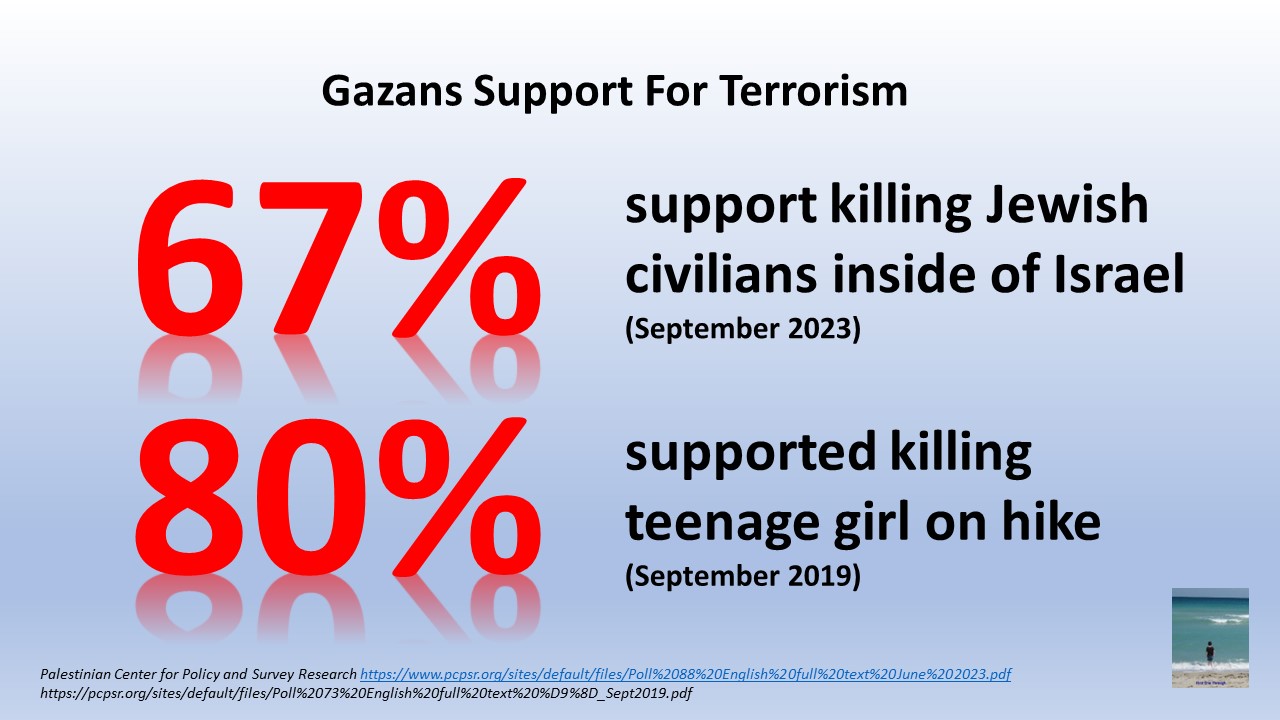
In the worst massacre of Jews since the Holocaust, Hamas — the ruling government of Gaza — unleashed its long-promised war of annihilation. They murdered 1,200 people, from babies in cribs to elderly women in wheelchairs. They burned families alive, filmed their atrocities, and broadcast their bloodlust to the world. The Palestinian street erupted in celebration. Polls showed 75% of Palestinian Arabs supporting the massacre of Jews.
This was not a surprise. This was fulfillment. A generation raised on genocidal propaganda in schools, mosques, and television carried out what they had been taught. They were not rebelling against Hamas — they were Hamas. Thousands of Gazans participated in the October 7 slaughter.
Israel, faced with an existential threat, responded. It had tried the diplomatic route. It had withdrawn from Gaza in 2005. It had allowed billions of dollars in humanitarian aid to flow into the Strip. It had mostly tolerated rocket fire and bus bombings and flaming kites with modest responses. But after October 7, there was no possibility of a tepid response with a group with an increasing capacity to carry out its genocidal intent.
Israel launched a war of necessity — a war to end the Hamas threat once and for all. The goal was not genocide, but defense. Not extermination, but eradication of a terrorist force.
But the nature of this war is highly complex. Hamas does not engage Israel’s army on an open battlefield but underneath hospitals, mosques and homes. It warehouses missiles in schools and launches them from playgrounds. There is no ability to eliminate the terrorists without severe destruction to dual-use civilian-military infrastructure and significant collateral damage.
And that looks a lot like ethnic cleansing.
Gaza ruins
Ethnic cleansing refers to the forced removal of an ethnic or religious group from a territory. And yes, it is possible that the outcome of Israel’s war will be a Gaza without many Palestinian Arabs. Gaza cannot be rebuilt atop terrorist tunnels and booby traps. The terrorist enclave that Gazans built since 2007 cannot remain nor be replicated.
It has long been a sign of instilled antisemitism that the United Nations has accused Israel of genocide, at least as far back as 2013, as a mask for Palestinian Arabs genocidal intentions. It is a classic form of the adage “the best defense is a good offense,” accusing Israel of the crimes of Palestinian Arabs, forcing Israel into a defensive posture, both militarily and politically.
But it is another level of tragic irony that in this defensive war, Israel is open to the accusation of ethnic cleansing.
No nation on earth has faced the choices Israel faces. No other country is expected to coexist with a neighbor whose elected leaders seek its annihilation. No one wants to see civilian suffering but Israel has tried every alternative — and the price has always been paid in Jewish blood.
The world is watching a premeditated war of genocide – which it enabled and encouraged through the United Nations’ statements and actions – be defeated by a small, determined country. The contours of that victory may appear to the casual viewer as ethnic cleansing, and will certainly be marketed as such by Israel haters, as a cruel collective punishment against civilians and so-called “refugees.”
The Global North will consider “ethnic cleansing” as the lesser charge relative to the smear of “genocide” long advanced by the Global South. Will the resulting actions encourage and enable the next genocidal war against the Jewish State remains to be seen.
On February 18, 1947, senior members of the British Kingdom’s government assembled to discuss the Palestine Mandate. By this point, the British had already separated the area east of the Jordan River and handed it to the small Hashemite tribe who created the Kingdom of Trans-Jordan. The people assembled at this meeting were at an impasse of how to handle the remaining portion of Palestine in regards to the roughly 1,200,000 Arabs and 600,000 Jews.
It is worth reading the discussion in full, but I will only highlight a few points here.
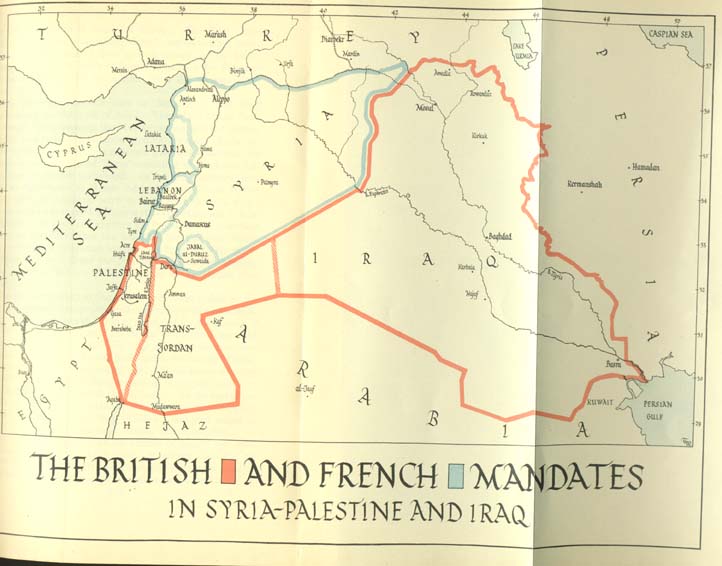
By way of background, the British had assumed the Palestine Mandate as well as for Iraq in 1922, while France had mandates for Syria and Lebanon. Due to Arab revolts in Palestine which started in 1936, the British – contrary to their mandate – limited Jewish immigration to Palestine to only 75,000 during the European Holocaust; they placed no limits on Arab migration into Palestine, allowing the Arab population to grow rapidly (more than doubling from 1918, whereas Syria only grew by 50% over the period).
An interesting observation is that the word “Palestinian” appears nowhere in the discussion, as the current notion that it only means Arabs would not be concocted for decades. At this point in time, the idea of a possible “Palestinian State” would incorporate both Palestinian Arabs and Palestinian Jews, a term without meaning today.
In discussing the desire of the local Arab population in Palestine, Bevin said that the Arabs were “unwilling to contemplate further Jewish immigration into Palestine,” even when survivors of the European Holocaust were desperate to come to the Jewish homeland. He added that the Arabs “are equally opposed to the creation of a Jewish State in any part of Palestine.“
Bevin would go on to state the position of Zionists who wanted an independent state, in line with the mandate which called for Jews “reconstituting their national home in that country.”
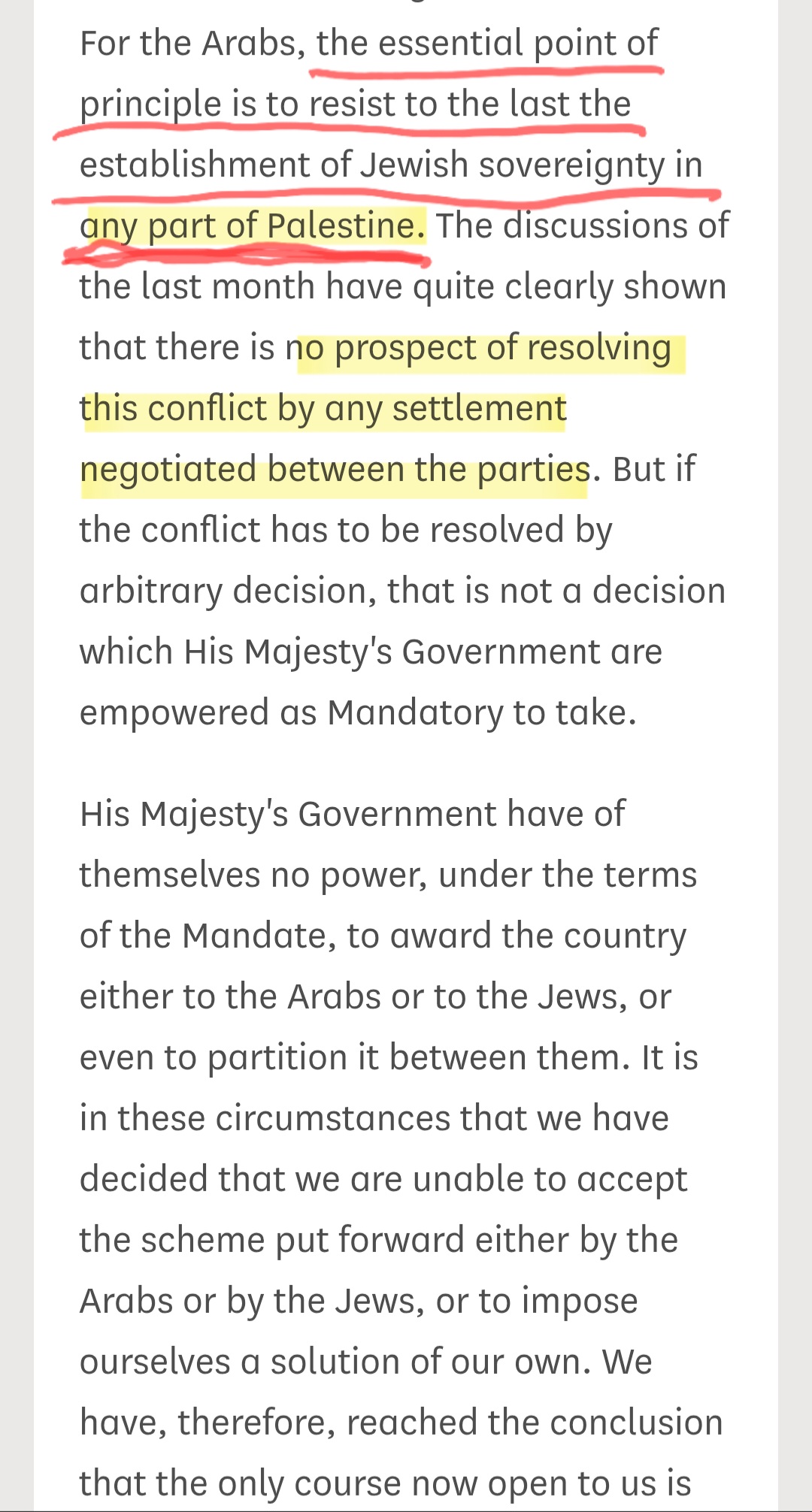
Again, he made the position clear that “for the Arabs, the essential point of principle is to resist to the last the establishment of Jewish sovereignty in any part of Palestine.” He saw “no prospect of resolving this conflict by [negotiated] settlement,” consequentially leading to persistent violence. The competing demands of the Arabs and Jews made the situation “irreconcilable.”
Willie Gallacher (1881-1965), a communist who had opposed Britain’s involvement in WWII asked during the back-and-forth whether the UK’s “Balfour Declaration is recognised to be utterly unrealistic,” giving priority to Arab claims. He failed to comprehend that the declaration served as the very basis for which Britain had been handed the mandate for Palestine. The members therefore concluded that the matter should go to the United Nations General Assembly to decide how to reconcile the irreconcilable.
The discussion proved prophetic. Even today (“to the last”), the majority of the Stateless Arabs from Palestine (SAPs) refuse to accept a Jewish State “in any part of Palestine.” They continue to fight it by any means at their disposal, including war, terrorism and boycotts. Their actions do not only make life difficult for Jews in Israel but for Americans. The US embassy in Israel issued “travel advisories” suggesting people reconsider travel to Israel and the West Bank and to not go to Gaza because of the activities of various Palestinian Arab terrorist groups.
The SAPs are fighting Jews on two fronts, via the Palestinian Authority (PA) and Hamas. The PA is fighting for a Palestinian State without a single Jew living in it. It has the United Nations endorsement, with the passing of UN Security Council Resolution 2334 in December 2016. Hamas and other terrorist groups are fighting to ensure no Jewish State exists “in any part of Palestine.”
Other jihadists – countries and groups – also rallied to fight a Jewish State “in any part of Palestine.” From 1948 to the 1970s, the Arab world routed 850,000 Jews from their nations. Most still refuse to recognize Israel. Many boycott Israel and do not allow Israelis to enter their country. Islamic countries which are not Arab – foremost Iran and Turkey – actively support Hamas. Turkish President Recep Erdogan said right after the October 7 massacre that “Hamas is not a terrorist organization, it is a liberation group, ‘mujahideen’ waging a battle to protect its lands and people.”
Jihadi groups like al Qaeda rally radical Muslims to attack “Americans and Jews” around the world because of Israel, and attack tourists and fellow Muslims in Egypt and Jordan because those countries struck peace agreements with the Jewish State. The presence of Jewish sovereignty in Palestine has generated a call to history of 1,000 years ago, with the “World Islamic Front for the Jihad Against Jews and Crusaders.“
The conflict is cast in western circles as a local conflict over land between Jews and Arabs which can find compromise, but radical Islamists see it as a global religious matter between Muslims and Jews. The violent extremists cannot accept Jewish sovereignty “in any part of Palestine” as an “essential point of principle.” Current efforts to “Globalize the Intifada” is their rallying call to end the Jewish State in its entirety, with Jews and Christians (“Crusaders”) fair marks for attack.
For decades, diplomats, academics, and international institutions have spoken in rote terms about a “two-state solution” to the Israeli-Palestinian Arab conflict. The problem is that such framing is intellectually dishonest and dangerously outdated.
There already is a state—Israel. It is not a hypothetical solution; it is a living reality. A sovereign nation with a vibrant democracy, a powerful military, a thriving economy, and a diverse citizenry, including over two million Arab citizens. Israel has fought for its survival, defended its borders, absorbed Jewish refugees from around the world, and became the most advanced and liberal society in the Middle East.
It is not a concept to be debated—it is a geopolitical fact.
Framing Israel as one part of a “two-state solution,” as if it were an idea or obstacle fundamentally misrepresents the situation. It inherently delegitimizes the struggle of millions of Israelis who sacrificed to build their nation since 1948 and casts their future into uncertainty.
We are not in 1947.
So let’s reframe the question. The only real debate is about the SAPs—the stateless Arab from Palestine. What is the just, secure, and realistic political future for them?
That opens multiple options—not a binary choice between creating “Palestine” or “occupation,” but a nuanced discussion based on facts on the ground and historical behavior. It reorients the discussion to the SAPs who seek an answer and thereby considers THEIR statements, sentiments, and actions rather than placing the scrutiny and opprobrium on Israel, which inherently strips SAPs of agency and responsibility.
Should the SAPs get a full sovereign state even after the dominant political party engaged in genocidal acts? Can SAPs be trusted with statehood and a military while state media glorifies terrorism and denies both Jewish history and Israel’s right to exist, and tramples on human rights?
Now, under the misguided focus on Israel as part of the “two-state solution,” the United Nations Human Rights Council has a standing item (Agenda 7) focused only on Israel. Similarly, UN Security Council passed Resolution 2334, which only reviews the actions of Israel. Nowhere does the UN focus on the actions and statements of SAPs and their leadership to consider the best course for their future. It’s a fatal flaw, one of many self-inflicted tragedies that the UN has instilled into the region.
The UN fails to comment and address:
The Palestinian Authority (PA) priority on paying salaries to the families of terrorists.
The barbaric attack of Hamas and Palestinian Islamic Jihad on October 7, 2023, and overwhelming support it had amongst SAPs.
A PA media and school system that promotes antisemitism and incites hatred.
A society with various armed groups which refuse to disarm that are more popular than the PA.
Instead, the UN focuses on misdirection towards Israel and masquerades the reality of SAPs. It gives the PA seats at UN panels and committees even though it has no power, support or authority, parading a fake caricature of the situation. This does nothing to help SAPs address the failure of its society nor hold it accountable for its actions.
For the UN, the answer to the question of SAPs is the creation of a new state for local Arabs which should be Jew-free. Remarkably, the global body cannot ponder that such goal is deeply antisemitic. Equally as pathetic, the failure to consider any other solution to statehood grants SAPs a free hand to commit any sort of atrocity.
The Question of SAPs must not have a forgone conclusion. That approach has failed for years at the price of thousands of lives.
Maybe SAPs can have a state-minus—something akin to post-WWII Japan: self-governance, civil services, education, cultural autonomy—but demilitarized, with security handled by an external guarantor to prevent further war and terror.
Or perhaps certain areas of the West Bank could be confederated with Jordan, whose population is majority SAPs already. Maybe Jordan itself should be divided whereby a section would be part of a Palestinian State together with parts of the West Bank.
The area east of the 1949 Armistice Lines (E49AL) might remain under Israeli sovereignty with SAPs having semi-autonomous status—akin to Native American reservations in the U.S., which have self-rule in many areas but rely on the larger state for defense, currency, and diplomacy. Or the areas get annexed and the residents get Israeli citizenship.
These are serious, legitimate proposals worthy of debate.
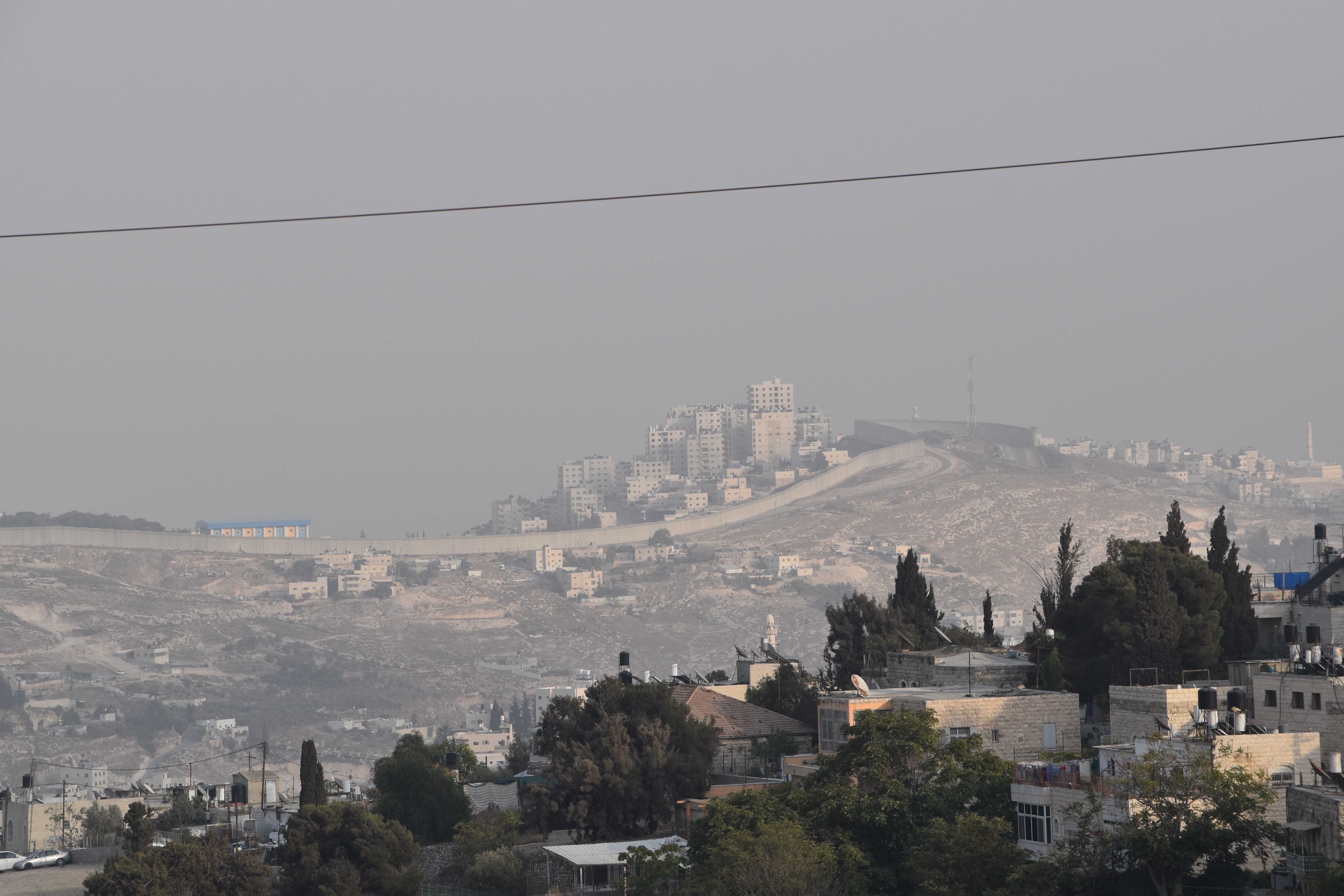
Buildings on both sides of Security barrier in Jerusalem (photo: First One Through)
But let’s be clear: any outcome is about solving the question of what to do with the SAPs. It is not about creating two states. Israel is already there.
The time has come to retire the “two-state solution” slogan. Not because peace is impossible—but because clarity and focus are essential.
For years, Palestinian Authority President Mahmoud Abbas spared no insult for U.S. President Donald Trump and his administration. He called Trump’s peace plan the “slap of the century.” He labeled U.S. Ambassador to Israel David Friedman a “son of a dog.” Abbas publicly refused to meet with any Trump envoy after the U.S. recognized Jerusalem as Israel’s capital in 2017, cutting off nearly all formal ties with Washington. He refused to stop paying salaries to the families of terrorists despite Trump’s demand that he do so.
PA President Abbas issues prayer that President Trump’s “house be destroyed” in 2018
But now, in a stunning reversal, Abbas is praising Trump following America’s attacks on Iran’s nuclear facilities, hoping to reengage with the man he once vilified. The about-face reveals not only Abbas’s desperation but also a familiar tactic in Middle Eastern politics: appealing to the ego of strongmen to gain leverage in diplomacy.
Just two weeks ago, Abbas condemned Hamas’s October 7 attack on Israel, in a letter to French President Emmanuel Macron and Saudi Crown Prince Mohammed bin Salman. Abbas had never done so before. He is seemingly attempting to distance himself from the dominant Palestinian political party which is struggling to stay alive.
Somehow, Abbas wants to bury reality and history. Just one year before the October 7, 2023 massacre, Palestinian factions agreed to a reconciliation in Algiers, Tunisia. Hamas, Fatah (Abbas’s political party), the Popular Front for the Liberation of Palestine and eleven other movements signed an agreement to “get rid of this [political] split and cancer that has entered the Palestinian body.” This move was an attempt to unify the Palestinian people under new elections with a single unified government representing all groups. The United Nations celebrated the integration of Hamas and PFLP – which the U.S. designates as terrorist groups – into a unity government.
A total of 14 Palestinian factions signed reconciliation agreement in Algiers to end their 15-year-long division. (photo: Xinhua)
But Abbas now recognizes the endgame of the current battle: Iran, Hezbollah, Houthis and Hamas have failed in their attempt to destroy the Jewish State. Abbas would have welcomed such outcome, so stayed quiet for over 600 days. Now, while his decimated fellow Muslims sort through the rubble, Abbas is attempting to distance himself from the losing side, of which he was a silently cheering member.
Appealing to Trump’s Vanity
As he throws Hamas under the bus, the nearly-90 year old unpopular Abbas is looking for a lifeboat. Imagine his dismay to realize that even after Hamas led Gaza to a war of destruction, Palestinian polls still show Hamas to be more popular than his Fatah party, and over 80% of Palestinians want Abbas to resign.
In Abbas’s worldview, perhaps aligning himself with a winner will salvage some dignity and allow a few more years of relevancy. Despite spitting on Trump’s Abraham Accords and vilifying Trump & Co., Abbas is replacing his vitriol with flattery.
This is not just a change in tone; it’s a strategic pivot. Abbas’s flattery is designed to appeal directly to Trump’s vanity. Trump craves recognition and praise, particularly when it comes from those who previously doubted him. Abbas is betting that Trump, flattered by the turnabout, might seek to craft a renewed deal between Israel and the Palestinians, this one closer to the Arab Initiative crafted by Saudi Arabia in 2002, rather than Trump’s “deal of the century.”
The logic is simple: Trump, the dealmaker, might relish the chance to win the Nobel Peace Prize by securing an Israeli-Palestinian Peace Agreement, alongside a broad opening of the Abraham Accords with Saudi Arabia and other nations whom would likely follow.
There is little indication that Abbas has changed his position on any of the core issues — recognition of Israel as a Jewish state and the so-called “right of return” principal among them. His newfound praise for Trump is not based on ideological alignment or shared values but on the simple belief that stroking Trump’s ego might yield results.
Israel’s View
From Israel’s perspective, Abbas’s pivot will likely be met with skepticism. Israeli officials have long regarded the Palestinian Authority as duplicitous — speaking the language of peace in English while praising and funding terrorists in Arabic. Abbas’s credibility is further diminished by years of internal repression, a stagnant economy, and a populace which despises him.
Still, Israeli leaders will watch closely. If Trump signals willingness to broker another deal — one perhaps based on regional normalization and security guarantees rather than the moribund Oslo framework — Abbas’s outreach could become a diplomatic variable worth tracking.
Conclusion: Desperation Dressed as Diplomacy
Mahmoud Abbas’s pivot from name-calling to praise is more than political theater. It’s a sign of deep weakness — a recognition that time, allies, and leverage are all slipping away. By appealing to Trump’s vanity, Abbas is hoping for a personal reprieve and a political lifeline.
But Trump will likely recall the years of insults and rejection. Whether he’s willing to forgive and forget — and whether Abbas is willing to concede more than just compliments — remains to be seen.
What is clear is that Abbas, who once derided Trump as a destroyer of peace, now sees him as his best hope to remain relevant.
On June 18, 2025, Columbia University announced that it had produced its third report on antisemitism. One would imagine that it would give people hope that the administration was seriously tackling Jew hatred on campus.
Alas.
The “Task Force On Antisemitism” did not focus on Jew hatred at Columbia; it did a poll of ALL students about how they felt about the anti-Israel encampments on campus during the 2023-2024 school year. The “antisemitism” task force wanted to understand everyone’s feelings. It was as though the Black Lives Matter movement put out a research paper that ALL Lives Matter. Not incorrect, just deaf, dumb and blind to the mission.
The report was called “Student Belonging and Exclusion Survey Report,” and polled 9,000 undergraduate and graduate students at the university in the summer of 2024. The responses were broken down between Jewish, Muslim, Christian, None and Other religious groups.
Jews fared the worst on each question.
Whether the question was about “a sense of belonging at Columbia” where only 34% of Jewish students felt welcome (compared to 41%, 54%, 51% and 49% for each of the other religious categories), or don’t feel accepted because of one’s religion where 62% of Jews felt unwelcome (compared to 53%, 13%, 3% and 11%), Jews were outliers, with Muslims trailing.
Jews were the most likely to have felt discrimination (53% versus 43%, 6%, 1% and 7%) and were uncomfortable sharing their beliefs (87% versus 82%, 64%, 58% and 58%). The fact that the majority of Columbia students were uncomfortable expressing their beliefs – including atheists – is a damning finding about university culture, beyond antisemitism.
Jews lost the most friends because of the encampments and campus environment (29% versus 16%, 7%, 6% and 9%) and had strained relationships (53% versus 30%, 27%, 22% and 20%). That is a sad state that extends to the personal student level, passed the administration and faculty.
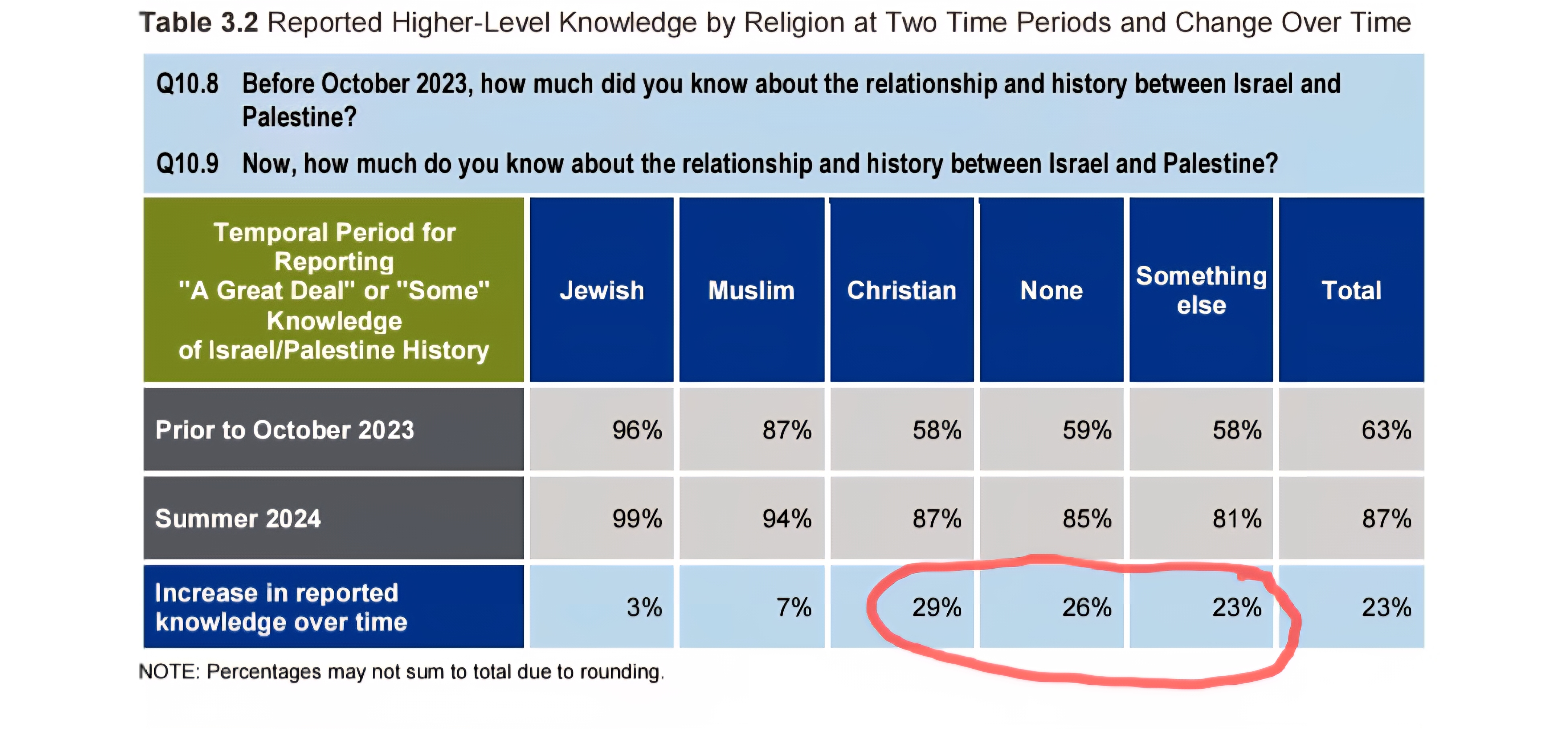
And while Jews felt the most stress over the period, they are learning the least. The campus protest barely taught them anything about the regional dynamic. But Christian and other faiths learned a lot – of pro-Palestinian narrative.
How does one know that students have only been absorbing a pro-Palestinian narrative from a year of encampments? While half of the student body participated or supported the protests, virtually none supported Israel. The pro-Israel protests were almost exclusively Jewish. While 21% of Jews sided with the Stateless Arabs from Palestine (SAPs), a mere 1% of Christians, atheists and other faiths supported Israel. No Muslims supported the Jewish State.
Israel is a pariah at Columbia University. It is only supported by a number of Jews.
How can an institution that claims to champion an open exchange of ideas have a majority of students afraid to express their beliefs? How is it that only Jews support Israel on campus?
It is obvious why nearly two-thirds of Jews at Columbia feel unwelcome on campus. It is unclear why any Jew continues to attend.
Banner hung at Columbia University’s Hamilton Hall supporting “intifada,” violence against Jewish civilians
When she stood in Congress on Israel’s May 14 Independence Day to introduce an “Ongoing Nakba” resolution because the State of Israel continues to exist, she decided to open by quoting Peter “AsAJew” Beinart.
Rep. Tlaib introducing the “Ongoing Nakba” resolution on May 14, 2025
Beinart is not a famous diplomat or philosopher. He’s not a celebrity or TikTok star. He’s not a Palestinian or Muslim. Most of the people in Congress never heard of him.
Yet Tlaib chose to quote him as a comrade in the effort to destroy the modern Jewish State.
Most left-wing Jews left their socialist-jihadi colleagues in the wake of the October 7, 2023 massacre, like rats fleeing a sinking ship. They were appalled at the moral depravity of people shouting to “Globalize the Intifada” and “Glory to the martyrs” after the savage killing of 1,200 people in Israel. Only the most radical fringe of the fringe remained; those who could bury their being a Jew and a human being far below the thrill of being beatified as a living saint by jihadists.
Those seeking the destruction of Israel have migrated from quoting the forgery Protocols of the Elders of Zion to Amnesty International to “AsAJew”s. The anti-Israel antisemitism has transmogrified from niche raw Jew hatred to generally accepted at the United Nations to Jewish-endorsed with a kosher seal of approval.
The crucification of the Jewish State may not have started with Jews, but the jihadi gospels being written now are putting AsAJews front-and-center nailing it to the cross.











 First One Through