The Hypocrisy Between An Embassy for Israel in Jerusalem and East Jerusalem, OPT

There are so many examples of the bias at the United Nations in favor of Palestinian Arabs over Israel, that the obvious ones are sometimes overlooked.

Consider the situation of Jerusalem, a holy city for three religions which has had a Jewish majority since the 1860’s.

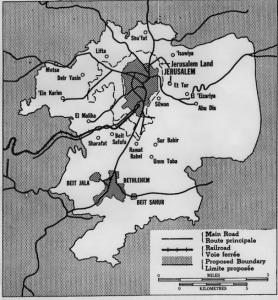
In trying to find a solution for the hotly contested city, the UN General Assembly voted on November 29, 1947 to place Greater Jerusalem and Greater Bethlehem into a distinct corpus separatum which would neither be part of a Jewish State of Israel nor an Arab State of Palestine. The nations at the UN voted 33 in favor, 13 against and 10 abstentions. (The 13 countries that voted against the partition were mostly the Arab and Muslim countries of Afghanistan, Cuba, Egypt, Greece, India, Iran, Iraq, Lebanon, Pakistan, Saudi Arabia, Syria, Turkey, Yemen.) The proposal would never come to pass, as the “corpus separatum” was divided after Israel’s War of Independence with Israel controlling the western half of Jerusalem and the Jordanians controlling all of Greater Bethlehem and the eastern portion of Jerusalem.

Israel declared Jerusalem as its capital city and located its federal government buildings there, but virtually no countries recognized Israel’s assumption of the western part of the city, nor the Jordanian occupation of the eastern part of the city. That was the situation from 1949 to 1967, and continued to be true after the Jordanians attacked Israel again in June 1967 and lost its portion of corpus separatum and the rest of the West Bank.

For decades, countries have continued to withhold their recognition of Jerusalem as Israel’s capital, much as they had since Israel founding.


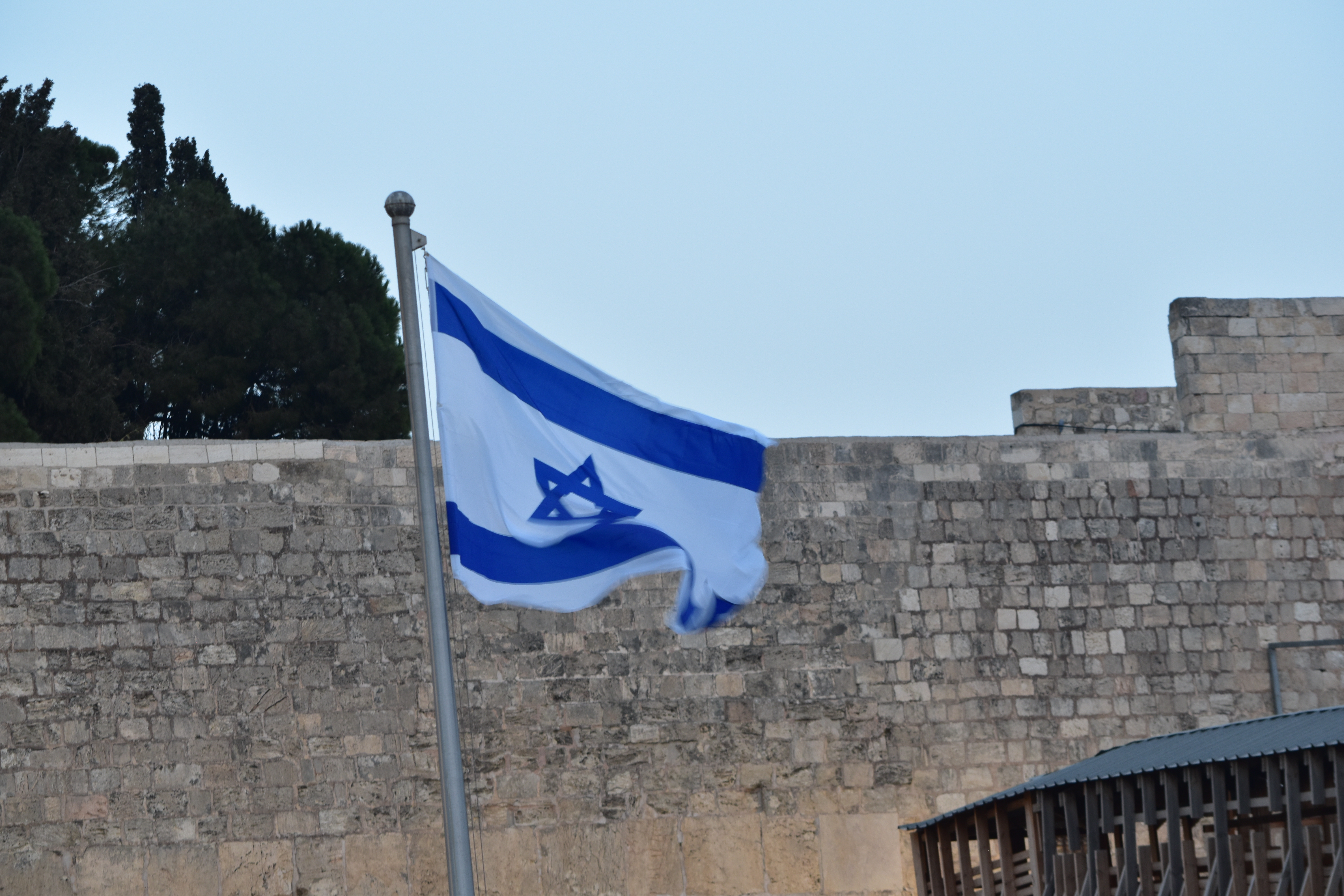
Israeli flag waving in front of the Western Wall of the Jewish Temple Mount
(photo: First.One.Through)

That changed recently.

In December 2017, the United States decided to acknowledge the fact that Israel’s capital is Jerusalem, to the chagrin of many other countries. A few weeks later, the UN voted to condemn the United States’ relocation of its Israeli embassy to Jerusalem by a vote of 128 to 9, with 35 abstentions. Many of the 128 countries voiced opinions that Jerusalem is a final status issue to be resolved between the Israelis and Palestinian Authority. Any recognition that either the Israelis or Palestinian Arabs has a superior claim to areas of corpus separatum was to be avoided.

Yet, with no sense of embarrassment or question of hypocrisy, many of those same nations which voted to admonish the US, chose to vote at the UN on November 16, 2018 on several resolutions which referred to East Jerusalem as “Occupied Palestinian Territory.”

  • Draft resolution “Applicability of the Geneva Convention relative to the Protection of Civilian Persons in Time of War, of 12 August 1949, to the Occupied Palestinian Territory, including East Jerusalem, and the other occupied Arab territories” (document A/C.4/73/L.19) passed by a vote of 154 to 5 with 8 abstentions.
  • The draft resolution titled “Israeli settlements in the Occupied Palestinian Territory, including East Jerusalem, and the occupied Syrian Golan” (document A/C.4/73/L.20) passed by a recorded 153 votes in favour to 5 against with 10 abstentions.
  • The draft resolution “Israeli practices affecting the human rights of the Palestinian people in the Occupied Palestinian Territory, including East Jerusalem” (document A/C.4/73/L.21) passed by 153 to 6 with 9 abstentions.

If countries want to be consistent in their treatment of Jerusalem and desire for peace, they have a choice: either recognize Israel’s claim to the western part of the city and move their embassies to the western part of Jerusalem just like the United States, OR refuse to call “East Jerusalem” part of “Occupied Palestinian Territory.”

Any country refusing to move its embassy for Israel to Jerusalem while simultaneously calling the eastern part of Jerusalem part of “Occupied Palestinian Territory” is spitting in the face of Israel and rejecting participating in the peace process.


Related First.One.Through articles:

Abbas’s Harmful East Jerusalem Fantasy

Western Jerusalem’s U.S. Consulate and Embassy

Ending Apartheid in Jerusalem

I call BS: You Never Recognized Jerusalem as Israel’s Capital

Both Israel and Jerusalem are Beyond Recognition for Muslim Nations

750 Years of Continuous Jewish Jerusalem

Arabs in Jerusalem

The Arguments over Jerusalem

The United Nations’ Adoption of Palestinians, Enables It to Only Find Fault With Israel

Maybe Truman Should Not Have Recognized Israel

The United Nations and Holy Sites in the Holy Land

The UN’s Disinterest in Jewish Rights at Jewish Holy Places

Subscribe YouTube channel: FirstOneThrough

Join Facebook group: FirstOne Through Israel Analysis


A Sofer at the Kotel

Jews around the world just finished reading the Torah, the Five Books of Moses, and promptly began to start the Bible again from the beginning. The time between finishing the public reading and recommencing the weekly recitation was only a few minutes. For Jews, the Bible is a living document that is always being read and learned. There is no “finishing” the Bible; just completing it and commencing again in rapid succession.

The holiday of completing the weekly Torah readings is called Simchat Torah, the Joy of the Bible. The Jewish religious denominations take different approaches to mark the holiday. Hasidic men may be seen dancing in circles with Torahs in the streets; many Reform Temples unfurl the entire Torah with men, women and children holding a section in a large circle. There is a common moment of celebration, but unique methods of celebrating.

With such thoughts about the recent holiday, it is time to advance a principle which is inscribed towards the end of the Pentateuch: to write a Torah.

Some biblical commentators believe that biblical commandment is only applicable to kings; others have said that the king need not actually write the Torah, but to own one. Still others have suggested that the commandment is for everyone to participate in the writing of the Torah, perhaps by paying a scribe, a sofer, to write one on their behalf.

This post is a proposal is to have a permanent sofer at the Western Wall, the Kotel, so everyone can participate in the mitzvah.

Background Issues

  1. Political. Discussions regarding Jerusalem, the Old City and the Kotel have been trapped in politics for many years. Who has or should have sovereignty and control is debated everywhere, with various advocates supporting Israel, the Palestinians, the Jordanian Waqf and the international community. Many leaders have sought to avoid the inherent religious nature of the location as they fear inflaming passions and violence among the three major monotheistic religions.
  2. Jewish Religious denominations. The Kotel plaza is currently caught in a fight within the various Jewish denominations. Recently, a dedicated space for non-Orthodox prayer has taken steps forwards-and-backwards, such as the expanded prayer area at Robinson’s Arch being approved and disapproved. The Jewish community outside of Israel (which is mostly non-Orthodox) has taken a sharply negative attitude towards Israel on this point, which is harmful on multiple levels to Israel and Jews worldwide.
  3. Education and performing a Mitzvah. Many people who come to the Kotel do not have a deep understanding of Judaism. They are foreigners who see an archaeological site caught in a political quagmire. Their visits often lack deeper religious engagement.
  4. Bridging the Israeli Ashkenazi and Sefaradi Communities. While the two communities often lead distinct lives, there is a chance for the two groups to create something together and forge a common bond, especially in Jerusalem.

The Opportunity

  1. Large Attendance. Jerusalem’s Old City – and the Kotel in particular – attracts millions of people a year. However, there has been no concerted attempt to actively engage the pilgrims and tourists in anything of religious or spiritual consequence. The plaza is simply an open space for pictures and pan-handlers.
  2. Spiritual Center. While the most sacred spot for Judaism is not the Kotel but the Temple Mount itself, it is the Kotel that has served as the religious symbol for Jews since the time of Suleiman I in the 1500s. While there is daily prayer at the Kotel, can there be more religious engagement?

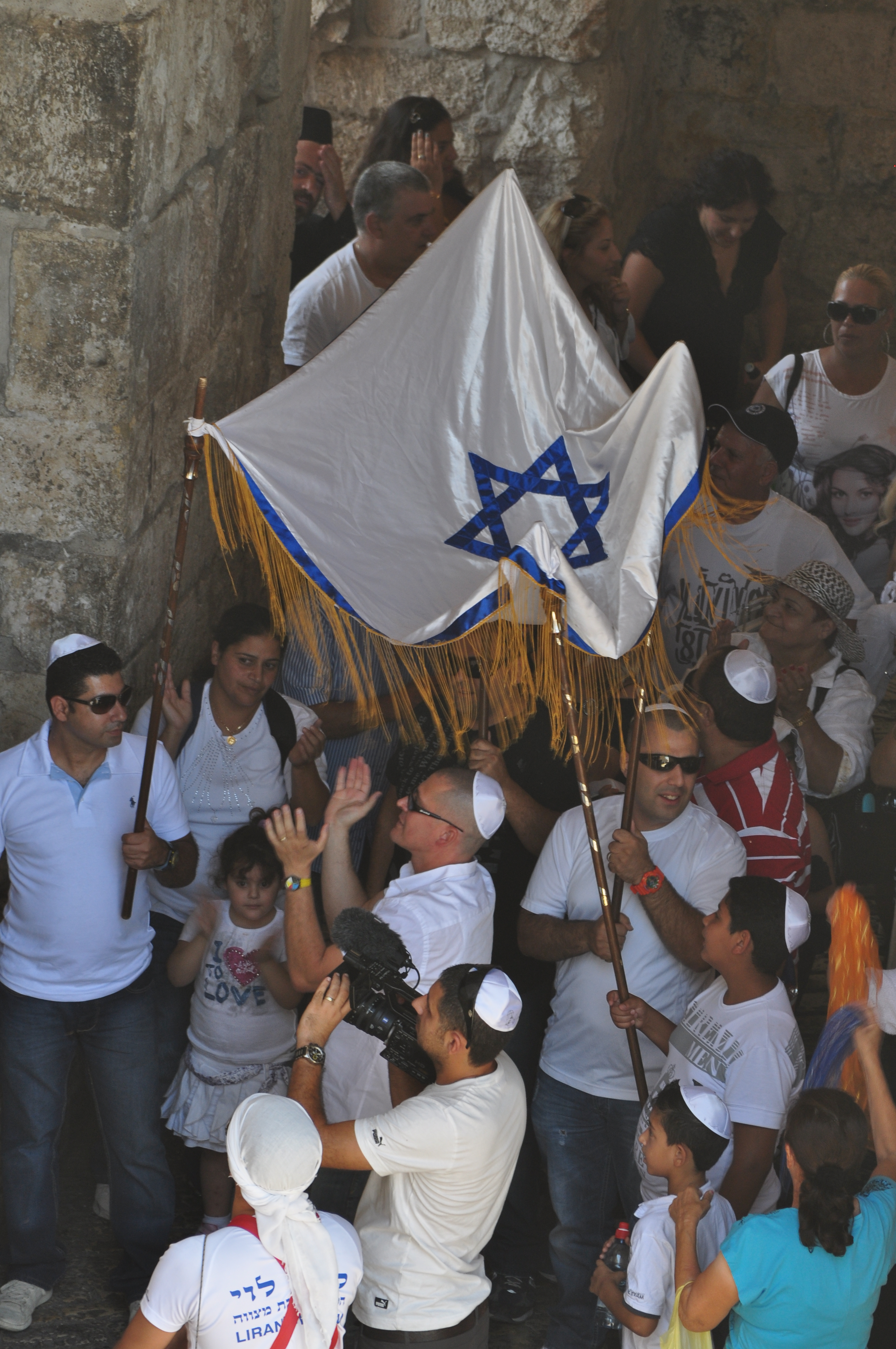
Bar Mitzvah party entering the Old City of Jerusalem through Zion’s Gate
(photo: First.One.Through)

The Proposal

  1. Sofer at Kotel. The issues above can be addressed by adding a small building (about 47 feet wide) at the back of the Kotel plaza which would house a sofer who would write a Torah six days a week from 8:00am to 8:00pm. By giving a donation, visitors would be able to participate in the mitzvah of writing a Torah, as they observe the sofer write a word on their behalf.
  2. Ashkenazi and Sefardi approved. There would be both Ashekanzi and Sefardi sofers that would be approved by the chief rabbis of each group. The finished Torahs would alternate between being housed in an Ashkenazi and Sefaradi cases.
  3. One Sefer published each year. A Torah would be completed each year around Simchat Torah. The Kotel plaza would have a large celebration at the completion of the sefer.
  4. The World’s Gifts to Israel. The first two Torahs (first Sefaradi and second year Ashkenazi) would be housed at the Kotel itself. In future years, the Torahs would be sent around Israel to shuls, schools, hospitals and army bases.
  5. Everyone can participate. A woman from sherut leumi will welcome each participant in the entry room of the building, just outside of the sofer’s room. They will accept a donation of any sum from the visitor which will go towards the Kotel Torah effort. A pruta, or penny, will be enough to “purchase” a single letter in the Torah, and minimum donation levels for a word or a sentence. The participant will have the option of having a picture taken with the sofer, and having their name, city, and country be included among the thousands participating in the writing of the sefer Torah.
  6. The Sofer building. The building would not be very large. It would resemble an Ashkenazi Torah scroll viewed from above: narrow rectangular entry and exit room on either sides (each about 10’ by 16’) and a broader rectangle in the middle for the sofer which will have a large window providing natural light and for people to peer in. The roof with have a conical dome in the middle above the sofer’s room, to resemble a Sefardi Torah case when viewed from street level.
    1. The entry room will have materials for signing in, and a digital map showing where all of the participants for the current Torah have come from. Exhibits explaining how a Torah is written will be on the walls.
    2. The sofer’s room will have materials and the desk for the sofer, and room for a photographer to take pictures with the participants.
    3. The exit room will have materials related to restoring Torahs and digital tools like Sefaria and the Bar Ilan project.

Concern

Everything around the Kotel involves a global outcry. The United Nations has gone to such extreme and absurd levels that it has condemned Israel for mundane items like placing an umbrella in the Kotel Plaza. Placing a building at the back of the Plaza might generate similar protest, however, limiting its size may ameliorate some of the concerns, as well as not having any national flags atop the structure.

Conclusion

Bringing a sofer to the Kotel will hopefully allow all Jews to engage with the Judaism’s holiest space in a religious manner. Everyone would have a chance to perform the special mitzvah – even those with no knowledge of Hebrew and limited Jewish education. Participants will not only view the site from a physical and political basis, but also from a spiritual one.

For Israel, this can be a fence-mending opportunity. The global non-Orthodox community which feels disconnected from Israel and its Orthodox religious leaders will be able to stand in line and participate in writing the very same Torah as Orthodox Jews. This is a chance to open religion and the Kotel to everyone around the world.

There is a song that will be sung in a continuous loop at the building that houses the permanent sofer at the Kotel, words from the prophets Isaiah and Micha: “For the Torah shall come forth from Zion, and the words of God from Jerusalem.” Words that will hopefully bring unity to Jews around the world.

וְֽהָלְכ֞וּ גּוֹיִ֣ם רַבִּ֗ים וְאָֽמְרוּ֙ לְכ֣וּ ׀ וְנַעֲלֶ֣ה אֶל־הַר־יְהוָ֗ה וְאֶל־בֵּית֙ אֱלֹהֵ֣י יַעֲקֹ֔ב וְיוֹרֵ֙נוּ֙ מִדְּרָכָ֔יו וְנֵלְכָ֖ה בְּאֹֽרְחֹתָ֑יו כִּ֤י מִצִּיּוֹן֙ תֵּצֵ֣א תוֹרָ֔ה וּדְבַר־יְהוָ֖ה מִירוּשָׁלִָֽם׃

“And the many nations shall go and shall say: “Come, Let us go up to the Mount of the LORD, To the House of the God of Jacob; That He may instruct us in His ways, And that we may walk in His paths.” For instruction shall come forth from Zion, The word of the LORD from Jerusalem.” (Micha 4:2) (Isaiah 2:3)


Related First.One.Through articles:

Taking the Active Steps Towards Salvation

A Seder in Jerusalem with Liberal Friends

Here in United Jerusalem’s Jubilee Year

The Reform Movement’s Rick Jacobs Has no Understanding of Tolerance

The Jewish Holy Land

Today’s Inverted Chanukah: The Holiday of Rights in Jerusalem and Judea and Samaria

Subscribe YouTube channel: FirstOneThrough

Abbas’s Harmful East Jerusalem Fantasy

The acting-President of the Palestinian Authority Mahmoud Abbas spoke to the United Nations General Assembly on September 27, 2018. The first words from his mouth were “Jerusalem is not for sale.” If only he understood the real truth in those words – Israel is not going to sell Jerusalem.

But, alas, Abbas thinks that the Palestinian Authority is the owner of Jerusalem, the PA controls it and will not compromise on its status.

Even more, Abbas ruled out any peace agreement without Jerusalem. At 18:04 of his speech, Abbas said “Peace in our region cannot be realized without an independent Palestinian state with East Jerusalem as its capital, with all its holy sites…. East Jerusalem, which has been occupied since 1967 is our capital. There is no peace otherwise.”

Abbas has long refused to acknowledge many truths. He imagines that Israel is a racist state which practices apartheid, even while it is the most open and liberal society for thousands of miles in any direction. Abbas pretends that he does not support terrorism, even while he sends terrorists’ families money and names schools and government properties after murderers.

Those lies lead Abbas to despise Israel and foment more violence and bloodshed. But, at least theoretically, he could advance peace and coexistence with such vile beliefs. However, his lies about Jerusalem are particularly harmful to the region, as he ties his fantasy to the ability to move forward to live in peace with Israel.

Jerusalem was never the capital of a Palestinian state nor intended to be a capital of an Arab state in any peace formulation. Ever.

When the United Nations voted on a partition plan for a Jewish State of Israel and Arab State of Palestine in 1947, it clearly marked a corpus separatum, a distinct international entity to hold Greater Bethlehem and Greater Jerusalem.

Annex B to resolution 181 (II) of the General Assembly,
dated 29 November 1947 for Greater Bethlehem and Greater Jerusalem

The Arab countries rejected the UN proposal and by May 1948 launched an attack on the new State of Israel. At war’s end, Jordan illegally seized control of three-quarters of the corpus separatum including all of Greater Bethlehem and the eastern half of Jerusalem, in a move that the world did not recognize. Israel took control of the western half of Greater Jerusalem and made it its capital. Jordan expelled all of the Jews from the area it seized and granted all non-Jews Jordanian citizenship in an outrageous antisemitic act in 1954.

The Jordanians gave Jordanian citizenship to the Palestinians in the newly named “West Bank” and “East Jerusalem.” They would make no attempt to give them independence or sovereignty throughout their period of illegal control until 1967.

In 1967, Jordan (and the Palestinians who had Jordanian citizenship) attacked Israel again and subsequently lost all of the “West Bank” and Greater Bethlehem and eastern Jerusalem. Israel took control of the area, and expanded the borders of Jerusalem in 1980, declaring “Jerusalem, complete and united, is the capital of Israel.”

As a sign of good faith during the Oslo Accords, Israel handed the Palestinian Authority a core part of corpus separatum, Bethlehem. With Israel, the PA and its peace sponsors all supporting the move, the concept of corpus separatum ended.

Abbas remains undeterred by facts. Before 1948 Jerusalem was to be an international city; from 1949 to 1967 the Jordanians controlled the city and made no efforts to give it to Palestinians; and from 1967 the entirety of the city has been the capital of Israel.

While Israel has permitted the Jordanian Waqf to have administrative responsibilities for Muslim holy sites in the Old City of Jerusalem (and no King Abdullah, Jordan has NO responsibility for Christian sites), the ownership, control and sovereignty of the city is Israel’s.

Jerusalem has never been a Palestinian capital, was never intended to be a Palestinian capital and is not a Palestinian city to even contemplate in a “sale.”


Related First.One.Through articles:

Ending Apartheid in Jerusalem

The Arguments over Jerusalem

750 Years of Continuous Jewish Jerusalem

Arabs in Jerusalem

I call BS: You Never Recognized Jerusalem as Israel’s Capital

Recognition of Acquiring Disputed Land in a Defensive War

Here in United Jerusalem’s Jubilee Year

The Invisible Flag in Judo and Jerusalem

The New York Times Inverts the History of Jerusalem

Today’s Inverted Chanukah: The Holiday of Rights in Jerusalem and Judea and Samaria

The Battle for Jerusalem

“East Jerusalem” – the 0.5% Molehill

Jerusalem, and a review of the sad state of divided capitals in the world

Related First.One.Through videos:

The Anthem of Israel is JERUSALEM

Judea and Samaria (Foo Fighters)

The 1967 “Borders” (The Kinks)

E1: The Battle for Jerusalem (The Who)

Subscribe YouTube channel: FirstOneThrough

Ending Apartheid in Jerusalem

Expulsion. Exclusion. Discrimination.

These are terrible actions, especially against civilians seeking to live and pray in their holiest city.

But they have been the reality in one of the great cities of the world – Jerusalem.

When the League of Nations (forerunner to the United Nations) sought to create space for Jews and Arabs in the Holy Land in 1922, it made clear that all parties should be free to live and worship according to their custom, as laid out in Article 15:

“The Mandatory shall see that complete freedom of conscience and the free exercise of all forms of worship, subject only to the maintenance of public order and morals, are ensured to all. No discrimination of any kind shall be made between the inhabitants of Palestine on the ground of race, religion or language. No person shall be excluded from Palestine on the sole ground of his religious belief.”

The United Nations tried to ensure that there would be freedom of access and worship when it took up the cause of Palestine in 1947. The UN planned on placing the cities of Jerusalem and Bethlehem into a “corpus separatum,” an international holy basin that would neither be part of a Jewish State of Israel, nor an Arab state of Palestine. While the Jewish Zionists accepted the plan, the Arabs rejected it and went to war to destroy Israel as soon as it declared itself an independent country in May 1948. By the war’s end in 1949, Jordan claimed all of Bethlehem and the eastern half of Jerusalem including Judaism’s holiest site, while Israel took the western half of Jerusalem.


The UN’s Corpus Separatum of Greater Jerusalem and Greater Bethlehem

The Israelis gave citizenship to all 160,000 non-Jews in Israel, but the Jordanians instituted an ethnic cleansing of all Jews from the west bank of the Jordan River through eastern Jerusalem.

In April 1950, the Jordanians annexed the Old City of Jerusalem, Bethlehem and the entirety in of the western bank of the Jordan River in a move that was not recognized by almost the entire world. The Arabs put up barbed wire and blockades and prevented any Jews from entering or visiting the Old City of Jerusalem including the holy sites of the Kotel, the Western Wall, and the Jewish Temple Mount.

In 1954, the Jordanians continued their discriminatory program and granted citizenship to the people of the west bank and eastern Jerusalem, specifically IF THEY WERE NOT JEWISH.

These Arab policies of expulsion, exclusion and discrimination would remain in effect until June 10, 1967.

Just as the Jordanians launched an attack on Israel in 1948, it would do so again in June 1967. And just as Israel won more land in its defensive battle of independence in 1948-9, it would take more of the land that had been allocated as a Jewish homeland in international law in 1922.

At the end of the Six Day War the Arab edicts of expulsion and exclusion were eradicated, and Jews once again moved into their holiest city, rebuilt the destroyed synagogues and resumed praying at the Kotel.

However, the stain of discrimination still exists in Jerusalem, as the government of Israel handed administrative control of the Jewish Temple Mount to the Jordanian Waqf in 1967 in an effort to forge peace. To this day, the Waqf continues to prohibit Jews from praying at Judaims’ holiest location.

While June 10, 1967 began the process of dismantling apartheid in Jerusalem, there is still some way to go.


The Kotel in the Old City of Jerusalem
(photo: First.One.Through)


Related First.One.Through articles:

The Original Nakba: The Division of “TransJordan”

The Three Camps of Ethnic Cleansing in the BDS Movement

The Many Lies of Jimmy Carter

Dignity for Israel: Jewish Prayer on the Temple Mount

Visitor Rights on the Temple Mount

Joint Prayer: The Cave of the Patriarchs and the Temple Mount

The United Nations and Holy Sites in the Holy Land

750 Years of Continuous Jewish Jerusalem

Subscribe YouTube channel: FirstOneThrough

Join Facebook group: FirstOne Through Israel Analysis


I call BS: You Never Recognized Jerusalem as Israel’s Capital

The United States officially recognized Jerusalem as Israel’s capital on December 6, 2017. Several countries have made a variety of arguments as to why they have not – and will not – similarly recognize Israel’s capital city.

Some countries note that Israel’s action on July 30, 1980 in which it declared that “Jerusalem, complete and united, is the capital of Israel,” was declared illegal by the United Nations Security Council.

Did countries recognize Jerusalem the day before on July 29, 1980? No.

Some countries say that they have not recognized Jerusalem as the capital of Israel because the “acquisition of territory by military conquest is inadmissible,” so they cannot recognize the eastern half of Jerusalem that was held by Jordan before the Six Day War of June 5 – June 10, 1967.

Did countries recognize the western portion of Jerusalem before the war on June 4, 1967? No.

How is it that so few countries EVER officially recognized Jerusalem as Israel’s capital, going back to the end of the war of independence? There was no controversy related to eastern Jerusalem during those 18 years until the Jordanians attacked Israel in June 1967, and lost the territory that they had illegally annexed.

Let’s be candid. The issue surrounding Jerusalem has always been about money, in particular, the Suez Canal in Egypt and the Arab world’s enormous oil wealth. Today, it continues to be trade, albeit it is much less important to the global economies than it was decades ago.

The excuse about the eastern half of Jerusalem which includes Muslim holy sites is a fig leaf covering the world’s lust for Arab money, from 1948 until today.


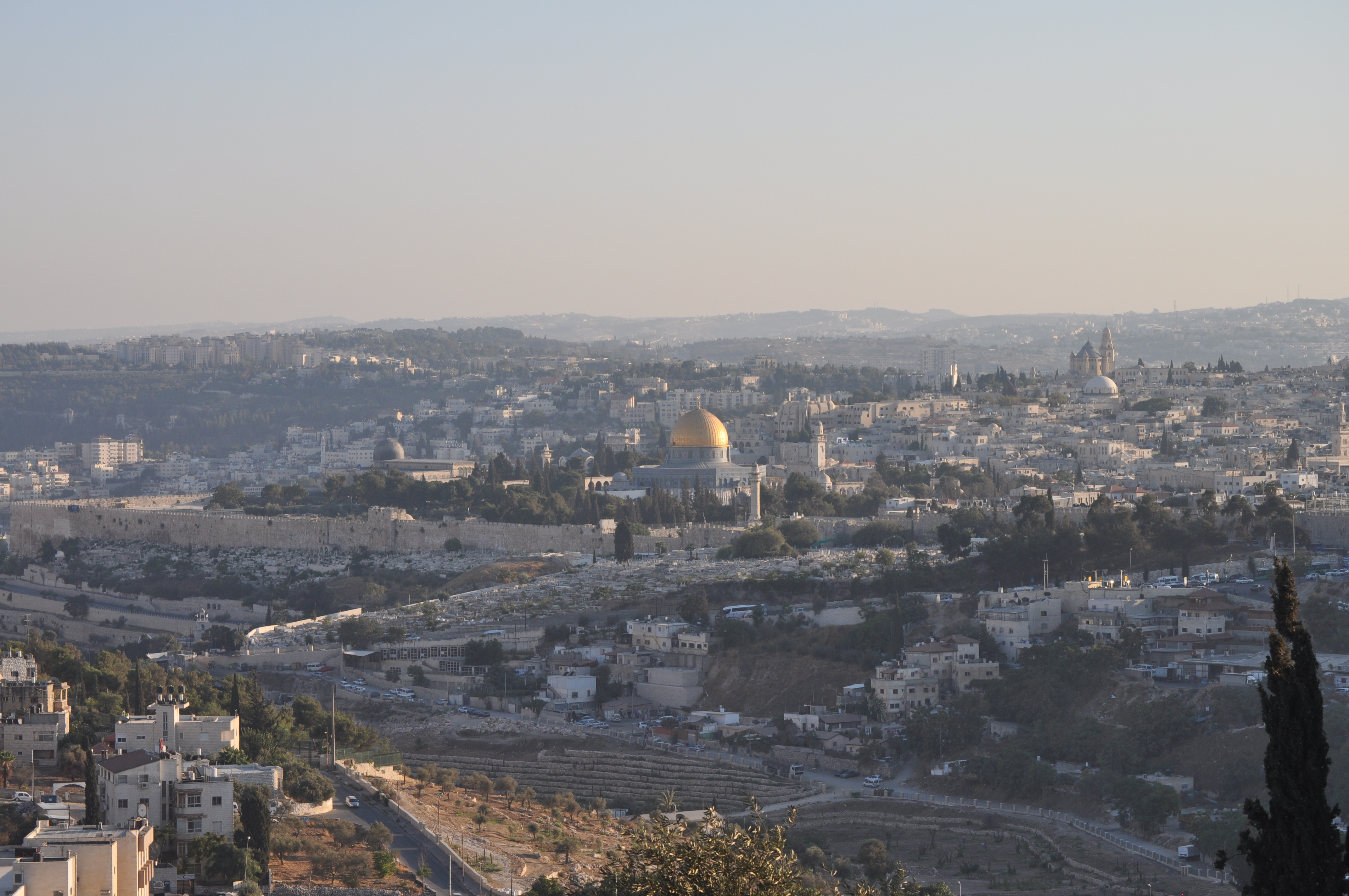
A view of the Old City of Jerusalem from Mt. Scopus
(photo: First.One.Through)

And the fig leaf is porous.

Countries already recognize the western half of Jerusalem as being an integral part of Israel. Further, many world leaders (including US Presidents Bill Clinton and George W Bush) came to Israel’s capital and addressed the parliament in Jerusalem. They recognized Jerusalem both as part of Israel and de facto as its capital.

Even German Chancellor Angela Merkel in March 2008 spoke at the Israeli Knesset. So when Merkel now states that “the status of Jerusalem is to be resolved in the framework of a two-state solution,” she unashamedly plays out the farce. Germany DOES recognize the western part of Jerusalem as part of Israel and as its functioning capital, but does not want to do it in an “official” capacity as it believes that withholding such recognition might enrich Germany through better relations and economic trading with the dozens of Arab and Muslim countries, and minimize the terrorism in Germany from Islamic extremists. As that seems a bit cold, Merkel put forward the red herring of seeking peace, as if recognizing reality somehow harms peace.

Let’s be clear: most of the world recognizes Jerusalem as Israel’s capital already. The farce of countries not “officially” recognizing Jerusalem is positioned as a prod that pushes Israel towards a peace agreement. But it is nothing of the sort. It is a calculated trade-off between the dignity of the citizens of Israel on one hand, against the commercial self-interest of trading with Arab countries on the other. It is therefore appropriate for Israel to rethink its own trading policies with countries which have no qualms in humiliating it on the global stage.


Related First.One.Through articles:

Recognition of Acquiring Disputed Land in a Defensive War

The Arguments over Jerusalem

Religious Countries Respond to Israel’s Jerusalem

Both Israel and Jerusalem are Beyond Recognition for Muslim Nations

The New York Times Inverts the History of Jerusalem

The Invisible Flag in Judo and Jerusalem

The Custodianship of a Child and Jerusalem

750 Years of Continuous Jewish Jerusalem

Today’s Inverted Chanukah: The Holiday of Rights in Jerusalem and Judea and Samaria

Palestinians agree that Israel rules all of Jerusalem, but the World Treats the City as Divided

The Battle for Jerusalem

“East Jerusalem” – the 0.5% Molehill

Jerusalem, and a review of the sad state of divided capitals in the world

The Parameters of Palestinian Dignity

Subscribe YouTube channel: FirstOneThrough

Join Facebook group: FirstOne Through Israel Analysis


NY Times Cannot Even be Even-Handed When Describing “No Man’s Land”

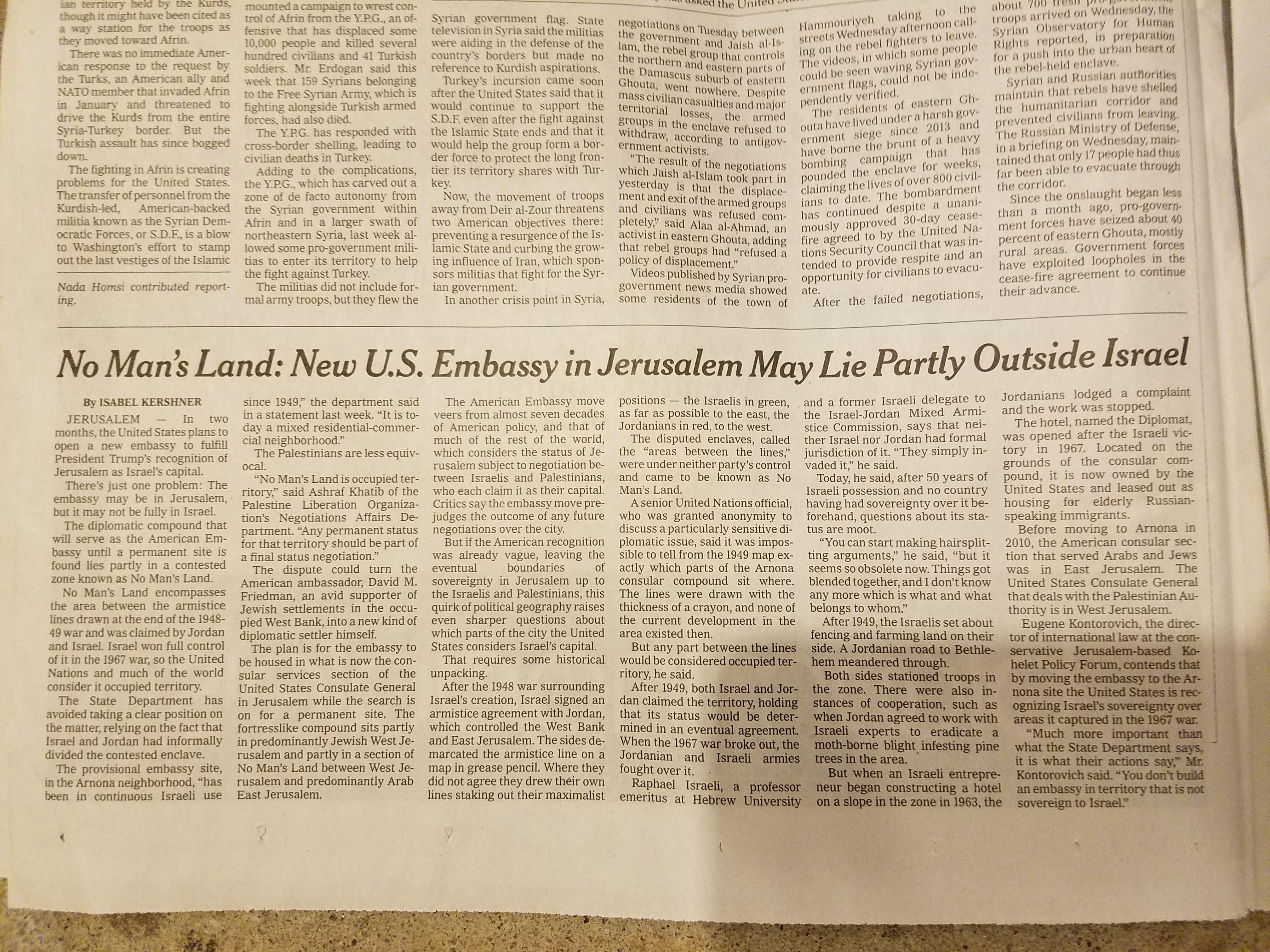
On March 8, 2018, Isabel Kershner wrote an article for the New York Times called “No Man’s Land: New U.S. Embassy in Jerusalem May Lie Partly Outside Israel.” The article described that the location of the U.S. embassy would partially lie outside of Israel’s 1949 Armistice Lines with Jordan in an area known at the time as the “No Man’s Land.” It attempted to explain the terminology through a history lesson about the area.

But being the New York Times, the history would be incomplete and distorted.

Consider the opening of the description:

“No Man’s Land encompasses the area between the armistice lines drawn at the end of the 1948-9 war and was claimed by Jordan and Israel. Israel won full control of it in the 1967 war, so the United Nations and much of the world consider it occupied territory.”

As the NY Times does at every occasion, it describes Israel’s administration of Judea and Samaria with a statement that the world does not recognize Israel’s claim and considers the land “occupied territory.” Yet the Times will never print – even here in an article meant to clarify the nature of the land – that Jordan’s claim on the entirety of the West Bank/Judea and Samaria was never considered valid.

The omissions would continue.

Kershner wrote that she would give some clarity to the nature of the land:

“After the 1948 war surrounding Israel’s creation, Israel signed an armistice agreement with Jordan, which controlled the West Bank and East Jerusalem. The sides demarcated the armistice line on a map in grease pencil. Where they did not agree they drew their own lines staking out maximalist positions – the Israelis in green, as far as possible to the east, the Jordanians in red, to the west.

The disputed enclaves, called the ‘areas between the lines,’ were under neither party’s control and came to be known as No Man’s Land.”

Note the many problems of the first sentence. It states that no party is to blame for the 1948 war. A person would never know that the armies of five Arab countries invaded Israel at its creation by the first half of the sentence. The second half would lead a reader to conclude that the Jordanians naturally had controlled the West Bank and East Jerusalem. This is deeply flawed. The Hashemite Kingdom of Transjordan, as today’s Jordan was known back in 1948, invaded and illegally annexed Judea and Samaria and the eastern half of Jerusalem. To state that Jordan simply “controlled the West Bank and East Jerusalem,” makes that illegal seizure seem normative and historic. It was neither. It was an invasion in an offensive war to destroy Israel.

The problems in the “historical unpacking” would continue:

“After 1949, both Israel and Jordan claimed the territory, holding that its status would be determined in an eventual agreement. When the 1967 war broke out, the Jordanian and Israeli armies fought over it.”

The 1967 war didn’t simply break out. Jordan attacked Israel first (again), after Israel repeatedly told the Jordanians to not initiate a war. The point is not a subtle one, as the laws regarding the seizure of land in a war are arguably not the same in a defensive war as an offensive war. Especially when the party that initiated the hostilities (Jordan) had zero claim to the land they occupied (all of the West Bank, eastern Jerusalem and the No Man’s Land!)

The article would also not mention anywhere that Israel formally annexed the entirety of the eastern portion of Jerusalem – including No Man’s Land – in 1980. How could any background on the area omit such a detail?

Further, Jordan gave up any claim to the area in July 1988. How could the article neglect to mention that small tidbit?

In short, the article focused squarely on Israel’s claim to a part of Jerusalem counter to a Jordanian claim that the paper wrote about as a historical reality. In truth, the Jordanians NEVER had an legal claim to any of the West Bank or eastern Jerusalem, and rescinded the false claim to that land 30 years ago.

Jerusalem was divided for roughly 19 years of its 4000 year history, from 1948 to 1967. But the New York Times will continue to try to slice and divide Judaism’s holiest city at every opportunity to minimize the Jewish State’s ties to its capital.


Related First.One.Through articles:

The New York Times Inverts the History of Jerusalem

Both Israel and Jerusalem are Beyond Recognition for Muslim Nations

750 Years of Continuous Jewish Jerusalem

Arabs in Jerusalem

Jordan’s Deceit and Hunger for Control of Jerusalem

The Arguments over Jerusalem

Jerusalem, and a review of the sad state of divided capitals in the world

The anthem of Israel is JERUSALEM

The Battle for Jerusalem

Subscribe YouTube channel: FirstOneThrough

Join Facebook group: FirstOne Through  Israel Analysis

Iran’s New Favorite Jewish Scholars

It is no secret that Iran despises the Jewish State, with calls to annihilate the “cancer” that is Israel. Iran’s leadership also enjoys provoking the ire of Jews generally, as it puts on exhibitions of Holocaust cartoons. To add to the insults, the Iranian media loves to showcase Jews that bash the Jewish State. It’s a spectacle for the Coliseum.

Press TV is a 24-hour English language news organization of the Islamic Republic of Iran Broadcasting, with headquarters in Tehran. The Iranian news organization’s favorite Jewish group for many stories is the Neturei Karta, an extremist anti-Zionist religious group that can be counted as featured speakers in stories about the Iranian nuclear deal, Palestinian rights and Holocaust revisionist history. What better way to convince people that Jews are evil, colonialist, parasitic liars than having Jews make such statements themselves?

In December 2017, Press TV found a new group of Jewish scholars to feature in its Israel bashing stories. In an article entitled “100 Jewish studies scholars sign petition condemning Trump’s declaration,” Press TV reviewed a petition signed by over 100 Jewish university scholars that denounced US President Trump’s recognition of Jerusalem as the capital of Israel, and his decision to relocate the US embassy to the city. The news site quoted the petition almost in its entirety, it was that rich for the Iranian government.  Below is the scholars’ statement (not the Iranian government’s) with fact-checking inserted after each paragraph.

“We write as Jewish Studies scholars to express our dismay at the Trump administration’s decision to reverse decades of bipartisan U.S. policy by declaring Jerusalem the capital of Israel, and authorizing the relocation of the U.S. embassy from Tel Aviv, outside of a negotiated political framework that ends the legal state of occupation and ensures respect for the rights of all Israelis and Palestinians to Jerusalem.”

  • “reverse decades of bipartisan U.S. policy.” The Jerusalem Embassy Act of 1995 was passed with bipartisan Congressional support and specifically made clear that: 1) Jerusalem should be an undivided city; 2) it should be the capital of Israel; and 3) the US should move its embassy to Jerusalem. The Act’s presidential waiver allowing for a deferral every six months only related to moving the embassy to Jerusalem and providing such funding. The recognition of Jerusalem as the united capital of Israel passed with bipartisan support in 1995 – the opposite of what the statement claimed.
  • “outside of a negotiated political framework that ends the legal state of occupation” The “political framework “is to arrive at a peaceful resolution to the disputed land by mutual agreement. The statement’s language about occupation and rights makes it appear that 1) there are no rights currently; 2) the entire peace process is just about those issues; and 3) that recognizing Israel’s capital undermines any of those discussions. All false.

“Jerusalem is of immense religious and thus emotional significance to Jews, Muslims, and Christians alike. It is the focus of national aspirations for both Israelis and Palestinians. We hope one day to see a world in which all inhabitants of the land enjoy equal access to the city’s cultural and material resources. Today, unfortunately, that is not the case.”

  • “immense religious and thus emotional significance to Jews, Muslims, and Christians alike.” One would imagine that Jewish scholars would have a basic understanding that Jews, Muslims and Christians are not “alike” in their attachment to Jerusalem. Only Judaism reveres the city as its holiest location. That Jewish scholars could write such a statement – happily repeated by Israel’s enemies – is outrageous and dangerous.
  • “We hope one day to see a world in which all inhabitants of the land enjoy equal access” It has only been under Israel that people have had equal access to Jerusalem. When the Arabs ruled the eastern part of the city from 1949-1967, they evicted and banned all Jews. When Israel reunited the city, it offered Israeli citizenship to any Arab that wanted it – and continues to extend such offer to this day. Quite different that Jordanians that denied citizenship to any Jews in the city. Further, the growth of the Arab population in Jerusalem surpasses the growth of Jews in the city. The “hope” of the scholars is the reality today- under Israeli rule.

“As the Israeli human rights organization B’Tselem* has documented, Palestinian residents of Jerusalem endure systematic inequalities, including an inequitable distribution of the city’s budget and municipal services, routine denial of building permits that are granted to Jewish residents, home demolitions, and legal confiscation of property for Jewish settlement. In addition, Palestinians in the West Bank, unlike Jewish Israelis resident in that territory, require a special permit to visit Jerusalem’s holy sites.”

  • “inequitable distribution of the city’s budget and municipal services, routine denial of building permits that are granted to Jewish residents” All Israelis – both Jewish and not Jewish – have their building permits go through the same approval processes. Some permits are approved and some are not. Under-investment in some predominantly Arab neighborhoods of Jerusalem is a function of many factors, and something that the current mayor of Jerusalem Nir Barkat has been trying to address, but he faces constant opposition from the United Nations to make such investments. How do Israel’s critics not feel the least bit of hypocrisy as they both demand that Israel invest in Arab neighborhoods in eastern Jerusalem, while also demanding that Israel abandon eastern Jerusalem altogether?
  • “Palestinians in the West Bank, unlike Jewish Israelis resident in that territory, require a special permit to visit Jerusalem’s holy sites.” All citizens of Israel go through the same process of entering Jerusalem. Non-citizens must go through border control to enter anywhere in Israel, whether holy sites in Jerusalem or elsewhere. But they do have access and travel to Jerusalem’s holy sites every day – something that Jews were unable to do when Jordanian and Palestinian Arabs ruled the Old City illegally.

“In this context, a declaration from the United States government that appears to endorse sole Jewish proprietorship over Jerusalem adds insult to ongoing injury and is practically guaranteed to fan the flames of violence. We therefore call on the U.S. government to take immediate steps to deescalate the tensions resulting from the President’s declaration and to clarify Palestinians’ legitimate stake in the future of Jerusalem.“

  • “sole Jewish proprietorship over Jerusalem”  Are these scholars deliberately trying to be provocative? Israel has sovereignty over Jerusalem. It is a country that has a mix of Jews (75%) and non-Jews (25%), one of the most ethnically diverse countries in the entire Middle East. Israel has allowed the Jordanian Waqf to administer the Jewish Temple Mount since the country reunited the city in 1967. How do the scholars write “sole Jewish propriertorship” for an ethnically diverse country having sovereignty over a city in which it has allowed a Muslim Waqf to administer the Temple Mount, which denies the rights of Jews to pray at the site?
  • “Palestinians’ legitimate stake in the future of Jerusalem.” What makes the Palestinian claim on Jerusalem legitimate? Do they have a legitimate claim on Jaffa? On Nazareth? The Israelis and Palestinian Authority will decide between themselves what kind of settlement makes sense. Do these scholars think that the US should not recognize any city in Israel or the State of Israel itself until it recognizes a State of Palestine?

The Iranian government has found new Jewish friends willing to publicly undermine Israel. And for Iran, these Jews have the added value of looking like hippy college professors as opposed to the black hat Neturei Karta rabbis.

Rabbi Jonathan Brumberg-Kraus (left), one of the petition’s signatories, member of Jews for Justice for Palestinians, which supports BDS and the dismantling
of any Jewish privileges in Israel (like a Jewish star on the Israeli flag); and


Terri Ginsberg (right), who currently teaches at the American University of Cairo (she signed the petition as x-Dartmouth) who also blogs for the vi
rulently anti-Israel sites Mondoweiss and Electronic Intifada

Just because the scholars don’t dress in a radical fashion, does not necessarily mean that their actions and statements aren’t extreme.

The petition ends with a request for comments to be sent to jewishstudiesstatement@gmail.com for rabbis that may or may not be on the list accidentally. Perhaps they would be interested in general comments as well.


Related First.One.Through articles:

The Custodianship of a Child and Jerusalem

Arabs in Jerusalem

Today’s Inverted Chanukah: The Holiday of Rights in Jerusalem and Judea and Samaria

The Arguments over Jerusalem

The Battle for Jerusalem

Jerusalem, and a review of the sad state of divided capitals in the world

Is Your Capital Central to Your Country?

Corpus Separatum Ended Forever in 1995

The US Recognizes Israel’s Reality

A Response to Rashid Khalidi’s Distortions on the Balfour Declaration

Liberals’ Biggest Enemies of 2015

Subscribe YouTube channel: FirstOneThrough

Join Facebook group: FirstOne Through  Israel Analysis

Is Your Capital Central to Your Country?

The United Nations Security Council pushed forward a vote that the United States could not recognize Jerusalem as the capital of Israel nor move its embassy there. The vote failed, as the United States exercised its veto power as one of the five permanent members of the UNSC. In response, the UN General Assembly is set to take a non-binding vote about the same issue on December 21, 2017.

It is beyond question that every country has the right to name its own capital, even a country despised by the United Nations like Israel.

What is particularly galling about this effort launched by the leader of Turkey, is that Israel is the only country that considers its capital city to be central to its identity. So much so, that its national anthem is all about Jerusalem.

So it is worth posing a question to the members of the UN Security Council:

  • United States: is your anthem about Washington, D.C.?
  • China: is your anthem about Beijing?
  • Russia: is your anthem about Moscow?
  • France: is your anthem about Paris?
  • United Kingdom: is your anthem about London?
  • Bolivia: is your anthem about Sucre?
  • Egypt: is your anthem about Cairo?
  • Ethiopia: is your anthem about Addis Ababa?
  • Italy: Is your anthem about Rome?
  • Japan: is your anthem about Tokyo?
  • Kazakhstan: is your anthem about Astana?
  • Senegal: is your anthem about Dakar?
  • Sweden: is your anthem about Stockholm?
  • Ukraine: is your anthem about Kiev?
  • Uruguay: is your anthem about Montevideo?

The answer to all of the above is no. Their capital cities are simply where the seats of government resides. For some countries like Egypt and Italy, the capitals have been there for many centuries.

But there is only one country in the entire United Nations, whose capital is so integral to the essence of the nation, that it’s national anthem is completely about its capital.

“As long as in our hearts within

The Jewish soul yearns,

And towards the eastern edges, onward,

An eye gazes towards Zion.

Our hope is not yet lost,

The hope that is two thousand years old,

To be a free nation in our land

The land of Zion: Jerusalem.“


#JerusalemIsIsraelsCapital


Related First.One.Through music video:

The anthems of the Middle East (Enya)

The 1967 “Borders” (The Kinks)

Ethiopian Jews come Home (Phillip Phillips)

Judea and Samaria (Foo Fighters)

Subscribe YouTube channel: FirstOneThrough

Join Facebook group: FirstOne Through  Israel Analysis


The Recognition Catch Up

The United States recognized Jerusalem as the capital of Israel on December 6, 2017 in a move that President Donald Trump said was a “long-overdue step.” Many countries disagreed, and viewed the announcement as premature, claiming that such recognition should be done in conjunction with a broader peace process and mirror whatever the Israelis and Palestinian Authority themselves agree to.

If anything, Trump’s move was very late considering the recognition that had been afforded to the Palestinian Arabs over the previous decade.

Recognition of Palestine

In 1988, the Palestinian Liberation Organization declared its independence. Israel and the western world ignored the declaration of the noted terrorist organization, while fellow Arab and Muslim countries quickly recognized the State of Palestine.

Within a few years of the PLO declaration, the Israelis and Palestinian Arabs signed the Oslo Accords (in 1993 and 1995) which put in motion a peace process, including the creation of a Palestinian Authority (PA). As part of those agreements, both parties agreed that the PA would have limited powers regarding international relations (Article IX), including having no ability to obtain official recognition from other governmental bodies.

“In accordance with the DOP, the Council will not have powers and
responsibilities in the sphere of foreign relations, which sphere includes the
establishment abroad of embassies, consulates or other types of foreign missions and posts or permitting their establishment in the West Bank or the Gaza Strip, the
appointment of or admission of diplomatic and consular staff, and the exercise of
diplomatic functions.”

When the leader of the PA, Yasser Arafat (fungus be upon him) failed to deliver on peace and launched a second intifada in September 2000, the peace process ground to a halt. Any movement by world organizations and governments to provide additional recognition on key issues for the Israelis and PA was put on hold.

Yet the Palestinian Authority under Mahmoud Abbas pushed forward with seeking global recognition, even as he lost control of the Gaza Strip in 2007.

Abbas began with Costa Rica (2008) and Venezuela (2009) before making significant headway with the major countries in South America.

In 2010, Abbas got Brazil and Argentina to recognize Palestine, despite commitments in the Oslo Accords that the PA would not take such steps. The Israeli foreign ministry released a statement that  “Recognition of a Palestinian state is a violation of the interim agreement signed by Israel and the Palestinian Authority in 1995, which established that the status of the West Bank and the Gaza Strip will be discussed and solved through negotiations….  All attempts to bypass negotiations and to unilaterally determine issues in dispute will only harm the trust of the sides and their commitment to agreed upon frameworks for negotiations.”

No matter.

In 2011, other South American countries recognized Palestine including Chile and Uruguay. UNESCO followed suit and admitted the “State of Palestine.” Shortly thereafter, Iceland became the first country in western Europe to recognize Palestine, with borders based on the 1949 Armistice Lines. By the following year, the United Nations began calling the entity the “State of Palestine” in all official documents.

Remarkably, at the end of the third Hamas war on Israel in 2014, Sweden became the second western European country to recognize Palestine.

Recognition of Jerusalem

While Abbas’s PA actively sought recognition of a state since 2008, Israel was fighting three wars from Gaza and a “stabbing intifada.” Israel was not busy lobbying the world to recognize Jerusalem as its capital, but focused on getting the world to stop the Islamic Republic of Iran from obtaining nuclear weapons while it declared its intention of destroying Israel.

While the Palestinian Authority was playing offense, Israel was playing defense.

At this point in time, with over 20 countries and United Nations entities recognizing Palestine over the past decade despite the explicit statements in the Oslo Accords, isn’t it well past time for countries of the world to recognize the capital of Israel?

Alternatively, if countries are truly concerned with the peace process, they can strip their recognition of Palestine, and leave the Israelis and PA to negotiate their peace, including matters related to borders, settlements and Jerusalem, and ultimately embrace the conclusion of the parties. Impartiality demands one or the other.


Jerusalem from the air, facing north


Related First.One.Through articles:

Both Israel and Jerusalem are Beyond Recognition to Muslim Nations

Recognition of Acquiring Disputed Land in a Defensive War

The US Recognizes Israel’s Reality

The UN’s #Alternative Facts about the 1967 Six Day War

Welcoming the Unpopular Non-President (Abbas) of a Non-Country (Palestine)

What do you Recognize in the Palestinians?

Subscribe YouTube channel: FirstOneThrough

Join Facebook group: FirstOne Through  Israel Analysis
Both Israel and Jerusalem are Beyond Recognition for Muslim Nations

After US President Donald Trump announced that the United States is officially recognizing the fact that Jerusalem is the capital of Israel on December 6, 2017, many Arab and Muslim countries sought to make a declaration.

They doubled-down on putting their heads in the sand.

Turkey pulled together the 57 countries of the Organization of Islamic Countries, the OIC, to condemn the statement of the United States. Turkey’s President Tayyip Erdogan said that Jerusalem was a “red line” for the Muslim world and the OIC would reject any recognition of the eastern half of Jerusalem as the capital of Israel.

Turkish President Erdogan at OIC Summit
(picture: Reuters K. Ozer)

That statement is a bit of a joke, as most of the countries in the OIC don’t even recognize Israel itself.

Even in 2017, almost 70 years after the reestablishment of the Jewish State in the holy land, the presence of Jews still irks too many Muslim nations, including: Afghanistan; Algeria; Bahrain; Bangladesh; Brunei; Chad; Comoros; Djibouti; Indonesia; Iran; Iraq; Kuwait; Lebanon; Libya; Malaysia; Mali; Mauritania; Morocco; Niger; Oman; Pakistan; “Palestine”; Qatar; Saudi Arabia; Somalia; Sudan; Syria; Tunisia; UAE; and Yemen. That’s 30 countries that do not recognize the State of Israel that came together to say that do not recognize its capital.

How is this news?

Here is something that would be ground-breaking for the global purveyors of #AlternativeFacts:

  • It would be news if the anti-Zionist media would ever state this basic fact that these countries are deeply hostile to Israel in any form.
  • It would be news if the media would not refer to “Arab East Jerusalem” in all caps as if it is an actual entity with endemic Arab roots.
  • It would be news for the media to state that “East Jerusalem” only existed for 18 years (1949-1967) in the city’s 4000 year history.
  • It would be news if the media would ever educate readers that Jews have been a majority in Jerusalem since the 1860s.
  • It would be news if the media ever wrote that the Jordanians expelled all of the Jews from eastern Jerusalem and the “West Bank” in 1949
  • It would be news if the media would give proper background that under Arab Muslim rule, Jews were forbidden from even entering the Old City of Jerusalem.
  • It would be news if the media would stop saying that Jerusalem is holy to Muslims, Christians and Jews ALIKE, as if the city isn’t uniquely the holiest city ONLY for Jews
  • It would be news if the media would bother to inform its readers that the man who called together and hosted the summit, Erdogan, is the major sponsor and backer of Hamas, the most anti-Semitic terrorist group that waged three wars against Israel in just the past ten years, and that he is still angry at Israel for recognizing an independent Kurdistan.

A squandered opportunity to show yet another example of the deep hatred that Muslims feel towards Jewish sovereignty in their holy land.

Instead, the media decided to report that a country like Iran, that has called for Israel to be wiped off of the map, is angry about the US recognizing Israel’s capital. Really.

Are you still paying for that paper that tells you nothing?


Related First.One.Through articles:

Arabs in Jerusalem

Nicholas Kristof’s “Arab Land”

The Arguments over Jerusalem

The New York Times Thinks that the Jews from Arab Countries Simply “Immigrated”

The Cancer in the Arab-Israeli Conflict

Subscribe YouTube channel: FirstOneThrough

Join Facebook group: FirstOne Through  Israel Analysis