Israel’s Nation-State Basic Law is Not Based on Religion

There are a few democratic countries that do not have formalized constitutions such as the United Kingdom, New Zealand and the State of Israel. These governments occasionally issue broad laws to outline the basic principles of government. Israel did just that in July 2018.

Israel’s 2018 Basic Law of the Nation-State of the Jewish People was interesting for what it omitted as much as for what it included.

The focus of the law was about the connection between the nation, the land and the people. Specifically, the law outlined the connection between the modern state of Israel, the Jewish people and the Jewish Holy Land.

But the law clearly omitted the religion of the Jews, Judaism.

The law had no preamble about the God of Judaism’s forefathers of Abraham, Isaac and Jacob, the way that Ireland begins its constitution about Jesus and the Trinity.

The law did not declare Judaism as the State of Israel’s official religion, nor did it declare that there was an official “church” or head rabbi in the country. Such laws are found in several democracies such as for Roman Catholicism in Costa Rica and for the Eastern Orthodox Church in Greece.

Israel’s Basic Law did not declare that the leader of the country needed to belong to the official government church. Such a law can be found in Denmark’s constitution regarding the Evangelical Lutheran Church.

The law did not mandate that Judaism must be taught in school, a law that is found about Catholicism in Malta.

The law did not even state that Israel’s laws are based on Jewish values and inspired by the Jewish prophets as was stated in the country’s Declaration of Independence. Such a statement about Christianity features prominently in the constitution of Norway. Panama’a constitution mentions “Christian morality,” while Peru’s constitution calls out the “Catholic Church as an important element in the historical, cultural, and moral formation” of the country.

As a matter of fact, the Basic Law seemed to go to pains to not even refer to religion.

The law refrained from using the words “God,” “Judaism,” “Holy Land,” “sacred,” or “religion” anywhere in the text. While the law declared the “Hatikvah” as the national anthem, that anthem similarly avoids using any religious language. That’s in sharp contrast to 34 democracies that use “God” or “Lord” in their anthems including Canada, Italy and Switzerland, and others that specifically refer to Christianity such as in the Netherlands and Romania .

The 2018 Basic Law simply detailed that the Jewish people were connected to the land of Israel because of history. Yet in doing so, the law opted to not also underscore the deep religious and unique connection that Jews have for all of the land of Israel, and particularly for Judaism’s holiest city of Jerusalem.


Seal of King Hezekiah found at the southern Temple Mount in Jerusalem
who reigned c.715 – 686 BCE

The emphasis of Israel’s 2018 Basic Law related to the essence of Jews are a people, not adherents to a religion. International law in 1920 recognized “the historical connexion of the Jewish people with Palestine and to the grounds for reconstituting their national home in that country.” In 2018, Israel took that same step of laying out the long and deep connection between the Jewish people to the land of Israel, realized in the modern state of Israel.


Tel Dan Stele from c.840 BCE found in southern Syria referring to the “House of David”

Jews are the modern Israelites that had kingdoms in Canaan, Israel and Judah. Israel’s 2018 Basic Law affirmed that historical connection between the people and the land, and laid out the initial markings which characterize the reincarnation of the indigenous people in the modern State of Israel.

It is remarkable that Israel chose not to define itself by religion when so many democracies do so.


Related First.One.Through articles:

A Response to Rashid Khalidi’s Distortions on the Balfour Declaration

750 Years of Continuous Jewish Jerusalem

Abbas’s Speech and the Window into Antisemitism and Anti-Zionism

From the Balfour Declaration to the San Remo Conference

In Defense of Foundation Principles

Squeezing Zionism

The UN’s Disinterest in Jewish Rights at Jewish Holy Places

Gimme that Old-Time Religion

Related First.One.Through videos:

Religious Democracies (music by Bob Marley)

God is a Zionist (music by Joan Osborne)

Subscribe YouTube channel: FirstOneThrough

Join Facebook group: FirstOne Through  Israel Analysis

Deciphering the 2018 Basic Law in Israel – The Nation State of the Jewish People

On July 19, 2018, Israel signed a new Basic Law called “The Nation-State of the Jewish People.” It has been called controversial by many liberal media outlets in what it purports to do with minority rights.

The notion that there is a major curtailment of Israeli Arabs’ rights is a gross exaggeration. However, what should be discussed is the novel stance whereby Israel has now assumed the responsibility for the security and the “cultural, historical and religious legacy” of Jews in the diaspora.

Below is the text of the latest Basic Law in Israel, with a review below each point.

  1. The State of Israel
    a) Israel is the historical homeland of the Jewish people in which the state of Israel was established.
    b) The state of Israel is the nation-state of the Jewish people, in which it actualizes its natural, religious, and historical right for self-determination.
    c) The actualization of the right of national self-determination in the state of Israel is unique to the Jewish people.

Review:

The comments in parts 1a and 1b are actually found in international law, in both the San Remo Conference Resolution of 1920 and the 1922 Mandate of Palestine. Specifically, international law acknowledged the historic ties of the Jewish people to the land of Israel and the goal to reconstitute such national home:

  • in favor of the establishment in Palestine of a national home for the Jewish people”
  • “recognition has thereby been given to the historical connection of the Jewish people with Palestine and to the grounds for reconstituting their national home in that country”

It’s an established fact that Jews have a long history in the land of Israel going back thousands of years. For over 100 years, Jews and the international community have been working to re-actualize the Jewish right to self-determination in that homeland. Sections 1a and 1b are seemingly innocuous and superfluous.

However, section 1c went a step further. It states that the national right of self-determination is ONLY for Jews. While the clause does not limit the INDIVIDUAL rights of non-Jews to live openly and freely in Israel, the intention of the clause is seemingly that non-Jews have no NATIONAL right of self-determination. Non-Jews in Israel have personal rights of self-determination as citizens of the state, while Jews have an added right as a people.

Why:

The State of Israel has very few Basic Laws. As such, why would the country opt to state the obvious points of 1a and 1b in a new Basic Law, and add the additional point of the uniqueness of Jewish self-determination in section 1c?

For the past several years, Palestinian Arab leaders have voiced their belief that Jews are not native to Israel and that only Palestinian Arabs are indigenous to the region. They have turned a blind eye to history and have been effective in getting various United Nations’ bodies to similarly cut off the deep historic and religious ties between Jews and their holy land. They have gotten the UN to decry that Jews are eliminating the natural and historic “Arab character” of Judaism’s holiest city and capital of Jerusalem where Jews have been a majority for over 150 years.

Further, Arabs contend that Jews are not even a people and therefore cannot have a claim of national self-determination. Jews are simply people that believe in a religion – Judaism – and are a diverse mix of cultures and nationalities from around the world, who descended on Palestine as tools of global powers to insert a foreign democracy in the heart of the Arab world. The Arabs have promoted the notion that these Israeli Jews are simply foreign interlopers, who are negating the Palestinian Arab right of self-determination. The acting-President of the Palestinian Authority Mahmoud Abbas gave a long lecture to this effect in April 2018.

If the rants of these wild fools would have been given no ear, perhaps this Basic Law would not have been drafted as is. But the mean and angry words have no longer just been echoed in the Muslim and Arab world, but are repeated in European capitals and at the United Nations. Consequently, Israel felt compelled to declare that the land of Israel has always been the homeland of the Jewish people and that the country of Israel is uniquely the nation-state of the Jewish people.

That the liberal press would be shocked at this section of the Basic Law is particularly surprising, noting how much they championed the idea of “two states for two people: one for Jews and one for Arabs,” for so many years.

  1. National symbols of the State of Israel
    a) The name of the state is Israel.
    b) The flag of the state is white, two blue stripes near the edges, and a blue Star of David in the center.
    c) The symbol of the state is the Menorah with seven branches, olive leaves on each side, and the word Israel at the bottom.
    d) The national anthem of the state is “Hatikvah”
    e) [Further] details concerning the issue of state symbols will be determined by law.

Review:

None of the items listed in section 2 is news to anyone that has ever been to Israel or knows anything about the country. These are all established facts.

Yet, it is curious that nowhere in this section is there a specific reference to Jews or Judaism. The symbols that are highlighted – Israel (Jews are known as the Children of Israel in the Bible); Star of David (King David was a leading unifying king in Jewish history); the Menorah (a symbol of religious Judaism from the Temple); the “Hatikvah” (a song of modern Jewish longing for a return to self-determination in the Jewish holy land) – are all based on Judaism and Jewish history, yet “Jews” and “Judaism” are absent in this section.

Why:

While section 1 underscored historical facts and repudiated the Arab narrative about Jews in Israel, section 2 put forward some modern manifestations of the Jewish State. As symbols, each item is simply a marker and note of Jewish pride. Each item does nothing to impact the day-to-day lives of Jew or non-Jew living in Israel.

Perhaps section 2e leaves open the idea that new state symbols might include items that are not inherently Jewish, such as a state bird.

  1. [The] unified and complete [city of] Jerusalem is the capital of Israel.

Review:

Jerusalem has always been the capital of Israel, and Israel enshrined this fact in the 1980 Basic Law about Jerusalem that was issued solely for such purpose. This section is seemingly wholly redundant.

Why:

While much of the world has not recognized Israel’s annexation of the eastern part of Jerusalem, the United Nations took additional steps against part of Israel’s capital in December 2017. UN Security Council Resolution 2334 declared that all lands that Israel won in its defensive war against Jordan in 1967 were illegally obtained, including the eastern part of Jerusalem.

It would appear that Israel opted to repeat its claim on the entirety of Jerusalem because of the recent action of the United Nations. If there were broader goals such as declaring the city as the holiest site for Jews, the statement would have been broader and discussed the holy sites in the city. Perhaps the drafters of the Law decided that they did not want to provoke the Muslim world, despite the Arabs’ constant belittling of Jewish sites and rights in Jerusalem.

  1. The Language of the State of Israel
    a) Hebrew is the language of the state.
    b) The Arabic language has a special status in the state; the regulation of the Arab language in state institutions or when facing them will be regulated by law.
    c) This clause does not change the status given to the Arabic language before the basic law was created.

Review:

Since the Mandate of Palestine of 1922, English, Arabic and Hebrew have been the official languages in Palestine (Article 22). When Israel declared itself a state in 1948, it continued to give preference to the Arabic language. This Basic law’s section 4b is seemingly a demotion of Arabic as an “official” language, but section 4c seems to ensure that there is no practical impact of such demotion, as Arabic will continue to be used in all governmental items such as monies, stamps and signage.

Why:

Section 4 can best be viewed through the same lens as section 2 – a symbolic note that has no practical impact on day-to-day life. Only the Hebrew language was called out with pride by David Ben Gurion in the country’s Declaration of Independence in May 1948. This section is seemingly another marker of the Jewishness of the State of Israel, even while it makes accommodations for people who speak Arabic.

  1. The state will be open to Jewish immigration and to the gathering of the exiled.

Review:

This statement is seemingly WEAKER than international law laid out in the Mandate of Palestine. In Article 6, that document specifically sought to “facilitate Jewish immigration under suitable conditions and shall encourage, in co-operation with the Jewish agency referred to in Article 4, close settlement by Jews on the land, including State lands and waste lands not required for public purposes.” The word “facilitate” is an active verb compared to simply being “open” to Jewish immigration.

More specifically, section 5 is completely redundant with the country’s Declaration of Independence which stated “THE STATE OF ISRAEL will be open for Jewish immigration and for the Ingathering of the Exiles.”

Why:

Once again, this Basic Law is seemingly redundant with international law and the country’s foundation document. Which might give a clue as to why the country’s lawmakers decided to issue such clauses in a rare new Basic Law.

The United Nations acted against its own international laws as it related to Jews and the Jewish homeland. The Mandate of Palestine clearly stated that no person could be excluded from living anywhere in the Mandate because of their religion (Article 15), but the British promptly separated half of the Mandate region into the Hashemite Kingdom of Jordan and allowed the country to become Jew-free. When Jordan attacked Israel in 1948 and subsequently banned all Jews from the west bank of the Jordan River, including eastern Jerusalem, and then gave citizenship only to Arabs – specifically excluding Jews – the United Nations said nothing. The UN continues to declare that the vast majority of the Mandate – Jordan, the “West Bank” and Gaza – should be Jew-free today.

Israel clearly felt the need to state in its own laws that it is going to welcome the Jewish exiles from around the world, as it has for years, and not rely on the neutered international laws from 1922, nor its own foundation document.

  1. The Diaspora
    a) The state will labor to ensure the safety of sons of the Jewish people and its citizens who are in trouble and captivity due to their Jewishness or their citizenship.
    b) The state will act to preservethe cultural, historical and religious legacy of the Jewish people among the Jewish diaspora.

Review:

Of the eleven sections in the 2018 Basic Law on The Nation State of the Jewish People, this is the only one that is truly new. It is not found in international law (1920 and 1922) nor in Israel’s Declaration of Independence (1948). It has no appearance in any of the country’s prior Basic Laws. It is extraordinary in every facet.

That a sovereign country would extend its safety net to a select group of non-citizens around the world is remarkable. It is without parallel.

The second underlying rationale of this new Basic Law becomes clear in this section. It is not only about echoing facts and laws that the world has chosen to ignore, but establishing this new one. The notion of a nation-state is a two-way street: Israel is the Jewish State, and the Jewish State is there for all Jews around the world.

This language stands against the carefully worded text of the Balfour Declaration of 1917 that specifically did not bias the Jewish communities outside of Palestine, that “nothing shall be done which may prejudice the civil and religious rights… or the rights and political status enjoyed by Jews in any other country.

While Jews are not in jeopardy of losing their “political status” as citizens of countries around the world, they now seemingly have a foreign country protecting them and their culture.

Why:

The 2014 War from Gaza unleashed waves of antisemitism around the world, particularly in Europe. Jews were attacked and killed in capital cities and small towns. It reached such a point that Israeli Prime Minister Benjamin Netanyahu went to Paris in early 2015 and asked the Jewish community whether it was time to leave France and move to Israel. It was an outrageous act, but also effective: the number of people from France making Aliya (moving to Israel) tripled after the events and Netanyahu’s visit.

Many people in France were angry at Netanyahu’s statement. The government of France appealed to its Jews that France would be considered a failure if it could not protect its Jewish population, but in fact, the Jewish community in France was broadly resentful that France was no longer a secure home for them.

Netanyahu came to Europe to state that times are different: the 1939 British White Paper which prevented Jews from fleeing the Holocaust to come to Israel was no more. Israel was a reality and ready to welcome anyone fleeing persecution as the nation-state for all Jews around the world.

It perhaps comes at a moment of security and smugness that Israel now offers its help to world Jewry, after decades of calling on world Jewry to help the nascent state. As Ben Gurion said on that fateful day in May 1948, “WE APPEAL to the Jewish people throughout the Diaspora to rally round the Jews of Eretz-Israel in the tasks of immigration and upbuilding and to stand by them in the great struggle for the realization of the age-old dream – the redemption of Israel.” Israel has now turned the table and is assuming the role of the guardian for world Jewry as opposed to the other way around.

But Jewish memory extends beyond the 1940s.

In 1917, British Jews made sure that the Balfour Declaration did not ensnare Jews outside of Palestine. However in 2018, Israel did not consult with world Jewry when it extended its sheltering tabernacle over their homes in the diaspora.

A very awkward step for a government that stated it had the interests of world Jewry in mind.


  1. The state views Jewish settlement as a national value and will labor to encourage and promote its establishment and development.

Review:

Section 7 is a repeat of international law as mentioned above in Article 6 of the Mandate of Palestine.

Why:

Settling the land has always been a priority of Zionists. It was true in the 1890s and remains true in the 21st century. The tie between the Jewish people and the Jewish holy land has been true for thousands of years, and no law that sought to connect the nation-state of Jews and Israel could possibly ignore the land of Israel. The Jewish ties to the Jewish holy land existed before the Modern State of Israel, and the government of Israel would be failing its basic mission of self-determination if it did not wholeheartedly promote the development of the land itself.

  1. The Hebrew calendar is the official calendar of the state and alongside it the secular calendar will serve as an official calendar. The usage of the Hebrew calendar and of the secular calendar will be determined by law.

Review:

Not news for anyone living in, or doing business in Israel.

Why:

As with the other items in this Basic Law, it seeks to affirm particular Jewishness of how the state operates. Like many of the sections, it does nothing to harm not-Jewish citizens, any more than some countries declaring Christmas a national holiday harms non-Christians.

  1. National Holidays
    a) Independence Day is the official holiday of the state.
    b) The Memorial Day for those who fell in the wars of Israel and the Memorial Day for the Holocaust and heroism are official memorial days of the state.

Review:

Beyond stating that the holidays and calendar of Judaism will be officially recognized in Israel’s calendar (sections 8 and 10), section 9 ascribes important moments in Israel’s history as national holidays in a typical fashion of any country, but adds a new dimension. Placing a historic event that occurred OUTSIDE of the country’s borders, which impacted a subset of its citizens is highly unusual. The Holocaust did not just have minimal impact on the non-Jews in Israel, but it had little direct impact on the majority Mizrachi Jews from countries including Iraq, Yemen, Egypt and Morocco.

But the Holocaust stands apart from the terrible persecutions suffered by Jews in Arab lands. The Holocaust was so evil and heinous, that it forced the world to create the Universal Declaration of Human Rights. Even the United Nations marks the day and encourages all member nations to remember the Nazi atrocities.

Of course the Jewish State would be one of those countries to recognize Holocaust Remembrance Day.

  1. Saturday and the Jewish Holidays are the official days of rest in the state. Those who are not Jewish have the right to honor their days of rest and their holidays. Details concerning these matters will be determined by law.

Review:

See section 8 above.

  1. This Basic Law may not be altered except by a Basic Law that gained the approval of the majority of the Knesset members.

Review:

Self explanatory.


The 2018 Basic Law is seemingly a reaction to world events since early 2014. While Israel has had to contend with an Arab world that rejects coexistence in favor of terrorism for decades, it has been the world’s more recent embrace of fake history and vile antisemitism that necessitated the Basic Law of the Nation State of the Jewish People at this time.

That the Basic Law would include language that Israel will act to protect Jews around the world, gives some insight of how Israel expects antisemitism to play out in the years ahead.


Related First.One.Through articles:

The Jewish Holy Land

The Left-Wing’s Two State Solution: 1.5 States for Arabs, 0.5 for Jews

Heritage, Property and Sovereignty in the Holy Land

A Response to Rashid Khalidi’s Distortions on the Balfour Declaration

750 Years of Continuous Jewish Jerusalem

Related First.One.Through videos:

Ethiopian Jews Come Home (Phillip Phillips)

The Anthem of Israel is JERUSALEM

Subscribe YouTube channel: FirstOneThrough

Join Facebook group: FirstOne Through Israel Analysis

The United Nations’ Select Concern for Arson in the Middle East

The fires around Israel have been burning for weeks, a direct result of the hundreds of arson attacks launched by Palestinian Arab terrorists in Gaza. And the United Nations has been silent.

Well, not exactly. The United Nations Special Coordinator for the Middle East Peace Process, Nickolay Mladenov made remarks in Gaza on July 15, 2018. In those remarks, he spoke about the situation from the Palestinian perspective. He spoke about the “humanitarian, political and security” situation of the people in Gaza, but not in Israel. The most telling indication of how Mladenov viewed the situation could perhaps be captured by this remark:

“For the last decade Palestinians in Gaza have lived through 3 conflicts. Israelis across the fence have lived with a constant threat of rocket attacks for the last decade. This cycle has to stop. It has to end.”

For the United Nations’ point person on the “Middle East Peace Process,” only the Palestinians lived through three wars, not the Israelis. The Israelis only had the “threat of rocket attacks,” not actual rocket attacks. Not abductions and infiltrations by underground tunnels. Not arson attacks through the air.

Simply threats. Not real violence.

It is not as though the UN doesn’t understand the dangers of arson. It has loudly spoken up about it – in the few cases when Israelis engaged in such attacks.

In July 2015, the UN loudly condemned Israelis. The Secretary General said at the time:

“The Secretary-General strongly condemns today’s murder of a Palestinian child in the West Bank and calls for the perpetrators of this terrorist act to be promptly brought to justice. He expresses his deepest condolences to the family of Ali Dawabsha, who were themselves severely injured in the arson attack. Continued failures to effectively address impunity for repeated acts of settler violence have led to another horrific incident involving the death of an innocent life.  This must end.”

The UN would say the same about another attack in March 2016:

“I strongly condemn today’s arson attack by suspected Jewish extremists on the home of Palestinian Ibrahim Dawabsheh in the occupied West Bank village of Duma. Mr. Dawabsheh and his wife were at home during the attack and sustained light injuries as a result of smoke inhalation. I wish them both a full and speedy recovery.”

But when it comes to Israel, the UN cannot acknowledge the HUNDREDS of arson attacks by HUNDREDS of Palestinian Arabs.

Similarly, the UN will never call out “Muslim extremists,” even while it comfortably condemns so-called “Jewish extremists,” despite passing resolutions that specifically denounce calling out extremists by their religious identity.

The UN will also not call the Palestinians’ attacks “terrorist acts” as it does for Israelis. It actually does the exact opposite. It celebrates the Palestinians. It calls the arsonists allies as it stands with the people of Gaza:

“Our allies in this are the Palestinian people in Gaza themselves. Our partners are in the Palestinian government and everybody who wants to see an end to this current escalation.”

“I assure you that the UN will not leave Gaza. We will enhance our presence here to be more effective and more efficient in providing support to the Palestinian people.”

There is ZERO concern for Israelis suffering from arson. Israel is simply a counter-party with whom the UN negotiates on behalf of the Palestinian Arabs:

“We will continue working with the Israeli authorities to improve access and movement for Gaza and to allow for more imports and exports. Without an economy, another escalation can come very quickly.”


For several decades, the United Nations has contorted itself with new and unique definitions for “refugees” just for Palestinian Arabs. It continues to turn a blind eye to the evils of Hamas which it seeks to legitimize by ushering it into a coalition government, as well as ignoring the actions of other Palestinian arsonists.

The Secretary General of the UN Antonio Guterres saidThe international community has the legal right and the moral duty to act collectively to put an end to terrorism ‘in all its forms and manifestations, committed by whomever, wherever and for whatever purposes.’” If only the UN would live up to its own values with it comes to Palestinian Arab terrorists.


Related First.One.Through articles:

The UN Must Pay to Repair the Gaza Fence

UN Comments on the Murder of Innocents: Itamar and Duma

UNRWA Is Not Just Making “Refugees,” It’s Creating Palestinians


The UN Must Pay to Repair the Gaza Fence

The United Nations has long encouraged a deeply flawed directive which stands against global international law, that descendants of Palestinian Arabs who left homes in 1948 have a right to move back to such houses inside Israel.

In addition to that particular Palestinian-only ruling, the UN created a unique definition for a “refugee” as it relates to Palestinian Arabs, coupled with a unique refugee agency, UNRWA, distinct from the global refugee agency. These convoluted UN initiatives have encouraged the Palestinian Arabs to view the borders of Israel as permeable, as mere temporary and arbitrary lines with no meaning. The UN has educated generations of these Stateless Arabs from Palestine (SAPs) that with the help of the United Nations, they will all move into Israel.


Key on top of UNRWA camp in Bethlehem,
encouraging the “Right of Return” for Palestinian Arabs

Together with the incitement of their leaders from the terrorist group Hamas, Gazans have taken the next small step to view the border fence with Israel as not just irrelevant, but completely illegitimate.

It is therefore no surprise that Gazans attacked the border fence with Israel in their “Great March of Return” during the spring of 2018. The Palestinian Arabs have been given tacit approval of such actions for decades by the United Nations.

It is therefore highly appropriate that the United Nations take active steps to correct the violation of Israel’s sovereignty which the UN itself implicitly inspired.

The UN must contribute funds to Israel’s repair of its border fence with Gaza. It must make clear to the people of Gaza and around the world that Israel’s borders are inviolable and no threat to the country will be tolerated.

Unless it really believes otherwise.


Related First.One.Through articles:

Delivery of the Fictional Palestinian Keys

The “Great Myth of Return”

Removing the Next Issue – The Return of 20,000 Palestinian Arabs

Stabbing the Palestinian “Right of Return”

UNRWA Is Not Just Making “Refugees,” It’s Creating Palestinians

UNRWA’s Ongoing War against Israel and Jews

Help Refugees: Shut the UNRWA, Fund the UNHCR

Subscribe YouTube channel: FirstOneThrough

Join Facebook group: FirstOne Through Israel Analysis

Maybe Truman Should Not Have Recognized Israel

On May 14, 2018, the United States of America moved its embassy in Israel from Tel Aviv to Jerusalem. The choice of May 14 was chosen to coincide with the 70th anniversary of Israel’s declaration of independence. Just as President Harry Truman chose to have the United States of America be the first country to officially recognize the Jewish State in 1948, President Donald Trump elected to have the USA be first to formally recognize Israel’s capital in the modern day.

Some protests – particularly from the Muslim, Arab and far-left world – have been loud and furious. This group (and yes, they are coalescing into a single mass) argue that recognizing Jerusalem as the capital of Israel without having a similar declaration for Palestinians is unfair. They note that Trump’s action will make the Arab world angry and provoke violence, leading to deaths on both sides of the conflict. Further, such a move does nothing to advance the cause of peace and is therefore a terrible mistake.

I will not argue that they are not entitled to their opinion. I will instead consider their arguments as though it was 1948.


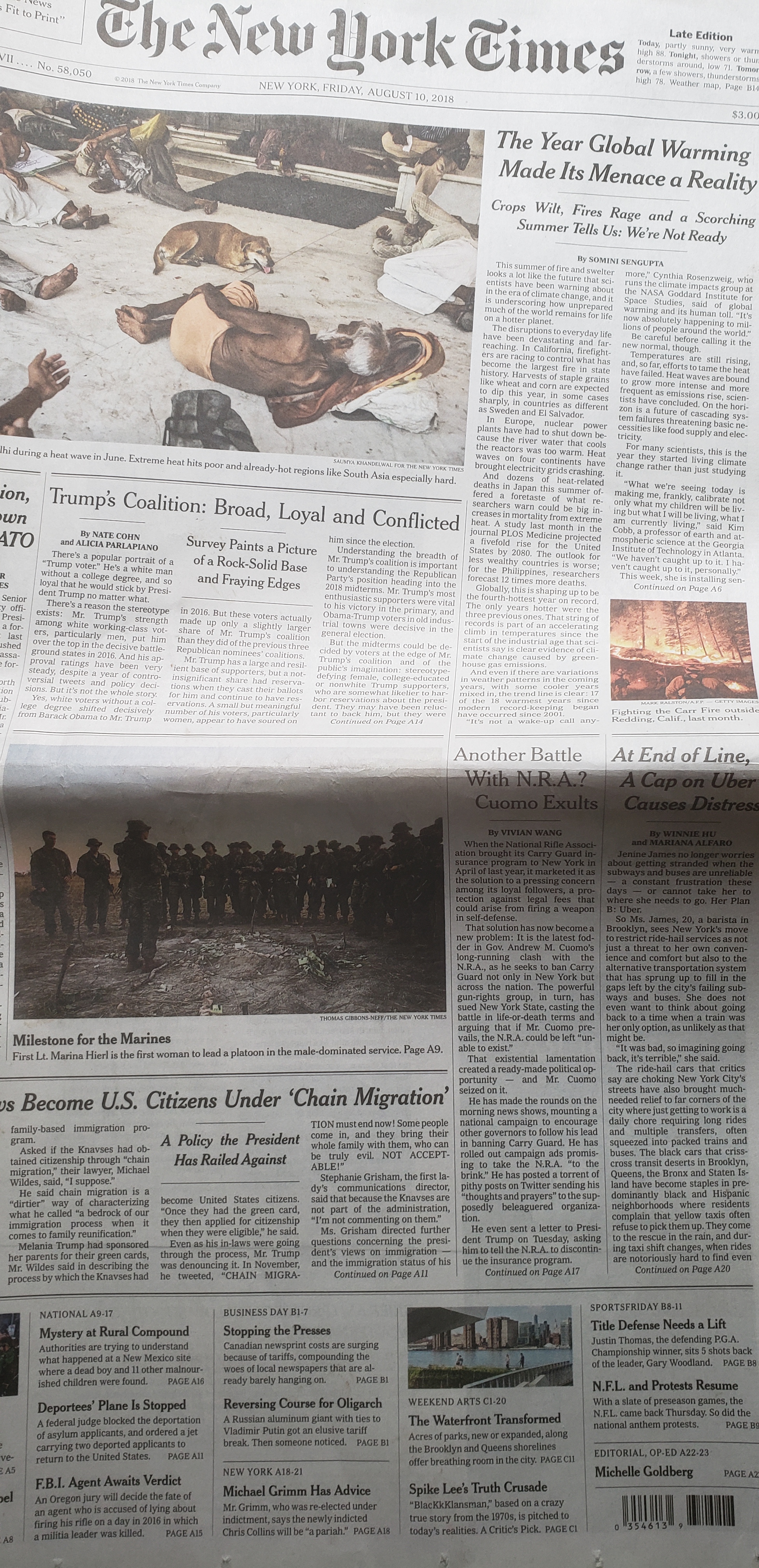
Front page of the New York Times, May 15, 1948

Consider:

  • Zionists declared an independent country in 1948, even though the local Arab population did not. Was it wrong for the US to recognize the Jewish State even though there was not a corresponding local Arab state?
  • The Arab world was furious with the declaration of the Jews and the US response. The armies of five Arab armies (Lebanon, Syria, Iraq, Jordan and Egypt) invaded Israel in a war that claimed thousands of lives.
  • No peace has come to the region. Now, over 70 years later, the Israelis have only been able to forge a peace agreement with two Arab countries, Egypt and Jordan.

The arguments of 1948 and 2018 seemingly remain the same. The US recognition was and is unbalanced, foments violence and harms peace efforts. One would therefore conclude that Truman was as wrong as Trump, and for many in the Arab/Muslim/alt-left camp (let’s call them “AMAL” for short, which means “hope” in Arabic), that is very true. (Note: Hebrew, which is read right-to-left would call these people “LAMA” which means “why?”)

But to do so is to contort cause-and-effect, actual history-with-“my truth” philosophy, and equality-with-fairness.

The AMAL legions believe that Israel is a foreign transplant in Arab land. They did not recognize the rights of Jews to live in and have sovereignty in the region in 1922 (as encouraged in international law in the Mandate of Palestine), in 1948 (at Israel’s declaration of independence) and do not recognize it now (as the US embassy moved to Jerusalem). They want Jerusalem for a capital today just as they wanted Haifa as part-and-parcel of Arab Palestine in 1948. They have fought tooth-and-nail against these events for 100 years.

For AMAL, accepting a foreigner stealing your home and land is a negation of one’s narrative and one’s dignity, and there can be no peace without dignity.

The alt-left has joined the anti-Zionist AMAL army in greater numbers as they have embraced and advanced the notion of “my truth” broadly. While the “progressives” may occasionally become offended at the vile anti-Semitism spewed by Palestinian Arabs, the Arab rejection of thousands of years of Jewish history in the holy land and the centrality of the land of Israel in Judaism, the alt-left have nevertheless adopted the underdog. They have redefined the conflict as a matter between Israel and the stateless Palestinians rather than the 100-year old Israel-Arab conflict. The alt-left sees a powerful Israel both economically and militarily on one side against a stateless impoverished people. They therefore see complete lack of equality in the actors, as they narrow the scope past the 20+ Arab and 50+ Muslim countries that dwarf the population of Jews in Israel by 100-to-1, to a scenario where Israel is the Goliath.

With such a mindset, the AMAL army contends that Trump added fuel to the fire of an unfair dynamic, just as when Truman blessed the theft of Arab land in 1948. The action continues to move the parties away from their perceived only pathway to peace which includes a bi-national Israel and a purely Arab Palestine.

The pro-Zionist camp sees the world very differently. It celebrates Truman’s recognition of Israel as part of the restoration of the Jewish people in their homeland. They know that if the Jewish State had been reestablished a decade earlier in the 1930s, tens of thousands of Jews would have been saved from the Holocaust. And they admire the thriving stable democracy which Israel has become, in the middle of a vicious and violent Arab Middle East. Recognition and partnership have been beneficial to both the USA and Israel.

But the soldiers of AMAL deny any recognition of Israel’s reality, whether Jerusalem as its capital, its flag in Judo tournaments, the research of its professors and the goods from the country. Thirty countries in AMAL still do not recognize the State of Israel. Their belief that the United States continues to be wrong from Truman to Trump runs deep.

The lines in the conflict continue to cut deeper. Do not simply consider whether the United States’ recognition of the capital of Israel was right or wrong because it is likely clouded by personal perceptions of Donald Trump. Ask yourself if you think president Truman was right in recognizing Israel 70 years ago to understand whether you are part of the AMAL horde or stand proudly with Israel.


Related First.One.Through articles:

The Cancer in the Arab-Israeli Conflict

The Palestinian State I Oppose

I call BS: You Never Recognized Jerusalem as Israel’s Capital

Israel’s Peers and Neighbors

The Impossible Liberal Standard

Subscribe YouTube channel: FirstOneThrough

Join Facebook group: FirstOne Through  Israel Analysis


May 15 is Israel’s Neighbor Day

On May 14, 1948, Israel declared itself a new independent country, as the British Mandate of Palestine expired. The declaration of independence stated that the country will be “for the benefit of all its inhabitants; it will be based on freedom, justice and peace as envisaged by the prophets of Israel; it will ensure complete equality of social and political rights to all its inhabitants irrespective of religion, race or sex; it will guarantee freedom of religion, conscience, language, education and culture; it will safeguard the Holy Places of all religions; and it will be faithful to the principles of the Charter of the United Nations.

It welcomed everyone.

Unfortunately, at that same time, the Arabs in Palestine had been rioting and killing Jews for many months in attempts to stop the Jewish State from coming into existence. Once Israel declared its independence, five armies from neighboring Arab countries came to destroy the nascent state. The war would go on for months. Israel survived.

Despite the Arab war against the Jews before Israel’s independence and after, Israel remained true to its vision of welcoming non-Jews as full citizens in the country. Approximately 156,000 non-Jews became citizens of Israel at the Jewish State’s rebirth, around 18% of the population. In 2018, 70 years later, the non-Jewish population in Israel stands at over 2 million people, representing over 25% of the Israeli population.


Israeli Arabs having a picnic in the shade under the ancient aqueduct in Caesarea
(photo: First.One.Through)

The Arab citizens of Israel have availed themselves of the open society that Israel created. 

  • There are currently 18 Arabs in the Israeli Knesset, 15% of the parliament. By way of comparison, there are only 50 blacks (9%) in the US Congress
  • Israel has non-Jewish Arabs on the Supreme Court, Salim Joubran being the first in 2004
  • Non-Jews have served as Israeli ambassadors around the world, including to Norway and the Dominican Republic
  • Non-Jews serve as generals in the Israeli army

Non-Jews are a key fabric of Israeli society, as envisioned in the Israeli declaration on May 14, 1948 that welcomed non-Jews to “participate in the upbuilding of the State on the basis of full and equal citizenship and due representation in all its provisional and permanent institutions.

It is appropriate to take the time to celebrate Israel’s non-Jewish citizens that chose to make peace with Israel, not war; that chose to help build the state, not to dismantle it; that chose to stay and be friends and neighbors with Jews, not to run and fight alongside the Jewish State’s enemies.

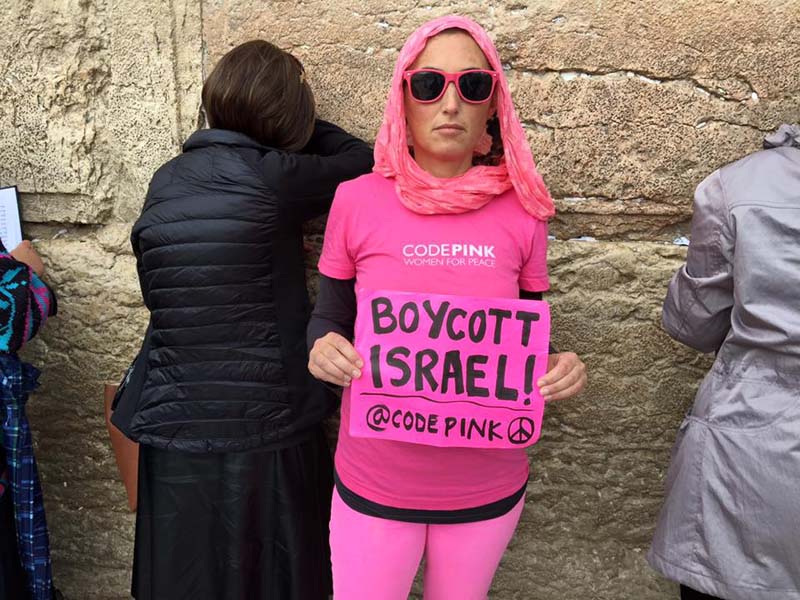
Regrettably, there are anti-Zionists that continue to undermine and attack Israel, who refer to the failed 1948 war to destroy the Jewish State as a “Nakba,” a “catastrophe.” As they channel their hatred on May 15th with angry calls to “Free Palestine,” let Zionists around the world commemorate “Neighbor’s Day,” a day to mark and celebrate the many non-Jews who stayed to become citizens of Israel in 1948 and continue to help the country thrive 70 years on.


Related First.One.through articles:

Arabs in Jerusalem

An Inconvenient Truth: Population Statistics in Israel/Palestine

Israel, the Liberal Country of the Middle East

Nakba 2: The Victory of a Democracy

Subscribe YouTube channel: FirstOneThrough

Join Facebook group: FirstOne Through  Israel Analysis


Arab women entering the Kotel Plaza in Jerusalem
(Photo: First.One.Through)

Israel’s Soldiers Also Earn the Honors

Since Israel’s independence in 1948, Israel has won 12 Nobel Prizes, an incredible total for such a small country. When considering that over those 70 years the country had to fight numerous wars, absorb millions of immigrants and develop an economy, the total is even more remarkable.

Even when backing out Nobel Prizes awarded for peace, which is the most dubious category as it is more aspirational and political than the other categories, Israel has still won 9 prizes. That puts the country as a top five winner of Nobel Prizes per capita.

Rank Country Nobel Prizes since 1948  2017 Population (m)  Nobels per Capita Non-Peace Prizes  Nobels per Capita
1 Sweden 19                  9.90                  1.92 18                  1.82
2 Switzerland 15                  8.37                  1.79 15                  1.79
3 Norway 8                  5.23                  1.53 8                  1.53
4 United Kingdom 93                65.64                  1.42 86                  1.31
5 Israel 12                  8.55                  1.40 9                  1.05
6 Austria 9                  8.75                  1.03 8                  0.91
7 Ireland 6                  4.77                  1.26 4                  0.84
8 Hungary 8                  9.82                  0.81 8                  0.81
9 Germany 60                82.67                  0.73 58                  0.70
10 Denmark 4                  5.73                  0.70 4                  0.70

The country also proves itself to be a leader in the commercial application of science and technology. Israel ranks as number 8 regarding patent filings per capita.

Rank Country  2016 patent filings  2017 Population (m)  Filings per capita
1 Switzerland            47,000                   8.37               5,614
2 South Korea         233,786                 51.25               4,562
3 Japan         456,467               127.00               3,594
4 Sweden            23,453                   9.90               2,368
5 Netherlands            39,058                 17.02               2,295
6 Germany         177,073                 82.67               2,142
7 Denmark            11,727                   5.73               2,046
8 Israel            15,108                   8.55               1,768
9 United States         521,802               325.70               1,602
10 Austria            13,869                   8.75               1,586

Not surprisingly, there is a strong correlation to the science awards and Nobel prizes in science to the educational level of the population. Israel ranks #2 in terms of the percent of the population with a tertiary education.

Rank Country  % Population with Tertiary education
1 Canada 51%
2 Israel 46%
3 Japan 45%
4 United States 42%
5 New Zealand 41%
6 South Korea 40%
7 United Kingdom 38%
8 Finland 38%
9 Australia 38%
10 Ireland 37%

The statistics above are simple numerical facts. Various organizations use these numbers and others to provide their views of the “qualitative” nature of the country by different measures.

For example, The Heritage Foundation produced its 2018 freedom ranking of 180 countries. It used measures such as the rule of law, property rights and openness of its markets to score each country. Israel ranked #31, ahead of some of the countries listed in the statistical tables above such as Austria #32 and Hungary #55, but behind the others. The Economist had a similar ranking, placing Israel as tied for #30. This is likely due to Israel’s hostile neighbors, many of which do not recognize its right to exist and are at an official state of war, which compromises some of Israel’s freedoms. This dynamic is in contrast to the other countries on the list, that have not fought four wars and multi-year mass riots since the turn of the century.

However, it is interesting to note that several of the countries that lead in science do not just lead in education, but have a mandatory military draft like Israel, including: Denmark; South Korea; Norway and Switzerland. The book Start-up Nation, attributes much of Israel’s economic success to the training a person gets in the army. Those skills are not limited to technical training, but also leadership and a sense of communal belonging. Perhaps countries like Denmark and Switzerland have similarly benefited from military training.

But none of those other countries have faced the missiles, gunfire, bombings, the wars and riots that Israel has had to endure. Switzerland continues to reduce the size of its army and holds a vote every few years to abolish conscription. It views the army as a holdover of a different time. Yet Israelis know that enemies that seek the country’s destruction are just miles away. Today.


Israeli soldiers at Har Herzl in Jerusalem

And so it is perhaps appropriate to pause on Yom Hazikaron, the day of remembering the fallen Israeli soldiers, to recall not just their sacrifice, but to honor them with a helek, a portion of every Nobel Prize, every doctorate, every award won and every IPO completed by each Israeli since the country’s founding. Every soldier has earned a part of it too.


Related First.One.Through articles:

Israel, the Liberal Country of the Middle East

A Flower in Terra Barbarus

Israel’s Peers and Neighbors

The Color Coded Lexicon of Israel’s Bigotry: It’s not Just PinkWashing

Israel: Security in a Small Country

Subscribe YouTube channel: FirstOneThrough

Join Facebook group: FirstOne Through Israel Analysis
Removing the Next Issue – The Return of 20,000 Palestinian Arabs

When US President Donald Trump announced that the United States was recognizing the reality of Jerusalem as the capital of Israel, many people argued that the move was much more than it was: the anti-Israel camp stated that it gave Israel something for nothing, while the pro-Israel camp celebrated the end of Jerusalem as a negotiating point in the Arab-Israel conflict.

Both points of view were incorrect.


US President Donald Trump recognizing Jerusalem as the capital of Israel
December 6, 2017

The US decision was a simple matter of realizing the reality that Jerusalem has held all of the key government functions of the State of Israel since its founding. The Trump administration clarified that its decision to relocate the US embassy to Jerusalem did nothing to preordain the borders or status of Jerusalem in a mutually-agreed upon peace between the Israelis and the Palestinian Authority.

But maybe it is time to take some actions that take a critical issue off of the table, namely the “Right of Return” of Palestinian “refugees.”

On December 11, 1948, the United Nations General Assembly passed Resolution 194 which included a clause which Palestinian Arabs hold as a sacred truth in Article 11:

“Resolves that the refugees wishing to return to their homes and live at peace with their neighbours should be permitted to do so at the earliest practicable date, and that compensation should be paid for the property of those choosing not to return and for loss of or damage to property which, under principles of international law or in equity, should be made good by the Governments or authorities responsible;

“Instructs the Conciliation Commission to facilitate the repatriation, resettlement and economic and social rehabilitation of the refugees and the payment of compensation, and to maintain close relations with the Director of the United Nations Relief for Palestine Refugees and, through him, with the appropriate organs and agencies of the United Nations;”

As of this time, there are fewer than 30,000 refugees related to UNGA resolution 194 that remain alive, nearly 70 years after the resolution’s passing. UNRWA, the UN agency tasked with providing services to the 1948 refugees (and later on, their descendants) was established one year later, on December 8, 1949. That UN agency ultimately created a completely unique distorted definition of a “refugee” to allow UNRWA to survive past its mandate and grow to accommodate the descendants of refugees.

But the bizarre abuse of the English language for UNRWA did nothing to alter the actual meaning of UN Resolution 194.

As a matter of moving the peace process forward, Israel should coordinate with the United Nations to assess which of the 1948 Palestinian Arab refugees seek to return to cities in Israel and live in peace with their Israeli neighbors, and which ones would prefer to receive compensation. As Israel does so, it need not ask anything of the Palestinian Authority in return.

Concluding one of the key agenda items of the Arab-Israeli conflict, the UN can hasten the dismantling of UNRWA and fold its functions into the global refugee agency, the UNHRC. The schools and hospitals of UNRWA would be transferred initially to UNHRC and then to the Palestinian Authority.  The refugee “camps” run by UNRWA would be dissolved into regular local neighborhoods.

The Trump administration has begun to take actions against the Palestinian Authority, including withholding funds to UNRWA. Israeli actions on the “right of return” can begin the process of ending the funding – and the UN agency – completely.


Related First.One.Through articles:

Help Refugees: Shut the UNRWA, Fund the UNHCR

UNRWA Is Not Just Making “Refugees,” It Creates Palestinians

UNRWA’s Munchausen Disease

UNRWA’s Ongoing War against Israel and Jews

Stabbing the Palestinian “Right of Return”

Losing Rights

How the US and UN can Restart Relations with Israel

Delivery of the Fictional Palestinian Keys

Time to Dissolve Key Principles of the “Inalienable Rights of Palestinians”

UN Summit for Refugees and Migrants September 2016

Subscribe YouTube channel: FirstOneThrough

Join Facebook group: FirstOne Through Israel Analysis

Israel & the United States Repel the Force of the World

“It is not in numbers, but in unity, that our great strength lies; yet our present numbers are sufficient to repel the force of all the world.”

Thomas Paine, Common Sense
January 9, 1776

On January 9, 1776, exactly 242 years ago, the great American Patriot Thomas Paine published the first edition of his pamphlet “Common Sense.” In it he advanced the arguments why the colonies needed to break free from England, and argued for a new political system based on democracy and equality, quite dissimilar to England’s monarchy and class-based hierarchy. While he acknowledged that the colonies were outnumbered and outgunned, he declared that the unity of the American colonies in spirit and purpose would withstand the battles to come.

Those sentiments are being borne out again, this time, between the United States of America and Israel.

On December 6, 2017, US President Trump acknowledged the reality that Jerusalem is the capital city of the State of Israel. It was a move that was welcomed by the government of Israel, but not by much of the world.

Shortly thereafter, the United Nations Security Council voted to denounce USA’s decision in a vote of 14-to-1, with only the US voting against the measure. That single vote by a permanent member of the UNSG was enough to block the resolution.

The Arab states moved to have a similar vote at the UN General Assembly. The lopsided vote came in at 128 countries voting to condemn the American recognition, 9 votes supporting the USA and 35 countries abstaining. The overwhelming vote was non-binding and the US continued to take measures that were completely within its rights and jurisdiction .

Not seven weeks after the US declaration of the Jerusalem Acknowledgment, US Vice President came to Israel, to visit its capital city of Jerusalem and address its parliament, the Knesset. He loudly and clearly proclaimed the unity between the US and Israel:

US Vice President Mike Pence addressing the Knesset
(photo: January 22, 2018)

“Thanks to the [US] President’s leadership, the alliance between our two countries has never been stronger, and the friendship between our peoples has never been deeper. And I am here to convey a simple message from the heart of the American people: America stands with Israel.

We stand with Israel because your cause is our cause, your values are our values, and your fight is our fight.

We stand with Israel because we believe in right over wrong, in good over evil, and in liberty over tyranny.”

Pence made clear that the US stands with Israel in both the positive and negative; in the passive and the aggressive.

The US stands with Israel in the mundane. In a democratic way of life. In commerce and trade. In acknowledging truth and fact.

And the US also stands with Israel against the forces of hatred, racism and antisemitism. Against evil ideologies and terror. Against distortions and fake history.

Pence reiterated those comments, as he absorbed the history of the Jews and the history of America:

In the story of the Jews, we’ve always seen the story of America. It is the story of an exodus, a journey from persecution to freedom, a story that shows the power of faith and the promise of hope….

“And your story inspired my forebears to create what our 16th President called a “new birth of freedom.” And down through the generations, the American people became fierce advocates of the Jewish people’s aspiration to return to the land of your forefathers to claim your own new birth of freedom in your beloved homeland.”

Pence addressed the lies spewed from the mouth of the acting-President of the Palestinian Authority and the UNESCO that the Jews have nothing to do with the land of Israel:
“The Jewish people held fast to a promise through all the ages, written so long ago, that “even if you have been banished to the most distant land under the heavens,” from there He would gather and bring you back to the land which your fathers possessed….“The Jewish people’s unbreakable bond to this sacred city [of Jerusalem] reaches back more than 3,000 years. It was here, in Jerusalem, on Mount Moriah, that Abraham offered his son, Isaac, and was credited with righteousness for his faith in God.

“It was here, in Jerusalem, that King David consecrated the capital of the Kingdom of Israel. And since its rebirth, the modern State of Israel has called this city the seat of its government.

“Jerusalem is Israel’s capital. And, as such, President Trump has directed the State Department to immediately begin preparations to move the United States Embassy from Tel Aviv to Jerusalem. In the weeks ahead, our administration will advance its plan to open the United States Embassy in Jerusalem, and that United States Embassy will open before the end of next year.”

Pence further spoke of a revolution in the Arab world, where some countries are breaking with past hatreds and establishing ties with Israel:
“Over the past two days, I’ve traveled to Egypt and Jordan, two nations with whom Israel has long enjoyed the fruits of peace. I spoke with America’s great friends, President Al Sisi of Egypt, and King Abdullah of Jordan, about the courage of their predecessors who forged an end to conflict with Israel in their time.And those two leaders prove every day that trust and confidence can be a reality among the great nations who call these ancient lands home.

In my time with those leaders, and with your Prime Minister, we discussed the remarkable transformation that is taking place across the Middle East today, and the need to forge a new era of cooperation in our day and age.

The winds of change can already be witnessed across the Middle East. Longstanding enemies are becoming partners. Old foes are finding new ground for cooperation. And the descendants of Isaac and Ishmael are coming together in common cause as never before.

Last year, in Saudi Arabia, President Trump addressed an unprecedented gathering of leaders from more than 50 nations at the Arab Islamic American Summit. He challenged the people of this region to work ever closer together, to recognize shared opportunities and to confront shared challenges. And the President urged all who call the Middle East their home to, in his words, “meet history’s great test — [and] conquer extremism and vanquish the forces of terrorism together.”

And Pence spoke about the common threat posed by radical Islamic terrorism and the evil of the Islamic republic of Iran:
“Radical Islamic terrorism knows no borders — targeting America, Israel, nations across the Middle East, and the wider world. It respects no creed — stealing the lives of Jews, Christians, and especially Muslims. And radical Islamic terrorism understands no reality other than brute force.Together with our allies, we will continue to bring the full force of our might to drive radical Islamic terrorism from the face of the Earth.”
Just over 242 years since Paine’s call for unity to launch a new nation, the US administration declared its affinity for Israel, in maintaining and advancing the Jewish State, just 70 years after it was reestablished:
“How unlikely was Israel’s birth; how more unlikely has been her survival. And how confounding, and against the odds, has been her thriving. You have turned the desert into a garden, scarcity into plenty, sickness into health, and you turned hope into a future.Israel is like a tree that has grown deep roots in the soil of your forefathers, yet as it grows, it reaches ever closer to the heavens. And today and every day, the Jewish State of Israel, and all the Jewish people, bear witness to God’s faithfulness, as well as your own.

It was the faith of the Jewish people that gathered the scattered fragments of a people and made them whole again; that took the language of the Bible and the landscape of the Psalms and made them live again. And it was faith that rebuilt the ruins of Jerusalem and made them strong again.

The miracle of Israel is an inspiration to the world. And the United States of America is proud to stand with Israel and her people, as allies and cherished friends.”

The US is proud of Israel and Israel is proud of the US. That unity is a strength for both countries and will hopefully continue to “repel the force of the world” for many years to come.


Related First.One.Through articles:

In Defense of Foundation Principles

Israel’s Peers and Neighbors

Comparing Nikki Haley’s and Samantha Power’s Speeches after UN Votes on Israel

Israel’s Colonial Neighbors from Arabia

Both Israel and Jerusalem are Beyond Recognition for Muslim Nations

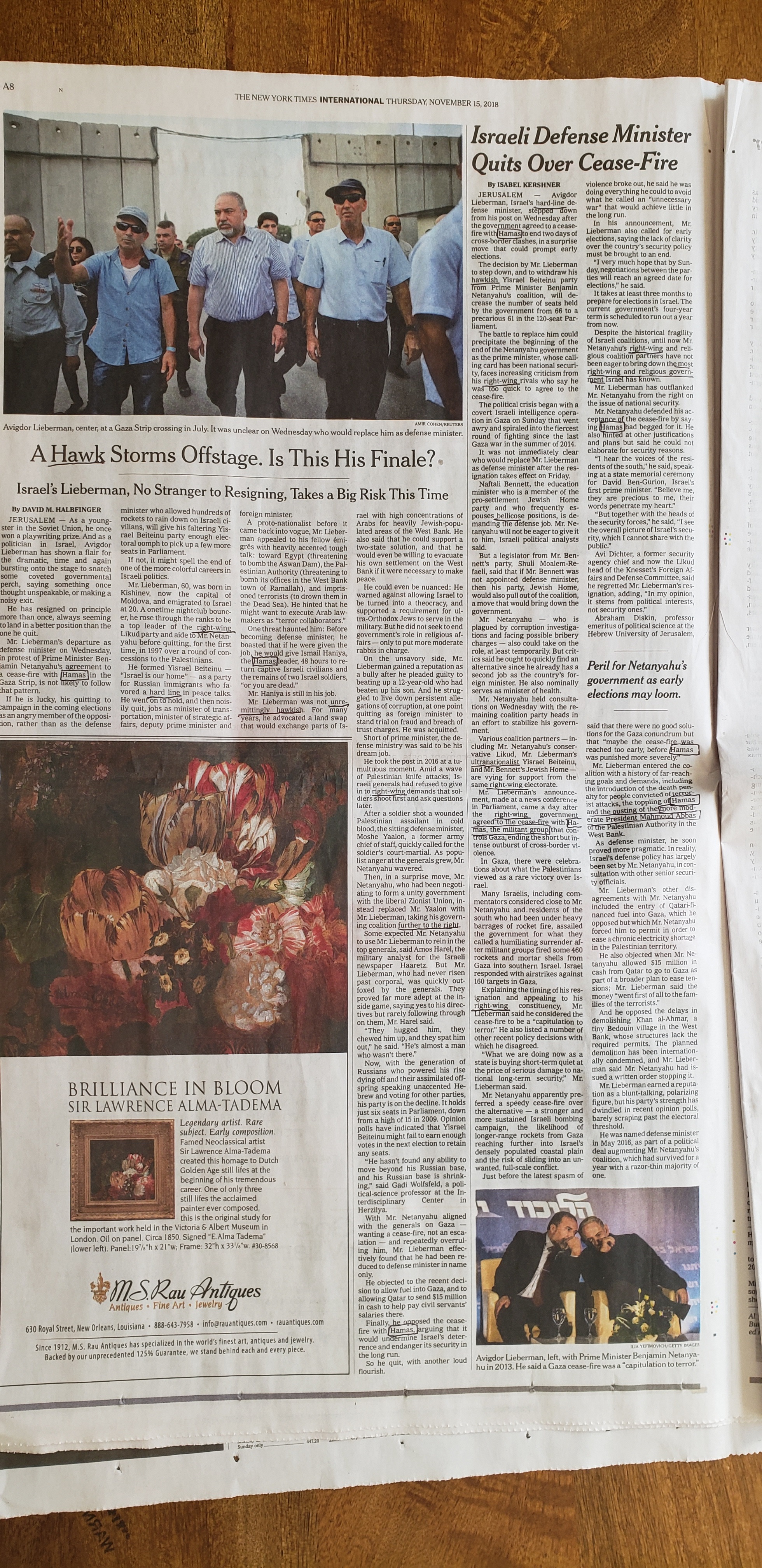
The New York Times Inverts the History of Jerusalem

The Invisible Flag in Judo and Jerusalem

First.One.Through videos:

US and Israel are there for each other (music by Michael Jackson)

God is a Zionist (music by Joan Osborne)

Subscribe YouTube channel: FirstOneThrough

Join Facebook group: FirstOne Through Israel Analysis
Israel’s Colonial Neighbors from Arabia

“Nothing in all the world is more dangerous than sincere ignorance and conscientious stupidity.”

Martin Luther King, Jr.

(1929-1968)

While the weekend celebration of Martin Luther King, Jr. was going on in the United States of America in 2018, acting-President of the Palestinian Authority Mahmoud Abbas continued to make a fool of himself in Ramallah.

In addition to layering on multiple insults of the US President Donald Trump, its Ambassador to the United Nations Nikki Haley and its Ambassador to Israel David Friedman, Abbas went on a tirade of fake history. He claimed that “Israel is a colonial project that has nothing to do with the Jews.” But it is precisely Jewish, both according to Jews and according to the Arab countries in the region that expelled close to 1 million Jews that were living in their countries in the decades following the establishment of Israel. If Israel has nothing to do with Jews, why did the Arabs expel all of their Jews at the foundation of Israel?

Abbas’s stupidity would continue. He claimed that Palestinian Arabs have been living in the holy land for the past 6000 years – for thousands of years even before the birth of Abraham. That’s pretty impressive for a group that didn’t arrive in the land of Israel until about 1400 years ago, even by the admission of Arabs themselves.

Yes, it is the Arabs that colonized the area, not the Jews.

The Jewish people came to the land of Canaan roughly 3700 years ago. They established their kingdoms and capitals there and have always maintained a presence in the land until this day.

At the founding of Islam in Saudi Arabia in the 7th century, the early Muslims looked to spread their religion throughout the world. They embarked from the Arabian peninsula and invaded and colonized many lands, including the Jewish holy land. This colonization project was so successful, that people do not even pause to think that the term “Arab” is rooted in the Arabian peninsula.

The Palestinians fully acknowledge that they are but a part of the colonial Arab project, as stated in their own 2003 Palestinian Basic Law:

Palestine is part of the Arab homeland. The state of Palestine abides by the Charter of the League of Arab States. The Palestinian people are part of the Arab and Islamic nations. Arab unity is a goal. The Palestinian people work on behalf of its realization.”

The Arab world views “Palestine” as simply one of the over 50 countries that comprise its Arab “homeland.” A homeland that was created thousands of years AFTER the Jews had been living in their Jewish holy land.

Abbas has denied Jewish history and presence in their native land. He has denied core elements of Judaism, including the location of the Jewish temples on the Jewish Temple Mount in Jerusalem. He has claimed that Zionists conspired to kill Jews in the Holocaust.

During Martin Luther King Day, it is a marvel to watch such “conscientious stupidity,” spew out of the mouth of someone that is venerated by the United Nations. But as MLK said many decades ago, the embrace of such venomous words are “dangerous,” and cannot simply be laughed away. This is not a debate between narratives, but the vile diatribe of a madman that must be condemned by every decent world leader.


Related First.One.Through articles:

A Native American, An African American and a Hispanic American walk into Israel…

Israel: Security in a Small Country

Nicholas Kristof’s “Arab Land”

Obama’s “Palestinian Land”

Israel was never a British Colony; Judea and Samaria are not Israeli Colonies

Heritage, Property and Sovereignty in the Holy Land

The Cancer in the Arab-Israeli Conflict

Subscribe YouTube channel: FirstOneThrough

Join Facebook group: FirstOne Through  Israel Analysis