There is an expression that has been used over the past few years called ‘Jew Face’ which has two principle meanings: one is the proliferation of non-Jews playing the role of Jews in movies and shows, while the second has to do with using make-up to dress up these non-Jewish actors to ‘look more Jewish.’ The first category is seen in movies and shows like Golda, The Marvelous Mrs. Maisel and the Lehman Trilogy all with non-Jewish actors, while the second can be exemplified by actor Bradley Cooper sporting a large nose to play Leonard Bernstein in Maestro.
There is a related phenomenon happening in politics called ‘Jew Mask,’ where politicians strut out a prominent Jew to “reeducate” Jews that they have no idea what’s really in their own best interest.
In July 2015, President Obama sent Treasury Secretary Jack Lew out to tell Americans that the Iranian nuclear deal (JCPOA) was a really “strong deal,” even when everybody on the planet knew that it was a farce that left the entire Iranian nuclear program intact. Sending out the Treasury Secretary – instead of the Secretary of Defense – to make the point added to the ridiculous spectacle. Everyone understood that Lew was paraded as the Jew Mask for Obama to convince the world that if an Orthodox Jew thinks that the Islamic Republic of Iran which had sworn to destroy Israel is now effectively neutered, it must be true.
The trotting out of a senior-ranking Jew to state what the president cannot say convincingly happened again this past week, as President Biden (who was Vice President when Lew did his 2015 performance) had New York Senator Chuck Schumer lambast Israeli Prime Minister Benjamin Netanyahu. Despite Israel having a civilian-to-terrorist death rate of less than 2:1 in urban combat during the current war from Gaza, when historic norms are closer to 9:1, Schumer excoriated Netanyahu on the Senate floor.
New York Senator Charles Schumer berates Israeli Prime Minister Benjamin Netanyahu
Obama and Biden sent Lew and Schumer to be their Jew Masks, selling a narrative which the majority of Jews don’t believe. They attempted to convince global Jewry that they are actually safe and America has made them so, despite Jews feeling terrified under attack and threat of annihilation.
Jew Face plays out in Hollywood and Broadway, an ugly annoyance of watching the replacement of Jews with non-Jews even though there are plenty of Jews in the performing arts. Conversely, Jew Mask happens in the real world, a terrifying spectacle of observing a prominent Jew under direction of a powerful boss, lie to global Jewry that imminent threats are not lethal, to get the paltry number of Jews to relinquish their basic right of self-defense.
As it does every three months, the Palestinian Center for Policy and Survey Research (PCPSR) conducted a poll of Arabs in Gaza and the West Bank in March 2024 as the war from Gaza continued to rage. The poll principally focused on the war, post-war, theoretical elections and Israel, and skipped many of the historic questions.
The results were a bit confusing, even for the pollsters.
The October 7 Massacre
Palestinian Arabs continue to support the raping and brutal slaughter of around 1,200 people in Israel. “While support for Hamas’ offensive on October the 7th remains as high as it was three months ago, Palestinian support in the West Bank has in fact dropped by 11 points while, surprisingly, support in the Gaza Strip has increased by 14 points.” As of March 2024, 71% of Palestinians in both the West Bank and Gaza support the heinous October 7 atrocities.
The vast majority of Arabs have still not watched the videos showing Hamas and Gazans torturing Israelis. “80% [now] (compared to 85% in December 2023) say they did not see videos, shown by international news outlets, showing acts committed by Hamas against Israeli civilians, such as the killing of women and children in their homes; only 19% (11% in the West Bank and 30% in the Gaza Strip) saw these videos.” Perhaps not surprisingly, only 5% of Palestinians think Hamas committed war crimes, while 94% think Israel has committed such crimes in the current war. Even among Palestinians who watched Hamas’s actions on October 7, 81% still believe that Hamas didn’t commit war crimes.
Blood soaked room in an Israeli nursery after Gazans slaughtered innocent Jews
The word “hostage” did not appear anywhere in the poll, ignoring one of the main reasons for the current war.
Ongoing War
Three months ago, there was a wide gap between Gazans and Arabs in the West Bank about who will win the war, with 50% of Gazans and 83% of West Bank Arabs believing that Hamas would prevail. That has now shrunken as more Gazans are optimistic about Hamas (56%) while the perceptions in the West Bank declined to 69%, producing an overall decline from 70% to 64% over the last three months.
With the majority of Palestinians believing in Hamas’s victory, a full 59% believe that Hamas will stay in power after the war. That 59% is similar to the 63% who prefer Hamas for the post-war ruling authority.
Palestinian Politics
Palestinians are disgusted by their political leaders. If parliamentary elections were held today, the largest segment (36%) would stay home. Hamas would cruise to victory among the voters winning 30% to only 14% for Fatah.
In electing a new president to replace the current corrupt leader Mahmoud Abbas, a man imprisoned with five life sentences, Marwan Barghouti would win a three-man race which included Abbas and the leader of Hamas, Ismael Haniyeh. However, Hamas would win a two-person race between Haniyeh and Barghouti.
Two-State Solution
A slim majority of 52% of Palestinians reject a two-state solution. The 45% who support a two-state solution is up significantly from 34% and 32% in December 2023 and September 2023, respectively.
War, or as Palestinians like to say “armed struggle,” is still the preferred approach of the local Arabs to end Israeli “occupation.” The percentages are 46%, 25%, 18% for war, negotiations and “peaceful resistance,” respectively. That is a significant change from three months ago when the numbers were 63%, 20% and 13%, respectively. Palestinians are seemingly beginning to tire of the war, even as they remain optimistic about the outcome.
Overall Palestinian Priority
The current war from Gaza is the most pressing issue for Palestinians but the priority is divided between Gazans and West Bank Arabs. A larger 66% of Gazans (up from 64% three months ago) consider the war the most pressing matter, while 50% in the West Bank (up from 42% three months ago), are focused on the war.
The overall most vital issue for Palestinians has become a close race between ending the occupation and forming a state with East Jerusalem as its capital (42%) to 33% desiring a full “right of return” into homes in Israel. This less than ten percentage gap has been a finding in these polls since the May 2021 short war; before that date, there was almost a twenty percentage gap in those two goals.
Conclusion
Palestinians continue to support Hamas and the October 7 massacre, and want to see Hamas continue to rule in Gaza, as they think that ultimately the political-terrorist group will prevail in the war. They seemingly are acknowledging that the battlefield is going horribly but that the world will deliver them a victory, possibly including a new Palestinian state and millions of Arabs pouring into Israel. It’s the 1.5 state solution for Arabs and 0.5 states for Jews as long desired by the fat-left anti-Zionists.
ACTION ITEM
As Palestinians are counting on global support to deliver a victory which they cannot achieve on the battlefield, it is critical to contact elected officials to continue to support Israel and limit support for Palestinians strictly to humanitarian aid until Hamas is completely defeated.
Rep. Jamaal Bowman has earned a number of nicknames over his time in Congress. Some call him ‘Fire Alarm’ Bowman for infamously pulling a fire alarm to delay a House vote. Others calls him ‘Censured’ Bowman’ for being censured by a bipartisan Congress, while others call him ‘Blowhard’ Bowman for constantly race-baiting Republicans in calling them Nazis as well as mentally and emotionally deficient to understand people of color.
The latest earned moniker is ‘Outside Money’ Bowman, as he has utterly failed to raise money from inside his district so is now focused on collecting money from extremists around the country and from radical Islamic regimes.
For the period ending December 31, 2023, Westchester County Executive George Latimer raised $1.4 million while Bowman couldn’t even raise $700,000. While Latimer raised 73% of his money from inside his district, Bowman only could muster 9 per cent.
Bowman has therefore decided to team up with the worst antisemites and far-left and jihadi radicals to raise money for his campaign.
Jamaal Bowman hugging notorious antisemite Rashida Tlaib who is funding much of his election campaign
Bowman is now actively jumping into the deep anti-Israel cesspool with a group called ‘Reject AIPAC’ that is calling Israel an ‘apartheid’ state built on ‘colonialism’ committing a ‘genocide’ of Palestinians. The group is attempting to shield the political-terrorist group Hamas and the rest of the Palestinian army from defeat so it can commit more atrocities against civilians in Israel.
The ‘Reject Israel’ supporters include the extremist fringe of anti-Zionists including Justice Democrats, Jewish Voice for Peace Action, IfNotNow, Working Families Party, Sunrise Movement, MPower Change Action Fund, Democratic Socialists of America, Our Revolution, Peace Action, National Iranian American Council, and Gen-Z for Change.
Westchester County Executive George Latimer has a long history of delivering for his constituents in NY congressional District 16 and has a grassroots campaign of locals who respect him. The incumbent has virtually no base, and is relying on radical groups from around the country and Iran to buy an election.
The first Friday or Ramadan came to Jerusalem amidst the 2023-4 Hamas War from Gaza. The jihadi-political party which leads the Palestinian army called upon Palestinians to confront Israel and come to the al Aqsa Mosque by the thousands.
Wafa, the official news agency of the Palestinian Authority took the other side of the jihadi extremist coin, and blamed Israel for blocking Muslims from visiting their holy site:
“Israeli occupation forces barred thousands of Palestinian Muslim worshippers from reaching the Al-Aqsa Mosque in occupied Jerusalem this morning to perform the first Friday prayer of the holy month of Ramadan.
“Eyewitnesses reported a significant deployment of Israeli troops around the Qalandiya checkpoint to the north of Jerusalem, the Zeitoun checkpoint to its east, and Bethlehem to its south. Thousands of worshippers were turned back and denied access to the city under the pretext of not having the necessary permits.
“The occupation forces also deployed thousands of police officers in the alleys of the Old City of Jerusalem, around the Al-Aqsa Mosque, and at its gates to restrict the entry of worshipers.
“This action follows the installation yesterday of iron barriers at the gates of the Al-Aqsa Mosque, specifically at the gates of King Faisal, Al-Ghawanmeh, and Al-Hadid, in an attempt to exert more control over the entry of worshippers and to restrict access and freedom of worship in the holy site.
“Of note, the occupation authorities have already been imposing strict restrictions on entry of worshipers to the Old City of Jerusalem and the Al-Aqsa Mosque since the outbreak of the ongoing Israeli aggression on the Palestinian people in early October of last year.
“Al-Aqsa Mosque is the third holiest place of worship for Muslims around the world after Mecca and Medina in Saudi Arabia. It has been under Israeli military occupation since 1967.”
This is a miseducation and misdirection of the public in the extreme. It is Jews who suffer from restricted access to their holiest site in Judaism.
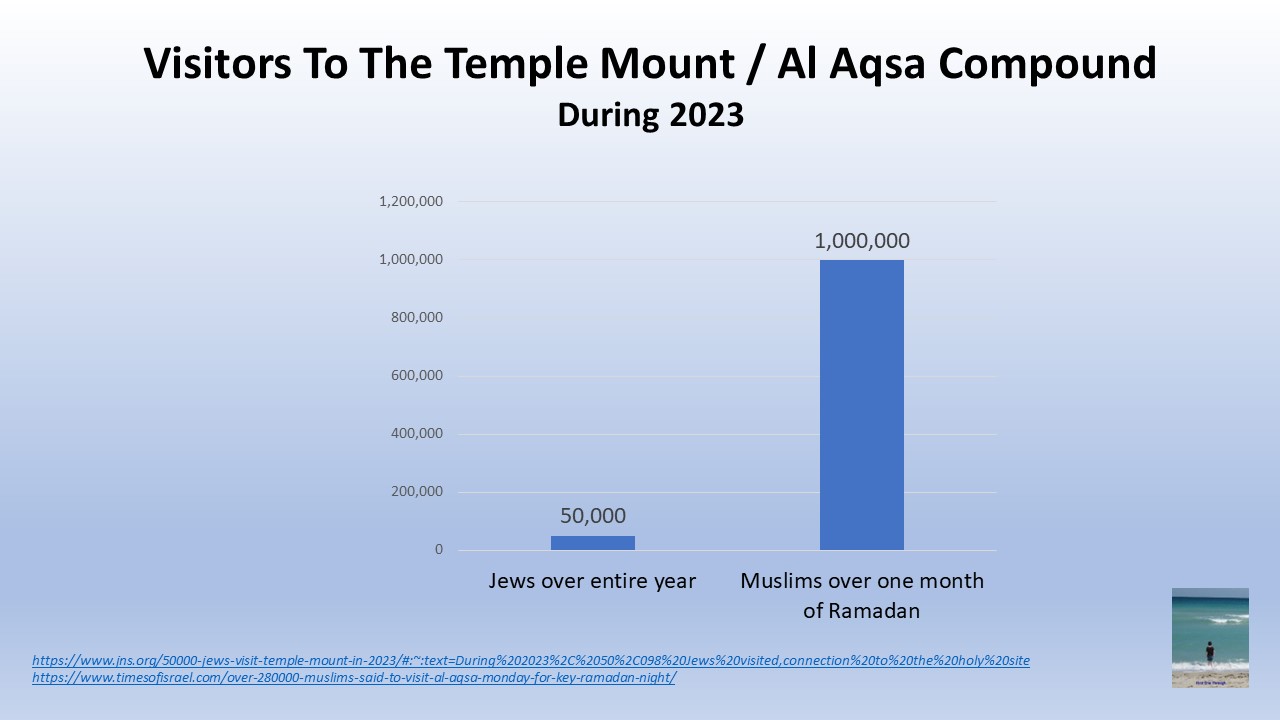
In the entirety of 2023, only 50,000 Jews got to visit the Jewish Temple Mount. That compares to over 1 million Muslims who came to the site over the single month of Ramadan.
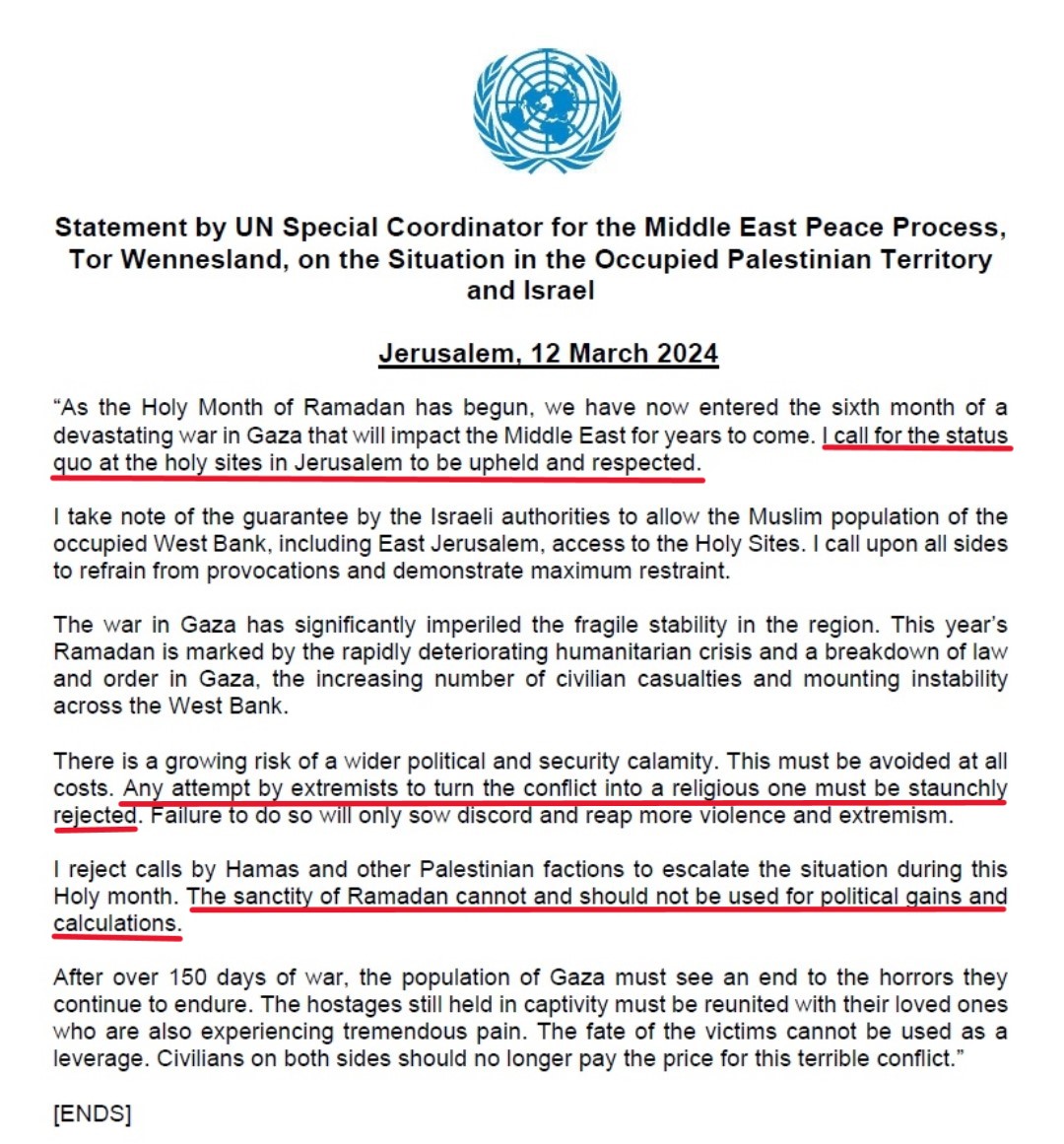
The United Nations supports this discrimination against Jews at the Temple Mount. Tor Wennesland, the UN Special Coordinator for the Middle East Peace Process, this week called “for the status quo at the holy sites in Jerusalem to be upheld and respected,” meaning barring Jews from praying at their holiest site.
Jews are being banned from visiting their holiest site per the demands of Hamas and the Palestinian Authority which consider any Jew visiting Judaism’s most sacred location to be a form of “provocation.” More Muslims get to visit the al Aqsa/ Temple Mount Compound on a single day of Ramadan than Jews over an entire year.
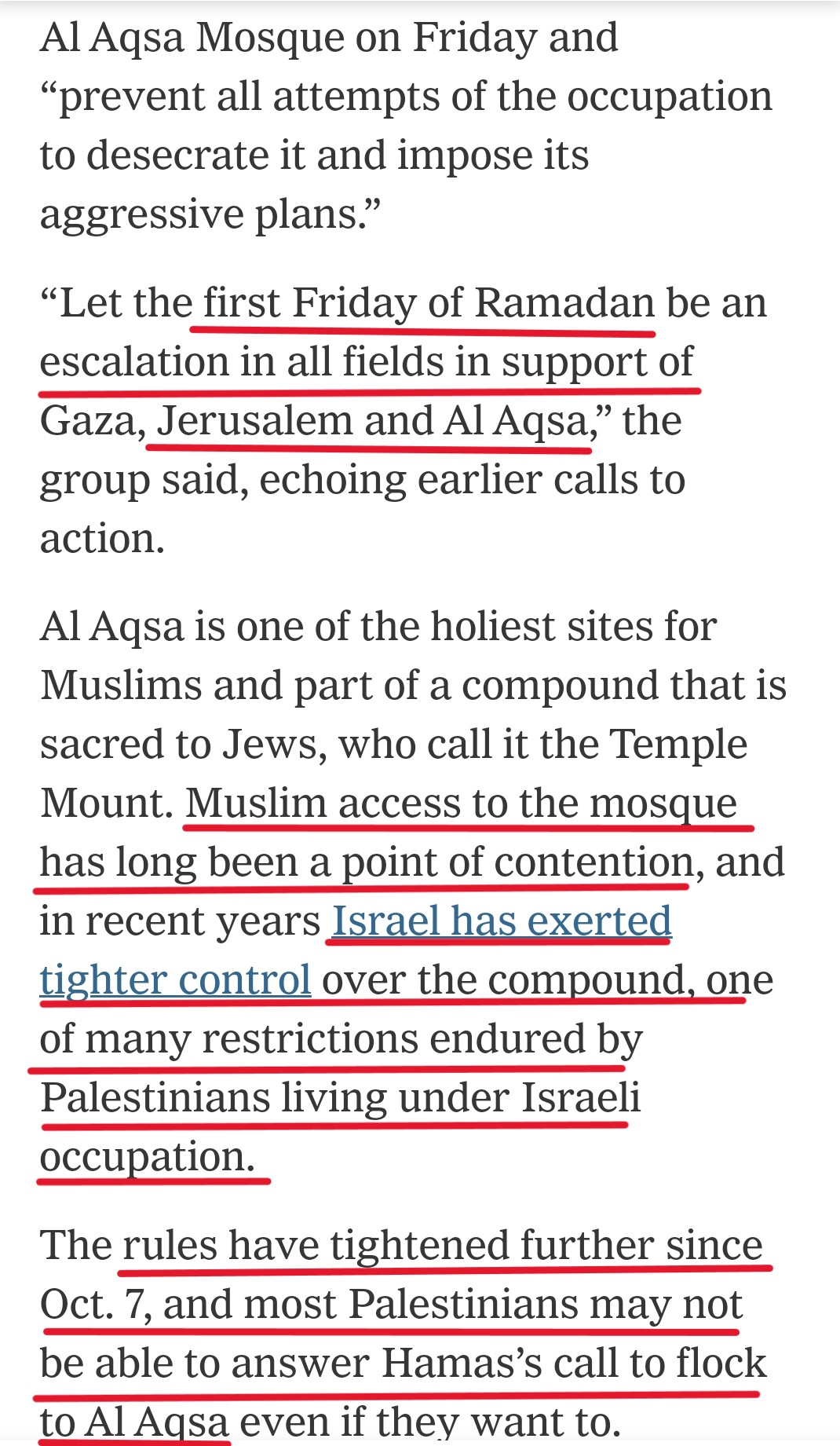
Yet the press inverts the story that it is Muslims who are “enduring” restrictions when in fact it is the Jews who face UN-endorsed discrimination.
Tor Wennesland is the Norwegian-born United Nations Special Coordinator for the Middle East Peace Process. His obvious inability to coordinate peace among the warring parties or even to separate them has certainly frustrated him since he took the position in 2021.
Wennesland has seemingly resorted to converting simultaneously to both Judaism and Islam, declaring himself both a rabbi and imam, and issued religious rulings and fatwas against both the Palestinian Muslims and Israeli Jews.
On March 12, 2024, Wennesland produced a curious declaration that flies in the face of facts, reality and dignity.
His opening salvo was against Jews around the world saying “I call for the status quo at the holy sites in Jerusalem to be upheld and respected.” That ‘status quo’ is the current ban on Jews praying at their holiest site of the Temple Mount, a complete trampling on the basic rights of Jews around the world. His language of “I call” was an interesting phrase, seemingly not offering his personal preference but taking the role of a rabbi to inform Jews that praying on the Temple Mount is forbidden.
He then turned to the Palestinian Islamists and said “Any attempt by extremists to turn the conflict into a religious one must be staunchly rejected.”
But that is the very core of the conflict and current Hamas war. Hamas’ foundational charter is a religious war against the Jews and the Jewish State with phrases such as:
“Israel will exist and will continue to exist until Islam will obliterate it.” (Opening)
“Our struggle against the Jews is very great and very serious.” (Preamble)
“Moslems fight the Jews(killing the Jews)… there is a Jew behind me, come and kill him” (Article 7)
“Nothing in nationalism is more significant or deeper than in the case when an enemy should tread Moslem land” (Article 12)
“In face of the Jews’ usurpation of Palestine, it is compulsory that the banner of Jihad be raised…. the Palestinian problem is a religious problem, and should be dealt with on this basis.” (Article 15)
“Israel, Judaism and Jews challenge Islam and the Moslem people.” (Article 28)
“fight with the warmongering Jews.” (Article 32)
“everywhere in the Islamic world will come forward in response to the call of duty while loudly proclaiming: Hail to Jihad.” (Article 33)
“Moslems were able to retrieve the land only when they stood under the wing of their religious banner… This is the only way to liberate Palestine… confront the Zionist invasion and defeat it… rid themselves of the effects of ideological invasion.” (Article 34)
Wennesland is obviously familiar with Hamas, its charter and philosophy. He knows that Palestinian Arabs support the group and the savage attack on Israelis on October 7. He therefore opted to don an Islamic tunic, promote himself and declare a fatwa that “The sanctity of Ramadan cannot and should not be used for political gains and calculations.” A curious declaration from a Christian to tell Muslims what to do with their holy month of Ramadan.
Beyond my obvious mocking and teasing of the absurdity of Wennesland’s dual conversions to both Judaism and Islam, perhaps there is a kernel of an idea in what he said.
For all these years, the global community specifically tried to frame the conflict as one solely about land and pretended that religion played no part. The foundation for that approach was that religion operates in absolutes and offers no compromises, and therefore no solutions to two people fighting over the same holy sites.
Unless, as Wennesland attempted to do, a single person – or perhaps a committee – represents both Muslims and Jews. A new council which would meet and find a way to respect the other’s faiths and traditions and map a pathway towards coexistence.
People have argued that there is no military solution to the middle east but history has shown that there is no political solution either. Now may be the time to find a religious path to peace in the holy land.
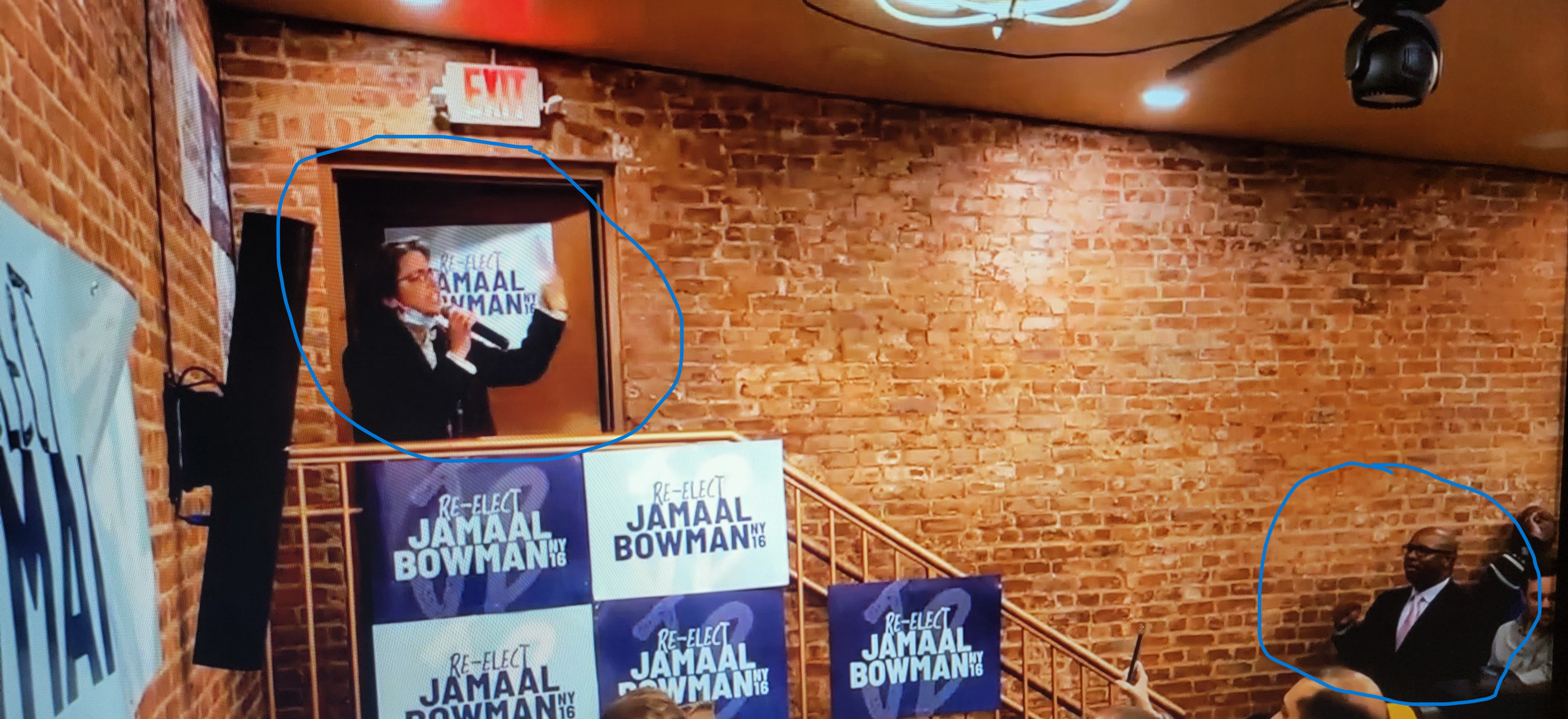
Rep. Jamaal Bowman has saddled up with some of the most violent anti-Israel Jew-haters in his New York district. They are now actively coming for Jews.
At the launch of Bowman’s 2024 congressional campaign, he featured Nada Khader who said before a cheering Bowman that Jews in Israel will only be safe when Palestinian Arabs “return to our homeland!” Until then, they can expect more October 7 massacres.
Nada Khader of WESPAC threatening Jews with more attacks if Palestinians do not get to move into Israel, with Rep. Jamaal Bowman cheering “Free Palestine”
Khader has taken her screed directly to Jewish schools.
On March 10, 2024, Khader and about twenty fellow anti-Israel agitators came to the Jewish Leffell School, where Jews gathered to discuss buying homes in Israel.
This seemed like an ideal time and location for Bowman’s supporters to tell Jews that they should be attacked.
Jihadist extremists carry banners in front of a Jewish Day School in Westchester County, NY on March 10, 2024
Khader and friends carried signs to “end the 75 year occupation”, meaning to destroy the Jewish State, as well as to “end Western complicity in Zionism” to rip any protections for Jews, so Muslim extremists can seek “Palestinian Liberation by any means necessary.”
Pro-Palestinian extremists are very clear what “any means necessary” means – more October 7 massacres with raping, beheadings and burning families alive.
NYC – these vile stickers are being spotted all around Union Square.
Khader’s charity, WESPAC, is somehow a tax-exempt entity despite calls for violence. It operates openly in the heart of Westchester County, home to 150,000 Jews.
Nada Khader with allies calling for the rape and slaughter of Jews in front of a Jewish day school on March 10, 2024
Imagine the danger to Westchester’s Jews if Jamaal Bowman prevails in the June 25th Democratic primary.
Rep. Jamaal Bowman and Rep. Rashida Tlaib shout “Free Palestine” before crowd after the October 7 massacre and mass rape of Israelis by Palestinian Arabs
‘The Zone Of Interest‘ is an unusual Holocaust movie. It shows the daily life of the head of the Auschwitz concentration camp inside his home abutting the vast killing factory. Living a peaceful life with his wife and children, the viewer is struck by the carefree life of the Nazi officer and his family, treating the annihilation of European Jewry as simply a normal 9-to-5 job which supports the family in the way they always desired.
Part of the funding for the movie was from the government of Poland, and its influence can be seen in directing the audience to see that the true evil actors were the German Nazis and not Poles, who were portrayed as trying to help Jews in some way, dropping apples around the camp for Jews who managed to escape. Modern Poles are shown at the end of the film, keeping today’s Holocaust museum at the site tidy for tourists who can view the Jewish possessions which were not seized by the Nazis and their families. The actual rampant Polish Jew hatred is invisible in the film.
Vile Jew-hatred continues today, as do new movies, shows and museums focused on the global scourge. Many contrast past antisemitism to modern Jew-hatred such as the remarkable play ‘Prayer for the French Republic‘ as well as ‘Leopolstadt’. Others are devoted just to the Holocaust like the new museum in Amsterdam. Some try to tie antisemitism into the Arab-Israeli conflict like the opera ‘Death of Klinghoffer.‘
Tragically, many of the works of art about noxious Jew hatred have become awash in the Arab-Israeli conflict. It would appear that Jews being cast as victims – whether with posters of kidnapped Israeli Jewish civilians, or a Holocaust museum – is too much for Palestinian Arab supporters who want to see the Jewish State crushed.
At the March 2024 opening of the new Holocaust museum in Amsterdam, hundreds of protestors gathered outside to shout “Free, free Palestine” and “Viva, viva Intifada,” screaming for the destruction of the Jewish State and murder of Jews.
Anti-Israel demonstrators at the opening of the National Holocaust Museum in Amsterdam. Pic: AP
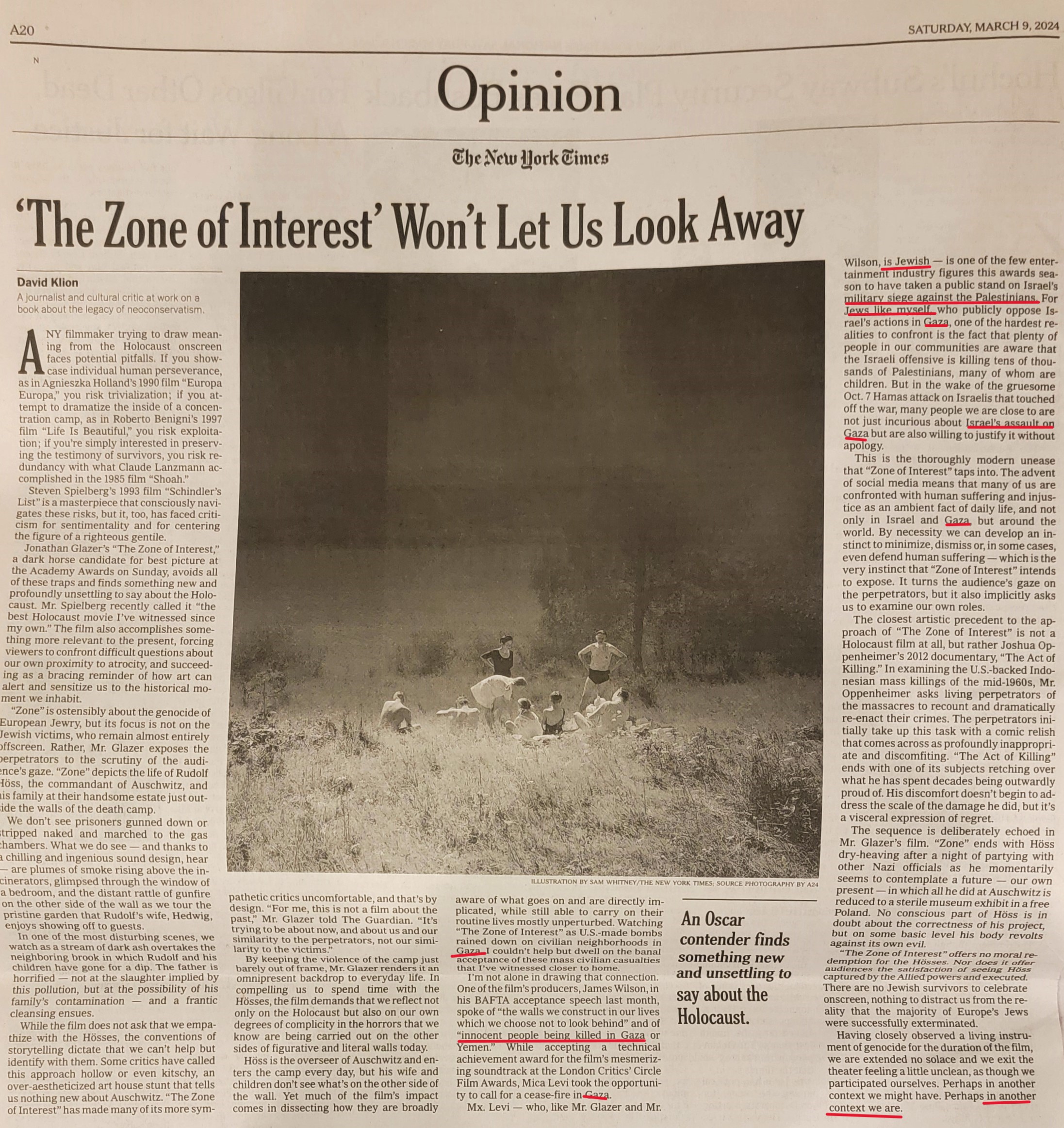
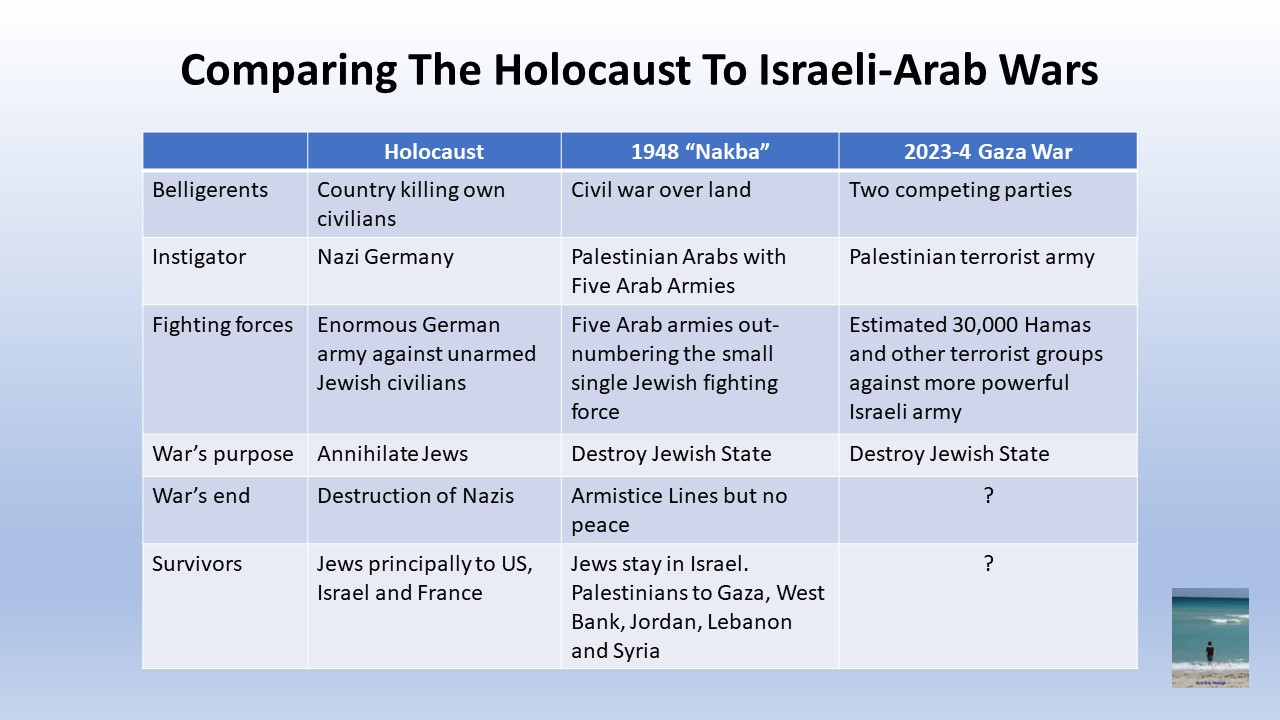
In the U.S., The New York Times published a grotesque opinion that compared Israel’s activities in trying to save its hostages and root out the perpetrators of the October 7 massacre to the Nazi family in ‘The Zone of Interest.’ Over-and-again it wrote of the “military siege of Gaza” and “Israel’s assault on Gaza” in a movie review about a Holocaust film.
NY Times lead opinion piece on March 9, 2024
The author, David Klein, could have stated his opinion about the War From Gaza without attaching his comments to a film about the systematic killing of 6 million Jews but he, and many like him, don’t want to. They want to strip Jews of any protection – offensive or defensive. The end of the article makes clear that he is against supplying Israel with weaponry to prosecute the Palestinian terrorist army of Hamas; appending his opinion to a Holocaust film is designed to also remove America’s shield for Israel at the United Nations and with resupplying the Iron Dome missile defense.
To make his refuse stink a bit less, Klein peppered the “AsAJew” line to protect himself from accusations of antisemitism.
Eli Lake penned an article in Commentary Magazine in March 2024 called “A Brief History of the ‘AsAJew’“. Lake sees this as a phenomenon of far-left diaspora Jews, as even progressives in Israel know that Hamas must be destroyed after the heinous barbarous attack which the terrorist group has threatened to repeat.
Lake described a long history of AsAJews during moments of Jewish suffering appealing to the antisemitic attackers to continue to persecute. He wrote that centuries ago, “the AsAJews of their day lobbied their hosts in the Diaspora to banish or convert the Jewish people to Christianity and to confiscate and burn the Talmud.” He details the story of a man in the 15th century named Johannes Pfefferkorn who converted from Judaism and helped fuel a mini crusade against his former co-religionists.
Times have changed some of the nouns in the anti-Semitic Mad Lib, but the story reads familiar.
Lake wrote, “In the Middle Ages, AsAJew converts were pawns the Church used to spread lies about the Talmud. In 2024, the AsAJews are not converts to Christianity. They are instead converts to the false prophecy of left-wing social-justice activism…. The anti-Semites of the Middle Ages needed AsAJews to provide credentials for the lies that justified their pogroms and expulsions. Today, Hamas and its allies in Iran need the AsAJews to persuade the Hague, European governments, and the White House to delegitimize Israel’s right to self-defense.”
I will add some observations on top of Lake’s. For centuries, antisemites including AsAJews, came for the Jews by attacking the religion itself. They concocted stories about Passover matzah in blood libels and the Talmud teaches black magic. Today’s cohort attack Jews and Jewish history, not the religion. They mock the Holocaust. They claim Jews have no history in the land of Israel and are “colonizers” who stole land from Arabs, and that Jews never had holy temples in Jerusalem so should be banned from prayer in a site that is solely holy to Muslims.
By ignoring religion, the modern day antisemites refuse to carry the antisemitic mantle because they are not attacking the religion, just bad actors who happen to be Jewish. The AsAJew allies provide a wide fig leaf for the charade, much as they’ve done for centuries.
Museums and films devoted to the heinous slaughter of Jews in the Holocaust, which would normally demonstrate the profound need for Jews to have self-determination, are being used by the alt-left and Islamic radicals to argue that Jews should be left to the wolves of Hamas. Some are not as shrill, and offer a tepid “both sides” support, blind to their echoing former President Donald Trump’s Charlottesville remarks.
‘The Zone of Interest’ Winning Best International Film on March 10, 2024, with callout to Israeli and Palestinian victims of terror
As antisemitism scales to terrifying levels around the world, the alt-left and Islamic radicals are turning works of art and remembrances of the deliberate mass butchering of Jews on October 7 and during the Holocaust into calls to attack Jews and the one Jewish State. Many progressive Jews are appalled and are abandoning their former partners-in-crime as now-revealed naked antisemites. But the AsAJews have remained steadfast and will share names and addresses of the Zionists, marking Jews as zealots who need to be punished for the good of mankind once again.
President Joe Biden addressed the nation on March 7, 2024 to discuss the state of the union. He discussed many points about situations abroad including Ukraine, Israel and China, and items on the domestic front such as immigration, abortion, education, the economy and crime.
President Joe Biden delivery State of the Union address on March 7, 2024
Biden put a very positive spin on the crime rate in the U.S. “All Americans deserve the freedom to be safe, and America is safer today than when I took office…. Last year, the murder rate saw the sharpest decrease in history, and violent crime fell to one of the lowest levels in more than 50 years.”
Sounds great.
But not for Jews.
Jews are being attacked and vilified on public streets and in schools. They watch university presidents smile when asked about calling for the genocide of Jews, and professors shout that they were exhilarated by the mass slaughter and rape of Jews in Israel.
In November 2023, Jewish Federations published a report that “70% of Jewish respondents said they feel less safe than they did a few months before [the Hamas war]…. Jews were twice as likely to say they worry very much about their personal safety compared to the general public.”
In February 2024, the American Jewish Committee released its own poll which found “63% of American Jews say the status of Jews in the U.S. is less secure compared to one year ago. In 2022, this number was 41%. In 2021, it was 31%.” The spike is found among the general public too in which “74% of U.S. adults say antisemitism is a problem in the United States today, compared to 68% who said so in 2022, and 60% in 2021.”
Biden knows about the tsunami of Jew hatred. In May 2023, five months before Palestinian jihadists butchered 1,200 people in Israel, Biden announced The U.S. Strategy To Counter Antisemitism. That document narrowly focused on the alt-right, with “Nazis” mentioned twelve times and “white supremacy” five. The more prevalent forms of Jew hatred from Islamic extremists, Blacks and the alt-left went completely unmentioned in the report.
The Biden administration was so blind to radical Islamic antisemitism that it put CAIR, the Council of American Islamic Relations, on the antisemitism committee at that time. The administration only removed CAIR after the head of the group said how pleased he was with the October 7 jihadi massacre.
The unwillingness of the Biden administration to clearly call out every manifestation of Jew hatred – not just from the alt-right – has upset many Jews. According to a February 2024 Siena College poll, the majority of Jews, who normally vote Democratic, are switching to Donald Trump for president in November 2024, buy a margin of 53% to 44%.
Joe Biden seems to be banking on math, that Jews are a minority-minority who are unlikely to tip the scales in any state. Or perhaps he just decided to “love the one your with” and cuddle up to the insidious jihad taking over America, protecting vile antisemites if the are Muslims or Blacks, who make up a much larger swatch of “minorities.”
Now in the 2024 election, Biden has informed Americans that the country is extremely safe, and is unwilling to acknowledge the tsunami of Jew hatred by his supporters in the Muslim, Black and progressive communities. Should Trump win the presidency, those left-wing and jihadi groups will surely come for the Jews in even greater numbers and ferocity than they are currently.
On January 29, 2021, the United Nations General Assembly published document A/75/729 which provided an update about Al Qaeda and ISIS, seemingly the only groups which the world agrees are terrorist groups. It contained a section called “Increasing support for the victims of terrorism,” which noted the importance of “healing” for victims and the need to be sensitive to events which might be “triggering or adding to their trauma.“
It was an interesting document for the UN, as two weeks earlier on January 16, 2021, UN Secretary General Antonio Guterres welcomed the news that the Palestinians would be holding elections, which he said would give “renewed legitimacy to national institutions, including a democratically elected Parliament and Government in Palestine.” It is baffling and alarming that the head of the United Nations would want to give “legitimacy” to an election which included the deeply anti-Semitic terrorist group, Hamas.
Guterres added that the election would “contribute to restarting a process towards a negotiated two-State solution based on the pre-1967 lines, and in accordance with relevant UN resolutions, bilateral agreements and international law.” Perhaps he never read Hamas’ foundational charter which is vociferously opposed to the basic existence of Israel and a peace process, “There is no solution for the Palestinian question except through Jihad. Initiatives, proposals and international conferences are all a waste of time.” (Article 13)
Now, three years after the leader of the United Nations called for Hamas to be part of the Palestinian political process while also calling for support for terrorist victims’ trauma, we are witnessing countries calls for Palestinian unity in the aftermath of the Palestinian armies of Hamas and PIJ butchering 1,200 innocent Israelis.
Last week, Palestinian Prime Minister Mohammad Shtayyeh resigned from office in light of the current war saying “I see that the next stage and its challenges require new governmental and political arrangements that take into account the new reality in Gaza and the need for a Palestinian-Palestinian consensus based on Palestinian unity and the extension of unity of authority over the land of Palestine.“
Russian Foreign Minister Sergei Lavrov welcomed the move towards Palestinian unity offering “Jesus Christ was born in Palestine. One of his sayings is: ‘A house divided against itself will not stand.’ Christ is honoured by both Muslims and Christians. I think that quote reflects the challenge of restoring Palestinian unity.” Leave aside that Jesus was a Jew and born in the land of Israel, the gist of Lavrov’s desires are understood.
United States Secretary of State Antony Blinken echoed a call for Palestinian rule over both the West Bank and Gaza while being unclear whether he supported a unified Palestinian government as he has denounced Hamas’s rule in Gaza. He shared in November 2023, “we need to see and get to, in effect, unity of governance when it comes to Gaza and the West Bank, and ultimately to a Palestinian state.”
Senior Hamas official Ghazi Hamad speaks in an interview with Lebanese channel LBC on October 24, 2023 calling for more butchering of Israelis. (Screenshot: X; used in accordance with Clause 27a of the Copyright Law)
A Palestinian government that is peaceful and demilitarized which governs all Palestinian territory can theoretically make peace with Israel, however, the majority of Palestinian Arabs approve of Hamas and its aims of destroying Israel and ethnically cleansing the land of Jews. Therefore, one can either have a “legitimate” Palestinian government which speaks for local Arabs which is at war with Israel, or an illegitimate Palestinian government which does not truly represent Palestinian Arabs making a peace agreement with Israel.
The United States seems to be pushing for the latter – a peace agreement over enduring peace – hoping that Israelis will ignore the leadership farce and that the Palestinian street will grow to accept the Jewish State over time.
Coupled with such approach, the United States will be demanding that the Israeli victims of terror and the entire country, ignore their profound trauma.
The sadistic massacre committed by Palestinian Arabs from Gaza on October 7 will impact the emotional and mental health of Israelis for a generation. That thousands of Palestinians could enter Israel and rape, mutilate and burn alive 1,200 people, brought back closeted inherited memories of the atrocities of the Holocaust and pogroms for Israelis and global Jewry. That Palestinians cheered the event and a majority support the heinous attacks, has scorched the sensibilities of Israelis, a trauma of the past that they will carry every day.
Palestinian leaders remain in control of Gaza and broadcast that they are committed to repeating the massacre, that “there will be a second, a third, a fourth because we have the determination, the resolve and the capabilities to fight…. We are not ashamed to say this, with full force. We must teach Israel a lesson and we will do this again and again.” The deep-seated evil ideology makes Israelis fear for their future.
Outside of Israel, hearing college professors say that they were “exhilarated” by the mass rape and butchering of Jews and felt “jubilation and awe” at the attacks has infused terror into the hearts of diaspora Jews, the 55% of global Jewry who live outside of their homeland in the land of Israel. Jews see that the attackers are not just Gazans but their global supporters.
For Jews, October 7 was a continuum of thousands of years of antisemitism brought forward to today and tomorrow. After centuries of instilled knowledge that nothing has ever appeased anti-Jewish zealots, Jews around the world look at the Israeli Defense Forces – a new army which was absent for 2,000 years – to reshape their future.
Israeli Defense Forces sing Israeli national anthem of “Hatikvah”, “The Hope”
For Palestinian Arabs, the IDF is their sworn enemy. Raised to believe that Israeli Jews are an illegal occupying force who stole Arab land, the IDF represents the boot on their necks enabling that crime to continue. As they watch tens of thousands of Gazans die and their infrastructure get obliterated by that army, they seethe in the present.
So despite the clear military trouncing of the Palestinian army of Hamas and Palestinian Islamic Jihad, the local Arabs are optimistic for their future. They are playing the long game and believe that Israel will soon cease to exist. In a June 2023 poll, “two-thirds say Israel will not celebrate the centenary of its establishment, and the majority believes that the Palestinian people will be able in the future to recover Palestine and return its refugees to their homes.”
The Islamic jihadists in the region believe that the IDF and Israeli Jews are evil but temporary. They see the tidal wave of global support crushing the “occupation army” and sweeping Jews from the region. The United States is Israel’s last column of support, and Islamic extremists see it buckling in the polls. With the help of Iran, Qatar and Turkey, they see a “liberation” of their land before Israel celebrates its 100th birthday.
Palestinians take dead Israeli bodies as trophies as part of October 7 atrocities
The IDF is the perceived game-changer for global Jewry, a chance to fight the toxic and violent antisemitism that has been killing Jews for thousands of years. It is the instrument to terminate their collective trauma and protect the ability to coexist in peace.
That same IDF is viewed by Palestinian Arabs and their supporters as deeply evil, causing a “genocide” of Gazans who, in their view, just want to live in peace in their land: everything from the River to the Sea, devoid of Jews.
Cornell University professor Russell Rickford celebrating the October 7 raping and slaughter of Israeli Jews
October 7th is fading in the world’s memory and is losing influence on opinions and policies. There is declining empathy for the ongoing Jewish trauma, as people focus on the latest body count of Palestinians. As part of that transition, the IDF is becoming the story as intended by the jihadists. The anti-Zionist extremists believe that neutering the Israeli army is the pathway to alleviating Palestinian trauma and perpetuating Jewish suffering.
Hamas might soon fade from public discourse. The political-terrorist force will blend into a new organization, having met its primary goals: the end of American support of the IDF as the pathway for the destruction of Israel. The political-terrorist group always knew that it could never defeat Israel militarily; its war mission was to weaken American support for the Jewish State, for its jihadi allies in Iran, Syria and Lebanon to strike the fatal blow.
ACTION ITEM
Write your politicians to maintain military aid to Israel to not only confront the Palestinian army but Hezbollah, Syria and the Islamic Republic of Iran.