Stateless Arabs from Palestine (SAPs) — in Gaza and the West Bank — often cry out that they cannot go wherever they wish in Israel. They protest that they cannot move to the towns where their grandparents once lived. They label Israel as racist for preventing them from settling there, even though their Muslim Arab cousins live peacefully in those very same towns.
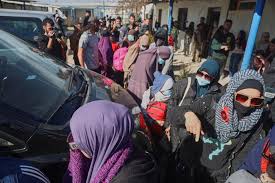
Arab women sitting in the shade in Akko, Israel (photo: First One Through)
They point to United Nations resolutions declaring they have a “right of return.” They frame their displacement as an “ongoing Nakba,” a catastrophe that Israel continues to impose.
I hear their complaint. I hear their anger. I more than understand — I live it.
Because Jews have lived that same nightmare — and worse. The very same United Nations that claims SAPs have a “right of return” decreed that Jews should be banned from living in half of their homeland. It told us we could not live in our own capital, Jerusalem. It told us we could not pray on our own holy mountain. It called it a “status quo” and the world nodded in approval.
And the Stateless Arabs from Palestine have the gall to try to deny Jews that very same right — to live freely in their homeland — while complaining that Jews are denying them theirs. They scream of injustice while vilifying “Yahoods.” The hypocrisy is obscene.
The Palestinian Arabs know it, and rather than confront it through accommodation and compromise, they wage war like Highlander, shouting “there can be only one.” They elected Hamas. They supported the October 7 barbarism. They continue to support Hamas, all in the hope of taking over the entire land from a small country.
Israeli Arabs make up 21% of the Israeli population, while Jews make up 0% of Gaza’s population and about 18% of the land east of the 1949 Armistice Lines (E49AL). The world ignores the Israeli Arabs with full citizenship rights, and obsesses and smears the Jews in the “West Bank” as illegal “settlers.” It seeks to ethnically cleanse that region of Jews while simultaneously claiming Israel has no true sovereignty to determine who to allow into its country to push the Israeli Arab population to 50%. It’s absurd.
Muslim Arabs have global support backed by 2 billion Muslims in their complaint against Israel. The small number of Israeli Jews receive global contempt for seeking the same right to live and travel freely in their homeland.
Israeli Arab women in Jerusalem (photo: First One Through)
Europe is declaring peace while America is building it.
As Britain and France rush to recognize a Palestinian state to pressure Israel, the United States is doing something more durable: expanding the Abraham Accords. With Kazakhstan now actively promoting its joining Muslim-majority nations normalizing ties with Israel, the U.S. is advancing a vision that builds relationships rather than rhetoric.
US President Donald Trump meets with Kazakh President Qasym-Zhomart Toqaev
European leaders say recognition will balance the scales and restart diplomacy. But what exactly are they recognizing? The Palestinians remain divided between an unpopular and corrupt authority in the West Bank and Hamas in Gaza—an antisemitic terrorist group that thrives on conflict and rejects coexistence. There are no elections, no functioning institutions, no borders, and no credible security force. Declaring this fractured reality a “state” doesn’t bring peace any closer. It just flatters the fantasy that paperwork can substitute for progress.
For Palestinians, European gestures feel validating, but validation without change is illusion. No declaration from Paris or London can rebuild Gaza, reform leadership, or disarm Hamas. It’s diplomacy as performance—morally satisfying to distant audiences but meaningless in practice.
The Abraham Accords take a different approach. They focus on cooperation. Each new country that signs—Bahrain, Morocco, the UAE, and now Kazakhstan—proves that Israel can be accepted across the Muslim world without waiting for Hamas’s permission. This shift is reshaping the region. It turns rejection into partnership, slogans into investment, and isolation into integration. Every handshake chips away at the myth that the Middle East must remain hostage to its oldest conflict.
But peace will never advance while Hamas holds power. Hamas doesn’t just oppose Israel; it opposes peace itself. It rejects every agreement, glorifies violence, and sacrifices its own civilians to preserve control. Allowing Hamas to participate in elections or continue ruling Gaza ensures that destruction will repeat everywhere. Disarming Hamas and excluding it from Palestinian politics isn’t an Israeli condition—it’s a Palestinian necessity. Without that step, there can be no state, no sovereignty, and no future.
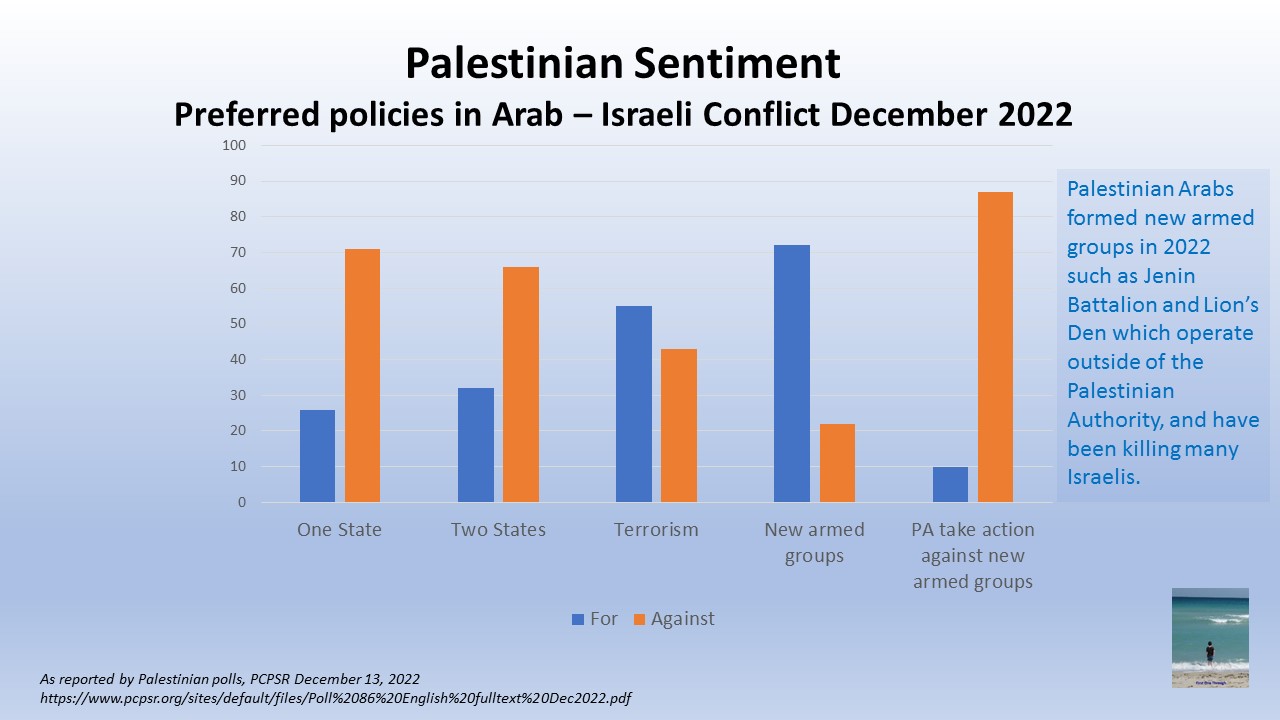
Alas, Palestinians disagree. In the latest PCPSR October 2025 poll, Hamas remains the most popular political party (60% approval) and Khaled Mashal, the leader of Hamas would trounce Fatah’s Mahmoud Abbas by 63% to 27%. Palestinian Arabs (69%) remain adamant that Hamas not give up its arms. Even after the decimation of Gaza, a majority (53%) still approves the October 7 massacre. And imagine that now, as the ceasefire appears to be bringing the end of the war, a remarkable 39% of Palestinians still think Hamas will win.
The choice is clear. Europe can keep recognizing an idea of Palestine that doesn’t exist and that the Palestinian Arabs are more moderate than they really are, or the U.S. can keep building the conditions for a reformed Palestinian society. The road to peace will not run through European parliaments; it runs through a changed Palestinian worldview, normalization between Israel and Muslim countries, economic growth, and a regional consensus that leaves Hamas behind.
The pathway to peace in the Middle East is the Abraham Accords, not European theater.
Google employs roughly 2,000 people in Israel, predominantly in offices in Tel Aviv and Haifa. The technology giant has hired teams in research & development, and purchased several Israeli companies including Waze and Wiz for billions of dollars to establish a large footprint.
And many of the company’s American employees don’t like it.
Hundreds of Google employees held protests about the company’s ties to Israel. Google fired around 50 of them in 2024 over their protests regarding “Project Nimbus,” a $1.2 billion contract signed in 2021 for Google and Amazon to provide the Israeli government with cloud computing and artificial intelligence services.
The disgruntled employees may now be fighting a more subtle fight.
To use Google’s calendar function, one is left with some odd choices to find the time zone in Israel. Rather than showcasing capital and major cities like Jerusalem, Tel Aviv and Haifa – cities where Google has a presence – the company shows time zones for Gaza and Hebron.
It’s both insane and stupid. And a reminder of the subtle Israel and Jewish erasure that is happening by radical technology employees under everyone’s noses.
ACTION ITEM
Complain to Google and have them feature main Israeli cities in their calendars.
The Organisation of Islamic Cooperation (OIC) recently issued yet another condemnation of Israel — this time for considering the death penalty for terrorists who murder Israelis. The outrage was immediate and performative. For one, it claimed that the proposed law was “racist” and being solely for “Palestinian detainees,” as opposed to people who murder. It further argued that Arabs who slaughter Jews should simply be treated as “Prisoners of War,” erasing any and all lines between soldiers and civilians and thereby condemning coexistence.
Wafa report on OIC condemning Israel for considering death penalty for Palestinian “detainees”
Here’s another uncomfortable truth: more than half of the OIC’s 57 member states have the death penalty — and not just for murder.
In Saudi Arabia, people are executed for drug trafficking, sorcery, and “crimes against God.” In Iran, the gallows await not only murderers, but those guilty of “corruption on earth” — a charge so elastic it includes political dissent, homosexuality, and apostasy. In Pakistan, blasphemy can mean death. In Mauritania and Sudan, apostasy itself is a capital crime. In Nigeria, men have been sentenced to death under Sharia courts for same-sex relations.
Yet these same governments now gather in moral indignation because Israel — a democracy under relentless terrorist attack — dares to debate capital punishment for those who slit the throats of families in their beds.
The hypocrisy is staggering.
The OIC has nothing to say when Hamas executes Palestinians in Gaza’s public squares for “collaboration.” It looks away when Iran hangs protesters from cranes, or when Afghanistan’s Taliban conduct public stonings. But when Jews, after burying their children, consider the ultimate penalty for their killers, suddenly the OIC finds its moral voice.
If morality were truly the concern, the OIC would start at home. It would demand an end to hangings for prayer and firing squads for love. But this is theater. Raw antisemitism redressed in sanctimony.
Israel’s debate over the death penalty is about justice for the innocent. The OIC’s silence over its members’ executions is about control of the obedient.
And that’s the dividing line between civilizations: one values life enough to punish those who destroy it; the other kills in the name of piety and calls it peace.
In October 2025, the Baháʼí Gardens in Haifa Israel shimmered under evening lights as thousands strolled the terraces surrounding the golden Shrine of the Báb. The event, “Terraces by Night,” invited everyone — Israelis, tourists, diplomats, Muslims, Christians, Jews — to share in quiet wonder. It was a celebration of beauty and peace, the essence of a faith that teaches the unity of mankind.
“The Bahá’í Gardens and the Shrine located in them are a religious and cultural asset of the highest order for Haifa and the State of Israel, and their spectacular beauty is an extraordinary global phenomenon. The connection between the city of Haifa and the Bahá’í Faith and the gardens is a unique bond of brotherhood and connection, because Haifa is a symbol of shared life.”
– Haifa Mayor Yona Yahav
That same faith is banned or persecuted across much of the Middle East. In Iran, where the Baháʼí Faith began, believers are barred from universities, their cemeteries desecrated, their homes seized. In Yemen, the Houthi regime has deported Baháʼís and outlawed their assemblies. In Qatar, a country that funds global propaganda about human rights, Baháʼís have been detained and denied employment. The list goes on: Christians face church burnings in Iraq and Egypt; Yazidis were enslaved by ISIS; Jews are long gone from the Arab world that once housed thriving communities.
The pattern is unmistakable — a region where religion is invoked constantly, yet religious freedom barely exists. Theocratic and authoritarian regimes claim divine legitimacy while erasing those who believe differently. Hatred of Jews may be the most visible strain, but the intolerance runs deeper: a rejection of pluralism itself.
Against that backdrop, Israel stands as an anomaly. The Baháʼí World Centre — the faith’s spiritual heart — sits on Mount Carmel, Haifa, Israel by choice, not exile. Baháʼís are forbidden by their own laws to proselytize in Israel, yet they flourish there. Muslims pray in mosques, Christians ring church bells, Druze maintain their shrines. It is imperfect coexistence, but coexistence nonetheless — a rare reality in a region where diversity elsewhere draws death sentences. Israel is the only country in the world where the religious majority does not make up the majority of annual tourists (Christians make up more than 50% of tourists to Israel each year).
Various pilgrims file in through the Jaffa Gate in the Old City of Jerusalem in April 2017 (photo: First One Through)
Even the United Nations, which rarely misses a chance to criticize Israel, cannot ignore this hypocrisy. In December 2024, it condemned Iran stating the “dramatic rise in persecution against Baha’i women is an alarming escalation.” Yet it has remained silent on Qatar, whose wealth buys global silence — from universities, media, and even diplomats who recite the language of tolerance while pocketing the proceeds of repression.
The Baháʼí Faith preaches that humanity is one family. In Haifa, that message is literal — thousands of visitors walking through open gates, cared for by volunteers of every background. It’s a vision of what the Middle East could be if faith were not used as a weapon.
The Baháʼís open their gardens in Israel while their co-religionists suffer in silence around the Muslim Middle East. They celebrate while others cower. And they do it in the one nation in the region where the doors of worship remain open for those willing to coexist peacefully.
Much of the attention on the Balfour Declaration—issued on November 2, 1917—focuses on the United Kingdom’s pledge to “facilitate” “the establishment in Palestine of a national home for the Jewish people.” Israel-haters rage at this clause, claiming that Jews had no historical connection to their ancestral homeland and that Britain had no right to “hand over” immigration rights from local Arabs to Jews.
Balfour Declaration
On the anniversary of the Declaration in 1943, Heinrich Himmler of Nazi Germany sent a telegram to the “Grand Mufti” of Jerusalem that Nazis and Arabs had the same enemies – Jewish invaders. In 2016, the President of the Palestinian Authority, Mahmoud Abbas demanded an apology and reparations from Britain for issuing the Balfour Declaration, having repeatedly failed to destroy the Jewish State.
Telegram from Heinrich Himmler to Amin al-Husseini on November 2, 1943
But there’s another part of that same document that antisemites also detest. The closing line reads:
“…nothing shall be done which may prejudice the civil and religious rights of existing non-Jewish communities in Palestine, or the rights and political status enjoyed by Jews in any other country.”
That final clause—protecting Jews’ rights around the world—is precisely what modern antisemitic movements are trying to undermine. Groups like Within Our Lifetime, CAIR, and the Democratic Socialists of America openly campaign to dismantle what they deride as “Jewish power” in America.
They smear Jews as self-serving “capitalists,” accuse them of exploiting “Black and Brown bodies” for profit (as Rep. Rashida Tlaib has said), and seek to push Jews to the margins of public life—all because Jews affirm that the land of Israel is their homeland.
A century after the Balfour Declaration, its promise remains under attack—not only in the Jewish homeland but wherever Jews dare to live proud and free.
The United Nations Relief and Works Agency, UNRWA, declares that it operates on four humanitarian principles — humanity, neutrality, impartiality, and independence. It is none of those things.
UNRWA is unlike any other UN agency. It is not the UNHCR, which manages refugees from every nation and conflict on earth. UNRWA is a creature of exception — created for a particular people, in a particular region, in a particular war.
The agency claims it was established to address the plight of refugees from Palestine following the 1948–49 Arab-Israeli War. But was that truly its purpose? When the fighting ended, thousands of Jews were also expelled from their homes east of the 1949 Armistice Lines (E49AL) — from Jerusalem’s Old City, from Hebron, and across Transjordan’s illegally occupied territory. They, too, were refugees from Palestine. Did UNRWA help any of them? No.
Jews expelled from the Old City of Jerusalem via the Zion Gate by the army of Transjordan
From its inception, UNRWA was built to serve Arabs alone. Even when those same Arabs became full Jordanian citizens, the agency continued to provide them with housing, food, education, and medical care — benefits that by any logical standard should have ended once citizenship was granted. Instead, UNRWA preserved refugeehood as an inheritance, not a temporary condition.
Over time, UNRWA’s mission has morphed from relief to perpetuation. It has shown itself highly partisan, politically entangled, and morally compromised. Its schools and clinics may operate under the UN flag, but the agency’s allegiance is often indistinguishable from the politics of rejectionism that dominate its host territories.
During the 2023 Gaza war, UNRWA boasted that only it had the infrastructure to provide food, education, and healthcare to the Gazan population. Yet when 250 Israelis were dragged into Gaza as hostages, where was this agency of “humanity”? Did it deliver a single bandage or calorie to the kidnapped Israelis held underground? Did it condemn their abduction, or even acknowledge their suffering? It did not. UNRWA’s humanity proved selective, its independence nonexistent.
Its operations in Gaza function only through integration with Hamas, the political-terrorist organization that rules the territory. Schools double as weapons depots; employees have been implicated in massacres; aid is distributed by political loyalty, not human need. Leaders at the OCHA, another UN “humanitarian” group, are not shy to say they view Hamas a legitimate political representatives of Palestinians, not as a terrorist group.
UNRWA now has additional offices outside of its field operations. It opened an office in Turkey to “expand its political and financial support base,” backed by the Organization of Islamic Cooperation (OIC), a political group. Very political. Neither independent nor neutral.
UNRWA is not a neutral humanitarian actor. It is a political instrument masquerading as one. It fails every principle it proclaims.
So long as UNRWA exists, it will preserve resentment, dependency and hatred. That agency founded in the shadow of war is the leading obstacle to peace.
To visit Poland is to walk among ghosts. The thriving Jewish civilization that once filled its towns and marketplaces was almost completely erased. Three million Jews were targeted for extermination — a number too vast to grasp by walking through silent cemeteries. The absence alone cannot speak the full horror.
To stand where synagogues were razed, where schools once taught Torah and arithmetic, where playgrounds once rang with Yiddish laughter, is to feel the emptiness press against your chest. It forces the imagination to repopulate the void — to summon the Jewish ghosts who linger, waiting for conscience to remember them.
It is easier to look at the living. Many Poles today are the grandchildren of those who watched as their Jewish neighbors were rounded up — and sometimes finished the work themselves when survivors returned seeking their homes. They became stand-ins for the killers of yesteryear, heirs to silence, envy, and complicity.
Now another people walks amid ruins. In Gaza, millions return to their shattered neighborhoods under a ceasefire, and we are told they have survived a “genocide” at the hands of Jews. Yet the number of Palestinian Arabs has grown, not diminished — a population larger than before the war they themselves began. They tread among the skeletons of broken buildings built atop their army’s tunnels, while ghosts — Israeli civilians burned alive in their kibbutzim and those taken hostage and murdered in Gaza — cry out from the ashes.
I ponder the ghosts of genocide: the murdered and the murderers; the societies that spawned the slaughter; the peaceful towns that became infernos.
Infrastructure shelters ghosts. Societies are haunted by the ones they create, both killer and killed. The unseen dead can no longer showcase their dancing on the one hand, or lust to murder, on the other.
There are scarcely any Jews left in Poland; their ghosts appear only to those who seek them. In Gaza, the ghosts are not gone. They walk the streets, armed and unrepentant — not spirits of victims, but kinsmen of murderers, now turning on one another.
Poland’s haunting is one of silence — an absence so total it chills the air. The ghosts there do not cry out; they wait to be remembered. Gaza’s haunting is the opposite: a cacophony of rage that refuses reflection. Its ghosts are not silent but screaming — not victims unburied, but hatreds unrepented.
Poland’s soil holds the murdered; Gaza’s streets still host the spirit of the murderers. One ghost asks to be mourned; the other demands to be judged.
The haunting does not end with time. It lingers wherever truth is buried, and it deepens each time the living deny the past that shaped them.
Only when a people can face its ghosts — naming both the murdered and the murderers — can it begin to live freely again.
For decades, Arab and Muslim leaders have fed their people a poisonous myth — that Israel dreams of ruling the Middle East, that it seeks to drive out Arabs and Muslims, that its goal is a genocidal “Greater Israel.” They have said it from Cairo pulpits and Riyadh conferences, shouted it at the United Nations, and woven it into the political DNA of generations.
Yet reality told a different story — 230 straight days of restraint.
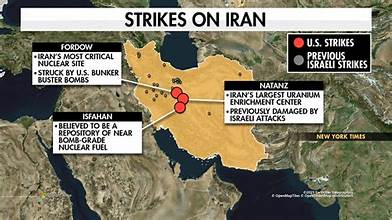
From October 26, 2024, when Israel obliterated Iran’s air-defense network, until June 13, 2025, when it finally struck Iran’s nuclear weapons sites, Israel had total air supremacy over the Islamic Republic. For more than seven months, Israel could have flattened Tehran, crippled the oil fields of Khuzestan, or plunged the country into darkness by bombing power plants and airports. Instead, it waited.
The Iranian regime — the self-declared spearhead of the “Axis of Resistance” — had launched a multi-front war: Hezbollah in the north, the Houthis from the south, militias in Iraq, drones from Syria. Yet Israel responded surgically, destroying Iran’s air defenses and exposing the regime’s weakness. Then it stopped. No mass civilian targets, no vengeance against cities — only vigilance.
When Israel finally acted again, its aim was limited and precise: the nuclear enrichment facilities that Tehran had openly threatened to use to annihilate the Jewish state. The operation was not about conquest; it was about survival.
Had the situation been reversed — had Iran dismantled Israel’s air defenses — the results would have been catastrophic. Iran’s own rhetoric, and its record of missile and drone attacks on Israeli cities, show exactly what it would have done: unleashed devastation on civilian population centers. Annihilating the “Zionist regime” as an excuse for eliminating the the threat of a “Greater Israel.”
For 230 days, Israel had the power to destroy Iran and chose not to, just as it could have obliterated Gaza from the first day of the war. Those months are the clearest refutation of the propaganda long sold across the Muslim world about “Greater Israel” and “genocide.” Israel does not seek domination or extermination — it seeks to live.
Two hundred thirty days of restraint. Two hundred thirty days of truth.
If one were to build a museum chronicling how a people educated generations toward hatred and eradication, the Palestinian Arabs would tragically merit their own institution. The Museum of Genocidal Intent would not showcase armies, the tools of genocide. It would display ideas, laws, sermons, and schoolbooks that made destruction a virtue and coexistence a sin.
Entrance Hall – The Charter of Death
Visitors first encounter the founding documents: the Hamas Charter (1988) and early Fatah Constitution passages promising Israel’s annihilation. There are ballots underneath from the 2006 parliamentary elections with articles alongside showing the Stateless Arabs from Palestine (SAPs) electing Hamas to 58% of parliament as a first action of breathing self-determination. As one leaves the room, leaders—from Arafat to Abbas to Haniyeh—chant “From the River to the Sea” and “We love death more than you love life.“
Gallery I – Educating for Erasure
School desks and children’s cartoons line the room. In cases, textbooks from the Palestinian Authority show lessons which erase Israel from maps. UNRWA teachers like Afaf Talab have Facebook posts featuring wishes that God kills the Jews. A 9th grade lesson calls the firebombing of an Israeli bus a “barbeque party.” There is a coloring book hanging on the wall used in a fifth grade class in an UNRWA school which has a flag dripping in blood in front of the al Aqsa Mosque in Jerusalem, with a map of Israel alongside, erased into “Palestine.”
Coloring book from an UNRWA fifth grade class tying religion, prayer, death and destruction of the Jewish State
A television plays cartoons from Hamas TV shows, showing ultra-Orthodox Jews and Israeli soldiers digging under al Aqsa mocking Arabs and Muslims who are “asleep” as the crooked nosed-Jews threaten the mosque.
Interactive displays allow visitors to click on various videos from summer camps in Gaza and east of the 1949 Armistice Lines (E49AL/ “West Bank”). Young girls sing about “igniting an intifada,” encouraged “to shoot all the Jews” and taught if the Jews don’t leave Palestine, all of them should be “slaughtered.”
And the music. Popular Arabic songs play throughout the museum. They call for Jews to leave the land or be killed or kidnapped.
Gallery II – Icons of Murder
Here hang portraits of those celebrated for killing Jews: Dalal Mughrabi, Yahya Ayyash, and others. Under each image scroll the names of their victims—families, schoolchildren, passengers. Nearby, official “martyrs’ fund” ledgers show stipends paid to convicted attackers from the Palestinian government. In the center of the room are mock ups of the various schools, public squares and soccer tournaments named for the “martyrs.”
Gallery III – International Complicity
Painted UN blue, this hall traces how global institutions enabled indoctrination. Pictures of leaders of various European countries including Belgium and Norway that fund the schools and squares named after terrorists. Copies of numerous United Nations resolutions cover the walls, which condemn Israel but not Hamas, which make it illegal for Jews to live in the Old City of Jerusalem, and illegal to pray at their holiest site on the Temple Mount.
A large picture of the entrance to the UN-run “refugee” camp in Bethlehem with a key on top of a keyhole portal emphasizes that the international community is the vehicle for Arabs to eradicate the Jewish State.
Gallery IV – Blood Narratives
Walls of newspapers and posters accuse Jews of medieval crimes: poisoning wells, harvesting organs. Animated panels compare Nazi caricatures to modern Palestinian cartoons—the imagery identical. Loudspeakers replay sermons calling Jews “descendants of apes and pigs.”
Interactive charts present PCPSR and other surveys over time:
December 2023 – about three-quarters of Palestinians called the October 7 attack “correct.”
Majorities favored continued “armed struggle.”
Roughly two-thirds support killing Jewish civilians in Israel in every poll since 2000
Gallery VI – Jerusalem: The Theater of Denial
A model of the Al-Aqsa plaza plays footage of Murabitat women harassing Jewish visitors to the Temple Mount.
PA President Mahmoud Abbas and other PA officials can be seen on videos claiming “Jews have no history in Jerusalem.” Audio of chants—“With blood and soul we will redeem you O Aqsa”—fills the room. Hamas leaders promise to repeat the October 7 “al Aqsa flood” massacre “again and again.”
PA president Mahmoud Abbas glorifying death on behalf of Jerusalem
Gallery VII – The Forgotten Ethnic Cleansing of Jews
Artifacts from before 1967 tell the story before the story:
The massacre and expulsion of Jews from Hebron in 1929
Synagogues Destroyed: photos of Jerusalem’s Old City after Jordan’s takeover—58 synagogues razed.
Expulsion: maps marking every Jewish family removed from the Old City.
Jordan’s illegal annexation of part of Israel in 1950.
Gallery VIII – Lynching: Public Violence as Spectacle
The public spectacle of the killing for the crowds is highlighted in the last room of the permanent collection.
Hebron 1929 – photos and testimonies of the massacre where 67 Jews were murdered
Ramallah 2000 – two Israeli reservists beaten to death by a mob; a photograph of a man showing blood-stained hands became an icon of the Second Intifada. The crowd cheers.
Gaza, 2023 – pictures of Gazans cheering as dead Israeli women are paraded through the streets.
The bloody hands of a Palestinian man after lynching an Israeli in Ramallah has become a symbol of the genocidal intent
Special Exhibit – The Sbarro Massacre: Innocence Targeted
At the museum’s center stands a quiet, glass-walled room marking August 9, 2001, the bombing of the Sbarro pizzeria in Jerusalem.
Bombing at Sbarro restaurant in the Palestinian terrorist war on Israeli Jews
Artifacts include: fragments of the restaurant sign and surviving menu board; the broken guitar of 15-year-old victim Malki Roth; children’s shoes and schoolbooks retrieved from the site.
Chronology Panel: maps trace the attacker’s route and later trials of the planners.
Testimony Wall: written reflections from victims’ families—the Roths, Greenbaums, Schijveschuurders—describe loss and their ongoing quest for justice.
Media Archive: displays neutral summaries of press interviews and court transcripts noting the convicted organizer’s open lack of remorse, contrasted with international outrage and U.S. extradition efforts.
A video concludes with the terrorist Ahlam al-Tamimi stating how proud she was to have killed “religious Jews” and eight children.
Her words hang over the door as one leaves the building: “the philosophy of death is very difficult to understand.” She lives as a free woman walking the streets of Jordan today, a hero to millions.
Interview with terrorist Ahlam al Tamimi who has no regrets for killing women and children at a pizzeria
Epilogue
The Museum of Genocidal Intent does not exist, yet its exhibits do—scattered through classrooms, speeches, and monuments. Each artifact documents a choice: to teach vengeance or to teach life. Only when the real-world versions of these exhibits are dismantled will the possibility of peace move from behind glass into the open air.