Platforming The ‘Third Intifada’

College campuses have become awash in calls for an “Intifada” which some anti-Israel apologists say is only a call for another independent Arab state. Others acknowledge it as a call to destroy the Jewish State of Israel echoing the genocidal jihadists. Others say it encompasses a Diaspora Intifada, which comes for Zionists and Israel supporters everywhere.

University presidents are attempting to figure out how to allow civil discourse and free speech. Many allow students to take over campuses with calls to destroy an American ally and hunt Jews, as long as there’s no immediate call for violence. Some give professors tenure to spew their toxic opinions and instill Jew hatred like medieval preachers discussing blood libels.

The U.S. Congress is doing much the same.

On May 9, 2019, Speaker of the House Nancy Pelosi invited Imam Omar Suleiman to give a prayer at Congress. Suleiman was already well known for his rhetoric about “Free Palestine” and what an ‘Intifada’ meant: a war to destroy the State of Israel.

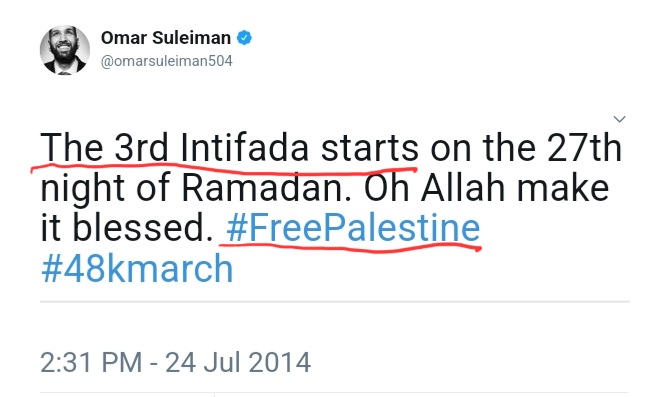
As the 2014 Israel-Hamas war started, Soleiman tweeted “The 3rd Intifada starts on the 27th night of Ramadan. Oh Allah make it blessed. #FreePalestine #48kmarch.” Just as the war was concluding, he tweeted much the same: “For the first time since 1967, Masjid Al Aqsa is closed. A third intifada is near insha’Allah #FreePalestine.”

None of these sentiments was disqualifying for Pelosi. She thought that a person calling for the destruction of an ally was appropriate to elevate to the national stage.

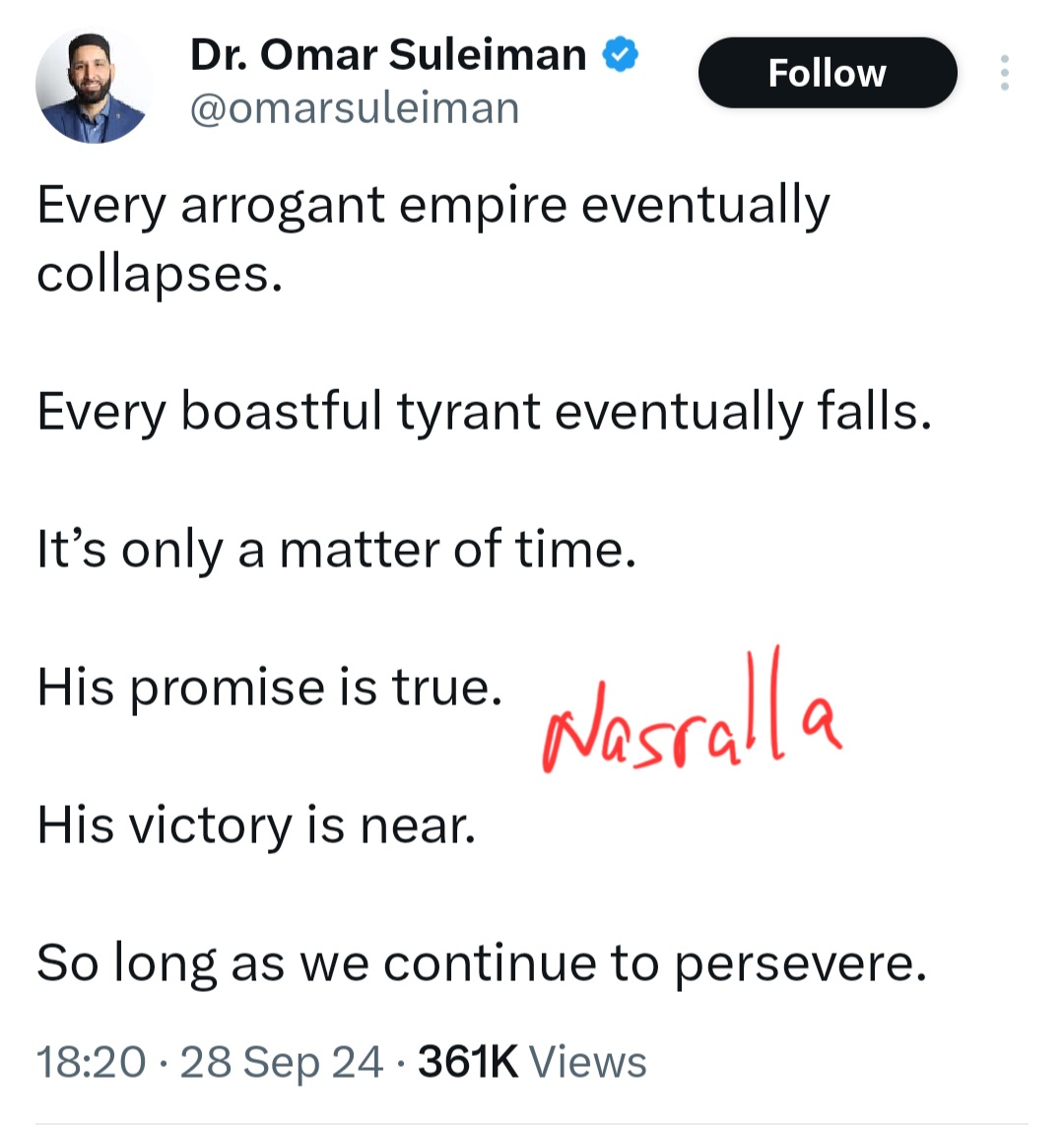
In the current Iranian proxies war against Israel, Suleiman continues to call for the destruction of Israel. After Hassan Nasrallah (fungus be upon him), the leader of the terrorist group Hezbollah was assassinated by Israel, Suleiman called to his followers to “continue to persevere” in the goal of eradicating the Jewish State.

The platforms which call for the destruction of the only Jewish State, where nearly half of Jewry lives, are plentiful: social media, universities and at governments. The defense is ‘free speech’ which a flimsy veneer to allow a voice for those who had typically not been seen or heard. While free speech is about CONTENT, today’s version is about the SPEAKER, and society is demanding those speakers be platformed regardless of what they say.

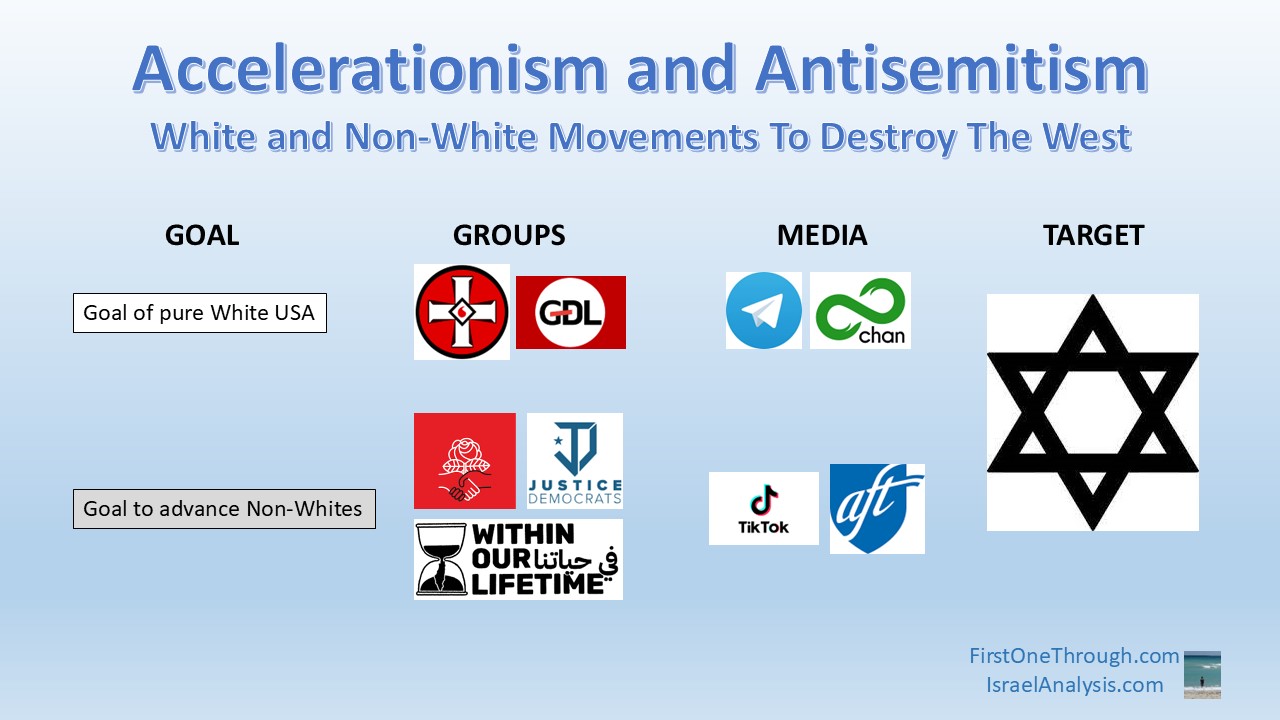
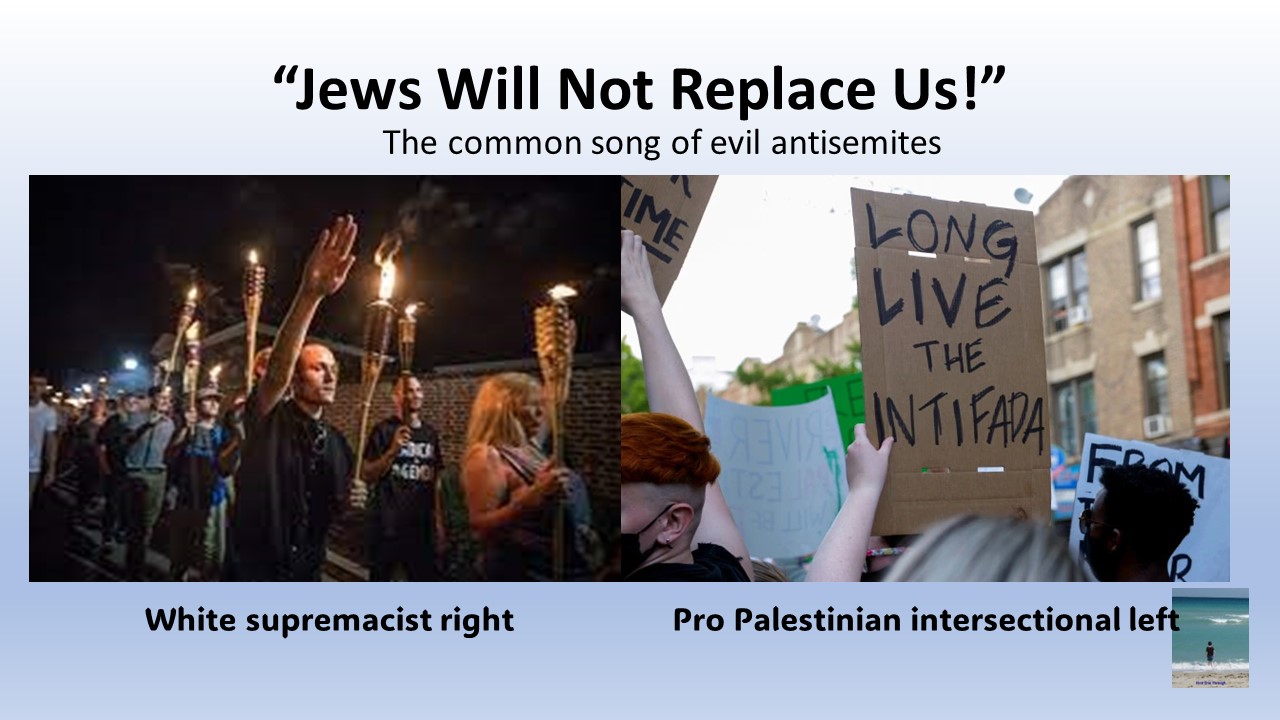
Noted White supremacists don’t get invited to address the House of Representatives nor given tenure at Ivy League schools. Universities have not permitted the KKK to have chapters on 250 college campuses like Students for Justice in Palestine.

The tenet of free speech and goal of giving voice to the unheard are seemingly complementary but alarmingly discordant today.

At least to Jews, who have suffered more hate crimes than any community for millenia. Now told to shut up and listen to the bile, as the victims of preference have the floor.

Related articles:

The Anti-Israel And Anti-American Woke Grows (July 2024)

Drawing Muhammed On U.S. College Campuses (May 2024)

Why Should Columbia Protect Jews If The Government Won’t? (April 2024)

Considering Campus Antisemitism (November 2023)

Should The KKK Open Chapters In Every American University, What Say You? (October 2023)

The Center Of Intersectionality Sounds Like Adolf Hitler (July 2023)

The Anti-Semitic Replacement Theory of White and Islamic Extremists (May 2022)

The Campus Inquisition (April 2022)

NY Times Considers Notion That Terrorism Against Israel is a Matter of Free Speech (January 2021)

Victims of Preference (July 2020)

The Insidious Jihad in America (July 2019)

Inclusion versus Attention, and The Failure of American Leadership (March 2019)

Covering Racism (March 2018)

Drawing Muhammed On U.S. College Campuses

The defenders of free speech on campus are out in force. Far-left members of congress like Ilhan Omar and Jamaal Bowman defend the right of agitators to yell for the genocide of Jews and destruction of the Jewish State as a matter of “uncomfortable speech” that should be allowed. Lawyers debate what crosses the line when calling for killing a group of people generally as being protected speech in public spaces but similar language directed at individuals and/or what could be considered an immediate call for violence, which would be prohibited speech.

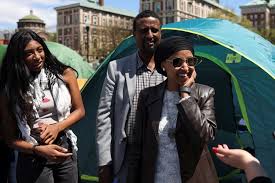
Rep. Ilhan Omar (D-Minn.) was spotted smiling at the anti-Israel encampment at Columbia University. (Photo: Reuters)

One would therefore imagine the free speech advocates easily standing alongside students drawing the Islamic prophet Mohammed on placards around campus, and most definitely, showing Mohammed in art classes, much the way paintings and statues of Jesus, Moses and David are discussed.

But the opposite has been the case.

Professors are being fired or intimidated to not show artwork with Muhammed. In Minnesota, Erika López Prater was fired from her position at Hamline University for showing a 14th-century painting depicting the Prophet Muhammad in a lesson on Islamic art. A student complained that she was upset and that it was blasphemous to show a depiction of the Islamic prophet and got the school to fire the professor. The professor had zero malicious intent and was simply reviewing artwork of religious figures but was nonetheless terminated.

The French satirical magazine Charlie Hebdo often lampoons religions and has made cartoons of the Islamic prophet as well. Jihadi radicals were incensed when their prophet was the subject matter, and shot up the company’s offices in 2015. The Islamic killers then shot up a kosher supermarket which had nothing to do with the magazine, simply to kill Jews.

A couple of months later in 2015, Pamela Geller held a “Draw Muhammed contest” in Texas, and two Muslim extremists shot up the event but were themselves killed. Both the Geller and Charlie Hebdo events were lampooning religion and Islam specifically, but covered under American and French ideals of free speech.

It will be an interesting spectacle to watch campuses with anti-Israel protests have counter-protests with Mohammed featured prominently on their placards with such statements like “Would Muhammed endorse Hamas’s rape of women?” and “What would Muhammed say about Hamas’s shooting the elderly?” Will Ilhan Omar rise to the defense of actual peace advocates the way she defends supporters of genocide?

Related articles:

Palestinian Hate Speech (May 2023)

NY Times Considers Notion That Terrorism Against Israel is a Matter of Free Speech (January 2021)

Is Antisemitic Graffiti a Hate Crime? (December 2019)

Uncomfortable vs. Dangerous Free Speech (October 2017)

Losing Rights (October 2017)

Politicians React to Vile and Vulgar Palestinian Hatred (May 2017)

The UN is Watering the Seeds of Anti-Jewish Hate Speech for Future Massacres (May 2016)

Selective Speech (May 2015)

New York Times Confusion on Free Speech (January 2015)

Should The KKK Open Chapters In Every American University, What Say You?

Americans are debating free speech on college campuses, as “resistance” protests have emerged around the country with students supporting the brutal massacre and butchery of 1,400 Jews in Israel. While Jewish students mourned for murdered friends and relatives, they walked passed schoolmates who were celebrating, sitting in class next to classmates who said that their families were thrilled about the slaughter of Jews, and in front a professor who discussed the “start of the Palestinian War of Liberation“, meaning the end of the Jewish State.

University administrators, who want to foster “free speech” allow – and often encourage – the spectacle to go on, knowing that Jews feel threatened. The years of trying to create “safe spaces” for the young people – including calling for disciplinary action for misgendering someone – seemingly had limits.

The AMCHA Initiative has done extensive studies which shows that universities with five or more pro-Israeli boycott professors are more than seven times more likely to have antisemitic incidents on campus than those with fewer. They similarly showed that those with a Students for Justice in Palestine chapter on campus are at least five times more likely to intimidate and harass Jewish students.

And none of the SJP chapters have been kicked off of campus. Instead, schools like New York University hand the group official awards. Brown University hosts talks such as “Decolonizing Palestine: Hamas between the Anticolonial and the Postcolonial,” which cleansed Hamas of being a terrorist group, and promoted the idea to “normalize and globalize Hamas (27:00).”

The Ku Klux Klan must be licking their chops.

The KKK, the most infamous hate group in the United States, despises Jews. And Blacks. And other minorities.

The hate group had been sidelined for years and thought it would be able to make a breakthrough during the Trump administration. To its disappointment, it did not have the money to influence universities the way Qatar, Saudi Arabia and other Muslim countries did in pouring billions of dollars onto campuses to build the anti-Zionist and antisemitic infrastructure.

But with a few student signatures and a single university professor with tenure, the KKK can open a chapter on campus. It can spout its false and hate-filled bile. And the university presidents will presumably remain silent, just as they have about SJP.

The war on college campuses is claiming its Jews, led by anti-Zionist groups like SJP. The KKK is right behind and will come for others.

Demand universities fire antisemitic professors like Columbia’s Joseph Massad, and kick Students for Justice in Palestine off of campus

Related articles:

Columbia University Completely Fails Mission. And Jews

Columbia University’s Latest Anti-Semitic Inanity: “Palestinian Hebrews”

The Problem With Antisemitism On College Campuses Stems From Where Jews And Arabs Focused Their Donations

Deformity Of Palestinian Culture In America’s Youth

Saudi Students In United States

Bigots In Power, Checked And Unchecked

Hamas And Harvard Proudly Declare Their Anti-Semitism And Anti-Zionism

Courageous Jews On Hostile Campuses

Hamas’s Willing Executioners

The Joy of Lecturing Jews

On Accepting and Rejecting Donations

Students for Justice in Palestine’s Dick Pics

Take Names in the Propaganda War

The UN is Watering the Seeds of Anti-Jewish Hate Speech for Future Massacres

The Campus Inquisition

First the Attackers Were Radical Islamic Extremists

Opinions on Facebook

On December 10, 1948, the United Nations General Assembly passed Resolution 217A, known as the Universal Declaration of Human Rights. The backdrop behind its passage was the Holocaust of European Jewry, in which an entire people was dehumanized, hunted and slaughtered, and the consequent global goal of making sure that it never happens again.

The first two stances in the resolution’s preamble make this clear:

“Whereas recognition of the inherent dignity and of the equal and inalienable rights of all members of the human family is the foundation of freedom, justice and peace in the world,

Whereas disregard and contempt for human rights have resulted in barbarous acts which have outraged the conscience of mankind, and the advent of a world in which human beings shall enjoy freedom of speech and belief and freedom from fear and want has been proclaimed as the highest aspiration of the common people,”

All people inherently deserve “freedom, justice and peace” and the common goal of humanity is the enjoyment of “freedom of speech and belief” as well as “freedom from fear and want.”

The resolution goes on to enumerate many ways to achieve such goals, such as banning slavery (Article 4) and torture (Article 5), the ability to marry and divorce (Article 16) and change one’s religion (Article 18). While these seem fundamental rights in the western world, they are unfortunately not present in much of the Middle East and Africa.

But the western world has its own challenges with other items published in the UDHR, that of freedom of speech in the world of social media. Article 19 states:

“Everyone has the right to freedom of opinion and expression; this right includes freedom to hold opinions without interference and to seek, receive and impart information and ideas through any media and regardless of frontiers.”

The notion that people have the right to “impart information… through any media… regardless of frontiers” is specifically being called out in the western world today.

The CEO of Facebook has been called before Congress and people have argued that Facebook must fact-check items before posting them as well as ban political ads.


Facebook CEO Mark Zuckerberg testifying before Congress

At a speech before the Anti-Defamation League, the actor and comedian Sacha Baron Cohen argued that Facebook, Twitter and Google have created “the greatest propaganda machine in history,” one that would have allowed Hitler to run 30 second ads contributing to fringe ideas “going mainstream.”

But such condemnation should be addressed towards the individual or group posting the vile viewpoints, not the platform itself. Facebook is a megaphone / modern soapbox for ideas. It is not a newspaper with a staff which writes opinions of its own.

We have become enamored with attacking the large social media giants by adopting false progressive notions that: 1) social media is media; 2) any kind of “fear” is real and should be considered; and 3) simply being large and powerful is inherently evil.

Social Media versus Media

Social media enables millions and billions of people to connect with each other. The platforms enable third parties to share ideas and pictures with both friends and family as well as people they’ve never met. The interactions may be cordial or hostile; the content, funny or sad.

The social media companies are distribution companies. This is vastly different than a media company which either writes and produces its own content or pays people to write content for them. As companies like Google begin to hire professionals to produce content on platforms like YouTube, it is only at that point that they become media companies themselves.

These distribution companies decide for themselves whether they wish to publish particular content. If Twitter opts to not publish political ads, that is its choice. If Facebook does not want to be a platform for nudity, it has full discretion to do so.

But it is the content itself which should be the focus of attention and possible derision.

Freedom from Fear

While Article 19 of the UDHR clearly articulates that all opinions should be available on any media, the preamble to the resolution makes clear that people should be able to live with “freedom from fear.” As such, any content which calls for violence against any person or group should be banned from all platforms. No ifs, ands or buts.

But what constitutes “fear?” A perceived insult or slight might trigger “microaggressions” such as using the wrong pronoun for a transgender person. But that cannot truly be the benchmark of what the UDHR had in mind.

Many videos by the conservative Prager U have been banned by YouTube, despite the videos not advocating any violence. Dennis Prager testified before Congress in July 2019 that the social media platforms have been banning conservative voices because the media outlets are run by “coastal liberal latte-sipping politically-correct out-of-touch folks,” as President Obama called them. Prager said that “liberals and conservatives differ on many issues but they have always agreed free speech must be preserved. While the left has never supported free speech, liberals always have.

Prager considered that “the left” has become overly sensitive about a wide range of issues and have used that as an excuse to shut down free speech with which they disagree. The notion of “freedom from fear” is being abused to shut down free speech.

The Powerful Institutions versus the Common Man

These same alt-left progressives have taken to the notion that large institutions like Google, Facebook, Amazon, Goldman Sachs and Walmart are inherently evil. The socialists in Congress have been looking to pass numerous laws to punish them, tax them and break them apart. While Prager sees the social media companies as liberal outlets, the left sees them as corporate thieves who helped defeat Hillary Clinton in the 2016 election.

As such, the left-wing socialists have waved the banner of support for the failing media companies who have peddled their half truths for years, arguing that they are on the front lines of democracy. (If only it were true.) But these media outlets can still write their pieces – and use the social media companies as outlets for distribution.


The big social media companies should NOT be in the fact checking business. However, they can improve upon their core distribution business by allowing people to see the source of the content placed before them and have greater control of the algorithms which tailor the content they see.

Allow people to have “freedom from fear” but not freedom from opinions of which they disagree.


Related First.One.Through articles:

Uncomfortable vs. Dangerous Free Speech

The Noose and the Nipple

Students for Justice in Palestine’s Dick Pics

The Press Are Not Guardians of the Galaxy

New York Times: “Throw the Jew Down the Well”

Ban Ki Moon Defecates on the Universal Declaration of Human Rights

Elie Wiesel on Words

Apostasy

Selective Speech

Subscribe YouTube channel: FirstOneThrough

Join Facebook group: FirstOne Through Israel Analysis

Hateful and Violent Platforms: Comparing Facebook and the Golan Heights

Social media companies have been urged by U.S. government officials to do more to curb the spread of hateful ideology on their platforms. While the major platforms like YouTube and Facebook had long ago removed content which promoted violence, last week those companies took measures to remove not only specific hateful speech, but banned the individuals and hate groups themselves.

Initially Facebook had touted itself as a town hall/ public square of sorts. If an individual or group had the legal right to say something in public – even objectionable – they would permit such expression online. However, in the wake of fake news and the spread of terrorism, Facebook opted to ban “dangerous individuals” including Louis Farrakhan, Alex Jones and Laura Loomer.

The reaction has been mixed.

While many people believe that the opinions of some individuals raise a level of hatred in society and welcome a new world order where such opinions would be deprived air, others are worried that the powerful global platforms would become the arbiters of what is considered permissible speech. Why should pointing out noxious radical Muslim Antisemitism be an action worthy of being banned while Holocaust denial is acceptable? Why should a crazy conspiracy theory that Jews were behind the terrorism of 9/11 be free to publish, while pointing to studies linking vaccinations and autism land someone in social media purgatory?

Others contend that YouTube and Facebook are private companies and are free to set the standards of their choosing. But is that so clear? Can the platforms, for example, more actively ban conservative content like PragerU than hate groups like Students for Justice in Palestine? If all private companies are permitted to decide for themselves what can be served on their platform, why the big fuss of the Colorado baker making a gay wedding cake? He didn’t ban gay people from buying items in his store, he just wouldn’t sell certain items at his store, nor create such items.

Governments also deny certain individuals particular rights if they feel such people are threats of its society.

Many countries – including leading democracies such as the United Kingdom, the United States and Israel – deny entry and citizenship to individuals “not conducive to the public good.” Some countries do more than just turn people away; they strip individuals of certain rights if they are viewed as threats, condemning them to “civil death.” These people lose the rights to use the country’s legal system, making it impossible to work in certain fields or even to own property.

The application of such principle is used in international contexts in the Middle East.

After decades of Syria shelling Israeli citizens in the 1950’s and 1960’s, and listening to Syrian taunts and threats of destroying Israel, Israel took the Golan Heights in the June 1967 Six Day War. That elevated platform was the launching pad Syrians used to attack the Israeli north. Israel effectively annexed the region in 1981 and the United States officially recognized Israeli rights to the area in March 2019, as the Syrian civil war wound down leaving the murderous dictator Basha al-Assad in place.


The Israeli Golan Heights
(photo: First.One.Through)

Societies around the world are making difficult decisions whether violent and hateful people, groups and governments maintain rights afforded to the public at large. How standards are applied and who protests such application, will say a lot about the organizations doing the banning and the protesters. But nothing will say more than the hypocrisies which will undoubtedly abound.


Related First.One.Through articles:

Uncomfortable vs. Dangerous Free Speech

Stopping the Purveyors of Hateful Propaganda

Selective Speech

The Press Are Not Guardians of the Galaxy

The Noose and the Nipple

New York Times Confusion on Free Speech

Alternatives for Punishing Dead Terrorists

Subscribe YouTube channel: FirstOneThrough

Join Facebook group: FirstOne Through Israel Analysis and FirstOneThrough

The Press Are Not Guardians of the Galaxy

There are many freedoms which are cherished in the United States, as outlined in the Bill of Rights. These freedoms were specifically enumerated to curtail the power of the government. Key provisions reserved for individuals can be found in the very first of the ten amendments made to the U.S. Constitution:

“Congress shall make no law respecting an establishment of religion, or prohibiting the free exercise thereof; or abridging the freedom of speech, or of the press; or the right of the people peaceably to assemble, and to petition the government for a redress of grievances.”

Individuals were given the right to speak their minds, to associate with people of their own choosing and to publicly write and disseminate materials without government interference. The government was specifically limited in forcing upon people a particular narrative.

That was in 1791.

Several items have changed the way Americans and (much of the world) view these key principles of freedom:

  • The Internet and social media have enabled people to have platforms which can reach every corner of the world, making each person potentially more influential than the mainstream media
  • The mainstream media’s business model has been collapsing as money from classifieds and advertising abandoned the press for those new media platforms like YouTube, Facebook and Twitter with greater reach, driving the remaining corporate media titans to become more partisan and inflammatory in their content to retain and attract viewership
  • Social media is not simply a soap box nor bulletin board, but includes a range of sophisticated algorithms which direct viewers towards a prioritized list of media to consume, making the platforms themselves powerful disseminaters of information

These first three points are critical to understanding the tension between the democratization of the press: how large media companies backed by large corporate advertising dollars are dissolving in the face of smaller and more niche sources of media. Those smaller media sources can survive as hobbies of individuals and can attract micro-audiences and some actually become larger than the historic media agencies.

Against this democratization of the press which has unfolded over the past two decades is the growth of global terrorism:

  • History has shown (the Holocaust) how propaganda can quickly descend into a genocide of innocent people prompting the introductions of hate speech laws which inherently limit free speech
  • World leaders and the press have presented their case that leading global terrorist organizations like the Islamic State and al Qaeda effectively recruited individuals online, and have pushed the social media platforms to remove the content of those organizations
  • Governments have similarly asked the social media platforms to alter their algorithms to intersperse a range of ideas to people who may be searching for niche extremist ideas

Lastly, in addition to the democratization of the press and growth of terrorism prompting governments to intervene in the business of social media, is the more general backdrop of society and how social media is currently used:

Taken together, governments and global organizations are infringing on many freedoms in the stated desired hope of promoting a more peaceful and inclusive society.

It sounds noble as a goal and problematic in practice. Limiting speech that incites violence is logical and lawful, but calling non-violent speech a form of illegal “microaggression” is an assault on the First Amendment. Perhaps a person could get over a very limited number of restrictions if the world would indeed become more peaceful. Perhaps, but that is beside the point here.

The issue is that the limitations on individual speech and associations online are being advanced while the mainstream media is becoming ever more inflammatory and biased. The dynamic that governments were held in check by a free press in a balance of power with the press acting as a guardian of the people is a principle which may have had a shelf life from 1791 to 2000, but no longer applies in a world where the people’s voices are just as loud.

Consider two statements made by the United Nations Secretary General António Guterres over the last few days:

On social media contributing to hatred and violence: “Around the world, we are seeing a disturbing groundswell of intolerance and hate-based violence targeting worshipers of many faiths. In recent days alone, a synagogue in the United States and a church in Burkina Faso have come under attack….

Parts of the Internet are becoming hothouses of hate, as like-minded bigots find each other online, and platforms serve to inflame and enable hate to go viral. As crime feeds on crime, and as vile views move from the fringes to the mainstream, I am profoundly concerned that we are nearing a pivotal moment in battling hatred and extremism.

That is why I have set in motion two urgent initiatives: devising a plan of action to fully mobilize the United Nations system’s response to tackling hate speech, led by my Special Representative on Genocide Prevention; and exploring how the United Nations can contribute in ensuring the safety of religious sanctuaries, an effort being led by my High Representative for the Alliance of Civilizations.”

On Freedom of the Press:A free press is essential for peace, justice, sustainable development and human rights. No democracy is complete without access to transparent and reliable information. It is the cornerstone for building fair and impartial institutions, holding leaders accountable and speaking truth to power….

When media workers are targeted, societies as a whole pay a price. On World Press Freedom Day, I call on all to defend the rights of journalists, whose efforts help us to build a better world for all.

The concepts that the head of the U.N. put forward taken together are ancient: the press is no longer the vehicle for “transparent and reliable information.” It is as jaundiced and bigoted as social media. Protecting the press while quashing social media would be the opposite of speaking truth to power; it would be empowering the press at the expense of the people, not in favor of the people.

Consider the leading mainstream media organization The New York Times. It’s portrayal of the Israeli-Arab Conflict is beyond biased. It posts articles and cartoons vilifying Jews and the Jewish State over and again while it whitewashes the antisemitism of Palestinians. Should the bigots of The NY Times control the narrative while individuals on social media explaining Muslim antisemitism be silenced? Who gets to decide if liberal or conservative ideas have a right to be shared or censored?

Journalists are no longer limited to the large press organizations but can be found throughout social media. Their rights must be defended as vigorously as any.

A free press without free speech for all would be a tyranny of the worst sort.

logo of First.One.Through


Related First.One.Through articles:

Uncomfortable vs. Dangerous Free Speech

New York Times Confusion on Free Speech

Social Media’s “Fake News” and Mainstream Media’s Half-Truths

Journalists in the Middle East

Israel’s Freedom of the Press; New York Times “Nonsense”

The Free Speech Nickel

The Fault in Our Tent: The Limit of Acceptable Speech

Selective Speech

We Should Not Pay for Your First Amendment Rights

The UN is Watering the Seeds of Anti-Jewish Hate Speech for Future Massacres

The Noose and the Nipple

I’m Offended, You’re Dead

Subscribe YouTube channel: FirstOneThrough

Join Facebook group: FirstOne Through Israel Analysis and FirstOneThrough

The Free Speech Nickel

Discussions surrounding free speech have many components, including the 5W’s (+how): what, when, where, how, who and why.

  • What? Should hate speech or fake news be allowed to spread on open, non-vetted platforms? Calls for violence are prohibited, but what about everything else?
  • Where? Facebook had declared itself as a platform, not a media company that vets articles or checks facts. The US Congress and many citizens have challenged the FB claim due to the company’s vast reach and influence.
  • Who? Should anonymous people be allowed to post opinions? What about non-US citizens? The accusation that Russians interfered with the US elections has prompted people to pressure for changes.
  • When? Should people be allowed to express their opinions when people have paid for an experience that does not include outside interference? Why should football fans watch players protest the national anthem after the fans spent a small fortune to come to the game? Should anti-Israel protesters take a free trip to Israel on a Birthright trip to hijack the discussion and experience from others?
  • How? Are marches through a residential neighborhood, anti-war protests at cemeteries, the burning of a flag, the drawing of a prophet, the burning of an effigy of a person, all captured under the same notion of free speech and expression?
  • Why? Does the reason behind the speech matter? If the goal is to upend an election, to get a woman to change her mind about an abortion, or to topple the government, should there be limits on free speech?

If a country that cherishes free speech begins to place restrictions around it, what are the tools that will be used to enforce those limits? If a person refuses to call a transgender person by their preferred pronoun, can an organization take actions such as expelling or fining him?

When

Several wealthy individuals have been paying for young people to attend a multi-day tour of Israel, in a program known as Birthright Israel. Recently, a group of anti-Zionists joined the trip in an attempt to tell their own version of history and facts that were not advanced by the organized tour. The agitators disrupted the special week for all of the other participants as discussed in a letter they wrote to the Jerusalem Post.

One of the co-founders of Birthright, Charles Bronfman, was particularly disturbed by the protesters’ actions and said

If people want to call Israel names and say bad things about the country, they certainly have the right to free speech. But they don’t have the right to do it on our nickel.

The essence of the complaint by both the organizers who sponsor the Birthright trip and the participants enjoying the trip was that the issue was not one of free speech, but one of a broken agreement. The founders paid for the trip which had a well-established and known itinerary. All of the participants on the trip accepted those terms but then a handful undermined it for everyone else on the tour.


Members of a Birthright trip to Israel enjoying a stop at the Kotel

The issue was not where the protesters opted to exercise free speech. Israel permits free speech and the Birthright protesters could have gone off to Palestinian Arab villages at the end of the tour. But they opted to ruin the experience for others with loud chants in the middle of their free trip.

The furor around players of the National Football League kneeling during the national anthem has a similar dynamic. If the players want to stand on Hollywood Boulevard and yell about their anger at perceived abuse by police, they are free to do so. However, they are doing it inside a forum where fans have paid to watch a football game. That is not the experience which people paid for.

Bronfman had it right when he objected to people undermining an experience “on his nickel.” The US president featured on the nickel, Thomas Jefferson once said

 “To compel a man to furnish funds for the propagation of ideas he disbelieves and abhors is both sinful and tyrannical.”

The Birthright Israel trip has a clear and specific agenda and those people who oppose it are free to not go on the tour. But it is disgraceful (“sinful and tyrannical”) to invert the purpose of the sponsors’ funds in a manner in which they completely disbelieve and abhor.


Related First.One.Through articles:

We Should Not Pay for Your First Amendment Rights

Denying Entry and Citizenship

Uncomfortable vs. Dangerous Free Speech

New York Times Confusion on Free Speech

Selective Speech

When Power Talks the Truth

Students for Justice in Palestine’s Dick Pics

Blasphemy OR Terrorism

Stopping the Purveyors of Hateful Propaganda

Subscribe YouTube channel: FirstOneThrough

Join Facebook group: FirstOne Through  Israel Analysis

Uncomfortable vs. Dangerous Free Speech

The month of September brings the most perfect weather to much of the world. Not too hot during the day and not too cold in the evening, people can be comfortable without the need for artificial air conditioning or heat.

Those are the Goldilocks days, which are, unfortunately, just a few weeks long.

However, as the autumn moves on to October and the nights get colder, people turn on their heating systems that had been dormant for months. Several states have laws that demand that beginning October 1, landlords must begin to provide heat. Yet there is no equivalent requirement for landlords to provide air conditioning in the hot summer months.

The rationale for forcing landlords to provide heat is about safety. People could become extremely sick or freeze to death if the temperature drops too low. Such a situation would likely force the individuals to turn on their stoves and ovens or light candles for heat, all of which could produce a massive fire killing many people and destroying property. The dangerous situation would stem from primary (the freezing cold itself) and secondary (the actions that people would take in reaction to the cold temperature) events.

The dynamic in the summer months is not so dire. People could dress lightly and use fans to cool off. The probability of someone dying from heat would only happen in extreme circumstances. As such, governments do not force landlords to supply air conditioning to their tenants.

The government intervention in matters of heat and air-conditioning revolves around safety, not comfort. Just as it does for free speech.

Free Speech

The First Amendment to the US Constitution gives people the right to free speech. Some people have argued that such right is absolute and that the government cannot provide any exceptions which ban people’s expressions. However, the government has placed laws which curtail some forms of speech.

Consider Justice Oliver Wendell Holmes Jr.’s 1919 opinon in Schenck v. United States, which limited free speech in certain situations. Holmes wrote that “The most stringent protection of free speech, would not protect a man in falsely shouting fire in a theatre and causing a panic…. The question in every case, is whether the words are used in such circumstances and are of such a nature as to create a clear and present danger that they will bring about the substantive evils that Congress has a right to prevent.”

The courts clarified this opinion in 1969’s Brandenburg v. Ohio when it wrote”the constitutional guarantees of free speech and free press do not permit a State to forbid or proscribe advocacy of the use of force or of law violation except where such advocacy is directed to inciting or producing imminent lawless action and is likely to incite or produce such action.

The courts ruling on free speech are similar to the rules on providing heat: the line between what is allowed and disallowed surrounds safety. It has nothing to do with the comments themselves nor around discomfort.

While this may appear basic, it has been upended and questioned in recent times.

Politicians and media sources recently argued that only right-wing racist calls to violence should be illegal. However the courts make clear that ALL calls for violence are illegal, including from far left extremists.

Free speech has NOTHING to do with political views and everything to do with safety.

There is a lot of speech that is hateful and offensive. Consider Pamela Geller’s Draw Mohammed Contest in 2015 which offended Muslims, or students at University of California Berkeley that wore shirts “White Man Bow Down” in 2017 which deliberately targeted and offended white men. The Draw Mohammed contest did ultimately result in violence while the racist behavior of the black Cal Berkeley students did not. But both initial expressions were considered lawful as there was no incitement to violence in the present.

The vast majority of speech is benign and enjoyable, like the Goldilocks days of September. Yet as more people take to the streets and social media to express themselves in more confrontational ways, we should be mindful of whether the temperature of the language is simply hot and uncomfortable, or dangerously cold that must be stopped. University students can escape to “safe spaces,” much like running to an air-conditioned mall on a hot summer day. But we must be mindful that the lines of safety not be crossed from either side of the political spectrum.

The right to free speech extends to the right and the left. It does not cover calls for violence from either the right or the left.


Related First.One.Through articles:

Active and Reactive Provocations: Charlie Hebdo and the Temple Mount

The UN is Watering the Seeds of Anti-Jewish Hate Speech for Future Massacres

The Fault in Our Tent: The Limit of Acceptable Speech

Selective Speech

We Should Not Pay for Your First Amendment Rights

The Monumental Gap between Nikki Haley and Donald Trump

Students for Justice in Palestine’s Dick Pics

Subscribe YouTube channel: FirstOneThrough

Join Facebook group: FirstOne Through  Israel Analysis

There are Standards for Unity

The Jewish holiday of Sukkot (Tabernacles) is one that emphasizes unity more than any other Jewish holiday.

In addition to the commandment to stay in huts (sukkahs) over the holiday, Jews are commanded to gather four species and hold them together in commemorating the holiday. The four species are the lulav, the aravot, the hadasim and the etrog. The four different natural items are said to represent four different types of people. Just as the four species have different characteristics – smell & taste / no smell & taste / smell and no taste / no smell & no taste – similarly these items represent people with a different mix of good deeds and Torah learning. Just as it is necessary to hold all four of these species together to execute the biblical command, so it is with welcoming all kinds of people into our communal tent.

As such, the holiday of Sukkot is a demonstration of unity.

Many progressive rabbis emphasize the nature of unity during the holiday but overlook a critical component of the laws surrounding the lulav: minimum standards.

Each of the four species cannot be contaminated in any way. For example, the tip of the etrog must be intact; the hadasim cannot be dried out. If any one of the four species is damaged, the mitzvah cannot be performed.

So too there are limits to unity.

In theory, all types of people should be allowed in the communal tent. However, there are thresholds at which actions or statements render people unfit and unwelcome into the collective.

Hillary Clinton made a point of describing racists and misogynists as “deplorable,” during her presidential campaign. While she was right in stating that there are some people that are deplorable, she chose that label for 25% of the US population. That is and was an absurd libel.

Liberals have held on to Clinton’s claim post the election of Donald Trump. They continue to state that one in four Americans is a pariah. A disgrace. Unfit to wield a vote.

As such, liberals concluded that the 2016 election was flawed. Like a lulav with dried out hadasim, the process itself was compromised. They held placards that “He’s not my president,” and blamed the loss on a variety of issues like Russian meddling and late breaking revelations about her emails.

But at the core, it was really about their perception of the American deplorables.

Protesters hold signs during a protest against the election of President-elect Donald Trump, Wednesday, Nov. 9, 2016, in downtown Seattle. (AP Photo/Ted S. Warren)

Similarly, for many pro-Israel Americans, there is a divide over acceptable approaches to Israel. Some left-wing extremist groups like Jewish Voice for Peace, the New Israel Fund and J Street are viewed as beyond the pale for many in the pro-Israel community due to the groups’ approaches of punishing Israel economically and politically. They are the Jewish “deplorables.”

Does one in four pro-Israel Americans really support such left-wing extremist groups? Unlikely. Just as the number of racists in America is much lower than 25%.

America and the pro-Israel community are strong enough to manage a handful of “deplorables.” But it is incumbent on all of us to make sure that our society does not reach a tipping point where one in four people have such hateful views.

The fabric of decency and unity has limits.


Related First.One.Through articles:

A Disservice to Jewish Community

The Fault in Our Tent: The Limit of Acceptable Speech

Selective Speech

Students for Justice in Palestine’s Dick Pics

A Deplorable Definition

Subscribe YouTube channel: FirstOneThrough

Join Facebook group: FirstOne Through  Israel Analysis

We Should Not Pay for Your First Amendment Rights

This past Sunday witnessed various protests during National Football League games with players refusing to stand for the playing of the national anthem. This article does not address whether the protests have merit or do not. The players actions miss a basic point: people shouldn’t have to pay for your first amendment rights.

Americans have various rights under the first amendment, including to free speech. That right enables individuals who want to stand on a street corner and yell about how much they hate America the freedom to do so.

But the football stadium is not a public street.

People pay hundreds of dollars to enter the stadium to watch a football game, not to watch players express their political opinions. Fans at home also spend lots of money for cable and satellite TV to watch their favorite teams. More specifically – to watch their teams play football.

The only way that a player should have a right to express his feelings about politics is with the approval of the team’s owner and the NFL. Should those governing bodies deem it appropriate to sanction certain behavior, then it becomes part of the game like a black bandage on a jersey in memory of a player.


NFL players take a knee during the national anthem
(photo: Michael Dwyer/AP)

If the NFL and team owners approve the actions of the players expressing their political opinions during the game, then the audience can decide whether they want to spend their time and money watching such activity. But until the league and owners approve the players’ actions, it should be banned or fined.

Thomas Jefferson once said:

“To compel a man to furnish funds for the propagation of ideas he disbelieves and abhors is both sinful and tyrannical.”

Even if you agree with the sentiments of the protesters, it is “both sinful and tyrannical” to be forced to pay to propagate such expressions.


Related First.One.Through articles:

New York Times Confusion on Free Speech

Selective Speech

The Fault in Our Tent: The Limit of Acceptable Speech

Elie Wiesel on Words

Active and Reactive Provocations: Charlie Hebdo and the Temple Mount

Subscribe YouTube channel: FirstOneThrough

Join Facebook group: FirstOne Through  Israel Analysis