
Subscribe YouTube channel: FirstOneThrough
Join Facebook group: FirstOne Through Israel Analysis

Subscribe YouTube channel: FirstOneThrough
Join Facebook group: FirstOne Through Israel Analysis
For several years, there has been a movement to provide transparency in various parts of society. Boards of public companies, schools and charities have started to show their shareholders and constituents more details involved in decision making and running their operations. Restaurants introduced “open kitchens” whereby diners could see straight into the kitchens to see how food was prepared. Transparency became so important, that when US President Obama declared his run for the presidency in 2008, he pledged to deal with the US public in a transparent manner to “strengthen our democracy and promote efficiency and effectiveness in Government.”
But do we want transparency all of the time? Do we need to actually see and read everything?
Open Kitchens
When I dine at a restaurant, I come to eat. I am not one that is interested in the open kitchen floor plan and seeing how the meal is prepared. If I want a lesson in food preparation, there are enough television shows on cable TV or the Web to educate me.
The only thing that I want to see from the kitchen is someone donning an oven mitt and pulling out a fresh delicious dish to consume. My appetite is actually compromised by seeing the stained aprons and sweating staff chopping and slicing my meal.
I am not alone. The world has come to recognize that too much transparency can be a negative experience. A simple health inspector grade on the front window of the restaurant is often more than enough for the masses.
C-SPAN
One of the less remarkable channels on cable is C-SPAN, the Cable-Satellite Public Access Network. The channel airs hours of “riveting” sessions of the US government at work, including hours and hours of members of the House of Representatives speaking so their mothers at home can see them on TV. But, I imagine, even their parents tune off after five minutes to return to a rerun of Shark Tank.
We really don’t want to see that much.
When presidential hopeful Jeb Bush released 33 years of tax returns, the public was left with a feeling that the man had nothing to hide. The public hoped (and assumed) that someone in the media (or his political opponents) would actually dig through the materials and summarize it in two brief paragraphs.
We really don’t want to read that much.
Today’s data-overloaded public simply wants to be told whether to swipe right or swipe left. It does not want the full brunt of exposure to such much raw information.
Hillary Clinton’s Emails
Hillary Clinton has often stated that she has been “transparent” with the American people about the use of a private email server for her work activities while she was Secretary of State. Whether in September 2015, when she said she has “tried to be as transparent as I can” or in March 2015 ,when she said “once the American public begins to see the e- mails, they will have an unprecedented insight into a high government official’s daily communications, which I think will be quite interesting.”
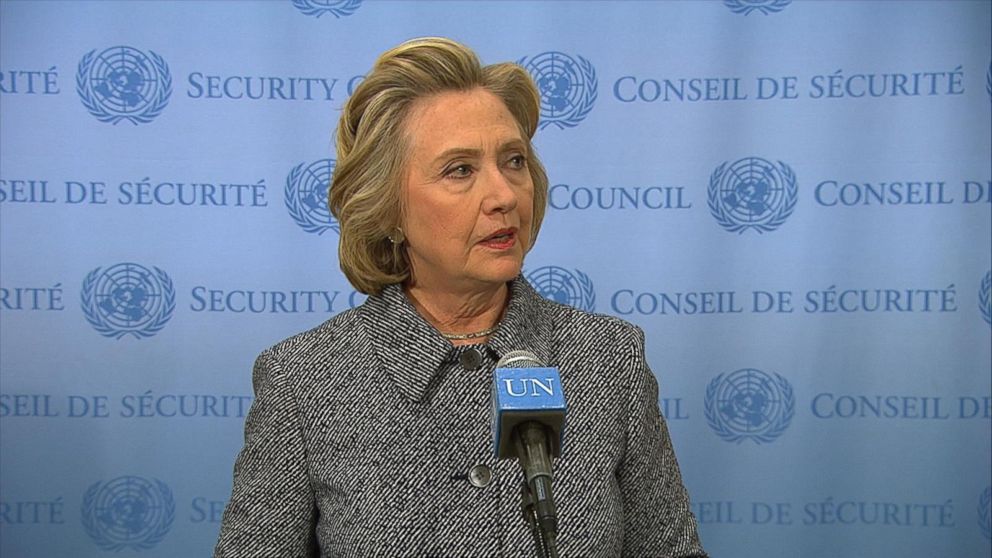
Hillary Clinton discussing her email server, March 2015
(photo: ABC News)
Psst, Hillary. No one cares about your 60,000 emails. They only care that you opted to delete half of them.
The simple way of being transparent is by being transparent. The best way to show that you have something to hide is by not only hiding information, but by deleting and destroying it. Mission accomplished.
As New York Times columnist Maureen Dowd wrote on February 14, 2016, young people do not connect with Hillary, because “she’s coming up drastically short on trustworthiness.”
Transparency When Things Go Bad
Airplanes have flight recorders known as “black boxes” which capture flight details and conversations in the cockpit. This data is useful should there ever be an accident, so investigators can uncover what transpired to cause the incident. Should the plane land safely, the data on the recorders can be erased and reused for the next flight.
Pilots are not allowed to tamper with those flight recorders. Should an accident occur, a pilot would be unauthorized to retrieve the black box and remove or tamper with any information.
Similarly, if people die from food poisoning in a restaurant, the letter grade on the front window would be immediately ignored. The board of health would demand complete access to the kitchen – whether in an open floor plan or not.
When things are calm, transparency can be overwhelming. When things go bad, transparency is essential.
It would be bad enough if Hillary Clinton ran her own email service and deleted half of the emails – and nothing bad ever happened on her watch. But the killing of Americans in Libya led to investigations of her department. The amount of money that poured into the Clinton Foundation from foreign governments while she was in office led to conflicts of interest every day.
For Hillary to claim that other Secretaries of State may have used private email accounts is a flawed red herring. They did not delete and destroy tens of thousands of emails. They did not have spouses who were taking millions of dollars from foreign governments. They did not have a foreign embassy get overrun.
Hillary Clinton’s email scandal will forever taint her as untrustworthy. Whether she ultimately goes to prison or the White House is uncertain. But the stain on her reputation is permanent and clear.
The only thing that is transparent for Hillary, is her commitment to do anything to get elected.
Related First.One.Through article:
Liar, Liar! Hillary’s Pant Suit’s on Fire!
Liberals’ Biggest Enemies of 2015
J Street’s Select Appreciation of Transparency
Subscribe YouTube channel: FirstOneThrough
Join Facebook group: FirstOne Through Israel Analysis
Nations of the World Are Silent
On October 1, 2015, Israeli Prime Minister Benjamin Netanyahu addressed the United Nations General Assembly in New York. He rebuked the governments in the room for their indifference to Iran’s call for destruction of the Jewish State. He said that “Iran’s rulers promised to destroy my country, murder my people, and the response from this body, the response from nearly every one of the governments represented here has been absolutely nothing. Utter silence. Deafening silence.” He then paused for 45 uncomfortable seconds, so that the people in the room could better understand how Israel is outraged by the lack of condemnation from governments around the world, against the outrageous comments from Iran.
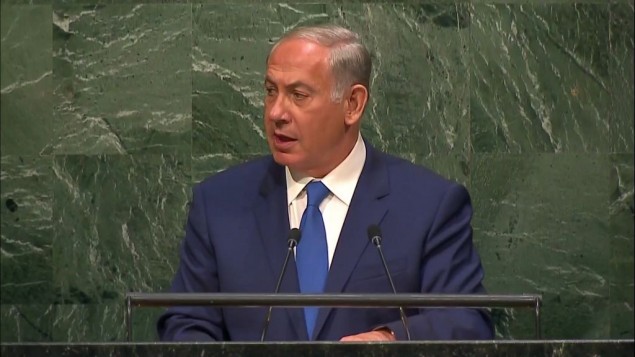
Israeli Prime Minister Benjamin Netanyahu at the United Nations
October 2015
The United Nations is Silent
Time and again, the United Nations itself chose to remain silent when Israeli Jews were deliberately attacked. The UN Media Centre wiped the murder of Jews from its records. The global body refused to call the crimes “terrorism.” The UN ignored deaths within Israel. Overall, the United Nations was silent when Israeli Jews were targeted. Was it because the UN considered Israel itself to be a terrorist state so any deaths were actually Israel’s fault? Perhaps the UN was upset that it voted to create a Jewish State in the first place. Whatever the motivation, the UN remained silent.
The United States is Silent
The United States is home to over 5 million Jews, the largest number of Jews after the State of Israel. For much of Israel’s existence, the United States has been the country’s main ally.
However, under the leadership of President Barack Obama, the United States has softened its support for Israel, such as removing pro-Israel positions in the Democratic platform (the US will never deal with Hamas; future borders of Israel will NOT follow the 1949 Armistice Lines; Palestinian “refugees” would NOT settle in Israel; Jerusalem is the capital of Israel). Still, the US government supported Israel’s right to defend itself, even while the US distanced itself from Israel, by not actively supporting Israel in combatting Palestinian terror.
In January 2016, the US – once again – had the opportunity to address the incessant nihilistic death chants from Palestinian Arabs. Not just the incitement from the acting President of the Palestinian Authority Mahmoud Abbas and others in the PA government, but in established PA laws. The decades-old PA law calls for the death penalty for any Arab that sells land to a Jew. While the New York Times refused to print such basic facts for years, the arrest of radical left-wing “activist” Ezra Nawi put the law in plain public sight for everyone to see: the PA not only demands a Jew-free state (an anti-Semitic demand which Obama supports), but will kill to make sure that such anti-Semitic demands are met.
How did the US respond?

US Ambassador to Israel Dan Shapiro
January 2016
Dan Shapiro, the US Ambassador to Israel spoke at an Israeli conference while Israelis buried a young mother who was stabbed and killed by a Palestinian Arab in an unprovoked attack. During his comments Shapiro attacked the Israeli government’s position of allowing Jews to build and buy homes east of the Green Line (EGL), and stated that that Israel was too lax in prosecuting crimes that Israelis commit against Palestinian Arabs.
Shapiro did not comment on the Palestinian law that calls for the death penalty for Arabs that sell land to Jews. He said nothing about Israel’s arrest of Ezra Nawi who helped the PA catch Palestinian Arabs who sold homes to Jews, for the PA to torture.
When John Kirby of the State Department was asked to comment about Shapiro’s statements, Kirby defended Shapiro as repeating the US’s position on Israeli settlements. He remained mum on Palestinian law that called for the death penalty on those that sell land to Jews.
The United States added a silent echo to the ugly mute chorus. No condemnation for those who call for the destruction of Israel. For the killing of Jews. For the killing of those that work with Jews.
As Simon and Garfunkel sang in 1964 “Silence, like a cancer grows.“
Related First.One.Through articles:
Obama’s Select Religious Compassion
The United Nations and Holy Sites in the Holy Land
International-Domestic Abuse: Obama and Netanyahu
Subscribe YouTube channel: FirstOneThrough
Join Facebook group: FirstOne Through Israel Analysis
President Barack Obama gave his final State of the Union address on January 12, 2016. He gave an outline of a speech in four parts: economic opportunity; technology; a safe America; and politics, as he projected a future world ten-plus years out.

Obama State of the Union Address
January 12, 2016 (photo: M. Scott Mahaskey/POLITICO)
Safe America: Regarding a safe America, Obama continued to limit his global enemies to two parties: al Qaeda and ISIL/ Islamic State. Other countries that shout “Death to America! Death to Israel” like Iran were not labeled enemies that threaten the USA. Obama mentioned Iran just a single time, when he extolled the “principled diplomacy” that “avoided another war.” That may have been true in 2015. But the future in ten-plus years that he facilitated, is a nuclear weapons-armed Iran.
A fanatical, anti-Semitic, America-bashing country with weapons of mass destruction is not a recipe to “keep America safe.” Unless, of course, Obama has banked on Iran limiting its attack only against Israel, as he doubts that Iran would consider attacking the “most powerful nation on Earth.”
Politics of religions: When Obama delved into politics, he not-so-subtly put Donald Trump in his crosshairs as he said “When politicians insult Muslims, when a mosque is vandalized, or a kid bullied, that doesn’t make us safer. That’s not telling it like it is. It’s just wrong. It diminishes us in the eyes of the world. It makes it harder to achieve our goals. And it betrays who we are as a country.”
Obama berated Trump for his comments about Muslims in the past. This time, he extended his comments passed the politics of Trump, to anti-Muslim actions in the United States generally. While he repeated prior statements that anti-Muslim actions betray the values of the United States, he added the dimension that Islamophobia “diminishes us in the eyes of the world.” The two additions are noteworthy.
As detailed in “Ramifications of Ignoring American Antisemitism” an average American Jew is over TWICE as likely to be attacked as either a Muslim or black American. Yet anti-Semitism is never flagged by Obama. That is actually too kind. Anti-Semitic attacks are often whitewashed by the Obama administration, such as his denial that Jews were targeted in Paris in January 2015.
Obama’s SOTU remarks add some color to his blindness. He is concerned that Islamophobia “diminishes us in the eyes of the world.” Not so anti-Semitism.
Anti-Semitism has a long history in the world. Over the past eighteen months it has reared it’s ugly head again in Europe. It is pervasive in the Middle East. As such, flagging anti-Semitism may diminish America’s standing in the world.
There are 1.6 billion Muslims in the world and only 16 million Jews, a 100:1 ratio. Islamophobia upsets at least 1.6 billion people and few seem to notice or care about the more prevalent anti-Semitism. So Obama omitted discussing anti-Semitism and only highlighted the less common attacks on Muslims.
In his seventh year as president of the United States, Obama finally made his views on anti-Semitism a little more clear: Jews and Israel are small sacrifices to ensure a safer America.
Related First.One.Through articles:
Obama’s Select Religious Compassion
Bibi’s Paris Speech in Context
The Democrats’ Slide on Israel
Failures of the Obama Doctrine and the Obama Rationale
Joe Biden Stabs a Finger at Israel
Subscribe YouTube channel: FirstOneThrough
Join Facebook group: FirstOne Through Israel Analysis
On January 12, 2016, The New York Times ran a cover story entitled “Balancing Terror and Reality in the State of the Union Address.” The article conveyed that President Obama will address the threat of terrorism against U.S. interests, even though such threats are actuality relatively minor. As Americans are nervous due to all of the terrorism they see in the world, Obama will discuss an issue he would rather minimize. As such, the guests that will accompany the First Lady to the speech include several people from the military, veterans and a police officer.
The long list of defense personnel guests masks the message of compassion in a veneer of strength. As the White House press release said, “the [invited] guests personify President Obama’s time in office and most importantly, they represent who we are as Americans: inclusive and compassionate, innovative and courageous.” Most of the military guests will be props for Obama to discuss: the fight against homelessness; women’s rights; Islam is a religion of peace; and monitoring the police force.
Obama’s message is that while there is a fight against terrorism, it is a secondary concern. The seven years of his administration were not primarily about keeping the country safe, but moving forward on a progressive agenda.
For example, another guest at the SOTU address was the lead plaintiff for the Supreme Court case that legalized same-sex marriage, Jim Obergefell. He described his fight for equality as “liv[ing] up to the promises to love, honor and protect each other.” The case was decided by the Supreme Court, not the executive branch, but it symbolized a step forward in “inclusiveness and compassion.”
The year 2015 also had lowlights on these exact points of inclusion, compassion and protection.
Protecting Children from Terrorism
On 9/11/2001, 2,753 people in New York City were murdered in acts of terrorism. Over the next fourteen years, the city had numerous failed terrorist attempts (such as the Times Square bomber) which also included “softer” targets. The city therefore placed more security around public schools to protect children.
The largest Jewish population in America is in New York City and the surrounding counties. That religious community suffers from the most persecution, where 57% of all anti-religious crimes were against Jews. As Jewish schools and synagogues were also targeted by terrorists, New York City advanced a bill to provide security to religious private schools.
Leading activists and politicians in the LGBT community were appalled.
LGBT Hate for the Bible and
Children that Learn the Bible
Rosie Mendez, a Manhattan Democrat, lobbied aggressively against providing security guards for Jewish children at private schools. She said: “As a member of the LGBT community, I know that a lot of these schools discriminate against us and if the city is going to provide any kind of funding, the schools should not be discriminatory.”
New York Councilmember Daniel Dromm of Jackson Heights said together with Mendez that “often their [Jewish] leaders embrace homophobia, transphobia, and other horrific ideologies, and subject our young people to them on a daily basis in the classroom. It is our duty to protect LGBTQ students in every school. We must not bankroll hate with tax dollars.”
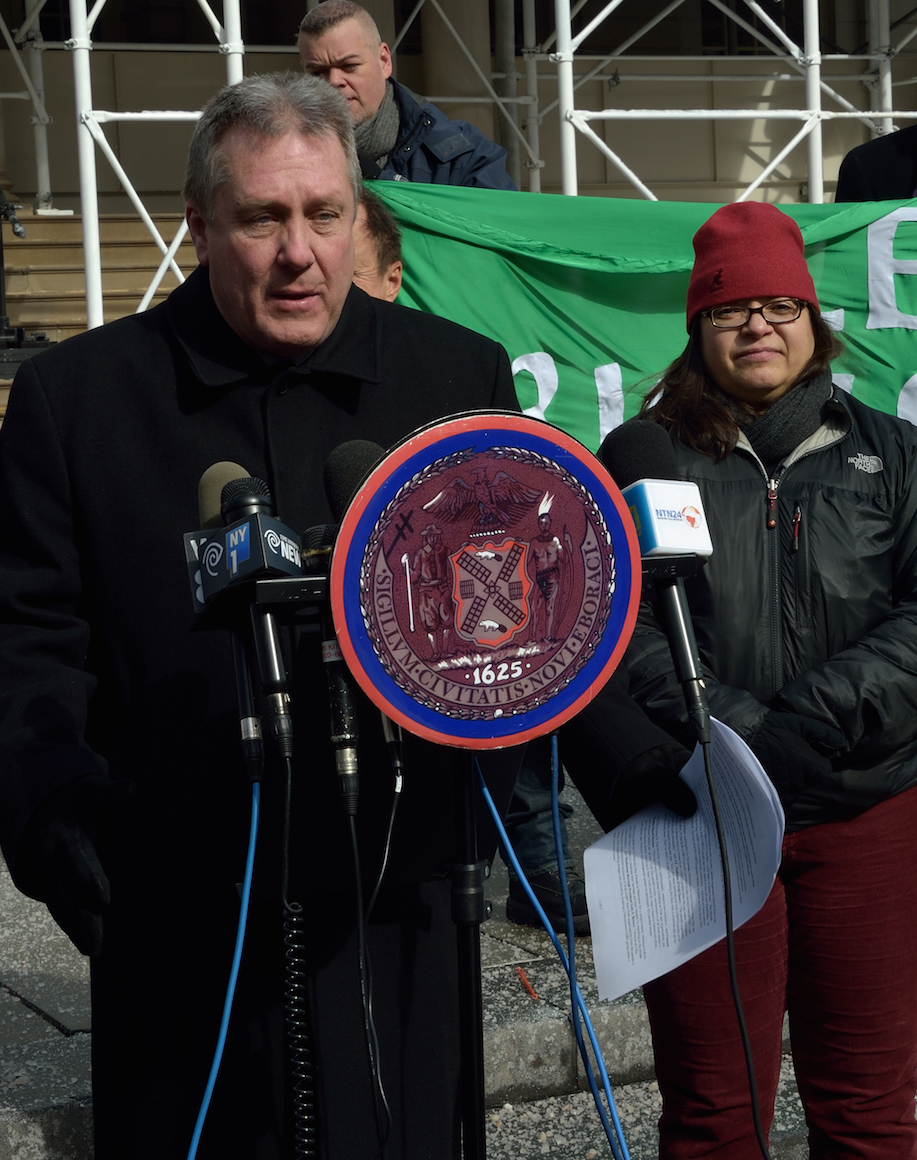
Council Members Danny Dromm and Rosie Mendez (photo: Donna Aceto)
In other words, because the Bible says that male homosexual acts are a sin, and the religious schools teach the Bible, these politicians do not want children in religious schools to be afforded the same police protection that children in public schools receive. Whether the topic of homosexual sex ever comes up in school is irrelevant (the Bible is thousands of pages long and the prohibition against gay sex is a single sentence- do the schools really “subject our young people to [anti-gay rhetoric] on a daily basis?”). The Bible also prohibits eating pig. Should everyone who eats bacon argue that police should not protect any children in a school that teaches the Bible, since they are offended by the Bible’s contents?
What does protecting children from potential terrorism have to do with a school’s curriculum? Would these councilmembers be comfortable if these young children were murdered?
The statements are thinly veiled masks for anti-Semitism.
Dromm and Mendez weren’t alone in attempting to block police protection for religious schools because of their distaste for the Bible.
Allen Roskoff, president of the LGBT Jim Owles Liberal Democratic Club, was strongly opposed to funding police for religious private schools, saying “religious institutions pushing this bill have a long history and present-day reality of discriminating against the gay community. Why should they be able to discriminate on our dime?”
Gay civil libertarian Bill Dobbs said, “religious freedom does not mean socking overburdened taxpayers for special treatment worth hundreds of millions. Religious freedom means don’t disturb religion, it doesn’t mean you throw your wallet their way.”
Note that the bill was not “special treatment” for the religious schools, but one that was drafted to give private school students the same police protection that are given to public school students.
LGBT Hate of “Jewish Money”
Rosie Mendez continued to spew anti-Semitic hatred. She accused New York City Mayor Bill Di Blasio of caving to the security request because “he’s trying to acquiesce to the lobbyists, to the religious community that has been looking for money for their private schools.” She invoked an old anti-Semitic canard that Jews don’t even care about children’s safety- they’re only out for the money.
While Obama reluctantly addresses terrorism during his State of the Union address, he must remember that protecting the people of the United States is the primary responsibility of the government. Not only is freedom of speech and religion protected in the First Amendment, but the physical protection of every individual underscores the entire reason for having governmental institutions.
When Obama joins the LGBT community to celebrate achieving equal rights, they must all remember that inclusion, compassion and protection extends to every single citizen – even Jewish children that learn the Bible.
Related First.One.Through articles:
Ramifications of Ignoring American Antisemitism
Absolute and Relative Ideological Terrorism in the United States
Subscribe YouTube channel: FirstOneThrough
Join Facebook group: FirstOne Through Israel Analysis
Hillary Clinton is no FDR
In October 2015, the Democratic presidential candidates held a debate. The debate moderator quoted a line from Franklin Delano Roosevelt when he ran for president in 1932 “judge me by the enemies I have made,” and asked the candidates to describe enemies they are most proud of. Former Secretary of State Hillary Clinton responded “well, in addition to the NRA, the health insurance companies, the drug companies, the Iranians, probably the Republicans.” This response drew huge applause from both the Democratic audience and the left-wing media.
It was nice of Clinton to mention at least one foreign entity when she recalled her enemies. After all, she was Secretary of State for four years during the War on Terror. However, I guess she felt that she did not do a very good job fighting Al Qaeda, the Taliban, Boko Haram or other radical jihadist groups to mention any of them. She certainly did not want to draw attention to her handling of Libya where she overthrew the government and then let the Islamic State take over the country. Or the way she oversaw leaving Iraq, letting the Islamic State take over that region. Or her refusal to engage in Syria to let Syrian leader Assad kill hundreds of thousands of his own people… and cede some of that country to the Islamic State too.
The radical jihadists probably view Clinton as their best friend.
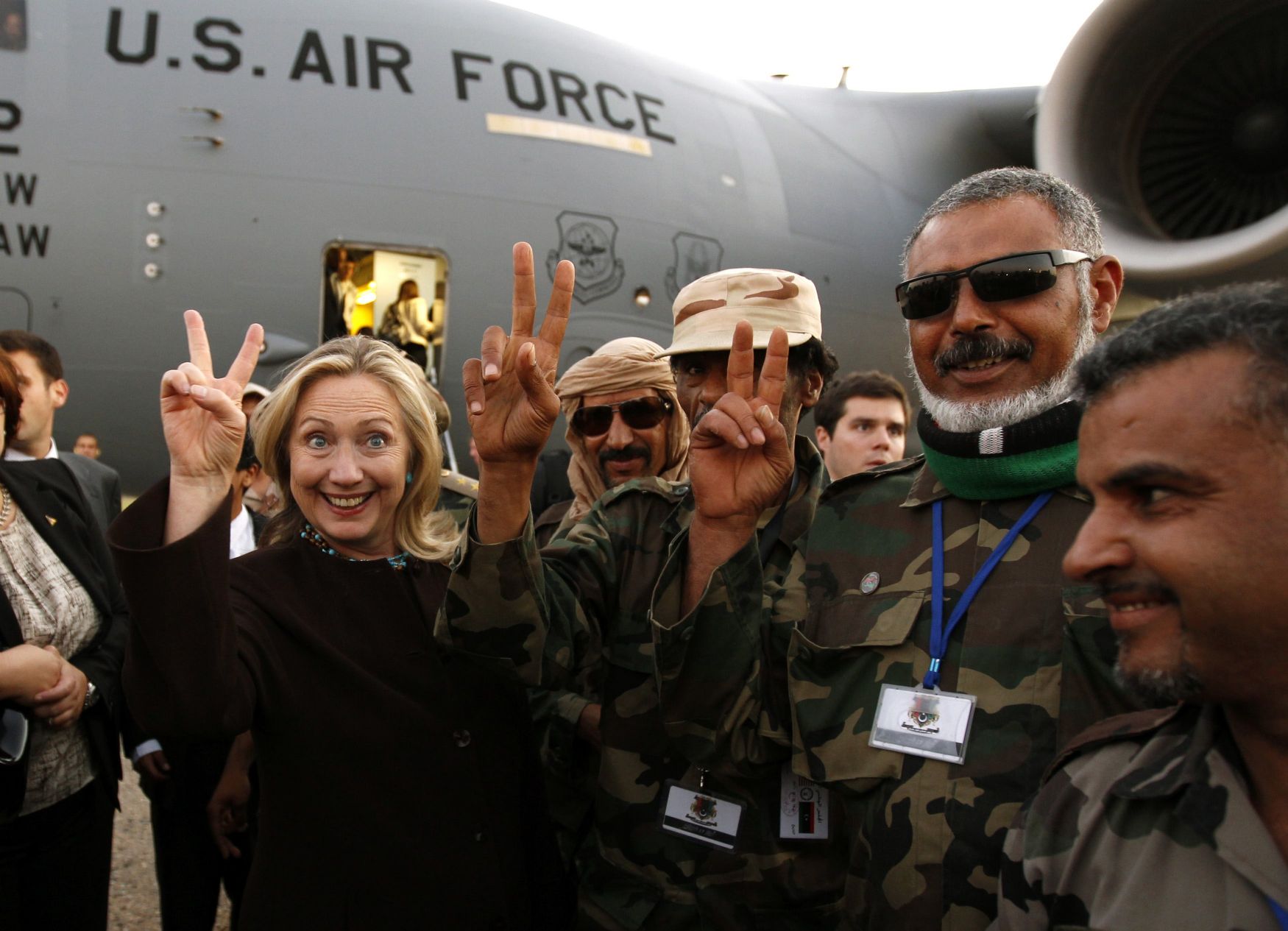
Secretary of State Hillary Clinton with Libyan soldiers declaring victory,
October 2011 (photo: Reuters)
Clinton did not highlight foreign enemies because they got the better of her. The one foreign entity that she mentioned was Iran, where she ultimately supported a deal that left the Iranian nuclear infrastructure intact.
No, Clinton mentioned DOMESTIC enemies. She mentioned the NRA (the National Rifle Association) which fights to protect the second amendment of the Bill of Rights. The right that the NRA defends have arguably much greater standing than Clinton’s favored group, Planned Parenthood (which she loudly defended in her remarks), which performs and advocates for procedures that are not specifically enumerated in the U.S. constitution.
Clinton’s calling out of Republicans as an enemy was also telling. Was she targeting 41% of American citizens, or just the Republicans elected to government office?
In a two-party system such as the United States, the democracy requires each party to exist. The other party is not an enemy which seeks to harm the country that must be vanquished. It is a counter-party with a different set of priorities and/or policies to govern. Each party serves an important and essential role in balancing budgets and laws to avoid a run-away system of governance by executive fiat.
Yet the person with arguably the most experience in government of any of the presidential candidates, believes the worst enemies she has encountered are: a group that tries to defend the U.S. constitution; and either half of the country or the other political party that enables America’s democracy to exist.
Perhaps Clinton should familiarize herself with the rest of FDR’s 1932 speech in which he also said “we are not Democrats, we are not Republicans; we are a people united in a common patriotism…. My friends, my policy is as radical as American liberty. My policy is as radical as the Constitution of the United States.”
Today’s leading liberal put fellow Americans in her crosshairs. Her battle plan is to shape a democracy of her liking, bending to her interpretation of law.
Liberal American Jews’ Number One Enemy is Israel
American Jews tend to vote Democratic in presidential elections, as roughly 70% of Jews are registered Democrats. J Street, a left-wing group did a poll in September 2015 that concluded that 68% of Jews would vote for Hillary Clinton (the 68% figure would actually be the worst showing for a Democrat amongst Jewish voters since Michael Dukakis secured 64% of the Jewish vote in 1988).
Regarding the U.S.A., many liberal Jews focus their efforts on attacking conservative American policies. When it comes to Israel, liberal Jews are twice as likely as conservative Jews to berate the Jewish State.
In October 2013, the Pew Research Center conducted a poll with the following findings:
J Street pushed very aggressively against the current Israeli government run by Likud’s Benjamin Netanyahu as detailed in “The Fault in our Tent: The Limit of Acceptable Speech” including advocating that the U.S. government should vote against Israel at the UN Security Council.
Like J Street, the left-wing Israeli newspaper Haaretz held a conference in the United States in 2015, along with the liberal group the New Israel Fund, NIF. The HaaretzQ conference included peculiar (alarming?) demonstrations of removing the Israeli flag from the stage as it offended some speakers, and a Haaretz columnist describing Jews who move to Israel as committing a “crime”, as Jewish Aliyah should be illegal. That line received wide applause from the liberal crowd.

Palestinian Authority member, Saeb Erekat, at the Haaretz and New Israel Fund conference in NYC, on December 13, 2015. (Photo by Amir Levy/Flash90)
Another left-wing group, Jewish Voice for Peace, JVP, claims to advocate for “social justice, equality, human rights, respect for international law, and a U.S. foreign policy based on these ideals.” The group’s interpretation of their mission is that Israel, by its very nature as a Jewish State, cannot meet these ideals, so their mission is to push the U.S. to dismantle the Zionist project. JVP’s 2015 conference loudly supported the BDS, Boycott, Divestment and Sanctions movement of Israel.
Even the president of the Shalom Hartman Institute of North America, a less radical liberal Jewish group, described a handful of Jews living in Hebron in just 3% of the city as a “self-imposed existential threat” to the country.
Liberals have become convinced that most Jews and the Jewish State are the enemies of peace. It’s a line familiar to anyone that has read the Hamas Charter.
Recently, liberal groups have focused their attention on checking off each of Natan Sharansky’s “3 D Test” of anti-Semitism: demonization; double standards; and delegitimization.
Jewish liberals think like Hillary Clinton: the enemy is from within, and must be stopped by all measures possible.
Conclusion
Tuvia Tenenbom wrote a book in 2015 called “Catch the Jew!” where he assumed a Sacha Baron Cohen/Ali G/ Borat kind of persona in Israel and the West Bank. At times he pretended to be Jewish, Christian or Muslim, and sometimes German or Israeli. He was a “Master Agent” and donned whatever role would get people to open-up and speak freely about their thoughts about Israel, Palestine, Jews and Arabs.
Tenenbom’s book spared no one. He saw racism and petty-mindedness in every corner of the Holy Land. The food and land received the accolades, while the residents of the land and consumers of the food were roundly criticized.
However, Tenenbom’s conclusion broke the region into shades of black: while he cringed at Jewish and Arab racism, he at least understood it. There’s a selfish motivation to wanting an Arab-free or Jew-free country. However, he viewed the liberal Europeans who fund NGO’s to “Catch the Jew” as a more vile form of racism, a deeper shade of black. How racist can one be to travel over a thousand miles to criticize Jews?
But the darkest shade of black, the worst kind of person to Tenenbom, were the self-haters. Groups like Rabbis for Human Rights and individuals like Haaretz journalist Gideon Levy were skewered the most. Tenenbom concluded that Germans do not have to openly be anti-Semitic anymore; they can just fund self-hating Jews and let them destroy Israel by themselves:
“If logic is any guide, Israel will not survive. Besieged by hate from without and from within, no land can survive for very long.”
Liberals often laugh at conservative Americans who proudly wave their flag. I used to think it was because liberals thought conservative Americans to be primitives who “cling to religion and guns” as Senator Barack Obama said when he ran for office in 2008. However, in 2015, it became clear that liberals do not look down in a condescending manner at fellow countrymen, but stare across their neighbor’s yard through a rifle scope.
In 2015, liberals declared that the enemy is from within. What battles will that bring in 2016?
Related First.One.Through articles:
A Disservice to Jewish Community
The Democrats’ Slide on Israel
Joe Biden Stabs a Finger at Israel
Parallel and Perpendicular Views of Iranian Nuclear Deal
Rick Jacobs’ Particular Reform Judaism
Subscribe YouTube channel: FirstOneThrough
Join Facebook group: FirstOne Through Israel Analysis

Full page NIF ad in The Jewish Week, November 20, 2015
claiming those opposed to NIF have an “ultranationalist agenda” and implying
that Israel without NIF intervention would be an illiberal, racist country
In December 2015, Republican presidential candidate Donald J. Trump announced his intention to impose a ban on all Muslims coming into the United States in response to various terrorist attacks done by militant radical jihadists. The question of whether such an action could be legally and practically enforced made historians look back to the treatment of Americans of Japanese descent during World War II. However, there is a better reference point for singling out a religious group, which happened 153 years ago this week.
General Grant Expelled the Jews
In the heat of the American Civil War, Major General Ulysses S. Grant was eager to establish military advantage. One of the ways he sought to accomplish this task was to curtail illegal smuggling of cotton and other goods out of the South which helped finance the Confederate’s war efforts. One group that Grant saw as being particularly involved in the trade was the Jews.
As such, on December 17, 1862 Union General U. S. Grant issued General Order No. 11 which stated:
“The Jews, as a class violating every regulation of trade established by the Treasury Department and also department orders, are hereby expelled from the Department [of the Tennessee] within twenty-four hours from the receipt of this order.
Post commanders will see to it that all of this class of people be furnished passes and required to leave, and any one returning after such notification will be arrested and held in confinement until an opportunity occurs of sending them out as prisoners, unless furnished with permit from headquarters.
No passes will be given these people to visit headquarters for the purpose of making personal application of trade permits.
By order of Maj. Gen. U. S. Grant”
As clearly spelled out, the order singled out one minority group – in its entirety – to be expelled from their homes within Grant’s territory (western Tennessee, Kentucky and Mississippi). This order continues to stand as the most anti-Semitic act by the US government to this day.
Jonathan D. Sarna’s book on Grant Expelling Jews in the Civil War
The Objection
As detailed in Jonathan D. Sarna’s book “When General Grant Expelled the Jews,” there were many objections to Order No. 11 at the time:
President Lincoln thought the order was inappropriate and countered the order. Lincoln commanded his general chief of the army, Henry Halleck, to revoke the order on January 4, 1863. Halleck wrote a letter to Grant which stated:
“It may be proper to give you some explanation of the revocation of your order expelling Jews from your department. The President has no objection to your expelling traitors and Jew peddlers, which, I suppose, was the object of your order; but, as it in terms proscribed an entire religious class, some of whom are fighting in our ranks, the President deemed it necessary to revoke it.”
Grant, who was later to become president of the United States, deeply regretted his Order No. 11 later in life, according to Sarna. He created a cabinet that included more Jews than any previous administration. When he was asked in 1875 why he issued such a bigoted order, he simply replied that in wartime “nice distinctions were disregarded. We had no time to handle things with kid gloves.”
Which has a similar ring to some calls against Muslims in America today.
Muslims in America Today
On December 8, 2015, the Wall Street Journal led with an editorial “The Obama-Trump Dialectic” which blamed the rise of Donald J. Trump’s illiberal suggestions of how to treat Muslims on the failures of Obama to confront militant radical jihadists.
The Obama failures regarding calling out and responding to radical Islam are plentiful, but beyond the scope of this article. The question is Trump’s desire to treat “an entire religious class” (to use the Lincoln-Grant phraseology) as a single unit.
Trump had two principle ideas of handling Muslims as of December 2015:
Each of Trump’s ideas treats all Muslims as a distinct minority subject to rules that do not apply to any other people. The distinction is based on religion, as was the case for Jews in 1862, which was objectionable to President Lincoln.
1. Immigrants: The first idea relates to incoming immigrants, not US Muslim citizens. As such, while objectionable in principle, it is different than applying discriminatory laws against US citizens who have broad protections under the law. Trump’s arguments for foreign Muslims today are different than for Jews in 1862, as they also are in comparing Jewish immigrants fleeing Europe in the 1930s and 1940s:
Regarding Muslim immigration, Obama’s failures to call out Islamic terrorism is magnified by his refusal to take a strong stand on border control, according to Republicans and the WSJ. Trump said that the ban would only be temporary until the government better understands the situation.
As detailed in “A Logical Approach to Immigration from Personal History,” there is a successful history of the US processing immigrants fleeing persecution to make sure that proper vetting takes place. It would NOT ban all Muslims, but instead require them to first be situated out of harm’s way in a displaced person’s camp, say in Jordan, at which point vetting would occur. Women and children would be permitted into the US first, followed by men at some point in the future.
Most significantly, not every situation is the same. Muslims in Myanmar are different than Sunnis and Shiites from the Middle East. Each may or may not have valid reasons to seek asylum in the USA.
Trump’s call for an edict against “Muslims as a class” regarding immigration recalls Grant’s comment during wartime that “nice distinctions were disregarded. We had no time to handle things with kid gloves.” But today, there is time to manage a logical vetting process – which is more robust than put forward by President Obama.
2. Muslim Citizens. While non-American Muslims are not afforded protection of US laws (but only those that relate to immigration policies), American Muslims are full citizens with full rights and protections. They account for 0.9% of the US population. While some may have committed terrorist acts, the vast majority have not. Further, there is no indication that there is a widespread plot to harm America or American interests.
Like the Jews in 1862, there is no basis of treating all co-religionists as a single “class,” while the treatment of the Jews was punitive, and the Trump suggestion for Muslims would just be placing the group under surveillance.
The US government just ended its vast metadata collection program. That database was on all Americans that helped to track connections between potential terrorists. Republican presidential candidate Chris Christie stated that ending that program was a big mistake, as using data collection and analytical tools helped locate would-be terrorists and keeps Americans safe.
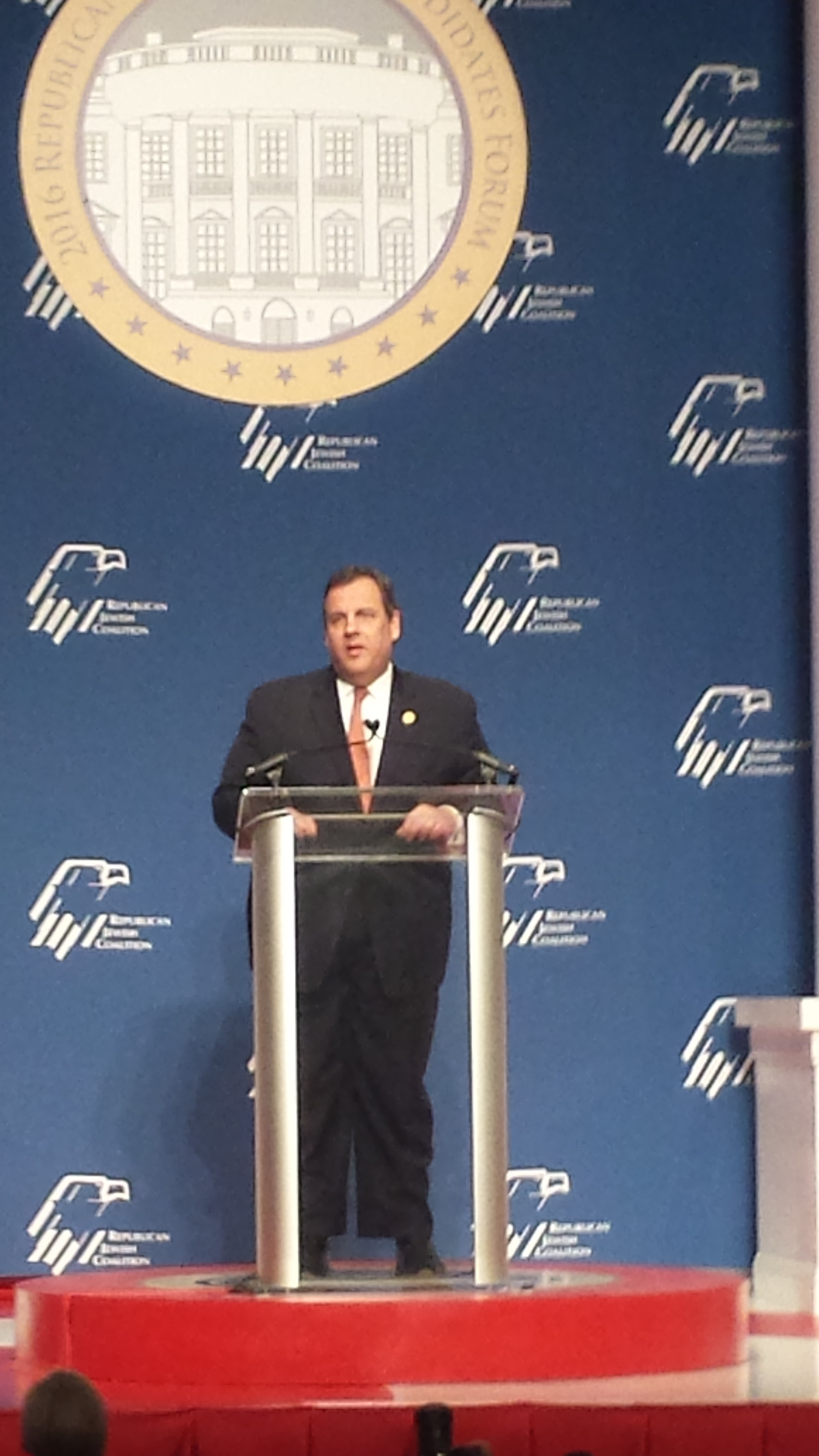
NJ Governor Chris Christie addressing the Republican Jewish Coalition
in Washington, D.C., December 2015
(photo: First.One.Through)
A new modified approach of data collection in which people who make calls to, or visit war zones, such as Iraq and Syria, would be tracked may be an appropriate next step. That would be more logical and fair and not treat all Muslims “as a class” simply for their religious beliefs, but based on actions. An action-based monitoring system and database would capture information on Muslims and non-Muslims alike.
Conclusion
On December 10, 2015, the liberal newspaper The New York Times led with an editorial “The Trump Effect, and How it Spreads” which blamed the entire Republican party as being a bunch of racists. As opposed to the Wall Street Journal editorial two days prior, it did not place any blame for the popularity of Trump’s positions on the many failures of the Obama administration.
While liberals and conservatives would both agree that a government’s primary concern is for the safety of its citizens, it does so within the framework of laws. America has laws requiring the separation of church-and-state and also does not have a class-based entrenched society. The foundation documents of the country are that “all men are created equal“, and they should be treated equally under the law.
General Grant made an anti-Semitic order during the Civil War, but society was fortunate to have Abraham Lincoln who realized the deep inherent flaw of punishing an entire group of people. In the middle of that episode, Lincoln made the Emancipation Proclamation on January 1, 1863, which freed the slaves. Lincoln understood that if all men are to be equal, it must include every minority – blacks or Jews.
General Grant had Lincoln to keep his anti-Semitic edict in check, and Grant ultimately proved to be a good friend of the Jews. His Order No. 11 was issued in the fervent hope of winning the war and protecting the Union.
Donald Trump has no power today so his words can best be kept in check by public voices, and ultimately the public vote. Both Republicans and Democrats have spoken out against his suggestions as being un-American. Indeed they are.
However, just as Grant was acting out of the interest of protecting America (with a very bad idea), it did not mark him as a permanent anti-Semite. It is similarly possible that a President Trump would place many Muslims on his cabinet.
Trump’s calls to treat Muslims “as a class” is wrong and racist. However, it does not mean that he will ultimately harbor anti-Muslim animus, just as Grant reformed in a time of peace. The NY Times suggestion that all of the Republican candidates are racists is as narrow-minded and bigoted as Trump’s declaration. However, it is more unlikely that the Times changes its biased viewpoints, than Trump modifying his.
Related First.One.Through articles:
The Gap between Fairness and Safety: WMDs in Iraq and Iran
Not Seeing the Eiffel Tower for the Girders
Subscribe YouTube channel: FirstOneThrough
Join Facebook group: FirstOne Through Israel Analysis
On December 3, 2015, the fourteen Republican presidential candidates lined up to speak to the Republican Jewish Coalition in Washington, DC. Almost all of them offered “red meat” to the crowd, denouncing the terrible foreign policies of current President Barack Obama with the assistance of his Secretaries of State, Hillary Clinton and John Kerry.
One of the foreign policy points that they discussed was the status of Jerusalem.
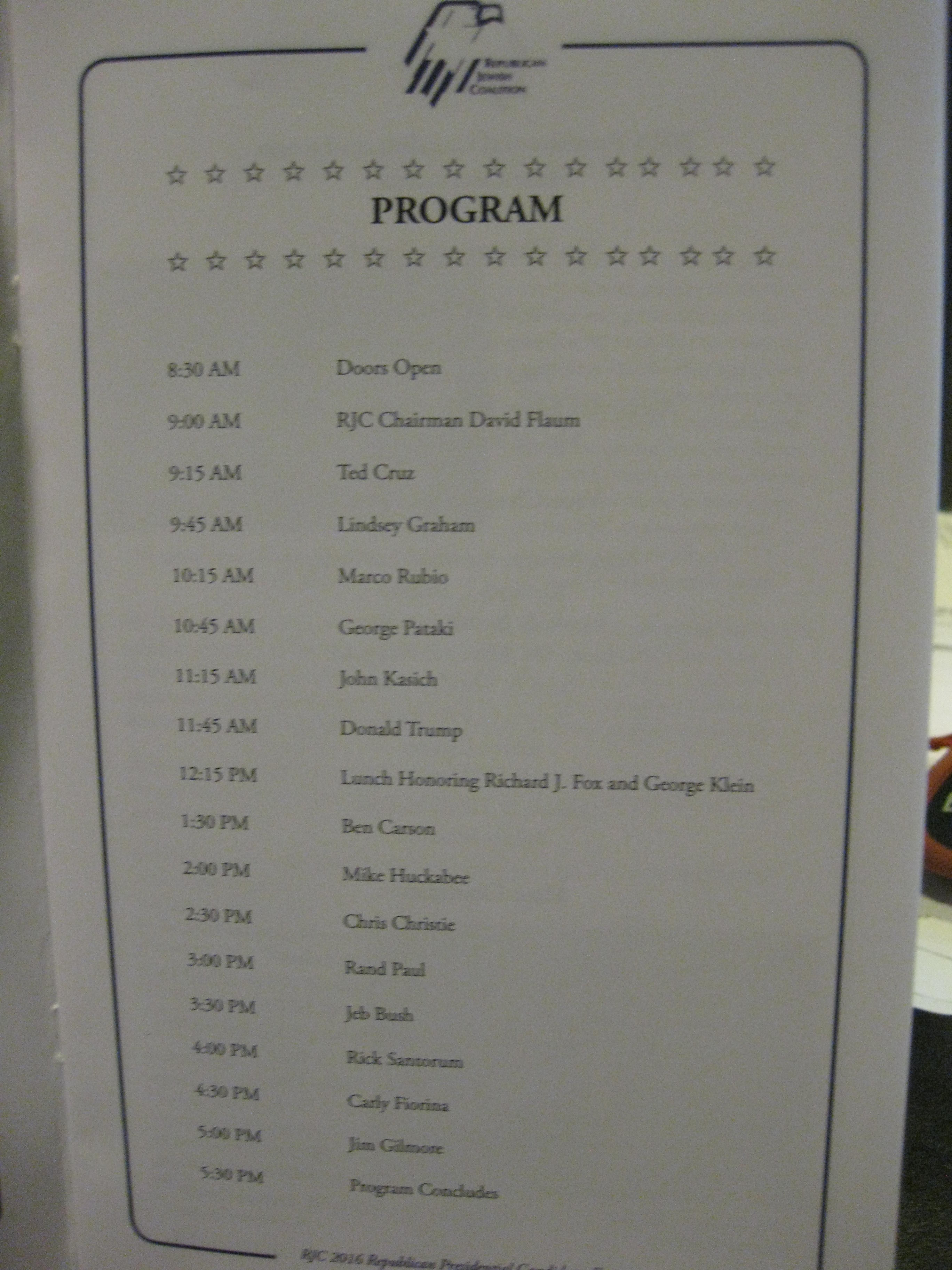
Program line-up of speakers at the RJC 2016 Republican Presidential Candidates Forum in Washington, D.C. December 3, 2015
(photo: FirstOneThrough)
Jerusalem is often mentioned during campaign season by both Democrats and Republicans. The two main talking points are:
As a presidential candidate, Senator Obama made these same comments in front of a crowd at an AIPAC conference in 2008, only to reverse his comments the next day. By the time he ran for re-election in 2012, he gutted the entire pro-Israel agenda from the Democratic platform. In seven years in office, his two comments proved meaningless.
At the 2015 RJC event, almost all of the Republican candidates mentioned Jerusalem in prepared remarks, while some repeated the two policy points above when responding to questions from RJC Executive Director Matt Brooks. Except for Donald Trump.

Senator Marco Rubio addressing foreign policy issues to the RJC
(photo: FirstOneThrough)
Trump, seemingly ever-desirous of inflaming passions, refused to give the crowd the same responses that all of the other candidates proffered. For that he was booed by the crowd, which, not surprisingly (based on his campaign to-date), did not seem to bother the candidate that much.

Donald Trump addressing his deal bona fides to the RJC
(photo: FirstOneThrough)
Campaign Promises versus Delivery of Actions
Presidential candidates always throw out promises to potential voters and donors. The fact that candidates from both parties state positions popular with an audience is as natural to the political process as lying is to politicians.
So reporters take note of the arrogant presidential front-runner who prides himself in “telling it like it is.”
As no president ever moved the US embassy to Jerusalem despite promises to pro-Israel groups during campaign season, is Trump just “telling it like it is?” Or is it simply his abrasive personality that cannot help upsetting audiences, whether they be black, Hispanic or Jewish?
There is more than that to extract from Trump’s comments. At the RJC, he quipped to the Jewish crowd “I’m a negotiator like you folks…Is there anyone in this room who doesn’t negotiate deals? Probably more than any room I’ve ever spoken.”
Putting aside Trump’s anti-Semitic stereotypes in a room that included many doctors and people outside of the business world, it underscored the entire Trump campaign: vote for me, since I’m a successful negotiator. Being the president of the United States is really just about negotiating deals – whether with Iran or Congress. As such, I like to leave my options open, and be unpredictable. That’s what makes me a great negotiator. Don’t pin me down in advance about what I will do, as it hurts the ultimate outcome.
Trump has approached every campaign opportunity with a simple tagline: Trust Me. I’m a Billionaire. I do Great Deals.
However, Trump failed to internalize in his address to “fellow negotiators,” that Israel just doesn’t want a peace deal, it wants actual long-term peace.
A Peace Deal versus Long-Term Peace
A deal comes about when two sides agree on terms. Typically, each side gives a little to arrive at a compromise. In a situation where the two parties do not have the same power or requirement to consummate a deal, the exchange will not be a 50-50 compromise. The party with greater leverage typically uses that leverage to extract better terms. The party that is more desperate for a deal, usually caves on key items.
In Trump’s world of deals, he sees a more powerful Israel and a more desperate Palestinian population. As such, he is confident that he can deliver a “good deal” to the Israelis, even while he won’t promise any particular move in advance regarding Jerusalem.
The crowd at the RJC does know some things about negotiating deals. One of the key requirements is having a real negotiating partner. Not just a counter-party, who, as Senator Rubio stated, “acknowledges Israel’s right to exist,” but can actually deliver a deal. Part of the crowd’s disappointment with the Obama administration is its continued hypocrisy of forcing Israel to negotiate with a straw man with no authority or power in acting PA President Mahmoud Abbas.
Further, as analyzed in detail, in The Arguments for Jerusalem, there is virtually no argument to support Palestinians’ claim for part of Jerusalem, other than sheer desire. Part of securing long-term peace means securing Jerusalem.
Lastly, Israel feels alone and vulnerable. The various anti-Israel United Nations resolutions and BDS (boycott, divestment and sanctions) proposals around the world feed the feeling of Israel’s isolation. The Iranian deal produced by the Obama administration instilled tremendous fear of an existential threat to both the Jewish state and the Jewish people. The terror attacks by Palestinian Arabs and anti-Semitic vitriol from the Palestinian leadership make Israel feel that there will never be peace.
Trump understood that the RJC reflects a powerful group that is strongly supportive an increasingly powerful Jewish State. But he failed to understand that the Jews in that room included Holocaust survivors and people who walked away from the Twin Towers on 9/11. Those people are not just looking for a “good deal.” They want support and true long-term peace.
It was not only Trump’s refusal to mention the Jerusalem points above that got him booed. Trump’s focus on the “Art of the Deal” instead of understanding that a peace deal is not the same things as true long-term peace will make him an increasingly difficult choice for Israel supporters.
Related First.One.Through articles:
The Israeli Peace Process versus the Palestinian Divorce Proceedings
Seeing Security through a Screen
Palestinians are “Desperate” for…
Israel was never a British Colony; Judea and Samaria are not Israeli Colonies
Subscribe YouTube channel: FirstOneThrough
Join Facebook group: FirstOne Through Israel Analysis
President Barack Obama and various religious groups stated their strong support for bringing fleeing Syrian refugees into the United States in the fall of 2015. In their effort to convince other Americans of the justice of bringing in those fleeing wars in the Middle East, they drew an analogy to the Holocaust and the ship the MS St. Louis which was turned away from Cuba, the United States and Canada and sent back to Europe, where the Jewish passengers perished in concentration camps.
For their part, various Republicans stated their opposition to admitting so many refugees at this time due to security concerns. They dismissed the analogy to the Holocaust for multiple reasons including the principal facts that in the past there was no terrorism going on in the United States, and the Jews in Europe were ordinary civilians not bearing any arms or involved in any fights.

Syrian refugees arrive on the Greek island of Kos
August 2015 (photo: Yannis Behrakis/Reuters)
There is room for an honest conversation and approach. Here, I lay out my family’s path to America and lessons that could be applied to refugees today.
Coming Alone
My paternal great-grandfather came to the USA from Russia in 1904. He fled the various pogroms that were going on in Russia over many years, including the significant Kishinev Pogrom in 1903. He set out for America alone via Great Britain. Once he established himself in New York City, he sent for his wife and two children to join him in their new home nine months later.
Many other Jews were leaving Russia during those years for the United States. The USA was also admitting many Irish, British, Scandinavians, Italians, Hungarians, Germans and Austrians at the same time. Each group spoke a different language and they all needed to adopt to the common language and culture of America.
And they did.
Fleeing en Masse
My maternal grandmother fled Austria with her immediate family after Kristallnacht in December 1938. They were part of an enormous wave of Jews fleeing Europe in those months before the start of World War II.
The whole family fled at one time. Before coming to the US, they were sent to Cuba where they were vetted and processed. My grandmother and her two children were allowed to travel to New York three months after their arrival, however, her husband was not permitted to join them right away. My grandfather waited in Cuba for over a year while the US vetted his background, and protected the jobs and security of Americans by slowly introducing thousands of men.
He waited in Cuba with hundreds of other men in the same predicament.
Lessons for Today
When my paternal great-grandfather came to America in 1904, he was part of a wave of immigrants coming to the US for a variety of reasons from a variety of countries. Over five decades (1880-1930), the US more than doubled its population (from 50 million to 123 million), while the percent of foreign-born people in the country grew to a high of 15 percent.
The situation today is different:
The US should indeed consider the history of Jews fleeing Europe before WWII, but appreciate the differences when it is now considering the admittance of refugees from Syria, Afghanistan and Iraq.
The current refugees are using the methodology of my paternal great-grandfather and sending men before the rest of the families. According to the UNHCR, 62% of current immigrants in the Mediterranean area are men. They are fleeing into Turkey and then quickly spreading throughout Europe. That is a bad and potentially dangerous situation and the US should pivot to a more logical approach:
Most men are not terrorists and most Muslims are not terrorists. But the majority of people attacking the US and its allies are Muslim men. Proper time and attention is needed to protect people.
Jews from Europe in the 1930s went through a long process of coming to America. The lesson of WWII is not simply to not turn back refugees to the place where they are fleeing like America did with the MS St. Louis. It is also to use a system to effectively admit refugees.
All governments must take appropriate steps to ensure the safety of its citizens as it welcomes new immigrants. It is shameful that there is finger-pointing and name-calling from both Democratic and Republican parties as the country attempts to welcome those fleeing war and prosecute those seeking war.
We should incorporate the best suggestions of both parties to help the refugees while placing priority on protecting Americans.
Related First.One.Through articles
The Explosion of Immigrants in the United States
Help Refugees: Shut the UNRWA, Fund the UNHCR
Subscribe YouTube channel: FirstOneThrough
Join Facebook group: FirstOne Through Israel Analysis
In November 2015, right after terrorists attacked Paris, France again, US Secretary of State John Kerry spoke of the logic of Islamic terrorists killing the people at the satirical magazine Charlie Hebdo in January:
“There’s something different about what happened from Charlie Hebdo, and I think everybody would feel that. There was a sort of particularized focus and perhaps even a legitimacy in terms of – not a legitimacy, but a rationale that you could attach yourself to somehow and say, okay, they’re really angry because of this and that.”
The statement highlighted many flaws in Kerry’s worldview:

Part of the Eiffel Tower
(photo: First.One.Through)
As detailed in “I’m Offended, You’re Dead,” a narrow focus on blasphemy misses the bigger agenda of radical Islam. Refusing to listen to terrorist groups’ own words and charters in which they call for the killing of infidels and destruction of countries is a blindness that simply is unacceptable in the Secretary of State of the most powerful country on earth.
Kerry and the Obama administration’s hyper-narrow focus on these so-called “legitimate grievances” led them to explore ways of trying to placate terrorists:
Is the failure of the US administration’s foreign policies due to blindness from narrow-focus, open-mindedness that the jihadists have “legitimate grievances,” or just bad policies and/or implementation of those strategies?
What do you think?
Related First.One.Through articles:
Failures of the Obama Doctrine and the Obama Rationale
Obama supports Anti-Semitic Palestinian Agenda of Jew-Free State
Subscribe YouTube channel: FirstOneThrough
Join Facebook group: FirstOne Through Israel Analysis


 First One Through