Jews “In Any Part Of Palestine”

On February 18, 1947, senior members of the British Kingdom’s government assembled to discuss the Palestine Mandate. By this point, the British had already separated the area east of the Jordan River and handed it to the small Hashemite tribe who created the Kingdom of Trans-Jordan. The people assembled at this meeting were at an impasse of how to handle the remaining portion of Palestine in regards to the roughly 1,200,000 Arabs and 600,000 Jews.

It is worth reading the discussion in full, but I will only highlight a few points here.

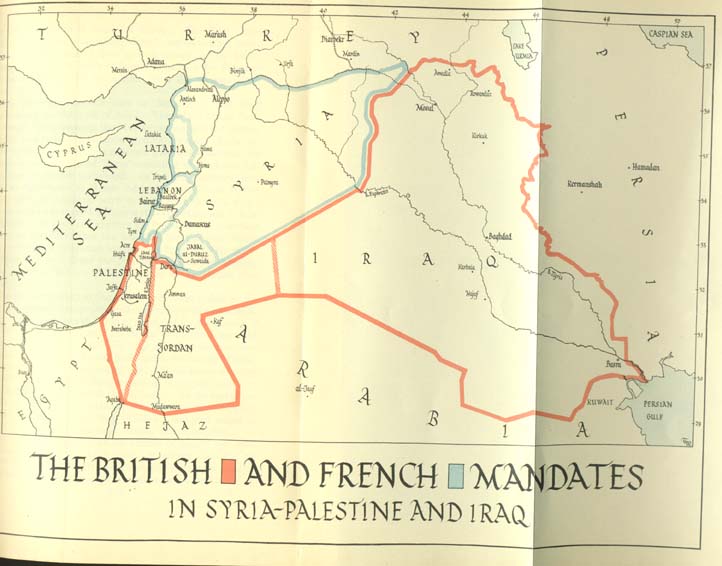
By way of background, the British had assumed the Palestine Mandate as well as for Iraq in 1922, while France had mandates for Syria and Lebanon. Due to Arab revolts in Palestine which started in 1936, the British – contrary to their mandate – limited Jewish immigration to Palestine to only 75,000 during the European Holocaust; they placed no limits on Arab migration into Palestine, allowing the Arab population to grow rapidly (more than doubling from 1918, whereas Syria only grew by 50% over the period).

An interesting observation is that the word “Palestinian” appears nowhere in the discussion, as the current notion that it only means Arabs would not be concocted for decades. At this point in time, the idea of a possible “Palestinian State” would incorporate both Palestinian Arabs and Palestinian Jews, a term without meaning today.

Secretary of State for Foreign Affairs, Ernest Bevin (1881-1951) led the discussion about the difficulty squaring the demands of both the Arabs and Jews. He was against the establishment of a Jewish State and even sent the Jewish refugee ship Exodus back to Germany. He had mocked the United States proposal to allow 100,000 Jews into Palestine immediately “because they do not want too many of them [Jews] in New York.” As a member of Winston Churchill’s war cabinet, he had prioritized friendly relations with the Arab world and with Muslims worldwide, as the UK still controlled India.

In discussing the desire of the local Arab population in Palestine, Bevin said that the Arabs were “unwilling to contemplate further Jewish immigration into Palestine,” even when survivors of the European Holocaust were desperate to come to the Jewish homeland. He added that the Arabs “are equally opposed to the creation of a Jewish State in any part of Palestine.

Bevin would go on to state the position of Zionists who wanted an independent state, in line with the mandate which called for Jews “reconstituting their national home in that country.”

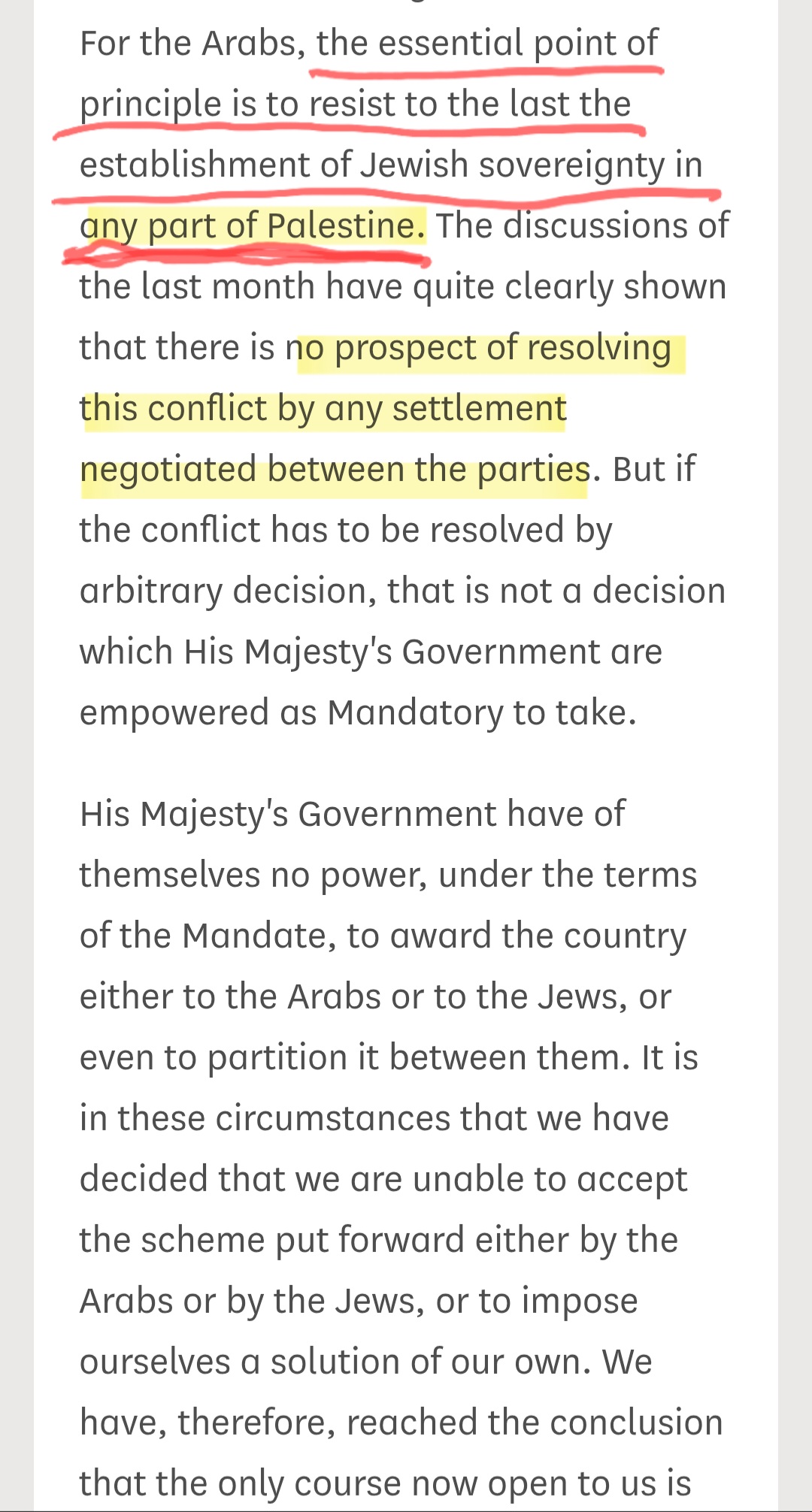
Again, he made the position clear that “for the Arabs, the essential point of principle is to resist to the last the establishment of Jewish sovereignty in any part of Palestine.” He saw “no prospect of resolving this conflict by [negotiated] settlement,” consequentially leading to persistent violence. The competing demands of the Arabs and Jews made the situation “irreconcilable.”

Remarks by FM Ernest Bevin on February 18, 1947 about the Palestine Mandate

Willie Gallacher (1881-1965), a communist who had opposed Britain’s involvement in WWII asked during the back-and-forth whether the UK’s “Balfour Declaration is recognised to be utterly unrealistic,” giving priority to Arab claims. He failed to comprehend that the declaration served as the very basis for which Britain had been handed the mandate for Palestine. The members therefore concluded that the matter should go to the United Nations General Assembly to decide how to reconcile the irreconcilable.

The discussion proved prophetic. Even today (“to the last”), the majority of the Stateless Arabs from Palestine (SAPs) refuse to accept a Jewish State “in any part of Palestine.” They continue to fight it by any means at their disposal, including war, terrorism and boycotts. Their actions do not only make life difficult for Jews in Israel but for Americans. The US embassy in Israel issued “travel advisories” suggesting people reconsider travel to Israel and the West Bank and to not go to Gaza because of the activities of various Palestinian Arab terrorist groups.

The SAPs are fighting Jews on two fronts, via the Palestinian Authority (PA) and Hamas. The PA is fighting for a Palestinian State without a single Jew living in it. It has the United Nations endorsement, with the passing of UN Security Council Resolution 2334 in December 2016. Hamas and other terrorist groups are fighting to ensure no Jewish State exists “in any part of Palestine.”

Other jihadists – countries and groups – also rallied to fight a Jewish State “in any part of Palestine.” From 1948 to the 1970s, the Arab world routed 850,000 Jews from their nations. Most still refuse to recognize Israel. Many boycott Israel and do not allow Israelis to enter their country. Islamic countries which are not Arab – foremost Iran and Turkey – actively support Hamas. Turkish President Recep Erdogan said right after the October 7 massacre that “Hamas is not a terrorist organization, it is a liberation group, ‘mujahideen’ waging a battle to protect its lands and people.”

Jihadi groups like al Qaeda rally radical Muslims to attack “Americans and Jews” around the world because of Israel, and attack tourists and fellow Muslims in Egypt and Jordan because those countries struck peace agreements with the Jewish State. The presence of Jewish sovereignty in Palestine has generated a call to history of 1,000 years ago, with the “World Islamic Front for the Jihad Against Jews and Crusaders.

The conflict is cast in western circles as a local conflict over land between Jews and Arabs which can find compromise, but radical Islamists see it as a global religious matter between Muslims and Jews. The violent extremists cannot accept Jewish sovereignty “in any part of Palestine” as an “essential point of principle.” Current efforts to “Globalize the Intifada” is their rallying call to end the Jewish State in its entirety, with Jews and Christians (“Crusaders”) fair marks for attack.

Related:

Globalize The Intifada With Socialists (May 2024)

The Normalization Deformity: No To Zionism and Peace; Yes To Massacres and Terrorism In a Global Intifada (January 2024)

Hamas’s Willing Executioners (July 2021)

Losing Rights (October 2017)

The Original Nakba: The Division of “TransJordan” (August 2017)

Names and Narrative: “Two State Solution” Versus “Question of SAPs”

For decades, diplomats, academics, and international institutions have spoken in rote terms about a “two-state solution” to the Israeli-Palestinian Arab conflict. The problem is that such framing is intellectually dishonest and dangerously outdated.

There already is a state—Israel. It is not a hypothetical solution; it is a living reality. A sovereign nation with a vibrant democracy, a powerful military, a thriving economy, and a diverse citizenry, including over two million Arab citizens. Israel has fought for its survival, defended its borders, absorbed Jewish refugees from around the world, and became the most advanced and liberal society in the Middle East.

It is not a concept to be debated—it is a geopolitical fact.

Framing Israel as one part of a “two-state solution,” as if it were an idea or obstacle fundamentally misrepresents the situation. It inherently delegitimizes the struggle of millions of Israelis who sacrificed to build their nation since 1948 and casts their future into uncertainty.

We are not in 1947.

So let’s reframe the question. The only real debate is about the SAPs—the stateless Arab from Palestine. What is the just, secure, and realistic political future for them?

That opens multiple options—not a binary choice between creating “Palestine” or “occupation,” but a nuanced discussion based on facts on the ground and historical behavior. It reorients the discussion to the SAPs who seek an answer and thereby considers THEIR statements, sentiments, and actions rather than placing the scrutiny and opprobrium on Israel, which inherently strips SAPs of agency and responsibility.

Should the SAPs get a full sovereign state even after the dominant political party engaged in genocidal acts? Can SAPs be trusted with statehood and a military while state media glorifies terrorism and denies both Jewish history and Israel’s right to exist, and tramples on human rights?

Now, under the misguided focus on Israel as part of the “two-state solution,” the United Nations Human Rights Council has a standing item (Agenda 7) focused only on Israel. Similarly, UN Security Council passed Resolution 2334, which only reviews the actions of Israel. Nowhere does the UN focus on the actions and statements of SAPs and their leadership to consider the best course for their future. It’s a fatal flaw, one of many self-inflicted tragedies that the UN has instilled into the region.

The UN fails to comment and address:

  • The Palestinian Authority (PA) priority on paying salaries to the families of terrorists.
  • The barbaric attack of Hamas and Palestinian Islamic Jihad on October 7, 2023, and overwhelming support it had amongst SAPs.
  • The vile antisemitic Hamas foundational charter which brought the party to 58% of parliament.
  • The ongoing failure of Palestinian parties to reconcile under a single governing entity.
  • The deeply corrupt and unpopular PA.
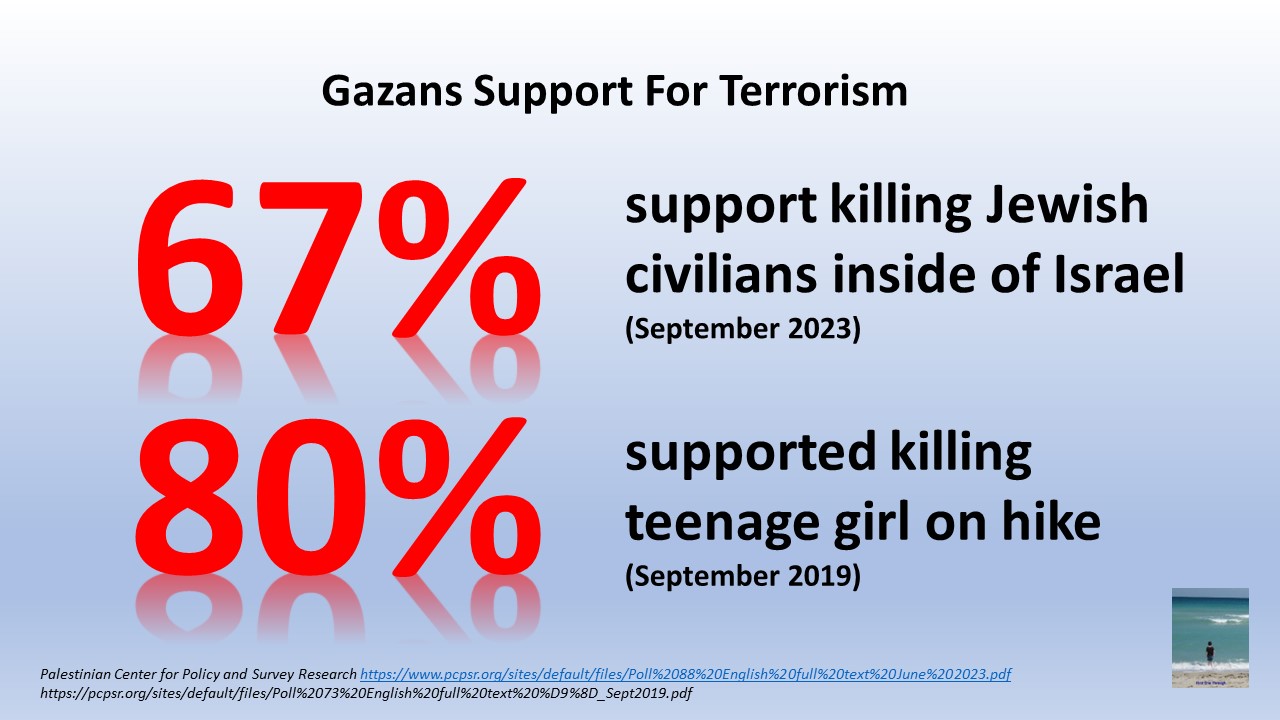
  • A deformity in local culture in which the majority of SAPs have always wanted to kill Jewish Israeli civilians.
  • A PA media and school system that promotes antisemitism and incites hatred.
  • A society with various armed groups which refuse to disarm that are more popular than the PA.

Instead, the UN focuses on misdirection towards Israel and masquerades the reality of SAPs. It gives the PA seats at UN panels and committees even though it has no power, support or authority, parading a fake caricature of the situation. This does nothing to help SAPs address the failure of its society nor hold it accountable for its actions.

For the UN, the answer to the question of SAPs is the creation of a new state for local Arabs which should be Jew-free. Remarkably, the global body cannot ponder that such goal is deeply antisemitic. Equally as pathetic, the failure to consider any other solution to statehood grants SAPs a free hand to commit any sort of atrocity.

The Question of SAPs must not have a forgone conclusion. That approach has failed for years at the price of thousands of lives.

Maybe SAPs can have a state-minus—something akin to post-WWII Japan: self-governance, civil services, education, cultural autonomy—but demilitarized, with security handled by an external guarantor to prevent further war and terror.

Or perhaps certain areas of the West Bank could be confederated with Jordan, whose population is majority SAPs already. Maybe Jordan itself should be divided whereby a section would be part of a Palestinian State together with parts of the West Bank.

The area east of the 1949 Armistice Lines (E49AL) might remain under Israeli sovereignty with SAPs having semi-autonomous status—akin to Native American reservations in the U.S., which have self-rule in many areas but rely on the larger state for defense, currency, and diplomacy. Or the areas get annexed and the residents get Israeli citizenship.

These are serious, legitimate proposals worthy of debate.

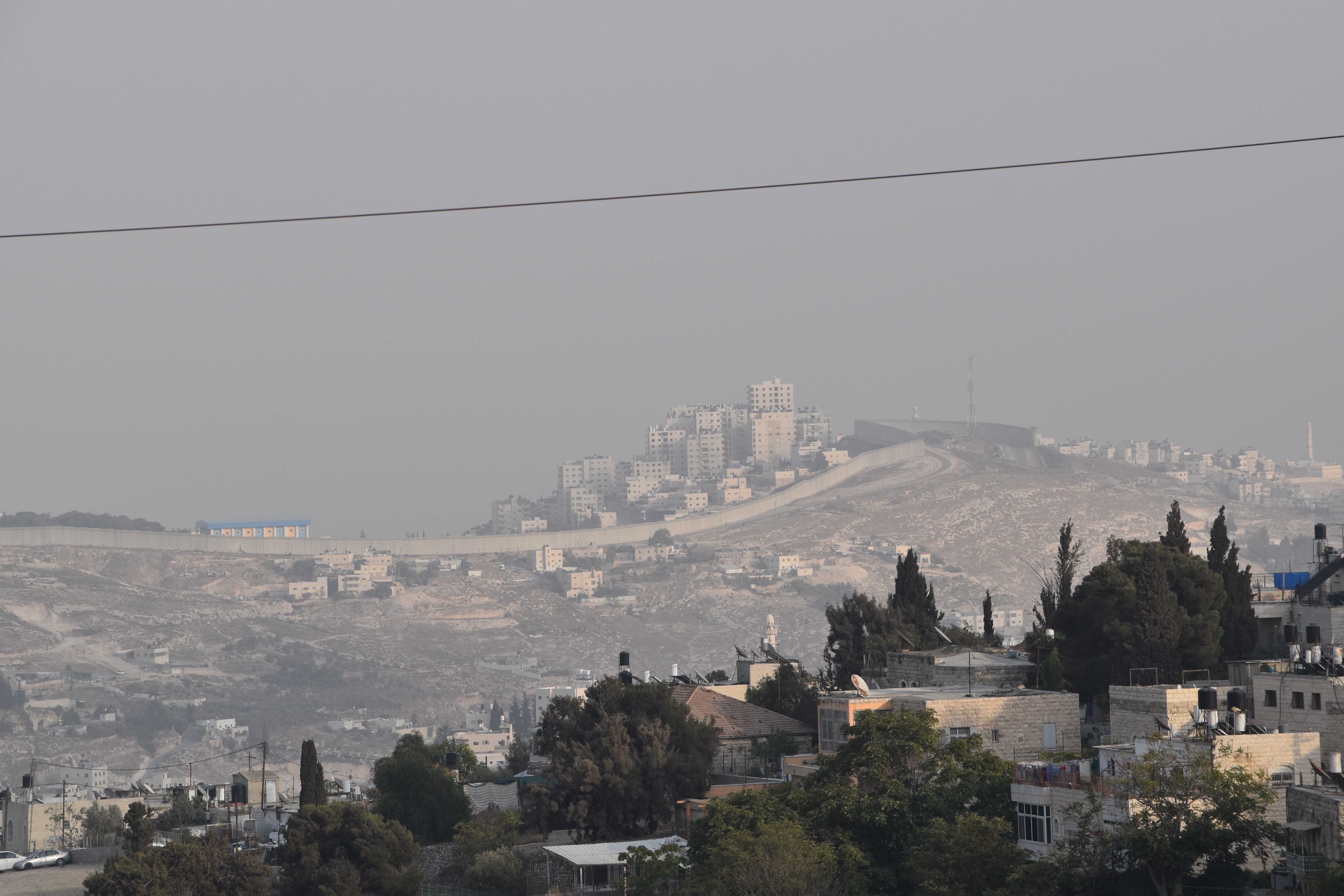
Buildings on both sides of Security barrier in Jerusalem (photo: First One Through)

But let’s be clear: any outcome is about solving the question of what to do with the SAPs. It is not about creating two states. Israel is already there.

The time has come to retire the “two-state solution” slogan. Not because peace is impossible—but because clarity and focus are essential.

Related:

The Distant Fantasy Of Two States Living Side By Side In Today’s Reality (August 2024)

The Three “Two-State Solution”s (December 2023)

“Two States For Two People” And An Arab “Right Of Return” Are Mutually Exclusive (September 2023)

Abbas Pivots from Insults to Flattery in a Bid for Trump’s Favor

For years, Palestinian Authority President Mahmoud Abbas spared no insult for U.S. President Donald Trump and his administration. He called Trump’s peace plan the “slap of the century.” He labeled U.S. Ambassador to Israel David Friedman a “son of a dog.” Abbas publicly refused to meet with any Trump envoy after the U.S. recognized Jerusalem as Israel’s capital in 2017, cutting off nearly all formal ties with Washington. He refused to stop paying salaries to the families of terrorists despite Trump’s demand that he do so.

PA President Abbas issues prayer that President Trump’s “house be destroyed” in 2018

But now, in a stunning reversal, Abbas is praising Trump following America’s attacks on Iran’s nuclear facilities, hoping to reengage with the man he once vilified. The about-face reveals not only Abbas’s desperation but also a familiar tactic in Middle Eastern politics: appealing to the ego of strongmen to gain leverage in diplomacy.

June 25, 2025 article in official Palestinian Authority media, Wafa, relaying Abbas’s appreciation for Trump reaching a ceasefire between Israel and Iran

Attempted Falsification of Division From Enemies

Just two weeks ago, Abbas condemned Hamas’s October 7 attack on Israel, in a letter to French President Emmanuel Macron and Saudi Crown Prince Mohammed bin Salman. Abbas had never done so before. He is seemingly attempting to distance himself from the dominant Palestinian political party which is struggling to stay alive.

Somehow, Abbas wants to bury reality and history. Just one year before the October 7, 2023 massacre, Palestinian factions agreed to a reconciliation in Algiers, Tunisia. Hamas, Fatah (Abbas’s political party), the Popular Front for the Liberation of Palestine and eleven other movements signed an agreement to “get rid of this [political] split and cancer that has entered the Palestinian body.” This move was an attempt to unify the Palestinian people under new elections with a single unified government representing all groups. The United Nations celebrated the integration of Hamas and PFLP – which the U.S. designates as terrorist groups – into a unity government.

A total of 14 Palestinian factions signed reconciliation agreement in Algiers to end their 15-year-long division. (photo: Xinhua)

But Abbas now recognizes the endgame of the current battle: Iran, Hezbollah, Houthis and Hamas have failed in their attempt to destroy the Jewish State. Abbas would have welcomed such outcome, so stayed quiet for over 600 days. Now, while his decimated fellow Muslims sort through the rubble, Abbas is attempting to distance himself from the losing side, of which he was a silently cheering member.
Appealing to Trump’s Vanity

As he throws Hamas under the bus, the nearly-90 year old unpopular Abbas is looking for a lifeboat. Imagine his dismay to realize that even after Hamas led Gaza to a war of destruction, Palestinian polls still show Hamas to be more popular than his Fatah party, and over 80% of Palestinians want Abbas to resign.

In Abbas’s worldview, perhaps aligning himself with a winner will salvage some dignity and allow a few more years of relevancy. Despite spitting on Trump’s Abraham Accords and vilifying Trump & Co., Abbas is replacing his vitriol with flattery.

This is not just a change in tone; it’s a strategic pivot. Abbas’s flattery is designed to appeal directly to Trump’s vanity. Trump craves recognition and praise, particularly when it comes from those who previously doubted him. Abbas is betting that Trump, flattered by the turnabout, might seek to craft a renewed deal between Israel and the Palestinians, this one closer to the Arab Initiative crafted by Saudi Arabia in 2002, rather than Trump’s “deal of the century.”

The logic is simple: Trump, the dealmaker, might relish the chance to win the Nobel Peace Prize by securing an Israeli-Palestinian Peace Agreement, alongside a broad opening of the Abraham Accords with Saudi Arabia and other nations whom would likely follow.

There is little indication that Abbas has changed his position on any of the core issues — recognition of Israel as a Jewish state and the so-called “right of return” principal among them. His newfound praise for Trump is not based on ideological alignment or shared values but on the simple belief that stroking Trump’s ego might yield results.

Israel’s View

From Israel’s perspective, Abbas’s pivot will likely be met with skepticism. Israeli officials have long regarded the Palestinian Authority as duplicitous — speaking the language of peace in English while praising and funding terrorists in Arabic. Abbas’s credibility is further diminished by years of internal repression, a stagnant economy, and a populace which despises him.

Still, Israeli leaders will watch closely. If Trump signals willingness to broker another deal — one perhaps based on regional normalization and security guarantees rather than the moribund Oslo framework — Abbas’s outreach could become a diplomatic variable worth tracking.

Conclusion: Desperation Dressed as Diplomacy

Mahmoud Abbas’s pivot from name-calling to praise is more than political theater. It’s a sign of deep weakness — a recognition that time, allies, and leverage are all slipping away. By appealing to Trump’s vanity, Abbas is hoping for a personal reprieve and a political lifeline.

But Trump will likely recall the years of insults and rejection. Whether he’s willing to forgive and forget — and whether Abbas is willing to concede more than just compliments — remains to be seen.

What is clear is that Abbas, who once derided Trump as a destroyer of peace, now sees him as his best hope to remain relevant.

Related:

Abbas Pays Tribute To Murderers Of Jews Before The United Nations General Assembly, To Applause (September 2023)

Abbas Declares All of Israel is a “Painful Settlement” (June 2021)

Abbas Failed To Capitalize on Trump’s Gift (December 2020)

Abbas’s Speech and the Window into Antisemitism and Anti-Zionism (May 2018)

There Is No Place For Jews At Columbia University

On June 18, 2025, Columbia University announced that it had produced its third report on antisemitism. One would imagine that it would give people hope that the administration was seriously tackling Jew hatred on campus.

Alas.

The “Task Force On Antisemitism” did not focus on Jew hatred at Columbia; it did a poll of ALL students about how they felt about the anti-Israel encampments on campus during the 2023-2024 school year. The “antisemitism” task force wanted to understand everyone’s feelings. It was as though the Black Lives Matter movement put out a research paper that ALL Lives Matter. Not incorrect, just deaf, dumb and blind to the mission.

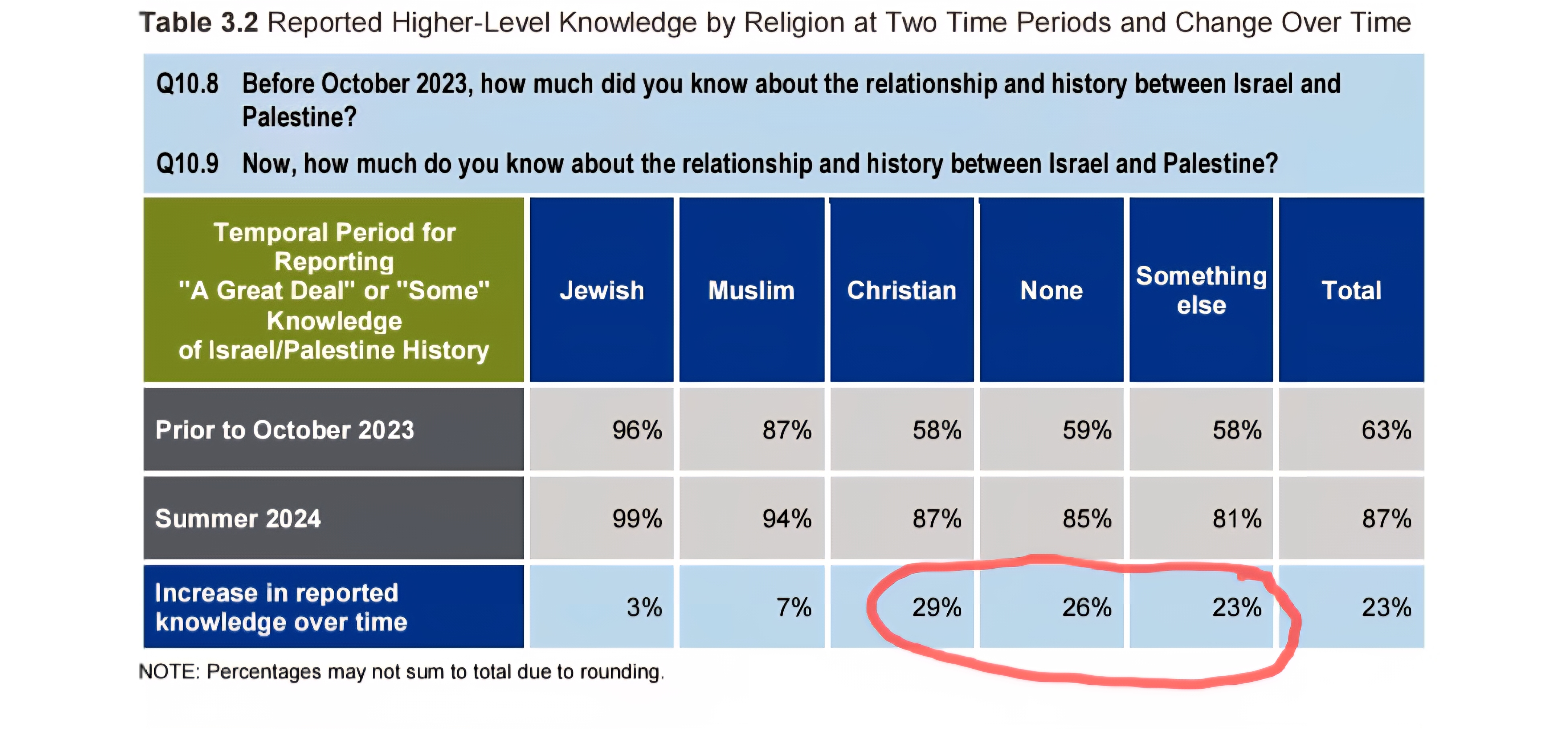
The report was called “Student Belonging and Exclusion Survey Report,” and polled 9,000 undergraduate and graduate students at the university in the summer of 2024. The responses were broken down between Jewish, Muslim, Christian, None and Other religious groups.

Jews fared the worst on each question.

Whether the question was about “a sense of belonging at Columbia” where only 34% of Jewish students felt welcome (compared to 41%, 54%, 51% and 49% for each of the other religious categories), or don’t feel accepted because of one’s religion where 62% of Jews felt unwelcome (compared to 53%, 13%, 3% and 11%), Jews were outliers, with Muslims trailing.

Jews were the most likely to have felt discrimination (53% versus 43%, 6%, 1% and 7%) and were uncomfortable sharing their beliefs (87% versus 82%, 64%, 58% and 58%). The fact that the majority of Columbia students were uncomfortable expressing their beliefs – including atheists – is a damning finding about university culture, beyond antisemitism.

Jews lost the most friends because of the encampments and campus environment (29% versus 16%, 7%, 6% and 9%) and had strained relationships (53% versus 30%, 27%, 22% and 20%). That is a sad state that extends to the personal student level, passed the administration and faculty.

And while Jews felt the most stress over the period, they are learning the least. The campus protest barely taught them anything about the regional dynamic. But Christian and other faiths learned a lot – of pro-Palestinian narrative.

How does one know that students have only been absorbing a pro-Palestinian narrative from a year of encampments? While half of the student body participated or supported the protests, virtually none supported Israel. The pro-Israel protests were almost exclusively Jewish. While 21% of Jews sided with the Stateless Arabs from Palestine (SAPs), a mere 1% of Christians, atheists and other faiths supported Israel. No Muslims supported the Jewish State.

Israel is a pariah at Columbia University. It is only supported by a number of Jews.

How can an institution that claims to champion an open exchange of ideas have a majority of students afraid to express their beliefs? How is it that only Jews support Israel on campus?

It is obvious why nearly two-thirds of Jews at Columbia feel unwelcome on campus. It is unclear why any Jew continues to attend.

Banner hung at Columbia University’s Hamilton Hall supporting “intifada,” violence against Jewish civilians

Related:

Columbia University Sets New Standards For Free Speech (December 2024)

Ignoring Columbia’s – And The Education Industry’s – Systemic Antisemitism (July 2024)

Columbia University Completely Fails Mission. And Jews (October 2023)

Is Columbia University Promoting Violence Against Israel and Jews? (December 2019)

Hold CAIR Accountable for Antisemitic Violence

Over the past several years, the Council on American-Islamic Relations (CAIR) has attempted to build a public image as a civil rights organization. In reality, it has become a hub for dangerous rhetoric, particularly against Israel, Jews and their supporters — rhetoric that is no longer just hateful speech but contributing to real-world violence.

A Track Record of Hate

CAIR’s leaders have spent the last several years referring to Zionists as “enemies,” dismissed Israel’s right to self-defense, and objected to Jewish synagogues being protected. The Anti-Defamation League (ADL) has tracked dozens of examples where the leadership of CAIR representatives used inflammatory and dehumanizing language to describe Israel and those who support it.

These aren’t just policy critiques. This is language that paints Jews, Israelis, and their supporters as existential threats — language that demonizes Jews and encourages acts of extremism. When you call someone a colonizer, an oppressor, a baby-killer, or genocide supporter, you invite violence against them.

And now, we’re seeing the consequences.

From Words to Violence

In recent weeks, two Israelis were shot and killed in Washington, D.C. outside a Jewish cultural event, in what’s being investigated as a targeted hate crime. A few days ago, an Egyptian man firebombed Jewish civilians walking peacefully in Boulder, CO in support of hostages taken by Gazans from Israel.

CAIR was quick to issue a press release condemning the Boulder attack. But make no mistake: the climate that led to these incidents didn’t appear out of nowhere. It was built brick by brick, tweet by tweet, speech by speech — by organizations like CAIR that have spent years demonizing Israel and portraying supporters of Israel as evil, illegitimate, and dangerous.

The Debate And Inversion About Material Support For Genocide

Legally speaking, genocide requires intent to destroy a group “in whole or in part.” Hamas, the political-terrorist group which leads Gaza, is the very definition of a genocidal group. Hamas’s incredible support in Gaza and the West Bank and for the barbaric massacre it conducted in Israel on October 7, 2023, is a condemnation of the gross deformity in Palestinian culture today.

The Stateless Arabs from Palestine (SAPs) are providing material support to Hamas. They elected it to 58% of parliament in 2006, stand as sentries over their terrorist tunnels in Gaza and continue to want Hamas to survive to destroy Israel, even after being pummeled in the war it initiated over 600 days ago.

SAP support for the October 7 “offensive” has declined to 50% in May 2025 from 72% in December 2023 according to PCPSR polls, remaining popular

CAIR’s support for the SAPs and their war to destroy Israel has been unwavering. It supported the October 7 attacks while Hamas was still burning families alive, making then President Biden remove CAIR from the taskforce to combat antisemitism. CAIR continues to support SAPs in the war, and calls Gazans’ failure to commit a genocide of Jews, a genocide perpetrated by Israel, in an attempted absolution via inversion.

Leader of CAIR on October 7, 2023 supporting Palestinians massacre of civilians in Israel

CAIR has been careful to avoid direct financial support for Hamas, and has seemingly kept its activities on a vocal level. It had been caught in the past being linked to the terrorist group Holy Land Foundation, which provided material support to Hamas, and is attempting to avoid becoming a banned entity.

To all appearances, to make up for its inability to materially back the antisemitic horde in Gaza, CAIR has ratcheted the language it uses for Israel and its supporters. In doing so, it has created a toxic swamp of Jew hatred in the United States.

Leader of CAIR San Francisco speaking at American Muslims For Palestine event November 2021

Has CAIR provided material support of a genocide of Jews in Israel? It has probably avoided that in a court of law. But abetting a genocide of Jews in the United States? It seems clear that it is doing so, despite the veneer of its condemnation of the Boulder attack. Sanctifying the burning of Jews alive in Israel endorses the burning of Jews in Boulder, despite the wink to the press.

Home of Israeli family burned by Gazans during October 7, 2023 massacre

Just a few months before Gazans launched its war of extermination, United Nations Secretary General Antonio Guterres delivered remarks for the anniversary of the 1994 Rwanda genocide against the Tutsi. He flagged hate speech as the “key indicator of the risk of genocide.”

How easily hate speech — a key indicator of the risk of genocide — turns to hate crime.  How complacency in the face of atrocity is complicity.  And how no place, and no time is immune to danger — including our own.

UN Secretary General Antonio Guterres

CAIR’s vilification of Jewish groups caught the attention of The Investigative Project on Terrorism back in December 2021. The vitriol from the CAIR has only increased since the October 7 attack.

Why This Matters for America

The attacks in Boulder and Washington aren’t isolated incidents — they’re part of a pattern. Jewish Americans are the most targeted group for hate crimes per capita in the United States – far above Blacks or members of the LGBT community. Yet groups like CAIR continue to push rhetoric that fuels that fire while pretending to stand for peace.

Enough is enough.

We can — and must — defend free speech. But we must also hold public figures and organizations accountable for the real-world consequences of their words. That starts by demanding that CAIR and others stop using anti-Zionism as a cover for antisemitism, stop dehumanizing Israelis and their supporters, and start owning up to the damage they’ve done. Their Diaspora Intifada is killing Jews here in America.

Jews have every right to safety and dignity. If CAIR can’t accept that, then maybe it’s time the rest of us stop accepting CAIR as a legitimate voice in our public discourse.

Related articles:

Colorful Antisemitic Manifestos Are At Your Lips (May 2025)

The Diaspora Intifada (September 2024)

Hamas, CAIR, DSA, Within Our Lifetime, SJP Are All Gunning For Jews (May 2024)

CAIR On October 7 Sadistic Massacre (December 2023)

End the War: Ban Hamas, Permanently

As the war from Gaza continues to take its devastating toll on everyone involved, the road to peace remains blocked by a singular, stubborn obstacle: Hamas. The group’s leadership refuses to accept ceasefires not out of strength, but from the conviction that they can endure, rearm, and fight again. The violence will not end as long as Hamas is allowed to believe it has a future.

It is time for the international community – particularly Western democracies – to take an unambiguous stand. Hamas must be permanently banned—not just its military wing, but its entire structure. There can be no meaningful peace, no rebuilding of Gaza, and no credible peaceful future while Hamas continues to hold power and wield influence.

Despite the mounting civilian cost, Hamas has shown no intention of disarming. The group openly positions itself as a perpetual “resistance force” rather than a governing body accountable to and respecting the people of Gaza. Its survival strategy is predicated on suffering—banking on civilian casualties to inflame global opinion while preserving its own arsenal in tunnels and bunkers. This is not governance. This is terrorism dressed in political clothing.

Hamas official boasts of sacrificing his own civilian population to slaughter Jewish civilians, shortly after the October 7, 2023 massacre in Israel (source: MEMRI)

Yet in Europe, the designation of Hamas as a terrorist organization remains inconsistent. Some countries distinguish between its so-called “military” and “political” wings, an artificial and dangerous separation. This division gives cover to operatives, fundraising networks, and propaganda arms that prolong the conflict and contribute to ongoing suffering.

Now, there is growing concern in the United Kingdom, where a legal effort is underway to challenge Hamas’s terrorist designation. This must not be allowed to succeed. On the contrary, the UK should lead Europe in reaffirming that Hamas is a terrorist entity in its entirety. Such a stance must be echoed by Germany, France, the Netherlands, and the rest of the EU. It must happen in Canada and Australia and throughout the Global North.

UK lawyers are fighting to get Hamas removed from the list of terrorist groups

Riverway Law submitted a 106-page filing in the UK which argued that Hamas is a local “resistance movement… which has won the only free and fair election in the occupied Palestinian territories” and it “poses no threat to the UK people.” The submission argued that “the legitimacy of the struggle of the Palestinian people for independence, territorial integrity, national unity and liberation from colonial and alien domination and foreign occupation by all available means, including armed struggle, is moral [and] legitimate.”

Lost in this filing is that the legal definition of terrorism is about targeting civilians for political aims. That is the core mission of Hamas. Its stated purpose and actions on, before and after October 7, 2023 is to attack Jewish civilians inside Israel and around the world.

To wit, in April 2022, Yahya Sinwar, the Hamas leader who would later spearhead the October 2023 massacre in Israel said “Whoever makes the decision to repeat this desecration of the Al-Aqsa Mosque will be making a decision to desecrate thousands of synagogues and Jewish temples all over the world,” explicitly saying that actions done by the Israeli government would be reason to take actions against Jews around the world, including in the UK.

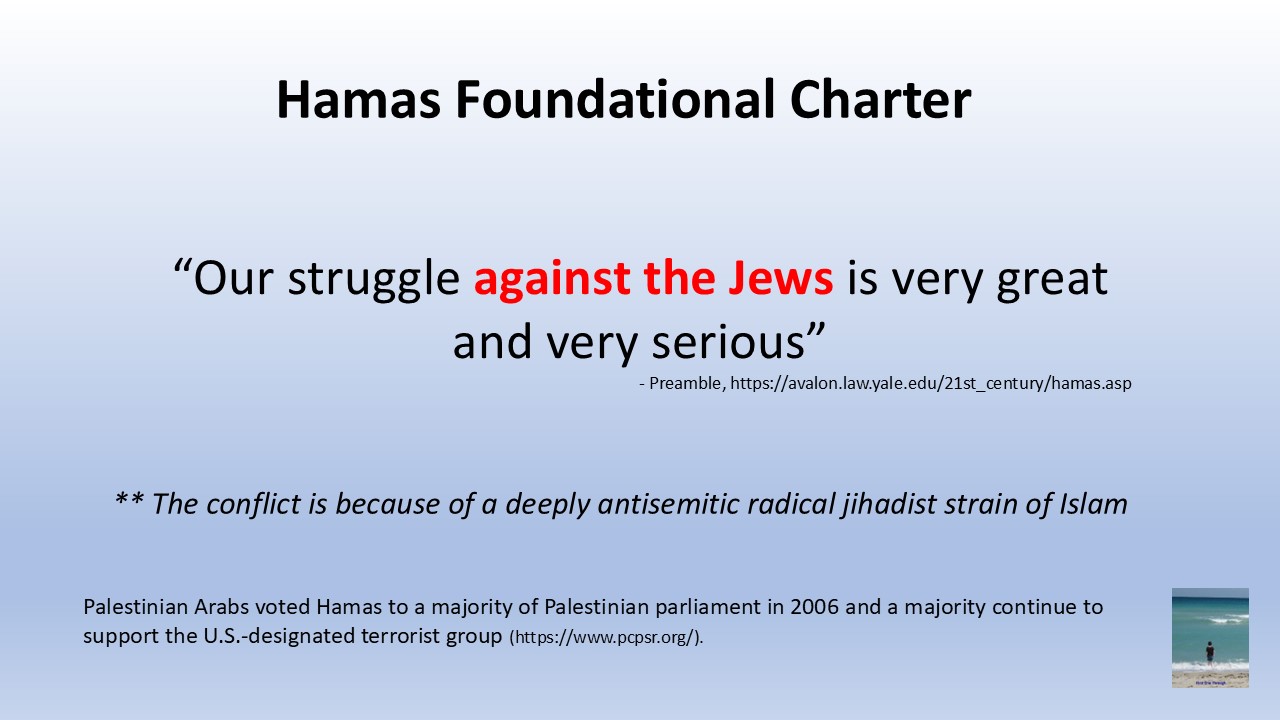
The invective is a grisly echo of the 1988 foundational Hamas Charter which explicitly cites the antisemitic forgery Protocols of the Elder of Zion about the supposed vile nature of Jews everywhere. It claims that Jews conspire to control the world and “Islamic groupings all over the Arab world should… fight with the warmongering Jews (Article 32).” The Hamas charter uses the word “world” twenty-five times. “Globe” is used twice. “Jew” – not “Zionist” – is used twelve times, including stating “Israel, Judaism and Jews challenge Islam and the Moslem people, (Article 28)” targeting Jews everywhere and the religion itself as a permanent offense to 1.9 billion Muslims.

It was with this antisemitic genocidal charter that Palestinians voted Hamas to the majority of parliament in 2006. That this vile party won elections – like the Nazi party in Germany – is not a defense of its legitimacy but a condemnation of the “deformity in Palestinian culture,” to quote James Zogby, President of the Arab American Institute comment at the United Nations Security Council on June 27, 2023.

Banning Hamas is not only a matter of principle, but of practical necessity. No group that openly glorifies violence and opposes basic coexistence can have any legitimate role in governance.

Ghazi Hamad of the Hamas political bureau said in an October 24, 2023 show on LBC TV (Lebanon) that Hamas is prepared to repeat the October 7 “Al-Aqsa Flood” Operation time and again until Israel is annihilated. (source: MEMRI)

A political party that glorifies the death of its own population with public declarations “we are called a nation of martyrs, and we are proud to sacrifice martyrs,” shows no value for the lives of its own civilians, let alone of others. The Global North must lead with moral clarity and urge the Arab League to follow suit.

When people on the streets and campuses in the Global North yell “Free Palestine,” they are doing so under the banner of Hamas in a call to eradicate the only Jewish State and to attack Jews globally. If people want to make the argument that the statement is for coexistence, then fight to end Hamas, argue for a Free Israel and to Create Palestine, and condemn the heinous attacks on Jews happening all over the world.

To end this war, we must end Hamas. Ban them—politically, financially, and globally. Only then can people talk about “the day after,” and the longer future.

ACTION ITEMS

Contact members of the British parliament to keep Hamas on the list of terrorist groups.

Contact the French office of foreign affairs to explicitly push to ban Hamas’s existence.

Related articles:

A Reminder That The UN Security Council Protects Hamas (April 2025)

United Nations Still Will Not Call For Hamas To Face Justice (October 2024)

Stop Genocide. Destroy Hamas (May 2024)

The Only Way The Conflict Can End (November 2023)

Say Its Name: ‘Hamas’ (October 2023)

Hamas And Harvard Proudly Declare Their Anti-Semitism And Anti-Zionism (May 2022)

Hamas’s Willing Executioners (July 2021)

The West Definitively Concludes Hamas is a Terrorist Group (June 2021)

A Proper UN Security Council Resolution on Israel and HAMAS (May 2021)

Considering Nazis and Radical Islam on the 75th Anniversary of D-Day (June 2019)

UN’s Guterres Only Hates Israeli Jews, Not Diplomats

United Nations Secretary General Antonio Guterres is first and foremost a politician, not a human being. What else can be the reasons behind his ignoring the slaughter of 1,200 people in Israel, burning entire towns, raping women and kidnapping 250 people, other than serving his constituents of the Global South whom he has learned are rabid antisemites?

When a radical socialist-jihadi gunned down two young Israeli diplomats outside a Jewish event in Washington, D.C. in May 2025, Guterres immediately issued a statement condemning the murders. It was something he did not do after the massacre in Israel on October 7, 2023. Or October 8. Or October 9. Or October 10.

But he rose to the occasion in May 2025 after the targeted killing of the Israeli couple by a lunatic yelling “Free, free Palestine,” as if he were surrounded by fantom college campus agitators. Perhaps anticipating blowback from the anti-Israel horde he leads (read serves), Guterres explained this statement “reiterat[ing] his consistent condemnation of attacks against diplomatic officials.”

THIS particular antisemitic murderer should be “brought to justice” because he killed diplomats, a Bozo no-no. In this circumstance, the UN “extends sympathies to the Government of Israel,” because members of the sacred circle of high brow governmental officials were gunned down, not Jews having breakfast with their kids in their kitchens.

The thousands of butchered and injured people in Israel by over 3,000 Gazans in October 2023 were just Jews and therefore deserved no sympathy from the United Nations. Guterres could not offer any words of condemnation or consolation to the Jewish State for such barbarity; he has been so trained by the Global South. His office would not demand that thousands of Gazans “be brought to justice”; they are the UN’s protected wards.

When the head of the United Nations explained to the world that he decided to quickly condemn the murder of two Israelis when he ignored the butchering of 1,200, because of unity among diplomats, he further exposed the profound inhumanity of the cancerous global institution.

Related:

Killing 26 Hindus in Kashmir Is Much Worse Than Butchering 1,200 Jews In Israel. For The UN. (April 2025)

The Global South Is Coming For The UN Security Council (March 2025)

Fire United Nations Secretary General Antonio Guterres (January 2024)

UN Secretary General Guterres is Losing the Confidence of Decent People (September 2017)

What Will France’s “Concrete” Steps Be To Advance A “Two State Solution”?

On May 23, 2025, France said it is “determined to advance the implementation of the two state solution.” The June conference in New York that it will chair with Saudi Arabia titled “the International Conference for the Peaceful Settlement of the Palestinian Question and the Implementation of the Two-State Solution” is designed to focus on IMPLEMENTATION. France made clear that it expects “Irreversible steps and concrete measures for its implementation” to make the future a reality.

The combined effort of a western country and the dominant force in the Arab world to spearhead the effort, might lead to a balanced consensus that can help the parties forward. To be successful, the team must be realistic about the goals and constraints of both Israel and Palestinian society, and move on a realistic timeframe. Most importantly, it must work on an ENDURING peace that will last, not simply getting to an agreement.

Here are seven constructive steps that could lead to a stable two-state solution:


1. Disarm All Palestinian Militias

Peace starts with law and order. The Palestinian Authority has no monopoly on violence in the territories it claims to govern. Hamas and Islamic Jihad still run Gaza. In the West Bank, terrorist groups like Lion’s Den and the Jenin Brigades run wild with guns and explosives.

France needs to lead an international push to fully disarm all terrorist militias, not just generic phrases of “condemning violence.” All arms must be placed under the control of the Palestinian Authority (PA), or there’s no point in talking about sovereignty. No state — and certainly not Israel — can accept a terror enclave as its neighbor, as has existed in Gaza since 2007.


2. Elections With Rules

The last Palestinian elections were held when Justin Beiber became legally allowed to drink alcohol. Mahmoud Abbas was elected in 2005… for a 4-year term. He’s now on year 20.

New elections must be held, but not every group gets to play. Hamas — a terrorist organization by U.S., EU, and Israeli designations — should not be allowed to run, just like Nazis weren’t allowed to run in post-war Germany. The party should be outlawed.

France and Saudi Arabia should insist on clear criteria: no party that promotes violence, antisemitism, or the destruction of Israel gets a seat at the table. There is no pathway to an enduring peace if there is an underlying state of war.


3. Reform Education — Stop Teaching Hate

An Enduring Peace isn’t signed on paper; it’s taught in classrooms and instilled in society.

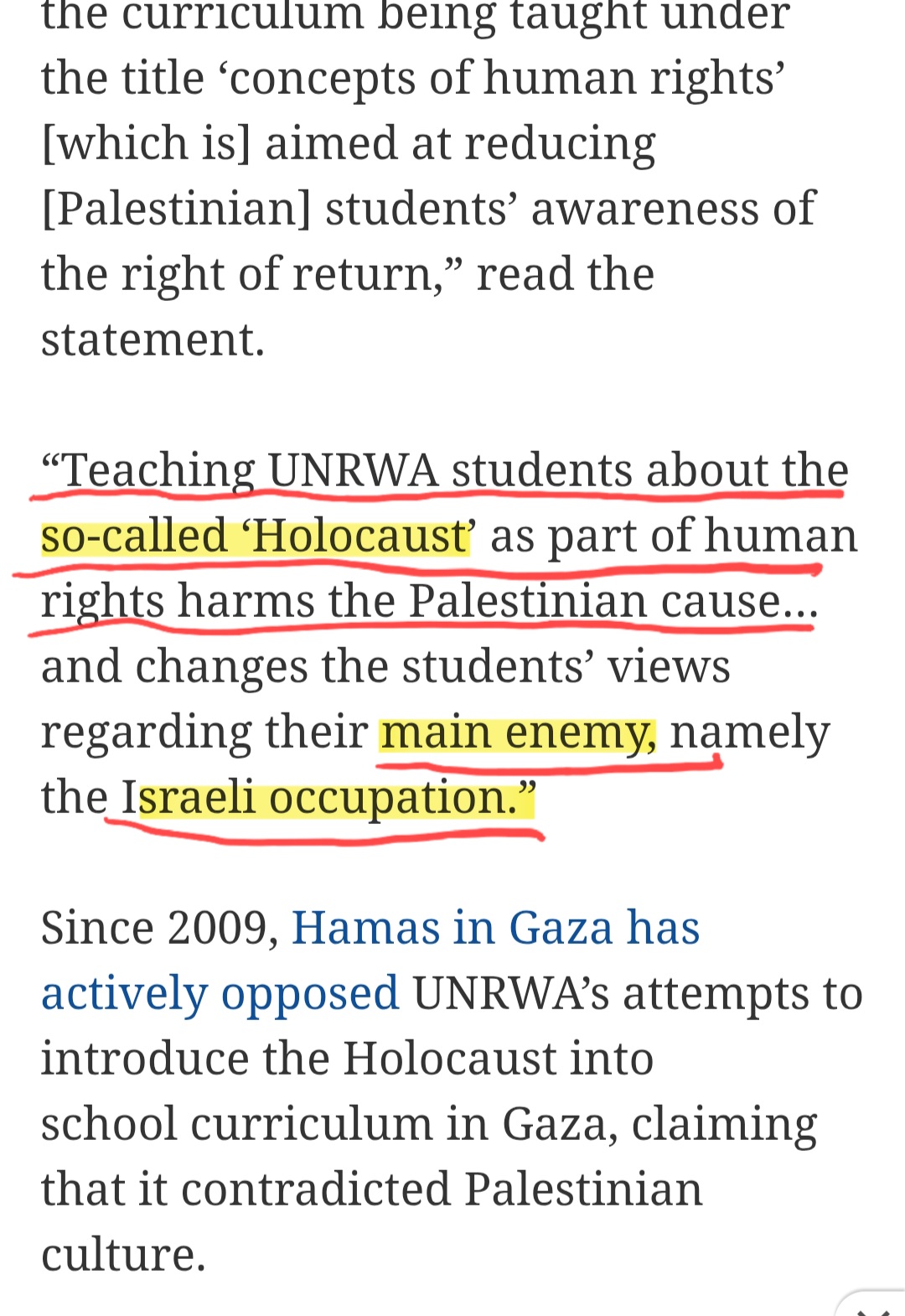
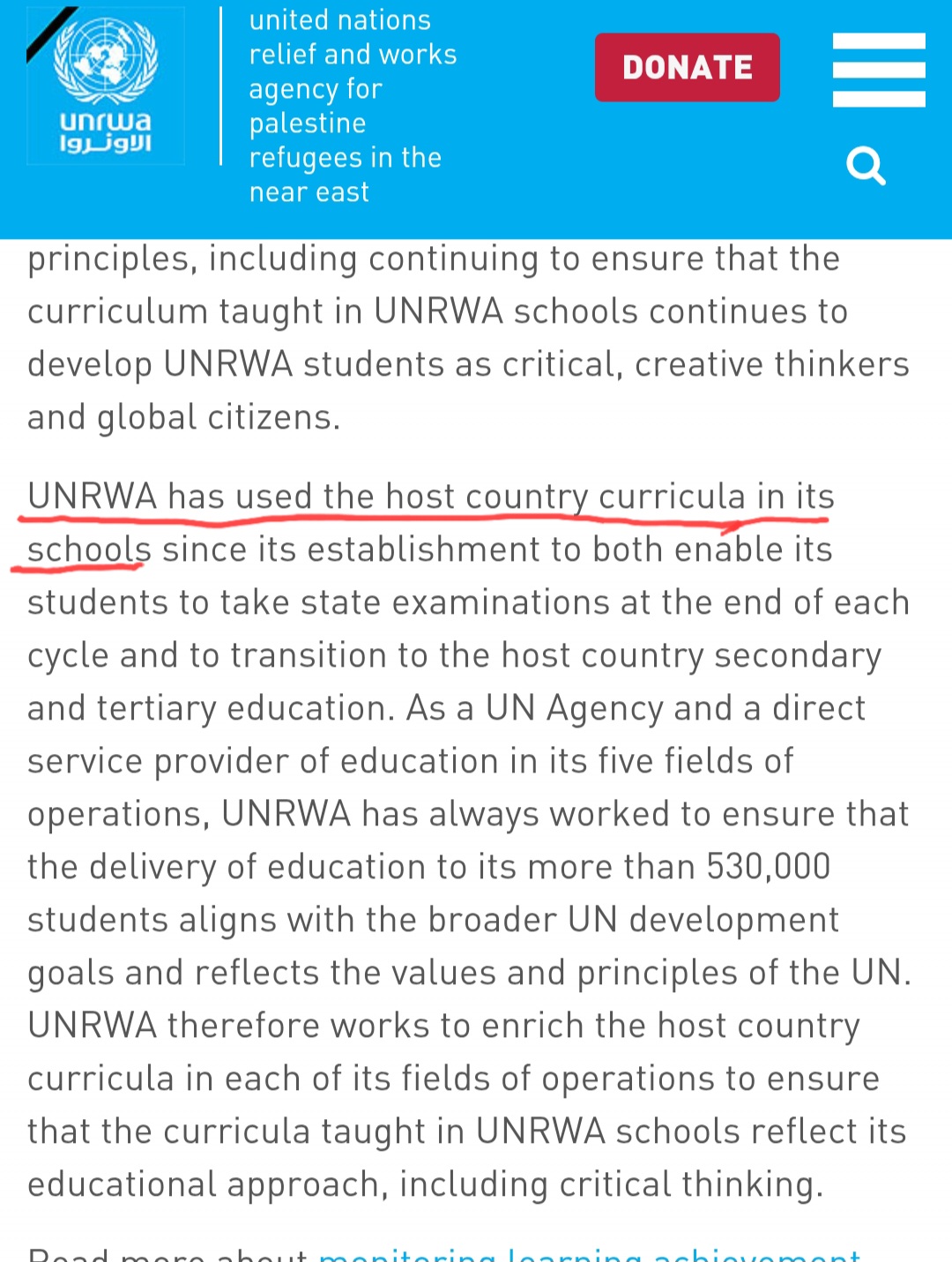
As part of de-Hamasification of Palestinian society, schools — especially and including those run by UNRWA — a complete overhaul of Palestinian education, with international oversight to remove antisemitic and violent content. IMPACT-SE has written about this problem for years, and concrete steps must be taken to allow a future of coexistence.


4. Stop Treating Jews Like Foreigners in Their Homeland

Palestinian schools aren’t the only problem. The United Nations is rank with Jew-hatred and one cannot expect Palestinians to be less anti-Israeli Jews than the global body.

UN Security Council Resolution 2334 outrageously declared that Jews living in eastern Jerusalem and east of the 1949 Armistice Lines with Jordan (E49AL) are somehow illegal — a modern form of antisemitism dressed up in legalese. UNSC 2334 should be renounced and rescinded as part of the steps towards an enduring peace.

France must reject the idea that Jews should be banned from parts of their ancestral homeland. At the same time, to facilitate compromise, a cap on Jewish residents east of the 1949 lines — say 15% of the overall population — could be introduced to avoid major demographic shifts in a future Palestinian state.


5. End the So-Called “Right of Return”

The Palestinian demand that millions of descendants of refugees be allowed into Israel is not about peace — it’s about destroying Israel demographically. It’s a fantasy rooted in grievance, not reality.

France must take the lead in declaring the Palestinian “right of return” over. In its place, a compensation fund should be set up — funded by Israel, Arab countries that started the 1948 war, and international donors. A similar fund should be set up for the descendants of Jews from Arab countries which were expelled in the decades after 1948. Work should begin now to compile a list of the properties which were lost and the related descendants who will collect associated reparations.


6. tighten the border framework, including jerusalem

The Saudi Peace Plan of 2002 suggested that Israel retreat to the 1949 Armistice Lines — a temporary ceasefire line, not a border. That’s not a starting point. That’s a non-starter.

France and its partners should endorse a realistic territorial framework: borders will fall somewhere between the current Israeli security barrier and the 1949 lines, through mutual negotiations. Land swaps are fine — as long as they reflect demographic realities and security needs.

In regards to Jerusalem, no country divides its capital city and no country places its capital on a border. Jerusalem should remain the capital of Israel, as it has uniquely afforded freedoms for all religions. Saudi Arabia should take over the administration of the Temple Mount from the Jordanian Waqf as part of advancing peace in the Middle East.


7. Shut Down UNRWA — Gradually, Responsibly

UNRWA, the UN agency that was supposed to help refugees, has become a sprawling, corrupt bureaucracy that perpetuates dependency and fuels incitement. Its existence undermines the Palestinian Authority and entrenches the myth of perpetual refugee status.

France and Saudi Arabia should lead the call for a phased shutdown of UNRWA, starting in Gaza and the West Bank. Services should be handed over to the PA — and resettlement should begin for Palestinians in Lebanon, Syria, and Jordan, with annual caps to avoid regional overload.

UNRWA offices in Jerusalem (photo: First One Through)

Bottom Line

France says it wants permanent changes on the ground. Good. The Middle East has had enough of circular negotiations, terrorism-as-usual, and international hypocrisy.

If France is ready to be honest, clear-eyed, and courageous, it can help move the region toward peace. But if it sticks to the same old script — blaming Israel, indulging Palestinian rejectionism, and hiding behind the UN — then we’ll just keep getting the same instability, bloodshed, and failure.

Peace will not be achieved overnight and “concrete” steps must be phased with reality. France and Germany gradually became allies after World War II with the benefit of the deNazification of Germany. Germany even made peace with the Jewish State over time once it was committed to avoid the hatred of its past. An overhaul of the Palestinian mindset and rejection of radical jihadism and goal of eliminating the Jewish State, under the sheepherding of Saudi Arabia can help map a better course for the region.

France must internalize the needed overhaul of the “deformity in Palestinian culture,” to quote James Zogby, President of the Arab American Institute who spoke to the UN in June 2023. Saudi Arabia must overlay the Abraham Accords on top of its 2002 Peace Plan to refine it to account for the reality of the last several years.

The emphasis of the France-Saudi chaired conference must be on the direction, not on the permanence of “concrete” and “irreversible” steps, to find a less violent and just future for the region.

Related articles:

There Is No Basis For A Palestinian “Right of Return” (July 2024)

The Three “Two-State Solution”s (December 2023)

Jerusalem Population Facts (May 2021)

When You Understand Israel’s May 1948 Borders, You Understand There is No “Occupation” (July 2019)

Ending Apartheid in Jerusalem (June 2018)

Arabs in Jerusalem (January 2016)

The Israeli Peace Process versus the Palestinian Divorce Proceedings (June 2015)

The Arguments over Jerusalem (May 2015)

Every Year a Refugee

How many generations should someone be called a “refugee?” Two? Ten? My parents were refugees and I consider myself the son of refugees. But not a refugee. To do so would be a mockery of millions of people fleeing homes to faraway lands where they have no family, infrastructure or knowledge of the local language.

Alas, while every year the world adds and removes refugees from the global tally, there is a permanent exception.

There are roughly 122 million displaced people worldwide (68 million internally displaced, 38 million refugees and millions of others seeking protection), and the United Nations High Commissioner for Refugees (UNHCR) is tasked with helping them. Its mission is clear: assist people fleeing conflict or persecution to either return home when it’s safe, or resettle in a new country where they can rebuild their lives and become citizens. Refugee status, according to UNHCR, is meant to be temporary. A tragic but manageable step toward normalcy.

But for one group of people, the rules were rewritten.

In 1949, the United Nations created a separate agency: the United Nations Relief and Works Agency (UNRWA). Its job was not to help all refugees, but a specific set—Arabs who left or were displaced from what became the State of Israel during the 1948 war.

Unlike the UNHCR, UNRWA never intended to help these refugees resettle or gain citizenship elsewhere. In fact, when Jordan annexed the to be named “West Bank” in 1950 and granted full Jordanian citizenship to the Arabs living there in 1954 (Jews were specifically excluded from Jordanian citizenship) —including the so-called refugees—UNRWA still kept them on its refugee rolls. Why? They were no longer stateless, no longer displaced from their community, and in most cases, were living just miles from where they or their families once resided.

No other refugee population in the world is treated this way.

The Palestinians under UNRWA are not counted based on where they live or whether they’ve rebuilt their lives. They’re counted based on ancestry—any descendant of someone who lived in Mandatory Palestine in 1946 and left during the war is considered a “refugee.” That includes people who are now citizens of Jordan who have never set foot in Israel, and those who live under Palestinian rule in the West Bank and Gaza.

This isn’t about resettlement. It isn’t about a “two-state solution.” It’s about return. Not return to a country they fled—but to homes where their grandparents once lived, in a country that has since fought multiple wars for its survival and established itself as a sovereign nation.

This has locked the Middle East into a perpetual state of conflict. UNRWA doesn’t just preserve the status of Palestinian refugees—it amplifies it, funds it, and builds an international bureaucracy around it. It has denied Israel’s right to control its own immigration, and basic principle of sovereignty.

Worse, the UN’s actions have turned a situation normally considered a humanitarian issue into a real estate dispute. By insisting that people return to a house—not a country, as outlined in international human rights law—the global political body has exceeded its own mandate. This isn’t a question of national self-determination, but one of personal property claims. UNRWA isn’t so much a champion of the creation of a state beside Israel; it champions individual return to specific homes, decades abandoned or destroyed, now occupied by others in a sovereign country.

Meanwhile, the descendants of every other refugee group in the world—from Sudan to Ukraine—are helped by the UN to find a path forward. Only the Palestinians are encouraged to walk backward, into the houses of their grandparents.

UNHCR helps refugees stop being refugees. UNRWA helps them stay that way.

Every year, new wars create new displaced people. But only one group stays on the list year after year, generation after generation.

For Palestinian Arabs, the 1948 war is still being fought. Generations of people haven’t been birthed into refugee status as much as the region is in a 100 years war. While the world may use political terminology of an UNRWA ward who has never been to Israel as a descendant of a “refugee,” Palestinians simply see a permanent property right which will never be forfeited. The UN simply provides cover under the “refugee” monicker.

Every year, a refugee. By design. In partnership.

Related articles:

Palestinian Authority Demands That UN Come Clean On UNRWA (November 2024)

‘Right Of Return’ Must Be Integral To Negotiations (September 2024)

There Is No Basis For A Palestinian “Right of Return” (July 2024)

After UNRWA (February 2024)

“Two States For Two People” And An Arab “Right Of Return” Are Mutually Exclusive (September 2023)

There Is No Backing For A Palestinian “Right Of Return” (December 2022)

When the Democrats Opposed the Palestinian “Right of Return” (August 2018)

Is “Free Palestine” Immoral Or “Counterproductive”?

In political and ideological debates, few words carry as much quiet weight as “counterproductive.” It is a term that cloaks deep moral issues in the language of strategy, substituting ethical clarity with tactical calculus.

Recent uses of the word by political figures and organizations—such as Cenk Uygur’s response to the murder of two Israeli diplomats in Washington, D.C., and J Street’s condemnation of the student takeover of Columbia University’s Butler Library—highlight the way moral outrage is increasingly filtered through the lens of utility.

Alt-left commentator Cenk Uygur comments about the murder of a young couple from Israel on the streets of Washington, DC by a man yelling “Free Palestine”

The Language of Outcomes

When Cenk Uygur called the murder of the diplomats “counterproductive” and “stupid,” he minimized his “obviously immoral” charge. He reframed the cold-blooded murder of two young Israelis at a Jewish event through a critique that the violence would “harm the Palestinian cause.” Similarly, J Street’s reaction to the Butler Library takeover focused not on the pain caused to students studying for finals but on the effectiveness of the mass action.

J Street commentary on violent takeover of Columbia University library during study week

Both statements imply a worldview where the ends can justify the means IF the means produce desired outcomes. Violence and disruptions aren’t inherently wrong, full stop; they’re wrong if they don’t work.

This mode of thinking belongs to a form of strategic utilitarianism—actions are weighed not on whether they are ethically sound, but whether they are instrumentally successful. Murder isn’t condemned for its cruelty or injustice, but for its inefficiency. Protest isn’t wrong because it defies norms, but because it alienates potential allies or invites political backlash as in: it “provide[s] the Trump Administration with ammunition…” and “it allows people to frame the whole peace movement as violent.”

The Profound Delusion

How is the October 7 massacre of 1,200 people and mass rape of women and butchering of babies a “peace movement?” a sane person would ask. How is the killing of a young couple in Washington – thousands of miles from Gaza – an issue of “framing” for the masses (read “potential allies”)?

The idea that victims’ deaths were simply “counterproductive” is chilling. It suggests they were not wronged, but miscalculated. Their humanity becomes a variable in someone else’s flawed strategy. The moral frame disappears; only the tactical one remains.

There is a profound gap between calculated language and moral reality. For the political commentators, everything is a chessboard; for the people on the ground, it is their lives.

Question If The Entire Movement Is Unjustified And Immoral

Uygur and J Street – different parts of the socialists-jihadi alliance – use of “counterproductive” is an attempt to separate the actions of the violent offenders in the United States from the Hamas-led war in Israel. It seeks to sanitize the Gazan war to “Free Palestine” as a noble goal, while the tactics of some people – including possibly the October 7 massacre itself – are flawed.

Lost on those absorbing this insidious narrative of “Free Palestine” is that the movement is immoral. The chants of an “ongoing Nakba” are not cries for peace but a desire of SAPs and their supporters to destroy Israel and ethnically cleanse the Jewish Promised Land of Jews, marketed under the banner of human rights. Yes, local Arabs deserve self-determination which can be achieved in multiple ways. No, they don’t have an “inalienable right” to their own country nor to move into houses where grandparents once lived.

The only way of achieving their stated desired goal of ending Israel is via violence, both there and here. The murder of two Israelis outside a Jewish event in America’s capital city isn’t “counterproductive” but an unspoken essential component of the global jihad. It is the definition of “by any means necessary.”

Conclusion

Language shapes how we see the world. When murder is called “counterproductive” – whether of two Israelis in Washington or 1,200 people in Israel – the victims’ moral worth is sidelined in favor of strategic impact. Worse, the soft wording obfuscates not only the evil of the immediate killings but that the entire “Free Palestine” mission is about the mass murder of Jews.

The issue isn’t optics. There is a reason the hordes are yelling “we are all Hamas,” “gas the Jews” and “Heil Hitler,” and it isn’t coexistence. The alt-left’s shielding of violent antisemites has made them complicit in both the violence against Jews and the ongoing trauma the Jewish community is enduring.

Related articles:

Genocidal Jihadists Come For ‘Soft Targets’ (September 2024)

When Enemies Of The Jews Use “Any Means Necessary” (May 2024)

The Normalization Deformity: No To Zionism and Peace; Yes To Massacres and Terrorism In a Global Intifada (January 2024)