Nicholas Kristof’s “Arab Land”

On February 26, 2015, Nicholas Kristof wrote an op-ed in the New York Times called “The Human Stain” that was more than flawed- it was wrong; it was more than anti-Israel, it was anti-Semitic.

Among the many incorrect and racist statements were his claims that the “West Bank” and “East Jerusalem” were Arab. Here are some quick thoughts about his statement that “nibbling of Arab land is just plain wrong.

IMG_2118
Judean Desert down to the Jordan Valley

Geography

The west bank of the Jordan and eastern Jerusalem are not part of the Arabian Peninsula. That landmass is located east of Israel. The borders of the region are surrounded by water on three sides (the peninsula) and the northwestern edge of Saudi Arabia is the land border.

The countries that constitute the Arab land in addition to Saudi Arabia are: Oman; Kuwait; UAE; Bahrain; Qatar; and Yemen. The Arabian Plate on which the peninsula rests includes parts of southern Jordan and southern Iraq.

Neither the Arabian Peninsula nor the Arabian plate cross the Jordan River, hence there is no geographical basis for referring to any land west of the Jordan as “Arab Land.”

Population

The “Arab Nation” spread beyond the Arabian Peninsula in the 7th and 8th centuries when Muslim invasion of neighboring lands brought Islam and Arabs to those areas. Those Muslim conquests brought Arabs to southern Spain called Andalusia. No one refers to Spain as Arab land today.

Politics

The Arab countries formed a “League of Arab States” which includes 22 countries. That group is political in nature and does not speak to the actual people and culture of the countries. For example, Syria was suspended from the League in 2011 due to its civil war. Palestine was admitted as a member in 1945 (the entire British Mandate of Palestine which includes Israel today) even though it was not an independent country.

To refer to the west bank of the Jordan as “Arab” because Palestine is a member state would also mean that Israel is an Arab state. Is that part of Kristof’s real message? Does he feel that Israel is not a valid entity and is occupying “Arab land”?

Ruby all Israel  29 (1)
Binyamin Region

Government Sovereignty

A “Land” is distinguishable from lowercase “land” in that one conveys sovereignty and ownership. The land on the west bank of the Jordan River is disputed land without independent sovereignty. Israel administers the land after Jordan attacked Israel in 1967 and subsequently lost the territory. Jordan gave up all claims to the land in 1988, including “East Jerusalem”. “Arab East Jerusalem” in capital letters makes no sense in any interpretation as sovereignty and administration belongs to Israel (albeit not recognized in much of the world) but the eastern part of the city is also not recognized, nor under sovereignty of Arabs, nor part of the Arab peninsula, and is 40% Jewish.

While many Palestinian Arabs claim the west bank of the Jordan as part of a future state and “East Jerusalem” as such state’s capital, the rule of the land is still in negotiations. As of this date, the land is much more Israeli than it is Palestinian.

Exclusivity

Liberals and progressives typically argue that no land should be the exclusive right of a single racial or religious group. No one refers to “White Selma” where only whites can live or “Black Harlem” where only blacks should be permitted to live.

While people refer to the Islamic State of Iran, Iran claims that it welcomes people of all faiths. Israel, the Jewish State, is 25% non-Jewish. Turkey, which is a secular Islamic state, is mostly non-Arab but has many Arabs living in the country.

Not only is the west bank of the Jordan not “Arab”, but the suggestion that it should be limited only to Arabs is racist and anti-Semitic. That policy was put into place under the Jordanian Arabs that attacked Israel in 1948 and expelled all of the Jews from the area including the eastern part of Jerusalem, counter the Fourth Geneva Convention.

IMG_4963
South of Bethlehem

Private Property

Land ultimately falls into two categories: private land and public land. Private land changes hands with the owner and is not considered to belong forever to a particular religion or people. One day it may be owned by an Arab, the next day by a Jew and the next by a WASP.

Public lands are administered by the government. As discussed above, the west bank of the Jordan is administered by Israel. The eastern part of Jerusalem was annexed by Israel decades ago.

Therefore neither the west bank of the Jordan River nor “East Jerusalem” can be considered “Arab land.”

History

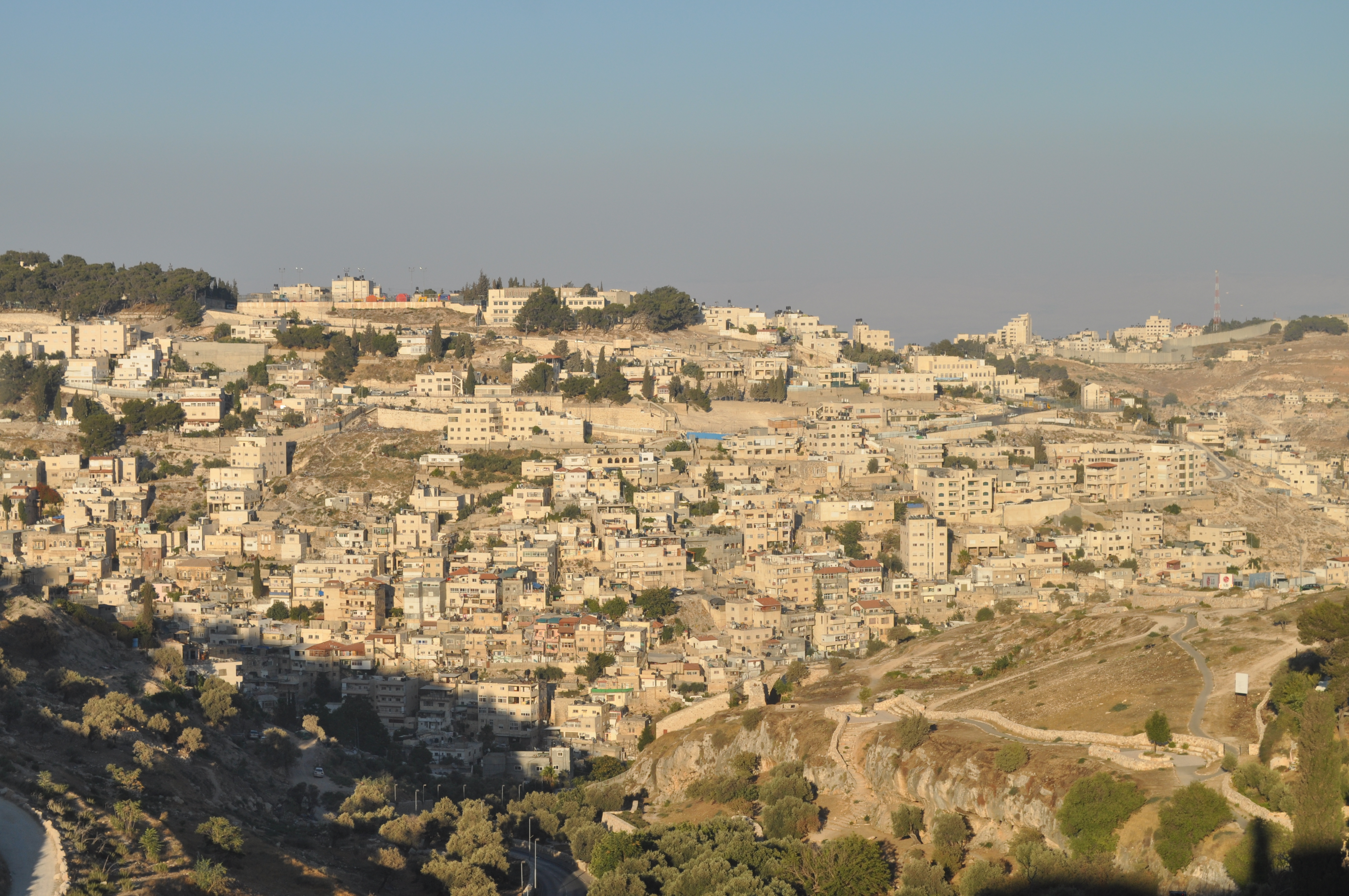
For 400 years the Ottomans ruled Palestine and allowed Jews to live everywhere without restriction. They lived in Jericho and Jerusalem and throughout the region. The Ottomans welcomed the Yemenite Jews who founded Silwan in the eastern part of Jerusalem just outside the city walls in 1881 – in what Kristof terms “Arab East Jerusalem.

The international community gave the British the Mandate to govern Palestine in 1922, in which it specifically stated that the entire mandate – including Kristof’s “Arab West Bank” – “shall facilitate Jewish immigration under suitable conditions and shall encourage, in co-operation with the Jewish agency referred to in Article 4, close settlement by Jews on the land, including State lands and waste lands not required for public purposes” (Article 6). The mandate further stated in Article 15 “No discrimination of any kind shall be made between the inhabitants of Palestine on the ground of race, religion or language. No person shall be excluded from Palestine on the sole ground of his religious belief”.
 DSC_1020
Silwan, in the eastern part of Jerusalem, founded by Yemenite Jews in 1881

Countering the Bible

As detailed above, there is no basis for naming places “Arab West Bank” or “Arab East Jerusalem”.   To claim that any land inherently belongs to a single group is a direct lift from the Old Testament in which God gives the land of Canaan to the Jews. Jews have always considered the entire land holy for that reason. Modern claims that part of that land is inherently Arab (and not Jewish) is done to specifically counter the Bible and any Jewish claim to the land.

Of course, the Jewish faith that asserts that the land is holy has nothing to do with sovereignty or private ownership. Jews have always considered the land holy, even in 1400 when they had no sovereignty, and Jews today who do not own land in Israel. The land is holy to Jews, which motivates many Jews to move there.

Kristof’s claim that this specific land (the “West Bank” which didn’t even exist as an entity or term until recently) is Arab is meant to directly confront the Jewish belief that the land was given to Jews by God. Just as the Times never uses the Jewish terminology of “Judea and Samaria” to remove Jewish connection to this land, Kristof attempts to sever the Jewish connection by stating it is inherently “Arab”. It is wrong in fact and intention.

Jews have always and will always consider Judea and Samaria/ the west Bank of the Jordan as holy regardless of its sovereignty, or the religion and ethnicity of a person living in a house on the land. Such sentiments do not preclude any type of peace deal.

Kristof wrote that The 350,000 Israeli settlers in the West Bank — not even counting those in Arab East Jerusalem — impede any Middle East peace and stain Israel’s image,” can only be viewed as an obstacle to peace for racists that want a Jew-free state.

Attacking the Jewish faith is not a path to peace. Antisemitic calls for banning Jews from anywhere – let alone places they consider holy and lived in for thousands of years – is disgraceful.  The “Human Stain” is Kristof’s and those that share such sentiments.

Why the Media Ignores Jihadists in Israel

Summary: According to the Times, terrorists in Europe and Israel are very different and have different motivations.  If they weren’t, the hope that two states (Israel and Palestine) could live side-by-side in peace would obviously disappear.

The New York Times has taken to breaking the universe of Islamic terrorists attacking civilians into two camps: those that are hardened and trained to commit attacks, and those that do so as a result of their personal situation as opposed to their beliefs.  Curiously, that line is defined by geography.

Consider the January 17, 2015 reporting about the raids that prevented a terrorist attack in Belgium. The Times discussed “the expanding threat from radical jihadists, many of them battle-hardened in Syria and Iraq.” Another article on the same day questioned why Lunel, a small town in France “has come to earn the dubious distinction as a breeding ground for jihadists.” A third article that day clearly stated that attacks in Paris against the magazine Charlie Hebdo were by “jihadist gunmen”. In Europe, the Times is clear that attacks against civilians are done by radical jihadists. While the articles discussed Muslim anger at the insult to their prophet Mohammed by the Charlie Hebdo cartoons that ultimately instigated the attacks, that anger was only the final motivating factor to unleash actions embedded in the radical jihadist philosophy.

The Times does not view attacks against Israelis the same way.

On January 23, 2015 the NY Times explored the motivation of a Palestinian who stabbed a dozen Israeli civilians on a bus in Tel Aviv. Over and again the Times referred to the man as “angered by the war in Gaza… and tensions over the revered Aqsa Mosque.” The article stated that “the family was in debt and struggling” and described this assailant as well as another who attempted to assassinate a Jewish activist as stories of “dislocation”. The New York Times deliberately kept the motivations away from any categorization of “radical jihad” by saying that the assailant “was not considered an extremist.”

This description fits consistently with the Times narrative as written in its editorial page on January 1, when it described the Palestinians as “desperate.” The opinion piece suggested that the Palestinians are “deeply frustrated” by their lack of a state. The Times does not feel that Palestinians are engaged in a radical jihad against Israel in the same way European cities are facing Islamic extremism. It is curious that they arrive at such a conclusion when there are Palestinian polls and elections that consistently show an overwhelming support for Hamas, which mentions “jihad” against Israel 36 times in its charter (see the FirstOneThrough article below).

Several articles in the Times mentioned the anti-Semitism harbored by Amedy Coulibaly, the French Muslim who shot a policeman and four Jews in a kosher supermarket in Paris. They discussed his allegiance to the Islamic State which seeks to build a new state in the Middle East ruled by Islamic sharia law. However, the New York Times never mentioned that the Palestinians are the most anti-Semitic people in the world, with 93% of the population holding anti-Jewish views. It neglected to inform its readers that the popular Hamas party seeks to completely destroy Israel and set up an Islamic state ruled by sharia law.

Why does the Times continue to relay different motivations and narratives for jihadists in Europe and Israel?

The liberal newspaper would like to see a new State of Palestine established in the Middle East, whereas it is comfortable with the borders of countries elsewhere. The conundrum is that the Times’ hope for a new moderate secular Palestinian state alongside Israel is in conflict with the reality that the Palestinians are much more radical than the paper pretends.

To conceal the radical nature of the Palestinians today, the Times editorials and articles follow specific guidelines in reporting that:

  • The Palestinians and its leadership are moderates
  • The Palestinians only take to violence because they are desperate and alienated
  • The Israelis are at fault for lack of a two-state solution

In Israel, people see the jihad in Iraq, France, Nigeria and in their own country as a single violent movement of Islamic extremism. That is why Israeli Prime Minister Benjamin Netanyahu referred to Hamas and Islamic State as “branches of the same poisonous tree”. Should the Times ever decide to detail the full nature of Hamas beyond simply being a “militant group” and also discuss the huge support it receives by Palestinians, it would undermine the vision of two states living side-by-side in peace. Therefore, the pages of the Times state that Europe faces “radical jihadists” while Israel faces desperate, isolated and alienated Palestinians (who are in that situation only because of Israel).

However, hope is hardly honest reporting.
20150125_162037


Sources:

Netanyahu comment on Hamas: http://www.pressherald.com/2014/09/30/netanyahu-islamic-state-hamas-branches-of-the-same-poisonous-tree/

Palestinians proudly elcebrating murderer of Israeli civilians: https://www.youtube.com/watch?v=RRTXmeRVPlY

Related First One Through articles:

Palestinians “Desperation Move”: https://firstonethrough.wordpress.com/2015/01/06/palestinians-are-desperate-for/

Palestinians are not “resorting” to violence: https://firstonethrough.wordpress.com/2014/11/19/the-palestinians-arent-resorting-to-violence-they-are-murdering-and-waging-war/

Hamas is mainstream: https://firstonethrough.wordpress.com/2014/09/04/its-the-democracy-stupid/

Abbas pivot to Hamas positions: https://firstonethrough.wordpress.com/2014/11/12/mainstream-and-abbas-jihad/

The extremism of the Palestinian positions: https://firstonethrough.wordpress.com/2014/10/25/extreme-and-mainstream-germany-1933-west-bank-gaza-2014/

New York Times Confusion on Free Speech

The attacks on the offices of the satirical magazine Charlie Hebdo in Paris in January 2015 sparked a plethora of articles describing the freedoms of speech and press. The New York Times, like many other media sources, fiercely defended the right of people to offer their opinions, even if such views are unpopular. Despite the clarity of its overall stance, the paper appeared confused about “double standards” in its articles which failed to clarify and distinguish between free speech and hate speech.

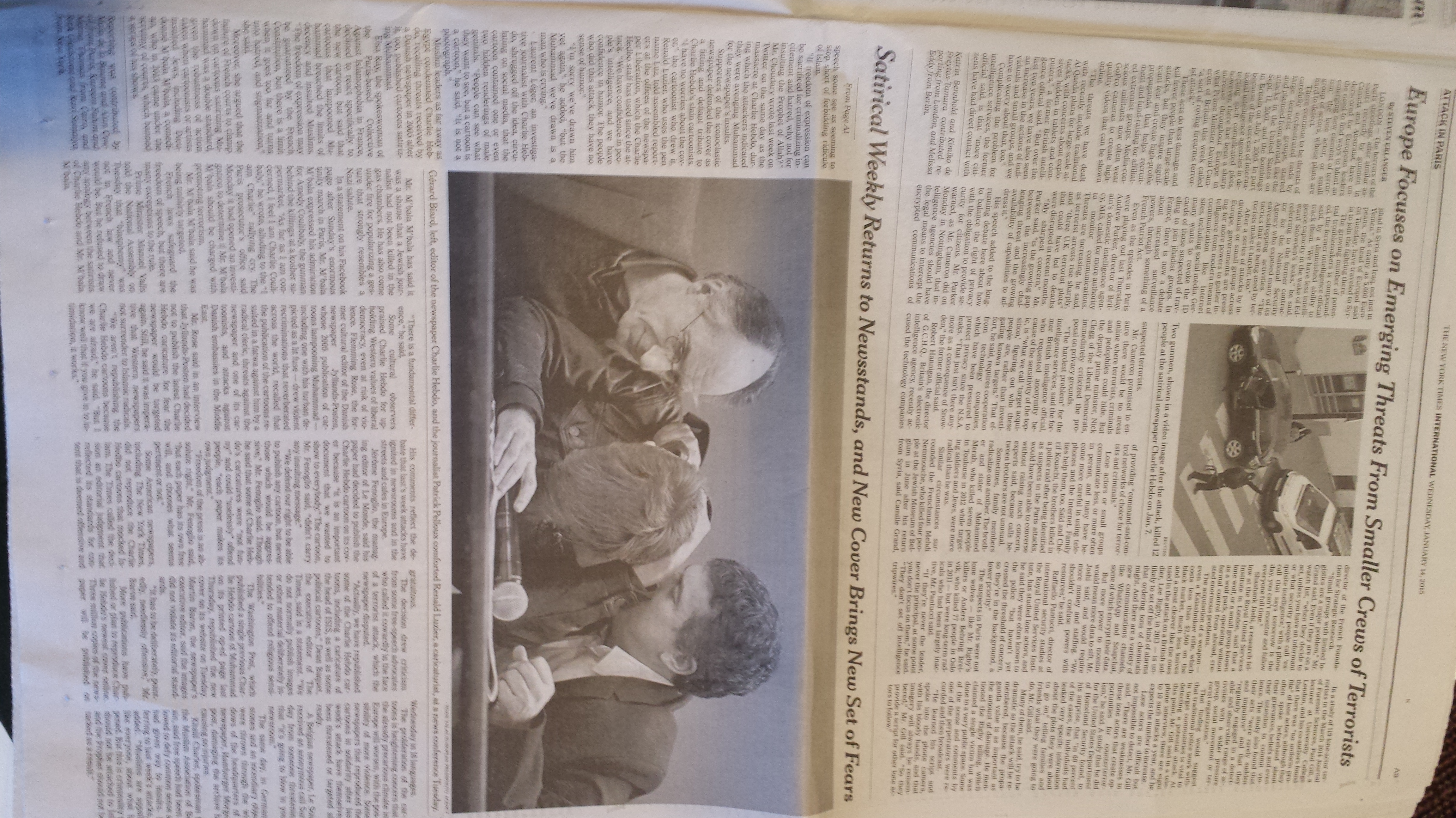
In the NY Times lead front page story of January 14 referring to such “double standards”, the paper contrasted the right of Charlie Hebdo to make cartoons of the Islamic prophet Mohammed, to the arrested French “comedian” M’bala M’bala who stated that a Jewish journalist should have been killed in the Nazi gas chambers and that he considers himself like the terrorist who shot and killed four Jews in the Parisian supermarket. Neither clarification nor education was given about the differences and limits of free speech.

20150115_144909

The NY Times continued to confuse the public (or itself) in a story the next day by David Carr, which included the following:

  • “Not all the French were reveling in unbridled expression of speech. Dieudonné M’bala M’bala, a comedian who has made highly provocative statements since the shooting at Charlie Hebdo’s offices, was detained as an “apologist for terrorism” for statements he made on his Facebook page that were seemingly in support of one of the attackers.
  • His arrest highlights the fact that one man’s free expression is another man’s hate speech or sedition. In Israel, the conservative Jewish newspaper HaMevaser scrubbed out the German chancellor Angela Merkel from a photograph, along with other female leaders who had participated in a solidarity march in Paris, because photos containing women are considered inappropriate in ultra-Orthodox publications.”

In an effort to educate the Times and its readership, here are three important points to distinguish between various types of speech:

  • Concept versus People
  • Active versus Reactive Incitement
  • Editing versus Censorship

 Concept versus People

A central dividing line between freedom of speech and hate speech has to do with the right to discuss concepts as opposed to the right (and limit) to discuss people. Everyone is free to say anything they want about concepts such as: capitalism, communism, Islam and Buddhism. Whether it is religion or economic theory, each topic is considered a concept worthy (perhaps?!) of discussion and debate in a positive or negative fashion. However, speech can descend into “hate speech” (or libel) which is banned by many countries, if people attack either groups or specific human beings.

For example, Louis Farrakhan, a bombastic anti-Semitic Muslim preacher referred to Judaism as a “gutter religion”. He was not brought up on any charges, despite the hateful speech. Egyptian leader Mohammed Morsi was not prosecuted for calling Jews the descendants of monkeys and pigs, which could have perhaps been classified as hate speech in some countries because he addressed people rather than a religion.

 Active versus Reactive Incitement

A key factor in the distinction of permissible versus prohibited speech revolves around “incitement”. Many countries prohibit speech that incites violence, as does the recent United Nations Resolution 16/18. The UN language:

  • “condemns any advocacy of religious hatred that constitutes incitement to discrimination, hostility or violence, whether it involves the use of print, audio-visual or electronic media or any other means”

The phrase incitement to violence is clear. For example, when an imam in Germany called for killing Jews, that fell under hate speech to incite violence, and the country is now investigating that imam.

However, it is considered completely legal to say things that may involve “reactive incitement”, that is, saying something that may annoy people to the extent that they would use violence. To ban reactive incitement would stifle free speech completely which is what the press sees as the essence of the Charlie Hebdo assassinations. Just because Muslims were insulted by the publishing of cartoons of their prophet, their reaction cannot be the basis to ban that freedom of expression.

Based on the United Nations language, the incitement to discrimination would have to be explored further. Did Charlie Hebdo promote discrimination against Muslims? Was the paper simply making pictures of Mohammed or was it attempting to foster intolerance of all Muslims? The new United Nations law makes a distinction.

The M’bala M’bala calls for a Jewish journalist to be killed in gas chambers and supporting terrorists who killed four innocent Jews are calls for direct and indirect incitement to hostility and violence.  Acting Palestinian Authority President Mamoud Abbas praise for martyrs who slaughtered innocents could also be called incitement to hostility and violence.

dalal_popular_inauguration

Fatah officials at naming of Dalal Mughrabi square,
murderer of 38 civilians including 13 children

 Editing versus Censorship

Every media outlet edits their news stories. Papers constantly select only those parts of interviews that confirm a thesis it promotes to its readers. That is (theoretically) its right. Michael Moore edited interviews about global warming and the auto industry to convey a particular narrative that he wanted to portray in his movies. The public may ultimately view the half-stories they receive as accurate, half-accurate or completely inaccurate because of the known bias of the producers of the content.

However, no one considers editing to be a form of censorship or an infringement on the freedom of speech or press. If a paper opted to not publish a sports section, that is its right. If it crops a picture to focus on a particular image to reinforce its narrative, that is also its right. It may be bad journalism, but it is not censorship (and certainly not by a governmental authority).

In its ramble on free speech above, the New York Times highlighted the Israeli “conservative” newspaper Hamevaser’s choice to edit the picture of the Paris unity march to remove the female leaders. Hamevaser is run by and serves an ultra-Orthodox Jewish community (not politically conservative) that is against showing pictures of women due to their interpretation of modesty. Such action is a form of editing that newspapers engage in to meet the tastes of its readership. To somehow suggest that it is a form of Israeli censorship is absurd. Why would the Times possibly lump this example in with examples of freedom of speech and hate speech? It is completely off topic.


People in the western world rallied behind Charlie Hebdo because they see this situation as falling completely within the framework of free speech: it poked fun at a religion (a concept), not people (Muslims); and it did not call for any violence, rather the attacks came from a reaction from incensed Muslims. The case of M’bala M’bala has to do with inciting violence against people, and the Hamevaser picture has nothing at all to do with government censorship.

So how did the Times develop this list of irrelevant examples and not try to educate its readers (and actually confuse them with calling out “double standards”)?


Sources:

NYtimes articles and picture Jan 14: http://www.nytimes.com/2015/01/14/world/europe/new-charlie-hebdo-has-muhammad-cartoon.html

NY Times article January 15: http://www.nytimes.com/2015/01/15/business/media/flocking-to-buy-charlie-hebdo-citizens-signal-their-support-of-free-speech.html?_r=0

Louis Farakhan on Judaism: https://www.youtube.com/watch?v=NbrH3eUuA3U

Egyptian leader Mohammed Morsi calling Jews names: https://www.youtube.com/watch?v=JukaOi8pKzM

UN Resolution 16/18: http://www2.ohchr.org/english/bodies/hrcouncil/docs/16session/A.HRC.RES.16.18_en.pdf

German imam calling for killing Jews: http://forward.com/articles/202751/germany-warns-against-hate-speech-after-imam-calls/

PA Abbas praise for terrorists: http://www.algemeiner.com/2013/01/10/video-of-abbas-praising-hitler-supporting-mufti-terrorists-released-video/

Naming square and centers after terrorist who killed 37 civilians: http://www.palwatch.org/pages/news_archive.aspx?doc_id=1442

Related First One Through articles:

Blasphemy or terrorism: https://firstonethrough.wordpress.com/2015/01/12/blasphemy-or-terrorism/

Klinghoffer opera: https://firstonethrough.wordpress.com/2014/06/23/eyal-gilad-naftali-klinghoffer-the-new-blood-libel/


New York Times Finds Racism When it Wants

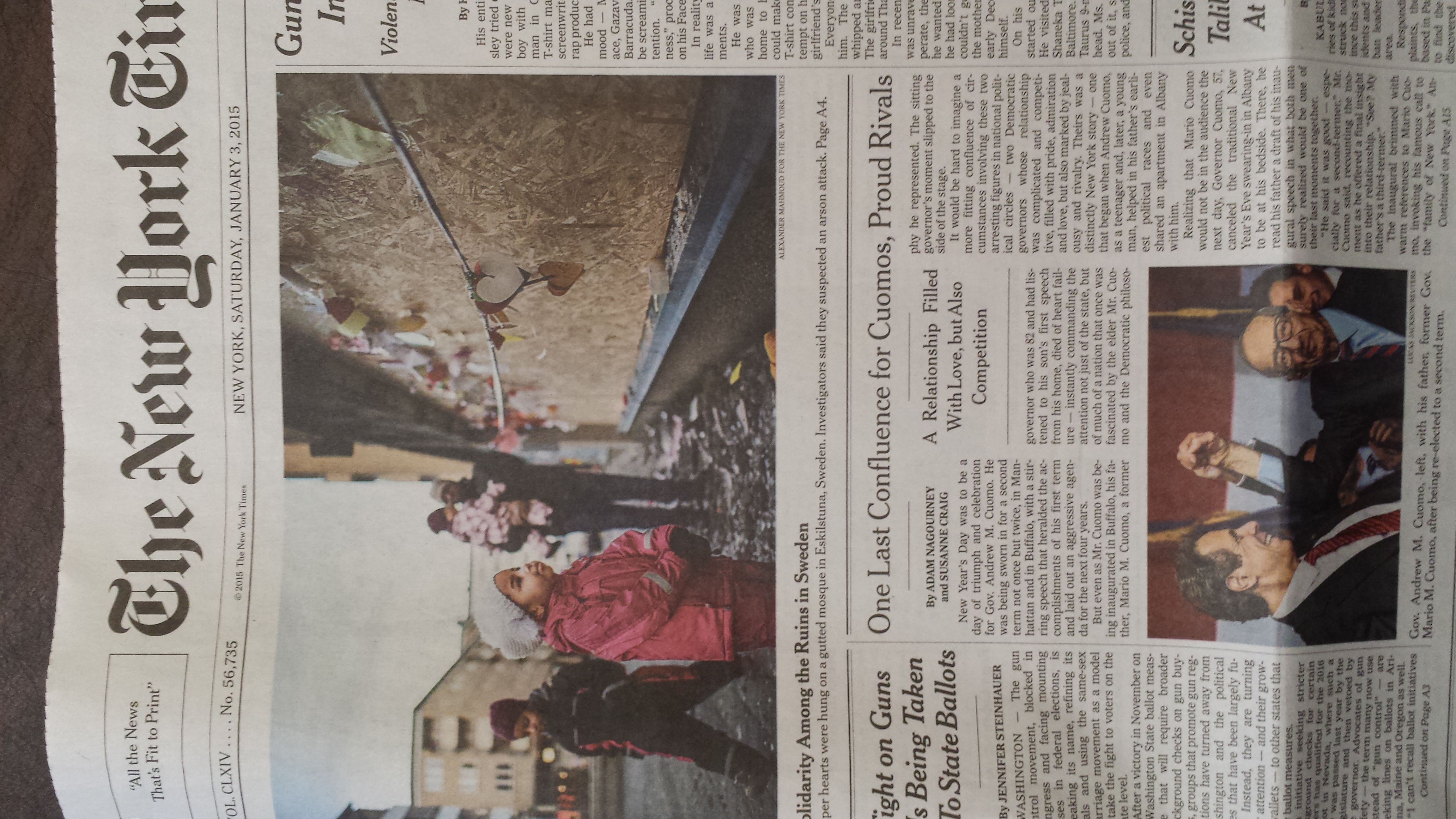
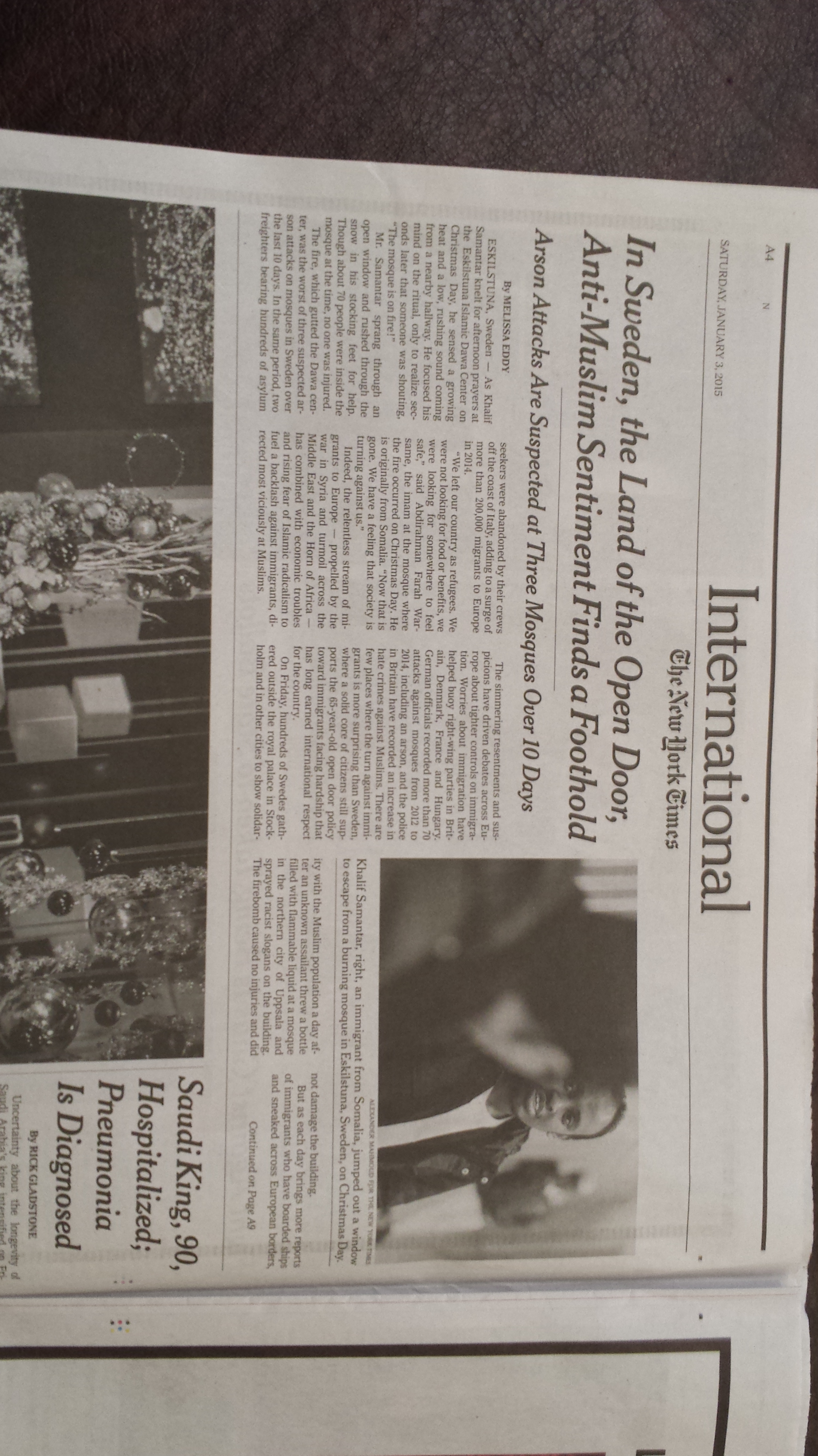
On January 3, 2015, the New York Times posted a large color picture on its front page about people in Sweden standing against a suspected arson attack on a mosque. The article on page A4 that continued onto page A9 described how anti-Muslim sentiment has taken hold in a country that had been known for its liberal immigration policy.

Sweden-articleLarge
New York Times cover about Attack on Mosque in Sweden

Anti-Muslim vs. Anti-Semitism

It is interesting to note how the paper highlighted the “anti-Muslim sentiment” in the title of the article after three suspected arson attacks against mosques in Sweden over the previous ten days. There were no witnesses and no arrests in the attacks but the Times drew its own conclusion that the fires must have been driven by “anti-Muslim” anger.

Compare that conclusion with the one at which the Times arrived in reviewing the actions in Europe during a week in July 2014. There were a dozen incidents involving thousands of people:

  • A synagogue was firebombed in Paris
  • Jewish stores including kosher butchers were looted and 18 people were arrested
  • A mob that gathered outside a synagogue with a hundred Jews trapped inside, shouted “Death to the Jews” and “Hitler was right”
  • In Belgium signs posted in store windows read “no Jews allowed”
  • In Berlin, an imam called for the murder of Jews
  • In Paris, a riot of 4000 people with weapons called for attacks on Jews; 70 were arrested
  • A Facebook page with the names and faces of Jews was posted with a call to attack the individuals who were later beaten
  • The leaders of several countries in Europe condemned the attacks as raw “anti-Semitism”

Despite the clarity of the attacks against Jews, in two separate articles the New York Times said those incidents had an “anti-Semitic tinge”. “TINGE” – meaning that the anti-Jewish sentiment was barely noticeable.

20150104_134833

The Invisible Cause

The Times article on Sweden did not highlight any Muslim actions that may have caused the Swedish “anti-Muslim” sentiment. It mentioned European “rising fear of Islamic radicalism” in a general manner, and mentioned the poor economic situation that recent immigrants find themselves in, and the generous benefits afforded by Sweden’s welfare economy. But the article sought to distance the economic strain on Swedish society by quoting a recent immigrant who stated: “We were not looking for food or benefits. We were looking for somewhere to feel safe.” Some stories neglected by the Times article:

Muslim riots: In 2013, various riots broke out in Sweden with Muslim immigrants burning cars and neighborhoods and throwing stones. Some of those events were covered by the Times. The paper referred to the rioters as “immigrants” throughout the article, and never mentioned their Islamic faith.

Explosion of Rape cases: Over the past decade, the number of reported rapes in Sweden has exploded. The country now ranks as the third highest country in terms of the number of rapes, as the frequency has jumped 250% between 2003 and 2010. While most of the world has seen reported cases of rape dropping or leveling out, the trend in Sweden has been alarming and the focus of much discussion and debate. Many people have attributed the dramatic spike as due to the influx of immigrants from the Middle East, Africa and southeast Asia where rape is much more common than western Europe. This piece of information was also not included in the Times article about Swedes becoming “anti-Muslim”.

Interestingly, in perhaps a related trend, a huge scandal broke in the summer of 2014 about 1400 girls in northern England who had been systematically raped by a gang of Pakistani Muslim men over 13 years. During its reporting of the story, the New York Times refused to publish that any of the attackers was Muslim and just referred to them as men with “Pakistani heritage”. Other media outlets did not exclude the common faith in their reporting.

It would appear that the New York Times deliberately avoids mentioning the religious background of Muslims when reporting crimes, but is quick to blame crimes against their community as “anti-Muslim”.

Conversely, in reporting the European riots protesting Israel, the New York Times seemed perplexed as to why Americans supported Israel while Europeans did not. It put forth an absurd idea that Americans supported Israel “because of the failure of the Arab Spring to spread democracy in the Middle East.” It ignored the actual evil actions and comments of the Palestinians that have been waging war against Israeli civilians for years. Once again, the Times absolved the Muslims of culpability. Regarding the riots in Europe against innocent Jewish citizens of their respective countries who were not Israelis, the Times dismissed the anti-Semitism as not noteworthy.

Racism and anti-religious feelings are indeed real.  The Times has shown that it is adept at finding or ignoring such sentiments as it fits the narrative they are selling.

20150104_134900


Sources:

Immigrant riots in Sweden: http://www.nytimes.com/2013/05/27/world/europe/swedens-riots-put-its-identity-in-question.html?pagewanted=all&_r=0

Rapes in Sweden: http://www.frontpagemag.com/2013/dgreenfield/1-in-4-swedish-women-will-be-raped-as-sexual-assaults-increase-500/

http://www.liveleak.com/view?i=de1_1394099792

Global rape statistics: http://en.wikipedia.org/wiki/Rape_statistics

Pat Condell on Sweden: https://www.youtube.com/watch?v=RZsvdg1dkJ4

Related FirstOneThrough articles:

Anti-Semitic Tinge: https://firstonethrough.wordpress.com/2014/07/25/an-anti-semitic-tinge/

NY Times calling “an anti-Semitic tinge” for a second time: https://firstonethrough.wordpress.com/2014/07/27/tinge-two-idioms-for-idiots/

1400 girls raped in Britain, yet the NY Times refuses to point to the rapists as Muslims: https://firstonethrough.wordpress.com/2014/09/06/the-ties-that-bind-and-those-unmentioned/


Palestinians are “Desperate” for…

On January 1, 2015, the New York Times editorial page led with a piece titled “The Palestinians Desperation Move.” The opinion piece advanced the case that acting Palestinian Authority President Mahmoud Abbas must be frustrated in his mission to create a new Palestinian State.

…Creating a State?

Desperate people take what they can. They view their options as limited and prospects as weak. They seize any opportunities to advance their main goal, whatever that might be.

Witness early Zionists agreeing to any size and configuration of a Jewish state, despite their dream for a larger state based on the British Mandate of Palestine in 1922. They voted “yes” to a United Nations partition in 1947. They voted “yes” to greater Jerusalem and greater Bethlehem being international cities.

The Arabs, on the other hand, consistently voted “no” at every juncture.

These are not activities of a people that is “desperate” for a state. These are not actions of leaders who are willing to make compromises to establish a country and move their people forward.


… Maximizing a Jew-free State and/or Destroying the current Jewish State

Palestinian actions have consistently had three main areas of focus:

  1. Creating a new state free of any Jews
  2. Maximize the size of the new Palestinian state: either the entirety of Israel+West Bank+Gaza or using the 1949 Armistice Lines
  3. If there remains a state of Israel, it should be small and not Jewish


A Jew-free Palestinian state: Palestinians have sought to recreate the conditions of the Arab-controlled regions that expelled and barred the Jews from 1949 to 1967. The Palestinian leadership has continually called for preventing any “settlements”, meaning barring any Jewish people from living anywhere in Gaza, the West Bank and the eastern part of Jerusalem that was controlled by Jordan from 1949-1967. Various Palestinian efforts towards peace talks have demanded a pre-condition of Jewish settlement freezes before any peace talks could begin.  They have lobbied the United Nations to condemn any and all settlements as illegal (even though Jews always lived in the lands before the illegal Jordanian takeover in 1949).

Palestinian law has repeatedly cemented the position of a Jew-free state. In 1973, it passed legislation that made the sale of any land or home to an Israeli to be a capital offense. The Palestinian Authority announced in 1997 that it would seek the death penalty for anyone selling land to a Jew or Israeli.

Abbas has repeatedly voiced his vision of a Jew-free Palestine, stating that he would not allow the presence of a single Israeli- civilian or soldier – in a new Palestine.

Abbas and other members of the Palestinian Authority have also called on the world to engage in a BDS- Boycott, Divestment and Sanction – of any Israeli company that has a presence in the territories they hope will become a Palestinian state. Their aggressive efforts in advancing BDS further underscores their desire to not only prevent any Jews living in a future state, but even establishing businesses there as well.

Even the Universities on the West Bank have laws that prohibit Jews from stepping foot onto campuses.

In short, Palestinian law and leadership calls for banning Jews from visiting, working, buying land or living in the territories it wants for a future state.

Those are the official positions of the “moderate” acting-president of the Palestinian Authority and the existing Palestinian laws. However, the majority of the Palestinian people are in favor of Hamas and would elect someone from Hamas as president according to every poll over the past few years. The Palestinian public elected Hamas to 58% of the Palestinian parliament in their last election in January 2006. Hamas’s charter and its leaders call for the outright killing of Jews and have specifically identified the Jewish nature of Israel as the root cause of the conflict: In face of the Jews’ usurpation of Palestine, it is compulsory that the banner of Jihad be raised…”


Maximize the size of the Palestinian state. It is not surprising that the Palestinians want to maximize the size of a future state; Israel wants to maximize what it can achieve in negotiations too. However, as detailed here, the working parameters for the Palestinians are to achieve “maximums” and certainly not reflective of a group that is “desperate” and willing to compromise.

Hamas calls for a single Arab Palestine to cover Gaza, the West Bank and all of Israel. They have never backed down or waivered from their 1988 charter in any statement from any leader since that time.

Abbas’ Fatah party has stated that it will “compromise” for a Palestine that follows the “1967 borders.” It states this, despite the fact the 1967 “borders” were not borders but Armistice Lines established in 1949 with Egypt and Jordan. Both of those armistice agreements specifically stated that those lines were not intended to be borders. After repeated invasions and wars by the Palestinians and its Arab allies, Israel has made clear that it will not accept those 1949 Armistice lines as final borders.

“Moderate” Palestinians argue that United Nations Resolution 242 stated that Israel should remove its armed forces from territory acquired during the 1967 war. While the Israelis point out that the language specifically does not state that it must leave “all” of the territory, Abbas is demanding such complete withdrawal; a “maximum” position within the two-state framework.


No recognition of the Jewish State. For much of Israel’s existence, the Arab world refused to recognize Israel in any matter at all and viewed Israel’s entire existence as illegitimate. The Arab world underscored the point with the famous three “no’s” in 1967 including refusing to recognize the basic existence of Israel.

In 1975, Yasser Arafat and the PLO effectively lobbied the United Nations to label the national aspirations of Jews to be a form of racial discrimination. Specifically, Resolution 3379 adopted by the General Assembly referred to the “the racist regime in occupied Palestine” and determined “that zionism is a form of racism and racial discrimination.” Such efforts have nothing to do with establishing a new country and everything to do with delegitimizing the rights and claims of Jews to their own state.

Today, Palestinian leadership continues on the same path of delegitimizing Israel.  Palestinian leadership makes a point of denying Jewish history in the Holy land. Whether addressing the United Nations General Assembly or speaking to reporters, acting Palestinian president Mahmoud Abbas denies any connection between Jews and their history in the land. In 2014, Abbas stated that “they [Israel] imagine that by brute force they can invent a history, establish claims and erase solid religious and historical facts.

Abbas has made very clear that he will never recognize the Jewishness of the state of Israel:

  • I’ll never recognize Israel as a Jewish state.” (2014);
  • We shall never agree to recognize the Jewish state.” (2013);
  • “I will never recognize the Jewishness of the state, or a “Jewish state.” (2011)

Underscoring these points is the insistence of a “Right of return” for descendants of pseudo-refugees to the state of Israel. He believes that the 4.6 million SAPs (Stateless Arabs from Palestine) should be entitled to move into Israel as opposed to a new Palestinian state. The entire point of partitioning the land for two peoples and creating a new Palestinian state is to create a home for these Arabs. What is the point of sending the grandchildren of Arabs who left homes in 1948 to a country they despise (Israel) when they are just creating the country they dreamed of (Palestine)?


For almost a century, the Palestinians have tried various paths to achieve their goals: broad regional wars;  local wars; intifadas; riots; peace talks and lobbying the United Nations.  But what are they hoping to achieve?

If the primary goal of the Palestinian people was a state, would they care if a small number of Jews lived there? Would they so strongly object to recognizing Israel as a Jewish State? Would they insist on an all-or-nothing strategy of getting everything in negotiations?

Are Palestinians truly desperate for a state or are they desperate to deny any rights and legitimacy of Jews to live in the land?

20150102_084725


Sources:

1936 riots: http://www.jewishvirtuallibrary.org/jsource/History/riots36.html

1947 Partition plan: http://www.jewishvirtuallibrary.org/jsource/History/partition_plan.html

1948-9 Israel war of Independence: http://www.jewishvirtuallibrary.org/jsource/History/1948_War.html

1967 Six Day War: http://www.washingtonpost.com/wp-dyn/content/article/2007/05/17/AR2007051701976.html

Khartoum declaration: http://www.sixdaywar.org/content/khartoum.asp

Arafat ends 2000 Clinton-Barack initiative: http://www.theguardian.com/world/2001/jan/03/israel2

Hamas wins 2006 elections: http://www.washingtonpost.com/wp-dyn/content/article/2006/01/26/AR2006012600372.html

No response to Olmert plan: http://www.haaretz.com/news/olmert-abbas-never-responded-to-my-peace-offer-1.263328

Netanyahu 10-month settlement freeze to re-start talks: http://www.nytimes.com/2009/11/26/world/middleeast/26israel.html

No Abbas engagement for nine months: http://www.foxnews.com/opinion/2010/10/13/kenneth-bandler-israel-palestine-peace-mahmoud-abbas-united-states-plo-arab/

Maximum of Olmert is short of Minimum for Abbas: http://www.israelnationalnews.com/News/News.aspx/175910#.VKl5bJs5CUl

Various quotes of Arab intents for Israel: http://www.paulbogdanor.com/israel/quotes.html

Palestinian law banning the sale of land to Jews: http://www.jpost.com/Middle-East/PA-affirms-death-penalty-for-land-sales-to-Israelis

Left-wing article on left-wing journalist barred from Bir Zeit University: http://jfjfp.com/?p=65375

UN resolution 242: http://www.jewishvirtuallibrary.org/jsource/UN/meaning_of_242.html

UN Zionism is Racism: http://unispal.un.org/UNISPAL.NSF/0/761C1063530766A7052566A2005B74D1


Related FirstOneThrough articles:

Laws of Living in Silwan: https://firstonethrough.wordpress.com/2014/10/20/real-and-imagined-laws-of-living-in-silwan/

Abbas knows Racism: https://firstonethrough.wordpress.com/2014/10/27/abbas-knows-racism/

Palestinians are not “resorting” to violence: https://firstonethrough.wordpress.com/2014/11/19/the-palestinians-arent-resorting-to-violence-they-are-murdering-and-waging-war/

The Green Line: https://firstonethrough.wordpress.com/2014/12/09/the-green-line/

Palestinian “refugees” or “SAPs”: https://firstonethrough.wordpress.com/2014/08/08/palestinian-refugees-or-saps/

Palestinian Xenophobia music video (Mr. Rogers): https://firstonethrough.wordpress.com/2014/11/11/wont-you-be-my-neighbor/


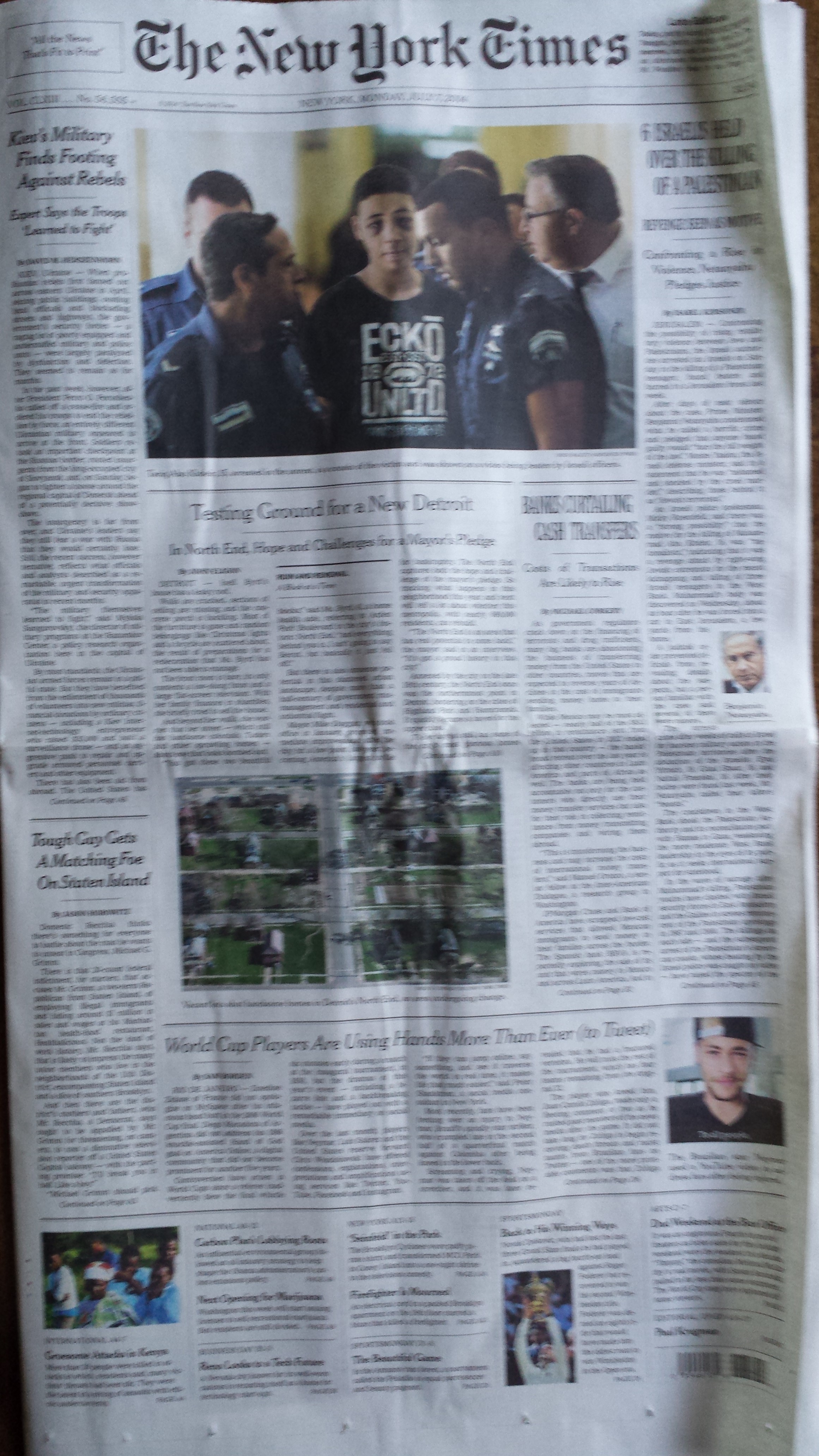
The New York Times Picture of the Year, 2014

15yearold

The year 2014 was notable for the global escalation in terror and death compared to prior years.

  • Islamic State/ ISIS created killing fields in Iraq, executing and beheading hundreds of people which it recorded and aired on the Internet. The group massacred and destroyed entire villages that existed for centuries.
  • Boko Haram in Nigeria killed hundreds of Christians and abducted hundreds of girls.
  • The ongoing war in Syria had a death toll approaching 200,000 people including over 10,000 children.
  • Israel responded to attacks from Gaza for the third time in eight years as Hamas continued rocket fire into Israeli towns. An advanced Hamas terror tunnel network extending into Israel forced a ground invasion into Gaza which claimed over 2000 lives.
  • Russia invaded and annexed Crimea, as Ukraine turned to the world for support but received virtually nothing.
  • Wars in Sudan, Yemen, Afghanistan and other countries continued to claim thousands of lives.

The year also included near break-out race riots in the United States as several unarmed black men were killed by white police officers. In Africa, the deadly disease Ebola killed thousands.

Various news agencies highlighted the most significant news events which ranged from Ebola to Russia’s invasion of Ukraine. They selected new events that impacted thousands of people in 2014 which had potentially long-term consequences.

The New York Times year-end review posted dozens of pictures of conflicts around the world to encapsulate 2014.  In my opinion, the NYT picture that  summed up a dominant theme in its reporting for 2014 was the picture above, of a 15-year old Arab surrounded by Israeli policemen. For the New York Times, the stories on its cover pages in 2014 repeatedly told the story: that Israel attacks Arab youths.

The large color picture was displayed on its cover page on July 7, 2014. The bruised 15-year old Arab boy was being escorted out of a police station where he had been detained after throwing stones in a riot. There are several things that make the front-page treatment of the teenager note-worthy:

  • On that same day, over 100 people were killed in attacks in Kenya, Uganda and Yemen. Small stories appeared on the inside pages of the Times to discuss the scores murdered.
  • When Boko Haram killed hundreds, it also did not make the front page.
  • ISIS beheadings of journalists did not make the front page.

The beating of an Arab youth by Israeli forces was given more prominence and therefore deemed more important than those other world events.

This New York Times news story came shortly after three Israeli teenagers were abducted and murdered by Palestinians. The New York Times never placed even a small black-and-white photo of any of the three Jewish teenagers on the front page. Their plight was also not viewed as important by the Times.

Over the course of the next several weeks as Operation Protective Edge unfolded, the New York Times continued to put pictures of Palestinian children on the front page of the paper. Throughout July (July 11, 14, 17, 21, 22, 24 and 29th) the paper had pictures of Palestinians suffering on the front page. It took until July 29 – buried on page A6 – for the Times to write about and post a single picture of the Hamas terror tunnel network that was a main factor in launching the Israeli ground invasion of Gaza.

Further, Palestinian leadership, whether Hamas leaders such as Khaled Mashal or acting Palestinian Authority president Mahmoud Abbas, never were pictured on the pages of the Times during Operation Protective Edge (the only leader to be pictured was Ismail Haniya on September 4 page A10, well after the fighting had stopped). The paper only showed pictures of Arab civilians. However, Israeli Prime Minister Benjamin Netanyahu’s picture was shown often (July 7 twice; July 22; July 27; July 29; August 7), as were Israeli police and soldiers. The overall message of the New York Times was clear: the Israeli government was attacking Palestinian youths and civilians; it was not a war between opposing government authorities.

The Times news stories and editorials built additional narratives onto this theme, regardless of inaccuracies. In attempts to make the Israeli government seem callous to the conditions of Arab youth, an article and editorial on July 7 and July 8 stated that “days of near silence” passed before Israel Prime Minister spoke about the killing of an Arab teenager by Israeli radicals. This was completely untrue and it took days for the NYTimes to print a correction (below).

The NYT editorial board led with a piece on July 19 entitled “Israel’s War in Gaza”.  It was not called “Hamas’ War against Israel”, nor was it called the “War Between Hamas and Israel”.  The Times continued to paint the battle as an aggressive Israeli action against a populace.

In case there was any confusion in the New York Times message to its readership, it included another small picture of Netanyahu near its large picture of the year. (By way of comparison, did you ever see the NYT post a picture of US President Obama near an article about drone strikes or deaths in Afghanistan that he specifically ordered and oversaw?)


The New York Times tried to defend its coverage of the Gaza conflict by printing an editorial on November 23, 2014 entitled “The Conflict and the Coverage”.  Not surprisingly, it attempted to defend its poor media coverage and that it tried too hard to offer “symmetry” in the conflict. It claimed that the paper has “baseline beliefs that Israel has a right to exist and that the Palestinians deserve a state of their own.” The charitable Times board believing that “Israel has a right to exist,” clearly doesn’t extend to: believing that Israel has a right to defend itself; that it was reluctantly pulled into a battle in Gaza; that it sought to minimize Arab casualties; that Hamas is rabidly anti-Semitic; that Hamas leaders are intent on destroying Israel and killing Jews; and that Arab leadership was responsible for the war and deaths of both Israelis and Palestinians.


Sources:

http://www.huffingtonpost.com/2014/07/07/jodi-rudoren-new-york-times-_n_5564067.html

Times moved picture down in online of story: http://www.nytimes.com/2014/07/07/world/middleeast/israel-palestinians-muhammad-abu-khdeir.html

Every Picture Tells a story: https://firstonethrough.wordpress.com/2014/07/04/every-picture-tells-a-story-dont-it/

Bibi as a killing monster: https://firstonethrough.wordpress.com/2014/07/08/every-picture-tells-a-story-part-ii/

The NYT buried pictures: https://firstonethrough.wordpress.com/2014/07/29/the-new-york-times-buried-pictures/


NY Times Correction: July 9, 2014

An article on Monday about the arrest of six Israelis in the killing of a Palestinian teenager referred incorrectly to Prime Minister Benjamin Netanyahu’s response to the killing of Muhammad Abu Khdeir. On the day of the killing, Mr. Netanyahu’s office issued a statement saying he had told his minister for internal security to quickly investigate the crime; it is not the case that “days of near silence” passed before he spoke about it. The error was repeated in an editorial on Tuesday.”


Names and Narrative: The West Bank / Judea and Samaria

The New York Times has taken more concerted efforts to balance the narrative between Muslims and Jews regarding the holy city and sites in Jerusalem. It has not taken such efforts elsewhere where it only uses an Arab narrative.

JERUSALEM

The holiest site in Judaism is “The Temple Mount” in Jerusalem, due to the fact that it was the location of Judaism’s two temples which existed from roughly 954BCE to 70CE. The Jewish King Herod built the Temple Mount platform specifically for Jewish use to ease access and flow to the Second Temple. To this day, it continues to be the direction of all Jewish prayer.

In Islam, that holy site is called the “Noble Sanctuary”, or “Bayt al-Maqdes” or “Al-Haram al-Sharif”. It is Islam’s third holiest site after Mecca and Medina, both located in Saudi Arabia. The Noble Sanctuary holds the Al Aqsa Mosque and the shrine known as the Dome of the Rock.

Historically, the New York Times would reference the names that both religions ascribed to the holy site, typically with the Jewish name first (the Temple Mount), and later in the article, it would use the Islamic name (Noble Sanctuary). More recently, the Times would use both names in the same sentence, and occasionally use the Islamic name first, followed by the Jewish name.

JUDEA AND SAMARIA

However, when it comes to other sites in the region with different names from the two peoples, the Times excludes the Israeli terminology: specifically, “Judea and Samaria”. For such region, the Times will only use the term “West Bank”, except if an Israeli is quoted using the name Judea and Samaria.

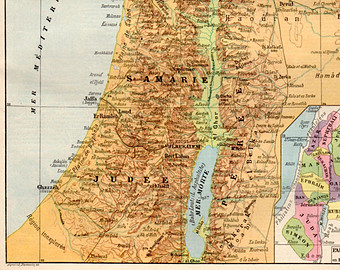
Interestingly, the West Bank never existed as an entity until 1949, and was never even referred to by the United Nations Security Council until 1953. In comparison, Judea and Samaria, which cover more area than just the West Bank, have existed for thousands of years.

The “West Bank” came into existence after five Arab armies attacked Israel in 1948. The armistice lines established in 1949 at the end of the war with Jordan became known as the “Green Line” as the line was drawn in green on the maps. The haphazard demarcation did not follow any historic, political or geographic contours, but was simply where the warring parties stopped fighting. The area east of the green line eventually became known as the West Bank.

In the years following the 1948 Arab attack on Israel, every United Nations Security Council (UNSC) Resolution regarding the “Palestine Question”, never mentioned Palestinians as a discrete people or the “West Bank” and Gaza as entities. Each resolution referred to the various parties in the conflict being Israel, Syria, Jordan and Egypt. The term “west bank (in lower case) of the Jordan” only showed up for the first time in 1953.

The term “West Bank” is an Arab artifice and highlights the short, violent and illegal Arab rule of the area:

  • It was achieved in an offensive war to destroy Israel
  • The duration of Arab rule only lasted for 18 years 1949-1967
  • Arab rule of the West Bank was never internationally approved (the UNSC never voted on the April 1950 Jordanian annexation of the area)
  • Was administered counter to the Fourth Geneva Convention (the Jordanians and Palestinians deported all of the Jews out of the territory)

The exclusive use of the term “West Bank” gives a false impression that the territory has a long history of Palestinian Arab rule. Further, in never using the term “Judea and Samaria” for the region, the UN, the New York Times and others, distance Jews and Israelis from lands that they lived in for thousands of years.

As the New York Times and other publications now give equal weight to “the Temple Mount” and “Noble Sanctuary”, they should do the same for “West Bank” and “Judea and Samaria”. Alternatively, it could use neutral nomenclature such as EGL- East of the Green Line.

judeasamaria


Source:

2014 NYTimes Noble Sanctuary first, then Temple Mount (11/19/14): http://www.nytimes.com/2014/11/19/opinion/horror-in-israel.html

2014 NY Times mentioning Temple Mount and Noble Sanctuary at the same time (10/31/14): http://www.nytimes.com/2014/10/31/world/middleeast/israel-palestinians-jerusalem-temple-mount-al-aksa.html

(11/7/14): http://www.nytimes.com/2014/11/07/world/middleeast/israel-jordan-jerusalem-al-aqsa-temple-mount.html

(11/23/14): http://www.nytimes.com/2014/11/23/world/middleeast/mistrust-threatens-delicate-balance-at-a-sacred-site-in-jerusalem-.html

Only calling it the “Al Aqsa compound” and not the “Temple Mount” (9/17/14): http://www.nytimes.com/2014/09/18/world/middleeast/unrest-by-palestinians-surges-in-a-jerusalem-neighborhood.html?_r=0

2013 NYTimes mentions Temple Mount and only later Noble Sanctuary (10/15/13): http://www.nytimes.com/2013/10/15/world/middleeast/ten-jewish-men-arrested-at-temple-mount.html

(9/22/13): http://www.nytimes.com/2013/09/22/world/middleeast/jews-challenge-rules-to-claim-heart-of-jerusalem.html?pagewanted=all

2009 NY Times only mentions Temple Mount (10/26/09): http://www.nytimes.com/2009/10/26/world/middleeast/26mideast.html

UN mentioning “west bank of Jordan” for the first time in 1953: http://www.un.org/en/ga/search/view_doc.asp?symbol=S/RES/101%281953%29


Related FirstOneThrough articles:

The Green Line

The EU’s Choice of Labels: “Made in West Bank” and “Anti-Semite”

Nicholas Kristof’s “Arab Land”

Honor Killings in Gaza

The Unmentioned Murders of the Middle East

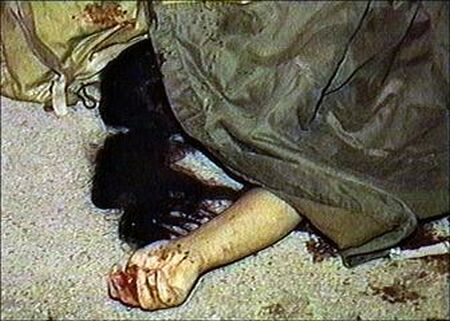
Honor killings have a sad history throughout the Muslim world. Many families deliberately and systematically kill wives and daughters if there is any suspicion of the women bringing “dishonor” to the family. The cause of such shame may come from actual or feared adultery, refusal to marry a designated spouse, or even dressing inappropriately. The cultural rationale for the honor killings is that by murdering the offending women, honor is restored to the families.

Gaza and the West Bank are similar to other parts of the Muslim world regarding the reasons for honor killings. However, the recent spike in the number of killings in the territories has been very dramatic and atypical. In 2011, there were five such murders in the territories. The number of homicides jumped to 13 in 2012, and doubled again to 27 in 2013. In just the first two months of 2014, 8 honor killings were reported by Palestinian media sources, a pace that would have put it on course for nearly doubling again.

By comparison, in Afghanistan an estimated 150 women are killed each year in honor killings. Afghanistan has over eight times the population of Gaza and West Bank, and 18 times Gaza alone. Therefore, on a proportionate basis, the Palestinians now kill twice as many women in honor killings as Afghanistan (or over three times as many if one only counts Gaza where most of the murders take place).

Adding insult to these horrific murders increasing popularity, was the lax way such murders were treated in Palestinian courts. According to the Palestinian Law (Article 340), the killers were not subject to any punishment.

He who discovers his wife or female relative committing adultery and kills,
wounds or injuries one or both of them is exempted from any penalty,
and he who discovers his wife, or one of his female ascendants or descendants
or sisters with another in an unlawful bed and he kills, wounds or injures one
or both of them, benefits from a reduction of penalty
.”

The terrible jump in honor killing of women in Gaza and the West Bank did not make it to the pages of The New York Times. The courts absolution granted to the murderers was not a subject that the Times decided to cover. In 2011. In 2012. In 2013. In 2014.

The closest the New York Times came to an article about the Palestinians’ disregard for a woman’s life in the territories was in an article by Jodi Rudoren in October 2012. That article was about a particular women’s rights advocate. While one would imagine some specifics about the lack of women’s rights and a review of honor killings being covered in such an article, there was barely any mention.

  • There was no description of honor killings
  • No report on the increasing number of killings
  • No review of Palestinian Law absolving the murderers

Instead, Roduren chose to describe the difficulty of a specific woman acting as a rights advocate in Gaza (as opposed to the hardship all women face in Gaza). Of course, according to Roduren, the main source of the hardship was Israel:

  • ““psychological siege” imposed by a combination of Israeli restrictions on travel and trade”
  • “lost a personal battle last month when Israel’s Supreme Court rejected a petition by her and three other women to study in the West Bank.”
  • “the resistance of the Israeli occupation as a priority,”
  • Israeli court ruled, 2 to 1, against the four women
  • “Israeli warplane hit an apartment building”

So what does a reader take-away from the New York Times?

    1. While the New York Times occasionally covered stories of honor killings in Afghanistan or Pakistan, it never covered those killings in Gaza, despite the greater prevalence in Gaza.
    2. When the paper had a chance to describe the honor killings in Gaza in an article about a woman’s rights advocates, it opted not to do so.
    3. The thrust of the sole article on the morbid topic laid most of the blame on Israel, as opposed to the Palestinians themselves

Hooray New York Times. You gave a pass for Mulim misogyny and murder meted out by Palestinians. Absolution of the Arab sins came from Jews just across the Green Line.

It would be much more convenient for the left-wing fringe if Israel bordered Pakistan and Afghanistan as well, so they could blame Jews for the entire reprehensible ritual.

honor_killings


Sources:

Jump in 2014 Honor Killings and Palestinian Law Article 340: http://www.al-monitor.com/pulse/originals/2014/03/palestine-honor-crime-women-abuse-law-abbas.html#

http://www.aljazeera.com/indepth/features/2014/03/upsurge-palestinian-honour-killings-gaza-201432372831899701.html

http://www.mezan.org/en/details.php?id=18419&ddname=honour&id_dept=9&p=center

Jodi Rudoren NY Times 2012 article on Honor Killings: http://www.nytimes.com/2012/10/13/world/middleeast/andalib-adwan-shehada-a-bold-voice-for-gaza-women.html

CNN coverage of honor killings back in 2009: http://www.cnn.com/2009/WORLD/meast/07/30/mideast.honor.killings/

Pope Francis in Turkey

The news agencies reported on Pope Francis’ visit to Turkey in November 2014. Remarkably, the major media outlets such as CNN, BBC, and The New York Times did not report on the extreme hardened Islamic moves that have taken place in Turkey over the past several years, nor other abuses:

  • No mention of the Turkish persecution of the Kurdish minorities
  • No mention of Turkey’s illegal invasion and ongoing occupation of northern Cyprus
  • No mention of the Turkish genocide of the Armenians
  • No mention of rightward shift of Turkish government:
    • Banning kissing in public
    • Banning Youtube
    • Banning Twitter
    • Jailing the most journalists in the world in 2012 and 2013
    • Banning drinking at night

The closest any major news organization came to criticizing Turkey was the Guardian, which quickly backed off with a quote “Things are good now, better than before certainly,” Atmaca said. “I think the Islamist rhetoric [of the government] is mostly show.””

By way of comparison, when the Pope visited Israel in May 2014, the New York Times did nothing to describe the positive environment of Christians in Israel, and constantly sought to portray every move of Pope Francis as critical of Israel in the Arab-Israel conflict (as described in the FirstOneThrough articles below.)  Absent from their narrative, was that Israel is a thriving country with more freedoms of press and worship than any country in the Middle East.  The country is much more than the conflict with the Palestinians, just as Turkey is more than its conflict in Cyprus or with the Kurds.

Here is a FirstOneThrough video analysis of an interview of Recep Erdogan from September 11, 2011, then the Prime Minister and now the President of Turkey. Like the liberal media outlets, the attacks on Israel are persistent, and the hypocrisy is without limits.

FirstOneThrough video “Turkish hypocrisy: Erdogan threatens Neighbors”:


Sources:

CNN coverage: http://www.cnn.com/2014/11/28/world/europe/turkey-pope-visit/

BBC coverage: http://www.bbc.com/news/world-europe-30239233

New York Times coverage: http://www.nytimes.com/2014/11/30/world/europe/pope-brings-message-of-interreligious-peace-to-istanbul.html?_r=0

FirstOneThrough comparing NY Times coverage of Turkish and Israeli elections: https://firstonethrough.wordpress.com/2014/08/11/new-york-times-talking-turkey/

FirstOneThrough on Pope in Israel: https://firstonethrough.wordpress.com/2014/05/28/nytimes-shows-its-preference-in-dueling-narratives-in-the-middle-east/

FirstOneThrough on NY Times Pope’s “Peace prayer” invitation: https://firstonethrough.wordpress.com/2014/05/30/ny-times-skewed-view-on-pope-prayer-invitation-and-mideast-peace/

erdogan

“Mainstream” and Abbas’ Jihad

Abbas’ call to Jihad is to put Fatah into the mainstream.

According to the Webster dictionary, “mainstream” means “a prevailing current or direction of activity or influence”. Dictionary.com defines it as “belonging to or characteristic of a principal, dominant, or widely accepted group, movement, style”.

It is perhaps telling (or sad?) that mainstream media does not understand what “mainstream” actually means. Consider the New York Times usage regarding acting-Palestinian Authority President Mahmoud Abbas’s Fatah party. Time and again it refers to Fatah as “mainstream”:

  • November 6, 2014: “…the attacks on Fatah, the mainstream Palestinian party led by President Mahmoud Abbas…”
  • August 18, 2014: “Hamas and its main rival, the mainstream Fatah faction..”
  • June 2, 2014: “…which is dominated by the mainstream Fatah faction, and its rival Hamas…”
  • May 29, 2014: “…which is dominated by the mainstream Fatah faction, and its rival, …”

However, polls show that both a majority of Palestinians support Hamas and the direction of support is increasing. Consider the quote from the Palestinian Center for Policy and Survey Research on October 10, 2014:

the public still favors Hamas’ “way” over negotiations, and Hamas and Haniyeh
are still more popular than Fatah and Mahmud Abbas”

Further, the trend of the polls shows Fatah continuing to lose support. In legislative elections, Fatah support declined from 43% (March) to 40% (June) to 36% (September). It is Hamas, not Fatah that represents the “current direction or influence” of the Palestinians.

September 25, 2014 poll:

  • Hamas and Haniyeh remain more popular than Fatah and Abbas”
  • “satisfaction with Abbas remains low”
  • “presidential elections if held today: Ismail Haniyeh would win a majority of 55% and Abbas 38%”
  • “If new legislative elections were held today with the participation of all factions… 39% say they would vote for Hamas and 36% say they would vote for Fatah, 5% would vote for all other third parties combined, and 21% are undecided.”

June 5, 2014 poll:

  • “If new presidential elections are held today and only two were nominated, Abbas would receive 53 % and Haniyeh 41%”
  • “If new legislative elections are held today, 32% say they would vote for Hamas and 40% say they would vote for Fatah, 9% would vote for all other third parties combined, and 19% are undecided”

March 20, 2014 poll:

  • “If presidential elections were between three: Mahmud Abbas, Marwan Barghouti and Ismail Haniyeh, Barghouti would receive the largest percentage (36%) followed by Abbas (30%), and Haniyeh (29%)”
  • “If new legislative elections are held today…28% say they would vote for Hamas and 43% say they would vote for Fatah, 12% would vote for all other third parties combined, and 17% are undecided.”

The Palestinians still want a war against Israel. Post Operation Protective Edge, over 79% of Palestinians want rocket fire to continue from Gaza into Israeli cities. Over 25% of Palestinians – in every Palestinian poll taken throughout 2014 – want a complete destruction of Israel.

Abbas knows this, and has used his soapbox afforded by his phony presidential credentials to incite more anger and violence as the Palestinian masses desire. Abbas and Fatah may eventually find their way to the “mainstream” of the Arab public by waving the banner of Jihad, just as its rival Hamas proclaims in its charter.

Quotes of Abbas, October and November 2014:

  • “Keep the settlers and the extremists away from Al-Aqsa and our holy places. We will not allow our holy places to be contaminated. Keep them away from us and we will stay away from them, but if they enter Al-Aqsa, [we] will protect Al-Aqsa and the church and the entire country.”
  • Israel is “leading the region and the world to a destructive religious war,”
  • “It is not enough to say the settlers came, but they must be barred from entering the compound by any means. This is our Aqsa… and they have no right to enter it and desecrate it,”
  • “It is important for the Palestinians to be united in order to protect Jerusalem,”
  • “We have to prevent them, in any way whatsoever, from entering the Sanctuary. This is our Sanctuary, our Al-Aqsa and our Church [of the Holy Sepulchre]. They have no right to enter it. They have no right to defile it. We must prevent them. Let us stand before them with chests bared to protect our holy places.” “

Sources:

FirstOneThrough on Extreme becoming Mainstream: https://firstonethrough.wordpress.com/2014/10/25/extreme-and-mainstream-germany-1933-west-bank-gaza-2014/

Palestinian Survey: http://www.pcpsr.org/

Pick your Jihad, Choose your infidel: https://firstonethrough.wordpress.com/2014/09/28/pick-your-jihad-pick-your-infidel/

The banners of Jihad: https://firstonethrough.wordpress.com/2014/09/29/the-banners-of-jihad/

Abbas’ new Jihad: http://rt.com/news/204583-palestine-abbas-al-aqsa-hamas/

http://news.yahoo.com/abbas-urges-palestinians-protect-al-aqsa-means-191742798.html

Fatah call to kill sellers of land to Jews: https://www.youtube.com/watch?v=YfVsLzfuVu0

http://www.palwatch.org/main.aspx?fi=157&doc_id=12915