Flip-Flopping on the Felling of Terrorist Groups’ Founders

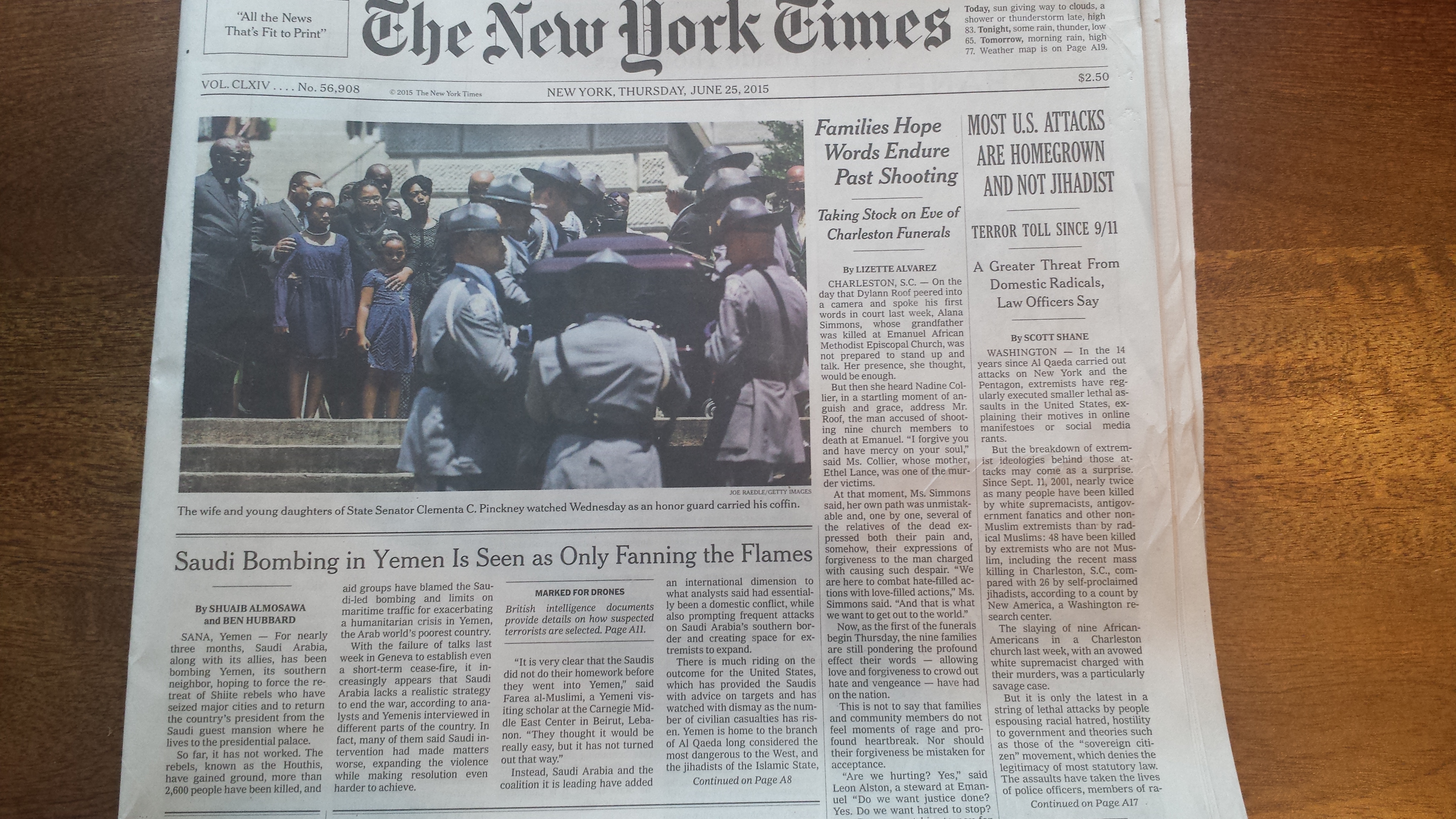
The New York Times reported on July 3, 2015 that “Tunisia’s most wanted jihadist” was killed in an American airstrike. The New York Times coverage stood in sharp contrast to the coverage that the paper used in covering Israel’s killing of a top jihadist in 2004.

DSC_0015
New York Times July 3, 2015 page A6

Headline: The headline from the story in 2015 was “Jihadist From Tunisia Died in Strike in Libya, U.S. Official Says” which clearly labeled the target as a “jihadist”. The way he died was framed in the passive “died” and was attributed to a “U.S. Official” speaking about the incident. This was in sharp contrast to the NYT article “Leader of Hamas killed in Airstrike by Israeli Missile” which did not suggest that the target was a militant but a “leader.” The man was “killed” in an active way, rather than simply stating that he “died”, and the method of the assassination was clearly attributed to Israeli action, rather than news reported by “US Officials.”

Opening paragraphs: A comparison of the opening paragraphs of each article shows the pattern of the Times coaxing its readers to celebrate the assassination of bad jihadists, but questioning the tactics of Israelis.

TUNIS — Tunisia’s most wanted jihadist, who masterminded a campaign of assassinations and terrorist attacks, including one against the United States Embassy in Tunis, was killed in an American airstrike in Libya in mid-June that had targeted another Al Qaeda leader, a senior United States official said on Thursday.

The jihadist, Seifallah Ben Hassine, also known as Abu Ayadh, was one of Osama bin Laden’s top lieutenants and the leader of the outlawed group Ansar al-Shariah in Tunisia. He had been based in Libya since 2013, according to reports, and ran training camps and a network of militant cells across the region.”

The article clearly spelled out that Ben Hassine was a very bad man from the very start of the article. He was the “most wanted jihadists” who led “assassination and terrorist attacks” including against American interests. If the US took out a man who launched many attacks including against Americans, it would make sense that such person got what he deserved. Heck, the article threw in two references to “Al Qaeda” and “Osama bin Laden” to convince the reader that this was a really, really bad guy.

Let’s compare the article about the targeted killing of the founder of Hamas by Israel in 2004:

JERUSALEM, Monday, March 22 Sheik Ahmed Yassin, the spiritual leader and founder of the militant Palestinian group Hamas, was killed early Monday by an Israeli missile that struck him as he left a mosque in Gaza City, his family and Hamas officials said. They said at least two bodyguards had been killed with him.

Sheik Yassin, a symbol to Palestinians of resistance to Israel and to Israelis of Palestinian terrorism, was by far the most significant Palestinian militant killed by Israel in more than three years of conflict.

The article led with the Sheik’s name. He was referred to as the “spiritual leader” who was killed while he “left a mosque.” His demise was reported by “his family.” Overall, he was regarded as much more of a religious human being than the “most wanted terrorist” in the article the attacker against the U.S.

The Times continued that the Sheik was “a symbol to Palestinians of resistance.” This phrase did many things: 1) using the term “symbol” made him appear as an uninvolved player; 2) “resistance” gave credence to a Palestinian narrative. No such equivalence was given to Tunisia’s most wanted terrorist.

While the Times stated that Yassin was the “founder of the militant Palestinian group Hamas”, it did not go on to state that the organization was considered a terrorist group by the US, EU, Israel and many other countries. Yet it did state that the Tunisian terrorist was “the leader of the outlawed group Ansar al-Shariah.”

Don’t worry. The contrasts get worse.

The NY Times then went on to praise the murder of the Tunisian terrorist:

“His death, if confirmed, would be an important victory for Tunisia in its struggle to contain a persistent insurgency in its western border region and a growing threat to its urban centers. Just last Friday, 38 people, most of them British, were massacred at a beach resort in the town of Sousse. In March, 21 people were killed when militants attacked the national museum.

The government has attributed many of the attacks to sleeper cells established by Mr. Ben Hassine when he founded Ansar al-Shariah after Tunisia’s revolution in 2011.”

The Times gave its readers the conclusion of the operation: it was “an important victory”. The people of Tunisia were struggling against a “persistent… and growing threat.” What about Israel?

“Black smoke curled over Gaza City as Palestinians began burning tires in the streets and demonstrators chanted for revenge. Mosque loudspeakers blared a message across Gaza of mourning for Sheik Yassin in the name of Hamas and another militant group, Al Aksa Martyrs Brigades.”

The Times reported that the assassination was not a step forward but a step backward. The killing of the founder of a terrorist movement in Tunisia was a step towards stability while the killing of founder of the Palestinian terrorist group was just a move to escalate a cycle of violence.

The Times emphasized the point by reporting on the recent attacks in Tunisia on tourists at a beach resort and a national museum (anyone in the world could have been one of those tourists, which elicits global sympathy). The Times failed to report on the multi-year Second Intifada which started in September 2000 in which Palestinians killed thousands of Israeli civilians. Just before the Israeli strike, Hamas took credit for two bombings at the Port of Ashdod which killed 10 people. No mention of the incident until much later in the article.


I leave the rest of the two articles for you to read. You will note that one article describes a military attack against a man with a long history of terrorist activities. The other article describes a Palestinian community in grief over the death of a “quadriplegic” without any mention of the hundreds of attacks and thousands of civilians murdered by Hamas.

It is not a coincidence that the article about Tunisia on July 3rd was next to another with a headline “Egypt fights back in Northern Sinai after Deadly Assault by Militants.”  The Times has taken to reporting that much of the world responds to militants while Israel attacks civilians and “spiritual leaders”.  The world’s responses will lead to victory and peace, while Israeli actions escalate violence.

Pretty amazing conclusions

  • from a country that has been waging wars for fourteen years, killing hundreds of thousands of people,
  • about a country that sits in the middle of region that is embroiled in civil wars and terrorist attacks that have also killed hundreds of thousands of people,
  • that is fighting against a group that has declared loudly and proudly its intentions of destroying its state

Related FirstOneThrough articles:

Double Standards: Assassinations

CNN’s Embrace of Hamas

The New York Times wants the military to defeat terrorists (but not Hamas)

Strange difference of opinion on Boko Haram and Hamas in New York Times

Differentiating Hamas

Why the Media Ignores Jihadists in Israel

Absolute and Relative Ideological Terrorism in the United States

Summary: The New York Times has sought to educate people to fear Republican terrorists more than Muslim extremists.

“Right-Wing” versus “Muslim Extremism”

In June 2015 the New York Times ran some articles and editorials claiming that domestic terrorism was more of a problem than radical Islamic terrorism.

  • A June 16 op-ed “The Growing Right-Wing Terror Threat” quoted a police officer that “said that “militias, neo-Nazis and sovereign citizens” are the biggest threat we face in regard to extremism’”. The paper quoted statistics from The Global Terrorism Database which counted 65 attacks at the hands of “right-wing ideologies and 24 by Muslim extremists since 9/11”. It added another source, “the International Security Program at the New America Foundation identifies 39 fatalities from “non-jihadist” homegrown extremists and 26 fatalities from “jihadist” extremists.
  • On June 24, the NYTimes had an article entitled “Homegrown Extremists Tied to Deadlier Toll Than Jihadists in U.S. Since 9/11”. The paper stated that “Since Sept. 11, 2001, nearly twice as many people have been killed by white supremacists, antigovernment fanatics and other non-Muslim extremists than by radical Muslims: 48 have been killed by extremists who are not Muslim, including the recent mass killing in Charleston, S.C., compared with 26 by self-proclaimed jihadists, according to a count by New America, a Washington research center.” That data looks to be the same as the International Security Program, but included the nine black church-goers who had just been gunned down. Another statistic in the article stated that “Non-Muslim extremists have carried out 19 such [ideological] attacks since Sept. 11, according to the latest count, compiled by David Sterman, a New America program associate, and overseen by Peter Bergen, a terrorism expert. By comparison, seven lethal attacks by Islamic militants.”

The Washington Examiner questioned the definition of “right-wing terrorists” to include a very broad group of people. How did neo-Nazis and racists get lumped in with the “right-wing”?  Before exploring the Times deliberate grouping of all non-Muslim extremism under a single banner, consider a brief education about relative numbers versus absolute numbers.

20150626_073343
Main cover story in the New York Times

 Absolute versus Relative

A cursory review of numbers could lead to a quick conclusion: 48 people killed is a greater total than 26 people killed. A total of 19 attacks is more than seven attacks. As such, the quotes in the article such as “Law enforcement agencies around the country have told us the threat from Muslim extremists is not as great as the threat from right-wing extremists” would appear accurate on its face as there were more than two times the number of attacks and almost twice the number of fatalities from non-Muslim attacks.

However, a review of the statistics on a relative basis would yield a very different result.

According to the Pew Research Center, Muslims accounted for 0.9% of Americans in 2014. That means that there are 99 times more non-Muslims than Muslims in the US. If one were to assume that the percentage of Muslims who are radical that would commit an act of terror is the same as the broad group of right-wing and anti-government terrorists within the non-Muslim population, one would expect the right-wing terrorists to have 99 times the number of attacks and fatalities, not two times.  This implies that an average Muslim is 49 times more likely to commit an act of ideological terror than a non-Muslim in the United States.

(By the way, the statistics deliberately exclude the jihadist terrorism of 9/11 which killed nearly 3000 people.)

 The New York Times Warning of Terrorism by Conservatives

After the Times led its readers to focus on “homegrown extremism” as the actual threat of terrorism (compared to jihadists), it lumped all of those non-Muslim fanatics into the Republican party:

 On several occasions since President Obama took office, efforts by government agencies to conduct research on right-wing extremism have run into resistance from Republicans, who suspected an attempt to smear conservatives. A 2009 report by the Department of Homeland Security, which warned that an ailing economy and the election of the first black president might prompt a violent reaction from white supremacists, was withdrawn in the face of conservative criticism.”

Even if one were to use the liberal paper’s biased assumptions that all anti-government and racist fanatics must exclusively come from the Conservative and Republican parties (which account for roughly 45% of the population according to a June 2015 Gallup poll), it would still suggest that an average Muslim is over 20 times more likely to commit an ideological attack as a “homegrown [Conservative] extremist.”

That would suggest one of the following conclusions:

  1. Non-Muslim terrorists have nothing to do with the Conservative/ Republican parties; OR
  2. An average Muslim is much more likely to commit acts of terror than an average non-Muslim

Either way -or both – these are the exact opposite conclusions that the New York Times sought to convey in its articles.


Related FirstOneThrough article:

Ramifications of Ignoring American Antisemitism


Educating the New York Times: Hamas is the Muslim Brotherhood

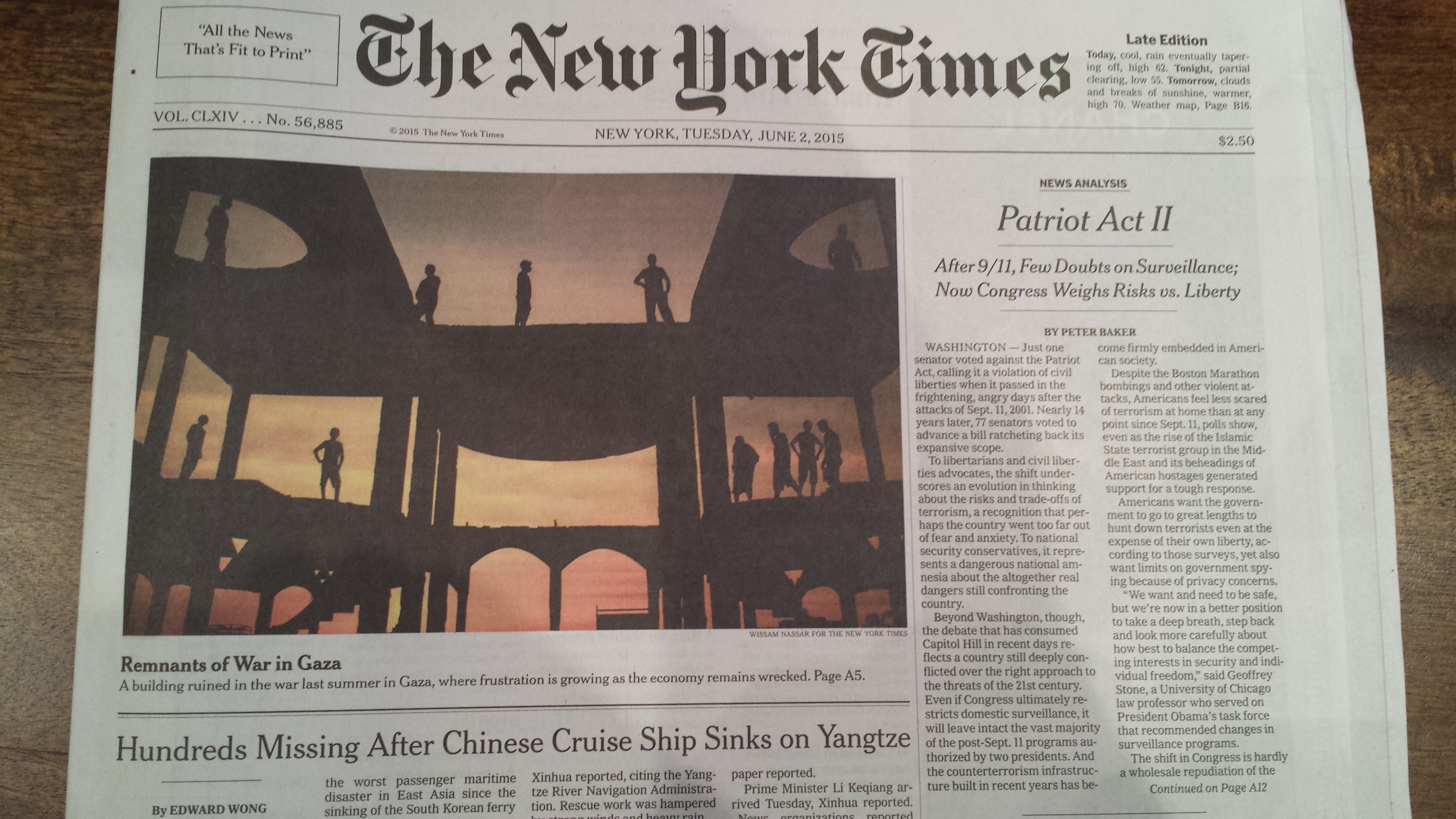
On June 2, 2015 the New York Times once again decided to tell the world that the people of Gaza are suffering.

20150602_201544
New York Times cover picture of Gaza,
June 2, 2015

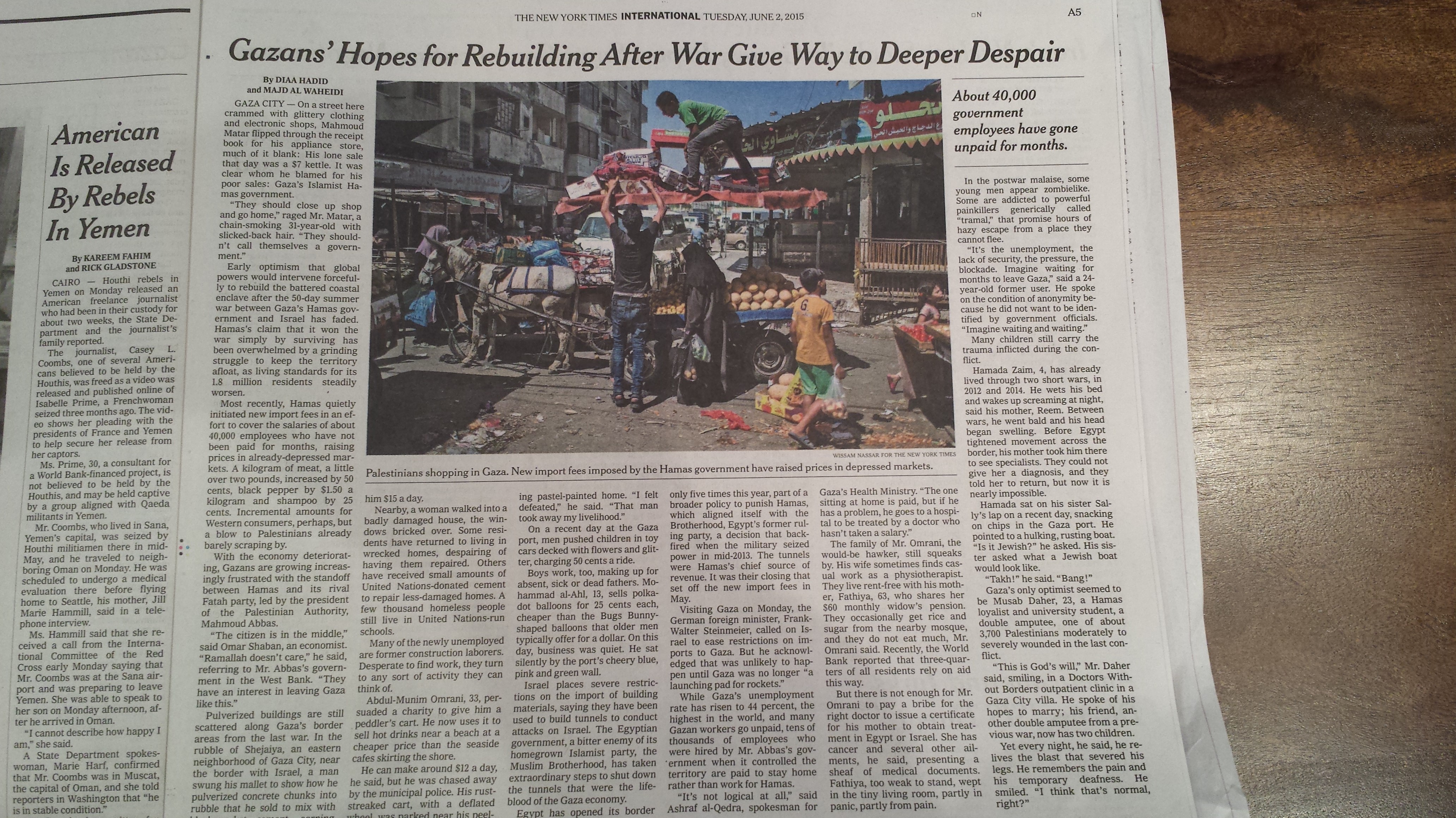
With a large color picture on the front page, the Times included another picture and article inside regarding how the Gazan community has still suffered from a lack of money, jobs and rebuilding of the infrastructure one year after the war “between Hamas and Israel.”  If a reader ever wanted to learn about the scores of people killed in Nigeria, they would have to hunt inside the paper for an article on page A4 (with no picture).  If they wanted to hear about the dozens of Yemeni civilians killed by Saudi Arabia, they would have had to turn to page A12 the day before.  This has been a continuing pattern for the NYT, as outlined in “Every Picture Tells a Story – Whitewashing the World” where the killing of civilians around the world went under-reported, while the suffering of Gazans remained over-reported.

Another trend of the liberal press has been to not label Hamas a terrorist organization, as reviewed in “CNN’s Embrace of Hamas.”  The group simply is a political group dedicated to “resistance.”

The June 2 NYT article “Gazans’ Hopes for Rebuilding After War Give Way to Deeper Despair” has continued to add to the trend of distancing Palestinian Arabs from Hamas, and Hamas from terrorism, as if everything that happened to Gazans was poor luck and happenstance.

20150602_201625

The article referred to the Palestinian Arabs’ “hope” and “Early optimism that global powers would intervene forcefully to rebuild the battered coastal enclave after the 50-day summer war between Gaza’s Hamas government and Israel “.  The article never discussed their hope that Hamas would destroy Israel.

The article detailed the blight in Gaza, stating “Pulverized buildings are still scattered along Gaza’s border areas from the last war. In the rubble of Shejaiya, an eastern neighborhood of Gaza City, near the border with Israel,” but did not discuss that the Shejaya neighborhood was the locus of dozens of tunnels from people’s homes into Israel to commit acts of terror.

It would appear that the NYT further wanted its readers to believe that the people of Gaza made a momentary strategic blunder in aligning itself with the Muslim Brotherhood in a “decision that backfired“:

The Egyptian government, a bitter enemy of its homegrown Islamist party,
the Muslim Brotherhood, has taken extraordinary steps to shut down the tunnels [connecting Egypt and Gaza]  that were the lifeblood of the Gaza economy.

Egypt has opened its border only five times this year, part of a broader policy to punish Hamas, which aligned itself with the Brotherhood, Egypt’s former ruling party,
a decision that backfired when the military seized power in mid-2013.

This is ridiculous.  Hamas IS an integral part of the Muslim Brotherhood. It didn’t simply “align itself” in “a decision that backfired.”  Here are quotes from the Hamas Charter (1988):

“Article 2: The Islamic Resistance Movement is one of the wings of Moslem Brotherhood in Palestine. Moslem Brotherhood Movement is a universal organization which constitutes the largest Islamic movement in modern times….

Article 7: The Islamic Resistance Movement is one of the links in the chain of the struggle against the Zionist invaders. It goes back to 1939, to the emergence of the martyr Izz al-Din al Kissam and his brethren the fighters, members of Moslem Brotherhood. It goes on to reach out and become one with another chain that includes the struggle of the Palestinians and Moslem Brotherhood in the 1948 war and the Jihad operations of the Moslem Brotherhood in 1968 and after.”

This is not subject to interpretation. Hamas is an integral part of the global Muslim Brotherhood movement, a group which has been actively banned and persecuted in Muslim countries such as Egypt and Syria for promoting terrorism.

However, such facts muddy a narrative of Palestinian Arabs as innocent victims.  Therefore, the media seems to have concluded that the best way to advance the victimhood tale requires a multi-part effort:

  1. Distance the people from the ruling government and negative reports. Minimize the fact that Palestinian Arabs voted for Hamas, which has led Fatah in every poll since 2006. Explain that the Arabs are frustrated by the Fatah corruption so had no practical choice other than voting for Hamas. Explain Palestinian Arabs being the most anti-Semitic people in the world by using terms like “not surprising” without delving into cause-and-effect.
  2. Stop calling Hamas a terrorist organization. Use terms like “militant” sparingly, and ideally, just “Islamist”.
  3. Refer to Hamas as a political entity. Which it is, like the Nazi party was a political entity elected by the Germans in the 1930s. Quote “political leaders” of Hamas often.
  4. Never refer to the Hamas Charter, which calls for the complete destruction of Israel; murder of Jews and never accepting any negotiated settlement. Skip the long, evil Jewish and Zionist conspiracy theories- those statements are just noise that cloud the picture of Palestinian Arab suffering.
  5. Localize Hamas to an Israeli resistant movement.  In a world that fears the dangerous rise of the Islamic State / ISIS, do not let Hamas get painted as part of a broader Muslim terrorist group (as described above).

If you follow these steps, the Palestinian Arabs can appear as passive victims and not as active participants in a radical anti-Semitic, anti-Western regional movement to install a Muslim caliphate.

Read the press today. Which rules are they using?


Related First.One.Through articles:

Cause and Effect: Making Gaza

The Death of Civilians; the Three Shades of Sorrow

Honor Killings in Gaza

The Palestinians aren’t “Resorting to Violence”; They are Murdering and Waging War

What do you Recognize in the Palestinians?

Extreme and Mainstream. Germany 1933; West Bank & Gaza 2014

Delivery of the Fictional Palestinian Keys

Summary: Imagine perceiving the future when you cannot see the present nor recognize the past.

One of the most famous paintings in the Sistine Chapel in the Vatican is by Pietro Perugino, entitled “Christ Handing the Keys of the Kingdom to St. Peter.” The painting itself is notable for several important contributions to the world of art such as displaying three dimensions using linear perspective and a vanishing point. The subject matter is also an interesting metaphor for the Israeli-Palestinian conflict today.

keys

The Painting

The subject of the painting reflects the establishment of the role of the pope in Catholicism. Jesus’s handing of the “keys of heaven” to his disciple Peter was considered establishing a connection between earth and the heavenly realm.

The center of the painting focuses on the actual handing of the keys: one key is held by Jesus, while a second key remains dangling in the foreground. The viewer does not really notice two keys, but the single dangling key. From that key, eyes are drawn up towards the open doors of the Temple of Solomon, displayed as an interpretation of the eight-sided Dome of the Rock. This is a metaphor of the connection between the divine to the physical and up again to the divine: the keys connecting Jesus and Peter, and then the dangling key from Peter to the Temple.

In the painting, the Temple of Solomon is sitting on a plaza surrounded by people and triumphal arches of Constantine. It was the emperor Constantine that welcomed Christianity to the Roman Empire in 325CE. While the Temple of Solomon sat in Jerusalem, these arches were in Rome, near the Vatican.  By integrating these themes, Perugino brought Jerusalem to Rome and had Christianity flanking the holy Temple.

 The Metaphor of Keys

Keys are often used as metaphors in art and poetry. Keys are not only tools for gaining access, but connote ownership. The holder of the key is considered both the rightful owner of whatever is locked, and is the sole person who has the means of gaining access to whatever the lock has sealed. In the case of this famous painting, Jesus holds the heavenly key in gold, which is paired with a darker key for Peter. The twining is a partnership bridging heaven and earth, with Peter as the rightful owner of the earthly key. The key itself opens the Temple in Jerusalem, the physical gateway back to heaven.

The brilliance of the painting lies in the suspension of the dark key. Set against a plain background in the center of the painting, a viewer has no choice but to be drawn to it. The key anchors the focus, and the story is built around it.

The Israeli-Palestinian Conflict

The Middle East has a long history of using keys, both physical and metaphorical. In 1917, the Mayor of Jerusalem handed over “keys of Jerusalem” to British General Allenby as a sign of surrender, and in 1841, the Ottomans handed the keys to Rachel’s Tomb in Bethlehem to Jews as a symbol of their control of the holy site. Even today, the Church of the Holy Sepulchre has a key that is held by a Muslim family as was the tradition dating back to 1246, even though the church has no religious significance to Islam.

Many Palestinians carry their own physical keys with symbolic messages today: that they are the rightful owners to homes in Israel and are waiting to move there.

keyboy

The skeleton keys are not the actual keys to homes that grandparents abandoned in 1948 while they waited for Arab armies to destroy the nascent Jewish State.  These Palestinian keys are representational of their quest to a “right of return” to homes in Israel. It has become a physical manifestation of their view of themselves as refugees. However, both the keys and status are manufactured.

As detailed in “Palestinian “Refugees” or “SAPs”?” there are only about 30,000 refugees (or more accurately, Internally Displaced Persons) alive from 1948, as refugee status cannot be handed down like an inheritance. Further, a refugee is someone who left a country, not a house. International law covers refugees return to a country, not an abandoned building (and Palestine was never a country).

Regardless, the acting President of the Palestinian Authority, Mahmoud Abbas, continues to put the “refugees” as a key issue in negotiations with Israelis. He does this with the blessings of the United Nations which is complicit in misleading the Palestinians.

The United Nations not only created a unique agency for Palestinian refugees (UNRWA) separate from the organization that handles all other refugees in the world (UNHCR), but uniquely enables the descendants of Palestinian refugees to get services from the UN.  As elaborated in “Help Refugees: Shut the UNRWA, fund the UNHCR” the staffing of the UNRWA now exceeds the total number of Palestinian refugees.

The larger issue with UNRWA is not their giving extended services to millions of Palestinians who are not refugees, but the UN agency’s active encouragement of Palestinians to seek to move to, and delegitimize Israel.

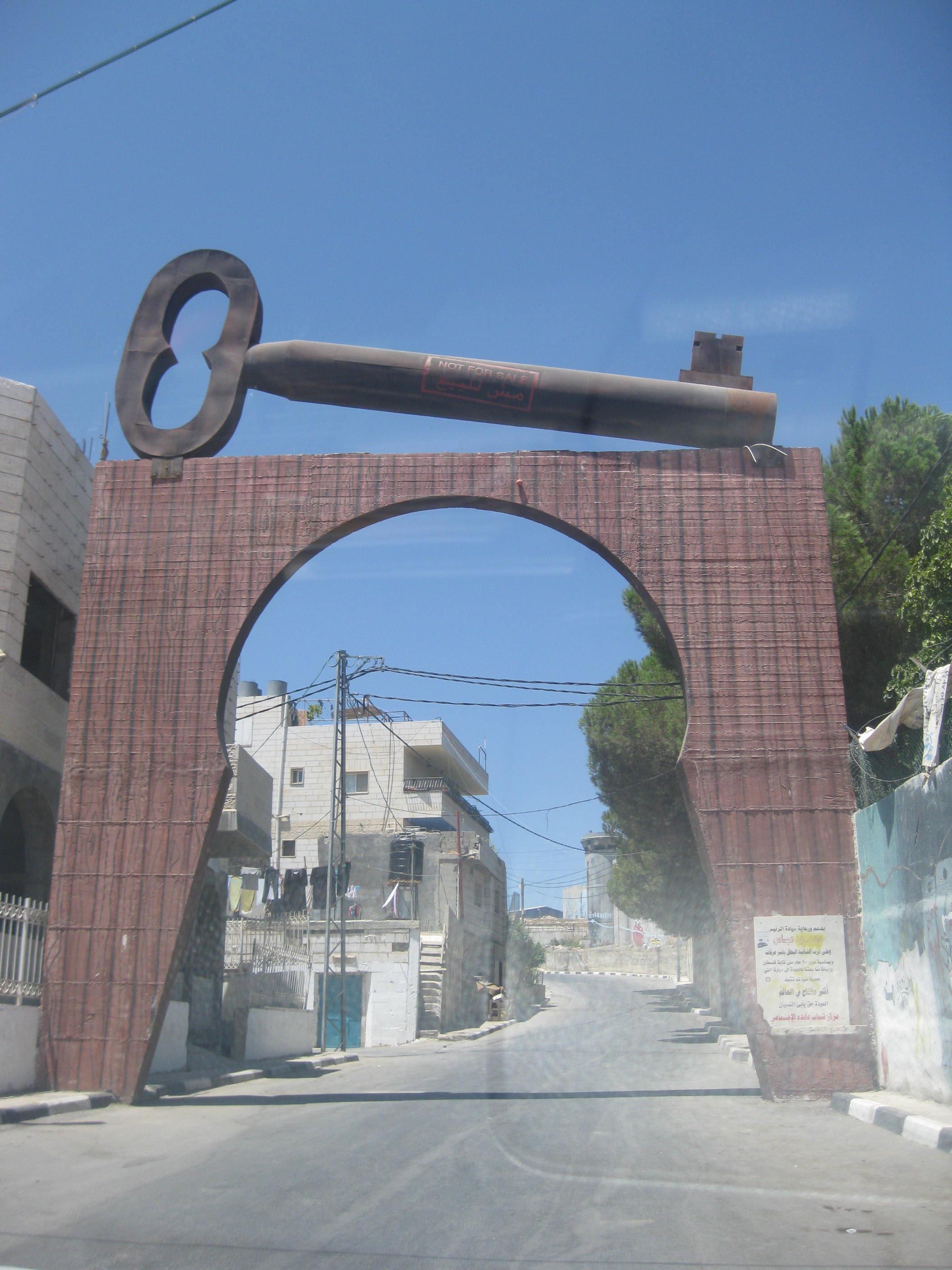
key doorway
Entryway to UNRWA camp in Bethlehem with a large key atop

Both the United Nations and Palestinians have manufactured a particular narrative:

  • Palestine was an Arab country in 1948
  • Palestinian Arabs were the only indigenous people who had lived there for centuries
  • Jews ethnically cleansed Palestine of its Arab inhabitants
  • Per the points above, Israel is not a legitimate state as the Jews are interlopers who stole the native Arab land

Such story stands in stark contrast to basic facts:

  • Palestine was never an independent country
  • The region and Mandate of Palestine had a mixture of Jews and Arabs, with Jews accounting for over 30% of the population in 1948
  • More Arabs than Jews moved to Palestine under the British Mandate 1922-1948
  • Many Palestinian Arabs were not land owners but tenants in the land
  • Most Arabs fled from their homes in 1948, while they hoped and waited for Arab armies from Jordan, Lebanon, Syria, Iraq and Egypt to destroy Israel
  • Israel welcomed non-Jews, giving 160,000 non-Jews citizenship in 1948, in sharp contrast to the Jordanian and Palestinian Arabs who expelled all Jews from Judea and Samaria

As in the painting “Delivery of the Keys,” UNRWA has  handed Palestinians a narrative and claim to Israel: the Arabs are the rightful owners of Israel. The United Nations paints these “refugees” against a bleak background (like the key in the painting) to emphasize their stateless position. The key above the portal at the UNRWA camp is a potent symbol to all Palestinians, that it is through the United Nations that millions of Arabs will migrate to Israel. UNRWA and the Palestinians have established a pairing of keys like Jesus and Peter in the painting above: Palestinian Arabs are the owners of Israel, and the gateway to getting that land is through the United Nations.

The Vanishing Point

The vanishing point is where eyes are drawn to in the horizon.  It is a place where parallel lines converge giving depth to a two dimensional painting.  It is also the point where things become increasingly smaller and faint, disappearing altogether.

In the Perugino painting, the vanishing point is the open door to the Temple of Solomon. It is this worldly portal to the heavens, where man’s prayers ascend to ethereal songs.  The viewer of the painting is pulled to the very spot where the material world melts – indeed, the vanishing point.

Today, a person could look at the artwork with another perspective.

The Temple of Solomon, the most holy place on earth for Jews, is replaced with an Islamic shrine.  The Temple, and Jewish presence has seemingly disappeared.  In this Christian piece of art, the flanking of Constantian arches and Jesus and Peter in the foreground are meant to underscore that the pope and Christianity are the proper pathways to God. Judaism has faded to Islam, and both are replaced by Jesus’s emissary.

Over Jerusalem Day 2015, the vanishing point added an additional dimension.

The current pope, Pope Francis, canonized two nuns who were born in the holy land in the 1840s, while it was part of the Ottoman Empire. One nun was born in Jerusalem and another was born in the Galilee.  Yet the pope decided to refer to these nuns as “Palestinians,” not Ottomans and not Israeli (while the status of Jerusalem is under debate, the only people that consider the Galilee part of Palestine are Hamas-supporters who seek the destruction of Israel).  If one chooses to be generous and argue that the region was called Palestine in the 1840s, does the pope refer to people from regions like the Sahara (Saharans?), the Rockies (Rockies?) or Patagonia (Patagonians?), or does he call them Libyans, Americans and Chileans?

Is the pope seeking a new replacement theology, where not only has the Vatican replaced Jerusalem as the center of divine revelation, but history itself can be updated? Is Israel being supplanted today the way the painting at the Vatican shows Judaism being replaced?

The news media has certainly rallied to such vision.  The New York Times decided to cover the celebrations of Jerusalem Day on May 17, 2015 from a purely Arab point of view.  The day in which Israelis celebrate the reunification of their holiest city from which they were expelled and barred from reentry was characterized as a moment of protest. The atrocities committed by Jordanian and Palestinian Arabs during 1949-1967 vanished and this year’s celebration was mocked.

The Times questioned the very essence of Israeli rights to Jerusalem as it quoted a Palestinian man ““How would you feel if somebody marched through your living room, without your permission?””  Whose house is this anyway?


A Vanishing Point has interesting features: our eyes are drawn there; but the subject matter blurs and disappears.

The world’s attention is focused on the Middle East and the Arab-Israeli conflict. Jews and Palestinian Arabs are focused on Jerusalem and the Temple Mount.  As they do, Palestinians grab hold of the dangling key and Israelis don’t see the golden key in their hand. Everyone wonders what the future will bring and ventures predictions as they gaze into the distance.

And as they do so, all reality disappears.


Related First One Through articles:

In Israel, Everybody’s New

The Holocaust and the Nakba

The Arguments over Jerusalem

“Arab” Land

Selective Speech

Summary: Just because we are free to do or say something, doesn’t mean we should. And the selection of what speech to admire or admonish is not hypocrisy, but a choice on philosophy.


Many people have taken very hard positions regarding the recent killings at a “Muhammad Art Exhibit and Contest,” in Texas. In an effort to portray everything in black-and-white, they miss important distinctions.

  1. Murdering someone for being insulted is ALWAYS wrong. As discussed on these pages, “I’m Insulted; You’re Dead,” everyone should whole-heartedly condemn the killing of people because sensibilities were offended. Whether the attacks were at the Parisian offices of the magazine Charlie Hebdo, or at an event in Texas where people drew the Islamic prophet, no one should condone murder.
  2. Freedom of Speech is a CAUSE worthy of Defense. Freedom of speech and press are cornerstones of western democracies. They are basic and important causes to uphold.
  3. Specific language does NOT need to be defended. Just because someone has the right to say something, doesn’t require everyone to come to the defense of the content of any particular speech. An individual or organization that opts to distance itself from an event does not mean they are against free speech.

Civil Sensitivities

Western societies are a mix of people and ideas. Such combinations create both civil and uncivil conversations. One can choose to be part of a completely civil society where nothing unpleasant is ever said, uncivil society in which people attack people all of the time, or more likely, a blend of the two, where different ideas are shared which may upset certain individuals at certain times.

Civil society’s “safe spaces” are one’s home and organizations where people share common values.  It is hard to imagine that one can walk in public and never hear or see something disagreeable.

An inherent component of being part of the mixed society is to strike a balance of the use of free speech and society’s sensitivities.  Just because someone has the right to say something, doesn’t mean that they should, and that everyone has to support the comment. The other half of that balance is that there is no requirement in society to be polite to everyone.

Not Hypocrisy, But a Preference

When a party or organization chooses to defend some speech and not others, they show their own preferences or priorities. Consider the New York Times approach to several events that upset segments of the American population:

  • Mosque at Ground Zero (2010): The United States offers freedom of religion (as well as speech and press) and as such, Muslims are free to build a mosque at any location where they legally have rights to the land. However, many people viewed the proposed building of a mosque overlooking the site where terrorists killed thousands of people in the name of Islam, as wrong and insulting. The New York Times editorial felt differently stating that it saw “the wisdom of going ahead with the project,” in an opinion that sided with Muslims but offended many people.
  • Convent at Auschwitz (1989): Similar to the mosque at the base of the destroyed World Trade Center, the location of a Roman Catholic convent on the grounds of a notorious concentration camp where over a million Jews were killed simply because of their religion, was viewed as completely insensitive by many Jews. While the Times covered the news story in several articles, it conspicuously never offered its own opinion as to whether the convent should be moved.
  • Giuliani on the Brooklyn Museum art show (1999): The Brooklyn Museum ran a controversial series of “art works” that treated Christianity harshly, including a painting of Mary covered in dung. After New York City NYOR Rudolph Giuliani threatened to withhold funding for the museum, the NYT opted to attack the Mayor stating that “Art is the name of a perpetual human struggle with the limits of perception. The Mayor… is failing dramatically in that role in a fashion that makes him and the city look ridiculous
  • Metropolitan Opera on Klinghoffer (2014): When the streets of New York held civil protests about the Metropolitan Opera’s airing of a play that showed a sympathetic side of terrorists murdering an infirm elderly Jew, the New York Times rushed to the opera’s defense. The editorial page ran a headline that stated “The Death of Klinghoffer Must Go On”. It argued that it stood for art and free speech. Others claimed that it simply stood on the side of Palestinian terrorists.
  • Charlie Hebdo (2015): The New York Times printed a series of editorials trying to find its position on the murder of journalists by Muslim terrorists. While it clearly stood by the rights of journalists to free press, it seemed to support such right because it lampooned all religions, and not just Islam.
  • Draw Mohammed Exhibit (2015). The New York Times chose to attack the organizer of the event, Pamela Geller and stated that the event was simply “hate speech”. It condemned the contest “cannot justify blatantly Islamophobic provocations like the Garland event.

What is the summary of the observations of the New York Times?

  • It sided with Muslims at Ground Zero and the Draw Mohammed Contest; against them at Charlie Hebdo;
  • It sided against Christians at the Brooklyn Museum and offered no opinion at the Auschwitz convent;
  • It sided against Jews for the Klinghoffer opera and no opinion at the Auschwitz convent

When it came to religion, the Times record was mixed, while showing a preference for Muslim sensitivities over Christians and Jews.

Overall, the Times will claim its record is for upholding freedoms.  It obviously failed in that principle when it came to the Mohammed Exhibit, which it claimed failed the threshold for art and was merely “hate speech”.  Perhaps the Times forgot the never-ending nature of its definition of art from 1999: “Art is the name of a perpetual human struggle with the limits of perception.”


Related First.One.Through articles:

Blasphemy OR Terrorism

My Terrorism

New York Times Confusion on Free Speech

Actions and Adjectives: Cluster Bombs

Summary: When it comes to reporting on the death of civilians, it is interesting to review how and when some media outlets choose to simply report facts, rather than delve into critical reporting. Here is a comparison of the New York Times discussion of cluster bombs being used by Syria and the Kingdom of Saudi Arabia (KSA). Remarkably, the party that is lambasted the most in the articles is Israel.

 Actions and Adjectives

The “Actions and Adjectives” series discusses the media’s use of language. Oftentimes, the press chooses to be fairly clinical in describing a situation, while at other times, it chooses to direct (or redirect) the conversation in a particular fashion.

For an example, an article can have different ways of describing a car crash:

  1. “Three people died in a car crash,” is purely factual.
  2. “Three people were killed in a car crash when a teenager crashed his car into oncoming traffic,” provides more color about the incident, giving an account of how the crash happened.
  3. “Three innocent people were killed when an irate teenager plowed his car into oncoming traffic after the teen had a big fight with his girlfriend,” takes the article to an entirely different place.

While all of the sentences are factual, the third description does two significant things:

  • It gets the reader to be more engaged- “innocent people were killed” by an “irate teenager,” phraseology gets the reader more excited and angry.
  • Further, the conversation moves the reader away from the victims, towards the driver. The reader is intentionally led towards possible motivation and background which caused the incident. Most likely, a more detailed description of the driver and his relationship would follow in the article. Should the balance of the article focus on teenage relationships, the headline would unlikely be about the car crash; the accident was there solely as a tool to delve into the main focus, which in this example, is the potential danger and ramifications of teenage love.

With that general overview about word choice and focus, consider the New York Times description of the use cluster bombs by Syria and Saudi Arabia.

Cluster Bombs Used by Saudi Arabia

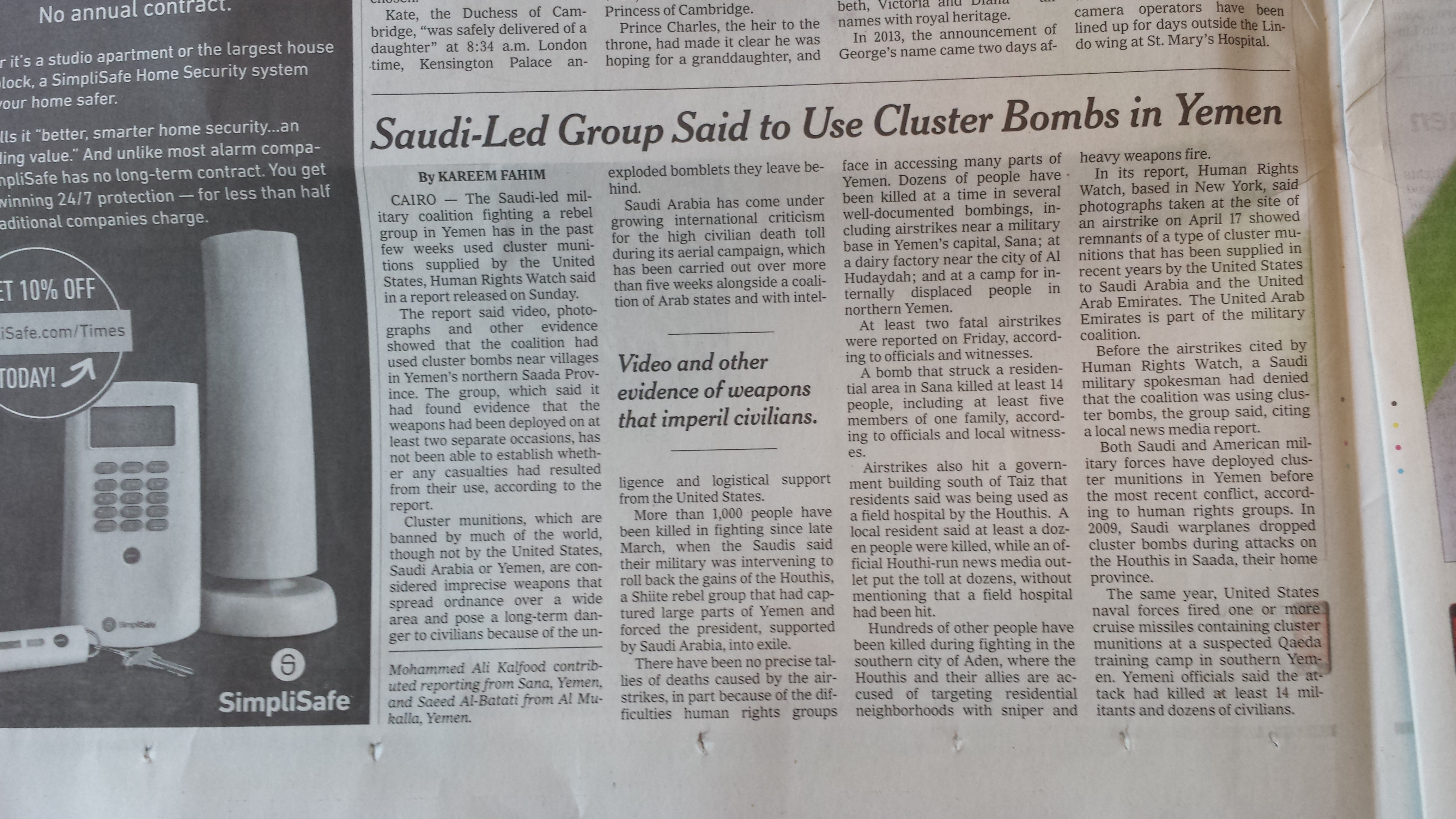
On May 3, 2015, the New York Times published a piece entitled “Saudi-led Group Said to Use Cluster Bombs in Yemen“. The 14 -paragraph article showed up at the bottom of page 10 and discussed a report by the Human Rights Watch (HRW) which concluded that Saudi Arabia used cluster bombs on at least two occasions. No casualty figures were supplied.

Saudi Arabia cluster bombs

The article made clear that “cluster munitions, which are banned by much of the world, though not by the United States, Saudi Arabia or Yemen,… pose a long-term danger to civilians because of the unexploded bomblets they leave behind.” The article included a single condemnation of KSA for its use of the weapons: “Saudi Arabia has come under growing international criticism for the high civilian death toll during its aerial campaign, which has been carried out over more than five weeks alongside a coalition of Arab states and with intelligence and logistical support from the United States. More than 1,000 people have been killed in fighting since late March, when Saudis said their military was intervening to roll back gains by the Houthis, a Shiite rebel group that had captured large parts of Yemen and forced the president, supported by Saudi Arabia, into exile.

These sentences may look unremarkable on their own, but consider what was actually written and the direction of the article as a whole:

  • It was clear that the parties that engaged in the use of the cluster bombs had not signed onto the treaty barring their usage
  • The “unexploded bomblets” were left behind by the cluster bombs, not by the Saudis which were a step removed
  • KSA was portrayed in a negative manner only a single time in the article: “growing international criticism
  • The aerial campaign was described as having wide support from a “coalition” which included “support from the United States”
  • A rationale was given for the KSA military attack- to “roll back” a “rebel group

The article stayed roughly true to the HRW report. This was in very stark comparison to an article in the New York Times published on August 28, 2014 called “Heavy Use of Banned Cluster Bombs Reported in Syria”

Cluster Bombs Used by Syria

In September, FirstOneThrough wrote a detailed analysis of the August 2014 article which outlined how the story about Syria’s use of cluster bombs ended up becoming harsh a critique of Israel. Below is some added comparisons to this week’s NYT article.

The 2014 article had a single negative comment for Syria’s use of cluster bombs, attributed to a HRW lawyer: “This year’s use of cluster munitions shows that while these weapons have been banned by most countries of the world, some actors still flout international opinion and standards,” Mary Wareham, the advocacy director of Human Rights Watch’s arms division,” in a statement that did not specifically mention Syria.

However, the Times did heap condemnation many times upon Israel, even though it was presumably not the focus of the article.  The author, Rick Gladstone, redirected the timely article about Syria towards Israel’s use of the cluster bombs eight years earlier.

 “Israel-Lebanon conflict that triggered global outrage and contributed to the establishment of the ban convention. Israel’s military was widely criticized at home and abroad for its heavy cluster-bomb use in Lebanon,”

Gladstone’s 16-paragraph article mentioned Israel in six of the paragraphs. In almost each case, Israel was lambasted.

  • In the 2015 article, KSA had “growing international criticism” while in 2014, Israel had “global outrage” and was “widely criticized” and many other uses of such critical language for Israel, including “insane and monstrous”  and “completely immoral.” Syria was not condemned by name.
  • In 2015, KSA fought against “the Houthis, a Shiite rebel group,”  However, in the 2014 article, Hezbollah, a Shiite army that is considered a terrorist group by the United States, was mentioned only once while “Israel-Lebanon” was used repeatedly.
  • The 2015 article articulated the reason KSA waged its aerial campaign; the 2014 article did not describe Hezbollah’s firing rockets into Israel and blowing up military vehicles which initiated the war.


As evidenced in this week’s KSA article on cluster bombs, the Times can write an article about the current news when it desires. It has also shown that it is deft at inflaming passion and redirecting an article towards Israel, as it did in August 27, 2014.  Why did the New York Times report on cluster bombs in such a different manner?

In August 2014, Israel and Hamas had just ended a bloody war in which the New York Times covered Israel as an evil, murderous aggressor against civilians.  The story of cluster bombs in Syria served as an excuse to continue to portray Israel as indifferent to the lives of civilians in a war.  The choice of critical adjectives and adverbs such as “insane,”  “monstrous” and “immoral” for Israel were meant as permanent monikers.

Other questions arise when reviewing the two cluster bomb -articles:

  • Why does the New York Times goes out of its way to portray Saudi Arabia as an ally of the United States that receives “support” but does not do the same for Israel?
  • Why was the United States’ usage of cluster bombs in 2009 buried at the bottom of the 2015 article, and the thousands that the US dropped in Vietnam mentioned in passing in the 2014 article?

Articles do not just convey facts. They tell a story that the editors want you to follow and believe. What do you believe?


Related First One Through articles:

Every Picture Tells a Story- Whitewashing the World (except Israel) 

New York Times Talking Turkey


Every Picture Tells a Story- Whitewashing the World (except Israel)

Summary: The New York Times continued to minimize pictures of attacks on civilians and assassinations around the world by burying small pictures deep inside its paper. The precious front page ink was only reserved for portrayals of Israel as the aggressor.


The Every Picture Tells a Story series reviewed media’s deliberate use of pictures to tell a story to its readers. It is a story that conveyed Israel committing gross atrocities, uniquely in the world:

  • Every Picture Tells a Story, Don’t it?” reviewed the New York Times’ use (and lack) of pictures of the three murdered Israeli teenagers in the summer of 2014 on the front page of its newspaper, while showing the Arab family whose son was killed.
  • Every Picture Tells a Story, the Bibi Monster reviewed how the NYT showed a large color picture of a Palestinian Arab teenager injured by Israeli police on its front page, while small pictures of mass murders in Kenya, Uganda and Yemen were found inside the paper. Further, pictures of Israeli PM Netanyahu repeatedly showed up next to pictures of injured Arabs, while no member of the Palestinian Authority or Hamas ever made it to the front pages during the entire Operation Protective Edge.
  • The New York Times Buried Pictures analyzed the puzzling lack of exposure of the Hamas terror tunnels from Gaza into Israel, which were the primary reasons for the Israeli ground offensive into Gaza.
  • The New York Times 2014 Picture of the Year wrapped up these observations, noting that the New York Times used large color photographs on its cover page of injured Palestinian Arabs repeatedly – on July 11, 14, 17, 21, 22, 24 and 29 – while continuing to hide pictures of Palestinian Arab aggression, and attacks in conflicts around the world.

THE WORLD

The Times continued preference for ignoring mass killings and assassinations in the world continued into 2015.

During a week of April 2015, world governments and terrorists killed hundreds of people. Not one incident merited a front page picture in the Times:

These articles were found buried in the paper. The associated pictures were relatively small and several were in black and white. No picture showed the victims injured or hurt.

This is not a new phenomenon. The Times often minimizes attacks that occur in the MENA (Middle East/ North Africa) region.  The exception to the rule, is if Israel is the attacker.

ISRAEL

Natan Sharansky, a famous Jewish refusenik who was jailed in Russia for trying to move to Israel, developed a three part “3D test” to determine anti-Semitism: Double standards; Demonization; and Delegitimization. Many liberals disagree with this approach and feel that double standards do not convey anti-Semitism. The liberal argument is that Israel should not be held to the same standards as Yemen, Iran, Iraq, Kenya, Saudi Arabia and the many countries in the Middle East, let alone terrorist groups like ISIS and al-Shabab. As Israel is a modern progressive country, the standards should be more akin to the USA or Western Europe. But that argument falls flat in general, and in particular, regarding the New York Times coverage of Israel.

DOUBLE STANDARDS

First, the situations are not remotely comparable. The US and Western Europe do not sit in the middle of the Middle East, surrounded by a combination of: war; terrorist groups operating freely; countries and entities that threaten to destroy their countries; and constant attacks on its citizens. It is easy to be judgmental while lunching in Luxembourg. However, Israel is forced to fight and defend itself repeatedly because of the volatile neighborhood and hostile attitude of its neighbors.

Second, the New York Times uses a double standard for the US and its allies. The paper does not treat the war effort of the US and Europe which have opted to fight battles thousands of miles from their borders, in the same manner as Israel fighting to defend itself. The NYT never posted a picture of President Obama next to the victims of a drone strike (which the president actually authorized) as it does with PM Netanyahu (for general military actions). It does not show pictures of civilians killed by US troops. It minimizes the pictures of terrorists killed by the US and its allies, using small black and white photos in the middle of the newspaper, rather than large color photographs on the front page as it does for Israel.

DEMONIZATION

Third, the NYT and many liberals do not only use double standards, but demonize and delegitimize Israel as well. The unique focus on how Israel defends itself is one thing (double standards). Uniquely showing pictures of injured Palestinian Arab victims alongside pictures of Israeli leaders and weaponry is demonization.

Simply compare the natural human reaction of looking at a small headshot picture of an al Qaeda leader (accompanied by an article that the United States killed the person), to a collage of pictures of injured and killed Palestinian civilians alongside pictures of Israeli military personnel and another of the Israeli Prime Minister. A person would likely skip the article buried in the paper that only has a head shot. But the large color collage of pictures on the front page delivers a biased story that is impossible to ignore: that the Israeli government is responsible for sending its army to kill civilians.

Further, consider opening the pages of paper and seeing a smoke trail coming from Gaza (the closest the Times came to showing Hamas militants firing weapons). The accompanying article refers to the people in Gaza providing a “counterpunch,” making the group appear as the victims instead of the party that initiated the fight.

20140718_103800

Imagine if the Times had shown pictures of the missiles Israel used to “tap” the roof of targeted homes to let the occupants know that a real explosive was coming so they could flee. Imagine the Times showed pictures of the thousands of leaflets that Israel dropped on certain neighborhoods urging residents to leave an upcoming battle zone.  Imagine pictures of Arabs holding cellphones far from the military action, because they received calls from Israel to move to safety.

You would need to imagine such images, because the Times does not print them.

DELIGITIMIZATION

The defensive nature of Israel’s war against Hamas was delegitimzed by the Times because the paper did show pictures of Hamas leaders, nor its tunnels and weaponry. Without the clear imagery of the three slain Israeli teenagers and Hamas terror tunnels which were the causes for the war, the reader was left with an impression that it was a war of choice for Israel.  Cover page pictures of injured Palestinians were coupled with articles under the headline “Confrontation in Gaza” as opposed to “War FROM Gaza,” left the reader with the incorrect conclusion that Israel as the big belligerent party.

The Times 2014 war coverage failed on all parts of the “3D Test” for anti-Semitism.


Now, in 2015, the Times photo editor has taken time off since Israel is not at war.

Attacks around the world continue to be buried inside the paper. Without images of Israel as the aggressor, more neutral and natural images cover the paper, such as shipwrecks in the Mediterranean, earthquakes and volcanoes.


The New York Times tried to defend its coverage of Israel as balanced. By going through the effort of explaining itself, it has at least realized that the accusation of double standards for Israel is indeed anti-Semitism, which is a better than many liberal pundits. It stil

It is time that everyone join the effort of pointing out to the Times its 3D failures, rather than just a handful of outlets like CAMERA, Honest Reporting, StandWithUs and FirstOneThrough.

Finding Mr. Right-Wing

Summary: US President Obama seemed fixed on select comments from Israeli Prime Minister Benjamin Netanyahu, in an effort to portray the Israeli leader as a right-wing extremist who is a regional threat to peace. Not the Iranians who seek nuclear weapons. Not the Palestinians who support Jihad.


Many articles have been published about US President Obama’s bizarre focus on select statements from Israeli Prime Minister Benjamin “Bibi” Netanyahu in the heat of elections. Articles point out the hypocrisy of Obama who himself made many statements during his elections from which he later back-tracked. Obama is also duplicitous in ignoring Iran’s chants of “Death to America” in the middle of nuclear negotiations.

How and why are some statements glossed over while Obama gives others great attention?

Obama is using Netanyahu as the straw man for the Iranian nuclear talks and the Israeli-Palestinian conflict. Obama has orchestrated a narrative where Netanyahu is the belligerent, right-wing, war-mongering leader, and not the Iranians or Palestinians.

IRANIAN NUCLEAR WEAPONS

  • The Concern: A right-wing, global sponsor of terrorism which has publicly and repeatedly declared its desire to destroy the United States and Israel is being allowed to develop nuclear weapons under Obama’s negotiations
  • The Israeli Position: Don’t threaten to destroy us; don’t have arms to carry out your threat; we will protect ourselves, as needed. We will make peace with you, if possible, on terms that do not undermine our security or viability.
  • The Obama position: Israel is a right-wing, war-chanting, racist country that doesn’t believe in a negotiated solution. The Iranians are-who-they-are and this is the best we can expect from them, and the best deal that can be achieved at this time.

Obama has said throughout his presidency that Iran should not get nuclear weapons and that he will make sure that they cannot get such weapons of mass destruction (WMDs). However, he has softened his tone and position significantly and acquiesced that Iran will be able to keep various plants and operations to make such weaponry. He believes that Iran has already advanced too far in its knowledge and infrastructure. Further, he thinks the rest of the P5+1 parties in the negotiations will not go along with a sanctions to enforce a better deal. Therefore, he capitulates to the Iranians as Brett Stephens of the Wall Street Journal wrote.

But why trash Netanyahu?

The Israeli Prime Minister believes the contemplated deal is a fiasco and has made his opinion known. He made clear that the deal assures the Iranians protection from attack while it continues to advance its nuclear research and development. The contemplated deal is not a nuclear deal, but simply a basis for the US to establish a new relationship with Iran and China. This same Iran, that threatens to destroy the US and Israel while it hangs gays in the streets. The same China, that executed three times the number of people as the rest of the world combined in 2014.

Netanyahu’s chant that “the emperor has no clothes” makes it hard for Obama to sell the failure. Obama has no response to tough questions about the nature of the deal, or about the nature of Iran itself. As such, he has enlisted his party hacks to skewer Netanyahu to draw attention away from the failure to keep his promises about Iran.

Obama and liberal loyalists have attempted to paint Israel as the right-wing fanatical country, not Iran. They portray Netanyahu as a hard-liner, not Iranian President Hassan Rouhani who is described as a moderate trying to fight his own Iranian “hard-liners. Netanyahu is described as a “racist“, while Rouhani is described as a “relative moderate“.

These characterizations are both an inversion of the truth and a red herring. But it serves to rally Obama’s liberal base in selling the Iranian non-nuclear deal: a right-wing fanatic (to them it has become Israel) is attacking a liberal country (magically, this has become Iran). Obama’s media minions mystically transformed the threat of the terrorist state of Iran being granted WMDs under Obama, to the right-wing rogue state of Israel attempting to block the moderate Iranians establishing ties with America. The deal’s numerous failures are ignored and the focus is diverted onto Netanyahu.

ISRAEL-PALESTINIAN CONFLICT

  • The Concern: The most anti-Semitic people in the world that has repeatedly gone to war to destroy Israel, continue to seek its destruction. A straw man without the people’s support nor power to enforce a peace deal, is labeled as a “moderate” for only seeking an end to the conflict on terms that undermine Israel’s peace and viability.
  • The Israeli Position: Don’t threaten to destroy us; don’t have arms to carry out your threat; we will protect ourselves, as needed. We will make peace with you, if possible, on terms that do not undermine our security or viability
  • The Obama position: Israel is a right-wing, war-chanting, racist country that doesn’t believe in negotiations. The Palestinians are-who-they-are and Israel cannot wait forever for the Palestinians to become moderate.

Obama made a specific calculation to build bridges to the Muslim world which he felt were damaged under President George W Bush. He began his presidency with an international trip to Egypt where he gave his famous “New Beginning” speech to the parliament in Cairo. (He did not use the opportunity of being in the region to visit Israel). Indeed, when he finally came to Israel in 2013, he snubbed Netanyahu’s invitation to address the Israeli parliament and instead used that time to speak to select Israeli students that support his weltanschauung.

When it came to America’s involvement in Israeli-Palestinian peace negotiations, Obama dictated various terms and conditions upon Netanyahu which had never been instituted in any of the various peace talks between the parties. It included a ten month freeze on constructing new homes east of the Green Line (EGL) and releasing dozens of convicted Palestinian terrorists. Netanyahu did both. These actions were on top of his handing control of EGL cities like Hebron to the Palestinians.

So why trash Netanyahu?

The Obama administration has not been able to extract a single concession from the Palestinians. They pushed to join the ICC against US wishes. The sought membership in UN agencies against US wishes. And they have spent the last several years continuing on a path that undermines any chance for peace with the Jewish State:

  • Inciting violence against Israel
  • Repeated wars against Israel
  • Insisting on a “right of return” for people who are not refugees, but “SAPs” (Stateless Arabs from Palestine) who are children and grandchildren of Arabs who sought the destruction of Israel
  • Never agreeing to recognize Israel as a Jewish State
  • Declaring a new Palestinian state must be free of Jews
  • Stating that no peace deal would happen without the eastern half of Jerusalem as a capital

Obama concluded that the Palestinians are forever stubborn and he has minimal influence over their actions.  He therefore feels he must exert greater pressure on Israel.

That left Obama in the uncomfortable position of pressuring its ally which has the strong support of the American people over an antisemitic people that preach Israel’s destruction. He concluded that the best way to convince the American people was to invert reality and portray the Palestinians as desperate moderates who only seek peace, and the Israelis as belligerent racist occupiers.  His left-wing megaphones were happy to pick up the line.

The New York Times has called the Palestinians “desperate” and full of “discontent” about their situation. They are constantly labeled victims (consider the coverage of “The War in Gaza” as opposed to “The War FROM Gaza“). The injured Palestinians in the 2014 conflict were covered on the front page of the Times for many days (consider that no pictures of the three murdered Israeli teenagers or victims of Saudi attacks in Yemen, US drone attacks, Boko Haram, al-Shabab and others have ever appeared on the front page).

Conversely, Netanyahu is portrayed as being racist and opposing peace.  His election night get-out-the-vote comment about Arabs was described as racist, even though he had an Arab on the Likud ticket. His comment about the unlikelihood of a two state peace deal in light of the Palestinian positions and Arab Spring were painted as anti-peace by the Obama administration, even though Netanyahu has repeatedly stated his support and has taken actions towards a two-state solution.

Obama’s team attacks Netanyahu in an effort to extract greater concessions from Israel, because of its failure to extract anything from the Palestinians. It attempts to force a peace treaty that offers no peace for Israel. It is an attempt to further US relationship with the Arab world.


Netanyahu has become the convenient scapegoat for Obama’s failure to negotiate with Islamic Iran and the Palestinian Arabs. In the case of Iran, Netanyahu is a diversion from the terrible deal. He is a straw man that the only alternative to his bad deal is a call for war rather than a better deal.  In regard to the Palestinians, Obama is attempting to portray the straw man Abbas as a real moderate negotiating partner by disparaging Netanyahu. Netanyahu’s refusal to engage in a bad/false treaty is portrayed by Obama as anti-peace.


Six years ago, US citizens hoped Obama’s outreach to the Arab and Islamic world would create an opportunity to advance global peace.  Instead, Obama continues to undermine global peace to foster a better relationship with the Arab and Islamic world.


Sources:

Obama on Abbas March 2014: https://www.whitehouse.gov/the-press-office/2014/03/17/remarks-president-obama-and-president-abbas-palestinian-authority?v=1362363401000%3F

Related First One Through articles:

Germany 1933, Gaza 2014

Recent Abbas comment on the Holocaust https://firstonethrough.wordpress.com/2014/05/19/frightening-new-york-times-42714-article-on-mahmoud-abbas-shifts-on-holocaust/


The New York Times Major anti-Netanyahu Propaganda Piece

Summary: The New York Times once again showed its bias against Jews living on the west bank of the Jordan River by painting opinion as international law. It posted a large non news-article during the week of Israeli elections in an attempt to discredit Israeli Prime Minister Netanyahu.

On March 12, 2015, the New York Times ran a cover page story called “As Israeli Settlements take Root, So do Complications” and on its online version it was titled “Netanyahu and the Settlements”. The article repeatedly referred to something called the “Geneva Initiative” as if the initiative carried any backing or legal authority. In actuality, the 2003 initiative is most akin to a present day Facebook Group.

20150313_130018
New York Times large cover story on the “Settlements”

The Times wrote “Two-thirds of new construction over the last two years, the Peace Now report shows, was on the Palestinian side of a line drawn by the Geneva Initiative, an international working group that produced a model agreement in 2003…
Efrat, with nearly 10,000 residents, is to Israelis the capital of the Etzion block. Palestinians, though, do not accept it as part of the block at all,
because it is on the eastern side of Route 60 — their side of the Geneva Initiative map. Annexing it would be far more complicated.”

By reading such statements, one would think that Israel is deliberately building homes on the “Palestinian side” of a road, contrary to existing laws and/or agreements. Palestinians are comfortable with Jews living on one side of Route 60, but not on the other.  That is specifically what the NYT intends the reader to conclude by writing such an article. It is completely untrue.

The Geneva Initiative was launched by a handful of people- both Israelis and Palestinians. The civilians met during 2003 and drafted a guideline of how a two state-solution could emerge. None of the people participating were elected or appointed by any governmental body. Their initiative was not endorsed by any government. Neither Israelis nor Palestinians consider this old private working paper at all.

“the 2003 Geneva Initiative is most akin
to a present day Facebook Group”

Meanwhile ACTUAL laws and agreements were deliberately omitted from the NYT article. They include the 1922 British Mandate of Palestine which was signed by the League of Nations, the precursor to the United Nations. The Mandate stated:

  • Article 6: The Administration of Palestine, while ensuring that the rights and position of other sections of the population are not prejudiced, shall facilitate Jewish immigration under suitable conditions and shall encourage, in co-operation with the Jewish agency referred to in Article 4, close settlement by Jews on the land, including State lands and waste lands not required for public purposes.
  • Article 15: The Mandatory shall see that complete freedom of conscience and the free exercise of all forms of worship, subject only to the maintenance of public order and morals, are ensured to all. No discrimination of any kind shall be made between the inhabitants of Palestine on the ground of race, religion or language. No person shall be excluded from Palestine on the sole ground of his religious belief.

As described above, international law enabled Jews to live everywhere in Palestine. Such freedom of movement and the ability to buy land was also the case under the Ottoman Turks. This is history and law – not the opinion of a handful of private citizens.

The west bank of the Jordan River was an integral part of the 1922 British Mandate of Palestine.  It was annexed by the Jordanians in 1950, after Jordan attacked Israel in the 1948-9 war (such Jordan annexation was with approval of the Palestinians but never considered by the United Nations). The Jordanians illegally evicted all of the Jews from the area, including the eastern part of Jerusalem, counter to the Fourth Geneva Convention.

After Jordan (and the Palestinians who were Jordanian citizens) attacked Israel again in 1967, Israel was obligated to launch a counter-attack per The Hague Regulations which state:

  • Article 40: Any serious violation of the armistice by one of the parties gives the other party the right of denouncing it, and even, in cases of urgency, of recommencing hostilities immediately.

Jordan was therefore legally attacked by Israel.  The Jordanians officially gave up all claim to the land in 1988.

None of these international laws, agreements or actions on the part of governments are mentioned in this large cover story by the New York Times. Instead, the Times chose to paint a picture that Israel is not abiding to laws to make it appear as the belligerent party. It does this with the aid of a private working paper from 12 years ago.

20150313_130046
Double page story by the NYT, continued from March 12 2015 cover 

There was nothing new in the story which begs the questions:

  • Why give the article such prominence by placing it on the cover with a large color picture, and continue with a full two-page spread in the inside pages complete with pictures, maps and drawings?
  • Why use an old private Initiative to make an argument about the location of settlements instead of history and law?
  • Why post the article now?

The New York Times posted the piece as they want to see Israeli Prime Minister Netanyahu defeated in upcoming Israeli elections.  The Israeli elections will take place later in the week, on March 17, 2015.  The New York Times, which has a long history of attacking the Israeli Prime Minister, put this non-news story on the front page the week before Israeli elections to make it appear that Israeli Prime Minister Benjamin Netanyahu was acting outside of the law.

The Times has once again shown it is not a credible source of news and chooses to air its biased opinions throughout the newspaper.  It has also shown that it seeks to influence the outcome of foreign elections with large distortions.  An interesting piece of hypocrisy, as the day before, on March 11, the NYT posted an op-ed from Thomas Freidman arguing about Sheldon Adelson’s attempts to influence elections in the United States with major contributions to Republican candidates, as well as claiming Adelson’s Israel Hayom newspaper is a biased mouthpiece for Netanyahu in Israel.

Is the Times posting the opinion of Barack Obama or George Soros?


First One Through articles:

Legal settlements: https://firstonethrough.wordpress.com/2014/12/11/the-legal-israeli-settlements/

NYT’s Nicholas Kristof’s “Arab Land”  https://firstonethrough.wordpress.com/2015/02/27/nicholas-kristofs-arab-land/

NYT ignores Jihadists in Israel: https://firstonethrough.wordpress.com/2015/01/26/radical-jihadists-in-europe-and-dislocated-and-alienated-palestinians-in-Israel/

NYT minimizing Netanyahu’s election success: https://firstonethrough.wordpress.com/2014/08/11/new-york-times-talking-turkey/

NYT only using “West Bank” instead of “Judea and Samaria” https://firstonethrough.wordpress.com/2014/12/08/names-and-narrative-the-green-line-west-bank-judea-and-samaria/

Nicholas Kristof’s “Arab Land”

On February 26, 2015, Nicholas Kristof wrote an op-ed in the New York Times called “The Human Stain” that was more than flawed- it was wrong; it was more than anti-Israel, it was anti-Semitic.

Among the many incorrect and racist statements were his claims that the “West Bank” and “East Jerusalem” were Arab. Here are some quick thoughts about his statement that “nibbling of Arab land is just plain wrong.

IMG_2118
Judean Desert down to the Jordan Valley

Geography

The west bank of the Jordan and eastern Jerusalem are not part of the Arabian Peninsula. That landmass is located east of Israel. The borders of the region are surrounded by water on three sides (the peninsula) and the northwestern edge of Saudi Arabia is the land border.

The countries that constitute the Arab land in addition to Saudi Arabia are: Oman; Kuwait; UAE; Bahrain; Qatar; and Yemen. The Arabian Plate on which the peninsula rests includes parts of southern Jordan and southern Iraq.

Neither the Arabian Peninsula nor the Arabian plate cross the Jordan River, hence there is no geographical basis for referring to any land west of the Jordan as “Arab Land.”

Population

The “Arab Nation” spread beyond the Arabian Peninsula in the 7th and 8th centuries when Muslim invasion of neighboring lands brought Islam and Arabs to those areas. Those Muslim conquests brought Arabs to southern Spain called Andalusia. No one refers to Spain as Arab land today.

Politics

The Arab countries formed a “League of Arab States” which includes 22 countries. That group is political in nature and does not speak to the actual people and culture of the countries. For example, Syria was suspended from the League in 2011 due to its civil war. Palestine was admitted as a member in 1945 (the entire British Mandate of Palestine which includes Israel today) even though it was not an independent country.

To refer to the west bank of the Jordan as “Arab” because Palestine is a member state would also mean that Israel is an Arab state. Is that part of Kristof’s real message? Does he feel that Israel is not a valid entity and is occupying “Arab land”?

Ruby all Israel  29 (1)
Binyamin Region

Government Sovereignty

A “Land” is distinguishable from lowercase “land” in that one conveys sovereignty and ownership. The land on the west bank of the Jordan River is disputed land without independent sovereignty. Israel administers the land after Jordan attacked Israel in 1967 and subsequently lost the territory. Jordan gave up all claims to the land in 1988, including “East Jerusalem”. “Arab East Jerusalem” in capital letters makes no sense in any interpretation as sovereignty and administration belongs to Israel (albeit not recognized in much of the world) but the eastern part of the city is also not recognized, nor under sovereignty of Arabs, nor part of the Arab peninsula, and is 40% Jewish.

While many Palestinian Arabs claim the west bank of the Jordan as part of a future state and “East Jerusalem” as such state’s capital, the rule of the land is still in negotiations. As of this date, the land is much more Israeli than it is Palestinian.

Exclusivity

Liberals and progressives typically argue that no land should be the exclusive right of a single racial or religious group. No one refers to “White Selma” where only whites can live or “Black Harlem” where only blacks should be permitted to live.

While people refer to the Islamic State of Iran, Iran claims that it welcomes people of all faiths. Israel, the Jewish State, is 25% non-Jewish. Turkey, which is a secular Islamic state, is mostly non-Arab but has many Arabs living in the country.

Not only is the west bank of the Jordan not “Arab”, but the suggestion that it should be limited only to Arabs is racist and anti-Semitic. That policy was put into place under the Jordanian Arabs that attacked Israel in 1948 and expelled all of the Jews from the area including the eastern part of Jerusalem, counter the Fourth Geneva Convention.

IMG_4963
South of Bethlehem

Private Property

Land ultimately falls into two categories: private land and public land. Private land changes hands with the owner and is not considered to belong forever to a particular religion or people. One day it may be owned by an Arab, the next day by a Jew and the next by a WASP.

Public lands are administered by the government. As discussed above, the west bank of the Jordan is administered by Israel. The eastern part of Jerusalem was annexed by Israel decades ago.

Therefore neither the west bank of the Jordan River nor “East Jerusalem” can be considered “Arab land.”

History

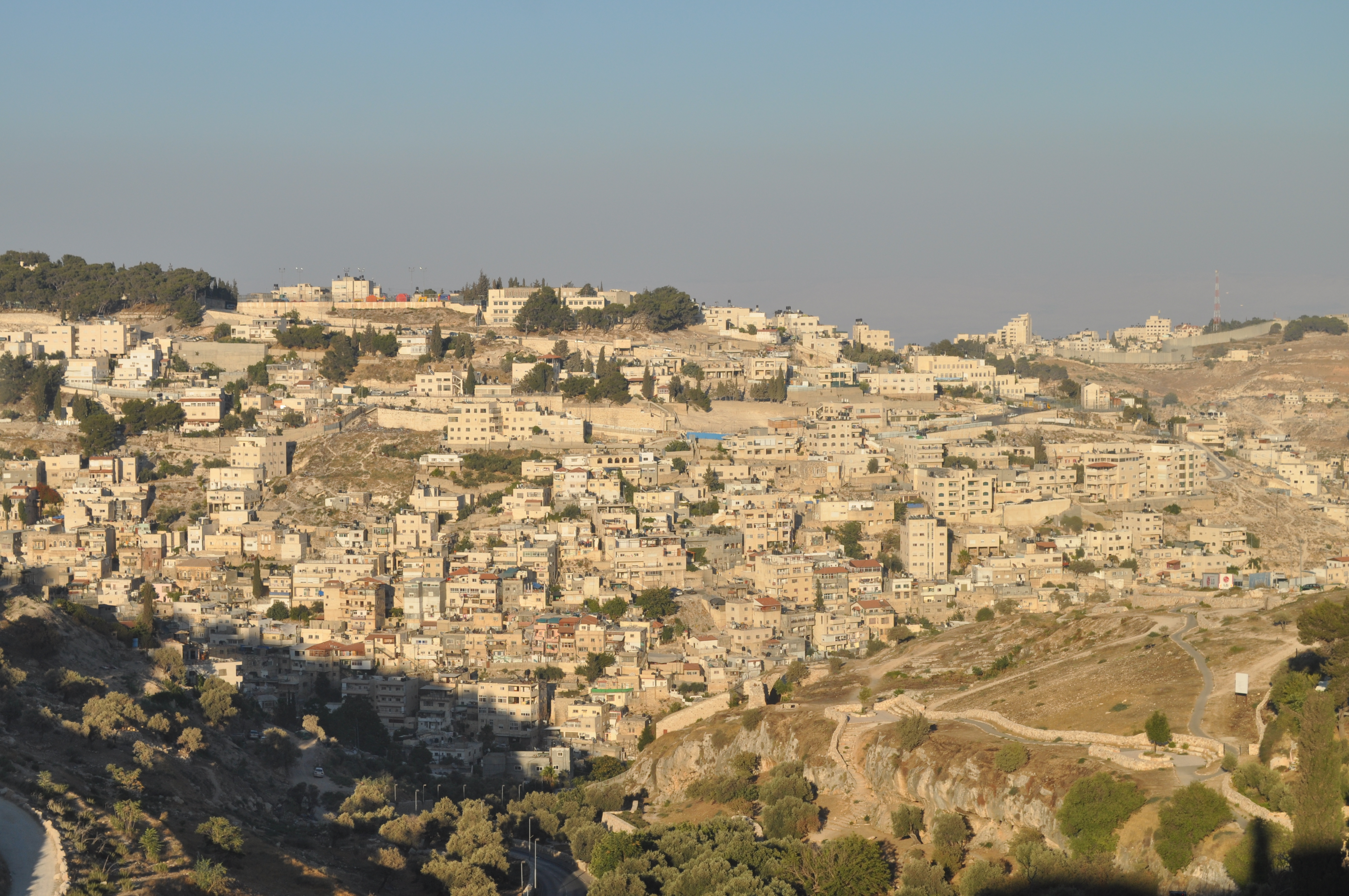
For 400 years the Ottomans ruled Palestine and allowed Jews to live everywhere without restriction. They lived in Jericho and Jerusalem and throughout the region. The Ottomans welcomed the Yemenite Jews who founded Silwan in the eastern part of Jerusalem just outside the city walls in 1881 – in what Kristof terms “Arab East Jerusalem.

The international community gave the British the Mandate to govern Palestine in 1922, in which it specifically stated that the entire mandate – including Kristof’s “Arab West Bank” – “shall facilitate Jewish immigration under suitable conditions and shall encourage, in co-operation with the Jewish agency referred to in Article 4, close settlement by Jews on the land, including State lands and waste lands not required for public purposes” (Article 6). The mandate further stated in Article 15 “No discrimination of any kind shall be made between the inhabitants of Palestine on the ground of race, religion or language. No person shall be excluded from Palestine on the sole ground of his religious belief”.

 DSC_1020
Silwan, in the eastern part of Jerusalem, founded by Yemenite Jews in 1881

Countering the Bible

As detailed above, there is no basis for naming places “Arab West Bank” or “Arab East Jerusalem”.   To claim that any land inherently belongs to a single group is a direct lift from the Old Testament in which God gives the land of Canaan to the Jews. Jews have always considered the entire land holy for that reason. Modern claims that part of that land is inherently Arab (and not Jewish) is done to specifically counter the Bible and any Jewish claim to the land.

Of course, the Jewish faith that asserts that the land is holy has nothing to do with sovereignty or private ownership. Jews have always considered the land holy, even in 1400 when they had no sovereignty, and Jews today who do not own land in Israel. The land is holy to Jews, which motivates many Jews to move there.

Kristof’s claim that this specific land (the “West Bank” which didn’t even exist as an entity or term until recently) is Arab is meant to directly confront the Jewish belief that the land was given to Jews by God. Just as the Times never uses the Jewish terminology of “Judea and Samaria” to remove Jewish connection to this land, Kristof attempts to sever the Jewish connection by stating it is inherently “Arab”. It is wrong in fact and intention.

Jews have always and will always consider Judea and Samaria/ the west Bank of the Jordan as holy regardless of its sovereignty, or the religion and ethnicity of a person living in a house on the land. Such sentiments do not preclude any type of peace deal.

Kristof wrote that The 350,000 Israeli settlers in the West Bank — not even counting those in Arab East Jerusalem — impede any Middle East peace and stain Israel’s image,” can only be viewed as an obstacle to peace for racists that want a Jew-free state.

Attacking the Jewish faith is not a path to peace. Antisemitic calls for banning Jews from anywhere – let alone places they consider holy and lived in for thousands of years – is disgraceful.  The “Human Stain” is Kristof’s and those that share such sentiments.