New York Times Lies about the Gentleness of Zionism

“Do not go gentle into that good night.
Rage, rage against the dying of the light.”
– Dylan Thomas (1914-1953)

The famous Welsh poet Dylan Thomas penned a poem called “Do Not Go Gentle into that Good Night.”  In it, he urged people to not accept their deaths meekly, without a fight.

Written for his dying father, the poem struck a chord among the broad public.  While the sentiments were intimate, they could be read on a grander scale, as it was published after the end of World War II and the Genocide of the Jews.  The British withstood a pounding by the German Nazi forces, but they fought on and prevailed.  The Jews of Europe were unarmed, and managed only a few resistance movements.  Two-thirds of the Jewish population perished.

Gentleness is normally pursued and praised.  But Thomas – and his fans – declared that one should not acquiesce to death.  At such times, gentleness is to be shunned.

NY Times Rage Against “Displacement”

On February 7, 2016, New York Times reporter Steven Erlander wrote an article called “Who Are the True Heirs of Zionism?” It’s an interesting question for someone who fails to understand Zionism.

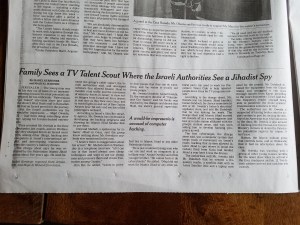
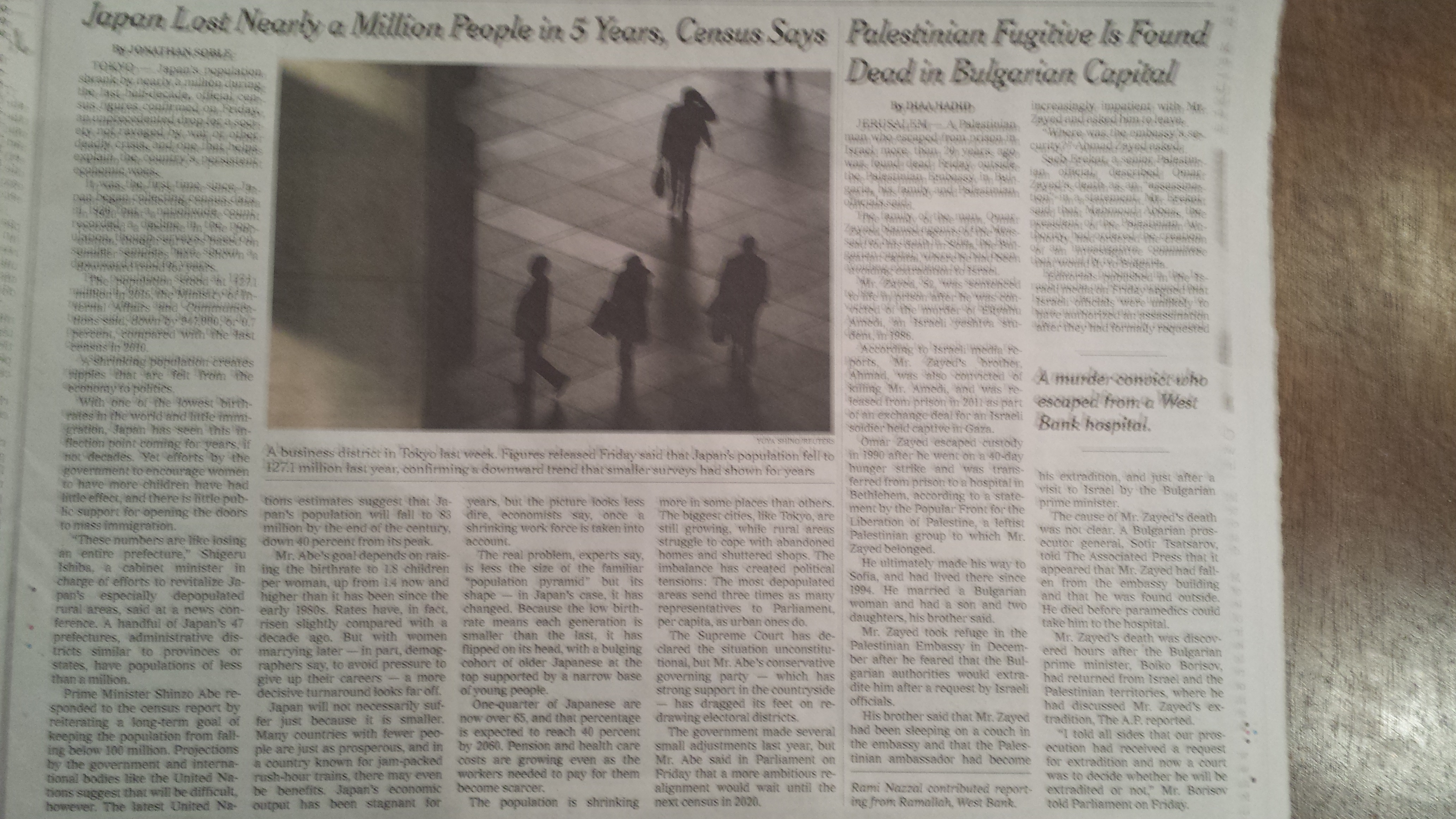
20160207_143907

The article launched with Erlander’s negative bias:

Zionism was never the gentlest of ideologies. The return of the Jewish people to their biblical homeland and the resumption of Jewish sovereignty there have always carried within them the displacement of those already living in the land.”

Quite an opening paragraph to direct readers that Zionism – whatever its future – is evil at its core. Erlander claimed that Zionism lacks a gentleness since it seeks to displace indigenous people.  It did so at its founding when the secular founders of Zionism created the State of Israel, and the religious settlers do so now, as they seek to annex the “West Bank,” east of the Green Line (EGL). Such claim is completely false and repeats an anti-Israel narrative of Jews as “colonial occupiers” (as acting-President of the Palestinian Authority Mahmoud Abbas claimed).

In reality, Zionism is about fighting against and fleeing from anti-Semitism.  It was the case when Theodore Herzl wrote “The Jewish State” in 1896, and it is the case today.  The essence was not about “displacing” people, but creating a safe place for Jews by reestablishing them in their homeland.

Some facts:

  1. Jews always lived in the Holy Land. While the mass expulsion of Jews happened in 135 CE by the Romans, Jews always maintained a presence in Israel. As evidence, Jews have been a majority in Jerusalem since the 1860s, thirty years before the first Zionist Congress.  In other words, Jews were not newcomers – they were part of “those already living in the land.”
  2. Jews were the only people that moved to the Holy Land during the last century of Ottoman Rule. From 1800 until the end of the Ottoman Empire, the annual growth rate of Muslims in the Holy Land was just 1.0% – the rate of growth of births minus deaths. That means that no Muslims migrated there. However, the Jewish rate of growth was 2.1% over that time period.
  3. Muslims only began to come to the Holy Land after the British Mandate. After a century of zero Muslim migration, Arab Muslims started to move to the Holy Land after the British Mandate of Palestine took effect. More Muslims moved to Palestine under the British Mandate than Jews.
  4. Jews did not intend to “displace” non-Jews. The Jews did not intend to remove the non-Jews – neither those that lived in Palestine for generations, nor the incredible number of Arab newcomers. The intent of Zionism was to bring in Jews from around the world, not to displace others as Erlander claimed. As evidence, Israel gave citizenship to every non-Jew when it declared statehood in 1948.

When Zionism was first broadly advanced in the 1890s after the Dreyfus Affair in France, there were roughly 540,000 people living in Palestine, and millions of Jews living in Europe and Russia. The dream of Zionism’s founders was to move millions of Jews from Europe and Russia to the sparsely populated, unpopular land of Palestine. As history would have it, two-thirds of the Jews in Europe would be massacred, and the Arabs would expel the Jews from their countries, many of whom were to then move to Israel and become the largest segment of the Israeli population.

Today, there are 8.1 million people in Israel, in just a fraction of the original Mandate of Palestine. Roughly 25% of the people – about 2 million – are non-Jews.  That is over four times the number of non-Jews in the entirety of Palestine in 1890. Clearly, Zionism created a place for non-Jews, counter to Erlander’s slander.

Zionism’s Next Phase According to the NY Times:
Secular Israelis versus Religious Jews

Erlander continued to paint a story of the “new Zionists – religious Zionists” who also seek to displace Arabs:

“In that gap between idealism and pragmatism is the fierce battle now going on in Israel, some 65 years after the founding of the state, about the true inheritors of Zionism. Are they those who hold to a secular and internationalist vision of the nation’s founders, or are they the nationalist religious settlers who create communities beyond the 1967 boundaries and seek to annex more of the biblical land of Israel?”

The article painted a picture of secular Israelis today seeking a pragmatic vision of Zionism within 1949 boundaries (as the Times and left-wing group J Street demand) on one side, and irrational religious Israelis, “settlers [that] are the epitome of a particularism, of localism, and they give a bad name to Zionism,” on the other.

Yet the article continued to ignore basic facts:

  1. Zionism continues to be principally about a haven from Anti-Semitism. The vast majority of people moving to Israel, making Aliyah, are people escaping persecution. The countries that dominate moving to Israel every year are Russia and Ukraine. When things get bad in France, French Aliyah spikes. Almost all of these Jews are not religious and are not moving for religious reasons, similar to Zionism of a century ago.
  2. Jews are moving to Judea and Samaria according to International Law, not the Bible.  The “religious settlers” are not seeking to resettle all of the biblical kingdoms of Israel. They are not moving into southern Lebanon, southern Syria or western Jordan which were all part of the Jewish kingdoms. They are moving into those areas that were established in international law in the San Remo Conference of 1920 that outlined that Jews could live throughout the land of Palestine. That land included Judea and Samaria. Just because the Jordanians attacked Israel in 1948, illegally annexed the land in 1950, and evicted all of the Jews counter to the Fourth Geneva Convention, does not mean that these lands are somehow not an integral part of the lands set for a Jewish homeland by international law.
  3. Non-Jews have not been expelled from the West Bank/EGL or Gaza.  The contention that the “religious settlers” are continuing this rage of Zionism by displacing yet more non-Jews is absurd.  The only people that the Israeli government expelled from their homes were Jews, as happened in Sinai (1982) and Gaza (2005).
  4. “Religious Settlers” are not primitive.  Erlander seemed to draw a contrast against the cosmopolitan, pluralistic, secular Israelis involved in art and technology living in Tel Aviv to “religious nationalists.”  Erlander would do well to visit Maale Adumim, Efrat and many other “settlements” to see that these “settlers” are more cosmopolitan than many of the people living in Bat Yam, just south of Tel Aviv.

The founders of Zionism in the 19th century knew the sentiment of Dylan Thomas’s poem before he was even born: “do not go gentle into the good night.”  They fought against hatred and persecution and set up a liberal democracy in the heart of the illiberal Middle East.  Had Zionism flourished earlier, and the Arabs and British not delayed the creation of the State of Israel, perhaps a million Jews would have been saved from the Holocaust.

Today, Jews continue to come to Israel, fleeing persecution. They live throughout Israel and Area C in the West Bank/EGL. They believe in the international law that gave them the right to settle and reconstitute their homeland.  Just as they would not tolerate the anti-Semitism from where they left, they do no support the anti-Semitic wishes of a Palestinian Authority that demands land free of any Jews.

Erlander is right that “Zionism was never the gentlest of ideologies,” but he misses the crucial point.  Zionism’s rage is against anti-Semitism and persecution; it has never been about displacement.

The gentleness of Zionism, in which “every high tech start-up, every new Thai restaurant and every successful film” flourishes, is found when and where anti-Semitism and persecution are absent.  As the world embraces the anti-Semitic credo of Palestinians demanding Jews be barred from living or working in the West Bank/EGL, Israelis will continue to “rage, rage against the dying of the light.”


Related First.One.Through articles:

New York Times’ Tales of Israeli Messianic War-Mongering

A Native American, An African American and a Hispanic American walk into Israel…

Rick Jacobs’ Particular Reform Judaism

Liberals’ Biggest Enemies of 2015

Squeezing Zionism

Israel was never a British Colony; Judea and Samaria are not Israeli Colonies

Obama’s “Values” Red Herring

A Flower in Terra Barbarus

Subscribe YouTube channel: FirstOneThrough

Join Facebook group: FirstOne Through  Israel Analysis

New York Times’ Lost Pictures and Morality for the Year 2015

On December 27, 2015, the New York Times shared its thoughts for a “Year in Pictures.” The Sunday Review was dominated by the waves of refugees and migrants from the MENA region (Middle East and North Africa) as well as pictures of terrorism that touched much of the world. For the Times, this excluded Israel.

The Times led its discussion with an opening paragraph: “This was the year of the great unravelling, with international orders and borders challenged or broken, with thousands of deaths, vast flows of migrants and terrorist attacks on some of the most cherished symbols of civilization, both Western and Muslim.

It continued with some reviews of terrorism: “Palmyra and Paris (twice), Aleppo, Homs, Kobani and even San Bernadino, Calif…. The outrages of Boko Haram and the Shabab in Africa. The abuse of the Rohingya minority in Myanmar. The war in Ukraine and the resurgence of the Taliban in Afghanistan. New tensions in the skies over the Baltics and a Russian plane shot down by a NATO country for the first time in decades.

The ruins still in Gaza, a year after a brutal and inconclusive war, and Israel hunkering down in a region losing its compass. Even the energetic secretary of State, John Kerry, has given up on serious negotiations for Mideast peace.”

In a year where Palestinian Arabs repeatedly attacked Israel civilians killing dozens, the Times decided to highlight the Gaza war of a year ago and dismissed the shift of the Arabs’ battlefront to Judea and Samaria from Gaza. It was not an oversight, as relayed in the Times’ actual pictures.

The chronology of pictures of the year included a number of pictures related to terrorist attacks:

  • A large picture of politicians holding hands in Paris after the January attacks (no attribution given to the killers);
  • A large picture in Kenya after students slaughtered in April (attribution to “Shabab militants”)
  • A small picture in South Carolina in July where “A Confederate flag was removed from the state house after the massacre of black churchgoers in Charelston.
  • A large picture from Gaza in August with a caption “Concrete salvagers in a building destroyed by the 2014 war between Israel and Palestinian militants in Gaza.”
  • A large picture of a victim from the Paris attacks in November (no attribution of who were the terrorists)
  • A medium sized picture of mourners in Paris honoring the victims of the November murders (no attribution)
  • A large picture of mourners in Lebanon from terrorist bombings in November (no attribution)
  • A small picture of people in California after a December attack with a caption “A candlelight vigil commemorated the victims of a mass shooting by a radicalized Muslim couple.

DSC_0041
New York Times’ large picture of ruined building in Gaza

What message could a person extract from the New York Times review of the significant events of the year? Much of the same message that the Times imparted throughout the year:

  • Terrorist attacks in the United States were not as significant as attacks elsewhere in the world
  • The Islamic State/ISIS was not labelled as responsible for any of the terrorist attacks in the world
  • The dozens of Israelis killed in the fall of 2015 were not mentioned in text nor portrayed in pictures, as the Times did not view Israelis as terrorist victims
  • Gazans were portrayed as victims, a year after their elected terrorist leaders launched their latest battle to destroy Israel and kill Israeli civilians.

The New York Times became more deliberate in separating radical Islam from global terrorism, just as President Obama did and while Republican Presidential candidate Donald Trump drew attention to the issue. The only mention of Islam in the picture captions was in the very final picture of the year.

The Times has always been deliberate about Israel. Israelis who were shot, stabbed and run over were not victims of terrorism. Israelis did not suffer. Israelis did not mourn.

However, Palestinian Arabs who have continued to fight for the destruction of Israel were featured among pictures of the sufferers and mourners.

If the trends continue, the New York Times’ 2016 Year in Pictures” will likely feature the western world as the radical terrorists.


Related First.One.Through articles:

Every Picture Tells A Story: Only Palestinians are Victims

Every Picture Tells a Story: The Invisible Murdered Israelis

Framing the Israeli-Palestinian Arab Conflict: WSJ and NY Times

Every Picture Tells a Story: Arab Injuries over Jewish Deaths

Every Picture Tells a Story: Versions of Reality

The New York Times Picture of the Year, 2014

Subscribe YouTube channel: FirstOneThrough

Join Facebook group: FirstOne Through  Israel Analysis


New York Times’ Tales of Israeli Messianic War-Mongering

Summary:  One year after acknowledging that Palestinians were to blame for the failed Israeli-Palestinian Authority peace process, left-wing NY Times contributor Roger Cohen cast Israelis as fanatical nationalists and Palestinians as passive, despondent victims. The Times’ cure for Jews’ violent adherence to their religious texts is punishing settlers with BDS, while the paper distanced Muslims from their religion and called for greater compassion towards these innocents.


Just in time for Christmas, Roger Cohen decided to write about the Israeli-Palestinian Arab conflict. Again.

In an article called “The Assassination in Israel that Worked,” Cohen portrayed an Israeli society overrun with religious fanatical murderers. He described the killer of Israeli Prime Minister Yitzhak Rabin, Yigal Amir, as “a religious-nationalist follower of Baruch Goldstein, the American-born killer of 29 Palestinian worshipers in Hebron in 1994.” He wrote about Jews living east of the Green Line (EGL) as obsessed with “Messianic Zionism,” at odds with the concept of democracy. Because Palestinians are desperate for their own state, Jews living in EGL make “violence inevitable” according to Cohen. He argued that the UN’s creation of Israel “was territorial compromise, as envisaged in Resolution 181 of 1947, calling for two states, one Jewish and one Arab, in the Holy Land. This was humankind’s decision, not God’s.” In short, according to Cohen, the vast Messianic cult of violence in Israel seeks all of the Holy Land, but the rights of Jews are limited to just half of the land as dictated by man’s laws.

Lastly, Cohen argued, the only way to push back against the right-wing Israelis and their government was to employ different angles of the BDS movement (Boycott, Divestment and Sanctions) in which Obama should “close American loopholes that benefit Israeli settlers.”

Here is a bit of education for Roger Cohen (maybe the byline was wrong and this was written by Roger Waters of Pink Floyd, the loud advocate of BDS?):

A smaller percentage of Jewish “settlers” are murderers, than are terrorists which are Muslim.  The Cohen opinion piece would lead a person to believe that every Jewish “settler” takes up arms against Arabs, while the reality is that almost every Jew living in the land seeks to live in peace with their Arab neighbors. Baruch Goldstein was an anomaly, not the rule.

Why would the Times print such an inflammatory piece against Jews when it is in the midst of a blitz about the dangers of “Islamophobia”?  The Times wrote over-and-again that most Muslims are peaceful and that Muslim terrorist abuse the interpretation of Islamic holy texts.  Yet the Times was eager to describe Jewish killers as motivated by the plain reading of the Jewish holy texts, and suggested that any Jew living in Judea and Samaria is either a potential killer, or instigates Palestinian violence.

It is untrue, unfair and reeks of hypocrisy to portray Jews in such a manner.  There are almost no Jews in Judea and Samaria that committed murders, but the Times labelled all “settlers” as devout killers.  Meanwhile, the global jihadist movement enlisted thousands and slaughtered thousands, and the Times rallied to the defense of Muslims.

IMG_3677IMG_3674
“Islamophobia” Op-Eds from Paul Krugman on December 11, 2015, and
Nicholas Kristof on December 13, 2015

IMG_3670IMG_3671
Front Page of NY Times Sunday Review on “Islamophobia”
on December 13, 2015

IMG_3662IMG_3667
Front Page New York Times story on December 15, 2015 about
Young Muslims suffering from “Islamophobia”

Jews are entitled to live in EGL/ Judea and Samaria according to international law. The 1922 Mandate of Palestine by the League of Nations clearly and specifically encouraged Jews to live throughout the Holy Land, including areas now known as the “West Bank.” The Mandate included language that specified that no one should be prevented from living anywhere because of their religion.

“Messianic Zionism” may be a driving force motivating some Jewish families to move to the region, just as they might move to Haifa or Be’er Sheva. Some people are motivated by Zionism without a Messianic component, while others go for good jobs in the only liberal democracy in the Middle East.  The motivation for living there is irrelevant; the right of Jews to live anywhere in the Holy Land was established in international law.

“Violence is inevitable” because Arab don’t want Jews as neighbors, not because Arabs want a state.  Arabs have been killing Jews in the Holy Land for 100 years.  In several episodes in the 1920s, including the brutal Hebron massacre in 1929, Arabs called for ridding the land of Jews.  On the eve of the Holocaust, they launched multi-year riots (1936-9) slaughtering dozens of Palestinian Jews and convinced the British to limit Jewish immigration, causing the death of hundreds of thousands of European Jews.

Whites in the 1950s also did not want to live with black neighbors. Racism and anti-Semitism are to be condemned, not rationalized.  Shame on the New York Times for defending Arab attacks on Jews.

The establishment of Israel as a Jewish State has been rejected by the Arabs for 100 years, and counting.  Cohen pointed to the United Nations Partition Plan which called for creating a Jewish State in 1947.  He failed to say that the Arabs REJECTED that plan.  They opted to launch a war against Israel instead.

Israel has continued to seek peace with its neighboring Arab countries: Jews approved the partition plan in 1947; the country uprooted Jews living in Sinai in 1982; it handed various cities to the Palestinian Authority in 1995; it uprooted Jews from Gaza in 2005. Israel made various peace offers to the Palestinians, including in 2000 and 2008. The Palestinians reacted to each offer with wars, and continue to reject Israel as the Jewish State to this day.

Conclusion

One year ago, Cohen wrote Why Israeli-Palestinian Peace Failed. “ In the article, he acknowledged various Israeli peace efforts including settlement freezes and prisoner releases.  In exchange for the Israeli gestures, the Palestinian Authority created a reconciliation government with the terrorist group Hamas, and joined international bodies counter to the agreed upon peace framework.  The peace talks collapsed.

Cohen has now concluded that while the Palestinians suffer from ineptitude and corruption, at the end of the day, their cause is just.  The Palestinians are not only despondent, but desperate for an external force to advance their vision of a state.  Cohen believes that Obama should begin to advance various iterations of BDS on Jews living east of the Green Line to assure the Palestinians goal of a Jew-free state (Obama has indicated in the past that he approves of a Judenfrei Palestine). Cohen had no suggestions – or concerns – of how to make Palestinians approve of the Jewish State living in security.

The radical left-wing call for BDS of the Israeli territories is easier to make when one ignores the 99% of peaceful families living in Judea and Samaria.  So Cohen, and other Israel-bashers paint all of these Jews as “Messianic Zionists” who are out of touch with reality.  They are either murderers of Arabs like Baruch Goldstein, or of the peace process with Arabs like Yigal Amir.

Cohen fails two of Natan Sharansky “Three Ds” test for anti-Semitism: demonization and double standards.  To rephrase the great ballad-rocker Meatloaf, Two of the Three IS Bad.

When will the Times and the left-wing fringe look at the Jewish families with an iota of the compassion they shower upon peaceful Muslims?


Related First.One.Through articles:

Palestinians are “Desperate” for…

Nicholas Kristof’s “Arab Land”

Framing the Israeli-Palestinian Arab Conflict: WSJ and NY Times

Names and Narrative: The West Bank / Judea and Samaria

Israel was never a British Colony; Judea and Samaria are not Israeli Colonies

Every Picture Tells A Story: Only Palestinians are Victims

The Narrative that Prevents Peace in the Arab-Israeli Conflict

Israel and Wars

Subscribe YouTube channel: FirstOneThrough

Join Facebook group: FirstOne Through  Israel Analysis

The New York Times on the History of Gush Etzion

The New York Times actually tried to give its readers some history of Gush Etzion for a change. Unfortunately, it still missed the critical points.
IMG_3663
New York Times article from December 15, 2015
In an article entitled “West Bank Shopping Center, a Symbol of Coexistence, is Shaken by Violence,” the Times gave more detailed history than typical when it provided background on the Gush Etzion “settlements” in Judea and Samaria/ West Bank of the Jordan River.  While the paper would typically state that “the world considers all settlements seized by Israel in 1967 as illegal,” it opted to give more historical context on December 15th.  It wrote:
“Gush Etzion, or the Etzion block, a cluster of more than a dozen Jewish settlements, lies south of Jerusalem, in the Bethlehem area. It is often described as part of the Israeli “national consensus,” a chunk of West Bank land seized from Jordan in the Arab-Israeli War of 1967 that many Jewish Israelis assume will always be part of Israel, and it holds a special status in the country’s psyche, associated with tragedy and triumph.

The first Jewish settlers arrived in the 1920s. Four communities were established by the 1940s but they were destroyed in the war of 1948 over the creation of Israel. Jordanian forces killed scores of Jews who tried to defend the area and took scores more captive.

After Israel captured the West Bank in the 1967 war, a group of Israelis, including some descendants of those who had fought to defend it in 1948, reestablished Jewish settlements there.

The Palestinians and much of the world consider all settlements in the territories seized in 1967 as illegal and an obstacle to establishing a Palestinian state. While most peace plans envisage exchanges of land that could leave at least part of Gush Etzion under Israeli sovereignty, Israelis and Palestinians have never agreed on the size of the block.”

The Times opted to repeat its often used language – twice – but it did give much more history than it normally does.  However, while it described Jews moving to area in the 1920s, and some of the new residents as descendants of those original settlers, the reader was still left with the wrong impression that Jews are living there illegally.
Key points that were omitted from the article:
  • The 1922 League of Nations Mandate specifically gave Jews the right to live and establish themselves THROUGHOUT the Holy Land. This was a matter of international law and the Jews availed themselves of this legal right.  In 1922, there was no concept of a “West Bank.”  It was all just “Palestine” and Jews legally purchased land and built homes in Gush Etzion.  As stated in Article 6, the Mandate “shall facilitate Jewish immigration under suitable conditions and shall encourage, in co-operation with the Jewish agency referred to in Article 4, close settlement by Jews on the land, including State lands and waste lands not required for public purposes.”  Further, Article 15 of the Mandate specifically stated that no part of Palestine should be off-limits to people based on their religion: “No discrimination of any kind shall be made between the inhabitants of Palestine on the ground of race, religion or language. No person shall be excluded from Palestine on the sole ground of his religious belief.”
  • When Jordan illegally attacked Israel in 1949 and killed the Jews in Gush Etzion, it did not undermine the legal rights Jews had for living in their homes.
  • Jordan’s illegal expulsion of all of the Jews from the region in 1949 counter to the fourth Geneva Convention was not mentioned by the Times.
  • The fact that Jordan illegally annexed the region in 1950 in an action that was never recognized by any country was also omitted.
  • Jordan (and Palestinians who had been granted Jordanian citizenship) attacked Israel in 1967, counter the Israel-Jordan Armistice agreement, and Israel was legally justified in responding in self-defense.
  • Jordan gave up all claim to the region in 1988.
It was nice to see the Times take steps to educate readers a bit more about Gush Etzion.  However, the details provided still left a reader with the impression that Jews live in Gush Etzion illegally, and it is only a matter of “national consensus” that leads Israelis to believe that the bloc will be formally part of Israel.  The many illegal activities of Jordan also continue to be ignored.
Perhaps the full facts disturb the Times’ narrative too profoundly to detail.

Related First.One.Through articles:

Subscribe YouTube channel: FirstOneThrough

Join Facebook group: FirstOne Through  Israel Analysis

“Peace” According to Palestinian “Moderates”

Liberals, including the left-wing paper The New York Times, often suggest that there are many leading Palestinian Arab and Israeli Arab moderates who genuinely want peace with Israel. US Secretary of State John Kerry warned Jews and Israelis about failing to fully engage “the moderate Palestinian leadership,” which could lead to “extremism.

Over the past six weeks, one has to wonder what kind of “peace” these “moderates” have in mind.

Mahmoud Abbas

On October 28, 2015, the acting-President of the Palestinian Authority addressed the United Nations Human Rights Council in Geneva, Switzerland. In his prepared remarks he said that Israeli occupation of Palestine has been in place since Israel’s founding in 1948. He viewed all of Israel as illegitimate, and Palestinian land.

Abbas is a proud Holocaust denier as well as denier of Jewish history in the holy land. His anti-Semitic call for a Jew-free country has been endorsed by the Obama administration, and his basic refusal to recognize Israel as the Jewish State make the goal of achieving peace with this straw man a laughable fantasy.

Ayman Odeh

The NY Times was very quick to promote the prospects for Israeli-Arab peace as one of the leaders of the Joint Arab List, Ayman Odeh, was coming to New York to address groups of Jews.  On December 10, the Times ran an article “Arab-Israeli Parliament Member sees Prospect for Peace,” which described a hopeful Ayman Odeh’s thoughts about peace because “many parts of the Jewish population were able for the first time to hear us.”  Somehow, the deafness on the part of Arabs to recognize the Jewish State doesn’t seem to bother him.

IMG_3659
New York Times article on December 10, 2015

On December 10, Ayman’s vision of Israel was brought to the open (except for readers of the NY Times since it opted not to print the follow-up story).

Ayman was due to speak to the Conference of Presidents of Major American Jewish Organizations.  However, when Ayman noticed that the meeting was taking place on the same floor in the building as the Jewish Agency (a group that facilitates Jews moving to Israel) and other Zionist organizations, he refused to go up the elevator.  He insisted that the meeting location be moved so he would not have to be on the same floor as “organizations whose work displaces Arab citizens.  The organization’s leader, Malcolm Hoenlein refused to change the meeting location and the meeting was cancelled.

Saeb Erekat

On December 13, 2015, perennial spokesperson for the Palestinians, Saeb Erekat came to speak at a conference run by the left-wing Israeli newspaper Haaretz and left-wing foundation, the New Israel Fund. Before taking the stage, he demanded that the Israeli flag be removed from the room.  The event organizers quickly complied.

“Moderates” seek a new State of Palestine,
not Peace with Israel

Many progressives have opened up various venues for engagement with Arabs to move a peace process forward.  As part of those efforts, they have chosen to label various Arab leaders as “moderates” and partners for peace.

However, these Arab “moderates” repeatedly make clear – in public, and in front of them – that they view the Jewish State of Israel as illegitimate.  The only rightful rights in the holy land belong to Arabs; if Jews are to remain in the land, it will only be subject to Arab review and approval.

Consider what these “moderates” say in private to their own constituents.

For Palestinian Arabs, there is one goal in the “peace process” and it is not peace with the Jewish State, but the establishment of a new State of Palestine.  The only difference between Arab moderates and extremists, is that extremists want to remove Israel in its entirety immediately, while moderates want to start with a Palestine in half of the holy land, before they assume complete control of the land.

John Kerry, Haaretz, the New York Times and other liberals loudly proclaim that the Palestinian Arab leadership are moderates who seek peace with Israel, but refuse to describe and detail all of the Arab comments and actions which clearly spell out their permanent hostility towards the Jewish State.

The fact that these “moderates” do not represent the general Palestinian public is yet all the more frightening, as 67% of Palestinian support the “stabbing intifada” according to the latest Palestinian poll.

The New York Times may highlight Ayman Odeh’s call that peace is possible since the “Jewish population can hear us.” But the world has news sources and blogs like First.One.Through that are read broadly around the world, that listen to more than just the sound-bites that dreamy liberals promote.

Peace partners are still not present.


Related First.One.Through articles:

The Israeli Peace Process versus the Palestinian Divorce Proceedings

The Narrative that Prevents Peace in the Arab-Israeli Conflict

Israel was never a British Colony; Judea and Samaria are not Israeli Colonies

What do you Recognize in the Palestinians?

Subscribe YouTube channel: FirstOneThrough

Join Facebook group: FirstOne Through  Israel Analysis

Every Picture Tells a Story: Arab Injuries over Jewish Deaths

On November 19, 2015, a Palestinian Arab murderer shot up cars in the Gush Etzion district of Judea and Samaria. Among the three Jews that were killed in that incident, was an American citizen who was studying in Israel for the year.

Ezra Schwartz was an 18 year old from Sharon, MA. He went with some friends to bring food and candies to Israeli soldiers who were guarding an intersection where three Israeli boys were abducted and killed in July 2014. On his way back to school, he was shot and killed along with others while sitting in traffic.

The New York Times did not think much of this Jewish American teenager.

The story of the murder was placed at the very bottom of page A6. There was no accompanying picture. No caption. No one saw this American victim of Palestinian Arab barbarity.  As a matter of fact, if you wanted to know the name of this American victim, you would have to wait until the tenth paragraph of the article.

IMG_3620
NY Times November 20, 2015, page A6

This was in sharp contrast to how the New York Times covered the story of an American Arab who was beaten up while engaged in a riot in Israel.

On July 7, 2014, the New York Times placed a large color picture on the front page of an Arab youth surrounded by policemen.  The caption read “Tariq Abu Kheidar, 15, arrested in the unrest, is a cousin of the victim and was shown on a video being beaten by Israeli officers.” Tariq led the world news, on a day when over 100 people were slaughtered in various attacks.

20140707_082918
Front page of the New York Times July 7, 2014

The beating of an Arab American who participated in a riot got front page attention, while the murder of a Jewish American who was simply riding in a car got nothing.

The New York Times has a long history of ignoring Israeli deaths and highlighting Palestinian injuries as detailed in the articles below. The New York Times has extended its bias against American Jews as well.


Related First.One.Through articles:

Every Picture Tells a Story: The Invisible Murdered Israelis

Every Picture Tells A Story: Only Palestinians are Victims

Every Picture Tells a Story: Versions of Reality

The New York Times’ Buried Pictures

Every Picture Tells a Story, the Bibi Monster

Every Picture Tells a Story, Don’t It?

The New York Times Picture of the Year, 2014

Subscribe YouTube channel: FirstOneThrough

Join Facebook group: FirstOne Through  Israel Analysis

The New York Times Refuses to Label Hamas a Terrorist Group

Readers rightfully assume that newspapers go through the effort of educating its readers. As such, the papers should include descriptions and backgrounds of the main actors in any news story.

“Good” actors and “bad” actors are often labelled as such.  For example, readers would imagine that the media would specifically call out a terrorist organization, and almost all of the time, they do. The exception is the terrorist group Hamas.

Consider this comparison:

P.K.K.

A group that is often-mentioned in the New York Times lately that is labelled a terrorist group is the P.K.K. The Kurdish group has been fighting for years against Turkey to gain independence and has used violence to achieve its goal. Some people consider the Kurdish aspirations for independence similar to the Palestinians, but there are many differences, such as the fact that the Kurds are actually a distinct people compared to Arabs and Muslims in Syria, Iraq and Turkey where they live, as opposed to Palestinians who are an indistinguishable part of the broader Arab world. The P.K.K. fights alone for the Kurdish people, while the whole Arab world fights for the Palestinian Arabs. Put those facts aside and look at recent reports from the New York Times.

The NY Times is consistent in labelling the P.K.K. a terrorist group.  It may state that the label is attributed to Turkey and other groups such as NATO, the United States or just “widely considered.”  But it usually avoids just stating that Turkey alone considers the group to be a terrorist organization:

  • October 12, 2015: “Turkey and its NATO allies consider the P.K.K a terrorist organization.”
  • September 9, 2015: “The Kurdish group, which is considered a terrorist organization by Turkey, the United States and the European Union, has been attacking Turkish security officials almost daily since the breakdown of the fragile peace process.”
  • August 12, 2015: “a Kurdish separatist group known as the P.K.K., which is widely listed as a terrorist group
  • August 6, 2015: “Mr. Erdogan has said he is acting in Turkey’s national security interests in targeting terrorists of all stripes, both the Islamic State and the P.K.K”
  • July 29, 2015: “Under alliance rules, they are bound to protect Turkey from threats, and they have long listed the Kurdish militant group that fought a long insurgency in Turkey, the P.K.K., as a terrorist organization
  • July 26, 2015 (an exception to prove the rule): “targeting camps of the militant Kurdistan Workers’ Party for the first time in four years… ended an unstable two-year cease-fire between the Turkish government and the Kurdish militants, also known by the initials of their Kurdish name, P.K.K.”

Readers of the New York Times are educated by the paper over-and-again that many countries outside of Turkey consider the P.K.K. a terrorist group.  Understanding that designation gives readers specific context with which to consider the story.  A government fighting a terrorist group is logical and appropriate; a defensive action of “the good guys” against the “bad guys”.

Now consider the labeling of Hamas in the New York Times.

Hamas

Hamas has been labeled a “Foreign Terrorist Organization” by the United States government since 1997. This is not subject to interpretation but is established fact.  It was awarded this designation on the same day as other notable terrorist groups including: Abu Nidal; Hizbullah; Palestine Liberation Front; Palestinian Islamic Jihad; Popular Front for the Liberation of Palestine; PFLP-General Command; and the P.K.K.  It is also consider a terrorist group by the European Union, Canada and other countries.

However, the New York Times does not call Hamas a terrorist group.  Instead it prefers to call it a “militant group.”  The Times does not call attacks by Hamas “deliberate attacks” but uses terms like “resorting to violence.”  The Times does not say that Hamas is the favorite established political party of the Palestinians, winning 58% of the Parliament, but uses terms like “dominates Gaza” to make it appear as an outside force against its own people.

All of these observations are plain facts for any reader of the Times to see (some examples are listed below, but do your own search of Hamas and the Times and see it for yourself).  These descriptions by the Times are used to transform readers’ mindsets:

  • from thinking of Hamas as a terrorist organization, to a freedom fighting group.
  • from a group that seeks to destroy all of Israel, to one that simply wants freedom of movement.
  • from a group that actively seeks to kill innocents, to one that is left with no choice.
  • from a popular Palestinian political party, to a small outside force.

From a terrorist group that violently seeks to overthrow a democratic government which must therefore be combatted aggressively with force, to a group that justly uses an armed struggle to achieve modest ends which should be placated.

  • July 17, 2015: “Saudi support for reconciliation between Hamas and Fatah, the two dominant but feuding Palestinian factions
  • June 30, 2015: “the ruling Islamist group, Hamas
  • June 8, 2015 “Hamas, the militant group that dominates Gaza”
  • June 3, 2015: “Hamas, the Islamic militant group that controls Gaza, has worked to enforce the cease-fire with Israel,” makes Hamas part of the peaceful solution (enforcing a cease-fire), not the core of the problem.
  • May 26, 2015: “The militant group Hamas used last summer’s war” separates Hamas from launching the war to a group that just used the war.
  • September 4, 2014: “…orchestrated by Hamas, which Israel regards as a terrorist group committed to its destruction” makes the characterization specific ONLY TO ISRAEL and not the US and many other countries.

IMG_3608
New York Times October 30, 2015 referred to Hebron as the
“‘Fortress of Hamas,’ because of its role as the Islamist group’s
unofficial West Bank headquarters.”

In short, the liberal paper goes through efforts to transform the broadly popular terrorist group that seeks the destruction of Israel and murder of Jews, to a fringe militant religious group that controls a part of the Palestinian population and occasionally resorts to violence against Israel. In such a narrative, who does the Times label as the “good guy” and who is the “bad guy”?  In such a scenario, is the current wave of violence just an “intifada” or “uprising” or part of a broader war to destroy the Jewish State?


Related First.One.Through articles

CNN’s Embrace of Hamas

Differentiating Hamas

The New York Times wants the military to defeat terrorists (but not Hamas)

Cause and Effect: Making Gaza

Why the Media Ignores Jihadists in Israel

The Palestinians aren’t “Resorting to Violence”; They are Murdering and Waging War

What do you Recognize in the Palestinians?

Subscribe YouTube channel: FirstOneThrough

Join Facebook group: FirstOne Through  Israel Analysis

Palestinians of Today and the Holocaust

The New York Times berated Israeli Prime Minister Benjamin Netanyahu for tying Palestinians to the Holocaust in its editorial pages on October 23, 2015 “Mr. Netanyahu’s Holocaust Blunder.”  It is interesting for the Times to be so angry about this remark while failing to note certain current truths about the Palestinians and the Holocaust:

  • Acting-President of the Palestinian Authority Mahmoud Abbas wrote his doctoral paper on Holocaust denial
  • Abbas’s April 2014 disturbing comments trivializing the Holocaust when he said that Palestinians understand genocide because they suffer “ethnic discrimination and racism” from Israelis was celebrated by the NY Times
  • Regular NY Times contributor Roger Cohen suggested a pathway to peace between Israelis and Palestinians was that “Jews should study the Nakba. Arabs should study the Holocaust” trivializing the torture and killing of millions of innocent people with a conflict about land.
  • Abbas repeatedly said that Israel is engaged in “a war of genocide” against Palestinians, in a deeply insulting distortion of both the conflict and the Holocaust.
  • Palestinian leaders forbid Holocaust education in UNRWA schools in Gaza, counter to the United Nations wishes and curricula.
  • The list goes on

The Palestinians are the most anti-Semitic people in the world, with almost every person (93%) holding negative feelings about Jews according to a May 2014 poll.  By almost every measure, the Palestinians today are more extreme than Germans were in 1933, whether in passing laws that forbid Jews entry onto Palestinian college campuses; laws that prevent land sales to Jews; or the stated desire to have a country free of any Jews.  Shouldn’t that be the main focus of the Times?  Why does it perpetually give a pass to the vile anti-Semitism and trivialization of the Holocaust by the Palestinians, but immediately attack of Netanyahu?

The Times stated that Netanyahu attempted “to distort history in order to draw a straight line between Mr. Husseini’s Nazi views and the current Palestinian leadership.”  Netanyahu didn’t need to do that. Palestinians do that themselves.

Pal nazi2Pal naziFatah nazimufi Jlem Nazi
Palestinians with Nazis yesterday. Palestinians acting like Nazis today.


Related First One Through articles:

Abbas Knows Racism

What do you Recognize in the Palestinians?

Extreme and Mainstream. Germany 1933; West Bank & Gaza Today

Subscribe YouTube channel: FirstOneThrough

Join Facebook group: FirstOne Through  Israel Analysis

Framing the Israeli-Palestinian Arab Conflict: WSJ and NY Times

The portrayals of the Israeli-Palestinian Arab conflict in the two main New York newspapers could not be more different.  Snapshots of the two papers on October 17, 2015 and the editorials from the prior days frame the conflicting attitudes.

In Pictures

On October 17, 2015, each paper posted a picture of an attack that occurred in Hebron. The Wall Street Journal captured the Palestinian who posed as a journalist stabbing an Israeli soldier.  The New York Times showed a picture of two Israeli soldiers standing over the dead Palestinian.

IMG_3554
Wall Street Journal front page picture of Israeli soldier attacked by Palestinian
October 17, 2015

IMG_3549
New York Times front page picture of armed Israeli soldiers standing over dead Palestinian October 17, 2015

The Wall Street Journal covered this story – and many of the stories over October 2015 when Palestinians attacked Israelis – as Palestinians as the aggressors and Israelis as defending themselves.  However, The New York Times almost uniformly showed all Palestinians as victims and Israelis as the armed aggressors.

In Editorials

New York Times: On October 15, the Times ran an editorial entitled “The Cycle of Violence in Israel.” The title and the opinion piece described a country that is in a never-ending cycle of “attacks and reprisals“, blaming neither party as being aggressor or instigating the violence.  The attacks were referred to as Palestinian “uprisings,” and the Times pointed the finger at a few parties:

  • “Yasir Arafat, could speak for all Palestinians” back in 1993 so there was a better prospect for peace according to the Times behind a unifying leader.  It neglected to state that the same Arafat walked away from a serious peace offer and then launched the Second Intifada in 2000, killing thousands.
  • The Times correctly stated that “Mahmoud Abbas is bitter and unpopular” which makes it difficult for him to lead and deliver peace negotiations. The paper failed to point out that Abbas has constantly incited violence against Israelis and never put forth any public comments on his willingness to compromise on his demands to create peace.
  • “Netanyahu has demonstrated little interest in a two-state solution” according to the Times, even though he is the only person that specifically has demonstrated a desire for peace: handing over half of the “Holy Basin”, Bethlehem, in 1996; a ten month settlement freeze in 2010; releasing dozens of terrorists; and repeatedly stating his willingness to engage in direct peace talks anytime, anywhere.

The New York Times described the only solution to ending the cycle of violence as “creating an independent Palestinian state alongside an Israel whose right to exist is fully acknowledged by all Palestinians.”  Note that the Times language specifically does not mention any Israeli demands of “security” and recognition as a “Jewish State.”  According to the Times, the only thing creating violence is the lack of a Palestinian state.

Wall Street Journal: On October 16, 2015, the WSJ had an editorial calledThe Knives of Jerusalem.The Journal’s attitude about the violence and approach could not be more different than the New York Times:

  • The WSJ called the Palestinian Arab attacks “terrorism” five times, a term never used by the Times (nor by the Obama Administration for that matter)
  • “[A] deep-seated culture of hate” among Palestinian Arab society was at the core of the attacks
  • Blame is specifically placed on Palestinian leaders including Abbas spreading “rumors” and “lies” about Israel to incite the Arabs.

The WSJ noted that Israel will need “to ride out another storm of terror.”  Peace will ultimately come when Palestinians realize that the Jews are not going to leave: “The sooner they [Israelis] impress on Palestinians that they will never bow to knives or bend to terror, the sooner the stabbings will end.”


The Times placed the principal blame for the attacks on Israeli “occupation” and therefore the solution is a peace agreement / a separation accord. Their pictures and articles repeatedly use images of Palestinians as victims and Israelis as militant occupiers.

The WSJ placed the blame on Palestinian Arabs who have denied the right of Jews to live in the holy land as self-governing people since the League of Nations gave Jews that legal right in 1922.  Peace will only come when Palestinian Arabs give up the fight and accept that the Jews are never going to leave. Their articles are more likely to show Israel as at the frontlines in the battle against Islamic radicals, similar to much of the western world.

The pictures and articles of the two papers have been consistent in their coverage of the conflict, and the weekend of October 17, 2015 brought the contrast into clear focus.


Related First One Through articles

Every Picture Tells A Story: Only Palestinians are Victims

Why the Media Ignores Jihadists in Israel

The Israeli Peace Process versus the Palestinian Divorce Proceedings

Every Picture Tells a Story: Versions of Reality

Subscribe YouTube channel: FirstOneThrough

Join Facebook group: FirstOne Through  Israel Analysis
Every Picture Tells a Story: Versions of Reality

The New York Times published an article on October 16, 2015 entitled “Conflicting Accounts of Jerusalem Strife Surround Wounded Boy“.  The article described a 13-year old Palestinian boy who stabbed a 13-year old Israeli boy who was riding a bicycle.  The acting-President of the Palestinian Authority Mahmoud Abbas claimed that the innocent Palestinian was executed by Israelis, while in fact he was recuperating at an Israeli hospital.

Normal logic would suggest that the pictures that accompany the article have something to do with the story.  Indeed, the Times did post a small black-and-white photograph of the 13-year old Palestinian recuperating in a hospital bed.  However, the Times decided to post a much larger photograph on top of that picture – of Israelis with machine guns standing over Palestinian Arab women.

IMG_3546
Times leading with a picture of armed Israelis standing over Arab women in a story about a 13-year old Palestinian terrorist being described as “executed” by Mahmoud Abbas

Why didn’t the Times also post a picture of the wounded Israeli boy? Why didn’t it have a picture of Abbas declaring the boy “executed”?  Or Israeli Prime Minister Benjamin Netanyahu pointing out the lies and incitement of Abbas? Because for this “progressive” newspaper, the real story about Arabs attacking innocent Israelis is about Israelis fighting Palestinians, not the other way around.

The Times wrote a piece about “conflicting versions of reality” between Israelis and Palestinians. The reality of the Times constant portrayal of Israelis “occupying” Palestinian victims is another disturbing story in the “conflicting” (read “false”) narratives that fan the flames in the region.


Related First One Through articles:

Every Picture Tells A Story: Only Palestinians are Victims

Every Picture Tells a Story: The Invisible Murdered Israelis

Subscribe YouTube channel: FirstOneThrough

Join Facebook group: FirstOne Through  Israel Analysis