Sanders Accuses Israel of Deliberately Killing Palestinians

In April 2016, Democratic candidates for president Hillary Clinton and Bernie Sanders debated before the primary contest in New York.  During the debate, Sanders described Israel’s fight against Palestinians in Gaza were “disproportionate.”  In actuality, it was Sanders’ discussion of the war that was disproportionate.

Sanders 3
Sanders talking to the New York Daily News April 2016
(photo: Anthony DelMundo/New York Daily News)

Discussion of 2014 Hamas War

Disproportionate Attack  Sanders said that Israel’s actions were a disproportionate attack.  Calling the operation an “attack” made it seem that Israel was on the offensive, rather than the defensive. It was Hamas that kidnapped and murdered three teenagers.  It was Hamas that dug dozens of tunnels into Israel to abduct more Israelis.  It was Hamas that fired thousands of rockets into Israeli civilian towns. Israel reacted to Hamas in a defensive battle.

Over 10,000 innocent people were killed in Gaza.”  Many people reacted strongly to Sanders’ gross overestimation of the number of Palestinians killed.  That is only half of the problem.  While the number of killed was closer to 1,500, half of those killed were terrorists firing into Israeli civilian areas, not “innocent people.”

The attacks against Gaza were indiscriminate and that a lot of innocent people were killed.”   Sanders said that Israel’s action showed a willful disregard for life by firing against Palestinians in an indiscriminate manner.  He made no mention of Israel’s dropping leaflets on neighborhoods and calling people to evacuate areas that were going to be fired upon.  Such selectivity of memory underlines a bias in approach.

Discussion of America’s War on Terror

Sanders supporters think that he is against all war, and Sanders likes to repeat often that he voted against the war in Iraq to underscore that image.  To view Sanders views more broadly and compare those comments to Israel’s war on terror shows deeper flaws in Sanders thinking.  In truth, Sanders was in favor of bombing Kosovo, supports destroying ISIS, and voted to fund America’s war in Afghanistan.

Regarding America’s killing of civilians in those wars, Sanders said the following:

“When bombing wedding parties of innocent people and killing dozens of them, that is, needless to say, not effective and enormously counterproductive.”

Sanders comment that America’s bombing of a wedding party (done several times in the War on Terror) is “not effective” and “counterproductive” falls pretty short of the condemnation that he used for Israel’s “indiscriminate” “attacks” against “innocent civilians.”  Why doesn’t Sanders similarly say that when Israel kills bystanders it is “not effective?”


Sanders clearly declared that Israel has every right to defend itself and combat terrorism when he stated that “I believe 100% not only in Israel’s right to exist, a right to exist in peace and security without having to face terrorist attacks.”  He further feels that Hamas is wrong in its approach to Israel and should be condemned “I strongly object to Hamas’ long held position that Israel does not have the right to exist – that is unacceptable. Of course, I strongly condemn indiscriminate rocket fire by Hamas into Israeli territory, and Hamas’ use of civilian neighborhoods to launch those attacks.

So are his arguments only meant that Israel should be more targeted in killing terrorists?

No.  If that were the case, he would use language that is more similar to how he described America’s killing of innocents.  His language of “disproportionate” and “indiscriminate” is meant to convey that Israel DELIBERATELY used too much force against Hamas.

Sanders does not believe that Israel is just defending itself from terrorism, he believes that Israel is deliberately trying to kill Palestinians.

Disproportionate Defense and Equivalence of Intent

As detailed in “The Disproportionate Defenses of Israel and the Palestinian Authority,” the disproportionate figure in the number of Palestinians and Israelis killed in the 2014 Gaza War had to do with the disproportionate DEFENSES of the two parties.  Israel used its Iron Dome defensive shield and bomb shelters throughout the country to minimize casualties on the Israeli side.  Without those defenses, the number of casualties on both sides would have been much closer.

Further, as described in “Pray for a Lack of “Proportionately” in Numbers. There will never be an Equivalence of Intent” the Hamas Charter, leaders and actions make abundantly clear their desire to kill Jews and destroy Israel.  Israel has no such desires to attack Arabs.  It accepted every ceasefire during the Gaza War while Hamas refused.

The objections of Israeli supporters about the comments of Bernie Sanders have little to do with his uninformed comments about the tally of dead in the Gaza War.  It has everything to do with Sanders’ gross mischaracterization of the Israeli Defense Force as indiscriminate killers.


Related First.One.Through articles:

The Democrats’ Slide on Israel

An Open Letter to Non-Anti-Semitic Sanders Supporters

Missing Netanyahu’s Speech: Those not Listening and Those Not Speaking

Cause and Effect: Making Gaza

Opinion: Remove the Causefire before a Ceasefire

Subscribe YouTube channel: https://www.youtube.com/user/FirstOneThrough

Join Facebook group: Israel Analysis


Oxfam and Gaza

Oxfam seems like such a nice charity.  It’s slogan is “The power of people against poverty.” What can be controversial about that?

Much of the organization’s work is focused on providing aid and services to poor communities around the world.  Work includes bringing clean water, food and basic services to people in need.

However, the organization also goes beyond a core mission of charity to other rights-based work including human rights and women’s rights.  The charity claims that “when people have the power to claim their basic human rights, they can escape poverty – permanently” and “the right to gender justice underpins all of our work.” Such activity leads Oxfam to get involved in politics and to advocate for particular actions by governments.

Oxfam produces reports and details its assessments of certain regions and their treatment of people.  Consider the report which warns about a potential slide in the treatment of women in Afghanistan.  Oxfam clearly “called on world leaders to ensure that any peace deal includes benchmarks to guarantee women’s rights” and highlighted the terrible crimes of “honor killings” in which wives and daughters are killed by family members if they engaged in something considered impure, like dressing inappropriately or turning down a male suitor.

Oxfam also puts feet on the ground to encourage peace in places such as South Sudan where “Oxfam has been working closely with communities and their leaders in Rumbek to establish peace committees that are now avenues for different clans to meet on a regular basis to discuss issues, mediate conflicts and encourage peaceful co-existence.” Such activity is obviously well beyond delivering humanitarian aid.

Consider Oxfam’s approach to Gaza.

Gaza

Oxfam has repeatedly called for “world leaders to press the Israeli government to lift the blockade on Gaza which Israel put in place in June 2007 to prevent arms smuggling after the terrorist group Hamas took over Gaza.  Hamas has used its weapons to fire over 10,000 rockets into Israel since then.

Legality: Oxfam called the blockade “illegal,” even though the United Nations Palmer Report of 2011 clearly stated “that Israel’s naval blockade was legal… Israel faces a real threat to its security from militant groups in Gaza.  The naval blockade was imposed as a legitimate security measure in order to prevent weapons from entering Gaza by sea and its implementation complied with the requirements of international law.

Ignoring the ruling authority of the terrorist group, Hamas: Oxfam stated that “The government of Israel holds the primary responsibility to lift the blockade, although agencies signing on to the campaign also recognize that reconstruction is hindered by the failure of Palestinian political parties to reconcile and prioritize reconstruction, and by Egypt’s closure of its border with Gaza.”

An amazing gloss over the facts.  Not only does Israel have “primary responsibility” for the situation, but the failure to alleviate the plight of ordinary people in Gaza according to Oxfam is also “the failure of Palestinian political parties to reconcile.” Hamas is a terrorist organization sworn to destroy Israel that repeatedly attacks Israelis. Until it relinquishes control of Gaza, the blockade will stay in place. It is not a matter that there is an internal division between Palestinian leaderships, as Oxfam states.

Collective Punishment:  Oxfam continued: “The government of Israel justifies the restrictions on security grounds. However, the United Nations and the International Committee of the Red Cross have repeatedly asserted that the blockade is a violation of international law. Indeed, there can never be justification for collective punishment of an entire population and leaving tens of thousands of families homeless and hundreds of thousands of children without a school or health centers.

Not only did the UN report specifically state that the blockade is legal as noted above, it also disputed the nature of “collective punishment” when it concluded that “although a blockade by definition imposes a restriction on all maritime traffic, given the relatively small size of the blockade zone and the practical difficulties associated with other methods of monitoring vessels (such as by search and visit), the Panel is not persuaded that the naval blockade was a disproportionate measure for Israel to have taken in response to the threat it faced.

Blame: Further, the phrasing of the Oxfam article put the blame for homeless families and “children without a school or health centers” on Israel, instead of the terrorist group Hamas that continues its war to destroy Israel.

Women’s Rights and Co-Existence:  Interestingly, for an organization that claims that “gender justice underpins all of our work,” it never once mentions in any of its numerous articles about Gaza, that Gaza now leads the world in the number of “honor killings” of women per capita.  It also doesn’t seem as keen to promote co-existence between Israelis and Palestinian Arabs as it does in South Sudan.


Oxfam is not simply a charitable organization, but a political one as well. It goes beyond important work of helping the poor, to a mission-based action group influencing governments.

When it comes to Gaza, it has turned a blind eye to an anti-Semitic terrorist government and focuses instead on demonizing a democracy that is protecting its citizens. It has produced articles with misinformation and circulated petitions to open Israel to attacks.

Consider that when you see an Oxfam volunteer walk up to you on the street.

oxfam


Related First.One.Through articles:

UN’s Confusion on the Legality of Israel’s Blockade of Gaza

Cause and Effect: Making Gaza

Honor Killings in Gaza

Gaza Blockade versus Cuban Blockade

Save the Children

Subscribe YouTube channel: FirstOneThrough

Join Facebook group: FirstOne Through  Israel Analysis

John Kerry’s Hypocrisy: “Can You Deliver?”

Listening to US Secretary of State John Kerry try to explain and defend the P5+1 Iranian nuclear deal to various audiences is a spectacle to behold, regardless of one’s position on the best course of action.  One of the people who might want to watch the sessions and learn something from John Kerry is John Kerry.

Kerry CFR
John Kerry speaking at the Council of Foreign Relations
July 2015

Secretary Kerry argued at the Council for Foreign Relations (CFR) that Congress must support the deal or it would undermine his ability to negotiate any treaty with any government in the future. At 29:55 of the CFR talk, Kerry said: “Other people in the world are going to sit there and say ‘hey, let’s negotiate with the United States, they have 535 Secretaries of State. I mean, please! I would be embarrassed to try to go out… I mean, what am I going to say to people after this as Secretary of State? ‘Come negotiate with us?’ ‘Can you deliver?’ Please!

Kerry made the point that when two parties sit down to negotiate, it is critical for the sides to know that the negotiating parties are both authorized to negotiate and have the ability to fulfill their sides of the deal. If no such authority or ability exists, the discussions are an irrelevant waste of time.

Despite Kerry being quite clear about his logic, he has nevertheless insisted that Israeli Prime Minister Benjamin Netanyahu sit down and negotiate with Acting-President of the Palestinian Authority Mahmoud Abbas, even though it is clearly understood that Abbas can deliver nothing.

  • No Mandate: Abbas’s four-year term as president ran out in 2009. No presidential elections have been held since then.
  • No Authority: Abbas’s Fatah party lost legislative elections in 2006, winning only 33% of the parliament. No legislative elections have been held since then.
  • No Support: Abbas lags in every Palestinian poll held since 2006.
  • No Control: Abbas has no control of Gaza since his Fatah party was kicked out in 2007.
  • No Track Record: Abbas has shown zero credibility in being able to strike compromises to govern his own people, let alone deliver compromises with Israel.

Despite the glaringly obvious impotence of Abbas, the Obama administration continued to pressure Israel to negotiate with this straw man.

The Obama administration publicly acknowledged that the Palestinian Authority has absolutely no ability to deliver peace a few years ago. During the Gaza war on Israel in 2012, then US Secretary of State Hillary Clinton tried to broker a cease-fire. She made a dozen calls to various world leaders to halt the war- but not ONCE called the Abbas and the Palestinian Authority.

Compounding the inherent flaws in Abbas and the Palestinian Authority is Abbas’s insistence on bringing terms of any deal with Israel to a referendum. Abbas stated that he cannot decide on the “Right of Return” for all Palestinians, but that each of the 5 million Palestinian Arab “refugees” must make a decision for themselves. Hey Kerry- 535 “second-guessers” looks pretty good compared to 5 million! In terms of the rest of the components of a final agreement, Abbas stated that he “would go to a referendum everywhere because the agreement represents Palestinians everywhere.”  That’s impressive – he seeks the approval of 11 million “Palestinian” Arabs from all around the world!


Kerry’s comments regarding Iran are both on- and off-the-mark.  Iran and all of the parties in the negotiations know that the United States is a democracy and the political process must run its course.  Once the American people’s representatives in Congress make a decision, the government will deliver on its commitments.

However, Abbas – a complete straw man if ever there was one – with no authority or control whatsoever, openly states that millions of individuals will ultimately not only decide the fate of an Israeli-PA deal overall, but even on certain components on an individual basis.


Kerry fully appreciates that before negotiators start a process that they want to know the answer to the fundamental question: “Can you deliver“? However, he doesn’t care when he forces Israel to do exactly that with Abbas and the Palestinian Authority.


Related FirstOneThrough video and articles:

Abbas demands R-E-S-P-E-C-T

The Disappointing 4+6 Abbas Anniversary

Palestinian “Refugees” or “SAPs”?

Subscribe YouTube channel: FirstOneThrough

Join Facebook group: FirstOne Through  Israel Analysis

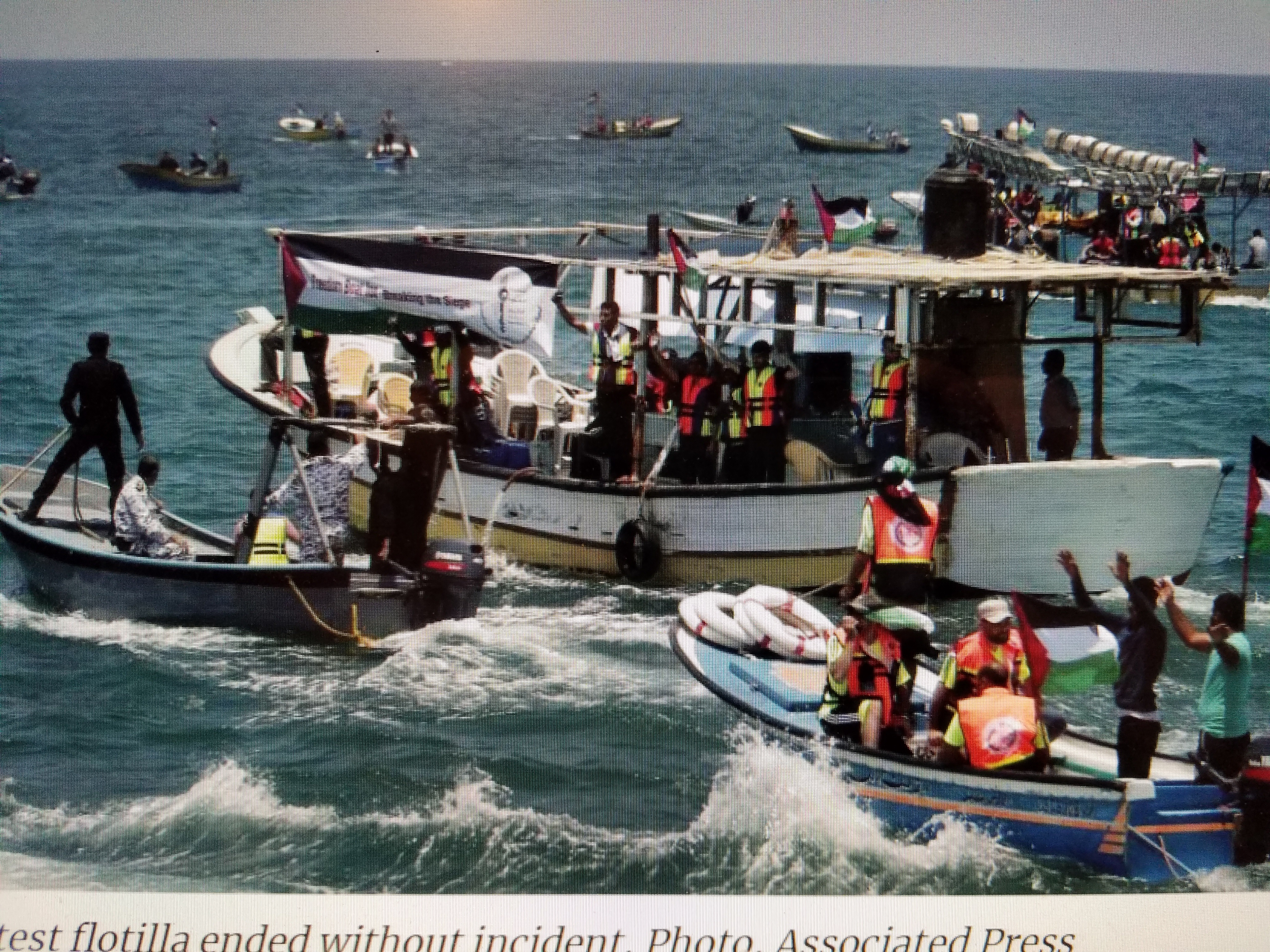
UN’s Confusion on the Legality of Israel’s Blockade of Gaza

In June 2015, the United Nations issued a report highly critical of Israel’s handling of its war against Palestinian attacks. Throughout the report, the committee suggested that the Israeli blockade of Gaza was a major cause for suffering of Palestinians, rather than a result of Palestinian actions, and helped precipitate the war.

Member of the Commission of Inquiry on the 2014 Gaza conflict Doudou Diene (L) gestures next to Chairperson of the Commission Mary McGowan Davis during a press conference to present their report on June 22, 2015 at the United Nations Office in Geneva. Both Israel and Palestinian militants may have committed war crimes during last year's Gaza war, a widely anticipated United Nations report said on June 22, decrying "unprecedented" devastation and human suffering.   AFP PHOTO / FABRICE COFFRINI

Member of the Commission of Inquiry on the 2014 Gaza conflict Doudou Diene (L) gestures next to Chairperson of the Commission Mary McGowan Davis during a press conference to present their report on June 22, 2015 at the United Nations Office in Geneva.  AFP PHOTO / FABRICE COFFRINI

2015 UN Assertion that
Blockade was Cause for Conflict

In the section of the report that reviewed the background to the 2014 conflict, the report stated that “In the preceding months, there were few, if any, political prospects for reaching a solution to the conflict that would achieve peace and security for Palestinians and Israelis and realize the right to self-determination of the Palestinian people. The blockade of Gaza by Israel, fully implemented since 2007 and described by the Secretary-General as “a continuing collective penalty against the population in Gaza” (A/HRC/28/45, para. 70), was strangling the economy in Gaza and imposed severe restrictions on the rights of the Palestinians.” By way of correction and education to the reader, the naval blockade of Gaza only began in January 2009 (not 2007). The land blockade of Gaza began in 2007 after Hamas routed Fatah from Gaza and took complete control of the region.

It is important and significant to point out that this 2015 report suggested that there were “few POLITICAL PROSPECTS for reaching a solution” and that the “blockade of Gaza.. was strangling the economy” and “imposed severe restrictions” on Palestinians. This directly implied that the Palestinians were seeking a political solution and rightfully frustrated with a blockade that was imposed on them (presumably for no reason).  Therefore, since a political solution was not available, they were forced to pursue a military response.

That is outrageous on many levels.

  1. Hamas has stated clearly in its charter and in addresses by its leaders that it seeks the complete destruction of Israel and that it will never enter peace negotiations. (A fact that was never mentioned in the UN report)
  2. Hamas clearly stated that it would not pursue any “peaceful solutions and international conferences” as seen in its charter, below.
  3. Hamas’s takeover of Gaza in 2007 is never mentioned in the UN report.

Hamas Charter Article 13: “Initiatives, and so-called peaceful solutions and international conferences, are in contradiction to the principles of the Islamic Resistance Movement…. These conferences are only ways of setting the infidels in the land of the Moslems as arbitraters… There is no solution for the Palestinian question except through Jihad. Initiatives, proposals and international conferences are all a waste of time and vain endeavors.

The UN report inverted reality and ignored that the blockade of Gaza was in response to Hamas’s taking over of Gaza and firing thousands of missiles at Israeli civilians.

 2015 UN Report
Call to Remove the Blockade

The UN report concluded with several suggestions which clearly placed the blame for the conflict on Israel’s actions: “The commission calls upon the Government of Israel… to address structural issues that fuel the conflict and have a negative impact on a wide range of human rights, including the right to self-determination; in particular, to lift, immediately and unconditionally, the blockade on Gaza.

This conclusion and suggestion are in stark contrast to the September 2011 UN “Palmer Commission Report” which clearly spoke of the legal nature of Israel’s blockade of Gaza and spoke to the harm and evil intent of Hamas which necessitated the blockade.


2011 UN Report
on LEGAL NATURE of Blockade of Gaza

To start, the Palmer Report correctly identified the different blockades of Gaza and the reason for them: “the tightening of border controls between Gaza and Israel came about after the take-over of Hamas in Gaza in June 2007.  On the other hand, the naval blockade was imposed more than a year later, in January 2009.”

The report continued that “the naval blockade as a distinct legal measure was imposed primarily to enable a legally sound basis for Israel to exert control over ships attempting to reach Gaza with weapons and related goods.  This was in reaction to certain incidents when vessels had reached Gaza via sea.”

The report then continued in greater detail on the “structural issues that fuel the conflict” with specific history (as opposed to simply echoing the Palestinian narrative as it did in the 2015 report): “Israel has faced and continues to face a real threat to its security from militant groups in Gaza.  Rockets, missiles and mortar bombs have been launched from Gaza towards Israel since 2001.  More than 5,000 were fired between 2005 and January 2009, when the naval blockade was imposed.  Hundreds of thousands of Israeli civilians live in the range of these attacks.  As their effectiveness has increased some rockets are now capable of reaching Tel Aviv. Since 2001 such attacks have caused more than 25 deaths and hundreds of injuries.  The enormity of the psychological toll on the affected population cannot be underestimated.  In addition, there have been substantial material losses.  The purpose of these acts of violence, which have been repeatedly condemned by the international community, has been to do damage to the population of Israel.  It seems obvious enough that stopping these violent acts was a necessary step for Israel to take in order to protect its people and to defend itself.

In regard for using a naval blockade to prevent the assault from Gaza on Israel, the report stated “The Israeli report to the Panel makes it clear that the naval blockade as a measure of the use of force was adopted for the purpose of defending its territory and population, and the Panel accepts that was the case.  It was designed as one way to prevent weapons reaching Gaza by sea and to prevent such attacks to be launched from the sea.  Indeed there have been various incidents in which ships carrying weapons were intercepted by the Israeli authorities on their way to Gaza.”

In sharp contrast to the 2015 report which cited the UN Secretary General’s comment that the blockade was a “collective penalty against the population in Gaza“, the 2011 Palmer Report concluded that “Although a blockade by definition imposes a restriction on all maritime traffic, given the relatively small size of the blockade zone and the practical difficulties associated with other methods of monitoring vessels (such as by search and visit), the Panel is not persuaded that the naval blockade was a disproportionate measure for Israel to have taken in response to the threat it faced.

The report concluded with clarity: “Israel was entitled to take reasonable steps to prevent the influx of weapons into Gaza.  With that objective, Israel established a series of restrictions on vessels entering the waters of Gaza.  These measures culminated in the declaration of the naval blockade on 3 January 2009… There is nothing before the Panel that would suggest that Israel did not maintain an effective and impartial blockade….  it is evident that Israel had a military objective.  The stated primary objective of the naval blockade was for security.  It was to prevent weapons, ammunition, military supplies and people from entering Gaza and to stop Hamas operatives sailing away from Gaza with vessels filled with explosives… It is also noteworthy that the earliest maritime interception operations to prevent weapons smuggling to Gaza predated the 2007 take-over of Hamas in Gaza.  The actual naval blockade was imposed more than one year after that event. These factors alone indicate it was not imposed to punish its citizens for the election of Hamas….  As this report has already indicated, we are satisfied that the naval blockade was based on the need to preserve Israel’s security.  Stopping the importation of rockets and other weapons to Gaza by sea helps alleviate Israel’s situation as it finds itself the target of countless attacks, which at the time of writing have once again become more extensive and intensive…  We have reached the view that the naval blockade was proportionate in the circumstances… The Panel therefore concludes that Israel’s naval blockade was legal… Israel faces a real threat to its security from militant groups in Gaza.  The naval blockade was imposed as a legitimate security measure in order to prevent weapons from entering Gaza by sea and its implementation complied with the requirements of international law.

Quite a different narrative and conclusion than the UN wrote up in 2015.


Related FirstOneThrough article:

Cause and Effect: Making Gaza

Gaza Blockade versus Cuban Blockade

Considering a Failed Palestinian State

Failed Countries
On July 9, 2011, the world welcomed a new country, South Sudan, which separated from Sudan. South Sudan rapidly became a failed state, one in which the central government lost the ability to control the security and economy of the country.
Failed states suffer from many terrible and unstable features: lack of governmental control; factional militias and armies; lack of border integrity and gross poverty. These societies often see rampant human rights abuses as various parties assert control over parts of the country and seek vengeance and control over minorities and local populations.
Consider some reports from South Sudan over the past year:
Ten thousand people have been killed and more than 1.6 million have been internally displaced since civil war broke out in South Sudan in December 2013.
June 2015: South Sudanese army may have caused widespread human rights abuses according to the UN
May 2015: At least 129 children killed, boys castrated and girls raped
July 2014: Food crisis declared worst in the world by UN Security Council
According to Business Insider, the worst failed states include: South Sudan; Sudan; Somalia; Congo; Chad and Yemen. The populations of these countries are forced to flee, suffer or die.

South Sudanese refugees wait to be registered at a crossing into Ethiopia earlier in 2015. (Photo: UNHCR/R. Riek)
Considering a Palestinian State
Many countries in the United Nations would like to see the Palestinian Arabs gain self-determination and have their own country. However, many of the ingredients for a failed state currently reside in the political structure of the Palestinian Authority:
The Palestinian territories have various stand-alone armies and militias including Hamas and Islamic Jihad
No central government, as the west bank of the Jordan River and Gaza strip are administered independently
Internal fighting as witnessed in the 2007 rout of Fatah by Hamas forces in Gaza, and various extrajudicial killings between those parties that continued since then
No border integrity as bedlam prevails in Gaza, Sinai and Israeli towns near the border of Gaza
Lack of functioning economy and widespread unemployment due: to the extremely high percentage of people under 25 years old; and constant war to destroy Israel
No presidential or legislative elections, as they were suspended due to the splits mentioned above. The presidential election was last held in 2005 and the president’s term expired a long time ago.
A country built on this framework would likely deteriorate. Factional fighting to dictate the future of the country would exacerbate. Unemployment would further skyrocket. Cross-border battles with Israel would escalate and also include the area east of the Green Line, EGL/ west bank of the Jordan River. This region, which already leads the world in the “honor killings” of women, would likely continue to see such murders increase.
It would be a country built in chaos, with people’s dreams dying alongside their lives.
Concrete Steps to Avoid a Failed Palestinian State
Should the Palestinian Arabs hope to achieve a functioning state after self-determination, important steps need to be instituted before the state is formed:
Remove all weaponry from Hamas and other groups. A functioning government must only have a single army. There cannot be a society in which various entities wage internal and external wars.
Ban Hamas. No entity which advocates for murder of minorities should be allowed to sit in any elected office, and no country should have any dealings with any country that seeks destruction of another country. As Hamas advocates for the killing of Jews and calls for the complete destruction of Israel, the party should be banned in its entirety until it renounces both positions completely.
Form new Political Parties and Hold Elections. The Palestinian Arabs have not held presidential elections since 2005 and legislative elections since 2006. As Hamas won legislative elections in 2006 and have polled to win future elections, new parties should be organized that can compete in new elections.
These are the basic steps that must occur for the Palestinian Authority to have a functioning government. Once the central authority rests in a representative body, that entity can negotiate a final status agreement with Israel to create a new state. To minimize the chances that it slip into a failed state, the Palestinian government should further consider the following:
Peace Agreement with Israel. A viable government should have a strong economy, including a flow of people and goods. Due to the separation of the Palestinian territories, it would be most efficient for the government to have a good working relationship with Israel to facilitate commerce.
Minimize Incoming Youth. A Palestinian state would likely want to welcome Arabs whose families once lived in the region. As a large population below age 25 often leads to rampant unemployment and instability, the emphasis on incoming people should be on professionally-trained adults.
Transitional control from UNRWA. UNRWA has kept infant mortality, immunizations, life expectancy and literacy of Palestinian Arabs at among the best rates in the world. Over a period of years, the UN should cede control of the schools and hospitals to Palestinian control.
While the world celebrated the founding of a new country four years ago in South Sudan, the declaration proved a hollow victory for the people. It would be a mistake to push forward another declaration for Palestinian Arabs at this time which would ultimately lead to further suffering. Mayhem with a flag benefits no one.

Related First.One.Through article:
A “Viable” Palestinian State

The Disproportionate Defenses of Israel and the Palestinian Authority

The United Nations Human Rights Council (UNHRC) produced a report in the spring of 2015 about the war between Israel and the Palestinians in the summer of 2014. The UNHRC continued with a debate in June 2015 in which several “delegations strongly condemned Israel’s excessive and disproportionate military aggression against the Palestinians” including from: Egypt; Tunisia; Maldives; Iraq; South Africa; Indonesia; Ireland and Cuba.

This analysis does not directly review “disproportionate force” but disproportionate defense employed by the two sides.

Obligation to Defend

The foremost responsibility of any governmental leadership is to protect its population. Such defense can be implemented in a variety of ways: a police force or army to maintain order; infrastructure to ensure safety; and intelligence which can guide the appropriate use of manpower and equipment. The United Nations has been developing a framework for “The Responsibility to Protect” over the past several years.

In the conflict between Israel and the Palestinian Authority, only one side proactively protects its citizens, while the other side uses reactive defenses. One side assumes responsibility via using its own resources and capabilities, while the other side relies completely on outside agents.

ISRAEL – ACTIVE DEFENSE

Protecting Against Incoming Missiles and Armaments

Bunkers and Bomb Shelters: Israel is unique in the Middle East in establishing a policy of bomb shelters throughout the country. In response to being surrounded to hostile neighbors that have attacked and shelled its people and lands since its inception, houses, schools, hotels, hospitals and even playgrounds are built with bomb shelters.

The Palestinians have not built shelters. Instead, they used their cement to build tunnels with which to attack Israel.

Israel_-_shelter_by_kate_simmons

Playground shelter in Israel
(photo: Kate Simmons)
Iron Dome. Israel developed a new missile defense system called the Iron Dome, and continues to build new air defense systems to protect the country from incoming missiles.

The Palestinians have neither developed nor imported defensive systems. They have only imported offensive weaponry.

irondome

Israeli developed “Iron Dome” Defense System
Blockade of Gaza. Israel imposed a naval blockade around Gaza after the terrorist group Hamas, which is sworn to the destruction of Israel, seized the land. The blockade has successfully kept out many missiles and other arms from reaching Hamas and ultimately causing death and destruction in Israel.

Protection Against Killers

Security Barrier. In September 2000, the Palestinians began multi-year riots which killed over a thousand Israelis through hundreds of attacks. In response, the Israeli government began to construct a security barrier in 2002 to keep out terrorists who mostly emanated from cities in Judea and Samaria/ east of the Green Line (EGL).

The Palestinians have not built any security barriers from the Israelis. There have been no suicide bombers going from Israel into Gaza or EGL blowing up civilians.

IMG_1805

Stretch of Security Barrier along highway
(photo: FirstOneThrough)

Airport Security. Well before the world became attuned to airport security after the attacks on the United States on 9/11/01, Israel established an extensive airport security system. The screening of passengers, x-rays of baggage and other methods were in response to a series of airplane hijackings in the 1970s (a method of terrorism created by the Palestinian Arabs).

The Palestinians do not have an airport and therefore no such security concerns.

plane blowup 1970

Palestinians blow up plane, 1970

Protection Against Lethal Plans

Intelligence. Israelis utilize a wide variety of information sources to uncover plans to attack its country. Whether through a network of Israeli spies, Palestinian informants, money tracking, wiretapping and other means, the Israelis gather information and make assessments on potential Palestinian Arab attacks. It is then able to take preventative action before such attacks occur.

PALESTINIAN AUTHORITY AND HAMAS – REACTIVE DEFENSE

Relying on Israeli Sensitivities and Sensibilities

Civilians. As detailed above, the Palestinian Authority and Hamas have not instituted proactive tangible means of defending its people. One of the ways it attempts to defend the population is by making it nearly impossible to distinguish between fighters and civilians.

  • The fighters do not typically wear uniforms and can therefore not be distinguished from civilians
  • Men, women and children are all enlisted in the war against Israel
  • Militants fire at Israel from mosques, schools and civilian neighborhoods

Palestinian Arabs hope that Israel will not indiscriminately fire upon everyone. By forcing Israel to take time and extra precautions to target the right attackers, it slows down Israeli defenses during battles.

humanshieldsgaza

Destroying its Own Infrastructure. Hamas built an extensive offensive network of tunnels into Israel which originated in many private homes. By relying on Israelis sensitivities to minimize destruction in civilian neighborhoods, Hamas was able to protect many tunnel openings.

Further, Hamas and other Palestinian Arab groups often booby-trapped homes from which they attacked Israel. While the Palestinian Arabs destroyed their own infrastructure, they slowed down and killed many Israelis who looked to root out the attackers.

Relying on Global Bodies like the United Nations

United Nations. One of the principal methods that the Palestinian Authority uses to defend its population is through global bodies AFTER a war. The United Nations includes 57 Islamic countries (in the OIC) and 22 Arab countries (in the Arab League) which align themselves with the Palestinian Arab cause. Many of those countries do not even recognize the State of Israel. They were instrumental in passing the “Zionism is Racism” resolution in 1975 and creating several committees devoted only to Palestinian causes.

The Palestinians turn to the UN to highlight the damage that Israel inflicts on its intentionally defenseless population. It uses deliberate attacks on Israel to provoke premeditated casualties to show the world.

This same UN has not condemned the Palestinian Authority for not properly defending its population. Instead, it recommended the incredulous idea that Israel must give the Arabs the defensive systems like Iron Dome that it developed.

The latest forum that the Palestinian Authority has pursued is the International Criminal Court, the ICC. While it is evident that the Palestinians Arabs definitely committed war crimes in the 2014 War against Israel, it would still sue Israel in the hopes that such action will hurt Israel, further its cause and protect the Palestinian Arabs.


As detailed above the two sides in the Israel-Palestinian Authority conflict have disproportionate defenses.

  • The Israelis use several proactive approaches; the Palestinians use reactive methods
  • The Israelis rely upon ingenuity and preparedness; the Palestinians rely on Israeli sensitivities and global sympathy
  • The Israelis principally depend on themselves; the Palestinians depend on the world

A discussion of “disproportionate force” cannot be made in a vacuum without discussing “disproportionate defenses”. The global community cannot continue to reward the acts of a leadership that deliberately deals in its own premeditated casualties.


Related FirstOneThrough articles:

Israel: Security in a Small Country

The United Nations and Holy Sites in the Holy Land

The International Criminal Court for Palestinians and Israelis

The United Nations Audit of Israel

Names and Narrative: Palestinian Territories/ Israeli Territories

Summary: Almost every major media outlet refers to the Gaza Strip and the west bank of the Jordan River as “Palestinian Territories”, when in fact, those areas are actually “Israeli territories” and “Palestinian Authority Territories.”

Most places in the world are part-and-parcel of a country.  However, there are situations when a place is administered by a government which has not incorporated the land and assumed full sovereignty.

The United States of America historically had several large territories as the country expanded, including Alaska and Hawaii.  Today, the USA continues to have several territories including:

  • Puerto Rico
  • US Virgin Islands
  • Guam
  • Northern Mariana Islands
  • American Samoa

These territories have some rights and protections of the US government, but not others such as the right to vote.

Israeli Territories and
Palestinian Authority Territories
1995 to Present

It is easy and obvious to understand that there are no “Palestinian Territories”, because there is no such thing as the State of Palestine (as of this writing, in any event).  Most of the area east of the Green Line (EGL/ west bank of the Jordan River, WBJR), is controlled and administered by Israel.

Under the Oslo Accords, EGL was divided into three parts: Areas A, B and C. Area A was handed over to the Palestinian Authority (PA) and it has complete control of that land.  Area C is “Israeli Territory” and is completely controlled by Israel. Area B is a hybrid, which is under the civil administration of the Palestinian Authority, but security control of Israel.

Areas ABC
Breakdown of Areas A, B and C
on the west bank of the Jordan River

Gaza would ostensibly be called “Palestinian Authority Territory”, however, the PA has no control in the area.  The governing party is Hamas, which won elections in 2006 and routed any PA personnel from the region in 2007.  Israel withdrew from Gaza in 2005.

Israeli Territories
1967 to 1995

The Oslo Accords between the State of Israel and the PLO started the process of breaking the Israeli territories into areas with local Palestinian Arab control.  Before the Oslo Accords, all of Gaza and EGL/ west bank of the Jordan River (WBJR) were only Israeli territories.

Israel took control of Gaza from Egypt in June 1967 during the Six Day War.  Egypt had amassed a large army and announced its intention of attacking Israel, so Israel preemptively attacked Egypt and seized Gaza.  In response to Israel’s preemptive attack on Egypt, Jordan attacked Israel from the EGL/WBJR. Jordan lost the region and gave up all claims to the land in 1988.

Jordan and Egyptian Territory
1949 to 1967

In May 1948, the Palestinian Arabs and five Arabs armies attacked Israel as it declared independence from Great Britain. At the end of the war in 1949, Jordan assumed control of much of Judea and Samaria in an area which became known as the “west bank of the Jordan River (WBJR)” in the United Nations, ultimately shortened to the “West Bank”.  Jordan annexed that area in 1950, gave all Arabs living there citizenship and expelled all of the Jews from the area, counter to the Fourth Geneva Convention.

Egypt assumed control of the Gaza Strip, but did not annex the area.

British Territory 1922 to 1948
Ottoman Territory 1517 to 1922

At the end of World War I, the defeated Ottoman Empire was carved up into several areas (including Lebanon, Syria, Iraq, and Jordan) which were administered by the French and British.  The lands currently known as WBJR and Gaza were part-and-parcel of the British Mandate and had no unique laws or characteristics.  Similarly under Ottoman rule for hundreds of years before the British, those areas were neither divided nor distinct.

As detailed above, there are not, nor have there ever been “Palestinian Territories”. Such terminology inherently upgrades the status of the Palestinian Authority and eliminates the legal role and status that Israel has in Areas B and C.


Related First.One.Through articles

Names and Narrative: The West Bank / Judea and Samaria

Nicholas Kristof’s “Arab Land”

The Subtle Discoloration of History: Shuafat

The Legal Israeli Settlements

Educating the New York Times: Hamas is the Muslim Brotherhood

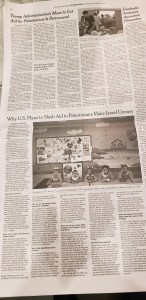
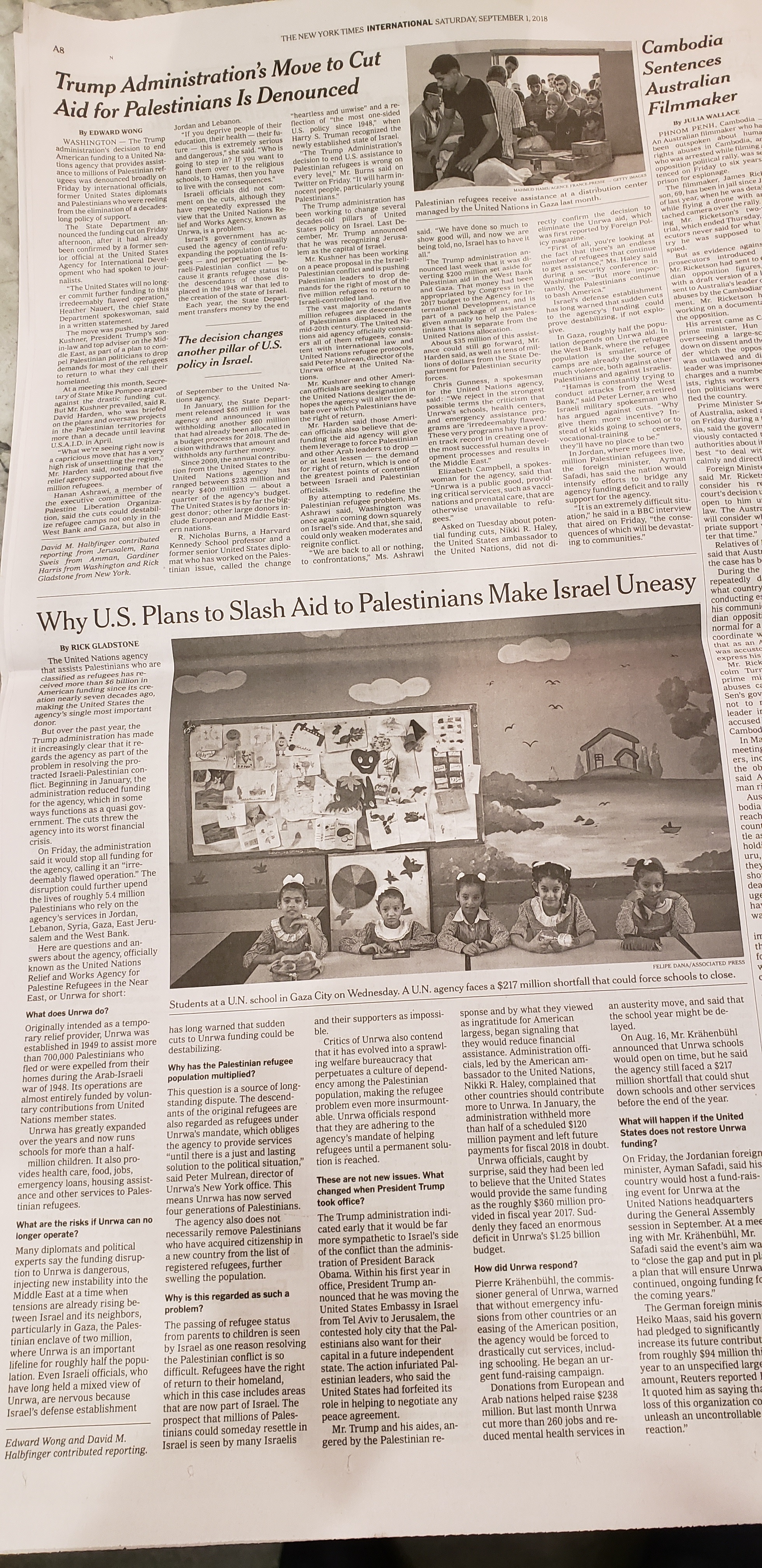
On June 2, 2015 the New York Times once again decided to tell the world that the people of Gaza are suffering.

20150602_201544
New York Times cover picture of Gaza,
June 2, 2015

With a large color picture on the front page, the Times included another picture and article inside regarding how the Gazan community has still suffered from a lack of money, jobs and rebuilding of the infrastructure one year after the war “between Hamas and Israel.”  If a reader ever wanted to learn about the scores of people killed in Nigeria, they would have to hunt inside the paper for an article on page A4 (with no picture).  If they wanted to hear about the dozens of Yemeni civilians killed by Saudi Arabia, they would have had to turn to page A12 the day before.  This has been a continuing pattern for the NYT, as outlined in “Every Picture Tells a Story – Whitewashing the World” where the killing of civilians around the world went under-reported, while the suffering of Gazans remained over-reported.

Another trend of the liberal press has been to not label Hamas a terrorist organization, as reviewed in “CNN’s Embrace of Hamas.”  The group simply is a political group dedicated to “resistance.”

The June 2 NYT article “Gazans’ Hopes for Rebuilding After War Give Way to Deeper Despair” has continued to add to the trend of distancing Palestinian Arabs from Hamas, and Hamas from terrorism, as if everything that happened to Gazans was poor luck and happenstance.

20150602_201625

The article referred to the Palestinian Arabs’ “hope” and “Early optimism that global powers would intervene forcefully to rebuild the battered coastal enclave after the 50-day summer war between Gaza’s Hamas government and Israel “.  The article never discussed their hope that Hamas would destroy Israel.

The article detailed the blight in Gaza, stating “Pulverized buildings are still scattered along Gaza’s border areas from the last war. In the rubble of Shejaiya, an eastern neighborhood of Gaza City, near the border with Israel,” but did not discuss that the Shejaya neighborhood was the locus of dozens of tunnels from people’s homes into Israel to commit acts of terror.

It would appear that the NYT further wanted its readers to believe that the people of Gaza made a momentary strategic blunder in aligning itself with the Muslim Brotherhood in a “decision that backfired“:

The Egyptian government, a bitter enemy of its homegrown Islamist party,
the Muslim Brotherhood, has taken extraordinary steps to shut down the tunnels [connecting Egypt and Gaza]  that were the lifeblood of the Gaza economy.

Egypt has opened its border only five times this year, part of a broader policy to punish Hamas, which aligned itself with the Brotherhood, Egypt’s former ruling party,
a decision that backfired when the military seized power in mid-2013.

This is ridiculous.  Hamas IS an integral part of the Muslim Brotherhood. It didn’t simply “align itself” in “a decision that backfired.”  Here are quotes from the Hamas Charter (1988):

“Article 2: The Islamic Resistance Movement is one of the wings of Moslem Brotherhood in Palestine. Moslem Brotherhood Movement is a universal organization which constitutes the largest Islamic movement in modern times….

Article 7: The Islamic Resistance Movement is one of the links in the chain of the struggle against the Zionist invaders. It goes back to 1939, to the emergence of the martyr Izz al-Din al Kissam and his brethren the fighters, members of Moslem Brotherhood. It goes on to reach out and become one with another chain that includes the struggle of the Palestinians and Moslem Brotherhood in the 1948 war and the Jihad operations of the Moslem Brotherhood in 1968 and after.”

This is not subject to interpretation. Hamas is an integral part of the global Muslim Brotherhood movement, a group which has been actively banned and persecuted in Muslim countries such as Egypt and Syria for promoting terrorism.

However, such facts muddy a narrative of Palestinian Arabs as innocent victims.  Therefore, the media seems to have concluded that the best way to advance the victimhood tale requires a multi-part effort:

  1. Distance the people from the ruling government and negative reports. Minimize the fact that Palestinian Arabs voted for Hamas, which has led Fatah in every poll since 2006. Explain that the Arabs are frustrated by the Fatah corruption so had no practical choice other than voting for Hamas. Explain Palestinian Arabs being the most anti-Semitic people in the world by using terms like “not surprising” without delving into cause-and-effect.
  2. Stop calling Hamas a terrorist organization. Use terms like “militant” sparingly, and ideally, just “Islamist”.
  3. Refer to Hamas as a political entity. Which it is, like the Nazi party was a political entity elected by the Germans in the 1930s. Quote “political leaders” of Hamas often.
  4. Never refer to the Hamas Charter, which calls for the complete destruction of Israel; murder of Jews and never accepting any negotiated settlement. Skip the long, evil Jewish and Zionist conspiracy theories- those statements are just noise that cloud the picture of Palestinian Arab suffering.
  5. Localize Hamas to an Israeli resistant movement.  In a world that fears the dangerous rise of the Islamic State / ISIS, do not let Hamas get painted as part of a broader Muslim terrorist group (as described above).

If you follow these steps, the Palestinian Arabs can appear as passive victims and not as active participants in a radical anti-Semitic, anti-Western regional movement to install a Muslim caliphate.

Read the press today. Which rules are they using?


Related First.One.Through articles:

Cause and Effect: Making Gaza

The Death of Civilians; the Three Shades of Sorrow

Honor Killings in Gaza

The Palestinians aren’t “Resorting to Violence”; They are Murdering and Waging War

What do you Recognize in the Palestinians?

Extreme and Mainstream. Germany 1933; West Bank & Gaza 2014

CNN’s Embrace of Hamas

Many people in the pro-Israel community continue to be frustrated by the refusal of many media outlets and some political organizations to designate Hamas a terrorist organization. While the phrase “one person’s terrorist is another person’s freedom fighter” is often bandied about, organizations have no difficulty clearly labeling some organizations as terrorist groups.

Consider CNN which highlighted five jihadist groups in February 2015 as terrorist organizations: Al-Shabaab; Al Qaeda; Boko Haram; ISIS; and the Taliban. The groups are consistently labeled as jihadist terror organizations that seek to destroy reigning governments.

AL-SHABAAB

CNN has clearly labeled Al-Shabaab as a terrorist group:

Al-Shabaab was specifically designated as a  terrorist organization by CNN, which did not couch the language as a suggestion that it could be considered a terrorist group by some third party.

AL QAEDA

As of early 2015, CNN considered Al Qaeda’s central command structure under threat while it spread around the world. It was clear in all circumstances that they were terrorists:

BOKO HARAM

CNN often localized Boko Haram to Nigeria and neighboring countries (compared to the growing global threat of Al Qaeda), but consistently referred to the group as terrorists.

ISIS

ISIS/ ISIL/ Islamic State has been extremely active in 2015 and gathering many news reports on CNN and all media outlets, particularly as the United States has been engaging them in Iraq and Syria:

TALIBAN

The Taliban has not been as prominent in the news lately.  However, when it was, CNN was clear that the group’s actions and the group itself was involved in terrorism.

These five organizations are identified by CNN as terrorist groups. They are Islamic jihadists. They terrorize and attack. They seek to overthrow existing governments through murder and mayhem.

Now compare them to CNN’s description of Hamas.

HAMAS

On February 28, 2015 CNN had an article entitled Egyptian court designates Hamas as a terror organization, state media says.  Note that CNN clearly did not make the designation, but repeated an assertion from Egypt.  The article read: “Hamas, the Islamist group which dominates the Gaza strip, has been at odds with the Egyptian government…” made it seem that there was simply a political disagreement between Hamas and Egypt, between two ruling parties. CNN referred to Hamas only as “Islamist” and not “jihadist”, “militant” or “terrorist”.

CNN continued: “Hamas quickly denounced the decision at a news conference…. “It is a shocking and dangerous decision that targets the Palestinian people,” Fawzi Barhoum, a Hamas spokesman, said at a news conference”.  The article highlighted that Hamas was designated a terrorist organization by one country (as opposed to actually being a terrorist group) and CNN made the effort of showing that the group challenged such opinion.  The quote chosen by CNN further tried to show that such designation was itself an attack on “the Palestinian people” making the group the victim.

How is that for a turn?

On January 6, 2015 CNN wrote another piece that seemed all about politics. “Senior Hamas official Izzat Risheq denied reports Monday that the group’s political leader Khaled Meshaal has been expelled from Qatar” making the group appear as purely s political party. There was no mention that the group is in favor of jihad, destruction of Israel or is terrorist group.

On November 27, 2014 a CNN article entitled “Israel says it broke up Hamas terror plot” specifically gave attribution of the plot to Israel, and not as a clear fact. The article stated that “Authorities arrested at least 30 members of Palestinian militant group Hamas” which at least referred to the group as “militantwhich is much more than it typically writes to describe Hamas.

These were the recent articles while Hamas licked its wounds from its 2014 war against Israel.  How did CNN describe Hamas during the 2014 campaign itself?

CNN’s Assertion of No Hamas War Against Israel 

In its August 22, 2014 article “Hamas leader admits militants abducted slain Israeli teens,” CNN quickly distanced the group leadership from the abduction and murder of three Israeli boys.  The three leading paragraph’s took pains to absolve the group’s leadership:

“Three Israeli teens kidnapped in the West Bank in June and later found dead were abducted by Hamas militants who did not inform the group leadership about
the kidnapping, a Hamas official said Friday.
“At that time, the Hamas leadership had no knowledge about this group or the operation it had just carried,” Saleh Aruri, a Hamas Political Bureau member, said in a statement from Doha, Qatar. “It turned out later, however,
that they were members of Hamas.”
Aruri said the operation to abduct the teens was not approved by the Hamas leadership or its military wing, the Qassam Brigades.”

The article (in its entirety) quoted no Israelis. CNN repeatedly referred to Hamas as a political entity (does CNN ever quote Boko Haram’s main political spokesman?), as the article sought to distance Hamas from the murders.

These actions were done repeatedly by CNN, most egregiously on August 4, 2014 when it aired an interview “CNN exclusive: Inside the mind of Hamas’ political leader

Meshaal CNN Meshaal “Political Leader” on CNN

The introduction to the interview with Khaled Meshaal made it appear that CNN was going to have a serious exchange: “CNN’s Nic Robertson had tough questions for Hamas’s political leader.”   Well, maybe not- CNN was again directing the public that Hamas is simply a political organization. Did the article ever mention:

  • that the Hamas Charter calls for the complete destruction of Israel?
  • the Hamas Charter calls for jihad and murder of Jews by every man, woman and Palestinian child?
  • the Hamas Charter which declares that there is no possibility of peace with Israel through any negotiation, and that all of Israel must be destroyed through military means?
  • the Hamas Charter’s repeated use of anti-Semitic slurs, stereotypes and conspiracy theories?
  • the repeated calls by Hamas and Palestinian leadership to attack Israel?

During the interview, did Robertson get answers to questions:

  • if Hamas is fighting for the Palestinians, why was Meshaal sitting comfortably in Qatar?
  • if Hamas was intentionally firing rockets from civilian neighborhoods in Gaza?
  • if Hamas targeted Israeli civilians with such attacks?
  • if Hamas built tunnels to abduct and kill Israelis?
  • if Hamas would abolish its charter?
  • if Hamas would recognize Israel?
  • what lands Hamas considers as “occupied” since Israel left Gaza in 2005

It is noteworthy that Robertson asked Meshaal how he was helping his “resistance” to Israel (Robertson used Hamas’ terminology instead of terrorism). Meshaal responded that Palestinians understood that military resistance was needed to get rid of Israeli occupation, the same way that the Americans got rid of the British and the French got rid of the Nazis.  Robertson let the statement stand and did not follow up about the absurdity of the comparisons. The French repelled the Nazi invading force that took over France. The US sought separation from a colony to an independent country. But here, the Palestinians were attacking an independent country, once again seeking its complete destruction and murder of its people.

Neither in the interview nor accompanying article did CNN’s Robertson ever call out Hamas as a jihadist terrorist group.  It did however, allow Meshaal to air his propaganda and assume a victim status both at the hands of Israel and the global community:

“”We the Palestinian people have, since 1948, have listened to the international community and U.N. and international regulations, in the hope they end the aggression against us. But the international community failed in ending the Israeli occupation and failed in helping our people to have self-determination and have its own state.”

Imagine CNN airing such an interview and article about any other terrorist group.


Related FirstOneThrough articles:

Differentiating Hamas into Political and Military Movements

The New York Times wants to defeat Terrorists (just not Hamas)

Cause and Effect: Making Gaza  

Recognizing the Palestinians

Palestinians are “Desperate” for…

The Palestinians aren’t “Resorting to Violence”; They are Murdering and Waging War

Why the Media Ignores Jihadists in Israel


Cause and Effect: Making Gaza

Summary: The media frequently touches on the suffering that takes place in Gaza. Yet, the depth of their coverage of Arab misery never approaches any level of analysis on the root cause for the Israeli-Arab conflict.


The Atlantic published an article on May 2, 2015 called “Gaza is Hell” (all in quotes) which described the miserable living conditions of Arabs living in Gaza. The 2000-word article covered the area and quoted the residents, but never scratched the surface of the underlying cause of the residents’ misery.

atlanticmay2
The Atlantic magazine,
May 2015

The problem in the coverage was in five key areas, long ignored by the media and politicians.

  1. Hamas isn’t “resisting” Israel. It wants to destroy Israel.
  2. Palestinian Arabs never ruled Gaza until 2005.
  3. Israel’s wars with Gaza have all been defensive.
  4. There are no “refugees” in Gaza.
  5. Much of the Gazan misery is self-inflicted.

The Atlantic article did not fall victim to a sixth category, which is actually a subset of lie #5: Hamas is the democratically-elected choice of Palestinian Arabs.

 HAMAS’S MISSION

Hamas’ mission is very clear for any literate individual: the complete destruction of Israel. It lays out its goal repeatedly in its 1988 Charter, the most antisemitic charter of any governing body in the world, including the Nazi party when it took power in 1933.

For those who cannot read (former US President Jimmy Carter?) there are dozens of recent videos from Hamas officials which call for the murder of Jews and destruction of Israel.

Yet, The Atlantic echoes soft lies in its piece stating that “Hamas’s rhetoric is all about resistance,” and “Hamas advocates militant resistance to Israel.” Nope. Resistance means opposing a force. Hamas is the force that seeks jihad and the total destruction of Israel. Any statement that says that Hamas is a resistance movement, inherently makes the argument that the basic existence of the State of Israel is an active force against Palestinians.

GAZA’S FIRST INDEPENDENCE and
ISRAEL’S DEFENSIVE WARS

The mutant siblings of lie #1 that Gazans are “resisting” Israel, are lie #2, that Palestinians have always been self-governing in a country of their own, and lie #3, that Gazans just want to live in peace alongside Israel but Israel continues to attack it.

Alice Su, the author of The Atlantic article is based in Jordan, a country that is over 50% Palestinian Arab. That country, like Gaza, was part of the 1922 British Mandate from the League of Nations. Before the British ruled Gaza, the Ottoman Turks were in charge, and after the British came the Egyptians. None of these rulers made it into Su’s description which starts a historical background of Gaza in 1967: “Gaza, which was under Israeli occupation from 1967 until 2005”. With some additional background, it would have been clear to any reader that Gaza was never ruled by local Arabs (the Ottomans were Muslims but not Arabs), and it has only been since Israel left the territory in 2005 that Gazans have ruled over themselves.

Additionally, the various wars that Israel fought against the Arabs including 1948 and 1967 were defensive wars against several Arab countries (including the Arabs in Gaza). The more recent wars from Gaza were also defensive, in response to Hamas’s rocket attacks, terror tunnels and abduction and murder of Israeli teenagers. Yet Su stated that “Israel has also launched three military operations in Gaza since the Hamas takeover,” which suggested that Israel was the aggressor, which it was not.

Arab amnesia repeats itself today, as Su writes about a Gazan: “They keep asking him why the Israelis bombed them. “I tell them, ‘Naseeb. This is our fate,’”  The Gazan assumed a completely passive stance in the conflict and Su did not educate the reader about: the abduction and murder of three Israeli teenagers; the rockets fired from Gaza into Israel; and the terror tunnels Hamas dug into Israel to kidnap Israelis.

It was only eight paragraphs later that Su brought up the tunnels: “Israel has restricted imports of key building materials like cement and steel, out of concern that they’ll be used to build tunnels and facilitate terrorist activity.”  Such concern looks out-of-place without any history regarding the Hamas tunnels which were used for terrorist activities.  The Israeli ground invasion into Gaza in 2014 was specifically to destroy those tunnels.

To underscore the point of misdirecting the reader, consider the title of the Atlantic article.  It comes from a resident of Gaza. ““Gaza is hell,” 20-year-old Ahmad told me in Shejaiya, one of the worst-hit neighborhoods in Gaza City.”

Shejaiya was the neighborhood with the greatest number of terror tunnels, many coming straight from people’s homes. That is why the Israelis concentrated its efforts on the neighborhood in a defensive action.

Why did The Atlantic run an article with a headline quote from a man who was part of the terrorist infrastructure?  Why did it deliberately mislead readers into thinking these people were merely passive homeowners who were bombed indiscriminately by Israel?

REFUGEES IN THEIR HOME

Su’s article describes refugees and refugee camps in Gaza. Now that Gaza is not occupied by Israel, Egypt, the British or anyone else, these people cannot be considered “refugees” since these “Palestinian Arabs” are living in “Palestine” run by themselves.

The refugee myth has continued to compound itself as this misnomer is incorrect on additional levels.  Refugee status cannot be handed down like inheritance through the generations.  Refugees can only be from a country, not a house or region.

At the most generous, these people can be considered descendants of “internally displaced” people from the region of Palestine which was occupied for centuries until 2005. Yet Su used the term refugee several times:

“a refugee camp initially built to shelter 9,000 out of the 750,000 Palestinians who became refugees when Israel was established in 1948. More than half a century later, the camp hosts more than 21,000 refugees,”

The description above elegantly covers many soft lies: the ones mentioned above, and that Arabs became refugees when they actively launched a war to destroy Israel; they were not passive “when Israel was established in 1948.

SELF-INFLICTED MISERY

Su did get several things right, such as “Gaza remains in ruins.” But why?

Su pointed out that “Hamas, the Islamic militant group that governs Gaza… since the organization defeated the PLO-affiliated Fatah party in Palestinian elections in 2006.” Hamas was chosen by the Palestinians in 2006 and polls continue to show Palestinians favoring Hamas should elections ever be held again. The various quotes of Arabs on the street in Su’s article affirm that view: “Another college student said she’d lost faith in politics, but would vote for Hamas if an election were held now.”

Yet Su would have you believe that Gazans are simply passive victims in the situation. That position is encapsulated in her article: “Those who survived last summer’s war are trapped in 360 square kilometers of trauma and contradiction, choking on war and blockade, disillusioned with the Palestinian leadership and disempowered by the aid communityThey sit without jobs, relief, or means of rebuilding, waiting for things to change.” Untrue.

  • The Palestinians voted for Hamas, well aware of its charter and calls to destroy Israel. The fact that Palestinians are “disillusioned” with their leadership is only because Hamas hasn’t been successful in their genocidal mission.
  • The phrase “disempowered by the aid community” is strange but Su’s meaning becomes clear when she later writes that foreign aid is slow in coming “because donors are put off by the political deadlock between Palestinian parties.”  A Lie. The aid is being held up until there are guarantees that Hamas will not have access to the funds as it is a terrorist organization.

The catalyst for war is Hamas.

  • If Gazans would turn away from Hamas, there would be no blockade.
  • If Gazans did not allow Hamas to build terror tunnels in their houses, the neighborhood would not get demolished.
  • If Hamas were disbanded and outlawed, foreign aid would flow into Gaza for rebuilding.
  • If Hamas would not attack Israel, there would be peace.

The simple cause-and-effect of the situation in Gaza is about the people’s support of a genocidal anti-Semitic regime.  But writing about such reality would make it harder to sympathize with the picture laid before readers in The Atlantic.

Scarier still, is the support for the insidious paring: Hamas with a nuclear Iran. That is what keeps the hopes of Gazans alive under the shade of complicit countries and malevolent media.


Related FirstOneThrough article:

The Death of Civilians; the Three Shades of Sorrow