Free Speech Is Not on Trial. Antisemitism Is.

Every time antisemitism is called out on the left, the same dodge appears on cue:
“It’s just free speech.”

That response is not a defense. It is a red herring.

No one is arguing that anti-Israel speech is illegal. Under American law, almost nothing is. You can shout racist slogans. You can be misogynistic. You can mock religions. You can hold a Draw Muhammad contest outside a mosque. You can call for the destruction of a country. You can deny a people’s history.

All of that is protected speech. That has never been the question.

The question is what that speech is.

And much of what now passes as “anti-Israel discourse” is not political critique at all. It is hate speech, clearly, historically, and deliberately so.

Calling for the destruction of the Jewish State is not foreign policy analysis.
Denying Jewish history in the Land of Israel is not academic debate.
Declaring that Jews alone have no right to national self-determination is not progressive politics.
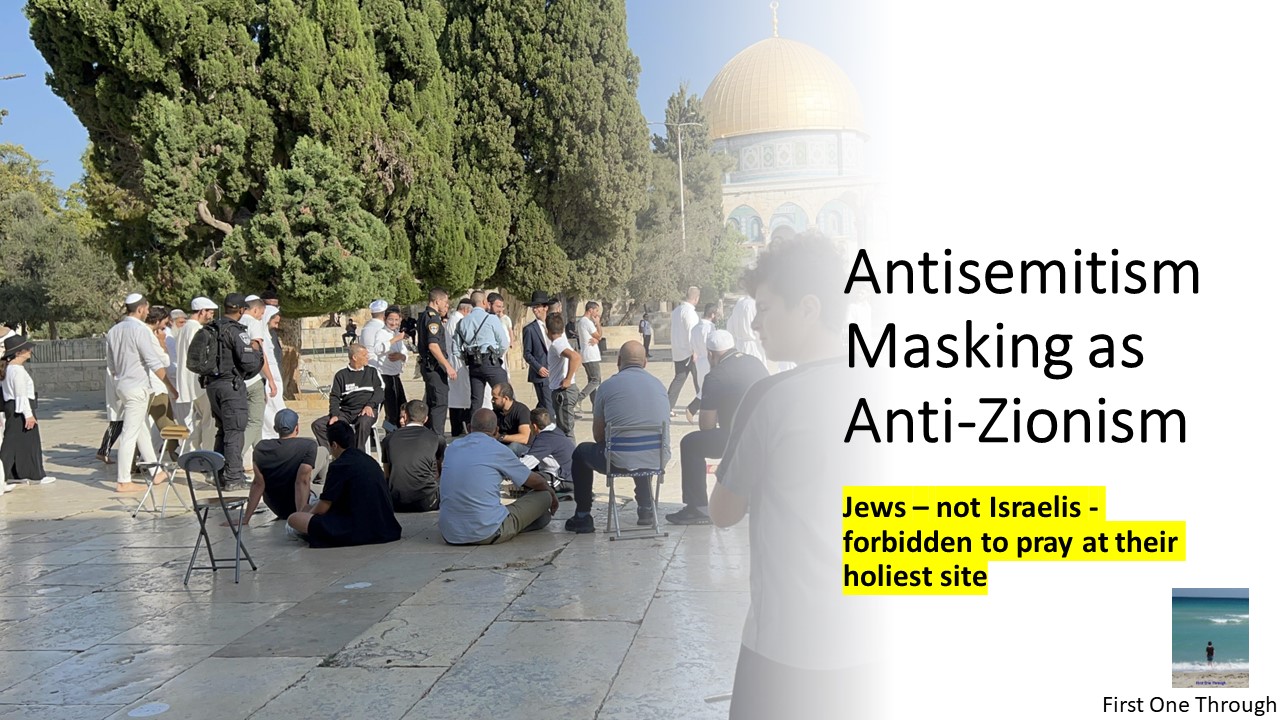
Passing a law that Jews cannot live somewhere and cannot pray at their holiest location is not a free exchange of ideas.

It is the application of a single moral standard to one people — and only one people — that says: you do not belong anywhere.

It is naked antisemitism.

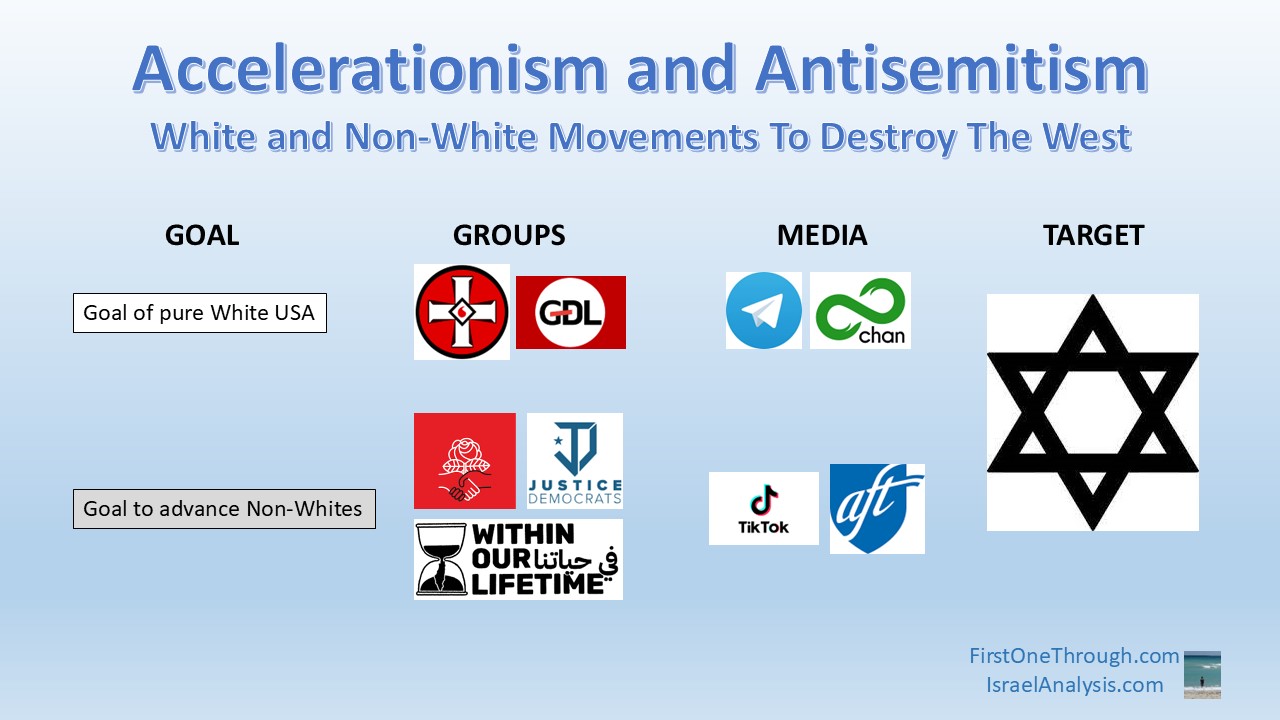
Organizations like Democratic Socialists of America, Students for Justice in Palestine, Within Our Lifetime and Palestine Youth Movement are not tolerating this rhetoric. They are chanting it, platforming it, amplifying it, and treating it as virtuous. They deny Jewish peoplehood, erase Jewish indigeneity, excuse violence against Jewish civilians, and then insist this is nothing more than robust debate.

It is not.

It is hate speech — even if the Constitution protects the right to utter it.

And then there is Zohran Mamdani, who embodies the selective blindness at the heart of this moment. No serious person believes he would tolerate a mass of protesters outside mosques depicting Muhammad as a terrorist, screaming at Muslims as they enter prayer. That would be — correctly — labeled Islamophobia, regardless of whether it was technically legal.

Yet Mamdani casually removed buffer zones around entrances to synagogues, insuring his excited comrades can yell epithets at Jews.

When Jewish institutions are targeted, when synagogues are surrounded, when Jewish national identity is declared illegitimate, the alt-left response suddenly becomes procedural: free speech.

Free speech does not launder bigotry. The First Amendment protects the right to speak; it does not cleanse the moral content of what is said. When people accuse Mamdani and the DSA of promoting Jew-hatred, they are not confused about constitutional law. They are describing the reality of ingrained Jew hatred.

“Most Americans are familiar with the classic Western flavors of anti-Semitism: the Christian, European, white-supremacist and Communist types. But little attention has been paid to the special case of Muslim anti-Semitism. That is a pity because today it is anti-Semitism’s most zealous, most potent and most underestimated form.” – Ayaan Hirsi Ali, July 2019

Invoking free speech is an evasion. A way to avoid responsibility while continuing to normalize ideas that would be instantly condemned if aimed at any other minority.

The tragedy – and fear – is that liberals understand this perfectly well in every other context. They simply refuse to apply it to Jews. Or at least, when uttered by a community of preference, Muslims.

Free speech is not on trial, do not be confused by the misdirection. Antisemitism is, and it is winning.

Hamas and the DSA: Ideology + Grassroots Mobilization to Power + Destruction

Political power is built when ideology is fused to daily life. Theory alone persuades few and charity alone commands none. Durable movements embed a worldview inside services people rely on, until dependence becomes loyalty.

That was the formula in Gaza. It is the same formula now visibly rising in New York.

Hamas entered Gaza with a rigid morally corrupt worldview long before it ruled. Its clinics, schools, mosques, and charities were never neutral. They delivered aid while teaching a doctrine that explained suffering, identified enemies, and promised redemption through allegiance. Service and ideology arrived together.

The Democratic Socialists of America advances along the same dual track in American cities. Mutual aid, tenant organizing, bail funds, and rent clinics function as delivery systems for a moral framework that divides society into oppressors and oppressed, treats ownership as suspect, and elevates redistribution as justice. Assistance arrives bundled with belief.

In both cases, aid becomes initiation and gratitude becomes allegiance.


The Manifesto: How Movements Legitimize Seizure

Grassroots legitimacy does not sustain power by itself. Movements require a manifesto—a moral architecture that explains why people suffer and who is to blame.

Hamas supplied that architecture in its 1988 foundational charter. The document framed politics as a total moral struggle, casting Jews collectively as illegitimate manipulators of capital and institutions, thieves of land and destiny. Jewish presence, ownership and sovereignty were criminalized. Seizure was the cure to restoration. Compromise vanished and was vilified. The charter’s function was clear: define an enemy class, strip legitimacy, and authorize permanent struggle.

The New York analogue operates through a different medium with the same effect. In the DSA ecosystem, capitalists and landlords are portrayed as extractive and illegitimate. Profit is framed as violence with ownership recast as theft. Confiscation is moralized as justice.

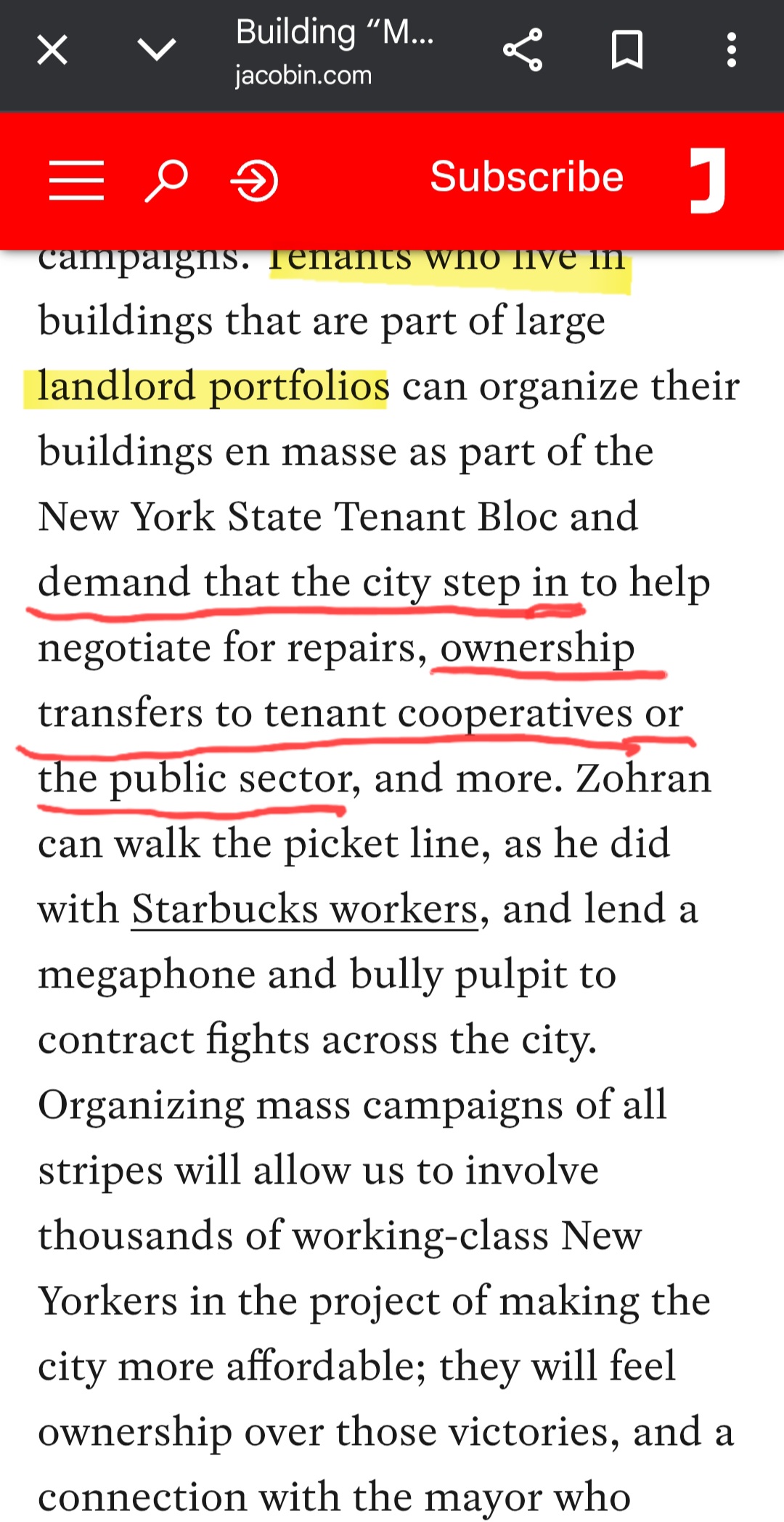
Alt-left magazine Jacobin advocating for government seizure of private real estate with “transfer to tenant cooperatives or the public sector” in January 2026

Jews are often implied rather than named—refigured as landlords, financiers, “Zionists,” or beneficiaries of immoral systems. Jewish capital becomes shorthand for illegitimate capital. The logic is identical: identify a moral contaminant and justify its removal.

Every mass movement needs a villain. The manifesto supplies one.


After Victory: Asset Capture as Governance

When Hamas seized Gaza in 2007, its parallel institutions fused into rule. Aid became leverage. Employment became conditional. Permits learned loyalty.

Then came Hamas’s most consequential real-estate empire: the tunnel network. A vast underground system ran beneath homes, schools, mosques, and hospitals—an invisible city binding the population into the movement’s infrastructure. Security, storage, command, and coercion converged below ground. Benefits flowed to the loyal. Dissent was isolated.

Governance became permanent: mobilization with infrastructure.

The governing theory now circulating in New York mirrors this logic. Mass governance insists movements never demobilize after elections.

Housing is the fulcrum. Advocates call for seizing or socializing rental property, transferring control to movement-aligned entities, and moralizing ownership itself. What cannot leave becomes the lever.

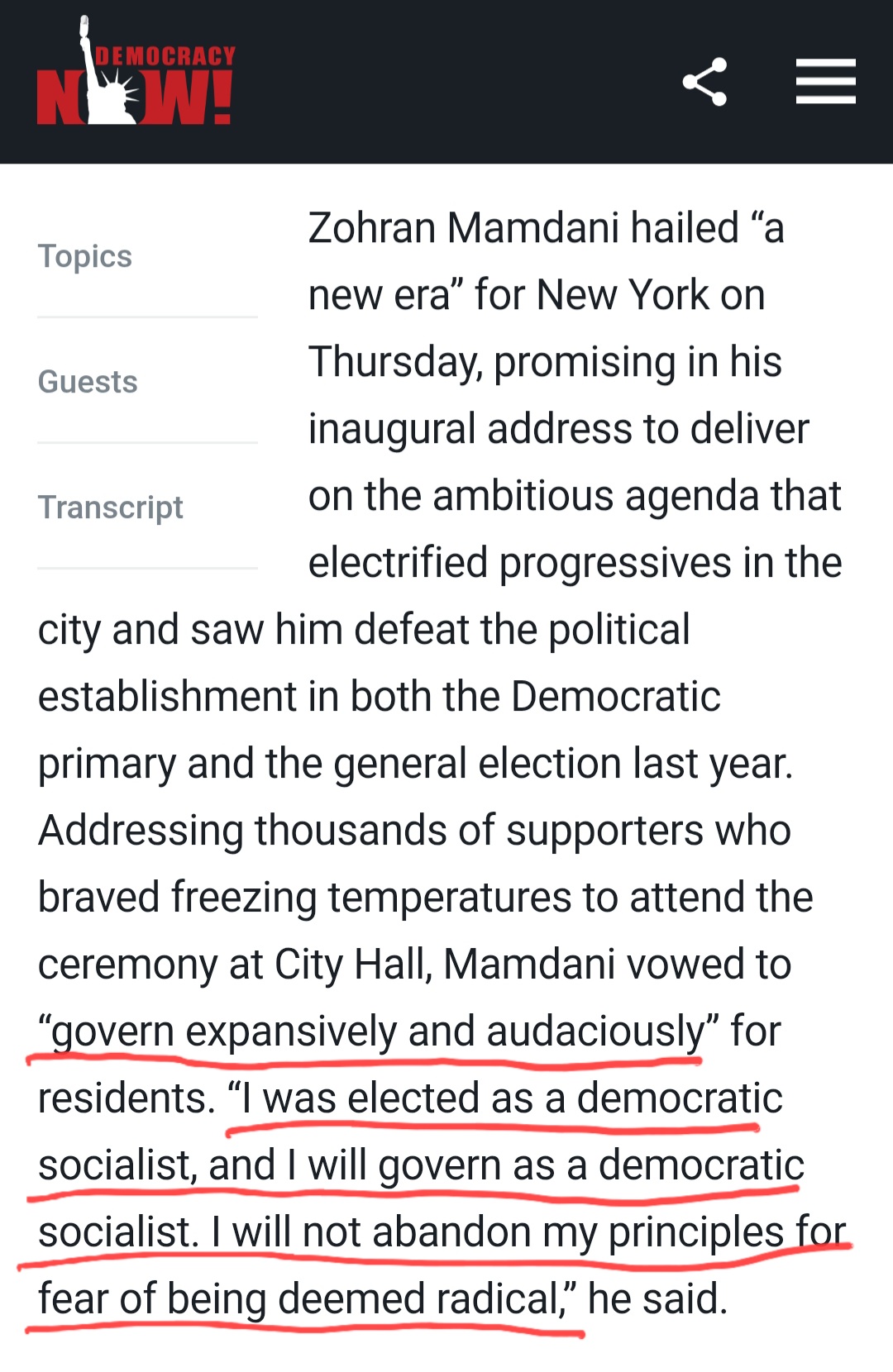
New York City Mayor Zohran Mamdani states openly that he will “govern expansively and audaciously” and not change course for being deemed too “radical.” What was once viewed as crazy is being normalized and soon to be implemented.


Redistribution Without Production

Hamas never built a productive economy in Gaza. It did not need to. External money—almost all of it routed through international “aid”—financed the broken economy. Governance ran on grievance and allocation. The system extracted and redistributed; it did not grow.

The same risk shadows New York’s mass-governance vision. There is no emphasis on productivity, investment, or growth. The emphasis is on free stuff and redistribution from outside: state transfers, federal dollars, and seizing capital from more wealthy citizens. When the mobile capital inevitably leaves, the focus will intensify on seizing what cannot leave: real estate. As jobs and taxpayers depart, redistribution turns inward. Assets are moralized, then absorbed.


The Bigger Warning: This Is Happening in New York

This is not unfolding in a peripheral city. It is unfolding in New York City—the capital of capitalism.

DSA-NYC backed Zohran Mamdani

A redistribution-first governing theology imposed here would not be contained. When growth is dismissed as immoral and allocation is elevated as virtue, capital leaves, talent migrates, and pressure turns inward.

The danger compounds because New York is also home to one of the largest Jewish populations in the world. History is unambiguous: when movements moralize capital and cast Jews—explicitly or implicitly—as its avatars, the outcome is rupture. Flight. Confrontation. Violence.

An antisemitic movement consolidating power beside Jewish life at this scale resulted in the deaths of tens of thousands in Israel and the terrorist enclave of Gaza. It is an impending disaster in New York.

The warning signs are already visible:

  • Meritocracy cast as a fiction
  • Growth dismissed as immoral
  • Redistribution elevated as governance
  • Private property declared illegitimate
  • Pressure treated as legitimacy
  • Protection deemed conditional
  • Jews recast as symbols of theft

Hamas showed the arc in Gaza: from grassroots mobilization plus ideology, to framing the enemy who causes despair, to asset confiscation and control, to an entrenched vicious philosophy financed by redistribution without production.

DSA-NYC is following the same arc, adapted to American law and language.

When the capital of capitalism abandons growth and sanctifies seizure, the city stops creating wealth and starts fighting over remnants.

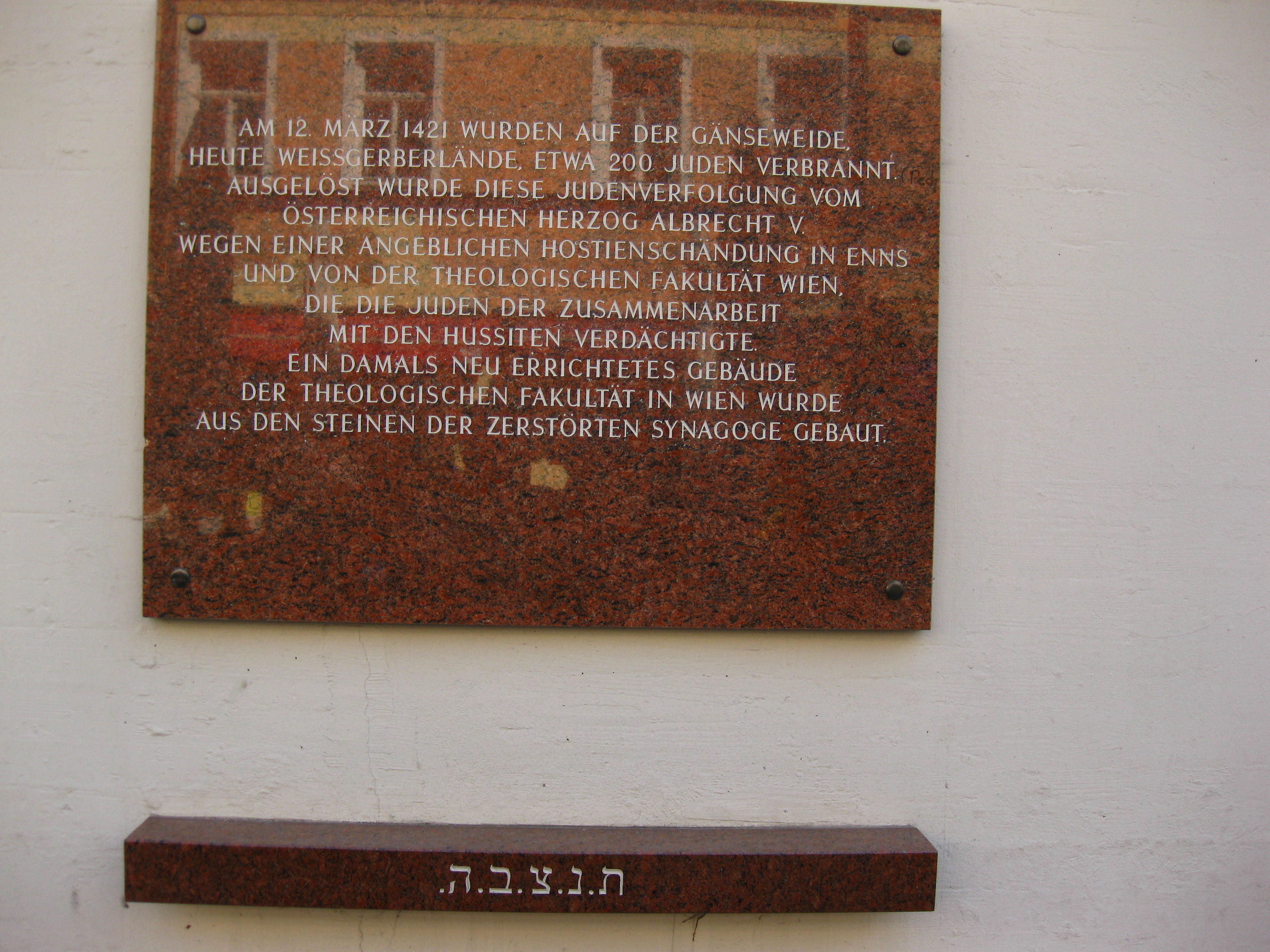
Memorial plaque in Vienna, Austria. In 1420, all Austrian Jews were arrested; 270 were burned at the stake, while the others were expelled and their property confiscated. The Vienna Gesera in 1421 brought the Jewish community in the Middle Ages to a truly bloody end. The root causes were antisemitism mixed with an economic desire to cancel debts.

Blessing and Inheritance

The story at the end of the Book of Genesis has an interesting lesson for Jews today.

If Jacob’s sons had remained in Canaan, the biblical pattern likely would have continued unchanged. Land and cattle anchored wealth, security, and continuity, and survival depended on concentration. In such an environment, inheritance narrowed toward a single heir capable of holding territory together through famine and conflict. Until this point, Genesis follows that logic closely, moving from Abraham to Isaac, from Isaac to Jacob, and nearly from Jacob to Joseph.

Canaan seemingly reinforced singular succession.

Egypt reshaped it.

The famine drained land of its defining value and redirected survival toward provision. In Egypt, Goshen mattered because it was allocated rather than owned. Jacob’s family entered as dependents, albeit under the protection of a senior official. With land no longer functioning as the primary store of value relative to neighbors, inheritance lost its organizing role. What carried forward instead was character and capacity.

Jacob recognized the shift and adapted to it. His final blessings did not distribute assets or authority but identity. Leadership, resilience, intensity, cohesion, adaptability—each son was seen for what he could contribute rather than what he would receive. Blessing became formative rather than transactional, oriented toward coexistence rather than accumulation.

This evolution reflected Jacob’s own hard-earned understanding. Early in life, he secured a singular blessing that concentrated destiny in one person and fractured a family in the process. Now, with seventy descendants – coming from different mothers – preparing to live together under pressure, he understood that continuity required a new orientation. Blessings and inheritance had to evolve if brothers were going to coexist in exile. Differentiation replaced rivalry, and identity replaced estate.

That shift allowed a family to become a people. Survival came to depend on shared memory, distinct roles, and collective endurance. The covenant moved through people rather than property, and the biblical story never narrowed again to a single bearer.

Jacob blessing his sons by Adam van Noort (1561–1641)

For nearly two thousand years, Jewish history unfolded within that framework. Without land, Jews carried blessing as portable identity—education, law, ethics, aspiration. Children were blessed for what they might become, not for what they would inherit. That model sustained continuity across dispersion, persecution, and renewal.

History has turned again.

Since 2008, a plurality of world Jewry lives once more in the land of Israel. Concentration has returned. Land, sovereignty, and inheritance are tangible again, not symbolic. The Jewish people find themselves in the inverse position of Parshat Vayechi: no longer learning how to survive without land, but learning how to live with it again after centuries of absence.

Jacob understood that blessings and inheritance had to change in order for brothers to live together in the diaspora. This moment demands a parallel act of wisdom. The task of this generation is to pass on collective and individual inheritances which will hold both realities at once: rootedness in the land of Israel alongside the moral, intellectual, and spiritual capital forged in exile. The next generation must receive blessings that affirm individual potential and an inheritance that binds those differences into a shared future.

That synthesis—blessing and land together—is the challenge of our time.

A Less Anti-Israel UN Security Council in 2026?

The United Nations rarely changes. But sometimes the composition changes just enough that the temperature drops—even if the structure stays broken.

That is what January 1, 2026 quietly delivered at the United Nations Security Council.

Five countries rotated off. Five rotated on. No grand reform. No moral awakening. Just personnel. And yet, for Israel, the difference matters.

The Council Israel Had to Endure

For much of 2024–2025, the Security Council was not merely critical of Israel. It was performative. Ideological. Repetitive. Certain members treated the Council less as a forum for conflict resolution and more as a theater for delegitimization.
None more so than Algeria.

Algeria did not argue policy. Israel, it insisted—again and again—was an illegitimate colonial outpost of Europe, no different from French rule in North Africa. History, geography, and Jewish continuity were irrelevant. This framing was injected into draft resolutions, press statements, and emergency sessions with missionary zeal. The goal was not peace. It was erasure.

Then there was Guyana, a country which bonded with the terrorist Palestinian Liberation Organization in the 1970s, which spoke with confidence and without knowledge—accusing Israel, rather than Arab states, of rejecting partition since 1948. One did not need to agree with Israel to recognize the historical absurdity. But the UN often rewards certainty over accuracy.

And Slovenia—a country with no meaningful role in the conflict—seemed to relish its moment on the moral stage. During Israel’s defensive war, it never called out Hamas. Slovenia repeatedly accused Israel of genocide. The charge was not legal analysis; it was rhetoric. And rhetoric, once introduced, metastasizes.

These countries rotated off quietly. No ceremony. No reckoning. Just gone.

The Council Israel Is Getting Instead

Their replacements are not “pro-Israel.” That bar is too high. But they are something rarer: less ideological.

Bahrain now occupies Algeria’s Arab Muslim chair. Bahrain is a signatory to the Abraham Accords and has diplomatic relations with Israel. It understands that shouting “colonialism” does not feed people, build ports, or stabilize regions. Bahrain may not defend Israel loudly—but it will not poison the well reflexively.

Colombia replaces Guyana in South America. Colombia is a serious country with a serious economy. It trades. It fights insurgencies. It understands security dilemmas. Domestic politics fluctuate, but Colombia does not need Israel as a symbolic enemy to feel virtuous on the world stage.

Latvia replaces Slovenia. Latvia knows what occupation actually looks like. It is cautious with language. It aligns more naturally with Western security frameworks and is unlikely to indulge in genocide rhetoric as a form of diplomatic performance art.

Liberia and Democratic Republic of the Congo round out the new entrants. Neither is a champion of Israel. But neither is an ideological crusader. Silence, at the UN, is often an upgrade.

This is not a transformed Security Council. The structural bias remains intact. Russia and China still exploit Israel as a pressure point. France still oscillates. The General Assembly still manufactures moral majorities untethered from reality.

But something important does change: the agenda-setters.

Algeria’s absence means fewer resolutions laced with colonial mythology. Slovenia’s departure means fewer genocide accusations casually flung like slogans. Guyana’s exit means fewer history-free lectures delivered with confidence.

In their place are countries – hopefully – that calculate before they accuse. That lowers the volume. It slows the cycle and gives diplomacy—especially American diplomacy—more room to maneuver.

Conclusion

Israel does not need the UN to love it. It needs the UN to stop lying about it.
The 2026 Security Council will not be fair. But it may be less dishonest. Less theatrical. Less obsessed with turning a regional war into a morality play with a prewritten villain.

Sometimes history doesn’t turn with a speech or a vote—but with who quietly leaves the room.