The Jewish Golden Years, 1991-2016

People tend to both forget and exaggerate. Today, many Americans speak as if antisemitism vanished for decades and only resurfaced after the October 7, 2023 massacre of Israelis by the Arabs of Gaza. The narrative goes: everything was fine, and then suddenly the world turned against Jews.

That is simply false.

Jews have always been the most targeted group for hate crimes in the United States on a per-capita basis. Jews were assaulted, synagogues were attacked, and Jewish centers were bombed long before social media existed to broadcast the hate. The 1970s alone saw a litany of terror: Jewish places targeted, flights to Israel hijacked, hostages separated by religion, and Jewish children born into a world where the UN itself declared Zionism—a core component of Jewish identity—to be racism. That infamous 1975 UN General Assembly Resolution 3379 did not merely insult Jews; it institutionalized antisemitism on a global stage.

But something remarkable happened in 1991. U.S. Ambassador Daniel Patrick Moynihan’s crusade finally came to fruition, and the UN revoked its poisonous declaration. For the first time in modern history, the Jewish story—people, land, and identity—was not officially stigmatized by the world’s central diplomatic body. Israel was no longer framed as a racist project; Zionism was permitted to exist as a normal national movement. With that reversal, Jews in the diaspora experienced something astonishing: a geopolitical tailwind.

Begin Center hosts event in Jerusalem about 50th anniversary of UNGA Resolution 3379, in December 2025a condemnation of the United Nations

The Jewish Golden Years had begun.

From 1991 through 2016, Jewish life flourished across the West. Israel integrated into global markets, made peace with former enemies, and became a hub of innovation admired even by countries without diplomatic ties. Antisemitic incidents did not disappear, but they lost their ideological legitimacy. The world’s leading institutions were no longer branding Jewish self-determination as a crime. Jews could breathe—never fully secure, but broadly accepted.

That period ended with a vote.

In December 2016, the Obama administration allowed UN Security Council Resolution 2334 to pass—a measure far more extreme than the 1975 resolution it resembled. The 1975 General Assembly resolution slandered Zionism; UNSC 2334 criminalized Jewish presence. It declared that Jews living anywhere east of the 1949 Armistice Lines—including the Jewish Quarter of Jerusalem’s Old City, the holiest ground in Judaism—are in violation of international law. Jewish prayer at the Western Wall was, according to the world’s most powerful diplomatic forum, an offense.

Hasidic Jews at the Kotel in Jerusalem’s Old City, learning, praying, and inserting wishes into cracks in the wall (photo: First One Through)

It was not merely a political resolution. It was the legalization of antisemitism.

Once the UN stamped Jewish presence in Judaism’s holiest places as illicit, the global tide shifted quickly. The Jewish Golden Years began to collapse.

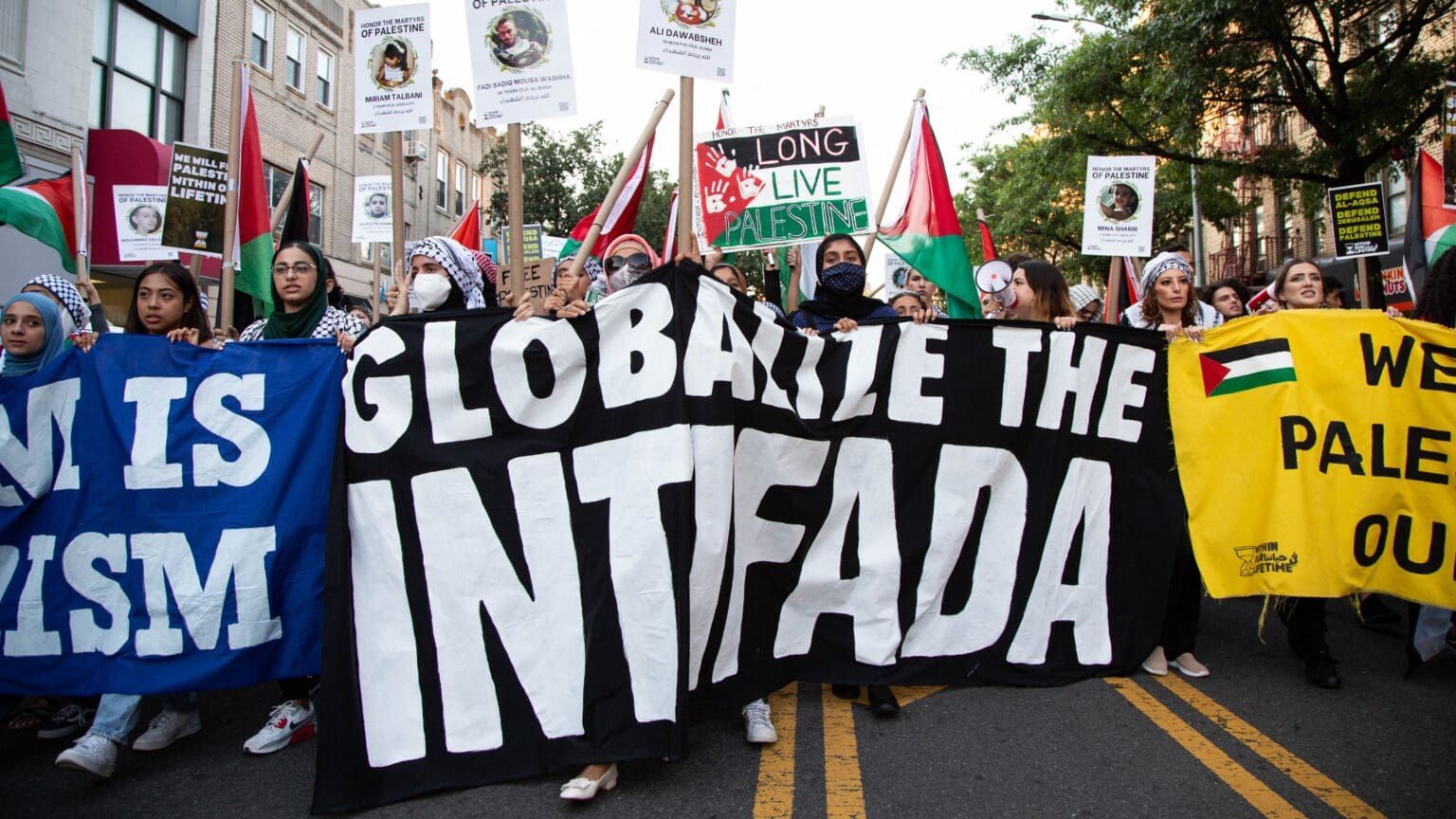
By 2018, Jews were being murdered in Pittsburgh and Poway. On college campuses, BDS campaigns metastasized into doctrinal dogma. In public schools, students were taught that Jews are not indigenous to the Land of Israel but “white Europeans” with no ancestral claim—a complete inversion of historical fact. Jews were physically beaten in the streets of New York and Los Angeles during the May 2021 Gaza conflict, years before the post–October 7 mobs marched with chants to “globalize the intifada.”

By the time American cities filled with crowds celebrating Hamas’s massacre, the unraveling was already underway.

The Golden Years—the 25 years of relative acceptance—were gone.

For generations, Jews believed that Israel’s existence itself guaranteed Jewish safety. The 1970s proved that was untrue. The present moment proves it again. A Jewish state cannot protect its people if the world delegitimizes it, demonizes it, or criminalizes Jewish presence in Judaism’s holiest places.

The real guarantor of Jewish safety is not Israel’s strength, but the world’s willingness to accept the basic history and human rights of Jews. That legitimacy existed only in a narrow window: from the UN’s repudiation of its Zionism-is-racism libel in 1991 to Obama’s decision to let UNSC Resolution 2334 pass in final days of 2016.

Those twenty-five years were an intermission in a much longer historical pattern. A rare pause in which Jews were not told by the world that their existence—national, historical, spiritual—was a crime.

Since 2016, the message has returned with force: Jews may live, but not there. Jews may pray, but not here. Jews may exist, but only on someone else’s terms.

The Golden Years did not end because Israel faltered, but because the world revoked its permission. Without it, the old hatreds rushed back as if they had never left.

Jews are not witnessing a sudden outbreak of antisemitism. They are living through the collapse of the only era in modern history when the world briefly pretended to accept the Jewish story.

The Little Drummer Boys of Terror

President Obama once derided those who warned of Iran’s nuclear ambitions as promoting a “drumbeat of war.” It was a curious charge, especially as his negotiated JCPOA deal paved Iran’s legal pathway to nuclear weapons within a decade—despite Tehran’s unabashed calls to utterly destroy an American ally, and referred to the United States as “Satan.”

The phrase “drumbeat of war” is worth pausing over, because its imagery is meant to point a damning finger at generals and war profiteers, when in fact it refers to a beating passion that comes from a variety of sources.

Music itself teaches us the power of the drumbeat. Maurice Ravel’s “Bolero” begins as a whisper—a single snare tapping a faint rhythm—but its relentless pattern swells, layer by layer, into a rapturous explosion. Nothing changes except the intensity. It is a master class in how a simple beat, repeated without interruption, can inflame emotion, tighten resolve, and propel an entire orchestra toward an inevitable climax. Passion grows not from complexity but from persistence.

Cinema took that lesson to the battlefield. Ennio Morricone’s “L’Arena,” born from spaghetti-western duels and later carried into modern war films, shows how percussion can elevate tension into confrontation. Its pounding drums accompanied by trumpets push characters toward conflict; the beat does not merely accompany battle—it summons it. Morricone understood that rhythm can be a weapon, a psychological drumroll that makes violence feel fated long before the first shot is fired.

In American history, drummers were not symbolic ornaments—they were battlefield communicators. The famous “Spirit of ’76” painting captures a young boy and an old man beating time through the fog of revolution. In both the Revolutionary War and the Civil War, the drummer corps relayed commands, kept formation, and lifted morale. Soldiers needed to be adults to enlist, but drummer boys could be barely in their teens. They were not the policymakers of war; they were the ones whose youthful energy pushed men forward into battle.

“The Spirit of ’76” (1875) by Archibald Willard (1836-1918)

It is an uncomfortable truth: the drumbeat of war is often carried not by governments or generals but by the young.

We like to imagine youth as the innocent bystanders of conflict—swept up, exploited, or victimized by forces beyond their control. That is often tragically correct. But not always. In the Middle East, teenage Palestinian Arabs have repeatedly been at the center of anti-Jewish violence. During the knife intifada of 2015–2016, most of the attackers were adolescents. Arabic media even gave them a romanticized nickname: Ashbāl al-Quds—the lion cubs of Jerusalem.

On October 12, 2015, two Palestinian boys, 15-year-old Hassan Khalid Manasra and his cousin 13-year-old Ahmad Manasra, stabbed two Israeli civilians in Jerusalem

They were not pawns in someone else’s narrative. They were active participants in it.

While they were stabbing Israelis in the streets, new legions of drummer boys was forming. The Lions’ Den was inaugurated in the West Bank to unleash dozens of attacks. The United Arab Emirates named a school for children for these young murderers. In the United States, a group calling itself the Palestinian Youth Movement openly glorifies the murderers of October 7 and calls for an intifada on American soil. They harass Jews at universities, shut down bridges, disrupt traffic, and chant for “uprisings”—all under the pretext of activism, and often shielded by tax-exempt organizations like WESPAC.

In the immediate aftermath of the October 7, 2023 massacre by Gazans of Israelis, Cornel West marches with PYM calling for an “Intifada revolution”. West has taught at Princeton, Harvard and Yale, indoctrinating the next generation of American leaders on intifada.

The drumbeat is steady. It is disciplined. And it is aimed squarely at Jews.

Where does this beat begin? It is not in the Israeli cabinet rooms the media delights in blaming. It begins at UNRWA schools, where generations of children are taught that Jews are colonial invaders with no history in their homeland. It echoes through activist teacher unions in the United States, where “decolonization” rhetoric is repackaged into lesson plans that erase Jewish indigeneity. It thunders at the United Nations, where Muslim-majority blocs and their allies advance resolutions asserting that Jews must be removed from Judea, Samaria, and even parts of Jerusalem “by any means necessary.” The young Palestinian Arab terrorist are then shielded from blame and prosecution by the poorly named “UN Coordinator for Middle East Peace.” Laughable if not such a tragedy.

The young listen. And they march.

At Christmastime, the world hears “The Little Drummer Boy”—a melody of humility. A child with nothing to give but a simple rhythm of devotion for a newborn Jewish baby in Bethlehem. A beat based on innocence and purity.

But the modern Middle East and its Western echo chambers have perverted that image.

Today’s little drummer boys are not offering gentle hymns. They are being raised, trained, and celebrated for a beat of hatred—an indoctrinated cadence that valorizes “martyrs,” delegitimizes Jews, romanticizes violence, and promises glory for those who shed blood.

The world should hear the drumbeat. And it should finally ask: Who handed these children the drums? Who taught them that murder is heroism, that Jews are prey, that violence is virtue?

These teenagers did not invent the rhythm—they are marching to a score composed by UN agencies, radicalized teachers, political opportunists, and ideological arsonists who hide behind the language of “justice” while grooming minors for war.

UN Watch’s Hillel Neuer presents new report, “Schools in the Grip of Terror: How UNRWA Allowed Hamas Chiefs to Control its Education System,” to the Italian Senate in September 2025

At Christmas, we think of a young drummer offering a humble gift to a Jewish child in Bethlehem. Alas, today too many young drummers are taught to offer not devotion, but destruction—and the world nods along as if the rhythm were unavoidable. It isn’t.

The beat continues only because we refuse to silence the conductors who train the next generation of drummers to hate.

Thailand, and Israel’s Pull On the Global South

When the last Thai hostage’s body was returned from Gaza, it barely made headlines outside of Israel and Thailand. His name — Sudthisak Rinthalak — was recited in both countries and memorials were held. But soon the world reverted into the endless ledger of loss and statistics.

The story of this single Thai agricultural worker is not a footnote. It is a reminder that the emerging bridge between Israel and Thailand is not diplomatic, not ideological, and certainly not written into UN resolutions.

It is a bridge made of people.

Sudthisak had come to Israel to pick fruit, send money home, and build a future for his family. Like tens of thousands of other Thais, he believed Israel offered something the Thai countryside could not: a ladder out of poverty. He became part of the massive human engine that powers Israeli agriculture — an engine so essential that nearly 40,000 Thais now work in Israel’s fields, orchards, farms, and increasingly, construction sites.

If you want to understand the future of the non-Muslim Global South, start with his story.

Thailand Votes One Way at the UN — But Lives Another Way in Israel

Look at Thailand from the perspective of international politics, and one picture emerges:

  • Thailand consistently votes with the pro-Palestinian bloc at the UN.
  • It has supported resolutions pushing for Palestinian statehood.
  • It aligns with the moral vocabulary of the Global South — anti-colonial solidarity, sympathy for the oppressed, skepticism of Western-aligned states.

This makes Thailand look like part of the same coalition as Malaysia, Indonesia, Pakistan, and other Muslim-majority defenders of the Palestinian cause. And in the formal, air-conditioned world of the UN General Assembly, that is true.

But look at Thailand from the ground level and a completely different picture emerges. There, Thailand looks more like India, not Indonesia.

The Monolithic Old Global South – the Muslim Global South – is where identity politics and Islamic solidarity define votes. The New Non-Muslim Global South is where development, technology, and people-to-people ties define futures.

Thailand still sits in both worlds — but one of them is getting stronger.

Thailand Is Quietly Becoming a “New India” in Israel’s Orbit

India once voted against Israel at the UN almost reflexively. Its elite identified with the Non-Aligned Movement, its public embraced the Palestinian Arab narrative, and its diplomats guarded that orthodoxy. But on the ground, something different was happening:

  • Indian engineers worked with Israeli tech.
  • Indian farmers adopted Israeli irrigation.
  • Indian tourists filled Israeli markets.
  • Defense ties deepened.
  • Human capital flowed both ways.

By the time India’s voting patterns began to soften, the relationship had already become irreversible. Reality had outrun rhetoric.

Thailand is following the same trajectory — but starting from a place even closer to Israel.

Consider the facts:

  • Tens of thousands of Thais live and work in Israel, forming one of the most intimate foreign labor communities in the country.
  • Israel is exploring Thai labor not just for agriculture but also construction, infrastructure, and caregiving.
  • Thai workers return home with Israeli skills in greenhouse technology and agri-tech, reshaping villages thousands of miles away.
  • Israeli tourism to Thailand is exploding — over a quarter million Israelis per year, with forecasts surpassing 350,000.
  • Thai cuisine, Thai workers, Thai–Israeli families, and Thai cultural presence are now woven into Israeli life.
“Little Thailand” emerging in the Carmel Market in Tel Aviv (photo: First One Through)

This is the Global South as a development engine, not an ideological bloc.

And Thailand is starting to discover what India and Malawi discovered earlier: countries that connect themselves to Israel’s people and know-how grow stronger for it.

Two Global Souths Are Emerging — and Thailand Is Crossing the Bridge

The term “Global South” used to describe one political posture. It no longer does. There is now a Muslim-majority Global South, loyal to the Stateless Arabs from Palestine (SAPs) and anchored in religious, cultural, and historical solidarity. And there is a development-driven non-Muslim Global South that sees its future in innovation, mobility, technology, worker migration, and agricultural modernization — where Israel is not a pariah but a partner.

Thailand is starting the migration between these worlds. For the moment, it votes with its Muslim neighbors at the UN but it increasingly lives with Israel. Works with Israel. Eats with Israel. Builds families with Israel.

In this sense, Thailand is part of the Global South’s next chapter: a world where alliances are formed through direct human interactions, not speeches.

Dozens of Thai food options in Tel Aviv (photo: First One Through)

And So the Hostages Return — to Two Countries Bound by People

When Sudthisak’s body finally left Gaza, diplomats issued statements and reporters filed their stories. But the people who understood the meaning of his return were not governments. They were Thai parents who send their sons to Israel to build a future. Israeli farmers who rely on Thai workers not as strangers but as partners. And both Thai and Israeli families stitched together by marriage, food, labor, and shared vulnerability.

Sudthisak’s journey — though tragic — tells the story of two countries whose relationship cannot be measured by UN votes. It is told by a deep human bond.


If the Global South is dividing into two futures, Thailand is already stepping across the bridge into the one defined by partnership, opportunity, and human connection.

Vatican II – and the New Jew

On December 8, 1965, a crowd of 100,000 spectators assembled in St. Peter’s Square to mark the closing ceremony of Vatican II. The three years of work was orchestrated to bring about Christian unity, hoping to bring non-Catholics and Catholics together in a joint mission. The sixteen documents that the council enacted were designed on the theme of aggiornamento (Italian for bringing up to date) the Catholic church, which had started to be viewed by many as fading in relevance.

Pope Paul VI greets the faithful during the closure of the Second Vatican Council in St. Peter’s Square at the Vatican Dec. 8, 1965. (CNS/Catholic Press Photo)

The Second Vatican Council did not emerge in a Christian vacuum. It unfolded in the long shadow of Auschwitz, under the moral weight of a truth that could no longer be hidden: Christian Europe had stood by, silent or complicit, as the Jewish people were hunted, deported, and incinerated. The murderers were not pagan invaders; many were baptized Christians. The trains did not run through lands hostile to Christianity; they passed churches, crossed Catholic villages, glided along tracks laid in the heart of Christendom.

In 1961, the world could no longer avert its eyes. The Eichmann trial in Jerusalem forced every nation, every church, every conscience to watch. Survivors spoke in court with the clarity of witnesses resurrected from the grave: the collaborators, the bystanders, the bureaucrats, the bishops who said nothing, the priests who closed doors, the institutions that rationalized their silence. The trial tore away the last veil protecting Christian moral innocence. It was a moment when the Church had to confront not only the sins of individual Christians but the theological soil in which hatred had grown.

Trial of Adolph Eichmann in Jerusalem, Israel in 1961 (Photo: Bettmann / Getty)

Against this storm of reckoning, another seismic event had already taken place: the re-establishment of the Jewish state in 1948. For nearly two thousand years, Christianity had preserved an image of the Jew as the wandering witness, condemned by God to homelessness so Christians could inherit the promise. But suddenly, the wandering stopped. The Jewish people returned to their ancient homeland. Hebrew was resurrected from liturgy into daily speech. Jewish sovereignty reappeared as if history itself had refused to obey the theological script.

Israel’s rebirth shattered the Christian narrative of Jewish exile more forcefully than any sermon ever could. It reopened questions buried since the early Church Fathers: What does it mean if God’s covenant with the Jews never ended? What does it mean if the Jewish people still live, still dream, still return? What does it mean when prophecy looks suspiciously like news?

Israel declares itself a new country on May 14, 1948, to take place officially the following day May 15, which was Shabbat, coinciding with Britain ending its mandate.

By the time the Vatican convened, the Church was wrestling with two cataclysms: the moral collapse of Christian Europe during the Holocaust and the miraculous revival of the Jewish nation that Christian theology had relegated to the margins of history. These two realities — failure and fulfillment — created an impossible tension.

One of the sixteen Vatican II documents, Nostra Aetate (October 26, 1965) was not merely a doctrinal correction. It was a confession, an apology, a theological revolution. It declared the Jews not rejected but beloved, not guilty but enduring, not a fossil but a living partner in covenant. It rejected antisemitism “at any time and by anyone.” For Christians, it was liberation from a poisoned inheritance. For Jews, it was an unexpected invitation to be seen — perhaps for the first time — not as shadows in another people’s story, but as a people with a story of their own.

And something else began in the wake of Vatican II, something few would have predicted: the rise of Christian Zionism in its modern form. Many Christians, freed from the contempt of supersessionism, looked upon the Jewish state not as an accident of geopolitics but as a fulfillment of ancient promise. Some of Israel’s strongest supporters today come from Christian communities shaped by the theological revolution Vatican II inaugurated. They see Jewish sovereignty as evidence not of colonialism but of covenant, not of power but of destiny. They stand with Israel not out of political calculation but out of spiritual gratitude — an act of repentance and solidarity woven together.

Christian leaders assemble at the Western Wall in Jerusalem, observing Jewish prayer in November 2025 (photo: First One Through)

For Jews, this support has been both a blessing and a riddle. After centuries of persecution in Christian lands, how does one accept the embrace of former adversaries? How does a people long defined by suspicion learn to trust a hand that once struck but now extends in friendship? The Jewish story, once shaped by surviving Christian hostility, must now grapple with receiving Christian loyalty. The sting of history meets the strange balm of reconciliation.

These questions unfold in a nation — the United States — whose own identity has been shaped by Judeo-Christian roots from its earliest days. As the country approaches its 250th birthday, Americans are rediscovering that its foundational ideas — human dignity, moral law, liberty of conscience — flowed from a biblical inheritance shared by Jews and Christians alike. The Founders read the Hebrew Bible not as relic but as roadmap. The Exodus shaped the imagination of revolutionaries and abolitionists. The prophets shaped the conscience of Lincoln and King. The Jewish story is woven into the American one, even when America failed to honor it.

Rabbi Meir Soloviechik leads a tour of Christians and Jews at the Metropolitan Museum of Art in New York City, discussing the Judeo-Christian roots of America through art, in September 2025 (photo: First One Through)

Now, as antisemitism again rises and institutions fray, the old alliance becomes newly urgent. Jews and Christians are bound not by accident but by destiny: two peoples who share scripture, share moral vocabulary, and share responsibility for sustaining a civilization built on covenant rather than empire. Vatican II made it possible for this bond to be spoken aloud again, freed from the hostility that had once obscured it.

December 8, 1965 created a new Christian. But it also created a new Jew: a Jew who could stand in relationship not only to Jewish history but to Christian history, not only in resistance but in dialogue, not only as survivor but as partner. A Jew whose identity could be affirmed by the very institutions that once erased it.

And perhaps, as America steps toward its 250th year, this renewed bond is not merely theological or historical. It is a reminder that the future of Western freedom may depend on the same truth Vatican II finally proclaimed: that the Jewish people are not a footnote in someone else’s story, but the root from which so much of our shared moral world has grown.

The Expulsion of Jewish History, Heritage and Lived Experience from America’s Classrooms

A quiet purge is beginning in American education. For decades, public schools relied on the Anti-Defamation League (ADL) to teach students about antisemitism, bigotry, and the Holocaust. Now the largest teachers’ unions are trying to drive the ADL out — not because antisemitism has disappeared, but because a new ideological litmus test has replaced the old moral clarity.

July 10, 2025 statement that largest teachers union in USA recommends no longer using material from the ADL

At the same time as NEA’s push to oust the ADL, New York City’s largest teachers’ union, the UFT, endorsed Democratic Socialist Zohran Mamdani to become mayor. Mamdani’s acceptance of the chant to “globalize the Intifada!” on New York City’s streets threatening Jews, was not considering disqualifying.

CAIR (Council of American Islamic Relations) celebrated the moment. The organization issued statements praising the union’s rejection of ADL and urging school districts across the country to follow suit. In their telling, removing the leading Jewish civil-rights organization from American classrooms was not a loss — it was liberation.

But liberation for whom?

What fills the void when ADL’s anti-bias programs are stripped from schools is not neutrality. It is an ideological curriculum that recasts Jewish history through the false frame of colonial theory. The Jewish people’s 3,000-year connection to the Land of Israel — recorded in scripture, archaeology, language, and tradition — is brushed aside in favor of a political slogan: Jews are Europeans; Israel is a colony; Jewish identity is whiteness in disguise.

And this falsehood is taught with absolute confidence, even though it collapses under the simplest demographic truth: most Jews in Israel are not European at all. More than half of Israeli Jews are Mizrahi — descendants of families rooted for centuries in Baghdad, Aleppo, Casablanca, Sana’a, and Tehran. Many arrived as refugees expelled from Muslim countries after 1948. But because their existence breaks the colonial narrative, it is erased.

In this rewritten history, Jews did not return home. They invaded. And Jewish children sitting in American classrooms are told, implicitly and sometimes explicitly, that their people do not come from the place their prayers face, the place their ancestors named, the place their holidays commemorate.

It gets worse.

Qatar is helping fill the hole in American education course materials. That same Qatar that bankrolls and supports the political-terrorist group Hamas that is sworn to killing Jews. The Institute for the Study of Global Antisemitism and Policy (ISGAP) published a report that shows how Qatari materials are being mainstreamed in K-12 education.

Map of “Palestine” used by the NEA erases Israel

The shift is not academic. It is surgical.

When the ADL is expelled from the curriculum and radical Islamic materials are substituted, so is the understanding that antisemitism is a unique and ancient form of hatred. So is the recognition that Jews are a minority-minority. So is the historical memory that Jews have been indigenous to the Land of Israel since before Rome, before Islam, before Christianity. The frameworks that replace it reduce Jewish identity to a political position and Jewish history to a fabrication.

And Jewish students feel it instantly.

A seventh grader is told her family “isn’t really from Jerusalem.” A boy wearing a Star of David is treated as if he is declaring an ideology rather than a heritage. Mizrahi and Sephardi students — whose grandparents fled violence or expulsion in the Middle East — learn in school that Jews are “white Europeans.” A child is shamed for speaking Hebrew, as if language itself were an act of domination.

The classroom becomes a place where Jewish children learn that their story is not welcome. That they are frauds.

The unions pretend this is progress. They say they are freeing schools from “biased” Jewish organizations. Democratic senators circle around to defend the teachers’ unions and mock Jewish concerns. They hope no one knows that teacher unions only donate to Democratic candidates.

But the result is not balance — it is a world in which Jewish history is a political inconvenience, and Jewish identity is recast as oppression. The very institutions tasked with protecting vulnerable students are now erasing the vulnerabilities of one of the world’s smallest minorities.

A people is stripped of its past in front of its children. To its children, to create a new type of American: anti-Jewish.

This is not an argument about Israel. It is a warning about America. When unions push out the ADL and bring in organizations which openly provide material support to terrorists, they are not modernizing education. They are dismantling the guardrails that distinguished history from propaganda and identity from accusation.

This has an ugly echo.

On May 10, 1933, 40,000 people watched as students burned Jewish books in Berlin, Germany, part of the Nationalist Socialist (Nazi) Party’s campaign to eradicate Jewish thought and show its control of the intellectual and cultural landscape.

University students burn upwards of 25,000 “un-German” books in Berlin’s Opera Square. Some 40,000 people gather to hear Joseph Goebbels deliver a fiery address: “No to decadence and moral corruption!”

Today, it’s not Jewish opinions but Jewish history, heritage and lived experiences that are targeted for obliteration in America’s schools by the teachers unions. It must stop.

Collective Responsibility From Dinah in Shechem to the Hostages in Gaza

When Shechem raped Dinah in Genesis 34, the Torah condemns not only the man who violated her but the entire city that allowed her to remain captive. Dinah was held openly in Shechem’s home, and no one objected. Not one elder confronted the crime. Not one resident demanded her release. Their silence became their guilt.

This is the Torah’s principle: A society that tolerates the humiliation of the innocent becomes responsible for it.

October 7 Made That Principle Contemporary

The political-terrorist group Hamas did not merely murder and rape on October 7, 2023. They dragged 251 human beings—children, women, men, elderly—into Gaza. For months, those hostages were kept in houses, apartments, tunnels beneath family homes, mosques, and clinics. People fed their captors. People guarded entrances. Crowds celebrated the kidnappings. The captivity was not hidden from the population; it was woven into daily life.

Crowds of Gazans celebrate the taking of captives – alive and dead – on October 7, 2023

And just as in Shechem, no one in Gaza intervened. Not one hostage was smuggled out. Not one family risked itself to free a stranger. Not one community leader demanded their return.

The Torah would not call this ignorance. It would call it complicity.

Dinah’s City and Gaza: A Shared Moral Failure

Shechem’s offense was personal; the city’s offense was communal. The same moral structure applies today: the crime begins with Hamas, but it enlarges to those who shelter, celebrate, or simply accept the captivity of innocents. The vast majority of Gazans supported Hamas’s actions.

Jacob criticized Shimon and Levi for endangering the family, but the Torah never suggests that the men of Shechem were innocent. Their passivity was enough to implicate them. When God protects Jacob’s family afterward, it signals that defending dignity—even forcefully—was morally justified.

The Torah’s Message for Our Generation

The world tries to draw a sharp line between Hamas and “the people of Gaza,” as though collective moral responsibility vanished in modern times, and the celebrated terrorism is not inherently a collective attack on an entire society. Dinah’s story rejects these illusions. It teaches that a society that houses kidnapped people is not neutral, and a population that normalizes and endorses cruelty shares responsibility for it.

Jacob scolded his sons Shimon and Levi for carrying out the revenge attack against Shechem’s people, and said that it would make their family a pariah. That too is repeating today, as many countries condemn and isolate the State of Israel for its actions in Gaza.

Dinah’s captivity was a test of Shechem’s moral fabric, and it failed. The captivity of Israeli hostages – for years – was a test of Gaza’s, and it also failed. The anger over the slaughter of the guilty has also left a deep mark then and today.

The lesson is simple and ancient: When a people accepts atrocity in its midst, the stain becomes communal. But it will not leave leave the actors in the just war untarnished in the days and years ahead.


The UN Celebrates Migrants Except Jewish Ones

Every December, the United Nations devotes a day to praising migrants.
It insists no human is illegal, that borders shouldn’t limit dignity, that newcomers must be protected regardless of how they arrived. It speaks in sweeping universalism: every migrant deserves acceptance, integration, and respect.

Every migrant — except the Jewish ones.

Because when a Jew moves to Jerusalem’s eastern neighborhoods or the hills of Judea, the UN suddenly abandons its sermon. The same institution that blesses migration everywhere else snaps into punitive mode: label, restrict, sanction, boycott.

The world’s great defender of human mobility becomes the world’s loudest opponent of Jewish mobility.

Migrants crossing seas and borders are embraced. Their stories honored. Their identities protected. But Jewish migrants returning to the land that shaped their peoplehood are told they are criminals. The UN proclaims them a threat, inventing a special category — “illegal settlers” — that exists for no other people on earth.

This is not inconsistency. It is intentional. A universal rule with a single carve-out: Jews.

United Nations says that migrants – even illegal one’s – deserve respect and safety

The UN Doesn’t Just Oppose Policy — It Delegitimizes Jewish Presence Itself

Despite the UN protesting the importance of protecting migrants, it passes resolutions specifically delegitimizing Jewish ones. It routinely asserts that Jews must not live in the very heartland of Jewish history. It passes resolutions declaring Jewish homes illegitimate, Jewish neighborhoods unacceptable, Jewish movement intolerable.

Every other people is encouraged to preserve identity and build community. Only Jews are told their presence in their ancestral homeland is an international crime. That their businesses should be labeled in specific lists, targeted for boycott and sanction.

This Isn’t Hypocrisy. It’s Anti-Jewish Discrimination.


Hypocrisy would imply the UN is failing its principles. But the UN applies its principles perfectly — just not to Jews.

It welcomes migrants when they are African, Asian, Latin American, European. It defends them when they are persecuted or undocumented.

But when they are Jewish, the vocabulary changes instantly and the moral umbrella snaps shut.

The world’s most ancient migrant people — the “wandering Jew” expelled, dispersed, and wandering for centuries — is the only group the UN insists may not migrate back home.

That is not flawed idealism. That is targeted exclusion.

Jews praying at the Western Wall, an act considered “illegal” by the United Nations, trespassing on lands it considers “occupied Palestine.” (photo: First One Through)


Passings

To arrive in Israel is never just a landing. For millennia, Jews faced this land in hope and longing, turning toward Jerusalem even when the path was blocked by oceans, armies, or fate itself. Countless generations passed on without ever setting foot on the stones their ancestors walked.

The architects of Ben Gurion Airport understood this ache.

Between the terminal and passport control, travelers move through parallel glass corridors — one for those entering the land, one for those departing. You can watch them the entire way: people going home, people leaving home. From above, the scene resembles Jacob’s Ladder, angels ascending and descending, a ceaseless movement connecting heaven and earth. Biblical commentators taught that the angels Jacob saw were the guardians of the Land of Israel — one set departing when he left, and a new set arriving to accompany him in the diaspora. So too here: those making aliyah rising in spirit; those heading abroad descending from holiness for a time, yet still tethered by an invisible thread.

In the last two years, this modern ladder of the Land of Israel took on a painful weight. Along the railing, as every arriving passenger stepped into the corridor, 251 photos lined the wall — the faces of each hostage seized by Hamas on October 7. Every person entering the land confronted them. No one could step onto the soil of the Jewish homeland without understanding the national wound, the unfinished promise that Israel would bring every soul – living and dead – home.

Photos of the hostages hung from railings meeting every person arriving in Israel at Ben Gurion Airport in 2024 (photo: First One Through)

On my most recent trip, the first picture I met was that of Dror Or. I did not pass. I lingered. For two years, his body was held in Gaza — a grotesque bargaining chip in a war the captors refused to end. Israel kept searching, praying, fighting, refusing to abandon its dead. A week after my arrival, his body was finally returned to his family and to the state. When I walked back through the airport corridor to depart, his photo was gone. His picture had been removed, but his passing — and his dignity — stayed with me.

In Israel, passings are never casual. In this small land, every encounter feels like a reunion: bumping into someone you have not seen in years; meeting friends to celebrate a simcha; honoring the memory of someone who has passed on; meeting a stranger and then talking intimately for twenty minutes. Moments here are not ordinary. The land itself seems to insist that they matter.

To pass by someone, to pass through a hallway, to pass from life — in the Jewish homeland, is not trivial. This is a country stitched together by arrivals and departures, by longing and fulfillment, by angels ascending and descending in steady and deliberate devotion.

The Age of Rocks and the Arrogance of History

To walk the land of Israel is to feel stitched into the fabric of time. Every trail from Beersheva to the Galilee whispers of footsteps that appear in the Bible—not legends, but people who actually lived, planted, quarreled, dreamed, and prayed on this soil. The stones beneath one’s feet carry the gravity of memory. They seem fused to the foundation of the earth itself, like the Even haShtiyah—the legendary rock at the center of the Temple Mount from which creation is said to have sprung.

Rocks in Judean Hills

But that connection is not geological. It is human.

The rocks of Eilat, the oldest in the region, date to around 800 million years. They feel unimaginably ancient to us—far older than Abraham’s tents, King David’s psalms, or the Hasmonean rebellions that command our sense of deep history. Yet even those craggy cliffs and mineral seams are infants compared to the rocks of Canada. In the Canadian Shield lie formations over 4 billion years old—some of the earliest surviving pieces of Earth’s crust. Five times older. A geologic eternity older.

And yet no one reveres those rocks. No pilgrim circles them. No faith assigns them cosmic origin stories. They are “pretty,” not primordial. They are scenery, not scripture.

Why?

Because we measure age in lifetimes. We crown the stones of the Holy Land as ancient not because they are old, but because we are old here—because human meaning saturated this place for millennia. The rocks become vessels for our significance.

It is, in a sense, a subtle arrogance: the centering of human experience as the measure of the world. We treat Earth’s deep past as a backdrop to our stories rather than a reality that dwarfs them. We act as if history begins with us, as if time itself depends on our noticing it.

When we walk these trails—past the ruins of synagogues, the outlines of Israelite cities, the remnants of Crusader walls—we feel connected because these places speak to human time. They anchor us. They dignify us. But the rocks beneath those ruins hum a different message: we are temporary here. Our religions, nations, languages, and conflicts occupy a blink of the planet’s eye.

A dose of humility would serve us well. To appreciate the holiness of our stories without mistaking them for the age of the world.

We walk ancient paths, and the ground reminds us we are all newcomers.

Where the Eagles Still Land

At Sinai, God tells the Israelites: “I carried you on eagles’ wings and brought you to Me” (Exodus 19:4). It is the Torah’s softest reassurance — that when the world turns crushingly heavy, something stronger will lift the Jewish people before they disappear beneath its weight.

Every generation reads the verse and wonders how such a thing could ever happen again.

The Yemenite Wings

In 1949–50, it did.

Yemenite Jews — who had kept Hebrew alive for centuries through chants in dim courtyards — found themselves suddenly gathered into airplanes they had never seen before. Operation Kanfei Nesharim lifted nearly 50,000 people from danger to home, a moment so surreal that many believed prophecy had slipped back into the world.

They came to Tel Aviv’s Kerem HaTeimanim, where the streets still hold their memory: Rechov Kanfei Nesharim, Rechov HaAliyah HaTeimanit, and alleys named after the poets and dreamers who carried Yemen’s Jewish soul through generations of exile. The neighborhood became a landing place for people who had lived so close to the dust of history that being lifted into the sky felt like God reaching down again.

A New Kind of Arrival

Today those same streets are welcoming new immigrants — Jewish artists from Paris, Berlin, Amsterdam, and London. They are not fleeing famine or forced conversion. They leave behind apartments, galleries, and studios, places where they once felt at home but now feel the room shifting beneath their feet.

They speak quietly of exhibitions canceled with careful wording, of colleagues who grow uncomfortable when they identify openly as Jews, of a cultural world that prides itself on openness yet signals, in subtle ways, that Jewish presence complicates the picture.

Or they just concluded it was time to move on.

Their departure is not dramatic. No riots, no decrees. Just a slow tightening — a sense that Europe’s warm lights are dimming for them. And so they come here, carrying sketchbooks, guitars, half-finished manuscripts, their beautiful voices, and the hope that Israel will give them what their former homes no longer can: the ability to be fully themselves.

They settle into Kerem HaTeimanim because it feels familiar: small homes, open doors, neighbors who still greet each other, a neighborhood built by people who also crossed deserts — literal or emotional — to find peace.

Actress and singer from London makes a new home in the “Yemenite Vineyard” section of Tel Aviv (photo: First One Through)

The Meeting of Journeys

In these narrow lanes, two different exoduses breathe the same air. Children run past synagogues founded by Yemenite families and new galleries opened by European artists. Hebrew floats from balconies in melodies that sound ancient and brand new at once.

The Yemenite grandparents who arrived barefoot on metal wings once prayed simply to reach Zion. The young European immigrants arriving today pray to belong — to a people, to a place, to their own identity without contortion.

Here, on Kanfei Nesharim Street, the verse from Sinai feels alive again. Not as a metaphor of miraculous rescue, but as a quiet truth: every Jew who finds their way home is carried by something — hope, fear, memory, longing — that lifts them just high enough to begin again.

In this little corner of Tel Aviv, you can almost feel the wings settling gently on the houses, as if history itself decided to rest for a moment before taking flight again.

Over three thousand years ago, God took the Jews of Egypt out from slavery and established the Jewish people. Nearly eighty years ago, just after the reestablishment of the Jewish State, the government of Israel rescued the Jews of Yemen from persecution and brought them to the holy land. Today, Jews from the West come on their own to the Jewish Promised Land.

We marvel at the notion of being taken to safety on “eagles’ wings.” Perhaps we should also marvel at the place to which we arrived.