New York Times’ Tales of Israeli Messianic War-Mongering

Summary:  One year after acknowledging that Palestinians were to blame for the failed Israeli-Palestinian Authority peace process, left-wing NY Times contributor Roger Cohen cast Israelis as fanatical nationalists and Palestinians as passive, despondent victims. The Times’ cure for Jews’ violent adherence to their religious texts is punishing settlers with BDS, while the paper distanced Muslims from their religion and called for greater compassion towards these innocents.


Just in time for Christmas, Roger Cohen decided to write about the Israeli-Palestinian Arab conflict. Again.

In an article called “The Assassination in Israel that Worked,” Cohen portrayed an Israeli society overrun with religious fanatical murderers. He described the killer of Israeli Prime Minister Yitzhak Rabin, Yigal Amir, as “a religious-nationalist follower of Baruch Goldstein, the American-born killer of 29 Palestinian worshipers in Hebron in 1994.” He wrote about Jews living east of the Green Line (EGL) as obsessed with “Messianic Zionism,” at odds with the concept of democracy. Because Palestinians are desperate for their own state, Jews living in EGL make “violence inevitable” according to Cohen. He argued that the UN’s creation of Israel “was territorial compromise, as envisaged in Resolution 181 of 1947, calling for two states, one Jewish and one Arab, in the Holy Land. This was humankind’s decision, not God’s.” In short, according to Cohen, the vast Messianic cult of violence in Israel seeks all of the Holy Land, but the rights of Jews are limited to just half of the land as dictated by man’s laws.

Lastly, Cohen argued, the only way to push back against the right-wing Israelis and their government was to employ different angles of the BDS movement (Boycott, Divestment and Sanctions) in which Obama should “close American loopholes that benefit Israeli settlers.”

Here is a bit of education for Roger Cohen (maybe the byline was wrong and this was written by Roger Waters of Pink Floyd, the loud advocate of BDS?):

A smaller percentage of Jewish “settlers” are murderers, than are terrorists which are Muslim.  The Cohen opinion piece would lead a person to believe that every Jewish “settler” takes up arms against Arabs, while the reality is that almost every Jew living in the land seeks to live in peace with their Arab neighbors. Baruch Goldstein was an anomaly, not the rule.

Why would the Times print such an inflammatory piece against Jews when it is in the midst of a blitz about the dangers of “Islamophobia”?  The Times wrote over-and-again that most Muslims are peaceful and that Muslim terrorist abuse the interpretation of Islamic holy texts.  Yet the Times was eager to describe Jewish killers as motivated by the plain reading of the Jewish holy texts, and suggested that any Jew living in Judea and Samaria is either a potential killer, or instigates Palestinian violence.

It is untrue, unfair and reeks of hypocrisy to portray Jews in such a manner.  There are almost no Jews in Judea and Samaria that committed murders, but the Times labelled all “settlers” as devout killers.  Meanwhile, the global jihadist movement enlisted thousands and slaughtered thousands, and the Times rallied to the defense of Muslims.

IMG_3677IMG_3674
“Islamophobia” Op-Eds from Paul Krugman on December 11, 2015, and
Nicholas Kristof on December 13, 2015
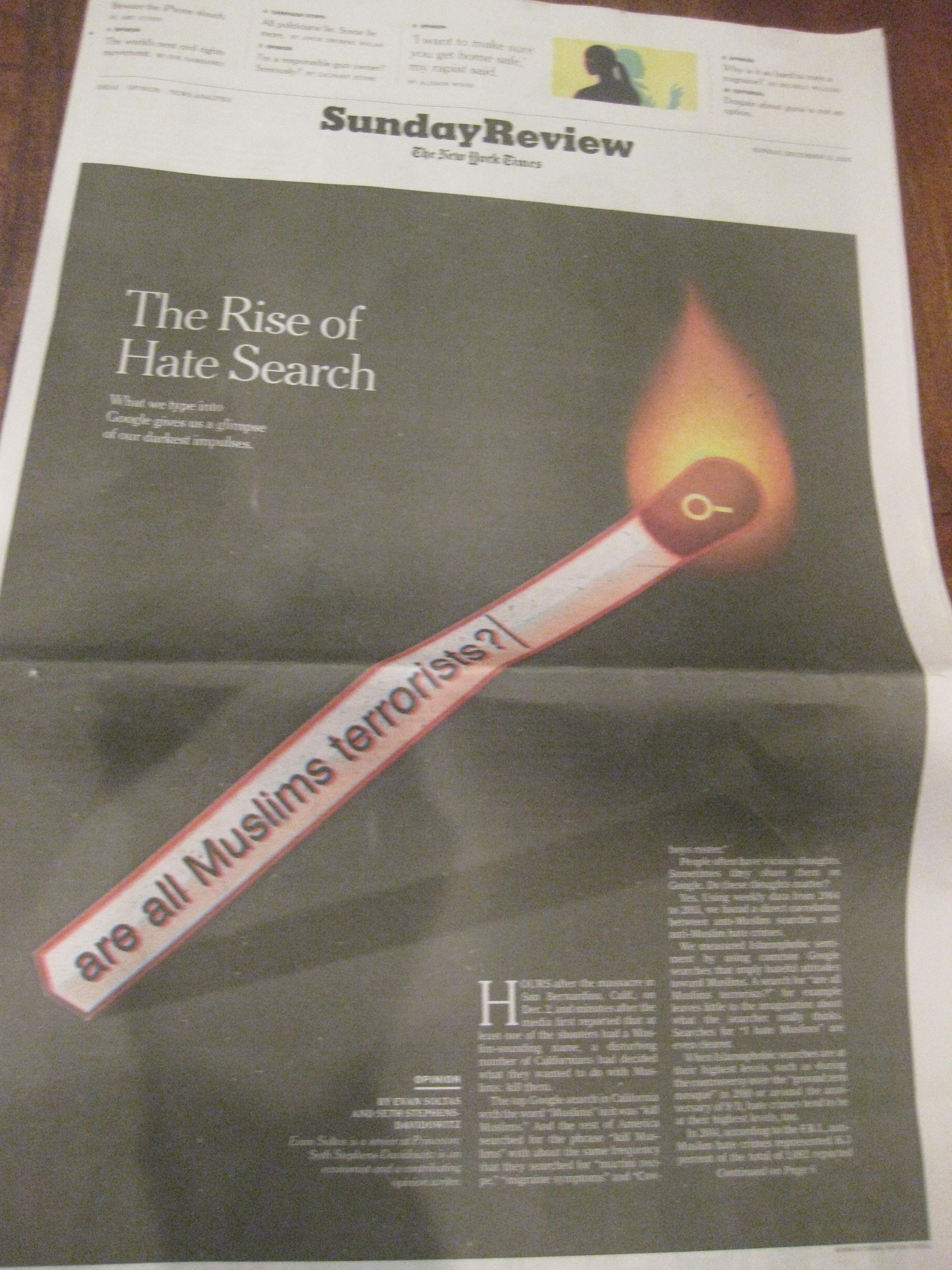
IMG_3670IMG_3671
Front Page of NY Times Sunday Review on “Islamophobia”
on December 13, 2015

IMG_3662IMG_3667
Front Page New York Times story on December 15, 2015 about
Young Muslims suffering from “Islamophobia”

Jews are entitled to live in EGL/ Judea and Samaria according to international law. The 1922 Mandate of Palestine by the League of Nations clearly and specifically encouraged Jews to live throughout the Holy Land, including areas now known as the “West Bank.” The Mandate included language that specified that no one should be prevented from living anywhere because of their religion.

“Messianic Zionism” may be a driving force motivating some Jewish families to move to the region, just as they might move to Haifa or Be’er Sheva. Some people are motivated by Zionism without a Messianic component, while others go for good jobs in the only liberal democracy in the Middle East.  The motivation for living there is irrelevant; the right of Jews to live anywhere in the Holy Land was established in international law.

“Violence is inevitable” because Arab don’t want Jews as neighbors, not because Arabs want a state.  Arabs have been killing Jews in the Holy Land for 100 years.  In several episodes in the 1920s, including the brutal Hebron massacre in 1929, Arabs called for ridding the land of Jews.  On the eve of the Holocaust, they launched multi-year riots (1936-9) slaughtering dozens of Palestinian Jews and convinced the British to limit Jewish immigration, causing the death of hundreds of thousands of European Jews.

Whites in the 1950s also did not want to live with black neighbors. Racism and anti-Semitism are to be condemned, not rationalized.  Shame on the New York Times for defending Arab attacks on Jews.

The establishment of Israel as a Jewish State has been rejected by the Arabs for 100 years, and counting.  Cohen pointed to the United Nations Partition Plan which called for creating a Jewish State in 1947.  He failed to say that the Arabs REJECTED that plan.  They opted to launch a war against Israel instead.

Israel has continued to seek peace with its neighboring Arab countries: Jews approved the partition plan in 1947; the country uprooted Jews living in Sinai in 1982; it handed various cities to the Palestinian Authority in 1995; it uprooted Jews from Gaza in 2005. Israel made various peace offers to the Palestinians, including in 2000 and 2008. The Palestinians reacted to each offer with wars, and continue to reject Israel as the Jewish State to this day.

Conclusion

One year ago, Cohen wrote Why Israeli-Palestinian Peace Failed. “ In the article, he acknowledged various Israeli peace efforts including settlement freezes and prisoner releases.  In exchange for the Israeli gestures, the Palestinian Authority created a reconciliation government with the terrorist group Hamas, and joined international bodies counter to the agreed upon peace framework.  The peace talks collapsed.

Cohen has now concluded that while the Palestinians suffer from ineptitude and corruption, at the end of the day, their cause is just.  The Palestinians are not only despondent, but desperate for an external force to advance their vision of a state.  Cohen believes that Obama should begin to advance various iterations of BDS on Jews living east of the Green Line to assure the Palestinians goal of a Jew-free state (Obama has indicated in the past that he approves of a Judenfrei Palestine). Cohen had no suggestions – or concerns – of how to make Palestinians approve of the Jewish State living in security.

The radical left-wing call for BDS of the Israeli territories is easier to make when one ignores the 99% of peaceful families living in Judea and Samaria.  So Cohen, and other Israel-bashers paint all of these Jews as “Messianic Zionists” who are out of touch with reality.  They are either murderers of Arabs like Baruch Goldstein, or of the peace process with Arabs like Yigal Amir.

Cohen fails two of Natan Sharansky “Three Ds” test for anti-Semitism: demonization and double standards.  To rephrase the great ballad-rocker Meatloaf, Two of the Three IS Bad.

When will the Times and the left-wing fringe look at the Jewish families with an iota of the compassion they shower upon peaceful Muslims?


Related First.One.Through articles:

Palestinians are “Desperate” for…

Nicholas Kristof’s “Arab Land”

Framing the Israeli-Palestinian Arab Conflict: WSJ and NY Times

Names and Narrative: The West Bank / Judea and Samaria

Israel was never a British Colony; Judea and Samaria are not Israeli Colonies

Every Picture Tells A Story: Only Palestinians are Victims

The Narrative that Prevents Peace in the Arab-Israeli Conflict

Israel and Wars

Subscribe YouTube channel: FirstOneThrough

Join Facebook group: FirstOne Through  Israel Analysis

The New York Times on the History of Gush Etzion

The New York Times actually tried to give its readers some history of Gush Etzion for a change. Unfortunately, it still missed the critical points.
IMG_3663
New York Times article from December 15, 2015
In an article entitled “West Bank Shopping Center, a Symbol of Coexistence, is Shaken by Violence,” the Times gave more detailed history than typical when it provided background on the Gush Etzion “settlements” in Judea and Samaria/ West Bank of the Jordan River.  While the paper would typically state that “the world considers all settlements seized by Israel in 1967 as illegal,” it opted to give more historical context on December 15th.  It wrote:
“Gush Etzion, or the Etzion block, a cluster of more than a dozen Jewish settlements, lies south of Jerusalem, in the Bethlehem area. It is often described as part of the Israeli “national consensus,” a chunk of West Bank land seized from Jordan in the Arab-Israeli War of 1967 that many Jewish Israelis assume will always be part of Israel, and it holds a special status in the country’s psyche, associated with tragedy and triumph.

The first Jewish settlers arrived in the 1920s. Four communities were established by the 1940s but they were destroyed in the war of 1948 over the creation of Israel. Jordanian forces killed scores of Jews who tried to defend the area and took scores more captive.

After Israel captured the West Bank in the 1967 war, a group of Israelis, including some descendants of those who had fought to defend it in 1948, reestablished Jewish settlements there.

The Palestinians and much of the world consider all settlements in the territories seized in 1967 as illegal and an obstacle to establishing a Palestinian state. While most peace plans envisage exchanges of land that could leave at least part of Gush Etzion under Israeli sovereignty, Israelis and Palestinians have never agreed on the size of the block.”

The Times opted to repeat its often used language – twice – but it did give much more history than it normally does.  However, while it described Jews moving to area in the 1920s, and some of the new residents as descendants of those original settlers, the reader was still left with the wrong impression that Jews are living there illegally.
Key points that were omitted from the article:
  • The 1922 League of Nations Mandate specifically gave Jews the right to live and establish themselves THROUGHOUT the Holy Land. This was a matter of international law and the Jews availed themselves of this legal right.  In 1922, there was no concept of a “West Bank.”  It was all just “Palestine” and Jews legally purchased land and built homes in Gush Etzion.  As stated in Article 6, the Mandate “shall facilitate Jewish immigration under suitable conditions and shall encourage, in co-operation with the Jewish agency referred to in Article 4, close settlement by Jews on the land, including State lands and waste lands not required for public purposes.”  Further, Article 15 of the Mandate specifically stated that no part of Palestine should be off-limits to people based on their religion: “No discrimination of any kind shall be made between the inhabitants of Palestine on the ground of race, religion or language. No person shall be excluded from Palestine on the sole ground of his religious belief.”
  • When Jordan illegally attacked Israel in 1949 and killed the Jews in Gush Etzion, it did not undermine the legal rights Jews had for living in their homes.
  • Jordan’s illegal expulsion of all of the Jews from the region in 1949 counter to the fourth Geneva Convention was not mentioned by the Times.
  • The fact that Jordan illegally annexed the region in 1950 in an action that was never recognized by any country was also omitted.
  • Jordan (and Palestinians who had been granted Jordanian citizenship) attacked Israel in 1967, counter the Israel-Jordan Armistice agreement, and Israel was legally justified in responding in self-defense.
  • Jordan gave up all claim to the region in 1988.
It was nice to see the Times take steps to educate readers a bit more about Gush Etzion.  However, the details provided still left a reader with the impression that Jews live in Gush Etzion illegally, and it is only a matter of “national consensus” that leads Israelis to believe that the bloc will be formally part of Israel.  The many illegal activities of Jordan also continue to be ignored.
Perhaps the full facts disturb the Times’ narrative too profoundly to detail.

Related First.One.Through articles:

Subscribe YouTube channel: FirstOneThrough

Join Facebook group: FirstOne Through  Israel Analysis

The Long History of Dictating Where Jews Can Live Continues

The world has a long established track record of telling Jews where they can and cannot live. It is a phenomenon that uniquely relates to Jews which continues to this day in the holy land.

Pluralistic World, Narrowly Defined

The “Western World” likes to think of itself as modern and “progressive.” Its leaders believe they have largely overcome rampant bigotry in their societies. For example, western leaders would never suggest that black people be only allowed to live in certain cities, or declare that gays be confined to ghettos. Even during this wave of radical Islamic terrorism, no leader would ever say that all Muslims should be expelled from the country. Modern civilized society would never tolerate such positions.

The “Western” pluralistic approach is not confined to opinions within its own borders. Wherever there is ethnic strife, western officials promote parties getting along.  In northern Cyprus, Christians and Muslims are urged to reconcile.  In Myanmar, the US calls for Muslims and Buddhists to try to live together in peace.

However, the attitudes change when it comes to Jews in the Middle East. Pluralism is passé east of the Green Line.

Jews are Treated Differently

Today, it has become all too common for Europeans to protest in the streets chanting “Free Palestine” in calls for the destruction of the Jewish State of Israel. University professors give legitimacy to Hamas, a terrorist group, which openly calls for killing Jews and destroying Israel. The leaders of the European Union call for Jews to be expelled from Judea and Samaria. And the President of the United States, Barack Obama, condemned Jews living in apartments they legally purchased in eastern Jerusalem.

While pluralism is an embraced ideal, the open tent does not cover Israel.  The western world that prides itself on fraternity, believes that Jews should be banned from living in predominantly Arab neighborhoods.  The modern culture that seeks a global community, wants to deny Jews the right to live in their homes. The progressive left which advocates for human rights, condemns Jews rather than Palestinian Arabs who fight for a Jew-free state.

Ideally, everyone should be able live anywhere.  Except for Jews who should be banned from living east of the invisible Green Line.

It should not surprise people that the Jewish State is treated differently. These same “progressive” countries have a long history of forcing Jews into ghettos and expelling them from their homes.  Dictating where Jews are allowed to live is second nature. It’s the Jewish “Pen Policy.”

Here is a list of the Pen Policy in action, after the Crusades. This list ignores the brutal slaughter of millions of Jews over that time.  There is no comparable treatment of any other ethnic or religious minority.

History of Expelling Jews

Many governments expelled all of their Jewish inhabitants, both on the local city level and on the national level.

Austria: Jews expelled from Vienna in 1670.

Brazil: Jews expelled from Recife in 1654.

Czech Republic: Jews expelled from Prague in 1745.

England: Expelled all of the Jews in 1290. Jews could not live in England for another 360 years.

Egypt: Jews expelled in 1956.
Israel removes Jews from Sinai in peace deal with Egypt in 1982.

France: 100,000 Jews expelled in 1306 and then again in 1322.
Charles VI expelled the Jews in 1394.
In 1420, the Jews were expelled from Lyons.

Germany: Jews expelled from Brandenburg in 1510.
In 1593, Jews expelled from Bavaria.
In 1614, Jews expelled from Frankfurt.

Hungary: Marie Theresa (still an all-time favorite leader among Hungarians) expelled all Jews from Hungary and Bohemia in 1744.

Italy: Jews expelled from Southern Italy in 1288.
In 1491, Jews expelled from Ravenna.
In 1492, Jews expelled from Sicily and Sardinia.
In 1494, Jews expelled from Florence and Tuscany.
In 1510, Jews expelled from southern Rome.
In 1541, last Jews evicted from Naples.
In 1550, Jews expelled from Genoa.
In 1558, Jews expelled from Recanati.
In 1569, all Jews forced out of Papal states by decree of Pope Pius V.
In 1571, Venice decides to evict all remaining Jews, but does not carry it out.
In 1593, Pope Clement VIII evicts Jews from all papal states, except Rome.
In 1597, almost all of the Jews of Milan are expelled.

Lithuania: Jews expelled in 1495.

Martinique: King Louis XIV ordered all Jews expelled from French colonies in the New World in 1683.

Netherlands: Jews banned from Utrecht in 1444.

Palestinian Authority: After massacre of 69 Jews by local Arabs, British forces remove remaining Jewish community of Hebron in 1929.
In 1949, after attacking Israel when it declared independence, Jordanians expel all Jews from Judea and Samaria and the eastern half of Jerusalem which they illegally annex.
In 2005, Israel removes all Jews from Gaza Strip.

Poland: Jews expelled from Warsaw in 1483.

Portugal: Some Jews expelled in 1483.
In 1497, choice of conversion or expulsion of all Jews.

Spain: Jews expelled from Seville in 1483.
All 200,000 Jews expelled from country in 1492.

Switzerland: Jews expelled from Basel in 1349.

Tunisia: Jews expelled or massacred in 1535.

Ghettos

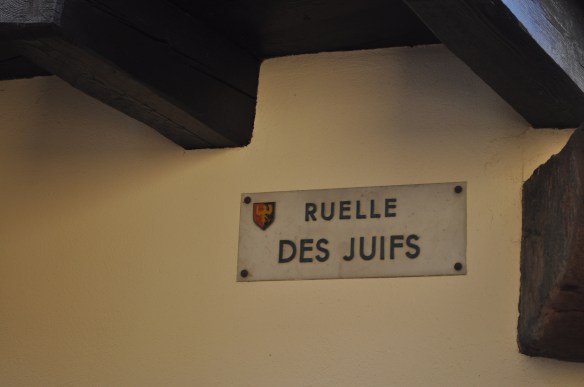
Some governments did not expel their Jews, but forced them to live in concentrated areas. Street signs can still be found in European cities named “Street of the Jews.”

Austria: Vienna’s Leopoldstadt goes back hundreds of years.

Czech Republic: Prague has one of the most famous Jewish Quarters, which was created as a restrictive ghetto.

Italy: Venice instituted the first ghetto by papal decree in Europe in 1516.  Others were developed in Ferrara (1624) and Rome (1555).

Germany: Created over 1000 in Germany and Poland during World War II, including the infamous Warsaw Ghetto.

Russia: Jews were confined to the “Pale of Settlements” in 1791.  Jews were forbidden to live in 75% of Russia.

DSC_0121
“Jew Street” in Obernai, France
(photo: FirstOneThrough)

The world has grown very comfortable dictating where Jews may live. It is well past time for Europeans to condemn the racist Jew-free attitudes of Jordanians (1949-1967) and Palestinian Arabs today, and adopt a pluralistic and welcoming approach towards Jews in Judea and Samaria.

In November 2015, in a speech about attitudes towards Muslims, US President Barack Obama said, “we don’t have religious tests for our compassion… We don’t discriminate against people because of their faith.” If only he and others held such feelings about Jews as well.


Related First.One.Through articles and videos:

Names and Narrative: The West Bank / Judea and Samaria

Names and Narrative: Palestinian Territories/ Israeli Territories

Video: Judea and Samaria (Foo Fighters)

Video: The “1967 Borders” (The Kinks)

Subscribe YouTube channel: FirstOneThrough

Join Facebook group: FirstOne Through  Israel Analysis

Israel was never a British Colony; Judea and Samaria are not Israeli Colonies

Many uniformed critics of Israel criticize the creation of Israel and claim that Israel was established as a colonial outpost of Great Britain. The statement is absurd and easily disproven.

International Law, Not British Law

Various international laws approved the immigration of Jews to Palestine and international bodies approved the creation of the Jewish State of Israel.

May 1949: International Approval: The United Nations voted to admit the State of Israel  as a member state, at the end of Israel’s war with Arab countries.

May 1948: International Approval: The United States, the Soviet Union and several other countries recognized Israel soon after Israel declared Independence.

May 1948: Israel Declares Independence, but not from Great Britain: Israel waited to declare its statehood until after Great Britain left the holy land and completed its mandate. The Israeli Declaration of Independence never mentioned Great Britain, as GB never viewed the land as a colony (compare that to the language in US Declaration of Independence which mentioned severing ties with GB.)

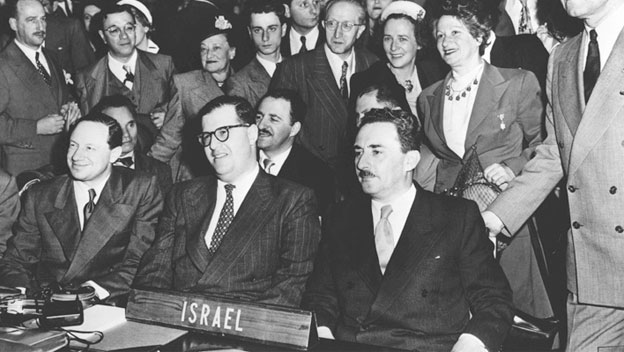
November 1947 UN Partition Vote: The United Nations voted to create a Jewish State in Palestine with 33 votes in favor, 13 against and 10 abstentions (Great Britain abstained).

July 1922 League of Nations Established Jewish Homeland: The League of Nations (precursor to the United Nations) voted to break apart the old Ottoman Empire and placed the area of Palestine under British oversight. That area of Palestine included areas of Jordan and Israel which were to include a “national home for the Jewish people.”

April 1920 San Remo Conference. The Allies of World War I (Britain, France, Japan and Italy) voted for the “establishment in Palestine of a national home for the Jewish people, it being clearly understood that nothing shall be done which may prejudice the civil and religious rights of existing non-Jewish communities in Palestine, or the rights and political status enjoyed by Jews in any other country.

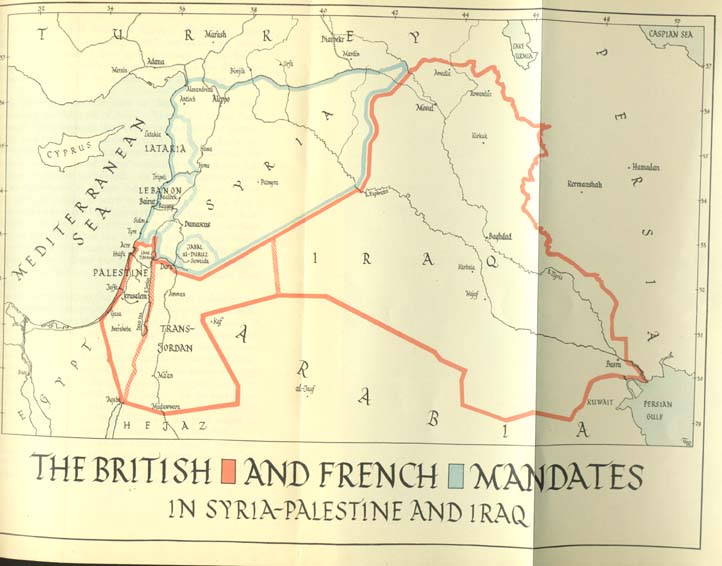
The term “British Mandate” has become confused for many people with Israel being a “British Colony.” It is simply untrue. The world powers broke apart huge sections of the Middle East with areas under both British and French administration, including countries today known as Lebanon and Syria. No one refers to any of those countries as a “colony.”

british and french mandates
British and French Mandates covering much of the Middle East

British did not favor Jews in Palestine

Despite language in the 1922 Mandate that the British should “facilitate Jewish immigration” to Palestine, the British sided with local Palestinians that sought to curtail an influx of Jews. On the eve of the Holocaust in Europe, when Jews were desperate for a place to flee, the British issued the 1939 “White Paper” which limited the number of Jews that could enter Palestine.  That edict likely cost hundreds of thousands of European Jews their lives.

The British decree created tremendous tensions between Palestinian Jews and the British. There were many battles between the groups, the most famous being the destruction of the King David Hotel in 1946.

No Transfer of British People

As described above, the British were merely administrators of Palestine for a period of time. They did not seek a permanent presence of soldiers or civilians. Virtually no British Jews (or non-Jews) relocated to Palestine on a permanent basis over the course of the Mandate period through 1948.  The Jews that came to Palestine under the Mandate period principally came from elsewhere in Europe and Russia:

  • Third Aliyah (1919-1923): 40,000 from Russia and Poland
  • Fourth Aliyah (1924-1929): 82,000 (many subsequently left) from Poland; Russia; Romania; Lithuania; Yemen and Iraq
  • Fifth Aliyah (1929-1939): 250,000 from Europe fleeing German Nazis
  • Aliyah Bet (1939-1948): 110,000, mostly illegally, smuggled from Europe fleeing Holocaust

Rights of the Indigenous Jewish People

The world powers voted to enable a national home for the Jewish people for a few reasons:

  • Jews were indigenous to Israel, as stated in the Mandate, the world recognized “the historical connection of the Jewish people with Palestine and to the grounds for reconstituting their national home in that country
  • Jews had been forcibly evicted from their national home
  • The Ottomans and others made it difficult for Jews to move back and acquire land for hundreds of years

The Jews had political kingdoms and religious Temples in the holy land for over 1000 years, but were expelled against their will. The new international laws were meant to remove the modern roadblocks that were placed before Jews from moving to Palestine and owning land.

Even though it was difficult for Jews to move to Palestine and acquire homes and land under the Ottomans, the Jews were the fastest growing religious group from 1800 to 1914. Jews have also been the largest religious group in Jerusalem since 1870.

Language

The official languages in Israel today are Hebrew and Arabic. While English is widely spoken, it is not an official language, further underscoring that the country never was established as a British colony.

ISRAEL:
RE-ESTABLISHED under International Law

In short, there is no basis whatsoever for calling Israel a British colony. The global community approved facilitating the free movement of Jews back to their holy land, where Jews already lived. The global community ultimately approved RE-ESTABLISHING a Jewish State. This was not Great Britain arbitrarily creating a colony for its own purposes.

It should also be underscored that Zionism was not only a modern idea conceived by Jews as a reaction to anti-Semitism in Europe and Russia.  Henry Dunant (1828-1910), the winner of the first Nobel Peace Prize was an ardent Christian Zionist who strongly advocated for the rights of Jews to live in Palestine in the 1860s.

Israel 1974 bote at UN
Vote for Israel at United Nations, 1947

The “West Bank” is not an Israeli Colony

As detailed above, the global community approved the rights of Jews to move to their ancient homeland in the holy land.  That right was given to the entire region, including Judea and Samaria.  While the UN voted to recognize a Jewish State within a section of Palestine, the right to move throughout the region was approved in repeated resolutions many decades ago.

While the UN does not recognize Judea and Samaria to be part of Israel, they also do not recognize it as part of Jordan that illegally annexed it in 1950 (Jordan gave up all claim to the region in 1988).  The UN would like to see that region be part of a new Arab State of Palestine through negotiations with Israel.

The desire to see a new Palestinian State does not mean that international law protecting the rights of Jews to live in the region are null and void.  The 1922 British Mandate Article 15 specifically stated that “no person shall be excluded from Palestine on the sole ground of his religious belief.”  “No person” included Jews, and “Palestine” covered the entire mandate area of 1922.

The Oslo Accords of 1993 and 1995 which were negotiated between the Palestinian Authority and Israel, specifically stated that Israel controls and administers most of the “West Bank.”  As such, Israel approves housing and roads and infrastructure for everyone.  So the Palestinians agree that Israel is in charge of housing and international law approves Jews living in the region.  Israel acts as the administrator, much in the same way that Great Britain acted as the administrator for Palestine from 1922 to 1948.

Lastly, the “settlements” are principally located next to greater metropolitan areas within Israel.  Unlike European colonies which were across oceans and thousands of miles from the country, these Jewish homes are just suburban communities of major Israeli cities like Jerusalem and Tel Aviv.  They happen to be on the other side of an invisible “green line” that was the Armistice Lines of 1949.  Those Armistice Agreements specifically stated that those lines were not to be considered borders.

Conclusion

Jews have lived throughout the holy land for thousands of years, including all over Judea and Samaria/ the “West Bank”.  International laws facilitated the ability of Jews to move back to, and throughout, their homeland.

Jews were self-governing for over a thousand years in the holy land.  International laws reconstituted the national Jewish home.

While Jordan illegally attacked Israel and expelled all of the Jews from Judea and Samaria counter to the Fourth Geneva Convention in 1949, those illegal actions cannot make it illegal for Jews to once again live in homes they legally purchase throughout the land.

When you hear acting-President of the Palestinian Authority chant “colonial occupier” or uninformed people claim that Israel is a colonialist tool, send them this article.


Related First.One.Through articles and video:

The United Nations’ Remorse for “Creating” Israel

The Legal Israeli Settlements

Recognition of Acquiring Disputed Land in a Defensive War

Palestinians agree that Israel rules all of Jerusalem, but the World Treats the City as Divided

The Arguments over Jerusalem

Video: Judea and Samaria (Foo Fighters)

Video: The “1967 Borders” (The Kinks)

Subscribe YouTube channel: FirstOneThrough

Join Facebook group: FirstOne Through  Israel Analysis
Recognition of Acquiring Disputed Land in a Defensive War

On November 13, 2015, several resolutions were put forth at the United Nations to advance the cause of a Palestinian State.  Some of the statements made in the resolutions are self-contradictory and undermine the very foundation of the claims that Israel occupies “Palestinian territory.”

Claim of Israel’s Illegal Acquisition
of Land by War

In the Resolution Peaceful settlement of the question of Palestine (A/70/L.13), there is a claim that Israel illegally took control over Palestinian land:

“Reaffirming the principle of
the inadmissibility of the acquisition of territory by war

This statement underlies the argument that many people have against Israel’s settlements in the “West Bank”: that Israel enlarged its boundaries when it “seized” (to quote the New York Times) Palestinian land in the Six-Day War in 1967.  The claim stems from some international laws in the United Nations:

  • UN Charter (1945) Article 2: Paragraph 3: “All Members shall settle their international disputes by peaceful means in such a manner that peace and security, and justice are not endangered.”
  • UN Charter (1945) Article 2: Paragraph 4: “All Members shall refrain in their international relations from the threat or use of force against the territorial integrity or political independence of any state, or in any other manner inconsistent with the Purposes of the United Nations.”
  • Declaration on Principles of International Law concerning Friendly Relations and Co-operation among States in accordance with the Charter of the United Nations (1970) Principle 1: “Every State has the duty to refrain in its international relations from the threat or use of force against the territorial integrity or political independence of any State, or in any other manner inconsistent with the purposes of the United Nations. Such a threat or use of force constitutes a violation of international law and the Charter of the United Nations and shall never be employed as a means of settling international issues.

What is peculiar in the condemnation of Israel, is that the UN and Palestinians already acknowledge that Israel “seized Palestinian land” in 1949 and have endorsed it, as detailed below.

In the very same November 2015 UN resolution, the various countries that put forth the resolution (Afghanistan, Algeria, Bahrain, Bolivia (Plurinational State of), Comoros, Djibouti, Ecuador, Egypt, Indonesia, Iraq, Jordan, Kuwait, Lebanon, Malta, Mauritania, Morocco, Nicaragua, Oman, Qatar, Saudi Arabia, Sudan, Tunisia, United Arab Emirates, Yemen and State of Palestine), stated the following:

“Noting with concern that it has been 68 years since the adoption of its resolution 181 (II) of 29 November 1947 and 48 years since the occupation of Palestinian territory, including East Jerusalem, in 1967,” 

Note that “the occupation of Palestinian territory” is claimed to have started in 1967.  If there is a valid claim that Israel seized “Palestinian” land , the argument should extend to territory that Israel acquired in 1948-9. Yet the Palestinians curiously omit such claim not because they don’t view everything as Palestinian land, but because Israel has not sought to annex the West Bank.

Israel
November 29, 1947 to June 10, 1967

On July 24, 1922, the League of Nations (precursor to the UN) drafted a resolution that recognized “the historical connection of the Jewish people with Palestine and to the grounds for reconstituting their national home… [and] will secure the establishment of the Jewish national home… [and] shall facilitate Jewish immigration under suitable conditions and shall encourage, in co-operation with the Jewish agency referred to in Article 4, close settlement by Jews on the land, including State lands and waste lands not required for public purposes.” It was on this basis that the world joined in the Zionist dream of further encouraging Jewish aliyah to Israel to create a Jewish homeland.

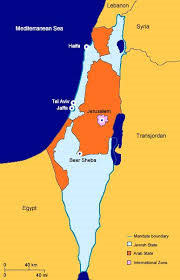
After several decades of Arabs fighting the law and seeking the end of Jewish immigration to Palestine, the British who oversaw the territory turned to the United Nations to implement a compromise solution.  On November 29, 1947, the United Nations voted to partition Palestine into distinct Jewish and Arab states. UN resolution 181 (which was specifically mentioned by the parties above in the 2015 UN resolution), was passed with 33 votes affirming; 13 against; and 10 countries abstaining.

On May 14 1948, as the British left Palestine, Israel declared itself as an independent state along the borders that were approved by the United Nations.  Several countries recognized the country including the US; the Soviet Union; Poland; Ireland; Yugoslavia; and South Africa, among others.  For their part, the Palestinian Arabs did NOT announce their own country along the UN stated borders.

1947 partition
Borders approved in UN resolution 181
November 29, 1947

Instead, with the approval of the Palestinian Arabs, several Arab countries – principally Jordan; Egypt; Syria; and Iraq, with forces also from Lebanon, Saudi Arabia and Yemen – invaded Israel.  In doing so those countries broke several international laws passed by the United Nations listed above about the “use of force against the territorial integrity or political independence of any State.

At war’s end, Israel took additional land from the region that was originally allocated by the UN to be a Palestinian Arab state.  Armistice agreements between Israel and the various warring parties were executed in 1949 which included language that the Armistice lines were NOT to be construed as final borders.  Egypt assumed control of the Gaza Strip and Jordan took control of Judea and Samaria, later annexing it into an area referred to as the “West Bank” in a move that was never recognized by the United Nations.

israel 1949 map
Borders after 1948-9 War

The world recognized the incremental land that Israel captured in its defensive war against the Arab armies in 1949.  That incremental land was disputed, and not part of any independent country or member state of the UN.

Israel
Since June 10, 1967

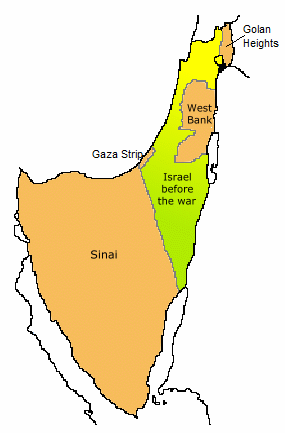
Even with the Armistice agreements meant to assure peace, Egypt and Syria made many provocative statements and actions that threatened Israel in early 1967.  In response to those threats, Israel launched a preemptive attack on Egypt and Syria in June 1967.  Despite warnings to remain out of the conflict, Jordan (together with Palestinian Arabs who were granted Jordanian citizenship in 1950) launched an attack on Israel from its illegal territory in the “West Bank.”

Once again, the Arab countries broke international law as well as the Armistice agreements they had in place with Israel.  As in the 1948-9 War, Israel legally defended itself and captured additional land:

  • Gaza (held by Egypt but not legally part of any country);
  • Sinai (part of Egypt)
  • Judea and Samaria/ West Bank (annexed illegally by Jordan, but not legally part of any country);
  • the Golan Heights (from Syria)

prewar_israel
Additional land added to Israel after
1967 Six Day War

When the Palestinian Arabs today discuss “the occupation of Palestinian territory, including East Jerusalem, in 1967,”  they are referring to land that is NOT, nor has it ever been part of a Palestinian state.  They are referring to lands that have been disputed for decades, that they would LIKE to have as a future Palestinian state.

Conclusion

The world accepted the acquisition of additional land by Israel in 1949.  The lands acquired were not “seized” in an offensive war against another country, but were disputed lands taken in a defensive war.  The West Bank and Gaza were taken similarly in 1967 (note that Israel left Gaza completely on its own in 2005).  The Sinai peninsula was returned to Egypt in 1982.

The Palestinians refused to accept Resolution 181 on November 29, 1947 and never declared an independent state.  While Israel has thus far only annexed the eastern part of Jerusalem that was divided in the 1948-9 War, it has left open the possibility of dividing Judea and Samaria, even though it was acquired in exactly the same manner as lands taken in 1948-9.

It is peculiar that countries acting on the Palestinian Arab’s behalf today should call out “the inadmissibility of the acquisition of territory by war,” when several of those countries illegally warred against Israel in 1948-9, and the world gave Israel incremental disputed land at that time.  Arab countries repeated their illegal wars against Israel in 1967 and are now trying to recast history when the situation was identical to 1948-9.

The world accepted the additional land acquired by Israel in 1949 and the Palestinians admit as much when they only refer to land “occupied” since 1967.  The global community should accept Israel’s annexation of additional land when Israel chooses to annex it, and stop mischaracterizing the disputed land as “Palestinian territory,implying a history with claims that do not exist.


Related First.One.Through articles:

The Legal Israeli Settlements

The Green Line

Names and Narrative: The West Bank / Judea and Samaria

Names and Narrative: Palestinian Territories/ Israeli Territories

The Narrative that Prevents Peace in the Arab-Israeli Conflict

Palestinians agree that Israel rules all of Jerusalem, but the World Treats the City as Divided

Real and Imagined Laws of Living in Silwan

Subscribe YouTube channel: FirstOneThrough

Join Facebook group: FirstOne Through  Israel Analysis

US State Department Comments on Terrorism in Israel and the Territories

There were several terrorist attacks against Israeli Jews in early October 2015.  The US State Department gave very tepid comments about the murders, especially compared to how the US reacted to the arson attacks that claimed the lives of three Palestinian Arabs in July 2015.  When one considers that the attack against the Arabs was arson against a house (which could have been empty) compared to deliberate murders shooting at a moving car and stabbing individuals, the response from the US State Department was even more appalling.

 Kirby
State Department Spokesperson John Kirby


July 31 Attack on Arabs October 1 Attack on Jews October 3 Attack on Jews
Words in Statement 122 68 77
Condemnation “condemns in strongest possible terms” “strongly condemns” “strongly condemns”
Terrorist attack “vicious terrorist attack” AND “terrorism” “terrorist attack” Not called terrorism
Condolences “profound condolences” “condolences” No condolences
Prayer for Injured “prayers for a full recovery” None None
Families mentioned “Dawabsheh family” None None
Location of Incident “Palestinian village of Douma” West Bank.” Not Israeli; not Samaria Old City of Jerusalem today”. Not Israeli
Call for Justice “murderers” “the perpetrators all perpetrators of violence” A general term

As seen in the chart above, the trend line of not even expressing condolences or calling the attack terrorism is very worrying.

Supporters of Israel have long complained about the bias of the United Nations against Israel.  It would appear that those supporters must now worry about the support of its strongest ally.

#JewishLivesMatter

Attacks Against Israelis

US State Department October 3, 2015:

“The United States strongly condemns all acts of violence, including the ‎tragic stabbing in the Old City of Jerusalem today that left two victims dead and two injured. We call for all perpetrators of violence to be swiftly brought to justice. We are very concerned about mounting tensions in the West Bank and Jerusalem, including the Haram al Sharif/Temple Mount, and call on all sides to take affirmative steps to restore calm and avoid escalating the situation.”

US State Department October 1, 2015:

The United States strongly condemns the terrorist attack that took place late Thursday evening in the West Bank. The shooting resulted in the death of an Israeli couple who were driving with their young children. We extend our condolences to the victims’ family. We urge all sides to maintain calm, avoid escalating tensions in the wake of this tragedy, and work together to bring the perpetrators to justice.

Attacks Against Palestinian Arabs

US State Department July 31, 2015:

“The United States condemns in the strongest possible terms last night’s vicious terrorist attack in the Palestinian village of Douma. The arson attack on a family’s home in the dead of the night resulted in the death of an 18 month-old baby and the injury of three other family members. We convey our profound condolences to the Dawabsheh family and extend our prayers for a full recovery to those injured.

We welcome Prime Minister Netanyahu’s order to Israel’s security forces to use all means at their disposal to apprehend the murderers for what he called an act of terrorism and bring them to justice. We urge all sides to maintain calm and avoid escalating tensions in the wake of this tragic incident.”


Related First.One.Through articles:

UN Comments on the Murder of Innocents: Henkins

UN Comments on the Murder of Innocents: Itamar and Duma

The New Blood Libel

The US State Department’s Selective Preference of “Status Quos”

Subscribe YouTube channel: FirstOneThrough

Join Facebook group: FirstOne Through  Israel Analysis
The Israeli Peace Process versus the Palestinian Divorce Proceedings

Summary: The gap in resolving the long running Israel-Palestinian Question has to do with the goals of each party: the Israelis believe they have been engaged in a peace process between peoples while the Palestinians are negotiating a divorce settlement between countries.

Politicians and the media – both well-meaning and otherwise – have blamed various parties for the failures to resolve the Israeli-Palestinian conflict. When they are not directly pointing accusing fingers, they still use language which conveys their biases. A person needn’t look past the language used in discussions about Jewish homes beyond the Green Line/ 1949 Armistice Lines – the “settlements”.

“Settlements”

“Viability”: As detailed in “A Viable Palestinian State”, various parties have described the “settlements” as a hindrance to a viable Palestinian state. The statement is meant as a direct attack on Israel, and is absurd. If a Palestinian state cannot exist with a 5% Jewish population, then surely Israel cannot exist with a 20% Muslim population. Are the people that make such a comment looking for Israel to expel a million Israeli Arabs?

Similarly, if a viable Palestine is compromised because such new country would be only 15km across at a single point, surely Israel cannot exist in its current configuration with a 15km narrow corridor for a dozen kilometers. Are these politicians and media pundits suggesting that Israel must annex the entire spine of the land?

“Complication” and “Provocation”: Another sentiment that is expressed is that settlements “complicate the peace process.” As conveyed in June 2015 by the New York Times in an article called “Israel’s work on a West Bank Site Gives Rise to New Suspicion,” even existing homes purchased by private individuals (as opposed to new communities established by the Israeli government) hurt the peace process. The article described a man who purchased an abandoned building and surrounding property: “Leftist Israeli politicians and advocacy groups have reacted with alarm, suspecting a new settlement in the occupied West Bank [a NYT term] that would further complicate the peace process.

This statement is similar to the rebuke of the Obama administration to Jews buying and moving into homes they own in Silwan, in the eastern part of Jerusalem. As detailed in the FirstOneThrough article “Obama supports Anti-Semitic Palestinian Agenda of Jew-Free State,” the Obama administration condemned Jews for legally buying homes and becoming neighbors in an Arab neighborhood east of the Green Line, referring to such basic act of living as a provocation.

And therein lies the basic gap in understanding the actions, intentions and goals of the two sides.

20150610_080707
New York Times article quoting “leftists” that claim that individual Jews owning land east of the Green Line “complicates peace”

Israeli Peace Process

The primary stated goals of the negotiations were to get to a peace based on two states:

  • The peace agreements with Egypt and Jordan are vital. But they’re not enough. We must also find a way to forge a lasting peace with the Palestinians. Two years ago, I publicly committed to a solution of two states for two peoples: A Palestinian state alongside the Jewish state. I am willing to make painful compromises to achieve this historic peace. As the leader of Israel, it is my responsibility to lead my people to peace.” Israeli Prime Minister Benjamin Netanyahu May 2011
  • Our goal is two states, Israel and Palestine, living side by side in peace and security. The process is the one of direct negotiations to end the Israeli-Palestinian conflict and to resolve all the permanent status issues and end the occupation that began in 1967 under which Palestinians have suffered so much.” Prime Minister of the Palestinian National Authority Mahmoud Abbas June 2003

As part of making peace with Palestinian Arabs, Israel has stated it will enable a new state of Palestine to be created.  For their part, the Palestinian Arabs are interested in their new state to be self-governing and to not deal with Israeli Jews. Israel has focused on peace with the people; Palestinians have focused on separation of the people. Two states living side-by-side in peace is not the same as two people living side-by-side in peace.

A peace process is best established with various personal, commercial and governmental relationships and dealings. Such interactions would enable the parties to navigate ongoing thorny issues like water rights and security.  It would enable partnerships to develop tourism and the economy.

Israel understands the importance of establishing relationships with its Arab neighbors.  As soon as the country was founded in 1948, the country granted 160,000 non-Jews citizenship and extended an offer and desire for peace with the neighboring Arab countries.  When Israel annexed Jerusalem, it offered all of the people there citizenship.  As of 2015, non-Jews account for 25% of Israel and have full rights in the most liberal country in the region, and one of the most liberal in the world. In the 2015 Israeli election, the Arab party placed third among the dozen parties seeking seats in the Knesset.

Over the decades, Israel forged peace agreements with neighboring Arab countries Egypt and Jordan.  It has stated that it is ready to so with Palestinian Arabs and the other neighboring countries as well.

Palestinian Divorce Proceedings

When Israel captured the area east of the Green Line in 1967 after it was attacked by the Jordanian and Palestinian Arabs, it rescinded the Jordanian ban on Jews living in the area (from 1949-67).  Israel allowed Jews to live and establish themselves in the region once again where they bought existing houses next to Arabs, built new houses, and created new companies.

All of which, made the Palestinian Arabs angry.

The Palestinians do not want Jewish neighbors in a new state.  Acting President Abbas made very clear his intention when he declared “we will not see the presence of a single Israeli – soldier or civilian – on our lands.”

The Palestinians do not want any Jewish businesses in a new state.  Despite the extraordinary efforts that some companies like Sodastream went through to hire Palestinian Arabs in its plant east of the Green Line (EGL) to work alongside Israeli Arabs and Jews, Palestinians put pressure on the company to abandon the area – which it did. Palestinians promote a BDS (boycott, divestment and sanctions) of all businesses established by Jews in the EGL.

Palestinians think Jews have no rights to buy or live anywhere in the land. They think the entire region – including Israel – is Arab land and that Jews have no history in the region. One can often hear Abbas and other Palestinians refer to the “Judaization” of the land, as if the holy land never had Jews.

The Palestinians reject the legitimacy of Israel itself. While the Palestinians will acknowledge the fact that Israel exists and will negotiate with it, they do not view the existence of the Jewish state as legitimate. They consider Jews colonialists and Israel a foreign colonial enterprise.  As such, they will not recognize Israel as a Jewish State.

The Palestinians are not looking for peace with Israel, nor are they seeking peace with Jews. They view the presence of both in the entire holy land as illegitimate. Their goals are to completely separate themselves from Israel and Jews in their own state, and to reestablish a majority Arab presence inside of Israel. Within their new country, the Palestinians do not want a single Israeli person or business.  Inside of Israel, they want millions of Arabs that are second and third generation removed from Arabs that once lived in the land, to specifically move to Israel because they feel that such land is also Arab land which Jews took illegally.


That is why Jewish “settlements” east of the Green Line are inaccurately called obstacles to a “peace process.” Jewish homes and businesses east of the Green Line do NOT “complicate the peace process”, they complicate the divorce proceedings that the Palestinians desire. A Jewish presence can only be called a “provocation” to a people that want to be rid of Jews.

It is not inaccurate to state that Jewish homes in EGL complicate permanent status negotiations, but it is an inversion of the truth to claim that they hurt the “peace process.”


Related First One Through articles:

Nicholas Kristof’s “Arab Land”

Delivery of the Fictional Palestinian Keys

Names and Narrative: The West Bank / Judea and Samaria


Names and Narrative: Palestinian Territories/ Israeli Territories

Summary: Almost every major media outlet refers to the Gaza Strip and the west bank of the Jordan River as “Palestinian Territories”, when in fact, those areas are actually “Israeli territories” and “Palestinian Authority Territories.”

Most places in the world are part-and-parcel of a country.  However, there are situations when a place is administered by a government which has not incorporated the land and assumed full sovereignty.

The United States of America historically had several large territories as the country expanded, including Alaska and Hawaii.  Today, the USA continues to have several territories including:

  • Puerto Rico
  • US Virgin Islands
  • Guam
  • Northern Mariana Islands
  • American Samoa

These territories have some rights and protections of the US government, but not others such as the right to vote.

Israeli Territories and
Palestinian Authority Territories
1995 to Present

It is easy and obvious to understand that there are no “Palestinian Territories”, because there is no such thing as the State of Palestine (as of this writing, in any event).  Most of the area east of the Green Line (EGL/ west bank of the Jordan River, WBJR), is controlled and administered by Israel.

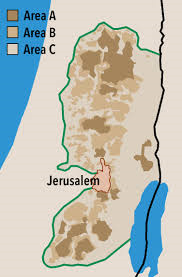
Under the Oslo Accords, EGL was divided into three parts: Areas A, B and C. Area A was handed over to the Palestinian Authority (PA) and it has complete control of that land.  Area C is “Israeli Territory” and is completely controlled by Israel. Area B is a hybrid, which is under the civil administration of the Palestinian Authority, but security control of Israel.

Areas ABC
Breakdown of Areas A, B and C
on the west bank of the Jordan River

Gaza would ostensibly be called “Palestinian Authority Territory”, however, the PA has no control in the area.  The governing party is Hamas, which won elections in 2006 and routed any PA personnel from the region in 2007.  Israel withdrew from Gaza in 2005.

Israeli Territories
1967 to 1995

The Oslo Accords between the State of Israel and the PLO started the process of breaking the Israeli territories into areas with local Palestinian Arab control.  Before the Oslo Accords, all of Gaza and EGL/ west bank of the Jordan River (WBJR) were only Israeli territories.

Israel took control of Gaza from Egypt in June 1967 during the Six Day War.  Egypt had amassed a large army and announced its intention of attacking Israel, so Israel preemptively attacked Egypt and seized Gaza.  In response to Israel’s preemptive attack on Egypt, Jordan attacked Israel from the EGL/WBJR. Jordan lost the region and gave up all claims to the land in 1988.

Jordan and Egyptian Territory
1949 to 1967

In May 1948, the Palestinian Arabs and five Arabs armies attacked Israel as it declared independence from Great Britain. At the end of the war in 1949, Jordan assumed control of much of Judea and Samaria in an area which became known as the “west bank of the Jordan River (WBJR)” in the United Nations, ultimately shortened to the “West Bank”.  Jordan annexed that area in 1950, gave all Arabs living there citizenship and expelled all of the Jews from the area, counter to the Fourth Geneva Convention.

Egypt assumed control of the Gaza Strip, but did not annex the area.

British Territory 1922 to 1948
Ottoman Territory 1517 to 1922

At the end of World War I, the defeated Ottoman Empire was carved up into several areas (including Lebanon, Syria, Iraq, and Jordan) which were administered by the French and British.  The lands currently known as WBJR and Gaza were part-and-parcel of the British Mandate and had no unique laws or characteristics.  Similarly under Ottoman rule for hundreds of years before the British, those areas were neither divided nor distinct.

As detailed above, there are not, nor have there ever been “Palestinian Territories”. Such terminology inherently upgrades the status of the Palestinian Authority and eliminates the legal role and status that Israel has in Areas B and C.


Related First.One.Through articles

Names and Narrative: The West Bank / Judea and Samaria

Nicholas Kristof’s “Arab Land”

The Subtle Discoloration of History: Shuafat

The Legal Israeli Settlements

Israel: Security in a Small Country

Israeli Prime Minister Benjamin Netanyahu described Israel as “a small country, one of the smallest”. That is true, but only part of the story. As Bibi added “Israel is strong, but it’s much more vulnerable [than the US].

Bibi Boehner
Netanyahu addressing US Congress,
March 2015

Size: Israel is about 20,000 square kilometers, using the 1949 Armistice Lines, or 22,000 including the eastern part of Jerusalem and the Golan Heights. It puts it on par with El Salvador, ranking 153rd in terms of land size.

Shape: Israel is very narrow along a significant stretch of its commercial center – only 15km across. Indeed, the slender, jagged shape of the country yields over 1,000km of borders. The ratio of land size to borders ranks Israel as the 15th smallest country in the world.

Neighbors: Most of the very small countries have very few neighbors. The smallest countries and territories, the Vatican, Monaco, San Marino, Liechtenstein, St. Martin, Andorra, Gibraltar and St. Maarten only border one or two countries. However, Israel has SIX neighbors: Lebanon; Syria; Jordan; “West Bank”; Egypt; and Gaza. By way of comparison, most countries with six neighbors are much larger (such as Argentina, which is over 130 times as large). Just beyond Israel’s borders, Turkey and Qatar openly support the Jihadist Hamas party in Gaza.

Status: Israel is unique in having a hostile relationship with most of its neighbors. All six of the surrounding countries are part of the Arab world and have launched wars against Israel at various times since the founding of Israel in 1948. Gaza (run by Hamas) openly calls for Israel’s destruction. Syria (and its puppet state Lebanon) have been in an ongoing state of war with Israel for years. Both countries are supported by Iran which has also called for Israel’s destruction and is on the verge of obtaining nuclear weapons. Syria itself was also building a nuclear facility before being stopped by Israel.

Other small countries with six bordering countries, like Oman, have not been repeatedly attacked by its neighbors.

Capital city: Israel is unique in having its capital questioned by the global community. While much of the world recognizes the western part of Jerusalem as Israel’s capital, countries have not moved their embassies to the city. No countries recognize Israel’s annexation of the eastern part of Jerusalem.

Israel is also unique (except Nicosia, Cyprus which is also a contested capital city), in having its capital sit on the border of another territory. Compare the small countries of Belize and El Salvador, whose capital cities are 50km and 80km, respectively, from the closest neighboring countries. By way of comparison, the entire width of the land between the Jordan River and the Mediterranean Sea is only 75km.

Israel is small and narrow, surrounded by countries that have repeatedly gone to war against the country and have threatened its existence. Its capital city is besieged by the global community that doesn’t recognize it, wants to divide it and place it on an international border, which all countries in the world avoid for security reasons.  Such a vulnerable country needs particular protections.

Security in a Vulnerable Landscape

For a country like Israel to have security and remain a viable country, a number of items would need to be established, if a Palestinian state were to be created:

  • No military for such Palestinian state, only local police
  • Israel would maintain full control of air space for its air force
  • Israel controls the borders
  • No division of the capital Jerusalem, and Israel further annexes land to the east of the city through to Ma’ale Adumim
  • Israel annexes land to the security barrier, which has helped maintain security over the past decade
  • Very limited land given from Israel to Palestine (the 1949 armistice Lines were arbitrary so there is no reason to maintain a quid pro quo in swapping land) as the Israeli landscape and topography are already too vulnerable
  • Hamas must be expelled from the Palestinian government and banned as a political party
  • Palestinian Authority must assume control of Gaza and EGL (East of the Green Line)
  • No negotiations with Syria on the Golan Heights for at least a decade after a Palestinian state is created. No negotiations if Iran obtains a nuclear weapon and/or continues to threaten Israel

While Israel has built an incredible democracy and thriving economy in the midst of a turbulent region, the size, shape and neighborhood require ongoing safeguards.


Related First One Through articles:

A Viable Palestinian State

Israel cannot solely rely on treaties – witness Ukraine in 2015

Obama’s cavalier approach to Israel’s security 

Obama does not consider Israel’s security to be time sensitive

Liberals and conservatives on Iran’s WMDs

The New York Times Major anti-Netanyahu Propaganda Piece

Summary: The New York Times once again showed its bias against Jews living on the west bank of the Jordan River by painting opinion as international law. It posted a large non news-article during the week of Israeli elections in an attempt to discredit Israeli Prime Minister Netanyahu.

On March 12, 2015, the New York Times ran a cover page story called “As Israeli Settlements take Root, So do Complications” and on its online version it was titled “Netanyahu and the Settlements”. The article repeatedly referred to something called the “Geneva Initiative” as if the initiative carried any backing or legal authority. In actuality, the 2003 initiative is most akin to a present day Facebook Group.

20150313_130018
New York Times large cover story on the “Settlements”

The Times wrote “Two-thirds of new construction over the last two years, the Peace Now report shows, was on the Palestinian side of a line drawn by the Geneva Initiative, an international working group that produced a model agreement in 2003…
Efrat, with nearly 10,000 residents, is to Israelis the capital of the Etzion block. Palestinians, though, do not accept it as part of the block at all,
because it is on the eastern side of Route 60 — their side of the Geneva Initiative map. Annexing it would be far more complicated.”

By reading such statements, one would think that Israel is deliberately building homes on the “Palestinian side” of a road, contrary to existing laws and/or agreements. Palestinians are comfortable with Jews living on one side of Route 60, but not on the other.  That is specifically what the NYT intends the reader to conclude by writing such an article. It is completely untrue.

The Geneva Initiative was launched by a handful of people- both Israelis and Palestinians. The civilians met during 2003 and drafted a guideline of how a two state-solution could emerge. None of the people participating were elected or appointed by any governmental body. Their initiative was not endorsed by any government. Neither Israelis nor Palestinians consider this old private working paper at all.

“the 2003 Geneva Initiative is most akin
to a present day Facebook Group”

Meanwhile ACTUAL laws and agreements were deliberately omitted from the NYT article. They include the 1922 British Mandate of Palestine which was signed by the League of Nations, the precursor to the United Nations. The Mandate stated:

  • Article 6: The Administration of Palestine, while ensuring that the rights and position of other sections of the population are not prejudiced, shall facilitate Jewish immigration under suitable conditions and shall encourage, in co-operation with the Jewish agency referred to in Article 4, close settlement by Jews on the land, including State lands and waste lands not required for public purposes.
  • Article 15: The Mandatory shall see that complete freedom of conscience and the free exercise of all forms of worship, subject only to the maintenance of public order and morals, are ensured to all. No discrimination of any kind shall be made between the inhabitants of Palestine on the ground of race, religion or language. No person shall be excluded from Palestine on the sole ground of his religious belief.

As described above, international law enabled Jews to live everywhere in Palestine. Such freedom of movement and the ability to buy land was also the case under the Ottoman Turks. This is history and law – not the opinion of a handful of private citizens.

The west bank of the Jordan River was an integral part of the 1922 British Mandate of Palestine.  It was annexed by the Jordanians in 1950, after Jordan attacked Israel in the 1948-9 war (such Jordan annexation was with approval of the Palestinians but never considered by the United Nations). The Jordanians illegally evicted all of the Jews from the area, including the eastern part of Jerusalem, counter to the Fourth Geneva Convention.

After Jordan (and the Palestinians who were Jordanian citizens) attacked Israel again in 1967, Israel was obligated to launch a counter-attack per The Hague Regulations which state:

  • Article 40: Any serious violation of the armistice by one of the parties gives the other party the right of denouncing it, and even, in cases of urgency, of recommencing hostilities immediately.

Jordan was therefore legally attacked by Israel.  The Jordanians officially gave up all claim to the land in 1988.

None of these international laws, agreements or actions on the part of governments are mentioned in this large cover story by the New York Times. Instead, the Times chose to paint a picture that Israel is not abiding to laws to make it appear as the belligerent party. It does this with the aid of a private working paper from 12 years ago.

20150313_130046
Double page story by the NYT, continued from March 12 2015 cover 

There was nothing new in the story which begs the questions:

  • Why give the article such prominence by placing it on the cover with a large color picture, and continue with a full two-page spread in the inside pages complete with pictures, maps and drawings?
  • Why use an old private Initiative to make an argument about the location of settlements instead of history and law?
  • Why post the article now?

The New York Times posted the piece as they want to see Israeli Prime Minister Netanyahu defeated in upcoming Israeli elections.  The Israeli elections will take place later in the week, on March 17, 2015.  The New York Times, which has a long history of attacking the Israeli Prime Minister, put this non-news story on the front page the week before Israeli elections to make it appear that Israeli Prime Minister Benjamin Netanyahu was acting outside of the law.

The Times has once again shown it is not a credible source of news and chooses to air its biased opinions throughout the newspaper.  It has also shown that it seeks to influence the outcome of foreign elections with large distortions.  An interesting piece of hypocrisy, as the day before, on March 11, the NYT posted an op-ed from Thomas Freidman arguing about Sheldon Adelson’s attempts to influence elections in the United States with major contributions to Republican candidates, as well as claiming Adelson’s Israel Hayom newspaper is a biased mouthpiece for Netanyahu in Israel.

Is the Times posting the opinion of Barack Obama or George Soros?


First One Through articles:

Legal settlements: https://firstonethrough.wordpress.com/2014/12/11/the-legal-israeli-settlements/

NYT’s Nicholas Kristof’s “Arab Land”  https://firstonethrough.wordpress.com/2015/02/27/nicholas-kristofs-arab-land/

NYT ignores Jihadists in Israel: https://firstonethrough.wordpress.com/2015/01/26/radical-jihadists-in-europe-and-dislocated-and-alienated-palestinians-in-Israel/

NYT minimizing Netanyahu’s election success: https://firstonethrough.wordpress.com/2014/08/11/new-york-times-talking-turkey/

NYT only using “West Bank” instead of “Judea and Samaria” https://firstonethrough.wordpress.com/2014/12/08/names-and-narrative-the-green-line-west-bank-judea-and-samaria/