Select Support in Fighting Terrorism from the US State Department

The month from October 13 to November 13, 2015 witnessed many terrorist attacks in the MENA region and Europe. The US State Department loudly condemned the large scale attacks in Chad, Lebanon and France, but was more muted in its condemnation of the attacks in Israel. Most significantly, the State department voiced its support for the various governments to combat the terrorism, but did NOT give any support to the government of Israel.

Further, over the entire month when numerous Arab terrorist attacks felled Israelis, the US State Department did not issue any additional condemnations.

  October 13 Attack in Israel October 27 Attack in Chad November 12 Attack in Lebanon November 13 Attack in France
Words in statement 88 140 118 149
Condemnation condemns in the strongest possible terms condemns” “strongly condemns” outrage and sadness”
“Terrorism” Once Once and “horrific and indiscriminate attacks” Four times Twice and “heinous, evil, vile acts.”
Condolences “We mourn any loss of life” deepest sympathies and condolences” “deepest condolences” “Our thoughts and prayers are with all those affected”
Innocent Life Israeli or Palestinian innocent civilians” None “innocent people”
Support to battle terror None. Requests “all sides to take affirmative steps to restore calm” support the governments and people of the Lake Chad Basin region in their ongoing struggle to defeat Boko Haram fully support the Lebanese authorities as they conduct their investigation… reaffirms its commitment to Lebanon’s security, and will continue to stand shoulder to shoulder with the people of Lebanon in confronting terrorism “must do everything in our power to fight back against what can only be considered an assault on our common humanity…. we stand ready to provide whatever support the French government may require”

Israeli Prime Minister Benjamin Netanyahu called all of the terrorism in the region as a single phenomena of radical Islamic terrorism. “The time has come for the world to wake up and unite in order to defeat terrorism. The time has come for countries to condemn terrorism against us to the same degree that they condemn terrorism everywhere else in the world

Based on the various remarks by the US State Department, it clearly disagrees.

Kirby
State Department Spokesman John Kirby

October 13, 2015 about Israel:

“The United States condemns in the strongest terms today’s terrorist attacks against Israeli civilians, which resulted in the murder of three Israelis and left numerous others wounded. We mourn any loss of innocent life, Israeli or Palestinian. We continue to stress the importance of condemning violence and combating incitement. We are in regular contact with the Israeli government and the Palestinian Authority. We remain deeply concerned about escalating tensions and urge all sides to take affirmative steps to restore calm and prevent actions that would further escalate tensions.”

October 27, 2015 about Chad:

The United States condemns the horrific and indiscriminate attacks at the Jambutu Mosque in Yola, Adamawa State, the Central Mosque of Polo Ward in Maiduguri, Borno State, and other locations in Maiduguri on October 23 and 24, 2015. We offer our deepest sympathies and condolences to the families and loved ones of the many innocent civilians who were killed and injured.

The apparent use of children – particularly young girls – to commit these attacks is especially heinous, and it provides yet more examples of the horrific measures Boko Haram is willing to take to terrorize civilians in northeast Nigeria and the Lake Chad Basin region.

The United States continues to support the governments and people of the Lake Chad Basin region in their ongoing struggle to defeat Boko Haram. We will continue to assist these vital efforts in every appropriate way.”

November 12, 2015 about Lebanon:

“The United States strongly condemns today’s terrorist attack on civilians in the Burj Barajneh neighborhood of Beirut, Lebanon. We extend our deepest condolences to the Lebanese people, particularly the families of the victims, and wish a swift recovery to the wounded.

Today’s events are a troubling reminder of the tremendous challenges Lebanon still faces. Terrorism, such as today’s attacks, seeks to undermine the freedom and security that the people of Lebanon have worked so hard to achieve. We fully support the Lebanese authorities as they conduct their investigation into this act of terror. The United States reaffirms its commitment to Lebanon’s security, and will continue to stand shoulder to shoulder with the people of Lebanon in confronting terrorism.”

November 13, 2015 about France:

“I share President Obama’s outrage and sadness over the terrorist attacks tonight in Paris.

Our thoughts and prayers are with all those affected by this assault on innocent people, going about their lives. And I am deeply concerned by ongoing reports of hostages.

These are heinous, evil, vile acts. Those of us who can must do everything in our power to fight back against what can only be considered an assault on our common humanity.

Our embassy in Paris is making every effort to account for the welfare of American citizens in the city, and in the days ahead we stand ready to provide whatever support the French government may require. France is our oldest ally, a friend and a vital partner. We stand with the French people tonight, as our peoples have always stood together in our darkest hours. These terrorist attacks will only deepen our shared resolve.”


Related First.One.Through articles:

US State Department Comments on Terrorism in Israel and the Territories

The US State Department’s Selective Preference of “Status Quos”

Failures of the Obama Doctrine and the Obama Rationale

Subscribe YouTube channel: FirstOneThrough

Join Facebook group: FirstOne Through  Israel Analysis

Failures of the Obama Doctrine and the Obama Rationale

Historians have begun to debate the “Obama Doctrine” and its impact on global stability. The Doctrine itself is not so novel or controversial.  It is the “Obama Rationale,” his underlying worldview, and how he applies the doctrine’s principles, that are causing the destabilization of global security.

Obama Doctrine
President Obama defining his “Obama Doctrine” with Thomas Freidman
April 2015 (photo: New York Times)

The Obama Doctrine
We will engage, but we preserve all our capabilities”

In April 2015, New York Times Op-Ed columnist Thomas Freidman penned a piece called “Iran and the Obama Doctrine.” In a long interview with US President Barack Obama, Freidman came to conclusions about Obama’s approach to foreign affairs. In short:

  • Engagement over Sanctions, Isolation and War. Obama stated a problem ignored is not a problem solved.  However, dialogue opened a possibility to change people’s hearts and minds. Diplomacy should always be the first option, both with allies and foes.
  • A Single Foreign Policy. The Executive Branch of the United States government must be the sole representative of US foreign policy. Senators and congresspeople should not engage with world leaders with messages that contradict those decided by the president.

Liberals and Conservatives may agree or disagree with this formula for engaging the world. Presumably, many would agree with these approaches in general.

Then why the terrible polls for Obama’s foreign policy?

Failed Implementation

There is a significant percentage of Americans who strongly disagree with Obama’s handling of foreign policy. Those reasons may have less to do with the Obama Doctrine itself, but how it is applied.

  • Negotiations with Foes. Engaging with friend or foe should yield results to one’s liking. Many Americans criticized the Obama team in that it did not extract enough concessions from negotiations.
    • Cuba was opened up with nothing to show for it.
    • Syria was given a pass for using chemical weapons even though Obama threatened the country with military force.
    • Iran was left with an enormous nuclear infrastructure, even though sanctions had pushed the country to the brink.
    • Russia actively established itself on the world stage including annexing part of Ukraine, as it knew that Obama would not take military action.
    • Engagement is okay, if it achieved the desired outcome, but Obama showed a pattern of coming away with only modest achievements at great costs. He resorted to touting the engagement itself as the victory, rather than tangible goals.
  • Engagement with Allies. Foreign policy is equally about managing relationships with allies. Yet Obama has shown an inability to keep allies close, work for American interests and make reforms, as necessary.
    • Egyptian President Hosni Mubarak was a longtime ally of the United States, and Obama made a point of visiting Cairo in his first international trip. Yet Obama quickly turned on this one-time ally and blessed his overthrow.
    • Israel has rarely had such a cold treatment form any US administration. The lack of trust has not produced an environment conducive to peace negotiations.
    • Saudi Arabia is an oppressive regime that is nevertheless a US ally. The kingdom has never been so unsure of America’s leadership, nor has it beheaded as many of its own citizens.
    • Turkey’s leader Erdogan has been described by Obama as being one of his closest allies.  Yet Turkey has dragged its feet in allowing the US to use its territory to fight ISIS and prefers using its Turkish troops to bomb Kurds than ISIS.
    • Despite an established agreement with Ukraine, Obama let the country fall to Russia.
  • Terrorism. More than almost any issue since 9/11/2001, has the world been focused on terrorism. Obama has been unsure how to utilize his “Doctrine” when the counter-party is not an official government, but a terrorist organization.
    • Islamic State/ ISIS has been targeted for destruction by Obama in words, but he has engaged in militarily confronting the group only sporadically. Meanwhile, the group continues to expand its attacks in Lebanon, Egypt (against a Russian airliner) and France.
    • Boko Haram; Al-Shabaab, Hamas and other Islamic terrorist groups do not get any engagement from Obama at all. Obama considers them local problems for local governments to handle and does not consider the global aspirations of the affiliates groups.  Never mind that these group like Ansar al-Sharia in Libya have attacked and killed Americans, including Ambassador Stevens.

The Obama Doctrine by itself is not that controversial to many Americans, however, it’s implementation is roundly criticized.  Further, the underlying Obama worldview which governs his approach to engagement is considered a disaster.

The Obama Rationale

President Obama has spent seven years outlining his thoughts as to why people use terrorism. The rationale leads directly to his proposed solutions, so appreciating those views is key to understanding his tactics.

In February 2015, not long after the terrorist attacks in Paris in January 2015, several world leaders met to discuss ways of combatting terror. President Obama addressed the American people and outlined his thoughts about the root causes of terrorism and his associated game plan:

  • Frustration with Injustice and Corruption. Obama stated that “anger that festers when people feel that injustice and corruption leave them with no chance of improving their lives.
  • No Outlet other than Through Violence. He added that the frustration was exacerbated by “[g]overnments that deny human rights play into the hands of extremists who claim that violence is the only way to achieve change
  • Misguided Belief that West is at War with Islam. Obama stated that some clerics and groups have a “twisted interpretation of religion” and that “al Qaeda and ISIL peddling the lie that the United States is at war with Islam

The Obama rationale for terrorism is that there is a very small number of people who have twisted religion and then prey upon people’s “legitimate grievances” (his words).  His approach to addressing this terrorist threat is an extension of his Obama Doctrine.

The Obama Solution to Terrorism

  • Broadcast the Voices of Muslim Moderates. “The world must continue to lift up the voices of Muslim clerics and scholars who teach the true peaceful nature of Islam”  Americans should show “support of their family, friends, teachers and faith leaders.”
  • Export Democracy.  While Obama has shown a reluctance to nation-build, he nevertheless thinks that advancing democracy would help stop terrorism: “Efforts to counter violent extremism will only succeed if citizens can address legitimate grievances through the democratic process and express themselves through strong civil societies.
  • Community Development.  Showing his roots as a community organizer, Obama advocates for local job creation, whereby “economic, educational and entrepreneurial development so people have hope for a life of dignity.” That’s why spokespeople like Marie Hart from the State Department continue to push the notion that a jobs program is the key to stop terrorism.
  • Repeat that the US is NOT at war with Islam. Obama consistently repeats over and again that America is not at war with Islam and that Islam is a religion of peace.  Such efforts, he believes, keep the terrorism from spreading to America’s shores and allies.

These approaches to terrorism are very much like the Obama Doctrine: engage and assist people in reaching democratic aspirations.  The small number of terrorists with hateful ideology would be eliminated (using “all capabilities”), while the masses should be “engaged”.  As Obama said:

Our campaign to prevent people around the world from being radicalized to violence
is ultimately a battle for hearts and minds.”

However, this approach has not slowed the advance of terrorism which continues to kill in France; Egypt; Israel; Lebanon; Nigeria; Kenya and elsewhere.

Critics of Obama say the battle is not “FOR the hearts and minds” but “OF the hearts and minds” of a broad number of Muslims.  They point out the murderous governments throughout the Muslim world, and the gross intolerance of their societies, that are not just offended by what people say or do, but who they are.

Many of these critics believe that the terrible state of global security is solely because of Obama’s worldview.  They argue that there is no administration failure to execute; the team is executing the Obama Doctrine according to the Obama Rationale: Give the various regimes money, jobs, trading, asylum and the like.  Remove American troops from the MENA region, engage economically, and peace will prevail (or if it doesn’t, it will be a local problem).

Obama’s critics dismiss this approach and believe the “clash of civilizations” goes beyond a handful of terrorists.  The world is too flat and integrated to believe such a naïve approach will keep America and its allies safe.


As Americans consider their next president, it will be important to not just consider whether they agree with the Obama Doctrine, but with the Obama worldview. If terrorism continues to occur over the election season, the Obama Rationale will take center stage in the debates.

Subscribe YouTube channel: FirstOneThrough

Join Facebook group: FirstOne Through  Israel Analysis

Palestinian Job Fair for Peace

A sad satire

The United Nations took a special interest in the high unemployment rate of Palestinians, which has led to feelings of despair and hopelessness, leaving many to resort to violence against Israelis.  As such, the UN held a meeting in October 2015 in Vienna to listen to various leaders of the Palestinian community describe their occupations to see if the global community could help advance their livelihoods.

Here are some of the presenters:

Gaza exterminator
Pest Control

Pest Control: The UN was impressed with the first presenter, the owner of a pest control company.  According to the businessman, there was a large infestation in the region that guaranteed a significant amount of work for many unemployed people.

Gaza quarry owner
Stone Masons

Stone Masons: A cleric from the West Bank described the incredible blessings of the holy land to be filled with stones of many sizes. He described the various types of rocks in the region and how they could be used in different situations.  Qatar pledged $100 million for a new quarry on the spot.

Gaza gambling
Gambling

Casinos: The casino in Jericho was reported to be doing very well.  The owner described “making a killing” in various games of chance.  He was happy to report that the gaming industry was actively hiring more people.

Gaza butcher
Butcher

Butchers:  While the amount of available meat for food consumption declined since Hamas took over Gaza, butchers continued to hone their skills.  A cleric showed off tools of the trade and urged others to get involved.

Gaza cattle ranchers
Cattle Ranchers

Ranchers:  As described above, the meat business has not been great, but Palestinian leadership was confident in their ability to corral enough when the market improved.

Gaza outdoor backpacker
Outdoor Hiking

Outdoor Activities:  Gaza developed a range of sporting centers with special backpacks, belts and other gadgetry for time outside.  While repelling has been around for a few years, preachers were just starting to advocate the activity.

Gaza behead
Bowling and entertainment

Indoor Activities:  The owner of one of the few Middle Eastern bowling alleys discussed “spares and strikes” and hoped to educate the community about fun “date-night” activities.

Gaza hide and seek
Teachers

Teachers: The Palestinian schools always need new teachers with new methods to teach the young.  A teacher presented an innovative method of teaching religion and history via a game of hide-and-seek with the children.

Gaza cheerlreader
Cheerleaders

Cheerleaders and Sports:  The UN was impressed with the progressive nature of the Palestinian schools that had a very large percentage of male cheerleaders.

Gaza surgeon
Surgeons

Doctors: The healthcare industry was still in shambles, particularly in Gaza.  However, the United Nations was heartened to listen to Palestinian doctors promoting their profession to the young.

Gaza zookeeper
Veterinary Medicine

Vets and Zoo:  The UN heard Palestinian requests to refurbish their zoos and teach veterinary medicine.  Apes and pigs were the primary attractions.

Gaza arms dealer
Arms Dealer

Arms Dealer:  Well, it is the Middle East.  The UN blessed Iran’s nuclear weapons program, so Palestinians thought they would have an easy time advancing an arms dealership in the region.  Turkey pledged to send a boat right away.

gaza journalist
Journalist

Journalism: Palestinians have taken to social media like African bees to a sweaty field worker. The United Nations promised to not only promote their posts, but to pay Palestinians for the news stories as well.

Gaza charm school
Charm School

Vocational Schools:  This was a hot topic in Vienna.  By teaching older adults new skills, more people would be able to earn livelihoods.  The graduates of Palestinian Charm Schools have a reputation of being so endearing, that they get speaking engagements paying handsome sums, even when they have little to say. The University of California school system has speakers booked through May.

Gaza ghost costume
Retail: Kids clothing

Retail: Clothing was historically a tough business in the territories, as large family sizes ensured a good supply of hand-me-downs.  This year, the UN promoted celebrating Halloween and paid for advertisements selling ghost and other costumes to stimulate the economy.

Gaza shapeshifters
Shape-shifters

Shape-shifters:  This occupation stumped the members of the UN commission.  They had heard of Jews controlling animals and sharks with their minds, but they were unsure about the nature of changing physical form.  The panel agreed to meet again later to learn more about the phenomenon and how it could be used to help the Palestinian cause.

Gaza shoe shine
Shoe Repair

Shoe Repair: The acting-President of the Palestinian Authority spoke about the basic needs of shoe repair and foot hygiene. His display of humility left the committee speechless.  One member of the committee from Ecuador commented that Abbas reminded him of the new pope.

The United Nations concluded the day-long session with a statement of support from Fodé Seck (Senegal), the Committee Chairperson.  The US Ambassador to the UN, Samantha Power remarked that the session showed a way forward for the Palestinian economy.  “As Obama says,” remarked Power, “once economic and political despair is overcome, peace will prevail.

In Middle East parlance, it is called putting the cart before the rocket launcher, a tried-and-true method of controlling the population.


Related First.One.Through articles:

Snack-Pack Inspections

Silwan Circulars, Christmas 2014

Subscribe YouTube channel: FirstOneThrough

Join Facebook group: FirstOne Through  Israel Analysis

An Inconvenient Truth: Palestinian Polls

There were a growing number of violent attacks by Palestinians against Israelis in October 2015.  Various politicians such as the US Secretary of State John Kerry blamed the root cause as Palestinian frustration about ongoing Jewish “settlements” east of the Green Line.  Acting President of the Palestinian Authority Mahmoud Abbas pointed the finger at defending Al Aqsa Mosque in Jerusalem from Israelis changing the status quo.  United Nations Secretary-General Ban Ki-Moon considered that it was due to Palestinians frustration about the failed peace talks and lack of progress towards creating a Palestinian state.

Why all of the guessing for identifying the root cause when the Palestinians poll themselves every three months?

The Palestinian Center for Policy and Survey Research conducts a poll every quarter on a range of issues.  It breaks the analysis between Palestinian Arabs living in the West Bank/ east of the Green Line and the Gaza Strip.  A review of the poll numbers gives a much better sense of Palestinian Arabs sentiments about their situation than biased and bogus statements from Kerry, Abbas and Ban Ki-Moon.

A Growing Majority of Palestinians Support Attacking Israeli Civilians

The poll figures do show a growing support of attacking innocent Israeli civilians.  In December 2013, the percentage of Arabs supporting unprovoked attacks was 34% and 58% in the West Bank and Gaza, respectively.  Those figures jumped to 48% and 68% for WB and Gaza in September 2014 and then to 50% and 70% in September 2015.  Overall, a clear majority of 57.2% of Palestinians were in favor of terrorism as of September 2015, up from 42.9% in December 2013.

Terrifying numbers about terrorism in both the absolute percentage and in the terrible trendline of support.

No heightened Palestinian fear regarding Annexing the West Bank and Changing the Status Quo on the Temple Mount. Palestinians are ALWAYS afraid.

Despite Kerry’s assertion that Palestinians are increasingly fearful of Israelis living east of the Green Line and Abbas’s statement about Israel changing the status quo on the Temple Mount, the statements are untrue.

kerry harvard
John Kerry at Harvard attacking Israeli settlements
(photo: Brian Snyder/Reuters)

Settlements: Palestinians have always been afraid of Israeli intentions regarding annexing land. In December 2013, 85.3% and 80.5% of Arabs in the West Bank and Gaza, respectively, believed that Israel would annex the entire region.  Those figures dropped after the 2014 Gaza War to 81.2% and 75.3% in September 2014, before rising again to 88.5% and 78% one year later.

In every quarter over the past two years, between 80% and 90% Palestinian Arabs in the West Bank thought Israel was intending to annex both the West Bank and Gaza.  The range was 70% to 82.5% for Palestinians living in Gaza.  Presumably the Arabs in Gaza did not have as great a fear as the Arabs in the West Bank since they clearly saw that Israel left Gaza in 2005.  The question remained why the fear factor numbers remain so consistently high, even in Gaza.  In any event, there was no correlation between the increased Arab desire to kill Jews and their fear of Israelis annexing territory.

Al Aqsa: The poll numbers show similar results for the Temple Mount/ Al Aqsa.  In March 2014, the PCPSR asked whether people were concerned that Israel would change the status quo on the Temple Mount.  Almost everyone – 93% – believed Israel intended to make changes to access and prayer rights.

In December 2014, 66.2% of West Bank Arabs, and 38.8% of Gazans thought that Israel intended to completely destroy the Al Aqsa mosque.  In the most recent September 2015 poll, those figures dropped to 60% and 33.4% for the West Bank and Gaza, respectively.  Again, there was no correlation between the uptick in violence due to Palestinian fears, despite the October 2015 protestations of John Kerry and Mahmoud Abbas.

The UN Fantasy of Palestinian Support for a Two State Solution
and Negotiated Process

Despite the United Nations repeated comments that the key to peace lies in a two state solution, it has never been a particularly popular dream of the Palestinians. In March 2014, a slim majority of 51.2% of Palestinians supported the idea. In the last poll of September 2015, 47.9% of Palestinians were in favor of two states.

Further, throughout 2015 a majority of Palestinians favored an armed struggle with Israel more than negotiations.  In December 2014, Arabs broke down as 41.9%, 25.6% and 28.3% in favor of using either violence, negotiations and non-violent protests, respectively. In September 2015, the polls showed little movement, with a breakdown of 41.6%, 29.2% and 24.2%.

The Palestinian polls show that the two state solution has never been a very popular idea, and those that favor it believe it can best be accomplished through violence. The recent uptick in actual violence actually accompanied a move from a preference for negotiations, counter to expectations.

Safety and Social Media

The poll numbers do show some trends that correlate to the spike in what Wall Street Journal’s Brett Stephens referred to as a Palestinian “blood lust.”

Safety: In December 2013, a majority of Arabs east of the Green Line (54.4%) and in Gaza (61.7%) felt safe.  That changed dramatically after the 2014 Gaza war.  Between June 2014 and December 2014 the sense of safety in the West Bank dropped from 51% to 38.3%, and in Gaza from 63.9% to 46.1%.  The numbers continued to stay low over 2015, with a perceived safety growing from 38.3% to 48.7% in September 2015 in the West Bank, and dropping further in Gaza from 46.1% to 39.5%.  Those are very dramatic declines from two years earlier.

Social Media: Palestinians, particularly those in the West Bank, have been getting their news from social media in much greater numbers.  In the West Bank, Arabs that use Facebook and Twitter jumped from 14.7% (June 2014) to 19% (December 2014) to 26.4% (September 2015). The numbers in Gaza over that time period went from 21.3% to 21.6% to 24.1%.  These are significant changes, particularly in the West Bank.

The survey does not cover what kind of items people are watching and sharing on social media.  According to some news reports, videos of Israeli forces shooting Palestinians and “how to” videos showing ways to stab Jews, have gone viral.

The Palestinian Authority

The Palestinian Authority has always been viewed as corrupt by Palestinians according to polls.  Anywhere from 78% to 84% of West Bank Arabs that live under the PA consider the government corrupt according to every poll.  In Gaza, the percentage is lower, from 72% to 82%, but the overall sentiment is the same.

However, what has not stayed the same is the confidence in Abbas.  While coming in dead last in a theoretical three-person presidential election each quarter, his support has plummeted in the West Bank, while it has grown in Gaza.  In the WB: 32.1% (12/13); 28.5% (6/14); 26.7% (12/14); 21.5% (9/15). In Gaza: 17.2% (12/13); 27.1% (6/14); 20.8% (12/14); and 27.4% (9/15).  By September 2015, 62.9% of West Bank Arabs and 67.4% of Gazans wanted Abbas to resign.

Conclusion

Principal players in the Israeli-Palestinian conflict are using stale and incorrect information to describe the current violence, and as such, are focused on irrelevant solutions.  The settlements and the Temple Mount are not reasons for violent attacks.  A negotiated two state solution was never popular, despite the many efforts of those who strongly advocate for it.  Like the corruption of the Palestinian Authority, these things are constant white noise that don’t suddenly motivate people to murder.

Today’s violence is erupting due to concerns over safety, and fueled by the credibility and incitement of Palestinians on new media.

Abbas announced the beginning of his retreat from the Oslo Accords and managing security in the West Bank. The West Bank Arabs now feel more threatened and communicate directly with each other over social media about attacks and injuries.  The raw videos of families and friends being injured make them feel more unsafe and angry.  They, in turn, make videos for their friends to attack Israelis and reject Palestinian leadership, which fuels the security fears on all sides.

World and regional leaders are rehashing old misconceptions about a pathway towards peace and security in the region.  They should look at what Palestinians are actually saying: they are ambivalent about of a negotiated two state solution. They do not believe or trust their own leadership any more than the intentions of the Israelis.

With such understanding, it is time to rethink always propping up Abbas, ignoring Hamas and condemning the Israelis. It is time to stop obsessing about the settlements and Temple Mount and focus on security and communications.

The inconvenient truth is that Palestinians don’t like and don’t trust any of today’s leaders, and those same leaders refuse to listen to what the Palestinians are telling them.  It is hard to imagine peace and security emerging from such a dynamic.

Subscribe YouTube channel: FirstOneThrough

Join Facebook group: FirstOne Through  Israel Analysis

UN Concern is only for Violence in “Occupied Palestinian Territory,” not Israel

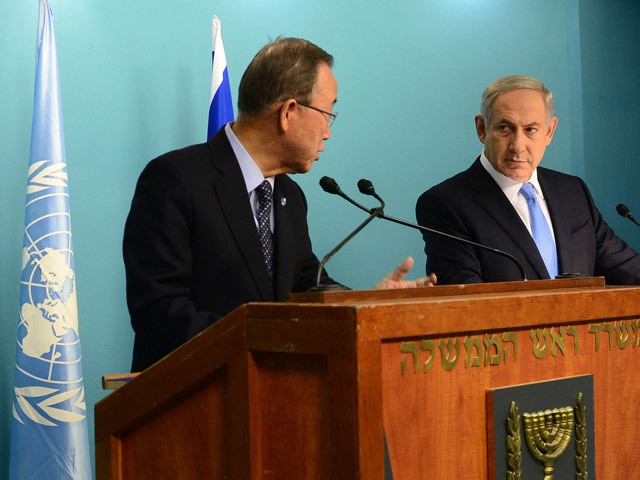
United Nations Secretary General Ban Ki-Moon arrived in Israel on October 19, 2015 with the claim that he hoped to stop “the dangerous escalation in violence across the occupied Palestinian Territory and Israel, especially in Jerusalem,” according to the UN official press release.

PM Netanyahu meets with UN Sec. Gen. Ban Ki-moon

PM Netanyahu meets with UN Sec. Gen. Ban Ki-moon (photo: GPO Kobi Gideon)

In discussing the situation, the United Nations opted to highlight certain cities where attacks took place: “in East Jerusalem, Ramallah, Hebron, Bethlehem, Jenin, Tulkarm and Nablus.” Note that every city that was mentioned was east of the Green Line. Seven cities, and not one west of the Green Line, where several attacks occurred including:

  • Petach Tikva (Stabbing October 7)
  • Kiryat Gat (stabbing October 7)
  • Tel Aviv (stabbing October 8)
  • Afula (stabbing October 8 & 9)
  • Jerusalem, west of the Green Line (stabbing and beating October 9 & 14)
  • Raanana (stabbing October 13)
  • Beer Sheva (shooting October 19)

Are these seven cities west of the Green Line not important? Is violence a concern to the United Nations only if it happens in “occupied Palestinian Territory?”

In case anyone thinks that mentioning seven random cities happened to coincidentally be east of the Green Line, the United Nations repeated those same seven cities the following day on October 20 in the press release mentioning:  “A series of deadly clashes between Palestinians and Israelis, including Israeli security forces, has marked much of October, with violent incidents reported in more than 50 different locations, including in East Jerusalem, Ramallah, Hebron, Bethlehem, Jenin, Tulkarm and Nablus.

When Ban Ki-Moon said that “No society should have to live in fear. No society can afford to see its youth suffer in hopelessness,” did he really only mean Palestinian Arabs?


Related First One Through articles:

The Narrative that Prevents Peace in the Arab-Israeli Conflict

Eyal Gilad Naftali Klinghoffer. The new Blood Libel.

Every Picture Tells a Story: The Invisible Murdered Israelis

Subscribe YouTube channel: FirstOneThrough

Join Facebook group: FirstOne Through  Israel Analysis

Framing the Israeli-Palestinian Arab Conflict: WSJ and NY Times

The portrayals of the Israeli-Palestinian Arab conflict in the two main New York newspapers could not be more different.  Snapshots of the two papers on October 17, 2015 and the editorials from the prior days frame the conflicting attitudes.

In Pictures

On October 17, 2015, each paper posted a picture of an attack that occurred in Hebron. The Wall Street Journal captured the Palestinian who posed as a journalist stabbing an Israeli soldier.  The New York Times showed a picture of two Israeli soldiers standing over the dead Palestinian.

IMG_3554
Wall Street Journal front page picture of Israeli soldier attacked by Palestinian
October 17, 2015

IMG_3549
New York Times front page picture of armed Israeli soldiers standing over dead Palestinian October 17, 2015

The Wall Street Journal covered this story – and many of the stories over October 2015 when Palestinians attacked Israelis – as Palestinians as the aggressors and Israelis as defending themselves.  However, The New York Times almost uniformly showed all Palestinians as victims and Israelis as the armed aggressors.

In Editorials

New York Times: On October 15, the Times ran an editorial entitled “The Cycle of Violence in Israel.” The title and the opinion piece described a country that is in a never-ending cycle of “attacks and reprisals“, blaming neither party as being aggressor or instigating the violence.  The attacks were referred to as Palestinian “uprisings,” and the Times pointed the finger at a few parties:

  • “Yasir Arafat, could speak for all Palestinians” back in 1993 so there was a better prospect for peace according to the Times behind a unifying leader.  It neglected to state that the same Arafat walked away from a serious peace offer and then launched the Second Intifada in 2000, killing thousands.
  • The Times correctly stated that “Mahmoud Abbas is bitter and unpopular” which makes it difficult for him to lead and deliver peace negotiations. The paper failed to point out that Abbas has constantly incited violence against Israelis and never put forth any public comments on his willingness to compromise on his demands to create peace.
  • “Netanyahu has demonstrated little interest in a two-state solution” according to the Times, even though he is the only person that specifically has demonstrated a desire for peace: handing over half of the “Holy Basin”, Bethlehem, in 1996; a ten month settlement freeze in 2010; releasing dozens of terrorists; and repeatedly stating his willingness to engage in direct peace talks anytime, anywhere.

The New York Times described the only solution to ending the cycle of violence as “creating an independent Palestinian state alongside an Israel whose right to exist is fully acknowledged by all Palestinians.”  Note that the Times language specifically does not mention any Israeli demands of “security” and recognition as a “Jewish State.”  According to the Times, the only thing creating violence is the lack of a Palestinian state.

Wall Street Journal: On October 16, 2015, the WSJ had an editorial calledThe Knives of Jerusalem.The Journal’s attitude about the violence and approach could not be more different than the New York Times:

  • The WSJ called the Palestinian Arab attacks “terrorism” five times, a term never used by the Times (nor by the Obama Administration for that matter)
  • “[A] deep-seated culture of hate” among Palestinian Arab society was at the core of the attacks
  • Blame is specifically placed on Palestinian leaders including Abbas spreading “rumors” and “lies” about Israel to incite the Arabs.

The WSJ noted that Israel will need “to ride out another storm of terror.”  Peace will ultimately come when Palestinians realize that the Jews are not going to leave: “The sooner they [Israelis] impress on Palestinians that they will never bow to knives or bend to terror, the sooner the stabbings will end.”


The Times placed the principal blame for the attacks on Israeli “occupation” and therefore the solution is a peace agreement / a separation accord. Their pictures and articles repeatedly use images of Palestinians as victims and Israelis as militant occupiers.

The WSJ placed the blame on Palestinian Arabs who have denied the right of Jews to live in the holy land as self-governing people since the League of Nations gave Jews that legal right in 1922.  Peace will only come when Palestinian Arabs give up the fight and accept that the Jews are never going to leave. Their articles are more likely to show Israel as at the frontlines in the battle against Islamic radicals, similar to much of the western world.

The pictures and articles of the two papers have been consistent in their coverage of the conflict, and the weekend of October 17, 2015 brought the contrast into clear focus.


Related First One Through articles

Every Picture Tells A Story: Only Palestinians are Victims

Why the Media Ignores Jihadists in Israel

The Israeli Peace Process versus the Palestinian Divorce Proceedings

Every Picture Tells a Story: Versions of Reality

Subscribe YouTube channel: FirstOneThrough

Join Facebook group: FirstOne Through  Israel Analysis

Every Picture Tells a Story: Versions of Reality

The New York Times published an article on October 16, 2015 entitled “Conflicting Accounts of Jerusalem Strife Surround Wounded Boy“.  The article described a 13-year old Palestinian boy who stabbed a 13-year old Israeli boy who was riding a bicycle.  The acting-President of the Palestinian Authority Mahmoud Abbas claimed that the innocent Palestinian was executed by Israelis, while in fact he was recuperating at an Israeli hospital.

Normal logic would suggest that the pictures that accompany the article have something to do with the story.  Indeed, the Times did post a small black-and-white photograph of the 13-year old Palestinian recuperating in a hospital bed.  However, the Times decided to post a much larger photograph on top of that picture – of Israelis with machine guns standing over Palestinian Arab women.

IMG_3546
Times leading with a picture of armed Israelis standing over Arab women in a story about a 13-year old Palestinian terrorist being described as “executed” by Mahmoud Abbas

Why didn’t the Times also post a picture of the wounded Israeli boy? Why didn’t it have a picture of Abbas declaring the boy “executed”?  Or Israeli Prime Minister Benjamin Netanyahu pointing out the lies and incitement of Abbas? Because for this “progressive” newspaper, the real story about Arabs attacking innocent Israelis is about Israelis fighting Palestinians, not the other way around.

The Times wrote a piece about “conflicting versions of reality” between Israelis and Palestinians. The reality of the Times constant portrayal of Israelis “occupying” Palestinian victims is another disturbing story in the “conflicting” (read “false”) narratives that fan the flames in the region.


Related First One Through articles:

Every Picture Tells A Story: Only Palestinians are Victims

Every Picture Tells a Story: The Invisible Murdered Israelis

Subscribe YouTube channel: FirstOneThrough

Join Facebook group: FirstOne Through  Israel Analysis

Every Picture Tells A Story: Only Palestinians are Victims

The “Every Pictures tells a Story” series reviews newspapers through a lens focused only on their pictures and captions. The brutal attacks that occurred in Israel during the week October 7-14 provide a good snapshot for how the New York Times viewed the conflict – the only victims in the Middle East are Palestinians.

To set the background for the two weeks of violence: on October 1, 2015, Palestinians shot an Israeli couple who were driving on a road with four of their children. After shooting up the car, the Palestinians approached it once it came to a stop and executed the parents. The Times did not post any pictures of the Henkins, the murdered Israelis along the story. If one were to only focus on the pictures and captions, their murders would never have occurred.

In the following days, the number of Palestinian Arab attacks against Jews continued to grow in frequency. Yet remarkably, the Times pictures showed one story: Palestinians as victims.

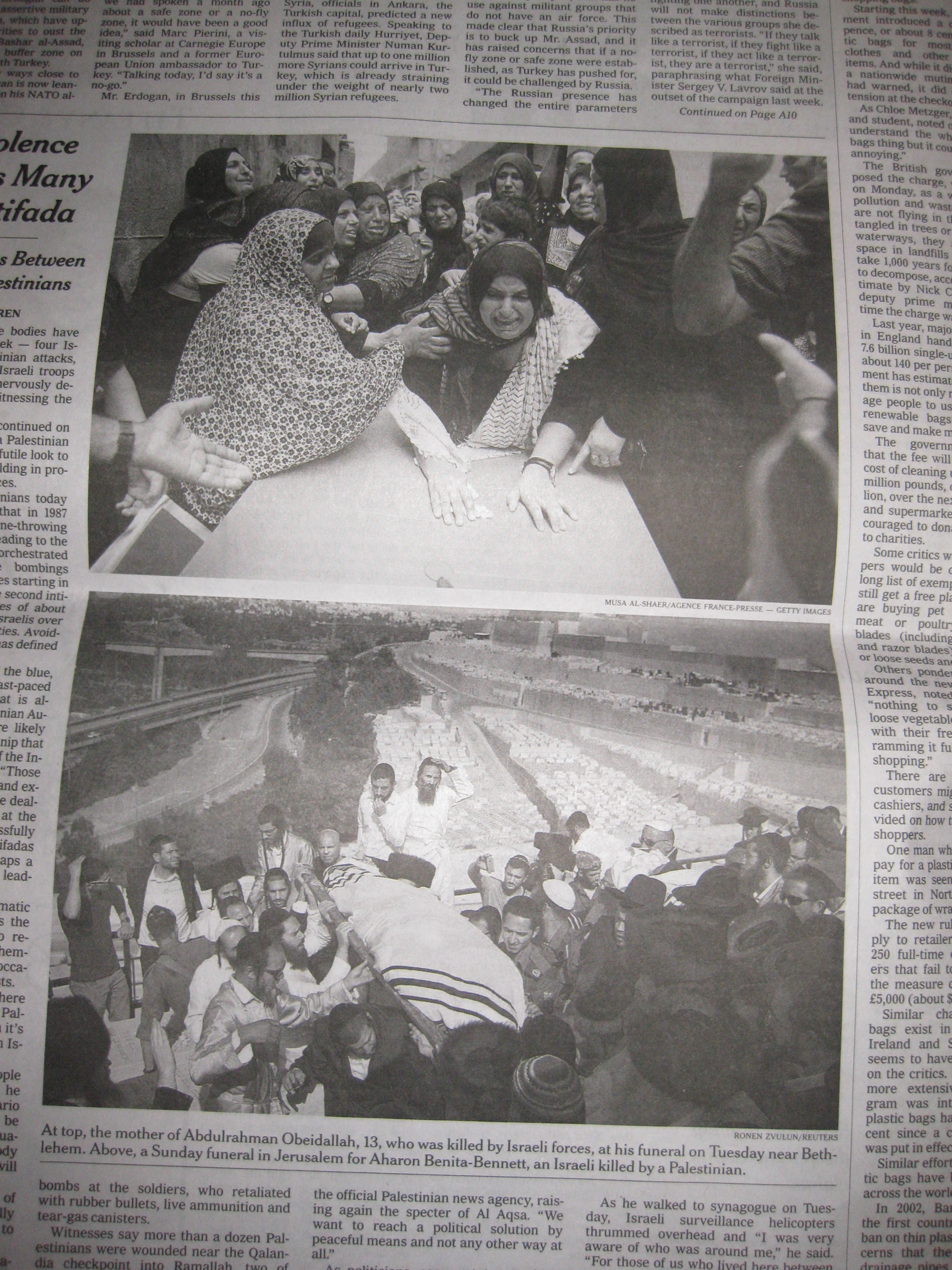
October 7 Page A4. “At top, the mother of Abdulrahaman Obeidallah, 13, who was killed by Israeli forces, at his funeral on Tuesday near Bethlehem. Above, a Sunday funeral in Jerusalem for Aharon Benita-Bennett, an Israeli killed by a Palestinian.” This was the Times only attempt at providing a “balanced” picture of deaths on both sides. However, there was no attempt to convey that the Palestinian was not shot intentionally, while the Palestinians deliberately were murdering Israelis.

IMG_3538
Only NY Times photo showing Israelis attacked during week October 7-14, 2015
included picture above of Palestinian killed

October 8 Page A6. “A Palestinian man in a flooded tunnel that was used to smuggle goods between Egypt and the Gaza Strip. Egypt has been flooding the tunnels to deter smuggling.” The large color picture and caption leads one to feel sorry for the Palestinian. Of course, what was not mentioned was that the “goods” that were being smuggled into the tunnels included weapons to target Israelis and Egyptians.  The article continued on page A14 with two black and white pictures.  The large picture’s caption “Juma Abu Shaer and his wife Masouma Abu Shaer, at home in Rafah. They fear they may have to leave because of flooding.” Names are given of people living in fear. You will not see that for Israelis over the week of terror attacks. The last small photo has a caption “The border between Rafah, in the Gaza Strip, and Egypt on the right. Egypt has flooded part of the nine-mile border area twice.” Such picture and caption confirms that the Times knows that many readers only glance over the articles and rely on the pictures and captions only.

The article about “Unrest Spreads in Israel Despite Tighter Security” which reviewed more Palestinian’s attacking Israelis had no pictures.  No Israelis were injured in unprovoked attacks for the news-in-pictures.

IMG_3536IMG_3537
Three sad Palestinian Arabs

October 9 Page A14. “An Israeli man looked over the body of a Palestinian assailant who was shot dead after carrying out a stabbing attack on an Israeli soldier and three civilians in Tel Aviv on Thursday.” Another article with larger picture “Palestinian protestors took cover during clashes with Israeli security forces on Thursday in Beit El, West Bank. Disputes over Jerusalem have added to tensions.” The pictures again show dead Palestinians and those under fire. There were no pictures of Israeli civilians who the Palestinian stabbed in unprovoked attacks. The “protestors” are not shown throwing Molotov cocktails and rocks.

IMG_3534IMG_3535
Dead Palestinian and one under attack

October 10 Page A4. Small color picture of soldiers over small boys “With security increased, Israeli border police told Palestinians on Friday they could not enter the Noble Sanctuary in Jerusalem’s Old City.” The caption fed a Palestinian narrative that the unrest is from Israeli soldiers keeping innocent Palestinians from praying at their holy site. The image of soldiers with weapons directing small boys add to the drama of the story. There were no pictures of Arabs harassing Jewish visitors on the Temple Mount nor firing firecrackers at the soldiers.

IMG_3527
Sad Palestinians Turned away by Israeli soldiers

Page A8: 2 color pictures. Very large crowd of Palestinians carrying wounded “Palestinians carried a wounded man on Friday in Gaza. It was the first time in the latest outbreak that significant unrest spread to the territory” smaller picture of man throwing stones “A Palestinian protestor hurled some stones at Israeli soldiers on Friday amid clashes on the Israeli border.” Again, Palestinians are shown injured, not Israelis.

Page A8 another article with medium color picture of Israelis taking wounded away “Israeli emergency personnel loaded a Palestinian into an ambulance on Friday after violent confrontations in the West Bank.” In the third article of the day, the Times once again chose to only show injured Palestinians in attacks that they provoked. None of the injured Israelis is pictured.

IMG_3524
Dead Palestinian

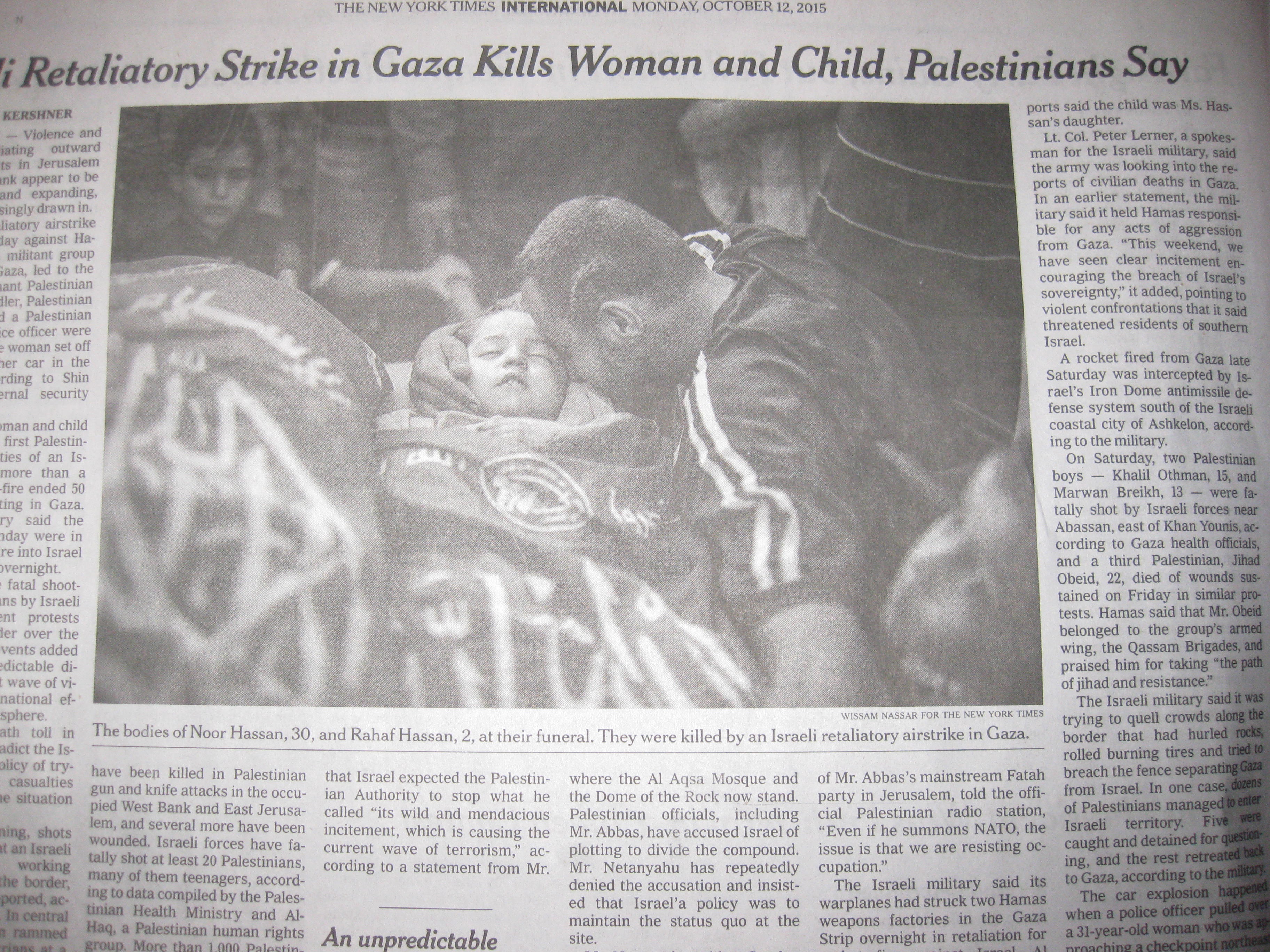
October 12 Page A6. Black and white of father over dead child “The bodies of Noor Hassan, 30m and Rahaf Hassan, 2, at their funeral. They were killed by an Israeli retaliatory strike in Gaza.” While the caption at least mentioned that the Israeli did a “retaliatory strike” conveying that Palestinians initiated the fight (compared to earlier language of a generic “confrontation”) the pictures are again only of Palestinians hurt in the conflict.

IMG_3520
Two dead Palestinian Arabs

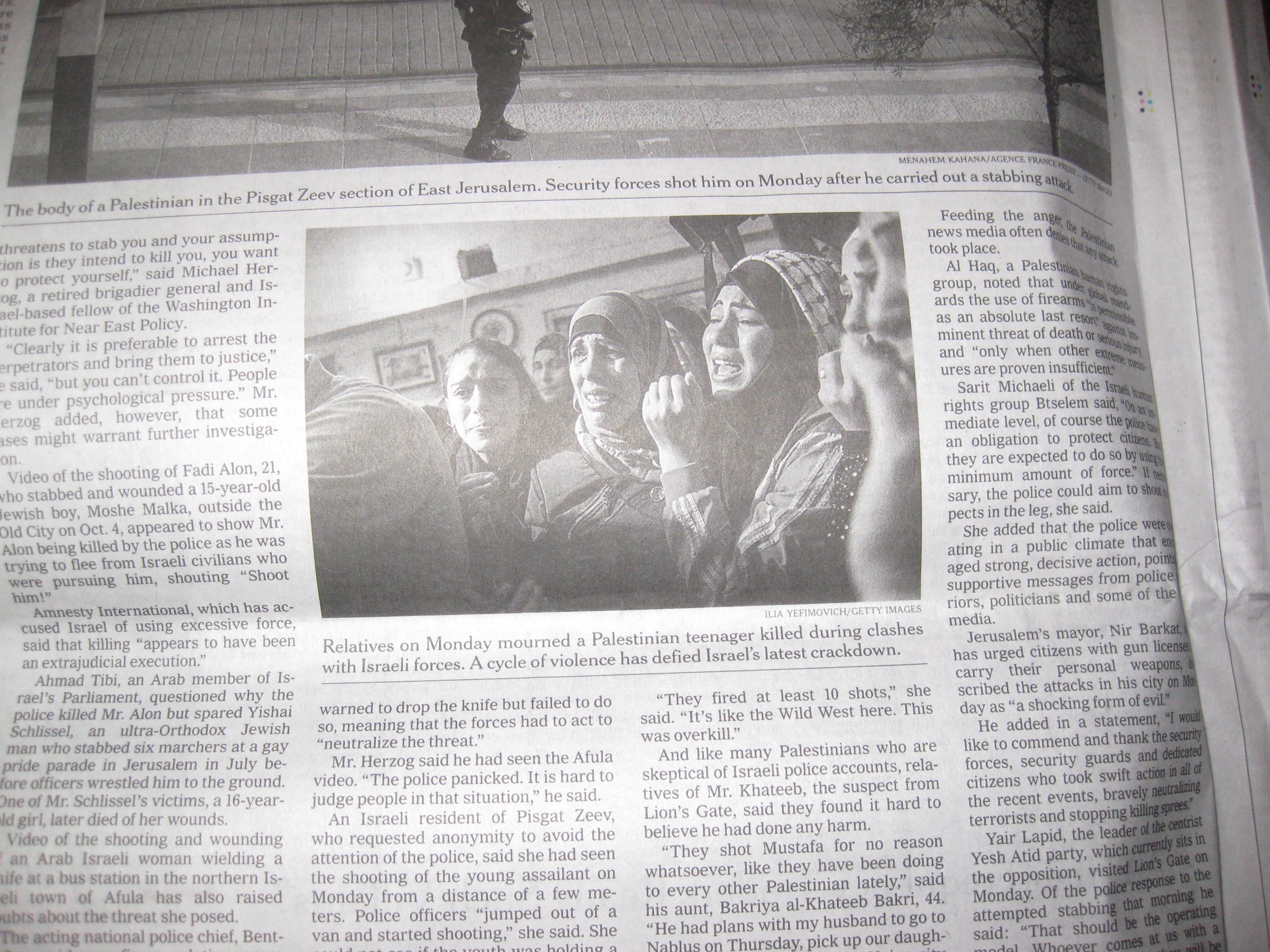
October 13 page A4. Two black and white photographs. The large photo caption reads “The body of a Palestinian in the Pisgat Zeev section of Eat Jerusalem. Security forces shot him on Monday after he carried out a stabbing attack.” The body of a partially dressed man lay on the ground surrounded by police.  The smaller photo showed women crying with a caption “Relatives on Monday mourned a Palestinian teenager killed during clashes with Israeli forces. A cycle of violence has defied Israel’s latest crackdown.

IMG_3529IMG_3530
Dead Palestinian and Grieving Palestinians

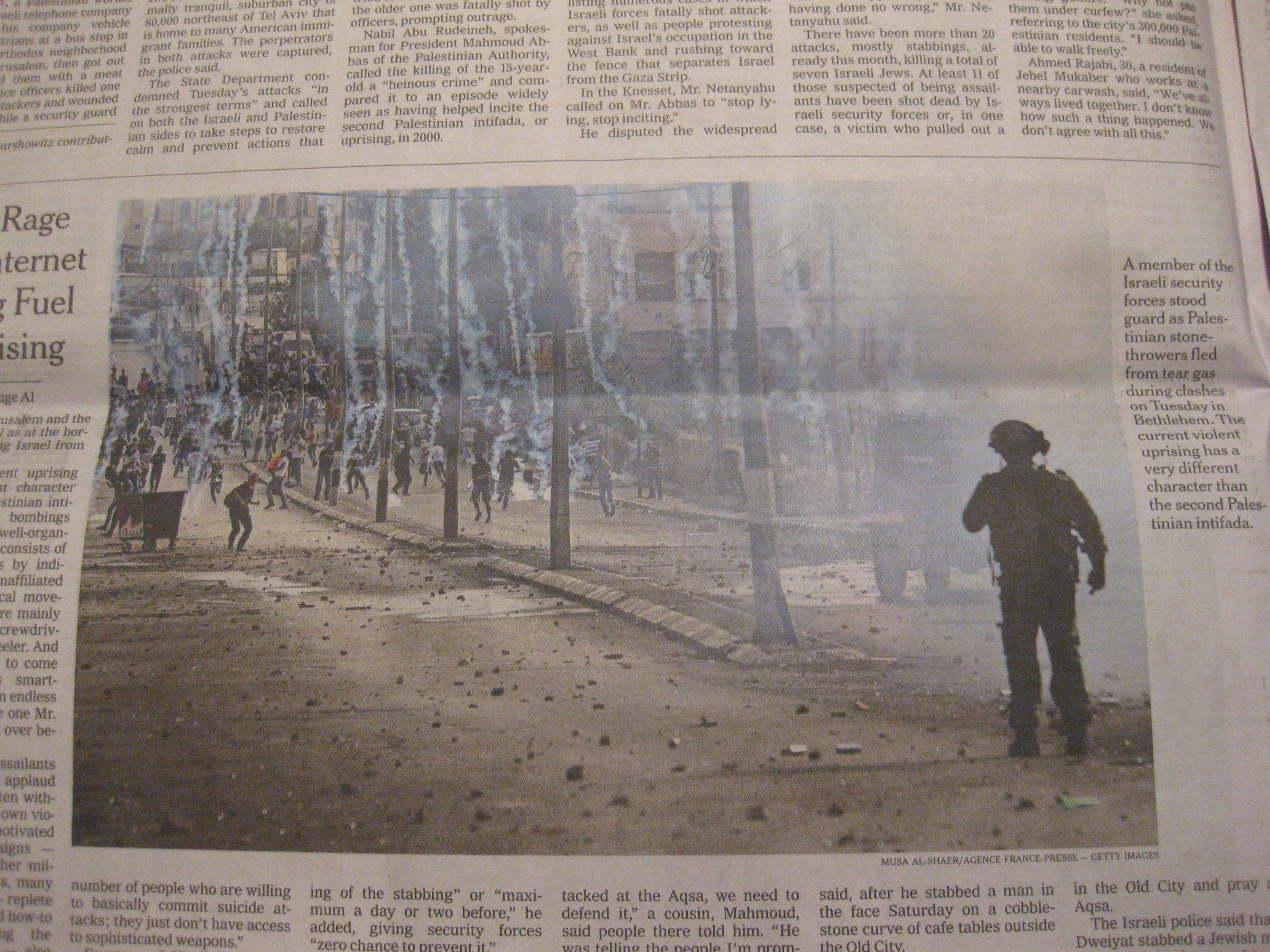
October 14 COVER PAGE: On a particularly violent day with Palestinian Arabs hacking people with meat cleavers and killing three, the Times covered an alternative news in its pictures. The front page large color photo of Palestinians running from Israeli tear gas with a caption “Palestinian demonstrators scattered Tuesday after Israeli forces fired tear gas during clashes in the West Bank city of Bethlehem.

IMG_3540
Cover page picture of Palestinians fleeing from Israeli forces

Page A8: The cover page story continued on page A8 with another large color picture of Israeli forces before Palestinians running from tear gas. The caption: “A member of the Israeli security forces stood guard as Palestinian stone throwers fled from tear gas during clashes on Tuesday in Bethlehem. The current violent uprising has a very different character than the second Palestinian intifada.”

IMG_3543
Palestinians fleeing tear gas

Page A8: Another story about the attacks medics pulling someone out of a bus. The caption: “Israeli emergency responders removing the body of a Palestinian from  bus where an attack took place in Jerusalem in Tuesday.” No Israeli victims covered from an unprovoked attack by a crazy Arab- note that no blame assigned for the “attack” in the caption.

IMG_3541
Dead Palestinian removed from a generic “attack”

In a week that saw dozens of unprovoked attacks on Israelis, it cannot be an oversight that the New York Times repeatedly chose to show only injured Palestinians. The Times deliberately decided to feed the narrative of Palestinian victimhood. The Israelis were seemingly untouched.

There are some researchers that argue that the media and social media are fanning the flames of the unrest in the Middle East by fanning “misinformation.” If so, the Times’ irresponsible journalism might be viewed as a war crime.


Related First One Through articles:

Every Picture Tells a Story: The Invisible Murdered Israelis

Every Picture Tells a Story- Whitewashing the World (except Israel)

Every Picture Tells a Story, the Bibi Monster

Every Picture Tells a Story, Don’t It?

The New York Times’ Buried Pictures

Subscribe YouTube channel: FirstOneThrough

Join Facebook group: FirstOne Through  Israel Analysis
Active and Reactive Provocations: Charlie Hebdo and the Temple Mount

Leaders of the Western World came to the defense of the French satirical magazine Charlie Hebdo in early 2015, after radical Islamists gunned down the staff in their offices. Those leaders stood in solidarity with the French in the name of freedom of speech. Yet those same leaders have not rallied to the side of Israel while Islamic radicals murder and attempt to murder Israelis for an even more basic principle.

empty-street-in-Jerusalem-during-Yom-Kippur
Empty Street in Jerusalem

Active Provocation

An act of active provocation is one in which the action itself is specifically designed to provoke and upset an individual or group. The person taking the action does not have any benefit from the activity, other than the enjoyment of upsetting someone.

For example, when Pamela Geller held a “Draw Mohammed” contest in Texas in May 2015, the event was designed to upset Muslims. The action of portraying the Islamic prophet in physical form is considered highly insulting to many Muslims, and several people came to the event with the goal of killing participants for the sacrilegious act.

While people came out in defense of Geller for exercising her right of free speech, few would argue that Geller had any personal benefit from her actions other than getting satisfaction in hurting the feelings of Muslims.

Reactive Provocation

Reactive provocation is significantly different from active provocation. Such activity has personal benefit and there is no intention of malice. For example, a person may eat a turkey sandwich which they truly enjoy, even though another person may be a vegetarian and find the action upsetting.

Everyone has sensitivities. How far could a society extend itself to ban certain “normal” activities because some people may be offended by the actions?

Would a government ban gay people from holding hands in public if it upsets the values of some religious people? Would it ban all meat because it upsets vegetarians?  It would be impossible to navigate such a world in which anyone could object and block any action.

America was founded on the principle of the “pursuit of happiness” and has defended such right in cases of active provocation such as Pamela Geller in the US and Charlie Hebdo abroad. How could it do less for situations of reactive provocations?

Western Values versus Personal Interest

Various western societies offer a wide spectrum of freedoms including, speech, assembly and religion meant to cover elements of “life, liberty and the pursuit of happiness.” Western culture is designed to offer space for different people to live and interact, even if various belief systems are in conflict. The expectation is for tolerance of different and possibly offending views.

The raison d’etre of Charlie Hebdo is to offend. It’s cartoons are examples of active provocation whereby people deliberately upset others. While the comedic value of some of the pieces could be debated, the principle of freedom of speech is core to western society and fiercely protected. While writing a magazine is not a common activity, free speech is a daily activity of everyone, so the leaders of western countries stood together to defend active provocation and all forms of free speech.

hebdo march
World Leaders come out in solidarity with France
January 2015

In Israel, people also attempt to live with ordinary freedoms.  Like other democracies, they include freedom of speech, press, religion and assembly. But such freedoms sometimes offend radical Muslims.

The Temple Mount has maintained established visiting hours for Jews and non-Jews alike for any decades.  People of all faiths visit the site.  They do so as a natural act of visiting an incredible tourist site or because of religious conviction.  They do not visit as a pretext of causing offense to anyone.  If there are some Islamic extremists who are upset that Jews visit, that is a reaction based on that person’s anti-Semitic biases, an example of reactive provocation.

Muslims have become more worried about Jewish visitation to the Temple Mount which they consider holy as well.  The number of Jews visiting the Temple Mount doubled over the past five years to about 11,000 in 2014.  It is still a paltry sum compared to the estimated 4 million Muslims who come to the site each year. However, fears of the growing Jewish presence has made Muslims begin to attack Jews throughout Israel.

So why is the western world so cavalier about the carnage in Israel from Islamic radicals, while shaken to its core for the Hebdo killings? Is freedom of religion and access a lesser democratic value than speech?  Is France considered more western than Israel? Perhaps some believe that to be true.

It is also a fact that Europe and America do not have shrines holy to Islam, so the situation of the al Aqsa mosque is really a narrow problem for Israel to handle.  Western ambivalence may not be so much a function of values as it is proximity.

How embarrassing that the narrow scope of the champions of democracy shows that they are less interested with values than personal interests.  The world should loudly condemn Islamic terrorism and support freedoms which are enshrined in Israeli law and democratic ideals.


Related First One Through articles:

My Terrorism

I’m Offended, You’re Dead

Selective Speech

Visitor Rights on the Temple Mount

Subscribe YouTube channel: FirstOneThrough

Join Facebook group: FirstOne Through  Israel Analysis
US State Department Comments on Terrorism in Israel and the Territories

There were several terrorist attacks against Israeli Jews in early October 2015.  The US State Department gave very tepid comments about the murders, especially compared to how the US reacted to the arson attacks that claimed the lives of three Palestinian Arabs in July 2015.  When one considers that the attack against the Arabs was arson against a house (which could have been empty) compared to deliberate murders shooting at a moving car and stabbing individuals, the response from the US State Department was even more appalling.

 Kirby
State Department Spokesperson John Kirby


July 31 Attack on Arabs October 1 Attack on Jews October 3 Attack on Jews
Words in Statement 122 68 77
Condemnation “condemns in strongest possible terms” “strongly condemns” “strongly condemns”
Terrorist attack “vicious terrorist attack” AND “terrorism” “terrorist attack” Not called terrorism
Condolences “profound condolences” “condolences” No condolences
Prayer for Injured “prayers for a full recovery” None None
Families mentioned “Dawabsheh family” None None
Location of Incident “Palestinian village of Douma” West Bank.” Not Israeli; not Samaria Old City of Jerusalem today”. Not Israeli
Call for Justice “murderers” “the perpetrators all perpetrators of violence” A general term

As seen in the chart above, the trend line of not even expressing condolences or calling the attack terrorism is very worrying.
Supporters of Israel have long complained about the bias of the United Nations against Israel.  It would appear that those supporters must now worry about the support of its strongest ally.

#JewishLivesMatter

Attacks Against Israelis

US State Department October 3, 2015:

“The United States strongly condemns all acts of violence, including the ‎tragic stabbing in the Old City of Jerusalem today that left two victims dead and two injured. We call for all perpetrators of violence to be swiftly brought to justice. We are very concerned about mounting tensions in the West Bank and Jerusalem, including the Haram al Sharif/Temple Mount, and call on all sides to take affirmative steps to restore calm and avoid escalating the situation.”

US State Department October 1, 2015:

The United States strongly condemns the terrorist attack that took place late Thursday evening in the West Bank. The shooting resulted in the death of an Israeli couple who were driving with their young children. We extend our condolences to the victims’ family. We urge all sides to maintain calm, avoid escalating tensions in the wake of this tragedy, and work together to bring the perpetrators to justice.

Attacks Against Palestinian Arabs

US State Department July 31, 2015:

“The United States condemns in the strongest possible terms last night’s vicious terrorist attack in the Palestinian village of Douma. The arson attack on a family’s home in the dead of the night resulted in the death of an 18 month-old baby and the injury of three other family members. We convey our profound condolences to the Dawabsheh family and extend our prayers for a full recovery to those injured.

We welcome Prime Minister Netanyahu’s order to Israel’s security forces to use all means at their disposal to apprehend the murderers for what he called an act of terrorism and bring them to justice. We urge all sides to maintain calm and avoid escalating tensions in the wake of this tragic incident.”


Related First.One.Through articles:

UN Comments on the Murder of Innocents: Henkins

UN Comments on the Murder of Innocents: Itamar and Duma

The New Blood Libel

The US State Department’s Selective Preference of “Status Quos”

Subscribe YouTube channel: FirstOneThrough

Join Facebook group: FirstOne Through  Israel Analysis