How many generations should someone be called a “refugee?” Two? Ten? My parents were refugees and I consider myself the son of refugees. But not a refugee. To do so would be a mockery of millions of people fleeing homes to faraway lands where they have no family, infrastructure or knowledge of the local language.
Alas, while every year the world adds and removes refugees from the global tally, there is a permanent exception.
There are roughly 122 million displaced people worldwide (68 million internally displaced, 38 million refugees and millions of others seeking protection), and the United Nations High Commissioner for Refugees (UNHCR) is tasked with helping them. Its mission is clear: assist people fleeing conflict or persecution to either return home when it’s safe, or resettle in a new country where they can rebuild their lives and become citizens. Refugee status, according to UNHCR, is meant to be temporary. A tragic but manageable step toward normalcy.
But for one group of people, the rules were rewritten.
In 1949, the United Nations created a separate agency: the United Nations Relief and Works Agency (UNRWA). Its job was not to help all refugees, but a specific set—Arabs who left or were displaced from what became the State of Israel during the 1948 war.
Unlike the UNHCR, UNRWA never intended to help these refugees resettle or gain citizenship elsewhere. In fact, when Jordan annexed the to be named “West Bank” in 1950 and granted full Jordanian citizenship to the Arabs living there in 1954 (Jews were specifically excluded from Jordanian citizenship) —including the so-called refugees—UNRWA still kept them on its refugee rolls. Why? They were no longer stateless, no longer displaced from their community, and in most cases, were living just miles from where they or their families once resided.
No other refugee population in the world is treated this way.
The Palestinians under UNRWA are not counted based on where they live or whether they’ve rebuilt their lives. They’re counted based on ancestry—any descendant of someone who lived in Mandatory Palestine in 1946 and left during the war is considered a “refugee.” That includes people who are now citizens of Jordan who have never set foot in Israel, and those who live under Palestinian rule in the West Bank and Gaza.
This isn’t about resettlement. It isn’t about a “two-state solution.” It’s about return. Not return to a country they fled—but to homes where their grandparents once lived, in a country that has since fought multiple wars for its survival and established itself as a sovereign nation.
This has locked the Middle East into a perpetual state of conflict. UNRWA doesn’t just preserve the status of Palestinian refugees—it amplifies it, funds it, and builds an international bureaucracy around it. It has denied Israel’s right to control its own immigration, and basic principle of sovereignty.
Worse, the UN’s actions have turned a situation normally considered a humanitarian issue into a real estate dispute. By insisting that people return to a house—not a country, as outlined in international human rights law—the global political body has exceeded its own mandate. This isn’t a question of national self-determination, but one of personal property claims. UNRWA isn’t so much a champion of the creation of a state beside Israel; it champions individual return to specific homes, decades abandoned or destroyed, now occupied by others in a sovereign country.
Meanwhile, the descendants of every other refugee group in the world—from Sudan to Ukraine—are helped by the UN to find a path forward. Only the Palestinians are encouraged to walk backward, into the houses of their grandparents.
UNHCR helps refugees stop being refugees. UNRWA helps them stay that way.
Every year, new wars create new displaced people. But only one group stays on the list year after year, generation after generation.
For Palestinian Arabs, the 1948 war is still being fought. Generations of people haven’t been birthed into refugee status as much as the region is in a 100 years war. While the world may use political terminology of an UNRWA ward who has never been to Israel as a descendant of a “refugee,” Palestinians simply see a permanent property right which will never be forfeited. The UN simply provides cover under the “refugee” monicker.
They were shipped to concentration camps to be gassed and incinerated.
They were sent on death marches in the winter to freeze to death.
They were lined up and shot in the heads after digging ditches to receive their corpses.
Almost the entirety of European Jewry was killed. One-third of global Jewry was liquidated.
Holocaust Survivors tried to return to their towns and homes after the war, to be greeted by the locals who had stolen their goods and moved into their homes, who quickly executed the survivors of horrors.
Yet the Holocaust survivors who watched their families, friends and people get annihilated did not take up arms against the German people. They didn’t begin gassing the Austrians after the war. They didn’t invade Poland to burn Poles alive.
Why?
People have argued that Israel’s war to destroy Hamas is breeding another generation of terrorists because of the massive death toll of Palestinian civilians. The argument posits that when young Arabs see the horrible devastation brought upon their families and towns, they will become terrorists when they grow up and seek revenge.
Yet the people who actually experienced a genocide – Jews – never embarked on such a lust for blood and revenge.
Why?
Jews wanted to just live a regular life before the Holocaust and afterwards. Their goals did not change with time. They went from loving their neighbors and governments in Europe to hating them but did not seek revenge.
Palestinian Arabs have also stayed their course. Their goal was to destroy the Jewish State and its founding and remains so today. The wars have not altered their goals and the death of friends and family are simply viewed as setbacks to achieving their aims.
Wars do not create a new generation of terrorists. A culture that dehumanizes the “other” as evil begets a generation of terrorists set on killing the invading entity.
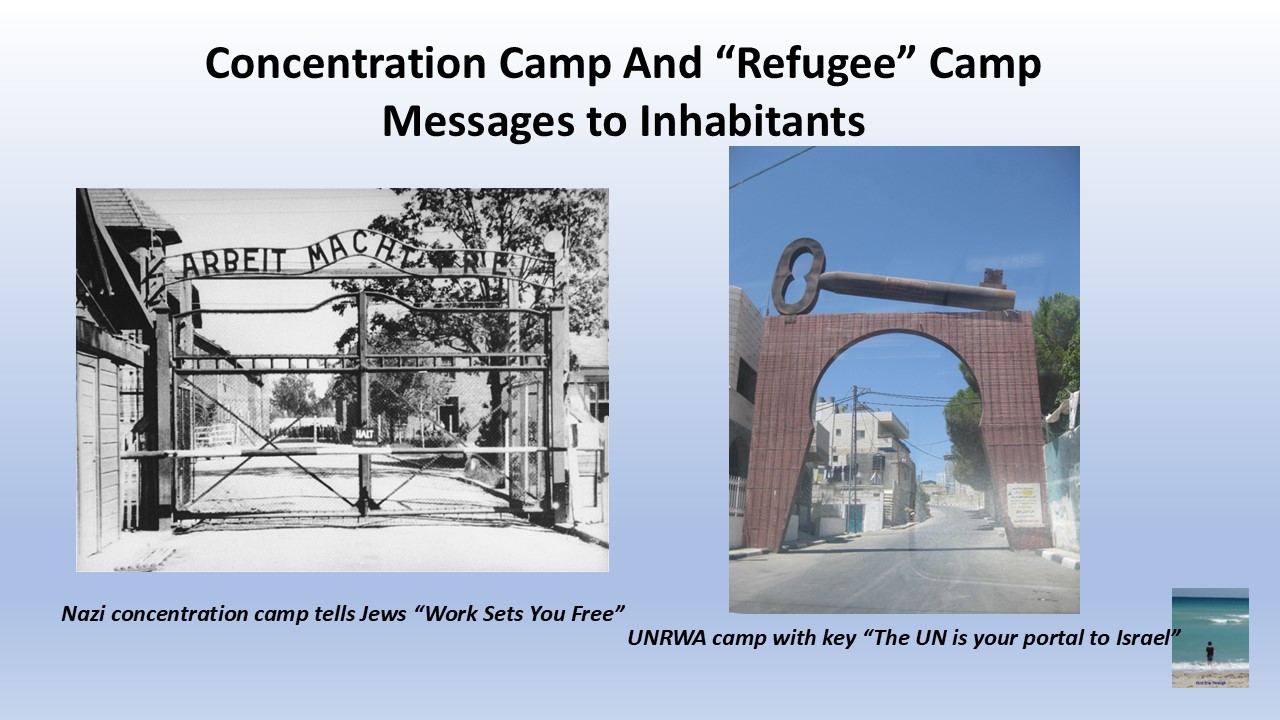
During the Holocaust, Nazis kept Jews calm in concentration camps, making them believe that they were in forced labor camps, not death mills. In recent decades, the United Nations has kept Palestinian Arabs in “refugee” camps, making them believe that the world was going to help them reclaim the towns and homes where grandparents once lived.
The Nazis killed millions of Jews inside their camps, while the UN raised generations to kill thousands of Jews just a short distance away.
ACTION ITEM
Contact the White House and your local representative that UNRWA is a weapon of war that must be closed. Pressure the United Nations and Saudi Arabia to state clearly that there is no “right of return” for Palestinian Arabs to move into Israel.
The United Nations General Assembly was wrapping up its 78th session on August 13, 2024, and was going to pass a resolution about racism with seemingly little objection. At the last minute, South Africa asked for the resolution to include a reference to the Durban Declaration and Programme of Action from 2001. The resolution quickly lost overwhelming support, with only 61 votes in favor, 78 abstentions, and a single opposing vote by Israel.
UN press release on August 13, 2024
The action was deliberate and calculating by South Africa, which recently pursued a case at the International Court of Justice charging Israel with committing genocide in Gaza. The African nation wanted to make Israel appear as a racist entity by opposing a resolution condemning racism.
It was specifically the inclusion of that Durban document that made Israel oppose the resolution. The Programme of Action was a lengthy document discussing racism and xenophobia which veered into the Palestinian-Israel conflict at several points, as jihadi regimes attempted to bundle condemnation of Israel into a document which was designed to confront racism.
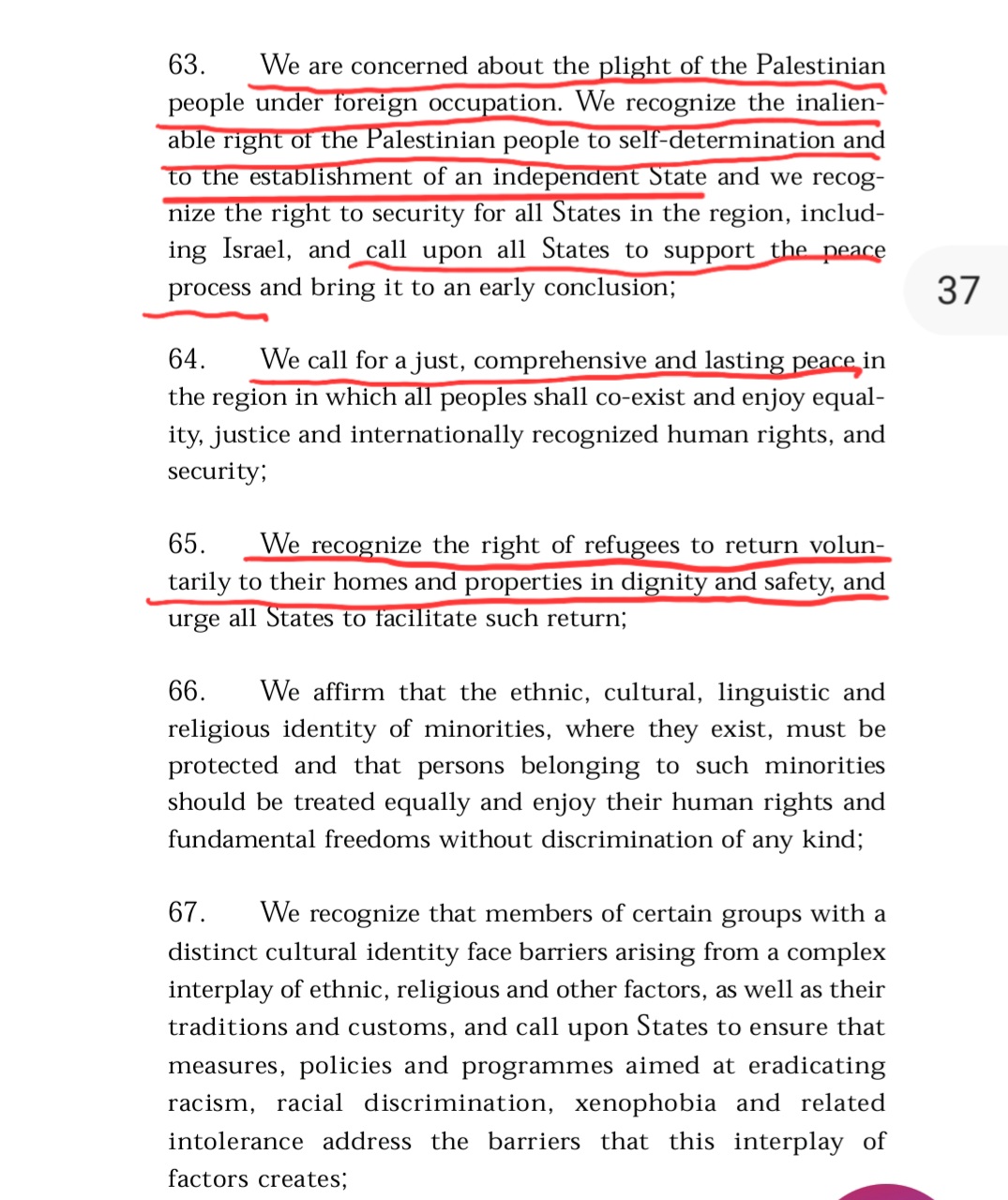
Durban conference of 2002 preamble mentioning that “Palestinian people [are] under foreign occupation” and that they have a “right to an independent state.”
The document included a call for Palestinian refugees “to return voluntarily to their homes and properties,” making it an individual right outside of negotiations between Israel and the Palestinian Authority. In a 100+ page global document about racism.
The 2001 event, just days before the terrorist attacks on the United States on 9/11, was deliberately inflammatory and made many countries send lower level officials or not vote for the programme.
The single largest issue in the Israeli-Palestinian Arab conflict is the belief among those Arabs that they have a right to move into towns and houses where grandparents lived many decades ago. They call it a “right of return” and state that it is an individual right laid out in international law.
Everyone has the right to leave any country, including his own, and to return to his country.
Everyone has the right to freedom of movement and residence within the borders of each state.
As it relates to the first point, Palestine either was or was not a country before Israel declared itself a state in May 1948. If it was not a country, the UDHR right is irrelevant as it specifically relates only to countries. If it was a state, than the Arabs living in Gaza and the West Bank are already part of such state and have no right to move based on the first clause. Their right to move to Israel under the second clause of moving “within the borders of each state” would mean negating the very existence of Israel, a member state of the United Nations, which would undermine the institution upon which the clause exists (rendering such notion impossible).
If Palestine were considered a state pre-Israel, then the descendants of refugees (DORs) in Lebanon, Syria and Jordan could relocate to Gaza or the West Bank (Palestine), but not to Israel.
So under broad international law, there is no right of return for Palestinian Arabs to Israel regardless of whether one thinks Palestine was a country in 1947.
Palestinian Arabs and their supporters therefore try to use a specific clause within a particular UN General Assembly resolution. UNGA Resolution 194, Article 11 states “Resolves that refugees wishing to return to their homes and live at peace with their neighbours should be permitted to do so at the earliest practicable date, and that compensation should be paid for the property of those choosing not to return and for loss of or damage to property which, under principles of international law or equity, should be made good by the Governments or authorities responsible.”
This resolution has multiple legal issues regarding applicability.
UN General Assembly resolutions are not legally binding, but advisory at the most fundamental. Second, Resolution 194 includes many items including Articles 7 and 8 which places holy places – including those in Nazareth and Jerusalem – under UN control, which neither Israel nor the Palestinian Authority desire. One cannot cherry-pick specific items which one side prefers to make a case; the entirety of that resolution is passed its expiration date.
Significantly, the clause itself demands that those refugees desiring to return to “homes” – which may or may not exist anymore – must live in peace with their neighbors. The many wars and pogroms by Palestinian Arabs, including their overwhelming support for Hamas and the October 7 massacre, show them to reject basic coexistence with Jewish neighbors.
Yet UN Secretary General Antonio Guterres makes a mockery of reality and destroys a pathway to peace when he says the opposite. He often states “the need for tangible progress towards a two-State solution based on 1967 lines, with Jerusalem as the capital of both States, in line with UN resolutions and international law.” That clause makes Palestinian Arabs think that millions of Arabs will get to move to Tel Aviv and Haifa. Their frustration of not moving there leads to frustration and causes massacres as seen on October 7.
The United Nations must make clear that there is no “right of return” for any Palestinian Arab to Israel, full stop. The failure to do so causes bloodshed and suffering.
The United Nations has long been a terrible actor in the Israeli-Arab conflict, perpetuating the conflict through terrible policies and procedures. One of the worst offenses which contributed to the October 7 massacre and the current Gaza War was backing the “right of return” for millions of Arabs into Israel.
The United Nations agency, UNRWA, services roughly 7.5 million people of which 6.7 million are registered as refugees, with another 763,000 on the global dole. The vast majority of the 7.5 million are descendants of people who used to live in Israel in 1947. Amongst these so-called “refugees,” approximately 1.8 million live in Gaza and 1.1 million in the West Bank, a total of 2.9 million, or 43 per cent of UNRWA “refugees” live inside of 1947 Palestine.
These 2.9 million have been told by the United Nations that they will get to move into Israel for the last 75 years, based on a single line in UN General Assembly Resolution 194 of December 1948, that has long passed its expiration date. With that false promise, Gazans spend their time and money building a war infrastructure rather than an economy as they don’t imagine a future in their current neighborhood of historic Palestine, but in the Jewish State.
On January 23, 2024, UN Secretary General Antonio Guterres may have laid the groundwork to finally end the dream of these 2.9 million Palestinians that their future homes will be in Israel.
In his remarks to the UN Security Council he said “The right of the Palestinian people to build their own fully independent State must be recognized by all. And any refusal to accept the two-State solution by any party must be firmly rejected. What is the alternative? How would a one-State solution look with such a large number of Palestinians inside without any real sense of freedom, rights and dignity? This would be inconceivable.”
The first part of Guterres’s comments is simply wrong. No state has a right to exist. None. Not Portugal, not China, not South Sudan, not Kurdistan. Individuals have a right to self-determination and there are many ways for that to be realized which do not create another Arab and Muslim country.
The second segment of his remarks, marked in bold above, is an important milestone for the UN. It is the first time Guterres essentially rejected the notion of Arabs swarming Israel – either in a one state solution or as part of a two-state solution in which 6.7 million Arab “refugees” enter the Jewish State.
Finally acknowledging that this will not happen, Guterres should make an unambiguous statement that there is no “right of return” for Arabs into Israel, a stale idea floated over 75 years ago in the midst of the 1948-9 Arab-Israeli War. In addition to such proclamation, he must follow up with actions to dismantle the “refugee” camps which dot Gaza and the West Bank, where UNRWA schools teach young Arabs that they will move into Israel and where UN facilities have keys above the portal to emphasize that the doorway for Palestinians to move into Israel is via the United Nations.
Entrance to Aida Refugee Camp (مخيم عايده) in Bethlehem with keyhole gateway and key on top to symbolize that UNRWA is the pathway for Palestinians to return to ancestors’ homes.
The United Nations finally said the obvious, that millions of Palestinian Arabs moving to Israel is “inconceivable.” It is time to explicitly state that there is no “right of return” and to dismantle the “temporary” refugee camps in Gaza and the West Bank which have long served as incubators for extremism and terrorism.
The global population was roughly 2.5 billion people in 1947. Less developed countries had a population of roughly 1.75 billion, and there were about 800 million in the developed world. Back then, the populations of China, India, the USA and Russia were about 570 million, 360 million, 150 million and 100 million, respectively.
Quite a different world then today.
The world was once much more regionalized. In 1947, there were fewer than 25 million international tourists; that figure was nearly 1.5 billion in 2019 before the pandemic, and has slightly rebounded to just under 1 billion in 2022. There were only about 10 million foreign-born people in the US in 1947, a number closer to 45 million in 2018. The figures are similar in Europe.
Computers were just starting to be used 75 years ago, with today’s pocket smartphones having more capabilities than those gigantic governmental ones. International calls cost a fortune as opposed to today’s free over-the-top calls made to people everywhere in an instant.
Technology and transportation have made the world smaller and people migrate much more than they did 75 years ago. Just since 1990, Europe went from having a foreign-born population accounting for roughly 5.5% of the population to nearly 10.5% in 2015. In the United States, it went from 7.9% to 13.9% over those same years.
Laws and regulations changed over the past 75 years which contributed to global migration patterns beyond technology and transportation. Many more immigrants from Latin American countries come to the United States now, whereas they used to come from Europe (75% in 1950s). Countries pass laws based on current realities and desires for the future. They tinker with immigration policy based on global demand as well as their own demographic needs for labor.
No country enacts policies to RECREATE A REALITY that existed in the past. They do not pretend that it’s 1947 and that laws passed back then have relevance to today’s reality.
Except for the United Nations as it relates in Palestinian Arabs.
The UN continues to bless the Palestinian desire for a “Right of Return” to homes that grandparents once lived in inside Israel based in a resolution passed in December 1948 when the Arab war to destroy the new State of Israel was still being waged. While the UN and Palestinians ignore most of Resolution 194 as it obviously has no bearing on today’s reality, they continue to prop up a single provision, article 11 which states:
“Resolves that refugees wishing to return to their homes and live at peace with their neighbours should be permitted to do so at the earliest practicable date, and that compensation should be paid for the property of those choosing not to return and for loss of or damage to property which, under principles of international law or equity, should be made good by the Governments or authorities responsible.“
Supporters of Hamas express their solidarity with the Jenin refugee camp, in Jabalia in the northern Gaza Strip on April 10, 2022. Days before, gunmen from Jenin went on a shooting rampage in Tel Aviv killing three Israelis and wounding more than a dozen others. (Photo by MOHAMMED ABED / AFP)
People correctly point out that almost all Palestinians today are not refugees and are unwilling to live at peace with Israel as demonstrated time and time again. More basically, today is not 1947, and the same way that UNGA Resolution 194 calling for the internationalization of Greater Jerusalem and Greater Bethlehem is no longer contemplated, so has the concept of a “right of return” long passed its expiration date.
The UN may advocate for Palestinian self-determination but cannot demand a right-of-return to Israel. All nations must make clear that they support terminating a concept which was captured in a single line in a resolution passed in 1948 in the middle of a war.
ACTION ITEM
Email White House “Make clear that our country opposes the idea that descendants of Palestinian refugees have a “right of return” to towns inside Israel which was contemplated as part of a broad end to the 1948 Arab-Israeli War. It continues to foment frustration, hatred and encourages war in the region.
Gaza is a crowded mess and there are two proposals for “voluntary emigration” which are getting vastly different reactions.
Situation In Gaza
The population of Gaza is roughly 2.1 million people, all Arabs, almost 99% of whom are Muslim. Roughly 39.8% of the population is under 14 years old, making it one of the youngest geographies in the world, with less than 3% of the Strip over 65 years old. The median age of 19.2 years old ranks it at #209 out of 227 areas scored by the World Fact Book. By way of comparison, the median age in Israel is 30.1, in USA 38.5, and 40.6 in the United Kingdom.
The US-designated foreign terrorist group Hamas exclusively governs Gaza since 2007. That means that roughly half of the Gaza Strip has only known the rule of a fanatical Islamist group committed to killing Jews and the destruction of the Jewish State next door. Fighters, typically aged 18-24, have known almost nothing other than Hamas and its mission.
As of 2022, UNRWA provided services to nearly 1.8 million people in Gaza, or about 83% of the population. It manages most of the schools in the Strip, many of which openly call for killing Jews and destroying Israel according to reports from IMPACT-SE. The report also covers that “13 UNRWA staff members have publicly praised, celebrated or expressed their support for the unprecedented deadly assaults on civilians [in Israel] on 7 October.”
Israeli Minister Bezalel Smotrich’s Proposal Condemned
Israeli Finance Minister Bezalel Smotrich said “a small country like ours cannot afford a reality where four minutes away from our communities there is a hotbed of hatred and terrorism, where two million people wake up every morning with aspiration for the destruction of the State of Israel and with a desire to slaughter and rape and murder Jews wherever they are.” As such, he expressed his support for encouraging “voluntary emigration” of the Strip’s population to other countries as part of his postwar vision.
The reaction to Smotrich’s proposal was quick. US State Department spokesman Matthew Miller labeled the suggestion as “inflammatory and irresponsible.” The New York Times reported that France and Germany had similar reactions.
United Nations’ Proposal Embraced
The United Nations also has a plan for Gaza. It involves the voluntary emigration of roughly 1.8 million Gazans for whom UNRWA provides services to relocate to Israel. It makes this proposal – still to this very day – as part of UN Resolution 194 which was passed in December 1948, over 75 years ago while the Israeli War of Independence was still being waged.
The proposal has long since passed its expiry date but dozens of Islamic and Arab countries, as well as the United Nations itself, keep on trying to breathe life into an idea to massively move over 80% of the population of Gaza – the majority of whom want to kill Jews – into Israel to extinguish the Jewish State.
Several Western countries and members of the progressive media were appalled that two members of the Israeli parliament suggested a “voluntary emigration” of Gazans to various countries but simultaneously embrace such emigration to Israel. It’s a peculiar mix of anti-Zionism and hypocrisy which seems very prevalent in these dark days.
Different formulas for striking a resolution to the Arab-Israeli Conflict have been advanced for decades. One sticking point seems banal on its surface, with ambiguous language which whitewashes the implausibility of implementation.
“A” Two State Solution Versus “The” Two State Solution
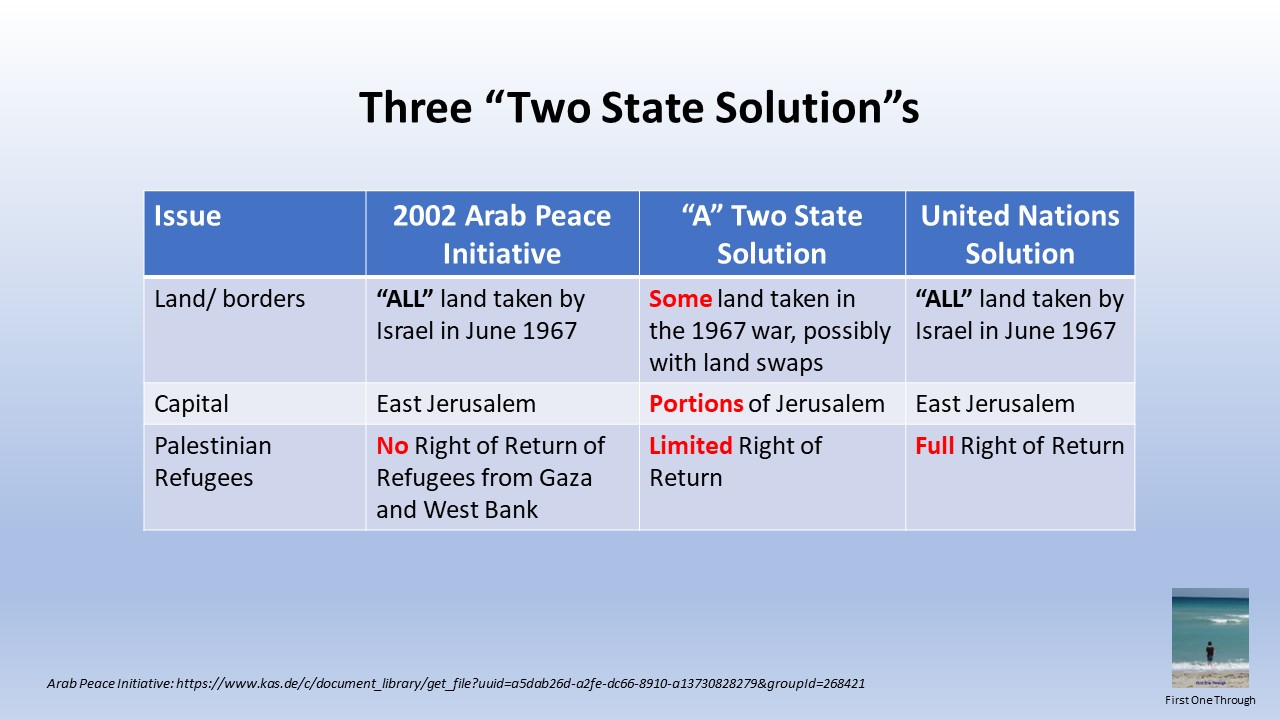
The United States has called for “A” two state solution, which is “two states for two peoples,” as President Biden has often said. One country is the Jewish State of Israel and the other country will become an Arab State of Palestine.
This is very different from the similarly named Arab-preferred “The” two state solution, which is the Arab Peace Initiative of 2002. That plan calls for an Arab State of Palestine and a bi-national state of Israel. That is not a formula for “two states for two people” but “one purely Arab state of Palestine and one state where Jews are allowed to live in Israel.”
The Arab two state plan calls for a “Right of Return” of 14 million Arabs who have some roots in Palestine to enter either Israel or Palestine, depending where ancestors had lived. Israel now has roughly 7.2 million Jews, so the clear goal is to end Jewish sovereignty in their homeland.
The difference is stark and both Republicans and Democrats in the United States fully understand the nature of the Arab claim for a “right of return” to end the Jewish state.
In a April 14, 2004 letter from U.S. President George W. Bush to Israeli Prime Minister Ariel Sharon, Bush wrote “It seems clear that an agreed, just, fair, and realistic framework for a solution to the Palestinian refugee issue as part of any final status agreement will need to be found through the establishment of a Palestinian state, and the settling of Palestinian refugees there, rather than in Israel.”
The Democrats had an almost identical clause in its platform (until President Barak Obama removed it) which stated “the creation of a Palestinian state through final status negotiations, together with an international compensation mechanism, should resolve the issue of Palestinian refugees by allowing them to settle there, rather than in Israel.“
A return for refugees would end Israel’s existence as a Jewish state.
BDS Leader, Omar Barghouti
The principle of “Two states for two people” and an Arab “Right of return” are mutually exclusive, and must be stated clearly by those pretending to advance an end to the conflict.
Acting President of the Palestinian Authority, Mahmoud Abbas, was lucky enough to be given a platform at the United Nations on May 15, 2023 to discuss the 75th anniversary of what Palestinians call the “Nakba,” the events surrounding the formation of Israel in which Arabs first rejected Jews being given any part of Palestine and then lost a war to destroy Israel. At war’s end, Israel denied admitting roughly 700,000 Palestinian Arabs who had left the fighting area while they waited for the Jewish State to be destroyed by five invading Arab armies. It was the first time that the United Nations held such event, and Abbas was given the floor to address the global body.
If you were in Abbas’ shoes, you probably would have prepared and rehearsed a compelling speech of 25 to 30 minutes, meant to draw support for your positions.
You would have relayed the refugee situation in a sympathetic light, as people who have benefited from the work of several UN agencies but still long for citizenship, whether in a new state of Palestine or in Israel.
You would have described the desire for coexistence with the Jewish State. In evidence of such, you might have shown empathy with Jews to show sincerity of living together in peace.
Abbas did none of these things.
He actually did the exact opposite.
Abbas rambled to the audience for roughly an hour, seemingly without care that he lost the crowd’s attention early on.
He lied about the Palestinian Arabs, saying that they were descendants of Canaanites when it is common knowledge that ARABS came from ARABIA in the seventh and eighth centuries as part of the Muslim invasion of the Middle East and North Africa. He said that roughly 1 million Arabs became refugees due to Israel’s wars in 1948 and 1967, when the commonly used figures range from 700,000 to 750,000 (even though those figures are often doubted). Why exaggerate the Arab position to undermine your credibility?
Rather than thank the United States and the United Kingdom for billions of dollars in aid donated to Palestinians over the decades, Abbas blamed them for launching a “colonial” implant in Palestine and demanded an apology.
Rather than portraying the Palestinians as ready for peace, Abbas declared that Jews have no history in the holy land and the Jewish temples never existed in Jerusalem – as if billions of Christians never read the bible.
Rather than talking about homes in Israel that had belonged to Arabs, he talked about towns that no longer existed and were replaced with forests and parks.
Mahmoud Abbas sporting a key on his lapel as if he owns a home in Israel and is ready to move in, addressing the United Nations in May 2023
Rather than display an understanding of international law and argue in a consistent fashion, Abbas argued both sides of UNGA Resolutions 181 and 194, saying that it was wrong and unlawful for foreign countries to create a Jewish State in Palestine and to make Greater Bethlehem and Greater Jerusalem a holy basin under international rule on one hand, but on the other hand Israel should be forced to admit the descendants of refugees per the same resolution.
Most tellingly, Abbas ignored the key phrase in UNGA Res. 194 Article 11 which conditioned any return of refugees or compensation to be based on the Arabs’ willingness “to live at peace with their neighbors [in Israel].” Abbas’ various slanders against Israel – including calling Jews Nazi-like – made clear to everyone that Palestinians deserve absolutely nothing.
Abbas comparing Jews to Nazis, the people who committed a genocide against them, a heinous antisemitic comparison.
Abbas squandered an opportunity to show himself a statesman, with the ability to forge peace with Israel. Instead, he showcased why the majority of Palestinian Arabs want him to resign and consider the Palestinian Authority to be a corrupt burden on their lives.
The only people who stayed for Abbas’s disgraceful speech were die-hard Palestinian supporters, and even they must have cringed at the performance. Unless they also see the pathway to a Palestinian State as trampling upon the sovereignty of a member state by a raging antisemite.
ACTION ITEM
EMAIL REP. JAMAAL BOWMAN (NY16) “Mahmoud Abbas’s vile display of antisemitism at the ‘Nakba Day’ event at the UN made readily apparent the unwillingness of Palestinians to ‘live in peace with Israel’, and negates any supposed rights of descendants of refugees to move into Israel.”
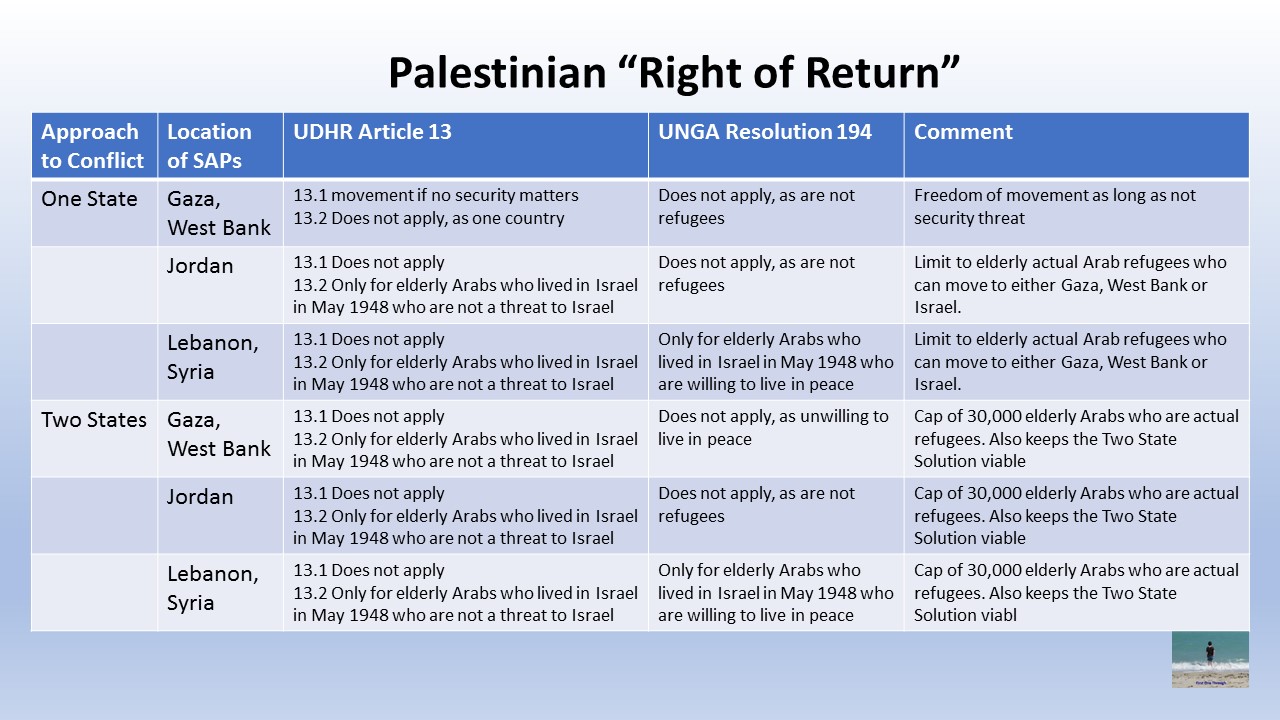
Palestinian Arabs and their supporters claim that they have a “right of return” to towns in Israel based on two principles. One is the Universal Declaration of Human Rights (established December 10, 1948) and the other United Nations General Assembly Resolution 194 (issued the following day, December 11, 1948). These are grossly misapplied, and if anyone wants to see a peace agreement between Israel and the Palestinian Authority, this issue is a complete roadblock.
UDHR, Article 13
Article 13 of the UDHR makes two statements that Palestinian propagandists assert give Palestinians the right to move into Israel:
Everyone has the right to freedom of movement and residence within the borders of each state.
Everyone has the right to leave any country, including his own, and to return to his country.
Regarding the first point, the freedom of movement is “within the borders”, meaning that any Israeli Jew or Arab should be free to live anywhere inside of their home country of Israel. This clause has nothing to do with Palestinian Arabs or wards of UNRWA who live outside of Israel. It simply means that Israeli Arabs should be free to move into Israeli towns – where grandparents may have lived or entirely new locations – as long as there are no security matters which render such movement impossible.
As it relates to the second point of leaving and returning to a country, there are two issues with Palestinians using this clause to move to Israel: the people and the land.
Israel is a new country, founded on May 14, 1948. There are only an estimated 20-30,000 elderly Arabs who lived in Israel on that date who now reside outside of the country’s recognized borders. The other 14 million Palestinian Arabs were born elsewhere and have no such claim to “return” to Israel, including the 6.4 million registered persons with UNRWA.
The second related matter has to do with the borders of Israel. If one were to take the non-factual view that the land of pre-1948 Palestine is a single country (it was a region / territory), then the millions of Arabs living in Gaza and the West Bank today still live in that same country, so there is no argument under the second clause. Only the Stateless Arabs of Palestine (SAPs) in Lebanon, Syria and Jordan could argue to move into Israel, Gaza or the West Bank. The right of return in UDHR relates to returning to a country, not a particular town or region.
UNGA Resolution 194, Article 11
As opposed to the general UDHR meant for all people, UNGA Resolution 194 was specifically adopted for Palestinians. Article 11 calls out the matter of returning to “homes,” not a country as specified in UDHR:
“Resolves that refugees wishing to return to their homes and live at peace with their neighbours should be permitted to do so at the earliest practicable date, and that compensation should be paid for the property of those choosing not to return and for loss of or damage to property which, under principles of international law or equity, should be made good by the Governments or authorities responsible.“
At the most fundamental level, General Assembly resolutions are simply suggestions and not binding in law. Israel is not beholden to GA resolutions.
Critically, Palestinians have shown in deeds and words since the founding of Israel that they are not willing to “live at peace with their neighbors.” Add to the fact that only 20-30,000 people at this time are actually “refugees” makes this resolution relatively meaningless in application.
Two State Solution
Those people who back the notion of a “two-state solution” for the Israeli-Arab Conflict, with one state for Jews and one state for Arabs, should be appalled at the idea of a Palestinian “right of return” to the Jewish State. The Jewish State currently has 25% of its citizenry being non-Jews. It would destroy the basic principle of the “two state solution” for millions of Arabs to enter Israel. It is even more outrageous, when the United Nations demands that NO JEWS be allowed to live in a future Palestinian State. There’s no two-state solution if 50% of the Jewish State is comprised of non-Jews and 0% of the Arab State has Jews.
One State Solution
For advocates who argue for a single Jewish-Arab country and that Palestine was always a singular country, there are a couple of considerations.
One, Arabs in the West Bank and Gaza already live in such country, so are not and have never been “refugees” but just internally displaced people, taking billions of dollars from the world’s largess over the past decades. Resolution 194 Article 11 is specifically for refugees which excludes Arabs in Gaza and the West Bank. Only UDHR 13.1 would argue for freedom of movement within the single country, if security matters permit.
Secondly, there is only return to a country under UDHR 13.2, not to villages where grandparents once lived. Allowing refugees from Lebanon, Syria and Jordan to move to the West Bank or Gaza satisfies this clause as much as moving inside the borders of Israel.
Palestinian Sentiment
Importantly, Palestinians have no interest in either of these solutions. According to the PCPSR December 2022 poll, only 32% of Palestinians support a two-state solution and 26% support a one-state solution with equal rights for Jews and Arabs. That compares to 55% who favor terrorism against Israelis, to destroy the Jewish State and replace it with a single Arab state. It’s outrageous for Palestinians to demand the right to move to homes under UNGA Resolution 194, and skip the basic premise of coexistence that the resolution demands.
The poll also showed that the right of return issue was the second most important issue for Palestinian Arabs, behind establishing a state. The fact that UNGA Resolution 194 requires coexistence while Palestinians support new armed gangs can only be viewed as an attempt to better infiltrate and take over the Jewish State, as part of establishing a new Palestinian State.
Sentiment of Israeli Arabs
When polled in June 2018, Israeli Arabs were the most likely to cap Palestinian refugees coming to Israel (the proposed question used a figure of 100,000 people) with the balance going to a new state of Palestine and getting compensation for lost property. A whopping 84.1% of Israeli Arabs supported such limited “right of return”, compared to 21.3% of Israeli Jews and 47.5% of Palestinian Arabs. When offered a different formulation in which a capped number of Palestinians would get permanent resident status but not citizenship in Israel, and Jews in the West Bank would similarly get such status in a new Palestinian State, Israeli Arab support (63.8%) dwarfed that of Israeli Jews and Palestinian Arabs with 36.1% and 31.7%, respectively.
Beyond the differences in granting a Palestinian “right of return” among Israeli Arabs, Jews and Palestinian, the same poll showed a big difference in support for a two state solution. Not surprisingly, no Israeli Arabs favored the idea of “apartheid” or expulsions of the other, while 14.9% of Israeli Jews voted in favor of minimal rights for Israeli Arabs, and 17.2% of Palestinians favored expelling all the Jews from the region.
SAPs in Lebanon, Syria and Jordan
The Stateless Arabs from Palestine (SAPs) only poll people in Gaza and the West Bank where the Palestinian Authority and Hamas have control and self-determination, having been given land to administer by Israel. The SAPs who might have some actual claims under UDHR and UNGA Resolution 194 are those in Lebanon, Syria and Jordan as described above but were not polled.
Almost all of the SAPs in Jordan have Jordanian citizenship so cannot be considered “refugees.” Jordan illegally annexed the West Bank after the 1948-9 War against Israel, and granted all Arabs living there citizenship– as long as they were not Jewish – in 1954. Palestinian-Chileans have the same non-claim to move to Israel as these Palestinian-Jordanians.
The Palestinians who might be considered “refugees” with rights to move to the holy land are those elderly Palestinians who left Israel in May 1948 and now reside in Lebanon and Syria, countries which have denied them citizenship for almost their entire lives. Of the 1.2 million SAPs in those two countries (18.8% of the total people getting services from UNRWA), around 2% are over 75 years old and would qualify to move to Israel under UDHR Article 13.2, and under UNGA Resolution 194, Article 11, if they are willing to live with Israelis in peace. While it is well understood that Palestinian Arabs in the West Bank and Gaza have no desire to live peacefully with Israelis, it is possible that those in UNRWA camps in Lebanon and Syria might.
If one advocates for a two-state solution, one must simultaneously be against a Palestinian “right of return” for any Arab other than the elderly living in UNRWA camps in Lebanon and Syria. All other Palestinians wishing to return to the region would need to move to Gaza or the West Bank under the approval of the Palestinian Authority. This has long been the logical bipartisan approach of both Democrats and Republicans.
In summary, there are very few people who qualify for a Palestinian “right of return” and there is very little support for, or belief that it can be implemented peacefully amongst the people in the region.



















 First One Through