The Countries the New York Times Doesn’t See

Chico Harlan wrote a beautiful article in The New York Times about Malawi, a poor African country struggling with devastating droughts, unpredictable flooding and the destruction of its agricultural economy. Joao Silva’s extraordinary photographs capture the beauty of the landscape and the hardships of the people who depend on it.

It is excellent journalism. But one passage is revealing.

Harlan quotes Malawi’s chief secretary, Justin Saidi, explaining that the government has been appealing to development banks and countries “like Britain and Australia” for assistance in implementing its El Niño preparedness plan.

Australia?
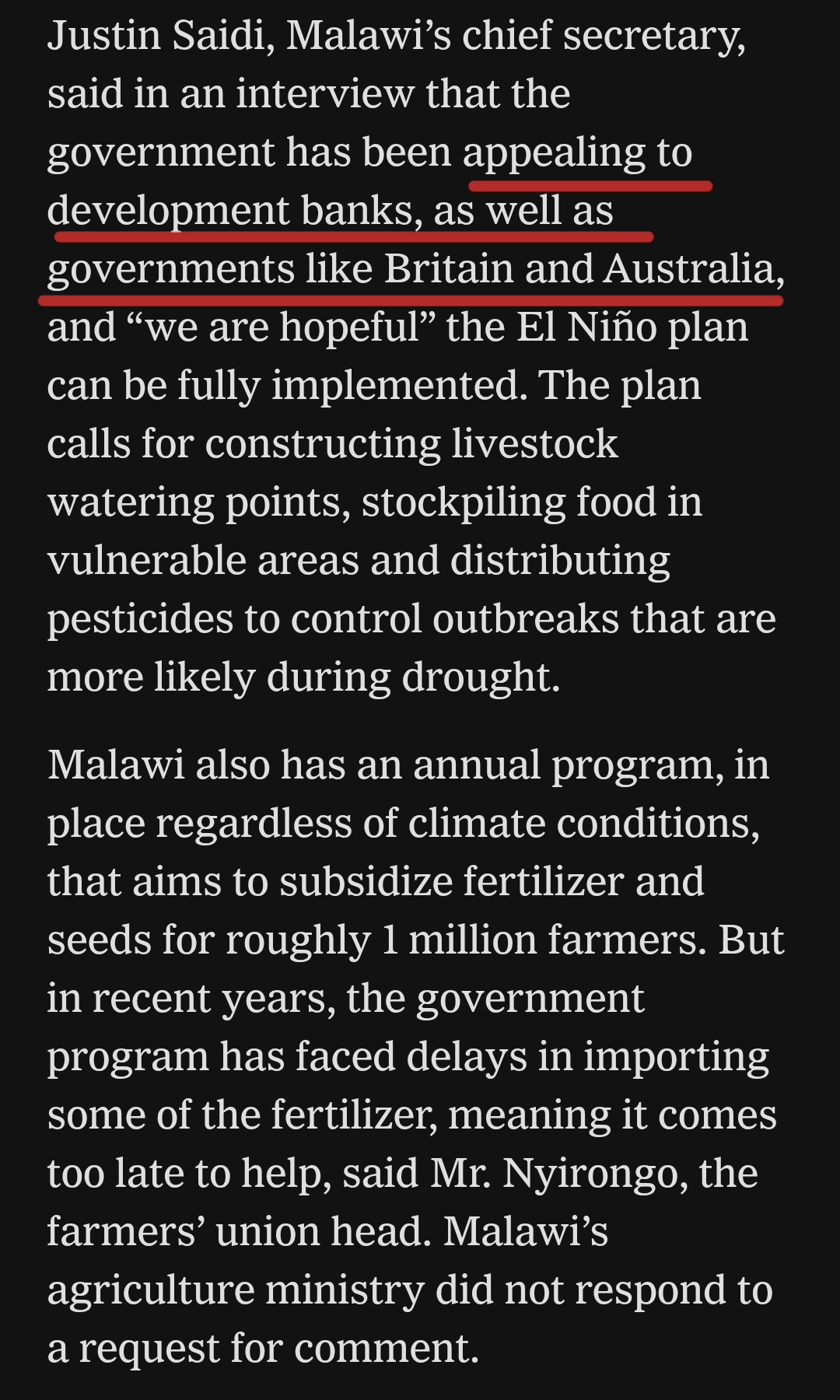
The United States has historically been Malawi’s largest bilateral donor, providing an average of more than $400 million annually between 2017 and 2023. America also contributed millions in emergency assistance during Malawi’s devastating 2024 El Niño drought. Britain has been another important donor, but Australia is nowhere near the top of the list.

Yet readers hear about Australia while America goes unmentioned in the discussion of international assistance.

Even more curious is the absence of Israel.

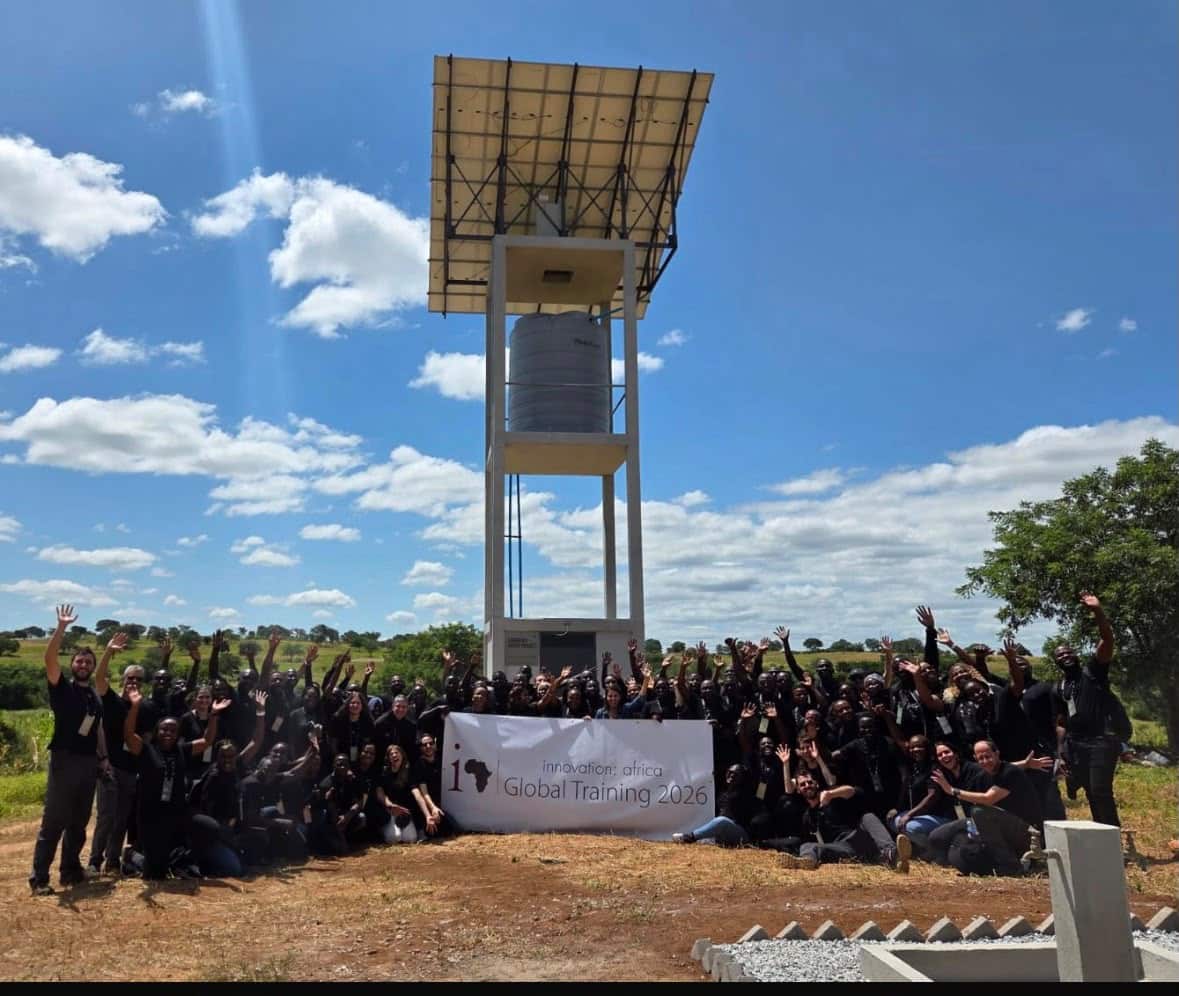
Israeli-founded Innovation: Africa led by Sivan Yaari has completed more than 200 solar and water projects in Malawi, reportedly benefiting approximately one million people. The organization uses Israeli technology to bring clean water and electricity to rural villages, installing solar-powered pumps and training local residents to maintain the systems.
IsraAID, another Israeli humanitarian organization, responded to Cyclone Freddy in 2023 by rehabilitating damaged boreholes and restoring clean water to more than 100,000 Malawians. Israeli medical organizations have treated children with serious heart conditions, trained healthcare workers and introduced medical technology. The two countries have also developed an agricultural employment partnership that allows Malawians to work in Israel and send money home.

Then there is the recent bonding of Israel and Malawi since the October 7 massacre by Gazans of Israelis. The two countries are becoming much more integrated.

Water, agriculture, healthcare and economic resilience. These are precisely the challenges Harlan describes so effectively.

Harlan is no stranger to either country. His recent reporting has repeatedly criticized American climate and foreign-aid policies, including the Trump administration’s retreat from international climate commitments. His 2018 reporting from Gaza focused on Palestinian casualties during confrontations with Israeli forces.

He also previously worked as a journalist in Sydney, Australia.

Perhaps Malawi’s chief secretary simply offered Britain and Australia as examples. We do not know what else was discussed during the interview or why those particular countries survived the editing process.

A journalist can report every fact accurately and still leave readers with a distorted understanding of the world. The selection of facts, the people interviewed, the questions asked and the information omitted all shape the story.

Harlan’s article makes Malawi’s suffering impossible to ignore. His photographs and reporting deserve praise. Yet readers come away knowing that Malawi is seeking help from Australia, without learning about America’s enormous financial contributions or the Israeli organizations already bringing water, electricity and medical care to Malawian communities.

The most revealing biases in journalism are sometimes found in the facts that never make it onto the page.

Malawi, Israel’s New Friend

Israel has long stood with few allies at the United Nations. As the Iranian Proxies War against Israel has continued and brought new anti-Israel resolutions, it is a strange and welcome relief to see a new name appear alongside Israel and the United States in votes to support Israel: the east African country of Malawi.

United Nations Votes

UN Watch has a database which tracks how countries vote on matters related to Israel. Whether at the General Assembly, Human Rights Council or World Health Organization, Malawi has started to break from the Global South and is abstaining from condemning Israel and sometimes providing outright support for the Jewish State.

Examples include a UNGA vote on the International Court of Justice condemning Israel in September 2024. With an overall vote tally of Yes (124), No (14), Abstain (43), and Absent (12), Malawi was one of the No votes. In a December 2024 vote condemning Israel for not signing onto the Middle East nuclear non-proliferation treaty, Malawi abstained, even as 153 countries voted yes. When the UN Human Rights Council voted in April 2024 to condemn Israeli “settlements,” Malawi was one of only three countries to vote against the measure.

It is therefore worth understanding the country more and appreciating why it is siding up to Israel while much of Africa has not.

Demographics

Malawi is a country of roughly 20 million people and very poor, with a GDP per capita of only $1,590 in 2020. The total fertility rate is relatively high compared to the world at 3.4, but half the country’s figure in 1982 (7.7). It has one of the highest population densities of Africa and among the youngest average populations. Sadly, the country has one of the highest incidents of AIDS and child orphans.

While agriculture represents 30 percent of Malawi’s GDP, and 90% of the population is employed in primary production agriculture, the country is vulnerable to extreme weather including cyclones and flooding. Only 15% of the country had electricity and the same percentage had access to a computer.

Around 77% of the country is Christian and slightly less than 14% are Muslim. This is a more Christian country than neighboring Mozambique and Tanzania, while less Christian than Zambia.

Agricultural Workers

Malawi’s strong understanding of agriculture and low GDP per capita make the country a good source of workers to replace Gazans who are no longer allowed into Israel because of the war it initiated. According to Statistica, there were 165,000 Stateless Arabs from Palestine (SAPs) working in Israel before October 7, 2023 in a variety of fields, of which 35,000 were illegal. Today, there are only 15,000 Arab workers from Gaza and E49AL/West Bank. That’s a lot of workers to replace.

In April 2024, Malawi opened an embassy in Tel Aviv. Minister of Foreign Affairs, Nancy Tembo said at that time that there was an effort to bring as many as 3,0000 agricultural workers to Israel.

When asked to discuss the war, Tembo said, “They [Israel] helped us get where we are now. We can’t, therefore, cut our ties with them today because there is a war in Gaza. Much as we regret the loss of lives, we reaffirm our firm solidarity to Israel.” The “help” provided by Israel included in areas of agriculture over the years.

Israeli Foreign Minister Israel Katz and Malawi Minister of Foreign Affairs, Nancy Tembo at the opening of an embassy in Tel Aviv on April 18, 2024 (photo: Yossi Zeliger/TPS )

The first batch of 3,000 agricultural workers is a good start but nowhere near enough, as the number of Arab workers has declined by 150,000, with tens of thousands attending to farms.

Today, the vast majority of foreign farm laborers in Israel are from Thailand, estimated to have been around 30,000 before October 7, 2023, reaching around 38,000 now. Israel has become a top four destination for Thai workers. Expectations are that a similar dynamic may play out for Malawi’s agricultural workers.

However, it is not that linear. According to recent reports, many Malawians over the past year used agricultural visas to enter Israel and then abandon the fields for employment in Israeli cities. For their part, Malawians protested that they were not paid according to the contracted rates. Israel is, therefore, also turning to India and Sri Lanka to supplement the depleted number of foreign workers.

Yet Malawi is still considered a strong source for workers, especially in farms. Earlier this week, Israeli Deputy Foreign Minister Sharren Haskel visited Malawi to ink a new bilateral labor agreement with Tembo. The agreement will facilitate Malawians placement and training in Israel with good quality and stable jobs, and likely cut the illegal migration of Malawians into South Africa looking for work.

In the 1970s, Israel’s agriculture accounted for over 10% of its economy but that has shrunk to around 2% as the country developed a thriving position in technology. Still, the country has a strong food business and has invested significantly in food technology, so is focused on protecting its farm production. Malawi workers may be a growing part of that labor force, with complementary votes for Israel at the United Nations.

Related articles:

The Global South Is Coming For The UN Security Council (March 2025)