
On January 6, 1941, President Franklin D. Roosevelt spoke of four fundamental freedoms which people should enjoy “everywhere in the world.” Two years later, Norman Rockwell brought those freedoms to life in four paintings depicting ordinary Americans.
On Thanksgiving 2026, American Jews may look at those paintings somewhat differently than their neighbors.
Freedom of Speech
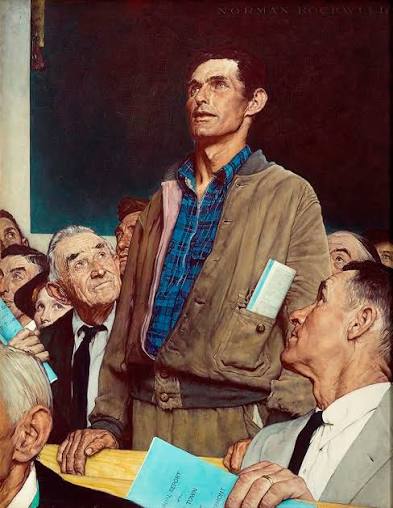
Rockwell painted a man standing among his neighbors, freely expressing his opinion at a town meeting. The people around him listened.
Not today. The literary world has become considerably less welcoming to certain voices.
PEN America’s 2026 report, A Silent Moratorium, documented the experiences of Israeli and Jewish writers who described professional exclusion, self-censorship and pressure to remove Jewish and Israeli content from their works. Novelist Meg Keene reported being advised to change the name of a Jewish character from Yael to Sue. One hundred far-left authors went ballistic about highlighting Jewish suffering and left PEN America.
Freedom of expression is closely tied to the freedom to assemble and associate with others. On American campuses, some Jews have been asked to renounce Zionism to participate in student organizations. In 2022, two Jewish students at SUNY New Paltz were excluded from a sexual assault survivors’ support group over their identification with Zionism.
What an extraordinary price to demand of a Jew for admission into American civil society.
Freedom of Worship
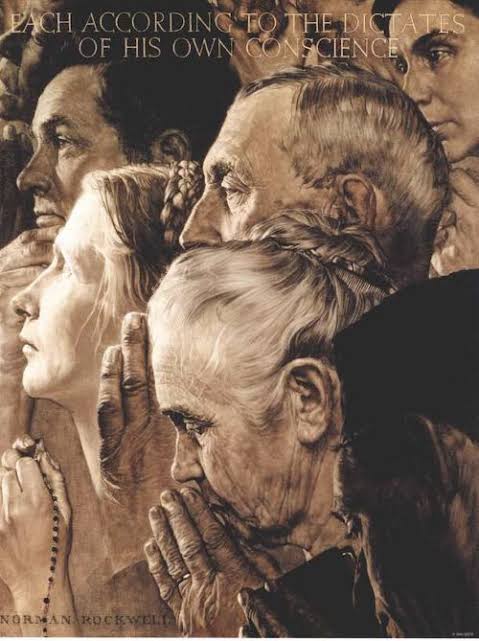
Rockwell painted Americans of different faiths freely worshipping God.
Jews have prayed towards Jerusalem for centuries. They pray for the welfare of Israel and conclude their Passover seders with the words “Next year in Jerusalem.” Jewish worship is intimately tied to Jewish peoplehood and attachment to the Jewish homeland.
In November 2021, CAIR official Zahra Billoo warned her audience about Zionist synagogues,” declaring, they are “your enemies.”
Even Jews seeking to pray in their own homes have encountered hostility.
In January 2021, Daniel Grand, an Orthodox Jew in University Heights, Ohio, sought to assemble a minyan, the quorum required for certain communal prayers, in his home on the Sabbath. The city issued a cease-and-desist order. Grand alleged that city officials subsequently subjected him to surveillance and harassment. On December 9, 2026, eighty-three years after Rockwell painted Freedom of Worship, the United States Supreme Court is scheduled to hear his case.
Communities are livid at “Judaizing” neighborhoods.
Whether at home or in synagogues, Jews are under pressure regarding their freedom to gather and worship.
Freedom from Want
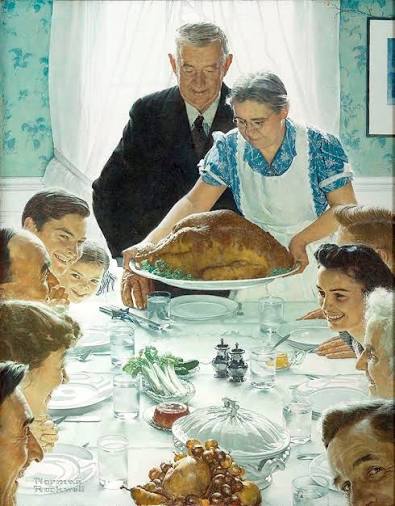
Rockwell painted a family gathered around a Thanksgiving turkey. It was a picture of American abundance which generations of Jewish immigrants worked hard to realize.
Yet Jewish prosperity continues to arouse suspicion. In 2021, teachers union president Randi Weingarten characterized American Jews as part of the “ownership class.” A year later, rapper Kanye West accused Jews of financially exploiting Black artists.
The stereotype of Jewish wealth obscures Jewish poverty. A 2020 Pew Research Center survey found that 26 percent of American Jews had difficulty paying basic expenses or debts during the preceding year. Eight percent struggled to pay for food.
The campaign to boycott Israel has reached the livelihoods of American Jews. A 2024 American Jewish Committee survey found that eight percent of Jewish employees reported experiencing or feeling exclusion at work because of their actual or assumed connection to Israel.
Jewish-owned businesses like Philadelphia’s Goldie restaurant have been targeted. Even Jews seeking to purchase homes in their ancestral homeland have encountered protests outside American synagogues.
Meanwhile, security expenditures for America’s Jewish institutions were estimated at more than $1 billion in 2025, an increase of 33 percent in a single year. Rich and poor alike are shouldering an increasingly expensive “antisemitism tax.”
Freedom from Fear
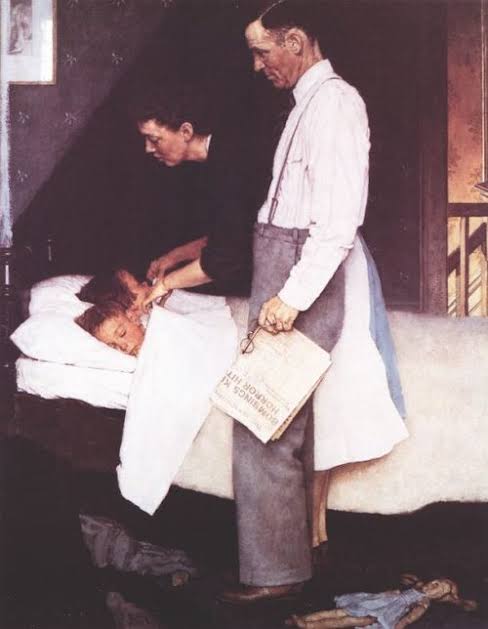
Rockwell painted parents putting their children to sleep, secure in their American home while war raged overseas.
Today, Jewish parents worry that their children’s attachment to a country thousands of miles away will make them unsafe in America.
In May 2021, Aaron Keyak, who led Jewish engagement for President Biden, advised Jews who feared for their lives or physical safety to remove their kippot and “hide your magen david.”
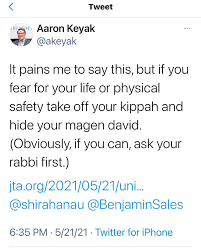
The message was clear: you live in fear and the government will not protect you. HIDE.
A 2025 study by the Anti-Defamation League and Jewish Federations of North America found that 20 percent of Jews who had worn visibly Jewish items before October 7, 2023 had subsequently stopped wearing them. Eighteen percent of American Jews reported experiencing assault, threats of physical attack or verbal harassment because of their Jewish identity during the preceding year. Fourteen percent had developed plans should they need to flee the country.
Following an attack at New York’s Central Synagogue in August 2026, Police Commissioner Jessica Tisch declared, “A place of worship should never be a crime scene.” Two months later, the Palestinian Youth Movement demanded her dismissal, accusing her of protecting “Zionist interests.” New York’s Democratic Socialists of America also pressed for changes to her policing policies or her removal, demands which Mayor Zohran Mamdani resisted.
The 2024 AJC survey found that 58 percent of American Jews who considered caring about Israel important to their Jewish identity worried that a family member would become a victim of antisemitism, compared with 27 percent of Jews for whom it was less important.
Jewish parents should be able to instill a love of their heritage in their children without fearing for their safety.
Generations of Jews have been thankful for an America which afforded them freedoms denied to their ancestors in much of the world. Roosevelt did not qualify those freedoms, and Rockwell did not paint Americans who had to abandon a part of themselves to enjoy them.
On Thanksgiving and every day, American Jews seek no more than their neighbors: the same four freedoms, without conditions.


