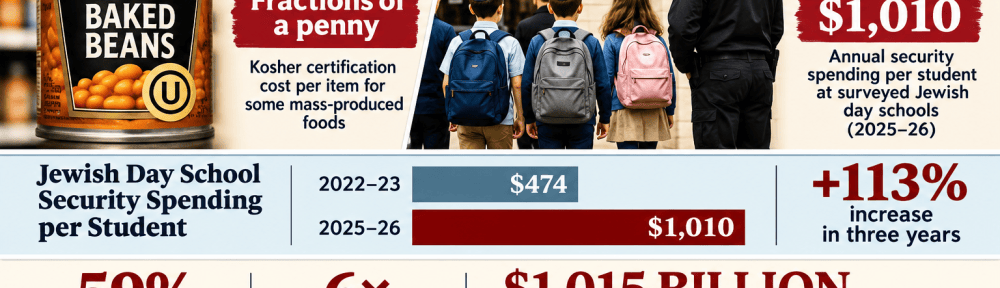
For decades, antisemites scoured the shelves of American supermarkets looking for evidence of Jewish exploitation. They found it on cans of baked beans.
The small letter U inside a circle, the kosher certification introduced by the Orthodox Union (OU) in the 1920s, was portrayed as evidence that Jews were extracting money from unsuspecting Americans. White supremacists and the Ku Klux Klan promoted the notion of a “kosher tax” and encouraged Americans to boycott kosher-certified products.
Food manufacturers had a different name for it: good business.
The cost of kosher certification for some mass-produced foods amounted to fractions of a penny per item. Manufacturers voluntarily sought certification to expand their markets. The number of companies certified by the OU grew from 37 in 1950 to over 6,000 in 2023.
A century after helping make food more accessible to Jews, the Orthodox Union is documenting how antisemitism is making Jewish life less affordable.
In March 2026, the OU’s Teach Coalition released a survey of 63 Jewish schools showing that annual security spending per student had more than doubled in three years, from $474 to $1,010. Security expenses grew at six times the rate of other school expenditures. Some 59 percent of students were being charged separate security fees.
Jewish parents are paying more for their children’s education without getting another teacher, textbook or hour of instruction.
In September 2026, the Jewish Federations of North America (JFNA) estimated that Jewish communal institutions were spending $1.015 billion annually on security, up 33 percent from its 2024 estimate. The figure excludes privately owned Jewish businesses, including kosher restaurants and supermarkets.
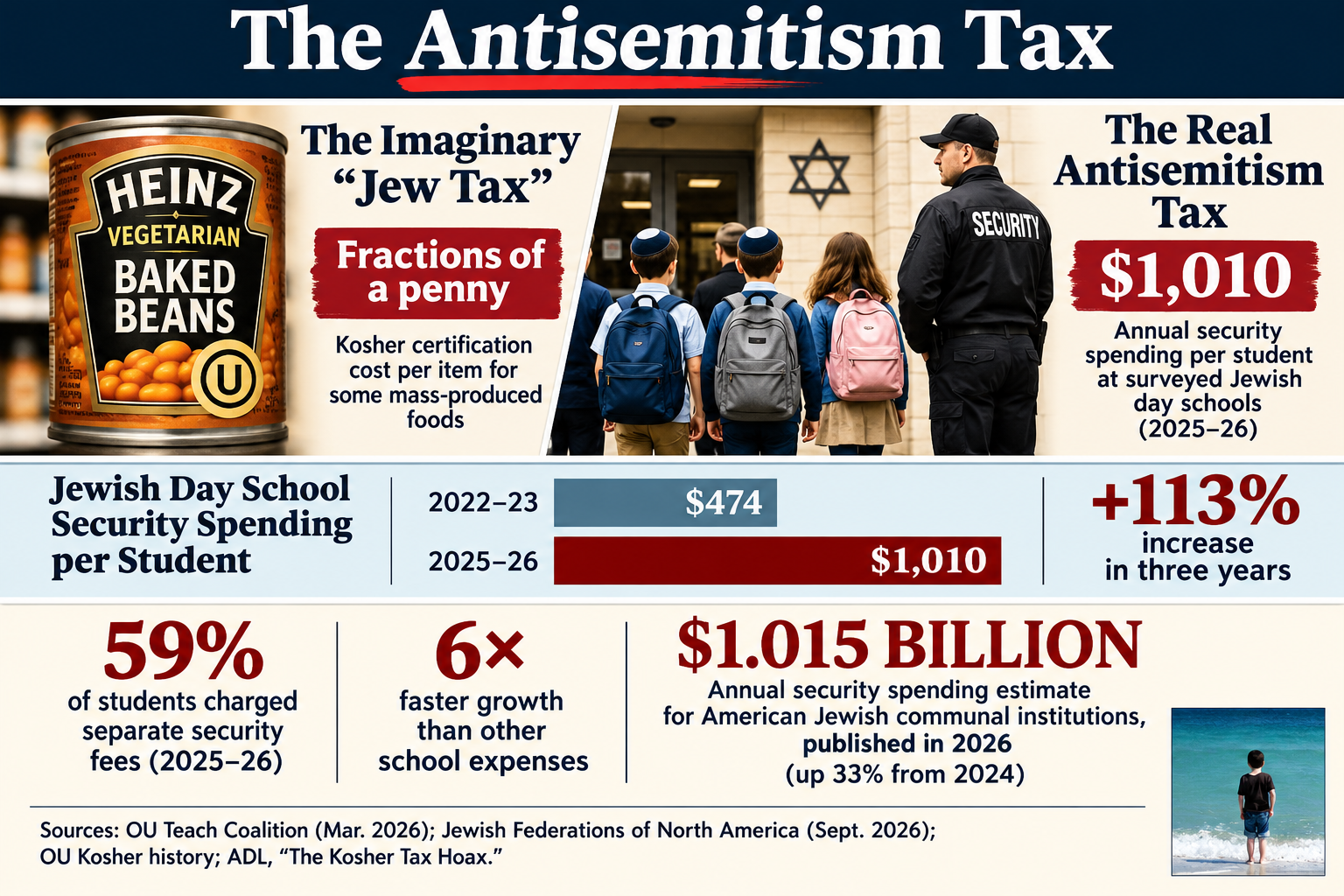
While federal and state governments provide security funding, Jewish communities must raise substantial sums themselves. The entire federal security grant program for vulnerable nonprofits of all faiths amounted to $300 million in 2026, less than one-third of what Jewish communal institutions alone spend on security.
JFNA estimated that the money spent annually protecting Jewish communal institutions could otherwise cover the day school tuition of 44,000 children. Instead of raising money to bring more children into Jewish schools, communities are raising money to keep the children inside them safe.
The burden is particularly onerous in smaller Jewish communities, where fewer families must share the expense of guarding a synagogue. Antisemitism threatens the survival of such communities through economics as well as intimidation.
As Americans wrestle with the rising cost of living, American Jews must also wrestle with the rising cost of living as Jews. The First Amendment guarantees the free exercise of religion, yet Jews increasingly must pay a premium to exercise that freedom safely.
The “Jew tax” was a fabrication. The antisemitism tax is real.


Pingback: The Four Freedoms, Without Conditions For American Jews Today | First One Through