The New York Times Picture of the Year, 2014

15yearold

The year 2014 was notable for the global escalation in terror and death compared to prior years.

  • Islamic State/ ISIS created killing fields in Iraq, executing and beheading hundreds of people which it recorded and aired on the Internet. The group massacred and destroyed entire villages that existed for centuries.
  • Boko Haram in Nigeria killed hundreds of Christians and abducted hundreds of girls.
  • The ongoing war in Syria had a death toll approaching 200,000 people including over 10,000 children.
  • Israel responded to attacks from Gaza for the third time in eight years as Hamas continued rocket fire into Israeli towns. An advanced Hamas terror tunnel network extending into Israel forced a ground invasion into Gaza which claimed over 2000 lives.
  • Russia invaded and annexed Crimea, as Ukraine turned to the world for support but received virtually nothing.
  • Wars in Sudan, Yemen, Afghanistan and other countries continued to claim thousands of lives.

The year also included near break-out race riots in the United States as several unarmed black men were killed by white police officers. In Africa, the deadly disease Ebola killed thousands.

Various news agencies highlighted the most significant news events which ranged from Ebola to Russia’s invasion of Ukraine. They selected new events that impacted thousands of people in 2014 which had potentially long-term consequences.

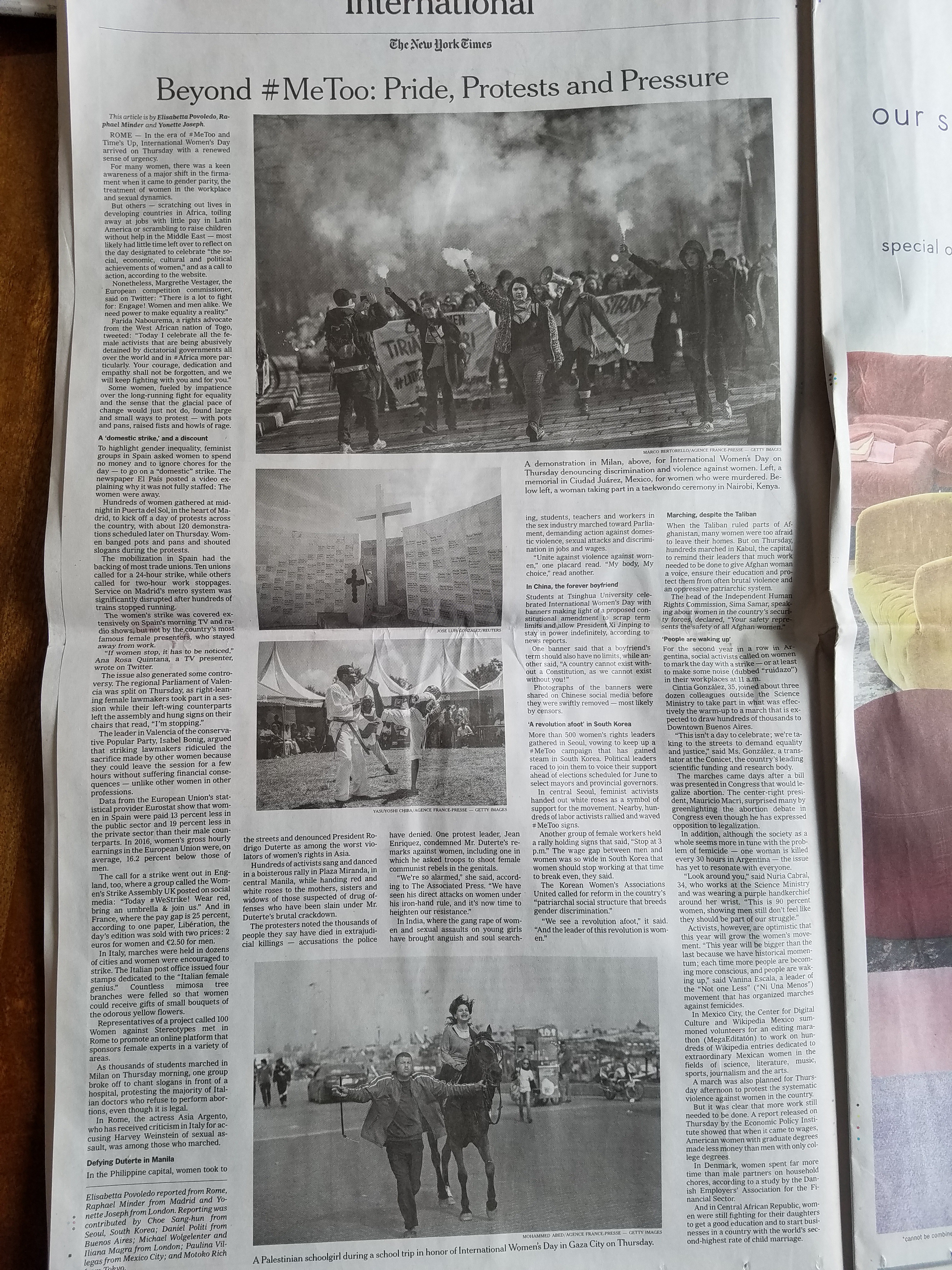
The New York Times year-end review posted dozens of pictures of conflicts around the world to encapsulate 2014.  In my opinion, the NYT picture that  summed up a dominant theme in its reporting for 2014 was the picture above, of a 15-year old Arab surrounded by Israeli policemen. For the New York Times, the stories on its cover pages in 2014 repeatedly told the story: that Israel attacks Arab youths.

The large color picture was displayed on its cover page on July 7, 2014. The bruised 15-year old Arab boy was being escorted out of a police station where he had been detained after throwing stones in a riot. There are several things that make the front-page treatment of the teenager note-worthy:

  • On that same day, over 100 people were killed in attacks in Kenya, Uganda and Yemen. Small stories appeared on the inside pages of the Times to discuss the scores murdered.
  • When Boko Haram killed hundreds, it also did not make the front page.
  • ISIS beheadings of journalists did not make the front page.

The beating of an Arab youth by Israeli forces was given more prominence and therefore deemed more important than those other world events.

This New York Times news story came shortly after three Israeli teenagers were abducted and murdered by Palestinians. The New York Times never placed even a small black-and-white photo of any of the three Jewish teenagers on the front page. Their plight was also not viewed as important by the Times.

Over the course of the next several weeks as Operation Protective Edge unfolded, the New York Times continued to put pictures of Palestinian children on the front page of the paper. Throughout July (July 11, 14, 17, 21, 22, 24 and 29th) the paper had pictures of Palestinians suffering on the front page. It took until July 29 – buried on page A6 – for the Times to write about and post a single picture of the Hamas terror tunnel network that was a main factor in launching the Israeli ground invasion of Gaza.

Further, Palestinian leadership, whether Hamas leaders such as Khaled Mashal or acting Palestinian Authority president Mahmoud Abbas, never were pictured on the pages of the Times during Operation Protective Edge (the only leader to be pictured was Ismail Haniya on September 4 page A10, well after the fighting had stopped). The paper only showed pictures of Arab civilians. However, Israeli Prime Minister Benjamin Netanyahu’s picture was shown often (July 7 twice; July 22; July 27; July 29; August 7), as were Israeli police and soldiers. The overall message of the New York Times was clear: the Israeli government was attacking Palestinian youths and civilians; it was not a war between opposing government authorities.

The Times news stories and editorials built additional narratives onto this theme, regardless of inaccuracies. In attempts to make the Israeli government seem callous to the conditions of Arab youth, an article and editorial on July 7 and July 8 stated that “days of near silence” passed before Israel Prime Minister spoke about the killing of an Arab teenager by Israeli radicals. This was completely untrue and it took days for the NYTimes to print a correction (below).

The NYT editorial board led with a piece on July 19 entitled “Israel’s War in Gaza”.  It was not called “Hamas’ War against Israel”, nor was it called the “War Between Hamas and Israel”.  The Times continued to paint the battle as an aggressive Israeli action against a populace.

In case there was any confusion in the New York Times message to its readership, it included another small picture of Netanyahu near its large picture of the year. (By way of comparison, did you ever see the NYT post a picture of US President Obama near an article about drone strikes or deaths in Afghanistan that he specifically ordered and oversaw?)


The New York Times tried to defend its coverage of the Gaza conflict by printing an editorial on November 23, 2014 entitled “The Conflict and the Coverage”.  Not surprisingly, it attempted to defend its poor media coverage and that it tried too hard to offer “symmetry” in the conflict. It claimed that the paper has “baseline beliefs that Israel has a right to exist and that the Palestinians deserve a state of their own.” The charitable Times board believing that “Israel has a right to exist,” clearly doesn’t extend to: believing that Israel has a right to defend itself; that it was reluctantly pulled into a battle in Gaza; that it sought to minimize Arab casualties; that Hamas is rabidly anti-Semitic; that Hamas leaders are intent on destroying Israel and killing Jews; and that Arab leadership was responsible for the war and deaths of both Israelis and Palestinians.


Sources:

http://www.huffingtonpost.com/2014/07/07/jodi-rudoren-new-york-times-_n_5564067.html

Times moved picture down in online of story: http://www.nytimes.com/2014/07/07/world/middleeast/israel-palestinians-muhammad-abu-khdeir.html

Every Picture Tells a story: https://firstonethrough.wordpress.com/2014/07/04/every-picture-tells-a-story-dont-it/

Bibi as a killing monster: https://firstonethrough.wordpress.com/2014/07/08/every-picture-tells-a-story-part-ii/

The NYT buried pictures: https://firstonethrough.wordpress.com/2014/07/29/the-new-york-times-buried-pictures/


NY Times Correction: July 9, 2014

An article on Monday about the arrest of six Israelis in the killing of a Palestinian teenager referred incorrectly to Prime Minister Benjamin Netanyahu’s response to the killing of Muhammad Abu Khdeir. On the day of the killing, Mr. Netanyahu’s office issued a statement saying he had told his minister for internal security to quickly investigate the crime; it is not the case that “days of near silence” passed before he spoke about it. The error was repeated in an editorial on Tuesday.”


Honor Killings in Gaza

The Unmentioned Murders of the Middle East

Honor killings have a sad history throughout the Muslim world. Many families deliberately and systematically kill wives and daughters if there is any suspicion of the women bringing “dishonor” to the family. The cause of such shame may come from actual or feared adultery, refusal to marry a designated spouse, or even dressing inappropriately. The cultural rationale for the honor killings is that by murdering the offending women, honor is restored to the families.

Gaza and the West Bank are similar to other parts of the Muslim world regarding the reasons for honor killings. However, the recent spike in the number of killings in the territories has been very dramatic and atypical. In 2011, there were five such murders in the territories. The number of homicides jumped to 13 in 2012, and doubled again to 27 in 2013. In just the first two months of 2014, 8 honor killings were reported by Palestinian media sources, a pace that would have put it on course for nearly doubling again.

By comparison, in Afghanistan an estimated 150 women are killed each year in honor killings. Afghanistan has over eight times the population of Gaza and West Bank, and 18 times Gaza alone. Therefore, on a proportionate basis, the Palestinians now kill twice as many women in honor killings as Afghanistan (or over three times as many if one only counts Gaza where most of the murders take place).

Adding insult to these horrific murders increasing popularity, was the lax way such murders were treated in Palestinian courts. According to the Palestinian Law (Article 340), the killers were not subject to any punishment.

He who discovers his wife or female relative committing adultery and kills,
wounds or injuries one or both of them is exempted from any penalty,
and he who discovers his wife, or one of his female ascendants or descendants
or sisters with another in an unlawful bed and he kills, wounds or injures one
or both of them, benefits from a reduction of penalty
.”

The terrible jump in honor killing of women in Gaza and the West Bank did not make it to the pages of The New York Times. The courts absolution granted to the murderers was not a subject that the Times decided to cover. In 2011. In 2012. In 2013. In 2014.

The closest the New York Times came to an article about the Palestinians’ disregard for a woman’s life in the territories was in an article by Jodi Rudoren in October 2012. That article was about a particular women’s rights advocate. While one would imagine some specifics about the lack of women’s rights and a review of honor killings being covered in such an article, there was barely any mention.

  • There was no description of honor killings
  • No report on the increasing number of killings
  • No review of Palestinian Law absolving the murderers

Instead, Roduren chose to describe the difficulty of a specific woman acting as a rights advocate in Gaza (as opposed to the hardship all women face in Gaza). Of course, according to Roduren, the main source of the hardship was Israel:

  • ““psychological siege” imposed by a combination of Israeli restrictions on travel and trade”
  • “lost a personal battle last month when Israel’s Supreme Court rejected a petition by her and three other women to study in the West Bank.”
  • “the resistance of the Israeli occupation as a priority,”
  • Israeli court ruled, 2 to 1, against the four women
  • “Israeli warplane hit an apartment building”

So what does a reader take-away from the New York Times?

    1. While the New York Times occasionally covered stories of honor killings in Afghanistan or Pakistan, it never covered those killings in Gaza, despite the greater prevalence in Gaza.
    2. When the paper had a chance to describe the honor killings in Gaza in an article about a woman’s rights advocates, it opted not to do so.
    3. The thrust of the sole article on the morbid topic laid most of the blame on Israel, as opposed to the Palestinians themselves

Hooray New York Times. You gave a pass for Mulim misogyny and murder meted out by Palestinians. Absolution of the Arab sins came from Jews just across the Green Line.

It would be much more convenient for the left-wing fringe if Israel bordered Pakistan and Afghanistan as well, so they could blame Jews for the entire reprehensible ritual.

honor_killings


Sources:

Jump in 2014 Honor Killings and Palestinian Law Article 340: http://www.al-monitor.com/pulse/originals/2014/03/palestine-honor-crime-women-abuse-law-abbas.html#

http://www.aljazeera.com/indepth/features/2014/03/upsurge-palestinian-honour-killings-gaza-201432372831899701.html

http://www.mezan.org/en/details.php?id=18419&ddname=honour&id_dept=9&p=center

Jodi Rudoren NY Times 2012 article on Honor Killings: http://www.nytimes.com/2012/10/13/world/middleeast/andalib-adwan-shehada-a-bold-voice-for-gaza-women.html

CNN coverage of honor killings back in 2009: http://www.cnn.com/2009/WORLD/meast/07/30/mideast.honor.killings/

Journalists in the Middle East

It is not easy to be a journalist in the Middle East.

The Middle East / North Africa (MENA) region is the only part of the world which does not have a single country with a full free press. This compares to Western Europe which does not have a single country without a free press according to Freedom House.

The profession has become much more dangerous as seen by the murders of two American journalists in Iraq by ISIS in August and September 2014. Some 70 journalists were killed around the world in 2013, the majority in volatile Muslim countries including: Syria; Iraq; Egypt; Pakistan; and Somalia.

Journalists lucky to be alive are often intimidated in their coverage (Gaza) or jailed (Turkey, Egypt and China).

Free press is only part of the problem in the region. There is virtually no freedom of assembly or freedom of speech. Protests in many cities around the world have been halted by government crackdowns – including in the United Kingdom and the United States.

Curiously, academia, which prides itself in freedom of expression, has singled out Israel for BDS (Boycott, Divestment & Sanction). Israel ranks far ahead of any country in the MENA region in every category of freedom of press, speech and assembly (Israel ranked #64 globally compared to the Palestinian Authority #182).

Free speech music video (Coldplay):

https://www.youtube.com/watch?v=dSuuuwPUjWI&list=PL42FF9A26E50944A7&index=20


Sources:

Click to access Global%20and%20regional%20tables.pdf

http://www.cpj.org/killed/2013/

http://www.cpj.org/imprisoned/2013.php

http://www.wjla.com/articles/2013/12/turkey-leads-world-in-jailed-journalists-for-second-straight-year-98286.html

http://www.ft.com/cms/s/0/6f70100a-fdba-11e2-a5b1-00144feabdc0.html#axzz2qZ6LIKvB

http://www.hrw.org/world-report/2013/country-chapters/algeria

http://www.channel4.com/news/university-of-london-student-protest-ban-senate-house-occupy

http://www.theguardian.com/commentisfree/2013/nov/25/quebec-spain-anti-protest-laws-democracyEgypt jailing: http://fsrn.org/2014/06/egypt-sentences-journalists-confirms-mass-death-sentences-squelches-protests/

killing Steven Sotloff: http://www.politico.com/story/2014/09/isil-steven-sotloff-110520.html

Gaza intimidation: http://www.timesofisrael.com/hamas-threatening-journalists-in-gaza-who-expose-abuse-of-civilians/

The Death of Civilians; the Three Shades of Sorrow

Every life is precious.

For many people, every life form is considered sacred, whether human or animal. In the United States alone there are an estimated 7 million people who restrict their diets to fruits and vegetables.

The vast majority of people around the world are not vegetarians. Still, there are limits to what they would consider eating. Domestic animals like dogs and cats are considered taboo in many cultures, and almost all 7 billion people on the planet avoid cannibalism. Even to those that do not consider eating meat to be immoral, there are limits.

The concept of the preciousness of life and limits of behavior extends beyond eating habits. Most of Europe has abolished the use of capital punishment.   The European Union considers the death penalty to be “cruel and inhuman”, even for heinous crimes.

However, 40+ countries still use capital punishment for a variety of offenses.  Each society decides the limits of acceptable and extreme behavior.  Even among countries that use capital punishment, the nature of the crime makes people assess the level of innocence of the person, the objection to the use of the death penalty, and sympathy for the accused. People may feel more upset when they hear about a homosexual who harmed no one, being stoned to death (in Mauritania, for example), than a mass murderer being executed (in the USA). There is a perceived range of innocence and guilt, and therefore associated gradations of grief.

This is true even among civilians who are killed during wartime. Some innocents are viewed as more “pure” than others and their unfortunate demise warrants more despair. Below are three categories of civilians from most to least innocent: Innocents; Targets; and Enablers.

  1. The Innocent
    A. Bystanders:
    In battles, passers-by may be attacked and killed without cause. These people have no part in the conflict and may not even be aware that one was taking place. An example would be the passengers on the Malaysia Airlines flight 17 that was shot over the border of Ukraine and Russia in July 2014. The 298 bystanders were killed without reason- the people had no role in the war. One can imagine that even the people that carried out the attack did it by mistake and regretted the action.B. Children: Children are innocent by definition: they lack knowledge and ability; they have no control of their situation; they neither vote nor fight. Still, almost every war has witnessed children killed. In the War between Gaza and Israel in the summer of 2014, hundreds of children were killed as the fighting took place in heavily populated areas.

    C. Slaughtered Citizens:
    Citizens of a country have every reason, right and expectation that their own government protects them. That protection is the primary basis for any government to exist. When a government reverses that course and turns its protective weaponry inwards to target its own population, it is a slaughter of innocents. Consider the millions of German Jews in the 1930s and 1940s who had every right to expect their government to protect them. When the Nazis specifically targeted these citizens, the Jews were left completely helpless. It was not a civil war of a division seeking independence; it was a slaughter of the defenseless by its own army.

2. The Targets

D. Initial Civilian Targets: Some civilians are attacked because of the actions of their government. The people going to work on September 11, 2001 in the USA were not military targets and were not part of the government. The attackers specifically targeted their places of work – America’s financial and military centers – as they were unhappy with America’s influence and presence in the Muslim world. The nearly 3,000 civilians were just going to work and had no role in, or understanding of the unhappiness of the attackers.

E. Civilians Targeted after Military Attack: The victims in Hiroshima and Nagaski were living in Japan when the US dropped an atomic bomb on them during the end of World War II in 1945. The Japanese initiated the war by attacking US military targets in Pearl Harbor four years earlier. As the war dragged on, the US concluded that it would end the war faster by obliterating entire cities which included both people involved in the war and uninvolved civilians who were part of the aggressor force. World reaction to the attack has been mixed, whether the action saved more lives by ending the war faster.

F. Civilians Targeted after Civilian Attack: The allies in WWII launched a bombing campaign on the German city of Dresden in February 1945. The Dresden attack was a reaction to the German-initiated war and attack on Great Britain. The further argument given to destroying the entire city was that it was an important center for the German war effort. An estimated 25,000 people were killed in the British and US bombing campaign.

  1. The Enablers
    G.  Backers of War Policy: Civilians are defined as people who are not part of the armed forces. However, there are people who are technically not part of the armed forces but are directly involved in advancing a war. For example, Palestinians voted overwhelmingly for Hamas and its war campaign against Israel in 2006. Hamas has fought constantly against Israel and Israel has responded with three operations: in 2008 (Operation Cast Lead); 2012 (Operation Pillar of Defense); and 2014 (Operation Protective Edge). Many civilians (both those that voted for the war policy and those that didn’t) were killed in those wars.

The loss of any life is sad, but it is human nature to react to the particular circumstance of each death. In an extreme example, an 8-year old killed while riding a bicycle brings more sympathy than a convicted murderer getting the death penalty. As detailed in the article above, it is not surprising that even in the finer shades of gray among civilians killed during war, that people feel more horror for the victims of Malaysia Airlines flight 17, than for Palestinians who voted for war.


Sources:

http://costsofwar.org/article/civilians-killed-and-wounded

http://en.wikipedia.org/wiki/Bombing_of_Dresden_in_World_War_II

EU human rights: http://eeas.europa.eu/human_rights/adp/index_en.htm

Death penalties worldwide: http://en.wikipedia.org/wiki/Use_of_capital_punishment_by_country#Capital_punishment_in_the_world_.28by_country_not_by_population.29

Hamas victory: http://www.washingtonpost.com/wp-dyn/content/article/2006/01/26/AR2006012600372.html

Death sentence for homosexuality: https://www.youtube.com/watch?v=2aXPECeOilA

3shades

Save the Children

I first came upon the “Save the Children” organization when I saw that they sponsored an appeal to raise money for Gaza in a poster in the London Underground. The name of the group sounded so innocent and well-meaning. Who is more innocent than a child? Who could possibly be against helping children? Can helping children ever be considered a biased agenda?

DSC_0418
Save the Children sponsored poster on Gaza,
London August 2014

Some days later, I came across a retail thrift store bearing the STC name in Bath, England. Posters in the store window contained two new appeals to help rebuild Gaza and to stop the “Israeli” War in Gaza. There was no appeal or comment to stop the Palestinian war against Israel. I decided to look into the group on their own website.

The President & CEO of STC, Carolyn Miles, posted a blog called “Gaza’s Miracle Tomatoes” on July 8, a day after Israel launched Operation Protective Edge to stop the bombardment of Palestinian missiles into Israel. It was her first ever (and currently only) post about Israel or Gaza.

In the column she describes the “bleak landscape” and “dusty barren patches” of Gaza. The scene contained “donkeys pulling carts filled with rubble and surrounded by men and boys along harsh, rocky earth”.

The blog continued that 20 minutes away from the bleak picture along the border with Israel, a “miracle” appeared from nowhere: “a lush green field …a simple greenhouse …row after row of beautiful tomatoes … the result of a recently-concluded project by Save the Children and other partners and funded by USAID.” This oasis painted by Miles intentionally gave a reader the specific impression that STC helped create a miracle from nothing in the terrible Gaza landscape. It contained three significant lies of omission:

  1. Gaza had a flourishing greenhouse business built by the Israelis for years. The Israelis cultivated 1,125 acres and built hundreds of greenhouses in Gaza while there in the 1990s up until they left in 2005. The business generated roughly $75 million of revenue.
  2. Jewish donors bought and donated the greenhouses to the Palestinians.  World Bank president James Wolfensohn, Mort Zuckerman and several others paid the Israelis $14 million for two-thirds of the greenhouse equipment to donate them to the Palestinians (some Israelis opted to not take the payment and take their equipment with them to re-start businesses back in Israel).
  3. The Palestinians looted and destroyed the greenhouses. Soon after the expulsion of Jews from Gaza, Palestinian looters stripped the greenhouses of the irrigation pumps, computer monitors and greenhouse sheeting, leaving over one-fourth of the greenhouses bare.  The businesses withered.

The STC piece continued: “we drove through the streets of Gaza and heard from residents about the impact of border crossing restrictions on children there—the rising rates of malnutrition and resulting stunting, the lack of basic medicines and care when children became sick, and the severe circumstances disabled children were in.” The article had now moved past being the miracle machine and placed blame for the situation on Israel (for border crossing restrictions), and continued with outright lies:

  1. The children of Gaza have better health statistics than almost all Arabs in the Middle East. According to the United Nations, UNICEF and UNRWA, Palestinians in Gaza have the highest immunization rates and longest life expectancy of surrounding Arab and Muslim countries (including: Turkey; Jordan; Egypt and Iran). They have the highest literacy rate.However, the facts don’t add to the Save the Children’s non-miracle.

Save The Children claims it does not choose sides, it just chooses children, but is that factual? Is the characterization that the children of Gaza suffer because of the actions of Israel – as opposed to the actions of their parents – really not taking sides? Is a minute and one-half video featured on the STC site that only shows bombings in Gaza (and nothing in Israel), not choosing sides? Has STC helped fund a single bomb shelter just a few miles away, in the targeted playgrounds of Israel?

A bigger question for Save the Children – and the world – is how do you protect children from their own parents?


Sources:

Save the Children president blog on Gaza: http://loggingcarolynmiles.savethechildren.org/?_ga=1.229256220.1625656554.1409305814

STC YouTube video on Israel-Gaza: https://www.youtube.com/watch?v=ISvA-rmhv4A

Jews donating the greenhouses to Palestinians: http://www.nytimes.com/2005/08/18/nyregion/18donate.html?adxnnl=1&adxnnlx=1409478973-DrXHog3bg5xC5HsRaqHwTg

Palestinians ransacking the greenhouses in 2005: http://www.haaretz.com/news/palestinian-militants-ransack-former-gush-katif-greenhouses-1.179788

http://www.csmonitor.com/2005/1025/p04s01-wome.html

FirstOneThrough on England’s Gaza Obsession: https://firstonethrough.wordpress.com/2014/08/29/no-disappearing-in-the-land-of-blind/

UNICEF immunization: http://www.childinfo.org/files/immunization_summary_en.pdf

CIA life expectancy at birth: https://www.cia.gov/library/publications/the-world-factbook/rankorder/2102rank.html

“Please Sir, May I have Some More?”

As the 2014 Operation Protective Edge (hopefully) draws to a close, one can expect the same histrionics that have become well-known and well-worn to emanate from the Arab world. The video below of Queen Rania of Jordan, is of her appeal to the United Nations five years ago, which can serve as the outline for the Arab textbook on UNRWA. In summation, we are pathetic and we want to ask the world for money again.

(As further background/amusement, Queen Rania of JORDAN was born in KUWAIT and considers herself Palestinian, when convenient).

“Life half-lived” – Palestinian Quality of Life. The Arabs will bemoan their treatment by Israel and ignore their treatment by their Arab brethren.

Palestinians in Lebanon and Syria are denied citizenship by their host countries. They are denied the ability to own property and obtain white color jobs. The Jordanians gave Palestinians citizenship in 1954, only to revoke it in 1988. Egypt has totally shut down Hamas which runs Gaza, as it is a part of the banned Muslim Brotherhood.

The reason why Palestinians have a bad quality of life (beyond the discrimination from their Arab “brothers”) is because of UNRWA. UNRWA has given millions of second and third generation Arabs a life “half-lived” because of a promise that they will get to go to a house that no longer exists, in a country that their grandparents sought to destroy at its infancy. The Arabs in Israel have twice the life of Palestinians in Arab countries.

Regardless, all protests about quality of life will be directed at Israel, and not at UNRWA, Lebanon, Syria or Egypt.

“Hours wasted at checkpoints” – Border control. The Palestinians will complain about the restrictions of movement out of Gaza and the West Bank. The fact that those territories have amassed over 10,000 rockets, have a charter calling for the death of Jews and destruction of Israel, have fired over 10,000 rockets at Israeli towns over the past 13 years, and killed hundreds of Israeli civilians does not seem to factor into their concern about Israel’s need for border controls.

Regardless, Arab nations will press Israel to alleviate travel restrictions.

“UNRWA has delivered sanctuary.” – Charge of War Crimes. The vast majority of UNRWA employees are Palestinians. These employees were caught not only storing missiles in their schools, but handing them over to Hamas to launch against Israel. Those same members of Hamas launched missiles in and around the UNRWA schools.  UNRWA teachers have been caught building rockets for Hamas.

Regardless, the histrionics of Israel firing at the missile launching sites will continue.

“Reconstruction”. – Appeal for Money to Gaza. The historic blame for the limited re-building homes and schools in Gaza was laid squarely on Israel’s restriction on allowing building materials into Gaza. As Operation Protective Edge made clear, the fault was not the lack of cement in Gaza, but which projects the Palestinians sought to develop. Hamas used the materials to build terror tunnels instead of schools and roads above ground.

Regardless, the Arabs will argue for the ease of more materials into Gaza without oversight.

“School provides a comforting routine.” The schools in Gaza may fly an UNRWA flag, but the curricula are determined by the ruling authority – Hamas. The Hamas education is complete with demonization of Jews and Holocaust denial.

Regardless, Palestinians will demand a rebuilding of schools under the Hamas watch.

“Hell on Earth”. Queen Rania described Gaza as “Hell on Earth” for many years. She used this statement even though people in Gaza had: longer life expectancy; better immunization rates and higher literacy rates than Jordanians.

“If we let UNRWA collapse… we risk destabilizing the entire region.” Queen Rania should hand back her prophesy credentials. The Arab and Muslim world is in total chaos in Syria, Iraq, Libya, Nigeria and other places, with no connection to Israel or UNRWA. UNRWA itself is a destabilizing force to the Israeli-Palestinian peace process, in its current configuration.

Regardless, the Arabs will shout that the organization should not be overhauled.

“All of us depend on UNRWA.” The appeal that the world needs UNRWA will continue even though it is blatantly false. It is a cheap attempt to get the world to continue to fund salaries for 30,000 Palestinians.

The amazing hypocrisy, is that the Arab world funds only 10% of the UNRWA budget, while they are the ones who claim it is necessary.

Regardless, Palestinians will once again have their hands out asking the world for more money.


Source:

“First of its kind” missile discovery: http://www.theguardian.com/world/2014/jul/17/unrwa-investigating-20-rockets-empty-gaza-school-palestinian

“Second time” http://www.unrwa.org/newsroom/press-releases/unrwa-condemns-placement-rockets-second-time-one-its-schools

Third time a trend? http://www.timesofisrael.com/rockets-found-in-unrwa-school-for-third-time/

“Vast Majority” of UNRWA employees are Palestinians: http://www.unrwa.org/userfiles/20100118153142.pdf

UNRWA teacher and terrorist: http://www.globaljihad.net/view_news.asp?id=409

Frontpage article on UNRWA: http://www.frontpagemag.com/2014/dgreenfield/defund-the-unrwa/

Protesting the Victor, not the Victims

Brett Stephens of the Wall Street Journal wrote an editorial on August 5, 2014 about the seeming hypocrisy of parts of the world protesting against Israel in the current Israel-Hamas war but barely making a peep about wars in Pakistan, Iraq, Nigeria, Libya, etc. He doubted the sincerity of people’s stated concern about Arab victims, and considered the protestors motivation of racism, since they only show up when the counter-party is Israel.

As posted in FirstOneThrough on July 21, wars involving Israel account for a very small portion of all Muslim deaths in wars. Muslim-Muslim wars account for 90% of fatalities.

That should not come as a surprise. Most wars are between neighboring countries or are civil wars. (The United States is the exception which seems to only go to war with countries that are not neighbors). As most Muslim countries neighbor other Muslim countries, it would stand to reason that most Muslim wars and fatalities would be at the hands of other Muslim countries.

However, the expected number of fatalities in wars involving Israel is out-of-proportion. Israel’s neighbors account for 7% of the world’s Muslim population (117 million people), but the fatalities account for only 1% of the deaths in wars.

The reason that so few deaths happen in wars with Israel has a lot to do with the length of the wars.

Israel’s wars tend to be much shorter than wars between Muslim countries. The Iran-Iraq war went on for 8 years. The civil war in Angola- 27 years; Somalia- 15 years; and the wars of Sudan (which included Christians) went on for 17 and 22 years. Those Muslim wars killed millions of people. Compare that to the 6-Day War of 1967, and the Israeli wars in 2006, 2008 and 2012 which were 34, 22 and 7 days long, respectively. Those four wars plus the current 2014 war killed 20,000 people combined.

The Israeli wars were short – when they were winning/won. The longest Israeli wars had heavy casualties. The 1948 Israeli War of Independence against five invading armies lasted 300 days, when Israel fought for its very existence. The First Lebanon War lasted three years and did not have a clear victor. Each of those wars had as many fatalities as the five short wars combined. Those battles where Israel was the decisive victor were typically under one month and consequently, the death tolls much smaller.

These facts lead to some interesting questions about the protests:

  • Were the wars short because Israel achieved its near-term security objectives and did not factor in global protests?
  • Did the protests help shorten the war?

More specifically to the question raised by Brett Stephens about the motivation of the protestors during these short battles with Israel:

  • Were the protestors actually concerned that Israel would wipe the opponents off the map, as their Muslim adversaries would certainly have done if they were the winner?
  • Would they protest a quick end to the wars if Israel were losing?

The answers to those questions would demonstrate that the motivation has little to do with victims, and everything to do with the victor. As the Arabs lost the wars, the protests masked their hatred for Israel as a call for the victims. If the Arabs had been winning, the protests would have been chants of support for the Muslim armies, and the “victims” would have been hailed as “martyrs” for the cause.

These anti-Israel protests occur in places with significant Muslim immigrants. If they protest a Muslim-Muslim war in their new host countries, it could lead to local street battles between Sunnis and Shiites, essentially importing their religious war to Europe. However, protesting against a common adversary in Israel is not only easier, but serves as a way of uniting Muslims that are in the middle of a large global war with themselves.


Sources:

Brett Stephens, Palestine and Double Standards: http://online.wsj.com/articles/bret-stephens-palestine-and-double-standards-1407194971?mod=trending_now_8

FirstOneThrough, Israel and Wars: https://firstonethrough.wordpress.com/2014/07/21/israel-and-wars/


The New York Times’ Buried Pictures

Operation Protective Edge was launched on July 8 after Palestinian terrorists infiltrated Israel through tunnels and launched missiles across Israel.

Israeli Prime Minister Benjamin Netanyahu stated repeatedly that the goal of the operation was to destroy the extensive tunnel network that the terrorists had constructed. “We will not finish the mission, we will not finish the operation without neutralizing the tunnels, which have the sole purpose of destroying our citizens, killing our children,” Netanyahu said.

Remarkably, pictures of the terrorists who use the tunnels have yet to make an appearance to the New York Times. Although numerous pictures and images of terrorists penetrating Israel were made available to journalists, the NYT decided to not print any of them.

Even though dozens of tunnels were uncovered, it took until July 29 for the Times to publish it’s first picture of one – inside the paper on the bottom of page A6 (under a picture of Palestinians mourning).  Jodi Rudoren referred to the Israeli military “propaganda push” which “invited a few journalists underground for a tour” as “Israelis exchange nightmare scenarios that are the stuff of action movies” – as if the tunnels were a backstage viewing at a Disneyland movieset.

In three weeks of covering the conflict, the Times featured pictures of Palestinians mourning on the front page seven times (July 11, 14, 17, 21, 22, 24 and 29th). But the root cause of the conflict – Hamas terrorists attacking Israel through the tunnel network – never made it to the front page pictures. The Times actually had a story of the tunnels on the front page on July 29- but decided that a large color photograph of a Palestinian morgue was a more appropriate picture for that article.

It would appear that the underground war is being fought by Hamas and by the Times.


Sources:

Articles and pictures of Gaza tunnels in other papers:
http://online.wsj.com/articles/israel-strikes-30-houses-in-gaza-killing-islamic-jihad-official-1406286950

http://af.reuters.com/article/egyptNews/idAFL6N0Q34PG20140728

http://www.businessweek.com/news/2014-07-27/secret-tunnels-under-israel-reveal-intricate-threat-from-gaza

http://america.aljazeera.com/articles/2014/7/23/gaza-undergroundhamastunnels.html

http://www.haaretz.com/news/diplomacy-defense/.premium-1.606903

Videos:

https://www.youtube.com/watch?v=TlvnkECJkYc&list=UUawNWlihdgaycQpO3zi-jYg

https://www.youtube.com/watch?v=_NBEixuQbYQ&list=UUawNWlihdgaycQpO3zi-jYg

https://www.youtube.com/watch?v=5-hH2026OnU&list=UUawNWlihdgaycQpO3zi-jYg

https://www.youtube.com/watch?v=Mv8xR1FPakY&list=UUawNWlihdgaycQpO3zi-jYg

July 29 cover July 29. A6 Jul 21 cover July 17.cover Jul 22 cover July 14. cover July 24 cover (2) July 11. cover

“An anti-Semitic Tinge”

Pulitzer Prize winner William Safire used to write for the New York Times “On Language.” His fascinating articles would describe the etymology of words; their usage and context. He spent years as a speechwriter for US President Nixon, followed by decades writing for the Times. He had a unique appreciation for words.

Safire would not appreciate the New York Times abuse of language today.

Some words are seldom used in daily speech. When heard or seen, we understand that there is a particular purpose and nuance for their application.  Even in comedy.

The old TV sitcom “Seinfeld” had a funny skit about George being set up on a blind date by his friend Jerry. George had a long list of questions to qualify his interest. When asking about her face he said: “Is there a pinkish hue?” The question puzzled his friend Jerry who was setting him up: “A pinkish hue?” he replied. “Yes, a rosy glow.” Jerry: “There’s a hue”. The exchange gets roars of laughter – not only because it is an absurd question to qualify a date, but the word itself is peculiar. I doubt there was ever a time in the history of television that the word “hue” was used so frequently.

We all (think we) know what the word “hue” means – heck, there was even a setting on our TV sets after “brightness” and “contrast” (but being candid, no one ever used it). The word “hue” was replaced by “color” or “tint” on many sets as those words convey a wider spectrum of color. Hue seemed too subtle.

If “hue” is subtle, the word “tinge” is meaningless. While “tinge” may be a slightly more common word, it means a great deal less.  Finding the TV’s hue setting and moving it a single notch, would be the equivalent of “tinge”. Only an expert could readily observe the slight change in color. A reasonable person could never be expected to notice a tinge without close and careful examination.

“An anti-Semitic tinge.”

It was curious (alarming?) to see the word “tinge” show up in an article about “The Confrontation in Gaza”, as the New York Times refers to current war in Gaza (avoiding using Israel’s terminology of “Operation Protective Edge” as that might make it appear that Israel was on the defensive).

On July 24, 2014, the New York Times ran an article called “As Much of the World Frowns on Israel, Americans Hold Out Support” about how angry the world is with Israel. Americans, according to the article, do not support Israel because they believe that Israel has a basic right to self defense in the face of missile attacks, but because “of the failures of the Arab Spring to spread democracy in the Middle East.” That NYT statement is beyond moronic and ignores the entire Pew report and decades of Pew Surveys which have always shown greater support for Israel than Palestinians.

The following paragraphs continued: “Pro-Palestinian demonstrations are continuing in Paris, Berlin, Vienna, Amsterdam and other European cities, some of them assuming an anti-Semitic tinge.” Quite a phrase “anti-Semitic tinge”.

So what happened in the protests the preceding weeks? On July 20 anti-Israel protestors firebombed a synagogue in the Parisian suburb of Sarcelles. Jewish shops were looted and 18 people were arrested. The French Prime Minister said: “What’s happened in Sarcelles is intolerable: attacking a synagogue or a kosher grocery, is quite simply anti-Semitism, racism.”

Just the week beforehand, a demonstration in Bastille Square in the center of Paris moved towards two synagogues which had hundreds of Jews trapped inside. The crowds chanted “death to the Jews” and “Hitler was right”. That demonstration was such a warning shock to the government that it banned further demonstrations, which took place anyway.

In Belgium, a store with a Palestinian flag and a crossed out Israeli flag in the window put up a sign in Turkish: “Dogs are allowed in this establishment but Jews are not under any circumstances.” The French text replaced “Jews” with “Zionists.”

In Berlin, Germany protestors were blocked by police in riot gear from bringing their demonstrations to the Holocaust Memorial. That week, an imam at one of Berlin’s mosques gave a sermon that Jews should be killed.

The Associated Press correspondent from Berlin wrote: “The foreign ministers of Germany, France and Italy on Tuesday condemned the rise in anti-Semitic protests and violence over the conflict in Gaza, saying they will do everything possible to combat it in their countries.”

“An anti-Semitic tinge.”

The New York Times deliberately chose to minimize the anti-Semitic motivation of the protestors as it would detract from what the Times considered an appropriate act of protesting against Israel (since the Times doesn’t believe the “confrontation” is truly about self defense). Even as riots broke out in the same cities that witnessed the Holocaust, and those governments called out against the rise in anti-Semitic protests and violence, the Times needed to bury that narrative.

For the Times, “an anti-Semitic tinge” means a few outliers; some bad seeds doing bad things. It ignores the lack of protests against: Russia in the Ukraine; Syria slaughtering its citizens; US in Iraq and Afghanistan; and other government actions in the world that have killed hundred of thousands of civilians over the past few years. Regrettably, the Times does not agree that when protestors only take to the streets when the Jewish State is in a “confrontation,” it brands the protest itself as anti-Semitic.  How does it ignore firebombings of synagogues?

Those actions are from the disgraceful anti-Semitism of the protestors. Regarding the media, it is bad enough that it is passively complicit in not identifying the anti-Semitic root cause of the protests. However, to actively trivialize riots, firebombings and death threats against Jews in the streets where millions of innocent Jews were killed, is not merely being complicit- it is an act of anti-Semitism itself.


Let me change the conclusion of the opening paragraph: William Safire would not be upset by the Times use of language.  He would be appalled by the New York Times abuse of Jews.


Sources:

http://www.jta.org/2014/07/20/news-opinion/world/anti-israel-rioters-torch-cars-throw-firebomb-at-paris-area-synagogue

http://www.algemeiner.com/2014/07/13/violent-anti-jewish-riots-rock-paris-activist-says-french-jews-are-in-serious-danger-video/

http://www.bbc.com/news/world-europe-28402882

http://abcnews.go.com/International/wireStory/berlin-bans-anti-semitic-slogan-gaza-protests-24658551

20140725_071755

Gaza Blockade versus Cuban Blockade

In 1962, US President John F Kennedy had a showdown with Russia to keep missiles from reaching Cuba. The US blockaded Cuba, and has a strict embargo which continues to exist in various forms today.

Cuba vs. Gaza

  • Cuba never stated its intention of wiping the US off of the map; it is in Hamas Charter and daily rants of its leadership
  • Cuba never fired a missile into the US; Hamas has fired over 10,000
  • Cuba never abducted US servicemen; Hamas has taken Israelis
  • Cuba never used suicide bombings against American civilians; Hamas has conducted over 100 bombings in Israel
  • Cuba is miles from US shores; almost all of Gaza borders Israel
  • Cuba does not have a racist government calling to kill Americans; Gaza has an anti-Semitic government that calls for killing Jews
  • The relative land size of Cuba:USA is larger than Gaza:Israel
  • The relative population size of Cuba:USA is larger than Gaza:Israel


Sources:

http://en.wikipedia.org/wiki/United_States_embargo_against_Cuba