Why the Media Ignores Jihadists in Israel

Summary: According to the Times, terrorists in Europe and Israel are very different and have different motivations.  If they weren’t, the hope that two states (Israel and Palestine) could live side-by-side in peace would obviously disappear.

The New York Times has taken to breaking the universe of Islamic terrorists attacking civilians into two camps: those that are hardened and trained to commit attacks, and those that do so as a result of their personal situation as opposed to their beliefs.  Curiously, that line is defined by geography.

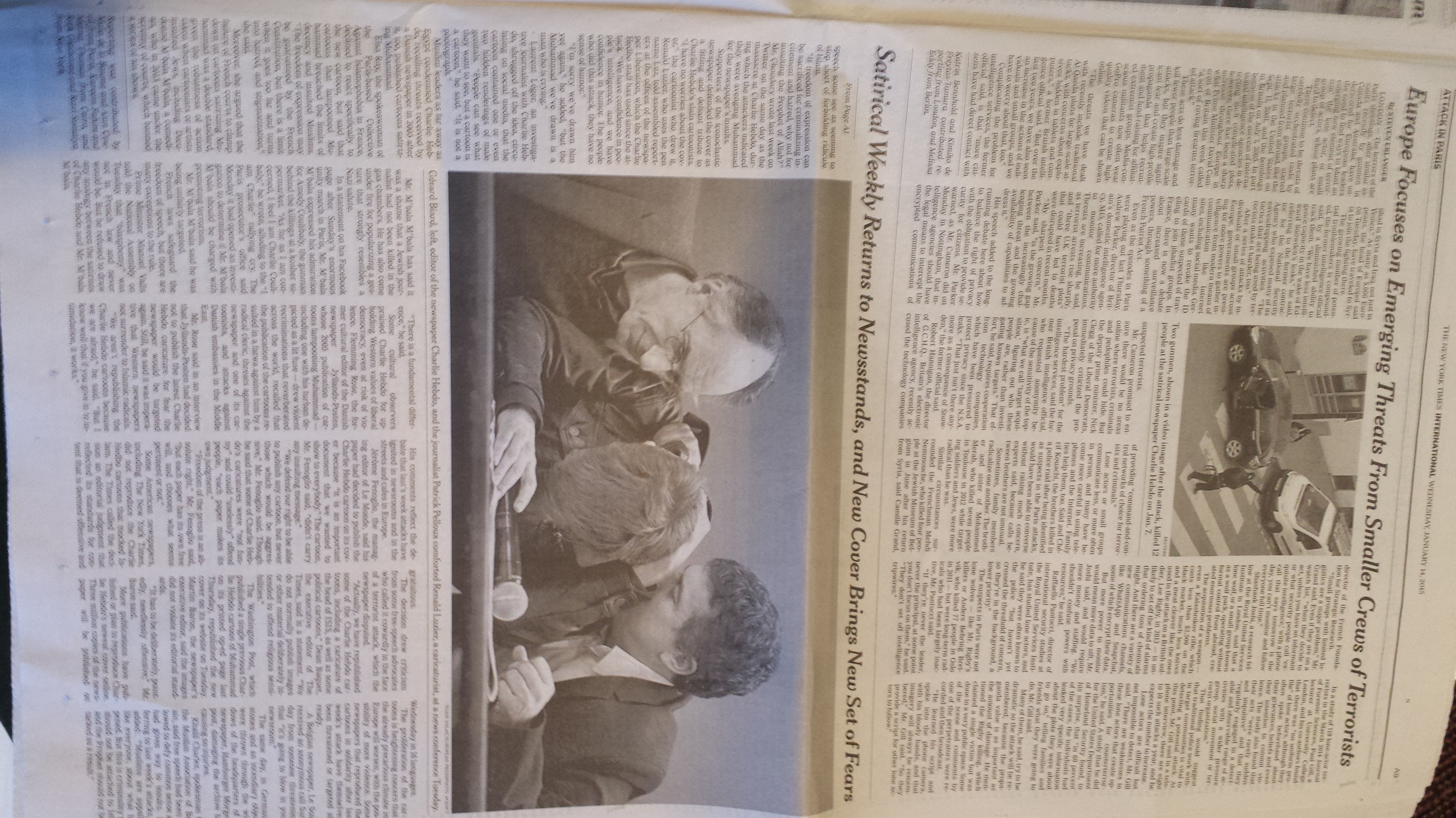
Consider the January 17, 2015 reporting about the raids that prevented a terrorist attack in Belgium. The Times discussed “the expanding threat from radical jihadists, many of them battle-hardened in Syria and Iraq.” Another article on the same day questioned why Lunel, a small town in France “has come to earn the dubious distinction as a breeding ground for jihadists.” A third article that day clearly stated that attacks in Paris against the magazine Charlie Hebdo were by “jihadist gunmen”. In Europe, the Times is clear that attacks against civilians are done by radical jihadists. While the articles discussed Muslim anger at the insult to their prophet Mohammed by the Charlie Hebdo cartoons that ultimately instigated the attacks, that anger was only the final motivating factor to unleash actions embedded in the radical jihadist philosophy.

The Times does not view attacks against Israelis the same way.

On January 23, 2015 the NY Times explored the motivation of a Palestinian who stabbed a dozen Israeli civilians on a bus in Tel Aviv. Over and again the Times referred to the man as “angered by the war in Gaza… and tensions over the revered Aqsa Mosque.” The article stated that “the family was in debt and struggling” and described this assailant as well as another who attempted to assassinate a Jewish activist as stories of “dislocation”. The New York Times deliberately kept the motivations away from any categorization of “radical jihad” by saying that the assailant “was not considered an extremist.”

This description fits consistently with the Times narrative as written in its editorial page on January 1, when it described the Palestinians as “desperate.” The opinion piece suggested that the Palestinians are “deeply frustrated” by their lack of a state. The Times does not feel that Palestinians are engaged in a radical jihad against Israel in the same way European cities are facing Islamic extremism. It is curious that they arrive at such a conclusion when there are Palestinian polls and elections that consistently show an overwhelming support for Hamas, which mentions “jihad” against Israel 36 times in its charter (see the FirstOneThrough article below).

Several articles in the Times mentioned the anti-Semitism harbored by Amedy Coulibaly, the French Muslim who shot a policeman and four Jews in a kosher supermarket in Paris. They discussed his allegiance to the Islamic State which seeks to build a new state in the Middle East ruled by Islamic sharia law. However, the New York Times never mentioned that the Palestinians are the most anti-Semitic people in the world, with 93% of the population holding anti-Jewish views. It neglected to inform its readers that the popular Hamas party seeks to completely destroy Israel and set up an Islamic state ruled by sharia law.

Why does the Times continue to relay different motivations and narratives for jihadists in Europe and Israel?

The liberal newspaper would like to see a new State of Palestine established in the Middle East, whereas it is comfortable with the borders of countries elsewhere. The conundrum is that the Times’ hope for a new moderate secular Palestinian state alongside Israel is in conflict with the reality that the Palestinians are much more radical than the paper pretends.

To conceal the radical nature of the Palestinians today, the Times editorials and articles follow specific guidelines in reporting that:

  • The Palestinians and its leadership are moderates
  • The Palestinians only take to violence because they are desperate and alienated
  • The Israelis are at fault for lack of a two-state solution

In Israel, people see the jihad in Iraq, France, Nigeria and in their own country as a single violent movement of Islamic extremism. That is why Israeli Prime Minister Benjamin Netanyahu referred to Hamas and Islamic State as “branches of the same poisonous tree”. Should the Times ever decide to detail the full nature of Hamas beyond simply being a “militant group” and also discuss the huge support it receives by Palestinians, it would undermine the vision of two states living side-by-side in peace. Therefore, the pages of the Times state that Europe faces “radical jihadists” while Israel faces desperate, isolated and alienated Palestinians (who are in that situation only because of Israel).

However, hope is hardly honest reporting.
20150125_162037


Sources:

Netanyahu comment on Hamas: http://www.pressherald.com/2014/09/30/netanyahu-islamic-state-hamas-branches-of-the-same-poisonous-tree/

Palestinians proudly elcebrating murderer of Israeli civilians: https://www.youtube.com/watch?v=RRTXmeRVPlY

Related First One Through articles:

Palestinians “Desperation Move”: https://firstonethrough.wordpress.com/2015/01/06/palestinians-are-desperate-for/

Palestinians are not “resorting” to violence: https://firstonethrough.wordpress.com/2014/11/19/the-palestinians-arent-resorting-to-violence-they-are-murdering-and-waging-war/

Hamas is mainstream: https://firstonethrough.wordpress.com/2014/09/04/its-the-democracy-stupid/

Abbas pivot to Hamas positions: https://firstonethrough.wordpress.com/2014/11/12/mainstream-and-abbas-jihad/

The extremism of the Palestinian positions: https://firstonethrough.wordpress.com/2014/10/25/extreme-and-mainstream-germany-1933-west-bank-gaza-2014/

My Terrorism

The streets in Paris were full of support for the victims of terror in January 2015. An estimated 1.6 million came out along with leaders of over 40 countries to memorialize the 17 victims, with signs that included “I am Charlie”, “I am the police” and “I am Jewish” to show solidarity with the murdered people.

jesuisjuif

The unity march was highly unusual compared to the reaction to terrorism that has plagued Europe for the past decade. There were no million person-marches or signs of support when:

The past victims included people killed for their use of free speech. They also included law enforcement officers and Jews. More people were killed at some of the attacks than were killed in the Charlie Hebdo and kosher supermarket attacks. So why was there the unique outpouring of support in Europe in 2015? Why didn’t anyone wear a pin “JeSuisMiriam” for the 8-year old girl that was shot in the head in France in 2012?

Looking at the recent protests in many European cities could lead one to conclude that the momentum of anti-immigrant groups and political parties have gained strength and popularity. The rise may stem from the number of terrorist attacks in Europe as well as the number of Islamic immigrants which has ballooned to 20 million in Europe due to the “Arab Spring” producing asylum seekers from throughout the Middle East/ North Africa region.

But why would world leaders show up now?

There was perhaps another factor at play which has to do with a more fundamental human characteristic: selfishness.

My Terrorism

People and nations react when they feel that their interests are being attacked. While they may sympathize with murdered victims everywhere, they take action when they feel that the terrorism strikes a selfish or personal nerve.

Witness the killings and abduction in Nigeria by the radical Islamist group Boko Haram. While there were murderous groups all over the world, including nearby in Sudan, there were barely any popular protests. However, when the US first lady Michelle Obama witnessed the abduction of over 200 black girls, she saw victims that looked like her own daughters and launched a “BringBack Our Girls” campaign which went viral. I do not doubt her sincerity or concern for other victims of terror including the 1400 girls who were raped by Muslim men for over 13 years in England. But it took a terrorist action that struck “close to home” against victims that resembled her own family for her to take action.

When three teenage boys were abducted in Israel a month after the Boko Haram abductions, Jews around the world and Israelis started their own hashtag campaign of #BringBackOurBoys and #EyalGiladNaftali. Israelis were obviously concerned about the Nigerian girls kidnapped by Boko Haram too – indeed Israel was one of only four countries that actually sent support to find the missing girls. But world Jewry acted much more actively when it was three teenaged Jewish boys that were abducted.

In Iraq, the Islamic State/ ISIS was busy wiping out entire cities, killing thousands of Christians, Yazidis and fellow Muslims. However, it took a video of the beheading of American journalists to get America to take action against the Jihadist group. Stated differently, while Americans may have been appalled at knowing that thousands of innocents were being slaughtered in Iraq, the atrocities were viewed as distant. It took the attack on a single man to bring the conflict close-to-home, and therefore worthy of a response.


And so it was with the various attacks in Europe. While the French were likely sad about the killings of Jews over the past decade, they viewed it as a Jewish problem. The majority of French could consider those attacks as targeted against a small community that was not their problem or a threat to themselves. Jews make up 0.2% of the world’s population and 0.8% of France’s population. The French may have felt pity for 8-year old Jewish girl Miriam, but they were not Miriam; no “JeSuisMiriam” placards.

Similarly, the Europeans were likely incensed over the decade-long attacks on policemen and servicemen too. But most Europeans were not in the military. They were angry, but they were not the military. Their military was fighting wars far away.

The large scale attacks in London and Madrid were similar to the attacks on the United States on September 11, 2001. Each nation was harmed as an entity, not just the immediate victims.

Yet the French did not march in Spain; the Germans did not march in England; and the Dutch did not march in the USA.

Lastly, free speech had been attacked before. The murder of Theo van Gogh, bombings in Stockholm (which didn’t murder anyone) and protests against the Danish newspaper, Jyllands-Posten, in 2005 all stemmed from Muslims protesting the press’s postings of images of their prophet Mohammed. But the limited scale of those attacks compared to the Charlie Hebdo strike awakened a different sensibility in millions of Parisians and leaders of the western world that prize freedom of the press and speech. (Other countries that do not have freedom of speech and press attended the march as well, including Turkey and Saudi Arabia, to place a fig leaf over their extremist Muslim ideology, lack of freedoms and desire to ingratiate themselves with the western world). The attack on free speech spoke to the people and leaders, as a personal attack on their way of life.

When terrorism became personal, people and countries responded with actions. When terrorism seemed remote and someone else’s problem, there was inaction.

Thanks for the Inclusion

So nations, people, papers and celebrities wore the “JeSuisCharlie” to stand by the victims, and to protest the assault on their own basic freedoms. Some people extended a courtesy to the other victims of the attacks, even though they did not represent a personal attack, wearing “JeSuisPolice” and “JeSuisJuif” alongside their primary banner.

The Jews of France were happy to be included in the memorial of the anti-Semitic attack and appreciated the condemnation of the French government against the attack on their community. But the Jews of France also recall the lack of outrage at the various murders in the recent past of Jews being killed for being Jews.

In France and most of the world, Jews do not get starring roles in the rage on behalf of victims. However, the world will consider Jewish loss once they have expressed outrage for an attack on themselves. Like the five people in the background who stand behind the principal star who receives a trophy at an awards show, Jews were happy to be recognized, even if no one really saw them.

The recognition is a step forward and better than the long history of being ignored.  But everyone knows that such acknowledgement is similar to non-Jews wishing Jews “Happy Chanuka” because it comes at the same time as Christmas. Chanuka is a minor holiday compared to Shavuot and Sukkot which are unknown to non-Jews. When was the last time any non-Jew wished someone a “Happy Purim”? It doesn’t happen because it is not connected to something that they care about personally, like Christmas.

Today’s war on terrorism will continue to be waged when nations see their interests being threatened.  The outpouring of emotion will also be rooted in selfish preservation.

While it may have been called a “unity march”, the Jews of Europe have already been educated about their place in society.


Sources:

Paris march: http://www.bbc.com/news/world-europe-30765824

Madrid bombings: http://www.cnn.com/2013/11/04/world/europe/spain-train-bombings-fast-facts/

London bombing: http://www.cnn.com/2013/11/06/world/europe/july-7-2005-london-bombings-fast-facts/

Stockholm bombing: http://en.wikipedia.org/wiki/2010_Stockholm_bombings

Copenhagen plot: http://en.wikipedia.org/wiki/December_2010_Copenhagen_terror_plot

Brussels shooting: http://www.theguardian.com/world/2014/jun/01/suspect-arrest-brussels-jewish-museum-shooting

Toulouse shooting: http://www.telegraph.co.uk/news/worldnews/europe/france/9154350/Toulouse-shooting-little-girl-cornered-in-school-and-shot-in-head.html

Torture of French Jew: http://www.nytimes.com/2006/03/05/international/europe/05france.html?pagewanted=all&_r=0

Killing of Theo van Gogh: http://www.wsws.org/en/articles/2004/11/gogh-n10.html

Muslims in Europe: http://www.wsj.com/articles/europe-immigration-and-islam-europes-crisis-of-faith-1421450060

Lee Rigby: http://www.bbc.com/news/uk-26357007

Michelle Obama protest: http://hollywoodlife.com/2014/05/08/michelle-obama-kidnapped-nigerian-schoolgirls-bring-back-our-girls/

Eyal Gilad Naftali: http://proisraelbaybloggers.blogspot.de/2014/06/eyal-gilad-and-naftaliin-our-hearts.html

Je Suis Juif: http://edition.cnn.com/2015/01/13/world/french-jews/


Related FirstOneThrough articles:

Je Suis Redux

Obama’s limit on abducted teenagers

Israel assists Nigerian search

Free speech review music video

Targeted terrorism for blasphemy

I’m Offended, You’re Dead

Subscribe YouTube channel: FirstOneThrough

Join Facebook group: FirstOne Through  Israel Analysis

New York Times Confusion on Free Speech

The attacks on the offices of the satirical magazine Charlie Hebdo in Paris in January 2015 sparked a plethora of articles describing the freedoms of speech and press. The New York Times, like many other media sources, fiercely defended the right of people to offer their opinions, even if such views are unpopular. Despite the clarity of its overall stance, the paper appeared confused about “double standards” in its articles which failed to clarify and distinguish between free speech and hate speech.

In the NY Times lead front page story of January 14 referring to such “double standards”, the paper contrasted the right of Charlie Hebdo to make cartoons of the Islamic prophet Mohammed, to the arrested French “comedian” M’bala M’bala who stated that a Jewish journalist should have been killed in the Nazi gas chambers and that he considers himself like the terrorist who shot and killed four Jews in the Parisian supermarket. Neither clarification nor education was given about the differences and limits of free speech.

20150115_144909

The NY Times continued to confuse the public (or itself) in a story the next day by David Carr, which included the following:

  • “Not all the French were reveling in unbridled expression of speech. Dieudonné M’bala M’bala, a comedian who has made highly provocative statements since the shooting at Charlie Hebdo’s offices, was detained as an “apologist for terrorism” for statements he made on his Facebook page that were seemingly in support of one of the attackers.
  • His arrest highlights the fact that one man’s free expression is another man’s hate speech or sedition. In Israel, the conservative Jewish newspaper HaMevaser scrubbed out the German chancellor Angela Merkel from a photograph, along with other female leaders who had participated in a solidarity march in Paris, because photos containing women are considered inappropriate in ultra-Orthodox publications.”

In an effort to educate the Times and its readership, here are three important points to distinguish between various types of speech:

  • Concept versus People
  • Active versus Reactive Incitement
  • Editing versus Censorship

 Concept versus People

A central dividing line between freedom of speech and hate speech has to do with the right to discuss concepts as opposed to the right (and limit) to discuss people. Everyone is free to say anything they want about concepts such as: capitalism, communism, Islam and Buddhism. Whether it is religion or economic theory, each topic is considered a concept worthy (perhaps?!) of discussion and debate in a positive or negative fashion. However, speech can descend into “hate speech” (or libel) which is banned by many countries, if people attack either groups or specific human beings.

For example, Louis Farrakhan, a bombastic anti-Semitic Muslim preacher referred to Judaism as a “gutter religion”. He was not brought up on any charges, despite the hateful speech. Egyptian leader Mohammed Morsi was not prosecuted for calling Jews the descendants of monkeys and pigs, which could have perhaps been classified as hate speech in some countries because he addressed people rather than a religion.

 Active versus Reactive Incitement

A key factor in the distinction of permissible versus prohibited speech revolves around “incitement”. Many countries prohibit speech that incites violence, as does the recent United Nations Resolution 16/18. The UN language:

  • “condemns any advocacy of religious hatred that constitutes incitement to discrimination, hostility or violence, whether it involves the use of print, audio-visual or electronic media or any other means”

The phrase incitement to violence is clear. For example, when an imam in Germany called for killing Jews, that fell under hate speech to incite violence, and the country is now investigating that imam.

However, it is considered completely legal to say things that may involve “reactive incitement”, that is, saying something that may annoy people to the extent that they would use violence. To ban reactive incitement would stifle free speech completely which is what the press sees as the essence of the Charlie Hebdo assassinations. Just because Muslims were insulted by the publishing of cartoons of their prophet, their reaction cannot be the basis to ban that freedom of expression.

Based on the United Nations language, the incitement to discrimination would have to be explored further. Did Charlie Hebdo promote discrimination against Muslims? Was the paper simply making pictures of Mohammed or was it attempting to foster intolerance of all Muslims? The new United Nations law makes a distinction.

The M’bala M’bala calls for a Jewish journalist to be killed in gas chambers and supporting terrorists who killed four innocent Jews are calls for direct and indirect incitement to hostility and violence.  Acting Palestinian Authority President Mamoud Abbas praise for martyrs who slaughtered innocents could also be called incitement to hostility and violence.

dalal_popular_inauguration

Fatah officials at naming of Dalal Mughrabi square,
murderer of 38 civilians including 13 children

 Editing versus Censorship

Every media outlet edits their news stories. Papers constantly select only those parts of interviews that confirm a thesis it promotes to its readers. That is (theoretically) its right. Michael Moore edited interviews about global warming and the auto industry to convey a particular narrative that he wanted to portray in his movies. The public may ultimately view the half-stories they receive as accurate, half-accurate or completely inaccurate because of the known bias of the producers of the content.

However, no one considers editing to be a form of censorship or an infringement on the freedom of speech or press. If a paper opted to not publish a sports section, that is its right. If it crops a picture to focus on a particular image to reinforce its narrative, that is also its right. It may be bad journalism, but it is not censorship (and certainly not by a governmental authority).

In its ramble on free speech above, the New York Times highlighted the Israeli “conservative” newspaper Hamevaser’s choice to edit the picture of the Paris unity march to remove the female leaders. Hamevaser is run by and serves an ultra-Orthodox Jewish community (not politically conservative) that is against showing pictures of women due to their interpretation of modesty. Such action is a form of editing that newspapers engage in to meet the tastes of its readership. To somehow suggest that it is a form of Israeli censorship is absurd. Why would the Times possibly lump this example in with examples of freedom of speech and hate speech? It is completely off topic.


People in the western world rallied behind Charlie Hebdo because they see this situation as falling completely within the framework of free speech: it poked fun at a religion (a concept), not people (Muslims); and it did not call for any violence, rather the attacks came from a reaction from incensed Muslims. The case of M’bala M’bala has to do with inciting violence against people, and the Hamevaser picture has nothing at all to do with government censorship.

So how did the Times develop this list of irrelevant examples and not try to educate its readers (and actually confuse them with calling out “double standards”)?


Sources:

NYtimes articles and picture Jan 14: http://www.nytimes.com/2015/01/14/world/europe/new-charlie-hebdo-has-muhammad-cartoon.html

NY Times article January 15: http://www.nytimes.com/2015/01/15/business/media/flocking-to-buy-charlie-hebdo-citizens-signal-their-support-of-free-speech.html?_r=0

Louis Farakhan on Judaism: https://www.youtube.com/watch?v=NbrH3eUuA3U

Egyptian leader Mohammed Morsi calling Jews names: https://www.youtube.com/watch?v=JukaOi8pKzM

UN Resolution 16/18: http://www2.ohchr.org/english/bodies/hrcouncil/docs/16session/A.HRC.RES.16.18_en.pdf

German imam calling for killing Jews: http://forward.com/articles/202751/germany-warns-against-hate-speech-after-imam-calls/

PA Abbas praise for terrorists: http://www.algemeiner.com/2013/01/10/video-of-abbas-praising-hitler-supporting-mufti-terrorists-released-video/

Naming square and centers after terrorist who killed 37 civilians: http://www.palwatch.org/pages/news_archive.aspx?doc_id=1442

Related First One Through articles:

Blasphemy or terrorism: https://firstonethrough.wordpress.com/2015/01/12/blasphemy-or-terrorism/

Klinghoffer opera: https://firstonethrough.wordpress.com/2014/06/23/eyal-gilad-naftali-klinghoffer-the-new-blood-libel/


Blasphemy OR Terrorism

On January 7, 2015, three French Muslim men went into the offices of Charlie Hebdo, a satirical magazine in Paris, France, and killed eleven people in response to the magazine’s cartoons depicting the Islamic prophet Mohammed in a negative manner. Politicians have publicly questioned whether this “act of terrorism” was done by “lone wolves” and whether this action had anything to do with Islam. The leaders of the western countries knew full well that this was not a random act of terror, but part of an ongoing rollout of laws that their governments are advancing with 57 Islamic nations to curb free speech around the world to comply with Muslim blasphemy laws.

Origins

Many religions consider blasphemy to be a sin. The range of the sin could be uttering the Lord’s name in vain or it could be drawing a picture of a prophet.  The Old Testament specifically prohibits using the name of God for no purpose or abusing the use of His name:

  • “Thou shalt not take the name of the LORD thy God in vain” (Exodus 20:7)

The New Testament refers to blasphemy many times, such as Matthew 12:31:

  • “Therefore I say unto you, Every sin and blasphemy shall be forgiven unto men;
    but the blasphemy against the Spirit shall not be forgiven.”

The Quran does not specifically call against abusing the name of God, but does consider it a crime to insult Mohammed:

  • “They swear by Allah that they did not say [anything against the Prophet] while they had said the word of disbelief and disbelieved after their [pretense of] Islam and planned that which they were not to attain. And they were not resentful except [for the fact] that Allah and His Messenger had enriched them of His bounty. So if they repent, it is better for them; but if they turn away, Allah will punish them with a painful punishment in this world and the Hereafter. And there will not be for them on earth any protector or helper.” (Quran 9:74)

In Judeo-Christian tradition, the punishment for the sin of blasphemy is considered to come from God and meted out either in this world or the world to come according to divine justice. In Islam, the punishment should be delivered by man in this world according to many Islamic scholars.

Country Laws

Western countries do not have laws against blasphemy. While insulting a religion may be considered rude, it is protected by the laws of free speech. (An editorial by David Brooks covers that nuance in the link below).

Countries that are governed by Islamic law (Sharia) have strict laws against blasphemy. The punishment ranges from fines to prison sentences to death. Here is a review of some of those countries:

  • Algeria: An individual who insults the prophet and the messengers of God, or denigrates the creed or prophets of Islam through writing, drawing, declaration, or any other means, will receive three to five years in prison.
  • Bahrain: Article 309 of the Bahrain Penal Code of 1976 penalizes individuals who insult any religious sects with a term of imprisonment not exceeding one year.
  • Egypt: A person ridiculing or insulting a heavenly religion or a sect following it, or damaging national unity” is punishable with six months to five years’ imprisonment.
  • Indonesia: Blasphemy is addressed in Article 156(a) of the Penal Code.  The Code imposes a penalty of up to five years’ imprisonment.
  • Iraq: Article 372 of Iraq’s Penal Code of 1969 provides that any individual who insults the creed of a religious sect or its practices, or publicly insults a symbol or person that is an object of sanctification, worship, or reverence for a religious sect, may be punished with a term of imprisonment not exceeding three years.
  • Jordan: Jordan explicitly criminalizes blasphemy.  Article 273 of Jordan’s Penal Code of 1960 punishes any individual who insults the Prophet Mohamed with a term of imprisonment of one to three years.
  • Kuwait: Law 19 of 2012 on National Unity was issued to amend article 111 of the Penal Code by imposing harsher penalties and criminalizing any publications and broadcasting content that could be considered offensive to religious “sects” or groups, including through social media.  The new law punishes such crimes with a fine ranging from US$36,000 to US$720,000 and a maximum of seven years in prison.
  • Lebanon: The Lebanese Penal Code punishes individuals who perform acts that are considered blasphemous to the name of God.  It also imposes penalties against individuals who publicly insult the religious proceedings of any religion.
  • Libya: Whoever publicly abuses the Islamic religion—that being the official religion of the State under the Libyan Constitution—with verbal terms not befitting for the Divine Being, the Messenger, or the Prophets, shall be punished with imprisonment for a term not exceeding two years.
  • Oman:  Article 209 of Oman’s Penal Code punishes with a term of imprisonment of between ten days and three years, or a fine between five to five hundred Omani Riyals (approximately US$13 to $1,300) an individual who commits the following acts: (1) publicly blasphemes God or the prophet Mohamed, (2) commits an affront to religions and faiths by spoken or written word, or (3) breaches the peace of a lawful religious gathering.
  • Pakistan:  Converts from Islam and atheists may be vulnerable to Pakistan’s blasphemy law, which prescribes life imprisonment for desecrating or defiling the Quran and the death sentence to anyone for using derogatory remarks towards the Prophet Mohammed.
  • Syria: Article 462 states that individuals who publicly defame religious proceedings are punishable with a term of two years’ imprisonment.

 A Global Mandate

Muslim countries have sought to enforce the ban on blasphemy beyond their borders to cover the entire world. In 2008, the United Nations General Assembly voted 85-50 (with 42 abstentions) to make blasphemy a crime. The measure was originally introduced by Pakistan in 1999 and has continued to be brought up by the 57 Muslim countries that make up the OIC, Organization of Islamic Conference. When the vote was brought up again in 2010, the margin of passage was smaller, 76-64 with 42 abstentions.

In 2011, the OIC attempted to push forward an alternate version of the resolution to overcome the objections of the United States and other western countries that felt the law trampled on basic rights of free speech. The US’s Obama Administration worked hard at developing Resolution 16/18, which sought to criminalize the act of stereotyping or discriminating against people based on religion, rather than the pillorying of the religion itself.

The terms “stereotyping” and “incitement to … hostility or violence” that are used throughout the resolution have been called “vague” and “problematic”.  The mandate of “[a]dopting measures to criminalize incitement to imminent violence based on religion or belief” is confusing as to whether it bans the direct call to incite violence, or for doing anything that could incite violence.  For example, if the cartoons made in Charlie Hebdo did not call for violence against a group, but the negative stereotyping could incite people to violence, would that be considered illegal? Would it be considered illegal if the stereotyping brought violence against the targeted group only, or even if it brought violence against Charlie Hebdo themselves for publishing the piece?  If each instance was considered illegal, it would likely have direct and significant negative impact on the freedom of speech and press for everyone.

 The Individual

According to many Muslim clerics, Islamic law mandates that Muslims take actions against people who slander the prophet Mohammed. As seen above, Sharia law has put such laws into effect in several Islamic countries, and the 57 OIC member countries have been aggressively advancing the case for blasphemy laws everywhere.

While Resolution 16/18 passed without a vote in 2011, most westerners do not know of its existence and consider the freedom of speech, thought, expression and press to be basic fundamental rights that they have in their countries. It is possible that the journalists at Charlie Hebdo did not know about Resolution 16/18.  They knew that their articles and pictures upset many people of different faiths; that was the essence of why they made them, and they considered it their right to do so under the country’s freedoms of speech and press. They experienced the wrath of Muslims when their offices were firebombed in 2011 after posting a caricature of Mohammed.  However, did they consider those cartoons illegal because it lampooned Mohammed which could have incited people to violence?

The French Muslims who came to the offices of Charlie Hebdo to kill the staff may or may not have known about Resolution 16/18.  They did know that their prophet was insulted and no action by the French government was being taken against the perpetrators.  Any Muslim who believes that blasphemers should be punished are obligated to take action. They took matters into their own hands, shouting while they shot the journalists “Hey! We avenged the Prophet Muhammad! We killed Charlie Hebdo.”  They viewed their actions as targeted vigilante justice against evil perpetrators, not terrorism.


If France and the western world are concerned about terrorism that strikes at random individuals, they should put “Paris Est Juif” on the Arc de Triomphe instead of “Charlie” in support of the innocent Jews who were massacred while shopping for their Sabbath meals.

paris est charlie

If France and the western world are concerned about the loss of their treasured freedoms, they should speak to their governments about the essence of Resolution 16/18 that they have advanced at the United Nations, and its implication on their freedom of speech.  At the moment, the governments are ducking from their complicit role, pointing their fingers at “terrorism” instead of “blasphemy”, and denying the role of Islam in any of this.


Sources:

Blasphemy in Quran article with eleven citations: http://www.deoband.net/blogs/blasphemy-in-islam-the-quran-curses-and-hadith-prescribes-punishment

David Brooks editorial on Charlie Hebdo: http://www.nytimes.com/2015/01/09/opinion/david-brooks-i-am-not-charlie-hebdo.html?_r=0

Country laws on blasphemy: http://www.loc.gov/law/help/apostasy/index.php

Recent death sentence in Pakistan for blasphemy: http://cnsnews.com/news/article/patrick-goodenough/pakistani-court-upholds-blasphemy-death-sentence-against-christian

2010 UN vote on basphemy: http://www.huffingtonpost.com/2010/11/25/blasphemy-resolution-pass_n_788305.html

Excellent Freedom House article on blasphemy laws: https://freedomhouse.org/blog/trouble-blasphemy-laws#.VLM1Z8mVnEY

UN Resolution 16/18: http://iheu.org/resolution-adopted-united-nations-human-rights-council-1618/

Article on Res 16/18: http://cnsnews.com/news/article/religious-tolerance-resolution-backed-obama-administration-aligns-islamic-bloc-s

US report on adopting Resolution 16/18: https://geneva.usmission.gov/2012/04/19/implementation1618/

Attack on Charlie Hebdo: http://www.cbsnews.com/news/charlie-hebdo-french-satirical-magazine-paris-office-attack-leaves-casualties/

French President Hollande: “these fanatics have nothing to do with the Muslim religion.”

http://www.news24.com/World/News/LIVE-Police-chase-Paris-suspects-20150109

Related First One Through article:

Press pushes free speech to advance the new blood libel: https://firstonethrough.wordpress.com/2014/06/23/eyal-gilad-naftali-klinghoffer-the-new-blood-libel/

Apostasy: https://firstonethrough.wordpress.com/2015/01/13/apostasy/