Venezuela in NYC, Twice

Venezuela has arrived in New York City in two forms.

One arrives carrying the wreckage of a socialist system that hollowed out a country by redefining private property as moral corruption and state control as virtue. That experiment ended in scarcity, corruption, and mass flight. Its leaders now face judgment far from home, a coda to a long collapse.

The other arrival is quieter, bureaucratic, and far more consequential. It moves through City Hall.


Words That Become Policy

Private property — especially homeownership — is a weapon of white supremacy masquerading as wealth-building public policy.

Those words were written by Cea Weaver, who now holds authority inside New York City government over housing regulation, landlord enforcement, and real estate policy.

This is a moral judgment about ownership itself. Homeownership is framed as harm. Property is recast as a moral hazard. The implication is straightforward: what has long been treated as legitimate must be dismantled.

Knowing full well her position about private real estate and home ownership, Weaver was elevated into a role designed to shape housing outcomes by Democratic Socialist Mayor Zohran Mamdani.


Real Estate as the Lever

Because housing is where ideology becomes operational.

Weaver’s portfolio centers on real estate because real estate concentrates independence, savings, and permanence. It is immobile, heavily regulated, and politically sensitive. Those traits make housing the easiest sector in which to normalize forced redistribution through regulation rather than spectacle.

Within Democratic Socialist thought, housing functions as the primary front for structural change. The stated objective is “decommodification” — removing housing from private markets through eminent domain and insulating it permanently from profit. Achieving that objective requires stripping ownership of legitimacy and transferring control to the state or state-backed collectives.


Jacobin Makes the Case Explicit

That program is reinforced repeatedly in Jacobin, the flagship publication of democratic socialism. Its housing coverage goes well beyond expanding public housing or strengthening tenant protections. It openly endorses removing homes from private ownership.

Jacobin has praised campaigns such as Berlin’s Deutsche Wohnen & Co Enteignen, which was approved by voters in 2021, calling for the expropriation of privately owned residential housing and its transfer to public control. It regularly argues that landlord property rights must yield to collective ownership if housing justice is to be achieved.

The logic is consistent: justice requires taking housing out of private hands.


Venezuela’s Sequence Is Familiar

Venezuela followed this same sequence.

Ownership was recast as exploitation.
Returns were constrained.
Controls expanded.
Maintenance collapsed.
Scarcity spread.

By the time property was openly seized, the groundwork had already been laid. Confiscation felt justified because ownership had already been condemned. Language prepared the public long before policy completed the transfer.

History records this pattern with grim consistency.


Ideological Alignment at City Hall

Zohran Mamdani placed Weaver precisely where her beliefs carry consequence.

“Impoverish the “white” middle class. Homeownership is racist/failed public policy.” – Cea Weaver

Democratic Socialists today debate pace and scope more than premise. Housing is the testing ground because it touches wealth, stability, and autonomy simultaneously. Alter the rules of ownership there, and broader economic control becomes easier to assert.


Donald Trump Begins to Align with Democratic Socialists on housing

And it seems that President Donald Trump is getting on board.

Trump just announced that he will ban institutional investors from buying single family homes. The goal is to keep the housing market acting rationally based on normal individual demand, rather than bowing to the force of massive realtors controlling rent prices.

It is not stripping individuals of their homes the way Weaver desires, but a first step in meeting the mission part way.


Naming the Mechanism

When government redefines private assets as illegitimate and reallocates them through enforcement, penalties, and regulatory attrition, the economic effect remains consistent regardless of branding.

Control shifts away from owners.
Value erodes.
Decision-making migrates to the state.

“As landlords exit the market, using state action to acquire properties and leverage divestment to convert thousands of homes into publicly and democratically controlled land/housing.” – Cea Weaver

“The president and his team are discussing a range of options to pursue this important foreign policy goal [of seizing Greenland], and of course, utilizing the U.S. military is always an option at the commander-in-chief’s disposal.” – Trump’s White House

Language about equity or justice does not change outcomes for families whose homes become conditional assets rather than protected property. Redistribution through regulation or seizure is theft.

People think of Donald Trump as a true Conservative; he is not. He spent years as a Democratic real estate developer in New York City. Owning, controlling and licensing property is in his bloodstream.

We are entering a dangerous moment when government leaders of the right and left are converging on the thesis that the state is the arbiter of private property, including your house.


The Question That Matters

A society either treats private property as legitimate or places it at the discretion of the state.

Once ownership depends on ideological approval, it no longer functions as a right. Capital withdraws. Investment slows. Stability erodes. Liberty disappears.

Venezuela already supplied the answer.

History rarely announces itself as collapse. It usually arrives disguised as compassion, long before the consequences become unavoidable.

Hamas and the DSA: Ideology + Grassroots Mobilization to Power + Destruction

Political power is built when ideology is fused to daily life. Theory alone persuades few and charity alone commands none. Durable movements embed a worldview inside services people rely on, until dependence becomes loyalty.

That was the formula in Gaza. It is the same formula now visibly rising in New York.

Hamas entered Gaza with a rigid morally corrupt worldview long before it ruled. Its clinics, schools, mosques, and charities were never neutral. They delivered aid while teaching a doctrine that explained suffering, identified enemies, and promised redemption through allegiance. Service and ideology arrived together.

The Democratic Socialists of America advances along the same dual track in American cities. Mutual aid, tenant organizing, bail funds, and rent clinics function as delivery systems for a moral framework that divides society into oppressors and oppressed, treats ownership as suspect, and elevates redistribution as justice. Assistance arrives bundled with belief.

In both cases, aid becomes initiation and gratitude becomes allegiance.


The Manifesto: How Movements Legitimize Seizure

Grassroots legitimacy does not sustain power by itself. Movements require a manifesto—a moral architecture that explains why people suffer and who is to blame.

Hamas supplied that architecture in its 1988 foundational charter. The document framed politics as a total moral struggle, casting Jews collectively as illegitimate manipulators of capital and institutions, thieves of land and destiny. Jewish presence, ownership and sovereignty were criminalized. Seizure was the cure to restoration. Compromise vanished and was vilified. The charter’s function was clear: define an enemy class, strip legitimacy, and authorize permanent struggle.

The New York analogue operates through a different medium with the same effect. In the DSA ecosystem, capitalists and landlords are portrayed as extractive and illegitimate. Profit is framed as violence with ownership recast as theft. Confiscation is moralized as justice.

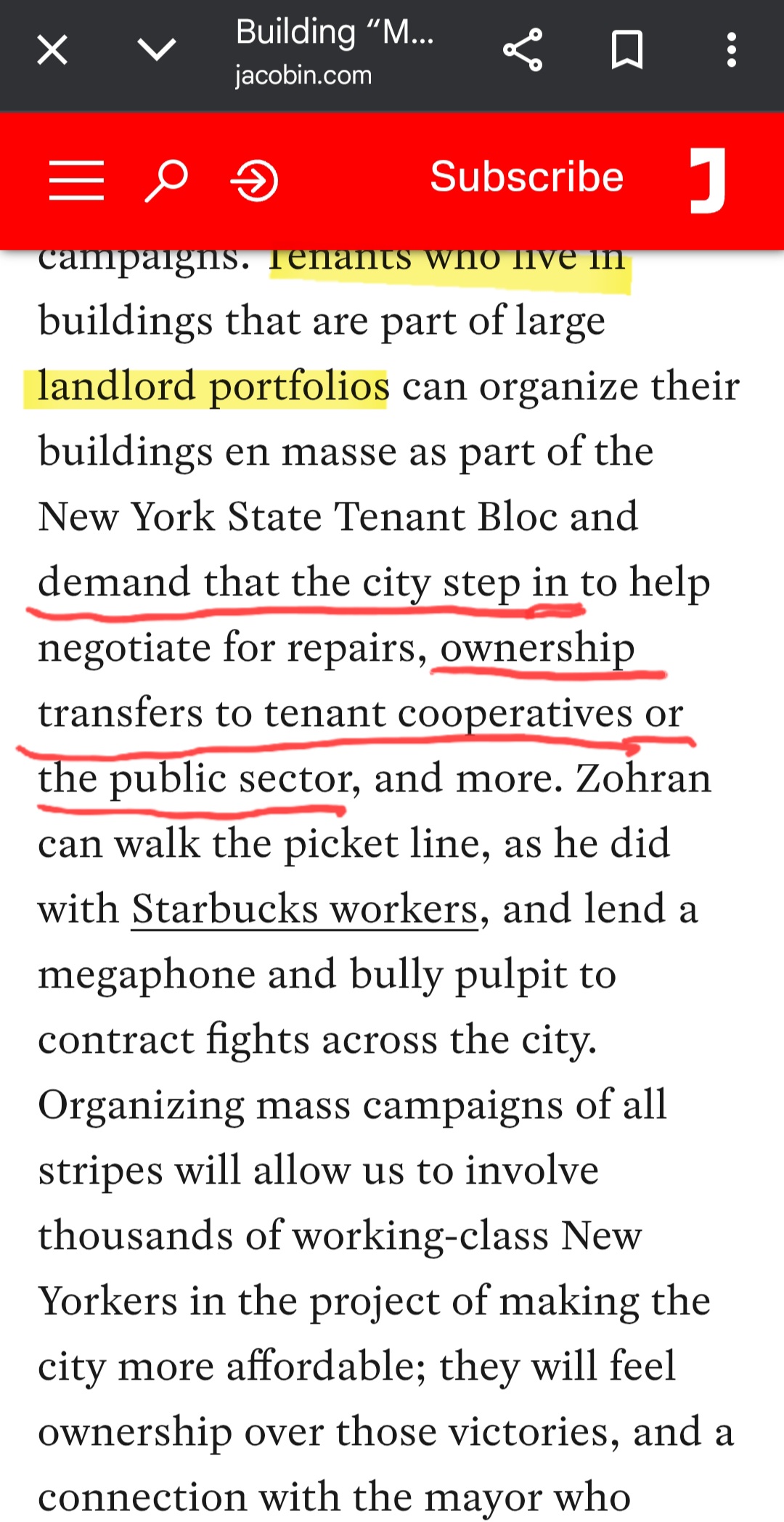
Alt-left magazine Jacobin advocating for government seizure of private real estate with “transfer to tenant cooperatives or the public sector” in January 2026

Jews are often implied rather than named—refigured as landlords, financiers, “Zionists,” or beneficiaries of immoral systems. Jewish capital becomes shorthand for illegitimate capital. The logic is identical: identify a moral contaminant and justify its removal.

Every mass movement needs a villain. The manifesto supplies one.


After Victory: Asset Capture as Governance

When Hamas seized Gaza in 2007, its parallel institutions fused into rule. Aid became leverage. Employment became conditional. Permits learned loyalty.

Then came Hamas’s most consequential real-estate empire: the tunnel network. A vast underground system ran beneath homes, schools, mosques, and hospitals—an invisible city binding the population into the movement’s infrastructure. Security, storage, command, and coercion converged below ground. Benefits flowed to the loyal. Dissent was isolated.

Governance became permanent: mobilization with infrastructure.

The governing theory now circulating in New York mirrors this logic. Mass governance insists movements never demobilize after elections.

Housing is the fulcrum. Advocates call for seizing or socializing rental property, transferring control to movement-aligned entities, and moralizing ownership itself. What cannot leave becomes the lever.

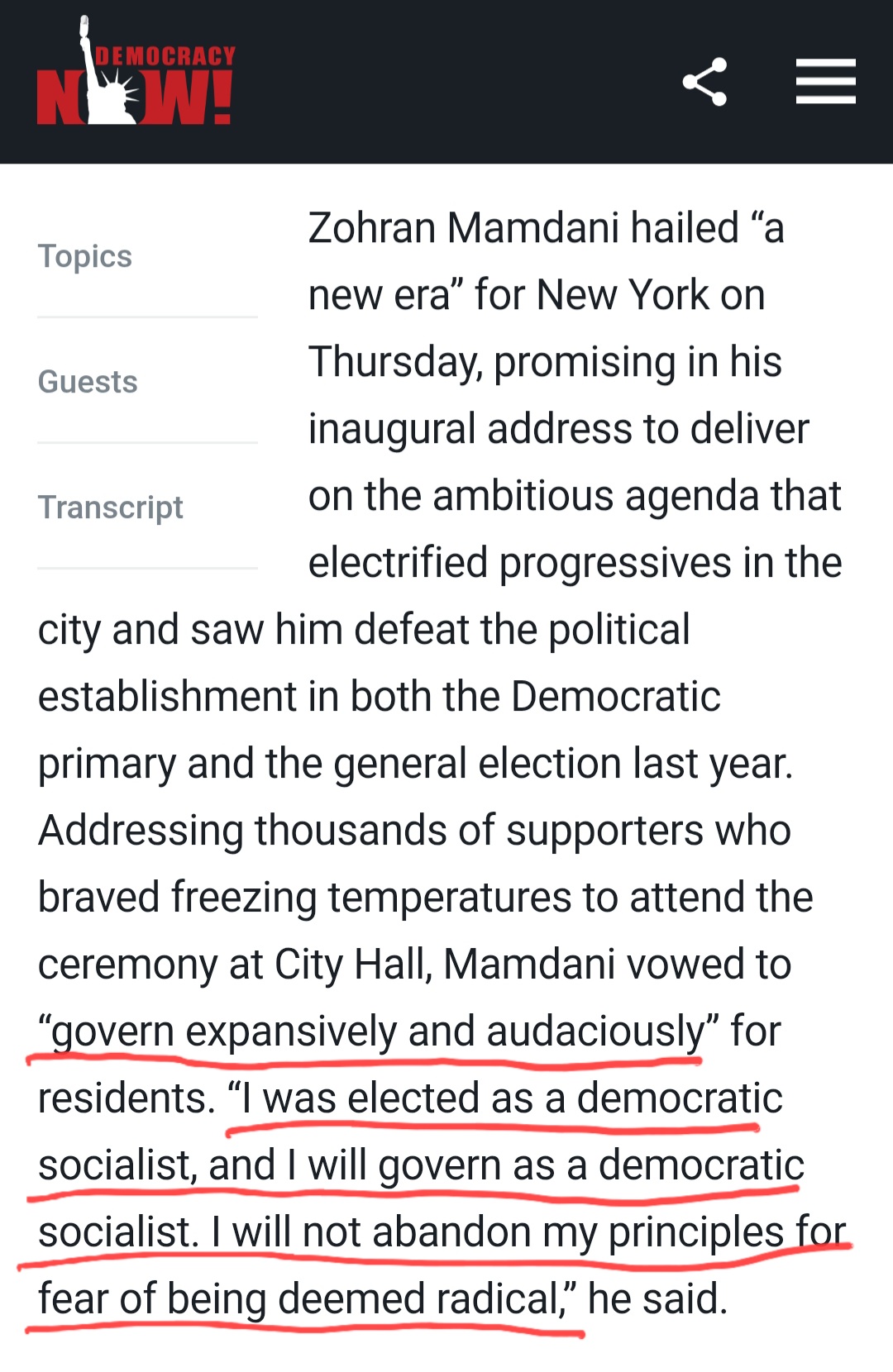
New York City Mayor Zohran Mamdani states openly that he will “govern expansively and audaciously” and not change course for being deemed too “radical.” What was once viewed as crazy is being normalized and soon to be implemented.


Redistribution Without Production

Hamas never built a productive economy in Gaza. It did not need to. External money—almost all of it routed through international “aid”—financed the broken economy. Governance ran on grievance and allocation. The system extracted and redistributed; it did not grow.

The same risk shadows New York’s mass-governance vision. There is no emphasis on productivity, investment, or growth. The emphasis is on free stuff and redistribution from outside: state transfers, federal dollars, and seizing capital from more wealthy citizens. When the mobile capital inevitably leaves, the focus will intensify on seizing what cannot leave: real estate. As jobs and taxpayers depart, redistribution turns inward. Assets are moralized, then absorbed.


The Bigger Warning: This Is Happening in New York

This is not unfolding in a peripheral city. It is unfolding in New York City—the capital of capitalism.

DSA-NYC backed Zohran Mamdani

A redistribution-first governing theology imposed here would not be contained. When growth is dismissed as immoral and allocation is elevated as virtue, capital leaves, talent migrates, and pressure turns inward.

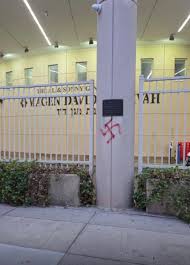
The danger compounds because New York is also home to one of the largest Jewish populations in the world. History is unambiguous: when movements moralize capital and cast Jews—explicitly or implicitly—as its avatars, the outcome is rupture. Flight. Confrontation. Violence.

An antisemitic movement consolidating power beside Jewish life at this scale resulted in the deaths of tens of thousands in Israel and the terrorist enclave of Gaza. It is an impending disaster in New York.

The warning signs are already visible:

  • Meritocracy cast as a fiction
  • Growth dismissed as immoral
  • Redistribution elevated as governance
  • Private property declared illegitimate
  • Pressure treated as legitimacy
  • Protection deemed conditional
  • Jews recast as symbols of theft

Hamas showed the arc in Gaza: from grassroots mobilization plus ideology, to framing the enemy who causes despair, to asset confiscation and control, to an entrenched vicious philosophy financed by redistribution without production.

DSA-NYC is following the same arc, adapted to American law and language.

When the capital of capitalism abandons growth and sanctifies seizure, the city stops creating wealth and starts fighting over remnants.

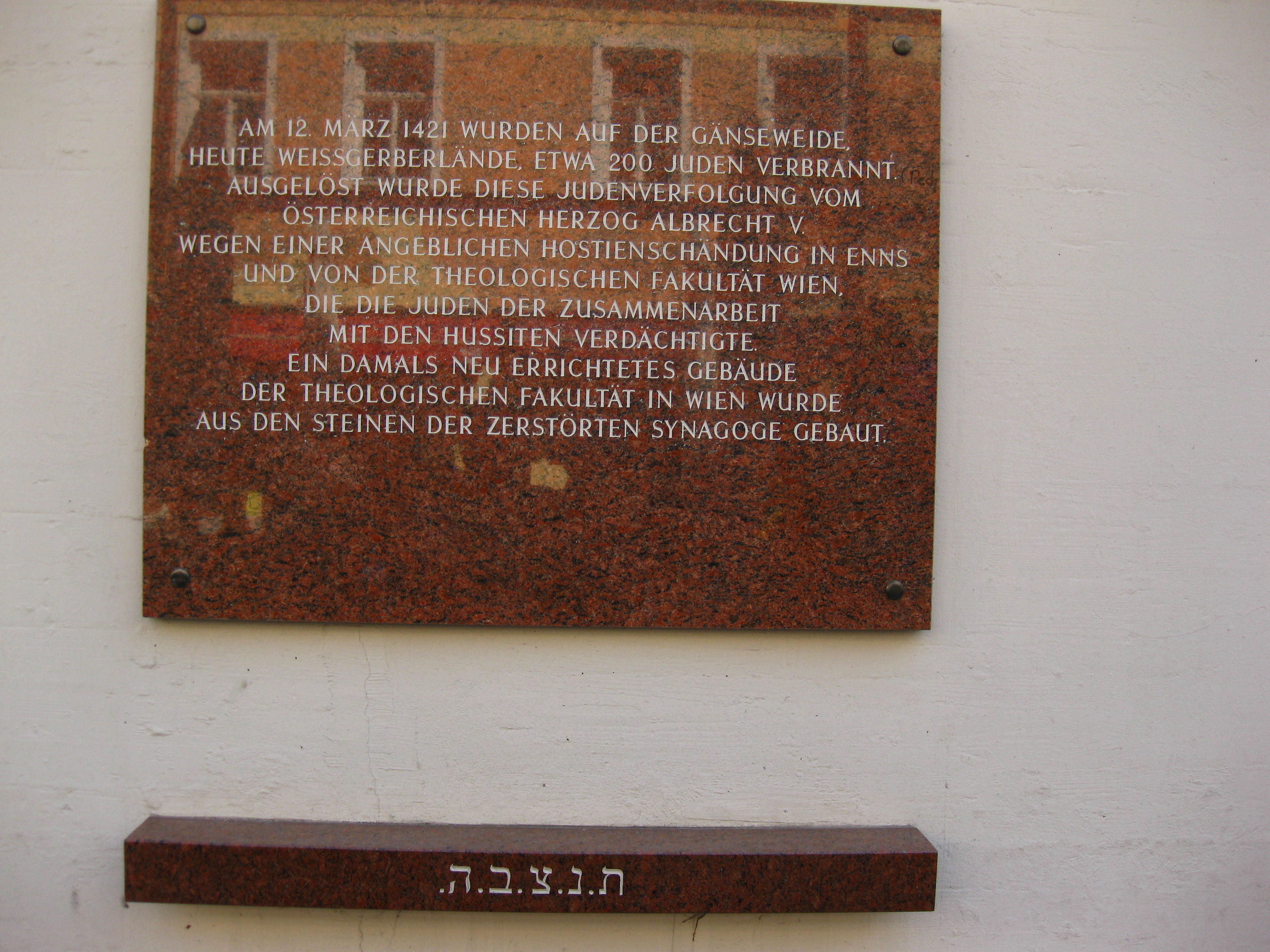
Memorial plaque in Vienna, Austria. In 1420, all Austrian Jews were arrested; 270 were burned at the stake, while the others were expelled and their property confiscated. The Vienna Gesera in 1421 brought the Jewish community in the Middle Ages to a truly bloody end. The root causes were antisemitism mixed with an economic desire to cancel debts.

Virality and Values

There was a time when respect was earned by learning. People who studied hard, accumulated degrees, mastered facts and logic were admired. They didn’t need followers; they had knowledge. They didn’t need virality; they had depth.

That world is gone.

Fame today is not built in libraries or laboratories but in the palm of a hand. A ring light replaces a classroom. A viral clip replaces a thesis. And the more lurid, outrageous, emotional, and dishonest the content is, the faster the fame spreads. The algorithms demand provocation, not proof. They reward outrage, not understanding.

And people are responding exactly as the system intends: they’re dropping degrees, skipping college, deciding that years of expensive education aren’t worth it in a world where clout is free and clicks are currency. AI will write the papers anyway. Tuition is a fortune. Morality is optional. Why struggle through years of learning when you can fabricate a persona, press “upload,” and watch the world react?

For the first time in history, the older generation will have far more education than the young. Degrees are becoming relics. Expertise is becoming an antique. And winning hearts and minds through argument — the old democratic ideal — is becoming a luxury.

Politics is drifting toward the young, the uninformed, the inflamed, the furious, the ones who know how to play the game of attention better than the game of truth.

Hasan Piker doesn’t win debates; he wins followers. Comedian David Smith isn’t famous for jokes; he’s famous for attacking fellow Jews, because tearing down your own people brings clicks in a sick digital economy.


And here is the crisis for the Jewish people: We are the People of the Book trying to survive in a world where books don’t matter. We are a civilization built on reason, argument, text, questioning — and we cannot comprehend why we’re losing the PR battle against influencers who deal only in emotion, rage, and spectacle.

We fight with facts. They fight with feelings.

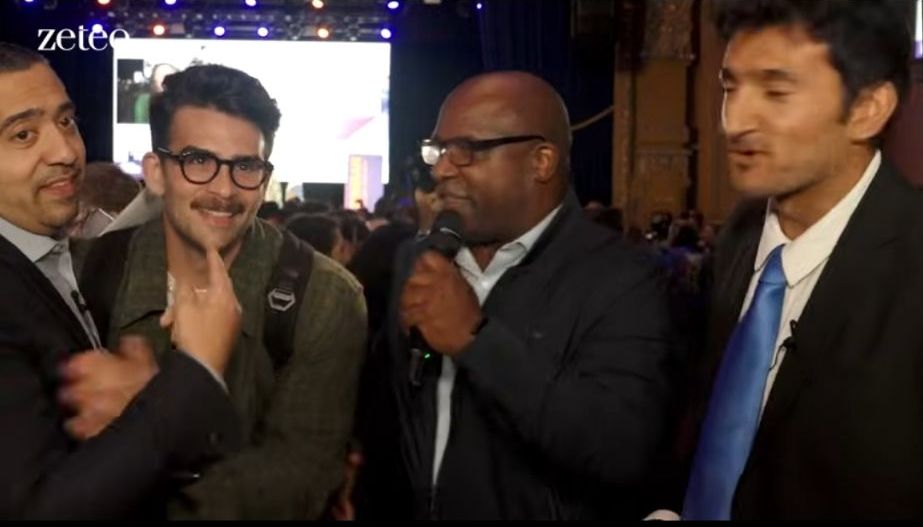
The socialist-jihadi crowd celebrates Hasan Piker showing up at Zohran Mamdani’s victory party

We build logic. They build engagement.

We look for truth. They look for traction.

And so a terrifying question hangs in the air: Must Jews abandon their values to survive? Must we trade nuance for noise?
Must we jump into the sewer of social-media fabrication because that is the only battlefield the world seems to care about? Must we out-viral our enemies just to protect ourselves from the lies, the hatred, and the persecution that spread faster than any truth we offer?

Or is there a third way — a way to fight fiercely without becoming the thing we oppose? A way to compete in the digital arena without destroying the intellectual soul that has kept us alive for 3,000 years?

This is the defining challenge of the modern Jewish experience. Not whether we can win a debate — we always could.
But whether debate still matters.

And if it doesn’t, then the Jewish people must decide how to defend themselves in a world where vanities, not virtues, are the currency of influence.

The People of the Book didn’t choose this kind of world. But we must learn how to survive it — without losing who we are.

From the Merit of the Righteous to the Merit of Evil

Abraham once defended the wicked on the merit of the righteous few. Today, the world defends the wicked for the sake of evil masses.


The Moral Math of Vayera
In Parashat Vayera, God tells Abraham that Sodom will be destroyed for its depravity. The city is beyond saving — cruelty is civic policy, justice a mockery. But Abraham does the unthinkable: he defends the wicked, not because he excuses them, but because he believes that within their city a few righteous might remain.

“Will You indeed sweep away the righteous with the wicked?”
(Genesis 18:23)

Abraham bargains God down — fifty, forty-five, thirty, twenty, ten. If even one percent (population of Sodom estimated 1,000) righteous can be found, the city deserves another chance. Abraham’s plea becomes the Torah’s first moral equation: mercy for the many on the merit of the few. He argues for the wicked because of the righteous – or perhaps for only the righteous to be spared.

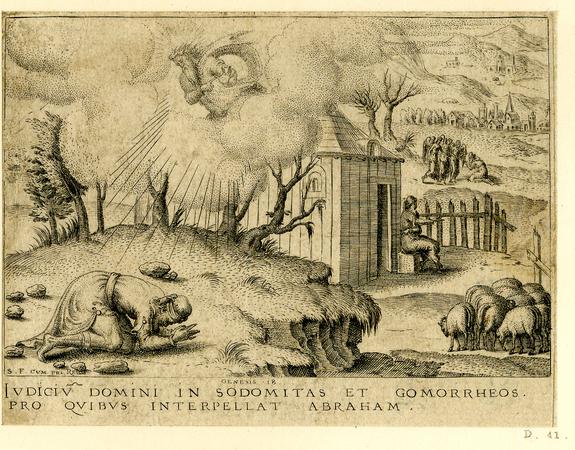
Abraham praying to God on behalf of the residents of Sodom and Gomorrah, by Étienne Delaune (1518-1583)

A Sordid Defense of Evil
Four thousand years later, the moral logic has flipped. After the October 7 massacre — the torture, murder, and kidnapping of civilians — millions marched not to defend the righteous within Gaza, but to defend the wicked who carried out the atrocities. From London to New York, the cry was “Globalize the Intifada.” The United Nations would not even utter Hamas’s name.

They did not plead for ten good souls but glorified evil itself. Abraham argued for the guilty because he believed in goodness; today’s socialist-jihadists argue for the guilty because they despise Jews. That is not compassion — it is moral rot spreading far from the center of evil, infecting universities, newsrooms, and now city halls.

In Sodom’s time, no one defended depravity. Today, Genocide becomes “context.” Rape becomes “resistance.” Decapitation becomes “desperation.” Abraham fought for the 99 percent on the merit of the 1 percent righteous. Now we see millions fighting for the 75 percent wicked, based on the very actions of the depraved.

Nowhere is this clearer than in New York City — home to the world’s largest Jewish community — where activists chanting “Globalize the Intifada” and rape deniers will shape city politics. The descendants of Abraham are mocked as colonizers in their own synagogues and schools.

The Torah is silent on the punishment for those who aid and abet wickedness, but American law is not. The U.S. forbids “material support to terrorism.” Groups like CAIR face renewed scrutiny for Hamas ties; Students for Justice in Palestine has been banned from campuses for celebrating terror. Perhaps the law will finally catch up to those who glorify murder under the banner of justice.

Or New York City’s new mayor will bend and enforce the law to his own tune.

Abraham taught that one may plead for the wicked only on the merit of the righteous — never for the wicked in a moral void. The first is faith and mercy; the second, blasphemy and depravity. Today, we have lost the lesson, a moral stain on this generation.

From Latte Sippers to Street Revolutionaries

Obama’s warning has become the Democratic nightmare in New York City

When Barack Obama commented in 2016 that Democrats were seen as “coastal, liberal, latte-sipping, politically correct, out-of-touch folks,” it was a wink to the party’s reputation — cultured, ironic, and comfortably detached. He meant it as a warning. But nine years later, the call about paying attention to Middle America has become prophecy about the edges. The latte-sippers have soured and radicalized on the coasts.

In New York City, the same college-educated progressives who once debated justice over cold brew now chant “Globalize the Intifada.” State Assemblyman Zohran Mamdani, a proud member of the Democratic Socialists of America, leads the charge. What began as a movement which could generously be described as advocating inclusion and equity has evolved into a campaign to dismantle the American order itself. Mamdani and his allies call for the end of “empire” — by which they mean capitalism, policing, private property, and even the current structure of education and governance.

Obama’s gentle caricature of the latte class — earnest but insulated — has given way to something angrier and openly revolutionary. The Democratic Socialists’ worldview is not about reforming the system; it’s about replacing it. They seek a complete redistribution of wealth and power — not by persuasion, but by restructuring society’s foundations. Police are rebranded as “colonial enforcers.” Public schools become “sites of decolonization.” Private ownership itself is treated as moral corruption. It demands a “new economic order,” “new international solidarity,” “new moral vision,” “new global governance,” “new global organizations,” and a “new political era.”

This is not the politics of compassion, but of confrontation. The privileged class that once signaled virtue with hashtags and slogans now preaches a theology of resentment. They speak of liberation but demand obedience; they denounce power while pursuing it ruthlessly through intimidation and ideology. In the name of justice, they aim to burn down the very structures that made justice possible.

Nowhere is this more visible than in the 2025 New York City mayoral race, where Mamdani and the DSA have moved from campus protests to the ballot box. Their platform is sweeping: defund and “reimagine” the police, end merit-based education, socialize housing, and impose vast new public ownership schemes. It is a manifesto for the redistribution not just of wealth, but of control — from elected institutions to activist networks.

The symbolism is staggering. The city that once embodied liberal ambition — the energy of Wall Street, the art of Broadway, the immigrant striving that defined America — now flirts with an ideology that condemns its own success. From Columbia’s lecture halls to Brooklyn’s activist collectives, the heirs of Obama’s “latte-sipping liberals” now view the American dream as a capitalist fraud.

If Mamdani’s movement captures City Hall, it won’t just transform New York’s politics; it will mark the moment when the Democratic Party’s indulgence of its radical wing becomes surrender. The centrism of Obama and Clinton — built on pragmatism and incremental reform — is being replaced by the revolutionary certainties of those who see compromise as corruption.

Obama once teased his party for sipping lattes on the coasts, detached from ordinary life. Today, those same hands are clenched into fists. The mugs are gone, replaced by megaphones and manifestos. The “latte-sippers” have become the street revolutionaries — no longer content to mock the system, but determined to overthrow it.

As New York teeters between order and upheaval, the rest of the country would do well to take heed — and look right.

ACTION ITEMS

  1. Register as a Democrat – regardless of your politics – in deeply blue cities and towns
  2. Vote – and get out the vote – in the Democratic primaries for moderate candidates. Do not let the DSA take over your town
  3. Vote Republican in the general November election. Keep your city and town from one party rule
  4. Enlist popular moderate politicians to run who will keep the race between two individuals – extremists win in elections with numerous candidates
  5. Local grassroots organization is key. It starts now, not weeks before elections

Look Right

There are signs on the streets of London that read “LOOK RIGHT.” They are painted boldly on the pavement to protect visitors—especially Americans—who are used to glancing left before stepping into the street. In the U.K., traffic comes from the opposite direction, and those who rely on old instincts can find themselves in sudden danger.

So it is now with American Jews.

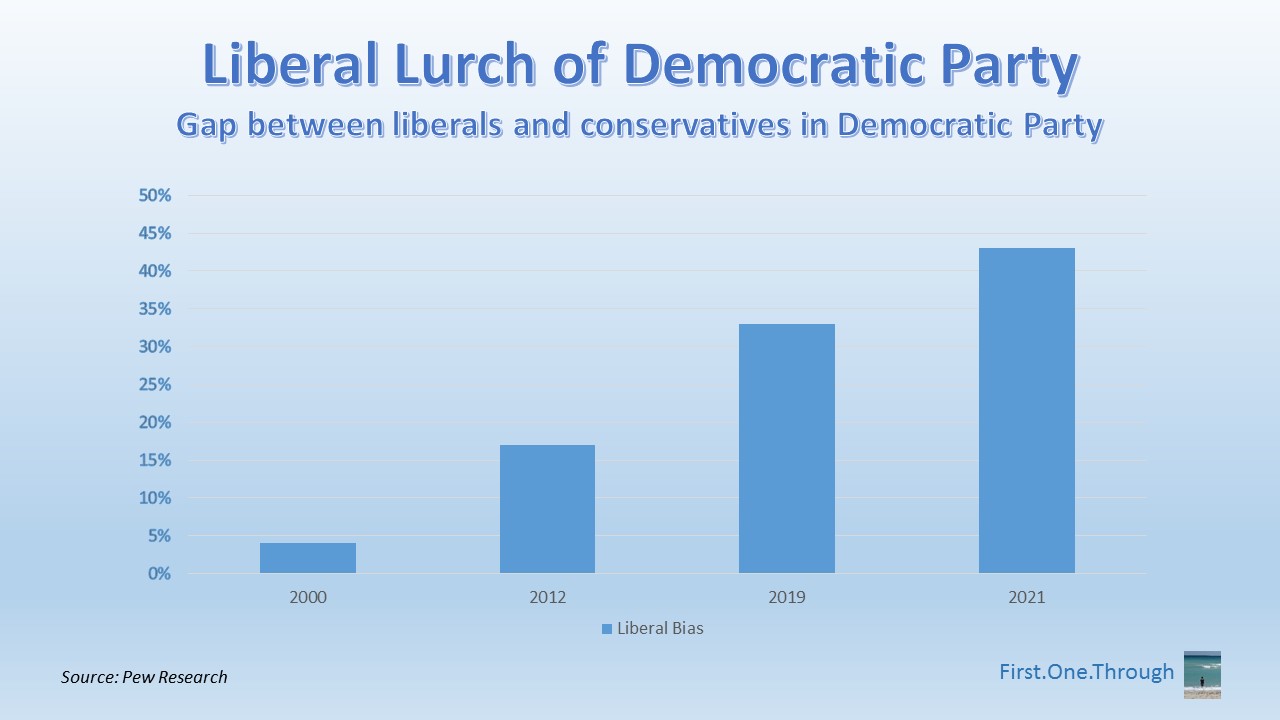
For generations, they have turned instinctively to the Democratic Party—to the left—out of habit, heritage, and a deep belief that liberal ideals best protected minorities. But the political landscape has shifted beneath their feet. The party that once championed freedom, tolerance, and support for Israel has been co-opted by radicals: anti-Israel voices, socialists, and anarchists who now wield growing influence in its ranks.

These are not the Democrats of old. They are activists who view capitalism as oppression, who denounce Israel as colonial, and who see Jews not as a vulnerable minority but as part of a power structure to be dismantled. They are coming for capitalism—and for the Jews who helped build and sustain it.

This election, American Jews must recognize that the public square is not what it used to be. The political traffic now comes from the right direction—but the danger comes from the left.

Times have changed. Look right.

Above and Below the Line

Jews Must Rise Above America’s Political Polarization

For Jews, the political spectrum no longer runs right or left — it runs above and below the line.

America once resembled a bell curve, a society centered in moderation. But over the last decade, that middle has collapsed into a barbell nation, with weight piling up at the extremes. And history has shown: whenever societies polarize, Jews suffer at both ends.

On the left, antisemitism festers in universities and coastal enclaves, driven by a socialist–jihadi alliance that paints Jews as colonial thieves and privileged elites. On the right, particularly across America’s heartland, antisemitism takes the form of nationalist resentment, depicting Jews as cunning manipulators steering the country toward decay.

The Jewish community now faces hostility from Justice Democrats and the Democratic Socialists on one side, and Christian nationalists and conspiratorial populists on the other. As America sorts itself into partisan tribes, Jews are politically homeless — stranded in what might be called Team White, surrounded by Red and Blue armies locked in mortal combat.

It is a moment that demands clarity:
Jews must not follow the crowd, nor celebrate the likes of Zohran Mamdani or Marjorie Taylor Greene simply because they shout loudest. Safety will not be found at the edges.

NYC mayoral front-runner Zohran Mamdani with the extremist group Democratic Socialists of America

Instead, Jews must think on the Y-axis and rise above the line — where decency, truth, and moral courage define political identity, not the toxic binaries of today’s discourse. The task is to build bridges among the decent left, right, and center, and to undermine the machinery of polarization itself.

That begins with the primary system, which rewards extremism and punishes moderation. Jews — and all who value stability — should register with the majority party in their region to vote for moderates in primaries, then vote for the opposing party in the general election to restore balance. The goal is not partisanship but preservation.

There is more to do:

  • Be counter-algorithm. Social media algorithms are built on inflaming passions and feeding extremism. Get kids away from social media including banning phones in schools. Encourage people to spend less time on the platforms or to promote moderate posts.
  • Invest in institutions that elevate, not inflame. Support schools, media, and synagogues that model dialogue over division.
  • Be models of decency. Civility is countercultural today — make it contagious. Argue without anger, engage without hatred, and remind others that moral clarity does not require moral superiority.
  • Rebuild community and trust. Host conversations, bridge gaps, and welcome allies who differ politically but share ethical ground. Strength grows in connection, not isolation.
  • Be proudly above the line. Celebrate being moderate, balanced, and reasonable. The middle is not weakness — it is wisdom earned through restraint.
  • Expose extremists, even within. Call out the Jewish radicals who justify Hamas and the October 7 pogrom, as well as those who echo conspiratorial nationalism. Moral consistency demands internal accountability.
  • Teach Jewish ethics loudly. The Torah’s call to pursue justice and peace should echo in civic spaces — as a guide for repairing the world, not tearing it further apart.

A polarized society is a society on edge — brittle, unstable, and eager for scapegoats. Extremists will portray Jews as symbols of what’s wrong, a convenient vessel for resentment. As a minority-minority, Jews become easy targets when the center collapses.

The survival of the Jewish people in America depends not on joining the mobs below the line, but on lifting others above it — where truth, civility, and unity still have a fighting chance.

New Yorkers Must Register Democrat and Vote Republican

To watch a political novice backed by a far-left extremist group rise to the brink of becoming mayor of the largest city in America is frightening enough. To realize that he will have the full backing of a Democratic governor and a compliant state legislature to enact his radical agenda is terrifying. Zohran Mamdani, a darling of the antisemitic Democratic Socialists of America, has weaponized a friendly smile and promises of “free” everything into a populist movement ready to capture real power.

The race is effectively over. The weakness and fragmentation of his opponents make his November 4 election almost certain. But that does not mean New Yorkers are powerless. Far from it.

1. Register Democratic — and block the radicals.
While national elections generate headlines, your single vote barely registers on a national scale. Local elections, however, can be swung by a few hundred ballots. In a deep-blue state like New York, the real election is the Democratic primary. That’s where the socialists gain power — because moderates stay home or remain registered as independents. If you want to stop extremists from running your city, county and state, you must register as a Democrat and vote against the zealots in the primaries.

2. Vote Republican in the general election — everywhere.
Even outside New York City, every voter can help slow the DSA’s march. New York State operates under a blue-wall trifecta: a Democratic governor and supermajorities in both the State Senate and Assembly. Republicans have no effective voice. Governor Kathy Hochul’s open endorsement of Mamdani means his far-left policies will move through Albany unchecked unless the state’s Republican vote share grows.

Far-left media Jacobin advances “to govern, the Left needs many Zohrans.”

So yes — in this strange political moment — the smart play for moderates and centrists is tactical: register Democratic to stop radicals in primaries, and vote Republican to blunt their power in office.

If New Yorkers don’t act now, the most radical city government in America won’t just run New York — it will set the agenda for the entire country.

Ackman: Buy Cuomo And Sliwa, Not Votes

Billionaire Bill Ackman – and millions of other New Yorkers and Americans – are appalled at the victory of Democratic Socialist Zohran Mamdani in the Democratic primary for mayor of New York City. Ackman has been vocal about an anyone-but-Mamdani campaign and willingness to put millions of dollars behind a new candidate to run against Mamdani in the general election. He’s even asked Andrew Cuomo to drop out of the race while endorsing Mayor Eric Adams.

That’s not the way politics works.

Politicians run for office. That’s what they do. They don’t care about what millions of people want outside the framework of what it means for them personally. They don’t run for office for you any more than teacher unions work for students. Each is selfish and looks after themselves.

Ackman, realizing the flaw in the logic of adding yet another person into the race, announced that he is going to back Eric Adams, sort of like Elon Musk’s backing of Trump for president: a billionaire backing an incumbent with baggage.

Unsurprisingly, Cuomo said that he is not dropping out of the race, and President Donald Trump said Cuomo should stay in the race. A recent poll has Cuomo ahead of both Adams and Republican Curtis Sliwa. Yet Ackman seems to think that money alone can turn the tide towards Adams.

In the multi-horse race and deeply Democratic city where people instinctively vote for the Democratic candidate regardless of who it is, Mamdani is likely to win in November.

Backing Mamdani is the alt-left who use Ackman’s comments to rally their comrades. Democratic Socialist Sen. Bernie Sanders who thinks that capitalism is evil, sees this as yet another manifestation of it: people with money can run the table and buy the votes – and everything else that non-rich people have.

The correct play for Ackman is to buy Cuomo, not New Yorkers. Promise Cuomo some board seats in companies or other plum positions. Adams can win in a less crowded race but not with Cuomo still running, regardless of how much money backs Adams.

People – rich and poor – only have a single vote and millions of dollars cannot change that. Money can assist in getting out the vote, an important dynamic but not decisive for all of the candidates. Millions of dollars poured into Mamdani’s campaign from bundlers and via George Soros’s network of socialist charities like the Open Society Foundations (212-548-0600), which were effective in getting out the vote in the primary. Ackman money would have similar benefit but not enough.

In this race, the millions to be spent by anti-Mamdani people will only guarantee that Mamdani wins a plurality of votes but below a 50% majority in a crowded field. He will still become mayor.

ACTION PLAN

It is time for influential people to encourage Cuomo to accept another exciting position to drop out of the race for selfish, not benevolent reasons. Saving New York may depend on it.

Organize the vote. Make sure that older New Yorkers get to vote early.

Related:

From Vienna to Queens: Karl Lueger, Zohran Mamdani, and the Politics of Polite Antisemitism (June 2025)

Make New York Bankrupt Again: The Danger of Mamdani and 21st Century Socialism (June 2025)

DSA Goes Full Antisemite (July 2024)

Who’s Afraid Of Superman?

The newest Superman movie incarnation is out and critics and journalists have grabbed a pen even before a seat. Their reflections on modern society will inform how they view the characters and plot more than the cinematic quality of the film.

An interesting take was made in The New York Times opinion section called “My Problem With Superman.” The guest essay was written Junot Diaz, an immigrant from the Dominican Republic who teaches creative writing at MIT. One would imagine the story of Superman would resonate with this first generation immigrant but Diaz makes clear that he never liked Superman as originally presented to the world.

He recognizes that Superman was brought into the world as a story of a foreign refugee who escaped his dying world, something with which he should be able to relate. Diaz is well versed in the storyline in which Superman’s powers were used to fight for good in a mad world.

Yet it does not resonate for him. Not through his eyes when he was young, nor in looking at society today.

Because for Diaz – and possibly (presumably?) many immigrants like him, Superman is a force unlike any around him, a body of permanent power inequality. He might be a refugee but the dynamic is irrelevant in a progressive worldview obsessed with inequalities and power.

In today’s environment, Superman is internalized not as an individual but a nation. For Democratic-Socialists, the United States is not a “shining city on a hill,” but a monstrous force convinced of exceptionalism which wreaks havoc on the Global South.

Diaz article in The NY Times “My Problem With Superman”

In this mindset, the “annihilating exceptionalism” of power IS the evil. It is neither a force for good nor an aspiration or inspiration. It is an unnatural entity in a society intoxicated by a mission of massive redistribution of wealth and power.

Diaz makes his point clear, quoting Frederick Douglass in a call for a revolution of “fire, thunder and earthquake” to mobilize a nation of people to combat the “world in peril” from a sick governmental order.

Diaz article in The NY Times “My Problem With Superman”

The citizens of Metropolis are voting for Democratic Socialists like Alexandria Ocasio-Cortez and Zohran Mamdani who believe that “billionaires shouldn’t exist.” Exceptionalism is viewed as inherently racist and/or enabled by a society which is deeply corrupt. Capitalism is tarred as deeply unfair. All of the power structures are fair game for targeted assassination – whether political, financial or moral.


Superman – and many of the superheroes of the era like Spiderman, Captain America and Batman – were created by young Jews before the start of the World War II and the Holocaust of European Jewry. They were young immigrants who wanted to survive in a world which had cast them out and marked them as forever different. The creators of these superheroes wrote stories of good defeating evil in a world which saw little support for the underdog. Evil was everywhere, and the only way of balancing the world between sparks of good and an inferno of evil was to oversize the good. Good needed to be extra – extra-powerful, extra-moral, and yes, extraterrestrial – to gain the upperhand.

That narrative spoke to Americans watching Nazi Germany incinerate Europe. It continued to capture the West’s attention in the following decades.

But now?

Much of the world is not looking at morality in the plain sense of the last generation. It is defined first – no, only – by equity. In this framework, without a balancing of power and wealth there can never be a good society. DEI (diversity, equity and inclusion) for progressives is the only solution, and a nation which strips those initiatives is attempting to install a permanent dynamic of inequalities. Democratic-socialists are seeking to dismantle such America via a revolution of the masses.

The two Jewish writers and illustrators who created Superman – Jerry Siegel and Joe Shuster – might be amazed that their creation finally has a Jewish actor, David Corenswet, playing the part in a major movie. If alive today, they might imagine that such milestone would mark a blessed society which finally welcomed the stranger, the immigrant, the survivor of the destruction of his old world. Embraced him as someone kind and noble who fought for justice for all.

David Corenswet as Superman

Alas. Imagine their amazement, the horror, if they could time travel to today, to see the target audience for their stories – immigrants in America – turn on Superman as a grotesque to be liquidated. Not because of White nationalism of Nazism that they faced a hundred years ago, but for the sin of exceptionalism in a society hell-bent on equity.

Related:

The Disappearing Jew (July 2024)

Now Is The Time For Sabra, An Israeli Superhero, To Join Captain America (October 2022)