A Muslim who visits Mecca is called a Hajji. It is one of the highest honors in Islam, the completion of the Hajj pilgrimage, celebrated by family and community as a sacred accomplishment.
A Catholic who travels to the Vatican is a pilgrim. For centuries, the faithful have journeyed to Rome, walking into St. Peter’s Square with reverence, greeted with blessing and legitimacy.
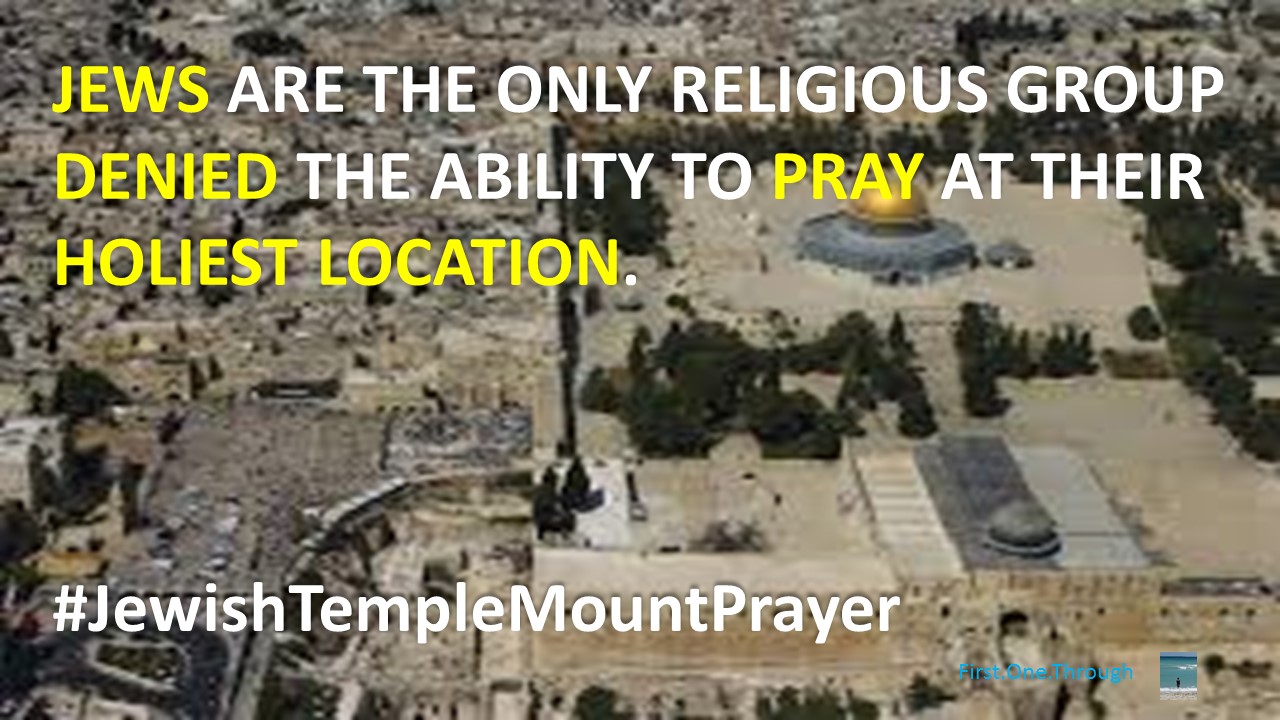
And a Jew who goes to the Temple Mount in Jerusalem — the very place where the First and Second Temples once stood, the holiest site in Judaism? That Jew is branded a provocateur. Not a pilgrim, not a worshiper, not a faithful soul ascending to pray — but an instigator, an agitator, an accused trespasser, a “settler” on their own sacred ground.
The disparity could not be starker. What is celebrated as devotion for others is condemned as incitement for Jews. For Muslims, the Hajj is a right; for Catholics, Vatican pilgrimage is honored; but for Jews, even quiet prayer on the Temple Mount is labeled an offense — by the United Nations, NGOs, and international bodies.
It is not only hypocrisy; it is erasure. To deny Jews the name of pilgrim is to deny Jewish history, Jewish identity, and Jewish legitimacy. It casts the holiest place in Judaism as alien to Jews themselves, a desecration of memory turned into policy.
And why? Because the world has normalized the jihad. It has allowed Islamic Supremacy to dictate permissible behavior, even in the Jewish holy land.
The truth is simple: a Jew ascending the Temple Mount is not incitement. It is the most ancient pilgrimage of them all — the echo of three millennia of devotion, commanded in Torah, rooted in covenant, and carried in every prayer whispered toward Jerusalem, before Islam was even created.
The real provocation is not the Jew who prays on the Temple Mount but a world that dares to tell Jews they don’t belong at the center of their faith.
ACTION ITEM
Come to the United Nations in New York City and demand Jewish rights and freedom of religious assembly in Jerusalem.
In biblical times, after the Great Flood destroyed the known world, mankind responded not with humility but with defiance. They sought to raise themselves above God’s wrath, building the Tower of Babel as a monument to their own power, reaching for the heavens.
Centuries later, as the Great Depression ransacked America, another tower began to climb skyward. John D. Rockefeller, the oil titan turned philanthropist, commissioned an audacious complex in the heart of Manhattan. Out of the rubble of despair rose Rockefeller Center, a collection of soaring structures anchored by “30 Rock,” a 70-story monument of steel and stone.
Construction workers having lunch as they build the RCA Building in 1932
At its entrance, the vision was chiseled into eternity: “Wisdom and Knowledge shall be the stability of thy times” — the words of Isaiah engraved above the door. Flanked by sculptures representing Light and Sound, the building proclaimed its purpose: to be the voice of news and entertainment for the world, a modern temple to information and culture.
Sculptures atop the main entrances of 30 Rockefeller Plaza(photo: First One Through)
Yet curiosity lingers when one gazes up at that famous inscription. The line from Isaiah 33:6 was never meant to stand alone. The full verse concludes: “…and the fear of the Lord is his treasure.” But that final clause was deliberately omitted. The builders sanctified wisdom and knowledge, but excised God. The omission transformed Rockefeller Center into secular scripture, elevating man’s wisdom over divine truth. For nearly a century, the complex stood representing a modern Tower of Babel: a singular voice beaming news, culture, and entertainment to a world tuned to one frequency.
Sculpture above doorway of 30 Rockefeller Plaza (photo: First One Through)
But the world has shifted. The authority of a single edifice has collapsed. The pandemic pulled workers from office towers into spare bedrooms and kitchen tables. The internet, social media, and ubiquitous cell phones scattered the once-unified audience into billions of isolated “my-truthers.” The great tower that once declared itself master of wisdom and knowledge no longer reigns over truth — or even news. Instead, we have a digital cacophony, a post-Babel of infinite voices, each one clamoring for relevancy.
In the ancient tale, God looked down upon Babel, saw mankind united in defiance, and scattered the people with a confusion of tongues. It was divine intervention that broke apart the human project. The modern incarnation lacks lightning bolts from the heavens with thunderous judgment. The fracture came from within. By sanctifying ourselves over the divine, the builders enshrined wisdom and knowledge as supreme — and in so doing, they planted the seeds of our undoing.
Even in scattering, the ancient world retained stability. Though tongues differed, mankind still clung to faith. Out of the dispersion of dialects came hundreds of religions, with Abraham’s radical monotheism, affirming that there was one God who bound the human family together, at its heart. In contrast, modern society’s disdain for God has left us truly unstable. We do not scatter into tribes of belief but dissolve into atomized individuals, each enthroning himself as arbiter of truth, each rejecting the notion of any higher authority.
There is no “stability of thy times.”
As Lord Jonathan Sacks once observed, “If you want to take this diverse, fractured culture and turn it into a united nation, you have to get them to build something together.” Culture is not born of proximity but of purpose. Yet even that is not enough. For building without faith leads only to another Babel — a project that may rise high but will ultimately fracture under the weight of its own pride.
Our ancestors knew this instinctively. They struggled, they questioned, they even quarreled with God — but they never erased Him from the story. Faith provided the mortar that held their collective together. In contrast, our age has celebrated knowledge while amputating belief, enthroning technology while dismissing transcendence. We build networks instead of communities, platforms instead of sanctuaries. And without faith, what we construct collapses into confusion, as surely as Babel once did.
A Way Forward
The modern Tower has already cracked. Today’s Titans do not build skyscrapers broadcasting monoliths of truth but platforms and algorithms addicting both tweeter and tweeterdom. We live in a splintered archipelago of isolated truths. To endure, we must restore the missing half of Isaiah’s wisdom. It is time to harken to Isaiah’s full words and engage with humble faith together with wisdom and knowledge, so that we may yet build a more perfect union.
Perhaps an answer for us today is not chiseling new words above our heads into the stone of Rockefeller Center to amend the verse. The real task is closer to home. Each of us can sanctify our own entrances with God’s presence. A mezuzah affixed to the doorpost — of a house, an apartment, and our workplaces — serves as the quiet reminder that wisdom and knowledge alone are not enough. It is God’s presence within that provides the stability of our times. Where the tower excised Him, the mezuzah restores Him. And if enough doorways bear that mark, perhaps our fractured society can yet rediscover a shared foundation.
30 Rockefeller Plaza at night, September 2025 (photo: First One Through)
The sound of the shofar is meant to pierce the heavens. Sometimes the shofar’s story pierces the heart.
I remember coming home one day to find my son in tears. His beloved shofar — a gift from his grandfather — had been chewed by his dear dog. The horn was mangled beyond salvation. I carried it to the rabbi in desperation, asking if it could be saved. Perhaps the mouthpiece could be trimmed…. Alas, it could not, and I never saw it again.
My father had given it to him not long before, teaching his grandson how to coax sound from its ancient curves in preparation for his bar mitzvah. That shofar, which transitioned from a smooth polished mouthpiece to a rough and natural opening, was more than bone and horn — it was a link between generations.
My father bought my son a new shofar and continued to teach him how to blow. He was there on the bimah as my son blew it proudly in Jerusalem on the first day of Elul for his bar mitzvah. I took in the special moment, and also considered my son’s previous shofar that was not there. Even more, the profound emotion of a young boy torn at losing his grandparent’s bar mitzvah gift – to a dog whom he also loved, who was just being a dog. The gathered family and milestone in Jerusalem were the key celebrations of the day, but recalling my son’s well of tears months earlier over this moment which may not have happened, enriched it.
My father’s own shofar has a different story. He blew it for decades in his shul, year after year, his steady blasts calling our community to repentance. Eventually the horn began to crack, to dry, to lose its voice. He gifted the treasure to me some years ago, and I have placed it on my living room mantle, its curves still beautiful though its sound has fallen silent.
This year, my father — approaching 90 — will not blow the shofar. While he’s strong enough to walk to synagogue, some health issues will keep him from the bimah as he has done for as long as I can remember. The body ages. The shofar ages.
There are shofars that pass through the generations, blown by grandparents and great-grandparents a hundred years ago and still blown today. They carry not just sound but touch — the hands that held them, the lips that pressed them, the prayers that filled them. In many ways, these shofars still live.
We think of the shofar as the instrument through which we hear God’s call on Rosh Hashanah. It is the vehicle – and the subject. The shofar itself has its own biography. Some are placed on mantles, mute witnesses to decades of service. Some are destroyed, leaving only the memory of their sound. Some are retired to museums as quiet curiosities.
As we enter a new year, I think of two particular shofars in my life — one that I can no longer see, one that I can no longer hear — and of the special people who breathed life through them whom I am blessed to still hold and cherish. These horns, like us, are finite. But their stories resound forever, calling us to remember, to connect, and to pray for many more years of holding them and each other as a family and community.
“What starts with the Jews doesn’t end with the Jews.” We are watching that adage unfold in real time.
Seven hundred days ago, way too many people in western cities took to the streets and shredded the faces of Israeli hostages taped to lampposts. Those faces were voices, each one a witness, a story, a plea — and that is precisely why some felt they had to be destroyed. It wasn’t enough to ignore them; they had to be erased, obliterated, so that the public would never be confronted by their humanity.
So it was with the assassination of Charlie Kirk. They didn’t just want his opinions silenced — they wanted his existence blotted out. His death was a warning to anyone who shared his worldview: you will not be allowed to speak, and if you persist, you will suffer.
This is not merely a campaign against perceived bad ideas — it is a maximal campaign against the people who hold them. They want Israel destroyed, and they want those who support Israel to feel pain. They want conservatives destroyed, and those who think like them to live in fear.
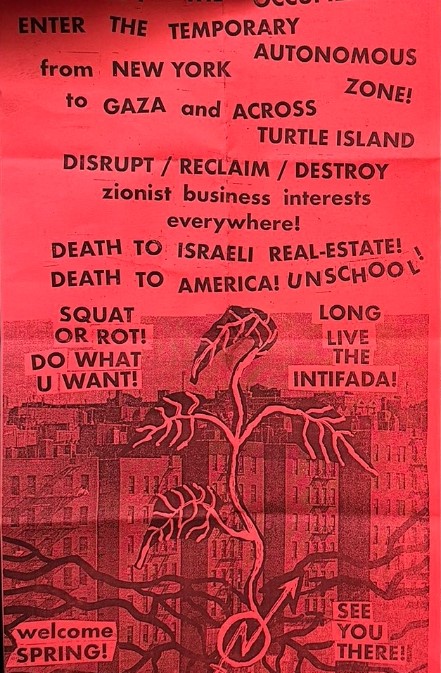
This is not free speech but a purge. It is a revolution that calls itself “good trouble” but wields the club, the knife, and the guns to bring the “intifada” to the west.
The secular left has adopted an “Islamonormative” framework. It treats the faces of Jewish hostages like drawings of Mohammed, punishable by erasure, and treats conservative talking points as blasphemy, punishable by death. This is not debate — it is jihad.
America is not just losing empathy for hostages nor tolerance for opposing ideas — it is learning to enjoy their destruction. The mob laughs as the faces are ripped down, cheers as the dissenter is silenced. America’s youth are being groomed to take pleasure in erasing the unwanted. Once that appetite is formed, it will not stay confined.
The spectacle of the auto de fe is slowly coming to America as society moves from speech to speakers. To infidels.
Jews have long been the most persecuted and hunted people in the world. Now, religious conservatives are becoming new Jews as the secular crusade vilifies their beliefs.
Ten years ago they came for blasphemers at Charlie Hebdo in France, and expanded their jihad to nearby Jews (read “random folks” by US President Obama). World leaders marched arm in arm that they would not be silenced. Now they offer to lie Charlie Kirk’s body at the U.S. Capitol building, in a sign of respect and a nation that remained unbowed. Gestures.
But the voice of the Jew, the face of the Jew, and the Jew himself are one and the same. People believe The Jew is targeted in isolation; that his situation is unique. A dynamic that will not pierce the majority. Until they realize that it has.
The drip of antisemitism infiltrates society and corrodes it from within, an insidious jihad. Stealthily, it kills morality and sanity. Alas, it is too subtle to recognize as a macro threat until it is a stage four tumor that has ransacked the body politic, then unable to proffer basic protection for the masses.
When the Torah commands the farmer to bring his first fruits, it does not let him talk about his soil or his labor. Instead, the ritual begins: “My father was a wandering Aramean…” (Deuteronomy 26:5) The commentators note that gratitude is not complete without memory. To thank God for the harvest, one must first recall that the Jewish story began in exile and slavery. Only against that backdrop does the basket of figs become miraculous.
Later in the same parsha (Deuteronomy 28:4), the Torah turns to blessings and curses. If Israel listens to God, “Blessed shall be the fruit of your womb, the fruit of your soil, and the fruit of your livestock.” If not, those very fruits will wither. Here too, fruit is not agricultural output — it is covenantal currency.
Put together, the two passages form a cycle. The first fruits ceremony roots gratitude in memory: remember that you were once landless and fruitless. The blessings and curses tie the future of fertility to obedience: remember that your continued abundance is not guaranteed.
And notice where this all happens: Jerusalem. The farmer did not simply thank God in his vineyard or whisper gratitude in his kitchen. He carried his produce up to the city, presented it at the Temple, and declared his history publicly. Jerusalem was not just a capital; it was the beating heart of Jewish memory and faith. The fruits gained meaning when they were placed before God in the city chosen for His name.
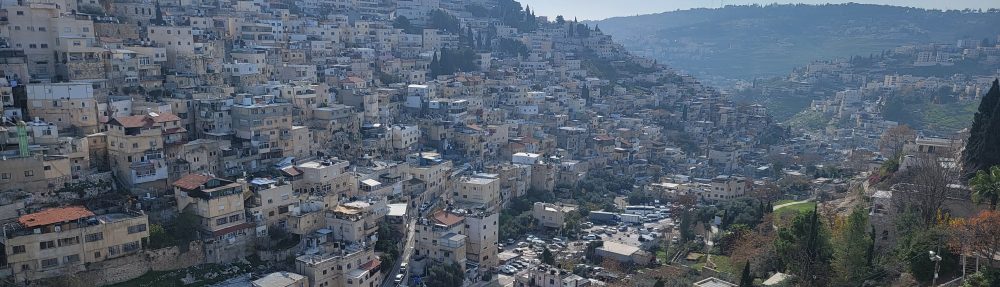
The Old City of Jerusalem including the Jewish Temple Mount
This is why the prophets, the rabbis, and Jewish history itself encircle Jerusalem. The city is not peripheral to Judaism — it is central. It is where private labor becomes national testimony, where agriculture becomes covenant, where the wandering Jew becomes rooted in a people’s eternal home.
To this very day, Jews sing at their wedding the verses of Psalms 137:5-6: “If I forget you, O Jerusalem, let my right hand wither; let my tongue stick to my palate if I cease to think of you, if I do not keep Jerusalem in memory even at my happiest hour.” Jerusalem is bound in memory, that same memory that reminds us of our history, our promise, our obligations.
Today, too, the Jewish people encircle Jerusalem. Jews bring their “first fruits” to the city not only in the form of produce, but through aliyah, prayer, innovation, and sovereignty. Just as in ancient days, the city transforms personal blessings into collective covenant.
And yet, the world still questions that rootedness. Governments refuse to recognize Jerusalem as Israel’s capital. Diplomats condemn the building of homes in areas like E1 — the very corridor that links Jerusalem to the rest of the land, enabling Jews from north, south, east, and west to come to their eternal city.
Ki Tavo reminds us that Jerusalem cannot be negotiable. To encircle it, to build in it and around it, is not a matter of politics but of foundational principle. Without Jerusalem at the center, our fruits risk becoming mere produce, and the people risk becoming wanderers once more.
The activists have long been screaming and yelling. They’ve been heckling in person and posting online. Yet nothing changes. The mob is impatient.
They’ve held conferences in Detroit, banged drums in the street, organized sit-ins and campus walkouts. Yet few of the policies they demand have been enacted. The mob is impatient.
The crowds find succor online. They read the manifestos of both killers and their favorite radical group. The hashtags keep trending, the slogans keep coming — yet the news cycle feels the same. The mob is impatient.
They interact with their heroes on social media. It feels like they have a direct connection in their hands and ears. They know the message. They know the orders. Doesn’t everyone? Where is the revolution? The mob is impatient.
It is easier to complain than to enact. It is quicker to destroy than to build. It is more satisfying to heckle than to speak clearly. To tweet and reteweet than to contemplate and deliberate. The mob is impatient.
The last ten years have proven that anyone can gain fame — or infamy. The louder and more outrageous, the greater the clicks. The calls to fellow travelers echo louder and the ranks grow. Not over years, but instantly. The mob is impatient.
Democratic Socialists for America stating that there are no innocent civilians
Political violence is not new. Presidents and senators have been assassinated before. But today, an army of lone soldiers is running toward their neighbors — convinced by the pandemic that everyone is a threat and trained by the Twitterstorm that outrage works.
The mob is impatient.
And, as it grows larger and closer, more people are turning to guns for self-defense. They see a government that appears weak, unable or unwilling to confront the rage.
The next step has arrived. The broken healthcare system was not addressed via advocacy but a bullet into the back of the CEO. To cheers. A splinter group from Jewish Voice for Peace has birthed a new violent Antizionist Jewish Student Front. When debate failed, when they could not best Charlie Kirk on the stage, they decided to silence him permanently. The People’s Conference for Palestine and the DSA have given them the language, the chants, the charge: Escalation.
A polite society is a beautiful thing when at peace. But politeness collapses when mobs take power. When debate is replaced by doxxing, when protest becomes arson, when manifestos become murder plans — the social contract frays. If the state cannot protect citizens from ideological violence, people will arm themselves and take matters into their own hands.
The question is no longer whether our institutions can withstand the mob — but whether they will act before the mob makes the next move, or allow a societal “resistance” movement to rise to replace dormant laws to revive trampled norms.
Conservative commentator Charlie Kirk was assassinated today while he spoke with college students in Utah. The killing was yet another sad marker on the collapse of American society. The comments about his murder were much the same.
The left-wing media at MSNBC essentially said that he deserved it with Matthew Dodd saying “He has been one of the most divisive figures … who is constantly sort of pushing this sort of hate speech aimed at certain groups. And I always go back to hateful thoughts lead to hateful words which then lead to hateful actions, and I think that’s the environment we’re in. You can’t stop with these sort of awful thoughts you have and then just saying these awful words and not expect awful actions to take place.” His colleague Katy Tur also called Kirk “a divisive figure. Polarizing. Lightning rod. Whatever term you want to use.”
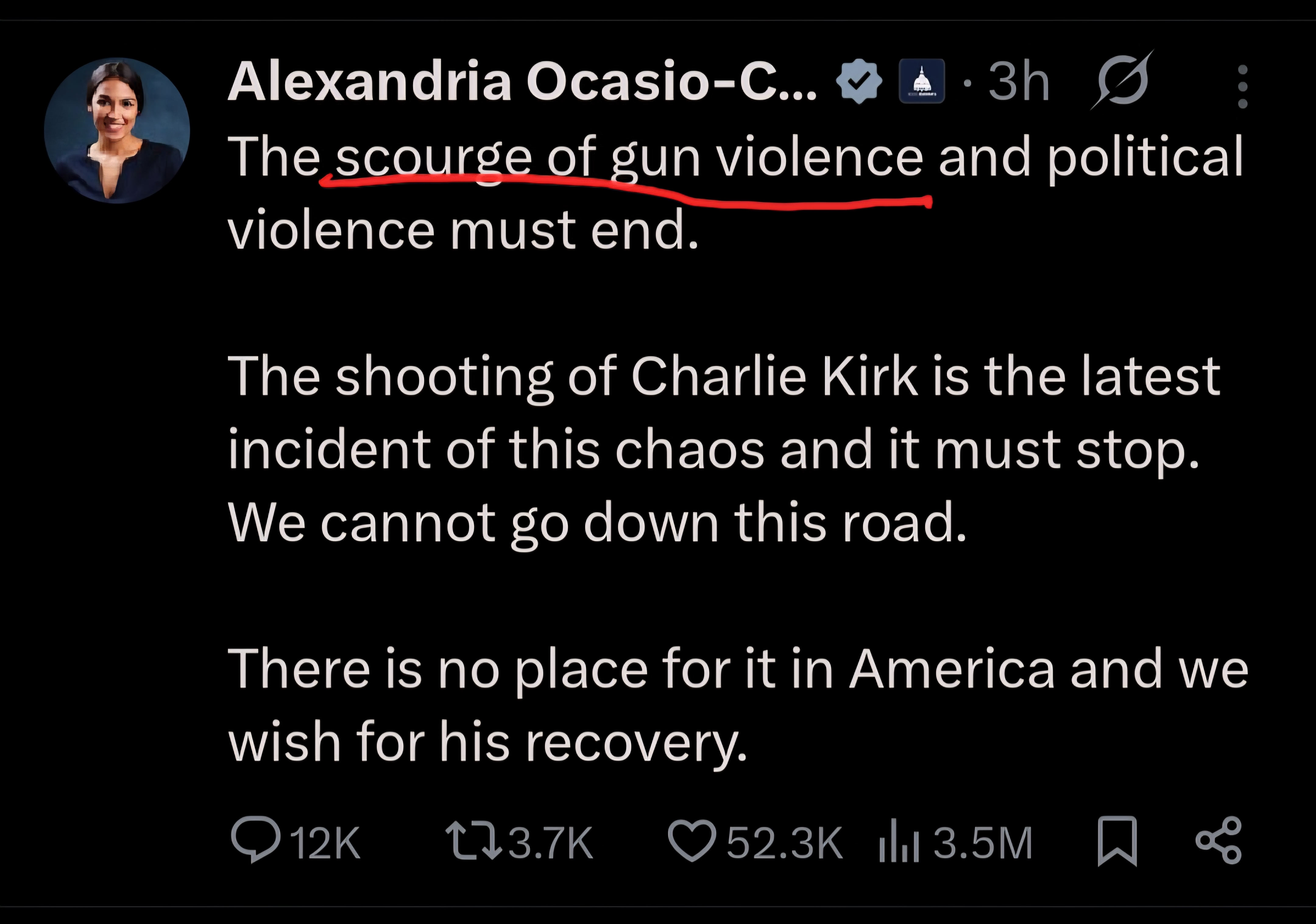
Left-wing politicians including AOC and Ilhan Omar condemned the killing and denounced… gun violence.
What if antisemitic Congressperson Rashida Tlaib were assassinated. Would AOC and Omar issue a statement about gun violence or denounce the killers and the vitriol that surrounded such shooting? Would MSNBC say she deserved to be taken out because of her rants about Jews? Would the right issue statements like the left-wing is doing today?
Tlaib is an active voice in conferences which call to destabilize the United States and to destroy Israel. She whips up the violent jihadi and Democratic Socialists of America mob to tear down western society and the Jewish State.
But that only means she’s evil. It means she should be arrested if found to incite violence. But it doesn’t mean she should be killed or her murder celebrated or excused.
Charlie Kirk had lots of opinions but he took the time to calmly debate and have a discussion with anyone. He did not call for the destruction of America or American allies. So why the obnoxious comments from the far left?
The issue before us is not only the violence itself but the selective outrage that follows. Political violence is corrosive to democracy. To our humanity. If Americans respond to it with partisanship — excusing it when the victim is an opponent, or diminishing it when the rhetoric seems uncomfortable — then the nation is already fractured beyond recognition.
The true test of a society’s moral health is whether it can condemn violence against its enemies with the same clarity as against its friends. Those people who cannot, are likely the ones whose goal is the destruction of our society.
The late comedian George Carlin had a famous routine about “the seven words you can’t say on television.” It was funny because everyone knew the words, and everyone knew the absurdity of pretending they didn’t exist. Then came cable television — HBO, Showtime, and the rest — and suddenly those words were everywhere. What once felt taboo became common, even boring.
So it is with the language used against Israel.
In 1991, after intense U.S. diplomatic pressure, the United Nations revoked its infamous “Zionism is racism” resolution. For a moment, it seemed like the libel had been buried. There was hope that the relentless delegitimization campaign against Israel would fade, that the language of hate would finally be retired.
But in 2001, just days before the jihadist terror attacks of September 11, the Durban Conference in South Africa blew the doors wide open again. A coalition of NGOs issued a statement accusing Israel of no fewer than five of the gravest crimes known to humanity:
Apartheid
Genocide
Ethnic cleansing
Racism
Crimes against humanity
This wasn’t fringe rhetoric. It was delivered under the UN umbrella, with global media present. Durban made it “respectable” to say the unsayable — and to say it loudly.
Since then, those accusations have seeped into mainstream discourse. Palestinian “human rights” groups echo the smears repeatedly. They are repeated on college campuses, in international tribunals, in op-eds from major newspapers, and by activists on social media. What was once a shocking smear has become routine — as casual as an f-bomb on late-night cable TV.
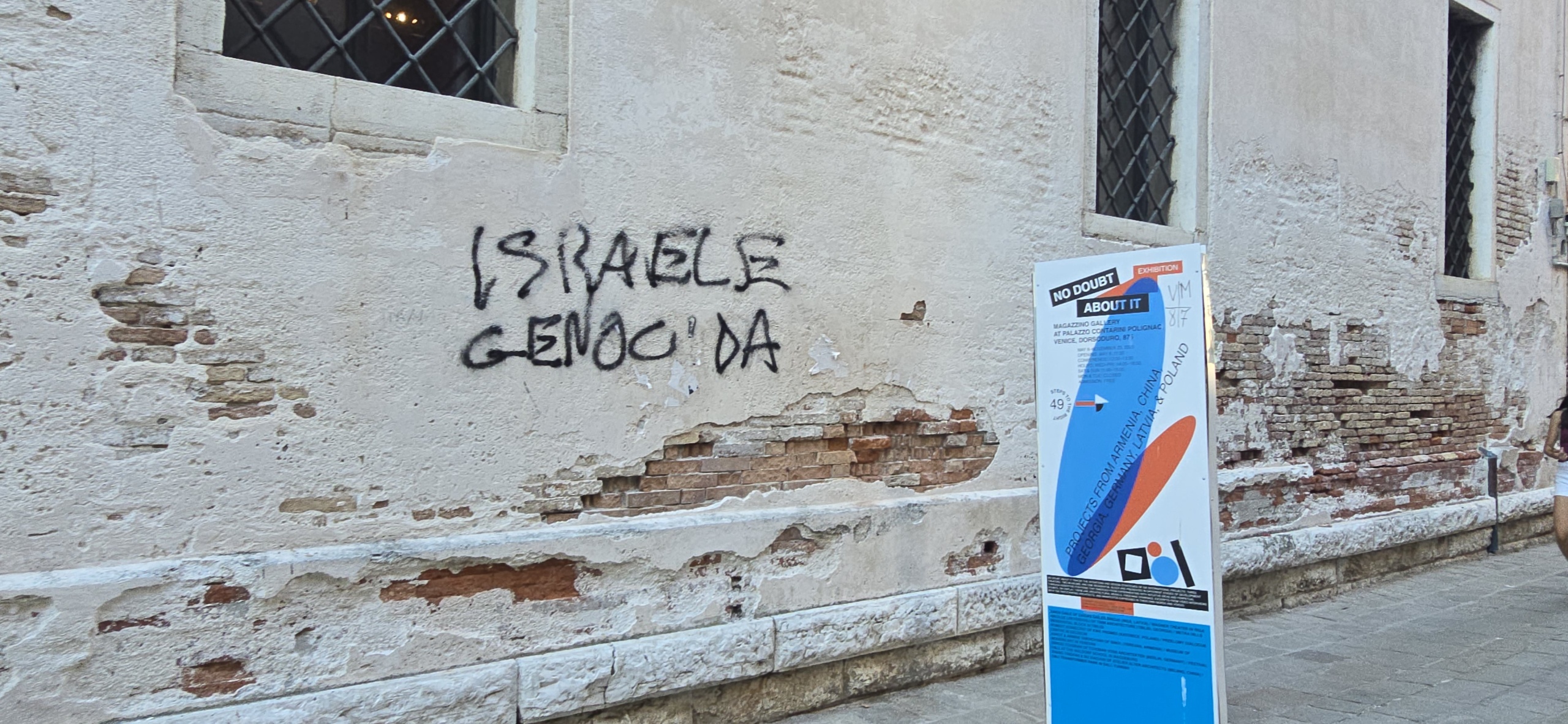
Graffiti that Israel is committing “Genocide” in Venice, August 2025
Durban didn’t just make it acceptable to slander Israel — it made it obligatory for the “serious” activist class. To not accuse Israel of apartheid or genocide – and now especially after Israel’s defensive war against Gaza – is to risk being called naive, a sellout, or worse. The same way edgy comics feel compelled to swear to prove they’re authentic, self-styled “human rights defenders” now compete over who can level the most outrageous accusation against the Jewish state.
The world has gone from debating Israel’s policies to cheering on its demonization. The libels have become cultural wallpaper — so constant that people stop noticing they’re lies. Durban didn’t merely open the floodgates. It built a sewer main, hooked it up to the global conversation, and has been pumping raw hate through it ever since — with the United Nations playing plumber, making sure the pipes never run dry.
The medieval accusation of Jews poisoning wells has been updated: now the “poison” is alleged genocide, apartheid, and crimes against humanity — and once again, the world is drinking it without question.
On October 28, 2011, Lord Jonathan Sacks, the Chief Rabbi of England, came to New York City and sat with Rabbi Meir Soloviechik at Yeshiva University. Their hour long talk touched on Lord Sacks’ book The Home We Build Together, and the role of religion in society, focusing on the United States and the United Kingdom, in particular.
Chief Rabbi Lord Jonathan Sacks Speaks at Yeshiva University with Rabbi Meir Soloveichik, October 2011
In the opening remarks (3:10), Rabbi Soloveichik shared a story about Senator Joseph Lieberman, who once observed that on Simchat Torah, Jews dance with the Torah in the streets with joy, yet often fail to carry that Torah into the world during the rest of the year. It was a reminder that religion cannot remain confined to ritual but must be brought into society.
Lord Sacks followed with a story of his own. Prime Minister Tony Blair once teased him that he had reached the “boring part” of the Hebrew Bible—the lengthy passages about the building of the Mishkan (Tabernacle). Why, Blair asked, does the Torah devote hundreds of verses to it, compared to just 34 for the creation of the universe?
Lord Sacks replied:
Prime Minister, it is not difficult for an omniscient, omnipotent, infinite God to create a home for human beings. But for finite, fallible human beings to create a home for the infinite God, that is difficult.
The Mishkan, Sacks explained, was not just architecture—it was a project that united the people. More than what God does for us, it is what we do for God that transforms and binds us together. “If you want to take this diverse, fractured culture of Britain and turn it into a united nation,” Sacks said, “you have to get them to build something together.”
Rabbi Soloveichik and Lord Sacks went on to describe that the decline of religious life and secularization of Europe was tied to fewer children being born. A self-centered focus weakens families, weakens faith, and weakens society. In contrast, raising children—caring for someone more than oneself—provides both the foundation of belief and the roots of charity: “having somebody whose life you care about more than yourself, that could actually be the foundation of faith for many of us.”
Washington (D.C.) and Rembrandt
Nearly fourteen years later, on September 8, 2025, U.S. President Donald Trump held an event at the Museum of the Bible in Washington, D.C. He invited members of the newly established (May 1, 2025) Religious Liberty Commission to hear how he was advancing the centrality of religion in American public life. He said “When faith gets weaker, our country seems to get weaker. When faith gets stronger… good things happen for our country…. To have a great nation, you have to have religion.”
One of the members of the Presidential Committee on Religious Liberty is Rabbi Meir Soloveichik. He was unable to attend the speech by the president in Washington because he was giving a day long-lecture in New York City at the home of Mem and Zalman Bernstein and the Metropolitan Museum of Art for the Tikvah Fund about art, religion and western society.
Rabbi Solveichik focused on Rembrandt’s two versions of the Sacrifice of Isaac. He contrasted Abraham’s devotion to God’s command to offer his son Isaac, to the investment of love and devotion he had made in his son. The angel broke the conflict, and with it, the end of human sacrifice which was prevalent in the world at that time. From this point onward, belief in a higher power could be accompanied by protecting and investing in our children.
Religion, Children and Western Democracy
It made for an interesting sermon triptych connecting religion, children and western values: Lord Sachs, Rabbi Soloveichik and President Trump all emphasized that religion has the power to strengthen ourselves, our families, our communities and our nation.
In Lord Sacks book, The Great Partnership, published in June 2011, right before his talk at YU, he wrote:
My argument has been that contrary to the received narrative, freedom has been better served in the modern world by a religious vision rather than a secular one. The Abrahamic vision, with its insistence on the non-negotiable dignity of the human person and the importance of protected space – the families and communities that make up civil society – where relationships are not based on power, saved England and America from the worst excesses of the revolutionary politics that cost tens of thousands of lives in France and tens of millions in Russia….
Abrahamic politics, by contrast, is politics with a human face, the politics that knows the limits of power, as well as the transformative effect of free persons freely joining together to make social institutions worthy of being a home for the divine presence. Abraham politics never forgets that there are things more important than politics, and that is what makes it the best defense of liberty.”
That is the motion before Western democracies: can humble faith as embodied in “Abraham politics” lead our different faiths to help build a cohesive society of respect and growth.
Concluding Circle
The discussion of religion and democracy is being advanced passionately today because it feels abandoned.
According to Lord Sacks, democracy under secularism preached intersectionality which yielded segregation and isolationism. Rabbi Solveichik responded that “a Mayflower of persecuted religions might leave England and Europe to come to safer shores [like America].” For his part, President Trump established the Religious Liberty Commission to deal with such matters, with the first group’s term ending on July 4, 2026, on the nation’s 250th anniversary.
So it was fitting that Rabbi Soloveichik should end his talk to the Tikvah Fund, a group whose motto is “Advancing Jewish Excellence and Western Civilization through Education & Ideas,” before Emanuel Leutze’s Washington Crossing the Delaware, while President Trump was concluding his remarks in Washington, D.C.
Rabbi Soloveichik at the Metropolitan Museum of Art, September 2025
In the 1851 painting, the future president of the United States stood aboard a boat filled with a diverse crew, readying to end the rule of England and break with the British monarchy and Church of England, to establish a new democratic state in 1776. Nearly 250 years later, the Chief Rabbi of England, the president of the United States, and the rabbi leading the oldest synagogue in the United States were championing the importance of religion in strengthening democracies everywhere. A quiet revolution to return to the foundations of faith to help build a more perfect union.
Six Jewish civilians were killed simply for being Jews. Surely, a world leader would stand firm, demand justice, and declare solidarity with the victims. Yet UN Secretary-General António Guterres offered only a perfunctory “strong condemnation” via his spokesperson—no mention of justice, no demand for the murderers to be brought to account, no affirmation of solidarity.
Because these murdered Jews were in Israel.
That’s the moral vacuum of the UN.
In Mali, after a terror attack on 17 September 2024, Guterres said he “strongly condemns the terrorist attack,” extended his “sincere condolences” to victims and the government, and—crucially—urged the Malian transitional government “to ensure that those responsible for this despicable attack are held to account.”
In Pakistan, following a deadly blast, he “strongly condemned the ‘abhorrent’ attack” and offering “solidarity” with the “Government and people of Pakistan in their efforts to address terrorism and violent extremism.“
Why does Guterres morph into a fierce defender of victims—and demand justice—when the targets are not Israelis, but merely issue a dry statement when Jews are murdered? Perhaps he is waiting to find out if this Palestinian Arab terrorist was also a UN employee?
This is not nuance. It’s deliberate abandonment. A moral inversion because the villains have long ago been beatified, and Guterres has internalized that 2 billion Muslims are his real clients.
The UN has become a place where Jewish lives are treated as collateral, while other victims are granted full moral and political recognition. Guterres’s pattern isn’t subtle—it’s a glaring indictment of the UN’s moral bankruptcy.










 First One Through