Squeezing Zionism

Zionism started before the First Zionist Congress in 1897 and before Theodore Herzl wrote “The Jewish State” in 1896. However, the core elements of Zionism that people recognize came from the 1917 Balfour Declaration. Those key elements found their way into the 1920 San Remo Conference and ultimately, the 1922 League of Nation’s Palestine Mandate. Those key points are:

  • Jewish History in the Holy Land:recognition has thereby been given to the historical connection of the Jewish people with Palestine
  • Reestablishing the Jewish homeland: “recognition… to the grounds for reconstituting their [Jewish] national home in that country [Palestine]
  • Immigration:shall facilitate Jewish immigration under suitable conditions
  • Owning land:shall encourage, in co-operation with the Jewish agency referred to in Article 4, close settlement by Jews on the land, including State lands and waste lands not required for public purposes
  • Citizenship:facilitate the acquisition of Palestinian citizenship by Jews who take up their permanent residence in Palestine
  • Freedom of worship and religion: “securing free access to the Holy Places, religious buildings and sites and the free exercise of worship…. complete freedom of conscience and the free exercise of all forms of worship, subject only to the maintenance of public order and morals, are ensured to all. No discrimination of any kind shall be made between the inhabitants of Palestine on the ground of race, religion or language. No person shall be excluded from Palestine on the sole ground of his religious belief.

Each of these principles is under attack.

History

Palestinian Arabs did not always doubt the history of Jews in the Holy Land. In the 1920s, the official guidebook of “Al Haram al Sharif” published by the Supreme Moslem Council, stated that the Temple Mount’s “identity with the site of Solomon’s Temple is beyond dispute” (page 4). Yet today, the entire history of Jews in the Holy Land is challenged by Palestinian Arab extremists (and “moderates”).

  • Acting President of Palestinian Authority (PA) Mahmoud Abbas addressed the United Nations General Assembly several times. In those speeches he spoke of the history of Jesus and Mohammed in the Holy Land, but ignored the history of the Jews in the land including: Jacob; Joseph; Joshua; David; and Solomon.
  • Various leaders of the PA have declared that: there was never a Jewish Temple in Jerusalem; if there was a Temple it wasn’t on the Temple Mount; and Israel is manufacturing ancient artifacts to fabricate a Jewish connection to Jerusalem.
  • Abbas claimed that Israel has attempted to “Judaize” Jerusalem, including claiming that the Western Wall is actually Islamic and known as the al-Buraq wall.
  • Abbas claimed that Jesus was a Palestinian, rather than a Jew.  His comments have continued to be repeated by PA officials and television.
  • Arab states are so upset about the history of Jews in the Holy Land, that 22 Arab states pressured UNESCO to cancel an exhibit called “People, Book, Land — The 3,500 Year Relationship of the Jewish People to the Holy Land”

Tel Dan
Inscription dating to 840 BCE in Tel Dan, northern Israel
referring to the “House of David”

Recently, some politicians outside of Israel have finally begun to push back on the Arab narrative that denies Jewish history.  US Representative Ileana Ros-Lehtinen (R-FL), remarked in December 2015 that “denying the historic connection of the Jewish people to Jerusalem is false. Amazing archeological discoveries are frequently made that prove the roots of the Jewish people are in Israel.”

royal-seal
Seal of King Hezekiah found in Jerusalem, around 700 BCE

Arabs came to the Holy Land during the Islamic invasion of the 7th centuries.  An Arab claim to being indigenous to Israel is like the Portuguese claiming to be indigenous to Brazil because they have been there for hundreds of years. There were people who lived there for thousands of years before the new people invaded, and continue to live there and claim the place as their home.

RECONSTITUTING The Jewish Homeland

The Arabs hope that by denying the history of Jews in the Holy Land, they can claim that they are the indigenous people of the land, and Jews are simply European colonialists. The claim that Israel is a new colonial force is repeated often by Palestinians and plays well to Europeans that have rethought their own colonial past.

However, Israel is not, nor has it ever been, a European colony.

Jews have lived in the Holy Land for over 3,700 years and were the only people to have independent political governments in the land.  They are also the only people to have their religious holiest sites in the land.

It is not a coincidence that Arabs shout to “Free Palestine” as opposed to “Create Palestine” as a new independent country.  The Arabs claim that the land was never home to Jewish Kingdoms and has always been Arab land.

Taylor_Prism-1
The Prism of Sennacherib, from roughly 689 BCE describing his attack on
the Jewish King Hezekiah in Jerusalem, as mentioned in 2 Kings: 18:13

Immigration

Arabs sought to deny Jewish immigration to Palestine immediately after the San Remo Conference.  Several Arab riots broke out in the 1920s, and in the 1930s the Arabs were able to convince the British to curtail Jewish immigration.  In 1939, on the eve of the Holocaust in Europe, the British issued the White Paper which capped Jewish immigration at 75,000 people for five years.  The goal was to keep Jews as a permanent minority in Palestine.

Arabs and left-wing Israeli radicals continue to call on limiting Jewish immigration to Israel.  In December 2015, Haaretz columnist Amira Hess said at a conference run with the New Israel Fund that Jewish “immigration to Israel under today’s circumstances — especially on the part of citizens of free Western countries — constitutes complicity in the crime.

Owning Land

The British and Arabs reduced the amount of land available for Jews to settle since the time that the Mandate took effect in 1922.

  • By 1928, the area now known as Jordan, was split from Palestine.
  • In 1929, after Arabs massacred Jews in Hebron, the British evacuated all of the remaining Jews from the city
  • In 1937, the Peel Commission suggested partitioning the land into two
  • In 1940, British drafted the Land Transfer Regulations which limited where Jews could purchase land to only one-third of the remaining part of Palestine
  • In 1947, the United Nations voted to partition the land into Arab and Jewish States
  • In 1949, after five Arab armies attacked Israel at its founding, Jordan illegally annexed Judea and Samaria and evicted all Jews from the territory, including the eastern part of Jerusalem, counter to the Fourth Geneva Convention
  • In 1967, after Jordan (and Palestinians who were then Jordanian citizens) attacked Israel and lost the area that they had termed the “West Bank,” they still fought to keep Jews from living in the land

The Jordanians had a Land Law in effect in the West Bank that prohibited the sale of any land to Jews from 1949 to 1967, punishable by death.  In 1997 – AFTER the Oslo Accords between the Palestinian Authority and Israel – the Palestinians confirmed that such land sales to Jews would be considered treason and a capital offense.

ezra nawi
Radical left-wing activist Ezra Nawi blew whistle on Arabs selling land to Jews
was arrested by Israel in January 2016

Citizenship

When the British left Palestine in 1948, Israel gave citizenship to everyone in Israel – Jews and non-Jews alike.  However, after the Arabs attacked Israel and Jordan assumed control of the West Bank, Jordan only granted citizenship only to Arabs.  The 1954 Jordanian law extending citizenship to Palestinian Arabs spelled out that Jews were excluded: “Any person who, not being Jewish, possessed Palestinian nationality before 15 May 1948 and was a regular resident in the Hashemite Kingdom of Jordan between 20 December 1949 and 16 February 1954.

Arab groups like Adalah and left-wing groups like the New Israel Fund (NIF) complain today about Israel’s Law of Return that allows Jews to become citizens of Israel on an expedited manner, a Law that non-Jews cannot use, claiming that such law is discriminatory. The groups fail to note that Israel institutes a Law of Return in the same manner that dozens of other countries use such a law to enable people with a lineage to the country to become citizens quickly.  The Jewish people have ties to the prior Jewish kingdoms in the Holy Land, while the Arabs, many of whom arrived over the past century, but certainly not before the 7th century, have no such ties.

When you see an advertisement about “social justice” and “equality” from groups like the NIF, they are attacking these fundamental principles of Zionism and common international laws.

NIF equality

Freedom of Worship

When the League of Nations endorsed the principles of Zionism, they also sought to ensure equality and fairness for the Jewish and non-Jewish inhabitants throughout the region.  One of the areas that they highlighted was the access to each religion’s holy places.  In theory.

Jews were banned from visiting or worshipping on the Temple Mount back in the 1550s under Suleiman I. The Ottoman Muslim leader enabled Jews to pray at the Western Wall, or the Kotel, but denied them their historical access to their holiest place. Moslems similarly forbade Jews from visiting their second holiest place, the Cave of the Jewish Patriarchs in Hebron.

When Israel took control of the post-1929 Palestine Mandate land in 1967, they sought to reestablish Jewish rights at the holiest Jewish places – just as called for in international law endorsing Zionism.

As detailed in “The United Nations and Holy Sites in the Holy Land,” Israel attempted to assert Jewish rights at their holiest places including: The Temple Mount; the Cave of the Jewish Patriarchs; Rachel’s Tomb in Bethlehem; and Joseph’s Tomb in Shechem/Nablus. It has been a struggle.

To this day, Jews are still banned from worshipping on the Temple Mount. This is just fine with the United Nations as highlighted in “The UN’s Disinterest in Jewish Rights at Jewish Holy Places.”

The United Nations Complicity in
Squeezing Zionism

It is understood that the Arabs would argue strongly for their own cause.  They have pursued an Arab and Muslim maximalist approach to the Holy Land for centuries.

However, the United Nations has backtracked significantly from its early endorsement of Zionism.  Under British administration, immigration was cut and the ability to own land was diminished.  When it came to vote at the United Nations to admit Israel as a new country, to “reconstitute the Jewish homeland,” Britain abstained.

The United Nations learned from Britain, and has continued to squeeze Zionism, such as recanting on the principle that Jews should have the freedom to worship at their holiest places, as discussed above.

While the UN constricted Zionism, it expanded the cause of Palestinian Arabs:

  • it created a new definition of “refugee” which included someone that left a house and town, rather than a country
  • It uniquely extended the definition of “refugees” to descendants, where the UN now considers there to be over 11 million Palestinians
  • The UN created a stand-alone refugee agency for Palestinian Arab “refugees” (UNRWA) that live in the surrounding area to the Holy Land, giving services to over 5 million people. Every other refugee in the world gets a single under-funded agency
  • UNRWA has promoted a narrative that all 5 million “refugees” will get to move to Israel, even though they are neither refugees nor have any right to move to Israel under the country’s Law of return
  • The UN altered its mission for refugees to one of protection and settlement (as it does throughout the world), to one that seeks to undermine Zionism

In 1975, the UN General Assembly endorsed Resolution 3379 stating that “Zionism is Racism,” essentially nullifying on the basic arguments and rights of Jews to their homeland.  The effort to limit Zionism had become an effort to terminate it.

Summary

The “Zionism is racism” declaration was ultimately overturned in 1991, in part, because of the efforts of the United States.  As US President George Bush argued before the UN: “Zionism is not a policy, it is the idea that led to the creation of a home for the Jewish people, to the State of Israel. And to equate Zionism with the intolerable sin of racism is to twist history and forget the terrible plight of the Jews in World War II, and indeed throughout history. To equate Zionism with racism, is to reject Israel itself, a member of good standing of the United Nations. This body cannot claim to seek peace and at the same time challenge Israel’s right to exist.”

Zionism has been getting squeezed since 1917, in rights, size and scope.  As Zionism has been squeezed, so has the State of Israel itself.

The “Freedom CHOIR (Freedom of worship and religion; Citizenship; History; Owning land; Immigration; and Reconstituting the Jewish State)” which are fundamental building blocks of Zionism, are under attack.  The Arabs have intensified their assault to include basic facts of Jewish history.  The British and United Nations have constricted Zionism in size and scope.  Left-wing radical groups have now joined the chorus using “progressive” language of “justice” and “equality,” while using the identical arguments of racists that seek to reject Israel.

Review the points of the Freedom CHOIR. Do you believe in Zionism?  Will you join the CHOIR or seek to silence it?


Related First.One.Through articles:

The United Nations’ Remorse for “Creating” Israel

The United Nations Applauds Abbas’ Narrative

Liberals’ Biggest Enemies of 2015

Real and Imagined Laws of Living in Silwan

Subscribe YouTube channel: FirstOneThrough

Join Facebook group: FirstOne Through  Israel Analysis

UN Media Centre Ignores Murdered Israelis

In what has become a routine abuse of facts, the United Nations Media Centre continued to edit comments that have to do with Israelis being attacked and murdered by Palestinian Arabs.

On December 15, 2015, High Commissioner for Human Rights, Cécile Pouilly gave a press briefing about situations in “Burundi, Israel / Occupied Palestinian Territory, and Cuba.”  In her opening statement about Israel, she said the following:

“We continue to be gravely concerned at the unrelenting violence in the Occupied Palestinian Territory and in Israel. Since the current escalation started at the beginning of October, 21 Israelis and 117 Palestinians have lost their lives (along with two foreign nationals), with thousands more injured.

Although international attention on the crisis has waned, the level of killings, injuries and arrests has continued, with on average one person dying every day.

The UN Media Centre reported the comments as follows:

“Although international attention has waned regarding the crisis in Israel and the Occupied Palestine Territory, the United Nations human rights office today warned that the region is still rife with violence and the recent escalation in the fighting has claimed 117 Palestinian lives, along with two foreign nationals and injured thousands more.”

Poof.  The murdered Israelis were erased.  The Palestinians and two foreign nationals were killed, but the murdered Israelis were wiped from the comments and history of the United Nations Media Centre.

pouilly
Cécile Pouilly, spokesperson for the Office of the High Commissioner for Human Rights. (Photo: OHCHR)

While the various UN bodies have long established anti-Israel biases, the media centre which summarizes the comments of hundreds of those same UN bodies, further sanitizes Palestinian Arab crimes and ignores the suffering of Israelis.

How much hatred for Israel can an organization have to deliberately omit Israelis, while mentioning every other person killed?  How far has the UN stretched itself to adopt an unbalanced, extremist Palestinian narrative?

When will western countries demand sanitizing the United Nations?


Related First.One.Through articles:

UN Press Corps Expunges Israel

UN Comments on the Murder of Innocents: Henkins

UN Comments on the Murder of Innocents: Itamar and Duma

The United Nations Audit of Israel

The United Nations’ Remorse for “Creating” Israel

The UN Can’t Support Israel’s Fight on Terrorism since it Considers Israel the Terrorists

Subscribe YouTube channel: FirstOneThrough

Join Facebook group: FirstOne Through  Israel Analysis


Israel was never a British Colony; Judea and Samaria are not Israeli Colonies

Many uniformed critics of Israel criticize the creation of Israel and claim that Israel was established as a colonial outpost of Great Britain. The statement is absurd and easily disproven.

International Law, Not British Law

Various international laws approved the immigration of Jews to Palestine and international bodies approved the creation of the Jewish State of Israel.

May 1949: International Approval: The United Nations voted to admit the State of Israel  as a member state, at the end of Israel’s war with Arab countries.

May 1948: International Approval: The United States, the Soviet Union and several other countries recognized Israel soon after Israel declared Independence.

May 1948: Israel Declares Independence, but not from Great Britain: Israel waited to declare its statehood until after Great Britain left the holy land and completed its mandate. The Israeli Declaration of Independence never mentioned Great Britain, as GB never viewed the land as a colony (compare that to the language in US Declaration of Independence which mentioned severing ties with GB.)

November 1947 UN Partition Vote: The United Nations voted to create a Jewish State in Palestine with 33 votes in favor, 13 against and 10 abstentions (Great Britain abstained).

July 1922 League of Nations Established Jewish Homeland: The League of Nations (precursor to the United Nations) voted to break apart the old Ottoman Empire and placed the area of Palestine under British oversight. That area of Palestine included areas of Jordan and Israel which were to include a “national home for the Jewish people.”

April 1920 San Remo Conference. The Allies of World War I (Britain, France, Japan and Italy) voted for the “establishment in Palestine of a national home for the Jewish people, it being clearly understood that nothing shall be done which may prejudice the civil and religious rights of existing non-Jewish communities in Palestine, or the rights and political status enjoyed by Jews in any other country.

The term “British Mandate” has become confused for many people with Israel being a “British Colony.” It is simply untrue. The world powers broke apart huge sections of the Middle East with areas under both British and French administration, including countries today known as Lebanon and Syria. No one refers to any of those countries as a “colony.”

british and french mandates
British and French Mandates covering much of the Middle East

British did not favor Jews in Palestine

Despite language in the 1922 Mandate that the British should “facilitate Jewish immigration” to Palestine, the British sided with local Palestinians that sought to curtail an influx of Jews. On the eve of the Holocaust in Europe, when Jews were desperate for a place to flee, the British issued the 1939 “White Paper” which limited the number of Jews that could enter Palestine.  That edict likely cost hundreds of thousands of European Jews their lives.

The British decree created tremendous tensions between Palestinian Jews and the British. There were many battles between the groups, the most famous being the destruction of the King David Hotel in 1946.

No Transfer of British People

As described above, the British were merely administrators of Palestine for a period of time. They did not seek a permanent presence of soldiers or civilians. Virtually no British Jews (or non-Jews) relocated to Palestine on a permanent basis over the course of the Mandate period through 1948.  The Jews that came to Palestine under the Mandate period principally came from elsewhere in Europe and Russia:

  • Third Aliyah (1919-1923): 40,000 from Russia and Poland
  • Fourth Aliyah (1924-1929): 82,000 (many subsequently left) from Poland; Russia; Romania; Lithuania; Yemen and Iraq
  • Fifth Aliyah (1929-1939): 250,000 from Europe fleeing German Nazis
  • Aliyah Bet (1939-1948): 110,000, mostly illegally, smuggled from Europe fleeing Holocaust

Rights of the Indigenous Jewish People

The world powers voted to enable a national home for the Jewish people for a few reasons:

  • Jews were indigenous to Israel, as stated in the Mandate, the world recognized “the historical connection of the Jewish people with Palestine and to the grounds for reconstituting their national home in that country
  • Jews had been forcibly evicted from their national home
  • The Ottomans and others made it difficult for Jews to move back and acquire land for hundreds of years

The Jews had political kingdoms and religious Temples in the holy land for over 1000 years, but were expelled against their will. The new international laws were meant to remove the modern roadblocks that were placed before Jews from moving to Palestine and owning land.

Even though it was difficult for Jews to move to Palestine and acquire homes and land under the Ottomans, the Jews were the fastest growing religious group from 1800 to 1914. Jews have also been the largest religious group in Jerusalem since 1870.

Language

The official languages in Israel today are Hebrew and Arabic. While English is widely spoken, it is not an official language, further underscoring that the country never was established as a British colony.

ISRAEL:
RE-ESTABLISHED under International Law

In short, there is no basis whatsoever for calling Israel a British colony. The global community approved facilitating the free movement of Jews back to their holy land, where Jews already lived. The global community ultimately approved RE-ESTABLISHING a Jewish State. This was not Great Britain arbitrarily creating a colony for its own purposes.

It should also be underscored that Zionism was not only a modern idea conceived by Jews as a reaction to anti-Semitism in Europe and Russia.  Henry Dunant (1828-1910), the winner of the first Nobel Peace Prize was an ardent Christian Zionist who strongly advocated for the rights of Jews to live in Palestine in the 1860s.

Israel 1974 bote at UN
Vote for Israel at United Nations, 1947

The “West Bank” is not an Israeli Colony

As detailed above, the global community approved the rights of Jews to move to their ancient homeland in the holy land.  That right was given to the entire region, including Judea and Samaria.  While the UN voted to recognize a Jewish State within a section of Palestine, the right to move throughout the region was approved in repeated resolutions many decades ago.

While the UN does not recognize Judea and Samaria to be part of Israel, they also do not recognize it as part of Jordan that illegally annexed it in 1950 (Jordan gave up all claim to the region in 1988).  The UN would like to see that region be part of a new Arab State of Palestine through negotiations with Israel.

The desire to see a new Palestinian State does not mean that international law protecting the rights of Jews to live in the region are null and void.  The 1922 British Mandate Article 15 specifically stated that “no person shall be excluded from Palestine on the sole ground of his religious belief.”  “No person” included Jews, and “Palestine” covered the entire mandate area of 1922.

The Oslo Accords of 1993 and 1995 which were negotiated between the Palestinian Authority and Israel, specifically stated that Israel controls and administers most of the “West Bank.”  As such, Israel approves housing and roads and infrastructure for everyone.  So the Palestinians agree that Israel is in charge of housing and international law approves Jews living in the region.  Israel acts as the administrator, much in the same way that Great Britain acted as the administrator for Palestine from 1922 to 1948.

Lastly, the “settlements” are principally located next to greater metropolitan areas within Israel.  Unlike European colonies which were across oceans and thousands of miles from the country, these Jewish homes are just suburban communities of major Israeli cities like Jerusalem and Tel Aviv.  They happen to be on the other side of an invisible “green line” that was the Armistice Lines of 1949.  Those Armistice Agreements specifically stated that those lines were not to be considered borders.

Conclusion

Jews have lived throughout the holy land for thousands of years, including all over Judea and Samaria/ the “West Bank”.  International laws facilitated the ability of Jews to move back to, and throughout, their homeland.

Jews were self-governing for over a thousand years in the holy land.  International laws reconstituted the national Jewish home.

While Jordan illegally attacked Israel and expelled all of the Jews from Judea and Samaria counter to the Fourth Geneva Convention in 1949, those illegal actions cannot make it illegal for Jews to once again live in homes they legally purchase throughout the land.

When you hear acting-President of the Palestinian Authority chant “colonial occupier” or uninformed people claim that Israel is a colonialist tool, send them this article.


Related First.One.Through articles and video:

The United Nations’ Remorse for “Creating” Israel

The Legal Israeli Settlements

Recognition of Acquiring Disputed Land in a Defensive War

Palestinians agree that Israel rules all of Jerusalem, but the World Treats the City as Divided

The Arguments over Jerusalem

Video: Judea and Samaria (Foo Fighters)

Video: The “1967 Borders” (The Kinks)

Subscribe YouTube channel: FirstOneThrough

Join Facebook group: FirstOne Through  Israel Analysis

The United Nations’ Remorse for “Creating” Israel

Some political analysts have suggested that Europeans tend to be more negative in their attitudes towards Israel than Americans, due to the former’s rejection of their colonialist past. The retreating by the British, French, Dutch, Portuguese and Belgians from the colonies that they had established hundred-plus years prior in India, Algeria, Tunisia, Congo, Morocco and other countries, was part of a repositioning of the world back to local sovereignty. The colonialist era has been cast in a racist light and rejected by today’s more “pluralistic” societies.

Palestinians have taken note of the change in attitudes, and have adopted new vocabulary to instigate the Europeans against Israel whereby the charges of “colonialist” has accompanied the accusation of being racist.

From “Zionism is Racism”
to “Colonial Occupier”

In the 1970s, the head of the Palestinian Liberation Organization, Yasser Arafat, led the world on a venomous attack against “Zionism.” In 1975, Arafat succeeded in getting the United Nations to pass Resolution 3379 condemning “Zionism is Racism.” Somehow, the world became convinced that the national aspirations of Jews to be self-governing was uniquely racist compared to every other nationalistic aspirations.

It took sixteen years for the United Nations to erase the charge, but the venom remained in the UN bloodstream.

At the UN, the “Question of Palestine” ceased to be a territorial dispute, and became an ethical question for the United Nations: should the global body have created and voted for the Jewish State?  Did it do so, solely because of the guilt from the Holocaust?

The current acting-President of the Palestinian Authority, Mahmoud Abbas, stokes that question to the mini-inferno that sits in the United Nations today. He constantly uses the term “colonial” to describe the emergence of Israeli “settlements,” and characterizes Israel as a recent foreign transplant on Arab soil. For some of his listeners, the malicious appearance of Israeli Jews began in the “West Bank” in 1967. For others, the Jewish colony overran the entirety of Palestine when the United Nations voted to partition the land into a Jewish State and Arab State in 1947.

UN-Palestinians-Statu_Horo-1-635x357
Acting President of the Palestinian Authority, Mahmoud Abbas
Addressing the United Nations, November 29, 2012
(photo: Richard Drew/AP)

As Abbas said in his address to the UN on November 29, 2012: “Israeli occupation is becoming synonymous with an apartheid system of colonial occupation, which institutionalizes the plague of racism and entrenches hatred and incitement.”

The Palestinian’s pivot was subtle but significant.  Self-determination (like Zionism) in itself was not a crime.  Indeed, the Palestinian Arabs seek the same right for themselves.  However, the Israelis’ “colonial occupation” was unique and the root cause of the problem.  It was not necessarily the Jews’ goal of self-determination, but the act of colonialization that created “racism” and “incitement.”

Somehow, the Europeans and a growing number of countries, have embraced these narratives, particularly that Israel in its entirety was a UN mistake.

International Remorse for Partitioning Palestine
November 29, not June 4

The clarity of the global adoption of these positions can be found in the annual commemoration of the day of the partition vote on November 29, 1947.

In 1977, while the “Zionism is Racism” edict was still fresh, the United Nations passed another resolution to annually commemorate the UN Partition vote, as the “International Day of Solidarity with the Palestinian People.”

The decision to partition Palestine was approved by Jews and rejected by Arabs in 1947, yet the UN specifically chose that date to stand in “solidarity with the Palestinian People.”  On its face, it would seem like a cruel decision to create a holiday for a people on the very day that those people despised.

However, taken together with the “Zionism is Racism” resolution of 1975, the picture becomes more clear: the UN believed that the decision to partition the land was a mistake.  The global body concluded that the Palestinians were correct in the assertion that the UN created a racist, anti-Arab entity in Palestine.  The Palestinians were correct to reject the partition plan in 1947.  The fault belonged to the United Nations, not the Palestinians, right at creation.

The United Nations did not choose June 4 or June 10 as the date to stand together with Palestinians.  Those dates in 1967 were the beginning and end of the Six Day War when the Jordanians (together with Palestinians who were then citizens of Jordan) launched an attack on Israel and consequently lost the “West Bank” which they had illegally annexed.  If the root cause of the plight of Palestinians was “Israeli settlements” in the West Bank, then those dates would have been more appropriate to anchor the anniversary.

But the United Nations wanted to mark its own poor decision.  While the Palestinians rejected partition in 1947 and launched wars in 1948 and again in 1967, those bad decisions and actions were not deemed relevant.  The UN chose to tell the Palestinians that it was not their fault.  Their situation stemmed from decisions that the UN itself made.

Today, while the UN may no longer outwardly state that “Zionism is Racism,” the global body has adopted Abbas’s narrative that the UN planted a colonialist flag in Palestine.  The Europeans and liberal press now echo Abbas and the Iranian Supreme Leader Ali Khamenei who claim that Israel is a foreign and dangerous entity that was unnaturally inserted into the Middle East, and that the Arabs are the sole indigenous people and the land itself is inherently “Arab.”


It is well passed time for Israel to actively combat this claim of colonialization, the way activists overturned the “Zionism is Racism” UN edict in 1991.  It is time to clearly educate the world that RE-ESTABLISHING the Jewish State and not banning where Jews can and cannot live is neither colonialist nor racist, but the essence of freedom and justice.


Related First.One.Through articles and video:

Israel was never a British Colony; Judea and Samaria are not Israeli Colonies

The United Nations Applauds Abbas’ Narrative

The Holocaust and the Nakba

The Legal Israeli Settlements

UNRWA’s Ongoing War against Israel and Jews

Nicholas Kristof’s “Arab Land”

Video: I hate Israel – Zionism

Subscribe YouTube channel: FirstOneThrough

Join Facebook group: FirstOne Through  Israel Analysis

The UN Can’t Support Israel’s Fight on Terrorism since it Considers Israel the Terrorists

On November 19, 2015, Palestinian Arab terrorists attacked Israelis which resulted in the death of five people.  On the same day, terrorists in Mali attacked a hotel and killed 20.

UN Secretary-General Ban Ki-Moon commented on both terrorist attacks. As seen below, the approach to each incident was quite different.

November 19, 2015 UN Responses Terror attacks killing five in Israel Terror attack killing 20 in Mali
Words in press release 97 218
Condemnation “terror attack” horrific terrorist attack”
Condolences “condolences to the families”” sincere condolences to the Government of Mali and the bereaved families”
Support for fight on terror None. “Imperative to restore calm.” full support to the Malian authorities in their fight against terrorist and extremist groups”

#JewishLivesMatter

The UN placed significant weight on its comments towards the Government of Mali. It extended condolences and offered “full support” to fight terrorists and extremists.

However, all such language and sentiment was absent for Israel over its wave of terrorism.

This has been true for every announcement made about deliberate murders committed by Palestinian Arabs against Israelis, whether the killing of the Henkins in front of their children (October 2015) or the slaughter of the Fogel family in their beds (March 2011).

The reason becomes clear when reviewing the various UN statements.

This November 19 attack was the first time that Ban Ki-Moon actually used the word “terror” about Israeli Jews (he used it when describing terror against Arabs such as the killing of an Arab teenager in Duma).  The reason for using it for this incident? Because a Palestinian was listed among those killed.  The language of the press release could just as easily lead a reader to conclude that the terrorism was CAUSED by Israel, rather than by Arab murderers.

That was the reason that the UN did not extend condolences to, or express support for the Government of Israel.  For the UN Secretary-General, Israel is as much part of the terrorist infrastructure as the jihadists.

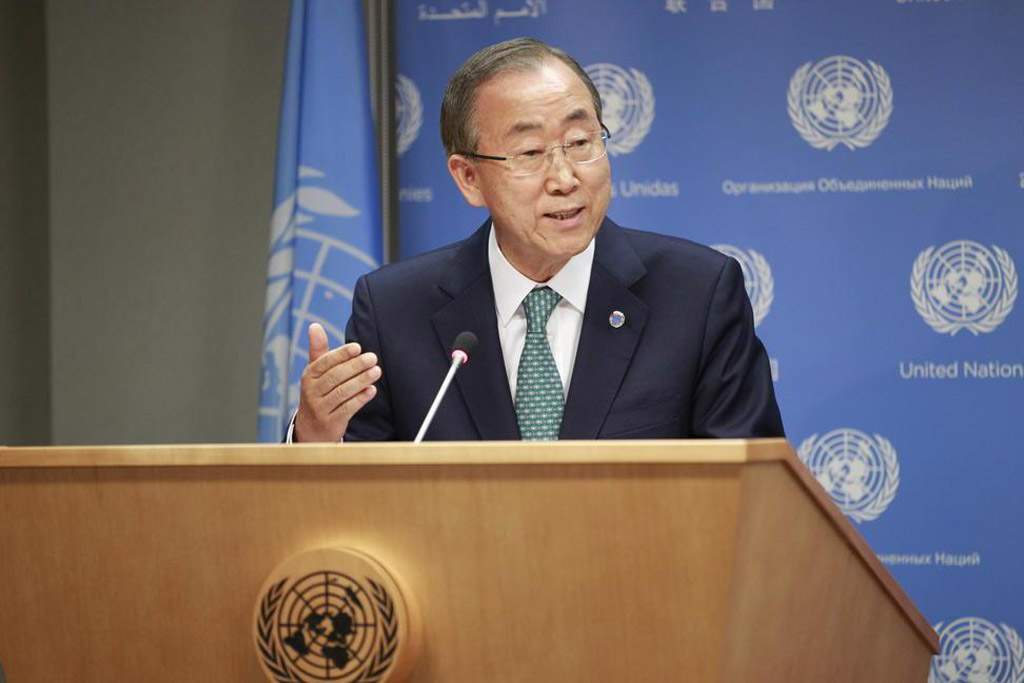
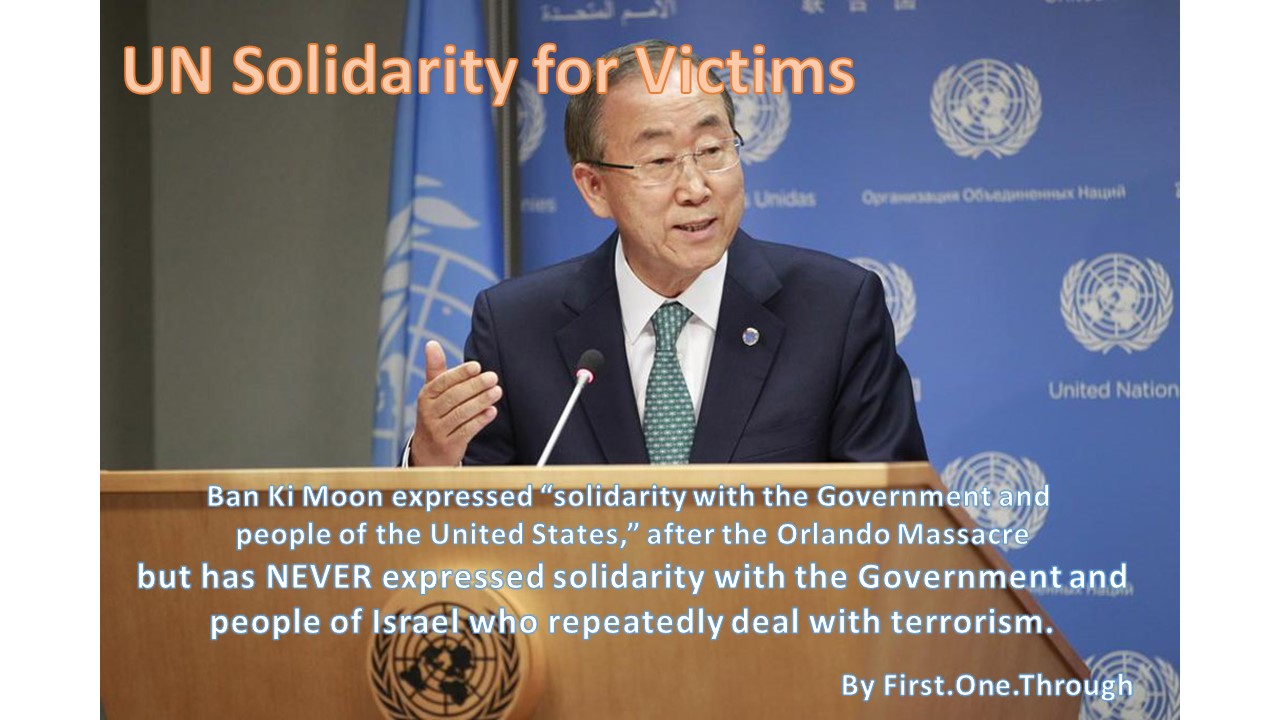
Ban Ki Moon
UN Secretary-General Ban Ki-Moon

Ban Ki-Moon on Attacks in Israel on November 19, 2015

“The Secretary-General condemns today’s terror attacks in Israel and the occupied West Bank. He expresses his condolences to the families of the five people killed today — three Israelis, a Palestinian and an American — and hopes for a full and speedy recovery for those injured. It is imperative now to restore calm

The Secretary-General calls upon all political, religious and community leaders to speak out against such brutal acts and refrain from incendiary language. He reiterates that only a negotiated solution to the conflict can bring peace and security to the peoples of this troubled land.”


Ban Ki-Moon on Attacks in Mali on November 19, 2015

The Secretary-General condemns the horrific terrorist attack at the Radisson hotel in Bamako which killed an unknown number of civilians and injured many more.  He expresses his sincere condolences to the Government of Mali and the bereaved families and wishes a speedy recovery to the wounded victims of this attack. The United Nations Multidimensional Integrated Stabilization Mission in Mali (MINUSMA) has been assisting the Malian authorities in the handling of this crisis.

The Secretary-General notes with concern that these attacks are taking place at a time when the peace process is making good progress and the signatory groups to the Agreement on peace and reconciliation in Mali, in particular the Coordination des Mouvements de l’Azawad and the Plateforme, were in Bamako to attend the sixth meeting of the Comité de suivi de l’Accord (CSA) with the Malian Government and international partners.

The Secretary-General deplores any attempt to derail the implementation of the Agreement. He expresses his full support to the Malian authorities in their fight against terrorist and extremist groups. He welcomes the statements of the signatory parties to the Agreement that they remain committed to its implementation.  He also reiterates the commitment of the United Nations, through MINUSMA, to support the Malian Government and the parties to the Agreement at this critical juncture in the peace process.”


Related First.One.Through articles

UN Comments on the Murder of Innocents: Henkins

UN Press Corps Expunges Israel

UNRWA’s Ongoing War against Israel and Jews

UN Comments on the Murder of Innocents: Itamar and Duma

Subscribe YouTube channel: FirstOneThrough

Join Facebook group: FirstOne Through  Israel Analysis

UNRWA’s Ongoing War against Israel and Jews

On October 27, 2015, US Representative Ileana Ros-Lehtinen (FL-R) blasted the United Nations group that works for the Palestinians.

UNRWA, the United Nations Relief and Works Agency for Palestine Refugees in the Near East, has a stated mission of helping over 5 million “Palestine refugees.” That unique and bizarre definition of “refugees” includes second, third and even fourth generation descendants of people who used to live in Palestine, even though refugee status cannot be handed down through the generations like an inheritance, and refugees are defined as people who flee from a country, not a house or a region.

The non-governmental organization (NGO) UN Watch, which monitors various UN bodies, reported on October 16 that “at least ten different UN staffers are using the imprimatur of their official positions to incite Palestinian stabbing and shooting attacks against Israeli Jews, with one calling on Facebook to “stab Zionist dogs.” That revelation led US Rep. Ros-Lehtinen to attack UNRWA from the House floor and question whether US taxpayers should continue to fund an organization that has close ties to Hamas.

In addition to the various UNRWA workers who posted on social media support for the killing of Jews, UNRWA has a long history which is not about supporting Palestinians, but about attacking Israel and Jews.

UNRWA stockpiled rockets to fire at Israel.  There were at least three occasions in 2014 when Hamas stored weapons at UNRWA schools during its war against Israel.

Hamas fired rockets from the UNRWA schools.  According to a UN report, “The area behind the [Gaza] school wall was known at the time for being used by militants, including for the firing of projectiles.

UNRWA School Headmaster made bombs and rockets to fire at Israel. The Rafah Prep Boys School was administered by UNRWA, and its headmaster developed rockets for Islamic Jihad to fire into Israel.

UNRWA schools refuse to teach the Holocaust.  Even though the teaching of the Holocaust is suppose to be a standard part of the curriculum, UNRWA caved to the wishes of Hamas in striking the program.

UNRWA Promises that the Agency will be the gateway for 5 million refugees to move to Israel.  While UN resolutions have discussed finding an appropriate solution for refugees, UNRWA has taken a lead in promising Arabs in Gaza that they will all be allowed to move to Israel, as described in Delivery of the Fictional Palestinian Keys.

In light of the disgraceful actions of UNRWA, Rep. Ros-Lehtinen introduced H.R.3829 which intends to enforce changes to UNRWA.  It includes stopping the US funding of UNRWA unless and until certain conditions are met:

  • no UNRWA official, employee, representative, or affiliate is a member of a foreign terrorist organization, has propagated anti-American, anti-Israel, or anti-Semitic rhetoric, or has used UNRWA resources to propagate political materials regarding the Israeli-Palestinian conflict;
  • no UNRWA facility is used by a foreign terrorist organization;
  • no UNRWA school uses educational materials that propagates anti-American, anti-Israel, or anti-Semitic rhetoric;
  • no recipient of UNRWA funds or loans is a member of a foreign terrorist organization;
  • UNRWA is subject to auditing oversight; and
  • UNRWA holds no accounts or other affiliations with financial institutions deemed by the United States to be complicit in money laundering and terror financing.

Write your senator and congressperson and include the link to this article, telling them to support this legislation.


Related First.One.Through articles:

Help Refugees: Shut the UNRWA, Fund the UNHCR

Palestinian “Refugees” or “SAPs”?

What do you Recognize in the Palestinians?

Considering a Failed Palestinian State

Educating the New York Times: Hamas is the Muslim Brotherhood

Subscribe YouTube channel: FirstOneThrough

Join Facebook group: FirstOne Through  Israel Analysis

ilena ros leicthten

An Inconvenient Truth: Palestinian Polls

There were a growing number of violent attacks by Palestinians against Israelis in October 2015.  Various politicians such as the US Secretary of State John Kerry blamed the root cause as Palestinian frustration about ongoing Jewish “settlements” east of the Green Line.  Acting President of the Palestinian Authority Mahmoud Abbas pointed the finger at defending Al Aqsa Mosque in Jerusalem from Israelis changing the status quo.  United Nations Secretary-General Ban Ki-Moon considered that it was due to Palestinians frustration about the failed peace talks and lack of progress towards creating a Palestinian state.

Why all of the guessing for identifying the root cause when the Palestinians poll themselves every three months?

The Palestinian Center for Policy and Survey Research conducts a poll every quarter on a range of issues.  It breaks the analysis between Palestinian Arabs living in the West Bank/ east of the Green Line and the Gaza Strip.  A review of the poll numbers gives a much better sense of Palestinian Arabs sentiments about their situation than biased and bogus statements from Kerry, Abbas and Ban Ki-Moon.

A Growing Majority of Palestinians Support Attacking Israeli Civilians

The poll figures do show a growing support of attacking innocent Israeli civilians.  In December 2013, the percentage of Arabs supporting unprovoked attacks was 34% and 58% in the West Bank and Gaza, respectively.  Those figures jumped to 48% and 68% for WB and Gaza in September 2014 and then to 50% and 70% in September 2015.  Overall, a clear majority of 57.2% of Palestinians were in favor of terrorism as of September 2015, up from 42.9% in December 2013.

Terrifying numbers about terrorism in both the absolute percentage and in the terrible trendline of support.

No heightened Palestinian fear regarding Annexing the West Bank and Changing the Status Quo on the Temple Mount. Palestinians are ALWAYS afraid.

Despite Kerry’s assertion that Palestinians are increasingly fearful of Israelis living east of the Green Line and Abbas’s statement about Israel changing the status quo on the Temple Mount, the statements are untrue.

kerry harvard
John Kerry at Harvard attacking Israeli settlements
(photo: Brian Snyder/Reuters)

Settlements: Palestinians have always been afraid of Israeli intentions regarding annexing land. In December 2013, 85.3% and 80.5% of Arabs in the West Bank and Gaza, respectively, believed that Israel would annex the entire region.  Those figures dropped after the 2014 Gaza War to 81.2% and 75.3% in September 2014, before rising again to 88.5% and 78% one year later.

In every quarter over the past two years, between 80% and 90% Palestinian Arabs in the West Bank thought Israel was intending to annex both the West Bank and Gaza.  The range was 70% to 82.5% for Palestinians living in Gaza.  Presumably the Arabs in Gaza did not have as great a fear as the Arabs in the West Bank since they clearly saw that Israel left Gaza in 2005.  The question remained why the fear factor numbers remain so consistently high, even in Gaza.  In any event, there was no correlation between the increased Arab desire to kill Jews and their fear of Israelis annexing territory.

Al Aqsa: The poll numbers show similar results for the Temple Mount/ Al Aqsa.  In March 2014, the PCPSR asked whether people were concerned that Israel would change the status quo on the Temple Mount.  Almost everyone – 93% – believed Israel intended to make changes to access and prayer rights.

In December 2014, 66.2% of West Bank Arabs, and 38.8% of Gazans thought that Israel intended to completely destroy the Al Aqsa mosque.  In the most recent September 2015 poll, those figures dropped to 60% and 33.4% for the West Bank and Gaza, respectively.  Again, there was no correlation between the uptick in violence due to Palestinian fears, despite the October 2015 protestations of John Kerry and Mahmoud Abbas.

The UN Fantasy of Palestinian Support for a Two State Solution
and Negotiated Process

Despite the United Nations repeated comments that the key to peace lies in a two state solution, it has never been a particularly popular dream of the Palestinians. In March 2014, a slim majority of 51.2% of Palestinians supported the idea. In the last poll of September 2015, 47.9% of Palestinians were in favor of two states.

Further, throughout 2015 a majority of Palestinians favored an armed struggle with Israel more than negotiations.  In December 2014, Arabs broke down as 41.9%, 25.6% and 28.3% in favor of using either violence, negotiations and non-violent protests, respectively. In September 2015, the polls showed little movement, with a breakdown of 41.6%, 29.2% and 24.2%.

The Palestinian polls show that the two state solution has never been a very popular idea, and those that favor it believe it can best be accomplished through violence. The recent uptick in actual violence actually accompanied a move from a preference for negotiations, counter to expectations.

Safety and Social Media

The poll numbers do show some trends that correlate to the spike in what Wall Street Journal’s Brett Stephens referred to as a Palestinian “blood lust.”

Safety: In December 2013, a majority of Arabs east of the Green Line (54.4%) and in Gaza (61.7%) felt safe.  That changed dramatically after the 2014 Gaza war.  Between June 2014 and December 2014 the sense of safety in the West Bank dropped from 51% to 38.3%, and in Gaza from 63.9% to 46.1%.  The numbers continued to stay low over 2015, with a perceived safety growing from 38.3% to 48.7% in September 2015 in the West Bank, and dropping further in Gaza from 46.1% to 39.5%.  Those are very dramatic declines from two years earlier.

Social Media: Palestinians, particularly those in the West Bank, have been getting their news from social media in much greater numbers.  In the West Bank, Arabs that use Facebook and Twitter jumped from 14.7% (June 2014) to 19% (December 2014) to 26.4% (September 2015). The numbers in Gaza over that time period went from 21.3% to 21.6% to 24.1%.  These are significant changes, particularly in the West Bank.

The survey does not cover what kind of items people are watching and sharing on social media.  According to some news reports, videos of Israeli forces shooting Palestinians and “how to” videos showing ways to stab Jews, have gone viral.

The Palestinian Authority

The Palestinian Authority has always been viewed as corrupt by Palestinians according to polls.  Anywhere from 78% to 84% of West Bank Arabs that live under the PA consider the government corrupt according to every poll.  In Gaza, the percentage is lower, from 72% to 82%, but the overall sentiment is the same.

However, what has not stayed the same is the confidence in Abbas.  While coming in dead last in a theoretical three-person presidential election each quarter, his support has plummeted in the West Bank, while it has grown in Gaza.  In the WB: 32.1% (12/13); 28.5% (6/14); 26.7% (12/14); 21.5% (9/15). In Gaza: 17.2% (12/13); 27.1% (6/14); 20.8% (12/14); and 27.4% (9/15).  By September 2015, 62.9% of West Bank Arabs and 67.4% of Gazans wanted Abbas to resign.

Conclusion

Principal players in the Israeli-Palestinian conflict are using stale and incorrect information to describe the current violence, and as such, are focused on irrelevant solutions.  The settlements and the Temple Mount are not reasons for violent attacks.  A negotiated two state solution was never popular, despite the many efforts of those who strongly advocate for it.  Like the corruption of the Palestinian Authority, these things are constant white noise that don’t suddenly motivate people to murder.

Today’s violence is erupting due to concerns over safety, and fueled by the credibility and incitement of Palestinians on new media.

Abbas announced the beginning of his retreat from the Oslo Accords and managing security in the West Bank. The West Bank Arabs now feel more threatened and communicate directly with each other over social media about attacks and injuries.  The raw videos of families and friends being injured make them feel more unsafe and angry.  They, in turn, make videos for their friends to attack Israelis and reject Palestinian leadership, which fuels the security fears on all sides.

World and regional leaders are rehashing old misconceptions about a pathway towards peace and security in the region.  They should look at what Palestinians are actually saying: they are ambivalent about of a negotiated two state solution. They do not believe or trust their own leadership any more than the intentions of the Israelis.

With such understanding, it is time to rethink always propping up Abbas, ignoring Hamas and condemning the Israelis. It is time to stop obsessing about the settlements and Temple Mount and focus on security and communications.

The inconvenient truth is that Palestinians don’t like and don’t trust any of today’s leaders, and those same leaders refuse to listen to what the Palestinians are telling them.  It is hard to imagine peace and security emerging from such a dynamic.

Subscribe YouTube channel: FirstOneThrough

Join Facebook group: FirstOne Through  Israel Analysis

UN Press Corps Expunges Israel

The United Nations has a long history of insulting, disparaging and attacking Israel.  It’s press corps now seems to want to selectively remove Israel from its records.

On October 16, 2015, the UN Security Council met to discuss the violence in the Middle East.  US Ambassador Samantha Power delivered her remarks about her “deep concern… about the current situation.”  She specifically condemned the violence in “Jerusalem, the West Bank, Israel and the Gaza Strip.”  However, when the UN media center summarized her remarks, it stated that the US condemned the violence in “Jerusalem, West Bank, Gaza and elsewhere.”   “Elsewhere”?  Really? Was writing “Israel” too difficult? Was acknowledging the stabbings and attacks in Israel too controversial?

samantha-power-AP
US Ambassador Samantha Power
(photo: AP)

When the Assistant Secretary General for Political Affairs at the UN, Tayé-Brook Zerihoun, gave an update on the situation, he described the violence in “the West Bank, Jerusalem and East Jerusalem,” but the press corps just mentioned a “deadly week in the West Bank” removing any mention of Jerusalem.

Tayé-Brook Zerihoun
Assistant Secretary General for Political Affairs, Tayé-Brook Zerihoun
(UN Photo/Paulo Filgueiras)

Most alarmingly, the Assistant Secretary General welcomed “Prime Minister Netanyahu’s repeated assurances that Israel has no intentions of changing the historic status quo at the holy sites,” but the UN media completely omitted the statement in its coverage.  As the Temple Mount rumor was the rallying cry for Palestinian extremists to engage in violence, shouldn’t that have been prominently highlighted, not ignored?

The UN press continued to ignore Israel three days later when it mentioned attacks in seven cities – all east of the Green Line/ the West Bank of the Jordan River. The attacks in seven Israeli cities were omitted.

It seems to not be sufficient for Israel to contend with numerous hostile countries at the United Nations and a UN leadership with an anti-Israel bias.  Israel must also deal with an internal UN media team that selectively removes it from its records.


Related First One Through articles:

The United Nations Audit of Israel

The United Nations “Provocation”

UN Comments on the Murder of Innocents: Henkins

Subscribe YouTube channel: FirstOneThrough

Join Facebook group: FirstOne Through  Israel Analysis


UN Concern is only for Violence in “Occupied Palestinian Territory,” not Israel

United Nations Secretary General Ban Ki-Moon arrived in Israel on October 19, 2015 with the claim that he hoped to stop “the dangerous escalation in violence across the occupied Palestinian Territory and Israel, especially in Jerusalem,” according to the UN official press release.

PM Netanyahu meets with UN Sec. Gen. Ban Ki-moon

PM Netanyahu meets with UN Sec. Gen. Ban Ki-moon (photo: GPO Kobi Gideon)

In discussing the situation, the United Nations opted to highlight certain cities where attacks took place: “in East Jerusalem, Ramallah, Hebron, Bethlehem, Jenin, Tulkarm and Nablus.” Note that every city that was mentioned was east of the Green Line. Seven cities, and not one west of the Green Line, where several attacks occurred including:

  • Petach Tikva (Stabbing October 7)
  • Kiryat Gat (stabbing October 7)
  • Tel Aviv (stabbing October 8)
  • Afula (stabbing October 8 & 9)
  • Jerusalem, west of the Green Line (stabbing and beating October 9 & 14)
  • Raanana (stabbing October 13)
  • Beer Sheva (shooting October 19)

Are these seven cities west of the Green Line not important? Is violence a concern to the United Nations only if it happens in “occupied Palestinian Territory?”

In case anyone thinks that mentioning seven random cities happened to coincidentally be east of the Green Line, the United Nations repeated those same seven cities the following day on October 20 in the press release mentioning:  “A series of deadly clashes between Palestinians and Israelis, including Israeli security forces, has marked much of October, with violent incidents reported in more than 50 different locations, including in East Jerusalem, Ramallah, Hebron, Bethlehem, Jenin, Tulkarm and Nablus.

When Ban Ki-Moon said that “No society should have to live in fear. No society can afford to see its youth suffer in hopelessness,” did he really only mean Palestinian Arabs?


Related First One Through articles:

The Narrative that Prevents Peace in the Arab-Israeli Conflict

Eyal Gilad Naftali Klinghoffer. The new Blood Libel.

Every Picture Tells a Story: The Invisible Murdered Israelis

Subscribe YouTube channel: FirstOneThrough

Join Facebook group: FirstOne Through  Israel Analysis

Visitor Rights on the Temple Mount

The cries coming from the acting-President of the Palestinian Authority and his rival political party, the terrorist group Hamas, to “defend al-Aqsa” stem from their claim that they are concerned that Jews are coming to destroy and/or defile the al Aqsa mosque, the third holiest site in Islam. To generate such fear, one would imagine that Jews are coming to the Temple Mount (on which al Aqsa sits on the southeastern most tip) illegally, and are bringing with them weapons and shouting threats against the mosque.

All of those assumptions would be completely false.

temple mt visit

To placate the outrageous claims from the PA, Hamas and the king of Jordan, on October 7, 2015, Israeli Prime Minister Benjamin Netanyahu announced a ban on Israeli members of Knesset from visiting the Temple Mount.

Here is a review of the completely legal, internationally approved and natural rights associated with Jews visiting the Temple Mount and today’s sad reality that none of it seems to matter.

Visiting Hours

Facts: The Temple Mount has regular visiting hours for people of all faiths. As mentioned by the popular tourist guidebook, Frommers:

There is no charge to enter the Temple Mount compound. You must not, however, wear shorts or immodest dress in the compound. (If your outfit is too revealing, guards may be willing to provide you with long cotton wraps, or they may ask you to return another time with more modest clothing.) Visitors are allowed on the Temple Mount
by permission of the Islamic religious authorities, and are asked
to obey instructions given by the guards.

There is an admission fee of NIS 38 ($9.50/£4.75) to go inside the two mosques and the Islamic Museum. If the buildings are again open to foreign visitors, I highly recommend that you invest in the combined admission ticket, which may be purchased from a stone kiosk between Al Aqsa and the Dome of the Rock. If visiting hours
are lengthened, you may usually remain on the Temple Mount, but cannot enter
the Dome of the Rock or the Al Aqsa Mosque during the midday prayers.”

The World Travel Guide site lists the specific visiting hours and ways of accessing the Mount:

Only one of the 10 gates to the complex, Al-Mughradi Gate, allows entry for non-worshippers. This is located to the right of the Western Wall and is accessed from
the Western Wall Plaza.

Opening Times: Closed during all prayer times (variable); otherwise Sun-Thurs 0730-1130 and 1330-1430 (summer); Sun-Thurs 0730-1030 and 1330-1430 (winter); Sun-Thurs 0730-1030 (during Ramadan); closed to non-Muslims Fri and Muslim holidays. During periods of tension, the site may be closed.

Admission Fees: No (for Temple Mount; charge for Dome of the Rock, Al Aqsa Mosque and Islamic Museum combined ticket).

Disabled Access: No

Unesco: Yes“

Reality today: Despite the publicized openness of the site, visiting this holy site and famous tourist location can be anything but pleasant. Hamas pays for Murabitun, Islamic extremists who shout and taunt Jewish visitors on the Temple Mount. Arabs have also hurled rocks at non-Muslim visitors.

Due to the various attacks, Israeli police escorts typically accompany non-Muslim visitors. The military has also occasionally restricted access to the Temple Mount for Muslims under 50 years old due to security concerns.

International Treaty

Facts: In 1994, Israel and Jordan signed a Peace Treaty. In that treaty was language that specifically gave special recognition of Jordan’s historic role at the Temple Mount site, while also cementing Israel’s responsibility for security.

The 1994 treaty discussed the Temple Mount, because Jordan had secured custodian rights to the site.  Jordan attacked Israel and illegally seized the entire Old City of Jerusalem (and Judea and Samaria) in 1948 and thereupon occupied the Old City. The Jordanians then expelled all of the Jews from the city and granted Jordanian citizenship to the Palestinians in the city. When Jordan attacked Israel again in 1967, it lost the Old City, but Israel allowed the Islamic Waqf controlled by Jordan to continue to administer the Temple Mount.

The Jordan-Israel treaty clearly gave rights to all people to visit holy sites in Jerusalem.  Article 9.1: Each Party will provide freedom of access to places of religious and historical significance.

And Article 9.3: “The Parties will act together to promote interfaith relations among the three monotheistic religions, with the aim of working towards religious understanding, moral commitment, freedom of religious worship, and tolerance and peace.”

Reality today: The kingdom of Jordan signed a treaty with Israel that assured the “freedom of access to places of religious and historical significance,” and to “promote interfaith relations… with the aim of working towards religious understanding.”  The words in that agreement seem empty today as the Jordanian king claims the Temple Mount only has an “Arab character,” as he threatens to destroy the relationship with Israel because Jews are visiting the Temple Mount.

Israeli Law

Facts: When Israel reunified the city of Jerusalem in 1967, the Israeli Prime Minister Levi Eshkol handed administrative control of the Temple Mount back to Jordan, the country that had just attacked his country for the second time in 20 years. He then enshrined “The Protection of Holy Places” law that all people would have access to the holy sites in Jerusalem.

” 1. The Holy Places shall be protected from desecration and any other violation and from anything likely to violate the freedom of access of the members of the different religions to the places sacred to them or their feelings with regard to those places.

  1. Whosoever desecrates or otherwise violates a Holy Place shall be liable to imprisonment for a term of seven years.

  2. Whosoever does anything likely to violate the freedom of access of the members of the different religions to the places sacred to them or their feelings with regard to those places shall be liable to imprisonment for a term of five years.”

The 1967 Israeli Law was complemented by the 1994 Jordanian-Israeli Treaty which not only promised Israeli support for universal access to the holy sites, but Jordan’s support as well.

Reality today: However, the current Prime Minister of Israel Benjamin Netanyahu is trampling on Jewish rights of access and “feelings with regard to those places” as he bans their visitation rights even though they bring no weapons and threaten no one.

United Nations on Access

Facts: The United Nations often claims that it is concerned with providing access to people of all faiths to their holy sites and that it would prefer to see a “universal” approach to sites that are holy to many religions.  For example, UNESCO on March 19, 2010 published a piece about Palestinian rights to the Cave of the Patriarchs in Hebron and the Tomb of Rachel in Bethlehem, among the holiest sites in Judaism.  UNESCO wrote:

  • that Israel was “endangering Palestinian cultural heritage and denying Palestinians their cultural patrimony, as well as denying development and access to heritage sites and historic places of worship.”
  • Israel has publicly begun to use these sacred and universal sites to provoke unnecessary religious conflict by promoting control and access on the exclusive basis of one faith while denying the rights and views of other faiths.”

By these statement, it would appear that the UN is very concerned:

  • that people of all faiths be allowed access its holy places;
  • that such holy places not be under the exclusive control of a single faith; and
  • that people should not be cut-off from their “cultural patrimony.”

A person would naturally assume from these UN comments about Hebron and Bethlehem, that the UN must strongly endorse Jewish rights of access to their holiest site in the world, and it must strongly condemn any group or country that sought to deny Jews those rights.

Reality today: But this is the United Nations that specializes in inversion when it comes to Israel. Secretary General Ban Ki-Moon described the basic Jewish desire and action of accessing its Temple Mount as a “provocation.”


Access is Not a Provocation

As detailed above, people of all faiths visiting the Temple Mount is legal by Israeli law, enshrined in an international treaty with Jordan, and follows a blueprint for co-existence as stated by the United Nations. Indeed, visiting hours exist for everyone.

For Jews, visiting their holiest spot in the world is a natural desire. They seek to do so in peace and quiet.  They do not seek to instigate a fight with anyone on the Mount.  Even Rabbi Yehuda Glick who was shot by Palestinian Arabs for advocating for Jewish prayer rights on the Temple Mount, did not seek to harm al Aqsa Mosque in any way.

No Temple = No Rights

If Jewish access to their holy sites is guaranteed and no one urged harming the site in any way, on what basis have Palestinian Arabs and Jordanians sought to deny Jews those basic rights of access?

The Palestinian Arabs have put forth a narrative that the Jewish Temple never existed on the Temple Mount. Their rationale is that if the Temple never existed there, Jews can claim no special visitation rights.

Consider that in addition to Mahmoud Abbas never mentioning Judaism in any of his speeches at the United Nations, there have been these quotes:

  • Mahmoud Abbas: “The leaders of Israel are making a grave mistake by thinking that history can move backward and that they could impose facts on the ground by dividing the Aksa Mosque in time and space, as they did with the Ibrahimi Mosque [Cave of the Patriarchs] in Hebron.
  • The Islamic Waqf on the discovery of ancient Jewish artifacts near the Temple Mount: “an attempt to support Israeli claims about Jewish rights in the holy city and to impose Israeli sovereignty on the occupied holy compound through the use of fake evidence….An immediate Arab and Muslim campaign is needed to stop the Israeli attempts to Judaise the holy city of Jerusalem,”
  • Israeli Arab MK Masoud Ganaim said the Temple never existed. “The site has always been holy to Islam, never to any other religion.”
  • Hamas’ Khaled Mashaal on the opening of the Hurva synagogue in the Old City: “It is part of a project to destroy the al-Aqsa Mosque” and replace it with Israel’s so-called “Solomon’s Temple.” It is a “falsification of history and Jerusalem’s religious and historic monuments.

Never mind that even Atheists have rights of access.

Never mind that denying a core belief of Judaism spits in the face of a treaty that sought to promote interfaith relationships.

The argument itself is nonsensical by the Arabs’ own beliefs.  The Christian story of Jesus is specifically placed at Jerusalem’s Jewish Temple. How can Abbas or Jordanian king Abdullah claim special rights over the Church of the Holy Sepulchre, if they deny the story of Jesus in Jerusalem?

The Insanity of Today

Regardless, logic and rights fall flat in the face of Islamic fundamentalism: The UN condemns Israel for managing security, for which it has responsibility. It attacks Israel for the “provocation” of enabling Jews to have access to its holy sites. And the United States urges Israel to maintain the status quo, even though Netanyahu has stated over-and-again that he has and will.

So to appeal to the crazies, Netanyahu is banning members of the Knesset from access to Judaism’s holiest site.

It would appear that the left-wing radicals and racists are slowly winning the battle against human decency.


Related FirstOne Through articles:

The Waqf and the Temple Mount

Tolerance at the Temple Mount

The United Nations and Holy Sites in the Holy Land

The UN’s Disinterest in Jewish Rights at Jewish Holy Places

Jordan’s Deceit and Hunger for Control of Jerusalem

Extremist” or “Courageous”

Subscribe YouTube channel: FirstOneThrough

Join Facebook group: FirstOne Through  Israel Analysis