Every Picture Tells a Story, the Bibi Monster

The “Every Picture” series highlights the power of photographs in the media and reviews the impact of size, color and placement of pictures along with their captions. The first installment reviewed how the New York Times painted a picture of Arab grief and suffering while portraying Israelis in a more aggressive and less sympathetic manner in a series of articles from June 30 to July 3 about the murder of three Israeli teens and a Palestinian teenager. If that article had a subtitle, it could have been “Palestinians trump Israelis”. You might think this second article in the series could be entitled: “Palestinians trump the World”, but the reality is much more subtle.

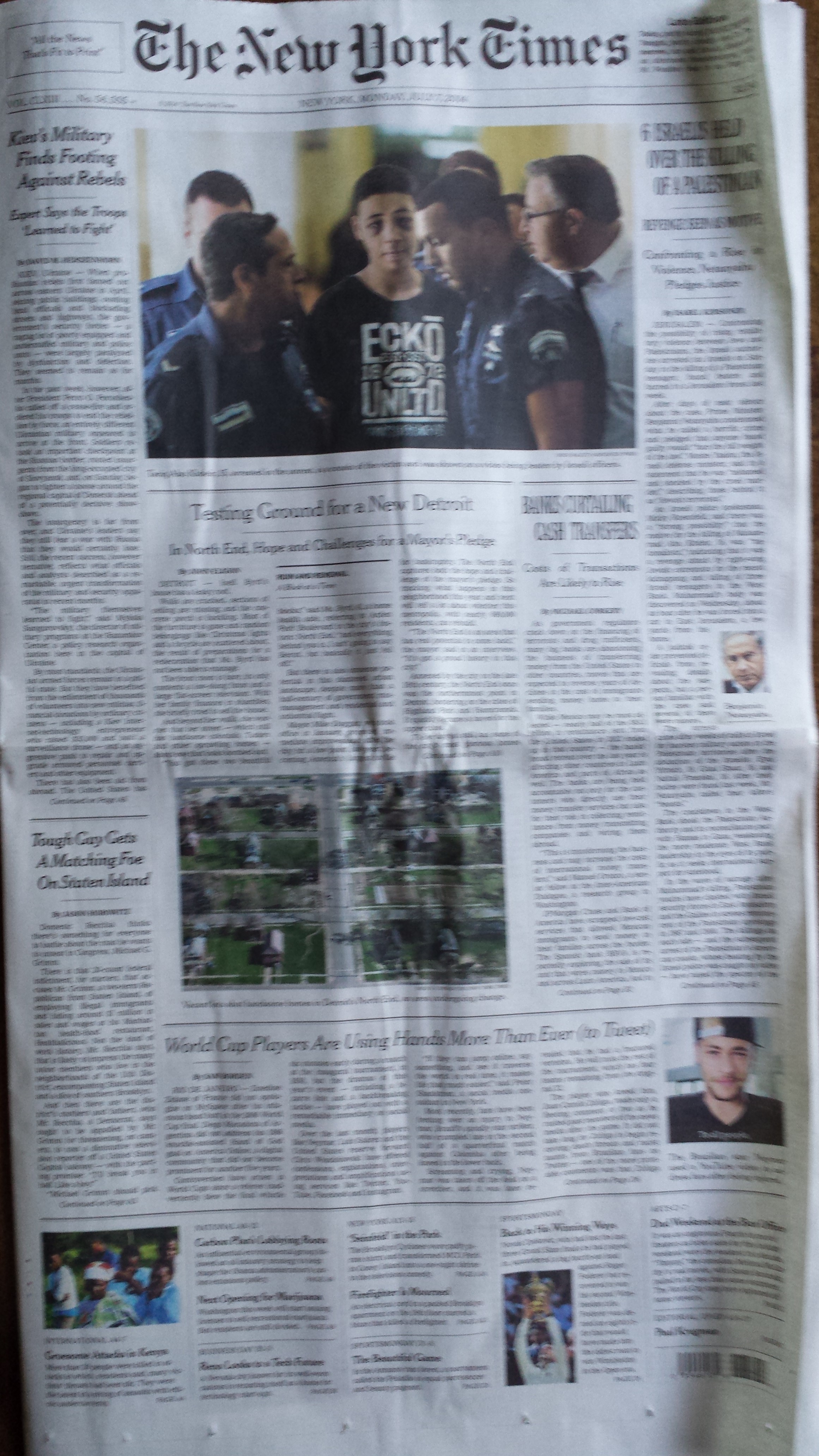
On July 7, 2014 the New York Times posted, on the top of its front page, a large color photograph of a Palestinian youth who was injured during riots against Israeli police. The bruised teenager was deemed to be a bigger story than victims of mass murders in other countries on a particularly violent day in Africa and the Middle East:

20140707_082918

On page A4, the paper posted a large black and white photograph and article about  20 people who had their throats slashed in Kenya;


On page A7, the NYT posted a black and white photograph of soldiers and militiamen in Uganda where 50 people were killed in a battle between security forces and a tribal militia;

On the bottom of that same page, a short article (with no associated picture) described how 35 to 40 people were killed in Yemen in a fight between “Shiite rebels and tribesmen associated with the government.”

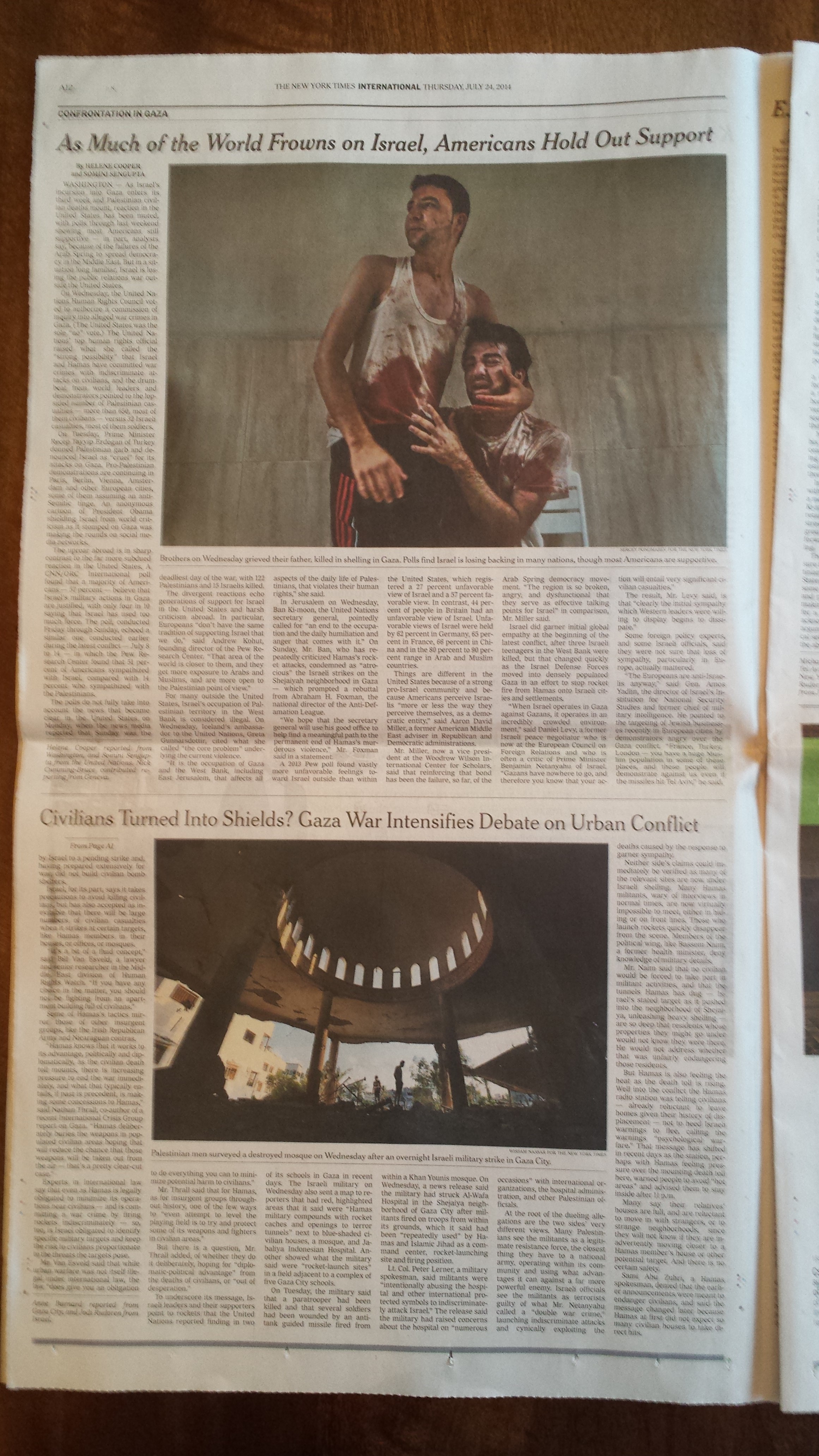
20140707_08293720140707_08294820140707_083002
Pictures of mass murders buried in the NYT pages

While over 100 people were slaughtered in the region, the Times thought that a bruised youth was more significant than any and all of those atrocities. Could that have been because the teenager was a Palestinian Arab? That wouldn’t be logical as the Yemenis are Arab too. Could it be because the injured boy was a Muslim? That also would not make sense since al-Shabab is the Islamist terror group in Kenya that has been killing dozens of people every week, and both parties in the slaughter in Yemen are Muslim.

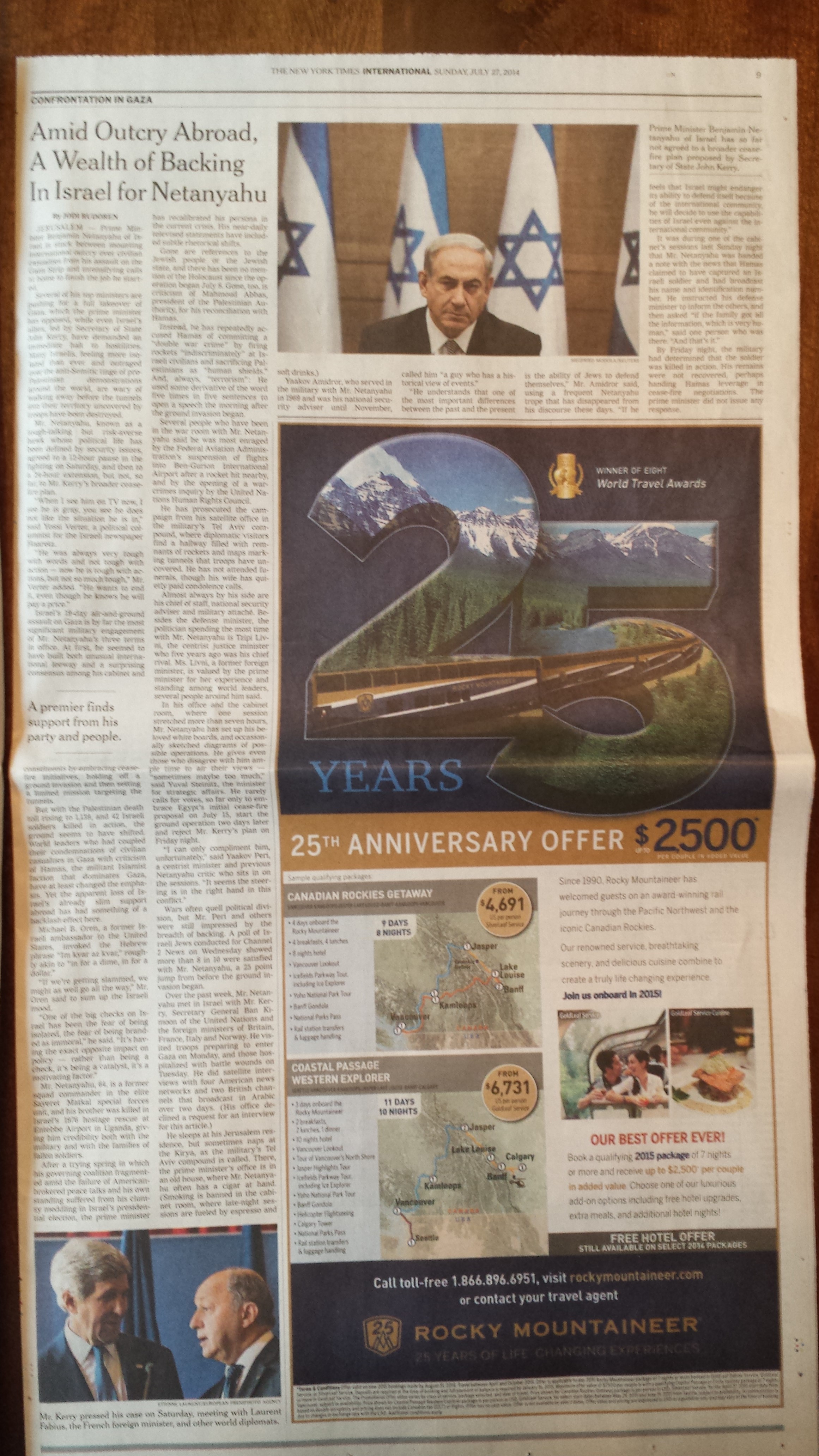
The difference in the dynamic of these stories lies in the counter-party – Israel – as evidenced by the other pictures in the news story. In a small picture on the (extreme right) side of the cover page, and then again in a color photograph on page A5, are close up pictures of Israeli Prime Minister Benjamin “Bibi” Netanyahu. Netanyahu is possibly the only world leader who is more despised by the NYT editorial board than former US President George W. Bush. The Times often uses pictures of Netanyahu alongside stories of Israeli aggression. It does this uniquely and consistently for Bibi.

By means of comparison, imagine an article about US drones killing civilians in Afghanistan, and then a picture alongside of it of US President Barack Obama. It doesn’t happen in the NYT or liberal media outlets. You probably wouldn’t even see a picture of injured people or mourning mothers in US papers. That is because they do not want to sketch a killer in Obama’s image.

As examples, here are two NYT articles that are critical of US policy of drone attacks – but include no pictures (let alone two!) of Obama. These are attacks that Obama ordered, (compared to a general situation in Israel which Netanyahu was not directly involved). Needless to say, the articles that simply report on the use of drones have no pictures of the US Commander-in-Chief.

http://www.nytimes.com/2013/10/22/world/asia/civilian-deaths-in-drone-strikes-cited-in-report.html?pagewanted=all&_r=0

http://www.nytimes.com/2014/06/26/world/use-of-drones-for-killings-risks-a-war-without-end-panel-concludes-in-report.html

In another article that is completely about Obama’s war on terrorism, the picture puts Obama so far in the background you would think he was accidentally caught in the photo.

http://www.nytimes.com/2012/05/29/world/obamas-leadership-in-war-on-al-qaeda.html?pagewanted=all

However, the New York Times and various liberal publications like to paint Bibi and Israel as attackers. They use his image alongside articles which describe attacks and counter-attacks. He has been made into a caricature of war; a cartoon of a blood libel.

Every picture tells a story. It is time to ask what the artist had in mind.

The Subtle Discoloration of History: Shuafat

Reader’s often assume that the more reputable news organization do research and perform fact-checks before posting articles. However, they do not often consider the word choices or juxtapositions of those facts relayed in a story. The truths and half-truths can combine to distort reality. This becomes exacerbated when quotes from biased witnesses are included in the article.

Witness the July 6, 2014 New York Times article on page 8 describing the terrible abduction and murder of an Arab teenager as a case in point. The second paragraph of the story: “…Mohammed was at the recreation center named for his respected, expansive Palestinian family in the ancient section of the East Jerusalem neighborhood of Shuafat.” I will avoid commenting on the “respected” background of the Abu Khdeir family who “started farming [in Israel] 250 years ago” as I do not know them (and why should I doubt Jodi Rudoren?). Consider the proximity in one sentence of the words “Palestinian”, “ancient”, “East Jerusalem” and “Shuafat”. A reader could naturally conclude that Palestinian Arabs have long been living in the ancient Palestinian city of East Jerusalem. A quote from a member of the family in the article adds that “All Shuafat is in danger, all the settlers are around us. It’s like a monster – they want to eat us.” could lead a reader to conclude that Jews are recent “settlers” to the area and harass Arabs.

All of those conclusions would be false.

Shuafat is indeed thought to be an ancient site. Archeological excavations reveal Roman encampments and Jewish homes and mikvahs from 2000 years ago. However, neither Shuafat, nor the rest of Israel, have ancient Arab finds as Arabs did not come to the region en masse until the Muslim invasion in the 7th century.

Shuafat remained a small village until 1967 when Jordan (together with Palestinian Arabs who were granted Jordanian citizenship) attacked Israel in the Six Day War. Israel took control of the “West Bank” and extended the boundaries of Jerusalem to include Shuafat and other villages around the city. In 1980, Israel declared all of Jerusalem to be its united capital.

For parties that do not recognize Israel’s annexation of the eastern part of Jerusalem, it would logically extend that those same people would not recognize Israel’s extension of Jerusalem’s boundaries. Shuafat is either a neighborhood in Jerusalem, Israel (if one accepts Israel’s position) OR it is a village in the West Bank (if one doesn’t).

Regarding the comment of “[Jewish] settlers”- there are many more new Muslims that moved to Jerusalem than there are new Jewish residents. Since 1967, when Israel reunified the city, until 2012, the Jewish population grew by 2.6 times while the Arab population grew by 4.4 times. This huge difference comes despite the higher (4.3) birth rate for Jewish women in Jerusalem than for Arab women (3.6).

Lastly, Shuafat and “East Jerusalem” are integral parts of Jerusalem. Just below 40% of the eastern part of Jerusalem which was annexed in 1967 is Jewish. Arabs and Jews work and live together in the city (compared to some Israeli cities like Umm al-Fahm that are 99% Arab). Shuafat sits just south of the second largest neighborhood in Jerusalem, Pisgat Ze’ev (pop. 37,000). The new Jerusalem light rail line includes two stops in Shuafat, one of the only neighborhoods with two stops.

A fact-checked sentence should have read:

“…in the ancient Jewish section of the predominantly Arab East Jerusalem neighborhood of Shuafat in Jerusalem…”.

Just saying…

Every Picture Tells a Story, Don’t It?

The media – whether print or digital – are experts at what they do. They know what articles make people react. They know what motivates people to buy their newspapers and watch their news programs. They know how to drive tweets and retweets.

I therefore observe and review how they craft their craft; how they shape the stories they sell.

Photographs – even in papers that art the printed word – are the most engaging. They are no longer limited to tiny and grainy black & whites of decades ago; they are now displayed in vivid colors that convey a story and an emotion. The choice of which pictures to present, as well as the how and where, essentially prioritizes the news for the reader. For example, a color photograph on the top of the front page with an associated article in the far right column is the most news-worthy story of the day. If a photograph is small and in black & white in the back of the paper, alongside advertisements and other news stories, it would transmit the passing interest in the event.

With such understanding, I reviewed the New York Times coverage of the kidnapping and killing of three Israeli teenagers, and the killing of Arab children in the subsequent days.


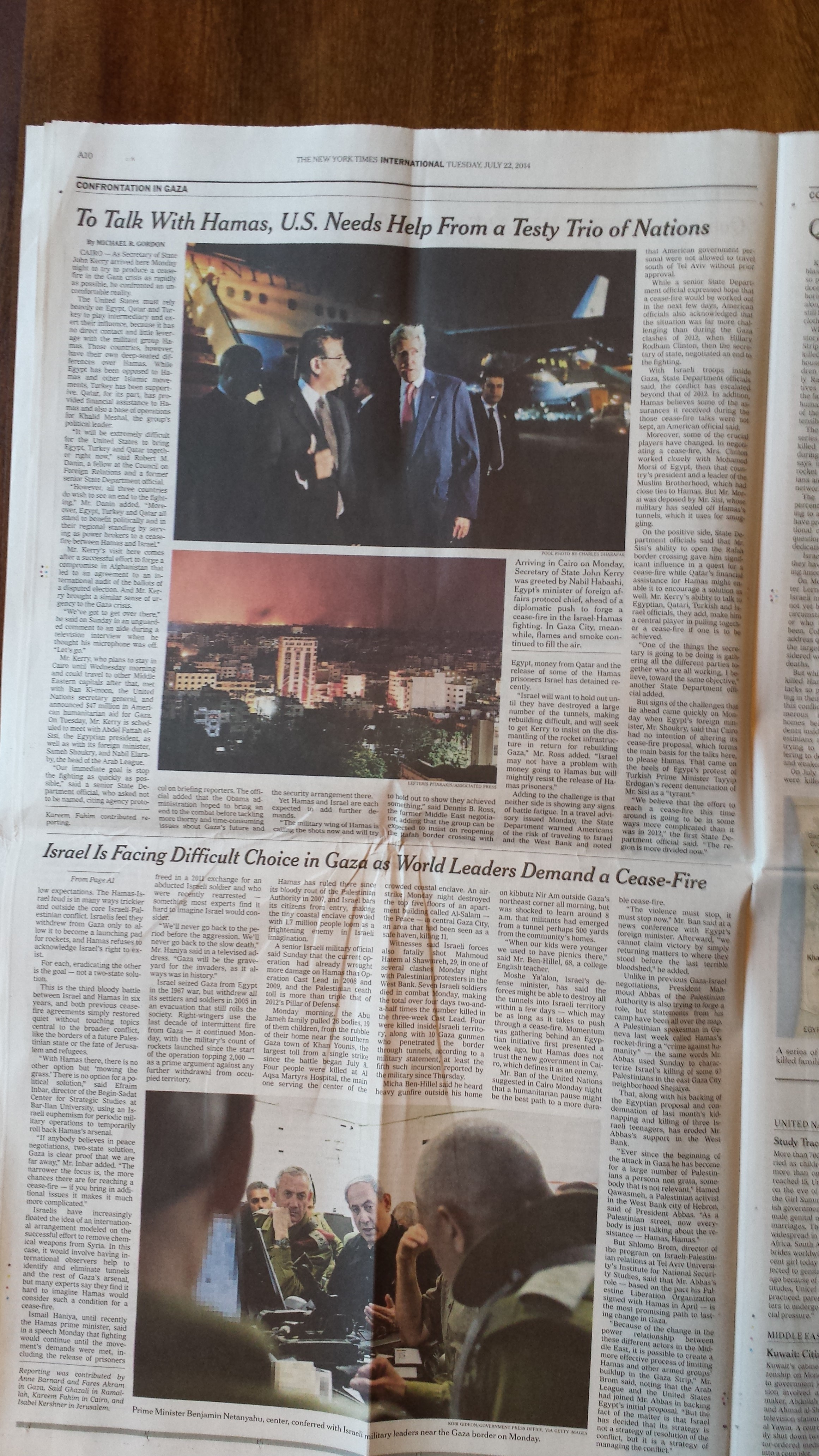
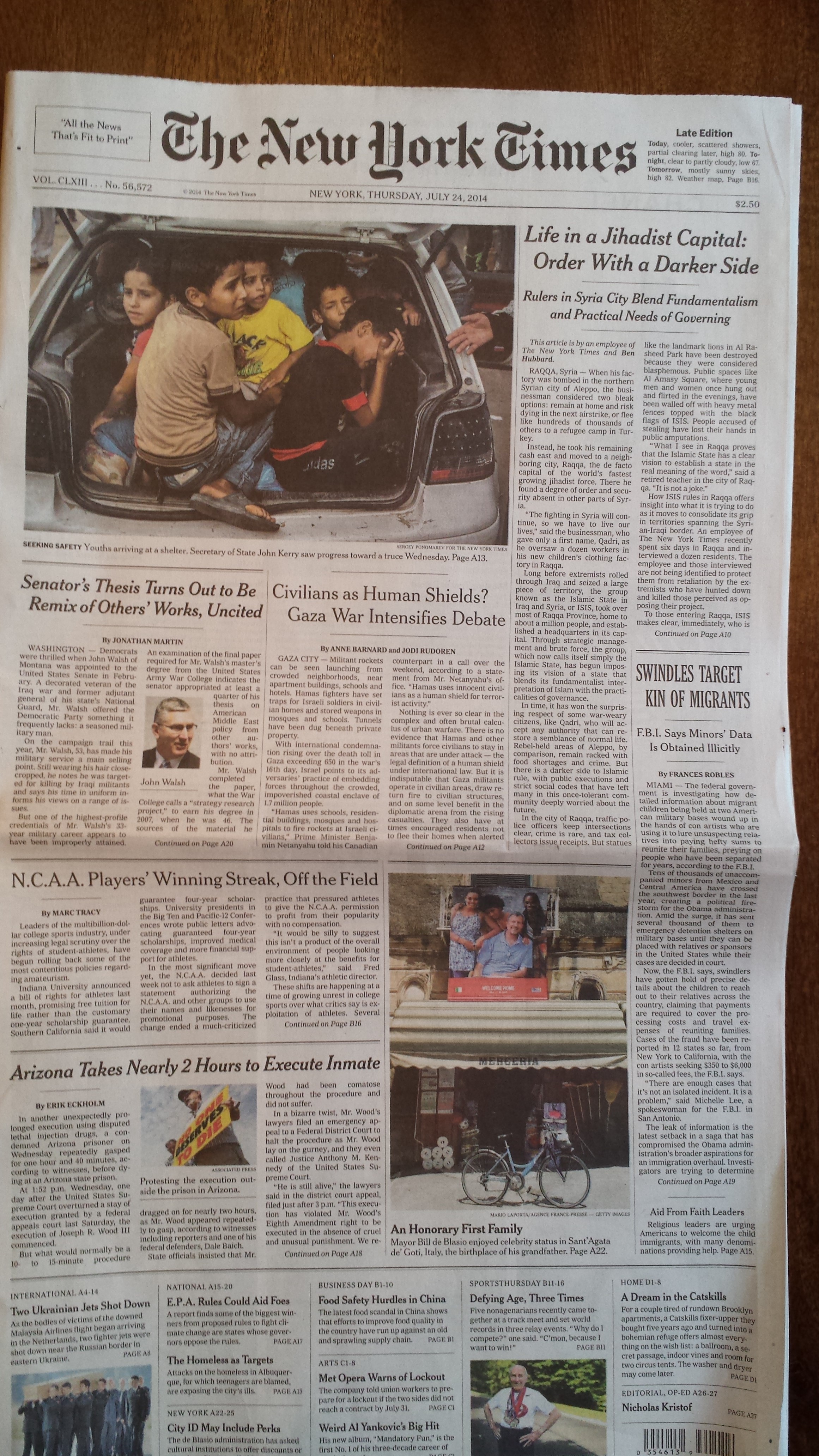
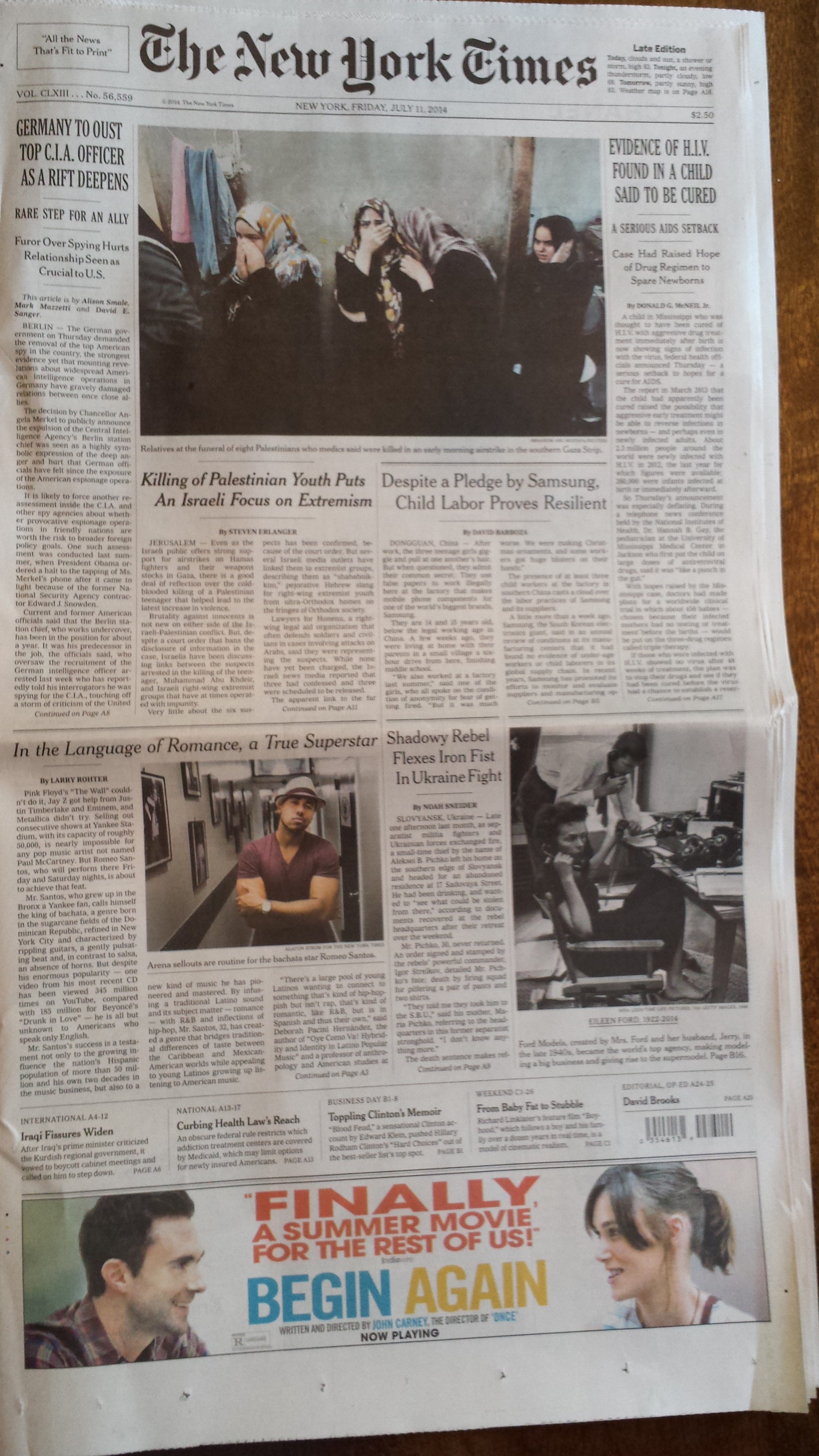
On June 30, the NYT ran a cover story on the bottom of the page, including two color photographs, about two mothers of victims – one Arab woman from the West Bank and another Jewish woman. The caption stated that the Arab woman’s son was “killed by Israeli soldiers” (one would need to read the article to learn that he was pelting the soldiers with rocks and bricks). The caption added that the Jewish woman’s son was “missing”. The article continued on page A9, with black and white pictures of equal size showing each woman together with friends praying. The captions again repeated that the Arab boy “was killed by Israeli soldiers”, and that the Jewish boy “was abducted” with other boys.

On July 1, the NYT ran a cover story that the Israeli teens were found dead. The story ran on the left hand (secondary) column of the front page and had no picture. The paper did, however, include several color photographs in the middle of the paper, on page A8, of a prayer vigil, pictures of the three boys, and army jeeps near the discovery site of the boys. The caption reads that their bodies “were found”.

On July 2, the NYT did not have any cover stories about the killings of the Israeli boys. On page A4, it posted some black and white photographs of friends mourning at the gravesite of one of the murdered teenagers. The caption read that the boys were “found dead”. The associated article ran from page A4 and continued on page A20.

On July 3, the NYT posted a large color photograph on the top of the page of Arab women mourning and an associated right-hand column about the killing of an Arab boy (the trifecta – large color photo on top of page 1 and associated right-hand article). The caption said her “son Mohammed was found dead” included a quote from the mother of the dead boy “We don’t feel safe”. The cover article continued on page A8 with three additional color photographs of: Palestinian men clashing with Israeli police; Israeli police searching the crime scene; and the dead boy. The captions state that there was a “kidnapping and killing of a Palestinian teenager”.

Over these four days, if one were to just get news from pictures and their captions, what would a reader take away?

From the captions, it would appear that everything that happened to the three Jewish teenagers was passive. The boys were “missing” and their bodies “were found”. There was no mention of kidnapping or killing, nor any attribution of who was the aggressor.

Contrast that to the captions of the Arab boys who were “killed by Israeli soldiers” and another that stated there was a “kidnapping and killing of a Palestinian teenager”. The aggression described against the Arab victims was underscored by the cover article quote from an Arab woman that “We don’t feel safe”. Pictures and captions showed Israeli soldiers and police, but shared no sentiment of the Jewish women.

Further, the large color pictures on the top of the page with the Arab women mourning was the only time that the NYT gave the stories in the region prominence. The only time we saw a cover picture (on the bottom of page) related to the Jewish victims was when one of the mothers appeared alongside a grieving Arab woman in a story meant to convey balance in grief. In fact, the underlying message was not balance: the pictures and captions made clear that the Arab woman was a victim of Israeli aggression trying to find missing teens, while the Jewish woman still had hope that her “missing” son (not kidnapped) would reappear.

What does the NYT positioning of greater emphasis on Arab suffering convey to a reader? How do the pictures of Israeli soldiers in armored vehicles and border police with machine guns compare with Palestinians throwing rocks? Were the pictures and captions deliberately shaping a larger story than the immediate events?

Were people more likely to buy the paper or talk about it with friends? Does the Times believe that more readers sympathize with Arabs than Israelis? Does the NYT editorial board believe that Israelis are the aggressors and Palestinians the victims, even when this entire episode began with the abduction and murder of three Jewish teenagers on their way home from school?

June 30. cover June 30. A9 July 1. cover July 1. A8 July 2. cover July 2. A4 July 3. cover July 3. A8What do you think?

Eyal Gilad Naftali Klinghoffer. The new Blood Libel.

A troublesome series of reports in major “liberal” media outfits like the New York Times and BBC have shown a pattern of “blame the victim” uniquely when it comes to Jews and Israel.

Consider the BBC’s Nicky Campbell’s coverage of the kidnapping of three Israeli teenagers, Eyal Yifrach, Gilad Shaer and Naftali Frankel, in Judea & Samaria arguing that “Palestinians would say perhaps these people were in the West Bank illegally.” He then continued to discuss Arabs in Israeli jails to “give [the kidnapping] some perspective” as if the comments provided any justifications for the kidnapping of teenagers trying to get home from school. (I suppose Nicky would support Iraqis kidnapping his daughters because of the UK involvement in the Iraqi war.)

The New York Times followed on June 16 when it posed several questions regarding “the cavalier practice of hitchhiking” in the West Bank. Was the NYT suggesting that these boys were responsible for their own kidnapping?

The hitchhiking abduction coverage was not unique. The New York Times ran an editorial on 6/19/14 bemoaning that the New York Metropolitan Opera, “bowing to the wishes of Leon Klinghoffer’s daughters and other Jewish critics,” decided to not globally telecast an opera about the murder of a 69-year old American Jew by Palestinian terrorists. The Times thought that “the opera gives voice to all sides” as if the rationale of the murder of an elderly American confined to a wheelchair was worthy of serious consideration. The general manager of the Met, Peter Gelb, said that the composer “John Adams said that in composing ‘The Death of Klinghoffer’ he tried to understand the hijackers and their motivations, and to look for humanity in the terrorists.” Gelb and the Times have called the opera “a masterpiece”. I am considering the right term for the Met and the Times.

Somehow, these outlets believe that Jews bare at least partial responsibility for the crimes committed against them: Jews are not victims; they are vehicles to voice displeasure of the state of the Palestinian Arabs.

To illustrate and contrast the vileness of this targeting of Jews and Israel by these media outlets, consider the coverage of other crimes during this same time period.

The New York Times covered the sexual assaults of women in Egypt during the celebrations for new President Abdul Fattah al Sisi with appropriate disgust. It ran articles, editorials and op-eds that condemned the attacks. The Times did not run articles questioning why the women were out late among so many men. The paper did not suggest that the women were dressed inappropriately. It did not post articles by Egyptian clerics who describe the value of modesty for women and the inappropriateness of their being out among men. Because if the paper had done so, it would have served to validate the disgraceful attack and place blame on the victim.

Similarly when a young man, Elliot Rodger, went on a shooting rampage in California because he felt rejected by girls in his school, the papers did not post opinions that girls should be nicer to young men and consider their feelings. As is clearly obvious, doing so would be an insult to all of the innocent victims of the rampage.

The daughters of Leon Klinghoffer, Lisa and Ilsa, put it best in their letter to the editor of the New York Times on June 21: “Our 69 year-old father was singled out and killed by Palestinian terrorists on his wedding anniversary cruise in 1985 solely because he was Jewish. His memory is trivialized in an opera that rationalizes terrorism and tries to find moral equivalence between murderers and the murdered. Imagine if Mr. Adams had written an opera about the terrorists who carried out the 9/11 attacks, and sought to balance their worldview with that of those who perished in the twin towers. The outcry would be immediate and overwhelming. But ‘Klinghoffer’ is justified as ‘a work of art’ and an opportunity to ‘debate’ the Israeli-Palestinian conflict. This is an outrage.”

The media’s blind spot for Jewish victims in its visual field have left Jews in the dark ages of history once again. The “progressives” are developing a new Blood Libel, in which every Jew has a hand soaked in the misfortune of Arabs. They have turned the State of Israel into a new blood matzah, conceived and living in sin.  During the Dark Ages, Jews were accused of taking missing Christian children.  At present, the progressive press blames Jews for their own missing and felled Jews – sacrifices that must be made to uphold the evil Jewish State.

Can anything right the “left”? If the Royal Ballet were to perform “The Untimely Fall of Lee Rigby” with beautiful arias about the sorrowful tale of Michael Adebolajo and Michael Adebowale, the two people who were sentenced to life in prison for Rigby’s murder, would the press react? Would the British press cheer the “work of art” and celebrate the “humanity in the terrorists” who hacked a soldier to death on the streets of England to avenge the killing of Muslims by British forces? The Klinghoffer daughters believe the “outcry would be immediate and overwhelming,” from the press and public. While I agree, I fear that it would not cause progressives to rethink their attitude towards Jews. The new Blood Libel has caught hold.


Related FirstOneThrough articles:

The Death of Civilians; the Three Shades of Sorrow

UN Comments on the Murder of Innocents: Itamar and Duma

The NY Times begins its assault on Israel’s Search and Rescue

It has been several weeks since Boko Haram kidnapped over 200 teenagers from their school. Over these weeks, the New York Times has repeatedly faulted the Nigerian government for not being aggressive enough in finding the girls. But in less than one week since the kidnapping of three Jewish teenagers, the New York Times is already running articles that Israel is too aggressive in trying to bring their boys back home.

NYT on Nigeria:

5/24/14: “That the hopes of many across the globe rests on such a weak reed as the Nigerian military has left diplomats here in something of a quandary about the way forward. The Nigerian armed forces must be helped, they say, but are those forces so enfeebled… the military presence on some of the region’s most dangerous roads is light, with only a handful of checkpoints

5/27/4: [Nigerian President Goodluck Jonathan] “responded to the kidnappings in the same way that he has responded to countless other Boko Haram atrocities (or indeed to the anti-civilian depredations of his own military): minimally, or not at all.”

NYT on Israel:

6/17/14 by Jodi Rudoren, the official NY Times reporter who covers news from a Palestinian perspective: “It was Day 3 of what Palestinians are universally calling a ‘siege’ on Hebron,” Jodi does not discuss the violent history of Hamas nor its past use of kidnapping. She quotes a “father of 10” (is this man with Hamas? A shopkeeper? Does his being a parent of 10 make him more or less reliable?): “’This is like they arrest 800,000 people in the Hebron area – look at the checkpoints.’”

Jodi continued that “many here and elsewhere in the Palestinian territories questioned whether the abductions even happened. Leaders referred to the ‘alleged kidnapping’ in their official statements… [Israel] staged the event…as a pretext to oust Hamas from the West Bank.”  Nice work getting a conspiracy theory into the public.

I wonder if the NY Times will get a reporter to cover the news from Boko Haram’s perspective. Perhaps they should send Jodi.

The New York Times wants the military to defeat terrorists (but not Hamas)

NYT 6/9/14: “Pakistan’s Latest Crisis” was a call to action for the military to defeat terrorists. What about Israel defeating Hamas? Not so much.

The Pakistan editorial led with a strong statement about the Taliban: “In its increasingly violent effort to destroy the Pakistani state”, the NYT made the Taliban’s ultimate goal clear. It continued with a call for the Pakistani government to wake up: “Will this be the crisis that finally persuades Pakistan’s government and its powerful military to acknowledge the Taliban’s pernicious threat and confront it in a comprehensive way? It should be.” The NYT editorial board clearly spelled out its desire for a military strike to defeat the terrorist entity that attacked civilians in Pakistan.

It is distressing to compare these statements with the 11/20/12 editorial about Gaza firing nearly 1000 rockets into Israel. The NYT did not describe Hamas as a terrorist entity (labeled so by the US, Canada, EU, Japan, Jordan, Egypt and Israel). It did not state that Hamas seeks the destruction of Israel – which it has made clear throughout its charter, and the statements and actions of its leadership for many years. Rather, the NYT stated that Hamas “resorted to violence” in a statement that is either evil or laughable in its ignoring the calls for death and destruction of Jews and the Jewish State.

The Times then went on to blame Israel: “Israel also has a responsibility for the current crisis,” Is the Times suggesting that if all the Jews would just leave the Middle East and dissolve Israel the way Hamas desires, they wouldn’t have to “resort to violence”?

The NYT was loath to suggest that Israel stamp out the terrorist entity bent on its destruction stating: “But military action is no long-term answer.”

The difference between the Taliban and Hamas is that Hamas is an elected government, having won 58% of the Palestinian vote in 2006. It governs a territory, Gaza, since 2007. But its desire to destroy all of Israel and kill civilians is not an iota less than the Taliban’s goals in Pakistan and the response from the government and military should similarly be supported. The links to the two editorials are below:


Pakistan-Taliban editorial:

http://www.nytimes.com/2014/06/10/opinion/pakistans-latest-crisis.html

given recent events, one has to assume the militants will stop at nothing until the state is utterly destabilized and they have taken control. Pakistani political and military leaders need to be honest about the militant threat that they and their people are facing


Israel-Hamas editorial

http://www.nytimes.com/2012/11/20/opinion/hamass-illegitimacy.html?_r=0

“If Prime Minister Benjamin Netanyahu of Israel had pursued serious negotiations on a two-state solution with the Palestinian president, Mahmoud Abbas, the Palestinians could have hope in a different future

The NY Times outdoes itself Swapping News and Editorials

The New York Times has established a reputation for infusing its news stories with the editors’ biases.  However, it outdid itself when it posted an editorial about Obama’s drone strikes one day, and subsequently posted the virtually identical article as a news story on the following day.  Both had the same misstatements which: ignored the studies pointing to Obama’s killing of civilians with drones; blamed Bush for the program; and defended Obama.

The editorial:

The “news story” the next day:


NY Times skewed view on Pope prayer invitation and MidEast Peace

NYT May 27, 2014 “For Middle East, Region of Religious Conflict, Pope Suggests a Respite in Prayer”


Jodi Rudoren penned a piece in a “Memo from Jerusalem”, freeing her from the invisible constraints of reporting news “truthfully”, and shared her personal observations about the pope and the Middle East conflict. Her bias towards the Palestinian narrative remains clear.


  1. Her opening sentence states that Pope Francis came back from the “Holy Land with the typical bag of ceremonial gifts, including, from the children of Bethlehem’s refugee camps, a mock-up of an identification card in the name of Jesus that lists family members as Mohandas K. Gandhi, Nelson Mandela, Yasir Arafat and Martin Luther King Jr.” Wow.
    1. I’ve been to Israel 30+ times. I’ve been to Jerusalem, Jericho and Bethlehem. I never once came back with a propaganda ID card. Does she really think that it’s “typical”?
    2. Jodi has often written about the Vatican and the UN now referring to the “State of Palestine”. You cannot have a refugee camp of Palestinians in a “State of Palestine”. You cannot claim to have a state and be a refugee of that state while living in such state.
  2. It is quite impressive to list a terrorist like Yasir Arafat with Gandhi and MLK. I would have hoped Jodi would have continued to detail the outrageousness of the comparison, but alas, I believe she thinks it fine to equate a civil rights leader with the man who brought the world airplane hijackings. Here are two quotes: one from Arafat and one from Gandhi. See if you can guess who said which:
    i.      “I suppose leadership at one time meant muscles; but today it means getting along with people.
    ii.      “We will not bend or fail until the blood of every last Jew from the youngest child to the oldest elder is spilled to redeem our land!
  3. The article compliments the pope navigating his trip “without seeming to offend” any of the parties.  A strange comment considering over the prior three days Jodi pointed out the anger of the Palestinians for the pope’s laying a wreath at Herzl’s grave and of the Israelis anger for the pope stopping at the security barrier near a sign that labeled it an “Apartheid Wall”.
  4. Jodi goes on to compare the pope’s stopping at the security barrier, with a wall commemorating Israeli victims of terror. In a “normal” world, these two visits would be THE SAME prayer to stop violence, as the security barrier was built during the Second Intifada specifically to stop terrorism. However, Jodi’s remarks make clear that the stop at the barrier was not just the pope connecting with Palestinians and Israelis, but was meant to “shame” the Israelis. How can a parallel be drawn between a security mechanism and a memorial to innocent victims?
  5. She dismissed the prospects of the “peace prayer” at the Vatican “particularly” because Israeli President Peres role is “ceremonial” and he is set to leave the post in July.
    1. NYT again blames Israel for any path forward.
    2. Ignores the fact that Palestinian President Abbas’s term in office expired in 2009 – over four years ago.
  6. Jodi chose to liken the parties stating that “extremists on both sides have exploited religion to block resolution”. That statement is not an over-simplification, it is dishonest:
    1. Hamas won the last elections the Palestinians held, winning 58% of the vote back in 2006. Kahane’s party has been banned in Israel for decades.
    2. Hamas controls Gaza and 1.7 million people. Jewish “extremists” are individuals who do not control land or a population.
    3. The “right-wing” (NYT terminology) Likud and The Jewish Home parties have no disparaging comments about Christians or Muslims. However, the Hamas governing charter is a rant of anti-Semitism. A few quotes here:
      i.      Article 20: [the Jews are] “a vicious, Nazi-like enemy, who does not differentiate between man and woman, elder and young…The Nazism of the Jews does not skip women and children, it scares everyone.”
      ii.      Article 22: “[Jews] have been scheming for a long time,… they took over control of the world media such as news agencies, the press, publication houses, broadcasting and the like. … They stood behind the French and the Communist Revolutions and behind most of the revolutions”
      iii.      Article 7: “The prophet, prayer and peace be upon him, said: The time will not come until Muslims will fight the Jews (and kill them); until the Jews hide behind rocks and trees, which will cry: O Muslim! there is a Jew hiding behind me, come on and kill him!”
  7. Notable for its absence over a week of reporting on the pope visiting the Holy Land, and again in this article dedicated to religion and prayer, was the current status of Christianity in the region.
    1. Israel has freedom of religion for all; all churches are open and people are free to pray in the manner of their choosing. That is not true in most of the Middle East
    2. Israel is the only country in the Middle East where the Christian population is growing
    3. Israel is the only country in the Middle East where the number of Christian tourists surpasses any other religion, including Jews.
    4. Israel is the only country in the region which is the target of BDS by some Christian groups
  8. Also absent from the articles was Abbas’s comment to the pope that “Israel is systematically acting to change [Jerusalem’s] identity and character, and strangling the Palestinians, both Christians and Muslims, with the aim of pushing them out”. No comment from the NYT about the religiously charged lie:
    1. The Christian population in Jerusalem has increased since Israel re-unified the city in 1967. The only time that the Christian population declined over the past 100 years was during Jordanian rule 1949-67
    2. The Muslim population in Jerusalem never increased more over the past 150 years than it has under Israeli rule
    3. From 1967-2011, Muslim population in Jerusalem increased 4.4x, compared to 2.5x for Jews
    4. Jerusalem has had a Jewish majority since 1870. How has the “identity and character” changed in Abbas’s mind? Oh, Jews are once again living in the Old City, now that the 1949 Jordanian expulsion of the Jews and 19-year ban is over.


NYTimes shows its preference in “dueling narratives” in the Middle East

New York Times May 26, 2014: “Pope Lays Wreath at Tomb of Zionism’s Founder”

The NYT headline would lead a reader to believe that the article is about Theodore Herzl, the founder of modern Zionism. Guess again.

1.      The article is not about Herzl at all- he is mentioned in passing in the seventh paragraph.

2.      The article is about dueling narratives of Israelis and Palestinians. It is clear which one the NY Times favors, as the day beforehand it posted a huge front page photograph of the Pope at the security barrier, compared to this article on page A10 which includes three photographs of the pope at religious sites for Jews, Muslims and Christians.

3.      The article does not point to the NYT posting the photograph on its front page, but says that the picture simply “rocketed around the Internet”, making the paper seem uninvolved in its promotion.

4.      The author writes of the “graffiti-scarred concrete barrier separating Bethlehem from Jerusalem”. There is no mention that Israel handed control of Bethlehem to Palestinians and that Israel controls Jerusalem, so a checkpoint is appropriate.

5.      The fact that the fence was built specifically due to Arabs from the West Bank murdering Israelis is stated only as a quote from Netanyahu, making the statement appear biased rather than factual.

6.      The choice of words “the pope acceded to Israel’s request that he add to his packed Monday morning another unscheduled stop” makes Israel appear demanding and unreasonable in bullying the pope.

7.      The NY Times decided that a stamp of the pope pressing his head against a security barrier next to a sign that says “Apartheid Wall” is somehow analogous to Israel making a stamp of the pope placing a note in the Western Wall. One is a wall constructed to prevent terror, but has a sign blaming the victim, while the other wall is a religious place of prayer. The Palestinian stamp is a propaganda tool which wipes its crimes clean, while the Israelis post a stamp of hope. (There are four paragraphs in the article to stress this point).

8.      The NYT mentions that Peres post of President of Israel is ceremonial and that he leaves his post soon, but does not continue that Abbas’s term of President of the Palestinian Authority ended in 2009.

9.      The NYT, as always, included language that make the Israelis appear angry: “incensed some Israelis” and “some Israeli griping”. This language is not used for Palestinians.

http://www.nytimes.com/2014/05/27/world/middleeast/pope-francis-jerusalem.html

Frightening New York Times 4/27/14 article on “Mahmoud Abbas Shifts on Holocaust”

  1. Abbas new statement that the Holocaust was bad does nothing to negate his various prior comments, phd paper and published book that claim: 1) that 6 million Jews were not murdered in the Holocaust; and 2) that Zionists conspired with Nazis so that more Jews would move to Palestine (so Zionists are at least partially to blame for the Holocaust).
  2. (By way of comparison, If Abbas would have reversed his prior statements and negated his research, that would have been a “shift”.  OR, if Abbas would have come out and said that the Palestinian Arabs of 1936-46 who fought successfully against the Zionists and British who then limited Jewish immigration to Palestine before and during WWII were responsible for 100,000+ Jews dying in the Holocaust, that would have been a shift).
  3. NYT claims that Abbas’s latest comment “goes further” in back-tracking from his Holocaust denial and attacks on Zionism because he claims that Palestinians understand suffering from Israeli “ethnic discrimination and racism”. Not only does the Abbas comment not negate his offensive comments, but it further insults Jews and Israelis by calling them racists, and suggests that the Holocaust is similar to the situation of stateless Arabs.
  4. Hamas is called a “militant Islamist faction” and not a terrorist organization
  5. No NYT mention of the fact that the Hamas Charter calls for the death of Jews
  6. No NYT mention that Hamas refuses to allow Holocaust education in the schools of Gaza against the wishes of the United Nations
  7. Thank you New York Times, for posting an article on Holocaust Remembrance Day about Abbas, the Holocaust denier, and his latest anti-Israel comments, and for phrasing the headline and article to try to make him look like a progressive.

http://www.nytimes.com/2014/04/27/world/middleeast/palestinian-leader-shifts-on-holocaust.html?_r=0