New York Times Creates, then Inflates Israeli Crimes

On August 28, the New York Times published an article called: “Heavy Use of Banned Cluster Bombs Reported in Syria”, which – one would imagine – was about Syria’s use of cluster bombs. A careful reader could come away with some information about Syria’s use of bombs; but any reader would be led to conclude that Israel is the worst offender on the planet.

The tone of the article (about Syria) moves quickly against Israel from the opening paragraph:

  •  Cluster bombs, outlawed munitions that kill and maim indiscriminately, have caused more casualties in the Syrian civil war than in the 2006 Lebanon conflict, when Israel’s heavy use of the weapons hastened the treaty banning them two years later, a monitoring group said Wednesday.

It is true that some countries adopted a treaty on the weapons about two years after the Israel-Lebanon war. In case Israel’s usage of bombs wasn’t clear, the article elaborated on this same point a few paragraphs later:

  • The [Human Rights] group’s statement said, “Already, casualties in Syria are higher than those attributed to the 2006 Israel-Lebanon conflict that triggered global outrage and contributed to the establishment of the ban convention.

I guess the Times wasn’t sure if people read the point at the start of the article, so it added a line about “global outrage” to underscore the world’s opinion about Israel. The Times continued:

  • Israel’s military was widely criticized at home and abroad for its heavy cluster-bomb use in Lebanon, dropping HUNDREDS OF THOUSANDS [CAPS ADDED]of them, containing more than 1.2 million bomblets, particularly in the final days of the 34-day conflict with Hezbollah. The Israeli newspaper Haaretz quoted a commander of the Israel Defense Forces as saying, “What we did was insane and monstrous, we covered entire towns in cluster bombs.”

By this point, the Times was really rolling. It repeated the anger at Israel two more times with “widely criticized” and “we [were] monstrous”. The attribution was given not only to the general global community, but also to Israelis criticizing themselves. The negative portrayal of Israel went on:

  • Jan Egeland, a Norwegian statesman and diplomat who at the time of the Lebanon conflict was the top humanitarian aid official at the United Nations, described Israel’s use of the weapons as “completely immoral.” Mr. Egeland’s criticism was widely credited with helping to galvanize the efforts to achieve a treaty two years later known as the Convention on Cluster Munitions.

To cap off the review of Israel, a fourth phrase “completely immoral” was given to “the top humanitarian aid official at the UN”. That totaled four attacks on Israel in an article about Syria’s use of cluster bombs. And how many negative comments were there against Syria – which was the subject of the story, and had more injuries than Israel? ZERO.

Further, the article was written in a manner that made it nearly impossible for a reader to clearly see that Israel used the weapons LEGALLY BEFORE THERE WAS ANY TREATY IN EXISTENCE. It inverted this point by repeatedly saying that Israel’s actions caused the treaty to come into existence.

The singular focus on Israel and phraseology were just the beginning of the Times’ crime creation.  Crime inflation was to come.

Gross omissions from the report gave the incorrect impression that Israel was the only country that used such weapons. In fact, according to the Cluster Munitions Monitor, 22 governments used the weapons in 38 countries since World War II. Today, over 90 countries hold stockpiles of the munitions. None of those points made it into the Times’ article.

On top of the obsession, wording and lies of omission, were complete falsehoods. The “hundreds of thousands” of bombs figure attributed to Israel was over-stated by about 250 times. It took three days for the Times to post a correction noting that the correct figure “was about 1,800 bombs”.

But wait, there’s more.

  • Megan Burke, another editor of the “Cluster Munition Monitor” report, said the widely accepted data for the Israel-Lebanon conflict showed 249 cluster munition casualties between July 12, 2006, and April 12, 2007. The time period goes beyond the conflict’s end to reflect the effects of the unexploded Israeli bomblets. The United Nations has said that many of the Israeli cluster bomblets in Lebanon did not explode, essentially turning them into booby traps that required an extensive cleanup operation.

A nice usage of “Israeli bomblets” twice in a single paragraph. By this point, “bomblet” is almost synonymous with Israel in the article as no other country in the article is married to the munitions in this way.

More egregious, the casualty figure is only compared to the 264 deaths in Syria until the very end of the article. If one were to read and report on the study, one would learn that the number of casualties from “Israeli bomblets totaled 0.5% of the total casualties inflicted by cluster bombs – or roughly 1 in 200.

The article finally mentions some other countries at the end of the article – in a passive way. It notes that the number of casualties in Laos, Vietnam and Iraq was higher than in Syria today, but it does not state who the perpetrators dropping the bombs were. Maybe bombs just happen when other countries are involved; only Israel actively drops “Israeli bomblets”.

If the Times had cared to educate a reader, or if it cared to comment on a country other than Israel, it might have noted that the only country which continues to produce, export and use cluster munitions is the United States. But the goal of the Times is clearly not to educate or report facts that disrupt its Israel-bashing narrative.


It is a sad but reliable continuation of Israeli coverage by the New York Times: it creates and inflates crimes attributed to Israel. Now, it is even featured in articles about other countries, in case you missed their point elsewhere in their “news” coverage.


Source:

An article about Syria using cluster bombs in the New York Times – August 27

http://www.nytimes.com/2014/08/28/world/middleeast/monitor-reports-heavy-cluster-bomb-use-in-syria.html?_r=0

“Cluster Munition Monitor 2014,” : http://the-monitor.org/index.php/LM/Press-Room/Cluster-Munition-Monitor-Media-Kit/CMM14/CMM-Major-Findings-2014-English


The Ties that Bind (and Those Unmentioned)

1400 girls in England raped by [Asians/Pakistanis/Muslims]

The case of the 1400 girls that were bound, beaten and raped over a period of 13 years in England horrified the civilized world. That such an event could go on at all, and then further, left unchecked by police has rightfully enraged the citizens of England and abroad.

Presumably, actions will being taken to right the wrong that was done to the girls and to prosecute those responsible. As part of the process, people are analyzing what could make people commit such atrocities on young children, and how could the police avoid taking action for so long.

Any decent analysis will examine the history of the cases and look for trends: time; place; individual; community; backgrounds; people and friends involved; etc. Common themes will certainly emerge. Some will be important and others less so.

At this point, reporting from some media outlets consider certain characteristics of the assailants important while others avoid them. Consider:

    • The Telegraph. Initial articles mentioned that the men were from “Asian gangs”. Later editorial-news clearly stated that “All but one of the perpetrators were Muslims of Pakistani heritage”.
    • The Wall Street Journal. The initial two stories mentioned the “Pakistani origin” of the attackers, but did not mention their religion. The third article did not specifically say that they were Muslim, but said that the Muslim community condemned the crimes, adding a quote from a member of the Muslim community that the attackers “are not Muslims.” In the fourth article, it declared that “the abusers were of Pakistani and Muslim origin”.
    • The Guardian. First described the attackers as “Asian”. Later articles mentioned the “perpetrators in the town mostly being Pakistani taxi drivers.”  Editorials in September reverted back to saying the rapists were “Asian”.
    • The New York Times. Has referred to the perpetrators as “men of Pakistani heritage”. To this day, none of their news accounts mention that the attackers were Muslim.


There was an evolution of the news flow in the more conservative papers: first the men are described as “Asian”, then “Pakistani” and finally “Muslim”. There are several reasons why this evolution may have occurred: more information about the perpetrators gradually became known, or the relevance of the additional information was viewed as more important as time went on.

The Telegraph and the Wall Street Journal added information that the attackers were Muslim. The Guardian held off, and only obtusely referred to their Islamic faith in an article on September 2nd where it reverted back to describing the attackers as “Asian” but the “growing influx of the far right” had expressed its anger at the “Muslim community”.  The New York Times has avoided mentioning the religion of the rapist in any manner.

By the beginning of September, the common religious background of the attackers was well reported. One must therefore conclude that the New York Times deliberately decided to not point out the attackers religious background because they felt it was not relevant to the story (but somehow their Pakistani heritage was).

Was the fact that the men were Muslim relevant to their actions? Was the fact that they were Muslim relevant to their community’s failure of reporting their actions? Was their religion a factor in the police not investigating the many reported cases? Was there an important distinction between being Pakistani and Muslim? Was this simply a gang that happened to be both Pakistani and Muslim and the religion and heritage of the people had only to do with their kinship and nothing to do with the attacks or cover-up?

Perhaps the investigations will resolve the questions. It will be interesting to see if a divide between conservative and liberal papers shields the perpetrators faith (but not heritage) at that time.


Source:

NYTimes : http://www.nytimes.com/2014/08/27/world/europe/children-in-rotherham-england-were-sexually-abused-report-says.html?_r=0

http://www.nytimes.com/2014/09/02/world/europe/reckoning-starts-in-britain-on-abuse-of-girls.html

Wall Street Journal: http://online.wsj.com/articles/u-k-report-details-widespread-child-sex-abuse-in-rotherham-england-1409095700

http://online.wsj.com/articles/calls-for-resignation-grow-after-u-k-report-on-sex-abuse-in-rotherham-1409177623

http://online.wsj.com/articles/rotherham-residents-search-for-answers-in-u-k-sex-abuse-scandal-1409272644

http://online.wsj.com/articles/brendan-oneill-when-political-correctness-took-over-in-yorkshire-1409249308


The Guardian: http://www.theguardian.com/society/2014/aug/26/rotherham-children-sexually-abused-report

http://www.theguardian.com/uk-news/2014/aug/26/rotherham-child-sex-exploitation-capital

http://www.theguardian.com/society/2014/aug/26/rotherham-sexual-abuse-children

http://www.theguardian.com/society/2014/sep/03/rotherham-you-cant-blame-all-of-us

The Telegraph: http://www.telegraph.co.uk/news/uknews/crime/11057647/Rotherham-sex-abuse-scandal-1400-children-exploited-by-Asian-gangs-while-authorities-turned-a-blind-eye.html

http://www.telegraph.co.uk/news/uknews/crime/11059138/Rotherham-In-the-face-of-such-evil-who-is-the-racist-now.html

National Review editorial: http://www.nationalreview.com/article/386648/rotherhams-and-englands-shame-john-osullivan

Forbes editorial: http://www.forbes.com/sites/rogerscruton/2014/08/30/why-did-british-police-ignore-pakistani-gangs-raping-rotherham-children-political-correctness/


New York Times Talking Turkey

Sometimes a contrast in coverage helps boldface the biases.

20140811_074503

The New York Times (for some reason) wrote quite glowingly of Prime Minister Erdogan of Turkey during presidential elections in August 2014. Some of the choice language on August 9 before the election included:

  •  “hoping to secure a legacy greater than that of the revered founder of modern Turkey”;
  • “broken down secular taboos”;
  • “economic policies have improved the lives of many”;
  • “long been a strategic ally of the United States”;
  • “In 2011, President Obama developed a close personal relationship with Mr. Erdogan, seeing Turkey as a model to emulate for countries upended by revolution’

After the elections, on August 11 the Times continued to use positive expressions: “thousands massed…and erupted in applause” to Erdogan’s victory, while caveating later in the article that there were some concerns among the country’s “liberals” about an “authoritarian” streak in Erdogan.

In both articles, the New York Times neglected to remind readers of a few policies of Erdogan over the prior year that gave Turkish citizens pause about Erdogan:

But if the New York Times likes you, certain facts will fade to the background.

Consider the surprisingly low-turnout for this first-time Turkish presidential election: only 74% came out to vote compared to 87% in 2011 general elections. The NYT said that few people showed up to vote “presumably because many had assumed Erdogan would win”. Erdogan squeaked out a win with 52% of the vote compared to the second place winner at 38% – only 37% higher. However, the NYT said “the election felt like a coronation”.


By way of comparison, look at the way the Times covered the election of Israeli Prime Minister Benjamin Netanyahu in January 2013.  The Times did not include any of the commentary used for Turkey about Israel: being a strong US ally; the strong economy of Israel; the island of stability in the sea of chaos of the Middle East.  Instead, the headline read: “Tepid Vote for Netanyahu in Israel Is Seen as Rebuke”. In that “tepid vote”, Israelis came out in numbers greater than ever before – 67% voted for the cabinet, compared to the 2009 election turnout of 65% and of 63% in the 2003 election.  Not only was the vote not “tepid”, but Netanyahu’s Likud party won the vast majority with 31 seats compared to the second place winner, Yesh Atid, with 19 votes – a margin of 63% (almost twice Erdogan’s clearance).

But the Times despises Netanyahu. The article had remarkable quotes for the victorious Prime Minister:

  • weakened Prime Minister Benjamin Netanyahu”;
  • “the outcome was a humbling rebuke”;
  • “Mr. Netanyahu posted a panicky message on Facebook”;
  • “The results were a blow to the prime minister, whose aggressive push to expand Jewish settlements in East Jerusalem and the West Bank has led to international condemnation and strained relations with Washington.”

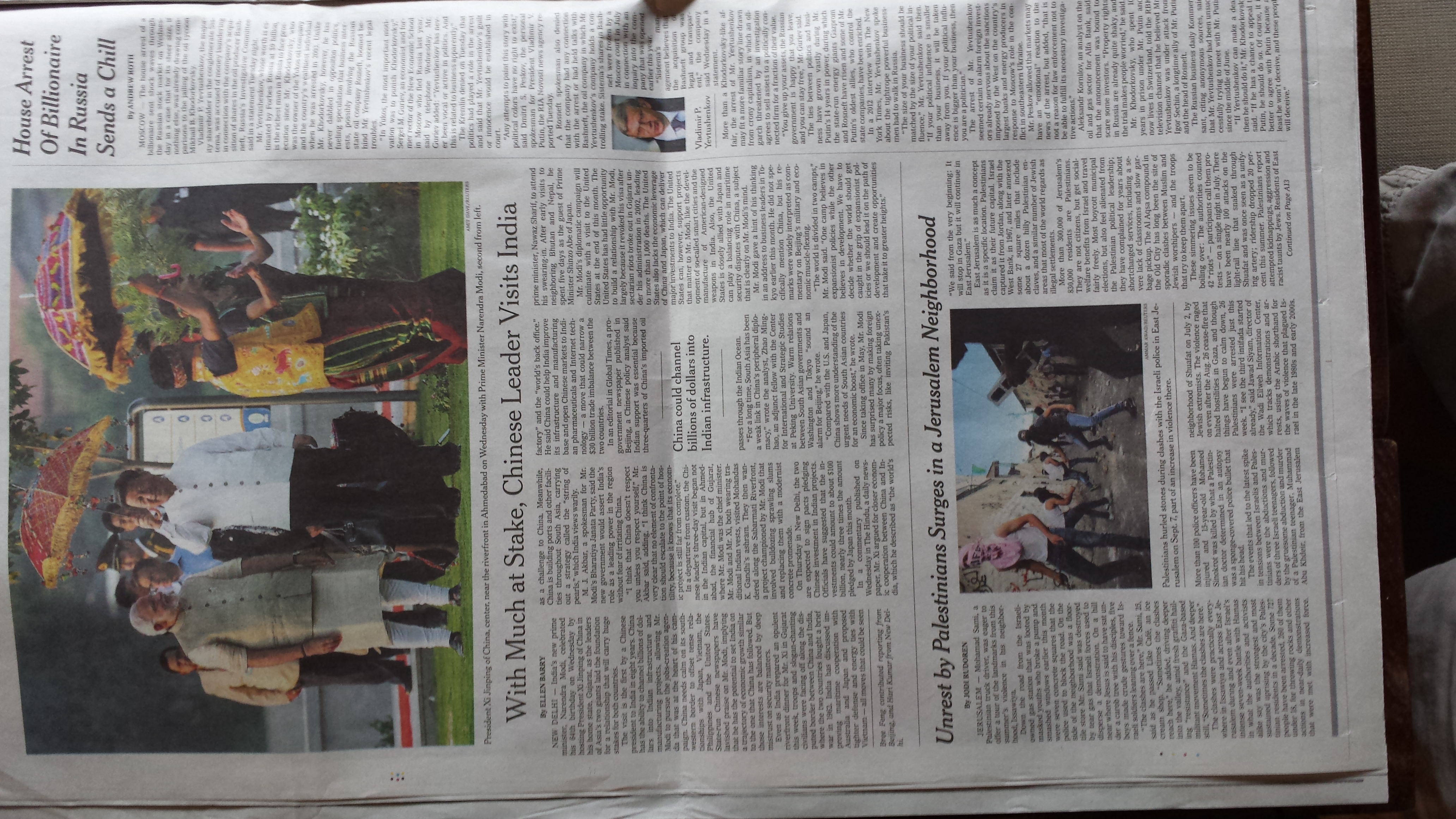
This last quote is a particularly embarrassing and revealing lie.  Jodi Roduren (who wrote the piece from the fantasy of her head instead of based on facts) sought to lay out a scenario where the Israeli public disagreed with the “aggressive push to expand Jewish settlements”.  In the real world, both the number two party, Yesh Atid (19 seats) and the number four party, Jewish Home (11 seats), were in favor of a united Jerusalem and continuing to build homes for Jews in Judea & Samaria.  The Jewish Home party campaigned on the basis of annexing Judea & Samaria.  The Times’ favorite parties, the left-wing parties of Hatnua and Meretz came in almost last place with 6 seats each.  (If you’re counting at home, that’s 61 seats versus 12 seats for the parties that want to keep united Jerusalem- a margin so large and bold you would think Roduren’s handlers could have managed to edit her “news” article).


The Times ignored reality in both situations. In Turkey, it failed to report on Erdogan’s strong right-ward shift into deep Islamic camp and painted him as more of a moderate. His modest win as blown out of proportion.

For Israel, Netanyahu’s strong win was considered poor. The country’s support of his policies about the rights for Jews to live all parts of Judea and Samaria were not just dismissed, but painted in a way that was completely opposite of the facts.

I sometimes think of the Times the way I think about turkey:  it tastes quite good but it puts a person to sleep.  Oh, and of course, it is one of the dumbest animals on the planet.


Sources:

Turkey, most journalist jailed 2012 and 2013: http://cpj.org/reports/2013/12/second-worst-year-on-record-for-jailed-journalists.php

Erdogan banned twitter May 2013: http://www.washingtonpost.com/news/morning-mix/wp/2014/03/21/turkey-bans-twitter-and-twitter-explodes/

Erdogan blocked Youtube: http://www.cnn.com/2014/03/27/world/europe/turkey-youtube-blocked/

Turkey ban kissing in public; late sale alcohol: http://www.bbc.com/news/world-europe-22780773

Netanyahu headline “Tepid Vote for Netanyahu in Israel Is Seen as Rebuke”: http://www.nytimes.com/2013/01/23/world/middleeast/israel-votes-in-election-likely-to-retain-netanyahu.html?pagewanted=all&_r=0

Lapid, Yesh Atid: Jerusalem not for negotiation http://www.jpost.com/Diplomacy-and-Politics/Lapid-Jerusalem-is-not-up-for-negotiation-because-the-city-will-never-be-divided-330680


The NYT refuses to Listen

On July 29, an explosion hit the electricity plant in Gaza, setting it afire.  The cause of the explosion is unclear – perhaps from Hamas mortar fire or from Israel – but according to the Times, the uncertainty and Israeli disclaimers were not a reason not to blame Israel from the outset.

IDF Spokesman, Lt. Col. Peter Lerner said repeatedly that Israel had “no confirmation” of striking the Gaza power plant and that it clearly “was not a target”.

Mark Regev, spokesman for Israeli Prime Minister Benjamin Netanyahu, said on CNN that it had definitively cleared the Israel Defense Forces as the cause of the fire as it had reviewed the activities of all of the IDF personnel in the area.

Regardless, the New York Times specifically blamed Israel for the attack in a caption on the front page “In Gaza, Israel bombed 150 sites, including the territory’s only power plant”.  In the story on page A6, the paper continued “Israel’s military on Tuesday broadened its offensive, bombing 150 sites, and one strike set ablaze the territory’s only power plant,”  The large color photograph alongside the article showed a huge ball of fire and smoke.  The same article quotes Lt. Col. Lerner as “I don’t have a clear picture of what happened there.”  Interesting that an article right below makes very different statements and there was no quote from Mark Regev.

The article in the Times below it was entitled “Israel Steps Up Airstrikes in Gaza as International Cease-Fire Efforts Stumble.”  But reading the article and watching the news makes clear that Hamas rejected the cease fire while all other parties accepted.  The cease-fire did not passively “stumble”, but was specifically rejected by Hamas.  The article entitled “Loss of Shelter and Electricity Worsens a Crisis for Fleeing Gazans” also stated that “International efforts to secure even short-term cease-fires have so far failed,” fails to mention that it was Hamas that rejected the cease-fire.

In both of the articles, there is not a single mention of Hamas terrorism on the day.  Nothing about the missiles that were fired into Israeli cities.  Nothing about Palestinian terrorists using tunnels to go into Israel, killing five soldiers and retreating back through the tunnels.

In the world of the Times, there is only one party who suffers, one party at fault.

July 30 cover July 30. A6


Sources:

http://news.nationalpost.com/2014/07/29/israel-hits-symbols-of-hamas-power-gazas-only-power-plant-in-heaviest-bombardment-of-war/

http://www.timesofisrael.com/hamas-tunnel-raid-kills-five-idf-soldiers-in-southern-israel/


The New York Times’ Buried Pictures

Operation Protective Edge was launched on July 8 after Palestinian terrorists infiltrated Israel through tunnels and launched missiles across Israel.

Israeli Prime Minister Benjamin Netanyahu stated repeatedly that the goal of the operation was to destroy the extensive tunnel network that the terrorists had constructed. “We will not finish the mission, we will not finish the operation without neutralizing the tunnels, which have the sole purpose of destroying our citizens, killing our children,” Netanyahu said.

Remarkably, pictures of the terrorists who use the tunnels have yet to make an appearance to the New York Times. Although numerous pictures and images of terrorists penetrating Israel were made available to journalists, the NYT decided to not print any of them.

Even though dozens of tunnels were uncovered, it took until July 29 for the Times to publish it’s first picture of one – inside the paper on the bottom of page A6 (under a picture of Palestinians mourning).  Jodi Rudoren referred to the Israeli military “propaganda push” which “invited a few journalists underground for a tour” as “Israelis exchange nightmare scenarios that are the stuff of action movies” – as if the tunnels were a backstage viewing at a Disneyland movieset.

In three weeks of covering the conflict, the Times featured pictures of Palestinians mourning on the front page seven times (July 11, 14, 17, 21, 22, 24 and 29th). But the root cause of the conflict – Hamas terrorists attacking Israel through the tunnel network – never made it to the front page pictures. The Times actually had a story of the tunnels on the front page on July 29- but decided that a large color photograph of a Palestinian morgue was a more appropriate picture for that article.

It would appear that the underground war is being fought by Hamas and by the Times.


Sources:

Articles and pictures of Gaza tunnels in other papers:
http://online.wsj.com/articles/israel-strikes-30-houses-in-gaza-killing-islamic-jihad-official-1406286950

http://af.reuters.com/article/egyptNews/idAFL6N0Q34PG20140728

http://www.businessweek.com/news/2014-07-27/secret-tunnels-under-israel-reveal-intricate-threat-from-gaza

http://america.aljazeera.com/articles/2014/7/23/gaza-undergroundhamastunnels.html

http://www.haaretz.com/news/diplomacy-defense/.premium-1.606903

Videos:

https://www.youtube.com/watch?v=TlvnkECJkYc&list=UUawNWlihdgaycQpO3zi-jYg

https://www.youtube.com/watch?v=_NBEixuQbYQ&list=UUawNWlihdgaycQpO3zi-jYg

https://www.youtube.com/watch?v=5-hH2026OnU&list=UUawNWlihdgaycQpO3zi-jYg

https://www.youtube.com/watch?v=Mv8xR1FPakY&list=UUawNWlihdgaycQpO3zi-jYg

July 29 cover July 29. A6 Jul 21 cover July 17.cover Jul 22 cover July 14. cover July 24 cover (2) July 11. cover

“Tinge” Two. Idioms for Idiots

Do you have friends that use the same expressions over and again?

Some are cultural phenomena, such as “Oh my God!”, “Get real” or “Could you believe it?” Entire groups of friends or communities may be heard using the same sayings. You can be confident that the familiar phrase will be punctuated throughout a conversation.

Sometimes, an expression is an original. A person (or organization) develops a catch-phrase that captures their current thinking. The first time you hear it, you might think nothing of it or just consider the comment a strange choice of words. But when you hear the same bizarre expression used again by different people in the same organization, you can be sure that it reflects a conscious cultural mindset.

On July 24, Helene Cooper and Somini Sengupta wrote an article in the New York Times about what they considered the unusual support Americans give to Israel relative to the rest of the world. In describing the pro-Palestinian protests in various cities in Europe, they stated that the protests had “an anti-Semitic tinge.” As detailed in FirstOneThrough that day (link below), the phrase ignored the riots specifically against Jews. The choice of the word “tinge” was highly offensive to any civilized person who objects to racism.

Europe being Europe and the Times being the Times, the next few days saw more of the same.

  • Israeli soccer players from Maccabi Haifa were attacked in Austria.
  • In Paris, 4000 people – many with weapons – staged a protest in Place de la Republique; 70 were arrested.
  • A Facebook page was created with the faces of French Jews with an encouragement to attack them; one of the Jews was subsequently attacked by a mob.

But the New York Times continued to be unruffled and unperturbed. So much so, that the incendiary phrase “an anti-Semitic tinge” was used again in a July 27 article by Jodi Rudoren.  Not only did she repeat the phrase verbatim, but she led that only Israelis were offended by these slight expressions of hatred (ignoring the strong condemnations of political leaders throughout the continent).

Perhaps other sections of the Times (which unlike the rest of the paper, still has a few remaining fans) will notice and react: the travel editor might highlight a nice tour of Mississippi that had “a sprinkle of lynchings”; a real estate article might describe a flat in Berlin as “airy, with a nice view of the genocide”; and the food and wine critic might describe a French liquor as “smoky, with a hint of Holocaust.”

One can expect to see other offensive and idiotic idioms in the Times in the weeks ahead.


Sources:

Recent European anti-semitism:
http://www.telegraph.co.uk/news/worldnews/europe/10992886/Anti-Semitism-on-the-march-Europe-braces-for-violence.html

http://www.ynetnews.com/articles/0,7340,L-4549072,00.html

http://www.israelnationalnews.com/News/News.aspx/183377#.U9Tm66NeLi8

http://www.algemeiner.com/2014/07/25/facebook-page-publishing-identities-of-french-jews-to-encourage-attackers-15-men-reportedly-assault-1-jew-in-paris-suburb-after-confirming-photo/

“An anti-Semitic Tinge” by FirstOneThrough:
https://firstonethrough.wordpress.com/2014/07/25/an-anti-semitic-tinge/

20140727_071838

“An anti-Semitic Tinge”

Pulitzer Prize winner William Safire used to write for the New York Times “On Language.” His fascinating articles would describe the etymology of words; their usage and context. He spent years as a speechwriter for US President Nixon, followed by decades writing for the Times. He had a unique appreciation for words.

Safire would not appreciate the New York Times abuse of language today.

Some words are seldom used in daily speech. When heard or seen, we understand that there is a particular purpose and nuance for their application.  Even in comedy.

The old TV sitcom “Seinfeld” had a funny skit about George being set up on a blind date by his friend Jerry. George had a long list of questions to qualify his interest. When asking about her face he said: “Is there a pinkish hue?” The question puzzled his friend Jerry who was setting him up: “A pinkish hue?” he replied. “Yes, a rosy glow.” Jerry: “There’s a hue”. The exchange gets roars of laughter – not only because it is an absurd question to qualify a date, but the word itself is peculiar. I doubt there was ever a time in the history of television that the word “hue” was used so frequently.

We all (think we) know what the word “hue” means – heck, there was even a setting on our TV sets after “brightness” and “contrast” (but being candid, no one ever used it). The word “hue” was replaced by “color” or “tint” on many sets as those words convey a wider spectrum of color. Hue seemed too subtle.

If “hue” is subtle, the word “tinge” is meaningless. While “tinge” may be a slightly more common word, it means a great deal less.  Finding the TV’s hue setting and moving it a single notch, would be the equivalent of “tinge”. Only an expert could readily observe the slight change in color. A reasonable person could never be expected to notice a tinge without close and careful examination.

“An anti-Semitic tinge.”

It was curious (alarming?) to see the word “tinge” show up in an article about “The Confrontation in Gaza”, as the New York Times refers to current war in Gaza (avoiding using Israel’s terminology of “Operation Protective Edge” as that might make it appear that Israel was on the defensive).

On July 24, 2014, the New York Times ran an article called “As Much of the World Frowns on Israel, Americans Hold Out Support” about how angry the world is with Israel. Americans, according to the article, do not support Israel because they believe that Israel has a basic right to self defense in the face of missile attacks, but because “of the failures of the Arab Spring to spread democracy in the Middle East.” That NYT statement is beyond moronic and ignores the entire Pew report and decades of Pew Surveys which have always shown greater support for Israel than Palestinians.

The following paragraphs continued: “Pro-Palestinian demonstrations are continuing in Paris, Berlin, Vienna, Amsterdam and other European cities, some of them assuming an anti-Semitic tinge.” Quite a phrase “anti-Semitic tinge”.

So what happened in the protests the preceding weeks? On July 20 anti-Israel protestors firebombed a synagogue in the Parisian suburb of Sarcelles. Jewish shops were looted and 18 people were arrested. The French Prime Minister said: “What’s happened in Sarcelles is intolerable: attacking a synagogue or a kosher grocery, is quite simply anti-Semitism, racism.”

Just the week beforehand, a demonstration in Bastille Square in the center of Paris moved towards two synagogues which had hundreds of Jews trapped inside. The crowds chanted “death to the Jews” and “Hitler was right”. That demonstration was such a warning shock to the government that it banned further demonstrations, which took place anyway.

In Belgium, a store with a Palestinian flag and a crossed out Israeli flag in the window put up a sign in Turkish: “Dogs are allowed in this establishment but Jews are not under any circumstances.” The French text replaced “Jews” with “Zionists.”

In Berlin, Germany protestors were blocked by police in riot gear from bringing their demonstrations to the Holocaust Memorial. That week, an imam at one of Berlin’s mosques gave a sermon that Jews should be killed.

The Associated Press correspondent from Berlin wrote: “The foreign ministers of Germany, France and Italy on Tuesday condemned the rise in anti-Semitic protests and violence over the conflict in Gaza, saying they will do everything possible to combat it in their countries.”

“An anti-Semitic tinge.”

The New York Times deliberately chose to minimize the anti-Semitic motivation of the protestors as it would detract from what the Times considered an appropriate act of protesting against Israel (since the Times doesn’t believe the “confrontation” is truly about self defense). Even as riots broke out in the same cities that witnessed the Holocaust, and those governments called out against the rise in anti-Semitic protests and violence, the Times needed to bury that narrative.

For the Times, “an anti-Semitic tinge” means a few outliers; some bad seeds doing bad things. It ignores the lack of protests against: Russia in the Ukraine; Syria slaughtering its citizens; US in Iraq and Afghanistan; and other government actions in the world that have killed hundred of thousands of civilians over the past few years. Regrettably, the Times does not agree that when protestors only take to the streets when the Jewish State is in a “confrontation,” it brands the protest itself as anti-Semitic.  How does it ignore firebombings of synagogues?

Those actions are from the disgraceful anti-Semitism of the protestors. Regarding the media, it is bad enough that it is passively complicit in not identifying the anti-Semitic root cause of the protests. However, to actively trivialize riots, firebombings and death threats against Jews in the streets where millions of innocent Jews were killed, is not merely being complicit- it is an act of anti-Semitism itself.


Let me change the conclusion of the opening paragraph: William Safire would not be upset by the Times use of language.  He would be appalled by the New York Times abuse of Jews.


Sources:

http://www.jta.org/2014/07/20/news-opinion/world/anti-israel-rioters-torch-cars-throw-firebomb-at-paris-area-synagogue

http://www.algemeiner.com/2014/07/13/violent-anti-jewish-riots-rock-paris-activist-says-french-jews-are-in-serious-danger-video/

http://www.bbc.com/news/world-europe-28402882

http://abcnews.go.com/International/wireStory/berlin-bans-anti-semitic-slogan-gaza-protests-24658551

20140725_071755

The Democrats’ Slide on Israel

Further evidence of left-wing radicals abandoning Israel? The Pew Research Center did a survey to assess how Americans felt about the Israel-Hamas fighting, over the week July 8-14, 2014. The numbers came back overwhelmingly supportive of Israel by over a 2-to-1 ratio. It is consistent with polls over the decades which show Americans supporting Israel more than Arabs in the ongoing conflict. The details of the poll (not highlighted by the New York Times) show a trend of conservatives and liberals diverting much more on this issue than was historically the case. Conservatives enthusiastically backed Israel by a 19-to-1 ratio, while liberals were the only group to not even cross a 2-to-1 ratio supporting Israel.

Support of Israel v. Palestinians

  • Conservative 77% v. 4%
  • Republicans 73%
  • White Evangelical Christians 70% v. 5%
  • Independents 45% v. 17%
  • Democrats 44%
  • Blacks 43% v. 20%
  • Hispanics 41% v. 17%
  • Liberals 39% v. 21%

What makes the poll results particularly distressing is that it was made in the middle of a war initiated by Hamas, the anti-Semitic terrorist organization that is sworn to destroy Israel. Had the poll been made in the middle of peace negotiations, one could have imagined that people would have been more evenly split in their projected hope that the parties could arrive at a settlement.

The slip in the Democrats feelings towards Israel can be traced to a number of actions since Democratic US President Barack Obama took office in 2009. Less than two years ago, in September 2012, Democrats took several concrete steps to distance themselves from “Israeli-leaning positions” that had always been part of the party’s platform during the Democratic National Convention.

DNC2012 vote
Democrats split on recognizing Jerusalem as capital of Israel in 2012 convention

Consider:

HAMAS: In 2008, the Democratic Party platform called for the isolation of Hamas until it renounced terrorism. “The United States and its Quartet partners should continue to isolate Hamas until it renounces terrorism, recognizes Israel’s right to exist, and abides by past agreements.”

In 2012, the statement was removed.

 “REFUGEES”: In 2008, the Democratic Party platform called for the settlement of the descendants of Palestinian refugees to be in a Palestinian State. “The creation of a Palestinian state through final status negotiations, together with an international compensation mechanism, should resolve the issue of Palestinian refugees by allowing them to settle there, rather than in Israel.”

In 2012, the statement was removed.

BORDERS: In 2008, the Democratic Party platform said that the 1949 Armistice Lines were unreasonable borders. “All understand that it is unrealistic to expect the outcome of final status negotiations to be a full and complete return to the armistice lines of 1949.”

In 2012, the statement was removed.

JERUSALEM: In 2008, the Democratic Party platform recognized Jerusalem as the capital of Israel. “Jerusalem is and will remain the capital of Israel.” The party removed the statement, and then reinstated it after a bitter fight on the convention floor.

SECURITY: The only pro-Israel statement that the Democrats kept in 2012 without a public brouhaha was about Israel’s right to self-defense (which is self-evident for any country on the planet anyway).

In March 2010, Obama made demands of Israel to halt construction in the eastern part of Jerusalem – along with 12 other demands – to get peace negotiations with Palestinian Arabs moving. It was the first time that the building of Jewish homes was ever advanced as a pre-condition to talks. Obama effectively reprimanded Israeli Prime Minister Benjamin Netanyahu through a series of deliberate acts such as walking out of the meeting, refusing to make a joint statement and taking customary photographs together.

All of these efforts by the liberal US president originated from his intention to have “a New Beginning” with the Islamic world. In June 2009 he visited Egypt where he took a position that no American president had made before: “The United States does not accept the legitimacy of continued Israeli settlements.” Remarkably, the first black president of the United States said that Jews should not be allowed to live in certain places: places they had lived for centuries, including under the Ottomans; places they were legally guaranteed to live under the League of Nations British Mandate as Article 15 clearly stated: “No discrimination of any kind shall be made between the inhabitants of Palestine on the ground of race, religion or language. No person shall be excluded from Palestine on the sole ground of his religious belief.”

The champion of American liberals made a clear path from his “New Beginning” until today to undermine the rights of Jews in the Middle East. His followers have taken note and are breaking with the majority of Americans. His foreign policy approval rating of 37% would appear to be made up only of fellow liberals.

On July 24, 2014, the New York Times posted an article about how out of touch Americans are with the rest of the world in supporting Israel. The liberal paper has been consistent in taking an aggressively pro-Palestinian and anti-Israel approach in it’s coverage of Operation Protective Edge. It would appear it knows its audience.

20140724_065532


Sources:

Pew Report: http://www.people-press.org/2014/07/15/as-mideast-violence-continues-a-wide-partisan-gap-in-israel-palestinian-sympathies/

2008 Democratic Party platform: http://www.presidency.ucsb.edu/ws/?pid=78283

2012 Democratic Party platform: http://www.presidency.ucsb.edu/ws/?pid=101962

The 2012 vote to remove Jerusalem as capital: http://www.theguardian.com/world/2012/sep/06/democratic-convention-reinstatement-jerusalem

March 2010 Netanyahu “dress down” by Obama: http://www.telegraph.co.uk/news/worldnews/barackobama/7521220/Obama-snubbed-Netanyahu-for-dinner-with-Michelle-and-the-girls-Israelis-claim.html

Cairo speech: http://www.whitehouse.gov/blog/NewBeginning/transcripts http://www.nytimes.com/2009/06/04/us/politics/04obama.text.html?pagewanted=all&_r=0

British Mandate: http://avalon.law.yale.edu/20th_century/palmanda.asp

Obama approval rating: http://www.politico.com/story/2014/06/poll-obama-lowest-approval-rating-nbc-wsj-107978.html

The Holocaust and the Nakba

Roger Cohen penned a piece in the New York Times Op-Ed on July 15 that suggested the pathway to peace in the Middle East is that “Jews should study the Nakba. Arabs should study the Holocaust.” Putting aside the naiveté of the suggestion, the comparison is disgusting in itself.

The Holocaust was a genocide of a people. It was a deliberate attempt of an elected government to commit genocide against a select group of its own citizens. As Nazi Germany conquered more territory, it continued to implement its plan of eradicating the Jews – which it deemed an inferior life form – in those additional lands. Not satisfied with only killing millions of innocents, the Nazis tortured and performed medical experiments on these unarmed men, women and children. It was one of the darkest periods of mankind.

The Palestinian Nakba was a civil war over control of land. Arabs in Palestine protested to the ruling authority (the British) to block the establishment of a Jewish national homeland as called for by the League of Nations (the precursor to the United Nations). The Arabs themselves initiated the fight to stop the implementation of international law, and launched multi-year riots and then a war to destroy Israel. Their Nakba was that they were not allowed to return to homes in the country they just sought to destroy.

How are these two events remotely comparable?

  • One was about life; one was about land.
  • One was about a government wiping out its citizens; one was about citizens fighting the government.
  • One was about passive unarmed civilians; one was about warring parties.
  • One left survivors scattered around the globe; one left survivors a few miles from their homes, living with the same people in a land that they wanted, which the UN had proposed to split anyway.
  • One made the United Nations call for human rights all over the world; the other had the UN create a special niche entity just for the losing party to perpetuate their civil war.

The events could not be more different. The only things they have in common is that they occurred around the same time in history and both involved Jews.

But Israel was not born from the ashes of the Holocaust and planted in the ground of a Palestinian Nakba. The only “fruit” of the Holocaust was the creation of the Universal Declaration of Human Rights. The preamble of the UDHR clearly stated that the “disregard and contempt for human rights have resulted in barbarous act which have outraged the conscience of mankind,” – the sickening actions of the Holocaust created the declaration meant to benefit all mankind.

Regarding Palestine, Jewish history in the land predated the Holocaust by thousands of years. The Ottomans welcomed Jews and they moved throughout the region from 1800 to 1914 at rates that dwarfed all other groups. After the Ottoman Empire broke apart, the League of Nations sought the “establishment in Palestine of a national home for the Jewish people” in 1920, decades before WWII. The Arabs rioted in 1920 and 1929 against the action, and in 1936 began what has become a 78-year running civil war to prevent – and later eradicate – the Jewish State. The Arab “Nakba” – their grievance about homes destroyed and left behind – is because they lost the battle they initiated. The “fruit” of the Nakba was the establishment of UNRWA by the United Nations which has encouraged the Arabs to never abandon their civil war. The rotten fruit has left the Palestinians to fester and subject to abuse by their host countries, including Lebanon and Syria. It has benefited no one.

Perhaps the first person to learn about the Holocaust and the Nakba is Roger Cohen.

The Times should be reprimanded for continuing to print pieces that give legitimacy to those who compare Israel to Nazi Germany and Netanyahu to Hitler. It gives cover to anti-Semites in Europe and the world who paint the Jewish state in Nazi colors. The term “Never Again” born from the massacres of innocents in the Holocaust means more than not allowing genocides to happen again. Civilized people should not trivialize evil. For a global paper like the Times to do so specifically against the Jewish State is reprehensible.


Sources:

http://www.holocaustawareness.com/the-udhr-document.html

http://www.badil.org/en/youth-education-a-activation-project/item/1373-the-nakba-1947-1949

http://wwi.lib.byu.edu/index.php/San_Remo_Convention

20140715_091640

Differentiating Hamas

It is with confusion that I watch the press try to present different sides of Hamas.  While the press may say that some Hamas members belong to the “political wing” and others the “military wing”, the simple fact is that Hamas is:

  1. a terrorist group;
  2. the most anti-Semitic ruling party in the world;
  3. a group of Holocaust deniers;
  4. committed to destroying ALL of Israel;
  5. the leading democratically elected party (winning 58% of the Palestinian parliament in their last election in 2006)

To put it another way, splicing Hamas is like differentiating between the Nazi Party, the SS and the Gestapo.  While there were differences in their roles, each was evil and guilty of genocide.

Do not kid yourselves. Hitler was democratically elected and a politician too.

Political music video on Hamas Theme Song (CSNY): http://www.youtube.com/watch?v=kF2fcaSPB6M