Tolerance at the Temple Mount

The Temple Mount in Jerusalem has become the focus of much debate both between religions (Islam and Judaism) and between different segments within a religion (Judaism). At its core, the debate is whether the most fervent believers continue to dictate the religious practices of everyone at the Temple Mount, or whether there is a place for a pluralistic approach to prayer.

 The Temple Mount

The Temple Mount is a 35 acre platform built by the Jewish King Herod over 2000 years ago. The platform held the second Temple, built around 515BCE until it was destroyed by the Romans in 70CE. The site of the two Temples (the first one lasted from around 954BCE to 586BCE), is considered Judaism’s holiest spot. It is now occupied by the Dome of the Rock, a gilded shrine built by Caliph Abd al-Malik in 691, and later richly adorned in 1561 by Suleiman I into the building we recognize now.

Al Aqsa is the only mosque on the Temple Mount. It is considered the third most holy site in Islam. It was built in its current configuration in 754CE, and sits on the far southern edge of the platform, in an area that did not exist until Herod expanded the platform southward 800 years earlier.

 Jews and the Temple Mount

In 1948, five Arab armies invaded Israel in an attempt to destroy the nascent Jewish State. Jordan seized Judea and Samaria and much of eastern Jerusalem including the Old City which contained the Temple Mount. The Jordanians then expelled all Jews from the territory it conquered (including the Old City) and the area later became known as the “West Bank”.

In 1967, the Jordanians and Palestinians attacked Israel again and lost all of the West Bank including the eastern part of Jerusalem. Rather than take full control of the Temple Mount, the Israelis handed religious control of the Temple Mount compound to the Waqf- the Islamic religious order run from Jordan, and assumed security control. The Jordanians continued to prohibit Jews from worshiping anywhere on the Temple Mount, even in areas far removed from the Al Aqsa Mosque, such as areas Muslim families used for picnics and football.

Many Jews are unhappy about the ban on Jews worshiping at their holiest spot on earth. People such as Rabbi Yehuda Glick made many arguments to Israeli authorities to loosen the anti-Jewish restrictions. For those efforts, he was shot in October 2014 by Palestinian Arabs after acting-President of the Palestinian Authority Mahmoud Abbas, incited his followers to “defend Al Alqsa by whatever means possible”, even though Jews who visited the Temple Mount never entered, nor attempted to enter, the mosque.

Liberal media outfits branded the Jews who sought the right to pray “right-wing extremists”. The New York Times referred to Glick and others as “agitators”. The “agitators” calls for equal prayer rights were considered outlandish. The opening paragraphs of a 10/30/14 New York Times article:

An Israeli-American agitator who has pushed for more Jewish access and rights
at a hotly contested religious site in Jerusalem was shot and seriously wounded Wednesday night by an unidentified assailant in an apparent assassination attempt.

The shooting of the activist, Yehuda Glick, compounded fears of further violence
in the increasingly polarized holy city, where tensions are already high over fears
of a new Palestinian uprising against Israeli occupation.”

Glick was not alone in seeking greater religious rights for people in Jerusalem.

 Women of the Wall

The “Western Wall” or the “Kotel” is part of the western retaining wall that Herod built to increase the size of Temple Mount. For many centuries, the Kotel was one of the areas closest to Judaism’s holiest site, which Jews could access. While several other spots on the retaining wall were closer to the site of the Jewish Temples, they were either very small, hard to access or considered unsafe. As such, the Western Wall achieved the status of Judaism’s holiest site because Jews could practically use the site for prayers.

After Israel reunited Jerusalem in 1967, it demolished the buildings in front of the Kotel and made a large plaza where thousands of Jews could pray. It gave religious control of the plaza to the Orthodox rabbinate to oversee religious activities. Those rabbis have restricted prayers to only be in the orthodox tradition.

In 1988, a group of feminist Jewish women who objected to the restrictions of the Orthodox rabbinate, formed a group seeking the right to pray at the Kotel in a manner of their own choosing. The Women of the Wall (WOW) were predominantly “progressive” orthodox women that believed that women wearing a tallit, tefillin and using a Torah were “kosher” actions under orthodoxy, if they prayed only with other women. However, the Orthodox rabbis use a more traditional approach to prayer and have established laws which prohibit those women from praying in their desired fashion at the Kotel.

In October 2014, WOW brought a miniature Torah to the Kotel and held a bat mitzvah on the women’s side of the plaza. The rabbis did not attack the women but stated that they will seek to prevent women from holding such services in the future.

Liberal media such as the New York Times did not refer to these women who broke the law and challenged the religious status quo as “right-wing extremists” or “agitators” but “advocates”. The opening paragraphs of the 10/25/14 article stated:

Members of a group advocating equal prayer rights for women at the Western Wall,
one of Judaism’s holiest sites, held its first full bat mitzvah there Friday,
fooling the strict male Orthodox overseers by sneaking in a miniature Torah scroll
that was read with a magnifying glass for the ceremony.

The action by the group, Women of the Wall, signaled a new phase of activity
after years of legal and religious struggles that have reverberated
among progressive Jews around the world.


The battles for pluralism at Jerusalem’s holy sites by the activists were the same. The actions of both Glick and WOW were non-violent. However the reactions to their activities were polar opposites:

  • the Palestinian authorities incited violence on the Temple Mount; the rabbinate called for stricter law enforcement at the Kotel
  • the world demanded that Israel maintain the status quo of barring all Jewish prayer at their holiest site; the world was silent on how Jewish denominations pray at the Kotel
  • Liberal media described the Temple Mount religious activists as “right wing extremists”; the media lauded the “activity” of “progressive Jews” seeking “equality”
  • Rabbi Glick was shot four times at point blank range and the acting Palestinian leader called the shooter a martyr destined for heaven; the Women of the Wall celebrated the bat mitzvah peacefully and decorum at the Kotel was maintained
  • Israeli Prime Minister Benjamin Netanyahu repeatedly told the Muslim world that he would maintain the anti-Jewish “status quo” edicts on the Temple Mount; the Jewish State is examining enacting new laws and new spaces along the Kotel for other religious denominations

Does liberal support of activism end when it elicits violence? Should Malala Yousafzai, the young Pakistani woman who defied Taliban law to not attend school, be described as an “agitator”? The world embraced Malala and awarded her the Nobel Peace Prize in the same month as the Glick shooting and WOW bat mitzvah. Will “progressives” and “liberals” rally to Rabbi Glick and advance the cause for Jewish rights on the Temple Mount? What do you think?


Sources:

Abbas call to defend al aqsa mosque: http://palwatch.org/main.aspx?fi=157&doc_id=12915

CAMERA on the Temple Mount: http://www.camera.org/index.asp?x_context=7&x_issue=4&x_article=1404

Women of the Wall: http://www.jewishvirtuallibrary.org/jsource/Judaism/WOW.html

Women of the wall use torah for bat mitzvah: http://www.nytimes.com/2014/10/25/world/middleeast/women-hold-western-wall-bat-mitzvah-in-jerusalem.html?_r=0

Shooting of Rabbi Glick: http://www.nytimes.com/2014/10/30/world/middleeast/right-wing-israeli-activist-shot-jerusalem.html

Malala Nobel prize: http://www.nobelprize.org/nobel_prizes/peace/laureates/2014/yousafzai-facts.html

Related First One Through articles:

“Extremist” or “Courageous”

The United Nations and Holy Sites in the Holy Land

The Arguments over Jerusalem

20141104_062922

“Extremist” or “Courageous”

Popularity versus Position, Pervasiveness and Power

The word “extremist” appears like a loaded word. That partially stems from the fact that it conveys two different meanings. The first is that it describes a person who has an extreme position. The second is that it portrays a person at the edges of society.

A person who holds a position at the far fringe of society is pretty straightforward. If someone believes that the moon is purple and 99.9% of the rest of society does not, that person could be called an extremist. The label could be viewed as appropriate simply because the opinion is not popularly held.

The pervasiveness of a position, as opposed to its popularity, is a more subjective criterion. Someone believing that the moon is purple is one thing. However, painting their entire house purple, dying their hair purple and changing their name to Professor Purple Plum, would be viewed as “eccentric” and “obsessive” at a minimum, and possibly even “extreme”.

The “extremist” label sticks best when the person’s actions impact other people. For example, an individual may believe that life starts at conception, but if that is simply a personally held viewpoint, most people would not describe that person as an extremist. However, if a person used that position to justify destroying abortion clinics and harming the people inside, the violent actions would lead people to use the “extremist” label.

Violent extremists are typically painted in two camps: “right-wing” extremists use power to protect religion and capitalism; “left-wing” extremists use violence to flatten social hierarchies, and are often viewed as anti-religion and anti-capitalism.

Religion: Popularity and Power

Popularity is a matter of simple statistics. As an example, if one looks at the distribution of world religions, one can see a few widely held beliefs and some unpopular belief systems:

  • Christians: 31.5%
  • Muslims: 23.2%
  • Unaffiliated: 16.3%
  • Hindus 15.0%
  • Buddhists 7.1%
  • Folk Religionists 5.9%
  • Jews 0.2%

By the measure of popularity, all Jews could be viewed as “extremists” because they have a belief system that is not held by 99% of the world. However, as Jews do not enforce their belief system on others, the “extremist” label would largely be considered inappropriate. Conversely, Islam is a very popular religion, but the various Muslim groups that seek to enforce sharia law and forced conversion of people are often called “extremists”, especially if people that refuse to succumb to their religious edicts are killed. Popularity is not considered the gauge; it is violent actions and/or actions that harm others that define extremists.

 Arab “Residents” and Israeli “Settlers”

Using such distinction between popularity and power, review how mainstream media uses the extreme label in regard to Israel.

On October 23, 2014, the New York Times reported on the story of an Arab that rammed his car into a crowd of Jews killing two people including an infant. Ignoring the Times’ generally terrible coverage overall, the nature of inverted reality and anti-Israel bias was typified in a particular paragraph in the story, where the non-aggressive party was labeled an extremist:

Mr. Shaloudy was a resident of Silwan, a predominantly Palestinian neighborhood
in territory that Israel captured from Jordan in the 1967 war and later annexed,
a step that has not been recognized internationally. An influx of right-wing Jewish settlers who have acquired property in the area in recent years have made
the neighborhood a flash point in the Israeli-Palestinian conflict.”

Mr. Shaloudy, the Arab man who killed two people, is described as a “resident of Silwan, a predominantly Palestinian neighborhood”. This description made him sound like a peaceful neighbor living among his people. He is tied to the majority and therefore, by implication, not an extremist if one were to use the popularity measure.

The paragraph continued that the neighborhood is in “territory that Israel captured…that has not been recognized internationally… right wing settlers…acquired property in the area.” The New York Times painted the Jews as “right wing” extremists. On what basis? That they moved into a “predominantly Palestinian neighborhood”? That they moved into houses that “has not been recognized internationally” to be part of Israel? That just made those Jews a minority in the neighborhood, and Israel’s claim on the territory a minority-held position. However, the actions taken by this group were peaceful: they purchased apartments; and moved into them legally. They harmed no one. As such, they took no actions that warrant being called “right wing”.

However, the Arab “residents” that the Times described, sought to kill Arabs that sell homes to any Jews, in accordance with Palestinian law. This particular Arab “resident” murdered innocent Israelis.  Yet, for some reason, these Palestinians that have laws calling for murdering Jews, who do ultimately commit murder, are not labeled extremists. This is both a perversion and inversion of reality where violent actions are considered the appropriate norm and unpopular positions are considered extreme.

A few paragraphs down, the Times called Israelis extremists again:

“Many of the recent clashes have centered on visits to the compound
by hard-right Israelis who have been increasingly demanding the right to pray there.
The mosque is on the Temple Mount, revered by Jews as the location
of ancient Jewish temples and the holiest site in Judaism.”

The juxtaposition of the sentences was unfair- the Jews had no interest of praying in the mosque, but were seeking to pray nearby on the holiest spot for Judaism. Were these “hard-right Israelis” seeking to hurt anyone? Were they seeking to destroy a mosque or convert anyone? Not at all. So how can their action be considered extreme?


It is true that Jews are a minority in the world. It is true that Israel is surrounded by dozens of Arab and Muslims states that either refuse to recognize Israel or call for its outright destruction. But simply being unpopular doesn’t make Jews or Israel “extreme”.

Jews seeking to buy and live in apartments like anyone else is neither illegal nor extreme. Jews seeking to pray at their holy sites is not extreme. It is exactly the opposite: those people that seek to murder Jews for doing basic activities should be labeled “extremists”. Pinning terminology that make the Jews look like unpopular invaders and therefore extreme, ignores history, decency and honesty.

Shame on the New York Times.  If these were blacks in the 1960s moving into predominantly white neighborhoods in the US, the Times would more likely call these people “courageous”.

20141023_075354


Sources:

World religions: http://www.pewforum.org/2014/04/04/global-religious-diversity/

NY Times “right wing settlers” http://www.nytimes.com/2014/10/23/world/middleeast/2-israeli-soldiers-wounded-near-egypt.html?_r=0

First One Through articles on Silwan:

False facts on Jews in Silwan

Obama supporting Jew-free state

UN echoing Palestinian narrative

Real and Imagined Laws of Living in Silwan

The New York Times deliberately misrepresented opinion as law to disparage Israel, and omitted actual Palestinian laws to hide Arab racism. As such, the paper fully embraced anti-Semitism and the principle of segregation if it prohibits Jews from living in predominantly Arab neighborhoods.

In an article on October 16, 2014 called “A House-by-House Struggle for Control of a Jerusalem Neighborhood”, the NYT’s Isabel Kershner had an opening paragraph that could have been taken from Mein Kampf in describing secretive, cheating and stealing Jews:

“In the dark of night, under the protection of Israeli security forces, Jewish settlers took possession of some 25 housing units in six locations around the Silwan neighborhood of East Jerusalem Many of the properties had been rented out, but they were strangely empty when the settlers arrived… Through a multimillion-dollar series of complex and shadowy transactions spanning several years,
Elad engineered the largest private settlement initiative in decades.”

[By way of comparison, here is a quote from Hitler’s Mein Kampf: “they (Jews) try to cheat the whole world with their tricks; they are lazy, but with their pretended ‘silent’ work they create the appearance of an enormous and equally laborious activity; in short, they are cheats, characters of political profiteering, who hate the honest work of others. Just as such a folkish moth always appeals to the darkness of the silence, one can bet a thousand to one that under its cover he does not produce, but only steals steals from the fruits of the labor of others”] 

The article goes on to describe and suggest that it is illegal for Jews to buy homes in the eastern part of Jerusalem. That suggestion is both untrue and racist. Here are the facts:

  • Silwan was established by Yemenite Jews in 1881. It was one of the first developments outside the city walls of Jerusalem, while the area was part of the Ottoman Empire.
  • Jews have been an established majority in Jerusalem since the 1860s.
  • The Ottomans did not impose any limits on where Jews could live.
  • When Britain took over Palestine as part of the League of Nations Palestine Mandate in 1922, the mandate specifically stated (Article 15) that no one should be barred from living in the area because of their religion.
  • The Palestinians rioted in 1936-9, killing hundreds of Jews, and effectively lobbied the British to limit Jewish immigration to Palestine. But even under those new anti-Jewish rules, there was no prohibition of Jews living in the eastern part of Jerusalem.
  • Jerusalem and Bethlehem were designated to be an international “Holy Basin” according to the 1947 United Nations Partition Plan, and was to be neither part of Israel or Palestine. Both Arab and Jew were free to live anywhere in the Basin.
  • Silwan, and much of the eastern half of Jerusalem was forcibly cleansed of Jews when the Palestinians and Jordanians initiated a war against the Jewish State in 1948, and the Jordanians illegally annexed the eastern half of the city. The Jordanians and Palestinians barred any Jews from even visiting the eastern half of the city.
  • The Jordanians granted Palestinian Arabs citizenship and denied giving any citizenship to Jews in the lands they forcibly conquered (including eastern Jerusalem), making it illegal for Jews to own land there.
  • The Jordanians and Palestinians launched another attack on Israel in 1967, only to lose the eastern half of Jerusalem in that war.

These facts were completely ignored. The only information discussed about the settling of Silwan described: “territory that Israel conquered from Jordan in the 1967 war and then annexed, in a move that was never internationally recognized. Most of the world considers the area illegally occupied by Israel

The suggestion that Israel’s annexation (as a result of a defensive war) is considered illegal by “most of the world” and therefore means that Jews are forbidden to live there is completely misleading and untrue.

  • The Israeli territory of Judea and Samaria (West Bank) is administered by Israel. Israel approves housing for both Arabs and Jews there, and in the eastern part of Jerusalem which they annexed.
  • International law against the forcible transfer of a population has nothing to do with individual rights of buying and living in a property of their own choosing.

The NYT article successfully: 1) described Jews the way Hitler did; 2) gave no background of the long and legal history of the Jews living in the eastern part of Jerusalem; 3) implied illegal activity of Jews buying and moving into their homes when such action is legal.

What the Times article deliberately failed to describe was the actual illegal activity – according to the Palestinian Authority – for any Arab to sell land to a Jew.

Palestinian law bans the selling of land to a Jew, punishable by death. Not only was that law not mentioned in this or any NYT article, Kershner deliberately hid this racist Palestinian law in the article with a false narrative: “At a stormy meeting of about 100 [Palestinian] residents and activists in a children’s playground soon afterward, participants denounced the [real estate] brokers and called for them to be publicly named and cast out of their clans. The Palestinian Authority has no jurisdiction in Jerusalem, but there is a history of vigilante justice: In the 1990s, some local land dealers accused of selling property to Jews were kidnapped and killed.

First, note how the article called Jews “settlers” and Arabs are called “residents”. Both parties are residents and neighbors in the same block. Is the New York Times so against coexistence that each party needs a distinct label?

Second, the article correctly points out that the Palestinian Authority has no jurisdiction in the area, but it describes the actions of “residents and activists” of “vigilante justice” making the actions appear random, unauthorized and opposed by the “moderate” Palestinian Authority. The fact is that property sales are considered a capital offense and Palestinian courts have handed out death sentences for the sale of land to Jews.


The New York Times’ illusion of Jews taking property by force in the dark of the night is outrageous. The secretive nature of the purchase was to protect the Arabs that sold the property from being killed by fellow Arabs according to Palestinian law.

The purchase of apartments by individual Jews in their holiest and capital city in a neighborhood founded by Jews is completely legal. The fact that they had to act discretely in their purchases because of racist Palestinian laws is a travesty that should anger the world – about Palestinians, not the Israelis.

20141020_211454


Sources:

NY Times article: http://www.nytimes.com/2014/10/16/world/middleeast/a-house-by-house-struggle-for-control-of-a-jerusalem-neighborhood.html?ref=todayspaper&_r=0

Yeminite Jews in Silwan: http://www.meforum.org/3281/silwan

1922 League of Nations Mandate: http://avalon.law.yale.edu/20th_century/palmanda.asp

1939 White Paper: http://avalon.law.yale.edu/20th_century/brwh1939.asp

Jordan’s nationality law (article 3) excluding Jews: http://www.refworld.org/docid/3ae6b4ea13.html

FirstOneThrough on the 800,000 Arabs moving to Palestine during the British Mandate: https://firstonethrough.wordpress.com/2014/07/03/whos-new-everybody/

Abbas on Jew-free Palestine: http://www.commentarymagazine.com/2013/07/30/abbas-arabs-in-israel-no-jews-in-palestine-peace-process/

Short history of Palestinians+Jordanians controlling Jerusalem: https://firstonethrough.wordpress.com/2014/07/07/east-jerusalem-the-0-5-molehill/

PA Land Law: http://www.jpost.com/Middle-East/PA-affirms-death-penalty-for-land-sales-to-Israelis

Jordan attacking Israel 1967 according to King Hussein: http://www.kinghussein.gov.jo/his_periods3.html

Palestinian courts handing death sentence for land sale to Jews: http://www.aljazeera.com/news/middleeast/2009/04/2009429105147715724.html

Mein Kampf: https://archive.org/stream/meinkampf035176mbp/meinkampf035176mbp_djvu.txt

The anthem of Israel is Jerusalem: https://www.youtube.com/watch?v=wulmUGVG3jA

Obama endorsing Jew-free state: https://firstonethrough.wordpress.com/2014/10/02/obama-supports-anti-semitic-palestinian-agenda-of-jew-free-state/


Israel’s Freedom of the Press; New York Times “Nonsense”

On May 1, 2014, Freedom House, a leading advocacy group on democracy and political freedom, released its annual report on freedom of the press around the world. “Global press freedom has fallen to its lowest level in over a decade” according to their report, led by declines in: Egypt; Libya; Jordan; Syria and Turkey. A notable exception was Israel, which became the only country in the entire MENA (Middle East and North Africa) to be ranked as having a free press.

Select 2013 country rankings (bold are MENA countries):

  • Israel (62)
  • Italy (64)
  • Chile (64)
  • South Korea (68)
  • South Africa (69)
  • India (78)
  • Philippines (87)
  • Brazil (90)
  • Argentina (106)
  • Lebanon (112)
  • Tunisia (112)
  • Kuwait (127)
  • Turkey (134)
  • Libya (134)
  • Morocco (147)
  • Qatar (152)
  • Jordan (155)
  • Egypt (155)
  • Iraq (157)
  • Oman (161)
  • Yemen (167)
  • UAE (167)
  • Ethiopia (176)
  • West Bank, Gaza (179)
  • Somalia (179)
  • Saudi Arabia (181)
  • Syria (189)
  • Iran (190)

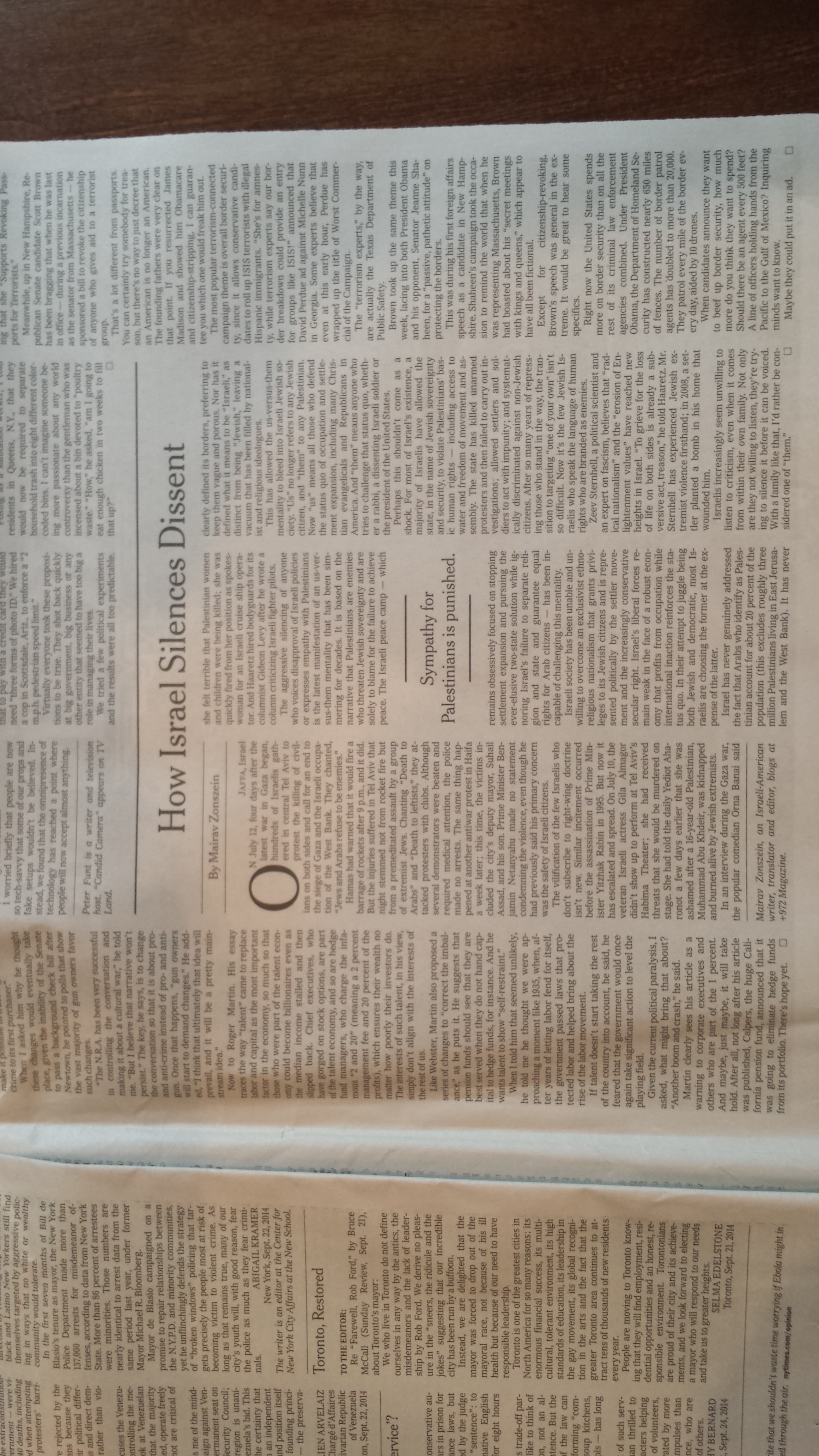
The New York Times declined to cover the story in May. However, on September 26, 2014 it ran an op-ed called “How Israel Silences Dissent”. The editorial said that the Israeli government punishes journalists that show sympathy for the Palestinians. There was no mention of the Freedom House ranking at that time either.

20140930_122042

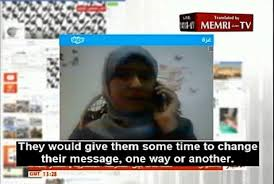
There was also no discussion of the Palestinians’ intimidation of the press.  While the NYT was printing its anti-Israel editorial, the Foreign Press Association was reporting on the intense discrimination they endured in covering Operation Protective Edge: “The FPA protests in the strongest terms the blatant, incessant, forceful and unorthodox methods employed by the Hamas authorities and their representatives against visiting international journalists in Gaza.” Even the extreme Israeli left-wing paper Haaretz reported that “some reporters received death threats. Sometimes, cameras were smashed. Reporters were prevented from filming anti-Hamas demonstrations where more than 20 Palestinians were shot dead by Hamas gunmen.”

gaza journalist

Hamas discussing changing journalist coverage, summer 2014

The New York Times did not report on any of this.  The only time the NYT opted to quote the FPA during the 2014 Palestinian war against Israel was early in the conflict on July 23 when the FPA complained about Israeli intimidation.

While ignoring the Hamas harassment, the Times was not completely silent.  Jodi Rudoren, the New York Times Middle East Bureau chief decided to make her position clear – on Twitter.  Roduren proclaimed: “Every reporter I’ve met who was in Gaza during war says this Israeli/now FPA narrative of Hamas harassment is nonsense.

Is the FPA only worth quoting when they complain about Israel?  Is an opinion piece about possible Israeli intimidation the only op-ed that is worth printing while remaining silent about Hamas death threats?  Is the uniqueness of Israel’s record of freedom of the press too hard for the New York Times to believe and therefore to report?

“Nonsense” seems to be the New York Times sense of balanced and accurate coverage.


Sources:

Freedom House May 2014 press release: http://freedomhouse.org/article/freedom-press-2014-media-freedom-hits-decade-low#.VDnLh_8tCUl

Freedom House 2013 country ranking: http://freedomhouse.org/report/freedom-press-2014/press-freedom-rankings#.VDnNCv8tCUl

Foreign Press on Hamas intimidation: http://www.timesofisrael.com/hamas-admits-intimidating-foreign-press-who-reported-wrong-message/

New York Times on FPA discussing Israeli intimidation July 23: http://www.nytimes.com/2014/07/24/world/middleeast/foreign-correspondents-in-israel-are-targets-of-intimidation.html?_r=0

Rudoren nonsense: http://www.camera.org/index.asp?x_context=2&x_outlet=35&x_article=2814

FirstOneThrough music video for journalists in the Middle East: https://firstonethrough.wordpress.com/2014/09/04/journalists-in-the-middle-east/

FirstOneThrough on Rudoren reporting nothing of Palestinian violence and Jewish history: https://firstonethrough.wordpress.com/2014/09/21/reading-roduren-unrest-by-Palestinians/

Blessing Islamophobia

The New York Times gave a warm and strong endorsement for Islamophobia this weekend. It’s opinion pages wrote strongly about the importance of free speech and the logic of exploring the hatred that many people feel towards all Muslims around the world, whether due to the 9/11 terror attacks or the beheadings of innocents today.

The New York Times editorial said it was “entirely correct” for people to express why they want to kill Muslims. It added that people “should not yield to critics” who want to use political correctness to suppress their anger.

The Times is on record – again – defending those who want to broadcast their rationale for killing any follower of Islam. Free speech “gives voice to all sides” including racists.

The paper remains standing “properly firm in defending… the principle of artistic freedom in a world rife with political pressures.” A surprising wake-up from a paper that people often view as erring more towards political correctness than towards the right of free speech.

In case you don’t believe the quotes and sentiments of the current NY Times editorial board, the links to the two editorials are below. The one (small) item worth noting, is that the paper actually wrote about killing Jews, not Muslims. But in balancing free speech and political correctness, I have made an assumption that the Times isn’t going to limit free speech just to anti-Semites. Was that a bad assumption?

20140921_120931


Sources:

NY Times editorial September 20 “The Met Opera Stands Firm”: http://www.nytimes.com/2014/09/20/opinion/the-death-of-klinghoffer-must-go-on.html

NY Times editorial June 19: http://www.nytimes.com/2014/06/20/opinion/the-metropolitan-operas-backward-move.html

FirstOneThrough on Klinghoffer Opera: https://firstonethrough.wordpress.com/2014/06/23/eyal-gilad-naftali-klinghoffer-the-new-blood-libel/

Reading Roduren: “Unrest by Palestinians”

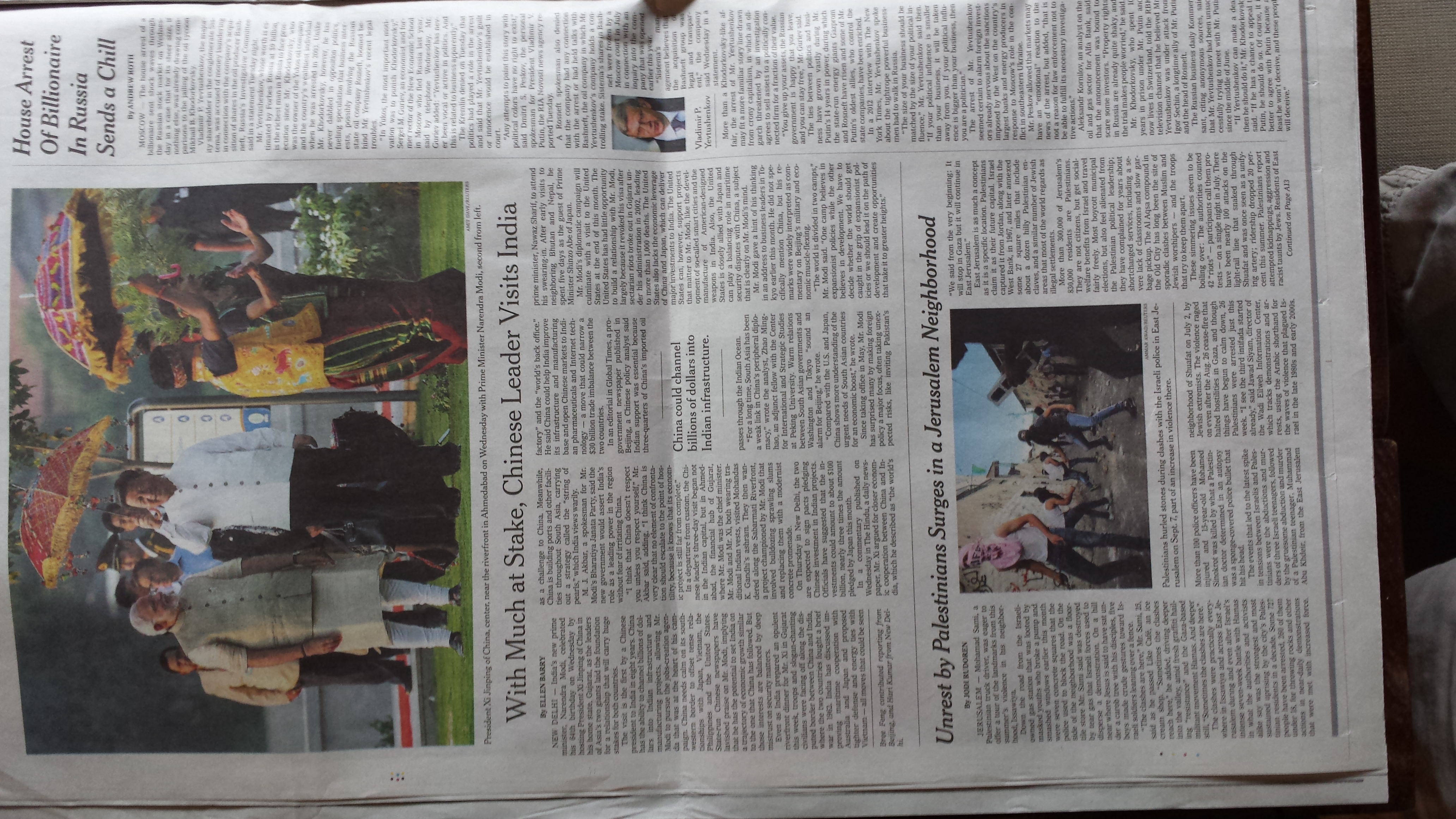
On September 18, 2014, NY Times journalist Jodi Rudoren wrote yet another article light on history and description (regarding Palestinian violence and Jewish history) entitled “Unrest by Palestinians Surges in a Jerusalem Neighborhood“.

The article mentioned an “Israeli-owned gas station that was looted by masked youths who broke a pump and smashed windows.” What Roduren failed to mention was that the Arab riot included dozens of youths and adults who repeatedly threw firebombs at the gas pumps in an effort to ignite them and blow up the entire station.

Roduren described “a hill near where Jesus is said to have sat under a carob tree”. There was no nod to Samuel the Prophet or dozens of Jewish leaders who lived and preached in the area.

In yet another egregious example of understating Arab violence, Roduren wrote that Palestinians were arrested for “throwing rocks and other actions.” Those “other actions” included Arabs throwing Molotov cocktails at Jewish homes. An uninformed reader might think they were simply making “crude gestures toward Israeli soldiers” as Roduren wrote in the preceding paragraph.

According to the article, the start of the “tensions” arose from “the abductions and murders of three Israeli teenagers, followed by the gruesome abduction and murder of a Palestinian teenager, Muhammad Abu Khdeir, from the East Jerusalem neighborhood of Shuafat on July 2, by Jewish extremists.” Note that the Israeli teenagers were not mentioned by name whereas the Palestinian boy was. There was no adjective for the murder of the Israelis, but the Palestinian murder was described as “gruesome”. There was no blame on Palestinians for the murder of three Israelis, but the sole Palestinian boy was killed by “Jewish extremists.” (FYI, when the New York Times reported on the arrest of the murderer of the Israeli teens, the man was simply mentioned by name and was not described as an Arab, a Muslim or an extremist.)

Roduren ignores a lot of highly relevant history in describing “East Jerusalem”. She writes that “Palestinians claim it as their future capital. Israel captured it from Jordan, along with the West Bank, in 1967, and later annexed some 27 square miles.” Neglected from this quick overview was that “Palestinians” were Jordanians in 1967, as they had Jordanian citizenship since 1950. It was the Jordanians (and Palestinians) who attacked Israel first in 1967, and Israel responded in self-defense. To state that “Israel captured it from Jordan”, ignores the reality that the Palestinians, together with the Jordanians, launched the attack on Israel.  Additionally, by beginning the overview of Jerusalem in 1967, ignores that:

  1. Jerusalem has had a Jewish majority since the 1860s;
  2. Arabs initiated attacks and killed Jews throughout Jerusalem well before Israel was even created including in 1920; 1929; 1936-9
  3. Jerusalem was never intended to be a Palestinian city according to the UN plan in 1947;
  4. the Jordanians and other Arab nations attacked Israel in 1948;
  5. the Jordanians illegally seized and annexed the eastern part of Jerusalem in 1949;
  6. the Palestinians became Jordanians in 1950, and were complicit in expelling all of the Jews from the eastern part of Jerusalem and barring their entry to the city and Jewish holy sites;
  7. the Jordanians (together with the Palestinians) initiated the attack on Israel in 1967.

The fact the Jordan gave up all claim to Jerusalem in 1988, and Israel gave control to half of the Holy Basin as described by the UN – Bethlehem – 20 years ago is ignored.

When Roduren described “300,000 of Jerusalem’s 830,000 residents are Palestinians. They are not citizens,” she deliberately misrepresented that they were offered Israeli citizenship, but declined.

Regarding the Temple Mount, Roduren refers to it by its Muslim name, the “Al Aqsa compound in the Old City has long been the site of sporadic clashes between Muslim and Jewish worshipers”. Other than denying the Jewish name of the holiest site in Judaism, the “long” history of conflict dates back well before 1967 when Muslim men attacked and killed Jews. Further, it is untrue to paint it as a mutual clash between parties – it was Jews who were repeatedly attacked by Arabs, not the other way around.

In describing the “nearly 100 attacks on the light rail system”, no party is mentioned in the violence, even though all of the attackers were Arabs. Instead, Roduren wrote that “Palestinians report attempted kidnappings, aggression and racist taunts by Jews.”

Roduren repeated her long-running narrative of painting the Arabs as indigenous and Jews as recent settlers. In the article, she refers to an Arab community leader “whose family dates back 800 years,” (she presents this as fact, not something the man simply claims). The fact is that the area discussed barely had any people living there: in 1922, the census reported a grand total of 333 persons in the neighborhood (and also reported that Jews were the majority, making up 54% of all of Jerusalem). Consider that during the British Mandate, over 800,000 Arabs from the Middle East moved to Palestine – hardly making the Arabs indigenous. By ignoring Jewish ties (as in only reporting Jesus’s history and calling the Temple Mount only by a Muslim name), Roduren tries to distance Jews from being the actual indigenous people of the region.

Maybe one day, the New York Times will finally print the undisputed fact that Jews have been the majority in Jerusalem for 100 years before the Six Day War. Perhaps the paper will finally call out the Palestinians when they instigate the violence. Yeah, right.

20140921_121806 20140921_121829


Sources:

http://www.jpost.com/Israel-News/Masked-Arabs-throw-rocks-bottles-of-paint-at-Jewish-school-bus-on-Mt-of-Olives-375967

http://www.ynetnews.com/articles/0,7340,L-4571547,00.html

Murder of Israeli teenagers arrested: http://online.wsj.com/articles/israel-makes-first-arrest-in-teens-murder-case-1407315912

NY Times coverage of arrest of Palestinian who killed Israeli teenagers: http://www.nytimes.com/2014/08/06/world/middleeast/israeli-arrest-made-public-in-abduction-of-3-youths.html?_r=0

From Jordanian king’s own site about launching offensive against Israel in 1967: http://www.kinghussein.gov.jo/his_periods3.html

1922 census: http://en.wikipedia.org/wiki/Isawiya#cite_note-Census1922-7

FirstOneThrough on East Jerusalem history: https://firstonethrough.wordpress.com/2014/07/07/east-jerusalem-the-0-5-molehill/

800,000+ Arabs moved to Israel under the British Mandate: https://firstonethrough.wordpress.com/2014/07/03/whos-new-everybody/

1920 riots in Jerusalem against the Jews: http://en.wikipedia.org/wiki/1920_Nebi_Musa_riots

Palestinian Xenophobia: https://www.youtube.com/watch?v=eQS1XVQR-Xc

Demographics of Jerusalem: http://en.wikipedia.org/wiki/Demographic_history_of_Jerusalem

New York Times Creates, then Inflates Israeli Crimes

On August 28, the New York Times published an article called: “Heavy Use of Banned Cluster Bombs Reported in Syria”, which – one would imagine – was about Syria’s use of cluster bombs. A careful reader could come away with some information about Syria’s use of bombs; but any reader would be led to conclude that Israel is the worst offender on the planet.

The tone of the article (about Syria) moves quickly against Israel from the opening paragraph:

  •  Cluster bombs, outlawed munitions that kill and maim indiscriminately, have caused more casualties in the Syrian civil war than in the 2006 Lebanon conflict, when Israel’s heavy use of the weapons hastened the treaty banning them two years later, a monitoring group said Wednesday.

It is true that some countries adopted a treaty on the weapons about two years after the Israel-Lebanon war. In case Israel’s usage of bombs wasn’t clear, the article elaborated on this same point a few paragraphs later:

  • The [Human Rights] group’s statement said, “Already, casualties in Syria are higher than those attributed to the 2006 Israel-Lebanon conflict that triggered global outrage and contributed to the establishment of the ban convention.

I guess the Times wasn’t sure if people read the point at the start of the article, so it added a line about “global outrage” to underscore the world’s opinion about Israel. The Times continued:

  • Israel’s military was widely criticized at home and abroad for its heavy cluster-bomb use in Lebanon, dropping HUNDREDS OF THOUSANDS [CAPS ADDED]of them, containing more than 1.2 million bomblets, particularly in the final days of the 34-day conflict with Hezbollah. The Israeli newspaper Haaretz quoted a commander of the Israel Defense Forces as saying, “What we did was insane and monstrous, we covered entire towns in cluster bombs.”

By this point, the Times was really rolling. It repeated the anger at Israel two more times with “widely criticized” and “we [were] monstrous”. The attribution was given not only to the general global community, but also to Israelis criticizing themselves. The negative portrayal of Israel went on:

  • Jan Egeland, a Norwegian statesman and diplomat who at the time of the Lebanon conflict was the top humanitarian aid official at the United Nations, described Israel’s use of the weapons as “completely immoral.” Mr. Egeland’s criticism was widely credited with helping to galvanize the efforts to achieve a treaty two years later known as the Convention on Cluster Munitions.

To cap off the review of Israel, a fourth phrase “completely immoral” was given to “the top humanitarian aid official at the UN”. That totaled four attacks on Israel in an article about Syria’s use of cluster bombs. And how many negative comments were there against Syria – which was the subject of the story, and had more injuries than Israel? ZERO.

Further, the article was written in a manner that made it nearly impossible for a reader to clearly see that Israel used the weapons LEGALLY BEFORE THERE WAS ANY TREATY IN EXISTENCE. It inverted this point by repeatedly saying that Israel’s actions caused the treaty to come into existence.

The singular focus on Israel and phraseology were just the beginning of the Times’ crime creation.  Crime inflation was to come.

Gross omissions from the report gave the incorrect impression that Israel was the only country that used such weapons. In fact, according to the Cluster Munitions Monitor, 22 governments used the weapons in 38 countries since World War II. Today, over 90 countries hold stockpiles of the munitions. None of those points made it into the Times’ article.

On top of the obsession, wording and lies of omission, were complete falsehoods. The “hundreds of thousands” of bombs figure attributed to Israel was over-stated by about 250 times. It took three days for the Times to post a correction noting that the correct figure “was about 1,800 bombs”.

But wait, there’s more.

  • Megan Burke, another editor of the “Cluster Munition Monitor” report, said the widely accepted data for the Israel-Lebanon conflict showed 249 cluster munition casualties between July 12, 2006, and April 12, 2007. The time period goes beyond the conflict’s end to reflect the effects of the unexploded Israeli bomblets. The United Nations has said that many of the Israeli cluster bomblets in Lebanon did not explode, essentially turning them into booby traps that required an extensive cleanup operation.

A nice usage of “Israeli bomblets” twice in a single paragraph. By this point, “bomblet” is almost synonymous with Israel in the article as no other country in the article is married to the munitions in this way.

More egregious, the casualty figure is only compared to the 264 deaths in Syria until the very end of the article. If one were to read and report on the study, one would learn that the number of casualties from “Israeli bomblets totaled 0.5% of the total casualties inflicted by cluster bombs – or roughly 1 in 200.

The article finally mentions some other countries at the end of the article – in a passive way. It notes that the number of casualties in Laos, Vietnam and Iraq was higher than in Syria today, but it does not state who the perpetrators dropping the bombs were. Maybe bombs just happen when other countries are involved; only Israel actively drops “Israeli bomblets”.

If the Times had cared to educate a reader, or if it cared to comment on a country other than Israel, it might have noted that the only country which continues to produce, export and use cluster munitions is the United States. But the goal of the Times is clearly not to educate or report facts that disrupt its Israel-bashing narrative.


It is a sad but reliable continuation of Israeli coverage by the New York Times: it creates and inflates crimes attributed to Israel. Now, it is even featured in articles about other countries, in case you missed their point elsewhere in their “news” coverage.


Source:

An article about Syria using cluster bombs in the New York Times – August 27

http://www.nytimes.com/2014/08/28/world/middleeast/monitor-reports-heavy-cluster-bomb-use-in-syria.html?_r=0

“Cluster Munition Monitor 2014,” : http://the-monitor.org/index.php/LM/Press-Room/Cluster-Munition-Monitor-Media-Kit/CMM14/CMM-Major-Findings-2014-English


The Ties that Bind (and Those Unmentioned)

1400 girls in England raped by [Asians/Pakistanis/Muslims]

The case of the 1400 girls that were bound, beaten and raped over a period of 13 years in England horrified the civilized world. That such an event could go on at all, and then further, left unchecked by police has rightfully enraged the citizens of England and abroad.

Presumably, actions will being taken to right the wrong that was done to the girls and to prosecute those responsible. As part of the process, people are analyzing what could make people commit such atrocities on young children, and how could the police avoid taking action for so long.

Any decent analysis will examine the history of the cases and look for trends: time; place; individual; community; backgrounds; people and friends involved; etc. Common themes will certainly emerge. Some will be important and others less so.

At this point, reporting from some media outlets consider certain characteristics of the assailants important while others avoid them. Consider:

    • The Telegraph. Initial articles mentioned that the men were from “Asian gangs”. Later editorial-news clearly stated that “All but one of the perpetrators were Muslims of Pakistani heritage”.
    • The Wall Street Journal. The initial two stories mentioned the “Pakistani origin” of the attackers, but did not mention their religion. The third article did not specifically say that they were Muslim, but said that the Muslim community condemned the crimes, adding a quote from a member of the Muslim community that the attackers “are not Muslims.” In the fourth article, it declared that “the abusers were of Pakistani and Muslim origin”.
    • The Guardian. First described the attackers as “Asian”. Later articles mentioned the “perpetrators in the town mostly being Pakistani taxi drivers.”  Editorials in September reverted back to saying the rapists were “Asian”.
    • The New York Times. Has referred to the perpetrators as “men of Pakistani heritage”. To this day, none of their news accounts mention that the attackers were Muslim.


There was an evolution of the news flow in the more conservative papers: first the men are described as “Asian”, then “Pakistani” and finally “Muslim”. There are several reasons why this evolution may have occurred: more information about the perpetrators gradually became known, or the relevance of the additional information was viewed as more important as time went on.

The Telegraph and the Wall Street Journal added information that the attackers were Muslim. The Guardian held off, and only obtusely referred to their Islamic faith in an article on September 2nd where it reverted back to describing the attackers as “Asian” but the “growing influx of the far right” had expressed its anger at the “Muslim community”.  The New York Times has avoided mentioning the religion of the rapist in any manner.

By the beginning of September, the common religious background of the attackers was well reported. One must therefore conclude that the New York Times deliberately decided to not point out the attackers religious background because they felt it was not relevant to the story (but somehow their Pakistani heritage was).

Was the fact that the men were Muslim relevant to their actions? Was the fact that they were Muslim relevant to their community’s failure of reporting their actions? Was their religion a factor in the police not investigating the many reported cases? Was there an important distinction between being Pakistani and Muslim? Was this simply a gang that happened to be both Pakistani and Muslim and the religion and heritage of the people had only to do with their kinship and nothing to do with the attacks or cover-up?

Perhaps the investigations will resolve the questions. It will be interesting to see if a divide between conservative and liberal papers shields the perpetrators faith (but not heritage) at that time.


Source:

NYTimes : http://www.nytimes.com/2014/08/27/world/europe/children-in-rotherham-england-were-sexually-abused-report-says.html?_r=0

http://www.nytimes.com/2014/09/02/world/europe/reckoning-starts-in-britain-on-abuse-of-girls.html

Wall Street Journal: http://online.wsj.com/articles/u-k-report-details-widespread-child-sex-abuse-in-rotherham-england-1409095700

http://online.wsj.com/articles/calls-for-resignation-grow-after-u-k-report-on-sex-abuse-in-rotherham-1409177623

http://online.wsj.com/articles/rotherham-residents-search-for-answers-in-u-k-sex-abuse-scandal-1409272644

http://online.wsj.com/articles/brendan-oneill-when-political-correctness-took-over-in-yorkshire-1409249308


The Guardian: http://www.theguardian.com/society/2014/aug/26/rotherham-children-sexually-abused-report

http://www.theguardian.com/uk-news/2014/aug/26/rotherham-child-sex-exploitation-capital

http://www.theguardian.com/society/2014/aug/26/rotherham-sexual-abuse-children

http://www.theguardian.com/society/2014/sep/03/rotherham-you-cant-blame-all-of-us

The Telegraph: http://www.telegraph.co.uk/news/uknews/crime/11057647/Rotherham-sex-abuse-scandal-1400-children-exploited-by-Asian-gangs-while-authorities-turned-a-blind-eye.html

http://www.telegraph.co.uk/news/uknews/crime/11059138/Rotherham-In-the-face-of-such-evil-who-is-the-racist-now.html

National Review editorial: http://www.nationalreview.com/article/386648/rotherhams-and-englands-shame-john-osullivan

Forbes editorial: http://www.forbes.com/sites/rogerscruton/2014/08/30/why-did-british-police-ignore-pakistani-gangs-raping-rotherham-children-political-correctness/


New York Times Talking Turkey

Sometimes a contrast in coverage helps boldface the biases.

20140811_074503

The New York Times (for some reason) wrote quite glowingly of Prime Minister Erdogan of Turkey during presidential elections in August 2014. Some of the choice language on August 9 before the election included:

  •  “hoping to secure a legacy greater than that of the revered founder of modern Turkey”;
  • “broken down secular taboos”;
  • “economic policies have improved the lives of many”;
  • “long been a strategic ally of the United States”;
  • “In 2011, President Obama developed a close personal relationship with Mr. Erdogan, seeing Turkey as a model to emulate for countries upended by revolution’

After the elections, on August 11 the Times continued to use positive expressions: “thousands massed…and erupted in applause” to Erdogan’s victory, while caveating later in the article that there were some concerns among the country’s “liberals” about an “authoritarian” streak in Erdogan.

In both articles, the New York Times neglected to remind readers of a few policies of Erdogan over the prior year that gave Turkish citizens pause about Erdogan:

But if the New York Times likes you, certain facts will fade to the background.

Consider the surprisingly low-turnout for this first-time Turkish presidential election: only 74% came out to vote compared to 87% in 2011 general elections. The NYT said that few people showed up to vote “presumably because many had assumed Erdogan would win”. Erdogan squeaked out a win with 52% of the vote compared to the second place winner at 38% – only 37% higher. However, the NYT said “the election felt like a coronation”.


By way of comparison, look at the way the Times covered the election of Israeli Prime Minister Benjamin Netanyahu in January 2013.  The Times did not include any of the commentary used for Turkey about Israel: being a strong US ally; the strong economy of Israel; the island of stability in the sea of chaos of the Middle East.  Instead, the headline read: “Tepid Vote for Netanyahu in Israel Is Seen as Rebuke”. In that “tepid vote”, Israelis came out in numbers greater than ever before – 67% voted for the cabinet, compared to the 2009 election turnout of 65% and of 63% in the 2003 election.  Not only was the vote not “tepid”, but Netanyahu’s Likud party won the vast majority with 31 seats compared to the second place winner, Yesh Atid, with 19 votes – a margin of 63% (almost twice Erdogan’s clearance).

But the Times despises Netanyahu. The article had remarkable quotes for the victorious Prime Minister:

  • weakened Prime Minister Benjamin Netanyahu”;
  • “the outcome was a humbling rebuke”;
  • “Mr. Netanyahu posted a panicky message on Facebook”;
  • “The results were a blow to the prime minister, whose aggressive push to expand Jewish settlements in East Jerusalem and the West Bank has led to international condemnation and strained relations with Washington.”

This last quote is a particularly embarrassing and revealing lie.  Jodi Roduren (who wrote the piece from the fantasy of her head instead of based on facts) sought to lay out a scenario where the Israeli public disagreed with the “aggressive push to expand Jewish settlements”.  In the real world, both the number two party, Yesh Atid (19 seats) and the number four party, Jewish Home (11 seats), were in favor of a united Jerusalem and continuing to build homes for Jews in Judea & Samaria.  The Jewish Home party campaigned on the basis of annexing Judea & Samaria.  The Times’ favorite parties, the left-wing parties of Hatnua and Meretz came in almost last place with 6 seats each.  (If you’re counting at home, that’s 61 seats versus 12 seats for the parties that want to keep united Jerusalem- a margin so large and bold you would think Roduren’s handlers could have managed to edit her “news” article).


The Times ignored reality in both situations. In Turkey, it failed to report on Erdogan’s strong right-ward shift into deep Islamic camp and painted him as more of a moderate. His modest win as blown out of proportion.

For Israel, Netanyahu’s strong win was considered poor. The country’s support of his policies about the rights for Jews to live all parts of Judea and Samaria were not just dismissed, but painted in a way that was completely opposite of the facts.

I sometimes think of the Times the way I think about turkey:  it tastes quite good but it puts a person to sleep.  Oh, and of course, it is one of the dumbest animals on the planet.


Sources:

Turkey, most journalist jailed 2012 and 2013: http://cpj.org/reports/2013/12/second-worst-year-on-record-for-jailed-journalists.php

Erdogan banned twitter May 2013: http://www.washingtonpost.com/news/morning-mix/wp/2014/03/21/turkey-bans-twitter-and-twitter-explodes/

Erdogan blocked Youtube: http://www.cnn.com/2014/03/27/world/europe/turkey-youtube-blocked/

Turkey ban kissing in public; late sale alcohol: http://www.bbc.com/news/world-europe-22780773

Netanyahu headline “Tepid Vote for Netanyahu in Israel Is Seen as Rebuke”: http://www.nytimes.com/2013/01/23/world/middleeast/israel-votes-in-election-likely-to-retain-netanyahu.html?pagewanted=all&_r=0

Lapid, Yesh Atid: Jerusalem not for negotiation http://www.jpost.com/Diplomacy-and-Politics/Lapid-Jerusalem-is-not-up-for-negotiation-because-the-city-will-never-be-divided-330680


The NYT refuses to Listen

On July 29, an explosion hit the electricity plant in Gaza, setting it afire.  The cause of the explosion is unclear – perhaps from Hamas mortar fire or from Israel – but according to the Times, the uncertainty and Israeli disclaimers were not a reason not to blame Israel from the outset.

IDF Spokesman, Lt. Col. Peter Lerner said repeatedly that Israel had “no confirmation” of striking the Gaza power plant and that it clearly “was not a target”.

Mark Regev, spokesman for Israeli Prime Minister Benjamin Netanyahu, said on CNN that it had definitively cleared the Israel Defense Forces as the cause of the fire as it had reviewed the activities of all of the IDF personnel in the area.

Regardless, the New York Times specifically blamed Israel for the attack in a caption on the front page “In Gaza, Israel bombed 150 sites, including the territory’s only power plant”.  In the story on page A6, the paper continued “Israel’s military on Tuesday broadened its offensive, bombing 150 sites, and one strike set ablaze the territory’s only power plant,”  The large color photograph alongside the article showed a huge ball of fire and smoke.  The same article quotes Lt. Col. Lerner as “I don’t have a clear picture of what happened there.”  Interesting that an article right below makes very different statements and there was no quote from Mark Regev.

The article in the Times below it was entitled “Israel Steps Up Airstrikes in Gaza as International Cease-Fire Efforts Stumble.”  But reading the article and watching the news makes clear that Hamas rejected the cease fire while all other parties accepted.  The cease-fire did not passively “stumble”, but was specifically rejected by Hamas.  The article entitled “Loss of Shelter and Electricity Worsens a Crisis for Fleeing Gazans” also stated that “International efforts to secure even short-term cease-fires have so far failed,” fails to mention that it was Hamas that rejected the cease-fire.

In both of the articles, there is not a single mention of Hamas terrorism on the day.  Nothing about the missiles that were fired into Israeli cities.  Nothing about Palestinian terrorists using tunnels to go into Israel, killing five soldiers and retreating back through the tunnels.

In the world of the Times, there is only one party who suffers, one party at fault.

July 30 cover July 30. A6


Sources:

http://news.nationalpost.com/2014/07/29/israel-hits-symbols-of-hamas-power-gazas-only-power-plant-in-heaviest-bombardment-of-war/

http://www.timesofisrael.com/hamas-tunnel-raid-kills-five-idf-soldiers-in-southern-israel/