The current estimated population of Gaza is about 2.25 million people, all Arab. Of that number, 1.8 million (80%) are wards of UNRWA, with a fraction being over 75 years old whom can claim to be refugees or internally displaced people, if one considers that Palestine included Gaza in 1948.
Approximately 25,000 belong to Hamas and thousands of others belong to other terrorist groups such as Palestinian Islamic Jihad.
The newest anti-Zionist terrorist groups to emerge over the past two years have been in Area A of the West Bank, controlled by the Palestinian Authority. They include Lion’s Den, Jenin Brigades and Tulkarm Brigades. They have been getting most of the attention of the Israeli Defense Forces as intelligence showed that they were planning and committing attacks. It’s possible that they were diversions to draw the IDF attention away from the terrorist groups in Gaza as they prepared for a major invasion.
As the IDF prepares to pursue ‘maximum justice‘ for Hamas for the heinous October 7 slaughter of civilians going about their everyday lives, the Israeli government needs to assess how far to pursue such ends to make sure that no such attack emerges from Gaza again.
To take out every member of Hamas would mean killing 25,000 terrorists, a huge figure. But they are only part of the area’s terrorist infrastructure. There may be as many as 10,000 other terrorists belonging to the other groups.
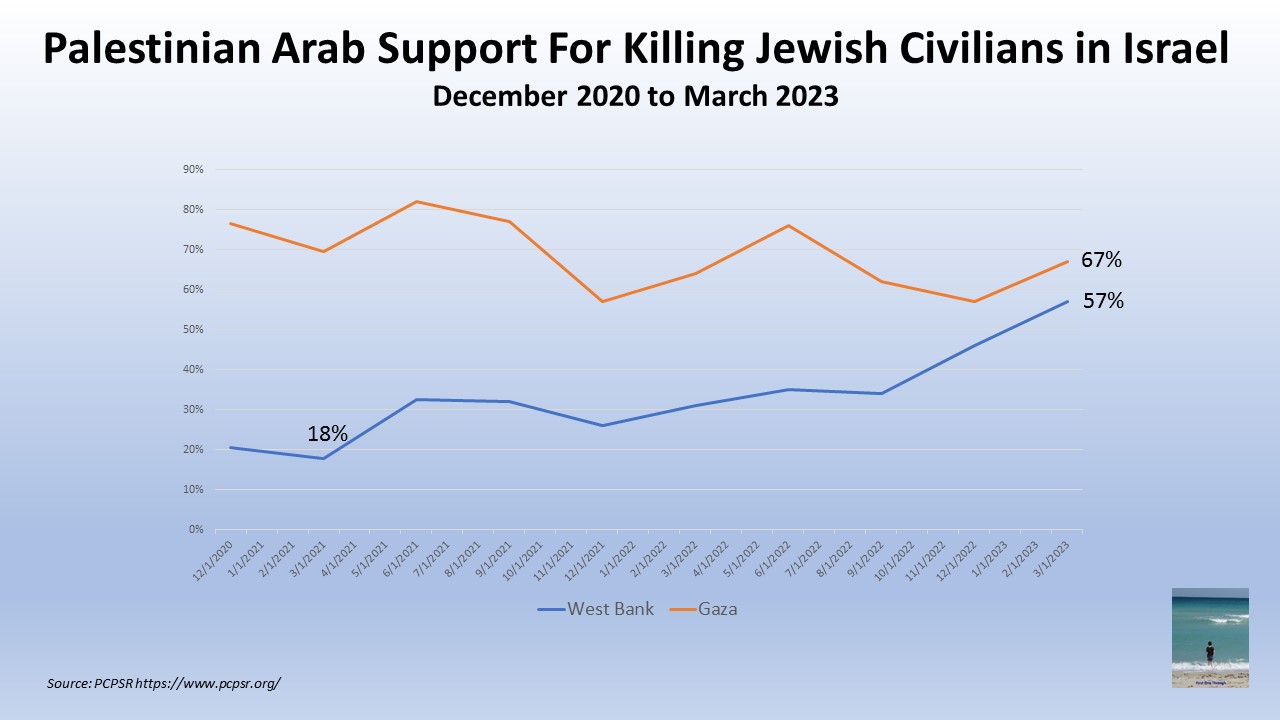
While Hamas gets funding and support from Iran, Turkey, Qatar and Sudan, it also has broad local support. An estimated 1.5 million people (67% of the population) in Gaza support the group and its goal of killing Jews inside of Israel according to recent Palestinian polls.
While it is abhorrent to realize that so many Palestinian Arabs actively support terrorism, can the Israeli government really consider wiping out 1.5 million people who want to kill Jews next door? If it would entertain such idea, the approach of sending in ground troops into Gaza where many soldiers will be killed would be insane. It would be easier to pound the region into submission from the air.
Israel makes efforts to minimize the loss of life of Arab civilians during such conflicts based on inside intelligence about where terrorists are located. However, based on the colossal failure of Israeli intelligence to foresee the October 7 massacre, it is doubtful that Israel’s operatives can be relied upon to pinpoint the terrorists.
Which leaves the question of what constitutes “crushing” Hamas so that the group essentially ceases to operate? All 25,000 terrorists in the group? 35,000 including the other terrorist groups? 1.5 million people?
It is likely that the Israeli government is trying to figure this out while it begins to hit the known Hamas locations in the war’s early days. Unfortunately, many Arab civilians have been killed – some who are part of the 1.5 million terrorist supporters and some of the 750,000 civil Arabs who are willing to live in peace with their Jewish neighbors.
One approach to minimize a horrible death toll would be for Hamas leadership and the 1,500 October 7 butchers to hand themselves over to Israel to spare fellow Arabs. I’m sure if they would agree, future bloodshed could be averted.
Assuming that Hamas remains consistent that they are in a war of liberation and will continue to fight and try to kill as many Israeli as possible, it is likely that the entire Hamas leadership and at least half of the group will need to be eliminated to end the jihadi dream of destroying Israel, roughly 12,500 people. When considering the number of civilians that will likely be killed alongside the terrorists, the total Arab dead may be 20,000 before the Palestinians relent and surrender to calm.
Before the “fog of war” sets in during battle, commanders set out their mission with some particular metrics. Hamas’s goal was to slaughter as many Jews as possible as deep into Israel as they could reach. They succeeded beyond their dreams.
Now is the time for Israel to map out its goals, before the cacophony of resolutions derail it from its aims.
It is difficult for people to comprehend the trauma felt in Israel. It goes beyond numbers as reviewed here.
The 9/11 Comparison
The Murdered. On September 11, 2001, 2,977 American civilians were killed by radical jihadists affiliated with the al Qaeda terrorist group. By comparison, on October 7, 2023, an estimated 900 people were killed in Israel. Relative to each population, roughly 1 out of 100,000 Americans were killed on 9/11 while 9.6 out of 100,000 Israelis were killed.
After 9/11, there were basically no further casualties on American soil. In Israel, several hundred additional people have been killed, with each day almost the equivalent of a 9/11. The total scale of the massacre of Israelis easily surpasses 10 times 9/11.
The Killers. There were 19 hijackers of four airplanes on 9/11, a relatively small number. The massacre in Israel involved an estimated 1,500 Palestinian Arab terrorists, about 80 times as many bent on killing civilians.
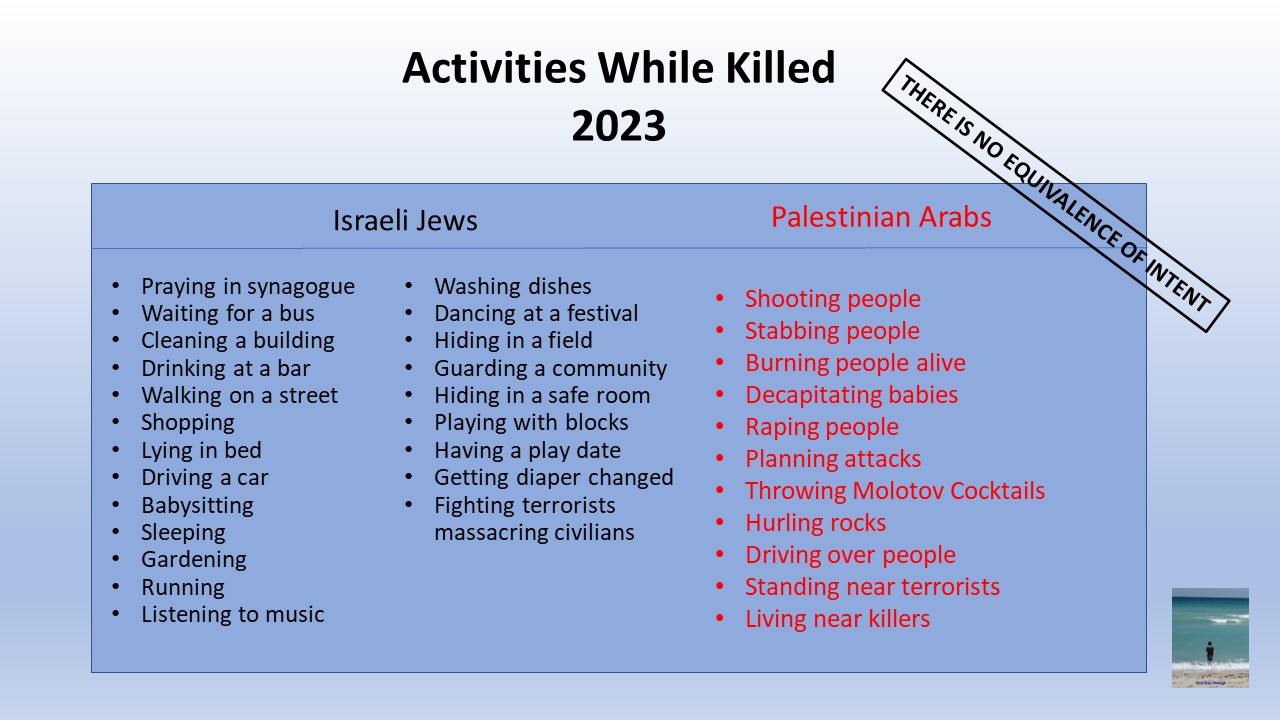
The Methodology. The 9/11 operation was clinically cold: the hijackers crashed planes into buildings. In the 10/7 atrocities, 1,500 Hamas terrorists went town-to-town hacking and shooting families to death. They raped women and dragged them through the street by their hair. They burned people alive. The butchers decapitated dozens of babies. For hours, they scoured the horizon for Jews to slaughter by hand.
Broad Local Support. The al Qaeda terrorists were a band of radical jihadists in 2001. They weren’t elected to any office. Not so for Hamas, which was elected to 58% of Palestinian parliament in 2006 with the most antisemitic charter ever written. They continue to hold that majority of the government, and according to polls, Hamas would win presidential elections if held now.
Location. The horde of al Qaeda terrorists were on the other side of the globe for the U.S.A. Hamas is literally next door to Israel – with the majority in Gaza but many in the West Bank. These Palestinian terrorists could carry out attacks against Israel from their backyards whenever they want.
The Aftermath. All 19 hijackers on 9/11 were killed in the suicide operation. They took no prisoners. However, well over 1,000 of the Arab terrorists survived and returned to their safe haven in Gaza, taking roughly 150 hostages with them. The Palestinian jihadists continue to fight on, now surrounded by 25,000 fellow jihadi terrorists, ensconced among civilians.
International Support. Al Qaeda became public enemy number one around the world after 9/11. America enlisted many countries in a fight against global terror which focused on America’s enemy. Yet now, in the immediate aftermath of the sickening slaughter in Israel, people and countries call the terrorism “resistance” and the massacre a cause for “celebration.” Israel will have a very difficult time gathering and maintaining global support to finally terminate this noxious evil.
Existential Threat. At the end of the day, while the 9/11 attacks were evil, the United States did not suddenly become really vulnerable; it was not going to disappear. But Israel is surrounded by many parties who refuse to accept its existence since its founding. The Islamic Republic of Iran, now at the cusp of nuclear weapons capability, has threatened to wipe it off the map and is actively sponsoring terrorist groups like Hamas and Hezbollah on Israel’s borders. Israel is highly vulnerable.
As people watch the news or consider the “pro-Palestinian resistance” protests taking place in cities and campuses, it is critical that they understand the current fear of Jews and Israelis: the collective post traumatic stress disorder which echoes the wails of parents and grandparents from the Holocaust and pogroms, has emerged again as the Satan of Gaza.
Even the most persecuted people in the world can be shocked by the barbarity of antisemites, and by the people who abandon them in their time of need.
The latest quarterly Palestinian poll came out on September 13, 2023, which repeated commonly heard Palestinian attitudes about their disgust with their leadership and wanting to kill Jews. A deeper look at the trends related to an open-ended question reveals a disturbing reality.
When asked about the most important issue for Palestinians to address, the goal of “ending the occupation and establishing a new Palestinian state” was always the number one choice. The second most important issue has consistently been getting the “right of return” to move into towns in Israel.
A look at the trendline since 2011 shows a significant erosion of those seeking to form a new Palestinian State. In September 2011, 59% of Palestinian Arabs said that ending Israeli rule in the “West Bank” and Gaza was the top priority with only 24% considering a right of return to Israel as the main goal. That 35% gap shrunk by nearly half to 18% by September 2015 and by nearly half again in September 2018 when there was a 10% difference. Now the gap stands at a mere 7%.
The decline is virtually completely from a drop in enthusiasm for a new Palestinian State. The desire for a “right to return” to Israel has stayed virtually constant.
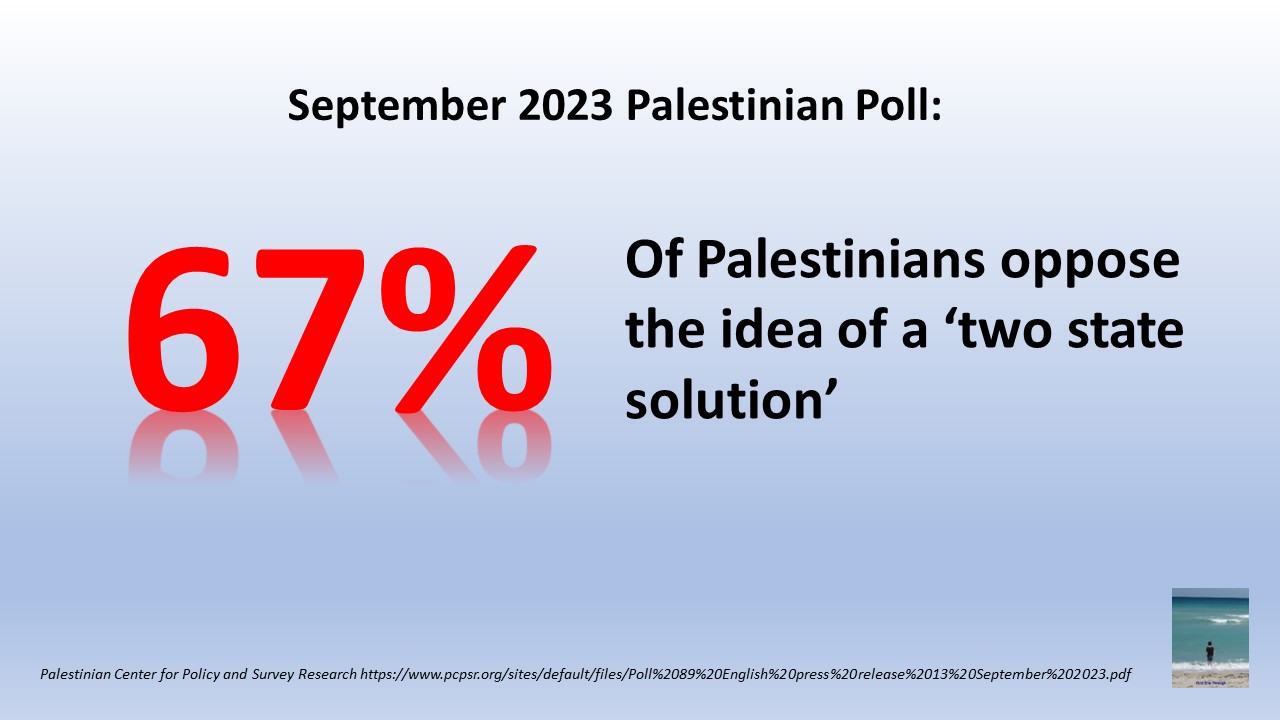
Not surprisingly based on the above, the opposition to a two state solution now stands at 67%.Opposition reached these elevated levels in early 2021, after a more modest opposition of 26% of Gazans and 40% of West Bank Arabs in December 2020.
It should not come as a surprise that Palestinians have come to oppose this Palestinian State. They view the leadership as terribly corrupt, with 78% wanting Palestinian Authority President Mahmoud Abbas to reign. The man has refused to hold elections and will soon start the 19th year of his four year-term.
This latest poll also asked about the Oslo Accords, now reaching its 30th anniversary. Today, 68% of Palestinian think Oslo harmed Palestinian interests and 71% think it was a mistake to sign them. A majority of 63% wants the PA to now abandon the accords completely.
These various responses reflect a new reality: Palestinians are done pursuing a peace agreement with Israel in search of a new corrupt Palestinian State. They have begun to prioritize the goal of moving to Israel, and taking over the Jewish State. It’s why Palestinian leaders are no longer shy condemning the ‘Judaization’ of Israel itself, and not just Jerusalem. They have called the entirety of the Jewish State a “painful settlement” in what they perceive of as purely “Arab land.”
The spike in Palestinian Arab violence since the beginning of 2021 is no longer about “resisting the occupation” and establishing an Arab State in the West Bank and Gaza. Palestinians are launching a war for Israel itself, as it considers the Nakba a living reality and not a moment in history in 1948. They have convinced themselves that Israel will soon cease to exist, and have set their sites on the bigger prize – from the river to the sea.
Over the 1990s decade, Saudi Arabia sent roughly 5,000 students per year to learn in the United States. After the terror attacks of 9/11/01 in which Saudis killed almost 3,000 people in the U.S., the number of Saudi students declined.
For a while.
In 2003, as the American War on Terror raged in mostly Muslim countries, the Kennedy-Lugar Youth Exchange and Study Program was launched. The goal was to bring “High school students from countries with significant Muslim populations [to] live and study in the United States for an academic year through the U.S.”
In the 2005/6 academic year, the program hit stride and really began to focus on Saudi Arabia, and reversed the trends of declining Saudi students in the U.S. The number of students grew from just over 3,000 in the 2004/5 academic year to over 61,000 in 2015/6. That high figure represents 0.2% of the entire population of Saudi Arabia to a single country. By way of comparison, the ENTIRE American students abroad cohort all over the world is around 162,000, or 0.05% of the U.S. population.
The whopping Saudi figures of 2014/5 and 2015/6 began to decline with the terrorist attacks in Europe including the Charlie Hebdo and kosher supermarket attacks of January 2015. Around that time, Saudi Arabian spies were also caught stealing private user information from Twitter to enable the government to crack down on users posting negative things about the monarchy.
Under the Trump administration, for all of the comments that President Trump cozied to the Saudis, the declining trend continued, which did not get any pushback from liberals who were incensed by the killing and dismemberment of dissident journalist Jamaal Khashoggi.
For the 2021/22 academic year, China and India were the countries with the largest cohort of students learning in the U.S., as Saudi Arabia dropped to number 7, “primarily due to changes in its government’s scholarship program.” COVID disrupted the program significantly in the following years. In 2021/22, China accounted for 31% and India 21% of all international students.
The human rights abuses in China, Saudi Arabia and Nigeria continue, and the U.S. continues to bring in their students, perhaps in an effort to build bridges to a more tolerant future.
In 2022, Saudi Arabia executed 196 people, the highest record in a single year recorded by Amnesty International. The trend has continued in 2023, including the July 2023 death sentence handed to Mohammad al-Ghamdi, who tweeted negative things about the government.
The United States is once again trying to build bridges to the powerful, rich and morally-defective Saudi kingdom. Fruits of that effort may be found throughout America’s college campuses.
News departments around the world are at the smallest levels, as the Internet destroyed the business model many years ago. Due to that reality, media outlets use the same source information and then craft it in a manner that fits the biases of its management team and readership.
The range of headlines that can emerge from a single story in a highly charged environment like the Israeli-Palestinian conflict is almost too remarkable to believe. Consider a story from August 17, 2023:
The plain facts are that the Israeli Defense Forces entered Jenin to arrest two people. As they encircled a building to arrest two wanted men, Palestinians fired on the troops who returned fire. A 32-year old Palestinian Arab named Mustafa al-Kastouni died of his wounds. He was a member of the Al-Aqsa Martyrs Brigades, a U.S. designated foreign terrorist organization.
Here’s how different media showcased the story online:
“Israeli forces kill Palestinian youth during Jenin raid,” wrote the official Palestinian news media Wafa, describing a 32 year old as a child. He was killed by “Israel forces” making the dynamic a David vs. Goliath scenario.
“Palestinian youth shot dead by zionist forces in Jenin,” read the Turkish ILKHA, repeating the lie that the Palestinian was a child and using inflammatory language that dismisses Israel as a country.
“Martyr, injuries from IOF fire during Jenin raid,” was the headline from Al Mayadeen, a Lebanese-based media group, that opted to sanctify the Palestinian gunman.
“Israel blows up Jenin bakery to assassinate resistance fighter,” was the most inflammatory headline cooked up by an online news site The Cradle, where anyone can contribute.
“Another Israeli raid on occupied West Bank’s Jenin kills one Palestinian,” from The New Arab also added inflammatory language in the headline to make the event part of a broader story of Israelis constantly invading Palestinian territory.
“One fatally shot during Israeli Occupation raid on Jenin,” from Jordan’s RoyaNews did not identify the dead man as a Palestinian Arab which was implied by the Israeli raid.
“Israeli forces kill Palestinian during Jenin raid” was the Middle East Eye headline, giving neither age nor status as to whether the man was armed.
“Israeli forces kill Palestinian during Jenin arrest raid,” from al Quds, an independent Palestinian-British site, was similar.
“Israeli forces fatally shoot Palestinian man in Jenin raid,” from Iranian PressTV also followed the most common fomat.
“Israel forces kill Palestinian in Jenin,” was the short headline from Middle East Monitor, was similar to Middle East Eye but dropped mentioning the raid.
“Israeli raid on Jenin kills Palestinian,” was the curt headline from ArabNews.
“Palestinian Killed in Exchange of Fire With Israeli Military in Jenin, Palestinian Health Ministry Says,” read the left-wing Israeli Haaretz headline, which added that there was an exchange of fire.
“Israeli troops kill a Palestinian militant in a gunbattle outside a West Bank bakery,” wrote ABCNews, in a bizarre highlight of the bakery on the ground floor of the building where the shooting took place.
“Israel raid kills West Bank militant, wounds health worker: Palestinians,” wrote France24, saying that the Palestinian killed was a militant in the West Bank.
“West Bank: a member of the Al Aqsa Martyrs Brigades killed in Jenin,” was the headline from Italy’s AgenziaNova, which uniquely highlighted the terrorist group affiliation of the Palestinian man.
“Palestinian gunman killed, terror cell arrested by Israeli forces in Jenin,” wrote The Times of Israel, marking the incident as between armed groups.
“An Israeli Raid on Jenin, a West Bank Militant Stronghold, Kills 1, Palestinians Say” was the Newsmax headline, which emphasized that Palestinian militants control Jenin.
“Palestinian Terrorist Killed as IDF Engages in Heavy Clashes in Jenin,” was the headline from Hamodia, a Jewish publication, labeling the Palestinian man as a terrorist.
“Clashes erupt in West Bank’s Jenin, one Palestinian terrorist killed,” from Israel’s i24News highlights that a terrorist was killed but doesn’t attribute the source of the fire from Israeli troops.
Such is the biased coverage from pro-Palestinian to pro-Israeli in the Middle East and European media. It demonstrates how news today is a crafted editorial to lead a reader to particular conclusions.
Some additional takeaways from this reporting is that Palestinian news lies openly and Israel’s left-wing Haaretz reporting mirrors that from Arab countries, while the right-wing US site Newsmax aligns its stories with Israeli and Jewish news sites.
Reading a single source of news about the Israeli-Palestinian conflict will inevitably leave a reader with a highly skewed view of any story, and if that source is the official news of the Palestinian Authority, with complete fabrications, commonly called #FakeNews.
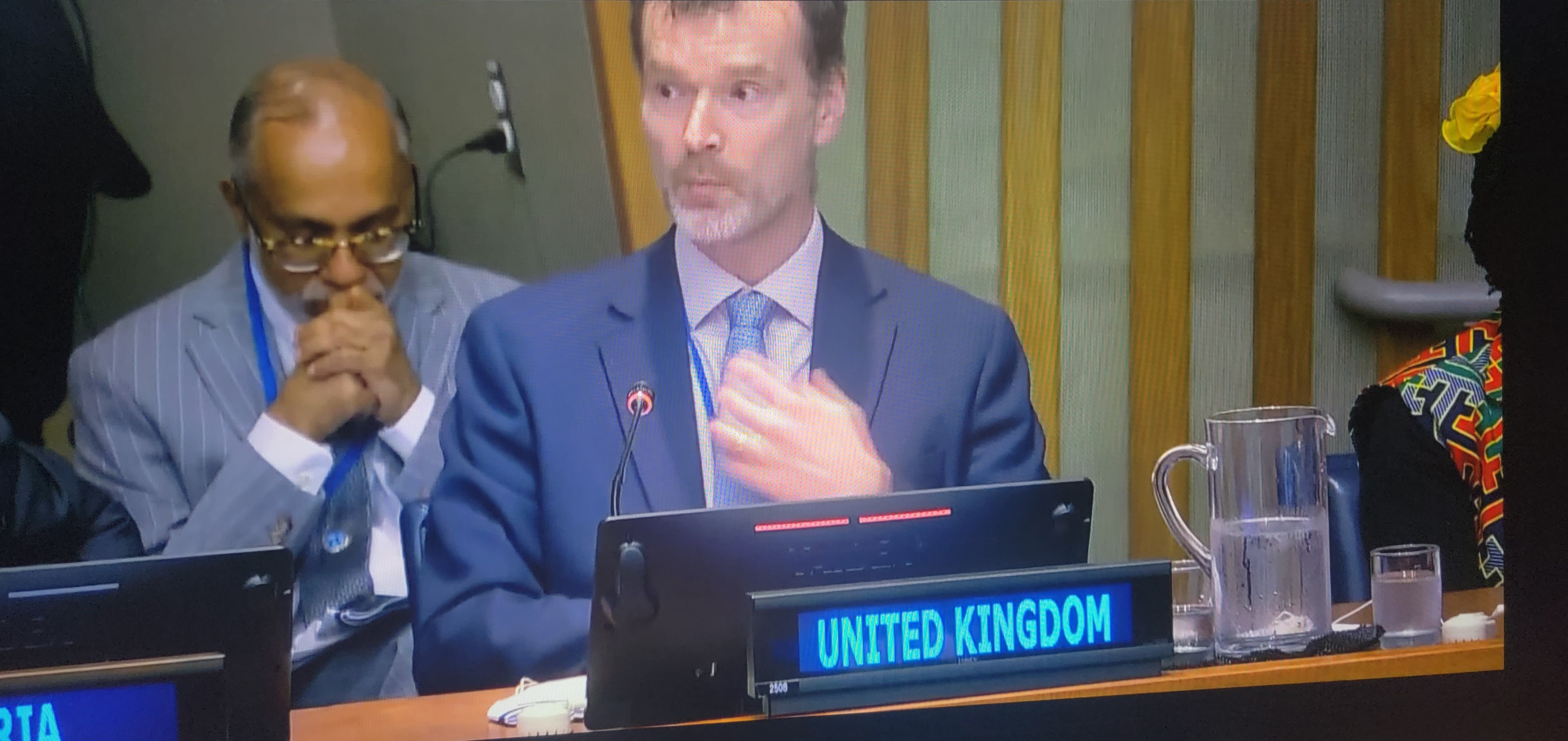
One of the sessions at the United Nations Conference on Counter-Terrorism in June 2023 was called “Building Effective and Resilient Member States’ Institutions in the Evolving Global Terrorism Landscape.” One of the speakers, Colin Smith from the United Kingdom, spoke (44:35) of the changing landscape of terrorism over the past twenty years and covered:
a focus on al Qaeda 20 years ago versus local terrorist groups today
a secretive counter-terrorism community vs. an open forum where countries share information and resources
immature counter-terrorism agencies vs. more sophisticated organizations
centers of terrorism vs. geographically diffuse operations now
Smith said “Since 2018, there’ve been nine successful terrorist attacks in the UK and one failed attack but none of them were directed from overseas. They were all self-initiated terrorists. So an individual or perhaps a small group getting together being radicalized by what they saw online or what they heard and turning to a terrorist attack in perhaps a very short of time, perhaps radicalizing in weeks, and not in months or years; perhaps days or weeks. Very low sophistication attacks using knives and cars. So since 2018, there have nine such attacks killing six people and injuring 23 in the UK but we’ve had no externally-directed attacks. In fact, the last time there was an externally successful attack in the UK was back in 2005.”
It begs the question as to the nature of home-grown terrorism in the UK since 2005.
Colin Smith of the United Kingdom talking at the United Nations counter-terrorism conference in June 2023
A quick review of some of the attacks:
On May 22, 2013, two Muslim men killed and hacked to death a British soldier stating that they did so “because Muslims are dying daily by British soldiers. And this British soldier is one…. By Allah, we swear by the almighty Allah we will never stop fighting you until you leave us alone.“
Quite a heavy toll between 2005 and 2018, and certainly more violent than only “using knives and cars.”
Smith’s UN comments were seemingly dismissive of the news when he said that the attackers were “radicalized by what they saw online or what they heard,” making it sound like the attackers were being fed disinformation and preyed upon. However, it was a well known and reported fact that the United Kingdom participated in fighting Al Qaeda and ISIL. The British Muslims who committed the terrorist attacks simply showed a greater love for co-religionists than for their fellow citizens whom they saw as co-conspirators killing Muslims.
Smith highlighted that the UK published a counter-terrorism document called CONTEST in 2018. Importantly for the UN conference, he spoke of the broad coordination happening amongst different agencies and the public sector to combat terrorism holistically, as called for in the report.
Yet he avoided discussing that between 2013 and the 2018 counterterrorism report, British police “foiled 25 Islamist plots since June 2013, and four extreme right wing terror plots in the past year alone…. The war in Syria, which was in its infancy when the last Strategy was published, has created both a haven and a training ground for British and foreign terrorists. UK citizens have been targeted in attacks overseas, for example in Sousse in 2015,” when 30 British tourists were killed in Tunisia.
The CONTEST publication was explicit about the serious threats facing the UK: “Daesh’s ability to direct, enable and inspire attacks still represents the most significant global terrorist threat, including to the UK and our people and interests overseas. Daesh’s methods are already being copied by new and established terror groups. Using pernicious, divisive messaging and amplifying perceived grievances, Daesh and Al Qa’ida exploit the internet to promote warped alternative narratives, urging extremists within our own communities to subvert our way of life through simple, brutal violence.”
In the setting of the United Nations panel, Smith avoided mentioning Islamic extremism, despite being the root cause of the British developing its comprehensive counterterrorism strategy. He alluded to disinformation, rather than point out that terrorists had grievances about actual facts. He did not discuss the end of British troops fighting in Iraq, Syria and Afghanistan (or at least the media covering such events) as cause for the pause in jihadists killing British citizens in recent years.
Significantly, Smith also did not talk about the United Kingdom’s refusal to repatriate perhaps as many as 400 British citizens back to its shores after fighting alongside terrorist groups in Syria and Iraq.
CONTEST was explicit, writing “Daesh’s initial state-building narrative persuaded thousands of people, including women and families, to travel to Syria from around the world, including from Europe and North Africa. This includes around 900 people of national security concern from the UK. Of these, approximately 20% have been killed while overseas, and around 40% have returned to the UK. The majority of those who have returned did so in the earlier stages of the conflict, and were investigated on their return. Only a very small number of travellers have returned in the last two years, and most of those have been women with young children.” That leaves 40% of the 900, or about 350 Britons still abroad as of 2018.
In regards to children still overseas, as of April 2023, as many as “60 British children are believed to be detained in al-Hol and Roj, two sprawling detention camps in northeast Syria primarily holding family members of Islamic State (ISIS) suspects” according to Human Rights Watch. Those children are among 37,000 foreign nationals held in the camps who are being refused re-entry into their home countries, many of whom have been stripped of their citizenship.
The UK published its goals of reintegrating returnees from the conflict in CONTEST, noting that its Desistance and Disengagement Programme (DDP) was “to reduce the risk from terrorism through rehabilitation and reintegration… will aim to more than double its current capacity to accommodate up to 230 individuals…. Through the DDP, we provide a range of intensive tailored interventions and practical support, designed to tackle the drivers of radicalisation around universal needs for identity, self-esteem, meaning and purpose; as well as to address personal grievances that the extremist narrative has exacerbated.” It was unclear whether addressing the terrorist’s grievances meant discussing why the UK fought ISIL or changing policy and having the UK abandon the fight.
Further, if there were still as many as 60 British children held in detention camps in Syria as of April 2023, it stands to reason that the UK has left almost all of the 350 adults in the camps as well, repatriating no one.
CONTEST also spoke of the government’s intention of pursuing would-be terrorists “including covert human intelligence sources, surveillance assets and the lawful intercept of communications. In addition to these capabilities, we also use a wide range of tools to constrain the ability of terrorists to act, for example working to proscribe organisations, freeze and seize their financial assets, and break up networks and associations in prison.” Even before the effort was launched, the report noted the government had contained “approximately 700 prisoners… who have been identified as engaged in terrorism or extremism, or about whom there are extremism concerns.”
Incarcerating would-be terrorists was also excluded from the panel discussion at the United Nations.
In summary, the UN forum was devoid of mentioning Islamic extremism, keeping terrorist in prisons at home and abroad, and blamed disinformation on the Internet for spawning attacks rather than actual grievances from a warped ideology.
It also did not mention acceding to terrorists’ demands which the United Kingdom may have already done, such as abandoning the fight on Islamic terror, whether ISIL, Taliban, al Shabab and Boko Haram, and resuscitating terrorist groups like Hamas.
The United Nations panelists on counter-terrorism did not speak openly, honestly or comprehensively about various approaches countries have implemented to tackle the global scourge and opted instead to parrot politically correct non-controversial narratives. Perhaps honest dialogues exist in private but the public spectacle of the UN is a ghostly version of reality.
There have been constants as well as changes in the century-long assaults by Palestinian Arabs against Jews in the holy land, yet the number of terrorist attacks goes up and down. It begs the question as to the reasons.
Latest Wave 2021 To Present
After years of relative calm between 2016 and 2020, Arab terrorism slaughtering Jews began to rise in 2021 and has not slowed down. The number of murdered Jews is on pace to surpass the number of murdered in the Gaza War of 2014.
There are a few reasons for the higher total: more multi-person deaths and a greater number of deaths by guns.
The years 2016 and 2017 saw two and four multi-person fatality incidents from terrorism, respectively. The totals then dropped for several years, with a single multiple person killing in 2018, when a Palestinian terrorist ran over two soldiers with a car. In 2019 and 2020 there weren’t any multi-person deaths. In 2021 there were two, each from rocket attacks from Gaza. That changed dramatically in 2022 when there seven, with five in the first half of 2023.
As the chart above shows, Palestinians have used guns, knives and cars for many years, while rockets and bombs have been used more recently in multi-victim attacks. Many more Arabs own guns than historically, both in Israel and in the West Bank. It has led to a huge spike in Arab-Arab violence in Israel, as well as capabilities for Palestinian Arabs to kill many people. Hundreds of guns were smuggled into the region by a Jordanian diplomat.
While guns contributed to the higher death toll, it doesn’t address the motivation behind Palestinians committing more attacks.
Palestinian Sentiments
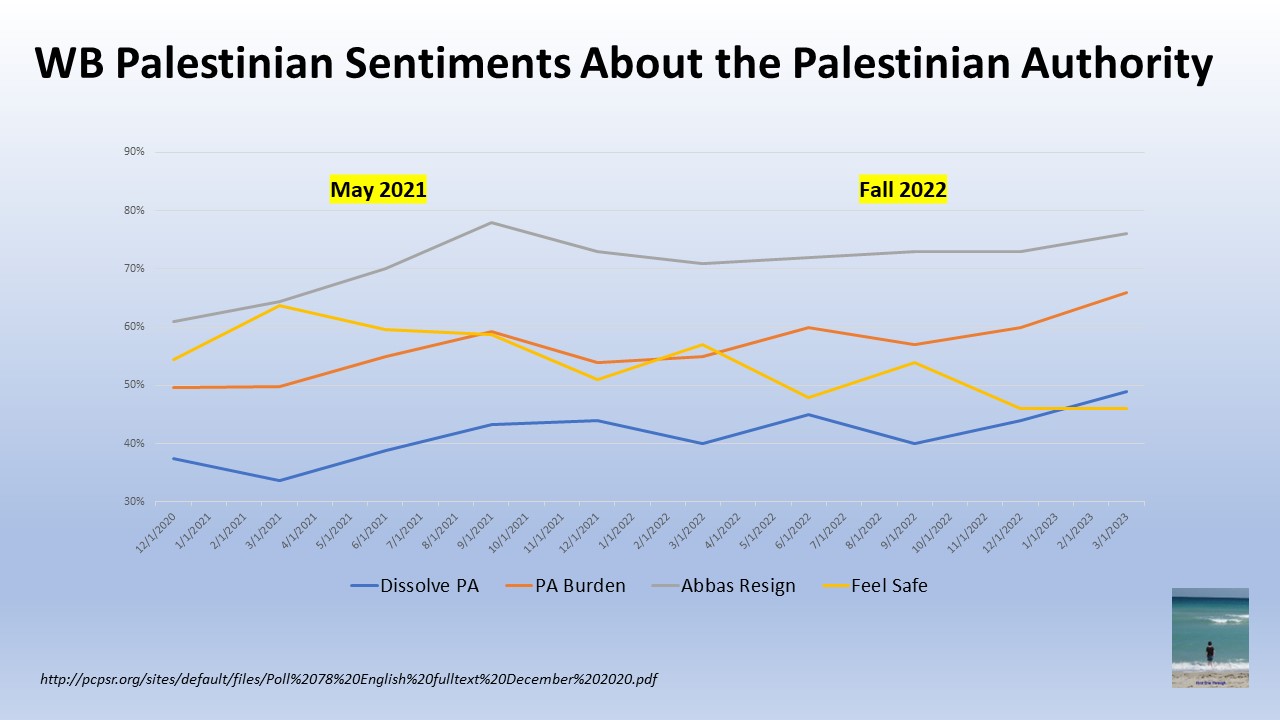
Palestinians have polled themselves every quarter since 2000. Many sentiments have remained constant about Jews and Palestinian leadership, especially for Gazans. However, the attitudes of West Bank Palestinians have changed since 2020.
Poll findings saw two significant shifts of West Bank Palestinian Arabs’ attitudes in the June 2021 poll and the polls of December 2022 and March 2023; break-out changes which did not appear during the relatively quiet prior years.
While the majority of Palestinian have consistently wanted PA President Mahmoud Abbas to resign, the June 2021 poll showed a 10% jump of those in favor. It coincided with a ten percentage jump in West Bank Arabs who believe that the Palestinian Authority has become a burden on Palestinians.
In December 2022 the number of West Bank Arabs who said they feel safe dropped below 50% for the first time. In the March 2023 poll, the West Bankers who felt that the PA was a burden jumped another 10%, as did the number of people saying they wanted to dissolve the PA, reaching 49% for the first time.
These inflection points are also seen regarding West Bank Arabs’ attitudes about Israel.
From the March 2021 poll to the June 2021 poll, West Bank Palestinians desire to murder Israeli civilians inside of Israel jumped from 18% to 33%, while those favoring another multi-year pogrom called an “intifada” jumped from 29% to 51%. Those attitudes held constant or slightly declined until jumping again in December 2022 and March 2023. In March 2023, 57% of West Bank Arabs said they were in favor of terrorism inside of Israel and 51% support a new intifada.
A similar shift in attitude happened regarding West Bank Arabs support of a two-state solution, with those opposed jumping to 61% in June 2021 from 51% three months earlier. In March 2023, those opposed to two-states crossed 70% for the first time.
Palestinians in the West Bank have moved away from supporting the Palestinian Authority and a peaceful resolution to the conflict to seeking a war with Israel, with inflection points happening in May 2021 and the fall of 2022.
The Rapture of Violent Jihad, May 2021
The various charts show how Palestinians used few rocket and mortar attacks from Gaza during the “lull” between 2016 and 2020. It is not as though they didn’t have much to complain about under the pro-Israel policies of U.S. President Donald Trump. Those initiatives included:
First sitting US president to visit Jerusalem’s Western Wall (5/17)
Recognized Jerusalem as Israel’s capital (12/17)
Signed Taylor Force Law banning funds to Palestinians if paid for terror (3/18)
Moved US embassy to Jerusalem (5/18)
Pulled US out of United Nations’ Human Rights Council due to obsession with Israel (6/18)
Pushed for major reforms at UNRWA (8/18)
Recognized Israeli sovereignty on Golan Heights (3/19)
Launched Israel-Palestinian Peace Initiatives (6/19 and 1/20)
Rejected notion that Israelis living in “West Bank” did so illegally (11/19)
Backed Israel in face of International Criminal Court allegations (6/20)
Despite all of the pro-Israel efforts, terrorist attacks against Israel were at all-time lows.
The world changed in several ways in early 2021. Joe Biden became president of the United States in January and in early May, after another round of elections in Israel, Naftali Bennett and Yair Lapid announced that they would form a coalition government to oust the long-time Prime Minister Benjamin Netanyahu.
While the news that Netanyahu was on his way out was breaking on May 9th, Arabs were rioting between May 6 and 10 about the pending eviction of long-term Arab squatters living in apartments in the Sheikh Jarrah section of Jerusalem who had refused to pay rent to the Jewish owners. Between May 10 and 25, riots spread into mixed communities in Israel and in the West Bank. Over that same time, Hamas rained rockets upon Israel.
The June 2021 PCPSR poll captured the change in mood on the Arab street well: “a semi-consensus that Hamas has won the May 2021 confrontation with Israel triggers a paradigm shift in public attitudes against the PA and its leadership and in favor of Hamas and armed struggle;… and the majority says Hamas, not Fatah under Abbas, deserve to represent and lead the Palestinian people.”
But Hamas did not follow-through to the liking of West Bank Arabs. While the political-terrorist group used language of incitement daily, it refrained from continuing to attack Israel. Even in May 2023, while Israel took out leaders and militants of Palestinian Islamic Jihad, Hamas remained on the sidelines.
New popular terrorist groups emerged to fill the thirst for violent jihad.
In September 2021, the Jenin Brigades was formed, the Nablus Brigades in May 2022, and then the Lions’ Den in August 2022. These West Bank terrorist groups led the spike in attacks against Jews in 2022 and 2023.
The December 2022 PCPSR poll captured the tide of events in the fall of 2022 which further increased West Bank Arabs’ quest to murder Israeli Jews: “The World Cup in Qatar helps to restore Palestinian public trust in the Arab World after years of disappointment; and in light of the escalating armed clashes in the West Bank and the near formation of a right wing and extreme government in Israel, the Palestinian public becomes more hardline while indicating a greater confidence in the efficacy of armed struggle.” The same poll showed almost every Palestinian thought that the PA had no right to interfere or arrest any member of the new terrorist groups.
Even as Hamas, Fatah and twelve other parties met in Algeria in October 2022 to reconcile and hold elections within the year, the Palestinian street chose to shun politics in favor of war. As one Palestinian said “This dialogue [Algerian Accords] will be recorded in the files within the long list of dialogues that the Palestinians have engaged in to achieve reconciliation, and it will not have any impact on the ground, whether in Gaza or the West Bank.”
Palestinians witnessed how violence stopped the evictions in Sheikh Jarrah and believe that terrorism will yield greater rewards than negotiations. The right-wing Israeli government that formed in the wake of those attitudes is intent on proving them wrong.
Yet, despite readily available information, the press publishes its typical inanity about the conflict.
After two Palestinian terrorist slaughtered Jews at a restaurant and gas station in June 2023, The New York Times offered that “The vanishing likelihood of a Palestinian state in the West Bank, the entrenchment of Israel’s control and a weakening of the mainstream Palestinian leadership have all contributed to a rise in Palestinian militancy.” That NYT opinion-stated-as-fact is complete stupidity. If those things were true, there would have been more acts of terrorism during the Trump years, not the fewest on record.
Palestinians know that they will not be able to achieve their goal of a Jew-free region without a global jihad, as the Jewish state will not negotiate away its existence. Palestinian terrorism spikes when local Arabs believe that the world supports its “armed struggle” and Israel backs down to its demands.
That’s the plain truth as shown by statistics and the sentiments aired in Palestinian polls. And Palestinians are backing these new leaders, nascent terrorist groups armed with thousands of guns committed to the violent jihad.
We often hear that the al Aqsa Mosque in Jerusalem is the third holiest site for Muslims, behind Mecca and Medina in Saudi Arabia. What remains unspoken is that the gap between numbers one and two to the distant number three is the size of the Grand Canyon.
Mecca is THE holy city of Muslims. It is there where Muslims perform the hajj, their pilgrimage to the Kaaba stone. During the week of the hajj, over 2 million people come to the city, of which roughly two-thirds are from outside Saudi Arabia.
During the hajj, many Muslims also visit Medina, where Muhammed is buried, about 280 miles away. Visitors come from Iraq, Pakistan, Indonesia and Egypt, among other Muslim-majority countries.
The same cannot be said for Muslim visitors to Jerusalem, which only draws local Arabs.
In 2019, before the pandemic dramatically impacted travel, Israel had over 4.5 million tourists visit the country. The two neighboring Arab countries with peace treaties with Israel barely came: Jordan had a mere 19,200 people visit Israel and Egypt had 8,000. Combined, the two countries accounted for 0.6% of tourists to the holy land. Amman, the capital of Jordan is less than a two hour drive from Jerusalem, an easy day trip.
Yet no one comes.
Turkey, which has long had relations with Israel, barely sends any tourists or pilgrims to Israel. The four Muslim majority countries, which recently struck normalization agreements with the Jewish State similarly have almost no visitors.
If al Aqsa is so holy, why don’t any Muslims from around the world come visit?
Some holy sites in the Jerusalem skyline, open to all under Israel
Christians make the pilgrimage to Israel all of the time. Italy alone had nearly 191,000 people come to see the various holy sites. Greece, with a population 1/10th the size of Egypt, had nearly 42,000 visitors to the Jewish State, or more than five times as many as Egypt. While Greece, Turkey and Israel were all once part of the Ottoman Empire, the Muslim interest in Jerusalem is vastly different. While roughly 417 Greeks per 100,000 go to Israel each year, only 37 per 100,000 Turks visit.
Israel allows access for Muslims to ascend the Temple Mount to visit al Aqsa every day, and even bars non-Muslims during Islamic holy days to facilitate Muslim prayers. Over one million Muslims went to Jerusalem during Ramadan in 2023, almost every one a local Arab, many who came repeatedly.
The al Aqsa Mosque is a holy shrine for local religious Muslims, while the entire Temple Mount is the holiest location for world Jewry and central focus of Judaism.
Many anti-Zionists point to the Balfour Declaration of 1917 (Britain), the San Remo Resolution of 1920 (Britain, Italy, France and Japan), and the United Nations Partition Resolution of 1947 as examples of foreign intervention against the will of the region’s inhabitants. While the Jews had thousands of years of history in the land and a religion which is uniquely tied to the land, the local Arabs did not want Jews in their midst. The Palestinian Arabs’ desires were ignored because foreigners sought to help Jews reestablish their rights in their homeland.
Those same anti-Zionists don’t pause in their push to ignore the will of local Israelis today who do not want millions of Arabs from abroad to move into their country. Not only do the pro-Palestinian advocates ignore the will of millions of Israeli citizens, they dismiss that Israel is a sovereign country with its own laws, something that was never true of Palestine before the creation of Israel in 1948.
Those same individuals point to United Nations Resolution 194 of 1948 Article 11 which states that refugees should be allowed to return to their homes if they are willing to live in peace. Somehow they ignore three critical items: 1) Palestinian Arabs refuse to coexist in peace, as shown in their terrorism and quarterly polls; 2) there are only a few thousand refugees from 1948, not millions of people which include descendants of people who left the region, many taking citizenship elsewhere; and 3) that resolution was for a moment in time and no longer relevant. For example, Article 8 says that greater Bethlehem and greater Jerusalem should be under United Nations control – are they advocating that Bethlehem be stripped from Palestinian Authority control?
The Ottomans and British may have ignored the wishes of the local Arab population in Palestine but they had the authority to do so. Today, there is no basis for the United Nations, the European Union, or anti-Zionists in the US Congress to impose their will over the common position of both the Israeli government and Israeli population.
The Arab-Israeli conflict gets so much ink and analysis because the region is always in flux.
Yet some things remain constant.
The Israelis and Palestinian Arabs poll themselves frequently about sentiments on a variety of topics. Occasionally, they conduct joint polls as occurred on January 24, 2023. The Palestinian Center of Policy and Survey Research (PCPSR) and Tel Aviv University’s International MA Program in Conflict Resolution and Mediation (Israeli Pulse) issued their report as Palestinians and Israelis engaged in a series of attacks. The joint poll is another tool to assess how Israeli Jews, Israeli Arabs and Palestinian Arabs (there are no Palestinian Jews anymore, as Palestinians exclude Jews from the definition) consider different aspects of living together, and how trends in such attitudes change.
In many ways, the groups agree on much: only about one-third of Israelis and Palestinians supports a two-state solution, a percentage that has continued to decline since 2016. About 85% of both Israelis and Arabs do not trust each other, and 84% of each considers themselves the victim in the conflict. About 60% of each group fears for their safety, roughly 93% of each group believes that they are the rightful owners to all of the land, and about 70% of each thinks the conflict is a zero-sum relationship, in that what’s good for one side is bad for the other.
The areas with some gap in sentiments includes engaging in an all-out war, with an estimated 40% of Palestinians and 26% of Israelis in favor, and roughly one-third of Israeli Jews willing to share the land with Palestinians but only 7% of Palestinians willing to share any land with Jews.
That last figure – only about one in fourteen Palestinians Arabs are in favor of sharing any of the land between the Jordan River and the Mediterranean Sea – is frightening and should be read in the context of another question in the joint poll.
“When did the conflict begin?”
To read the news and consider the ideas floated to bring peace to the region, one would imagine that the respondents would answer “the 1967 Six Day War,” to the question when the conflict originated, as that is when “occupation” began and those are the contours proposed in the Saudi Peace Plan. Yet only 8% of Palestinian Arabs and 5% of Israeli Jews believe that is the beginning of the conflict.
A majority of both Palestinians and Israeli Jews (60% and 52%, respectively) believe that the conflict began with the Balfour Declaration in 1917 and the Zionist immigration wave. It is the increased presence of Jews in the region – with international support – that is the core of the conflict, and why only 7% of Palestinians would consider sharing any of the land with the Jewish “colonialists.”
Only Israeli Arabs don’t hold this position, as they believe the conflict began with Israel’s declaration of independence, which makes sense as that is when their reality began. Similarly, they are the group most likely to promote good relations between Jews and Arabs (70%), followed by Israeli Jews (56%). Almost no Palestinians want to promote good relations (22%), as it has been blacklisted under the banner of “normalization.”
Palestinians do not believe that the Arab-Israeli conflict is about land or religion. They believe it is about the physical presence of Jews in the land they view as singularly theirs. Until the world focuses on changing this jaundiced Palestinian viewpoint, there is no hope for a peaceful resolution.









 First One Through