Meteors streak through the night sky, lighting up for a brief second before vanishing into nothing. They burn because the Earth protects itself. Our planet’s atmosphere—thin but powerful—defends it from destruction. The meteors disintegrate, and the world goes on unharmed.
The Moon has no such shield. Every rock, every speck of space dust that comes its way slams straight into its surface. That’s why it’s pockmarked with craters—permanent scars of endless bombardment. Without protection, the Moon endures the full force of the universe’s hostility.
So it is with the Jewish people.
Across centuries, Jews have existed as the exposed body in a world of friction and fire. Without a “cultural atmosphere” to cushion them, they’ve absorbed the hits directly—pogroms, inquisitions, expulsions, boycotts, and genocides. The Jewish story is a catalogue of collisions that the rest of humanity barely felt.
Christians and Muslims, by contrast, have lived for centuries within the thick atmosphere of dominance. Their societies, their empires, their majority status wrapped them in protection and privilege. When hatred sparks, their vast numbers and institutions disperse the heat before it burns. They are Earth-like—shielded by mass and power.
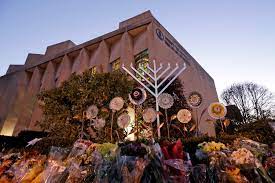
The Jew, wherever he resides as a minority, has always been lunar—alone in orbit, lacking an atmospheric buffer. Every ideological meteor, every political upheaval, every cultural storm leaves its mark. From England in 1290 to Spain in 1492, from Kishinev in 1903 to Pittsburgh in 2018, the craters accumulate.
If Christianity and Islam represent the Earth—secure, dominant, cushioned by atmosphere—Judaism remains the Moon, enduring open space without defense, absorbing the hits and still shining back upon the world.
In that celestial backdrop, we are now in a major meteor shower. We look up at them pounding the Moon and lighting the Earthly skies. We see the Moon amassing more scars and pray the projectiles will be small enough to incinerate before hitting Earth.
Jews had learned to survive without a shielding atmosphere for two thousand years. And then, in 1948, it got one, in the very place where the Jewish forefathers lived. Now, when the meteor showers of Jew-hatred arrive, those in Israel feel the impacts when the projectiles are large, while their diaspora brothers on the Moon get pummeled by lighter fare.
The Earth and Moon Jews have been barraged these last two years. They are scarred but eternal, waiting for the wave of debris to pass by as quickly as possible.
Every political movement faces the same question: what do you do with the bad people in your camp?
Ezra Klein, writing in The New York Times, argues that Democrats should welcome everyone under their banner — no matter how extreme — because inclusion wins elections. He calls it the big tent: forget purity, just make sure they call themselves Democrats. It’s politics over principle, and power over conscience.
Republicans, by contrast, still try to draw a line. When groups like the Heritage Foundation flirt with extremists such as Tucker Carlson or Nick Fuentes — men who traffic in grievance and racism — many conservatives recoil. To them, the party label still carries moral weight. You can lose elections, but you shouldn’t lose your soul.
And then there’s Hamas — the third model. When Hamas decides someone in its own ranks isn’t loyal enough, it doesn’t debate inclusion or expulsion. It breaks their legs in the street. It executes them in public. For Hamas, politics is not persuasion or debate; it is terror enforced by fear. That’s how it keeps power — absolute, unchallenged, and bloodstained.
The Temptation of the Big Tent
Ezra Klein’s “big tent” philosophy played out in real time with Zohran Mamdani’s win in New York City. The Democratic Party opened its doors to a wholly different ideology and welcomed it inside to secure a victory. But at what cost?
The party platform now stretches so far that it’s unrecognizable — and to many, repulsive. In its desperation to confront unified Republican power in Washington, the Democrats chose to absorb the fringe rather than confront it. The price of inclusion was coherence.
For illustration, imagine a Jewish newspaper facing a business dilemma:
A group like Jews for Jesus wants to buy an ad. The editor must decide: Do we take the money? Do we run it in the name of inclusion and open debate? Or do we reject it as off-brand, offensive, and disloyal to our readership?
Most would choose the last. They’d rather forgo the check than cheapen their identity.
But the Democrats have made a different calculation. The party tasted the fringe, saw no backlash, and convinced itself there’s no downside. It’s as though that Jewish paper ran the Jews for Jesus ad — and the subscribers applauded. So what’s next? An ad from the KKK? Pork recipes for Passover? How far can inclusion stretch before it becomes desecration?
Power, Principle, and the Price of Brand
Republicans have power so can afford to maintain their brand by shedding radicals. Hamas maintains power by shedding blood. Democrats, desperate to gain power, are willing to shed consistency.
Three models emerge to rule:
The Democrat: inclusion for victory
The Republican: exclusion for integrity
The Islamist: execution for control
Each reveals a truth about how institutions face the corrupting pull of power.
Politics, like publishing, isn’t just about what you include — it’s defined by what you refuse to print. A brand without boundaries isn’t brave. It’s broken.
Of course the masses would like consistency and inclusion and integrity and peace on the streets. But they have come to realize that politics is power, and they want power. When Congress was a bell curve with little difference between Democrat and Republican, there was general ambivalence about elections and the impact on people’s daily lives regarding who was in power. Not so in today’s barbell society with extremists dominating politics.
The Jewish Community
What does the Jewish community do with groups like Neturei Karta that join the worst of the anti-Israel protests and fly to Iran for Holocaust denial conferences? With Jews who voted for a mayor who supports “globalize the Intifada”?
Neturei Karta protesting a march against antisemitism in New York City, January 2020 (photo: First One Through)
Neturei Karta is a small fringe group that mostly keeps themselves isolated, so in practice, there needn’t be an active response. But there were an estimated one-third of Jews in New York City that voted for Zohran Mamdani, including public officials and celebrities. There was a big turnout in younger Jews voting for Mamdani, estimated at two-thirds of those under 44 years old.
How does the Jewish community react when a majority of young Jews are viewed as putting the broader community at risk? Which model does it follow, or is the question more complicated as one’s Jewishness cannot be shed like political affiliation, and being a Jew is not about attaining power.
And is the conclusion in the observation? Politics is about power and people take actions depending on the environment to obtain or maintain power. However, Judaism shuns power, and seeks to live a religious life of one’s choosing without external influence.
Mandy Patinkin endorsing Zohran Mamdani for mayor, president and emperor
Jews, while always small in number, have always had a very large and wide tent because they don’t get to decide who to include and exclude for their numbers. They only decide who should be included in their associations – in their shuls, schools, umbrella groups.
In May 2021, young anti-Israel Jews were calling Israeli engagement with Palestinian Arabs “apartheid” and “genocide’ (well before Hamas’s 2023 War on Israel), and some were thereby fired from teaching positions at Jewish schools. At Upper East Side Yeshivat Ramaz, alumni pressured the Principal Emeritus Haskel Lookstein to not speak at Donald Trump’s 2017 inauguration. Jews shut down other Jews for their comments and associations.
I do not believe that there is a single answer for what Jews should do with kinsmen who are regarded as beyond the pale. Historically, in a bell curve political dynamic with moderate antisemitism, the radical could be ignored as noise. However, in today’s barbell political reality, with heightened antisemitism, active measures need to be considered regarding the bad apples.
Antonio Guterres, the United Nations’ Secretary-General, flew to Saudi Arabia last week to praise tourism as a “force for peace” and “inclusive development.” He told the UN Tourism Assembly that travel “brings humanity closer together.” The speech glowed with globalist virtue.
Except for one problem: it was delivered in a country that bans people of certain religions from entering its holiest city. Non-Muslims can tour the malls of Riyadh, but not take a single step inside Mecca. “Inclusive,” Saudi style, comes with a checkpoint.
The hypocrisy is so thick you could pave a runway with it. The leader of the United Nations extolling openness from a podium in a state that literally posts “Muslims Only” signs on highways. Tourism for peace—so long as you’re the right faith.
Saudi Arabia’s Vision 2030 invites the world’s money while keeping its spiritual gates locked. And the UN, a tool of Islamic Supremacy, pretends not to notice. It’s hard to bring humanity closer together when half of humanity is forbidden to enter.
The latest United Nations conference on “social justice” met in Qatar – that same Qatar that supports the antisemitic genocidal terrorists of Hamas and instills their narrative into the United States and the world.
UN Deputy Secretary-General Amina Mohammed pretended to reach for the moral high ground, invoking the Copenhagen Declaration and the Doha Development Agenda as the guiding stars of global fairness. She spoke of social justice, inclusion, development, and the duty to “leave no one behind.” And then, inevitably, she cited Gaza – and only Gaza – not as a lesson in hypocrisy, but as a tragedy of war that, in her telling, derailed those noble promises.
But the fact is that Gaza did not collapse because the UN’s social programs failed to reach it or from war. Gaza was the UN’s social program. For decades, the UN built and funded the schools, administered the food aid, managed the clinics, and drafted the talking points. Generations were raised under their flag of humanitarian idealism. Yet what was taught was not coexistence, tolerance, or equality. It was grievance, entitlement, and the dream of a land without Israel.
If Copenhagen promised inclusion, Gaza delivered indoctrination. If Doha promised shared prosperity, Gaza institutionalized dependency. The UN’s own agencies became the state’s scaffolding—without the accountability of a state or the moral compass of true social justice. There was never any “leaving no one behind”; there was only teaching millions that history owed them everything and responsibility was optional.
The United Nations Deputy Secretary-General mourns Gaza as proof that war has undone the UN’s human-development vision. Alas, Gaza is proof that the vision itself was hollow, or at least deeply corrupted when it came to the Stateless Arabs from Palestine (SAPs). The declarations were printed on fine paper, but the values were never applied where it mattered most. No education for coexistence. No curriculum of compromise. No inclusion for those outside the narrative.
The Copenhagen and Doha declarations were supposed to represent the conscience of human values. In Gaza, they became the cover for a project that replaced human rights with perpetual resentment. That is not social justice. That is social decay, dressed up in UN language and called compassion.
Stateless Arabs from Palestine (SAPs) — in Gaza and the West Bank — often cry out that they cannot go wherever they wish in Israel. They protest that they cannot move to the towns where their grandparents once lived. They label Israel as racist for preventing them from settling there, even though their Muslim Arab cousins live peacefully in those very same towns.
Arab women sitting in the shade in Akko, Israel (photo: First One Through)
They point to United Nations resolutions declaring they have a “right of return.” They frame their displacement as an “ongoing Nakba,” a catastrophe that Israel continues to impose.
I hear their complaint. I hear their anger. I more than understand — I live it.
Because Jews have lived that same nightmare — and worse. The very same United Nations that claims SAPs have a “right of return” decreed that Jews should be banned from living in half of their homeland. It told us we could not live in our own capital, Jerusalem. It told us we could not pray on our own holy mountain. It called it a “status quo” and the world nodded in approval.
And the Stateless Arabs from Palestine have the gall to try to deny Jews that very same right — to live freely in their homeland — while complaining that Jews are denying them theirs. They scream of injustice while vilifying “Yahoods.” The hypocrisy is obscene.
The Palestinian Arabs know it, and rather than confront it through accommodation and compromise, they wage war like Highlander, shouting “there can be only one.” They elected Hamas. They supported the October 7 barbarism. They continue to support Hamas, all in the hope of taking over the entire land from a small country.
Israeli Arabs make up 21% of the Israeli population, while Jews make up 0% of Gaza’s population and about 18% of the land east of the 1949 Armistice Lines (E49AL). The world ignores the Israeli Arabs with full citizenship rights, and obsesses and smears the Jews in the “West Bank” as illegal “settlers.” It seeks to ethnically cleanse that region of Jews while simultaneously claiming Israel has no true sovereignty to determine who to allow into its country to push the Israeli Arab population to 50%. It’s absurd.
Muslim Arabs have global support backed by 2 billion Muslims in their complaint against Israel. The small number of Israeli Jews receive global contempt for seeking the same right to live and travel freely in their homeland.
Israeli Arab women in Jerusalem (photo: First One Through)
Europe is declaring peace while America is building it.
As Britain and France rush to recognize a Palestinian state to pressure Israel, the United States is doing something more durable: expanding the Abraham Accords. With Kazakhstan now actively promoting its joining Muslim-majority nations normalizing ties with Israel, the U.S. is advancing a vision that builds relationships rather than rhetoric.
US President Donald Trump meets with Kazakh President Qasym-Zhomart Toqaev
European leaders say recognition will balance the scales and restart diplomacy. But what exactly are they recognizing? The Palestinians remain divided between an unpopular and corrupt authority in the West Bank and Hamas in Gaza—an antisemitic terrorist group that thrives on conflict and rejects coexistence. There are no elections, no functioning institutions, no borders, and no credible security force. Declaring this fractured reality a “state” doesn’t bring peace any closer. It just flatters the fantasy that paperwork can substitute for progress.
For Palestinians, European gestures feel validating, but validation without change is illusion. No declaration from Paris or London can rebuild Gaza, reform leadership, or disarm Hamas. It’s diplomacy as performance—morally satisfying to distant audiences but meaningless in practice.
The Abraham Accords take a different approach. They focus on cooperation. Each new country that signs—Bahrain, Morocco, the UAE, and now Kazakhstan—proves that Israel can be accepted across the Muslim world without waiting for Hamas’s permission. This shift is reshaping the region. It turns rejection into partnership, slogans into investment, and isolation into integration. Every handshake chips away at the myth that the Middle East must remain hostage to its oldest conflict.
But peace will never advance while Hamas holds power. Hamas doesn’t just oppose Israel; it opposes peace itself. It rejects every agreement, glorifies violence, and sacrifices its own civilians to preserve control. Allowing Hamas to participate in elections or continue ruling Gaza ensures that destruction will repeat everywhere. Disarming Hamas and excluding it from Palestinian politics isn’t an Israeli condition—it’s a Palestinian necessity. Without that step, there can be no state, no sovereignty, and no future.
Alas, Palestinians disagree. In the latest PCPSR October 2025 poll, Hamas remains the most popular political party (60% approval) and Khaled Mashal, the leader of Hamas would trounce Fatah’s Mahmoud Abbas by 63% to 27%. Palestinian Arabs (69%) remain adamant that Hamas not give up its arms. Even after the decimation of Gaza, a majority (53%) still approves the October 7 massacre. And imagine that now, as the ceasefire appears to be bringing the end of the war, a remarkable 39% of Palestinians still think Hamas will win.
The choice is clear. Europe can keep recognizing an idea of Palestine that doesn’t exist and that the Palestinian Arabs are more moderate than they really are, or the U.S. can keep building the conditions for a reformed Palestinian society. The road to peace will not run through European parliaments; it runs through a changed Palestinian worldview, normalization between Israel and Muslim countries, economic growth, and a regional consensus that leaves Hamas behind.
The pathway to peace in the Middle East is the Abraham Accords, not European theater.
The vile antisemitism of Within Our Lifetime‘s Nerdeen Kiswani and MPower Change‘s Linda Sarsour isn’t accidental or peripheral — it’s the smoke that hides the fire. Their venom serves political purposes: to push Zohran Mamdani further and to make him look like a moderate.
Kiswani, the founder of Within Our Lifetime, just declared that there is “no scourge of antisemitism” in New York, that antisemitism is merely a “political tool.” She dismisses Jewish fear as propaganda, mocking the very notion that attacks on Jews are real or meaningful. It’s malice dressed up as activism.
Sarsour, her ideological twin, has spent years deflecting and justifying Jew-hatred while demanding that “Zionists” be excluded from feminist and progressive spaces. Both women were already disgusting before Mamdani’s rise; their brand of hatred was a known quantity. But now, with a self-proclaimed “anti-Zionist” mayor-elect, their vitriol has a new function.
By shouting louder, by pushing uglier rhetoric, by saying they will hold Mamdani “accountable,” Kiswani and Sarsour pull the Overton window so far into open antisemitism that Mamdani’s own positions — once fringe — could appear reasonable. When he calls for “justice for Palestine” but refuses to condemn chants for the destruction of Israel, he suddenly sounds measured. When he pays lip service to opposing antisemitism while platforming its deniers, he looks balanced.
That’s the trick. The extremists normalize the radical.
Expect them to ratchet it up — louder, uglier, more unapologetic. Every grotesque statement they make gives Mamdani cover to pretend he’s in the middle, that he’s the “responsible” voice between hatred and hysteria. In reality, it’s a choreography: they spew; he sanitizes.
This is how antisemitism gains respectability — not only through mobs on the street which are clearly terrifying sights – but through mayors in city hall who appear “moderate” only because the activists behind them are obscene.
New York should not fall for the illusion. The vile bigotry of Sarsour and Kiswani doesn’t make Mamdani reasonable — it exposes how far the city’s moral compass has tilted. When hatred becomes the baseline, even those who echo it softly begin to sound centrist.
There’s always someone worse. That’s how the worst ideas survive.
During a July 31, 2021 WOL rally in Brooklyn, after fireworks were lit, Kiswani told [01:02:43] the crowd: “I hope that a pop-pop is the last noise that some Zionists hear in their lifetime!”
Abraham once defended the wicked on the merit of the righteous few. Today, the world defends the wicked for the sake of evil masses.
The Moral Math of Vayera In Parashat Vayera, God tells Abraham that Sodom will be destroyed for its depravity. The city is beyond saving — cruelty is civic policy, justice a mockery. But Abraham does the unthinkable: he defends the wicked, not because he excuses them, but because he believes that within their city a few righteous might remain.
“Will You indeed sweep away the righteous with the wicked?” (Genesis 18:23)
Abraham bargains God down — fifty, forty-five, thirty, twenty, ten. If even one percent (population of Sodom estimated 1,000) righteous can be found, the city deserves another chance. Abraham’s plea becomes the Torah’s first moral equation: mercy for the many on the merit of the few. He argues for the wicked because of the righteous – or perhaps for only the righteous to be spared.
Abraham praying to God on behalf of the residents of Sodom and Gomorrah, by Étienne Delaune (1518-1583)
A Sordid Defense of Evil Four thousand years later, the moral logic has flipped. After the October 7 massacre — the torture, murder, and kidnapping of civilians — millions marched not to defend the righteous within Gaza, but to defend the wicked who carried out the atrocities. From London to New York, the cry was “Globalize the Intifada.” The United Nations would not even utter Hamas’s name.
They did not plead for ten good souls but glorified evil itself. Abraham argued for the guilty because he believed in goodness; today’s socialist-jihadists argue for the guilty because they despise Jews. That is not compassion — it is moral rot spreading far from the center of evil, infecting universities, newsrooms, and now city halls.
In Sodom’s time, no one defended depravity. Today, Genocide becomes “context.” Rape becomes “resistance.” Decapitation becomes “desperation.” Abraham fought for the 99 percent on the merit of the 1 percent righteous. Now we see millions fighting for the 75 percent wicked, based on the very actions of the depraved.
Nowhere is this clearer than in New York City — home to the world’s largest Jewish community — where activists chanting “Globalize the Intifada” and rape deniers will shape city politics. The descendants of Abraham are mocked as colonizers in their own synagogues and schools.
The Torah is silent on the punishment for those who aid and abet wickedness, but American law is not. The U.S. forbids “material support to terrorism.” Groups like CAIR face renewed scrutiny for Hamas ties; Students for Justice in Palestine has been banned from campuses for celebrating terror. Perhaps the law will finally catch up to those who glorify murder under the banner of justice.
Or New York City’s new mayor will bend and enforce the law to his own tune.
Abraham taught that one may plead for the wicked only on the merit of the righteous — never for the wicked in a moral void. The first is faith and mercy; the second, blasphemy and depravity. Today, we have lost the lesson, a moral stain on this generation.
The cameras panned across the crowd at Zohran Mamdani’s victory celebration — the newly elected mayor of New York City, surrounded by socialist activists, digital influencers, and the self-congratulating left. It was meant to be a night of triumph for the “movement.” But what stood out for those watching was not unity, or even politics. It was who was cheering.
Standing shoulder to shoulder, laughing and hugging, were Jamaal Bowman, Hasan Piker, and Zeteo’s Mehdi Hasan — three men whose names have become synonymous with the moral collapse that followed the Hamas atrocities of October 7.
Zeteo’s Mehdi Hasan at the Mamdani victory party with Hasan Piker and Jamaal Bowman. (start at 52:00)
Bowman, the disgraced former congressman, made his name shouting on New York’s streets that Israeli women were not raped on October 7 — that the accounts of mass sexual violence by Hamas terrorists were fabricated. He wasn’t a lone crank in an internet comment section; he was a member of Congress using his platform to publicly deny the humanity of Jewish victims in the streets of his district.
Hasan Piker, meanwhile, mocked the entire subject on his Twitch stream, telling his millions of followers that he didn’t care if the women on October 7 were raped. That flippant cruelty — that casual dismissal of atrocity — has become a feature, not a bug, of a corrupted culture that cloaks moral degeneracy in “anti-imperialist” rhetoric. His anti-American and anti-Israel rhetoric had become so toxic, that Rep. Ritchie Torres, a Latin-Black gay Congressman, wrote a letter on October 29, 2024 to the CEO of Twitch to have Piker removed.
And then there was Mehdi Hasan, who publicly argued that early reports of “mass rape” on October 7 were overstated and politicized, arguing that the allegations had been “weaponized by supporters of Israel.” At Mamdani’s party, he stood smiling with Bowman and hugging Piker as the pain of Jews was being amplified and normalized.
And celebrated.
The spectacle was a black mirror of a broken city — a city that once prided itself on tolerance and moral clarity now relishing Jewish trauma.
New Yorkers didn’t just elect a socialist. They elected a symbol of moral inversion — a man whose supporters include those who laughed at, ignored, or explained away the rape and murder of innocents.
When the applause dies down and the speeches fade, one question will remain for the city that crowned Mamdani: What kind of people celebrate with rape deniers and those that revel in the pain of the most persecuted minority-minority?
Google employs roughly 2,000 people in Israel, predominantly in offices in Tel Aviv and Haifa. The technology giant has hired teams in research & development, and purchased several Israeli companies including Waze and Wiz for billions of dollars to establish a large footprint.
And many of the company’s American employees don’t like it.
Hundreds of Google employees held protests about the company’s ties to Israel. Google fired around 50 of them in 2024 over their protests regarding “Project Nimbus,” a $1.2 billion contract signed in 2021 for Google and Amazon to provide the Israeli government with cloud computing and artificial intelligence services.
The disgruntled employees may now be fighting a more subtle fight.
To use Google’s calendar function, one is left with some odd choices to find the time zone in Israel. Rather than showcasing capital and major cities like Jerusalem, Tel Aviv and Haifa – cities where Google has a presence – the company shows time zones for Gaza and Hebron.
It’s both insane and stupid. And a reminder of the subtle Israel and Jewish erasure that is happening by radical technology employees under everyone’s noses.
ACTION ITEM
Complain to Google and have them feature main Israeli cities in their calendars.