Successful race baiters become famous and powerful. They first attract attention which brings in followers, and then money and ultimately true power.
Adolf Hitler produced his manifesto called ‘Mein Kampf” meaning ‘My Struggle” which sought to air his grievances about the state of German society and the struggles of the common man. He used the Jew as his scapegoat, at times attacking the Hebrew Pinata for being poor, dirty and smelly, and at other times for being a rich banker who profited off the work of others. He portrayed the Jews as leeches which sucked the blood and labor of poor workers and profited in a sneaky plan for world domination.
Some selections on his second “powerful parasite theme”:
Jewish parasites: “In the business world things were even worse. Here the Jewish people had really become ‘indispensable.’ The spider began slowly to suck the people’s blood out of its pores. By way of the war societies one had found the instrument with which to put an end, bit by bit, to a national and free economy.“
Jews stealing in secret: “they try to cheat the whole world with their tricks; they are lazy, but with their pretended ‘silent’ work they create the appearance of an enormous and equally laborious activity; in short, they are cheats, characters of political profiteering, who hate the honest work of others. Just as such a folkish moth always appeals to the darkness of the silence, one can bet a thousand to one that under its cover he does not produce, but only steals from the fruits of the labor of others.“
Jewish profiteers and desire for world domination: “Jews are the regents of the stock exchange power of the American Union. Every year they manage to become increasingly the controlling masters of the labor power of a people of 120,000,000 souls; one great man, Ford, to their exasperation still holds out independently there even now. With rapacious cleverness they knead public opinion and form from it the instrument of a struggle for their own future. Already the greatest heads of Jewry envisage the approach of the fulfillment of the hereditary slogan of the great devouring of the nations.“
Hitler was appalled that people would come to the defense of the Jews, knowing that they profit off of the toil and suffering of others:
Don’t defend Jews who profit off your misery:“If the Hungarian government hangs ten Jewish stock exchange profiteers, whose money is sticky with the blood and the sweat of hundreds of thousands of honest people, we protest, we cry about pogroms and we demand the boycott of an entire State.”
Hitler wrote Mein Kampf in July 1925 as a poor man in prison. Within eight years he was the chancellor of Germany.
The Alt-Left’s Modern ‘Mein Kampf’
The National Socialist German Worker’s Party of the 1930’s and 1940’s was commonly called the Nazi Party. It is associated with the far right’s desire for racial purity, demonization of inferior races and elevation of proper Aryan Germans. It drew its inspiration from Hitler’s manifesto.
Today’s Democratic Socialists of America (DSA) is a far-left group which shuns much of the ideology of the Nazi Party while embracing other key tenets.
It does not follow Hitler’s screed against the dirty, smelly Jew or other poor people as the party argues that it is fighting for the poor working class. Instead the alt-left goes all-in against the rich “ownership class” which robs from poor people of their work and dignity. Jews just happen to be the mascot of the evil profiteers, whether in Gaza or Detroit.
Randi Weingarten, longtime president of the American Federation of Teachers, a lobbying group with 1.7 million members which pumps millions of dollars into Democratic politicians’ pockets, declared that American Jews are “part of the ownership class…. now want to take that ladder of opportunity [education] away from those who do not have it.” (Weingarten is married to Rabbi Sharon Kleinbaum, who sits on the Rabbinical Committee of the left-wing group J Street, and was just appointed by President Biden to join the US religious freedom commission. An interesting spectacle of Jews eating their own).
Congresswoman Rashida Tlaib (D-MI), a proud member of the DSA made her own declaration about Jews:
“As I think about my family in Palestine, that continue to live under military occupation and how that really interacts with this beautiful Black city I grew up in … you know I always tell people that cutting people off from water is violence, and they do it from Gaza to Detroit, and it’s a way to control people, to oppress people. And it’s those structures that we continue to fight against. I know you all understand the structure we’ve been living under right now is designed by those who exploit the rest of us, for their own profit. I always say to people ‘I don’t care if it’s around the issue of global human rights, and our fight to free Palestine, or to pushing back against those who don’t believe in a minimum wage or those who believe we don’t have a right to healthcare and so much more.’ And I tell those same people, that if you open the curtain andlook behind the curtain, it’s the same people who make money and—yes they do—off of racism, off of these broken policies. There is someone there making money and you saw it, it was so exposed during the pandemic…. They made record profit.”
It’s a wonderful summation of Hitler’s thesis, that Jews operate in the shadows to profit off the suffering of others.
Rashida Tlaib (D-MI) speaking at a DSA event under tagline “From the Ashes of the Old: Socialism for a new tomorrow”
The DSA is remarketing key talking points of the Nazi Party under the banner “From the ashes of the old: socialism for a new tomorrow.” Who would imagine that the heirs to Hitler’s ideology that Jews are puppet masters exploiting the labor and suffering of the masses, would be Jewish and Muslim women?
Hamas is a very popular political-terrorist group among Palestinian Arabs. According to recent polls, Palestinians support attacking Jewish civilians inside of Israel and were thrilled by Hamas’s rocket attacks against Israel a couple of months ago. Should Palestinian elections ever be held again, Hamas is expected to win both the presidency and the majority of parliament.
But beyond the blood lust desire to kill Jews and destroy Israel, what drives Hamas to abuse the dead?
On August 1, 2014, Hadar Goldin and Oron Shaul, officers in the Israeli Defense Forces, were abducted and killed during a US-sponsored ceasefire between Hamasand Israel. Seven years later, Hamas continues to hold their bodies and refuses to return them to their families in Israel. It is a flagrant violation of human rights and decency and the United Nations does nothing.
Oron Shaul and Hadar Goldin
Hamas’s mutilation of dead bodies is also a crime. They kill suspected collaborators and drag their bodies through the streets in an effort to intimidate the public, much like ISIS burning people alive.
Members of Hamas drag man through the streets of Gaza in November, 2012
This kind of barbarism is not confined to Hamas in Gaza. At the beginning of the Second Intifada, a mob broke into a police station and dragged two Israeli soldiers into a room where they killed them and then threw the bodies to the street where the Palestinian mob trampled them beyond recognition.
Lynching of Israeli soldiers in Ramallah at start of Second Intifada
Today, people celebrate these atrocities and barbarians. In Amsterdam people chant “Hamas, Hamas, Jews to the Gas,” while in the streets of Brooklyn marchers call for the destruction of Israel.
And in the halls of Congress, Rashida Tlaib (D-MI) says that the people of Gaza “just want to live” and have “dignity,” to shield their vile actions and intentions.
If Tlaib wants to put a pretty face on Hamas, the minimum she should do is to get the political-terrorist group to release the bodies of the two Jewish men who have been withheld from their families for last seven years.
Haters of Israel have a growing list of terms which they throw about frequently in attempts to demonize the Jewish State. The ugly list bears no resemblance to the truth but this kind of hatred is morbidly stupid, not just blind and deaf.
Here’s a review of some of the choice expressions with some basic facts about the slander.
“Genocide”
This is a particularly disgusting one, as it goes to the core of anti-Semitic hatred against Israel. Jews just went through a genocide of one-third of its population in Nazi Germany less than 100 years ago in a crime in which Palestinians were complicit (meeting repeatedly with Hitler and other Nazi leaders as well as convincing the British to not comply with the mission of the Mandate to limit the entry of Jews fleeing the Holocaust). Stating that Israel is committing genocide is a vicious attempt to belittle the Holocaust and argue that Jews are worthy of the anti-Semitism hurled at them.
The application of the term itself is insane, as the Arab population growth in Israel, Gaza and the West Bank has surpassed the growth rates of Arabs in all the surrounding countries.
“Ethnic Cleansing”
Like “genocide,” this is an attempt to invert the charge from the Arab and Muslim nations that ethnically-cleansed around one million Jews from their lands since the founding of Israel. As noted above, the population in the area under the 1922 Palestine Mandate has skyrocketed. Even in Jerusalem, the population growth rate of Arabs surpasses that of Jews since Israel reunified the city.
“Apartheid”
Israel gave citizenship to every non-Jew when the state was founded. It has non-Jewish supreme court judges, members of parliament and generals in the army. It allows Muslims to pray at Judaism’s holiest site of the Jewish Temple Mount and to build mosques and minarets around the country, as well as to wear hijabs and eat halal meat. The term makes absolutely no sense in the most liberal country in the region for one thousand miles.
“Colonialist”
Jews lived in Israel for over 3,000 years. Judaism is the only religion that is tied to a specific land, the land of Israel. It is not possible to colonize a place which ancestors lived in for centuries and which is the center of daily religious focus.
Further, when international law split the Ottoman Empire into different French and British mandates including Iraq, Syria, Lebanon and Palestine, they did not send their own French and British citizens to live in the land. The Jews who moved to Palestine from the 1922 mandate until the founding of the country in 1948 came from dozens of countries, with the Jews of England and France making up a paltry sum. Today, the majority of the Jews in Israel came from the Muslim countries which expelled their Jews including Morocco, Tunisia, Egypt, Libya, Algeria, Syria and Iraq, alongside a sizable group from Russia and Ukraine.
“Europeans”
This is a code to say that Jews are “White” and part of the oppressor class in today’s woke terminology. Most of the Jews in Israel are actually Black and Brown from Africa as listed above, including over 100,000 Ethiopian Jews.
“Occupied Palestinian Territory”
Many anti-Zionists consider the entirety of the State of Israel to be “Occupied Palestinian Territory.” The more moderate part of the Israel-haters consider the West Bank and Gaza to be “OPT.”
Perhaps there will one day be an independent State of Palestine like there is currently a Jewish State of Israel. But that day is not today, as the Palestinian Arabs have refused to agree to the various peace offers Israel put before them. Until that time, the only Palestinian territories are the ones that Israel handed to the Palestinian Authority in Gaza and Areas A and B in the West Bank which cover 86% of West Bank Arabs. By definition, those aren’t “occupied” and are run by Palestinians.
“Threaten Al Aqsa”
This is a term that extremists use to rile up riots against Jews around the world. Israel has not made any moves against the al Aqsa Mosque, and welcomes Muslims to pray peacefully in their holy site. Still, there are many Jews which are appalled by the anti-Semitic edict which prohibits Jews from also praying on the Temple Mount. Just as the Cave of the Jewish Patriarchs and Matriarchs in Hebron has space and time for people of both religions to pray, Jews seek a similar accommodation. In no manner shape of form do they want any harm to befall the Islamic holy site. Stating that Jews are threatening the site has generated multiple riots and killed hundreds over the years and is dangerous and inflammatory.
“Expulsions”
As reviewed in “ethnic cleansing,” Israelis have not and are not seeking to get rid of the Arab population. There have been “evictions” of people who live in a house illegally and “expulsions” of a select number of terrorists over the decades. But the general usage of the term has no bearing to reality.
“Crimes against Humanity”
The term “crimes against humanity” has a particular definition covering genocide, slavery, apartheid and torture. As reviewed above, these do not apply to Israel. The country does its utmost to have a peaceful society for all of its citizens with a wide range of freedoms not found elsewhere in the Middle East and North Africa.
“War Crimes”
Israel is in an asymmetric war against a terrorist group that fights from schools and hospitals and has a network of tunnels beneath houses and mosques. It attempts to use a targeted approach to fight against Arab terrorists who deliberately attack Israeli civilians. It is an approach that will most likely be adopted by other parts of the world that seek to manage wars against terrorist groups embedded with civilians (who support them).
“Open air prison,” “Apartheid Wall” and “Collective Punishment”
When the Palestinian Arabs rejected Israel’s peace proposal in 2000 that gave them almost everything that they wanted, they launched the Two Percent War which is generously marketed as the “Second Intifada,” in which they went on a terrorism campaign against ice cream stores, buses, restaurants and any soft targets populated with Jews. To stop the barbaric wave of hundreds of murders, Israel constructed a security barrier roughly along the 1949 Armistice Lines which anti-Zionists call an “apartheid wall.” The barrier is 90% fence and only 10% wall and built specifically because of Palestinian terrorism.
When Israel abandoned the Gaza Strip in 2005 it did not place a blockade on the area. Only after Palestinians voted the political-terrorist group Hamas to 58% of parliament in 2006 with the most anti-Semitic charter ever written, followed by Hamas’s take-over of Gaza in June 2007, and the attempted import of missiles and attack against Israel in 2008, did Israel resort to a full blockade of the terrorist enclave. Even though anti-Zionists call Gaza the world’s largest “open air prison” and a form of “collective punishment,” the actions were deemed legal by the United Nations (no friend of Israel) which commissioned the Palmer Report. That report stated that it “concludes that Israel’s naval blockade was legal… Israel faces a real threat to its security from militant groups in Gaza. The naval blockade was imposed as a legitimate security measure in order to prevent weapons from entering Gaza by sea and its implementation complied with the requirements of international law.”
Weapons on the Turkish vessel Mavi Marmara which sought to bust the Gaza blockade, used to attack Israeli soldiers
“Settler” and “Settlement”
The term “settler” has morphed into something anti-Semitic.
Once upon a time, an Israeli who developed a new outpost east of the Green Line (EGL) was called a “settler” because he and she established a new settlement. But people who wanted to see a new Arab state of Palestine without the presence of a single Jew changed and weaponized the meaning of “settler.” A Jew buying an apartment in an existing building in an existing town – even Jerusalem – somehow became a “settler.” The media has now gotten to the point where Jews who are just visiting EGL including the Western Wall, are called “settlers.” The president of the Palestinian Authority, Mahmoud Abbas calls the entirety of Israel a “painful settlement.“
“Zionist” and “Zionism”
Zionism was and is a two-part movement: a deliberate action against the scourge of pervasive anti-Semitism through the encouragement and support of 1) Jews moving back to their ancestral land and 2) to reestablish sovereignty in the Jewish holy land.
In 1975, with dozens of Arab and Muslim lands holding oil barrels over the world economy, the United Nations passed the “Zionism is Racism” resolution. While cancelled in 1991 due to the efforts of the US, it was revived in the August 2001 Durban Conference Against Racism. It has since been picked up broadly by Israel haters ranging from the far right to the alt left.
The extremist media empires like The New York Times have adopted the smear, and state openly that “Zionism was never the gentlest of ideologies.” Zionism is rapidly becoming a curse word, where left-wing schools are preaching that in order to be an anti-Racist one needs to be an anti-Zionist. This gaslighting campaign has corralled Jews to join the anti-Israel crusade, forgetting that the entire purpose of Zionism was to fight anti-Semitism and to have the same self-governing status that they seek for the stateless Arabs of Palestine.
The anti-Zionist lexicon is changing the very meaning of words in an aggravated assault against the Jewish State and Jews around the world. Everyone should readily recognize the mendacious slander and call out the perpetrators for their libel.
A new U.S. government report noted that the birth rate continues to fall, now with a fertility rate of just 1.6 children per woman. That rate is considered “below replacement rate” meaning that the next generation will be smaller than the current one and that the overall population will grow older on average.
According to the World Bank, the overall percentage of the global population under 14 years old in 2019 was just 25.6%. It was just 18.5% for the United States, down significantly from 30.8% in 1961 in the post-World War II boom years.
There is a meaningful divide between the western world and the rest in terms of the number of children and how it relates to household wealth which will be reviewed here.
Children and Household Wealth around the World
There are three parts of the world which have a very young population, with over 35% of the population being 14 years old or younger: sub-Saharan Africa, several Muslim countries, and the islands of the Pacific.
Roughly 42% of sub-Saharan Africa is under 14 years old. Most of the countries are very poor, with a GDP per capital under $2,000. Outliers like Seychelles (with a relatively low 24% of the population under 14 y.o.) and Mauritius (17%) have much higher GDP per capita (GDP/C) of $17,448 and $11,099, respectively.
The other regions have a more scattered correlation between GDP per capita and high percentage of children as seen in the chart below.
Countries with over 35% of the population under 14 years old fall into three buckets: sub-Saharan Africa (not shown), Muslim countries (yellow) and Pacific islands(blue)
The blue dots represent Pacific island countries and the yellow dots correspond to Muslim countries. Pakistan, Tajikistan, Yemen and Afghanistan have GDP/C of around $1,000 or less. The two subsidized Muslim economies of Iraq ($5,955) and the Palestinian Authority ($3,562) are outliers in their relatively higher income levels and young population. Only Tonga and Samoa have similar around $4,000 GDP/C outside of Africa.
The United States
The GDP per Capita in the United States crossed $65,000 in 2019 while the fertility rate plummeted. The country has a diverse population so a deeper review of the drivers of the fertility drop as well as the dynamics of household wealth are worth exploring to appreciate the underlying causes.
As seen in the US Fertility Rate table above, the fertility rate for women of all races declined significantly between 2008 and 2016. The drop was greatest for Hispanic women (-26%) and Native Americans (-24%), followed by Whites and Blacks (-12% each).
The census data on average household income by race and status adds further color.
Characteristic
All races
White alone, not Hispanic
Black alone
Asian alone
Hispanic (any race)
No Children
89,315
96,081
60,794
113,354
70,604
With children <18
119,506
138,970
79,151
165,793
80,592
Married no kids
127,016
132,340
99,595
141,350
96,487
Married with kids
146,238
161,392
123,121
178,510
94,336
Unmarried, no kids
103,795
107,342
78,588
156,377
91,062
Unmarried with kids
87,865
95,925
71,381
(B)
78,031
Male, no kids
92,133
99,118
74,695
123,492
82,112
Male with kids
83,983
94,733
63,693
88,764
73,777
Female, no kids
74,953
79,148
69,543
92,755
64,067
Female with kids
57,274
65,248
46,900
90,476
52,923
Household income for various US groups in 2019 according to the U.S. census. Too small a data set for unmarried Asian households with children at home.
There’s a lot of data here, so some observations:
Households headed by married couples with children at home make more money. Households (HH) with children under 18 at home make more money than those without, but that is purely driven by married HH. Asian married HH that have kids at home make an average of 26% more than married Asian HH without children. For Blacks the difference was 24%. Meanwhile, Hispanic married HH – and only Hispanics – without children make slightly more money than those with kids.
“Non-traditional” HH with no kids make more money. Unmarried HH and those headed by either a single father or mother have greater wealth if there are no children. The difference is the greatest for Black HH headed by a woman, where average HH income is 48% higher if there are no kids at home, and for HH headed by Asian men, who make 39% more money on average if no kids are at home. Only HH headed by Asian women have virtually no difference whether there are kids at home or not.
Asian and Blacks have dramatically different household wealth. Not only do Asians make significantly more money than Black HH (86% more in HH with no kids at home and 109% more in HH with kids at home), the biggest drivers were in unmarried HH without kids and woman-headed HH with kids.
The change in household income adds additional color, with the table below showing the change from 2012 to 2019.
Characteristic
All races
White alone, not Hispanic
Black alone
Asian alone
Hispanic (any race)
Married no kids
38%
38%
40%
39%
35%
Married with kids
44%
42%
51%
49%
50%
Unmarried, no kids
35%
34%
37%
62%
20%
Unmarried with kids
48%
45%
41%
NA
55%
Male, no kids
38%
41%
42%
37%
32%
Male with kids
41%
41%
35%
34%
44%
Female, no kids
32%
31%
33%
24%
38%
Female with kids
40%
33%
47%
60%
50%
Change in household income between 2012 and 2019 for various groups in the United States according to US Census
Households with kids have income growing faster. Income grew faster for households with children relative to those without kids between 2012 and 2019 for every type of household. Income grew fastest for those households headed by unmarried couples. Minorities faired better than Whites for female-headed homes with kids and married homes.
Hispanic households seeing the biggest gaps to an increase in income between having kids and not having kids. While Whites, Blacks and Asians mostly followed the averages or had mixed results, the Hispanic community saw big advances among those families which had children at home relative to the more modest gains among those with no children at homes.
In summary, the Hispanic community which accounts for 16.7% of the US population is having a steep decline in the number of children which is driving the overall low US fertility rates. While this is happening, the wealth for Hispanic households without kids is growing at a much slower pace than those HH with children. This is creating a gap in the Hispanic community between the wealthier HHs with children and the poorer ones which are having no kids.
Possible Reasons for Fertility Rates and Changes
There is clearly a correlation around the world that poorer countries have more children than richer countries.
The Guttmacher Institute estimates that 93 out of 1,000 pregnancies are unintended in poor countries compared to 66 in middle income and 34 in wealthy countries. Abortions are also more prevalent in wealthier countries with 40%, 66% and 43% of such unwanted pregnancies ending with an abortion in poor, middle and wealth countries, respectively. The net result is a higher fertility rate in poorer countries.
Religion should also be considered as a factor as many devout Muslim countries do not promote contraception and abhor abortions.
The low fertility rates in the United States goes beyond income and abortions.
Minority groups have the highest rates of abortion in the US. In 2016, 28% of abortions were by Black women even though they account for just 13% of the population. Hispanics accounted for 25% of abortions while they make up 17% of the population. This is in contrast to the global trend where poorer segments had fewer abortions.
In the US, Hispanics and Blacks still have higher fertility rates (2.1 and 1.9, respectively) than Whites (1.7) but the trends are much steeper for Hispanics as they are quickly adopting the more prevalent fertility rates found throughout America.
The lower fertility rates may seem strange relative to Pew Research which shows that women in America are having MORE children, albeit later in life as they prefer to pursue advanced degrees and build their careers. Pew notes that their work looks at the lifetime fertility rates of women whereas the standard definition of fertility is based solely on that one year’s accounting of births.
The Pew report also noted that one of the biggest changes in fertility is among women who were never married having children, where 55% of women aged 40-44 have had a child in 2014, up from just 31% in 1994. Incorporating the data above, this suggests that unmarried women are having children despite the fact that they are likely to be poorer for doing so, but the income level for this segment (unmarried moms) is growing the fastest.
Outlier
One country seems to be defying the trends in fertility, with a higher fertility rate and a high level of wealth: Israel.
From 2000 to 2019, Israel’s fertility rate stayed relatively constant, growing from 2.95 to 3.01. With a GDP/C of $43,600, this is a remarkable achievement.
The country’s ultra-Orthodox and Bedouin communities continue to have large numbers of children and the number of abortions in the country continues to hit new lows every year.
A quick read of the low and declining fertility rates in the US is certainly reason for concern, but a deeper dive into the numbers reveals some important facts. 1) Women are extending the period of time in which they have children to later in life so the total number of children they have is actually rising. 2) The drop off in fertility in the US is mostly due to the Hispanic community moving quickly towards the societal average. 3) The average income for the growing “non-traditional” households (unmarried, single parent) with children is growing faster than the rest of society.
Due to the pro-Israel backlash about Ben & Jerry’s announced decision to stop selling ice cream in the West Bank/area east of the Green Line (EGL), the two founders penned an opinion piece in the liberal opinion paper, The New York Times on July 29, 2021. Here is a review.
Ben & Jerry comment: “We are the founders of Ben & Jerry’s. We are also proud Jews. It’s part of who we are and how we’ve identified ourselves for our whole lives. As our company began to expand internationally, Israel was one of our first overseas markets. We were then, and remain today, supporters of the State of Israel.“
FirstOneThrough review: Sounds reasonable. The duo is asserting that they are proud to be both Jewish and supporters of Israel so everything that follows must be read in that light. Meaning, this is what they want readers to believe are opinions of pro-Israel Jews.
B&J: “But it’s possible to support Israel and oppose some of its policies, just as we’ve opposed policies of the U.S. government. As such, we unequivocally support the decision of the company to end business in the occupied territories, which a majority of the international community, including the United Nations, has deemed an illegal occupation.“
FOT: B&J say they oppose lots of U.S. policies BUT THEY STILL SELLS ICE CREAM IN THE US. Double-standards, anyone? Further, while it is true that “a majority of the international community” views Israeli Jews living in EGL as “Illegal,” it’s also a fact that most of the world considers homosexuality to be illegal. Are B&J really going to use international standards to decide what is a progressive value?
B&J: “While we no longer have any operational control of the company we founded in 1978, we’re proud of its action and believe it is on the right side of history. In our view, ending the sales of ice cream in the occupied territories is one of the most important decisions the company has made in its 43-year history. It was especially brave of the company. Even though it undoubtedly knew that the response would be swift and powerful, Ben & Jerry’s took the step to align its business and operations with its progressive values.“
FOT: Progressives say that climate change is the most important issue of our lifetimes and B&J proudly supports environmental issues. Yet these two men proclaimed that boycotting the West Bank because Israel has held off annexing it, in the hope of trading some of it for an enduring peace with local Arabs is “one of the most important decisions the company has made.” I guess B&J’s long list of progressive issues really aren’t that important.
B&J: “That we support the company’s decision is not a contradiction nor is it anti-Semitic. In fact, we believe this act can and should be seen as advancing the concepts of justice and human rights, core tenets of Judaism.“
FOT: In what orbit is objecting to Jews living and praying somewhere – let alone in their holy land – advancing human rights, and not anti-Semitic? B&J should re-read the bible to understand that the land of Israel is a core tenet of Judaism.
B&J: “Ben & Jerry’s is a company that advocates peace. It has long called on Congress to reduce the U.S. military budget. Ben & Jerry’s opposed the Persian Gulf war of 1991. But it wasn’t just talk. One of our very first social-mission initiatives, in 1988, was to introduce the Peace Pop. It was part of an effort to promote the idea of redirecting 1 percent of national defense budgets around the world to fund peace-promoting activities. We see the company’s recent action as part of a similar trajectory — not as anti-Israel, but as part of a long history of being pro-peace.“
FOT: The company opposed US wars but still sells ice cream throughout the United States, but uniquely decided to boycott the West Bank. This is not consistent at all. A parallel move would be to sell a new ice cream flavor – maybe with halavah and dates called “Abraham’s Twins” – and to donate part of the proceeds to schools and organizations that promote peace and coexistence.
B&J: “In its statement, the company drew a contrast between the democratic territory of Israel and the territories Israel occupies. The decision to halt sales outside Israel’s democratic borders is not a boycott of Israel. The Ben & Jerry’s statement did not endorse the Boycott, Divestment and Sanctions movement.“
FOT: As the two surely know, the issued statement was not approved by its independent board, which did not include the statement about Israel. The last sentence was inserted by Unilever as the board actually wanted a boycott of all of Israel.
B&J: “The company’s stated decision to more fully align its operations with its values is not a rejection of Israel. It is a rejection of Israeli policy, which perpetuates an illegal occupation that is a barrier to peace and violates the basic human rights of the Palestinian people who live under the occupation. As Jewish supporters of the State of Israel, we fundamentally reject the notion that it is anti-Semitic to question the policies of the State of Israel.“
FOT: It is not “anti-Semitic to question the policies of the State of Israel,” but it is anti-Semitic to boycott the State of Israel in a complete double standard. The company does not boycott the US where it objects to many policies nor does it boycott China, Turkey, Morocco, India, Pakistan, Russia, Ukraine, Azerbaijan or many other countries which have disputed territory. The “perpetuation” of the Arab-Israeli dispute is because the Palestinians have rejected Israeli offers time and again, not because Israel never made any offers to make peace.
B&J: “When we left the helm of the company, we signed a unique governance structure in the acquisition agreement with Unilever back in 2000. That structure is the magic behind both Ben & Jerry’s continued independence and its success. As part of the agreement, the company retained an independent board of directors with a responsibility to protect the company’s essential brand integrity and to pursue its social mission.“
FOT: Anti-Semitism is not a “social mission” and the boycott of Israel is illegal in many jurisdictions so the board acted outside of its authority. Will this board that advocates for “defunding the police” stop selling ice cream in cities that don’t slash police budgets? The board is in favor of expanding voting rights so will it get engaged in vote harvesting which is considered illegal in many states? Being in favor of peace means promoting peace through legal activities. The board is not advancing peace and taking illegal actions.
B&J: “We believe business is among the most powerful entities in society. We believe that companies have a responsibility to use their power and influence to advance the wider common good. Over the years, we’ve also come to believe that there is a spiritual aspect to business, just as there is to the lives of individuals. As you give, you receive. We hope that for Ben & Jerry’s, that is at the heart of the business. To us, that’s what this decision represents, and that is why we are proud that 43 years after starting an ice cream shop in a dilapidated gas station in Burlington, Vt., our names are still on the package.“
FOT: The piece ends as it began with innocuous statements that have nothing to do with the insidious actions taken by the board.
A Ben & Jerry’s ice-cream delivery truck is seen at their factory in Be’er Tuvia, Israel July 20, 2021. (Photo: REUTERS/Ronen Zvulun)
Progressive Jews like Ben & Jerry have endorsed Iran, the leading state sponsor of terrorism which calls for the destruction of Israel, to have a legal pathway to nuclear weapons, and wants that Islamic State to be able to freely ship such weaponry to Hamas in an un-blockaded Gaza and Hezbollah in Lebanon. It should therefore not surprise anyone that the far-left would stop selling ice cream to Israelis in bomb shelters.
Ben & Jerry are boycotting the Old City of Jerusalem, the holiest location for Jews, while they preach that they are both proud Jews and supporters of Israel who are taking action to advance a core tenet of Judaism. The two may not only be guilty of double standards, but lack a basic understanding of Judaism, as they encourage the whole world to engage in the BDS movement to rid the holy city of Jewish presence once more.
The Orthodox and Ultra-Orthodox Jewish communities are extremely upset about their depiction in the Netflix show “My Unorthodox Life.” People have accused the show’s star, Julia Haart, of maliciously slandering the lifestyle of thousands of women as outrageously “fundamentalist” in nature. One woman said in a local newspaper that “Monsey is home to thousands of women who are thriving religiously, professionally and personally. We are wise, we are proud and opportunities abound. We come in all different flavors. While some of us have chosen to be stay-at-home wives and mothers, many of us have pursued careers as CEOs, doctors, lawyers, nurses, authors, artists, business owners, computer techs, professors, therapists, accountants — and pretty much anything else out there.“
While undoubtedly true, Haart’s story has its own message and it has so much less to do with Judaism than it does about the brand she is building and the money she hopes to make.
Julia Haart in Netflix’s “My Unorthodox Life”
Haart is the CEO of a modeling agency called Elite World Group and a clothing line named “e1972.” In the competitive world of modeling and apparel, brand message is everything and critical to success.
Haart elected to build her brands around the central theme of “giving women a voice,” and the entire “Unorthodox” show was developed to burnish that image.
The thrust of the “voice of women” message is found throughout. Haart specifically states that she is focused on helping models build their own personal brands as influencers on social media and elsewhere to extend their careers. In one episode, Julia spends time with a model helping her to launch her own line of sauces with flavors from her hometown and an image of herself on the label. One of Haart’s daughters builds her own social media presence, which she then tries to use on behalf of other models.
The underwriter of Julia’s modeling empire is her husband who built and sold a communications company years earlier. He is virtually invisible throughout the show, as his presence would undermine the message that this is a woman’s company showcasing women’s voices. The husband represents the “creepy old men from the fashion industry,” which Julia has promised to purge.
While marketed as a reality TV show, it is heavily crafted. That the women wake up in bed with an hour’s work of makeup on their faces and two-inch eyelashes in place, is but one tell-tale sign.
The storylines are all orchestrated with “the voice of women” message. Women – and Julia in particular – come off as assertive and powerful, while the men are feckless and timid. The women have successful or budding careers, while the men are faltering (there is deliberately no discussion of what Julia’s successful husband does). The women have active dating lives while the men cannot even talk to women without assistance of a female family member. There are repeated scenes of women keeping men waiting at restaurants or not showing up for appointments because the women are too busy, in a poor attempt to show the women as more important than those kept waiting, when it just made the women look rude and exposed the scriptwriters’ choreography too blatantly.
Of course, everyone comes to Julia for advice and she’s always the one with the right answers to solve each problem. She is the mascot of the brand and her voice and message must be the strongest.
It is through that lens that one has to consider the depiction of Ultra-Orthodox Judaism in the show.
Religion is just a tool in the script. To be a true inspiration to others, Julia must have broken away from a terrible past that had suppressed her. The darker and more fundamentalist her background, the greater her star shines in her new brand. In the past she was just a baby machine and unable to wear what she wanted; now she stops her children from having kids and walks around showing as much cleavage as she can while keeping the show PG. She had been limited to kosher and now enjoys shrimp and non-kosher restaurants. She had lived in her husband’s shadow in a male-dominated cloistered society, while now she is the star and bread-winner in the world, supporting the entire family.
The Orthodox community watches the Haart show from their particular vantage point, rightly insulted by the commentary on their lifestyle but cannot fathom that despite the show’s title, it has nothing to do with Judaism. “Unorthodox” is just a multi-hour long EWG “voice of women” infomercial, and the various over-the-top portrayals are simply gimmicks to keep everyone talking to burnish the brand.
When Donald Trump pushed an executive order (EO) to limit the entry into the United States of people from a few countries who were deemed to have poor border controls and many terrorists, the Democratic Party called it a “Muslim ban,” even though the order still allowed people from over forty Muslim-majority countries to enter the US. The Democratic cheerleaders in the mainstream media picked up the phrase and each used it to advance the narrative of Trump as a racist and “Islamophobe.” It wasn’t hard to do, as Trump frequently attacked various minority groups and Islam in other situations.
But the phrase “Muslim ban” made no sense in regards to the actual EO which continued to allow in people from Afghanistan and Saudi Arabia and many other Muslim war-torn countries beset by terrorism.
In sharp contrast, the media refuses to call the global effort for a boycott, sanctions and divestment from Israel (BDS) campaign, a “Jewish ban,” even though it is explicitly that on many levels.
The BDS movement is economic warfare against the only Jewish state and does not target any other country involved in a dispute over land, of which there are many. The effort is to refuse selling products or services to Israel and also to refuse buying such from the country. It attempts to block any speakers, professors, exchange students, sporting teams and athletes, as well as to push investment funds to not invest in any Israeli companies. A variant of the BDS movement only seeks to impose those restrictions against the Israeli territory of Area C in the area east of the Green Line (EGL)/ the West Bank.
The rationale behind this effort is not to protect citizens like Trump’s EO, but to punish Israel for not annexing the West Bank, which Israel has held off doing in the hopes of trading some of the land for an enduring peace with Palestinian Arabs. Israel already gave the Palestinians the entirety of the Gaza Strip and land in the West Bank which is home to 86% of the Palestinian population. The Jewish State has offered more land in various initiatives but each proposal was rejected as insufficient by the Palestinian Authority.
BDS supporters are not interested in a negotiation between the parties but full Israeli capitulation to Palestinian demands.
In the interim, BDS supporters want to enforce a number of additional Jewish bans beyond those listed above. They want to ban Jews from living, working or visiting the West Bank and the eastern part of Jerusalem. They want to bar Jews from praying at their holiest site of the Jewish Temple Mount. They want Jews to abandon their second holiest location in Hebron and the Tomb of the Jewish Patriarchs and Matriarchs to sole Muslim control.
Members of the Israeli security forces stand guard to protect Jews from Palestinian Arabs as they visit the Jewish Temple Mount on Tisha B’Av (Ninth of Av), commemorating the destruction of the Jewish temples some 2000 and 2600 years ago. (Photo by AHMAD GHARABLI / AFP)
As part of the effort, they will deny Jewish history in the holy land and engage in Holocaust denial. They will attempt to alter Arab history by declaring that Jesus was a Palestinian rather than a Jew and instead of acknowledging that Arabs invaded the holy land in the 7th century, claim that Palestinians are descendants of Canaanites and Jebusites in a comic attempt to pre-date Jews. They will further attempt to smear Jews as “colonialists” engaging in “apartheid” and “ethnic cleansing” as a core message of their campaign, in sharp contrast to reality.
The so called-“Muslim ban” was solely placed on people coming from a few countries and did not persecute citizens from those lands nor Muslims generally in the US. Not so for the BDS movement, which attacks the Jewish State and Jews globally.
When the United States placed sanctions on the Islamic Republic of Iran, it did so because the leading state sponsor of terrorism was attempting to build nuclear weapons, a matter of global security concern. When the US put limits on the ability of China to own and operate communications infrastructure, it did so because of national security concerns.
But the BDS movement is not about protecting local or global interests. It is not even about being pro-Arabs-thousands-of-miles-away who have a better situation in Israel and Area C than Arabs in all of the surrounding countries. Those Arabs in Syria, Lebanon, Egypt, Libya, Iraq and elsewhere get no support from the BDS’ers, because BDS’ers aren’t pro-Arab but anti-Jew. They believe that a Jew controlling Arab land or people offends Muslim sensibilities and denies their dignity.
BDS is a movement against the Jewish State, Jews living in the holy land and Jews around the world. It is a “multipronged Jewish ban and jihad,” and should be clearly labeled as such.
There is an emerging fight going on about Ben & Jerry’s sudden decision to stop selling ice cream in what it calls the “occupied Palestinian territories.” One side has called it anti-Semitic while the other defends the company and its parent, Unilever, from the charge stating that not deciding to sell a product in the OPT but continuing to do so in Israel cannot be called anti-Semitic as it differentiates between Israel and the West Bank/ Judea and Samaria.
While this sounds like a niche and irrelevant subject – about selling ice cream! – the discussion and decisions made on this topic are important for the broader review of the boycott, divestment and sanctions (BDS) movement. As dissected and reviewed below, the Ben & Jerry’s board engaged in a boycott of the West Bank (and likely Israel) in concert with its far-left progressive followers but likely outside of its agreement with Unilever. Other companies will be taking note of the fallout.
The Ben & Jerry’s Boardand Mission
B&J was acquired by Unilever in 2000 with a clause in the purchase agreement that allows the ice cream maker to retain its own independent board to preserve “Ben & Jerry’s social mission, brand integrity and product quality, by providing social mission-mindful insight and guidance to ensure we’re making the best ice cream possible in the best way possible.” The term “social mission” is a progressive catch-all that covers a wide range of activities. The three primary categories of values detailed on the company’s website are “human rights and dignity,” “social and economic justice” and “environmental protection.” The company pursues each of these items through a progressive lens which directs the company to use capitalism to the benefit of all, to protect the environment as best it can, and “support nonviolent ways to achieve peace and justice.”
These are clear and worthwhile missions for the company and within its rights to run a company as it sees fit. But any company working with a mission statement as its guide – and Ben & Jerry’s in particular, as this independent board takes actions BASED on the clause in its acquisition agreement that it can pursue its “social mission” – cannot do anything that it wants and just claim it as a “social mission.” Some important criteria to review:
is there really a social mission behind the action
is the action being taken an internal or external concern to the company
is the action itself legal and moral
While B&J was acquired with the proviso that it’s social mission is at the discretion of its independent board, these questions are critical for Unilever to review as to whether the board acted within its rights to boycott the OPT.
The Board Boycott and Intent
Before delving into each of these points, it is important to review what was and wasn’t said by B&J.
On July 19, 2021, B&J issued a statement which read:
“We believe it is inconsistent with our values for Ben & Jerry’s ice cream to be sold in the Occupied Palestinian Territory (OPT). We also hear and recognize the concerns shared with us by our fans and trusted partners.
We have a longstanding partnership with our licensee, who manufactures Ben & Jerry’s ice cream in Israel and distributes it in the region. We have been working to change this, and so we have informed our licensee that we will not renew the license agreement when it expires at the end of next year.
Although Ben & Jerry’s will no longer be sold in the OPT, we will stay in Israel through a different arrangement. We will share an update on this as soon as we’re ready.”
The statement makes clear that its “values” make it difficult to see its product in the “OPT.” It differentiates the OPT from Israel and states in the last line that it will continue to sell ice cream in Israel.
But the B&J board never authorized the last sentencethat it will remain in Israel. The board subsequently released a statement that “The statement released by Ben & Jerry’s regarding its operation in Israel and the Occupied Palestinian Territory (the OPT) does not reflect the position of the independent board, nor was it approved by the independent board.” The sentence was added solely by Unilever without B&J knowledge. The chair of the B&J board, Anuradha Mittal, was incensed by the statement that the ice cream will continue to be sold in Israel and said “I am saddened by the deceit of it. This is not about Israel; it is about the violation of the acquisition agreement that maintained the soul of the company. I can’t stop thinking that this is what happens when you have a board with all women and people of color who have been pushing to do the right thing.“
Mittal specifically wanted no mention of Israel in its statement, just that it is boycotting the “Occupied Palestinian Territory,” presumably meaning the area east of the Green Line (EGL). She seemed poised to rally minorities to her defense describing her situation as pitting “women and people of color” against a conglomerate, deflecting the conversation from her values and actions.
B&J’s website showcases its board members and notes that Mittal’s primary social cause is “Land and Indigenous Rights.” Her resume led with a note that she is “founder and executive director of the Oakland Institute, is an internationally renowned expert on development, human rights, and agriculture issues.“
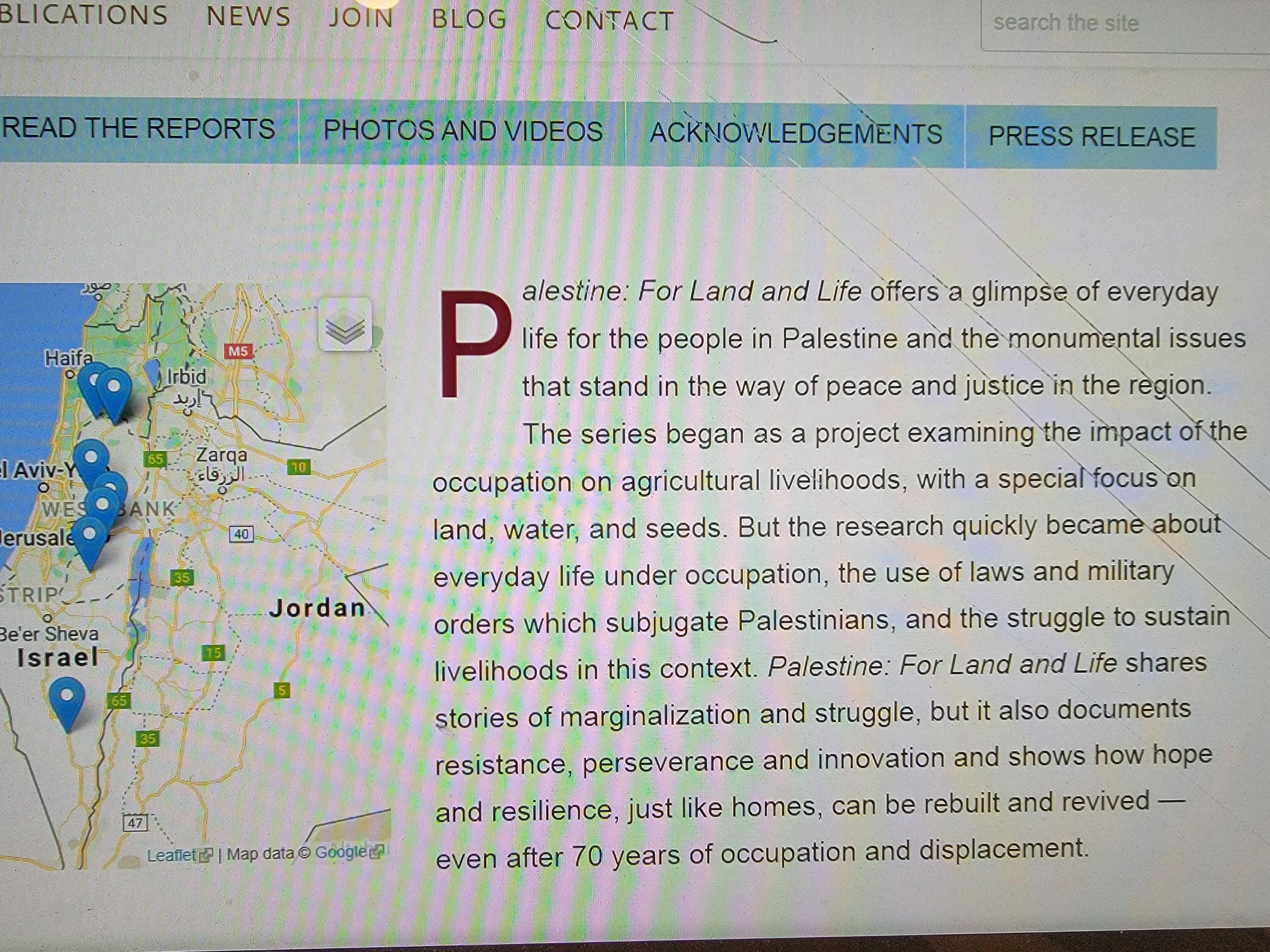
The Oakland Institute website covers a number of topics including “Palestine.” It refers to “research” published by Mittal on “Palestinian resistance & resilience 70 years after the Nakba & 100 years after the Balfour Declaration.” It includes a map regarding places of such “resistance” which includes areas in Israel.
The Oakland Institute website founded by the board chair of Ben and Jerry’s, refers to Palestine and occupation with locations inside of Israel.
Mittal’s references to the “Nakba” in 1948 and Balfour Declaration in 1917 (each well before there was a land called the “West Bank” in 1967) are part-and-parcel of her objection to the inclusion by Unilever of a statement regarding operating in Israel. Her position is seemingly that all of Israel and Israeli territory is “Occupied Palestinian Territory.” That is why she was alarmed by Israel’s “downgrading Arabic as an official language,” (nothing to do with the West Bank) and efforts by Congress “that would criminalize the nonviolent Boycott, Divestment, and Sanctions (BDS) campaign against Israel and Israeli settlements,” (note the inclusion of Israel.)
The B&J board’s statement was vague in verbiage as to whether OPT meant just the West Bank or the entire area known as Palestine in 1917, allowing mainstream progressive groups to jump to the defense of B&J on the premise that this action was just a non-violent “social mission” fighting against Israel’s “military occupation” of the West Bank, and cheered by the radical left and jihadi extremists who consider ALL of Israel to be under occupation.
What Constitutes a Social Mission
Is opposing the existence of a Jewish homeland a valid social mission?
That is the current mindset connecting jihadists, progressives and the alt-right today.
The anti-Zionists were birthed in the Arab and Muslim worlds in 1917 at the Balfour Declaration. The alt-right joined the cause in earnest during the reign of Nazi Germany which collaborated against “the shared… enemy [of world Jewry] and joint fight against it and creating the strong base uniting Germany and freedom-seeking Arabs around the world,” as Heinrich Himmler wrote to the Palestinian Grand Mufti of Jerusalem in 1943. The toxicity spread at the United Nations as more Arab and Muslim countries were admitted and effectively passed the “Zionism is Racism” resolution in 1975. While that resolution was rescinded in 1991 due to the efforts of the United States, it was reintroduced to the world at the Durban Conference in 2001, just before the jihadi attacks on America on 9/11. With the Zionism-is-Racism smear once again in vogue and the progressive wing of intersectionality pushing active anti-Racism initiatives, Anti-Zionism got incorporated under the same banner by necessity.
Is anti-Racism a social mission? Most likely. If one believes that “Zionism is Racism” it follows naturally that anti-Zionism is a social mission too.
Lost in the logic is recognizing the false premise of the “Zionism is Racism” mantra. The notion that Jews should be able to live throughout their holiest land where they have thousands of years of history is a matter of simple human rights. The dream of having independence and sovereignty in the land is no longer a “debatable political philosophy” (to quote Keith Ellison, a progressive politician) but a reality. Arguing against Zionism today is a call to dismantle the sole Jewish State, an anti-Semitic urge.
Anti-Semitism is not a social mission. At least, not for any decent human being or organization.
Internal / External Social Mission
The social mission of a company often helps it build its brand, empower employees and the community in which it operates and serves. The choices are therefore important.
Some experts suggest avoiding politics, niche causes and charisma-fueled social missions, while stressing issues like the environment, local community involvement and charity.
Ben & Jerry’s did not follow this advice and always made its political leanings known. It’s current focus areas include a host of progressive issues including: criminal justice reform; voting rights; racial justice; LGBT rights; climate justice; campaign finance reform; and refugee rights.
The company actively engages in some of these things as a matter of how it runs the company, for example making products in an environmentally-friendly way. In other situations, it tries to inform people about a topic – like criminal justice reform – with articles on its website and directing people how to register to vote.
The company is not shy about getting involved in controversial topics like “Defund the Police,” where it argues that Minneapolis disbanding its police department “is a great start.”
Some topics, like abortion, do not make it onto its website, perhaps to avoid alienating about 40% of America. Still, it signs onto letters in advertisements that criticize abortion restrictions.
So with such history of activism outside the walls of the company’s business, it should not be a surprise that the company would wade into the Arab/Muslim-Israeli conflict.
The question is, what is its position? Does it seek coexistence and peace? Does it advocate for a one state, two state or three state solution? Does it want to see the end of Israel as a Jewish State?
Ben & Jerry’s has operated in Israel since 1987, even before the First Intifada. It has distributed ice cream throughout Israel and EGL/West Bank over this time, even during the waves of Palestinian terrorism and wars over the past 20 years. This suggests that the company has (or at least had) no issue doing business in the Jewish State or its territories.
Anuradha Mittal joined the B&J board in 2008, the same year she founded the Oakland Institute. Her publications there covered many countries including Ethiopia, Sri Lanka, Cambodia and Sierra Leone. Some publications were highly critical of the U.S. Bush Administration for using the War on Terror to cut aid to some poor countries. She wrote that “the U.S. threatened to sever humanitarian aid to the people of Palestine for exercising their right to vote.” Well, maybe not for the act of voting but for voting overwhelmingly for Hamas, a US designated terrorist organization which killed over a thousand people. She skipped that part but added “Alarmed by its [Hamas’s] victory, President Bush announced to his Cabinet that he will not support a Palestinian government made up of Hamas. The U.S. has put pressure on other international donors to follow similar action with the intention of bankrupting the future Hamas-led Palestinian Authority,” and added her concern that “nearly one-half of all Palestinians already live below the poverty line…. and cutting off aid would push the Palestinian territories into chaos.” She tacitly advocated for the US to support a government run by a Palestinian political-terrorist group.
That article which covered the broad War on Terror was an outlier and Mittal did not devote much time to the Arab/Muslim-Israeli conflict at the Oakland Institute until 2017 when she became alarmed at the election of Donald Trump and his pro-Israel positions. It seems that despite B&J operating in Israel for 30 years, the idea of taking action against Israel really came to the front of her mind as U.S. policy began to favor Israel more explicitly.
Is the Action Legal or Moral
As discussed above, the promotion of peace and coexistence is a noble social mission. Actions to advance that mission could include donating to schools and organizations that facilitate dialogue and working together. Ben and Jerry’s donates to numerous causes and there is no shortage of groups (mostly in Israel) which seek to develop a harmonious future which would be happy beneficiaries of the company’s funds but the company specifically excludes donating to international organizations.
In contrast, there are actions that do not advance peace and coexistence such as supporting a ban on Jews living alongside Arabs in the West Bank and in eastern Jerusalem. The denial of Jewish history and connection to the land is not only anti-Semitic but harms the ability for the people to live together as it falsely portrays Jews as foreigners. Promoting a status quo which prevents Jews from praying at their holiest location is a simple denial of basic human rights.
The question comes back to what is the underlying “value” that the board is seeking to promote and is the subsequent course of action, legal and moral.
The board clearly feels that the United States needs to improve a lot in areas like police reform, refugee and LGBT rights, not to mention those of indigenous Americans. Yet B&J continues to manufacture and serve ice cream in these non-perfect lands. It runs its business as a profit-oriented company, selling its products in all 50 states, while articulating methods in which it believes the country can improve. It comments on its values and continues to sell ice cream.
The company has done the opposite in regards to Israel. There is no stated message anywhere on the B&J site about its objection to the state and how it is “inconsistent” with its values. It just published the July 19 statement above that it was going to stop conducting business in the “occupied Palestinian territories.” It did this, with the full knowledge – and perhaps hoping – that various states and countries which have laws banning the boycott of Israel and its territories would take action against the company to elevate the discussion globally.
If the company is against serving its products in disputed territories then it should say so and take similar actions in Cyprus/Turkey, Kashmir/India/Pakistan, Tibet/China, Western Sahara/Morocco and other locations as a new corporate policy and live with the ramifications of doing so. I cannot imagine that Unilever would allow B&J to take such actions of severely hurting the company’s business, which must fall outside the spirit of their agreement.
Israel did not annex the territory it took in a defensive war against Jordan (which itself, had illegally annexed the land in 1950), with the exception of the eastern half of Jerusalem which had been ethnically-cleansed of its Jews under Muslim Arab rule. Israel has withheld annexation in the hopes of arriving at a land-for-peace arrangement which has been consistently rejected by the Palestinians. To penalize Israel and/or the people living in the territory for holding out the hope of reaching an enduring peace goes beyond being illegal in many jurisdictions to being simply asinine.
Ben & Jerry’s board is headed by someone who seemingly thinks all of Israel is occupied Palestinian territory and believes the US should support the popular political-terrorist group Hamas. She is now taking aim at Israel and its territories in full knowledge that such action is considered illegal in many jurisdictions despite the company not taking similar actions in other disputed lands (which also do not incur financial repercussions). Further, while decrying a long list of problems in the United States, B&J continues to operate and sell its products here, but in contrast, it never says anything about the Arab/Muslim-Israeli conflict and then suddenly announces its intention to boycott the region.
The shroud of a social mission does not provide a shield from the accusations of inconsistency, double-standards and poor business judgment, and a global progressive company joining the BDS movement does not miraculously christen anti-Zionism as a “value” for a either a person or a company.
The fallout from the B&J boycott is in the early days and may yet claim the chair of its board.
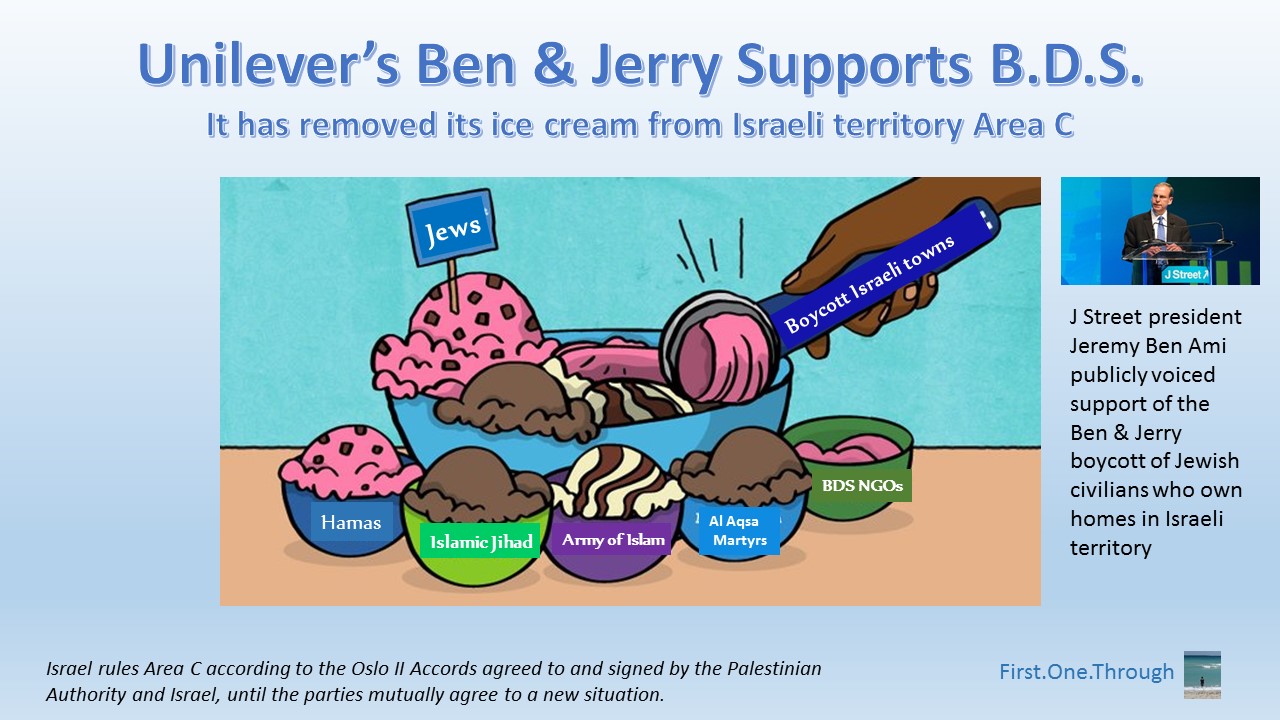
The pro-Israel community is livid about Ben & Jerry’s decisions to ban the sale of its ice cream in the Israeli territories of Area C and to not renew its affiliation with the distributor who sells the ice cream in Israel. Kosher stores around the world are removing the ice cream from its shelves and pro-Zionists and human rights activists are considering boycotting Unilever (the conglomerate which owns Ben & Jerry’s) products.
But not J Street. Jeremy Ben Ami congratulated Ben & Jerry’s on the move:
J Street President @JeremyBenAmi said that @benandjerrys was drawing “a principled and rational distinction between commercial transactions in the State of Israel & those in the territory it occupies.”
Far left extremist rabbis and synagogue presidents proudly affiliate with the organization while members sit in silence and assume that if their religious leaders support the group which bills itself as “pro-Israel”, then actions advocated by J Street like boycotting Israel and giving Iran a legal pathway to nuclear weapons, must be the pro-Israel thing to do.
It is time for Israel supporters to show J Street and its backers the door before they advance truly dangerous initiatives to a feckless administration and susceptible organizations which might believe they actually speak for the Jewish community.
Palestinian Arabs are like the kid who kills his parents and then asks the court for mercy because he is an orphan.
Here are a few examples:
The Security Barrier which Palestinian Arabs call an “Apartheid Wall.” Once upon a time there was no separation barrier between Israel and the West Bank. But the Arabs launched a ferocious wave of terrorism beginning in September 2000 killing and maiming hundreds of people. By 2002, Israel decided it was imperative to erect a mix of fencing and concrete walls to stop the flow of Arab jihadi terrorists from entering Israel. By 2005, the number of terrorist attacks dropped significantly due to the barrier. The Palestinians hate the wall and blame Israel for it, even though it was constructed because of their genocidal actions.
Section of security barrier erected to keep Palestinian terrorists from killing Israeli civilians
The Gaza Blockade which Palestinian Arabs and supporters refer to as “the World’s Largest Open Air Prison.“ In 2006, Palestinians elected the terrorist group Hamas to 58% of their parliament. Hamas routed the rival Fatah party from Gaza the following year and took over ruling the strip. As Hamas’s charter calls for the destruction of Israel and its history of terrorist attacks, the Jewish State imposed a blockade of Gaza to keep Hamas from importing weapons. The terrorist-political group has still done its utmost to wage war against Israel with missiles, underground tunnels, arson balloons and more. Despite the genocidal intent and actions, Israel still allows goods to flow in and out of Gaza through managed ports, as well as electricity to flow into the area. The Palestinians complain that the blockade is illegal even though investigations concluded that it is warranted due to Hamas’s genocidal actions and stated intentions.
Israeli Soldiers Protecting Jews on the Temple Mount. Palestinians and their supporters complain that Israeli troops harass Muslim worshipers and “storm” the al Aqsa Compound. The reality is that Muslim worshipers have specifically targeted Jewish visitors to the site for years with taunts and pelting them with rocks, necessitating the Israeli security detail.
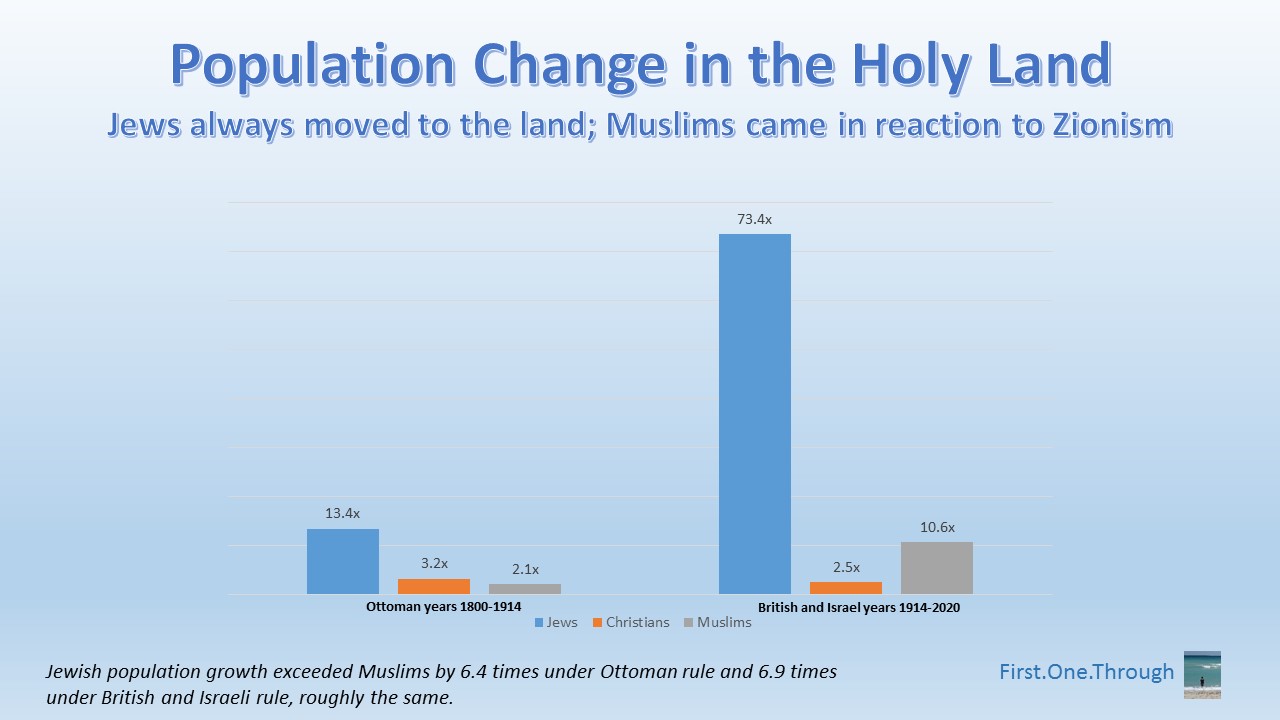
Palestinians blame Israel for the “Nakba” in 1948. Jews moved to the holy land at six to seven times the rate of Muslims during the Ottoman period as well as since the Balfour Declaration. But since the Ottomans left Palestine, Arabs have rioted and done everything in their power to stop Jews from entering the Jewish holy land, including riots, terrorism and trying to destroy the Jewish State at its rebirth in 1948. Palestinians mourn losing the civil war they initiated and then pretend that the number of Arabs in Israel and in Israeli and Palestinian territories hasn’t skyrocketed since then, with outrageous claims of “ethnic cleansing.”
The “Occupation.” While Zionists approved the proposed United Nations Partition Plan in 1947, the Arabs unanimously rejected it and went to war. The Arabs continued warring many more times in attempts to destroy Israel but the result was losing land, lives and dignity. Palestinian leadership continued to refuse Israeli peace offers, even in 2000 and 2008, opting instead for war. The fact that Israel has not annexed all of the lands in the hopes of one day making peace in an action that no nation in the world would ever make is remarkable. Yet anti-Zionists invert the situation and blame Israel for holding out the prospect of land-for-enduring peace, rather than blame Palestinian Arabs for constantly going to war and refusing coexistence.
Jews buying land via third parties. Palestinian Arabs and their anti-Zionist supporters describe Jews buying land in eastern Jerusalem and the West Bank in “shadowy transactions” in a libelous attempt to make them appear as sneaky and crooked Jews “nibbling Arab land.” The reality is that the Palestinian Authority has anti-Semitic laws which call for the death penalty for any Arab who sells land to a Jew, so they have to conduct real estate transactions via third parties or the Arabs would get killed. Read the stories of Issam Akel, Ahmed Salama or Ezra Nawi and then ponder how Jews attempting to do a normal activity like buying homes for their families are portrayed in vile fashion because of anti-Semitic Palestinian laws.
All around the world, going on a plane requires arriving at the airport hours in advance, going through long security lines, removing shoes and belts, and being scanned in a prophylactic system to prevent death and mayhem because of the actions of jihadi extremists twenty years ago. Israel has similarly instituted security measures to protect lives after years of jihadi wars and terrorism.
The TSA, airport screening, the security barrier and Gaza blockade are not forms of collective punishment but systems put in place to protect society from the all too real Islamic extremism and terrorism.